

Submitted:
23 February 2026
Posted:
26 February 2026
Read the latest preprint version here
Abstract
Dry reforming of methane (DRM) is an attractive route for H2 production and simultaneous CO₂ utilization, but its practical implementation is limited by catalyst deactivation. This study experimentally investigates the catalytic performance of Ni/Al₂O₃ and Gd-doped ceria–promoted Ni/GDC–Al₂O₃ catalysts for DRM in a fixed-bed quartz reactor over 400–800 °C at gas residence times of 0.1 s and 0.4 s. Increasing temperature and residence time enhanced CH₄ and CO₂ conversion as well as H₂ and CO yields for both catalysts. The GDC-promoted catalyst exhibited markedly improved activity, achieving conversions and product yields at 0.1 s comparable to those of Ni/Al₂O₃ at 0.4 s and reaching complete CH₄ conversion at about 650 °C, approximately 100 °C lower than the Ni/Al₂O₃. Long-term testing demonstrated high durability of Ni/GDC–Al₂O₃ at 650 °C with no detectable carbon deposition, consistent with thermodynamic equilibrium analysis.
Keywords:
Dry reforming of methane
; Ni catalysts
; Al2O3 support
; GDC promoter
1. Introduction
The incentive to reduce the carbon footprint of power systems is driving the development and introduction of low-carbon and zero-carbon fuels. Hydrogen (H₂) is widely regarded as an energy carrier with significant potential for decarbonizing industrial processes [1]. H₂ can be produced via dry methane reforming (DRM), a process that simultaneously consumes methane (CH₄) and carbon dioxide (CO₂). This makes DRM an attractive route not only for H2 production but also for the mitigation of greenhouse gas emissions, thereby contributing to environmental impact reduction. The overall chemical reaction of the DRM is as follows [2]:
CH₄ + CO₂ ⇌ 2H₂ + 2CO ΔH@298 = +247 kJ/mol
The elevated temperatures are required to overcome the activation barrier of the reaction and achieve appreciable reaction rate. To facilitate the reaction, it is typically performed over suitable catalysts which provide an alternative reaction pathway with a lower effective activation energy [3]. However, catalyst performance is often severely compromised by carbon deposition, metal sintering, and insufficient long-term stability under the demanding reaction conditions required for DRM [4]. Consequently, the development of robust catalysts remains a critical research focus.
Noble metal catalysts such as ruthenium (Ru), rhodium (Rh), platinum (Pt), and palladium (Pd) have demonstrated excellent catalytic activity and resistance to carbon formation in DRM due to their superior ability to activate CH₄ and suppress coke formation [3]. Despite these advantages, their high cost and limited availability significantly restrict their large-scale industrial application. In contrast, nickel (Ni) catalysts have emerged as a promising alternative owing to their high activity for CH4 activation, abundance, and economic viability. Nevertheless, Ni catalysts are susceptible to sintering and carbon deposition, which leads to rapid deactivation [5].
In Ni-based catalysts, the catalyst support plays a key role in determining Ni species dispersion, thermal stability, and resistance to deactivation [4]. Therefore, careful choice of support is an important design parameter for improving the performance and durability of Ni catalysts. Common supports for Ni-based systems include metal oxides such as alumina (Al₂O₃), magnesia (MgO), ceria (CeO₂), and lanthana (La₂O₃) [6].
Within the group of oxide supports, Al₂O₃ has emerged as one of the most widely used materials due to its high surface area, excellent thermal stability, mechanical strength, and favorable interaction with Ni species [7]. Despite these advantages, the Ni/Al₂O₃ catalysts still face challenges related to coke formation and limited oxygen mobility, necessitating further modification [8].
To improve the performance and stability of the Ni/Al₂O₃ catalysts, the introduction of suitable promoters has been widely investigated. Promoters can modify the surface, enhance Ni dispersion, increase oxygen mobility, and facilitate the removal of carbonaceous species formed during DRM [2]. Numerous studies have reported that the incorporation of CeO₂ into Ni/Al₂O₃ catalysts as a promoter significantly enhances catalytic performance during DRM [9,10,11,12,13].
To further optimize catalytic activity, CeO₂ can be doped with gadolinium (Gd), forming Gd-doped ceria (GDC). While several studies have investigated GDC as a support or promoter for Ni-based catalysts in DRM [14,15,16,17,18,19,20], few studies, to the authors’ knowledge, have examined DRM over Ni/GDC–Al₂O₃ catalysts. G.X. Zhang et al. [21] investigated the effects of Gd doping on the structure and DRM activity of Gd-promoted Ni/CeO₂–Al₂O₃ catalysts with different Gd₂O₃ loadings and examined their DRM performance in a fixed-bed quartz reactor at 500–800 °C. Their study demonstrated that calcination at 800 °C significantly influenced catalytic performance, while Gd addition notably enhanced both reaction activity and resistance to carbon deposition. Among the catalysts tested, Ni/CeO₂–Al₂O₃ with 1.2 wt% Gd₂O₃ exhibited the highest catalytic activity and stability. Y. Khani et al. [22] evaluated a series of Ni-based catalysts for CH4 reforming using reactors coated with Ni/X–Al₂O₃ (X = Ce, Zr, Gd) and Ni/CeZr₀.₅GdO₄ catalysts over the temperature range of 500–800 °C, and demonstrated that the Ni/Ce–Zr–Gd–Al₂O₃ catalyst exhibited appreciable CH₄ conversion and reasonable stability under reaction conditions confirming the beneficial role of combined Ce–Zr–Gd promotion in enhancing Ni/Al₂O₃ catalytic performance.
The present study aims to experimentally investigate the performance of Ni/Al₂O₃ and Ni/GDC–Al₂O₃ catalysts in DRM using a fixed-bed quartz reactor under various operating conditions. The effects of operating temperature, gas mixture residence time in the reactor, and catalyst type on reforming performance are evaluated. The experimental results are further compared with thermodynamic equilibrium calculations to identify the operating conditions under which the reforming behavior most closely approaches equilibrium while ensuring minimal carbon deposition, thereby promoting catalyst stability.
2. Experimental Setup
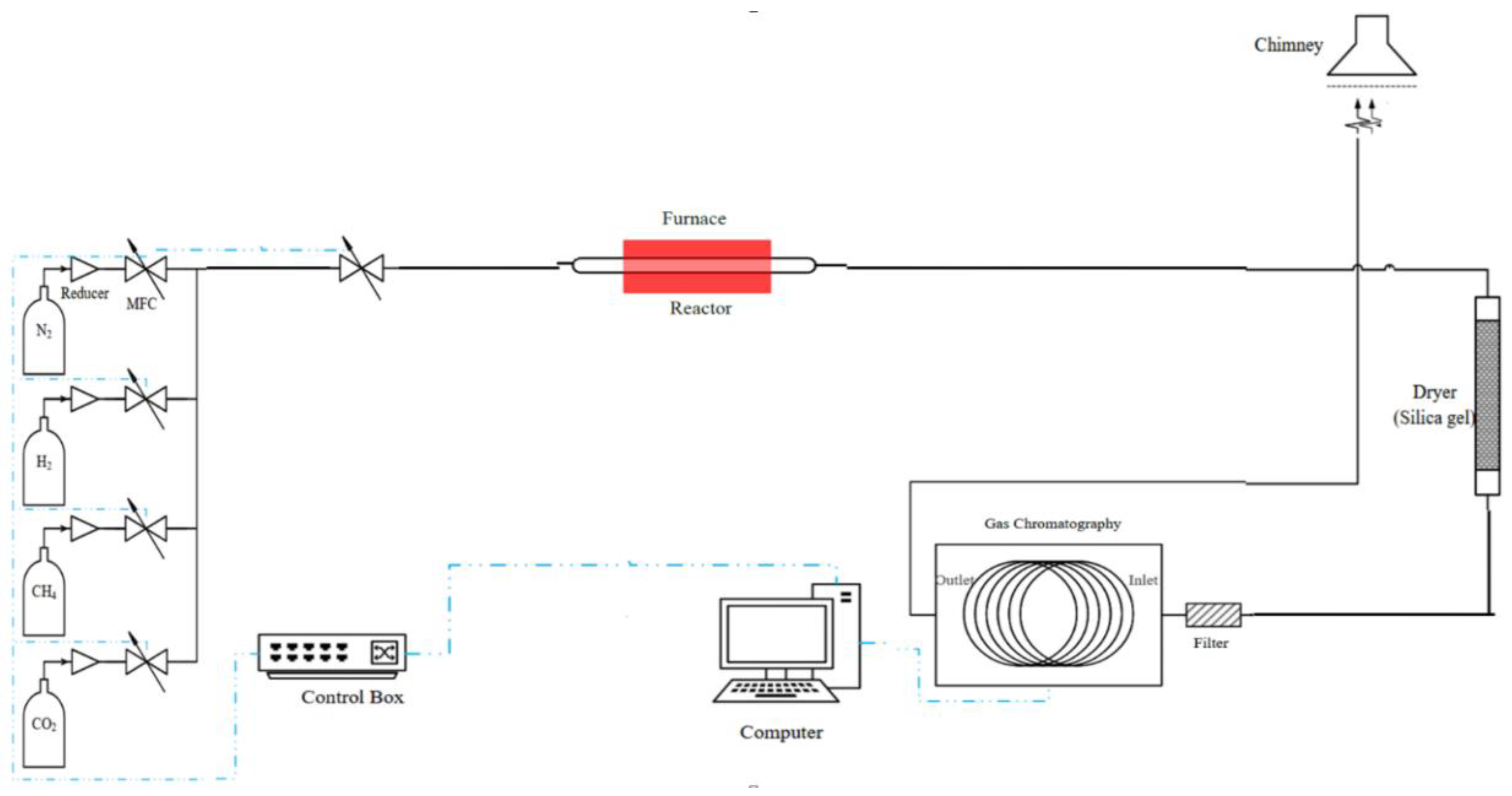
The dry reforming experiments were conducted using the setup shown schematically in Fig. 1. A premixed gas stream consisting of CH₄, CO₂, and nitrogen (N₂) was introduced into the reformer, which was positioned inside a horizontal Carbolite furnace (2 kW maximum power, maximum temperature 1200 °C). The furnace comprised a ceramic tube (650 mm length, 65 mm inner diameter), within which a centered tubular quartz reactor (10 mm inner diameter, 12 mm outer diameter, 900 mm length) was placed. Axial temperature measurements using a type K thermocouple indicated that the temperature distribution along the quartz tube is almost uniform, with a temperature deviation of less than 5 °C.
For the experiments, two types of catalyst beds were prepared by mechanical mixing. One contained 0.4 g of commercial NiO powder, characterized by a BET surface area of 3.5 m²·g-1 supplied by Fuel Cell Materials Inc. [23], mixed with 3.0 g of porous Al₂O₃ microspheres supplied by MaTecK Inc. [24]. The other contained 0.4 g of a NiO–GDC composite (60 wt% NiO – 40 wt% Gd0.1Ce0.9O2-x), with a BET surface area of 4 m²·g-1 supplied by Fuel Cell Materials, mixed with 3.0 g of porous porous Al₂O₃ microspheres. The catalyst bed (40 mm in length) was positioned at the center of the furnace to ensure isothermal operation. Prior to each experiment, the catalysts were reduced in situ under H₂ flow.
The total flow rate of the gas mixture is controlled using a Bronkhorst mass flow controller and set to either 500 ml/min or 2000 ml/min, corresponding to residence times of approximately 0.4 s and 0.1 s within the reformer, respectively. The gas stream exiting the reformer is directed to a Aglient 490 Micro gas chromatograph (GC) for measuring the mole fractions of H₂, carbon monoxide (CO), CH₄, N2 and CO₂, with an estimated relative uncertainty of 2%. Prior to entering the GC, water (H2O) vapor is removed using a silica gel dryer to prevent moisture interference, as the instrument is highly sensitive to H2O and can be damaged by exposure. The GC exhaust stream is discharged to the chimney. Both the GC and the mass flow controllers are operated and monitored through a computer based control system.
The feed composition consists of 2% CH₄, 4% CO₂, and 94% N₂. For this gas mixture, the chemical transformation governed by Eq. 1 can be presented as:
0.02 CH4 + 0.04 CO2 + 0.94 N2 → 0.04 H2 + 0.04 CO + 0.02 CO2 + 0.94 N2
The low fractions of CH₄ and CO₂ are selected because, as mentioned above, the dry reforming reaction is highly endothermic, and limiting the reactant fractions lowers the overall heat demand of the system. This minimizes temperature gradients within the reactor and thereby helps maintain a uniform temperature distribution, which is essential for reliable kinetic measurements. Furthermore, a CO₂/CH₄ ratio of 2, which is above the stoichiometric value (Eq.1), decreases the tendency for carbon deposition because CO₂ can supply oxygen species that help gasify carbon formed from CH₄ and CO cracking [25]. This effect is supported by equilibrium calculations, which indicate that excess CO₂ suppresses carbon deposition. In this study, the equilibrium calculations were performed using a computational program based on the Gibbs free-energy minimization method [26]. Equilibrium calculations accounted for 53 common gas species in C-H-O system [27], along with condensed H2O and carbon. Following equilibrium determination, species fractions were recalculated by removing H2O from the gas mixture and re-normalizing the remaining components to enable comparison with the GC measurements.
Figure 1.
Schematic of the experimental setup.
3. Results and Discussion
Figure 2a and Figure 2b show the CH₄ and CO₂ mole fractions, respectively, measured over the reactor temperature interval of 400–800 °C at residence times of 0.1 s and 0.4 s using Ni/Al₂O₃ and Ni/GDC–Al₂O₃ catalysts, alongside thermodynamic equilibrium mole fractions calculated for comparison. As shown in Fig. 2a, the CH₄ fraction at 400 °C is approximately 2% for both catalysts and residence times, corresponding to the CH4 inlet concentration before any reforming occurs. With increasing temperature, the CH₄ fraction decreases, reflecting enhanced reforming activity and a trend toward the equilibrium concentration. At 600 °C over the Ni/Al₂O₃ catalyst, roughly 20% of the CH₄ is converted at the residence time of 0.1 s, whereas approximately 60% is converted at 0.4 s, demonstrating the substantial influence of residence time on the extent of CH₄ reforming. The results also indicate that at 750 °C, the CH₄ concentration is reduced to below 0.1% at a residence time of 0.4 s while at 0.1 s, approximately 75% of the CH₄ is reformed.
A similar trend is observed for the experiments conducted with the Ni/GDC-Al2O3 catalyst. Comparison of the two catalysts indicates that the reforming process proceeds more rapidly with Ni/GDC-Al2O3. For instance, at 600 °C and a residence time of 0.1 s, approximately 60% of the CH₄ is reformed, which is comparable to the conversion achieved with Ni/Al2O3 at the same temperature but at a longer residence time of 0.4 s. As shown, near-total CH₄ conversion at a residence time of 0.4 s is achieved at 650 °C, representing an approximately 100 °C decrease in the temperature required compared with the Ni/Al₂O₃ catalyst under the same residence time.
The CO₂ variations exhibit behavior similar to that of CH₄, as shown in Fig. 2b. This fraction at 400 °C is approximately 4% for both catalysts and residence times, corresponding to the CO₂ inlet concentration. With increasing temperature, the CO₂ fraction decreases, reflecting enhanced reforming activity and a trend toward the equilibrium fraction of about 1.5%. The effects of residence time and catalysts on CO₂ conversion are similar to those observed for CH₄. For instance, at 600 °C over the Ni/Al₂O₃ catalyst, roughly 20% of the CO₂ is converted at a residence time of 0.1 s, whereas approximately 40% is converted at 0.4 s which is comparable to the value achieved with Ni/GDC-Al₂O₃ at the same temperature but with a shorter residence time of 0.1 s.
Figure 3a and Figure 3b present the H₂ and CO mole fractions, respectively, as functions of reactor temperature at residence times of 0.1 s and 0.4 s, measured using Ni/Al₂O₃ and Ni/GDC–Al₂O₃ catalysts, together with comparisons to equilibrium calculations. As shown in Fig. 3a, for both catalysts and residence times, the H₂ fraction at 400 °C is zero before reforming occurs, and then increases with temperature, in agreement with the CH₄ reforming trends in Fig. 2a. At 600 °C over the Ni/Al₂O₃ catalyst, the H₂ fraction is 1.7% for a residence time of 0.4 s and about 0.5% for 0.1 s, demonstrating the effect of residence time. At 750 °C, the H₂ fraction reaches about 3% at 0.4 s, approaching the equilibrium H₂ fraction, whereas a lower value of 2.4% is observed at 0.1 s. Experiments using the Ni/GDC–Al₂O₃ catalyst exhibit a similar trend, with accelerated H2 production. For example, the H₂ fraction tends toward its equilibrium value at about 650 °C with the Ni/GDC-Al2O3 catalyst at a residence time of 0.4 s, which is about 100 °C lower than the temperature required under identical residence time conditions when using the Ni/Al2O3 catalyst.
The CO variations exhibit behavior similar to that of H₂, as shown in Fig. 3b. At 400 °C, the fraction is zero before reforming occurs and then increases with temperature. At 650 °C over the Ni/Al₂O₃ catalyst, the CO fraction is about 3.8% at a residence time of 0.4 s, and at 750 °C it reaches 4.5%, approaching equilibrium. Experiments using the Ni/GDC–Al₂O₃ catalyst follow a similar trend, exhibiting accelerated CO production consistent with the faster CH₄ and CO₂ consumption observed in Fig. 2a and 2b. For instance, at 600 °C over the Ni/GDC–Al₂O₃ catalyst, the CO fraction is approximately 4% at a residence time of 0.4 s and about 2.8% at 0.1 s, where the latter is comparable to that obtained with Ni/Al₂O₃ at the same temperature and a residence time of 0.4 s.
Comparison of the measured mole fraction values, which are close to equilibrium (Figure 2 and Figure 3), with those derived by Eq. 2 reveals clear differences. The measured fractions of H₂, CO₂, and CO are about 3%, 1.5%, and 4.5%, respectively, whereas Eq. 2 indicates approximately 4%, 2%, and 4%. These discrepancies show that Eq. 2 alone cannot fully describe the DRM chemical reaction system.
We attribute the discrepancies to H₂O formation. Usually this process is described by the endothermic reverse water–gas shift (RWGS) reaction (Eq. 3 [2]), which consumes H₂ and CO₂ and produces CO and H₂O, thereby decreasing the H₂ and CO₂ mole fractions while increasing the CO mole fraction in the product relative to those derived by Eq. 2.
CO₂ + H₂ ⇌ CO + H₂O ΔH@298 = +41 kJ/mol
Furthermore, at some measurement points, carbon deposition was observed, as indicated by changes in catalyst color and reactor pressure. The formation of solid carbon cannot be explained by Eq. 2 or Eq. 3. Commonly it is attributed to the Boudouard reaction (Eq. 4 [2]).
where Cs is solid carbon. This reaction is strongly exothermic, and Cs forms from CO as the reaction proceeds. Increasing the temperature, however, promotes the endothermic reverse reaction, which gasifies Cs and forms CO. However, it should be pointed out that CH4 reforming is a multi-step complex process and additional reactions might be added to the reaction mechanism to describe it properly.
2CO ⇌ CO₂ + Cs ΔH@298 = -247 kJ/mol
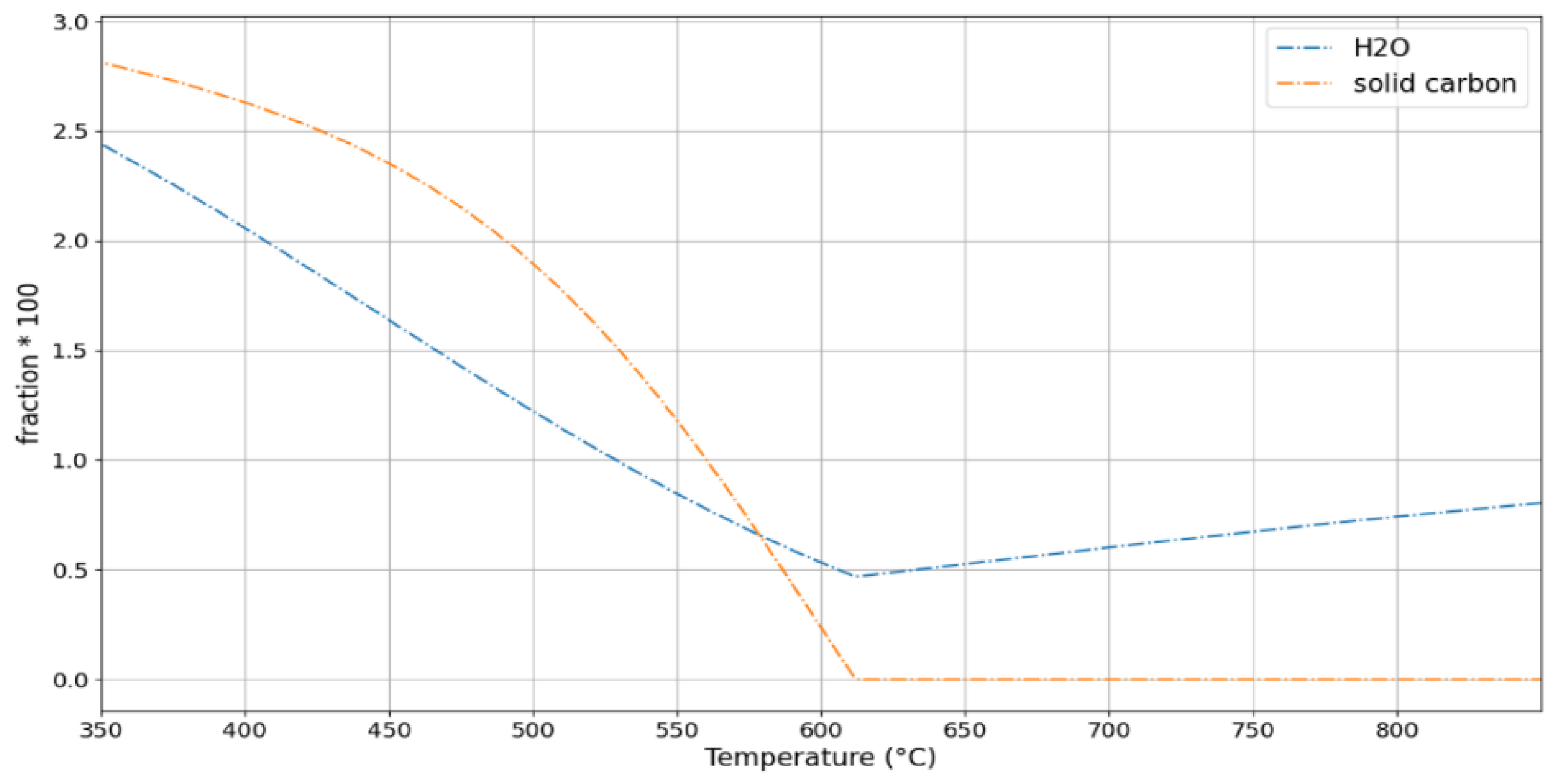
The formation of H₂O and solid carbon is also shown by the equilibrium calculations. Figure 4 presents the equilibrium fractions of H₂O and solid carbon as functions of temperature. Under conditions where the experimental measurements tend to equilibrium (Figure 1 and Figure 2), the H₂O mole fraction is approximately 0.5% and increases slightly with temperature.
The equilibrium calculation implies a carbon deposition of approximately 2% at 400 °C. As the temperature increases, the solid carbon fraction decreases to zero above 620 °C. This thermodynamic trend also qualitatively aligns with our experimental observations, as carbon deposition on the Ni/GDC–Al₂O₃ catalyst was observed within a few hours during reforming at 550 °C, whereas at 650 °C no carbon deposition was recognized, and the process proceeded stably for more than one week, indicating effective suppression of solid carbon formation at elevated temperatures.
4. Conclusions
This study investigated the catalytic performance of Ni/Al₂O₃ and Ni/GDC–Al₂O₃ for DRM process within a fixed-bed tubular reactor across a temperature range of 400–800 °C at gas mixture residence times of 0.1 s and 0.4 s. The results show that higher reactor temperatures and longer gas residence times noticeably increase CH₄ and CO₂ consumption, as well as H₂ and CO production rates. Notably, integrating GDC promoter into the Al2O3 support substantially accelerates reforming kinetics. This catalytic enhancement is evidenced by the fact that Ni/GDC–Al₂O₃ at a residence time of 0.1 s achieves CH₄ and CO₂ conversion efficiencies, as well as H₂ and CO yields, comparable to those of Ni/Al₂O₃ at 0.4 s. The superior kinetics of the Ni/GDC–Al₂O₃ catalyst are further evidenced at a 0.4 s residence time, where complete CH4 and about 60% CO2 conversion is reached at about 650°C, which is approximately 100°C lower than the temperature required by the Ni/Al₂O₃ catalyst.
A comparison of the measured mole fraction values, which are approaching equilibrium (temperatures above 650 °C) with those derived by the single DRM reaction reveals a clear discrepancy, indicating that the DRM reaction alone is insufficient to describe the DRM chemical process. This discrepancy is attributed to H₂O production, which is usually described by the RWGS reaction. Additionally, carbon deposition observed at low temperatures, commonly attributed to the Boudouard reaction, suggests that it should also be considered when describing the DRM system. Long-term testing confirmed the high durability of the Ni/GDC-Al₂O₃ catalyst, with no carbon deposition detected at 650 °C, consistent with zero solid carbon equilibrium calculation.
Overall, the results demonstrate that Ni/GDC–Al₂O₃ is a highly active catalyst for the DRM process, offering enhanced reforming kinetics and good durability at temperatures above 600 °C, making it a promising candidate for efficient syngas production under moderate operating conditions.
Informed Consent Statement
Informed consent was obtained from all subjects involved in the study.
Acknowledgments
The authors would like to express their thanks to the China Scholarship Council (CSC), Dutch Research Council (NWO), and Clean Energy Transition Partnership Program (CETP) for financial support, and M. Bosker and T. H. B. Langedijk from the University of Groningen, The Netherlands.
Conflicts of Interest
The authors declare no conflicts of interest.
References
- Zhu, Y.; Keoleian, G. A.; Cooper, D. R. “The role of hydrogen in decarbonizing U.S. industry: A review”. Renewable and Sustainable Energy Reviews 2025, 214, 115392. [Google Scholar] [CrossRef]
- Green, D. W.; Southard, M. Z. “Perry’s Chemical Engineers’ Handbook”, 9th ed.; McGraw-Hill Education: New York, 2018. [Google Scholar]
- Pakhare, D.; Spivey, J. A review of dry (CO₂) reforming of methane over noble metal catalysts. Chem. Soc. Rev. 2014, 43, 7813–7837. [Google Scholar] [CrossRef]
- You, J.; Lai, L.; Chen, Y. “Recent Advances in Strong Metal-Support Interaction Engineering for Dry Reforming of Methane Catalysts”; Wiley, 2025. [Google Scholar]
- Seo, H. O. “Recent Scientific Progress on Developing Supported Ni Catalysts for Dry (CO₂) Reforming of Methane”. Catalysts 2018, 8, 110. [Google Scholar] [CrossRef]
- Meloni, E.; Martino, M.; Palma, V. “A Short Review on Ni Based Catalysts and Related Engineering Issues for Methane Steam Reforming”. Catalysts 2020, 10, 352. [Google Scholar] [CrossRef]
- Xu, Y.; Du, X.h.; Li, J.; Wang, P.; Zhu, J.; Ge, F.j.; Zhou, J.; Song, M.; Zhu, W.y. “A comparison of Al₂O₃ and SiO₂ supported Ni-based catalysts in their performance for the dry reforming of methane”. Fuel Process. Technol. 2019, 47, 199–208. [Google Scholar]
- Gao, X.; Ge, Z.; Zhu, G.; Wang, Z.; Ashok, J.; Kawi, S. “Anti-Coking and Anti-Sintering Ni/Al₂O₃ Catalysts in the Dry Reforming of Methane: Recent Progress and Prospects”. Catalysts 2021, 11, 1003. [Google Scholar] [CrossRef]
- Aghamohammadi, S.; Haghighi, M.; Maleki, M.; Rahemi, N. “Sequential impregnation vs. sol–gel synthesized Ni/Al₂O₃–CeO₂ nanocatalyst for dry reforming of methane: Effect of synthesis method and support promotion”. J. Mol. Catal. Chem. 2017, 431, 39–48. [Google Scholar]
- Han, J.; Zhan, Y.; Street, J.; To, F.; Yu, F. “Natural gas reforming of carbon dioxide for syngas over Ni–Ce–Al catalysts”. Int. J. Hydrogen Energy. 2017, 29, 18364–18374. [Google Scholar] [CrossRef]
- Laosiripojana, N.; Sutthisripok, W.; Assabumrungrat, S. “Synthesis gas production from dry reforming of methane over CeO2 doped Ni/Al2O3: Influence of the doping ceria on the resistance toward carbon formation”. Chem. Eng. J. 2005, 112, 13–22. [Google Scholar] [CrossRef]
- Babakouhi, R.; Alavi, S.M.; Rezaei, M.; Jokar, F.; Varbar, M.; Akbari, E. “Hydrogen production through combined dry reforming and partial oxidation of methane over the Ni/Al2O3−CeO2 catalysts”. Int. J. Hydrogen Energy. 2024, 60. [Google Scholar] [CrossRef]
- Marinho, A.L.A.; Toniolo, F.S.; Noronha, F.B.; Epron, F.; Duprez, D.; Bion, N. “Highly active and stable Ni dispersed on mesoporous CeO2−Al2O3 catalysts for production of syngas by dry reforming of methane”. Appl. Catal. B Environ. 2021, 281, 119459. [Google Scholar] [CrossRef]
- Ioannidou, E.; Neophytides, S. G.; Niakolas, D. K. “Au-Mo-Fe-Ni/CeO₂(Gd₂O₃) As Potential Fuel Electrodes For Internal CO₂ Reforming of CH₄ in Single SOFCs”. ECST 2023, 111, 2473–2485. [Google Scholar]
- Gurav, H.R.; Dama, S.; Samuel, V.; Chilukuri, S. “Influence of preparation method on activity and stability of Ni catalysts supported on Gd doped ceria in dry reforming of methane”. J. CO2 Util. 2017, 20, 357–367. [Google Scholar] [CrossRef]
- Unal; Meisuria, S.; Choolaei, M.; Reina, T.R.; Horri, B.A. “Synthesis and characteristics of nanocrystalline Ni1−xCoxO/GDC powder as a methane reforming catalyst for SOFCs”. Ceram. Int. 2018, 44, 6851–6860. [Google Scholar] [CrossRef]
- Wang, W.; Jiang, S.P.; Tok, A.L.Y.; Luo, L. “GDC-impregnated Ni anodes for direct utilization of methane in solid oxide fuel cells”. J. Power Sources 2006, 159, 68–72. [Google Scholar]
- Gurav, H.R.; Dama, S.; Samuel, V.; Chilukuri, S. “Influence of preparation method on activity and stability of Ni catalysts supported on Gd doped ceria in dry reforming of methane”. J. CO2 Util. 2017, 20, 357–367. [Google Scholar] [CrossRef]
- Marinho, A.L.A.; Rabelo-Neto, R.C.; Epron, F.; Toniolo, F.S.; Noronha, F.B.; Bion, N. “Effect of Metal Dopant on the Performance of Ni@CeMeO2 Embedded Catalysts (Me = Gd, Sm and Zr) for Dry Reforming of Methane”. Methane 2022, 1, 300–319. [Google Scholar] [CrossRef]
- AlFatesh, A.S. “Promotional effect of Gd over Ni/Y2O3 catalyst used in dry reforming of CH4 for H2 production”. Int. J. Hydrogen Energy 2017, 42, 18805–18816. [Google Scholar] [CrossRef]
- Zhang, G.X.; Wang, Y.; Li, X.K.; Bai, Y.K.; Zheng, L.; Wu, L.; Han, X.L. “Effect of Gd promoter on the structure and catalytic performance of mesoporous Ni/Al2O3-CeO2 in dry reforming of methane”. Ind. Eng. Chem. Res. 2018. [Google Scholar] [CrossRef]
- Khani, Y.; Bahadoran, F.; Shariatinia, Z.; Varmazyari, M.; Safari, N. “Synthesis of highly efficient and stable Ni/CexZr1−xGdxO4 and Ni/X−Al2O3 (X = Ce, Zr, Gd, Ce-Zr-Gd) nanocatalysts applied in methane reforming reactions”. Ceram. Int. 2020, 46, 25122–25135. [Google Scholar] [CrossRef]
- Fuel Cell Materials, Inc., USA. Available online: https://www.fuelcellmaterials.com.
- MaTecK GmbH, Germany. Available online: https://www.mateck.com.
- Hussien, G. S.; Polychronopoulou, K. “A Review on the Different Aspects and Challenges of the Dry Reforming of Methane (DRM) Reaction”. J. Nanomater. 2022, 12, 3400. [Google Scholar] [CrossRef] [PubMed]
- Kuo, K. K. Principles of Combustion; John Wiley and Sons, 2005. [Google Scholar]
- Smith, G. P.; Golden, D. M.; Frenklach, M.; Moriarty, N. W.; Eiteneer, B.; Goldenberg, M. GRI-Mech 3.0. 2000. Available online: http://combustion.berkeley.edu/gri-mech.
Figure 2.
Experimental and equilibrium mole fractions as functions of temperature over Ni/Al₂O₃ and Ni/GDC–Al₂O₃ catalysts at residence times of 0.1 s and 0.4 s: (a) CH₄ and (b) CO₂.
Figure 2.
Experimental and equilibrium mole fractions as functions of temperature over Ni/Al₂O₃ and Ni/GDC–Al₂O₃ catalysts at residence times of 0.1 s and 0.4 s: (a) CH₄ and (b) CO₂.
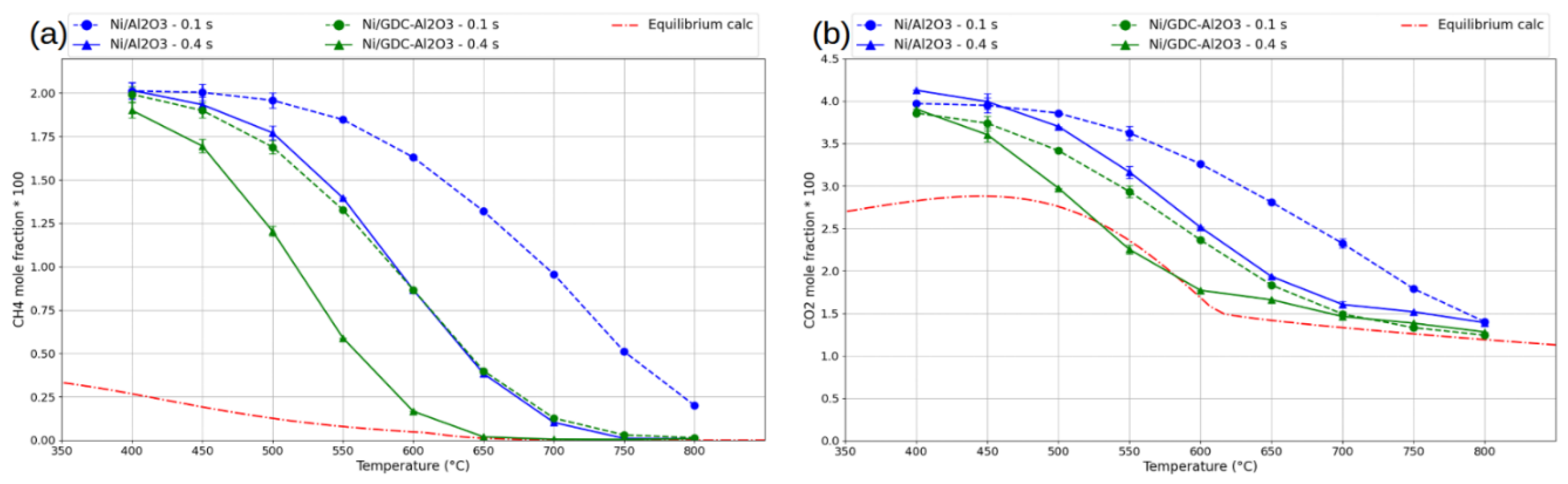
Figure 3.
Experimental and equilibrium mole fractions as functions of temperature over Ni/Al₂O₃ and Ni/GDC–Al₂O₃ catalysts at residence times of 0.1 s and 0.4 s: (a) H2 and (b) CO. .
Figure 3.
Experimental and equilibrium mole fractions as functions of temperature over Ni/Al₂O₃ and Ni/GDC–Al₂O₃ catalysts at residence times of 0.1 s and 0.4 s: (a) H2 and (b) CO. .
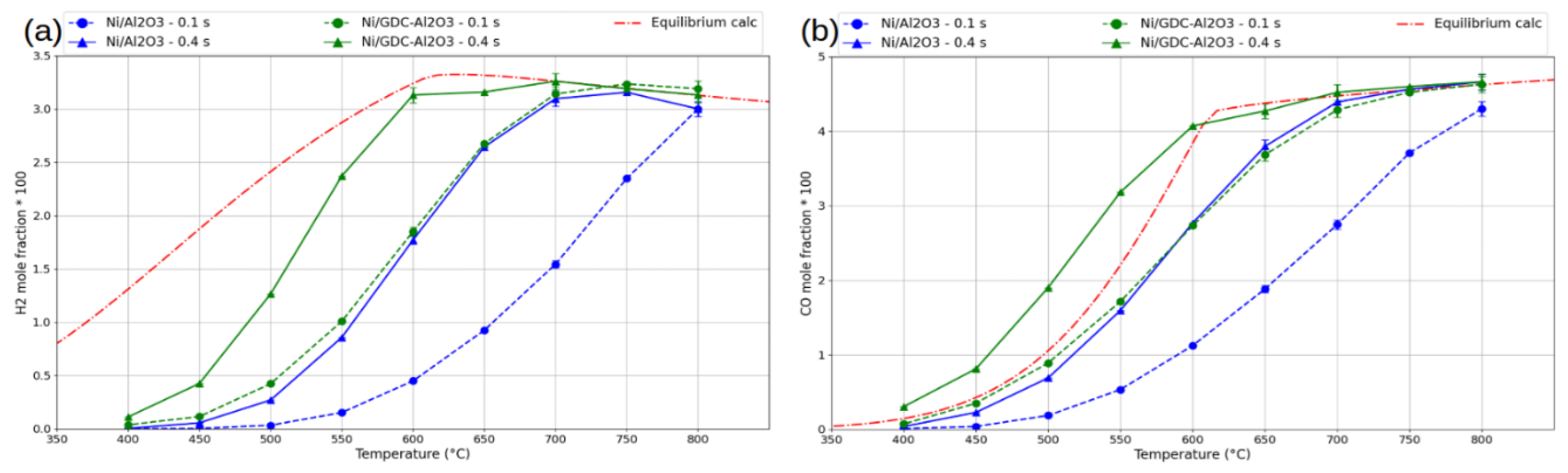
Figure 4.
Equilibrium fractions of H₂O and solid carbon as functions of temperature.
Disclaimer/Publisher’s Note: The statements, opinions and data contained in all publications are solely those of the individual author(s) and contributor(s) and not of MDPI and/or the editor(s). MDPI and/or the editor(s) disclaim responsibility for any injury to people or property resulting from any ideas, methods, instructions or products referred to in the content. |
© 2026 by the authors. Licensee MDPI, Basel, Switzerland. This article is an open access article distributed under the terms and conditions of the Creative Commons Attribution (CC BY) license (http://creativecommons.org/licenses/by/4.0/).
Copyright: This open access article is published under a Creative Commons CC BY 4.0 license, which permit the free download, distribution, and reuse, provided that the author and preprint are cited in any reuse.


