

Submitted:
14 February 2026
Posted:
27 February 2026
You are already at the latest version
Abstract
Precision Agriculture (PA) is reshaping nutraceutical crop production by enabling high-resolution monitoring and adaptive management strategies that simultaneously optimize yield, stabilize phytochemical composition, and enhance environmental sustainability. Nutraceutical crops derive their economic and functional value from bioactive compounds whose concentration, uniformity, and temporal stability are highly sensitive to spatial and environmental variability. To address these constraints, PA integrates advanced sensing technologies, unmanned aerial vehicle (UAV)–based multispectral, hyperspectral, thermal, and LiDAR observations, Internet of Things (IoT)–enabled soil–plant–atmosphere monitoring, and artificial intelligence (AI) and machine-learning (ML) analytics within data-driven decision-support frameworks. This review synthesizes recent scientific evidence demonstrating how PA improves agronomic performance, stabilizes phytochemical profiles, and increases resource-use efficiency in nutraceutical systems through precision irrigation, site-specific nutrient management, three-dimensional canopy characterization, and real-time stress detection. Particular emphasis is placed on Moringa oleifera Lam. as a model nutraceutical crop for climate-sensitive Mediterranean agroecosystems. Recent field applications show that the integration of UAV-based spectral and thermal imaging, LiDAR-derived canopy metrics, and IoT-guided management enhances canopy assessment, optimizes harvest timing, improves phytochemical consistency, and strengthens traceability and quality control along the value chain. Emerging developments—including AI-enabled predictive decision-support systems, digital twins, and blockchain-based traceability—are discussed as key enablers for scalable, quality-oriented nutraceutical production. Collectively, the evidence positions PA as a foundational approach for resilient, climate-smart, and standardized nutraceutical agriculture, fully aligned with smart farming paradigms based on sensors, robotics, and artificial intelligence.
Keywords:
smart farming
; UAV remote sensing
; multispectral and hyperspectral imaging
; thermal imaging
; LiDAR canopy characterization
; Internet of Things (IoT)
; artificial intelligence and machine learning
; decision-support systems
; digital agriculture
; climate-smart agriculture
1. Introduction
Nutraceutical crops—including medicinal plants, aromatic herbs, functional fruits, and specialty vegetables—represent a rapidly expanding segment of global agriculture, driven by increasing consumer demand for natural health-promoting compounds and functional foods. Their agronomic, economic, and industrial value is closely linked to the accumulation of bioactive molecules such as antioxidants, polyphenols, carotenoids, vitamins, flavonoids, terpenes, and volatile oils, which underpin both nutritional and pharmacological functionality [1,2]. Unlike commodity crops, however, the competitiveness of nutraceutical species depends not only on biomass production or yield, but also on the concentration, stability, and spatial uniformity of phytochemical profiles—key quality attributes that determine extract performance, standardization, regulatory compliance, and acceptance within nutraceutical, pharmaceutical, and cosmetic value chains [3,4].
The growing demand for medicinal and aromatic plants (MAPs) has consequently intensified the need for advanced monitoring and management strategies capable of ensuring consistent product quality, traceability, and long-term sustainability [5,6,7,8,9]. In this context, unmanned aerial vehicle (UAV)–based technologies have emerged as effective tools for the cultivation of aromatic species such as rosemary (Salvia rosmarinus Spenn.) and sage (Salvia officinalis L.), enabling assessment of crop vigor, early detection of biotic and abiotic stresses, and optimization of irrigation and fertilization practices. The integration of UAV-derived information supports informed decision-making on harvest timing and contributes to improvements in yield stability, crop uniformity, and resource-use efficiency [10,11].
In Mediterranean regions such as Sicily—where agricultural systems are still largely characterized by traditional management practices and pronounced environmental heterogeneity—the adoption of smart farming and Precision Agriculture (PA) technologies offers a strategic opportunity to enhance productivity while improving environmental sustainability [12,13,14,15,16,17]. Within this framework, the integration of Internet of Things (IoT) technologies further strengthens sustainable production systems by enabling continuous monitoring and control of key soil, plant, and microclimatic variables. Notably, photovoltaic-powered IoT-based systems implemented in Sicily have demonstrated how real-time regulation of temperature and relative humidity can significantly improve the efficiency and quality of MAP post-harvest processing, such as solar drying [5,7,18,19].
At a broader scale, the central challenge of sustainable agriculture lies in increasing productivity while simultaneously reducing resource consumption, production costs, and negative environmental impacts. These pressures have stimulated global research efforts toward energy-efficient and adaptive farming systems, fostering the adoption of PA approaches for medicinal and nutraceutical crops based on system-level monitoring and adaptive management of spatial and temporal variability [20]. A critical constraint in nutraceutical production is the inherent plasticity of secondary metabolite biosynthesis, which responds nonlinearly to environmental, nutritional, and physiological drivers. Field-scale heterogeneity in soil properties, water availability, microclimate, and biotic stress can therefore translate into substantial within-field variability in phytochemical composition, leading to inconsistent quality and reduced market value [21,22]. Even moderate fluctuations in temperature, radiation, plant water status, or nutrient supply can alter metabolic pathways and shift the balance among phenolics, pigments, vitamins, and other functional compounds [23].
This intrinsic sensitivity makes nutraceutical crops particularly well suited to PA, which is explicitly designed to quantify and manage spatio-temporal variability through high-resolution monitoring and site-specific interventions. Conventional cultivation practices often lack the spatial resolution, monitoring frequency, and physiological proxies required to control quality-related variability across production cycles [24]. In contrast, PA integrates advanced sensing and analytics—including UAV platforms, multispectral and hyperspectral imaging, proximal sensing, IoT sensor networks, and machine-learning (ML) techniques—to continuously characterize crop status, environmental drivers, and stress dynamics [25,26,27].
Within this technological ecosystem, the integration of advanced sensing technologies has fundamentally transformed crop monitoring and management, enabling higher accuracy, efficiency, and sustainability [11,28,29,30,31,32,33,34]. In addition to spectral and thermal approaches, Light Detection and Ranging (LiDAR) has emerged as a key tool for high-resolution, three-dimensional (3D) characterization of crop canopies. By emitting laser pulses and measuring the return time of reflected signals, LiDAR generates dense point clouds that enable accurate and non-destructive quantification of structural canopy traits such as height, width, volume, density, porosity, and vertical foliage distribution [35,36]. These parameters are directly linked to photosynthetic performance, microclimate regulation, biomass accumulation, and resource-use efficiency, and are therefore critical for site-specific decisions related to pruning, irrigation scheduling, fertilization, and pest control [37,38,39,40,41,42]
Compared with traditional sensing methods (e.g., manual measurements, RGB imagery, or multispectral remote sensing), LiDAR provides superior structural detail and spatial resolution, capturing both intra- and inter-plant variability and offering a more comprehensive understanding of canopy architecture and dynamics [43,44,45,46,47,48,49]. Such capabilities are particularly relevant for perennial and woody crops, where canopy structure plays a central role in determining light interception, microclimate buffering, and yield formation [50,51,52,53]. When integrated with multispectral, thermal, and IoT-derived physiological data, LiDAR enhances PA decision-support systems (DSSs) by linking structural, physiological, and biochemical dimensions of crop performance within a unified data-driven framework (Figure 1).
Among emerging nutraceutical species, Moringa oleifera Lam. has gained increasing attention as a multifunctional crop with significant agro-nutritional, medicinal, and socio-economic value. Native to South Asia but widely cultivated in tropical and subtropical regions, moringa is recognized for its rapid growth, drought tolerance, and multifunctional uses in food, feed, pharmaceuticals, and bioenergy [54,55,56,57,58]. Comprehensive reviews have consolidated evidence on its ethnopharmacology, phytochemistry, and therapeutic potential, reinforcing its relevance for functional foods and nutraceutical applications [54,59,60,61].
In Mediterranean contexts—particularly under marginal, hilly, and semi-arid conditions such as those found in Sicily—M. oleifera is being introduced as an innovative species capable of diversifying cropping systems and contributing to sustainable rural development [7,62]. Recent field studies demonstrate that its agronomic performance and product quality can be significantly enhanced through PA strategies. UAV-based multispectral and thermal monitoring, coupled with precision irrigation and nutrient management workflows, has been successfully applied to assess canopy vigor and water stress, optimize harvest timing, and link field-scale monitoring to downstream applications such as leaf ingredient production and food fortification pathways [7,10,11,61,62,63].
Applying LiDAR technology to M. oleifera cultivation offers additional opportunities for canopy-based monitoring. Specifically, LiDAR enables precise assessment of canopy growth dynamics, biomass accumulation, porosity, and structural variability—parameters essential for optimizing input use, improving productivity, and supporting predictive models for yield estimation and resilience assessment under climate stressors such as drought and heat waves [42,44,64,65,66,67,68,69,70]. The combined use of high-resolution 3D canopy metrics with PA frameworks therefore enhances DSSs for site-specific management, contributing to climate-smart and resource-efficient nutraceutical farming.
Collectively, these advances position M. oleifera as a compelling model crop for demonstrating how precision agriculture—integrating UAV-based spectral and thermal sensing, LiDAR-derived structural characterization, IoT monitoring, and AI-driven analytics—can stabilize nutraceutical quality, enhance traceability, and improve resilience within Mediterranean and other climate-sensitive production systems.
2. Theoretical Foundations
2.1. Precision Agriculture as a Data-Driven Ecosystem
Precision Agriculture (PA) can be formally defined as a data-driven management ecosystem that integrates remote and proximal sensing technologies, geospatial analytics, Internet of Things (IoT) monitoring networks, and machine learning–based modelling within a continuous and adaptive decision-support framework [71,72].Through the coordinated acquisition, integration, and analysis of heterogeneous datasets—including hyperspectral and multispectral imagery, UAV-based observations, soil and crop sensors, plant-level physiological measurements, and environmental IoT nodes—PA enables high-resolution and near-real-time characterization of plant–soil–atmosphere interactions across both spatial and temporal scales [25,73].
This systemic and data-intensive paradigm is particularly well suited to nutraceutical cropping systems, where agronomic and economic performance depends not only on biomass accumulation but also on the concentration, uniformity, and temporal stability of bioactive compounds. The biosynthesis of secondary metabolites is highly sensitive to fine-scale variability in temperature, plant water status, nutrient availability, and light regime, frequently resulting in pronounced within-field heterogeneity in phytochemical profiles [74,75]. Conventional agricultural practices—typically based on spatially uniform inputs and episodic field observations—lack the spatial resolution and temporal continuity required to detect, interpret, and manage such variability.
In contrast, PA operates as an enabling ecosystem that tightly couples sensing, data analytics, and site-specific interventions, allowing growers to simultaneously optimize productivity, resource-use efficiency, and functional quality in high-value nutraceutical systems. Recent applications to Mediterranean aromatic species further support this paradigm. For instance, UAV-based remote sensing and multimodal data fusion using RGB and multispectral imagery have been successfully applied to Salvia rosmarinus Spenn. (Lamiaceae), enabling accurate canopy height estimation and biomass prediction, and providing robust indicators for crop monitoring and agronomic decision-making [11].
Among emerging nutraceutical crops, Moringa oleifera Lam. represents a particularly effective model for PA-based management. The nutraceutical value of moringa—especially its leaves, which are rich in vitamin C, quercetin, kaempferol, carotenoids, and phenolic compounds—is strongly modulated by micro-environmental conditions. Consequently, fine-scale monitoring of canopy vigor, plant water status, and physiological stress is essential for stabilizing both yield and phytochemical quality. These characteristics position M. oleifera as a robust reference crop for demonstrating the effectiveness of PA approaches in Mediterranean agroecosystems [62].
2.2. Nutraceutical Crops and Phytochemical Optimization
The nutraceutical value of crops is governed by a complex and dynamic spectrum of secondary metabolites—including phenolics, flavonoids, anthocyanins, carotenoids, terpenes, essential oils, alkaloids, and glucosinolates—whose biosynthesis is tightly regulated by environmental drivers and plant physiological responses [4,76]. As outlined in the Introduction, these compounds exhibit high sensitivity to spatial and temporal variability in growing conditions, rendering conventional uniform management strategies inadequate for ensuring consistent nutraceutical quality.
Within this context, Precision Agriculture provides a robust and scalable framework for phytochemical optimization by enabling site-specific and adaptive management strategies grounded in high-resolution monitoring of crop–environment interactions. Key PA-enabled interventions include precision irrigation and water-stress regulation, which influence secondary metabolite pathways through osmotic adjustment, redox signaling, and stress-induced metabolic reprogramming. When accurately controlled, moderate water deficits have been shown to stimulate the biosynthesis of phenolics, flavonoids, and antioxidant compounds, without compromising yield [22,77].
Similarly, site-specific nutrient management—particularly of nitrogen, potassium, and micronutrients—plays a central role in regulating chlorophyll synthesis, phenylpropanoid metabolism, and essential oil biosynthesis, thereby influencing both productivity and phytochemical composition [78,79]. In controlled or semi-controlled environments, additional refinement is achieved through light-spectrum manipulation using LED technologies, which allows targeted modulation of carotenoid, anthocyanin, and vitamin accumulation [80].
The effectiveness of these interventions critically depends on the early detection of biochemical and physiological shifts prior to the manifestation of visible symptoms. Precision tools such as hyperspectral imaging, near-infrared (NIR) spectroscopy, chlorophyll fluorescence sensing, and IoT-based physiological monitoring enable the identification of subtle metabolic transitions associated with nutrient imbalance, water stress, or phenological stage [81,82,83,84]. In Moringa oleifera, PA-driven irrigation scheduling and nutrient optimization have been shown to enhance vitamin C concentration, carotenoid profiles, and overall antioxidant capacity, confirming the effectiveness of precision strategies for phytochemical optimization under Mediterranean growing conditions.
2.3. Spatial Variability Management in Nutraceutical Cropping Systems
Spatial variability in soil properties, water availability, nutrient distribution, microclimate, and biotic pressure exerts a strong influence on both yield and phytochemical uniformity in nutraceutical crops [85,86,87,88]. As highlighted in Section 2.1 and Section 2.2, secondary metabolite biosynthesis is highly sensitive to micro-environmental heterogeneity; consequently, the effective characterization and management of within-field variability is essential for achieving consistent functional quality and meeting nutraceutical market standards.
Within Precision Agriculture (PA) frameworks, spatial variability management is increasingly based on the integration of complementary sensing modalities that capture spectral, thermal, and structural dimensions of crop status. Multispectral and hyperspectral remote sensing provide information on canopy vigor, chlorophyll concentration, nutrient status, and biochemical proxies, while thermal imaging supports spatially explicit assessment of plant water status and stress dynamics [89,90,91,92]. However, these approaches primarily describe physiological and functional variability and offer limited insight into the three-dimensional structural organization of the crop canopy.
In this context, Light Detection and Ranging (LiDAR) has emerged as a key enabling technology for the structural dimension of spatial variability management. By generating high-density, three-dimensional point clouds, LiDAR allows the non-destructive quantification of canopy architecture, including plant height, crown width, canopy volume, porosity, and vertical biomass distribution. These structural traits play a central role in regulating light interception, air circulation, microclimate formation, and transpiration dynamics, all of which directly influence photosynthetic efficiency and secondary metabolite accumulation. As such, LiDAR provides a critical structural bridge between environmental drivers and physiological responses, complementing spectral and thermal observations.
UAV-mounted and terrestrial LiDAR systems enable fine-scale mapping of intra- and inter-plant structural heterogeneity, supporting the delineation of management zones that cannot be reliably identified through spectral indices alone. In perennial and semi-woody nutraceutical crops, where canopy architecture strongly affects both yield formation and phytochemical consistency, LiDAR-derived metrics offer robust indicators for pruning optimization, biomass estimation, and long-term canopy management [89,92]. When integrated with multispectral and thermal data, LiDAR enhances the capacity of PA systems to interpret stress signals in their structural context, reducing uncertainty in decision-making.
UAV platforms have proven particularly effective for spatial data acquisition in Precision Aromatic Crops (PAC), allowing the collection of high-resolution RGB, multispectral, thermal, and LiDAR data with high operational flexibility and reduced costs compared to satellite or manned airborne platforms [7,11,19,94]. In heterogeneous Mediterranean agroecosystems, this multi-layer sensing approach enables the simultaneous characterization of canopy structure, physiological status, and environmental constraints, thereby improving the robustness of site-specific management strategies.
IoT sensor networks further complement UAV- and LiDAR-based observations by providing continuous point-scale measurements of soil moisture, nutrient dynamics (NPK), electrical conductivity, pH, ambient temperature, relative humidity, photosynthetically active radiation (PAR), and CO₂ concentration [95,96,97,98]. When fused with LiDAR-derived structural metrics and remote-sensing indicators, these data streams enable advanced machine-learning models—such as Random Forest, convolutional neural networks (CNNs), and gradient boosting algorithms (e.g., XGBoost)—to identify structural–physiological stress hotspots, predict phytochemical outcomes, and optimize site-specific interventions [99,100,101].
In Moringa oleifera cultivated under heterogeneous Mediterranean soil and microclimatic conditions, spatial variability is often pronounced due to differences in soil depth, texture, and water-holding capacity. UAV-based multispectral and thermal mapping has demonstrated high effectiveness in detecting spatial gradients in canopy temperature, chlorophyll concentration, nutrient sufficiency, and water demand across Sicilian plantations. The integration of LiDAR-derived canopy volume, density, and porosity metrics adds a crucial structural layer, enabling a more comprehensive interpretation of variability patterns and supporting precision irrigation, fertilization, and pruning strategies. This combined structural–physiological approach enhances uniformity in leaf biomass production and stabilizes phytochemical quality at the field scale.
Overall, the explicit integration of LiDAR within PA frameworks strengthens spatial variability management by extending analysis beyond surface spectral responses to include three-dimensional canopy organization. This multi-dimensional perspective is particularly valuable for nutraceutical crops, where canopy structure mediates the interaction between environmental drivers and metabolite biosynthesis. Consequently, LiDAR-enabled PA systems represent a decisive step toward fully integrated, quality-oriented, and climate-smart nutraceutical agriculture.
3. Technologies and Methodologies in Precision Nutraceutical Farming
Precision Agriculture (PA) applied to nutraceutical crops builds upon an integrated technological ecosystem designed to capture, interpret, and manage spatial and temporal variability in crop growth, physiology, and phytochemical composition. Consistent with the data-driven framework outlined in the Introduction, PA integrates advanced sensing technologies, geospatial analytics, Internet of Things (IoT) networks, and artificial intelligence (AI)–based decision-support systems to enable adaptive, site-specific management strategies (Table 1). This approach is particularly relevant for high-value nutraceutical systems, where yield optimization must be coupled with the stabilization of bioactive compound profiles and environmental sustainability.
Within this context, Moringa oleifera cultivated under Mediterranean conditions in Sicily represents an effective model crop for evaluating PA methodologies. Its high physiological plasticity, strong responsiveness to environmental drivers, and nutraceutical relevance allow a direct linkage between field-scale monitoring, management interventions, and downstream quality outcomes, in line with the methodological framework adopted in this study.
3.1. Hyperspectral and Multispectral Imaging
Hyperspectral imaging (HSI) constitutes one of the most powerful non-destructive tools for monitoring nutraceutical crops, owing to its capacity to capture hundreds of contiguous, narrow spectral bands that encode detailed information on plant biochemical and structural properties. Spectral signatures acquired through HSI are closely linked to metabolic pathways associated with pigments, water status, biomass accumulation, and secondary metabolites—including phenolics, flavonoids, anthocyanins, and carotenoids [25,102,103,104].
These characteristics enable the quantitative estimation of nutraceutical quality traits—such as vitamin C concentration and antioxidant activity—through advanced multivariate and machine-learning modeling approaches, including partial least squares regression (PLSR), support vector machines (SVM), random forest algorithms, and convolutional neural networks (CNNs) [105,106,107].
At the operational field scale, multispectral imaging provides a complementary and more scalable solution. In Mediterranean agroecosystems, vegetation indices such as NDVI, NDRE, GNDVI, and VARI have been widely applied to M. oleifera to assess canopy vigor, chlorophyll content, and phytochemical maturity across spatially heterogeneous Sicilian plantations. These indices support early detection of nutrient and water stress and facilitate spatial delineation of management zones, thereby enabling site-specific interventions and optimized harvest timing. The integration of hyperspectral and multispectral sensors on UAV platforms extends these capabilities to high-resolution, rapid field monitoring under variable soil and microclimatic conditions [108,109,110].
3.2. UAV-Based Thermal Imaging
UAV-mounted thermal infrared sensors provide a robust approach for assessing plant water status through spatially explicit measurements of canopy temperature. Thermal imaging is particularly relevant for nutraceutical crops, as plant water status exerts a direct influence on secondary metabolite biosynthesis and, consequently, on functional quality [111,112,113,114,115].
Thermal indices such as the Crop Water Stress Index (CWSI) enable early detection of water stress prior to the onset of visible symptoms, supporting proactive and precision-based irrigation management. In Sicilian M. oleifera systems, UAV-derived thermal monitoring has been successfully integrated into irrigation workflows. CWSI-guided scheduling has resulted in significant reductions in water consumption while simultaneously enhancing phenolic concentration and antioxidant accumulation in leaves, demonstrating the dual benefit of improved resource-use efficiency and nutraceutical quality [7,11]. These findings confirm UAV-based thermal sensing as a core component of precision water management in semi-arid Mediterranean environments.
3.3. IoT Soil–Plant–Atmosphere Sensor Networks
IoT technologies form the backbone of continuous, real-time monitoring in PA systems, enabling dynamic observation of soil, plant, and atmospheric processes across temporal scales. Distributed sensor networks measure soil moisture, temperature, electrical conductivity, nutrient availability (NPK), and pH, in parallel with microclimatic variables such as air temperature, relative humidity, photosynthetically active radiation (PAR), and CO₂ concentration. At the plant level, sensors capturing sap flow, leaf temperature, and chlorophyll fluorescence provide direct indicators of physiological status and stress responses.
Low-power wireless communication protocols (e.g., LoRaWAN, ZigBee, Wi-Fi) support efficient data transmission and near-real-time integration into DSSs [116]. Given the rapid responsiveness of phytochemical biosynthesis to environmental fluctuations, continuous IoT-based monitoring is essential for stabilizing nutraceutical quality [117]. In M. oleifera cultivated in Sicily, IoT-guided irrigation strategies have significantly improved water-use efficiency and promoted uniform canopy development, resulting in enhanced vitamin C content, carotenoid accumulation, and antioxidant capacity [61].
3.4. LiDAR-Based Canopy Characterization
Light Detection and Ranging (LiDAR) has emerged as a pivotal technology for three-dimensional characterization of crop canopies within advanced PA frameworks, particularly for perennial and semi-woody nutraceutical species. By emitting laser pulses and measuring the return time of reflected signals, LiDAR generates dense 3D point clouds that allow accurate, non-destructive quantification of canopy structural traits, including height, volume, density, porosity, and vertical foliage distribution. These structural parameters are tightly linked to photosynthetic efficiency, microclimate regulation, biomass accumulation, and resource-use dynamics.
In Moringa oleifera cultivated under Mediterranean conditions, both UAV-mounted and terrestrial LiDAR platforms have demonstrated strong potential for precision canopy monitoring and spatial variability assessment. Recent field experiments in Sicily showed that LiDAR-derived voxel-based metrics enable robust estimation of canopy volume, density, and internal porosity, supporting objective evaluation of pruning intensity, growth heterogeneity, and biomass distribution within the canopy. Ground-based LiDAR provided the highest point density and most detailed representation of internal canopy architecture, while low-altitude UAV-mounted LiDAR offered an effective compromise between structural accuracy and spatial scalability.
When integrated with multispectral, thermal, and IoT-derived physiological data, LiDAR-based structural metrics substantially enhance DSS performance, enabling improved irrigation scheduling, nutrient management, and assessment of plant resilience under heat and water stress. Moreover, LiDAR-driven canopy reconstruction supports predictive modeling of biomass accumulation and climate-smart management strategies, reinforcing the role of M. oleifera as a reference nutraceutical crop for structurally informed, data-driven Precision Agriculture in Mediterranean and semi-arid agroecosystems.
3.5. Machine Learning, Artificial Intelligence, and Decision-Support Systems
The multisource datasets generated by UAV platforms, hyperspectral sensors, LiDAR systems, and IoT networks require advanced analytical frameworks capable of managing high dimensionality and temporal complexity. Machine learning (ML) and artificial intelligence (AI) therefore represent essential components of PA, enabling pattern recognition, prediction, and optimization throughout the crop production cycle.
Deep learning architectures such as CNNs facilitate spectral and structural feature extraction, disease detection, and phytochemical trait prediction, while recurrent models (e.g., LSTM networks) support time-series forecasting of soil moisture dynamics, crop growth, and metabolite accumulation [118,119,120]. Classical ML algorithms—including random forest and gradient boosting approaches such as XGBoost—are widely applied for stress classification and nutrient-status inference in nutraceutical species 121]. These analytics are increasingly embedded within DSSs that integrate sensor data, environmental drivers, and predictive models to optimize irrigation, fertilization, and harvest timing [73].
In M. oleifera, AI-enabled DSSs have demonstrated the capacity to support precision nutrient management and to predict phenolic and antioxidant accumulation, thereby facilitating targeted harvesting and improved standardization of nutraceutical quality [61].
3.6. Precision Irrigation Technologies
Water availability represents a primary driver of secondary metabolite synthesis in nutraceutical crops, positioning precision irrigation as a critical management component. Soil moisture–based smart irrigation systems enable real-time regulation of water delivery, preventing both deficit and excess irrigation [121]. Regulated deficit irrigation (RDI), widely applied in specialty and medicinal crops, has been shown to enhance phenolic, flavonoid, and antioxidant concentrations while reducing overall water use [122].
Thermal UAV imagery complements soil-based sensing by providing spatially explicit indicators of canopy water stress, thereby improving irrigation accuracy at the field scale [123]. In Sicilian M. oleifera plantations, IoT-controlled drip irrigation combined with RDI strategies has reduced water consumption by approximately 30–40% while improving leaf biochemical profiles, confirming the effectiveness of PA-based water management under Mediterranean semi-arid conditions.
3.7. Precision Nutrient Management Systems
Nutrient availability strongly influences both biomass production and phytochemical composition in nutraceutical crops. Precision nutrient management integrates soil fertility mapping, spectral diagnostics, and variable-rate application technologies to align nutrient supply with spatially explicit crop demand. Tools such as SPAD chlorophyll meters, portable leaf spectroscopy, and vegetation indices enable rapid assessment of nitrogen status and broader nutrient imbalances [124].
In M. oleifera, leaves constitute the primary source of bioactive compounds for nutraceutical applications, and nitrogen and potassium availability play a central role in regulating vitamin C content, carotenoid accumulation, and antioxidant capacity [60]. Field experiments in Sicily demonstrate that PA-guided fertilization improves nutrient-use efficiency, enhances biomass production, and stabilizes phytochemical composition across heterogeneous soils, reinforcing the value of site-specific nutrient management.
3.8. Low-Cost Precision Tools for Smallholders
Despite its demonstrated benefits, widespread adoption of PA remains constrained by investment costs, particularly for smallholder nutraceutical producers. Recent technological advances, however, have accelerated the development of low-cost precision tools that improve accessibility while maintaining agronomic effectiveness. As emphasized in sustainable farming frameworks, PA implementation must simultaneously address cost reduction, revenue maximization, environmental protection, and efficient use of water and energy resources [94].
Smartphone-based imaging systems combined with ML algorithms enable reliable detection of nutrient deficiencies and foliar diseases, while portable near-infrared (NIR) devices support rapid in-field estimation of phenolic content, essential oils, and antioxidant capacity [25,125]. Open-source IoT platforms based on ESP32, Arduino, or Raspberry Pi facilitate affordable deployment of environmental monitoring networks [120]. In addition, low-cost multispectral sensors integrated with consumer-grade UAVs provide accessible solutions for canopy vigor and phytochemical assessment [126].
These innovations are particularly relevant for M. oleifera cultivation in Mediterranean regions, where smallholder systems dominate and cost-effective PA solutions can significantly enhance economic viability, product quality, and environmental sustainability (Figure 2).
4. Impacts on Yield, Quality, and Sustainability
Precision Agriculture (PA) exerts multidimensional impacts on nutraceutical cropping systems, encompassing agronomic performance, phytochemical quality, environmental sustainability, and economic competitiveness. By integrating high-resolution sensing technologies, artificial intelligence, and site-specific management strategies, PA enables adaptive control of key physiological drivers governing both biomass accumulation and secondary metabolite biosynthesis. These impacts are particularly pronounced in nutraceutical crops, whose functional quality is highly sensitive to environmental variability and management intensity. Recent field-based evidence from Mediterranean Moringa oleifera production systems confirms the potential of PA to simultaneously enhance yield performance, stabilize phytochemical profiles, and improve resource-use efficiency [61].
4.1. Yield Improvements
Yield enhancement represents one of the most immediate and quantifiable outcomes of Precision Agriculture (PA) adoption in nutraceutical cropping systems. Through fine-scale regulation of water and nutrient inputs and the early detection of abiotic and biotic stresses, PA consistently improves biomass production, with reported yield gains typically ranging from 5% to 30%, depending on crop species, environmental conditions, and management intensity [127,128,129].
High-resolution remote sensing technologies—particularly multispectral vegetation indices (e.g., NDVI, NDRE, GNDVI) and UAV-based thermal imagery—provide timely indicators of canopy vigor, nutrient sufficiency, and plant water status. These indicators enable early identification of suboptimal conditions and support rapid corrective interventions, thereby preserving photosynthetic efficiency, radiation-use efficiency, and canopy development throughout the growing season [93,130,131].The integration of LiDAR-derived structural metrics further strengthens yield-oriented management by enabling objective quantification of canopy height, volume, density, and spatial heterogeneity—key determinants of light interception, microclimate regulation, and biomass accumulation.
Machine-learning–based analytics further enhance yield prediction and optimization by capturing complex, non-linear interactions among canopy structure, soil–plant–atmosphere variables, and crop growth dynamics. Predictive models based on convolutional neural networks (CNNs), random forest algorithms, and long short-term memory (LSTM) architectures support accurate forecasting of biomass trajectories, growth rates, and optimal harvest timing under variable environmental conditions [132,133,134,135].
In Sicilian Moringa oleifera plantations, PA-driven irrigation management combined with UAV-based multispectral monitoring has resulted in leaf biomass increases of approximately 12–18%, improved canopy uniformity across spatial management zones, and enhanced resilience to Mediterranean climate variability. These outcomes confirm the strong physiological responsiveness of moringa to fine-scale regulation of water and nutrient supply and support its role as a reference nutraceutical crop for PA-based production systems [61,136].
4.2. Enhancement of Nutraceutical Quality
Beyond yield optimization, the stabilization and enhancement of bioactive compound profiles constitute the most defining contribution of Precision Agriculture (PA) to nutraceutical cropping systems. Unlike commodity crops, where productivity is the dominant performance indicator, the agronomic and economic value of nutraceutical species is intrinsically linked to the concentration, uniformity, and temporal stability of secondary metabolites that underpin functional quality and industrial applicability [10,137,138,139]. These metabolites—including phenolics, flavonoids, anthocyanins, carotenoids, essential oils, glucosinolates, and vitamins—exhibit pronounced sensitivity to microclimatic fluctuations, nutrient availability, and plant water status, resulting in substantial within-field and inter-seasonal variability under conventional management [140,141,142].
Precision Agriculture addresses this challenge by providing the spatial and temporal resolution necessary to regulate the physiological drivers of secondary metabolism. Site-specific water and nutrient management enables controlled exposure to moderate, well-timed stress conditions that activate targeted metabolic pathways without compromising biomass accumulation. In this context, regulated deficit irrigation (RDI) has been shown to enhance the biosynthesis of phenolic acids, flavonoids, antioxidants, and essential oils through stress-mediated redox signaling and metabolic reprogramming, while concurrently improving water-use efficiency [143,144,145]. Likewise, precision nutrient management—particularly the fine-tuning of nitrogen and potassium availability—plays a central role in regulating chlorophyll synthesis, carotenoid accumulation, anthocyanin expression, and other quality-related metabolites, directly influencing nutraceutical value [1,146,147,148].
High-resolution sensing technologies constitute the analytical backbone of quality-oriented PA strategies. Hyperspectral and multispectral imaging enable non-destructive, near-real-time estimation of total phenolic content, antioxidant activity, chlorophyll density, and pigment composition, allowing continuous tracking of biochemical trajectories throughout the growing season [2,60,81,149,150,151,152]. When integrated with thermal and LiDAR-derived structural information, these datasets support a comprehensive interpretation of quality formation by linking biochemical responses to canopy architecture, microclimate regulation, and stress distribution at the field scale.
In Mediterranean Moringa oleifera systems, PA-driven irrigation and nutrient optimization have resulted in significant increases in vitamin C content, carotenoid concentration, chlorophyll density, and total antioxidant capacity, while simultaneously improving spatial uniformity of phytochemical profiles. UAV-derived indices such as NDRE and VARI have proven particularly effective for identifying optimal harvest windows, enabling producers to target peak phytochemical maturity and reduce quality variability across management zones. These outcomes demonstrate how PA facilitates a transition from yield-centered management to quality-driven production systems, reinforcing the strategic role of precision technologies in strengthening nutraceutical value chains under heterogeneous Mediterranean conditions.
4.3. Environmental Sustainability and Resource Efficiency
Environmental sustainability constitutes a foundational outcome of Precision Agriculture (PA) adoption in nutraceutical cropping systems, particularly under water-limited, climate-variable, and resource-constrained conditions typical of Mediterranean agroecosystems. By enabling spatially and temporally optimized management of water, nutrients, and crop protection inputs, PA facilitates a decoupling of productivity and quality enhancement from resource intensification, thereby supporting climate-smart and environmentally resilient production models (Table 2).
Precision irrigation systems integrated with soil–plant–atmosphere sensing networks consistently reduce water consumption by approximately 25–40% relative to conventional practices, without compromising yield performance or phytochemical quality [71,123,153,154,155,156,157]. This efficiency gain arises from the ability of PA to synchronize water delivery with plant physiological demand, avoiding both deficit-induced yield penalties and excess irrigation that promotes nutrient leaching, root hypoxia, and metabolic dilution of bioactive compounds. In nutraceutical crops, where secondary metabolism is highly sensitive to water status, such regulation is critical for achieving sustainability without sacrificing functional quality.
Nutrient-use efficiency is similarly enhanced through variable-rate fertilization and spatially explicit nutrient management informed by multispectral, hyperspectral, and proximal sensing diagnostics. These approaches reduce fertilizer losses, mitigate nitrate leaching and phosphorus runoff, and decrease risks of soil and groundwater contamination, while maintaining or enhancing crop nutritional status [158,159,160,161]. By aligning nutrient supply with localized crop demand, PA minimizes metabolic imbalances and supports stable phytochemical biosynthesis, reinforcing the strong linkage between environmental efficiency and nutraceutical quality outlined in Section 4.2.
Early detection of biotic stress through hyperspectral, multispectral, thermal, and structural sensing further contributes to environmental sustainability by reducing reliance on prophylactic pesticide applications. The capacity to identify disease and pest pressure at incipient stages enables targeted interventions, lowering chemical input volumes, reducing off-target effects, and limiting ecosystem toxicity [162,163,164]. Collectively, improved efficiency in irrigation, fertilization, and crop protection translates into reduced greenhouse gas emissions associated with fertilizer manufacture, transport, and excessive field operations, thereby enhancing the climate-mitigation potential of PA-based nutraceutical systems.
Moringa oleifera inherently exhibits strong tolerance to drought and heat stress; however, PA interventions significantly amplify these adaptive traits by stabilizing plant water status, optimizing nutrient uptake, and reducing physiological stress under variable environmental conditions. In Mediterranean environments—particularly in Sicily—PA-managed moringa systems have achieved higher productivity and improved nutraceutical quality with substantially reduced resource inputs, positioning the species as a robust model for climate-smart nutraceutical agriculture under semi-arid conditions [7,62].
Collectively, these results demonstrate that the integration of multispectral, thermal, LiDAR, IoT, and AI-driven technologies within a Precision Agriculture framework enables Moringa oleifera production systems to simultaneously enhance yield performance, stabilize nutraceutical quality, and reduce environmental impacts. The convergence of structural, physiological, and biochemical monitoring supports a transition from input-intensive management toward climate-smart, quality-oriented nutraceutical agriculture, particularly suited to Mediterranean and semi-arid regions.
4.4. Economic Competitiveness and Market Value
From an economic standpoint, Precision Agriculture (PA) enhances the competitiveness of nutraceutical cropping systems by simultaneously reducing production costs, stabilizing yield and quality outcomes, and increasing the market value of harvested products. These economic benefits arise directly from the improved resource-use efficiency and environmental performance discussed in Section 4.3, confirming the strong interdependence between sustainability and profitability in data-driven agricultural systems. Such advantages are particularly critical for nutraceutical crops destined for pharmaceutical, cosmetic, and functional food markets, where strict requirements regarding chemical composition, traceability, and quality consistency must be met to ensure market access and price premiums [2].
PA-enabled optimization of irrigation, fertilization, and crop protection reduces variable input costs while minimizing yield volatility associated with climatic and edaphic heterogeneity. At the same time, enhanced monitoring of physiological and biochemical traits enables producers to deliver raw materials with higher and more uniform concentrations of bioactive compounds, thereby accessing premium market segments such as standardized herbal extracts, essential oils, antioxidant-rich leaf powders, and functional ingredients. Empirical evidence from high-value cropping systems consistently reports positive returns on investment associated with PA adoption, driven by improved water-use efficiency, reduced fertilizer losses, enhanced crop health, and superior product quality [165,166,167].
In Moringa oleifera, PA-driven improvements in antioxidant capacity, vitamin C content, carotenoid profiles, and phytochemical uniformity translate directly into increased economic value of leaf-derived nutraceutical products, including powders, extracts, teas, and fortified food formulations. Furthermore, the integration of digital traceability systems—supported by UAV monitoring, IoT sensor networks, and data-driven decision-support tools—enhances transparency, facilitates regulatory compliance, and strengthens consumer trust. These attributes significantly improve the positioning of moringa-based products within European and international nutraceutical value chains, reinforcing PA as a key enabler of economically viable, sustainability-oriented nutraceutical agriculture [61].
5. Challenges and Barriers to Precision Nutraceutical Farming
Despite the substantial agronomic, phytochemical, environmental, and economic benefits associated with Precision Agriculture (PA), its widespread adoption in nutraceutical cropping systems remains constrained by a set of interrelated technical, economic, infrastructural, and socio-institutional barriers. These limitations directly affect the scalability, accessibility, and long-term sustainability of PA, particularly in regions characterized by smallholder or fragmented production systems, such as the Mediterranean basin. In such contexts, the successful integration of PA into high-value nutraceutical crops—including Moringa oleifera—requires careful alignment between technological potential, operational feasibility, and the broader socio-economic and institutional landscape.
5.1. High Initial Costs and Limited Access to Technology
The implementation of PA typically entails significant upfront investments in sensing technologies, UAV platforms, hyperspectral and thermal sensors, LiDAR systems, IoT infrastructure, and advanced data-processing and analytics software. For nutraceutical producers—many of whom operate at small or medium scale—these capital requirements can constitute a major adoption barrier, particularly when coupled with recurrent costs related to system maintenance, data storage, software licensing, and technical support. Although lower-cost alternatives, including smartphone-based imaging systems, consumer-grade UAVs, and open-source IoT platforms, are increasingly available, their effective deployment still requires baseline technical expertise and reliable supporting infrastructure. In Mediterranean regions such as Sicily, limited access to financial capital therefore remains one of the primary constraints to the broader adoption of PA in M. oleifera and other emerging nutraceutical production systems.
5.2. Technical Complexity and the Need for Digital Skills
PA systems generate large volumes of heterogeneous, high-dimensional data that must be processed, interpreted, and translated into operational decisions. The combined use of UAV imagery, hyperspectral and thermal datasets, LiDAR-derived structural metrics, IoT sensor streams, and machine-learning outputs requires multidisciplinary competencies spanning agronomy, plant physiology, data science, geospatial analysis, and information technology. Many growers lack such expertise and therefore rely on external advisory services or technology providers, increasing operational costs and reducing decision-making autonomy. Moreover, the limited availability of intuitive, user-friendly decision-support systems (DSSs) tailored to nutraceutical crops remains a critical bottleneck, particularly for emerging species such as M. oleifera, for which standardized PA workflows, operational thresholds, and validated decision rules are still under development.
5.3. Data Interoperability and Standardization Constraints
The PA technological ecosystem is currently characterized by substantial fragmentation. Sensors, platforms, and software solutions are often developed by different manufacturers using proprietary architectures and incompatible data formats. This lack of interoperability hampers efficient data integration, limits cross-platform analytics, and constrains the development of holistic, multi-source DSSs. For nutraceutical cropping systems—where optimization of yield and phytochemical quality depends on the simultaneous integration of structural (e.g., LiDAR), spectral, physiological, and environmental information—such fragmentation significantly restricts the development of robust predictive models linking management practices to biochemical outcomes. The absence of standardized data protocols, open architectures, and harmonized metadata frameworks therefore represents a major structural barrier to the scalability, reproducibility, and transferability of PA applications.
5.4. Infrastructure and Connectivity Limitations
Reliable digital infrastructure is a prerequisite for IoT-enabled monitoring, cloud-based analytics, and near-real-time decision-making. However, many agricultural areas—particularly hilly, inland, or remote Mediterranean regions where nutraceutical crops and M. oleifera are frequently cultivated—suffer from limited broadband coverage and unstable connectivity. Insufficient internet access delays data transmission, restricts cloud-based processing, and limits the practical deployment of advanced AI-driven models. In addition, constraints related to power supply can compromise the long-term operation and maintenance of distributed IoT sensor networks, reducing data continuity and system reliability under field conditions.
5.5. Policy, Incentive, and Institutional Gaps
The diffusion of PA within nutraceutical agriculture is strongly influenced by policy frameworks, financial incentives, and the effectiveness of extension and advisory services. In many regions, regulatory environments remain fragmented or insufficiently aligned with the requirements of digital and data-driven agriculture. Limited access to targeted subsidies, a lack of structured training and capacity-building programs, weak public–private partnerships, and inadequate coordination among research institutions, advisory services, and producers collectively impede technology transfer. For emerging crops such as M. oleifera, the absence of standardized agronomic protocols, certification schemes, and quality benchmarks further complicates the integration of PA into commercial production systems and regulated nutraceutical value chains.
5.6. Biological Variability and Crop-Specific Calibration Requirements
Nutraceutical crops often exhibit pronounced genetic, phenotypic, and biochemical variability across cultivars, management regimes, and growing environments. This intrinsic variability poses major challenges for sensor calibration, spectral model development, and the prediction of crop responses to irrigation, fertilization, and stress conditions. PA tools and algorithms originally developed for major commodity crops cannot be directly transferred to nutraceutical species without extensive recalibration and field validation. In M. oleifera, for instance, variability among genotypes (e.g., African, Indian, PKM1, PKM2) influences spectral reflectance patterns, canopy architecture, water-use efficiency, and phytochemical accumulation, necessitating genotype-specific models and location-specific calibration to ensure predictive accuracy and operational reliability) [56,61].
5.7. Limited Long-Term and Large-Scale Field Validation
While many PA technologies have demonstrated promising performance under experimental or short-term field conditions, long-term validation under commercial nutraceutical production systems remains limited. Multi-season and multi-site studies are required to assess the agronomic stability, economic viability, and environmental benefits of PA across variable climatic and edaphic contexts. For M. oleifera, sustained field trials are particularly important to refine irrigation thresholds, calibrate spectral and structural indices for phytochemical prediction, and develop robust genotype- and environment-specific management strategies suitable for Mediterranean agroecosystems.
5.8. Socioeconomic Factors and Adoption Behavior
Beyond technical and economic considerations, the adoption of PA technologies is strongly shaped by sociocultural dynamics and farmer perceptions (Figure 3). Risk aversion, limited trust in digital tools, uncertainty regarding return on investment, and strong attachment to traditional management practices can significantly reduce adoption rates. In nutraceutical production systems—often characterized by artisanal practices and experiential knowledge—bridging the gap between conventional approaches and data-driven management requires targeted capacity-building initiatives, participatory research, demonstration farms, and effective knowledge-transfer mechanisms. Addressing these socioeconomic dimensions is essential for fostering long-term adoption and fully realizing the transformative potential of Precision Agriculture in nutraceutical cropping systems.
6. Future Perspectives
The future evolution of Precision Agriculture (PA) in nutraceutical cropping systems will be driven by the convergence of rapid technological innovation, accelerating global demand for functional and health-promoting foods, and intensifying pressures associated with climate change, resource scarcity, and environmental regulation (Figure 4). Demographic growth and increasing climate variability require agricultural production systems capable of delivering high efficiency, adaptive capacity, and operational responsiveness while simultaneously ensuring environmental sustainability and product quality [94]. In this context, PA is expected to transition from predominantly experimental or pilot-scale implementations toward mature, scalable, and commercially viable production paradigms.
As sensing technologies, artificial intelligence (AI), automation, and digital infrastructures become more accurate, affordable, and interoperable, PA will increasingly support integrated, end-to-end management of nutraceutical value chains. For emerging crops such as Moringa oleifera, characterized by strong environmental responsiveness and high phytochemical value, PA will play a strategic role in scaling production, stabilizing quality attributes, and enhancing resilience in Mediterranean and global agroecosystems. Recent evidence already indicates that the integration of UAV platforms, advanced sensing, and AI-based analytics is transforming medicinal and nutraceutical plant cultivation by improving productivity, sustainability, and quality consistency, although challenges related to data governance, market integration, and farmer training remain to be addressed [20].
6.1. Advances in Sensor Technologies and High-Resolution Phenotyping
Next-generation hyperspectral, multispectral, thermal, and LiDAR sensors are expected to deliver progressively higher spatial, spectral, and temporal resolution while becoming increasingly compact, energy-efficient, and cost-effective. The development of ultra-light UAV-mounted hyperspectral sensors, together with low-cost proximal, wearable, and in-canopy sensing devices, will enable continuous, real-time monitoring of crop physiological, biochemical, and structural traits throughout the growing season.
For M. oleifera, future phenotyping efforts are likely to refine robust spectral and structural markers associated with vitamin C content, carotenoid accumulation, chlorophyll density, antioxidant capacity, and canopy architecture. The integration of three-dimensional plant modeling and LiDAR-based canopy reconstruction will further enhance biomass estimation, structural characterization, and spatial variability analysis, particularly under heterogeneous Mediterranean soil and microclimatic conditions. These advances will support a shift from indirect proxies toward mechanistically informed, structure–function phenotyping frameworks.
6.2. Artificial Intelligence, Predictive Analytics, and Digital Twins
Artificial intelligence is expected to drive a fundamental transition in PA from descriptive and reactive management toward predictive, prescriptive, and anticipatory decision-making. Advanced machine-learning and deep-learning architectures will increasingly enable early disease detection, forecasting of phytochemical accumulation, and dynamic optimization of irrigation and nutrient regimes under variable environmental conditions.
Within nutraceutical systems, the development of digital twins—virtual, data-driven replicas of crops, fields, or entire production systems—represents a particularly promising frontier. These models will allow simulation of plant growth, canopy development, and biochemical responses under multiple genotype × environment × management scenarios. In M. oleifera, digital twins may support genotype-specific simulations of responses to water stress, nutrient availability, and microclimatic variability, enabling tailored management strategies that maximize both yield and phytochemical quality. Such tools will be especially valuable in semi-arid Mediterranean regions, where climate variability and extreme events are projected to intensify.
6.3. Integration of Controlled-Environment Agriculture and Vertical Systems
The convergence of PA with controlled-environment agriculture (CEA)—including greenhouses, plant factories, and vertical farming systems—opens new opportunities for year-round production of nutraceutical crops with unprecedented control over microclimate, light spectrum, and nutrient delivery. LED-based spectral tuning technologies enable targeted modulation of carotenoid, flavonoid, phenolic, and vitamin biosynthesis, allowing precise control of functional quality attributes.
Although M. oleifera has traditionally been cultivated in open-field systems, growing interest in high-density and protected cultivation suggests new pathways for standardized leaf biomass and extract production. Precision climate control, fertigation, and spectral lighting may support the production of moringa leaf powders and extracts with highly consistent nutraceutical profiles, meeting the stringent quality requirements of pharmaceutical, cosmetic, and functional food industries.
6.4. Blockchain and Advanced Traceability Systems
Transparency, traceability, and quality certification are becoming central requirements in global nutraceutical markets. PA provides the digital backbone necessary to support blockchain-enabled traceability systems capable of documenting cultivation practices, environmental conditions, management interventions, and phytochemical attributes across the entire production cycle.
For M. oleifera-derived products—particularly leaf powders, teas, and extracts—blockchain-based digital passports could certify geographic origin, production methods, sustainability metrics, and biochemical quality. Such systems have the potential to strengthen consumer trust, facilitate regulatory compliance, and improve access to high-value international markets. The pronounced nutraceutical profile of M. oleifera further supports its strategic role in the development of commercially viable, traceable functional food products [56,60].
6.5. Low-Cost and Open-Source PA Tools for Smallholders
Ensuring equitable and widespread adoption of PA requires the development of accessible, scalable solutions tailored to small and medium-sized producers, who dominate nutraceutical and medicinal plant sectors. Advances in low-cost sensors, open-source IoT platforms, smartphone-based diagnostic tools, and cloud-enabled analytics are expected to democratize access to precision technologies.
The parallel development of simplified, user-centric decision-support systems will be essential to reduce technical and cognitive barriers. In Sicily and the broader Mediterranean region, smallholder M. oleifera producers may particularly benefit from modular, low-cost PA kits capable of delivering real-time information on soil moisture, nutrient dynamics, canopy status, and stress indicators. Such systems can enable effective precision management without prohibitive capital investment, improving both economic viability and product quality.
6.6. Climate Resilience and Adaptation Strategies
Climate change is expected to impose increasing constraints on nutraceutical crop production through rising temperatures, altered precipitation patterns, and more frequent extreme events. PA will be central to the development of adaptive strategies that enhance climate resilience via optimized irrigation management, stress forecasting, and genotype–environment interaction modeling.
Moringa oleifera is inherently drought tolerant and well adapted to warm climates; however, PA tools can further enhance its resilience by stabilizing plant water status, mitigating heat stress, and optimizing harvest timing to capture peak phytochemical expression. These attributes position moringa as a strategic species for climate-smart nutraceutical agriculture in Mediterranean and semi-arid regions.
6.7. Expansion of Genotype-Specific PA Models for Emerging Crops
Most existing PA tools and spectral models have been developed for major staple crops such as cereals, maize, and soybean. Future progress in nutraceutical agriculture will therefore depend on the development of genotype-specific and species-specific PA models tailored to emerging crops. Multi-year, multi-site field experiments, expanded spectral libraries, and integrated biochemical databases will be essential for calibrating sensors and AI models for species such as M. oleifera, saffron, rosemary, oregano, lavender, and berry crops.
These efforts will enable more accurate prediction of phytochemical dynamics, improved irrigation and nutrient scheduling, and enhanced long-term planning for growers, supporting the transition toward robust, quality-driven nutraceutical production systems. In this context, future investigations aimed at identifying species-specific vegetation index thresholds (e.g., NDVI-based decision rules) for integration into decision-support systems will be particularly valuable for implementing targeted fertilization, irrigation, and harvesting strategies in aromatic and nutraceutical crop fields [10] (Figure 5).
7. Conclusions and Outlook
Precision Agriculture (PA) has emerged as a transformative paradigm for nutraceutical crop production, providing an unprecedented capacity to monitor, interpret, and actively regulate the environmental and physiological drivers governing both yield formation and phytochemical quality. By integrating advanced sensing technologies, UAV-based multispectral and thermal monitoring, IoT-enabled soil–plant–atmosphere networks, and artificial intelligence (AI)–driven analytics, PA enables the fine-scale characterization and management of spatial and temporal variability that fundamentally determines the concentration, stability, and uniformity of bioactive compounds. This capability is particularly critical for nutraceutical crops, whose economic value and functional relevance extend beyond biomass production to include stringent requirements for quality standardization, traceability, and biochemical consistency.
The evidence synthesized in this review demonstrates that PA delivers multidimensional benefits across agronomic, qualitative, and environmental dimensions. Precision irrigation, site-specific nutrient management, and real-time stress detection consistently improve yield stability, canopy uniformity, and biomass accumulation, while simultaneously promoting the targeted synthesis of key secondary metabolites, including phenolics, flavonoids, carotenoids, vitamins, and antioxidant compounds. In parallel, PA adoption generates measurable environmental gains, such as reductions in water consumption, enhanced nutrient-use efficiency, decreased pesticide reliance, and mitigation of greenhouse gas emissions. Collectively, these outcomes position PA as a cornerstone of climate-smart, resource-efficient, and quality-oriented agricultural systems, fully aligned with the sustainability imperatives discussed in Section 6.
Within this framework, Moringa oleifera emerges as a particularly compelling model species for PA-enabled nutraceutical agriculture. Under Mediterranean conditions—especially in semi-arid environments such as Sicily—moringa exhibits pronounced physiological plasticity and strong responsiveness to precision interventions. The integrated application of UAV-based spectral and thermal sensing, IoT-driven environmental monitoring, LiDAR-supported canopy characterization, and AI-enabled decision-support systems has enabled optimized irrigation scheduling, refined harvest timing, stabilization of phytochemical profiles, and improved spatial uniformity of leaf biomass. These results not only confirm the suitability of moringa for PA-based management but also illustrate its value as a flagship crop for demonstrating how emerging nutraceutical species can be introduced, optimized, and scaled within climate-sensitive agroecosystems.
Despite these advances, the transition from experimental to large-scale implementation of PA in nutraceutical systems remains constrained by several structural barriers. High initial investment costs, fragmented and non-interoperable data ecosystems, limited digital infrastructure, and the need for crop- and genotype-specific calibration models continue to limit adoption, particularly among small and medium-sized producers. Addressing these challenges will require coordinated progress in sensor affordability, open and standardized data architectures, and the development of intuitive, user-oriented decision-support systems. In parallel, sustained capacity-building initiatives, strengthened extension services, and long-term multi-site field validation will be essential to ensure the robustness, reproducibility, and economic viability of PA-based nutraceutical production systems.
Looking forward, the technological trajectories outlined in Section 6 are expected to further consolidate the role of PA across nutraceutical value chains. The convergence of high-resolution sensing with digital twins, autonomous monitoring platforms, low-cost and wearable sensors, LED-controlled microclimate systems, and blockchain-enabled traceability frameworks will enable predictive, prescriptive, and fully transparent production models. For M. oleifera and other emerging nutraceutical crops, these innovations offer the potential to achieve genotype-specific management, standardized phytochemical outputs, and enhanced resilience to climate variability, while simultaneously strengthening regulatory compliance and consumer trust.
In conclusion, Precision Agriculture provides a robust scientific and technological foundation for the sustainable intensification and value enhancement of nutraceutical crop production. By bridging high-resolution monitoring, advanced analytics, and adaptive management, PA enables a shift from yield-centered practices toward integrated systems that jointly optimize productivity, quality, and sustainability. For Moringa oleifera and analogous nutraceutical species, PA offers the tools necessary to unlock their full agronomic and functional potential. As climate pressures intensify and global demand for health-promoting foods continues to expand, PA-integrated nutraceutical systems are poised to play a central role in building resilient, efficient, and high-quality agri-food value chains in the Mediterranean region and beyond.
Author Contributions
Conceptualization, G.M.C.F. and C.G.; methodology, G.M.C.F., S.A. and M.M.M.; software, S.O.; validation, C.G. and S.O.; formal analysis, M.M.M; investigation, G.M.C.F. and C.G.; resources, M.M.M.; data curation, C.G. and S.O.; writing—original draft preparation, G.M.C.F., S.A. and C.G.; writing—review and editing, C.G., S.A. and S.O.; visualization, M.M.M.; supervision, C.G. and S.O.; project administration, C.G. and M.M.M.; funding acquisition, C.G. All authors have read and agreed to the published version of the manuscript.
Funding
This research received no external funding.
Data Availability Statement
The raw data supporting the conclusions of this article are available from the authors on request.
Conflicts of Interest
The authors declare no conflicts of interest.
References
- Rai, M., & Ingle, A. Role of nanotechnology in agriculture with special reference to management of insect pests. Applied microbiology and biotechnology 2012, 94(2), 287-293. [CrossRef]
- Zude-Sasse, M., Akbari, E., Tsoulias, N., Psiroukis, V., Fountas, S., & Ehsani, R. Sensing in Precision Horticulture. Sensing approaches for precision agriculture 2021, 221-251.
- Bian, X., Wang, L., Ma, Y., Yu, Y., Guo, C., & Gao, W. A flavonoid concentrate from Moringa oleifera Lam. leaves extends exhaustive swimming time by improving energy metabolism and antioxidant capacity in mice. Journal of Medicinal Food 2024, 27(9), 887-894. [CrossRef]
- Moghimi, A., Yang, C., & Anderson, J. A. Aerial hyperspectral imagery and deep neural networks for high-through put yield phenotyping in wheat. Computers and Electronics in Agriculture 2020, 172, 105299. [CrossRef]
- Greco, C.; Agnello, A.; La Placa, G.; Mammano, M.M.; Navickas, K. Biowaste in a circular bioeconomy in Mediterranean area: A case study of compost and vermicompost as growing substrates alternative to peat. Riv. Studi Sulla Sostenibilità 2019, 2, 345–362. [CrossRef]
- Greco, C.; Comparetti, A.; Fascella, G.; Febo, P.; La Placa, G.; Saiano, F.; Mammano, M.M.; Orlando, S.; Laudicina, V.A. Effects of Vermicompost, Compost and Digestate as Commercial Alternative Peat-Based Substrates on Qualitative Parameters of Salvia officinalis. Agronomy 2021, 11, 98. [CrossRef]
- Greco, C., Gaglio, R., Settanni, L., Alfonzo, A., Orlando, S., Ciulla, S., & Mammano, M. M. Monitoring Moringa oleifera Lam. in the Mediterranean Area Using Unmanned Aerial Vehicles (UAVs) and Leaf Powder Production for Food Fortification. Agriculture 2025a, 15(13), 1359. [CrossRef]
- Comparetti, A.; Greco, C.; Mammano, M.M.; Navickas, K.; Orlando, S.; Venslauskas, K. Valorisation of urban green areas for producing renewable energy and biochar as growing substrate of Sicilian aromatic and nutraceutical species in a circular economy. Riv. Studi Sulla Sostenibilita 2019, 2 (Suppl. S2), 299–314.
- Comparetti, A.; Greco, C.; Orlando, S.; Ciulla, S.; Mammano, M.M. Comparison of mechanical, assisted and manual harvest of Origanum vulgare L. Sustain. For. 2022, 14, 2562. [CrossRef]
- Greco, C., Catania, P., Orlando, S., Vallone, M., & Mammano, M. M. Assessment of Vegetation Indices as Tool to Decision Support System for Aromatic Crops. Lect. Notes Civ. Eng. 2024, 521 LNCE,322–331. [CrossRef]
- Greco, C., Gaglio, R., Settanni, L., Sciurba, L., Ciulla, S., Orlando, S., & Mammano, M. M. Smart farming technologies for sustainable agriculture: A case study of a Mediterranean aromatic farm. Agriculture 2025b, 15(8), 810. [CrossRef]
- Balafoutis, A.T.; Beck, B.; Fountas, S.; Tsiropoulos, Z.; Vangeyte, J.; van der Wal, T.; Soto-Embodas, I.; Gómez-Barbero, M.; Pedersen, S.M. Smart Farming Technologies—Description, Taxonomy and Economic Impact. Springer: Berlin/Heidelberg, Germany 2017; pp. 21–77. ISBN 978-3-319-68713-1. [CrossRef]
- Mesgaran, M.B.; Madani, K.; Hashemi, H.; Azadi, P. Iran’s land suitability for agriculture. Sci. Rep. 2017, 7, 1–12. [CrossRef]
- Virk, A. L., Noor, M. A., Fiaz, S., Hussain, S., Hussain, H. A., Rehman, M., ... & Ma, W. Smart farming: an overview. Smart village technology: concepts and developments 2020, 191-201.
- Abhinav, S.; Jain, A.; Gupta, P.; Chowdary, V. Machine learning applications for precision agriculture: A comprehensive review. IEEE Access 2021, 9, 4843–4873. [CrossRef]
- Kwaghtyo, D.K.; Eke, C.I. Smart farming prediction models for precision agriculture: A comprehensive survey. Artif. Intell. Rev. 2023, 56, 5729–5772. [CrossRef]
- Petrovìc, B.; Bumbálek, R.; Zoubek, T.; Kuneš, R.; Smutný, L.; Bartoš, P. Application of precision agriculture technologies in Central Europe-review. J. Agric. Food Res. 2024, 15, 101048 . [CrossRef]
- Greco, C.; Campiotti, A.; De Rossi, P.; Febo, P.; Giagnacovo, G. Energy consumption and improvement of energy efficiency for the European agricultural-food system. Riv. Studi Sulla Sostenibilità 2020, 92–103 . [CrossRef]
- Greco, C., Serio, G., Viola, E., Barbera, M., Mammano, M. M., Orlando, S., ... & Gaglio, R. Exploring the Functional Properties of Leaves of Moringa oleifera Lam. Cultivated in Sicily Using Precision Agriculture Technologies for Potential Use as a Food Ingredient. Antioxidants 2025c. [CrossRef]
- Kumar, V., Zadokar, A., Kumar, P., Sharma, R., Sharma, R., Siddiqui, M. W., Irfan, M., & Chandora, R. Advancing medicinal plant agriculture: Integrating technology and precision agriculture for sustainability. 2025, Peer J, 13(4). [CrossRef]
- Aftab, T. A review of medicinal and aromatic plants and their secondary metabolites status under abiotic stress. Journal of Medicinal Plants 2019, 7(3), 99-106.
- Matías, J., Rodríguez, M. J., Carrillo-Vico, A., Casals, J., Fondevilla, S., Haros, C. M., ... & Reguera, M. From ‘farm to fork’: Exploring the potential of nutrient-rich and stress-resilient emergent crops for sustainable and healthy food in the Mediterranean region in the face of climate change challenges. Plants 2024, 13(14), 1914. [CrossRef]
- Vidican, R., Mălinaș, A., Ranta, O., Moldovan, C., Marian, O., Ghețe, A., ... & Cătunescu, G. M. Using remote sensing vegetation indices for the discrimination and monitoring of agricultural crops: A critical review. Agronomy 2023, 13(12), 3040. [CrossRef]
- Sharma, S. Precision agriculture: Reviewing the advancements technologies and applications in precision agriculture for improved crop productivity and resource management. Reviews In Food and Agriculture 2023, 4(2), 45-49. [CrossRef]
- Mahlein, A. K. Plant disease detection by imaging sensors–parallels and specific demands for precision agriculture and plant phenotyping. Plant disease 2016, 100(2), 241-251. [CrossRef]
- Zarco-Tejada, P. J., González-Dugo, V., & Berni, J. A. Fluorescence, temperature and narrow-band indices acquired from a UAV platform for water stress detection using a micro-hyperspectral imager and a thermal camera. Remote sensing of environment 2012, 117, 322-337. [CrossRef]
- Jabed, M. A., & Murad, M. A. A. Crop yield prediction in agriculture: A comprehensive review of machine learning and deep learning approaches, with insights for future research and sustainability. Heliyon 2024, 10(24).
- Greco, C.; Catania, P.; Orlando, S.; Vallone, M.; Mammano, M.M. Assessment of vegetation indices as tool to decision support system for aromatic crops. In International Conference on Safety, Health and Welfare in Agriculture and Agro-food Systems. Cham: Springer Nature Switzerland. 2023a, pp. 322-331.
- Pierpaoli, E.; Carli, G.; Pignatti, E.; Canavari, M. Drivers of precision agriculture tech-nologies adoption: a literature review. Procedia Technology 2013, 8(2013) 61-69. [CrossRef]
- Fountas, S.; Malounas, I.; Athanasakos, L.; Avgoustakis, I.; Espejo-Garcia, B. AI-assisted vision for agricultural robots. AgriEngineering 2022, 4(3), 674-694. [CrossRef]
- Louta, M.; Karagiannis, P.; Papanikolopoulou, V.; Vouraki, S.; Tsipis, E.; Priskas, S.; Arsenos, G.F. A Decision Support System for Dairy Sheep and Goat Production. Animals 2023, 13,1495. [CrossRef]
- Akhter, R.; Sofi, S.A. Precision agriculture using IoT data analytics and machine learning. Journal of King Saud University-Computer and Information Sciences 2022, 34(8), 5602-5618. [CrossRef]
- Sharma, S.; Srushtideep, A. Precision agriculture and its future. International Journal of Plant & Soil Science 2022, 34(24), 200-204.
- Mourtzis, D.; Angelopoulos, J.; Panopoulos, N. Unmanned Aerial Vehicle (UAV) path planning and control assisted by Augmented Reality (AR): The case of indoor drones. International Journal of Production Research 2024, 62(9), 3361-3382. [CrossRef]
- Colaço, A.F.; Molin, J.P.; Rosell-Polo, J.R.; Escolà, A. Application of light detection and ranging and ultrasonic sensors to high-throughput phenotyping and precision horticulture: current status and challenges. Horticulture research 2018, 5. [CrossRef]
- Sandonís-Pozo, L.; Rufat, J.; Pascual, M.; Villar, J.M.; Arnó, J.; Escolà, A.; Rosell-Polo, J.R.; Martínez-Casasnovas, J.A. LiDAR-derived indices and their relationship with productivi-ty and oil quality attributes in high-density olive orchards. Smart Agricultural Technology 2025, 12(2025) 101213. [CrossRef]
- Ouda, S.; Zohry, A.E.H. Climate-smart agriculture 2022, Springer International Publishing.
- Alexandridis, T.K.; Andrianopoulos, A.; Galanis, G.; Kalopesa, E.; Dimitrakos, A.; Katsogiannos, F.; Zalidis, G. An integrated approach to promote precision farming as a measure toward reduced-input agriculture in Northern Greece using a spatial decision support system. Comprehensive Geographic Information Systems 2017, 1, 315-52.
- Behmann, J.; Mahlein, A.K.; Rumpf, T.; Römer, C.; Plümer, L. A review of advanced machine learning methods for the detection of biotic stress in precision crop protection. Precision agriculture 2015, 16(3), 239-260 . [CrossRef]
- Peña, J.M.; Torres-Sánchez, J.; de Castro, A.I.; Kelly, M.; López-Granados, F. Weed mapping in early-season maize fields using object-based analysis of unmanned aerial vehicle (UAV) images. PloS one 2013, 8(10) e77151. [CrossRef]
- Bendig, J.; Bolten, A.; Bennertz, S.; Broscheit, J.; Eichfuss, S.; Bareth, G. Estimating biomass of barley using crop surface models (CSMs) derived from UAV-based RGB imaging. Remote sensing 2014, 6(11), 10395-10412. [CrossRef]
- Pádua, L.; Marques, P.; Hruška, J.; Adão, T.; Peres, E.; Morais, R.; Sousa, J.J. Multi-temporal vineyard monitoring through UAV-based RGB imagery. Remote Sensing 2018, 10(12), 1907. [CrossRef]
- Adão, T.; Hruška, J.; Pádua, L.; Bessa, J.; Peres, E.; Morais, R.; Sousa, J.J. Hyperspectral imaging: A review on UAV-based sensors, data processing and applications for agriculture and forestry. Remote sensing 2017, 9(11), 1110. [CrossRef]
- Hosoi, F.; Omasa, K. Estimating vertical plant area density profile and growth parameters of a wheat canopy at different growth stages using three-dimensional portable lidar imaging. ISPRS Journal of Photogrammetry and Remote Sensing 2009, 64(2), 151-158. [CrossRef]
- Torres-Sánchez, J.; López-Granados, F.; Borra-Serrano, I.; Peña, J.M. Assessing UAV-collected image overlap influence on computation time and digital surface model accuracy in olive orchards. Precision Agriculture 2018, 19(1), 115-133. [CrossRef]
- Rosell, J.; Sanz, R. A review of methods and applications of the geometric character-ization of tree crops in agricultural activities. Computers and Electronics in Agriculture 2012, 81,124–141. [CrossRef]
- Moorthy, I.; Miller, J.R.; Berni, J.A.J.; Zarco-Tejada, P.; Hu, B.; Chen, J. (2011) Field characterization of olive (Olea europaea L.) tree crown architecture using terrestrial laser scanning data. Agricultural and Forest Meteorology 2011, 151, 204–214. [CrossRef]
- Karim, M.R.; Reza, M.N.; Jin, H.; Haque, M.A.; Lee, K.H.; Sung, J.; Chung, S.O. Application of LiDAR sensors for crop and working environment recognition in agriculture: a review. Remote Sensing 2024, 16, 4623.
- Béland, M.; Widlowski, J.L.; Fournier, R.A. A model for deriving voxel-level tree leaf area density estimates from ground-based LiDAR. Environmental Modelling & Software 2014, 51, 184–189. [CrossRef]
- Hatfield, J.L.; Prueger, J.H. Variable atmospheric, canopy, and soil effects on energy and carbon fluxes over crops. Improving Modeling Tools to Assess Climate Change Effects on Crop Response 2016, 7, 195-216.
- Haboudane, D.; Miller, J.R.; Tremblay, N.; Zarco-Tejada, P.J.; Dextraze, L. Integrated Narrow-Band Vegetation Indices for Prediction of Crop Chlorophyll Content for Application to Precision Agriculture. Remote Sensing of Environment 2002, 81, 416-426. [CrossRef]
- Popescu, S.C.; Zhao, K.; Neuenschwander, A.; Lin, C. Satellite lidar vs. small footprint airborne lidar: Comparing the accuracy of aboveground biomass estimates and forest structure metrics at footprint level. Remote Sensing of Environment 2011, 115(11), 2786-2797. [CrossRef]
- PEñA, A. L. F. R. E. D. O.; Gryning, S. E.; Floors, R. R. Lidar observations of marine boundary-layer winds and heights: a preliminary study. Meteorologische Zeitschrift 2015, 24(6), 581-589. [CrossRef]
- Garofalo, G.; Buzzanca, C.; Ponte, M.; Barbera, M.; D’Amico, A.; Greco, C.; ... & Gaglio, R. Comprehensive analysis of Moringa oleifera leaves’ antioxidant properties in ovine cheese. Food Bioscience 2024, 61, 104974. [CrossRef]
- Greco, C.; Catania, P.; Orlando, S.; Vallone, M.; Mammano, M.M. An Innovative Indoor and Controlled Sustainable Snail Breeding System. In International Conference on Safety, Health and Welfare in Agriculture and Agro-food Systems (pp. 243-253). Cham: Springer Nature Switzerland. 2023b.
- Greco, C.; Gaglio, R.; Settanni, L.; Alfonzo, A.; Orlando, S.; Ciulla, S.; Mammano; M.M. Monitoring Moringa oleifera Lam. in the Mediterranean Area Using Unmanned Aerial Vehicles (UAVs) and Leaf Powder Production for Food Fortification. Agriculture 2025d, 15(13), 1359. [CrossRef]
- Leone, A.; Spada, A.; Battezzati, A.; Schiraldi, A.; Aristil, J.; Bertoli, S. Cultivation, genetic, ethnopharmacology, phytochemistry and pharmacology of Moringa oleifera leaves: An overview. International journal of molecular sciences 2015, 16(6), 12791-12835. [CrossRef]
- Rockwood, J.L.; Anderson, B.G.; Casamatta, D.A. Potential uses of Moringa oleifera and an examination of antibiotic efficacy conferred by M. oleifera seed and leaf extracts using crude extraction techniques available to underserved indigenous populations. International Journal of Phytotherapy Research 2013, 3(2), 61-71.
- Gupta, R., Mathur, M., Bajaj, V. K., Katariya, P., Yadav, S., Kamal, R., & Gupta, R. S. Evaluation of antidiabetic and antioxidant activity of Moringa oleifera in experimental diabetes. Journal of diabetes 2012, 4(2), 164-171. [CrossRef]
- Gupta, S., Kumar, D., Aziz, A., AbdelRahman, M. A., Fiorentino, C., D’Antonio, P., & Moursy, A. R. Modern optical sensing technologies and their applications in agriculture. African Journal of Agricultural Research 2024, 20(10), 896-909.
- Greco, C., Catania, P., Orlando, S., Calderone, G., & Mammano, M. M. Rosemary Biomass Estimation from UAV Multispectral Camera. Lect. Notes Civ. Eng., 2025e, 586 LNCE, 615–623. [CrossRef]
- Salsi, G., Greco, C., Laudicina, V. A., Lucia, C., Muscarella, S. M., Greco, G., ... & Mammano, M. M. Preliminary results of Moringa oleifera Lam. grown in a semi-arid Mediterranean environment in a climate change scenario. Frontiers in Sustainable Food Systems 2025, 9, 1576147. [CrossRef]
- Gadhwal, M. Precision irrigation management through thermal and multispectral remote sensing: An integration of sensing systems and analytical techniques. Kansas State University, 2023.
- Cánovas-García, F.; Alonso-Sarría, F.; Gomariz-Castillo, F.; Oñate-Valdivieso, F. Modification of the random forest algorithm to avoid statistical dependence problems when classifying remote sensing imagery. Computers & Geosciences 2017, 103, 1-11. [CrossRef]
- Wu, D.; Johansen, K.; Phinn, S.; Robson, A. Suitability of airborne and terrestrial laser scanning for mapping tree crop structural metrics for improved orchard management. Remote Sensing 2020, 12, 1647. [CrossRef]
- Perna, C.; Pagliai, A.; Sarri, D.; Lisci, R.; Vieri, M. Can a Light Detection and Ranging (LiDAR) and Multispectral Sensor Discriminate Canopy Structure Changes Due to Prun-ing in Olive Growing? A Field Experimentation. Sensors 2024, 24, 7894. [CrossRef]
- Madec, S.; Baret, F.; De Solan, B.; Thomas, S.; Dutartre, D.; Jezequel, S.; Comar, A. High-throughput phenotyping of plant height: comparing unmanned aerial vehicles and ground LiDAR estimates. Frontiers in plant science 2017, 8, 2002. [CrossRef]
- Tsoulias, N.; Fountas, S.; Zude-Sasse, M. Estimating the canopy volume using a 2D LiDAR in apple trees. In IV International Symposium on Horticulture in Europe-SHE 2021. 2021. 1327, pp. 437-444 . [CrossRef]
- Vigani, M.; Rodríguez-Cerezo, E.; Gómez-Barbero, M. The determinants of wheat yields: The role of sustainable innovation, policies and risks in France and Hungary. JRC Science and Policy Reports 2015, EUR, 27246.
- Zarco-Tejada, P.J.; Diaz-Varela, R.; Angileri, V.; Loudjani, P. Tree height quantification using very high resolution imagery acquired from an unmanned aerial vehicle (UAV) and automatic 3D photo-reconstruction methods. European journal of agronomy 2014, 55, 89-99. [CrossRef]
- Getahun, S., Kefale, H., & Gelaye, Y. Application of precision agriculture technologies for sustainable crop production and environmental sustainability: A systematic review. The Scientific World Journal 2024(1), 2126734. [CrossRef]
- Tsouros, D. C., Bibi, S., & Sarigiannidis, P. G. A review on UAV-based applications for precision agriculture. Information 2019, 10(11), 349. [CrossRef]
- Adamchuk, V. I., Hummel, J. W., Morgan, M. T., & Upadhyaya, S. K. On-the-go soil sensors for precision agriculture. Computers and electronics in agriculture 2004, 44(1), 71-91. [CrossRef]
- Tabussam, N., Rana, R. M., Shah, M. K. N., Ahmad, M. S., Sajjad, M., & Lu, Y. Nutraceutical profiling of elite onion germplasm and breeding hybrids with improved nutraceutical quality. Plos one 2022, 17(1), e0262705. [CrossRef]
- Isah, T. Stress and defense responses in plant secondary metabolites production. Biological research 2019, 52. [CrossRef]
- Al Murad, M., Razi, K., Jeong, B. R., Samy, P. M. A., & Muneer, S. Light emitting diodes (LEDs) as agricultural lighting: Impact and its potential on improving physiology, flowering, and secondary metabolites of crops. Sustainability 2021, 13(4), 1985. [CrossRef]
- Franco-Navarro, J. D., Padilla, Y. G., Álvarez, S., Calatayud, Á., Colmenero-Flores, J. M., Gómez-Bellot, M. J., ... & Acosta-Motos, J. R.. Advancements in Water-Saving Strategies and Crop Adaptation to Drought: A Comprehensive Review. Physiologia Plantarum 2025, 177(4), e70332. [CrossRef]
- Sharma, P., Jha, A. B., & Dubey, R. S.. Oxidative stress and antioxidative defense system in plants growing under abiotic stresses. In Handbook of Plant and Crop Stress, Fourth Edition 2019, (pp. 93-136). CRC press.
- Garza-Alonso, C. A., González-García, Y., Pérez-Labrada, F., & Juárez-Maldonado, A. Nanotechnology to Improve Plant Secondary Metabolite Production. In Agricultural Sustainability through Nanotechnology (pp. 129-146). CRC Press 2025.
- Wu, W., Wu, H., Liang, R., Huang, S., Meng, L., Zhang, M., ... & Zhu, H. Light regulates the synthesis and accumulation of plant secondary metabolites. Frontiers in Plant Science 2025, 16, 1644472. [CrossRef]
- Tosin, R. Advanced Methodologies for the Diagnosis of Agronomic Processes Based on Systems Biology for Precision Agriculture (Doctoral dissertation, Universidade do Porto (Portugal)), 2024.
- Avola, G., Matese, A., & Riggi, E. An overview of the special issue on “precision agriculture using hyperspectral images”. Remote Sensing 2023, 15(7), 1917. [CrossRef]
- Sarić, R., Nguyen, V. D., Burge, T., Berkowitz, O., Trtílek, M., Whelan, J., ... & Čustović, E. Applications of hyperspectral imaging in plant phenotyping. Trends in plant science 2022, 27(3), 301-315. [CrossRef]
- Xu, R., Li, C., & Bernardes, S. Development and testing of a UAV-based multi-sensor system for plant phenotyping and precision agriculture. Remote Sensing 2021, 13(17), 3517. [CrossRef]
- Kuo, C. G., Schafleitner, R., Schreinemachers, P., & Wopereis, M. Vegetables and climate change: pathways to resilience. 2020 (No. WorldVeg Publication 20-843).
- Martínez-Peña, R., Vélez, S., Vacas, R., Martín, H., & Álvarez, S. Remote sensing for sustainable pistachio cultivation and improved quality traits evaluation through thermal and non-thermal UAV vegetation indices. Applied Sciences 2023, 13(13), 7716. [CrossRef]
- Panwar, E., Singh, D., Sharma, A. K., & Kumar, H. Monitoring wheat crop biochemical responses to random rainfall stress using remote sensing: a multi-data approach. IEEE Access, 2024. [CrossRef]
- Witkowicz, R., Skrzypek, E., Gleń-Karolczyk, K., Krupa, M., Biel, W., Chłopicka, J., & Galanty, A.Effects of application of plant growth promoters, biological control agents and microbial soil additives on photosynthetic efficiency, canopy vegetation indices and yield of common buckwheat (Fagopyrum esculentum Moench). Biological Agriculture & Horticulture 2021, 37(4), 234-251. [CrossRef]
- Žalohar, J. Remote Sensing in Conservation and Farming. 2025.
- Psiroukis, V., Papadopoulos, G., Darra, N., Koutsiaras, M. G., Lomis, A., Kasimati, A., & Fountas, S. Unmanned aerial vehicles applications in vegetables and arable crops. In Unmanned Aerial Systems in Agriculture. 2023. Academic Press. (pp. 71-91).
- Dlamini, C. M., Odindi, J. O., Mutanga, O., & Matongera, T. N. The Use of Unmanned Aerial Vehicles (UAV) Remotely Sensed Data and Machine Learning Techniques to Predict Maize Yield. 2024.
- Gerhards, M., Schlerf, M., Rascher, U., Udelhoven, T., Juszczak, R., Alberti, G., ... & Inoue, Y. Analysis of airborne optical and thermal imagery for detection of water stress symptoms. Remote Sensing 2018, 10(7), 1139. [CrossRef]
- Gerhards, M., Schlerf, M., Mallick, K., & Udelhoven, T. Challenges and future perspectives of multi-/Hyperspectral thermal infrared remote sensing for crop water-stress detection: A review. Remote Sensing 2019, 11(10), 1240. [CrossRef]
- Aslan, M. F., Durdu, A., Sabanci, K., Ropelewska, E., & Gültekin, S. S. A Comprehensive Survey of the Recent Studies with UAV for Precision Agriculture in Open Fields and Greenhouses. Applied Sciences (Switzerland) 2022, 12(3). [CrossRef]
- Postolache, S., Sebastião, P., Viegas, V., Postolache, O., & Cercas, F. IoT-based systems for soil nutrients assessment in horticulture. Sensors 2022, 23(1), 403. [CrossRef]
- Alhasnawi, B. N., Jasim, B. H., & Issa, B. A. Internet of things (IoT) for smart precision agriculture. Iraqi Journal for Electrical and Electronic Engineering 2020, 16(1), 28-38. [CrossRef]
- García, L., Parra, L., Jimenez, J. M., Lloret, J., & Lorenz, P. IoT-based smart irrigation systems: An overview on the recent trends on sensors and IoT systems for irrigation in precision agriculture. Sensors 2020, 20(4), 1042. [CrossRef]
- Abuzanouneh, K. I. M., Al-Wesabi, F. N., Albraikan, A. A., Al Duhayyim, M., Al-Shabi, M., Hilal, A. M., ... & Muthulakshmi, K. Design of machine learning based smart irrigation system for precision agriculture. Computers, Materials & Continua 2022, 72(1). [CrossRef]
- Yu, S., Fan, J., Lu, X., Wen, W., Shao, S., Liang, D., ... & Zhao, C. Deep learning models based on hyperspectral data and time-series phenotypes for predicting quality attributes in lettuces under water stress. Computers and Electronics in Agriculture 2023, 211, 108034. [CrossRef]
- Farmonov, N., Amankulova, K., Szatmári, J., Sharifi, A., Abbasi-Moghadam, D., Nejad, S. M. M., & Mucsi, L. Crop type classification by DESIS hyperspectral imagery and machine learning algorithms. IEEE Journal of selected topics in applied earth observations and remote sensing 2023, 16, 1576-1588. [CrossRef]
- Wang, C., Liu, B., Liu, L., Zhu, Y., Hou, J., Liu, P., & Li, X. A review of deep learning used in the hyperspectral image analysis for agriculture. Artificial Intelligence Review 2021, 54(7), 5205-5253. [CrossRef]
- Tayade, R., Yoon, J., Lay, L., Khan, A. L., Yoon, Y., & Kim, Y. Utilization of spectral indices for high-throughput phenotyping. Plants 2022, 11(13), 1712. [CrossRef]
- Bhargava, A., Sachdeva, A., Sharma, K., Alsharif, M. H., Uthansakul, P., & Uthansakul, M. Hyperspectral imaging and its applications: A review. Heliyon 2024, 10(12).
- Raghav, M., Dubey, A., & Singh, J. Hyperspectral Imaging for Detection and Classification of Plant Primary and Secondary Metabolites: A Review. Phytochemical Analysis 2025. [CrossRef]
- Mahajan, G. R., Das, B., Murgaokar, D., Herrmann, I., Berger, K., Sahoo, R. N., ... & Kulkarni, R. M. Monitoring the foliar nutrients status of mango using spectroscopy-based spectral indices and PLSR-combined machine learning models. Remote Sensing 2021, 13(4), 641. [CrossRef]
- Hafsah, S., Ahmad, F., Arianti, N. D., Saputra, E., & Hartuti, S. Rapid and non-destructive determination of vitamin C and antioxidant activity of intact red chilies using visible near-infrared spectroscopy and machine learning tools. Case Studies in Chemical and Environmental Engineering 2023, 8, 100435. [CrossRef]
- Eshkabilov, S., & Simko, I. Assessing Contents of Sugars, Vitamins, and Nutrients in Baby Leaf Lettuce from Hyperspectral Data with Machine Learning Models. Agriculture 2024, 14(6), 834. [CrossRef]
- Wang, Y., An, J., Shao, M., Wu, J., Zhou, D., Yao, X., ... & Zhu, Y. A comprehensive review of proximal spectral sensing devices and diagnostic equipment for field crop growth monitoring. Precision Agriculture 2025, 26(3), 54. [CrossRef]
- Surendran, U., Nagakumar, K. C. V., & Samuel, M. P. Remote sensing in precision agriculture. In Digital agriculture: A solution for sustainable food and nutritional security. Cham: Springer International Publishing 2025, (pp. 201-223).
- ARAYA, N., GOKOOL, S., AMOO, S., SITHOLE, N., MULOVHEDZI, N., & NDAYAKUNZE, A. DETERMINING THE WATER USE, WATER AND NUTRITIONAL WATER PRODUCTIVITY OF MORINGA UNDER VARYING CROP MANAGEMENT PRACTICES. 2024.
- Santesteban, L. G., Di Gennaro, S. F., Herrero-Langreo, A., Miranda, C., Royo, J. B., & Matese, A. High-resolution UAV-based thermal imaging to estimate the instantaneous and seasonal variability of plant water status within a vineyard. Agricultural Water Management 2017, 183, 49-59. [CrossRef]
- Pineda, M., Barón, M., & Pérez-Bueno, M. L. Thermal imaging for plant stress detection and phenotyping. Remote Sensing 2020, 13(1), 68. [CrossRef]
- Gerhards, R., Kollenda, B., Machleb, J. et al. Camera-guided Weed Hoeing in Winter Cereals with Narrow Row Distance. Gesunde Pflanzen 2020, 72, 403–411. [CrossRef]
- Wen, T., Li, J. H., Wang, Q., Gao, Y. Y., Hao, G. F., & Song, B. A. Thermal imaging: The digital eye facilitates high-throughput phenotyping traits of plant growth and stress responses. Science of The Total Environment 2023, 899, 165626. [CrossRef]
- Messina, G., & Modica, G. Applications of UAV thermal imagery in precision agriculture: State of the art and future research outlook. Remote Sensing 2020, 12(9), 1491. [CrossRef]
- Ullah, U., Usama, M., Muhammad, Z., & Akbar, A. AI-enabled low-powered wireless area networks for quality air. In Low-Power Wide Area Network for Large Scale Internet of Things. CRC Press, 2024. (pp. 100-141).
- Bhargava, K., Ivanov, S., McSweeney, D., & Donnelly, W. Leveraging fog analytics for context-aware sensing in cooperative wireless sensor networks. ACM Transactions on Sensor Networks 2019, (TOSN), 15(2), 1-35. [CrossRef]
- Kannan, J., Palani, T., Selvakumar, D., Dhashnamurthi, V., Shanmugam, V., Duraisamy, K., & Mannu, J.. Computational Approaches in Multi-Omics for Crop Improvement. Current Bioinformatics, 2025. [CrossRef]
- Liang, L., Shi, H., Wang, Z., Wang, S., Li, C., & Diao, M. Research on time series prediction model for multi-factor environmental parameters in facilities based on LSTM-AT-DP model. Frontiers in Plant Science, 2025, 16, 1652478. [CrossRef]
- Gómez-García, R., Campos, D. A., Aguilar, C. N., Madureira, A. R., & Pintado, M. Valorisation of food agro-industrial by-products: From the past to the present and perspectives. Journal of Environmental Management 2021, 299, 113571. [CrossRef]
- Ahmad, Q. U. A., Biemans, H., Moors, E., Shaheen, N., & Masih, I. The impacts of climate variability on crop yields and irrigation water demand in South Asia. Water 2021, 13(1), 50. [CrossRef]
- Cotera, R. V., Guillaumot, L., Sahu, R. K., Nam, C., Lierhammer, L., & Costa, M. M. An assessment of water management measures for climate change adaptation of agriculture in Seewinkel. Science of the Total Environment 2023, 885, 163906. [CrossRef]
- Gago, J., Douthe, C., Coopman, R. E., Gallego, P. P., Ribas-Carbo, M., Flexas, J., ... & Medrano, H. UAVs challenge to assess water stress for sustainable agriculture. Agricultural water management 2015, 153, 9-19. [CrossRef]
- Gitelson, A. A., & Merzlyak, M. N. Non-destructive assessment of chlorophyll carotenoid and anthocyanin content in higher plant leaves: principles and algorithms. 2004.
- Saranwong, S., Sornsrivichai, J., & Kawano, S. Prediction of ripe-stage eating quality of mango fruit from its harvest quality measured nondestructively by near infrared spectroscopy. Postharvest biology and technology 2004, 31(2), 137-145. [CrossRef]
- Zhang, C., & Kovacs, J. M. The application of small unmanned aerial systems for precision agriculture: a review. Precision agriculture 2012, 13(6), 693-712. [CrossRef]
- Bousquet, E., Mialon, A., Rodriguez-Fernandez, N., Prigent, C., Wagner, F. H., & Kerr, Y. H. Influence of surface water variations on VOD and biomass estimates from passive microwave sensors. Remote Sensing of Environment 2021, 257, 112345. [CrossRef]
- Mansoor, S., Iqbal, S., Popescu, S. M., Kim, S. L., Chung, Y. S., & Baek, J. H. Integration of smart sensors and IOT in precision agriculture: trends, challenges and future prospectives. Frontiers in Plant Science 2025, 16, 1587869. [CrossRef]
- Aman, M., Khan, Z. U., Khan, J., Mashori, A. S., Ali, A., Jabeen, N., ... & Li, F.. A Comprehensive Review on Crop Stress Detection: Destructive, Non-Destructive, and ML-Based Approaches. Frontiers in Plant Science 2025, 16, 1638675. [CrossRef]
- Sharma, H., Sidhu, H., & Bhowmik, A. Remote Sensing Using Unmanned Aerial Vehicles for Water Stress Detection: A Review Focusing on Specialty Crops. Drones 2025, 9(4), 241. [CrossRef]
- Vera-Esmeraldas, A., Pizarro-Oteíza, S., Labbé, M., Rojo, F., & Salazar, F. UAV-Based Spectral and Thermal Indices in Precision Viticulture: A Review of NDVI, NDRE, SAVI, GNDVI, and CWSI. Agronomy 2025, 15(11), 2569. [CrossRef]
- Han, S., Liu, J., Zhou, G., Jin, Y., Zhang, M., & Xu, S. InceptionV3-LSTM: A deep learning net for the intelligent prediction of rapeseed harvest time. Agronomy 2022, 12(12), 3046. [CrossRef]
- Peng, W., & Karimi Sadaghiani, O. A review on the application of machine learning in production of woody biomass from natural and planted forests. Journal of Renewable and Sustainable Energy 2023, 15(3). [CrossRef]
- [134] Hernández Hernández, G. C., Gómez Gómez, J., & Jiménez-Cabas, J. Predictive Models Based on Artificial Intelligence to Estimate Crop Yield: A Literature Review. Agriculture 2025, 15(23), 2438. [CrossRef]
- Bounoua, I., Saidi, Y., Yaagoubi, R., & Bouziani, M. (2024). Deep learning approaches for water stress forecasting in arboriculture using time series of remote sensing images: Comparative study between convlstm and cnn-lstm models. Technologies 2024, 12(6), 77. [CrossRef]
- Marques, P., Pádua, L., Sousa, J. J., & Fernandes-Silva, A. Advancements in remote sensing imagery applications for precision management in olive growing: A systematic review. Remote Sensing 2024, 16(8), 1324. [CrossRef]
- Joana Gil-Chávez, G., Villa, J. A., Fernando Ayala-Zavala, J., Basilio Heredia, J., Sepulveda, D., Yahia, E. M., & González-Aguilar, G. A. Technologies for extraction and production of bioactive compounds to be used as nutraceuticals and food ingredients: An overview. Comprehensive Reviews in Food Science and Food Safety 2013, 12(1), 5-23. [CrossRef]
- Mishra, H. Nanobiostimulants and Precision Agriculture: A Data-Driven Approach to Farming and Market Dynamics. In Nanobiostimulants: Emerging Strategies for Agricultural Sustainability. Cham: Springer Nature Switzerland 2024. (pp. 365-398).
- Riar, C. S., & Panesar, P. S. (Eds.). Bioactive Compounds and Nutraceuticals from Plant Sources: Extraction Technology, Analytical Techniques, and Potential Health Prospects. CRC Press, 2024.
- Pant, P., Pandey, S., & Dall’Acqua, S. The influence of environmental conditions on secondary metabolites in medicinal plants: A literature review. Chemistry & Biodiversity 2021, 18(11), e2100345. [CrossRef]
- Prinsloo, G., & Nogemane, N. The effects of season and water availability on chemical composition, secondary metabolites and biological activity in plants. Phytochemistry Reviews 2018, 17(4), 889-902 . [CrossRef]
- Qaderi, M. M., Martel, A. B., & Strugnell, C. A. Environmental factors regulate plant secondary metabolites. Plants 2023, 12(3), 447. [CrossRef]
- Chai, Q., Gan, Y., Zhao, C., Xu, H. L., Waskom, R. M., Niu, Y., & Siddique, K. H. Regulated deficit irrigation for crop production under drought stress. A review. Agronomy for sustainable development 2016, 36(1), 3. [CrossRef]
- Yang, B., Fu, P., Lu, J., Ma, F., Sun, X., & Fang, Y. Regulated deficit irrigation: an effective way to solve the shortage of agricultural water for horticulture. Stress Biology 2022, 2(1), 28. [CrossRef]
- Chen, Y., Leng, Y. N., Zhu, F. Y., Li, S. E., Song, T., & Zhang, J. Water-saving techniques: physiological responses and regulatory mechanisms of crops. Advanced Biotechnology 2023, 1(4), 3. [CrossRef]
- Zude, M. PRODUCT MONITORING AND PROCESS CONTROL IN THE HORTICULTURAL SUPPLY CHAIN. Progress in Food Engineering Research and Development 2008, 1.
- Zhang, Q., Liu, M., & Ruan, J. Metabolomics analysis reveals the metabolic and functional roles of flavonoids in light-sensitive tea leaves. BMC plant biology 2017, 17(1), 64. [CrossRef]
- Gorai, T., Yadav, P. K., Choudhary, G. L., & Kumar, A. Site-specific crop nutrient management for precision agriculture—A review. Curr. J. Appl. Sci. Technol 2021, 40, 37-52. [CrossRef]
- Velusamy, P., Rajendran, S., Mahendran, R. K., Naseer, S., Shafiq, M., & Choi, J. G. Unmanned Aerial Vehicles (UAV) in precision agriculture: Applications and challenges. Energies 2021, 15(1), 217. [CrossRef]
- Mostafa, H., Saha, K. K., Tsoulias, N., & Zude-Sasse, M. Using LiDAR technique and modified community land model for calculating water interception of cherry tree canopy. Agricultural Water Management 2022, 272, 107816. [CrossRef]
- Dabek, A., Mantovani, L., Mirabella, S., Vignati, M., & Cinquemani, S. Advancements in Non-Destructive Detection of Biochemical Traits in Plants Through Spectral Imaging-Based Algorithms: A Systematic Review. Algorithms 2025, 18(5), 255. [CrossRef]
- Szechyńska-Hebda, M., Hołownicki, R., Doruchowski, G., Sas, K., Puławska, J., Jarecka-Boncela, A., ... & Włodarek, A. Application of Hyperspectral Imaging for Early Detection of Pathogen-Induced Stress in Cabbage as Case Study. Agronomy 2025, 15(7), 1516. [CrossRef]
- Smith, R. J., Baillie, J. N., McCarthy, A. C., Raine, S. R., & Baillie, C. P. Review of precision irrigation technologies and their application. National Centre for Engineering in Agriculture Publication 2010, 1003017(1).
- Bwambale, E., Abagale, F. K., & Anornu, G. K. Smart irrigation monitoring and control strategies for improving water use efficiency in precision agriculture: A review. Agricultural Water Management 2022, 260, 107324. [CrossRef]
- Lakhiar, I. A., Yan, H., Zhang, C., Wang, G., He, B., Hao, B., ... & Rakibuzzaman, M. A review of precision irrigation water-saving technology under changing climate for enhancing water use efficiency, crop yield, and environmental footprints. Agriculture 2024, 14(7), 1141. [CrossRef]
- Xing, Y., & Wang, X. Precision agriculture and water conservation strategies for sustainable crop production in arid regions. Plants 2024, 13(22), 3184. [CrossRef]
- Ali, A., Hussain, T., & Zahid, A. Smart irrigation technologies and prospects for enhancing water use efficiency for sustainable agriculture. AgriEngineering 2025, 7(4), 106. [CrossRef]
- Betteridge, K., Schnug, E., & Haneklaus, S. Will site specific nutrient management live up to expectation. Agriculture and Forestry Research 2008, 4(58), 283-294.
- Singh, A. K. Precision agriculture in india–opportunities and challenges. Indian Journal of Fertilisers 2022, 18(4), 308-331.
- Meena, D. K., Brahma, D., Dawar, R., Patidarand, A., & Singh, T. Site-specific nutrient management for enhancing nutrient use efficiency. Site-specific nutrient management for enhancing nutrient use efficiency, 2023. 1-4.
- Nakachew, K., Yigermal, H., Assefa, F., Gelaye, Y., & Ali, S. Review on enhancing the efficiency of fertilizer utilization: Strategies for optimal nutrient management. Open Agriculture 2024, 9(1), 20220356. [CrossRef]
- Ferguson, R. B., Gebbers, R., Yang, C., Zhang, C., Kovacs, J. M., Walters, D., ... & Chen, G. Precision agriculture for sustainability 2018, (Vol. 52). Burleigh Dodds Science Publishing.
- Ferguson, R. B., Pane, C., Sudduth, K. A., Franzen, D. W., & Denton, A. M. Instant Insights: Proximal sensors in agriculture. Burleigh Dodds Science 2023, Publishing. (Vol. 63).
- Taylor, B., Casey, J., Luke, B., Beale, T., Beeken, J., Edgington, S., ... & Godwin, J. EO4AgroClimate: improving modelling of pests and biological control agents to adapt to changing climates. agriRxiv 2023, 20230121664.
- Ayerdi Gotor, A., Marraccini, E., Leclercq, C., & Scheurer, O. Precision farming uses typology in arable crop-oriented farms in northern France. Precision Agriculture 2020, 21(1), 131-146. [CrossRef]
- Chen, X. The role of modern agricultural technologies in improving agricultural productivity and land use efficiency. Frontiers in Plant Science 2025, 16, 1675657. [CrossRef]
- Khaspuria, G., Khandelwal, A., Agarwal, M., Bafna, M., Yadav, R., & Yadav, A. Adoption of precision agriculture technologies among farmers: A comprehensive review. Journal of Scientific Research and Reports 2024, 30(7), 671-686 . [CrossRef]
Figure 1.
Conceptual overview of Precision Agriculture applied to nutraceutical crops. The figure illustrates the integration of advanced sensing technologies (UAV imaging and proximal sensors), IoT-based monitoring, and AI-driven data analytics within a data-driven precision agriculture framework. This integrated ecosystem supports yield optimization, stabilization of phytochemical quality, and environmental sustainability, enabling smart farming strategies for high-value nutraceutical production and health-oriented agri-food systems.
Figure 1.
Conceptual overview of Precision Agriculture applied to nutraceutical crops. The figure illustrates the integration of advanced sensing technologies (UAV imaging and proximal sensors), IoT-based monitoring, and AI-driven data analytics within a data-driven precision agriculture framework. This integrated ecosystem supports yield optimization, stabilization of phytochemical quality, and environmental sustainability, enabling smart farming strategies for high-value nutraceutical production and health-oriented agri-food systems.
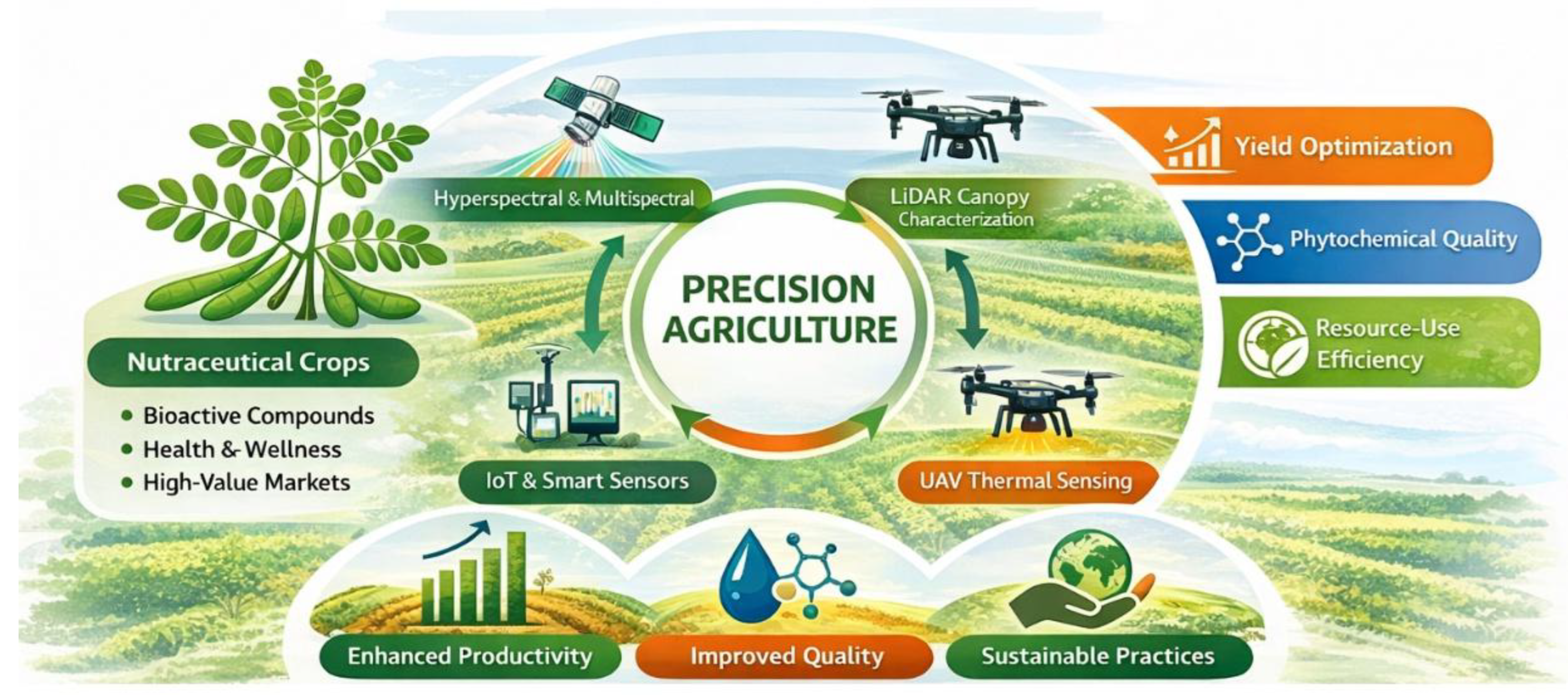
Figure 2.
Conceptual representation of Precision Agriculture as a data-driven ecosystem for managing spatial variability in nutraceutical cropping systems, with application to Moringa oleifera. The figure integrates hyperspectral and multispectral imaging, LiDAR-based three-dimensional canopy characterization (ground-based and UAV-mounted), UAV thermal sensing, IoT soil–plant–atmosphere monitoring, precision irrigation and nutrient management, and low-cost tools for smallholders. LiDAR-derived point clouds and voxel-based metrics quantify canopy structure, volume, density, and porosity. These multi-source data are processed through machine learning and artificial intelligence within decision-support systems, enabling site-specific, climate-smart management aimed at optimizing yield, stabilizing phytochemical quality, and improving resource-use efficiency under heterogeneous field conditions.
Figure 2.
Conceptual representation of Precision Agriculture as a data-driven ecosystem for managing spatial variability in nutraceutical cropping systems, with application to Moringa oleifera. The figure integrates hyperspectral and multispectral imaging, LiDAR-based three-dimensional canopy characterization (ground-based and UAV-mounted), UAV thermal sensing, IoT soil–plant–atmosphere monitoring, precision irrigation and nutrient management, and low-cost tools for smallholders. LiDAR-derived point clouds and voxel-based metrics quantify canopy structure, volume, density, and porosity. These multi-source data are processed through machine learning and artificial intelligence within decision-support systems, enabling site-specific, climate-smart management aimed at optimizing yield, stabilizing phytochemical quality, and improving resource-use efficiency under heterogeneous field conditions.
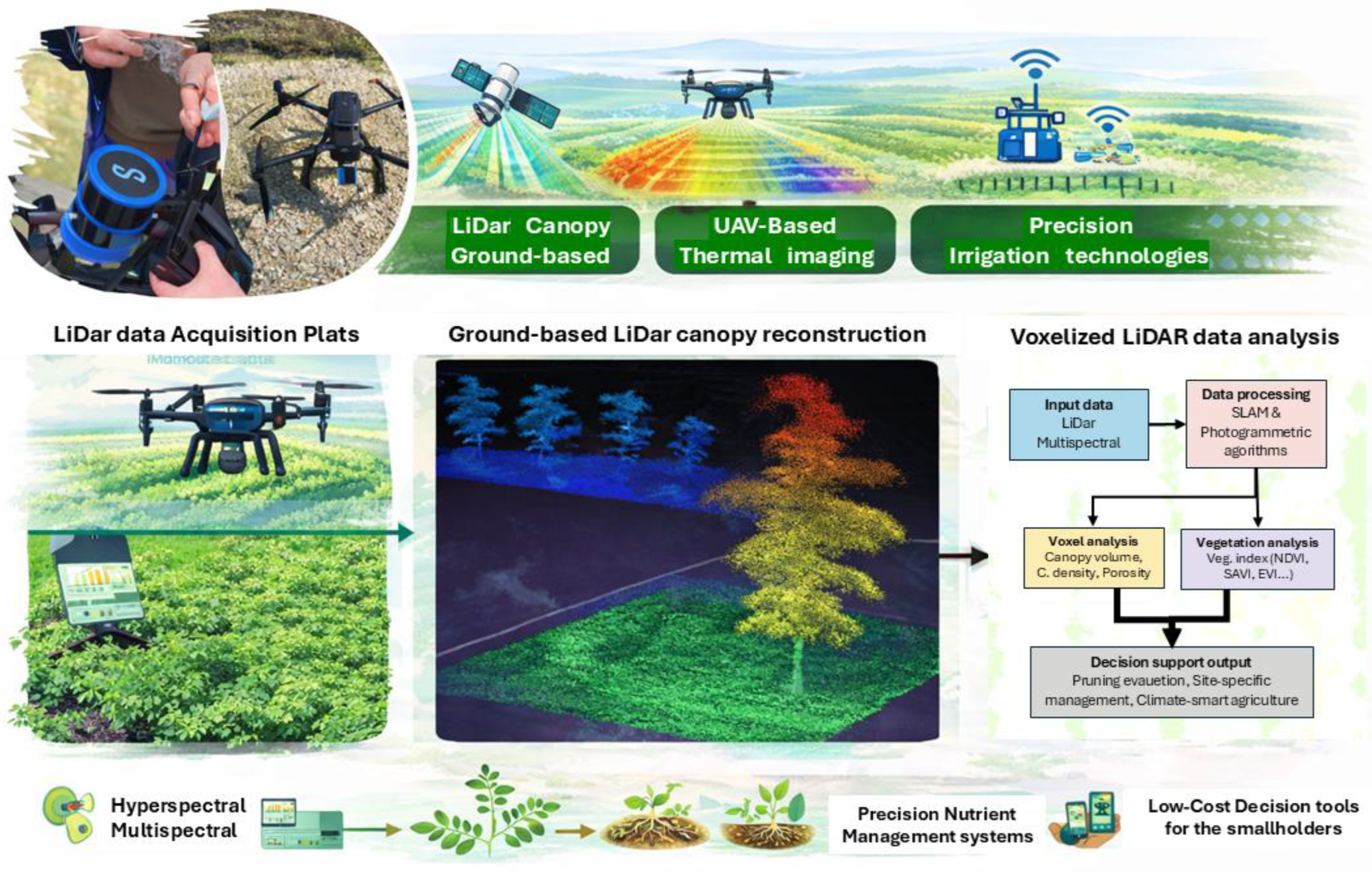
Figure 3.
Conceptual framework linking barriers, solutions, and impacts in Precision Nutraceutical Farming. The figure synthesizes the main constraints limiting the adoption of Precision Agriculture (PA) in nutraceutical cropping systems-including high initial costs, technical complexity, data interoperability gaps, infrastructure limitations, biological variability, and socio-institutional barriers—and maps them to corresponding technological, organizational, and policy-oriented solutions. Proposed solutions include low-cost and open-source sensing tools, user-friendly decision-support systems, standardized data architectures, capacity-building initiatives, and supportive policy frameworks. The resulting impacts highlight improved yield stability, enhanced phytochemical quality, increased resource-use efficiency, climate resilience, and strengthened economic competitiveness, with specific relevance to Moringa oleifera–based nutraceutical value chains under Mediterranean conditions.
Figure 3.
Conceptual framework linking barriers, solutions, and impacts in Precision Nutraceutical Farming. The figure synthesizes the main constraints limiting the adoption of Precision Agriculture (PA) in nutraceutical cropping systems-including high initial costs, technical complexity, data interoperability gaps, infrastructure limitations, biological variability, and socio-institutional barriers—and maps them to corresponding technological, organizational, and policy-oriented solutions. Proposed solutions include low-cost and open-source sensing tools, user-friendly decision-support systems, standardized data architectures, capacity-building initiatives, and supportive policy frameworks. The resulting impacts highlight improved yield stability, enhanced phytochemical quality, increased resource-use efficiency, climate resilience, and strengthened economic competitiveness, with specific relevance to Moringa oleifera–based nutraceutical value chains under Mediterranean conditions.
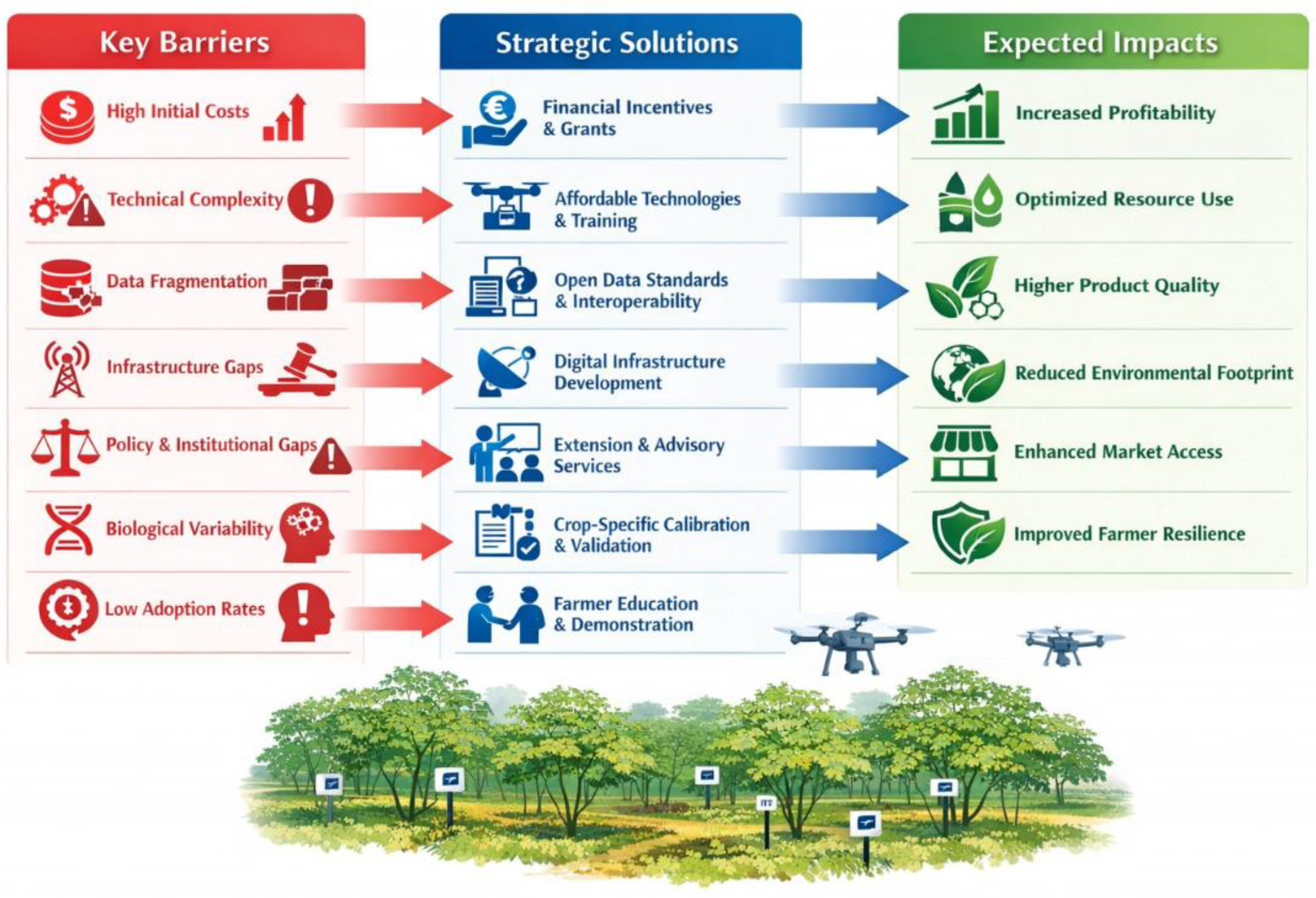
Figure 4.
Future perspectives of Precision Agriculture in nutraceutical cropping systems. The figure illustrates how advances in sensing technologies, UAV-based phenotyping, artificial intelligence, and digital twins—together with controlled-environment agriculture, blockchain-enabled traceability, and low-cost precision tools—are expected to drive the transition from pilot-scale applications to widespread deployment. These innovations support climate-resilient, resource-efficient, and quality-driven production systems, with Moringa oleifera highlighted as a representative nutraceutical crop for Mediterranean and semi-arid agroecosystems.
Figure 4.
Future perspectives of Precision Agriculture in nutraceutical cropping systems. The figure illustrates how advances in sensing technologies, UAV-based phenotyping, artificial intelligence, and digital twins—together with controlled-environment agriculture, blockchain-enabled traceability, and low-cost precision tools—are expected to drive the transition from pilot-scale applications to widespread deployment. These innovations support climate-resilient, resource-efficient, and quality-driven production systems, with Moringa oleifera highlighted as a representative nutraceutical crop for Mediterranean and semi-arid agroecosystems.
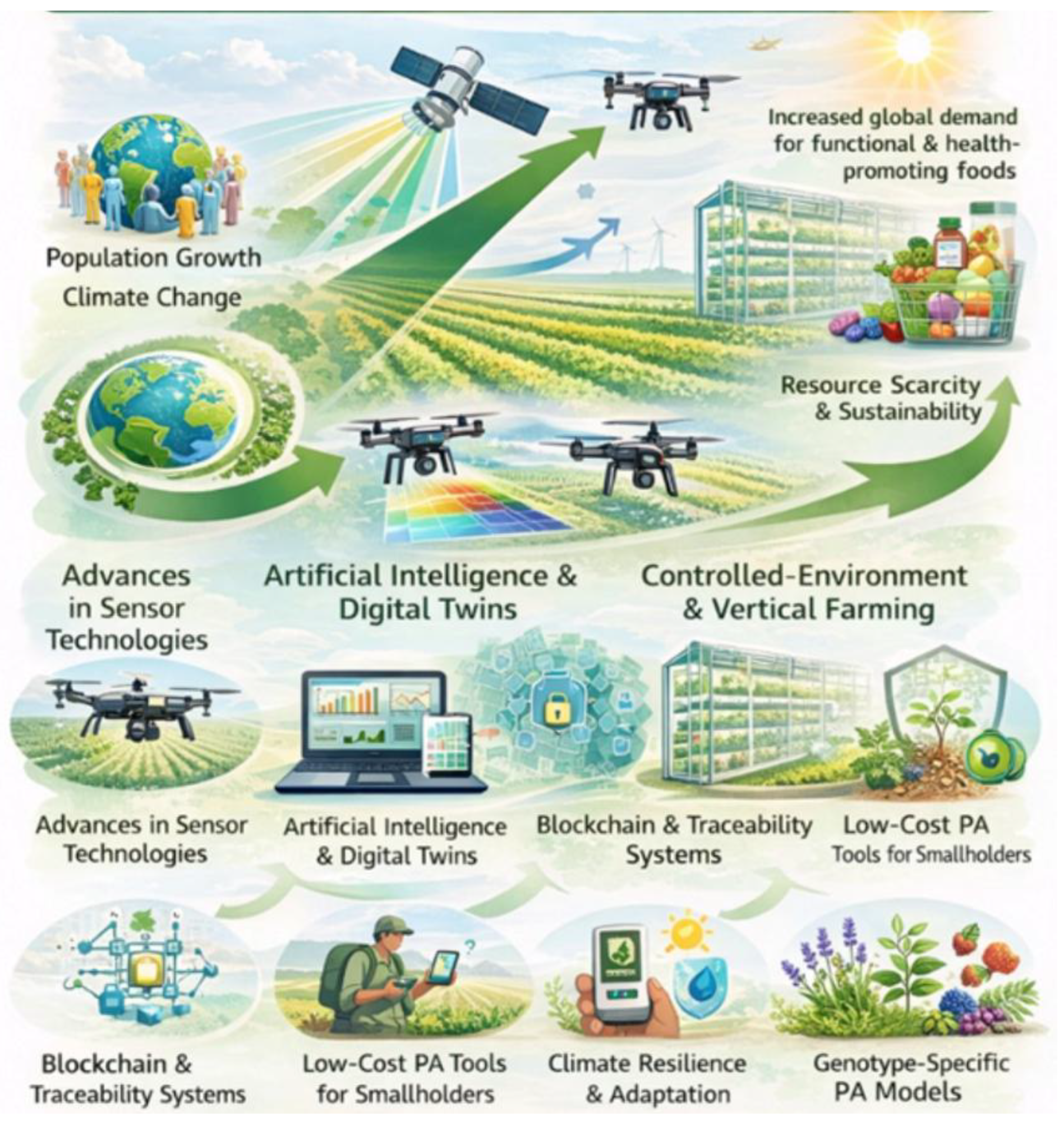
Figure 5.
Future roadmap for Precision Agriculture (PA) in nutraceutical cropping systems. Conceptual overview of the technological and methodological trajectories shaping next-generation PA for nutraceutical crops, with a focus on Moringa oleifera. The roadmap integrates advances in high-resolution sensing and 3D phenotyping (multispectral, hyperspectral, thermal, and LiDAR), artificial intelligence and digital twins for predictive and prescriptive management, controlled-environment and vertical systems, blockchain-enabled traceability, and low-cost open-source tools for smallholders. These components converge toward climate-resilient, quality-oriented, and resource-efficient production systems, enabling genotype-specific management, standardized phytochemical profiles, and enhanced sustainability across Mediterranean and semi-arid agroecosystems.
Figure 5.
Future roadmap for Precision Agriculture (PA) in nutraceutical cropping systems. Conceptual overview of the technological and methodological trajectories shaping next-generation PA for nutraceutical crops, with a focus on Moringa oleifera. The roadmap integrates advances in high-resolution sensing and 3D phenotyping (multispectral, hyperspectral, thermal, and LiDAR), artificial intelligence and digital twins for predictive and prescriptive management, controlled-environment and vertical systems, blockchain-enabled traceability, and low-cost open-source tools for smallholders. These components converge toward climate-resilient, quality-oriented, and resource-efficient production systems, enabling genotype-specific management, standardized phytochemical profiles, and enhanced sustainability across Mediterranean and semi-arid agroecosystems.
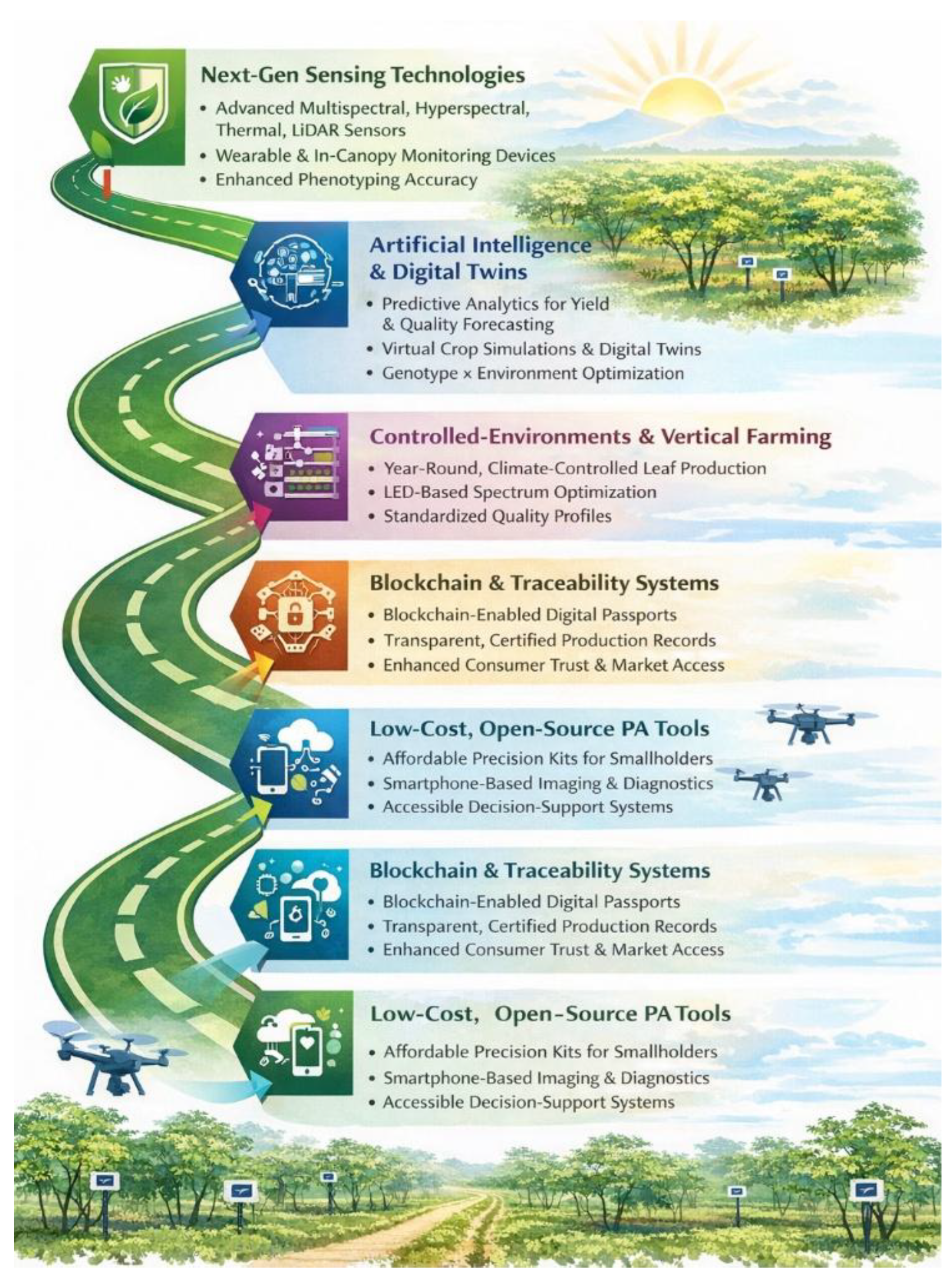

Table 1.
Comparative overview of multispectral, thermal, and LiDAR sensing technologies for Pre-cision Agriculture applications in Moringa oleifera.
Table 1.
Comparative overview of multispectral, thermal, and LiDAR sensing technologies for Pre-cision Agriculture applications in Moringa oleifera.
| Technology | Main measured variables | Key agronomic information | Strengths | Limitations | Main applications in Moringa oleifera |
|---|---|---|---|---|---|
| Multispectral imaging (UAV) | Spectral reflectance (VIS–NIR), vegetation indices (NDVI, NDRE, GNDVI, VARI) | Canopy vigor, chlorophyll content, photosynthetic activity, spatial variability | High spatial coverage; operational scalability; cost-effective; strong link with physiological status | Indirect estimation of biomass; limited sensitivity to canopy internal structure | Monitoring canopy vigor and uniformity; detection of nutrient and water stress; harvest timing optimization; mapping phytochemical maturity |
| Thermal imaging (UAV) | Canopy temperature, thermal indices (e.g., CWSI) | Plant water status, transpiration efficiency, heat stress | Early detection of water stress; strong support for irrigation scheduling; rapid response to stress | Sensitive to atmospheric conditions; lower structural detail; requires calibration | Precision irrigation management; water-use efficiency improvement; stress prevention under semi-arid Mediterranean conditions |
| LiDAR (UAV / terrestrial) | 3D point clouds, canopy height, volume, density, porosity, vertical foliage distribution | Structural architecture, biomass estimation, pruning response, spatial heterogeneity | Direct measurement of canopy structure; high accuracy; non-destructive; robust biomass estimation | Higher costs; data processing complexity; limited spectral information | Canopy architecture analysis; biomass and volume estimation; assessment of pruning strategies; integration with multispectral/thermal data for DSS |
Table 2.
Mapping of Precision Agriculture technologies to yield, nutraceutical quality, and sustainability outcomes in Moringa oleifera cropping systems.
Table 2.
Mapping of Precision Agriculture technologies to yield, nutraceutical quality, and sustainability outcomes in Moringa oleifera cropping systems.
| PA Technology | Key Variables Monitored | Yield-Related Outcomes | Nutraceutical Quality Outcomes | Environmental & Sustainability Impacts |
|---|---|---|---|---|
| UAV Multispectral Imaging (NDVI, NDRE, GNDVI, VARI) | Canopy vigor, chlorophyll content, nutrient status, spatial heterogeneity | +12–18% leaf biomass increase; improved canopy uniformity; optimized harvest timing | Stabilization and enhancement of vitamin C, carotenoids, chlorophyll density, antioxidant capacity | Reduced fertilizer overuse; site-specific interventions; lower input waste |
| UAV Thermal Imaging (CWSI) | Canopy temperature, plant water stress | Yield stabilization under water-limited conditions; reduced stress-induced biomass losses | Increased phenolic content and antioxidant activity via controlled water stress | 25–40% water savings; improved irrigation efficiency; climate adaptation |
| LiDAR-Based 3D Canopy Characterization (UAV & Terrestrial) | Canopy height, volume, density, porosity, structural heterogeneity | Improved biomass estimation accuracy; optimized pruning and canopy management | Indirect enhancement of phytochemical uniformity through optimized light interception and microclimate | Reduced unnecessary pruning; improved resource-use efficiency; structural resilience |
| IoT Soil–Plant–Atmosphere Sensor Networks | Soil moisture, NPK, EC, pH, microclimate, plant physiological signals | Stable growth trajectories; reduced yield variability across management zones | Enhanced vitamin C, carotenoids, antioxidant capacity via continuous physiological regulation | Water and nutrient savings; reduced leaching; lower environmental footprint |
| Machine Learning & AI-Based DSS (CNN, RF, LSTM) | Multisource data integration; growth and stress prediction | Accurate biomass forecasting; optimized harvest timing | Prediction of phytochemical accumulation peaks; quality standardization | Reduced trial-and-error inputs; data-driven efficiency gains |
| Precision Irrigation (RDI + Smart Drip Systems) | Soil moisture thresholds; plant water demand | Yield maintenance under deficit irrigation; improved water productivity | Increased phenolics, flavonoids, antioxidant compounds | Water conservation; improved drought resilience |
| Precision Nutrient Management (VRA, Spectral Diagnostics) | Nitrogen, potassium, micronutrient status | Improved leaf biomass production; nutrient-use efficiency | Enhanced carotenoid synthesis, vitamin C stability, antioxidant capacity | Reduced fertilizer losses; lower GHG emissions |
| Low-Cost PA Tools (Smartphone imaging, Open-source IoT) | Visual stress indicators; basic spectral/physiological signals | Yield protection in smallholder systems | Acceptable nutraceutical quality consistency at low cost | Democratization of PA; economic and environmental sustainability |
Disclaimer/Publisher’s Note: The statements, opinions and data contained in all publications are solely those of the individual author(s) and contributor(s) and not of MDPI and/or the editor(s). MDPI and/or the editor(s) disclaim responsibility for any injury to people or property resulting from any ideas, methods, instructions or products referred to in the content. |
© 2026 by the authors. Licensee MDPI, Basel, Switzerland. This article is an open access article distributed under the terms and conditions of the Creative Commons Attribution (CC BY) license (http://creativecommons.org/licenses/by/4.0/).
Copyright: This open access article is published under a Creative Commons CC BY 4.0 license, which permit the free download, distribution, and reuse, provided that the author and preprint are cited in any reuse.


