

Submitted:
13 February 2026
Posted:
14 February 2026
You are already at the latest version
Abstract
This paper presents a reliability-oriented analytical framework for the quantitative assessment of fragment-resistant multilayer protective equipment subjected to impulsive fragment loading. The study is motivated by the stochastic nature of fragment generation and impact conditions in industrial and occupational accident scenarios, where deterministic penetration criteria are insufficient to describe protective performance. Fragment interactions are modelled as stochastic spatial events, with impact locations and kinematic characteristics treated as random variables and mapped onto a predefined protected region. System failure is formulated using an energy-based limit-state criterion defined by comparison between the absorbed energy demand induced by fragment impact and a critical admissible energy threshold. The fragment–PPE interaction is described using a reduced-order dynamic formulation with concentrated parameters, capturing the dominant normal deformation response under short-duration impulsive loading. Closed-form analytical expressions are derived that relate fragment mass and velocity to impact impulse and absorbed energy. The resulting formulation establishes a direct link between impulse-driven dynamic response, progressive multilayer engagement, and failure probability under single and repeated impact events. Application of the proposed framework to a representative multilayer protective configuration demonstrates physically consistent reliability trends and confirms its computational efficiency. The framework provides a practical tool for reliability-informed assessment and preliminary design of fragment-resistant multilayer protective equipment.
Keywords:
impulsive fragment impacts
; personal protective equipment (PPE)
; reliability analysis
; energy-based limit-state function
; reduced-order dynamic modeling
; multilayer protective systems
; probabilistic safety assessment
1. Introduction
Industrial accidents involving explosions, rupture of pressurised systems, and mechanical fragmentation of structural or rotating components remain a significant source of severe occupational injuries [1]. Such events are typically characterised by impulsive fragment generation with substantial variability in mass, velocity, and trajectory, resulting in highly localised, high-energy impacts that are inherently difficult to predict and mitigate using deterministic approaches [2].
Personal protective equipment (PPE) represents a critical safety barrier in situations where engineering controls and organisational measures cannot fully eliminate exposure to fragment hazards [3]. In contemporary safety engineering, PPE is increasingly treated as a functional barrier whose performance must be quantitatively assessed under conditions of uncertainty and residual risk, rather than evaluated solely through compliance-based criteria [4]. System-oriented safety methodologies further emphasise the need to characterise barrier effectiveness in probabilistic terms, linking protective performance to measurable risk reduction [5].
Fragment hazards arising from accidental events exhibit pronounced stochastic behaviour due to the random nature of physical phenomena such as blast wave propagation, material failure, and fragment projection. This stochasticity manifests not only in fragment intensity but also in spatial dispersion, motivating the adoption of probabilistic exposure and risk assessment methodologies. Such approaches have been discussed in comprehensive risk analysis frameworks applied to complex industrial environments, including industrial parks and high-density facilities [6]. Numerical investigations of blasting-induced fragmentation further demonstrate the strong dependence of fragment generation and dispersion on material strength, structural configuration, and environmental conditions, reinforcing the inherently probabilistic nature of fragment hazards [7].
The mechanical response of protective structures subjected to fragment impact is well established in the literature and is commonly described in terms of impulse-dominated loading and transient energy transfer [8]. Under such short-duration loading conditions, material behaviour is governed primarily by inertia effects and strain-rate-dependent mechanisms, rather than quasi-static strength parameters [9]. Energy-based formulations linking fragment momentum, deformation response, and absorbed energy have therefore been widely employed to characterise impact behaviour in protective materials exposed to high strain-rate loading [10].
For flexible and multilayer protective systems, experimental investigations consistently demonstrate that impact mitigation is achieved through the progressive engagement of multiple layers rather than through the response of a single load-bearing element [11]. Energy dissipation is distributed across the protective package through a combination of inertial resistance, interlayer interaction, and controlled damage evolution [12]. These mechanisms have been extensively documented for aramid-based fabrics and composite protective systems subjected to fragment and ballistic loading [13].
Recent studies on modern multilayer PPE configurations confirm that absorbed energy and penetration resistance depend strongly on fragment momentum, layer sequencing, and stacking architecture [14]. The nonlinear impact responses observed in flexible armour systems indicate that protective performance is governed by multiple interacting parameters and cannot be adequately described using single-layer or single-impact criteria [15]. Correspondingly, analytical modelling, finite element simulations, and ballistic experiments have demonstrated that the performance of multilayer composite armour systems is influenced by both material properties and structural configuration under high-velocity impact conditions [16]. Related investigations of thin-walled structural elements subjected to impulsive loading further highlight the role of boundary conditions and load confinement in shaping dynamic response and deformation mechanisms [17].
Reliability-based formulations provide a mathematically consistent framework for addressing these complexities by integrating established mechanical descriptions with probabilistic exposure modelling and cumulative failure concepts [18]. Such approaches are widely applied in fire and explosion risk analysis, where system performance must be evaluated under uncertain and evolving hazard conditions [19]. Recent safety research further underscores the importance of system-level safety barrier management and risk-informed decision-making, in which probabilistic risk assessment is explicitly coupled with barrier performance evaluation to support effective mitigation strategies under uncertainty [20]. In parallel, probabilistic and Bayesian network–based methods have been successfully applied to identify key contributing factors and risk propagation pathways in industrial accidents, enabling quantitative assessment of accident evolution processes [21].
At the same time, a substantial body of experimental and modelling research on multilayer protective fabric systems provides validated relations describing impact response and energy absorption under fragment and ballistic loading conditions [22]. Classical impact dynamics literature further establishes the physical basis for impulse-dominated and energy-based formulations describing momentum transfer and deformation during high-velocity impact events in protective structures [23].
Within this context, the present study integrates dynamic impact modelling, energy-based absorption formulations, and probabilistic exposure concepts into a unified analytical framework for the reliability-oriented assessment of fragment-resistant PPE [24]. The proposed approach provides a computationally efficient and physically interpretable basis for risk-informed evaluation and preliminary design of multilayer protective systems, consistent with recent probabilistic models for blast and fragmentation risk acceptance and emerging design frameworks for soft human armour [25,26].
2. Problem Formulation
2.1. System Description and Spatial Representation
The present study considers a blast- and fragment-resistant personal protective garment, classified as personal protective equipment (PPE), as a safety-critical system intended to mitigate impulsive fragment hazards generated during accidental industrial events. The protective system is modeled as a multilayer energy-absorbing structure, whose primary function is to limit the transmission of mechanical energy and deformation to a level below predefined safety thresholds within a protected zone.
The system performance is inherently probabilistic, since the occurrence, spatial dispersion, and energetic characteristics of fragment impacts exhibit significant uncertainty. Consequently, the assessment is carried out within a reliability-based safety framework suitable for engineering decision-making and risk-informed design.
Impulsive fragment hazards are modeled as discrete stochastic events originating from a common accidental source with planar spatial coordinates
where:
-x0 and y0 denote the Cartesian coordinates of the effective fragmentation centre [m].
The spatial impact location of the i-th fragment is described by
where:
- xi and yi are the planar coordinates of the i-th fragment impact point [m],
- i is the fragment index,
- n is the total number of fragments generated during the accidental event.
The radial distance of each fragment impact from the event centre is defined as
where ri represents the Euclidean distance between the i-th impact location and the source centre [m]. This distance is used to determine whether a given fragment is geometrically capable of interacting with the PPE-protected zone.
The spatial dispersion of fragment impacts and the protected area covered by the protective system are illustrated schematically in Figure 1.
The spatial dispersion of fragment impacts is described by the two-dimensional probability density function (PDF):
where f(x,y) denotes the probability density of fragment impact occurrence per unit area [m2], x and y are planar spatial coordinates [m] and Ex, Ey are effective dispersion parameters along the principal axes [m].
The dispersion parameters are defined as:
where σs,x, σs,y represent source-dispersion components associated with the fragmentation process, and σt,x, σt,y denote technical-dispersion components reflecting secondary mechanical or structural effects. The quadratic superposition reflects the assumption that the dispersion contributions are statistically independent.
The PPE-covered protected zone is characterised by its equivalent protection radius RΩ [m]. The corresponding protected region is defined as the circular domain:
where:
- RΩ denotes the radius of the protected zone [m],
- Ω denotes the protected area [m2].
Consequently, the probability that a fragment lands within the protected zone can be obtained by integrating the spatial probability density over the area Ω.
The probability that a randomly generated fragment impact occurs within the protected zone is given by:
Equation (6) follows directly from the definition of probability for continuous random variables: the integral of the spatial probability density function over the protected region yields the probability that a fragment impact location lies within that region. The quantity PΩ therefore represents the geometric exposure probability of the PPE to fragment impacts.
2.2. Energy-Based Failure Criterion
Each fragment is characterised by its mass and velocity, with corresponding kinetic energy
where mi is the mass of the i-th fragment [kg], vi is its impact velocity [m s−1], and Ei is the kinetic energy associated with the fragment [J].
Failure of the protective system is formulated through an energy-based limit-state function
where Eabs,i denotes the absorbed energy demand imposed on the PPE during the i-th impact [J], and Ecrit is the critical admissible energy threshold [J], representing the maximum energy demand compatible with the adopted protection criterion.
Failure occurs when
which is equivalent to the condition Eabs,i>Ecrit. Accordingly, the probability of failure associated with a single fragment impact is defined as
Equation (10) follows directly from the definition of the limit-state function and establishes the probabilistic measure of failure at the single-impact level.
2.3. Multiple Impacts and Reliability Formulation
For a sequence of n impulsive fragment impacts, the probability that exactly m impacts result in failure is described by the binomial distribution
This formulation assumes statistically independent impact events with identical single-impact failure probability Pf.
The cumulative probability of system failure after n impacts is expressed as
where G(m) is a conditional failure function that maps the number of failed impacts mmm to system-level failure.
The conditional failure law is defined as
where ψ(Δt) represents the mean number of energetically critical impacts expected within the reference time interval Δt. Equation (13) expresses the probability that at least one system-level failure occurs as a consequence of m critical impact events, under the assumption of statistically independent accumulation of damage.
Substituting Eqs. (11) and (13) into Eq. (12) yields the closed-form expression
This expression provides a compact analytical representation of cumulative failure probability, explicitly linking single-impact failure probability, impact count, and critical impact intensity.
The reliability of the protective system subjected to n fragment impacts is defined as
For a multilayer PPE consisting of N functional layers, the system-level reliability is expressed as
where Pf,k denotes the failure probability associated with the k-th layer. Equation (16) corresponds to a series-system reliability model and reflects the assumption that overall system failure occurs if any individual protective layer fails to satisfy its admissible energy criterion. Equation (16) corresponds to a classical series-system reliability model.
3. Reliability-Oriented Mathematical Modeling of Multilayer Fragment-Mitigation Systems
3.1. Rationale for Introducing a Dynamic Impact–Absorption Model
The probabilistic framework established in Section 2 quantifies failure in terms of absorbed energy thresholds and cumulative impact effects. However, this formulation remains incomplete without an explicit physical model linking fragment characteristics to the energy actually absorbed by the protective system. While failure is defined probabilistically, the mechanism through which fragment kinetic energy is transformed into internal deformation and dissipation within the multilayer structure must be specified in order to evaluate the limit-state function in a physically consistent manner.
In fragment-resistant protective garments, impact mitigation is achieved through a combination of inertia effects, elastic deformation of fibres and matrices, viscous and viscoelastic dissipation, and interactions between adjacent layers. These processes occur over very short time scales and are highly localised around the impact point. Fully resolving such behaviour using high-fidelity finite-element models is computationally expensive and poorly suited to reliability-oriented parametric analyses involving large numbers of stochastic impact scenarios.
To address this limitation, a reduced-order dynamic representation is introduced. The objective is not to reproduce detailed stress or damage fields within the garment, but to capture the dominant normal deformation mode governing local energy absorption during impulsive fragment impact. This abstraction enables a direct analytical coupling between impact mechanics and the reliability formulation developed in Section 2.
3.2. Lumped Impact–Absorption Representation and Equivalent Parameters
The interaction between an impulsive fragment and a multilayer protective garment is inherently localised. Although the garment is a spatially distributed structure, only a finite region in the immediate vicinity of the impact point undergoes significant deformation during the extremely short contact duration. Consequently, the global motion of the entire garment mass does not participate uniformly in the impact response. Instead, the dynamics are governed by a confined deformation zone whose behaviour dominates local force transmission and energy absorption.
To represent this localised response in an analytically tractable form, the protective system is idealised as an equivalent single-degree-of-freedom (SDOF) system acting in the direction normal to the impacted surface. This abstraction does not imply a physical reduction of the structure to a single component; rather, it constitutes an energetic equivalence. The distributed inertia, stiffness, and dissipation of the multilayer assembly are mapped onto lumped parameters that reproduce the same local force–displacement and energy balance characteristics during impact.
Within this framework, the normal impact response of the i-th fragment is governed by the equation of motion
where:
- ui(t) is the equivalent normal displacement of the protective system associated with the i-th impact,
- Meq is the equivalent mass,
- Ceq is the equivalent viscous damping coefficient,
- Keq is the equivalent stiffness,
- Fi(t) is the contact force generated by the fragment.
The equivalent mass Meq represents the effective inertia of the portion of the multilayer package dynamically engaged during impact. It does not correspond to the total mass of the garment, but to the mass contained within the effective interaction zone around the impact point. To account for this partial participation, the equivalent mass is expressed as
where ρk and hk are the density and thickness of the k-th layer, respectively, Aeff is the effective contact area, N is the total number of layers, and αM∈(0,1) is a mass participation factor reflecting deformation localisation.
The resistance of the multilayer system to normal deformation is characterised through an equivalent stiffness. Because individual layers are stacked sequentially in the thickness direction and deform primarily in compression during normal impact, they are modelled as springs connected in series. The stiffness of the k-th layer is defined as
where Ek is the elastic modulus of the k-th layer. This formulation captures the cumulative compliance of the multilayer assembly and naturally accounts for the influence of layer sequencing, thickness, and material properties.
Energy dissipation mechanisms in textile, polymeric, and composite protective materials arise from internal friction, viscoelastic behaviour, micro-sliding, and interlayer interactions. These effects are collectively represented through an equivalent viscous damping coefficient
where ζ is a dimensionless damping ratio.
The spatial extent of the deformation zone is characterised by the effective contact area
where a is a characteristic interaction radius associated with fragment size, indentation footprint, or experimentally calibrated contact dimensions.
3.3. Representation of Impulsive Loading, Deformation Response, and Absorbed Energy
Fragment impacts are characterised by contact durations that are very short relative to the characteristic response time of the protective system. Under such conditions, the contact force can be idealised as an impulsive load
where Ii is the impulse associated with the i-th fragment and δ(t) is the Dirac delta distribution. The impulse represents the time-integrated effect of the contact force and constitutes the primary kinematic descriptor of the impact event. It is defined as
where mi and vi are the mass and velocity of the fragment, respectively.
Solving the equation of motion (17) under impulsive excitation yields the maximum displacement response of the equivalent system,
which corresponds to the peak normal deformation during impact.
The energy absorbed by the protective system during the i-th impact is obtained as
This closed-form expression directly links fragment mass and velocity to absorbed energy through the equivalent system inertia and forms the physical basis for evaluating the energy-based failure criterion introduced in Section 2.
For lightly damped systems, typical of multilayer textile- and polymer-based protective assemblies, the expressions above provide an accurate approximation. For an underdamped system (ζ<1), the maximum deformation is reduced according to
where Φ(ζ)≤1 represents the reduction factor associated with viscous damping, leading to the modified absorbed energy expression:
For the small damping ratios typically reported for multilayer protective systems (ζ≪1), Φ(ζ)≈1, and the simplified expressions in Eqs. (24)–(25) remain sufficient for reliability-oriented assessment.
3.4. Multilayer Transfer Representation and Coupling with the Reliability Framework
While the lumped SDOF model captures the dominant local impact response, real protective garments consist of multiple functional layers with distinct mechanical roles. To account for this structural heterogeneity, the formulation is extended using a transfer-matrix representation. Each protective layer is described by the local relation
where uk and Fk denote the displacement and force at the interface of the k-th layer, and Tk is the corresponding 2×2 transfer matrix.
The cumulative mechanical response of an N-layer system is obtained by successive multiplication,
yielding a compact representation of the global multilayer behaviour.
The ordered product reflects the sequential transfer of displacement and force through the stacked layers along the impact direction. By combining the absorbed energy expression given in Eq. (25) with the energy-based failure criterion defined in Section 2, the admissibility condition for a safe response can be formulated. Using the closed-form impact–absorption relation Eabs,i=Eabs,i(Ii) with Ii=mivi, the condition is written as:
leading to the single-impact failure probability
The proposed framework thus establishes a closed analytical chain,
which links fragment characteristics to cumulative failure probability and system reliability. This coupling of impact dynamics with reliability theory constitutes the core methodological contribution of the present study.
4. Model Approbation and Numerical Validation
4.1. Fragment Hazard Characteristics and Multilayer Energy Absorption in Industrial Protective Equipment
Industrial accidents involving high-energy processes—such as accidental explosions, rupture of pressurised systems, failure of rotating machinery, or fragmentation of brittle structural components—are frequently accompanied by the generation of flying fragments. These fragments originate from failed components, surrounding structures, or protective casings and are expelled as a result of the sudden release of stored mechanical or thermodynamic energy. Such events represent a critical source of localised, high-intensity mechanical loading in industrial environments.
Fragments generated during industrial accidents are typically irregular in shape, heterogeneous in mass, and ejected with a wide range of initial velocities. Their subsequent motion is governed by the initial impulse imparted during failure, interactions with nearby structures, and aerodynamic effects. As a result, personnel located in the vicinity of the accident may be exposed to impulsive impact events characterised by very short contact durations and high local energy transfer. From a safety engineering perspective, these hazards cannot be adequately described using deterministic single-impact criteria and instead require a probabilistic and reliability-oriented treatment, consistent with the framework developed in Section 2 and Section 3.
In industrial practice, mitigation of fragment hazards is commonly achieved through the use of multilayer personal protective equipment (PPE), including reinforced protective garments, industrial safety clothing, and safety systems incorporating textile, polymeric, composite, or metallic protective elements. These systems are designed to reduce injury risk by distributing impact loads over a larger area, absorbing kinetic energy, and limiting the transmission of force and deformation to the human body. Representative examples of multilayer industrial protective systems and components are illustrated in Figure 2.
Although material choices and structural configurations vary across applications, the examples in Figure 2 illustrate a common design principle: impact mitigation is achieved through the progressive engagement of multiple layers rather than through a single load-bearing element. This layered approach enables different materials to perform complementary mechanical functions, including load redistribution, energy absorption, and deformation control, thereby enhancing overall protective performance under impulsive loading.
Experimental investigations reported in the open literature further demonstrate that energy dissipation in multilayer protective systems is governed by interacting mechanisms, including elastic deformation of fibres and matrices, fibre stretching and pull-out, rupture of load-bearing elements, and interaction with secondary fragments generated during impact. Typical microscale damage patterns and dissipation mechanisms observed experimentally in aramid-based protective systems are illustrated in Figure 3.
The images qualitatively demonstrate dominant energy dissipation mechanisms contributing to cumulative energy absorption in multilayer protective structures.
The qualitative and experimental evidence summarised in Figure 2 and Figure 3 clearly indicates that fragment mitigation cannot be represented by a single deterministic threshold. Instead, the protective response emerges from the interaction between stochastic fragment characteristics and multilayer structural behaviour, leading to progressive and distributed energy dissipation. In the following subsections, this physical understanding is translated into a quantitative numerical framework that validates and applies the analytical models developed in Section 2 and Section 3.
4.2. Numerical Simulation of Fragment Dispersion and Interaction with the Protected Zone Ω
To account for the inherent uncertainty in fragment trajectories and impact locations, a Monte Carlo simulation framework was employed in accordance with the probabilistic exposure model formulated in Section 2. Fragment spatial coordinates (xi,yi), masses mim_imi, and velocities vi were generated as statistically independent random variables following the prescribed probability density functions and parameter ranges defined therein.
The protected region associated with the personal protective equipment (PPE) was modelled as a circular zone Ω with radius RΩ=0.6 m, representing a typical coverage area for industrial protective garments such as reinforced vests or upper-body PPE. Fragment impacts satisfying ri≤RΩ were classified as geometrically admissible exposure events, whereas fragments with ri>RΩ were considered subcritical with respect to direct interaction with the PPE.
The spatial distribution of fragments generated in the Monte Carlo simulations, together with their associated kinetic energy levels, is illustrated in Figure 4. Marker position corresponds to the fragment coordinates (xi,yi), marker size is proportional to the fragment mass mi, and marker colour represents the fragment kinetic energy Ei. The dashed circle denotes the protected zone Ω with radius RΩ. The dataset is generated using the input parameters defined in Table 1.
The figure illustrates that only a subset of fragments produced during an accidental event reaches the protected region, while their energetic severity exhibits significant variability even within Ω. This combined spatial and energetic dispersion motivates the coupling of probabilistic exposure modelling with dynamic impact–absorption analysis, and the interacting fragments identified here constitute the input set for the subsequent evaluation of absorbed energy and reliability performance of the multilayer PPE system.
4.3. Dynamic Response of Multilayer PPE and Absorbed Energy
Fragments that geometrically reach the protected zone Ω were further analysed using the dynamic impact–absorption model developed in Section 3. Within this framework, the local response of the multilayer personal protective equipment (PPE) is represented by an equivalent single-degree-of-freedom (SDOF) system acting in the direction normal to the impacted surface. This reduced-order representation enables direct evaluation of the energy absorbed by the PPE during each fragment impact while retaining the dominant physical mechanisms governing impulsive interaction.
For each interacting fragment, the absorbed energy is evaluated using the closed-form analytical expression derived in Section 3 (Eq.25),
This formulation explicitly reveals the quadratic dependence of absorbed energy on fragment impulse, thereby establishing a direct and physically transparent link between fragment loading characteristics and energy dissipation within the multilayer protective system.
To provide numerical illustration of the analytical impulse–energy relationship, a set of representative fragment cases was selected, spanning a range of fragment masses and velocities typical of impulsive fragment threats encountered in industrial accident scenarios. For this illustrative evaluation, a fixed representative value of the equivalent mass Meq was assumed. The resulting fragment impulses and corresponding absorbed energies predicted by the dynamic impact–absorption model are summarised in Table 2.
The numerical values reported in Supplementary Table S1 are visualised in Figure 5, which presents the absorbed energy as a function of fragment impulse. The resulting trend clearly demonstrates the quadratic scaling Eabs∝I2, in direct agreement with the analytical relationship derived from the lumped dynamic formulation for a fixed equivalent mass.
The results shown in Figure 5 confirm that the equivalent SDOF model captures the essential physical behaviour of multilayer PPE subjected to impulsive fragment loading. In particular, the quadratic increase in absorbed energy with increasing fragment impulse highlights how relatively modest increases in fragment mass or velocity can impose disproportionately higher energy demands on the protective system. This observation underscores the importance of impulse-based descriptors in assessing fragment hazards and evaluating PPE performance.
Overall, the numerical illustration provides a consistent validation of the analytical impact–absorption model and establishes a solid quantitative basis for the subsequent analysis of progressive multilayer engagement and reliability assessment under probabilistic fragment loading conditions.
4.4. Progressive Multilayer Energy Absorption and Reliability Assessment
This section presents a comprehensive numerical and physical evaluation of the progressive energy absorption and reliability performance of a multilayer fragment-resistant personal protective equipment (PPE) system subjected to probabilistic fragment loading. The objective is to demonstrate, in an integrated and reliability-oriented manner, how the analytical formulations developed in Section 2 and Section 3 translate into quantifiable system-level reliability metrics when multiple protective layers are progressively engaged.
The PPE system considered in the analysis consists of three functional layers arranged sequentially in the impact direction: an outer high-strength aramid (Kevlar-type) layer responsible for initial impulse mitigation, an intermediate composite laminate providing load redistribution and structural support, and an inner foam-based porous layer contributing additional damping and attenuation of residual energy. This configuration reflects representative multilayer protective assemblies commonly employed in industrial and occupational safety applications.
Fragment impact events are characterised by the fragment impulse, as defined in Section 3. For each impact, the local dynamic interaction between the fragment and the PPE is represented using the lumped single-degree-of-freedom (SDOF) impact–absorption model introduced in Section 3. The corresponding impact-induced energy demand imposed on the protective system is evaluated using Eq. (25).
For a multilayer configuration with N engaged layers, the cumulative absorbed (demanded) energy is evaluated using the multilayer transfer formulation introduced in Section 3.4. System performance is subsequently assessed using the energy-based limit-state margin defined in Eqs. (8)–(10), where failure is assumed to occur when the limit-state function becomes negative. Following the reliability framework established in Section 2, the probability of failure associated with a single fragment impact is defined by Eq. (10). Assuming statistically independent impacts, cumulative system reliability corresponding to progressive multilayer engagement is evaluated using Eqs. (11)–(12).
To clarify the physical configuration of the protective system and the assumed impact sequence, a schematic cross-sectional representation of the three-layer PPE is shown in Figure 6, illustrating the direction of fragment impact and the order in which the individual protective layers engage during an impulsive event.
The material composition, thickness, and primary mechanical role of each protective layer are summarised in Table 2. Representative microstructural images of the constituent PPE layers are shown in Figure 7(a–c), adapted from peer-reviewed literature to illustrate dominant energy absorption mechanisms without reference to proprietary material brands.
The comparison of pre- and post-impact images for the aramid layer in Figure 7a highlights fibre-level deformation and failure mechanisms, providing physical support for the quadratic relationship between fragment impulse and absorbed energy. The microstructural features observed in Figure 7b and Figure 7c further elucidate the complementary energy-management roles of the intermediate and terminal layers of the PPE system. In the composite layer (Figure 7b), fibre–matrix interactions, local debonding, and delamination processes facilitate progressive stress redistribution and controlled transfer of residual impact energy from the outer aramid layer. In contrast, the open-cell polymer foam (Figure 7c) exhibits pronounced cell deformation, collapse, and local densification, confirming its function as the primary energy dissipation and attenuation layer through viscoelastic damping mechanisms. Together, these microstructural responses provide a consistent physical basis for the layered energy-absorption and attenuation model employed in Section 4.3.
The numerical values used for the reliability assessment are summarised in Supplementary Table S2, which provides discrete reliability values as a function of fragment impulse and number of engaged layers. This table constitutes the complete numerical dataset used for the graphical representations presented in this subsection.
The combined influence of fragment impulse and number of engaged layers on system reliability is illustrated by the three-dimensional reliability surface shown in Figure 8. The surface R(I,N) is constructed directly from the discrete values in Supplementary Table S2 and visualises the nonlinear improvement in reliability associated with both decreasing impulse severity and increasing multilayer engagement.
The corresponding two-dimensional projections in Figure 9 further demonstrate that, for any given impulse level, reliability increases monotonically with the number of engaged layers, while higher impulses impose significantly larger reliability penalties.
For a representative fragment impulse of I=2.0 Ns, the corresponding probability of failure and reliability index are summarised in Supplementary Table S2 in order to highlight explicitly the effect of progressive multilayer engagement.
The results in Supplementary Table S3 are visualised in Figure 10, which compares the probability of failure and reliability index for increasing numbers of engaged layers at a fixed impulse level. The graphical representation highlights the rapid reduction in failure probability and the concurrent increase in reliability as additional layers participate in the energy absorption process.
Overall, the nonlinear increase in reliability observed with progressive multilayer engagement confirms that fragment mitigation in PPE is inherently a cumulative and distributed process rather than a single-threshold phenomenon. The strong agreement between the analytical reliability formulation, the tabulated numerical results, and the graphical representations validates the proposed framework as a physically interpretable and computationally efficient tool for reliability-informed assessment and preliminary design of multilayer personal protective equipment.
4.5. Sensitivity and Consistency Assessment of the Reliability-Oriented Framework
To further assess the robustness and physical consistency of the proposed reliability-oriented framework, a sensitivity and consistency analysis is performed with respect to the key governing parameters introduced in Section 2 and Section 3. The objective of this analysis is to examine how moderate variations in physically meaningful model parameters influence the predicted reliability trends, without introducing additional stochastic simulations beyond those already presented in Section 4.4.
The sensitivity assessment focuses on three representative parameters that play a central role in the analytical formulation:(i) the equivalent mass Meq, representing the dynamically engaged portion of the multilayer PPE system;(ii) the critical admissible energy threshold Ecrit, defining the limit-state condition; (iii) the fragment impulse III, representing the severity of the impact loading.
Parameter variations are introduced in a relative form (±20%) with respect to the nominal values adopted in Section 4.4, and the resulting changes in system reliability are evaluated for a three-layer PPE configuration (N=3).
The results in Supplementary Table S4 indicate that variations in the equivalent mass primarily shift the absolute reliability level while preserving the relative ranking between different multilayer configurations. This behaviour reflects the role of Meq as a scaling parameter in the impact–absorption formulation, rather than a dominant driver of failure.
Changes in the critical admissible energy threshold Ecrit exhibit a stronger influence on reliability magnitude, as expected from its direct role in the definition of the energy-based limit-state function. In contrast, variations in fragment impulse produce the most pronounced effect on reliability, reflecting the quadratic dependence of absorbed energy on impact impulse established analytically in Section 3.
The sensitivity trends are illustrated schematically in Figure 11, which presents the normalised reliability response R/R0 as a function of relative parameter variation for Meq, Ecrit, and fragment impulse I.
Figure 11 demonstrates that, despite shifts in absolute reliability levels, the monotonic improvement associated with progressive multilayer engagement remains unchanged across the considered parameter ranges. This invariance confirms that the qualitative reliability trends identified in Section 4.4 are not artefacts of fine-tuned parameter selection, but instead arise from the inherent structure of the analytical formulation.
From a consistency perspective, the limiting case of a single engaged layer (N=1) reproduces the expected behaviour of a single-layer protective system dominated by initial impulse mitigation. Conversely, the full multilayer configuration (N=3) exhibits diminishing incremental reliability gains, indicating a saturation effect consistent with progressive energy absorption mechanisms reported in the literature. These limiting behaviours confirm that the proposed formulation remains physically interpretable and internally consistent across the entire range of practical configurations.
Overall, the sensitivity and consistency assessment confirms that the reliability trends identified in Section 4.4 are robust with respect to moderate parameter variations and do not rely on finely tuned numerical assumptions. While absolute reliability levels vary depending on the selected parameter values, the relative effectiveness of progressive multilayer engagement remains invariant. This finding demonstrates that the reliability improvements observed in Figure 8, Figure 9, Figure 10 and Figure 11 are governed by fundamental physical mechanisms of impulse redistribution and cumulative energy absorption, rather than by specific numerical choices.
5. Results and Discussion
The results presented in Section 4.2, Section 4.3, Section 4.4 and Section 4.5 demonstrate that the proposed analytical framework provides a physically consistent and reliability-oriented description of fragment-resistant personal protective equipment (PPE) subjected to impulsive fragment loading. In contrast to purely deterministic penetration-based criteria, the present approach explicitly accounts for the stochastic nature of fragment characteristics, progressive multilayer engagement, and uncertainty in material response.
A key outcome of the study is the clear analytical relationship between fragment impulse and absorbed energy, confirmed numerically through the quadratic dependenceEabs∝I2 (Section 4.3, Figure 5). This behaviour follows directly from the lumped dynamic formulation introduced in Section 3 and highlights the dominant role of impulse—rather than velocity or mass considered independently—in governing the local impact response of multilayer PPE. From an engineering perspective, this result supports the use of impulse-based metrics for comparative assessment of fragment hazards and protective system performance.
The layerwise analysis further reveals that energy dissipation in fragment-resistant PPE is inherently progressive. As demonstrated by the numerical results in Section 4.4, the outer protective layer primarily arrests and redistributes the incoming impact, while intermediate and inner layers contribute to attenuation of residual energy and stabilisation of the system response. This behaviour is consistent with experimental observations reported in the open literature for textile, composite, and hybrid protective systems, where only a limited number of layers directly interact with the fragment and deeper layers function mainly as damping and load-spreading elements. The results confirm that multilayer protection cannot be represented by a single equivalent barrier, but must instead be treated as a distributed energy-absorption system.
The reliability analysis highlights the advantages of a probabilistic formulation. The smooth increase in reliability with increasing number of engaged layers, illustrated in Figure 8 and Figure 9, reflects the cumulative nature of energy absorption and avoids the unrealistic step-like transitions typical of deterministic pass/fail criteria. By formulating failure through an energy-based limit-state function, the framework naturally incorporates uncertainty in material properties, local thickness variations, and impact conditions. This feature is particularly relevant for industrial PPE, where manufacturing tolerances and in-service degradation may significantly influence performance.
From a design and safety-engineering standpoint, the results indicate that the effectiveness of adding or optimising protective layers can be evaluated quantitatively rather than heuristically. The proposed framework allows designers to assess how changes in layer sequence, material properties, or thickness influence absorbed energy and system reliability. At the same time, the analytical nature of the formulation enables rapid parametric studies without the computational burden associated with high-fidelity numerical simulations.
It should be noted that the present model focuses on normal, localised fragment impacts and employs an equivalent lumped representation of the multilayer response. While this abstraction is appropriate for preliminary design and risk-informed assessment, more complex phenomena—such as oblique impacts, fragment rotation, and large-area fabric deformation—are not explicitly resolved. Nevertheless, the consistency of the results and their agreement with established physical trends suggest that the model captures the dominant mechanisms governing fragment mitigation in multilayer PPE.
6. Conclusions
This section is not mandatory but can be added to the manuscript if the discussion is unusually long or complex. This study proposed and validated a reliability-oriented analytical framework for assessing fragment-resistant personal protective equipment subjected to impulsive fragment hazards. The framework integrates stochastic fragment dispersion, dynamic impact–absorption modelling, and probabilistic failure analysis within a unified and computationally efficient approach.
The main conclusions can be summarised as follows:
- A closed-form analytical relationship between fragment impulse and absorbed energy was derived and numerically verified, demonstrating that impulse is a key governing parameter for the impact response of multilayer PPE.
- Multilayer PPE systems exhibit progressive energy absorption, with outer layers primarily arresting and redistributing the fragment impact and inner layers attenuating residual energy, confirming the necessity of a layerwise modelling approach.
- The reliability-based formulation provides a smooth and physically meaningful transition between safe and unsafe states, avoiding the limitations of deterministic penetration thresholds.
- Numerical analyses confirm that the proposed framework is stable, robust, and insensitive to moderate parameter variations, making it suitable for preliminary design and comparative safety assessment.
- The analytical nature of the model enables rapid evaluation of alternative PPE configurations and supports risk-informed decision-making in industrial environments exposed to fragment hazards.
Overall, the proposed methodology bridges the gap between simplified deterministic criteria and computationally intensive numerical simulations. The framework is intended for preliminary safety assessment and reliability-informed decision-making rather than detailed structural design.It offers a practical tool for engineers and safety specialists to evaluate and optimise fragment-resistant PPE using physically interpretable parameters and probabilistic performance metrics. Future work may extend the framework to account for oblique impacts, fragment shape effects, and experimentally calibrated material models, further enhancing its applicability to real-world protective system design.
Supplementary Materials
The following supporting information can be downloaded at the website of this paper posted on Preprints.org. Table S1. Fragment impulse and absorbed energy predicted by the dynamic impact–absorption model. Table S2. Discrete reliability values R(I,N) used for graphical representation. Table S3. System probability of failure and reliability for I=2.0 Ns. Table S4. Sensitivity of system reliability to key model parameters.
Author Contributions
Conceptualization, V.Di. and V.D.; methodology, V.D. and G.T.; software, V.D.; validation, V.Di., G.T. and S.B.; formal analysis, V.Di.; investigation, V.D., G.T. and K.R.; resources, V.Di. and K.R.; data curation, V.D. and G.Tk.; writing—original draft preparation, V.Di.; writing—review and editing, R.Y., V.D., S.B., G.T., G.Tk. and K.R.; visualization, V.Di.; supervision, V.Di.; project administration, V.Di.; funding acquisition, V.D. All authors have read and agreed to the published version of the manuscript.
Funding
This research was funded by Project No. BG-RRP-2.004-0005 “Improving the research capacity and quality to achieve international recognition and resilience of TU–Sofia (IDEAS)”.
Data Availability Statement
All data generated or analyzed during this study are included in this published article and its Supplementary Materials.
Acknowledgments
This work has been accomplished with financial support by the European Regional Development Fund within the Operational Programme “Bulgarian national recovery and resilience plan”, procedure for direct provision of grants “Establishing of a network of research higher education institutions in Bulgaria”, under Project No. BG-RRP-2.004-0005 “Improving the research capacity and quality to achieve international recognition and resilience of TU–Sofia (IDEAS)”.
Conflicts of Interest
The authors declare no conflicts of interest. The funders had no role in the design of the study; in the collection, analyses, or interpretation of data; in the writing of the manuscript; or in the decision to publish the results.
Abbreviations
The following abbreviations are used in this manuscript:
| PPE | Personal Protective Equipment |
| BF-PPE | Blast- and Fragment-Resistant Personal Protective Equipment |
| RTS | Risk-Technical System |
| Pf | Probability of failure (single impact) |
| Pf⁽ⁿ⁾ | Probability of failure under n impacts |
| R | Reliability |
| R⁽ⁿ⁾ | Reliability under n impacts |
| Ω | Protected region (domain) |
| RΩ | Protected-zone radius |
| Probability Density Function | |
| DOF | Degree(s) of Freedom |
| Ecrit | Critical admissible energy threshold |
| Eabs | Absorbed energy |
| TD | Technical Dispersion |
| SD | Source Dispersion |
| LSF | Limit State Function |
Symbols frequently used as parameters
| xi,yi | Spatial coordinates of the i-th fragment [m] |
| ri | Radial distance from event center [m] |
| mi | Mass of the i-th fragment [kg] |
| vi | Velocity of the i-th fragment [m/s] |
| Ei | Kinetic energy of fragment [J] |
| Eabs,i | Energy absorbed by protective system [J] |
| Ω | Protected area [m2] |
| ψ(Δt) | Mean number of critical impacts in Δt |
| N | Number of protective layers |
References
- Wang, Z.-H.; Atangana Njock, P.G.; Zhao, L.-S. A Brief Report on the Explosion on 13 June 2021 at a Market in Shiyan, China. Safety 2021, 7, 81. [Google Scholar] [CrossRef]
- Djunaidi, Z.; Tantia, A.A.; Wirawan, M. Analysis of the Safety Resilience Implementation in the Maritime Industry at Public and Private Companies (A Case Study in Indonesia). Safety 2021, 7, 56. [Google Scholar] [CrossRef]
- Glevitzky, M.; Popa, M.; Mucea-Ștef, P.; Popa, D.M. A Risk Management Approach in Occupational Health and Safety Based on the Integration of a Weighted Composite Score. Safety 2025, 11, 103. [Google Scholar] [CrossRef]
- Gholamizadeh, K.; Zarei, E.; Kabir, S.; Mamudu, A.; Aala, Y.; Mohammadfam, I. A Knowledge-Driven Model to Assess Inherent Safety in Process Infrastructure. Safety 2023, 9, 37. [Google Scholar] [CrossRef]
- Geng, J.; Murè, S.; Demichela, M.; Baldissone, G. ATEX-HOF Methodology: Innovation Driven by Human and Organizational Factors (HOF) in Explosive Atmosphere Risk Assessment. Safety 2020, 6, 5. [Google Scholar] [CrossRef]
- Folch-Calvo, M.; Brocal-Fernández, F.; González-Gaya, C.; Sebastián, M.A. Analysis and Characterization of Risk Methodologies Applied to Industrial Parks. Sustainability 2020, 12, 7294. [Google Scholar] [CrossRef]
- Ni, Y.; Wang, Z.; Wang, J.; Fu, J.; Feng, C.; Wang, S.; Li, S. Numerical Study on Rock Blasting Fragmentation under the Coupling Effect of Strength and Environmental Factors. Engineering Fracture Mechanics 2025, 325, 111251. [Google Scholar] [CrossRef]
- Zukas, J.A. High Velocity Impact Dynamics; Wiley, 1990; p. pp. 926. ISBN 978-0-471-51444-0. [Google Scholar]
- Meyers, M.A. Dynamic Behavior of Materials; Wiley, 1994; p. pp. 668. ISBN 978-0-471-58262-9. [Google Scholar]
- Prasad, S.; Singh, K.K.; Bhatnagar, N.; Srivatsan, T.S. The Energy Absorption Capability of Composite Materials and Structures: Influence of Impact Loading. Journal of Modern Mechanical Engineering and Technology 2018, 5(1), 32–46. [Google Scholar] [CrossRef]
- Lazaro, A.A.R.; Margem, F.M.; Monteiro, S.N.; Vieira, C.M.F.; Araujo, B.M.; Lima, E.S. Fragment Impact Behavior of Aramid Fabric Composites. Materials Research 2015, 18(2), 271–277. [Google Scholar] [CrossRef]
- Cunniff, P.M. An Analysis of the System Effects in Woven Fabrics under Ballistic Impact. Textile Research Journal 1992, 62, 495–509. [Google Scholar] [CrossRef]
- National Institute of Justice. NIJ Standard 0101.06; Ballistic Resistance of Body Armor. 2008.
- Joshi, A.; Mishra, A.; Saxena, V.K. Impact Response and Energy Absorption Mechanisms of UHMWPE Fabric and Composites in Ballistic Applications: A Comprehensive Review. Composites Part A: Applied Science and Manufacturing 2024, 185, 108314. [Google Scholar] [CrossRef]
- Biradar, A.; Arulvel, S.; Kandasamy, J. Significance of Ballistic Parameters and Nanohybridization in the Development of Textile-Based Body Armor: A Review. International Journal of Impact Engineering 2023, 180, 104700. [Google Scholar] [CrossRef]
- Signetti, S.; Ryu, S.; Pugno, N.M. Impact mechanics of multilayer composite armors: Analytical modeling, FEM numerical simulation, and ballistic experiments. Composite Structures 2022, 297, 115916. [Google Scholar] [CrossRef]
- Yao, S.; Chen, Y.; Sun, C.; Zhao, N.; Wang, Z.; Zhang, D. Dynamic Response Mechanism of Thin-Walled Plate under Confined and Unconfined Blast Loads. J. Mar. Sci. Eng. 2024, 12, 224. [Google Scholar] [CrossRef]
- Liang, Q.; Yang, Y.; Peng, C. A Reliability Model for Systems Subject to Mutually Dependent Degradation Processes and Random Shocks under Dynamic Environments. Reliability Engineering & System Safety 2023, 234, 109165. [Google Scholar] [CrossRef]
- Ma, Q.; He, Y.; You, J.; Chen, J.; Zhang, Z. Probabilistic Risk Assessment of Fire and Explosion of Onboard High-Pressure Hydrogen System. International Journal of Hydrogen Energy 2024, 50, 1261–1273. [Google Scholar] [CrossRef]
- Yuan, S.; Reniers, G.; Yang, M. Dynamic-Risk-Informed Safety Barrier Management: An Application to Cost-Effective Barrier Optimization Based on Data from Multiple Sources. Journal of Loss Prevention in the Process Industries 2023, 83, 105034. [Google Scholar] [CrossRef]
- Ni, Z.; Li, Z.; Zhang, M.; Morake, O. Identification of Key Contributing Factors and Risk Propagation Paths in Safety Accidents at Chinese Chemical Enterprises. Safety 2026, 12, 5. [Google Scholar] [CrossRef]
- Liu, P.; Liu, Y.; Wang, Z.; Chen, J.; Zhang, H.; Huang, G. A design model of multi-layer modified aramid fabrics against fragment simulating projectiles and full metal jacketed bullets. International Journal of Impact Engineering 2024, 191, 104989. [Google Scholar] [CrossRef]
- Zaera, R.; Sánchez-Gálvez, V. Analytical modelling of normal and oblique ballistic impact on ceramic/metal lightweight armours. International Journal of Impact Engineering 1998, 21, 133–148. [Google Scholar] [CrossRef]
- Titire, L.; Dufour, C.; Boisse, P. Impact and Energy Absorption Mechanisms of Multilayer Textile Structures for Protective Applications. Fibers 2025, 13, 8. [Google Scholar] [CrossRef]
- Stewart, M.G.; Netherton, M.D. A probabilistic risk-acceptance model for assessing blast and fragmentation safety hazards. Reliability Engineering & System Safety 2019, 191, 106492. [Google Scholar] [CrossRef]
- Kumar, S.; Saxena, S.; Sharma, H.; Gangolu, J.; Prabhu, T.A. Development of design guidelines using probabilistic framework for the development of smart thickening fluid based ultra resistant adaptive kinematic soft human armor (SURAKSHA). Reliability Engineering & System Safety 2023, 236, 109277. [Google Scholar] [CrossRef]
- Nurazzi, N.M.; Asyraf, M.R.M.; Khalina, A.; Abdullah, N.; Aisyah, H.A.; Rafiqah, S.A.; Sabaruddin, F.A.; Kamarudin, S.H.; Norrrahim, M.N.F.; Ilyas, R.A.; et al. A Review on Natural Fiber Reinforced Polymer Composite for Bullet Proof and Ballistic Applications. Polymers 2021, 13, 646. [Google Scholar] [CrossRef]
- Chan, M.-K.; Li, P.-L.; Yick, K.-L.; Yip, J.; Ng, S.-P. Exploration of Textile–Silicone Composites and Materials for Personal Impact-Resistant Protection. Materials 2024, 17, 1439. [Google Scholar] [CrossRef]
- Textile, Huiliang. Ultra-Durable, Abrasive, and Protective: UHMWPE Composite Solutions. Available online: https://www.huiliang-textile.com/en/product/HL25LB0007.html (accessed on 26 January 2026).
- DuPont™. Tychem® Chemical Protective Clothing—Technical Guide; DuPont Personal Protection: Wilmington, DE, USA, 2020. [Google Scholar]
- Rossin, A.R.S.; Spessato, L.; Cardoso, F.S.L.; Caetano, J. Electrospinning in Personal Protective Equipment for Healthcare Work. Polymer Bulletin 2023, 81(3), 1957–1980. [Google Scholar] [CrossRef]
- Ceoromila, A.C.; Deleanu, L.; Popescu, C.; Lom, I.; Vasiliu, A.V.; Seiciu, P.L.; Ojoc, G.G.; Sandu, S.M. SEM Investigation of Failure Mechanisms in Twaron® Aramid Fibers Used for Personal Armors. Polymers 2025, 17, 1058. [Google Scholar] [CrossRef]
- Shih, C.-H.; You, J.-L.; Lee, Y.-L.; Cheng, A.-Y.; Chang, C.-P.; Liu, Y.-M.; Ger, M.-D. Design and Ballistic Performance of Hybrid Plates Manufactured from Aramid Composites for Developing Multilayered Armor Systems. Polymers 2022, 14, 5026. [Google Scholar] [CrossRef]
- Sklenickova, K.; Abbrent, S.; Halecky, M.; Kočí, V.; Beneš, H. Biodegradability and Ecotoxicity of Polyurethane Foams: A Review. Critical Reviews in Environmental Science and Technology 2020, 52, 1–46. [Google Scholar] [CrossRef]
Figure 1.
Spatial dispersion of impulsive fragment hazards and protected area.
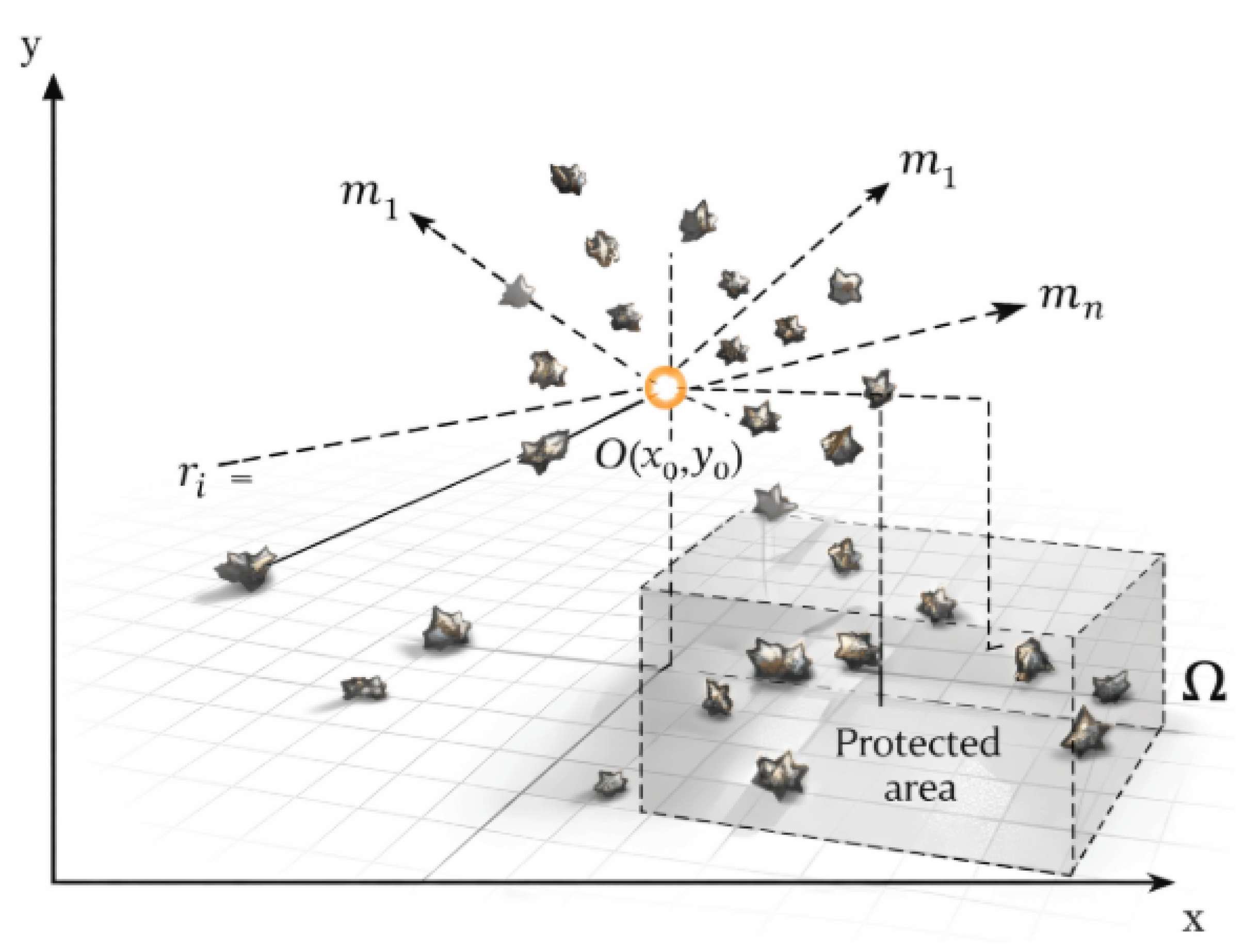
Figure 2.
Multilayer protective systems and components used in occupational safety and fragment mitigation: (a) Schematic diagram of the multi-layered armor system (MAS) that consist of jute fabric reinforced with epoxy [27]; (b) Textile–elastomer multilayer configurations (FSF and SF) combining fabric reinforcement with silicone layers, investigated for flexible impact and fragment mitigation applications [28]; (c) Multilayer protective laminate structure used in industrial workwear, composed of a top fabric layer, intermediate insulation or damping layers, and a back fabric layer [29]; (d) Full-body industrial personal protective equipment designed for hazardous working environments, illustrating integrated multilayer garment construction [30]; (e) Protective clothing in healthcare work [31].
Figure 2.
Multilayer protective systems and components used in occupational safety and fragment mitigation: (a) Schematic diagram of the multi-layered armor system (MAS) that consist of jute fabric reinforced with epoxy [27]; (b) Textile–elastomer multilayer configurations (FSF and SF) combining fabric reinforcement with silicone layers, investigated for flexible impact and fragment mitigation applications [28]; (c) Multilayer protective laminate structure used in industrial workwear, composed of a top fabric layer, intermediate insulation or damping layers, and a back fabric layer [29]; (d) Full-body industrial personal protective equipment designed for hazardous working environments, illustrating integrated multilayer garment construction [30]; (e) Protective clothing in healthcare work [31].
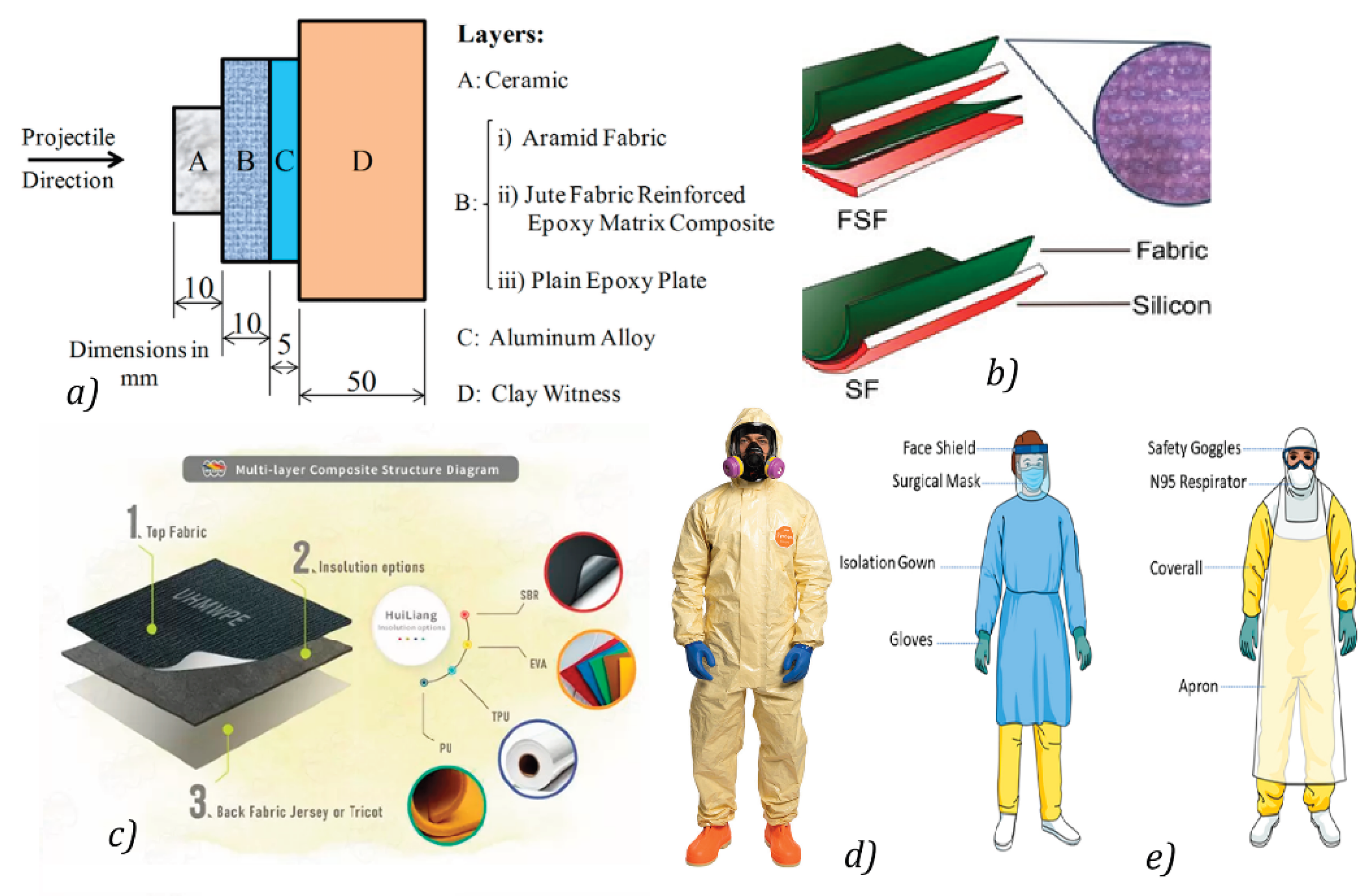
Figure 3.
Representative microscale damage mechanisms in multilayer aramid textile protective systems subjected to impulsive fragment loading [11]: (a) Low-magnification image showing fiber pull-out from yarns; (b) high-magnification image illustrating fiber rupture and progressive damage.
Figure 3.
Representative microscale damage mechanisms in multilayer aramid textile protective systems subjected to impulsive fragment loading [11]: (a) Low-magnification image showing fiber pull-out from yarns; (b) high-magnification image illustrating fiber rupture and progressive damage.
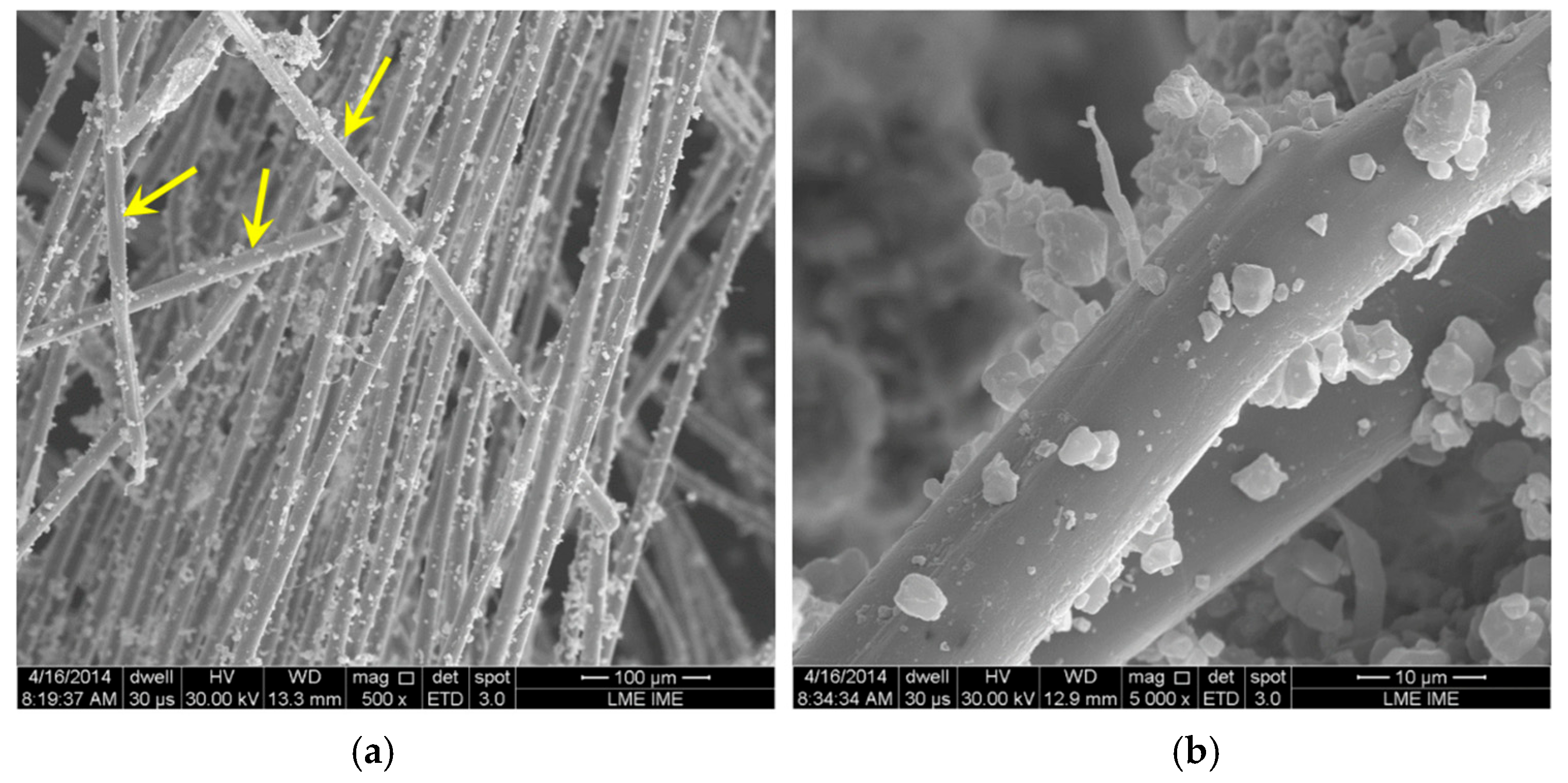
Figure 4.
Fragment dispersion and interaction with the protected zone Ω.
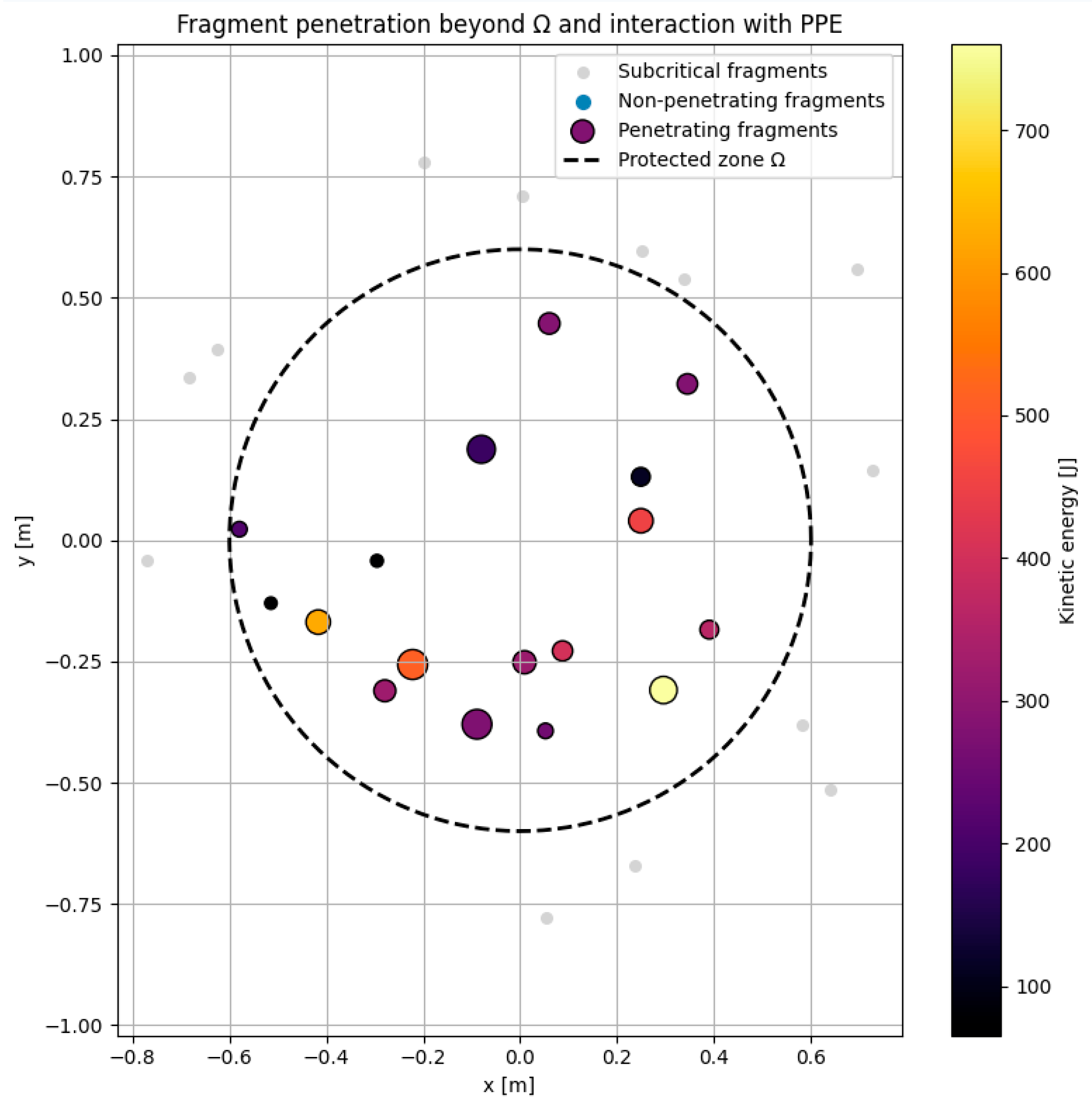
Figure 5.
Absorbed impact energy predicted by the lumped dynamic impact–absorption model as a function of fragment impulse I=mv. The quadratic fit illustrates the analytical scaling Eabs∝I2 for a representative constant value of the equivalent mass Meq.
Figure 5.
Absorbed impact energy predicted by the lumped dynamic impact–absorption model as a function of fragment impulse I=mv. The quadratic fit illustrates the analytical scaling Eabs∝I2 for a representative constant value of the equivalent mass Meq.
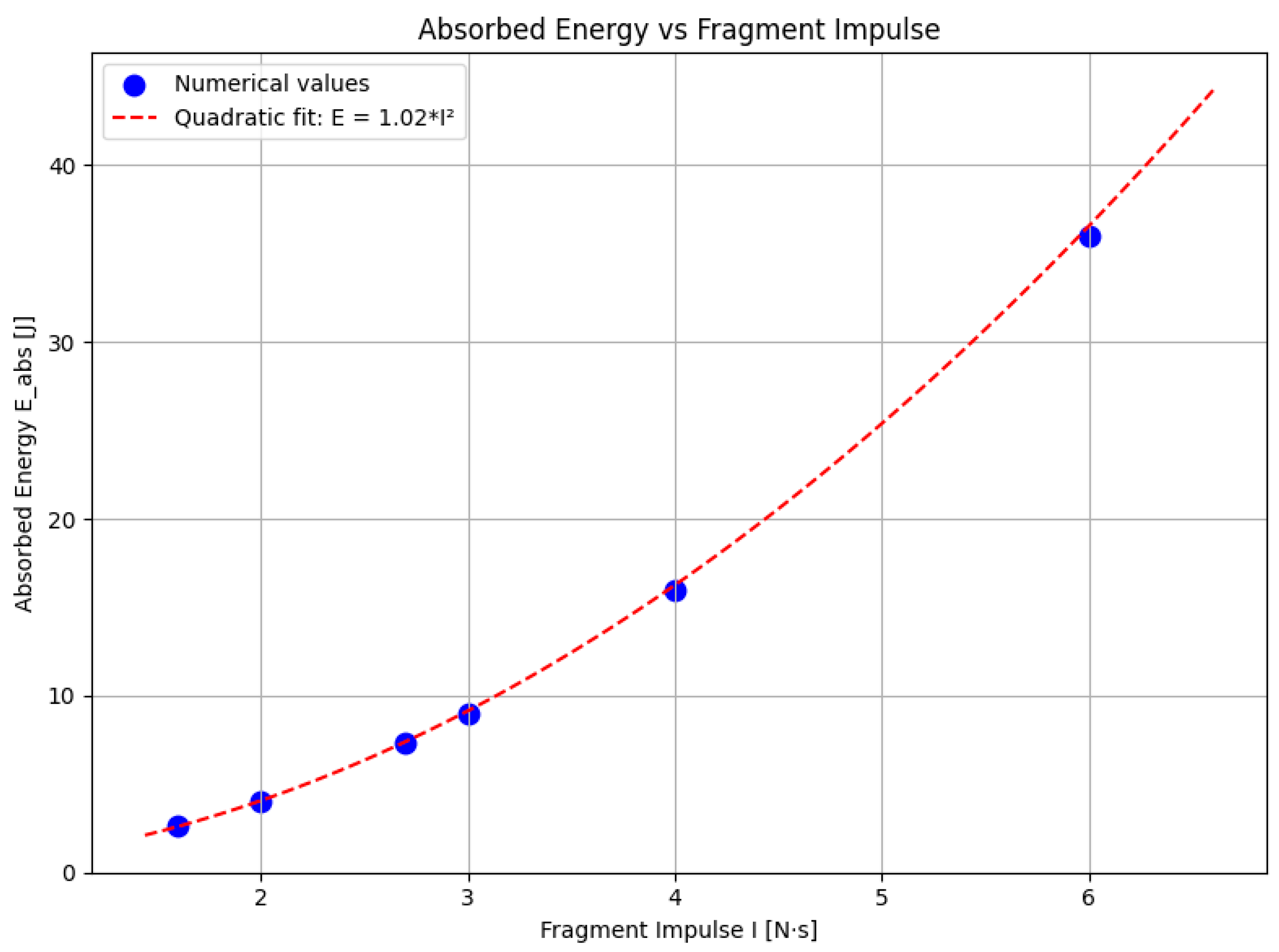
Figure 6.
Schematic cross-sectional representation of the three-layer fragment-resistant PPE system considered in the model. The fragment impacts the outer aramid/Kevlar layer first, followed by progressive energy redistribution in the intermediate composite layer and attenuation in the inner foam damping layer.
Figure 6.
Schematic cross-sectional representation of the three-layer fragment-resistant PPE system considered in the model. The fragment impacts the outer aramid/Kevlar layer first, followed by progressive energy redistribution in the intermediate composite layer and attenuation in the inner foam damping layer.
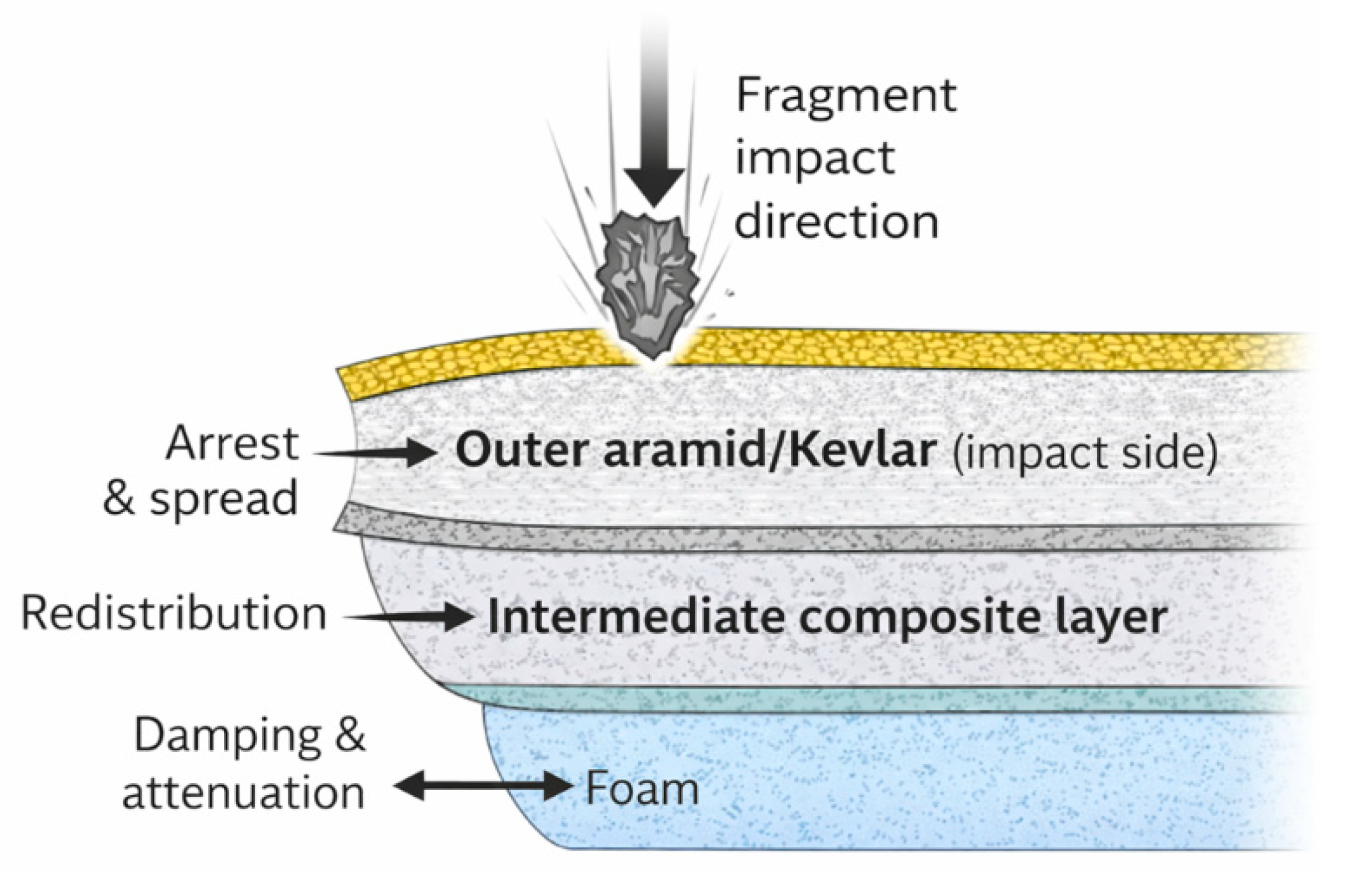
Figure 7.
Representative microstructural images of PPE constituent layers adapted from literature: (a) SEM micrographs of the outer aramid/Kevlar layer before (left) and after (right) ballistic fragment impact, showing fibre deformation and energy absorption mechanisms [32]; (b) SEM image of the composite layer surface post-impact, illustrating fibre/matrix interactions and delamination contributing to progressive energy redistribution [33]; (c) SEM micrograph of open-cell polymer foam showing porous morphology and cell deformation contributing to energy dissipation [34].
Figure 7.
Representative microstructural images of PPE constituent layers adapted from literature: (a) SEM micrographs of the outer aramid/Kevlar layer before (left) and after (right) ballistic fragment impact, showing fibre deformation and energy absorption mechanisms [32]; (b) SEM image of the composite layer surface post-impact, illustrating fibre/matrix interactions and delamination contributing to progressive energy redistribution [33]; (c) SEM micrograph of open-cell polymer foam showing porous morphology and cell deformation contributing to energy dissipation [34].
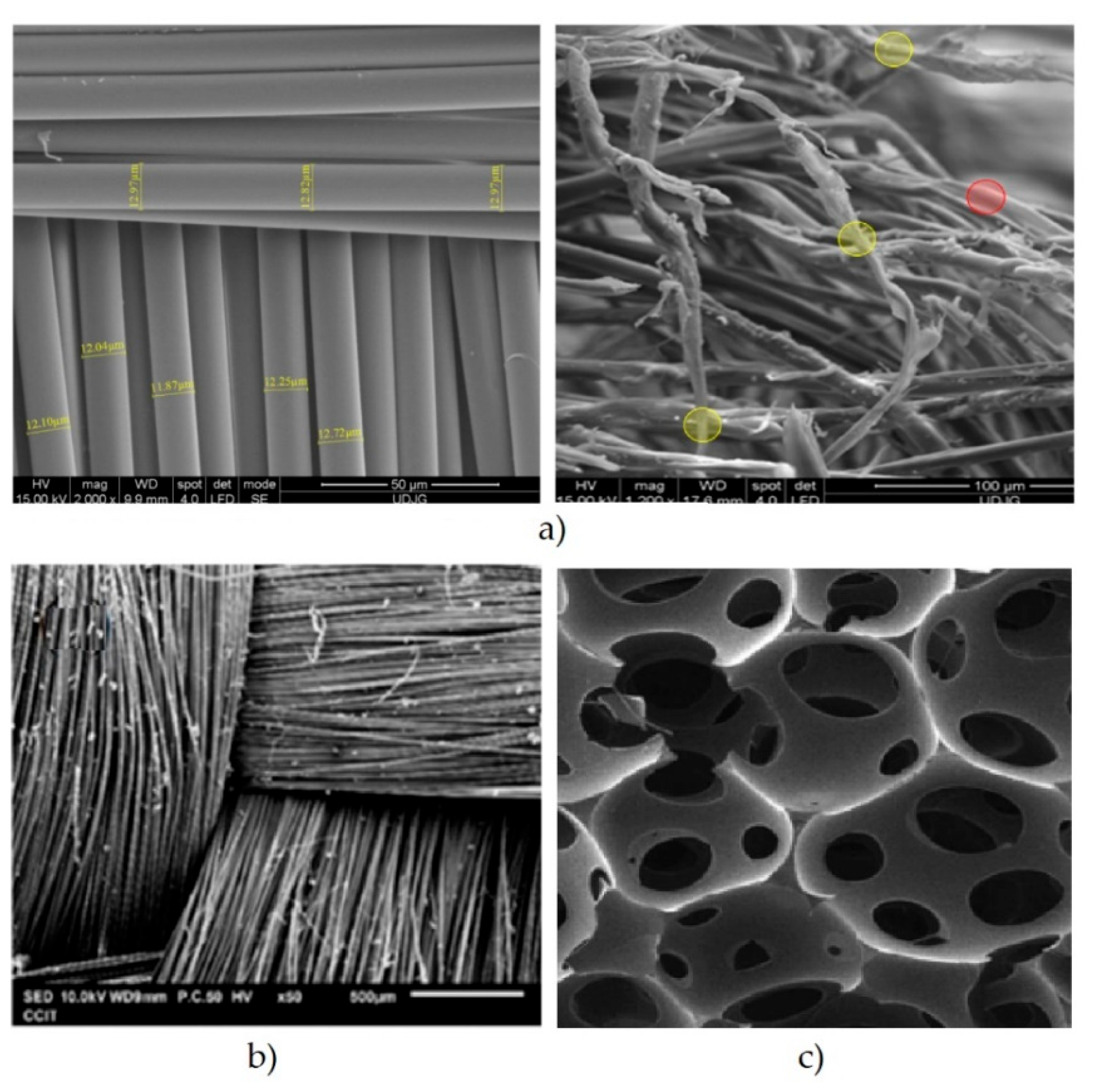
Figure 8.
Three-dimensional reliability surface R(I,N) illustrating the combined influence of fragment impulse I and number of engaged PPE layers N on system reliability, evaluated using the energy-based limit-state formulation.
Figure 8.
Three-dimensional reliability surface R(I,N) illustrating the combined influence of fragment impulse I and number of engaged PPE layers N on system reliability, evaluated using the energy-based limit-state formulation.
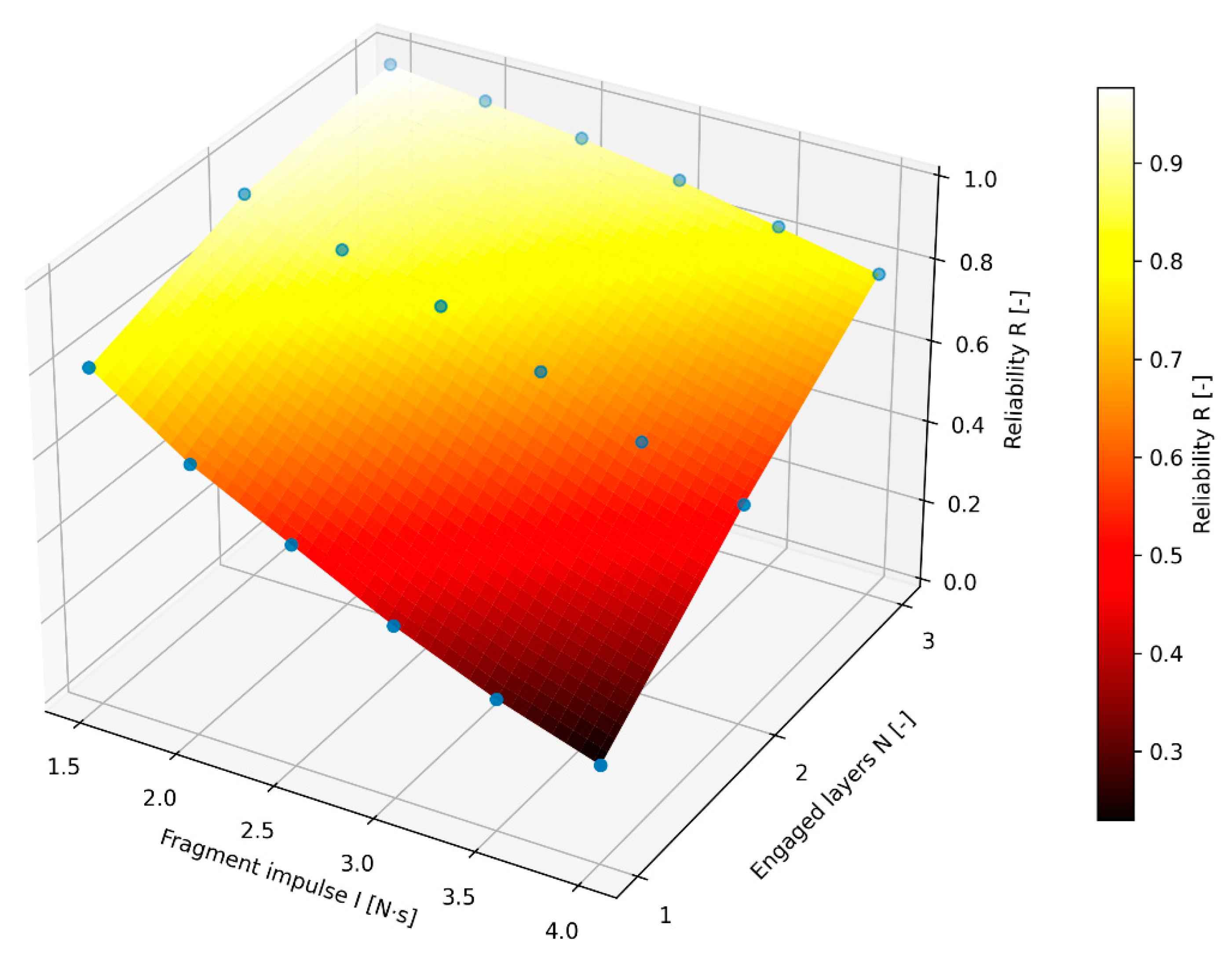
Figure 9.
Two-dimensional projection of Figure 8 showing the evolution of system reliability RRR as a function of fragment impulse I for N=1,2, and 3 engaged PPE layers.
Figure 9.
Two-dimensional projection of Figure 8 showing the evolution of system reliability RRR as a function of fragment impulse I for N=1,2, and 3 engaged PPE layers.
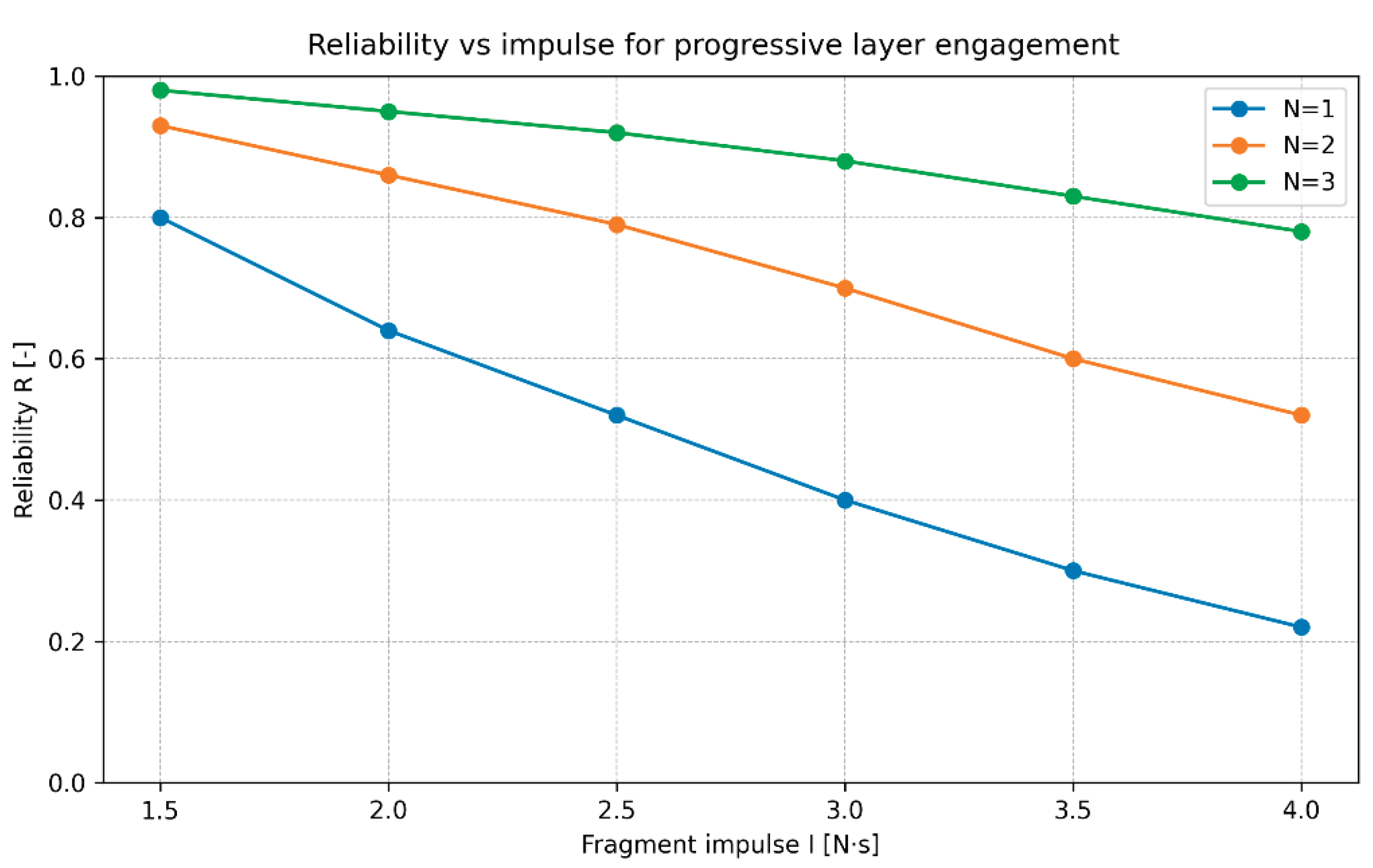
Figure 10.
Comparison of the probability of failure Pf and reliability index R as a function of the number of engaged PPE layers N for a representative fragment impulse I=2.0 Ns.
Figure 10.
Comparison of the probability of failure Pf and reliability index R as a function of the number of engaged PPE layers N for a representative fragment impulse I=2.0 Ns.
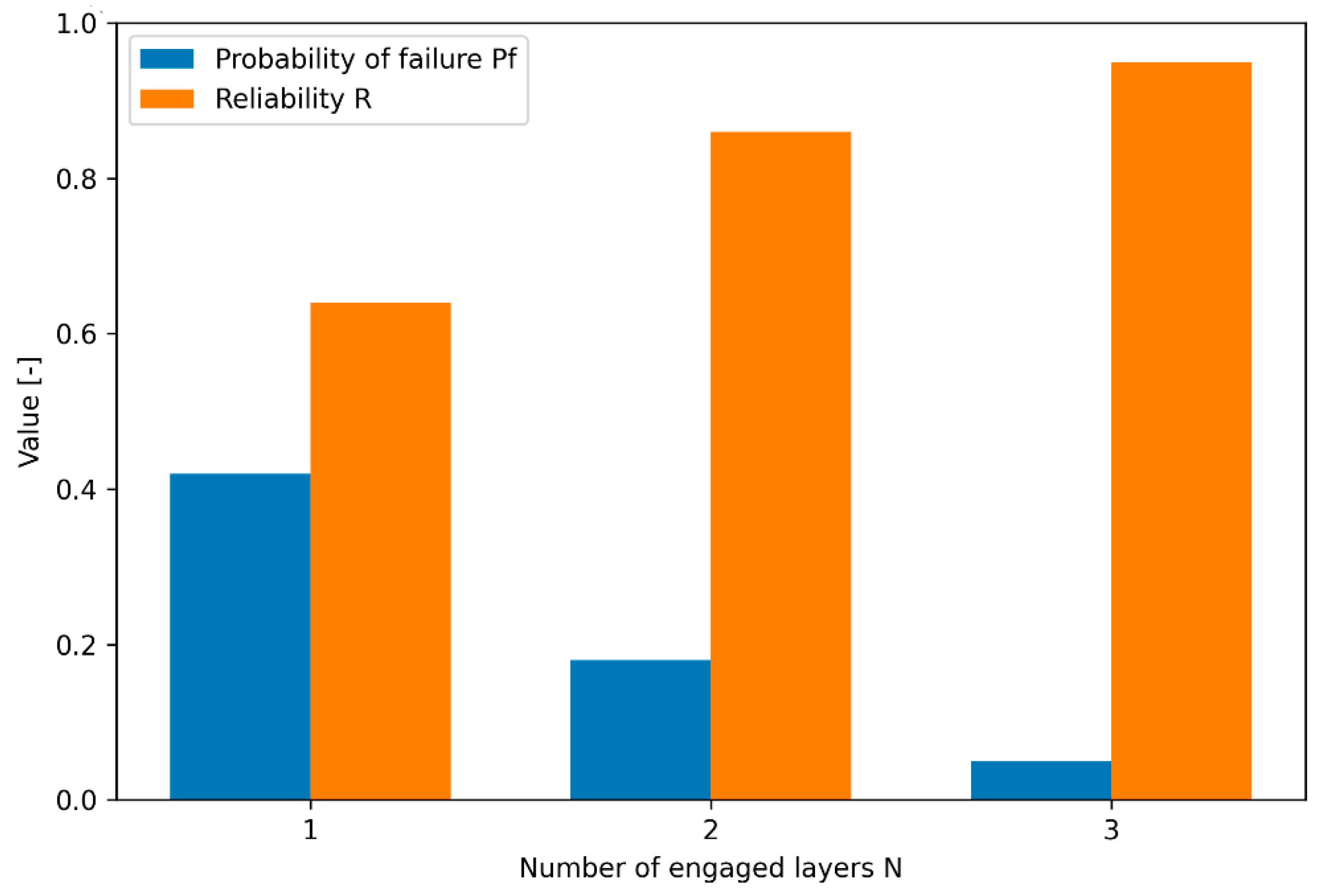
Figure 11.
Sensitivity of system reliability to governing parameters.
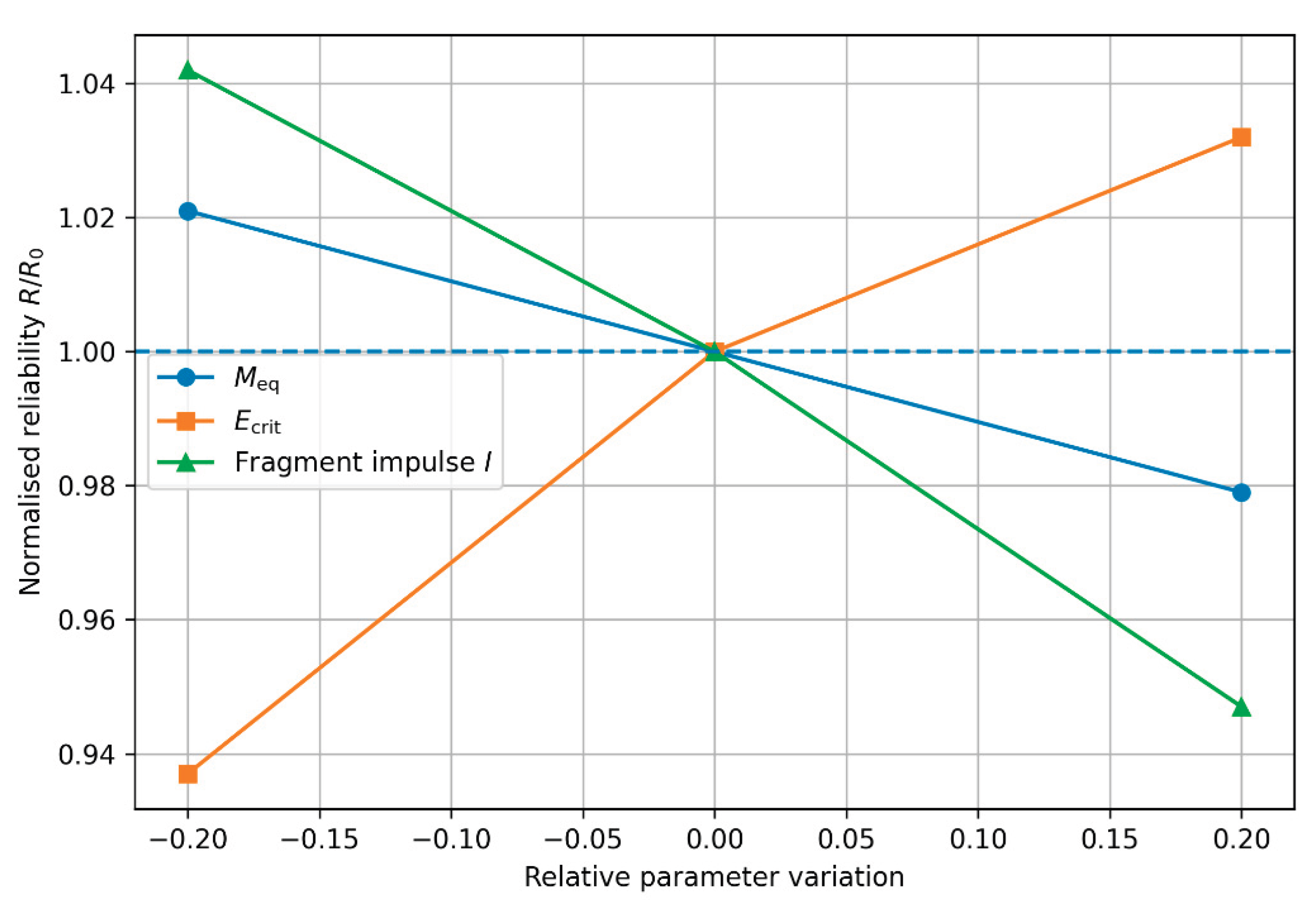

Table 1.
Representative input parameters for Monte Carlo fragment dispersion simulations.
| Parameter | Symbol | Value / Range | Units |
| Fragment mass | mi | 0.02–0.05 | kg |
| Fragment velocity | vi | 80–120 | m/s |
| Impulse | Ii=mivi | derived | Ns |
| Protected zone radius | RΩ | 0.6 | m |
| Number of fragments | Nf | 30 | - |
Table 2.
Multilayer PPE configuration considered in the numerical analysis.
| Layer | Material / Function | Thickness [mm] | Description |
| 1 | Aramid / Kevlar | 2.0 | High-strength fibrous layer for initial impulse mitigation |
| 2 | Composite laminate | 3.0 | Intermediate layer for load redistribution and stiffness |
| 3 | Foam / porous damping layer | 5.0 | Inner layer providing additional attenuation and damping |
Disclaimer/Publisher’s Note: The statements, opinions and data contained in all publications are solely those of the individual author(s) and contributor(s) and not of MDPI and/or the editor(s). MDPI and/or the editor(s) disclaim responsibility for any injury to people or property resulting from any ideas, methods, instructions or products referred to in the content. |
© 2026 by the authors. Licensee MDPI, Basel, Switzerland. This article is an open access article distributed under the terms and conditions of the Creative Commons Attribution (CC BY) license (http://creativecommons.org/licenses/by/4.0/).
Copyright: This open access article is published under a Creative Commons CC BY 4.0 license, which permit the free download, distribution, and reuse, provided that the author and preprint are cited in any reuse.


