
Submitted:
12 February 2026
Posted:
14 February 2026
You are already at the latest version
Abstract
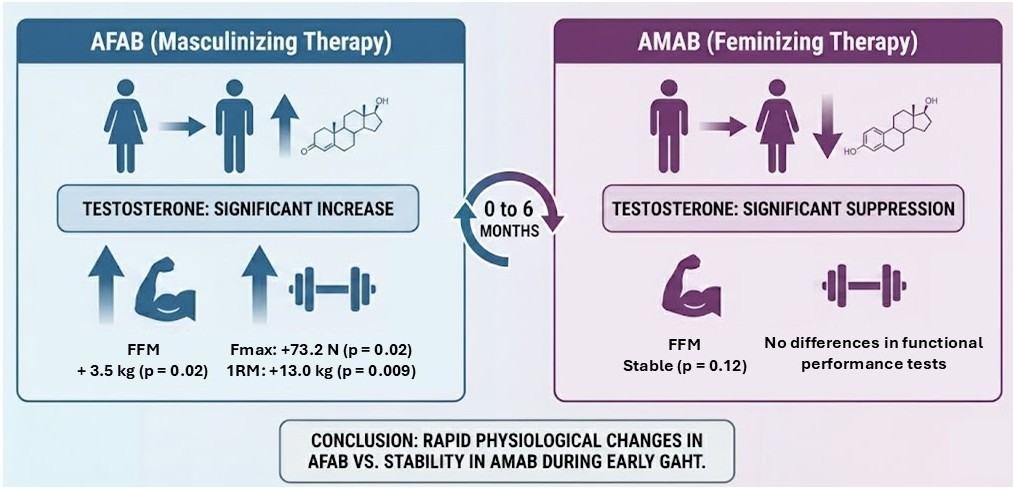
Background/Objectives: Gender-affirming hormone therapy (GAHT) is a cornerstone of medical transition, yet its early effects on physical performance and body composition remain partially explored, particularly in non-athletic individuals. This pilot study aimed to evaluate the short-term, within-individual changes in strength, anthropometry, and body composition in not-athletic transgenders during the first six months of GAHT. Methods: This prospective longitudinal study enrolled 19 participants (8 assigned female at birth [AFAB]; 11 assigned male at birth [AMAB]). Participants were assessed at baseline (T0) and after six months of GAHT (T6). Assessments included bioelectrical impedance analysis (BIA) for body composition, isometric leg extension (maximal force [Fmax] and endurance), 1-repetition maximum (1RM) bench press, handgrip strength (HG), and submaximal cycle ergometry for VO2max estimation. Results: In the AFAB group, GAHT led to a significant increase in total testosterone (TT), fat-free mass (+3.5 kg; p = 0.020), Fmax (p = 0.015), and 1RM bench press (+13.0 kg; p = 0.009). A strong correlation was found between TT increases and 1RM improvements (r = 0.718). Conversely, the AMAB group achieved significant suppression of TT and gonadotropins but exhibited remarkable stability in all anthropometric parameters and functional performance metrics, with no significant declines in strength or cardiorespiratory fitness (p > 0.05). Conclusions: These findings reveal a distinct sexual dimorphism in the early response to GAHT. While AFAB individuals experience rapid functional and anabolic gains, AMAB individuals maintain physical stability during the first six months of therapy. Our findings suggest the recommendation to lifestyle shifts from sedentary to active physical training session in transgender individuals to preserve them from potential metabolic adverse effects of GAHT in the long-term.
Keywords:
Transgender
; physical exercise
; exercise performance
; gender dysphoria
; body composition
; testosterone
; estrogens
Copyright: This open access article is published under a Creative Commons CC BY 4.0 license, which permit the free download, distribution, and reuse, provided that the author and preprint are cited in any reuse.


