
Submitted:
12 February 2026
Posted:
13 February 2026
You are already at the latest version
Abstract
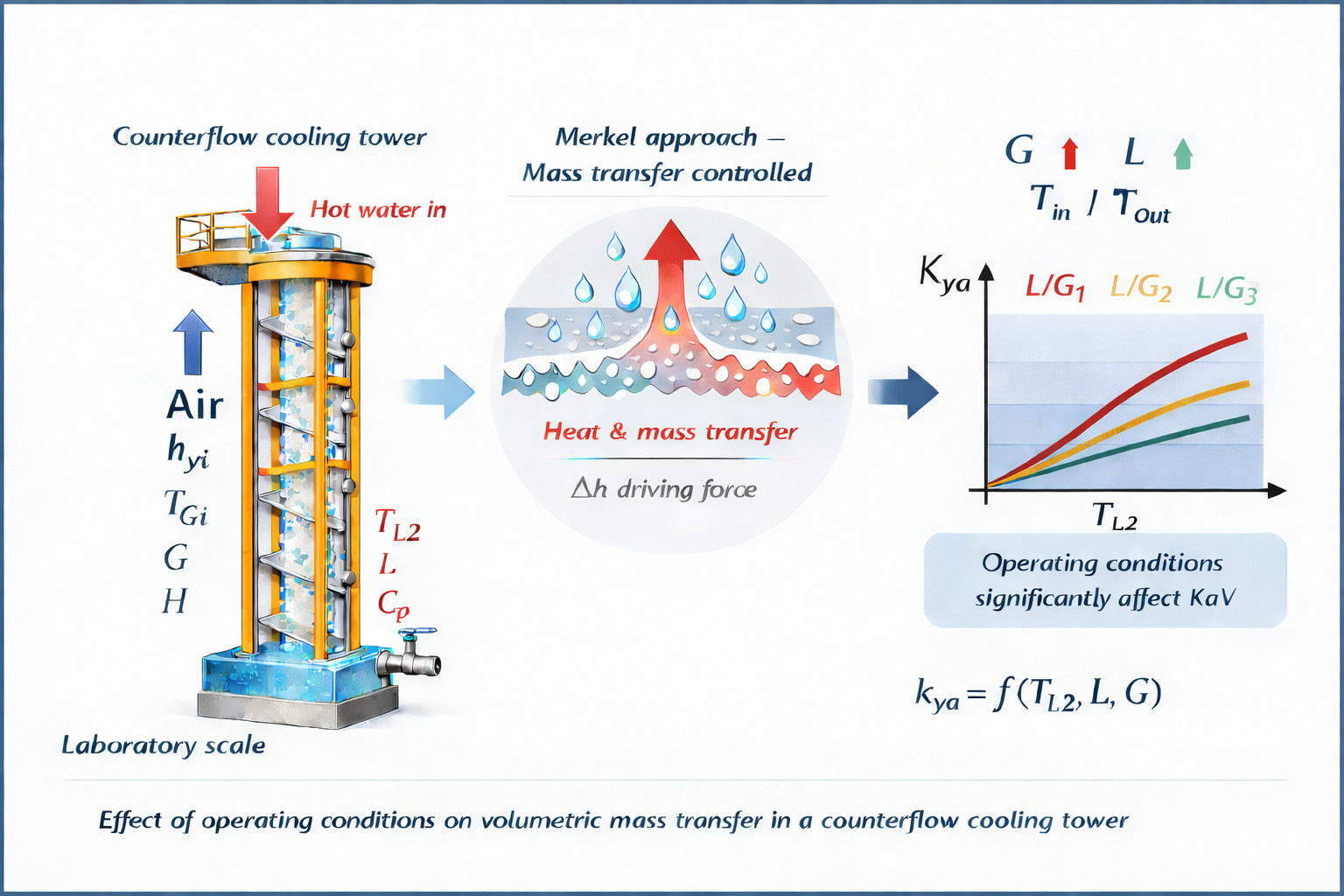
A laboratory–scale mechanical draft cooling tower equipped with eight sections of perforated inclined plates was designed to determine the effect of operating conditions on the volumetric mass transfer coefficient (kya) between water and air. A three–factor, three–level design of experiments (DOE) was implemented, considering liquid mass flow rate L (120, 240, and 360 kg/h), gas mass flow rate G (36, 57, and 75 kg/h), and top water temperature TL2 (50, 60, and 70◦C). A total of 54 runs were performed, and the global volumetric mass transfer coefficient was calculated by combining energy and mass balances with the Mickley method. The experimental data were fitted to a power–law correlation using multivariable regression. The ANOVA showed that TL2 is the dominant factor, followed by L, whereas the influence of G is comparatively small in the studied range. The selected correlation, based on the nominal gas flow rate, achieved R2=0.869 and a RMSE of 5930 kg/(m3h). The kya values were found in the range from 4600 to 62000 kg/(m3h). Vertical temperature profiles of water and air along the column revealed that, for high liquid flow rates, most of the cooling occurs in the lower stages, suggesting that the upper sections are underutilized.
Keywords:
laboratory-scale cooling tower
; evaporative cooling
; volumetric mass transfer coefficient
; operating conditions
; perforated inclined plates
Copyright: This open access article is published under a Creative Commons CC BY 4.0 license, which permit the free download, distribution, and reuse, provided that the author and preprint are cited in any reuse.


