

Submitted:
13 February 2026
Posted:
13 February 2026
You are already at the latest version
Abstract
Forest, wild, and exotic fruits are integral yet often overlooked components of agricultural landscapes in East and Southern Africa. These “hidden harvests” contribute to food and nutrition security, livelihoods, biodiversity conservation, and climate resilience, but remain marginal in dominant food system narratives and policy frameworks. This study aims to systematically synthesise existing evidence on the roles of forest, wild, and exotic fruits within agricultural landscapes of Tanzania, Uganda, Zambia, and Rwanda, with a focus on their nutritional, economic, environmental, and social contributions. A systematic review was conducted in accordance with PRISMA guidelines, drawing on peer-reviewed and selected grey literature published since 2000. Relevant studies were identified through major academic databases and screened using predefined eligibility criteria. The results indicate that fruits significantly enhance dietary diversity and micronutrient intake, provide seasonal food buffers during lean periods, and support income diversification, particularly for women and marginalised groups. Environmentally, fruit trees contribute to ecosystem services, biodiversity conservation, and climate adaptation through agroforestry and landscape-based systems. However, their potential is constrained by governance challenges, tenure insecurity, weak value chains, and policy fragmentation. The study concludes that recognising forest, wild, and exotic fruits as integral components of multifunctional agricultural landscapes is essential for advancing resilient, nutrition-sensitive, and sustainable food systems in the region.
Keywords:
agricultural landscapes
; biodiversity conservation
; food and nutrition security
; forest fruits
; livelihoods
; wild and exotic fruits
1. Introduction
Agricultural landscapes in East and Southern Africa are characterised by high diversity, complexity, and multifunctionality [1]. These landscapes typically integrate crop production, livestock rearing, forest patches, fallow land, wetlands, and homestead gardens, forming dynamic systems that support both livelihoods and ecosystems [1,2,3,4,5]. Smallholder farmers dominate the region’s agriculture, often operating under conditions of climatic variability, land pressure, soil degradation, and limited access to external inputs. As a result, agricultural landscapes have evolved to be adaptive and resilient, drawing on indigenous knowledge and locally available resources to sustain food production, income generation, and environmental stability [6]. Within these heterogeneous landscapes, trees and forests play a critical role, not only for timber and fuelwood but also as sources of diverse foods that complement staple crop-based diets.
Forest fruits, wild fruit trees, and exotic or introduced fruit species are integral components of mixed farming systems across East and Southern Africa. These fruit resources are found in natural forests, woodlands, agroforestry systems, farm boundaries, home gardens, and communal lands [7,8]. Forest and wild fruits often require minimal management, thrive under low-input conditions, and are well adapted to local agroecological zones. Exotic fruits, on the other hand, are frequently incorporated into home gardens and small orchards, contributing to both household consumption and market-oriented production. Together, these fruit types enhance dietary diversity, provide essential micronutrients, generate seasonal income, and serve as safety nets during periods of food scarcity. Their integration into farming systems strengthens ecological functions, such as improving soil fertility, regulating microclimates, and conserving biodiversity, reinforcing the sustainability of agricultural landscapes [9,10,11,12].
Despite their importance, the contributions of forest, wild, and exotic fruits remain largely under-recognised in dominant food system narratives and agricultural development strategies. The concept of “hidden harvests” captures this oversight, referring to food resources that are routinely accessed and consumed by rural households but are poorly documented, undervalued in policy frameworks, and often excluded from national statistics [13,14,15,16,17]. These hidden harvests play a crucial role in bridging seasonal food gaps, supporting nutrition during lean periods, and diversifying diets beyond staple cereals. They also contribute to cultural identity, traditional food systems, and the transmission of indigenous knowledge. However, because they are frequently harvested informally, consumed within households, or traded through local and informal markets, their full significance is rarely captured in conventional assessments of agricultural productivity and food security [18].
The regional context of Tanzania, Uganda, Zambia, and Rwanda offers a rich and diverse setting for examining the role of fruit resources within agricultural landscapes. These countries encompass a wide range of agroecological zones, from humid highlands and lake basins to semi-arid lowlands and savanna ecosystems. Each country has distinct forest types, fruit species diversity, land-use patterns, and policy environments that shape how forest, wild, and exotic fruits are accessed, managed, and utilised. At the same time, they share common challenges, including climate variability, deforestation, land fragmentation, population growth, and nutrition transitions [19]. Understanding how fruit resources contribute to food systems across these varied contexts provides valuable insights into both country-specific dynamics and broader regional patterns.
In Tanzania and Uganda, forest and wild fruits are closely linked to forest-dependent livelihoods and agroforestry systems, particularly in areas adjacent to protected forests and lake ecosystems [20]. In Zambia, fruit trees are widely integrated into farming systems and landscapes characterised by miombo woodlands, where they contribute to food security and income diversification. Rwanda’s densely populated and intensively managed agricultural landscapes highlight the role of home gardens and exotic fruits in supplementing diets and enhancing household resilience. Across all four countries, fruits serve as important connectors between agriculture, forestry, nutrition, and rural livelihoods, yet their roles are often fragmented across sectoral policies and research agendas.
The growing recognition of sustainable food systems, agroecology, and landscape approaches underscores the need to understand better and document the contributions of forest, wild, and exotic fruits. While a substantial body of research exists on agriculture, forestry, and nutrition in East and Southern Africa, evidence on fruit-based resources is scattered across disciplines, methodologies, and geographic scales. Studies vary widely in focus, ranging from species-level assessments and nutritional analyses to livelihood studies and market evaluations [20,21,22,23]. This fragmentation limits the ability to draw comprehensive conclusions about the overall role of fruits within agricultural landscapes and hampers efforts to integrate them into development planning and policy processes.
A systematic review is therefore warranted to synthesise existing evidence, identify patterns and gaps, and provide a coherent understanding of how forest, wild, and exotic fruits contribute to agricultural landscapes in East and Southern Africa. By systematically examining peer-reviewed and grey literature from Tanzania, Uganda, Zambia, and Rwanda, this review aims to consolidate knowledge on the nutritional, economic, environmental, and social functions of fruit resources. Such synthesis is critical for informing research, policy, and practice, particularly in the context of climate change, biodiversity loss, and persistent food and nutrition insecurity [24].
The objectives of this systematic review are threefold. First, it seeks to assess the extent and nature of existing evidence on the contributions of forest, wild, and exotic fruits to food and nutrition security within agricultural landscapes. Second, it aims to examine the livelihood, economic, and environmental roles of these fruit resources, including their integration into farming systems and value chains [25]. Third, the review aims to identify key constraints, trade-offs, and knowledge gaps that affect the sustainable management and use of fruit resources across the region. Guided by these objectives, the review addresses the following questions: What roles do forest, wild, and exotic fruits play in supporting food systems and livelihoods in agricultural landscapes? How do these roles vary across countries and agroecological contexts? What opportunities exist to better integrate fruit resources into sustainable agriculture and food system strategies? By answering these questions, the review helps reframe fruits as visible, valuable, and integral components of resilient agricultural landscapes rather than as overlooked or marginal resources.
2. Literature Review
2.1. Conceptual Framework
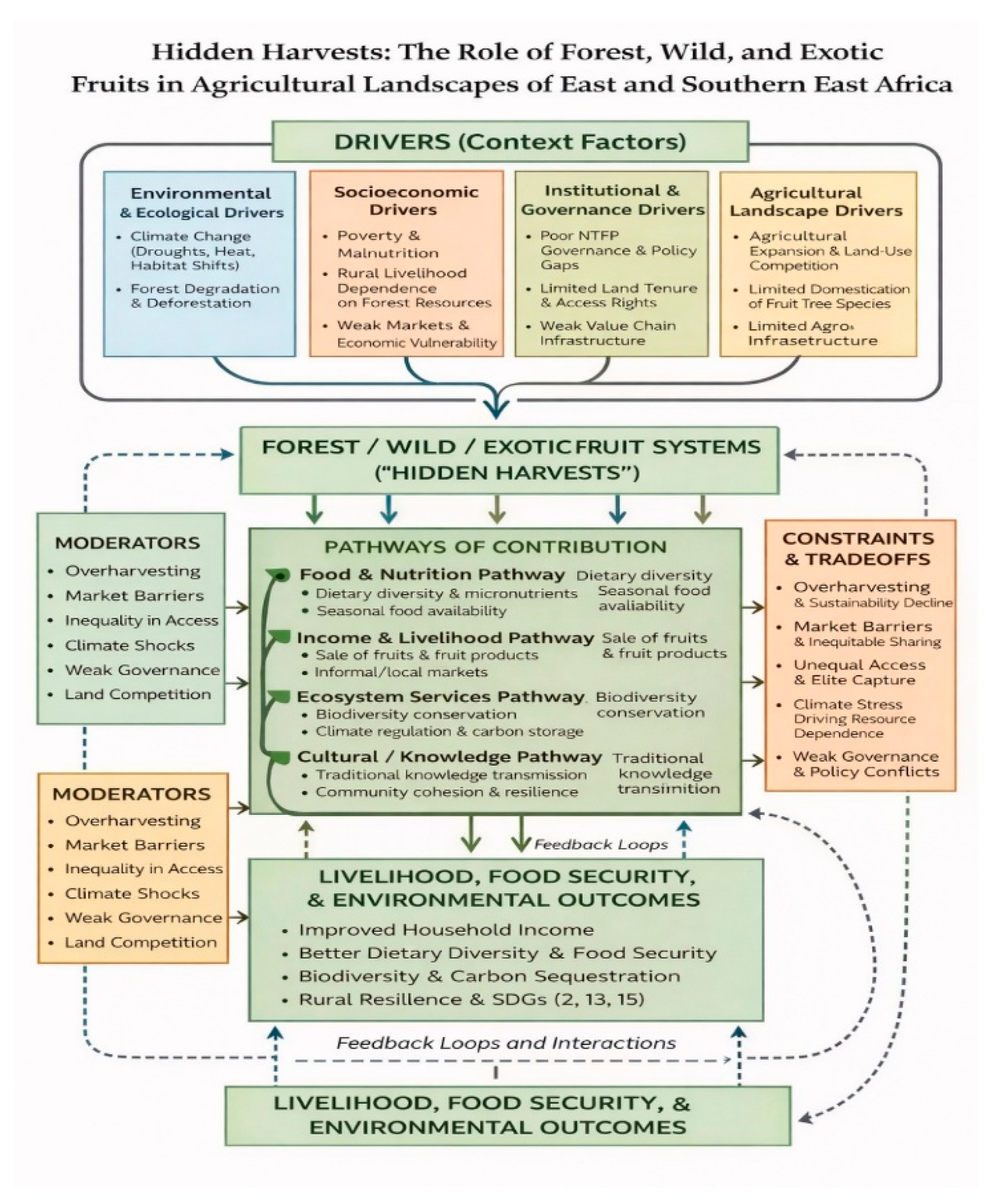
Understanding the role of forest, wild, and exotic fruits in agricultural landscapes requires a conceptual framework that situates fruit resources within interconnected food, livelihood, and ecological systems. In East and Southern Africa, agricultural landscapes are not composed solely of crop fields but represent mosaics of farms, forests, fallows, grazing lands, wetlands, and homesteads [23,24,25,26,27,28,29]. Within these multifunctional landscapes, fruit-bearing trees and shrubs function as biological, economic, and cultural assets. The conceptual framework adopted in this review emphasises the classification of fruit resources, the multiple pathways through which they contribute to food systems and ecosystem sustainability, and how these resources are integrated into agricultural landscapes.
Figure 1.
The Conceptual framework of the study.
2.2. Definition and Classification of Fruit Resources
Fruit resources in agricultural landscapes can be broadly classified into forest fruits, wild fruit trees, and exotic or introduced fruit species [26]. Although these categories may overlap in practice, distinguishing them conceptually is important for understanding their origins, management regimes, and contributions to food systems.
Forest fruits are derived from trees and shrubs that occur naturally within forest ecosystems, woodlands, and protected or semi-protected areas. These fruits are typically harvested from natural stands rather than cultivated, and their availability is closely linked to forest health and seasonal ecological cycles [27]. Forest fruits often play a critical role in subsistence and supplementary nutrition, particularly for households living adjacent to forests. They are frequently consumed fresh, processed locally, or sold in informal markets. Because forest fruits are embedded within broader forest ecosystems, their availability is influenced by land-use change, forest governance, and conservation policies.
Wild fruit trees are fruit-bearing species that occur naturally in non-forest settings, such as farmlands, fallows, grazing areas, and communal lands. Unlike forest fruits, wild fruit trees are often intentionally retained by farmers in agricultural landscapes for their perceived benefits. These trees may be protected during land clearing, selectively managed, or lightly domesticated over time [28]. Wild fruit trees represent a bridge between natural ecosystems and cultivated agriculture, offering fruits adapted to local environmental conditions and requiring minimal external inputs. Their presence reflects long-standing indigenous knowledge systems that recognize the multifunctionality of trees within farming systems [29,30].
Exotic or introduced fruit species are fruit trees that originate outside local ecosystems but have been introduced through trade, colonial agricultural expansion, or modern development initiatives. These species are commonly cultivated in home gardens, orchards, or agroforestry systems and are often more closely associated with market-oriented production. Exotic fruits can provide reliable yields, income opportunities, and dietary diversity, particularly in peri-urban and densely populated rural areas. However, their integration into local landscapes depends on access to planting material, water, management knowledge, and markets [31].
Together, these three categories of fruit resources form a continuum ranging from wild and forest-based to semi-managed and fully cultivated systems. This continuum highlights the diverse ecological niches, management intensities, and socio-economic roles that fruits occupy within agricultural landscapes [32].
2.3. Pathways of Contribution to Food and Nutrition Security
One of the primary pathways through which forest, wild, and exotic fruits contribute to agricultural landscapes is food and nutrition security. Fruits are rich sources of vitamins, minerals, dietary fibre, and bioactive compounds that complement staple-based diets dominated by cereals and roots. In many rural households, fruits play a crucial role in improving dietary diversity, particularly for women and children [33].
Forest and wild fruits are especially important during seasonal food shortages, when staple crops are scarce or when households face economic constraints. Their availability often coincides with lean seasons, providing a buffer against hunger and micronutrient deficiencies. Exotic fruits, particularly those grown in home gardens, contribute to year-round access to fresh foods and can enhance household nutrition when consumed regularly. The conceptual framework recognises fruits as both primary and supplementary food sources, contributing to everyday diets and serving as fallback foods during crises.
Beyond direct consumption, fruits also support food security through processing and preservation methods such as drying, fermenting, and juicing. These practices extend shelf life and allow fruits to be consumed beyond their harvest season. By diversifying food sources and stabilising food availability across seasons, fruit resources strengthen the resilience of household food systems [33].
2.4. Livelihoods and Income Diversification Pathways
Fruit resources also contribute to agricultural landscapes through pathways of livelihood and income diversification. The harvesting, processing, and sale of fruits generate cash income for rural households, often requiring relatively low capital investment. Wild and forest fruits are frequently traded in local and informal markets, providing income opportunities for women, youth, and marginalised groups [34]. Exotic fruits, particularly those with higher market demand, can serve as important cash crops for smallholder farmers.
Income derived from fruits is often seasonal and complementary to crop and livestock production. This diversification reduces reliance on a single income source and enhances household economic resilience in the face of climate shocks, market volatility, or crop failure. Fruit-based value chains, although often underdeveloped, have the potential to create employment opportunities in processing, transport, and marketing. The conceptual framework highlights the role of fruits in spreading economic risk and supporting adaptive livelihood strategies within agricultural landscapes [35].
2.5. Contributions to Biodiversity Conservation
Forest, wild, and exotic fruits play a significant role in biodiversity conservation within agricultural landscapes. Fruit-bearing trees and shrubs provide habitats and food sources for a wide range of wildlife, including birds, insects, and mammals. By maintaining tree cover and structural diversity, fruit resources enhance landscape connectivity and ecological stability [36,37].
Wild and forest fruit trees contribute to the conservation of indigenous plant species and genetic diversity. Their retention within farmlands supports in situ conservation and helps maintain ecological functions that are often lost in simplified agricultural systems. Even exotic fruit trees, when integrated thoughtfully, can contribute to landscape heterogeneity and reduce pressure on natural forests by providing alternative sources of food and income. The framework positions fruits as key elements in reconciling agricultural production with biodiversity conservation [38].
2.6. Climate Resilience and Ecosystem Services
Another critical pathway through which fruit resources contribute to agricultural landscapes is their role in enhancing climate resilience and providing ecosystem services. Trees moderate microclimates, reduce soil erosion, enhance water infiltration, and contribute to soil fertility through organic matter inputs: fruit trees, particularly those integrated into agroforestry systems, help stabilise production systems under variable climatic conditions.
Forest and wild fruit trees are often highly adapted to local climates and can withstand droughts, pests, and poor soils. Their resilience makes them valuable assets in climate change adaptation strategies. Exotic fruits, when appropriately selected, can also enhance resilience by diversifying production systems and reducing dependence on climate-sensitive staple crops. Additionally, fruit trees contribute to carbon sequestration, supporting climate mitigation goals at landscape and national scales [40].
2.7. Integration of Fruits Within Agricultural Landscapes
The integration of forest, wild, and exotic fruits within agricultural landscapes occurs through multiple spatial and institutional arrangements. Fruits may be harvested from natural forests, retained on farmlands, planted along boundaries, incorporated into agroforestry systems, or cultivated in home gardens [23,24]. These integration pathways reflect local land-use practices, tenure systems, cultural values, and policy environments.
The conceptual framework emphasises that fruit resources are not isolated components but are embedded within broader socio-ecological systems. Governance structures, access rights, market dynamics, and knowledge systems shape their contributions. Effective integration of fruits into agricultural landscapes requires recognising their multifunctionality and aligning agricultural, forestry, nutrition, and climate policies [2].
This conceptual framework positions forest, wild, and exotic fruits as central yet often overlooked components of agricultural landscapes in East and Southern Africa. By tracing their contributions to food and nutrition security, livelihoods, biodiversity conservation, and climate resilience, the framework provides a foundation for synthesising empirical evidence and identifying opportunities to make hidden harvests more visible, valued, and sustainably managed [1,4].
3. Methods
3.1. Review Design
This study adopts a systematic review design to synthesise empirical evidence on the role of forest, wild, and exotic fruits in agricultural landscapes of East and Southern Africa. A systematic approach was used to ensure transparency, rigour, and reproducibility in identifying, selecting, and synthesising relevant literature. The review follows the principles and reporting structure outlined in the Preferred Reporting Items for Systematic Reviews and Meta-Analyses (PRISMA) guidelines. These guidelines provide a structured framework for minimising bias and enhancing the reliability of review findings through clearly defined search, screening, and selection procedures.
The review was designed to capture multidisciplinary evidence spanning agriculture, forestry, nutrition, ecology, and rural livelihoods. Given the inherently cross-sectoral nature of fruit resources in agricultural landscapes, the systematic review approach enables the integration of diverse study designs, including quantitative, qualitative, and mixed-methods studies. This design supports a comprehensive assessment of how fruit resources function as “hidden harvests” across ecological, socio-economic, and institutional dimensions in Tanzania, Uganda, Zambia, and Rwanda.
3.2. Search Strategy
A comprehensive, structured search strategy was developed to identify peer-reviewed and relevant grey literature on forest, wild, and exotic fruits in agricultural landscapes. Multiple academic databases were consulted to ensure broad disciplinary coverage and minimise the risk of omitting relevant studies. The primary databases included Scopus, Web of Science, Google Scholar, and AGRIS. These databases were selected because they collectively cover a wide range of journals and publications in agriculture, forestry, food systems, environmental sciences, and development studies.
Search strings were constructed from combinations of keywords related to fruit categories, agricultural landscapes, and outcome domains aligned with the study's conceptual framework. Boolean operators were used to refine and expand search results, enabling the capture of studies that address multiple dimensions of fruit contributions. Keywords included terms related to forest fruits, wild fruit trees, exotic or introduced fruits, agroforestry, agricultural landscapes, food and nutrition security, livelihoods, biodiversity, ecosystem services, and climate resilience. Synonyms and alternative spellings were incorporated to ensure inclusivity across disciplinary terminologies.
The search was conducted within a defined temporal scope to capture both foundational and recent evidence on fruit resources in agricultural landscapes. Studies published from 2000 onwards were considered, reflecting the period during which integrated landscape approaches, agroecology, and nutrition-sensitive agriculture gained prominence in research and policy discourse (Table 1). Only publications written in English were included due to feasibility constraints and the dominance of English-language publications in the selected databases. Reference lists of key articles were also screened to identify additional relevant studies that may not have been captured through database searches.
3.3. Eligibility Criteria
Clear eligibility criteria were established to guide the screening and selection of studies and ensure alignment with the review objectives. Inclusion criteria focused on geographic relevance, study content, and outcome measures. Studies were included if they were conducted in Tanzania, Uganda, Zambia, or Rwanda, or if they presented comparative evidence including at least one of these countries. The review considered empirical studies that examined forest fruits, wild fruit trees, exotic or introduced fruit species, or combinations thereof within agricultural or forest–agriculture interface landscapes.
Eligible study types included quantitative analyses, qualitative case studies, mixed-methods research, and systematic or scoping reviews that provided primary or synthesised evidence on fruit-related outcomes. Outcomes of interest encompassed contributions to food and nutrition security, livelihood and income diversification, biodiversity conservation, climate resilience, and ecosystem services. Studies addressing fruit production, harvesting, utilisation, processing, marketing, or governance were included, provided they explicitly linked fruits to agricultural landscapes or rural food systems.
Exclusion criteria were applied to maintain focus and analytical coherence. Studies conducted outside the four target countries without transferable or comparative relevance were excluded. Research that focused exclusively on staple crops, non-fruit-tree products, or industrial fruit plantations, without landscape or smallholder relevance, was also excluded. Opinion pieces, editorials, and publications lacking empirical evidence were omitted. Additionally, studies that mentioned fruits only tangentially, without substantive analysis of their roles or outcomes, were excluded from the final synthesis.
Together, these methodological procedures ensure that the systematic review provides a robust, transparent, and comprehensive assessment of the role of forest, wild, and exotic fruits as hidden harvests within agricultural landscapes of East and Southern Africa.
3.4. Study Selection
The study selection process was conducted in a structured, transparent manner to ensure alignment with the objectives of the systematic review and to minimise selection bias. Following the database searches, all retrieved records were exported into a reference management system, where duplicate entries were identified and removed. The remaining records underwent a three-stage screening process: title screening, abstract screening, and full-text review.
During the title screening stage, studies were assessed for broad relevance to forest fruits, wild fruit trees, exotic fruit species, and agricultural landscapes within the geographical scope of Tanzania, Uganda, Zambia, and Rwanda. Titles that clearly fell outside the thematic or geographic focus of the review were excluded at this stage. The abstract screening stage involved a more detailed assessment of relevance, with abstracts evaluated against the predefined eligibility criteria, including fruit categories, study context, and outcome domains related to food and nutrition security, livelihoods, biodiversity, and climate resilience. Studies that appeared relevant but lacked sufficient detail were retained for full-text assessment to avoid premature exclusion.
Full-text screening was the final selection stage, in which articles were examined in detail to confirm their eligibility. This stage involved careful evaluation of study objectives, methodologies, geographic coverage, and reported outcomes to ensure alignment with the conceptual framework of hidden harvests in agricultural landscapes. Only studies that explicitly addressed the role or contributions of forest, wild, or exotic fruits within agricultural or forest–agriculture interface landscapes were included in the final synthesis. The entire selection process was documented using a PRISMA flow diagram, which illustrates the number of records identified, screened, excluded, and included at each stage. This diagram provides a clear overview of the decision-making process and enhances the review's reproducibility.
3.5. Data Extraction
The literature search was conducted between July and November 2025 using the following international databases and publisher platforms: Web of Science Core Collection, Scopus, IEEE Xplore, ScienceDirect, SpringerLink, and MDPI journals (including Sensors, Forests, and Remote Sensing). The search strategy applied keyword combinations such as “forest monitoring IoT”, “smart forest”, “Forest 4.0”, “Forest 5.0”, “digital twin forestry”, “AI wildfire detection”, “IoT carbon sequestration”, “sustainable forest management IoT”, and “IoT biodiversity monitoring”.
A total of 135 records published between 2020 and 2025 were initially identified. After removing 8 duplicates, 127 records remained for screening (Figure 2). During title and abstract screening, 38 records were excluded due to limited relevance to forestry applications. The remaining 89 full-text articles were assessed for eligibility, and 60 studies were excluded because they did not fit the review's methodological scope (e.g., focused on non-forestry domains such as agriculture, horticulture, or urban IoT systems, or lacked sufficient methodological detail). Ultimately, 29 peer-reviewed articles met the inclusion criteria and were included in the final narrative synthesis.
3.6. Quality Assessment
To ensure the robustness and credibility of the review findings, the methodological quality and risk of bias of included studies were systematically assessed. Given the diversity of study designs in the review, different quality assessment tools were used for qualitative, quantitative, and mixed-methods studies. Quantitative studies were evaluated based on criteria such as clarity of research design, appropriateness of sampling methods, validity and reliability of data collection instruments, and transparency of data analysis procedures. Qualitative studies were assessed for methodological rigour, including clarity of research questions, appropriateness of data collection methods, depth of analysis, and reflexivity.
For mixed-methods studies, the assessment focused on the coherence and integration of qualitative and quantitative components, as well as the extent to which methodological triangulation enhanced the validity of findings. Studies were also examined for potential sources of bias, including selection bias, reporting bias, and contextual limitations. Rather than excluding studies solely on quality, the assessment informed the interpretation and weighting of evidence in the synthesis.
The quality assessment process strengthened the reliability of the systematic review by ensuring that the conclusions were grounded in methodologically sound, contextually relevant evidence. By explicitly considering study rigour and potential biases, the review provides a balanced and credible synthesis of how forest, wild, and exotic fruits contribute to agricultural landscapes and food systems in East and Southern Africa.
4. Results: Overview of the Evidence Base
4.1. Temporal and Spatial Distribution of Studies
The body of literature examining forest, wild, and exotic fruits within agricultural landscapes of East and Southern Africa has expanded steadily over the past two decades. Early studies primarily focused on ethnobotanical documentation and the subsistence uses of wild fruits, often framed within the disciplines of forestry or anthropology. More recent research reflects a broader systems perspective, incorporating nutrition, livelihoods, agroforestry, biodiversity conservation, and climate resilience [13]. This temporal evolution mirrors the growing recognition of multifunctional landscapes and the integration of food systems thinking into agricultural and environmental research.
Spatially, the evidence base is unevenly distributed across the four countries. Research clusters are often concentrated in ecologically rich or policy-relevant regions, such as forest margins, agroforestry hotspots, and areas experiencing rapid land-use change. While some landscapes have been extensively studied, others, particularly dryland and remote rural areas, remain underrepresented. This uneven spatial coverage highlights both the richness of localised evidence and the need for broader, comparative analyses across agroecological zones [15].
4.2. Country-Level Evidence
In Tanzania, the literature emphasises forest-dependent livelihoods and the role of wild and forest fruits in supplementing diets and incomes, particularly in communities adjacent to natural forests and woodlands. Studies frequently document the importance of seasonal fruit availability for food security and cultural practices, as well as emerging challenges related to forest access and conservation restrictions [14].
Uganda’s evidence base reflects its diverse agroecological zones and relatively strong tradition of agroforestry research. Many studies explore the integration of fruit trees into farming systems, home gardens, and smallholder landscapes. Research also highlights the nutritional importance of fruits and their role in buffering households against food shortages, particularly in densely populated rural areas [23].
In Zambia, studies commonly focus on wild and semi-managed fruit trees within miombo woodland-dominated landscapes. Fruits are often examined in relation to livelihood diversification, informal markets, and seasonal coping strategies. There is also growing attention to the role of fruit trees in climate resilience and landscape restoration initiatives.
Rwanda’s literature is more limited in volume but offers valuable insights into intensively managed agricultural landscapes. Research emphasises home gardens, exotic fruits, and land-use intensification, highlighting how fruit trees contribute to dietary diversity and income generation under conditions of land scarcity [18,19,20,21,22,23,24,25].
Across all four countries, the evidence underscores the centrality of fruit resources to rural livelihoods and food systems, while also revealing significant variation in research focus and depth.
4.3. Dominant Research Themes and Methodologies
The reviewed studies span multiple disciplines and methodological approaches. Dominant research themes include food and nutrition security, livelihood diversification, agroforestry systems, biodiversity conservation, and climate adaptation [26]. Methodologically, qualitative approaches such as household surveys, ethnographic studies, and participatory rural appraisals are common, particularly in studies documenting traditional knowledge and fruit use patterns [27]. Quantitative methods, including dietary assessments, income analyses, and ecological surveys, are increasingly employed to quantify contributions and outcomes. Mixed-methods studies provide particularly rich insights by linking socio-economic data with ecological and nutritional indicators.
4.4. Key Species and Fruit Types Studied
The literature documents a wide diversity of fruit species, ranging from indigenous forest fruits and wild fruit trees to widely cultivated exotic species. Indigenous fruits are often valued for their adaptability, nutritional richness, and cultural significance, while exotic fruits are associated with market opportunities and year-round availability. However, the depth of analysis varies considerably by species, with some receiving repeated attention while others remain poorly studied despite their local importance [29].
4.5. Contributions of Fruits to Food and Nutrition Security
4.5.1. Dietary Diversity and Micronutrient Intake
A consistent finding across the evidence base is the positive contribution of forest, wild, and exotic fruits to dietary diversity. Fruits provide essential vitamins and minerals that complement staple-dominated diets and help address micronutrient deficiencies [31]. Indigenous fruits, in particular, are often nutrient-dense and contribute significantly to household nutrition when consumed regularly.
4.5.2. Seasonal Food Availability and Hunger Mitigation
Fruits play a critical role in mitigating seasonal hunger by providing food during periods when staple crops are scarce. Wild and forest fruits often mature during lean seasons, serving as fallback foods that reduce reliance on food aid or market purchases. Exotic fruits cultivated in home gardens further enhance year-round food availability [32].
4.5.3. Role in Child, Women, and Household Nutrition
The literature highlights the disproportionate importance of fruit for women and children, who are often responsible for collecting and preparing it. Fruits contribute to maternal and child nutrition and are frequently among the first foods introduced to young children. Their accessibility and cultural acceptability make them vital components of household diets [27].
4.5.4. Traditional Food Systems and Cultural Relevance
Fruits are deeply embedded in traditional food systems and cultural practices. They are associated with seasonal rituals, medicinal uses, and social identity. The erosion of access to wild and forest fruits, therefore, has implications not only for nutrition but also for cultural continuity [40].
4.6. Livelihood and Economic Contributions
4.6.1. Income Generation and Market Participation
Fruit harvesting and sale provide important sources of cash income, particularly for rural households with limited access to formal employment. Income from fruits is often used to meet basic needs such as food, education, and healthcare. While much of this trade occurs through informal markets, it represents a vital economic activity [11].
4.6.2. Gendered Roles in Harvesting, Processing, and Marketing
The literature consistently highlights the central role of women in the harvesting, processing, and marketing of forest, wild, and exotic fruits across agricultural landscapes in East and Southern Africa. Fruit-related activities are often embedded within women’s traditional responsibilities for household food provisioning, nutrition, and care, positioning them as primary custodians of knowledge related to fruit species, seasonal availability, processing methods, and uses. Women frequently lead the collection of wild and forest fruits, particularly those located near homesteads, communal lands, and forest edges, and are often responsible for determining how fruits are allocated between household consumption, processing, and sale [3].
Processing activities such as drying, fermenting, and transforming fruits into juices, jams, or preserves are also predominantly carried out by women. These practices not only extend the shelf life of fruits but also add value and increase their economic and nutritional benefits. Women’s involvement in small-scale fruit marketing, often through informal markets, roadside stalls, or local trading networks, provides critical income streams that contribute to household resilience and financial autonomy. Income from fruit sales is often used to meet immediate household needs, such as food, healthcare, and children’s education, reinforcing fruit's role as a livelihood-supporting resource [29,31].
Despite their centrality, women’s participation in fruit-based value chains is constrained by structural and institutional barriers. Limited access to land, secure tenure, credit, extension services, and market information restricts their ability to scale up fruit production or invest in improved processing technologies. Women often operate at the lower end of value chains, engaging in labour-intensive activities with low returns while lacking opportunities to participate in higher-value market segments [4]. Social norms and gendered divisions of labour further limit mobility and decision-making power, particularly in contexts were men control land or commercial transactions. Addressing these constraints is critical for unlocking the full potential of fruit resources as pathways for gender-equitable livelihoods and food system transformation [33].
4.6.3. Value Chains and Commercialisation Potential
The evidence reviewed indicates significant untapped potential to strengthen fruit value chains within agricultural landscapes. Forest, wild, and exotic fruits are widely produced and harvested. Yet, much of their economic value remains unrealised due to weak market linkages, high post-harvest losses, and limited processing capacity. Many fruit resources are traded through informal markets with minimal quality control, price transparency, or value addition, which constrains income generation and discourages investment [8].
Value addition through processing such as drying, juicing, or packaging offers a critical opportunity to enhance incomes and expand market reach. Improved storage and preservation technologies can reduce spoilage and enable fruits to be sold beyond local markets and peak harvest periods. Developing organised value chains that connect producers to processors, traders, and consumers can also create employment opportunities and stimulate rural economies [10]. However, realising this potential requires supportive infrastructure, including transport, storage facilities, and access to energy and water.
Institutional frameworks play a crucial role in shaping commercialisation pathways. Policies that recognise and support non-timber forest products, including fruits, can facilitate sustainable commercialisation while safeguarding access to resources. Extension services and training programs tailored to fruit production and processing can enhance skills and quality standards [34]. Market information systems and cooperative structures can improve bargaining power and enable smallholders, particularly women and youth, to participate more effectively in fruit value chains. Without such enabling conditions, commercialisation risks exacerbating inequalities or driving unsustainable exploitation of fruit resources.
4.6.4. Risk Buffering During Climate and Economic Shocks
Forest, wild, and exotic fruits contribute significantly to livelihood resilience by buffering households against climate and economic shocks. Diversification of income and food sources is a well-recognised strategy for reducing vulnerability, and fruits play a central role in this diversification within agricultural landscapes. When staple crops fail due to droughts, floods, pests, or disease, fruits often remain available, providing both food and income during periods of crisis [15].
Wild and forest fruits are particularly important as safety nets during extreme events, as they are often more resilient to climatic variability than annual crops. Exotic fruits grown in home gardens or irrigated systems further enhance resilience by providing reliable production under changing climatic conditions [17]. Income from fruit sales can help households absorb shocks, smooth consumption, and avoid distress coping strategies such as selling productive assets. At the community level, fruit resources contribute to collective resilience by supporting local markets and social safety networks during times of scarcity [19].
4.7. Environmental and Ecosystem Contributions
4.7.1. Biodiversity Conservation and Habitat Connectivity
Fruit trees play a vital role in conserving biodiversity within agricultural landscapes by maintaining structural and species diversity. Forest and wild fruit trees provide habitats and food sources for a wide range of organisms, including pollinators, birds, and mammals, supporting ecological interactions and trophic networks. Their presence within farmlands enhances habitat connectivity, linking fragmented forest patches and enabling species movement across landscapes [15].
By retaining indigenous fruit trees within agricultural systems, farmers contribute to the conservation of genetic resources and local biodiversity. These trees often represent reservoirs of adaptive traits, supporting ecosystem stability under environmental change. Even exotic fruit trees, when integrated in diverse and mixed systems, can contribute to heterogeneity and reduce pressure on natural forests by providing alternative sources of food and income [18].
4.7.2. Soil Health, Pollination, and Ecosystem Services
Fruit trees contribute to a range of ecosystem services that underpin sustainable agricultural production [7]. Through litter fall and root systems, they enhance soil organic matter, improve nutrient cycling, and reduce erosion. Tree canopies moderate microclimates, reducing temperature extremes and moisture loss, which benefits associated crops. Interactions with pollinators further enhance productivity, not only in fruit trees but also in adjacent crops that depend on insect pollination.
These ecosystem services are particularly important in smallholder systems facing soil degradation and declining productivity. By integrating fruit trees into agricultural landscapes, farmers can improve soil health and ecosystem functioning while maintaining or increasing food production [9]. The multifunctionality of fruit trees underscores their value as natural assets within sustainable farming systems.
4.7.3. Climate Change Adaptation and Mitigation Roles
Fruit trees contribute to both climate change adaptation and mitigation. Their deep root systems enhance water uptake and stabilise soils, increasing the system's resilience to drought and heavy rainfall. By diversifying production systems, fruit trees reduce reliance on climate-sensitive crops and spread risk across multiple livelihood pathways.
From a mitigation perspective, fruit trees sequester carbon in biomass and soils, contributing to climate goals at landscape and national scales. Agroforestry systems incorporating fruit trees can play a meaningful role in reducing emissions from land-use change while supporting food and livelihood objectives [11]. The dual benefits of adaptation and mitigation from fruit trees make them strategic components of climate-smart agricultural landscapes.
4.7.4. Integration with Agroforestry and Landscape Restoration
The integration of fruit trees into agroforestry systems and landscape restoration initiatives offers a promising pathway for aligning food production with environmental sustainability. Fruit-based agroforestry systems combine ecological restoration with tangible livelihood benefits, thereby increasing the appeal of restoration efforts to smallholder farmers. Such systems contribute to soil rehabilitation, biodiversity recovery, and climate resilience while producing food and income [13].
Landscape restoration initiatives that incorporate fruit trees can enhance community participation and long-term sustainability by linking ecological outcomes to household needs. By positioning fruit trees as multifunctional assets, agroforestry and restoration approaches can bridge the divide between conservation and development, making hidden harvests visible and central to sustainable agricultural landscapes in East and Southern Africa [14].
4.8. Constraints and Trade-Offs
Despite the substantial contributions of forest, wild, and exotic fruits to food systems, livelihoods, and environmental sustainability, their potential remains constrained by structural, ecological, and institutional challenges. These constraints reflect trade-offs inherent in managing multifunctional agricultural landscapes where competing land uses, governance priorities, and market forces intersect. Understanding these challenges is essential for designing interventions that enhance the benefits of fruit resources while ensuring their long-term sustainability [21].
4.8.1. Access, Tenure, and Governance Challenges
Access to forests and wild fruits is closely tied to land tenure systems and governance arrangements, which vary widely across East and Southern Africa. In many rural contexts, forest and woodland areas are governed by a combination of statutory law, customary tenure, and community-based management [23]. While customary systems often allow flexible access to fruit resources, formal conservation policies and land privatisation processes can restrict or redefine access rights. The establishment of protected areas, forest reserves, or commercial plantations has, in some cases, reduced local communities’ ability to harvest forest fruits that were previously integral to household food security and livelihoods.
Tenure insecurity further complicates the management of fruit resources within agricultural landscapes. Smallholder farmers may be reluctant to invest in protecting or planting fruit trees if land rights are unclear or contested [26]. This is particularly relevant for women, who often face additional barriers to land ownership and control. Governance arrangements that fail to recognise customary use rights or gendered access patterns risk marginalising key resource users and undermining sustainable management. Addressing these challenges requires governance frameworks that balance conservation objectives with local food and livelihood needs and explicitly recognise fruit resources as integral components of agricultural landscapes [27,31].
4.8.2. Overharvesting and Sustainability Concerns
As demand for forest and wild fruits increases, driven by population growth, urban markets, and commercialisation, concerns about overharvesting and resource degradation have become more prominent. Unsustainable harvesting practices can reduce fruit availability, compromise regeneration, and degrade associated ecosystems. This is particularly problematic for slow-growing species or those confined to shrinking forest habitats. Commercialisation can intensify extraction pressures, especially where regulatory oversight is weak, or communities lack incentives or capacity to manage resources sustainably [31,33,35].
Balancing use and conservation represent a key trade-off in managing fruit resources. While restricting access may protect ecosystems, it can also undermine food security and livelihoods for resource-dependent households [37]. Conversely, unrestricted access can lead to depletion and long-term losses. Sustainable management approaches, including community-based resource management, domestication of high-value wild species, and integration of fruit trees into agroforestry systems, offer pathways for reconciling these trade-offs. Such approaches require supportive policies, local capacity building, and recognition of indigenous knowledge systems [38].
4.8.3. Market Access and Value Chain Limitations
Market access remains a significant constraint on the economic potential of fruit resources. Many rural areas lack adequate infrastructure, including roads, storage facilities, and processing equipment, limiting producers' ability to reach markets or add value to fruit products. High post-harvest losses, particularly for perishable fruits, further reduce returns and discourage investment. Limited access to market information, such as prices and quality standards, constrains producers’ bargaining power and reinforces dependence on intermediaries [37].
Value chain development for fruit resources is also hindered by weak institutional support and limited access to finance. Smallholders, especially women and youth, often lack the capital needed to invest in processing technologies or to comply with formal market requirements [35]. Informal markets dominate fruit trade, offering flexibility and accessibility but providing limited incentives for quality improvement or scale. Strengthening value chains requires coordinated investments in infrastructure, finance, extension services, and market organisation, alongside policies that support inclusive and sustainable commercialisation [33].
4.8.4. Knowledge Gaps and Policy Disconnects
Despite growing recognition of sustainable food systems, forest, wild, and exotic fruits remain marginal in many agricultural, nutrition, and climate policies. This marginalisation is partly due to limited and fragmented evidence on fruit contributions, as well as the difficulty of capturing informal and subsistence uses in national statistics. Research on fruits is often siloed within forestry, nutrition, or development disciplines, limiting cross-sectoral understanding and policy integration [32].
Policy disconnects are further exacerbated by institutional fragmentation, with responsibility for fruit resources often spread across multiple ministries and agencies. As a result, fruits fall between policy domains, receiving insufficient attention in agricultural investment plans, nutrition strategies, and climate adaptation frameworks. Addressing these gaps requires improved data collection, interdisciplinary research, and policy coordination that explicitly recognises fruits as multifunctional assets within agricultural landscapes [3].
4.9. Comparative Insights Across Countries
4.9.1. Similarities and Differences
Across Tanzania, Uganda, Zambia, and Rwanda, forest, wild, and exotic fruits consistently contribute to food security, livelihoods, and environmental sustainability. In all four countries, fruits enhance dietary diversity, provide seasonal food buffers, and support income generation, particularly for women and marginalised groups. However, the nature and extent of these contributions vary depending on ecological conditions, land-use systems, and socio-economic contexts [5,6,7,8,9].
Differences are evident in the relative importance of forest versus cultivated fruits, the degree of market integration, and the strength of agroforestry traditions. Countries with extensive forest cover and woodlands tend to rely more heavily on wild and forest fruits, while densely populated or intensively farmed landscapes place greater emphasis on home gardens and exotic fruits. These variations underscore the importance of context-specific analysis for understanding fruit-based food systems [10,11,12,13].
4.9.2. Policy, Institutional, and Ecological Drivers
National policies and institutional arrangements play a decisive role in shaping how fruit resources are managed and utilised. Countries that have integrated agroforestry, nutrition, and climate objectives into their agricultural strategies tend to show greater recognition of fruit contributions [15,16,17,18,19]. Ecological drivers, including climate variability, soil conditions, and biodiversity patterns, further influence species composition and management practices. Together, these drivers shape the opportunities and constraints facing fruit-based systems.
4.9.3. Context-Specific vs. Transferable Lessons
While fruit species and management practices are context-specific, broader lessons on diversification, resilience, and multifunctional landscapes are widely transferable across the region [21,22,23,24]. Recognising fruits as hidden harvests and integrating them into food system strategies can enhance sustainability and resilience (Table 2). The challenge lies in translating localised knowledge and practices into scalable and policy-relevant solutions that respect ecological and cultural diversity while addressing common regional challenges.
5. Discussion
This systematic review synthesises a growing and diverse body of evidence demonstrating that forest, wild, and exotic fruits play critical yet under-recognised roles in agricultural landscapes in East and Southern Africa [4,5,6,7,8,9,10,11,12,13,14,15,16]. Across Tanzania, Uganda, Zambia, and Rwanda, fruits are multifunctional resources that support food and nutrition security, livelihood diversification, biodiversity conservation, and climate resilience. The evidence confirms that fruits contribute significantly to dietary diversity and micronutrient intake, particularly for women and children, and serve as seasonal buffers during periods of food scarcity [23,27]. At the same time, fruit-related activities generate income, strengthen local economies, and provide safety nets during climate and economic shocks.
A key insight from the review is the centrality of fruits in mixed and multifunctional agricultural landscapes, rather than as isolated or peripheral resources [32]. Forest and wild fruits are deeply embedded in traditional food systems and indigenous knowledge, while exotic fruits increasingly feature in home gardens and market-oriented production. Together, these fruit categories form a continuum that bridges natural ecosystems and cultivated agriculture. Despite this centrality, fruits remain largely invisible in formal agricultural statistics and policy frameworks, reinforcing their characterisation as “hidden harvests.” The review highlights that this invisibility does not reflect a lack of importance but rather a gap in how food systems are conceptualised and measured [19,20,21,22,23].
The synthesis also reveals important trade-offs and constraints. While commercialisation offers opportunities for income generation and value addition, it can intensify pressure on wild and forest fruit resources if sustainability safeguards are absent [24,25,26,27,28,29,30,31,32,33,34,35,36,37]. Governance arrangements, tenure insecurity, and limited market access further constrain the potential of fruit-based systems [12]. These findings underscore the need for integrated approaches that balance use and conservation while enhancing equity and resilience.
5.1. Alignment with Food Systems, Agroecology, and Landscape Approaches
The findings of this review align strongly with contemporary food systems, agroecological, and landscape-based approaches to agricultural development. Food systems perspectives emphasise the interconnectedness of production, consumption, markets, and governance, and the evidence presented here illustrates how fruits operate across these dimensions [8]. Fruits contribute not only to food availability and access but also to dietary quality, cultural relevance, and environmental sustainability core pillars of sustainable food systems [15].
Agroecological approaches prioritise diversity, local knowledge, and ecological processes, all of which are reflected in the management and use of forest and wild fruits. Indigenous fruit species are often well adapted to local environments, require minimal external inputs, and support ecosystem services such as pollination and soil fertility. Their integration into farming systems exemplifies agroecological principles of diversification and resilience [4,8]. Exotic fruits, when integrated thoughtfully into diverse systems, can complement these principles by enhancing productivity and income without undermining ecological integrity [17].
Landscape approaches further contextualise fruit resources within mosaics of land uses and governance regimes [6]. By highlighting the spatial and functional integration of fruits across forests, farms, and home gardens, the review reinforces the value of managing agricultural landscapes as multifunctional systems. This perspective is particularly relevant in regions facing competing land demands, where fruits can serve as a bridge between conservation and development objectives [19].
5.2. Implications for Nutrition-Sensitive Agriculture and Climate-Smart Food Systems
The review’s findings have significant implications for nutrition-sensitive agriculture and climate-smart food systems [9,10]. Nutrition-sensitive agriculture seeks to improve nutritional outcomes through agricultural interventions, and fruits are among the most direct pathways for achieving this goal. By enhancing access to diverse, nutrient-dense foods, fruit-based systems can address persistent micronutrient deficiencies and improve maternal and child nutrition [23]. However, realising this potential requires the deliberate integration of fruits into agricultural planning, extension services, and dietary interventions [11].
From a climate-smart perspective, fruits contribute to both adaptation and mitigation. Fruit trees enhance system resilience by stabilising production under variable climatic conditions, diversifying income sources, and providing ecosystem services that buffer against climate extremes [27]. Their role in carbon sequestration further supports mitigation objectives. Integrating fruit trees into climate-smart agriculture strategies can therefore deliver multiple co-benefits, aligning productivity, resilience, and environmental sustainability [3].
5.3. Positioning Forest and Wild Fruits in Agricultural Development Agendas
A central challenge emerging from the review is the marginal role of forest and wild fruits in agricultural development agendas [12]. Despite their demonstrated contributions, fruits are often absent from national agricultural investment plans, nutrition strategies, and climate policies [21]. This omission reflects broader biases toward staple crops and formal market commodities, as well as the difficulty of capturing informal and subsistence-based food resources within policy frameworks [5,13].
Repositioning fruits requires a shift in how agricultural development is conceptualised, moving beyond yield-focused metrics to embrace diversity, resilience, and nutrition. Recognising fruits as integral components of agricultural landscapes can inform more holistic and inclusive development strategies. This recognition must be accompanied by investments in research, extension, and value chain development to support sustainable and equitable fruit-based systems [19].
5.4. Knowledge Gaps and Research Priorities
5.4.1. Understudied Species and Regions
The review identifies significant gaps in knowledge about specific fruit species and geographic regions [11]. While some indigenous fruits are relatively well documented, many others remain poorly studied despite their local importance. Similarly, research coverage is uneven across agroecological zones, with drylands and remote rural areas receiving limited attention. Addressing these gaps is essential to capturing the full diversity and potential of fruit resources [17].
5.4.2. Methodological Limitations
Methodological limitations constrain the existing evidence base. Many studies rely on cross-sectional designs, limiting insights into temporal dynamics and long-term impacts [7]. Inconsistent metrics and indicators hinder comparability across studies and countries. Greater methodological rigour and standardisation are needed to strengthen the evidence base and support synthesis [18].
5.4.3. Needs for Longitudinal, Nutrition, and Gender-Focused Studies
There is a clear need for longitudinal research that tracks changes in fruit availability, use, and outcomes over time, particularly in the context of climate change and land-use transitions [3,12]. Nutrition-focused studies that quantify the contribution of fruits to dietary quality and health outcomes are also limited. Gender-focused research is essential for understanding intra-household dynamics, resource access, and the potential for empowerment in fruit-based systems [23].
5.4.4. Opportunities for Interdisciplinary Research
Finally, the review highlights opportunities for interdisciplinary research that bridges agriculture, nutrition, ecology, economics, and policy studies. Such approaches are well-suited to capturing the multifunctionality of fruits and informing integrated solutions. By embracing interdisciplinarity, future research can enhance the visibility and valuation of hidden harvests and contribute to more resilient and sustainable food systems in East and Southern Africa [28].
5.4.5. Policy and Practice Implications
The findings of this systematic review underscore the need for deliberate, coordinated policy and practice interventions to elevate forest, wild, and exotic fruits from marginal or informal resources to recognised pillars of sustainable food systems in East and Southern Africa [23]. Given their demonstrated contributions to food and nutrition security, livelihoods, biodiversity conservation, and climate resilience, fruits must be more explicitly integrated into agricultural, forestry, and nutrition policy frameworks. Translating evidence into action requires cross-sectoral alignment, institutional innovation, and investments that reflect the multifunctional role of fruits in agricultural landscapes [29].
5.4.6. Recommendations for Agricultural, Forestry, and Nutrition Policies
Agricultural policies in the region have historically prioritised staple crop productivity and export-oriented commodities, often overlooking diverse food sources such as fruits [27]. A key policy implication of this review is the need to broaden agricultural policy objectives to include dietary diversity, resilience, and ecosystem sustainability [33]. National agricultural strategies should explicitly recognise forest, wild, and exotic fruits as components of farming systems and include them in extension packages, input support programs, and research agendas. Supporting the domestication and integration of indigenous fruit species into agroforestry and home garden systems can enhance productivity while preserving local biodiversity [34].
Forestry policies also play a critical role in shaping access to and management of fruit resources. Forest and wild fruits are frequently governed under non-timber forest product frameworks that focus on regulation rather than promotion. Revising forestry policies to balance conservation objectives with sustainable use can improve access for local communities while safeguarding ecosystems [35]. This includes recognising customary harvesting rights, promoting community-based forest management, and supporting sustainable harvesting guidelines for fruit species.
Nutrition policies and strategies offer a particularly important entry point for elevating the role of fruits [23]. National nutrition action plans should incorporate forest and wild fruits as affordable, culturally appropriate sources of micronutrients, especially for vulnerable populations. Integrating fruits into school feeding programs, maternal and child nutrition initiatives, and public awareness campaigns can enhance dietary quality and reinforce the link between agriculture and nutrition outcomes. Aligning agricultural, forestry, and nutrition policies around shared objectives is essential to creating enabling environments that support fruit-based food systems [36].
5.4.7. Integration into National Food System Strategies
The review highlights the importance of integrating fruit resources into broader national food system strategies that address production, distribution, consumption, and governance. Food system approaches emphasise the interconnectedness of actors and activities across value chains and policy domains, making them well-suited to capturing the multifunctional roles of fruits [4,17]. National food system transformation agendas should therefore explicitly include forest, wild, and exotic fruits as contributors to food availability, access, utilisation, and stability [31].
Integrating fruits into food system strategies requires improved data collection and monitoring to make their contributions visible. National statistics and food balance sheets often fail to capture subsistence consumption and the informal trade in fruits, leading to an underestimation of their importance [32,33,34,35,36]. Developing indicators and data systems that reflect fruit production, consumption, and ecosystem services can inform evidence-b[4,17]ased decision-making. Additionally, food system strategies should support inclusive value chain development, linking smallholders and community producers to markets while ensuring sustainability and equity [2].
5.4.8. Role of Extension Services and Community-Based Management
Extension services and community-based management structures are critical for translating policy commitments into practice [33]. Agricultural extension systems in the region have traditionally focused on staple crops and input-intensive technologies, with limited attention to fruit trees and agroforestry systems. Expanding extension mandates to include fruit species management, processing, and marketing can enhance farmers’ capacity to integrate fruits into their livelihoods. Training programs should emphasise locally adapted species, low-input management practices, and value-addition techniques that align with smallholder realities [34].
Community-based management approaches are particularly relevant to forest and wild fruits, which are often harvested from communal lands and forests. Empowering local communities to manage fruit resources through participatory governance arrangements can enhance sustainability and equity [35]. Such approaches recognise local knowledge, strengthen stewardship, and create incentives for conservation. Linking community-based management with extension services and market support can further enhance the benefits of fruit resources and reduce pressures on natural ecosystems.
5.4.9. Implications for Sustainable Development Goals (SDGs 2, 13, and 15)
The policy and practice implications of this review are closely aligned with the Sustainable Development Goals, particularly SDG 2 (Zero Hunger), SDG 13 (Climate Action), and SDG 15 (Life on Land). By improving dietary diversity and nutrition, fruits directly contribute to SDG 2 targets related to food security and the reduction of malnutrition. Their role in livelihood diversification and income generation further supports targets for poverty reduction and sustainable agriculture [36].
In relation to SDG 13, fruit trees enhance climate adaptation and mitigation through ecosystem services, carbon sequestration, and resilience building. Integrating fruits into climate-smart agriculture and landscape restoration initiatives can strengthen national responses to climate change while delivering co-benefits for food systems. For SDG 15, conserving indigenous fruit species and their habitats contributes to biodiversity protection and sustainable land management. Agroforestry systems that incorporate fruit trees exemplify synergies between production and conservation objectives [37,38,39,40].
Overall, recognising and investing in forest, wild, and exotic fruits as multifunctional assets can advance multiple SDGs simultaneously. Policy coherence, cross-sectoral collaboration, and community engagement are essential for realising this potential [40]. By making hidden harvests visible within policy and practice, governments and development partners can support more resilient, inclusive, and sustainable food systems in East and Southern Africa.
Conclusion
This systematic review demonstrates that forest, wild, and exotic fruits constitute essential yet under-recognised components of agricultural landscapes and food systems in East and Southern Africa. Across Tanzania, Uganda, Zambia, and Rwanda, these fruit resources make substantial contributions to food and nutrition security, livelihood diversification, biodiversity conservation, and climate resilience. By enhancing dietary diversity, supplying critical micronutrients, and providing seasonal food buffers during periods of scarcity, fruits play a pivotal role in sustaining household nutrition, particularly for women and children. Their importance is most evident during lean seasons and climatic shocks, where they function as safety nets that reduce vulnerability and reliance on external assistance.
Beyond nutrition, fruit resources support rural livelihoods through income generation, participation in informal markets, and opportunities for value addition. The review highlights the central role of women in harvesting, processing, and marketing fruits, underscoring their significance for gendered livelihood strategies and household resilience. Environmentally, fruit trees contribute to ecosystem services, including improved soil health, pollination, microclimate regulation, carbon sequestration, and biodiversity conservation. Their integration into agroforestry systems and agricultural mosaics strengthens landscape multifunctionality and aligns food production with conservation and climate adaptation objectives.
Despite these multiple benefits, the review identifies persistent constraints that limit the full realisation of fruit-based contributions. These include insecure access and tenure arrangements, weak governance of forest and wild fruit resources, underdeveloped value chains, high post-harvest losses, and fragmented policy frameworks that marginalise fruits within agricultural, nutrition, and climate strategies. The concept of “hidden harvests” aptly captures this disconnect between the everyday reliance of rural households on fruit resources and their limited visibility in research, statistics, and policy. The evidence synthesised in this review calls for reframing fruits as integral elements of resilient and sustainable agricultural landscapes rather than as peripheral or supplementary resources. Strengthening interdisciplinary research, improving data collection, supporting inclusive value chains, and enhancing policy coherence across agriculture, forestry, nutrition, and climate sectors are critical steps toward making hidden harvests visible, valued, and sustainably managed. Recognising and investing in forest, wild, and exotic fruits offers a practical pathway for advancing food system resilience, livelihood security, and environmental sustainability in East and Southern Africa.
Author Contributions
Conceptualisation, C.P.; methodology, C.P.; software, U.Y.; validation, A.E. and M.J.; formal analysis, C.P.; investigation, C.P., M.J. and AE; writing original draft preparation, C.P. and U.Y.; writing review and editing, M.J. and N.M.G; supervision, A.E. All authors have read and agreed to the published version of the manuscript.
Funding
This research received no external funding.
Acknowledgments
AI has been used for purposes of grammatical error improvement and sentence redundancy [Grammarly and ChatGPT]. The authors have reviewed the output and take full responsibility for the content of this publication.
Conflicts of Interest
The authors declare no conflicts of interest.
Abbreviations
The following abbreviations are used in this manuscript:
| Acronym | Full Meaning |
| AGRIS | International System for Agricultural Science and Technology |
| AI | Artificial Intelligence |
| CPS | Cyber-Physical Systems |
| FAO | Food and Agriculture Organisation of the United Nations |
| GIS | Geographic Information Systems |
| ICT | Information and Communication Technology |
| IEEE | Institute of Electrical and Electronics Engineers |
| IoT | Internet of Things |
| LiDAR | Light Detection and Ranging |
| LoRa | Long Range (low-power wireless communication) |
| LoRaWAN | Long Range Wide Area Network |
| LTE | Long-Term Evolution |
| MDPI | Multidisciplinary Digital Publishing Institute |
| NB-IoT | Narrowband Internet of Things |
| NTFPs | Non-Timber Forest Products |
| PRISMA | Preferred Reporting Items for Systematic Reviews and Meta-Analyses |
| SDG | Sustainable Development Goal |
| SDGs | Sustainable Development Goals |
| SFM | Sustainable Forest Management |
| UAV | Uncrewed Aerial Vehicle |
| UN | United Nations |
| WSN | Wireless Sensor Network |
| 4G | Fourth Generation Mobile Network |
| 5G | Fifth Generation Mobile Network |
References
- Leaver, J.; Cherry, M.I. Informal forest product harvesting in the Eastern Cape, South Africa: A recent assessment. Biol. Conserv. 2020, 242, 108421. [Google Scholar] [CrossRef]
- Leaver, J.; Cherry, M.I. Forest product harvesting in the Eastern Cape, South Africa: Impacts on habitat structure. S. Afr. J. Sci. 2020, 116, 1–9. [Google Scholar] [CrossRef]
- Maroyi, A. Traditional uses of wild and tended plants in maintaining ecosystem services in agricultural landscapes of the Eastern Cape Province, South Africa. J. Ethnobiol. Ethnomed. 2022, 18, 15. [Google Scholar] [CrossRef]
- Sardeshpande, M.; Shackleton, C. Wild edible fruits: A systematic review of an under-researched multifunctional non-timber forest product. Forests 2019, 10, 467. [Google Scholar] [CrossRef]
- Lubisi, N.P.; Matlala, M.E.; Ramarumo, L.J.; Ndhlovu, P.T. Ethnobotanical and nutritional evaluation of understudied wild edible fruits in South Africa: Bridging indigenous knowledge and food security—A review. Foods 2025, 14, 102. [Google Scholar] [CrossRef] [PubMed]
- Leaver, J. Resource use in indigenous forests of the Eastern Cape, South Africa and its effects on bird communities; Stellenbosch University: Stellenbosch, South Africa, 2020. [Google Scholar]
- Constant, N.L.; Tshisikhawe, M.P. Hierarchies of knowledge: Ethnobotanical knowledge, practices and beliefs of the Vhavenda in South Africa for biodiversity conservation. J. Ethnobiol. Ethnomed. 2018, 14, 56. [Google Scholar] [CrossRef]
- Paumgarten, F.; Locatelli, B.; Witkowski, E.T.F. Wild foods: Safety net or poverty trap? A South African case study. Hum. Ecol. 2018, 46, 815–829. [Google Scholar] [CrossRef]
- Kugedera, A.T.; Kokerai, L.K.; Sakadzo, N.; Chivhenge, E. Utilisation and contribution of forest resources to improve food security in dry regions of Africa. Sustainability 2024, 16, 2311. [Google Scholar]
- Leakey, R.R.B.; Tientcheu Avana, M.L.; Awazi, N.P.; et al. The future of food: Domestication and commercialisation of indigenous food crops in Africa over the third decade (2012–2021). Sustainability 2022, 14, 2359. [Google Scholar] [CrossRef]
- Hajdu, F.; Neves, D.; Granlund, S. Changing livelihoods in rural Eastern Cape, South Africa (2002–2016): Diminishing employment and expanding social protection. J. S. Afr. Stud. 2020, 46, 743–760. [Google Scholar] [CrossRef]
- Sileshi, G.W.; Dagar, J.C.; Akinnifesi, F.K.; et al. Potentials of indigenous fruit trees in enhancing nutrition, income and biodiversity conservation in African agroforestry. Agrofor. Syst. 2023, 97, 109–128. [Google Scholar]
- Wessels, C. Climate change risk to southern African native wild food plants; University of Cape Town: Cape Town, South Africa, 2021. [Google Scholar]
- Mdiya, L.; Taruvinga, A.; Mushunje, A.; Mopipi, K. Rural community use and perception of rangeland products in Eastern Cape Province, South Africa. Afr. J. Range Forage Sci. 2021, 38, 45–56. [Google Scholar] [CrossRef]
- Dikko, C.O.; Adamu, A.A. Indigenomics prospects of underutilised tropical fruits agrobiodiversity: A scoping review. Agrobiodiversity 2025, 6, 88–104. [Google Scholar]
- Baudron, F.; Tomscha, S.A.; Powell, B.; et al. Testing the various pathways linking forest cover to dietary diversity in tropical landscapes. Front. Sustain. Food Syst. 2019, 3, 97. [Google Scholar] [CrossRef]
- Powell, B.; Bhatt, I.D.; Mucioki, M.; et al. The need to include wild foods in climate change adaptation strategies. Curr. Opin. Environ. Sustain. 2023, 63, 101299. [Google Scholar] [CrossRef]
- Ravindran, K.M.; Jones, P.J. Can underutilised tropical fruits meet the nutritional requirements of rural Indonesia? Indonesia. J. Nutr. Diet. 2021, 9, 55–66. [Google Scholar]
- Dhyani, S.; Saraniya, S.; Katz, E. Wild edibles and their role in localising UN SDGs. In Wild Edibles and Sustainable Food Systems; Springer: Cham, Switzerland, 2025; pp. 1–18. [Google Scholar]
- Makhubele, L.; Chirwa, P.W.; Araia, M.G. The influence of forest proximity on harvesting and use of provisioning ecosystem services in traditional agroforestry landscapes. Int. J. Sustain. Dev. World Ecol. 2022, 29, 347–359. [Google Scholar] [CrossRef]
- Omotayo, A.O.; Ncama, K.; Aremu, A.O. Exploring the diverse potential of underutilised Kei-apple (Dovyalis caffra): A multi-purpose fruit tree. Hum. Ecol. 2019, 47, 455–466. [Google Scholar] [CrossRef]
- Ickowitz, A.; McMullin, S.; Rosenstock, T.; et al. Transforming food systems with trees and forests. Lancet Planet. Health 2022, 6, e632–e639. [Google Scholar] [CrossRef]
- Chapman, A.S.A.; Green, R.; Hadida, G.; et al. Biodiversity pressure from fruit and vegetable consumption in the United Kingdom, India and South Africa varies by product and growing location. Nat. Food 2025, 6, 122–134. [Google Scholar] [CrossRef]
- Muimba-Kankolongo, A. Food Crop Production by Smallholder Farmers in Southern Africa: Challenges and Opportunities for Improvement; Academic Press: London, UK, 2018. [Google Scholar]
- Vansant, E.; Hall, C.; den Braber, B.; et al. Multipurpose trees on farms can improve nutrition in Malawi. One Earth 2025, 8, 112–124. [Google Scholar] [CrossRef] [PubMed]
- Gergel, S.E.; Powell, B.; Baudron, F.; Wood, S.L.R. Conceptual links between landscape diversity and diet diversity: A roadmap for transdisciplinary research. BioScience 2020, 70, 362–373. [Google Scholar] [CrossRef]
- Chamberlain, J.L.; Darr, D.; Meinhold, K. Rediscovering the contributions of forests and trees to transition global food systems. Forests 2020, 11, 756. [Google Scholar] [CrossRef]
- Pritchard, R.; Grundy, I.M.; van der Horst, D.; Ryan, C.M. Environmental incomes sustained as provisioning ecosystem service availability declines along a woodland resource gradient in Zimbabwe. World Dev. 2019, 122, 104–116. [Google Scholar] [CrossRef]
- Garzón Delvaux, P.A.; Gomez y Paloma, S. Access to common resources and food security: Evidence from national surveys in Nigeria. Food Secur. 2018, 10, 1559–1574. [Google Scholar] [CrossRef]
- Nxusani, Z.N.; Zuma, M.K.; Mbhenyane, X.G. A systematic review of indigenous food plant usage in Southern Africa. Sustainability 2023, 15, 8129. [Google Scholar] [CrossRef]
- Fulgentius, K.L.L. Assessment of indigenous forest degradation and deforestation along the Wild Coast, near Port St John’s, Eastern Cape Province, South Africa. Forests 2018, 9, 312. [Google Scholar]
- Mokria, M.; Gebretsadik, Y.; Birhane, E.; McMullin, S.; et al. Nutritional and ecoclimatic importance of indigenous and naturalised wild edible plant species in Ethiopia. Food Chem. 2022, 367, 130667. [Google Scholar]
- Muir, G.F.; Sorrenti, S.; Vantomme, P.; et al. Into the wild: Disentangling non-wood forest product terms and definitions for improved forest statistics. Int. For. Rev. 2020, 22, 101–113. [Google Scholar] [CrossRef]
- Lee, T.M.; Sigouin, A.; Pinedo-Vasquez, M.; et al. The harvest of tropical wildlife for bushmeat and traditional medicine. Annu. Rev. Environ. Resour. 2020, 45, 1–28. [Google Scholar] [CrossRef]
- Talukdar, N.R.; Choudhury, P.; Barbhuiya, R.A.; et al. Importance of non-timber forest products in rural livelihoods: A study in Patharia Hills Reserve Forest, northeast India. Trees For. People 2021, 5, 100098. [Google Scholar] [CrossRef]
- Sosibo, M.T.; Ehlers Smith, Y.C.; et al. Perspectives on the use and value of Southern Mistbelt forests to surrounding rural communities in northern Eastern Cape and southern KwaZulu-Natal, South Africa. Afr. J. Range Forage Sci. 2022, 39, 211–223. [Google Scholar] [CrossRef]
- Coad, L.; Fa, J.E.; Abernethy, K.; van Vliet, N.; Santamaria, C.; et al. Towards a Sustainable, Participatory and Inclusive Wild Meat Sector; CIFOR: Bogor, Indonesia, 2019. [Google Scholar]
- Hendriks, S.L.; Viljoen, A.; Marais, D.; Wenhold, F.A.M.; et al. Considerations for designing nutrition-sensitive production programmes in rural South Africa. BMC Public Health 2020, 20, 39. [Google Scholar] [CrossRef] [PubMed]
- Ramaano, A.I. Potential for tourism to promote indigenous resources for community development in Musina Municipality, Vhembe District, Limpopo Province, South Africa. For. Econ. Rev. 2021, 3, 45–58. [Google Scholar] [CrossRef]
- Onomu, A.R. Pitfalls and potential pathways to commercialisation of indigenous food crops, fruits, and vegetables in Africa. Asian J. Agric. Rural Dev. 2023, 13, 221–233. [Google Scholar]
Figure 2.
Study’s identification and screening workflow (PRISMA).
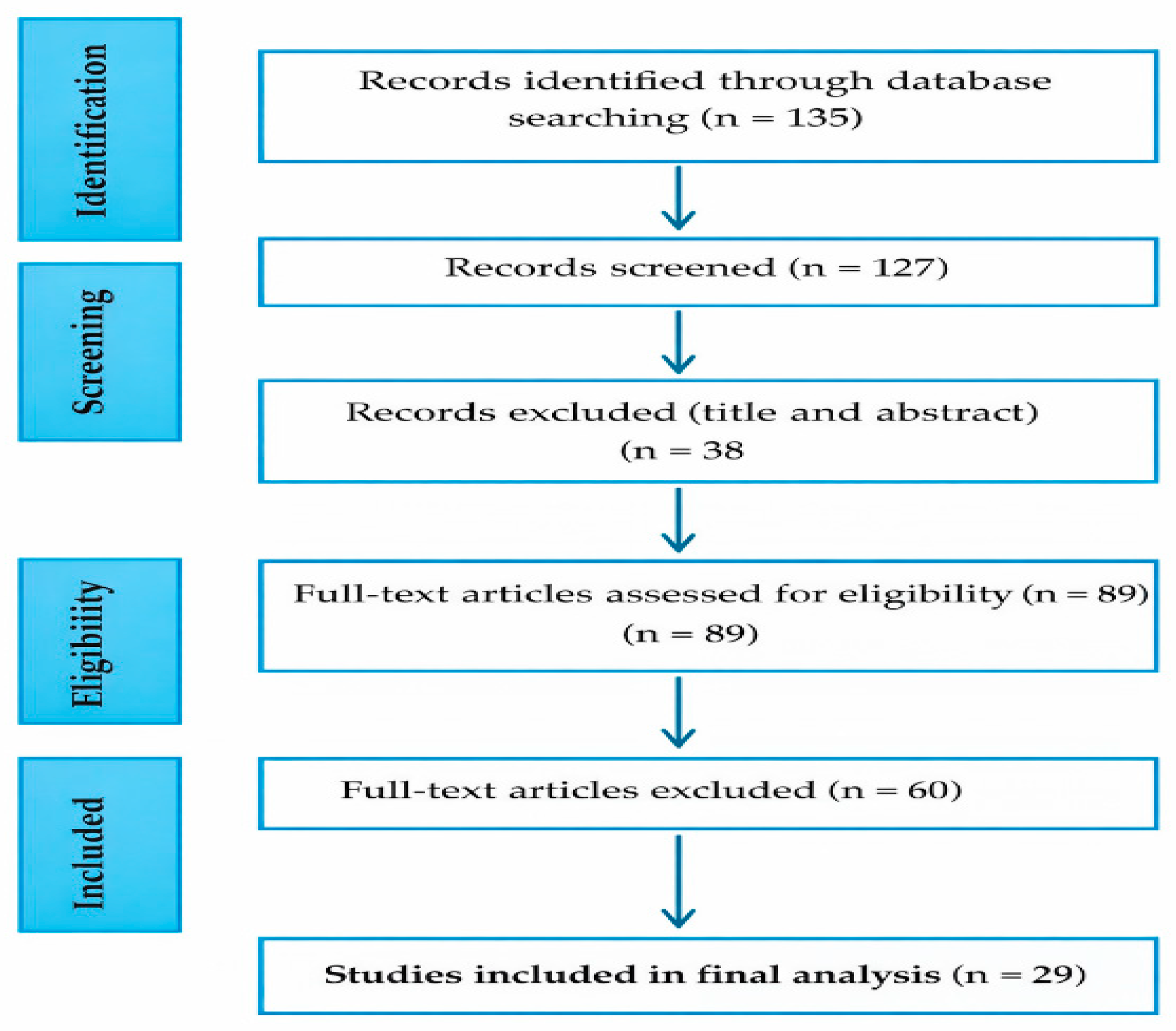

Table 1.
Boolean Operators and Search Strings Used for Literature Identification (2020–2025).
| Search Theme | Keywords / Synonyms Included | Boolean Search String (Example) | Purpose / Relevance |
|---|---|---|---|
| Smart Forest / Digital Forestry | smart forest, smart forestry, digital forestry, precision forestry | (“smart forest” OR “smart forestry” OR “digital forestry” OR “precision forestry”) | Captures studies focused on digitised forest management and monitoring systems |
| Forest 4.0 and Forest 5.0 | Forest 4.0, Forest 5.0, Industry 4.0 forestry, intelligent forestry | (“Forest 4.0” OR “Forest 5.0” OR (“Industry 4.0” AND forestry) OR “intelligent forestry”) | Identifies emerging paradigms and frameworks of advanced forestry digitisation |
| IoT in Forest Monitoring | IoT, Internet of Things, sensor network, wireless sensor networks (WSN) | (“IoT” OR “internet of things” OR “wireless sensor network*” OR WSN OR “sensor network*”) AND (forest* OR forestry) | Retrieves forest-related IoT monitoring systems, sensor deployments, and field implementations |
| Forest Monitoring Systems | forest monitoring, forest surveillance, forest sensing, real-time monitoring | (“forest monitoring” OR “forest surveillance” OR “forest sensing” OR “real-time monitoring”) AND (IoT OR sensor* OR WSN) | Focuses on operational monitoring and surveillance technologies |
| Wildfire Detection and Fire Management | wildfire detection, forest fire, fire monitoring, fire prediction, early warning | (“wildfire detection” OR “forest fire” OR “fire monitoring” OR “fire prediction” OR “early warning system*”) AND (AI OR IoT OR “machine learning” OR sensor*) | Captures detection, prediction, and early warning in fire management studies |
| Artificial Intelligence and Machine Learning | AI, artificial intelligence, machine learning, deep learning, neural networks | (“artificial intelligence” OR AI OR “machine learning” OR “deep learning” OR “neural network*”) AND (forest* OR wildfire* OR forestry) | Identifies AI-driven monitoring and analytics applications in forestry |
| Remote Sensing + IoT Integration | remote sensing, satellite, UAV, drone, LiDAR, GIS | (“remote sensing” OR satellite OR UAV OR drone OR LiDAR OR GIS) AND (IoT OR sensor* OR “smart forest”) | Captures hybrid monitoring approaches combining satellite/drone data with IoT sensors |
| Digital Twin Forestry | digital twin, virtual twin, cyber-physical systems (CPS) | (“digital twin” OR “virtual twin” OR “cyber physical system*” OR CPS) AND (forest* OR forestry OR ecosystem*) | Identifies studies modelling forests using digital twin concepts |
| Biodiversity Monitoring | biodiversity monitoring, wildlife monitoring, species detection, habitat monitoring | (“biodiversity monitoring” OR “wildlife monitoring” OR “species detection” OR “habitat monitoring”) AND (IoT OR sensor* OR AI OR “remote sensing”) | Focuses on biodiversity and ecological monitoring supported by digital technologies |
| Carbon Sequestration Monitoring | carbon sequestration, carbon stock, biomass estimation, forest carbon | (“carbon sequestration” OR “carbon stock*” OR biomass OR “forest carbon”) AND (IoT OR sensor* OR AI OR “remote sensing”) | Captures forest carbon quantification and monitoring systems |
| Sustainable Forest Management | sustainable forest management, SFM, ecosystem management, conservation forestry | (“sustainable forest management” OR SFM OR “ecosystem management” OR conservation) AND (IoT OR AI OR sensor* OR “digital twin”) | Targets forest management strategies enabled by digital tools |
| Environmental Monitoring in Forests | microclimate monitoring, soil moisture, temperature, humidity, air quality | (“soil moisture” OR humidity OR temperature OR microclimate OR “air quality”) AND (forest* OR forestry) AND (IoT OR sensor*) | Captures environmental parameter monitoring studies relevant to forest ecosystem health |
| Forest Health and Disease Detection | forest health, tree disease, pest detection, deforestation monitoring | (“forest health” OR “tree disease” OR pest* OR deforestation) AND (AI OR IoT OR “remote sensing” OR sensor*) | Identifies technology applications for forest health risk detection |
| Edge Computing / Cloud Platforms | edge computing, fog computing, cloud computing, big data | (“edge computing” OR “fog computing” OR “cloud computing” OR “big data”) AND (forest* OR forestry) AND (IoT OR sensor*) | Captures system architecture and computing approaches in forest IoT networks |
| Wireless Communication in Forests | LoRa, LoRaWAN, ZigBee, NB-IoT, GSM, LTE, 5G | (LoRa OR LoRaWAN OR ZigBee OR “NB-IoT” OR GSM OR LTE OR 5G) AND (forest* OR forestry) AND (sensor* OR IoT) | Captures communication technologies used in forest sensor deployments |
| Exclusion Filter (Non-Forestry Domains) | agriculture, horticulture, urban, smart city | NOT (agriculture OR horticulture OR “smart city” OR urban OR greenhouse) | Reduces irrelevant results not related to forest ecosystems |
Table 2.
Constraints and Trade-offs on Forest, Wild, and Exotic Fruits in Agricultural Landscapes of East and Southern Africa.
Table 2.
Constraints and Trade-offs on Forest, Wild, and Exotic Fruits in Agricultural Landscapes of East and Southern Africa.
| Author(s) / Year | Study Title (Short) | Study Location | Key Constraints | Key Trade-offs / Risks |
|---|---|---|---|---|
| Leaver & Cherry (2020) | Informal forest product harvesting | Eastern Cape, South Africa | Informal/unregulated harvesting; high dependence on forest products; weak enforcement | Livelihood and food security benefits vs forest degradation and long-term resource decline |
| Leaver & Cherry (2020) | Impacts on habitat structure | Eastern Cape, South Africa | Overharvesting, habitat disturbance, and declining forest structure | Forest product extraction vs loss of habitat quality and ecosystem services |
| Maroyi (2022) | Traditional uses of wild/tended plants | Eastern Cape Province, South Africa | Loss of indigenous knowledge; declining wild plant availability; limited formal support | Agricultural intensification vs sustaining ecosystem services and cultural food systems |
| Sardeshpande & Shackleton (2019) | Wild edible fruits review | Global (incl. Southern Africa) | Limited research evidence; weak policy integration; limited market development | Commercialisation potential vs overexploitation and exclusion of poorer harvesters |
| Lubisi et al. (2025) | Wild edible fruits review | South Africa (review) | Underutilization, weak documentation of nutritional value, and limited domestication | High nutrition potential vs lack of food safety/quality control and low investment |
| Leaver (2020) | Resource use & bird communities (Thesis) | Eastern Cape, South Africa | Forest degradation, habitat loss, and weak management institutions | Community forest use vs biodiversity decline (bird communities) |
| Constant & Tshisikhawe (2018) | Vhavenda knowledge & biodiversity | Limpopo Province, South Africa | Knowledge erosion, undervaluation of indigenous systems, and weak integration into conservation | Formal conservation vs local livelihood needs and cultural practices |
| Paumgarten et al. (2018) | Wild foods: safety net or poverty trap | South Africa (case study) | Poverty-driven dependence; seasonal availability; limited livelihood alternatives | Wild foods as a safety net vs reinforcing poverty and dependency |
| Kugedera et al. (2024) | Forest resources & food security | Dry regions of Africa (incl. Southern Africa) | Climate stress; degradation of dry forests; weak access to forest products | Food security reliance vs reduced regeneration and long-term ecological decline |
| Leakey et al. (2022) | Domestication & commercialization | Africa-wide review | Poor investment in domestication; weak markets; limited processing infrastructure | Domestication for income vs genetic erosion and uneven benefit-sharing |
| Hajdu et al. (2020) | Changing livelihoods | Eastern Cape, South Africa | Diminishing employment, livelihood instability, and high dependence on natural resources | Increased reliance on forests vs. a shrinking resource base and vulnerability |
| Sileshi et al. (2023) | Indigenous fruit trees in agroforestry | Africa-wide | Limited planting materials; low extension support; slow adoption; weak markets | Agroforestry nutrition/income benefits vs land competition and delayed returns |
| Wessels (2021) | Climate change risk to wild food plants (Thesis) | Southern Africa | Climate change impacts, drought stress, and shifting suitability ranges | Conservation investments vs uncertainty in future species distribution and productivity |
| Mdiya et al. (2021) | Rangeland products use/perception | Eastern Cape, South Africa | Overharvesting, weak rangeland governance, and declining availability | Livelihood dependence vs rangeland degradation and reduced ecosystem resilience |
| Dikko & Adamu (2025) | Underutilized fruits agrobiodiversity | Tropical Africa (scoping review) | Limited genomic research, weak breeding programs, and low funding | Scientific potential vs poor translation into farmer adoption and food systems |
| Baudron et al. (2019) | Forest cover & dietary diversity pathways | Tropical landscapes (incl. Africa) | Weak evidence linking forest cover and diets; data limitations; confounding factors | Forest conservation vs agricultural expansion pressures and opportunity costs |
| Powell et al. (2023) | Wild foods & climate adaptation | Global/Africa-focused | Wild foods are ignored in adaptation planning; poor policy integration | Adaptation benefits vs risk of overharvesting without governance systems |
| Makhubele et al. (2022) | Forest proximity & harvesting | South Africa (agroforestry landscapes) | Unequal access due to distance, transport barriers, and localised depletion near forests | Improved access vs overharvesting close to forests and inequitable benefits |
| Omotayo et al. (2019) | Kei-apple potential | South Africa | Weak consumer awareness; limited markets; lack of processing/value chains | High commercialisation potential vs biodiversity risk and land-use competition |
| Ickowitz et al. (2022) | Trees/forests transforming food systems | Global (incl. Africa) | Policy fragmentation; agriculture–forestry sector separation; weak investment | Food system transformation vs institutional barriers and land conversion risks |
| Chapman et al. (2025) | Biodiversity pressure from fruit demand | South Africa + global comparison | Unsustainable sourcing; biodiversity pressure from fruit production systems | Health/nutrition benefits of fruit consumption vs biodiversity and environmental footprint costs |
| Muimba-Kankolongo (2018) | Smallholder crop production challenges | Southern Africa | Climate variability, low productivity, weak extension, and limited inputs | Agricultural expansion for food vs forest clearing and ecosystem service loss |
| Vansant et al. (2025) | Multipurpose trees improve nutrition | Malawi | Land constraints, limited access to seedlings, and adoption barriers | Nutrition improvement vs reduced crop area and delayed tree benefits |
| Gergel et al. (2020) | Landscape diversity & diet diversity | Global conceptual | Weak interdisciplinary frameworks; limited integrated monitoring | Diversified landscapes for diet resilience vs reduced focus on high-yield monocropping |
| Chamberlain et al. (2020) | Forests/trees in the global food transition | Global (incl. Africa) | Under-recognition of NTFPs in policy and statistics | Contribution of wild fruits vs invisibility in planning and underinvestment |
| Pritchard et al. (2019) | Woodland gradient & environmental incomes | Zimbabwe | Declining woodland resources; overuse along gradients | Environmental income benefits vs depletion and reduced future provisioning |
| Nxusani et al. (2023) | Indigenous food plant usage review | Southern Africa | Poor documentation, declining use of indigenous plants, and limited promotion | Nutrition and cultural value vs modernisation and erosion of traditional diets |
| Fulgentius (2018) | Forest degradation/deforestation | Wild Coast, Eastern Cape, South Africa | Deforestation, forest degradation, and weak enforcement | Short-term livelihood extraction vs long-term loss of forest ecosystem services |
| Mokria et al. (2022) | Wild edible plants importance | Ethiopia | Seasonal scarcity; climate sensitivity; limited domestication; weak promotion | Nutritional benefits vs vulnerability to climate change and habitat decline |
| Muir et al. (2020) | NTFP definitions/statistics | Global | Weak definitions; inconsistent reporting; poor monitoring | Underestimation of wild fruit contribution vs continued policy neglect |
| Sosibo et al. (2022) | Southern Mistbelt forest use/value | Eastern Cape & KwaZulu-Natal, South Africa | Community dependence, limited governance, and declining forest health | Forest reliance vs long-term ecosystem degradation and reduced provisioning |
| Hendriks et al. (2020) | Nutrition-sensitive production programs | Rural South Africa | Poverty barriers, weak market access, and affordability constraints | Nutrition promotion vs limited access and the inability of households to sustain fruit intake |
| Ramaano (2021) | Tourism & indigenous resources | Musina Municipality, Limpopo, South Africa | Weak tourism development, limited institutional support, and poor market linkage | Tourism income vs cultural exploitation and unequal benefit distribution |
| Onomu (2023) | Commercialization pitfalls | Africa-wide | Weak value chains, poor processing, and limited policy support | Commercialisation vs. exclusion of smallholders and loss of agrobiodiversity |
Disclaimer/Publisher’s Note: The statements, opinions and data contained in all publications are solely those of the individual author(s) and contributor(s) and not of MDPI and/or the editor(s). MDPI and/or the editor(s) disclaim responsibility for any injury to people or property resulting from any ideas, methods, instructions or products referred to in the content. |
© 2026 by the authors. Licensee MDPI, Basel, Switzerland. This article is an open access article distributed under the terms and conditions of the Creative Commons Attribution (CC BY) license (http://creativecommons.org/licenses/by/4.0/).
Copyright: This open access article is published under a Creative Commons CC BY 4.0 license, which permit the free download, distribution, and reuse, provided that the author and preprint are cited in any reuse.


