

Submitted:
12 February 2026
Posted:
13 February 2026
You are already at the latest version
Abstract
Waste-to-energy (WtW) systems constitute a complex thermochemical interface between energy production and waste management. This can be done by generating CO2 streams of mixed biogenic and fossil origin. Net-negative emissions can be achieved by integrating carbon capture and storage (CCS) into WtE plants. However, the physical chemistry of the capturing process under heterogeneous conditions is not yet fully understood. This review analyzes the molecular and thermodynamic foundations of CO2 capture in WtE contexts and emphasizes solvent-solute interactions, reaction equilibria, and energy landscapes governing sorption and regeneration. Moreover, the chemistry of amine-based systems, ionic liquids, and solid sorbents will be examined, with respect to flue gas composition, impurity tolerance and degradation pathways, as well as the thermodynamic and kinetic frameworks for CO2 compression, phase behavior and geochemical storage reactions. The present review presents WtE–CCS as a particular field where the principles of physical chemistry contribute substantially to the development of sustainable approaches to environmental management.
Keywords:
waste-to-energy
; carbon capture
; carbon storage
; sustainability
; physical chemistry
1. Introduction
Waste-to-energy (WtE) facilities are at the point where modern waste management methods go hand in hand with sustainable energy production. [1] With the rapid expansion of cities and the increase in material consumption, the production of municipal solid waste worldwide is increasing, intensifying the pressure on traditional landfill methods. WtE plants provide an excellent solution by recovering the chemical energy stored in residual, non-recyclable waste streams and converting it into heat, electricity, or district heating. [2] Their function is not limited to energy production: Waste-to-Energy (WtE) plants are critical infrastructure that reduces reliance on landfills, limit methane emissions and strengthens local energy resilience. In many countries, WtE plants are part of climate and circular economic strategies, as they simultaneously address waste management, resource recovery and energy security. Unlike intermittent renewables, WtE plants provide controlled, stable baseload power, helping to stabilize grids with a high share of variable energy generation. [3,4,5] They also serve as critical infrastructure components that reduce landfill dependency and enhance local energy resilience as well. WtE capacity is often integrated into climate and circular-economy strategies by some countries, due to the simultaneous waste treatment, resource recovery and energy security. [6,7] In comparison with the intermittent renewables, WtE can offer controllable continuous power, that can stabilize grids with high shares of variable generation. [8,9] However, the strategic value of Waste-to-Energy (WtE) plants is now being assessed not only in terms of energy production, but also in terms of their environmental footprint. As climate targets become more demanding, attention is turning to the carbon emissions of WtE facilities and the potential for integrating carbon capture technologies to align their operation with long-term decarbonization goals. [10,11]
The CO₂ emitted from WtE plants has a distinctive composition that sets it apart from conventional fossil-fuel power stations. Municipal solid waste contains a heterogeneous mixture of materials, such as plastics and synthetic polymers derived from mineral sources, as well as paper, food waste, textiles and other biogenic components derived from recent biomass. [12] As a result, waste incineration produces a dual stream of CO₂ emissions: one from fossil-based materials, which directly contributes to net anthropogenic emissions, and a biogenic stream, which feeds into the short-term carbon cycle. This combination creates both challenges and opportunities. [10] The overall carbon intensity of WtE is generally lower than that of coal or oil but still significant due to the presence of non-renewable waste fractions.
Integrating carbon capture and storage (CCS) into WtE systems is becoming a central strategy for driving substantial decarbonization in the waste sector. Since a significant portion of WtE CO₂ comes from biogenic sources, capturing and permanently storing it can produce net-negative emissions, effectively extracting CO₂ from the atmosphere. [13] This positions WtE-CCS among the new scalable negative-emission technologies available today, especially in urban regions with high waste throughput. Also, CCS can reduce the fossil-derived portion of emissions, to a great extent, aligning WtE operations with stringent climate targets and emissions trading frameworks. [14] Coupling carbon capture with utilization pathways like synthetic fuels, mineral carbonating or polymer precursor synthesis, can also contribute to a circular carbon economy and atoms can be continuously recycled rather than emitted. [15,16,17] This can link waste management, energy generation and carbon valorization into a single integrated system.
This paper focuses on the physical-chemistry foundations that rule carbon capture in the specific context of WtE flue gas environments. Even though many CCS technologies have been evaluated in conventional or industrial settings, WtE flue gases have unique characteristics, like higher moisture, variable oxygen levels, acidic contaminants and fluctuating CO₂ concentrations, that can affect capture performance at a molecular level. [18,19] A physical chemistry perspective can help in better understating of sorbent-CO2 interactions, reaction energetics, transport phenomena, solvent stability and the thermodynamics of separation, under WtE-specific conditions. This approach can also highlight how the molecular-level mechanisms can be translated into process-level behavior, affecting energy penalties, capturing efficiency or long-term operational stability. The study combines insights from adsorption science, solution chemistry, gas–solid interface interactions, and phase equilibrium modeling to provide a comprehensive understanding of how to optimize CCS for heterogeneous waste-derived flue gases. By focusing on these fundamental principles, it aims to guide material selection, process integration, and system-level design for advanced WtE-CCS applications.
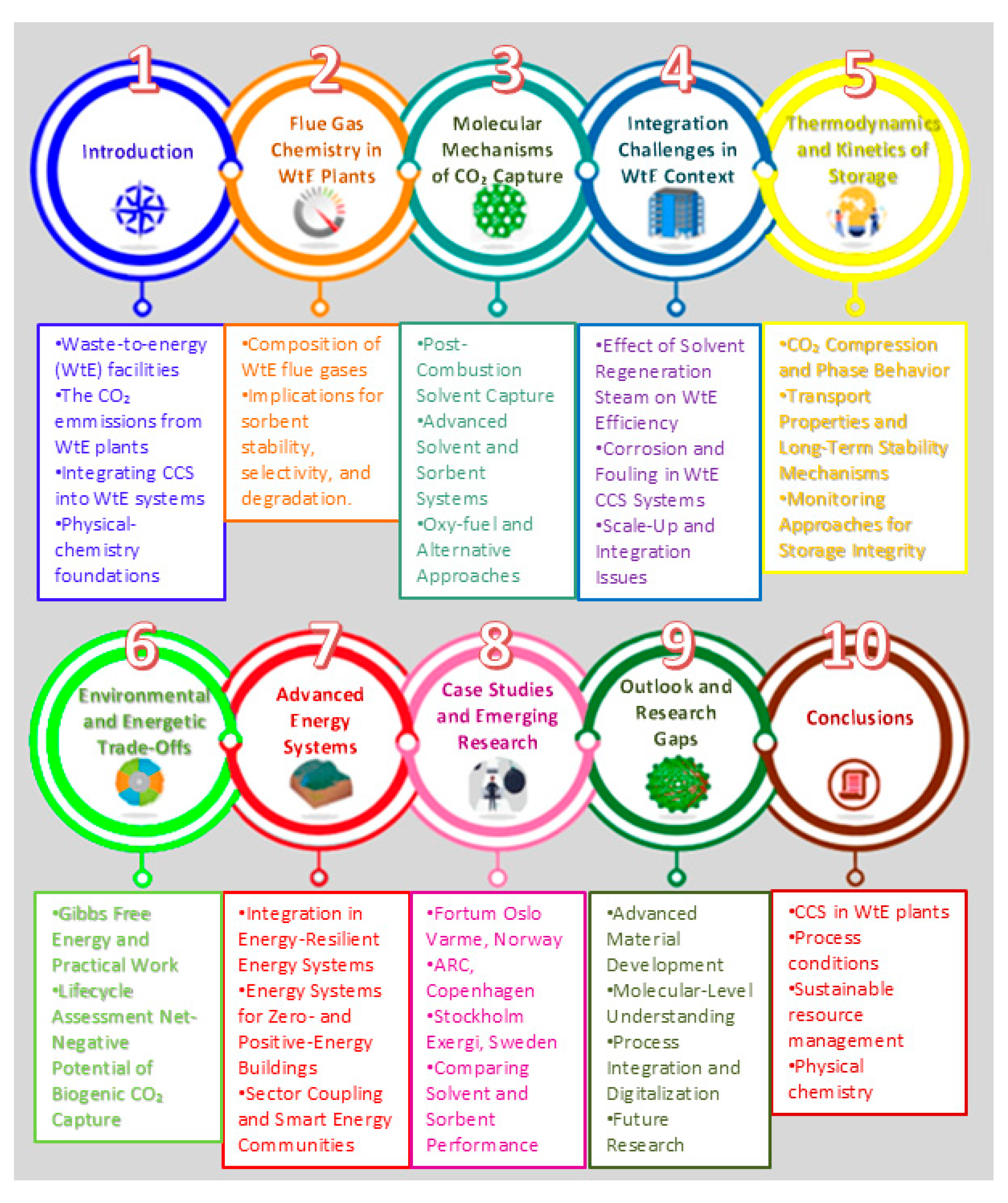
2. Flue Gas Chemistry in WtE Plants
2.1. Composition of WtE Flue Gas
Waste-to-energy (WtE) incineration treats around 63% of European waste and requires careful monitoring of flue gas composition and emissions. This study compares two emission evaluation methods during the design phase: an Excel-based calculation model and Ebsilon 13.2 simulations. A flue gas cleaning system was proposed for a simulated Jordanian WtE plant. Ebsilon results for a 25 kg/s load and 1.5 excess air ratio showed CO₂, NO₂, SO₂, and HCl emissions of 258,514, 749.9, 890.2, and 717 mg/Nm³, respectively. SNCR reduced NO₂ to 180 mg/Nm³, and Ca(OH)₂ injection cut SO₂ and HCl to 44 and 7.16 mg/Nm³. Carbon absorption achieved a 91% CO₂ reduction. The calculation model was validated as effective for predicting flue gas volume, oxygen demand, and emissions at the design stage. [19]
Waste-to-Energy (WTE) plants produce fly ash (FA) as a hazardous air pollution control residue. This study examined FA formation, chemical/mineral composition, and heavy metal leachability under high- and low-moisture ash processing conditions. FA mainly contains CaO (40%), Cl (15%), SO₃ (8%), and CO₂ (8%), with 45–50% crystalline phases (carbonates, chlorides, sulfates, aluminates, silicates) and 50–55% amorphous material. High-moisture processing favored stable hydrates (e.g., ettringite) and C–S–H phases. Heavy metal leachability was assessed using LEAF (pH-dependent) and TCLP tests per RCRA standards. [20]
2.2. Implications for Sorbent Stability, Selectivity, and Degradation
Aminopolymer sorbents, like PEI/Al₂O₃, are effective for direct air CO₂ capture due to high capacity and selectivity, but long-term stability is crucial for scalable use. This study examines their degradation under continuous and cyclic dry and humid conditions at 70 °C, focusing on the effects of CO₂ and O₂. Analyses (TGA, elemental, and in situ HATR-IR) show that CO₂ with O₂ accelerates deactivation via oxidative cleavage of secondary amines, forming excess primary amines. Bound CO₂ species likely catalyze this degradation by lowering activation energy. After 30 cycles, sorbent stability declined by 29% (dry) and 52% (humid), with cyclic loss less severe than continuous deactivation. [21]
3. Molecular Mechanisms of CO2 Capture
Efficient, low-energy CO₂ capture remains challenging because conventional amine absorbents have limited reaction efficiency and high energy demand. This study modifies MEA, DEA, and MDEA using the surfactant AEO-9 and evaluates their CO₂-capture performance, reaction products, and molecular interactions. Adding AEO-9 lowers surface tension by 41.4%–49.1%, enhances foaming, and improves CO₂ removal by 22.3%–41.5%. Several foamed amine blends outperform pure MEA, indicating potential for lower energy use and reduced corrosion. ¹³C NMR and FTIR confirm product formation, while molecular dynamics simulations show that AEO-9 strengthens molecular cooperation by altering solvation-shell density and dynamics, increasing hydrogen-bond length and angle, and improving mobility. Overall, the work demonstrates that surfactant-induced foaming and interfacial regulation can significantly enhance amine absorbents, offering a promising route to more efficient CO₂-capture technologies. [22]
Global warming driven by CO₂ emissions, much of it from post-combustion sources, demands efficient flue-gas CO₂ capture. This study introduces an ionic-liquid/ethanol mixed solvent for post-combustion capture, with the [C1Py][CF₃COO]-ethanol blend optimized using a CAILD-based MINLP model. Its performance was evaluated through detailed process simulations, and an oil-based metric was used to assess energy-use quality. Results show that this solvent can cut carbon emissions by 62.33%–75.51%, energy consumption by 64.71%–72.7%, and total annual cost by 53.6%–61.7% relative to MEA/MDEA systems. Overall, the IL–ethanol process offers a highly efficient, cost-effective, and environmentally promising route for post-combustion CO₂ capture. [23]
The review outlines major CO₂ capture routes (pre-, post-combustion, and oxy-fuel), recent advances, and remaining challenges. It then summarizes CO₂ utilization pathways, chemical, biological, and mineralization, and their emerging benefits. Geological storage options such as saline aquifers and depleted reservoirs are examined with emphasis on monitoring, safety, and long-term risks. The paper also evaluates integrated CCUS systems through techno-economic analysis and case studies, addressing feasibility, scalability, and policy barriers. It concludes that CCUS is vital for climate mitigation and requires ongoing innovation, supportive policies, and lower costs for broad deployment. [24]
3.1. Post-Combustion Solvent Capture
3.1.1. Amine Chemistry: Carbamate Formation, Bicarbonate Pathways, Reaction Kinetics
To develop efficient, reusable solvents for industrial CO₂ capture, this study synthesized three alcohol-amine deep eutectic solvents (DESs) and analyzed them using experiments, molecular simulations, and machine learning. DES1, composed of TBAB and ME, showed the best performance, achieving a CO₂ uptake of 0.198 g/g at 30 °C and maintaining over 95% regeneration efficiency after seven cycles. Machine-learning analysis (CatBoost) identified ESPmin and Farthest_Distance as key molecular descriptors. Combined with DFT and molecular-dynamics results, the findings show that DES1’s electron-rich amino nitrogen and strong electrostatic complementarity with CO₂ promote chemisorption, while its low viscosity enhances mass transfer. In contrast, DES3’s –CH₃ steric hindrance in MDEA limit’s reaction activity, resulting mainly in physical absorption. Overall, the integrated experiment–simulation–data approach reveals how electronic effects, sterics, and mass-transfer properties jointly control performance, offering guidance for designing next-generation low-carbon solvents. [25]
Post-combustion CO₂ capture with amine solvents remains a practical option for cutting emissions from fossil-fuel industries. This study evaluates five amines, MEA, DEA, TEA, MDEA, and DGA, using an Aspen-Hysys model to compare energy demand, CO₂ removal, and solvent make-up rates. MEA shows the best overall performance, requiring the least energy (70,466.83 kJ/kg CO₂) with acceptable replenishment needs. TEA minimizes solvent make-up but has the highest energy use (94,396.55 kJ/kg CO₂), reducing its suitability. The results highlight the trade-offs among energy efficiency, solvent stability, and operational constraints, emphasizing the need to select amines that match specific process requirements for effective industrial CO₂ capture. [26]
Conventional amine absorbents used for post-combustion CO₂ capture face challenges such as high regeneration energy, corrosion, and limited recyclability. This study examines whether nanoparticles and additives can enhance amine performance through microgelation and mixing. Two nanoformulations were developed: an MEA-based solvent (NF-1) and a DEA-based solvent (NF-2). Tests in an interfacial contact reactor at ~300–320 K show that both nanoformulations increase CO₂ absorption by 10–15% and boost capture rates by 20–60%, especially at higher temperatures. They also exhibit better recyclability and higher volumetric loading over three cycles compared with standard 30 wt% MEA or DEA. Enhanced performance is linked to Brownian-motion-induced micromixing and synergistic chemical effects from additives. NF-1 provides higher volumetric loading at equal concentrations, while NF-2 offers greater molar absorption capacity and more efficient regeneration, supported by NMR and COSMO-RS predictions. [27]
Fossil-fuel power plants will continue to supply much of the world’s electricity, making effective carbon-reduction technologies essential. Aqueous amine absorbents especially MEA are the current standard for post-combustion CO₂ capture, but their high capital and regeneration energy costs limit broader use. Biphasic solvents offer a promising lower-energy alternative, yet most studies have focused on coal flue gas rather than the more dilute exhaust from natural-gas systems. Two biphasic blends, diethylenetriamine (DETA) and triethylenetetramine (TETA), are evaluating for CO₂ capture from a natural-gas flue-gas simulant. Both solvents showed substantial regeneration-energy savings compared to MEA: 46% less for DETA and 35% less for TETA. Molecular-dynamics simulations reveal that phase separation arises from strong interactions between CO₂-reaction products and water, with separation intensity depending on CO₂ loading (Figure 2). [28]
3.1.2. Degradation Mechanisms in the Presence of WtE Flue Contaminants (SO₂, HCl, Heavy Metals)
As full-scale CO₂ capture deployment approaches, understanding solvent degradation and emissions is increasingly important. This study monitored a 30 wt% MEA system at a mobile pilot treating waste-to-energy flue gas in Denmark. Nitrosamine and nitramine emissions were below detection limits. Initial results indicate that an acid wash can remove up to 83% of gaseous MEA degradation products, though further evaluation is required. Emissions of CO, NO, NO₂, SO₂, NH₃, and HCl varied with wash-tower temperature and process configuration, but levels in the CO₂ product stream remained below 5 mg/m³. Over four months, heat-stable salts, mainly formate and acetate, accumulated in the solvent, while iron levels stayed under 10 mg/L. Overall, the findings clarify emission behavior in waste-to-energy CO₂ capture systems, highlighting heat-stable salt buildup as the primary challenge for MEA-based solvents. [29]
3.1.3. Solvent Regeneration Thermodynamics (Enthalpy, Entropy Considerations)
Solvent-based CO₂ capture remains one of the most promising decarbonization strategies because liquid solvents offer high selectivity, capacity, and efficiency. However, conventional thermal regeneration suffers from high energy use, solvent degradation, and emissions, motivating the search for alternatives. Electrochemical regeneration is especially attractive due to its potentially higher energy efficiency, low-temperature operation, and modular, plug-and-play design suitable for retrofitting existing systems. This review summarizes electrochemical regeneration methods applied to solvents such as alkali hydroxides, amines, ammonia, and amino acids. It outlines key design principles and recent progress in electrolytes, electrodes, membranes, and process configurations. A comparative assessment of performance and techno-economics highlights the promise of electrochemical methods relative to thermal regeneration. Although still at the R&D stage, these approaches show strong potential to improve the cost, efficiency, and flexibility of CO₂ capture, particularly when powered by renewable energy, supporting the shift toward a low-carbon future. [30]
3.2. Blended Amines, Ionic Liquids, Phase-Change Solvents
3.2.1. Blenden Amines, Ionic Liquids, Phase-Change Solvents
Solvent-based absorption is currently the only commercial technology for post-combustion CO₂ capture, but its high cost has driven research into alternatives such as advanced solvents, membranes, and sorbents. Although sorbent-based capture offers lower energy use due to the absence of water, it has received less attention than solvent systems. [31]
Amines reversibly react with CO₂, making them attractive for CO₂ capture from gas streams such as flue gas. Although aqueous alkanolamine absorption is the most established technology, it is energy intensive and causes corrosion. These drawbacks can be reduced by selective chemical adsorption using solid amine sorbents, which consist of amines immobilized on porous supports. This review summarizes recent developments in solid amine-based CO₂ adsorbents. It examines mesoporous silicas (MCM-41, SBA-15, KIT-6) and polymeric supports (PMMA, PS), focusing on their synthesis, modification, and characterization. Methods for amine impregnation and grafting are compared, along with adsorption mechanisms, material properties, and preparation strategies. The review also presents original data and critically evaluates CO₂ adsorption capacities, cyclic performance, and stability of key systems, including PEI- and TEPA-impregnated adsorbents and APTES-grafted materials. [32]
Solid amine adsorbents were synthesized by functionalizing silica nanoflowers (MSN) with large pore volume using Pluronic P123 (P123) and Polyethyleneimine (PEI) to explore their synergistic effect of CO2 capture. At the optimal loading of 65 wt% PEI and 5 wt% P123, the adsorbent (65PEI/5P123-MSN) displayed peak adsorption performance of 4.12 mmol/g under the dry condition. [33]
Ionic liquids have emerged as promising next-generation functional materials and have drawn considerable attention since the late 1990s due to their potential for CO₂ capture and conversion. As substitutes for aqueous amine scrubbers, they provide enhanced stability and efficiency. [34]
3.2.2. Solid Adsorbents (Zeolites, Metal-Organic Frameworks (MOFs), Porous Carbons): Adsorption Isotherms, Selectivity, Regeneration Energetics
This study evaluates an internally circulating fluidized bed (ICFB) reactor for direct air CO₂ capture using solid sorbents, specifically Al₂O₃ and K₂CO₃/Al₂O₃, under ambient conditions. Reactor performance and adsorption behavior were optimized using a 2³ factorial design. Al₂O₃ showed a higher initial adsorption rate, while K₂CO₃/Al₂O₃ achieved greater CO₂ capacity due to chemisorption. Kinetic analysis confirmed physisorption for Al₂O₃ and multi-step chemisorption for K₂CO₃/Al₂O₃. Characterization verified sorbent stability and effective K₂CO₃ dispersion. The ICFB reactor enhanced gas–solid contact and continuous operation, demonstrating its potential as an efficient and scalable platform for direct air CO₂ capture using solid sorbents. [35]
Rising atmospheric CO₂ from fossil fuel use drives climate change, creating an urgent need for energy-efficient capture technologies. Using an interpenetration strategy, a new microporous fluorinated metal–organic framework, dptz-CuTiF₆, shows high CO₂ uptake and much lower regeneration energy than aqueous amine systems. Its superior performance arises from efficient CO₂ packing and strong cooperative host–guest interactions. [36]
3.2.3. Chemical Looping & Redox-Active Materials
Waste incineration and waste-to-energy plants are vital for waste management but produce large CO₂ emissions, creating a need for affordable capture technologies. Many current options remain uneconomical under existing carbon taxes. This study compares two calcium (carbonate) looping CO₂ capture concepts for a German WtE plant processing 200 kt of waste annually. [37]
Achieving global carbon neutrality by 2050 requires major reductions in CO₂ emissions. Carbon capture is a key strategy, but conventional wet scrubbing relies on large amounts of amines and high energy input. Electrochemical direct carbon capture (EDCC) using redox-active materials offers a lower-energy alternative capable of capturing CO₂ from dilute sources such as air or oceans. Developing cost-effective and energy-efficient redox-active adsorbents is therefore essential for advancing EDCC technologies (Figure 3). [38]
3.3. Oxy-Fuel and Alternative Approaches
3.3.1. Thermodynamics of Oxy-Fuel Combustion for Waste Streams
Fossil fuels dominate energy production, driving CO₂ emissions and climate change, which must be reduced. Oxyfuel combustion, a process using oxygen and recirculated gas to produce concentrated CO₂ and watershows promise. Although research is ongoing, knowledge is still limited. [39]
This study proposes a blue ammonia process using oxy-fuel combustion to simplify CO₂ capture. By utilizing surplus O₂ from the air separation unit, high-purity CO₂ can be separated via water condensation, avoiding energy-intensive amine regeneration and distillation. Compared to conventional air-combustion with amine capture, the process cuts CO₂ emissions by 61% and achieves a 19.5% ROI, highlighting oxy-fuel combustion’s potential for low-carbon blue ammonia production. [40]
3.3.2. Cryogenic Separation Principles
Rising energy demand from non-renewable sources increases GHG emissions, driving climate change. Cryogenic carbon capture (CCC) offers a solvent-free method to extract CO₂ by cooling it into liquid or solid forms. This review highlights recent experimental, simulation, and technology developments in CCC. Modern methods, including packed beds, external loops, and CryoCell technology, can capture over 99% of CO₂, mainly using liquid nitrogen and integrated cooling systems. While mostly at small-scale or simulation stages, CCC shows promise. Future work should improve efficiency, integrate renewables, explore hybrid systems, and convert CO₂ into valuable products to enhance economic viability and reduce industrial emissions. [41]
Rising economic growth is depleting natural resources, harming air quality, and driving climate change. Carbon capture and storage (CCS) can help reduce industrial CO₂ emissions, with cryogenic carbon capture (CCC) offering high recovery and purity. This review examines CCC methods, their advantages, challenges to commercialization, and potential small- and large-scale applications, including blue hydrogen and direct air capture. It assesses technological readiness, compares competing technologies, and outlines future R&D directions for CCC systems. [42]
3.3.3. Hybrid Capture Systems
Rising CO₂ emissions require urgent reduction. Post-combustion capture is widely used, and hybrid processes offer higher efficiency and capacity than standalone methods like absorption or cryogenic separation. Membrane technology is ideal for hybridization, with three main configurations, in-series, parallel, and integrated, applied for CO₂ capture. [43]
Increasing demand for clean energy, water, and hydrogen requires efficient multi-generation systems, but current solutions face low energy recovery and high costs. This study presents a hybrid biogas–solar system that produces electricity, freshwater, hydrogen, and cooling while integrating post-combustion CO₂ capture. It combines an ORC and Kalina cycle for power, uses waste heat via ERC and HDH units, and employs a solar-assisted MEA capture unit to reduce CO₂ emissions and carbon footprint. [44]
4. Integration Challenges in WtE Context
4.1. Effect of Solvent Regeneration Steam on WtE Efficiency
First of all, integrating CCS into WtE plants requires careful consideration of heat and mass balance. Large amounts of low-pressure steam are demanded, for solvent-based capture systems, for solvent regeneration. [45] This steam is often extracted from the turbine, reducing the net electricity output and overall plant efficiency. [46] Balancing the energy demand of the capture systems with the plant’s power generation profile is critical to maintain economic feasibility. WtE plants function with fluctuating waste streams that lead to fluctuations in flue gas temperature and flow, further complicating energy management. [47] Efficiency losses can be minimized by optimization strategies like heat recover from flue gas and staged steam extraction. [48]
The captured heat can be reused in district heating, offsetting energy penalties, through thermal integration. [49] The accurate modeling of the mass flow, CO2 capture rates and energy streams is very important, to ensure that CCS integration does not undermine the plant’s primary energy recover function. [50] The interplay between flue gas volume, steam availability, and CO₂ concentration must be continuously monitored. Overall, the challenge lies in maintaining high capture efficiency without compromising electricity or heat delivery. [51]
4.2. Corrosion and Fouling in WtE CCS Systems
WtE flue gas contains high moisture, acid gases, particulate matter and heavy metals that can induce severe corrosion and fouling in capture equipment. Solvents such as monoethanolamine (MEA) are strongly affected by acidic impurities, which lead to their degradation and consequently to a reduction in both the efficiency of the solvent and its ability to absorb CO₂. [52] The maintenance needs can be increased, by particulates and aerosols that deposit on heat exchangers or piping, reducing transfer efficiency. [53] The cost may also be increased by corrosion-resistant and coting materials. Pre-treatment systems like wet or dry scrubbers can remove some contaminants but add complexity to plant operations. Large-scale operation and molecular level chemistry can be affected, due to the interactions between metal ions, flue gas acids and solvents that can produce precipitates, scaling or amine degradation products. [54,55,56] Temperature fluctuations and high moisture further accelerate corrosion, particularly in carbon steel components. [57,58] To avoid unplanned downtime, it is critical to monitor and predict maintenance. Advanced solvent compositions or additional inhibitors can reduce some of the degradation, but long-term operating data on CCS in waste-to-energy (WtE) plants is limited. Ensuring the reliability and long-term operation of equipment under these demanding conditions remains a key challenge for industrial use (Figure 4). [53,56,57]
4.3. WtE CCS Scale-Up and Integration Issues
Integrating CCS into existing WtE plants often presents some scale-up challenges, in comparison to designing new-built facilities. Retrofitting demands careful accommodation of capture units, absorbers and reboilers into already existing layouts, that may have limited space and constrained flue gas pathways. [11] Exploiting steam for solvent regeneration can disrupt existing turbine cycles and power generation, requiring extensive redesigns or adjustments to operation. [59] The energy integration, flue gas routing and thermal efficiency from the outset can be optimized by new-built plants that can be incorporated into CCS in the initial design. [48,60] Both retrofit and new-build projects must address regulatory compliance, emissions monitoring, and potential impacts on local heat networks or electricity grids. [61,62] Moreover, detailed computational modeling is important in scale-up, to predict the solvent performance flue gas variability and heat integration effects. [60,63,64,65] Also, operational flexibility must be sustained to handle variable waste streams, while ensuring CO2 capture targets are met. [66] Lastly, for the successful full-scale implementation, workforce training, safety protocols and monitoring systems are critical.
5. Thermodynamics and Kinetics of Storage Pathways
The effectiveness of CCS in WtE plants is also controlled by the thermodynamic stability and kinetic robustness of CO2 storage pathways, not only by the capture efficiency. The CO2 that is separated from flue gas, undergoes compression, transport and injection into geological formations that interacts with the reservoir fluids and minerals over the years. In order to ensure storage integrity, minimize the leakage risk and assess the environmental sustainability, it is important to understand these processes from a physical chemistry point of view. [67,68]
5.1. CO₂ Compression and Phase Behavior
Once captured, CO2 from WtE plants typically compresses pressures above their critical point (7.38 MPa, 31.1 °C), forming a supercritical fluid. Supercritical CO2 can combine gas-like diffusivity with liquid-like density. [69] This is crucial for efficient pipeline transport and enhanced injectivity into geological formations. The phase behavior of CO2 can be affected by the temperature, pressure and composition. [70]
The CO2 that comes from flue-gas streams of the WtE plants, may consist of impurities like N2, O2, NOx, H2O or trace organics. This can lead to a modification of the phase equilibria, density, viscosity, and compressibility, that may increase the risk of corrosion or alterations of the storage behavior. [71,72] For instance, SOx and water can lead to the formation of acids under compression, while the critical parameters that can affect the pipeline design can be shifted by non-condensable gases. [73]
To understand and predict multi-component CO2 behavior during compression and transport, it is important to mention some equations of state (EoS) like Peng-Robinson and SAFT-based models.
5.1.1. Peng-Robinson Equation (PR)
Peng-Robinson is one of the most used models in CCS studies and pipeline design. It is very useful to predict the CO2 density near the critical point and is also widely validated for supercritical CO2. However, some of its limitations are the limited accuracy for strongly associating fluids and its low reliability for electrolytes and reactive systems. [74,75,76]
The Peng-Robinson equation:
With P=pressure, T=temperature, Vm=molar volume, R=gas constant, a(T), b=substance-specific parameters related to attractive and repulsive forces.
The function of α on temperature, also referred as a(T) is often expressed
with:
5.1.2. Soave-Redlich-Kwong (SRK)
The Soave-Redlich-Kwong (SRK) equation is a former equation for Peng-Robinson, that is less accurate than Peng-Robinson but is still used on some pipeline and transportation models. [77]
Soave-Redlich-Kwong equation:
5.1.3. Basis of SAFT
SAFT treats molecules as chains of interacting pieces, with explicit consideration of the dispersion forces, association, chain formation and polar interactions.
Helmholtz free energy is written as:
There are many SAFT Variants relevant to CCS. First of all, there is SAFT-VR (Variable Range) that is accurate for phase equilibria and can be used in fundamental CO2 mixtures. Moreover, PC-SAFT (Perturbed-Chain SAFT) is widely used in CCS research, because it is very accurate for CO2-H2O systems, it can predict the density, solubility and phase envelopes, and lastly, handles impurities and associating components. Finally, ePC-SAFT is an extension to electrolytes, critical for modeling CO2-brine systems in reservoirs storage.
5.2. Transport Properties and Long-Term Stability Mechanisms
Transport properties including viscosity, density, diffusivity and solubility in brine control the migration and stabilization of CO2 in geological formations. Supercritical CO2 is slightly related to formation water, driving upward migration until structural or capillary trapping mechanisms immobilize it (Figure 5). [68,69,81]
There are 4 primary long-term trapping mechanisms that contribute to storage security: structural trapping beneath impermeable caprocks, residual trapping via capillary forces, solubility trapping though dissolution into brines and mineral trapping via geochemical reactions. Each of them operates in different timescales and is affected by thermodynamic and kinetic constraints. [82,83]
Transport processes, both diffusion and convection, play a key role in solubility trapping, with convection causing density differences significantly enhancing CO₂ dissolution. Predicting long-term stability and assessing leakage risks requires kinetic models that combine multiphase flow with geochemical reactions [84,85] In the context of WtE plants, the implementation of decentralized or smaller-scale CCS systems requires careful adjustment of injection rates at the base of the reservoir to ensure stable CO₂ plume behavior. [86]
5.3. Monitoring Approaches for Storage Integrity
To understand in situ processes and build public and regulatory confidence in CCS deployment, reliable monitoring of stored CO2 is essential to verify containment. A combination of spectroscopic, geophysical, and geochemical techniques is most commonly used.
In situ characterization of CO2 phase state and dissolved species in monitoring walls can be done via Spectroscopic methods, including infrared absorption and Raman spectroscopy. [87,88] Techniques such as seismic reflection, electrical resistivity tomography, and gravity measurements provide spatially resolved data on plume movement and changes in saturation. [89,90] Geochemical tracers, both intrinsic like isotopic signatures of carbon and oxygen, but also added like noble gases or perfluorocarbons, can provide insights into transport pathways, leakage detection, and reaction progress. [91,92]
6. Environmental and Energetic Trade-Offs
Carbon capture and storage (CSS) integration into waste-to-energy plants propose a complex set of environmental and energetic trade-offs, that extend beyond simple capture efficiency metrics. These trade-offs can be controlled by thermodynamics of CO₂ separation, the molecular energetics of capture materials, and the broader system-level implications for emissions and resource use. All of these can evaluate whether the CCS-enhanced WtE systems can contribute to climate mitigation and sustainable energy transitions.
6.1. Gibbs Free Energy and Practical Work in WtE CO₂ Capture
The minimum theoretical energy for the CO2 separation from flue gas streams is dictated by the Gibbs free energy mixing. [91]
General definition:
For ideal mixture:
Non ideal mixture:
For typical WtE flue gas compositions (8-14vol% CO2), the Gibbs free energy of separation is about 5-10 kJ·mol⁻¹ CO₂, making this thermodynamic limit ideal for reversible process and serves as a standard to evaluate capture technologies. [93]
However, irreversible losses associated with heat transfer, mass transfer resistance, solvent regeneration and compression can make the energy demand of CO2 capture processes significantly higher. Physical chemistry analysis points that this gap between theoretical and real energy consumption can be linked to enthalpy-entropy trade-offs, reaction kinetics or phase equilibria. [94]
WtE plants face additional limitations due to the fact that the capture energy is typically drawn from steam extracted from the power cycle, leading to a reduction in net electrical efficiency. Quantifying this energy penalty in terms of lost exergy or reduced plant efficiency can contribute to a more physically meaningful comparison than gross energy consumption alone. This way, the importance of developing capture systems with optimized binding energies that minimize regeneration enthalpy while maintaining enough CO2 selectively can be highlighted. [10,95,96]
6.2. Lifecycle Assessment of Solvents and Sorbents in WtE CCS
The embodied energy and material intensity of capture media can also influence the environmental footprint of CCS in WtE plants. The synthesis, purification and degradation of solvents and solid sorbents reflect increasing energy investments at the molecular level, looking at it from a physical chemistry perspective. [97,98]
For example, amine-based solvents may require higher energy chemical synthesis routes and are subject to oxidative and thermal degradation under WtE flue gas conditions, that most of the time contain oxygen, moisture acidic gases or trace metals. [99,100] The need to continuously replace degraded solvent contributes to indirect carbon emissions and resource depletion. Advanced sorbents like metal-organic frameworks or functionalized carbons can reveal favorable adsorption thermodynamics, but their large-scale production can involve high-temperature processing or scarce precursor materials. [101,102]
The comparison of capture pathways not only on capture efficiency but also on molecular stability, recyclability, and cumulative energy demand can be done by evaluating CCS options through lifecycle assessment (LCA), informed by physical chemistry. This reveals that capture chemistries with slightly lower performance, but lower embodied energy may lead to superior environmental outcomes at the system level (Figure 6). [97,103,104,105]
6.3. Carbon Capture Chemistry and Its Influence on WtE Emissions
The net emissions profile of WtE plants can be influenced by the choice of CO2 capture chemistry. Capture processes can cause secondary emissions through solvent degradation products, auxiliary fuel consumption for regeneration and increased electricity demand. These effects are based on reaction pathways, degradation kinetics or side reactions, that happen under real flue gas conditions. [10,29]
For instance, heat-stable salts formed in amine systems can not only reduce capture efficiency but can also necessitate solvent reclamation processes that increase energy use and waste generation. On the contrary, capture technologies rely on weaker physical adsorption mechanisms may exhibit lower regeneration energy, but they are lagging from reduced selectivity or sensitivity to moisture. [106,107,108,109]
In order to quantify these impacts, coupling chemical reaction modeling with process-level emission accounting is required. Such integrated analyses help identify capture chemistries that minimize unintended emissions, while the performance in the chemically complex environment characteristic of WtE flue gases is maintained. [110]
6.4. Net-Negative Potential of Biogenic CO₂ Capture
WtE plants can be used in municipal solid waste treatment, a substantial fraction of which is biogenic in origin like food waste, paper or wood. The overall system can achieve net-negative emissions, when CO2 derived from this biogenic fraction is captured and permanently stored. [13,111]
Physical-chemistry speaking, the capture process itself does not differentiate between fossil-derived and biogenic CO2 molecules. However, isotopic and computational analysis can be used to quantify this biogenic share of captured CO2. Therefore, the net-negative potential depends on the capture efficiency, storage performance and the additional emissions associated with capture and compression (Figure 7). [111,112,113]
Excessive energy penalties could offset the climate benefits of biogenic CO2 removal. So, thermodynamic and kinetic optimization of capture systems can be very important. Hence, properly designed CCS integration in WtE plants represents a rare convergence of waste management, energy production and carbon dioxide removal (CDR), positioning WtE-CCS systems as potentially significant contributors to long-term climate stabilization strategies. [96,114]
7. Advanced Energy Systems in Energy-Resilient and Zero/Positive Energy Buildings, Communities, and Districts
The integration of advanced, multi-vector energy technologies capable of delivering reliability, flexibility, and net-zero or net-positive performance is the main key to transitioning towards climate-neutral energy systems. [115,116] WtE with CCS can play a strategic role beyond centralized power generation by supporting energy-resilient buildings, communities, and district-scale energy systems, because they can contribute to both decarbonization and energy security, coupled with advanced thermal, electrical and carbon management, while enabling circular resource flows. [117,118]
7.1. Integration of WtE-CCS in Energy-Resilient Energy Systems
As mentioned before, the transition to climate-natural urban systems requires energy infrastructures, combining flexibility, reliability and deep decarbonization. WtE-CCS systems can provide dispatchable heat and electricity while reducing net greenhouse gas emissions at the same time. [119,120] Unlike sporadic renewable sources, WtE facilities operate as baseload units, that stabilize energy supply and enhancing resilience against demand fluctuations and external disruptions. These systems can deliver low-carbon or even net-negative energy, especially when biogenic carbon fractions dominate the waste stream, when CCS is integrated into them. [121,122] Furthermore, thermal energy recovered from capture processes can be effectively utilized within district heating networks, improving overall system efficiency and reducing waste heat losses. [123,124]
7.2. Advanced Energy Systems for Zero- and Positive-Energy Buildings
In order to achieve zero-energy and positive-energy buildings, balance between energy efficiency, renewable generation and system-level flexibility is required to maintain the annual net-zero or net-positive performance. However, there are some challenges concerning seasonal variability, storage limitations, and intermittent renewable production. Such buildings can be supported by supplying stable low-carbon electricity and carbon-neutral district heating, reducing reliance on fossil-based backup systems. [125,126] From a thermodynamic and transport point of view, the overall energy balance can be preserved by optimizing heat integration, minimizing solvent regeneration energy, and enhancing mass and heat transfer within capture units. Efficient integration ensures that carbon capture processes do not impose excessive energy penalties, thereby maintaining the performance targets of advanced zero- and positive-energy built environments. [127,128]
7.3. Sector Coupling and Smart Energy Communities
Sector-coupled systems that integrate electricity, heat, fuels and carbon flows into unified multi-energy networks are important for energy-resilient communities. In this context, WtE-CCS can operate as a central hub that connects waste management, power and heat generation, hydrogen production and carbon storage or utilization. [129,130] Synthetic fuel production can be achieved by the integration of captured CO2 with renewable hydrogen, while thermal and electrical storage can improve system flexibility under variable renewable supply. So, these hybrid configurations can lead to enhanced local energy autonomy, reduce carbon intensity and support circular resource utilization. [127,129,130] Advanced control, digital monitoring, and predictive optimization further strengthen the system’s resilience by enabling real-time balancing of energy flows, improving operational efficiency, and supporting adaptive responses to disturbances. [127,129,130]
8. Case Studies and Emerging Research
There are recent operational experiences and pilot-scale studies that provide critical insights into the performance of carbon capture technologies in waste-to-energy (WtE) facilities, that highlight both the opportunities and the challenges associated with treating complex flue gases. These are extremely important because WtE flue gases contain not only CO2, but also high moisture, variable oxygen content and trace contaminants like Sox, Nox, heavy metals and particulate matter. It is important to understand how capture systems respond to real-world conditions, for evaluating their feasibility, sustainability and integration into existing plant frameworks.
8.1. Fortum Oslo Varme, Norway
At the Fortum Oslo Varme plant in Oslo Norway, pilot-scale operation of an amine-based CO2 capture system, supplied extensive data on solvent performance under authentic WtE flue gas conditions. The plant’s flue gas consisted of a mixture of domestic waste firing products. This leads to operational challenges like solvent degradation of emissions or secondary pollutants. More than 5.000 hours of operational demonstrative studies conducted and conclude to the fact that amine-based solvents can achieve high CO₂ removal efficiency, often exceeding 90 %, but their long-term performance is sensitive to fluctuations in flue gas composition, temperature, and contaminant levels. To mitigate oxidative and thermal degradation, regular solvent monitoring and regeneration are required, and can lead to increased operational costs and reduce capture efficiency over time. This experience shows the importance of sturdy solvent management strategies, and also the need for integration of the capture systems with already existing heat and flue gas management networks (Figure 8). [129,130]
8.2. ARC, Copenhagen
Similarly, in Denmark, the Amager Resource Center (ARC) has also implemented pilot-scale carbon capture tests. This is important to investigate the scalability and strength of capture technologies under real WtE conditions. Both conventional solvent systems like monoethanolamine (MEA) and emerging solid sorbent degradation have been evaluated. The data that was collected consist of capture efficiency, energy consumption, solvent degradation, and operational stability over several months of continuous operation. Trials indicated that while solvent-based systems offer high CO2 removal rates, they are prone to operational fluctuations and the presence of impurities, leading to accelerated degradation. On the contrary, solid sorbents demonstrated greater resistance to contaminants and can also reduce chemical degradation, even though they often require higher heat for regeneration and may have lower CO2 loading capacity. Pilot-scale data like these are important for guiding process optimization, including heat recovery, sorbent regeneration, and flue gas pretreatment. [127,129,130]
8.3. Stockholm Exergi, Sweden
Likewise, Stockholm Exergi in Sweden has been running pilot and demonstration projects under the BECCS@STHLM initiative. Capturing biogenic CO2 from waste and biomass combustion is the main focus, integrating pilot-scale data into the design of future large-scale facilities. These pilot efforts provide real-world measurements of capture efficiency, energy demand and operational reliability, offering insights that are directly transferable to other WtE plants considering CCS deployment.
8.4. Comparing Solvent and Sorbent Performance for CO₂ Capture
The comparison of solvent and solid sorbents under real WtE flue gas conditions disclose distinct advantages and limitations for each technology. In amine-based solvents, high CO2 removal efficiency can be provided, but oxidative and thermal degradation can be caused, especially in the presence of flue gas contaminants, like Sox and Nox. Solid sorbents, like amine-impregnated materials and carbonated-based systems, tend to be more resilient under such conditions, even if their lower CO2 loading capacity and higher thermal regeneration requirements can pose design and energy challenges. When choosing between these technologies, energy consumption, operational stability, and life-cycle sustainability must go through consideration (Figure 9). [132]
Collectively, all these case studies highlight the importance of pilot and full-scale testing to identify operational challenges and optimize integration strategies. Even if both solvent and sorbent-based technologies are important for WtE CCS, system performance is mainly influenced by the flue gas composition, solvent and sorbent stability and the design of heat and gas management subsystems. Understanding these factors is critical or scaling CCS solutions in a way that is both energy-efficient and sustainable.
9. Outlook and Research Gaps
The deployment of carbon capture and storage (CCS) technologies in waste-to-energy plants is an evolving field, that can be further improved and investigated, to optimize capture efficiency, reduce energy consumption and ensure long-term sustainability. Progress has been made in both solvent and sorbent-based capture systems, but several critical research gaps should be addressed to maximize the potential of CCS in WtE contexts.
9.1. Advanced Material Development
The development of capture media that are resilient under demanding conditions of WtE flue gas, that often contains high temperatures, acidic components and trace contaminants, is a major challenge that needs to be addressed. Current sorbents and solvents can degrade over repeated cycles, and this can affect their performance while increasing the operational costs. [133,134]
More research should be done on designing degradation-resistant sorbents with high selectivity for CO2, so they can be able to maintain their performance over long periods of time. This can also minimize the cost. [135,136,137]
Moreover, solvent blends with reduced regeneration enthalpy could be developed. Solvent regeneration is one of the main energy sinks in CCS, so forming blends that require less heat for regeneration can reduce the overall energy penalty while improving the plant-level efficiency. [138,139,140]
Hybrid materials and composite adsorbents could be explored, combining the strengths of different material classes, like functionalized solids and supported liquids, to enhance CO2 capacity, selectivity and durability. Adaptivity to variable flue gas compositions can also come from these hybrid materials, improving overall process resilience. [141,142,143]
9.2. Molecular-Level Understanding of Carbon Capture Systems
Molecular-level insights are crucial to accelerating material innovation and optimizinh process performance. Fundamental understating of solvent-gas and sorbent-gas interactions can be achieved by computational methods like ab initio calculations, molecular dynamics (MD) and density functional theory (DFT). This can also predict thermodynamic and kinetic behaviors and guide rational design of capture media. [145,146,147]
Firstly, the influence of flue gas impurities on capture efficiency and material degradation can be quantified. Impurities like Nox, Sox or heavy metals, may interact with both sorbents or solvents, reducing the capture efficiency and acceleration degradation. The molecular-level simulations can identify these interactions and can propose ways to mitigate negative effects. [148,149]
Future research could focus on simulating multi-component interactions in order to predict their real performance. Since flue gas contains a complex mixture of CO2, water vapor, O2 and trace contaminants, we can model these multi-component systems to allow accurate predictions of sorbent or solvent behavior. [150,151]
Moving in the same direction, more research should be done on integrating molecular predictions with experimental validation. Computational insights should be tested under realistic conditions for reliability insurance. Thus, a combined modeling experimental approach can accelerate material discovery while reducing trial-and-error experimentation. [152,153]
9.3. Process Integration and Digitalization
Process integration is particularly important for the CCS performance in WtE plants. A deep understanding of the interplay between flue gas composition, capturing medium performance and plant operational conditions, can increase the CO2 capture efficiency. [154]
Digital twins and sensor-based monitoring can anticipate changes in flue gas composition and adjust parameters accordingly. This can minimize energy consumption and solvent or sorbent degradation while enabling a consistent CO2 capture. [153]
Also, capturing CO2 often competes with other energy needs in the plant, so advanced modeling and process simulation can reveal trade-offs. This can help with decision guidance that balance capture efficiency with the overall plant performance. [155]
Finally, scalable strategies for retrofitting existing plants should be further developed, since many WtE plants were not originally designed for CCS. Further research can focus on helping to identify optimal retrofitting solutions that minimize downtime, costs, and technical risks while maximizing carbon reduction. [11]
9.4. Future Research Roadmap
Many key areas have been identified as priorities for advancing carbon capture and storage (CCS) in waste-to-energy (WtE) plants. These areas consist of knowledge gaps, technological limitations, and integration challenges, forming a roadmap for both academic research and industrial development.
First of all, future research could focus on designing capture media that maintain high CO2 selectivity and capacity over extended periods of time. Experimental and computational approaches will be critical. This can allow researchers to explore new materials and solvent blends systematically. The operational costs can be reduced by reducing regeneration energy requirements, which are important to improv plant efficiency. Also, materials should be resilient to the variable composition of WtE flue gas, including moisture, trace contaminants and acidic components. This can ensure consistent performance, with no frequent replacements or technical treatment. [98,156,157]
The efficient CCS deployment can be increased by bridging the gap between molecular-level understanding and full-scale plant operations. By integrating physical chemistry knowledge into process models and digital twins, the control strategies can be predicted, allowing operators to respond dynamically to change flue gas composition or plant conditions. This approach supports more reliable, flexible, and cost-effective CCS integration in existing and new WtE facilities. [158,159]
Moreover, CCS deployment should be evaluated in the context of sustainability and economic feasibility as well. To quantify environmental benefits and potential trade-offs, life-cycle assessments of carbon footprint, water consumption and energy use are also necessary. More research should be done on economic analysis, including capital costs, operational expenditures, and potential revenue from carbon credit, guiding to a policy development. Together, these evaluations ensure that CCS adoption contributes meaningfully to climate mitigation without introducing unintended environmental or economic burdens. [160,161,162,163]
To conclude, these research gaps are critical for the next generation of CCS technologies in WtE plants. Future research can enable CCS systems that are not only highly efficient but also durable, economically viable and fully aligned with circular economy or climate goals. This can be achieved by combing innovations in material design, molecular level understanding, process integration, and sustainably assessment. This roadmap provides a structured pathway for transforming WtE plants into low-carbon, sustainable energy systems that actively contribute to global decarbonization efforts.
10. Conclusions
To conclude, carbon capture and storage (CCS) in waste-to-energy (WtE) plants, represents a critical convergence of waste management and climate mitigation strategies. Key insights have been provided from a molecular and thermodynamic perspective, which helped in understanding gas-solid interactions, solvent-based capture processes and reaction energetics, into the efficiency and selectivity of CO₂ capture technologies. The importance of process conditions like temperature, pressure and flue gas composition, can be highlighted through thermodynamic modeling, to determine capture performance and energy penalties. This can guide the design of more robust and optimize CCS systems for WtE applications.
WtE-CCS occupies a unique position at the interface of negative emissions and sustainable resource management. WtE plants can contribute to more carbon-negative energy solutions, while reducing landfill dependence, by coupling the energy recovery from municipal and industrial waste with CO₂ capture. This double role highlights the potential of WtE-CCS to serve as an integrated platform and not merely as a mitigation technology. This is important for circular economic strategies and climate-responsive waste management.
Finally, physical chemistry provides the foundational framework necessary for scaling CCS in WtE systems sustainably, since molecular-level understanding informs the selection of sorbents, and catalysts, while thermodynamic and kinetic analyses, forming the basis for integrating and optimizing processes. Future research could focus on combining experimental insights with predictive modeling, which will be crucial in order to reduce cost and minimize the environmental impact, making CCS deployment across WtE facilities more widely achievable. In the end, the synergy of waste-to-value processes, energy production and carbon removal establishes CCS-enabled WtE as a crucial element of the sustainable energy landscape.
Author Contributions
Conceptualization, I.A.K.; methodology, M.P.; K.A. and I.A.K.; validation, M.P. and I.A.K.; formal analysis, M.P.; K.A.; investigation, M.P.; K.A.; resources, I.A.K.; writing-original draft preparation, M.P.; K.A. and I.A.K.; writing-review and editing, M.P.; K.A. and I.A.K.; visualization, I.A.K.; supervision, I.A.K. All authors have read and agreed to the published version of the manuscript.
Funding
This research received no external funding.
Data Availability Statement
Data sharing is not applicable to this article as no new data were created or analyzed in this study.
Acknowledgments
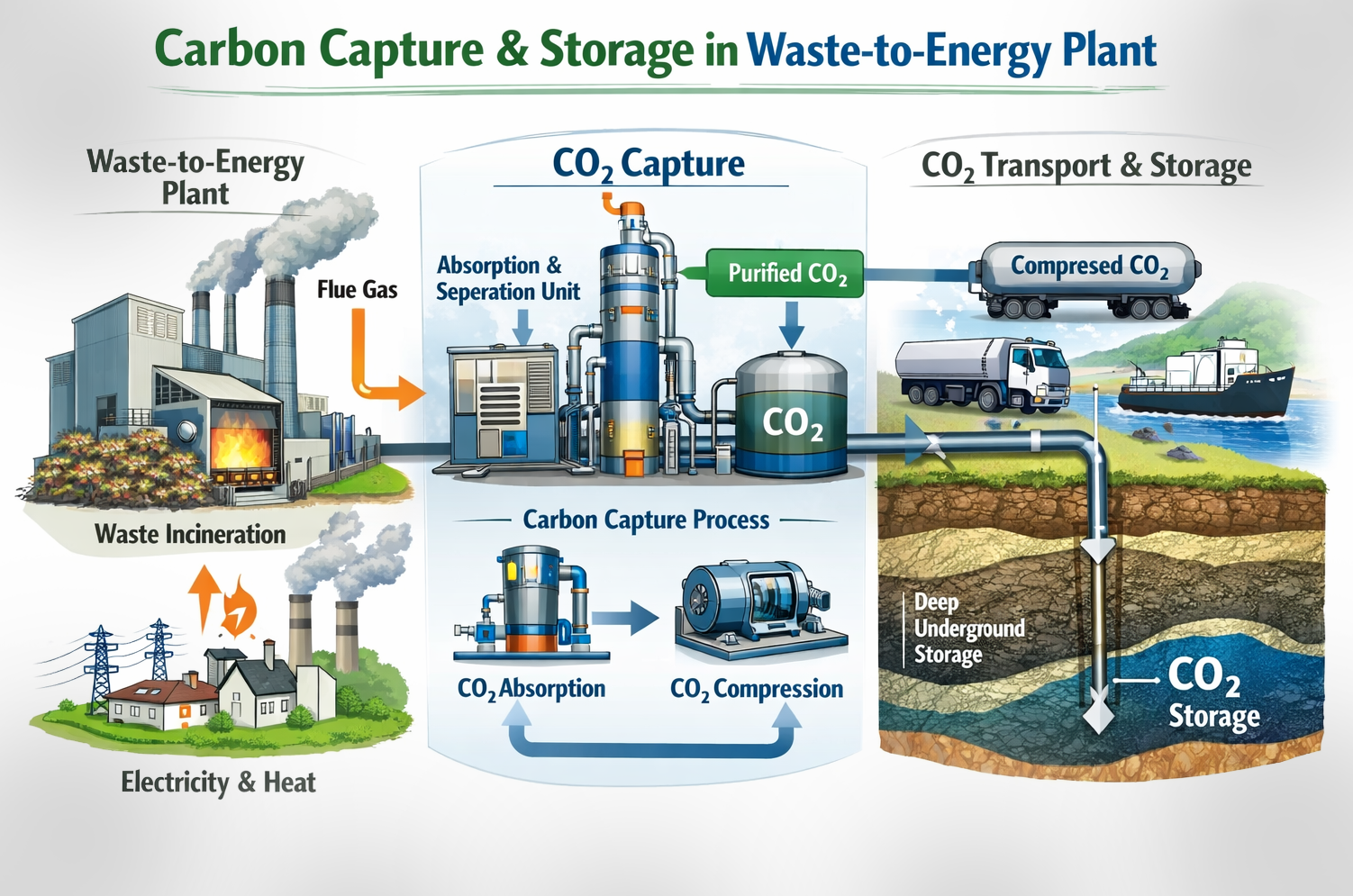
During the preparation of this manuscript, the authors used artificial intelligence tool ChatGPT for the purposes of creating part of the background template of graphical abstract. The authors have reviewed and edited the output and take full responsibility for the content of this publication.
Conflicts of Interest
The authors declare that there are no conflicts of interest.
Abbreviations
The following abbreviations are used in this manuscript:
| BECCS | Bioenergy with Carbon Capture and Storage |
| CCS | Carbon Capture and Storage |
| CCUS | Carbon Capture, Utilization, and Storage |
| DEA | Diethanolamine |
| DES | Deep Eutectic Solvent |
| DFT | Density Functional Theory |
| DGA | Diglycolamine |
| EfW | Energy from Waste |
| EoS | Equation of State |
| ePC-SAFT | Electrolyte Perturbed-Chain Statistical Associating Fluid Theory |
| ERC | Ejector Refrigeration Cycle |
| FA | Fly Ash |
| FTIR | Fourier Transform Infrared Spectroscopy |
| GHG | Greenhouse Gas |
| HCl | Hydrochloric Acid |
| HDH | Humidification–Dehumidification |
| ICFB | Internally Circulating Fluidized Bed |
| IL | Ionic Liquid |
| LCA | Life Cycle Assessment |
| LEAF | Leaching Environmental Assessment Framework |
| MD | Molecular Dynamics |
| MDEA | Methyldiethanolamine |
| MEA | Monoethanolamine |
| MOF | Metal–Organic Framework |
| NMR | Nuclear Magnetic Resonance |
| NOx | Nitrogen Oxides |
| ORC | Organic Rankine Cycle |
| PC-SAFT | Perturbed-Chain Statistical Associating Fluid Theory |
| PR | Peng–Robinson Equation of State |
| RCRA | Resource Conservation and Recovery Act |
| SAFT | Statistical Associating Fluid Theory |
| SNCR | Selective Non-Catalytic Reduction |
| SRK | Soave–Redlich–Kwong Equation of State |
| TCLP | Toxic Characteristic Leaching Procedure |
| TEA | Triethanolamine |
| TGA | Thermogravimetric Analysis |
| WtE | Waste-to-Energy |
References
- Brunner, P.H.; Morf, L.S. Waste to energy, indispensable cornerstone for circular economy: A mini-review. Waste Manag. Res. J. a Sustain. Circ. Econ. 2024, 43, 26–38. [Google Scholar] [CrossRef]
- Kasiński, S.; Dębowski, M. Municipal Solid Waste as a Renewable Energy Source: Advances in Thermochemical Conversion Technologies and Environmental Impacts. Energies 2024, 17, 4704. [Google Scholar] [CrossRef]
- Zueva, S.; Ferella, F.; Corradini, V.; Vegliò, F. Review of Organic Waste-to-Energy (OWtE) Technologies as a Part of a Sustainable Circular Economy. Energies 2024, 17, 3797. [Google Scholar] [CrossRef]
- Boer, E.D.; Banaszkiewicz, K.; Boer, J.D.; Pasiecznik, I. Energy Recovery from Waste—Closing the Municipal Loop. Energies 2022, 15, 1246. [Google Scholar] [CrossRef]
- Rezania, S.; Oryani, B.; Nasrollahi, V.R.; Darajeh, N.; Ghahroud, M.L.; Mehranzamir, K. Review on Waste-to-Energy Approaches toward a Circular Economy in Developed and Developing Countries. Processes 2023, 11, 2566. [Google Scholar] [CrossRef]
- Mata-Lima, H.; Silva, D.W.; Nardi, D.C.; Klering, S.A.; de Oliveira, T.C.F.; Morgado-Dias, F. Waste-to-Energy: An Opportunity to Increase Renewable Energy Share and Reduce Ecological Footprint in Small Island Developing States (SIDS). Energies 2021, 14, 7586. [Google Scholar] [CrossRef]
- Atstaja, D.; Cudecka-Purina, N.; Koval, V.; Kuzmina, J.; Butkevics, J.; Hrinchenko, H. Waste-to-Energy in the Circular Economy Transition and Development of Resource-Efficient Business Models. Energies 2024, 17, 4188. [Google Scholar] [CrossRef]
- Beiron, J.; Montañés, R.M.; Normann, F.; Johnsson, F. Combined heat and power operational modes for increased product flexibility in a waste incineration plant. Energy 2020, 202. [Google Scholar] [CrossRef]
- Banaś, M.; Pająk, T.; Bator, J.; Wróbel, W.; Ciuła, J. Energy Efficiency Analysis of Waste-to-Energy Plants in Poland. Energies 2024, 17, 2390. [Google Scholar] [CrossRef]
- Acampora, L.; Grilletta, S.; Costa, G. The Integration of Carbon Capture, Utilization, and Storage (CCUS) in Waste-to-Energy Plants: A Review. Energies 2025, 18, 1883. [Google Scholar] [CrossRef]
- Bertone, M.; Stabile, L.; Cortellessa, G.; Arpino, F.; Buonanno, G. Techno-Economic Assessment of Amine-Based Carbon Capture in Waste-to-Energy Incineration Plant Retrofit. Sustainability 2024, 16, 8468. [Google Scholar] [CrossRef]
- Mohn, J.; Szidat, S.; Zeyer, K.; Emmenegger, L. Fossil and biogenic CO2 from waste incineration based on a yearlong radiocarbon study. Waste Manag. 2012, 32, 1516–1520. [Google Scholar] [CrossRef] [PubMed]
- Bertone, M.; Stabile, L.; Buonanno, G. An Overview of Waste-to-Energy Incineration Integrated with Carbon Capture Utilization or Storage Retrofit Application. Sustainability 2024, 16, 4117. [Google Scholar] [CrossRef]
- Oxford Energy Institute. Carbon capture from Energy from Waste (EfW); 2024. [Google Scholar]
- Roy, P.; Mohanty, A.K.; Misra, M. Prospects of carbon capture, utilization and storage for mitigating climate change. Environ. Sci. Adv. 2023, 2, 409–423. [Google Scholar] [CrossRef]
- Wang, Z.; Yuan, P.; Yu, H.; Ma, Q.; Xu, B.; Zhao, D. Carbon Capture, Utilization and Storage: Technology, Application, and Policy. Processes 2025, 13, 3414. [Google Scholar] [CrossRef]
- Sun, S.; Sun, H.; Williams, P.T.; Wu, C. Recent advances in integrated CO2capture and utilization: A review. Sustain. Energy Fuels 2021, 5, 4546–4559. [Google Scholar] [CrossRef]
- Wang, W.; Tian, S.; Long, J.; Liu, J.; Ma, Q.; Xu, K.; Zhang, Z. Investigation and Evaluation of Flue Gas Pollutants Emission in Waste-to-Energy Plant with Flue Gas Recirculation. Atmosphere 2022, 13, 1016. [Google Scholar] [CrossRef]
- Thabit, Q.; Nassour, A.; Nelles, M. Flue Gas Composition and Treatment Potential of a Waste Incineration Plant. Appl. Sci. 2022, 12, 5236. [Google Scholar] [CrossRef]
- Tian, Y.; Themelis, N.J.; Bourtsalas, A.; Kawashima, S.; Gorokhovich, Y. Systematic study of the formation and chemical/mineral composition of waste-to-energy (WTE) fly ash. Mater. Chem. Phys. 2022, 293. [Google Scholar] [CrossRef]
- Guta, Y.A.; Carneiro, J.; Li, S.; Innocenti, G.; Pang, S.H.; Sakwa-Novak, M.A.; Sievers, C.; Jones, C.W. Contributions of CO2, O2, and H2O to the Oxidative Stability of Solid Amine Direct Air Capture Sorbents at Intermediate Temperature. ACS Appl. Mater. Interfaces 2023, 15, 46790–46802. [Google Scholar] [CrossRef]
- Ge, Y.; Wang, Z.; Yang, L.; Heng, X.; Zhang, Z.; Wang, Y.; Liu, F.; Yang, X.; Liu, B.; Liu, K. CO2 capture performance and foaming mechanism of modified amine-based absorbents: A study based on molecular dynamics. Carbon Capture Sci. Technol. 2025, 15. [Google Scholar] [CrossRef]
- Lei, Y.; Du, L.; Hu, S.; Kuang, Y.; Liu, X.; Fang, H.; Chen, Y. Ionic liquid-ethanol mixed solvent design for the post-combustion carbon capture. Sep. Purif. Technol. 2024, 354. [Google Scholar] [CrossRef]
- Hanson, E.; Nwakile, C.; Hammed, V.O. Carbon capture, utilization, and storage (CCUS) technologies: Evaluating the effectiveness of advanced CCUS solutions for reducing CO2 emissions. Results Surfaces Interfaces 2024, 18. [Google Scholar] [CrossRef]
- Hu, D.; Cao, D.; Wang, Q.; Wang, B.; Lu, S. Multi-scale studies on CO₂ capture: An in-depth investigation of amine-based deep eutectic solvents using machine learning and molecular simulations. Chem. Eng. J. 2025, 519. [Google Scholar] [CrossRef]
- Esfandyari, M.; Moghaddam, A.H. Comparative analysis of amine-based solvents for energy efficient post-combustion CO2 capture. Fuel 2025, 402. [Google Scholar] [CrossRef]
- Kumar, Y.; Santhi, V.M.; Sangwai, J. Experimental and COSMO-RS modelling into CO2 absorption performance using MEA/DEA-based nanoformulations for post-combustion carbon capture. Chem. Eng. J. 2025, 525. [Google Scholar] [CrossRef]
- Wiechert, A.I.; Jung, G.S.; Stamberga, D.; Jang, G.G.; Cordon, M.J.; Custelcean, R.; Sholl, D.S.; Tsouris, C. Biphasic solvents for post-combustion CO2 capture from natural gas flue Gas. Chem. Eng. J. 2025, 514. [Google Scholar] [CrossRef]
- Neerup, R.; Rasmussen, V.E.; Vinjarapu, S.H.; Larsen, A.H.; Shi, M.; Andersen, C.; Fuglsang, K.; Gram, L.K.; Nedenskov, J.; Kappel, J.; et al. Solvent degradation and emissions from a CO2 capture pilot at a waste-to-energy plant. J. Environ. Chem. Eng. 2023, 11. [Google Scholar] [CrossRef]
- Liu, P.; Liu, H.; Li, K.; Fan, Z.; Lu, Q.; Sun, B.; Hu, L.; Yin, L.; Wang, X.; Liu, L. Recent advances in integrating solvent-based CO2 capture with electrochemical regeneration process: A review. Fuel 2024, 385. [Google Scholar] [CrossRef]
- Zhao, X.; Cui, Q.; Wang, B.; Yan, X.; Singh, S.; Zhang, F.; Gao, X.; Li, Y. Recent progress of amine modified sorbents for capturing CO2 from flue gas. Chin. J. Chem. Eng. 2018, 26, 2292–2302. [Google Scholar] [CrossRef]
- Ünveren, E.E.; Monkul, B.Ö.; Sarıoğlan, Ş.; Karademir, N.; Alper, E. Solid amine sorbents for CO2 capture by chemical adsorption: A review. Petroleum 2017, 3, 37–50. [Google Scholar] [CrossRef]
- Li, W.; Fu, D. Synergistic effect of surfactant and silica nanoflowers support on CO2 capture from simulated flue gas by solid amine adsorbents. Chem. Phys. Lett. 2024, 843. [Google Scholar] [CrossRef]
- Parameswaran, J.; Ghani, N.A.; Hossain, S.; Ab Rahim, A.H.; Razip, M.A.A.M.; Yunus, N.M.; Leveque, J.-M. Enhanced carbon dioxide capture using phosphonium and ammonium-based amino acid ionic liquids as next-generation functional materials. J. Mol. Liq. 2025, 439. [Google Scholar] [CrossRef]
- Tripoonsuk, C.; Limahksohn, M.; Chalermsinsuwan, B.; Piumsomboon, P. Direct air CO2 capture in an internally circulating fluidized bed reactor: Evaluating adsorption performance of Al2O3 and K2CO3/Al2O3 sorbents. Chem. Eng. J. 2025, 522. [Google Scholar] [CrossRef]
- Liang, W.; Bhatt, P.M.; Shkurenko, A.; Adil, K.; Mouchaham, G.; Aggarwal, H.; Mallick, A.; Jamal, A.; Belmabkhout, Y.; Eddaoudi, M. A Tailor-Made Interpenetrated MOF with Exceptional Carbon-Capture Performance from Flue Gas. Chem 2019, 5, 950–963. [Google Scholar] [CrossRef]
- Greco-Coppi, M.; Eisenbach, N.; Kurkunc, M.-D.; Sattler, M.; Roloff, N.; Ströhle, J.; Epple, B. Techno-economic assessment of carbonate looping for cost-effective CO2 capture in waste incineration. Int. J. Greenh. Gas Control. 2025, 149. [Google Scholar] [CrossRef]
- Choi, G.H.; Song, H.J.; Lee, S.; Kim, J.Y.; Moon, M.-W.; Yoo, P.J. Electrochemical direct CO2 capture technology using redox-active organic molecules to achieve carbon-neutrality. Nano Energy 2023, 112. [Google Scholar] [CrossRef]
- Raho, B.; Colangelo, G.; Milanese, M.; de Risi, A. A Critical Analysis of the Oxy-Combustion Process: From Mathematical Models to Combustion Product Analysis. Energies 2022, 15, 6514. [Google Scholar] [CrossRef]
- Lee, Y.; Oh, S.; Mun, H.; Lee, I. Carbon-neutral design of ammonia synthesis process using oxy-fuel combustion-based carbon capture: Carbon-techno-economic comparison. J. Ind. Eng. Chem. 2024, 144, 711–722. [Google Scholar] [CrossRef]
- Wanison, R.; Syahputra, W.N.H.; Kammuang-Lue, N.; Sakulchangsatjatai, P.; Terdtoon, P.; Tippayawong, N.; Suttakul, P.; Mona, Y. A review of cryogenic carbon capture research: Experimental studies, simulations, and application potential. Therm. Sci. Eng. Prog. 2025, 61. [Google Scholar] [CrossRef]
- Font-Palma, C.; Cann, D.; Udemu, C. Review of Cryogenic Carbon Capture Innovations and Their Potential Applications. C 2021, 7, 58. [Google Scholar] [CrossRef]
- Yu, M.-C.; Bai, L.-J.; Moioli, S.; Tontiwachwuthikul, P.; Plisko, T.V.; Bildyukevich, A.V.; Feng, Y.-N.; Liu, H. Hybrid CO2 capture processes consisting of membranes: A technical and techno-economic review. Adv. Membr. 2023, 3. [Google Scholar] [CrossRef]
- Liu, L.; Aljibori, H.S.S.; Abdulrahman, A.; Samad, S.; Zhang, L.; Osman, H.; Abdujabbarov, A.; Mahariq, I. A novel hybrid biogas–solar-driven energy system integrated with carbon capture for multi-generation: Machine learning-based technical, economic, and environmental optimization. Appl. Therm. Eng. 2025, 280. [Google Scholar] [CrossRef]
- Cormos, C.-C.; Petrescu, L.; Cormos, A.-M.; Dinca, C. Assessment of Hybrid Solvent—Membrane Configurations for Post-Combustion CO2 Capture for Super-Critical Power Plants. Energies 2021, 14, 5017. [Google Scholar] [CrossRef]
- Zhang, G.; Yang, Y.; Xu, G.; Zhang, K.; Zhang, D. CO2 capture by chemical absorption in coal-fired power plants: Energy-saving mechanism, proposed methods, and performance analysis. Int. J. Greenh. Gas Control. 2015, 39, 449–462. [Google Scholar] [CrossRef]
- Pozzo, A.D.; Lucquiaud, M.; De Greef, J. Research and Innovation Needs for the Waste-To-Energy Sector towards a Net-Zero Circular Economy. Energies 2023, 16, 1909. [Google Scholar] [CrossRef]
- Calderón, A.M.A.; Salgado, O.A.J.; Limón, N.V.; Perez, M.R.; Aguilar, J.O.A.; Díaz, M.O.G.; Díaz, A.G. Optimisation of an Integrated System: Combined Heat and Power Plant with CO2 Capture and Solar Thermal Energy. Processes 2023, 11, 155. [Google Scholar] [CrossRef]
- Ling, J.; Chen, X. Energy and Economic Analysis of a New Combination Cascade Waste Heat Recovery System of a Waste-to-Energy Plant. Energies 2024, 17, 5196. [Google Scholar] [CrossRef]
- Kahlke, S.-L.; Pumpa, M.; Schütz, S.; Kather, A.; Rütters, H. Potential Dynamics of CO2 Stream Composition and Mass Flow Rates in CCS Clusters. Processes 2020, 8, 1188. [Google Scholar] [CrossRef]
- Decardi-Nelson, B.; Liu, S.; Liu, J. Improving Flexibility and Energy Efficiency of Post-Combustion CO2 Capture Plants Using Economic Model Predictive Control. Processes 2018, 6, 135. [Google Scholar] [CrossRef]
- Lamprou, E.; Stergioudi, F.; Skordaris, G.; Michailidis, N.; Nessi, E.; Papadopoulos, A.I.; Seferlis, P. Effect of NOX and SOX Contaminants on Corrosion Behaviors of 304L and 316L Stainless Steels in Monoethanolamine Aqueous Amine Solutions. Coatings 2024, 14, 842. [Google Scholar] [CrossRef]
- Liu, P.; Liu, W.; Gong, K.; Han, C.; Zhang, H.; Sui, Z.; Hu, R. Numerical Study on Particulate Fouling Characteristics of Flue with a Particulate Fouling Model Considering Deposition and Removal Mechanisms. Energies 2022, 15, 8708. [Google Scholar] [CrossRef]
- Chen, G.; Liu, Q.; Liu, L.; Zhang, S.; Li, G.; Li, H.; Wang, D. Research on the Process for Removing Heat-Stable Salts from Organic Amine Absorbents via Electrodialysis. Processes 2025, 13, 2519. [Google Scholar] [CrossRef]
- Shoukat, U.; Knuutila, H.K. Effect of Various Parameters on the Thermal Stability and Corrosion of CO2-Loaded Tertiary Amine Blends. Energies 2020, 13, 2626. [Google Scholar] [CrossRef]
- Dhingra, S.; Khakharia, P.; Rieder, A.; Cousins, A.; Reynolds, A.; Knudsen, J.; Andersen, J.; Irons, R.; Mertens, J.; Abu Zahra, M.; et al. Understanding and Modelling the Effect of Dissolved Metals on Solvent Degradation in Post Combustion CO2 Capture Based on Pilot Plant Experience. Energies 2017, 10, 629. [Google Scholar] [CrossRef]
- Sun, K.; Zhong, W.; Huang, S.; He, X.; Cai, W.; Ma, R.; Jiang, T.; You, S.; Wang, L.; Li, W. Research Progress on the Corrosion Mechanism and Protection Monitoring of Metal in Power Equipment. Coatings 2025, 15, 119. [Google Scholar] [CrossRef]
- Narayana, P.L.; Tiwari, S.; Maurya, A.K.; Ishtiaq, M.; Park, N.; Reddy, N.G.S. Quantitative and Qualitative Analysis of Atmospheric Effects on Carbon Steel Corrosion Using an ANN Model. Metals 2025, 15, 607. [Google Scholar] [CrossRef]
- Fytianos, G.; Ucar, S.; Grimstvedt, A.; Hyldbakk, A.; Svendsen, H.F.; Knuutila, H.K. Corrosion and degradation in MEA based post-combustion CO2 capture. Int. J. Greenh. Gas Control. 2016, 46, 48–56. [Google Scholar] [CrossRef]
- Zhai, R.; Liu, H.; Wu, H.; Yu, H.; Yang, Y. Analysis of Integration of MEA-Based CO2 Capture and Solar Energy System for Coal-Based Power Plants Based on Thermo-Economic Structural Theory. Energies 2018, 11, 1284. [Google Scholar] [CrossRef]
- Tang, Z.; Yin, Y.; Chen, C.; Liu, C.; Li, Z.; Shi, B. A Synergistic Planning Framework for Low-Carbon Power Systems: Integrating Coal-Fired Power Plant Retrofitting with a Carbon and Green Certificate Market Coupling Mechanism. Energies 2025, 18, 2403. [Google Scholar] [CrossRef]
- Romasheva, N.; Ilinova, A. CCS Projects: How Regulatory Framework Influences Their Deployment. Resources 2019, 8, 181. [Google Scholar] [CrossRef]
- Plakia, A.; Papaioannou, C.; Grammelis, P. Thermodynamic and Process Modeling of CO2 Chemical Absorption Process Using Aqueous Monoethanolamine and Enzymatic Potassium Carbonate Solvents: Validation and Comparative Analysis. Energies 2025, 18, 2981. [Google Scholar] [CrossRef]
- Kang, J.-L.; Liu, K.-T.; Wong, D.S.-H.; Jang, S.-S.; Tsai, D.-H. Multi-Scale Modeling and Study of Aerosol Growth in an Amine-based CO2 Capture Absorber. Environments 2020, 7, 58. [Google Scholar] [CrossRef]
- Jiang, S.; Li, Z.; Liu, P. A Hybrid Mechanism and Data-Based Modeling Approach to a Post-Combustion Carbon Capture Process in a Coal-Fired Power Unit. Processes 2025, 13, 186. [Google Scholar] [CrossRef]
- Sachio, S.; Ward, A.; Pini, R.; Papathanasiou, M.M. Operability-economics trade-offs in adsorption-based CO2 capture processes. Commun. Eng. 2024, 3, 1–10. [Google Scholar] [CrossRef]
- Wang, S.; Jin, K.; Zhao, W.; Ding, L.; Zhang, J.; Xu, D. Mechanism, Modeling and Challenges of Geological Storage of Supercritical Carbon Dioxide. Energies 2025, 18, 4338. [Google Scholar] [CrossRef]
- Kampman, N.; Bickle, M.; Wigley, M.; Dubacq, B. Fluid flow and CO2–fluid–mineral interactions during CO2-storage in sedimentary basins. Chem. Geol. 2014, 369, 22–50. [Google Scholar] [CrossRef]
- Vitali, M.; Zuliani, C.; Corvaro, F.; Marchetti, B.; Terenzi, A.; Tallone, F. Risks and Safety of CO2 Transport via Pipeline: A Review of Risk Analysis and Modeling Approaches for Accidental Releases. Energies 2021, 14, 4601. [Google Scholar] [CrossRef]
- Liu, J.; Yao, D.; Chen, K.; Wang, C.; Sun, C.; Pan, H.; Meng, F.; Chen, B.; Wang, L. Effect of H2O Content on the Corrosion Behavior of X52 Steel in Supercritical CO2 Streams Containing O2, H2S, SO2 and NO2 Impurities. Energies 2023, 16, 6119. [Google Scholar] [CrossRef]
- Yan, Y.; Lyu, W.; Yu, H.; Lv, W.; Wei, K.; Jiang, L. Advances in Synergistic Corrosion Mechanisms of and Management Strategies for Impurity Gases During Supercritical CO2 Pipeline Transportation. Molecules 2025, 30, 4094. [Google Scholar] [CrossRef]
- Simonsen, K.R.; Ostadi, M.; Zychowski, M.; Pedersen, S.; Bram, M.V. Review of CO2 Corrosion Modeling for Carbon Capture, Utilization and Storage (CCUS) Infrastructure. Processes 2026, 14, 170. [Google Scholar] [CrossRef]
- Peng, D.Y.; Robinson, D.B. A New Two-Constant Equation of State. Ind. Eng. Chem. Fundam. 1976, 15, 59–64. [Google Scholar] [CrossRef]
- Redlich, O.; Kwong, J.N.S. On the Thermodynamics of Solutions. V. An Equation of State. Fugacities of Gaseous Solutions. Chem. Rev. 1949, 44, 233–244. [Google Scholar] [CrossRef] [PubMed]
- Porter, R.T.; Fairweather, M.; Pourkashanian, M.; Woolley, R.M. The range and level of impurities in CO2 streams from different carbon capture sources. Int. J. Greenh. Gas Control. 2015, 36, 161–174. [Google Scholar] [CrossRef]
- Span, R.; Wagner, W. A New Equation of State for Carbon Dioxide Covering the Fluid Region from the Triple-Point Temperature to 1100 K at Pressures up to 800 MPa. J. Phys. Chem. Ref. Data 1996, 25, 1509–1596. [Google Scholar] [CrossRef]
- Chapman, W.; Gubbins, K.; Jackson, G.; Radosz, M. SAFT: Equation-of-state solution model for associating fluids. Fluid Phase Equilibria 1989, 52, 31–38. [Google Scholar] [CrossRef]
- Mutailipu, M.; Xue, Q.; Li, T.; Yang, Y.; Xue, F. Thermodynamic Properties of a Gas–Liquid–Solid System during the CO2 Geological Storage and Utilization Process: A Review. Energies 2023, 16, 7374. [Google Scholar] [CrossRef]
- Gross, J.; Sadowski, G. Perturbed-Chain SAFT: An Equation of State Based on a Perturbation Theory for Chain Molecules. Ind. Eng. Chem. Res. 2001, 40, 1244–1260. [Google Scholar] [CrossRef]
- Bell, A.J.; Frey, J.G. Raman emission from the photolysis of NOCl at 266 nm. Mol. Phys. 1990, 69, 943–945. [Google Scholar] [CrossRef]
- Kim, K.; Kim, D.; Na, Y.; Song, Y.; Wang, J. A review of carbon mineralization mechanism during geological CO2 storage. Heliyon 2023, 9, e23135. [Google Scholar] [CrossRef]
- Chen, Y.; Chen, S.; Li, D.; Jiang, X. Density-Driven Convection for CO2 Solubility Trapping in Saline Aquifers: Modeling and Influencing Factors. Geotechnics 2023, 3, 70–103. [Google Scholar] [CrossRef]
- Al Hameli, F.; Belhaj, H.; Al Dhuhoori, M. CO2 Sequestration Overview in Geological Formations: Trapping Mechanisms Matrix Assessment. Energies 2022, 15, 7805. [Google Scholar] [CrossRef]
- Liu, H.; Lian, W.; Li, J.; Wu, Y. Engineering Parameter Design for CO2 Geological Storage: Research Progress and Case Analyses. Eng 2025, 6, 329. [Google Scholar] [CrossRef]
- Lyu, X.; Cen, F.; Wang, R.; Liu, H.; Wang, J.; Xiao, J.; Shen, X. Density-Driven CO2 Dissolution in Depleted Gas Reservoirs with Bottom Aquifers. Energies 2024, 17, 3491. [Google Scholar] [CrossRef]
- Ma, J.; Zhou, Y.; Zheng, Y.; He, L.; Wang, H.; Niu, L.; Yu, X.; Cao, W. Advances in Geochemical Monitoring Technologies for CO2 Geological Storage. Sustainability 2024, 16, 6784. [Google Scholar] [CrossRef]
- Lian, W.; Liu, H.; Li, J.; Wu, Y. Site and Formation Selection for CO2 Geological Sequestration: Research Progress and Case Analyses. Appl. Sci. 2025, 15, 11402. [Google Scholar] [CrossRef]
- Park, S.Y.; Ahn, T.; Lee, H.; Chen, Z. Application of Raman spectroscopy for analyzing the behavior of gases in sandstone reservoirs. Spectrochim. Acta Part A: Mol. Biomol. Spectrosc. 2024, 327, 125323. [Google Scholar] [CrossRef]
- Roberts, J.J.; Gilfillan, S.M.; Stalker, L.; Naylor, M. Geochemical tracers for monitoring offshore CO2 stores. Int. J. Greenh. Gas Control. 2017, 65, 218–234. [Google Scholar] [CrossRef]
- Anyosa, S.; Eidsvik, J.; Grana, D. Evaluating geophysical monitoring strategies for a CO2 storage project. Comput. Geosci. 2024, 185. [Google Scholar] [CrossRef]
- Krekel, D.; Samsun, R.C.; Peters, R.; Stolten, D. The separation of CO2 from ambient air – A techno-economic assessment. Appl. Energy 2018, 218, 361–381. [Google Scholar] [CrossRef]
- Flohr, A.; Matter, J.M.; James, R.H.; Saw, K.; Brown, R.; Gros, J.; Flude, S.; Day, C.; Peel, K.; Connelly, D.; et al. Utility of natural and artificial geochemical tracers for leakage monitoring and quantification during an offshore controlled CO2 release experiment. Int. J. Greenh. Gas Control. 2021, 111. [Google Scholar] [CrossRef]
- Zito, A.M.; Clarke, L.E.; Barlow, J.M.; Bím, D.; Zhang, Z.; Ripley, K.M.; Li, C.J.; Kummeth, A.; Leonard, M.E.; Alexandrova, A.N.; et al. Electrochemical Carbon Dioxide Capture and Concentration. Chem. Rev. 2023, 123, 8069–8098. [Google Scholar] [CrossRef] [PubMed]
- Layding, S.J.; Caram, H.S. A thermodynamic approach to energy requirements for CO2 capture and a comparison between the minimum energy for liquid and solid sorbent processes. Int. J. Greenh. Gas Control. 2024, 137. [Google Scholar] [CrossRef]
- Julio, A.A.V.; Castro-Amoedo, R.; Maréchal, F.; González, A.M.; Palacio, J.C.E. Exergy and economic analysis of the trade-off for design of post-combustion CO2 capture plant by chemical absorption with MEA. Energy 2023, 280. [Google Scholar] [CrossRef]
- Su, D.; Herraiz, L.; Lucquiaud, M.; Thomson, C.; Chalmers, H. Thermal integration of waste to energy plants with Post-combustion CO2 capture. Fuel 2022, 332. [Google Scholar] [CrossRef]
- Eke, V.; Sahu, T.; Ghuman, K.K.; Freire-Gormaly, M.; O’BRien, P.G. A comprehensive review of life cycle assessments of direct air capture and carbon dioxide storage. Sustain. Prod. Consum. 2025, 55, 217–241. [Google Scholar] [CrossRef]
- Rana, A.; Andino, J.M. A Review of Materials for Carbon Dioxide Capture. Catalysts 2025, 15, 273. [Google Scholar] [CrossRef]
- Azarpour, A.; Zendehboudi, S. Hybrid Smart Strategies to Predict Amine Thermal Degradation in Industrial CO2 Capture Processes. ACS Omega 2023, 8, 26850–26870. [Google Scholar] [CrossRef]
- Hasan, S.; Abbas, A.J.; Nasr, G.G. Improving the Carbon Capture Efficiency for Gas Power Plants through Amine-Based Absorbents. Sustainability 2020, 13, 72. [Google Scholar] [CrossRef]
- Wang, Y.; Tang, X.; Yi, H. Adsorption Materials for Carbon Capture: Research Advancements and Prospects. Separations 2025, 12, 334. [Google Scholar] [CrossRef]
- Zentou, H.; Hoque, B.; Abdalla, M.A.; Saber, A.F.; Abdelaziz, O.Y.; Aliyu, M.; Alkhedhair, A.M.; Alabduly, A.J.; Abdelnaby, M.M. Recent advances and challenges in solid sorbents for CO2 capture. Carbon Capture Sci. Technol. 2025, 15. [Google Scholar] [CrossRef]
- Lilonfe, S.; Rodgers, S.; Abdul-Manan, A.F.; Dimitriou, I.; McKechnie, J. Technical, economic and lifecycle greenhouse gas emissions analyses of solid sorbent direct air capture technologies. Carbon Capture Sci. Technol. 2025, 15. [Google Scholar] [CrossRef]
- Mouctar, M.H.; Hassan, M.G.; Bimbo, N.; Abbas, S.Z.; Shigidi, I. Comparative Assessment and Deployment of Zeolites, MOFs, and Activated Carbons for CO2 Capture and Geological Sequestration Applications. Inventions 2025, 10, 78. [Google Scholar] [CrossRef]
- Terlouw, T.; Bauer, C.; Rosa, L.; Mazzotti, M. Life cycle assessment of carbon dioxide removal technologies: A critical review. Energy Environ. Sci. 2021, 14, 1701–1721. [Google Scholar] [CrossRef]
- Khan, U.; Ogbaga, C.C.; Abiodun, O.-A.O.; Adeleke, A.A.; Ikubanni, P.P.; Okoye, P.U.; Okolie, J.A. Assessing absorption-based CO2 capture: Research progress and techno-economic assessment overview. Carbon Capture Sci. Technol. 2023, 8. [Google Scholar] [CrossRef]
- Gunawardene, O.H.P.; Gunathilake, C.A.; Vikrant, K.; Amaraweera, S.M. Carbon Dioxide Capture through Physical and Chemical Adsorption Using Porous Carbon Materials: A Review. Atmosphere 2022, 13, 397. [Google Scholar] [CrossRef]
- Shirokikh, S.; Kalmykov, D.; Matveev, D.; Bazhenov, S. Reclaiming of Amine CO2 Solvent Using Extraction of Heat Stable Salts in Liquid-Liquid Membrane Contactor. Membranes 2023, 13, 230. [Google Scholar] [CrossRef]
- Ling, H.; Liu, S.; Gao, H.; Liang, Z. Effect of heat-stable salts on absorption/desorption performance of aqueous monoethanolamine (MEA) solution during carbon dioxide capture process. Sep. Purif. Technol. 2019, 212, 822–833. [Google Scholar] [CrossRef]
- Akinmoladun, A.; Tomomewo, O.S. Advances and future perspectives in post-combustion carbon capture technology using chemical absorption process: A review. Carbon Capture Sci. Technol. 2025, 16. [Google Scholar] [CrossRef]
- Dong, B.; Wang, S.; Thorin, E.; Sun, Q.; Li, H. Negative emission potential from biomass/waste combined heat and power plants integrated with CO2 capture: An approach from the national perspective. J. Clean. Prod. 2024, 467. [Google Scholar] [CrossRef]
- Cooper, J.; Dubey, L.; Hawkes, A. The life cycle environmental impacts of negative emission technologies in North America. Sustain. Prod. Consum. 2022, 32, 880–894. [Google Scholar] [CrossRef]
- Flude, S.; Johnson, G.; Gilfillan, S.M.V.; Haszeldine, R.S. Inherent Tracers for Carbon Capture and Storage in Sedimentary Formations: Composition and Applications. Environ. Sci. Technol. 2016, 50, 7939–7955. [Google Scholar] [CrossRef] [PubMed]
- Zhou, K.; Zhang, J.; Xu, M. How to incentive carbon capture and storage technology application in waste-to-energy industry: A facility-level integrated assessment of China. Carbon Capture Sci. Technol. 2025, 14, 100364. [Google Scholar] [CrossRef]
- Soussi, A.; Zero, E.; Bozzi, A.; Sacile, R. Enhancing Energy Systems and Rural Communities through a System of Systems Approach: A Comprehensive Review. Energies 2024, 17, 4988. [Google Scholar] [CrossRef]
- Hinkelman, K.; Garcia, J.D.F.; Anbarasu, S.; Zuo, W. A Review of Multi-Energy Systems from Resiliency and Equity Perspectives. Energies 2025, 18, 4536. [Google Scholar] [CrossRef]
- Qian, N.; Fu, Y.; Marengo, M.; Xu, J.; Chen, J.; Jiang, F. Heat Transport Capacity of an Axial-Rotating Single-Loop Oscillating Heat Pipe for Abrasive-Milling Tools. Energies 2020, 13, 2145. [Google Scholar] [CrossRef]
- Chaves, T.R.; Martins, M.A.I.; Martins, K.A.; de Macedo, A.F.; de Francisci, S. Application Study in the Field of Solutions for the Monitoring Distribution Transformers of the Overhead Power Grid. Energies 2021, 14, 6072. [Google Scholar] [CrossRef]
- Wang, L.; Cui, Y.; Zhang, F.; Li, G. Architectures of Planetary Hybrid Powertrain System: Review, Classification and Comparison. Energies 2020, 13, 329. [Google Scholar] [CrossRef]
- Khanesar, M.A.; Branson, D. Robust Sliding Mode Fuzzy Control of Industrial Robots Using an Extended Kalman Filter Inverse Kinematic Solver. Energies 2022, 15, 1876. [Google Scholar] [CrossRef]
- Ramirez, D.R.; Martin, C.; A.K., G.; Arahal, M.R. Min-Max Predictive Control of a Five-Phase Induction Machine. Energies 2019, 12, 3713. [Google Scholar] [CrossRef]
- Kulikov, I.; Kozlov, A.; Terenchenko, A.; Karpukhin, K. Comparative Study of Powertrain Hybridization for Heavy-Duty Vehicles Equipped with Diesel and Gas Engines. Energies 2020, 13, 2072. [Google Scholar] [CrossRef]
- Júnior, J.A.; Caldeira-Pires, A.; Oliveira, S. Coupling Exergy with the Emission of Greenhouse Gases in Bioenergy: A Case Study Using Biochar. Energies 2019, 12, 1057. [Google Scholar] [CrossRef]
- Trincado, E.; Sánchez-Bayón, A.; Vindel, J.M. The European Union Green Deal: Clean Energy Wellbeing Opportunities and the Risk of the Jevons Paradox. Energies 2021, 14, 4148. [Google Scholar] [CrossRef]
- Martinopoulos, G.; Tsimpoukis, A.; Sougkakis, V.; Dallas, P.; Angelakoglou, K.; Giourka, P.; Nikolopoulos, N. A Comprehensive Approach to Nearly Zero Energy Buildings and Districts: Analysis of a Region Undergoing Energy Transition. Energies 2024, 17, 5581. [Google Scholar] [CrossRef]
- Babiarz, B.; Krawczyk, D.A.; Siuta-Olcha, A.; Manuel, C.D.; Jaworski, A.; Barnat, E.; Cholewa, T.; Sadowska, B.; Bocian, M.; Gnieciak, M.; et al. Energy Efficiency in Buildings: Toward Climate Neutrality. Energies 2024, 17, 4680. [Google Scholar] [CrossRef]
- Talei, S.; Szanyi, A.; Mizsey, P. Improving the energy efficiency of carbon capture process: The thermodynamic insight. Energy 2024, 308. [Google Scholar] [CrossRef]
- Pauzi, M.M.M.; Azmi, N.; Lau, K.K. Emerging Solvent Regeneration Technologies for CO2 Capture through Offshore Natural Gas Purification Processes. Sustainability 2022, 14, 4350. [Google Scholar] [CrossRef]
- Soudagar, M.E.M.; Rao, B.M.; Mohanavel, V.; Ayyar, M.; Maranan, R.; Venkatesh, R.; Gnanasekaran, L.; Shanmugapriya, D.; Santhamoorthy, M. Hydrogen-electricity-heat sector Coupling: Review of integrated models, control strategies, challenges, and future research directions. Renew. Sustain. Energy Rev. 2026, 231. [Google Scholar] [CrossRef]
- Xiong, J.; Li, H.; Wang, T. Low-Carbon Economic Dispatch of an Integrated Electricity–Gas–Heat Energy System with Carbon Capture System and Organic Rankine Cycle. Energies 2023, 16, 7996. [Google Scholar] [CrossRef]
- Fagerlund, J.; Zevenhoven, R.; Thomassen, J.; Tednes, M.; Abdollahi, F.; Thomas, L.; Nielsen, C.J.; Mikoviny, T.; Wisthaler, A.; Zhu, L.; et al. Performance of an amine-based CO2 capture pilot plant at the Fortum Oslo Varme Waste to Energy plant in Oslo, Norway. Int. J. Greenh. Gas Control. 2021, 106. [Google Scholar] [CrossRef]
- Bisinella, V.; Hulgaard, T.; Riber, C.; Damgaard, A.; Christensen, T.H. Environmental assessment of carbon capture and storage (CCS) as a post-treatment technology in waste incineration. Waste Manag. 2021, 128, 99–113. [Google Scholar] [CrossRef] [PubMed]
- E Holmes, H.; Kim, J.; Realff, M.J. Process systems engineering: A key enabler of adsorption-based direct air capture. Curr. Opin. Chem. Eng. 2025, 51. [Google Scholar] [CrossRef]
- Leonzio, G.; Mwabonje, O.; Fennell, P.S.; Shah, N. Environmental performance of different sorbents used for direct air capture. Sustain. Prod. Consum. 2022, 32, 101–111. [Google Scholar] [CrossRef]
- Ryu, D.-Y.; Jo, S.; Kim, T.-Y.; In, S.-Y.; Woo, J.-H.; Lee, J.-H.; Chae, H.-J.; Kim, J.-K.; Hwang, J.-E.; Kim, J.-C.; et al. CO2 Sorption and Regeneration Properties of K2CO3/Al2O3-Based Sorbent at High Pressure and Moderate Temperature. Appl. Sci. 2022, 12, 2989. [Google Scholar] [CrossRef]
- Ganiyu, S.A. Review of zeolitic-based sorbents for CO2 capture: Insights into functional modifications, economic feasibility and machine learning-enhanced strategies. Chem. Eng. J. Adv. 2025, 23. [Google Scholar] [CrossRef]
- Available online: https://pubs.rsc.org/en/content/articlelanding/2022/TA/D1TA07697C.
- Afify, N.D.; Sweatman, M.B. Solvent-mediated modification of thermodynamics and kinetics of monoethanolamine regeneration reaction in amine-stripping carbon capture: Computational chemistry study. J. Chem. Phys. 2024, 160. [Google Scholar] [CrossRef]
- Rozaiddin, S.A.M.; Lau, K.K. A Review on Enhancing Solvent Regeneration in CO2 Absorption Process Using Nanoparticles. Sustainability 2022, 14, 4750. [Google Scholar] [CrossRef]
- Fourie, R.; Hashemi, H.; Naidoo, P.; Ramjugernath, D. Advanced Amine Solvent Strategies for Efficient CO2 Capture in Post-Combustion Systems. Int. J. Environ. Res. 2025, 19, 1–18. [Google Scholar] [CrossRef]
- Romanos, G.E.; Schulz, P.S.; Bahlmann, M.; Wasserscheid, P.; Sapalidis, A.; Katsaros, F.K.; Athanasekou, C.P.; Beltsios, K.; Kanellopoulos, N.K. CO2 Capture by Novel Supported Ionic Liquid Phase Systems Consisting of Silica Nanoparticles Encapsulating Amine-Functionalized Ionic Liquids. J. Phys. Chem. C 2014, 118, 24437–24451. [Google Scholar] [CrossRef]
- Ab Rahim, A.H.; Yunus, N.M.; Bustam, M.A. Ionic Liquids Hybridization for Carbon Dioxide Capture: A Review. Molecules 2023, 28, 7091. [Google Scholar] [CrossRef]
- Aquino, A.S.; Vieira, M.O.; Ferreira, A.S.D.; Cabrita, E.J.; Einloft, S.; de Souza, M.O. Hybrid Ionic Liquid–Silica Xerogels Applied in CO2 Capture. Appl. Sci. 2019, 9, 2614. [Google Scholar] [CrossRef]
- Bassano, C.; Micciancio, M.; Deiana, P.; Calì, G.; Maggio, E.; Colelli, L.; Vilardi, G. Experimental Test and Modeling Validation for CO2 Capture with Amine Solvents in a Pilot Plant. Clean Technol. 2026, 8, 6. [Google Scholar] [CrossRef]
- Wang, Y.; Jiang, X.; Yang, X.; Wang, S.; Qiu, X.; Liu, L.; Gao, S.; Li, Z.; Zhang, C. Molecular Simulation of Adsorption Separation of CO2 from Combustion Exhaust Mixture of Commercial Zeolites. Processes 2023, 11, 2987. [Google Scholar] [CrossRef]
- Wang, S.; Jiang, X.; Wang, Y.; Liu, J.; Qiu, X.; Liu, L.; Gao, S.; Yang, X.; Ma, J.; Zhang, C. Molecular Simulation of Adsorption of CO2 from a Combustion Exhaust Mixture of Zeolites with Different Topological Structures. Processes 2024, 12, 2730. [Google Scholar] [CrossRef]
- Sharif, M.; Ge, C.; Wang, T.; Zhang, W.; Fang, M.; Gao, X. Computational Investigation of Co-Solvent Influence on CO2 Absorption and Diffusion in Water Lean Solvents. Processes 2024, 12, 1588. [Google Scholar] [CrossRef]
- Guo, S.; Yu, Q.; Zhao, S.; Tang, X.; Wang, Y.; Ma, Y.; Long, Y.; Yi, H. Research progress on the adsorption of sulfocompounds in flue gas. Chem. Eng. J. 2023, 476. [Google Scholar] [CrossRef]
- Wang, S.; Xu, S.; Gao, S.; Xiao, P.; Jiang, M.; Zhao, H.; Huang, B.; Liu, L.; Niu, H.; Wang, J.; et al. Simultaneous removal of SO2 and NOx from flue gas by low-temperature adsorption over activated carbon. Sci. Rep. 2021, 11, 1–15. [Google Scholar] [CrossRef]
- Qu, L.; Wang, Z.; Liu, L. Molecular Simulation Study Based on Adsorption of Gas (CO 2, O2, CH4) on Coal. Fire 2023, 6(9). [Google Scholar] [CrossRef]
- Wadi, B.; Golmakani, A.; N.Borhani, T.; Manovic, V.; Nabavi, S.A. Molecular Simulation Techniques as Applied to Silica and Carbon-Based Adsorbents for Carbon Capture. Energies 2023, 16, 5013. [Google Scholar] [CrossRef]
- Khosrowshahi, M.S.; Abdol, M.A.; Mashhadimoslem, H.; Khakpour, E.; Emrooz, H.B.M.; Sadeghzadeh, S.; Ghaemi, A. The role of surface chemistry on CO2 adsorption in biomass-derived porous carbons by experimental results and molecular dynamics simulations. Sci. Rep. 2022, 12, 1–19. [Google Scholar] [CrossRef]
- Akinola, T.E.; Prado, P.L.B.; Wang, M. Experimental studies, molecular simulation and process modelling\simulation of adsorption-based post-combustion carbon capture for power plants: A state-of-the-art review. Appl. Energy 2022, 317. [Google Scholar] [CrossRef]
- Chen, Y.-S.; Chiu, H.-H.; Jao, H.-S.; Kiew, Y.-Q.; Yu, B.-Y. Progress in modeling of carbon capture technologies. Camb. Prism. Carbon Technol. 2025, 1, e5. [Google Scholar] [CrossRef]
- Otgonbayar, T.; Mazzotti, M. Modeling and assessing the integration of capture in waste-to-energy plants delivering district heating. Energy 2023, 290. [Google Scholar] [CrossRef]
- Ma, H.; Fu, H.; Tong, Y.; Umar, A.; Hung, Y.M.; Wang, X. Advances in CO2 capture and separation materials: Emerging trends, challenges, and prospects for sustainable applications. Carbon Capture Sci. Technol. 2025, 15. [Google Scholar] [CrossRef]
- Dhoke, C.; Zaabout, A.; Cloete, S.; Amini, S. Review on Reactor Configurations for Adsorption-Based CO2 Capture. Ind. Eng. Chem. Res. 2021, 60, 3779–3798. [Google Scholar] [CrossRef]
- Vega, L.F.; Bahamon, D. Importance of Bridging Molecular and Process Modeling to Design Optimal Adsorbents for Large-Scale CO2 Capture. Accounts Chem. Res. 2023, 57, 188–197. [Google Scholar] [CrossRef]
- Mostafa, M.; Varela, C.; Franke, M.B.; Zondervan, E. Dynamic Modeling and Control of a Simulated Carbon Capture Process for Sustainable Power-to-X. Appl. Sci. 2021, 11, 9574. [Google Scholar] [CrossRef]
- Gowd, S.C.; Ganeshan, P.; Vigneswaran, V.; Hossain, S.; Kumar, D.; Rajendran, K.; Ngo, H.H.; Pugazhendhi, A. Economic perspectives and policy insights on carbon capture, storage, and utilization for sustainable development. Sci. Total. Environ. 2023, 883, 163656. [Google Scholar] [CrossRef]
- Emborg, M.; Kisieliene, L.; Thonemann, N.; Eftekhari, A.; Olsen, S. Life cycle assessment of carbon capture and storage value chains: A systematic, critical literature review. Sustain. Prod. Consum. 2025. [Google Scholar] [CrossRef]
- Dong, C.; Jiang, J.; Ye, B.; Xia, C.; Zhang, Y. LCA-based cost-benefit assessment and carbon footprint accounting of CCUS technologies in China. J. Clean. Prod. 2024, 486. [Google Scholar] [CrossRef]
- Wang, Y.; Shao, S.; Gao, Q.; Zhang, Y.; Wang, X.; Gao, X. Life cycle environmental impact and economic analysis of post-combustion carbon capture technologies in supercritical coal-fired power plants. Environ. Impact Assess. Rev. 2025, 114. [Google Scholar] [CrossRef]
Figure 2.
Methodology of emission specification for the proposed waste incineration plant (LCV denotes the lower calorific value and λ, the excess air) [19].
Figure 2.
Methodology of emission specification for the proposed waste incineration plant (LCV denotes the lower calorific value and λ, the excess air) [19].
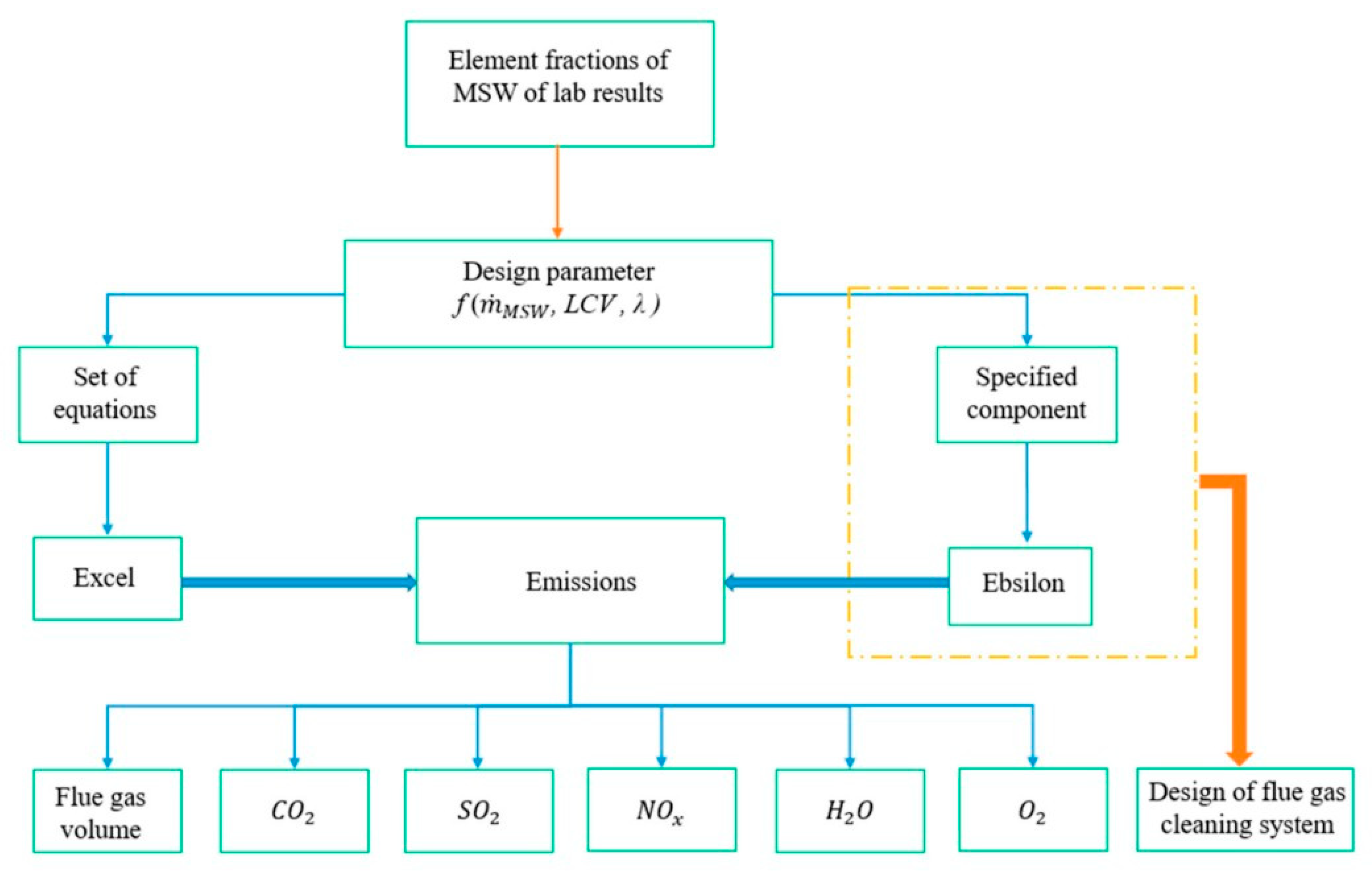
Figure 3.
Comparison between simulation and experiment from the 0.1 MWth plant: (a) molar fraction of CO2 and O2 [%]; (b) SO2 and CO emission [mg/MJ] [39].
Figure 3.
Comparison between simulation and experiment from the 0.1 MWth plant: (a) molar fraction of CO2 and O2 [%]; (b) SO2 and CO emission [mg/MJ] [39].
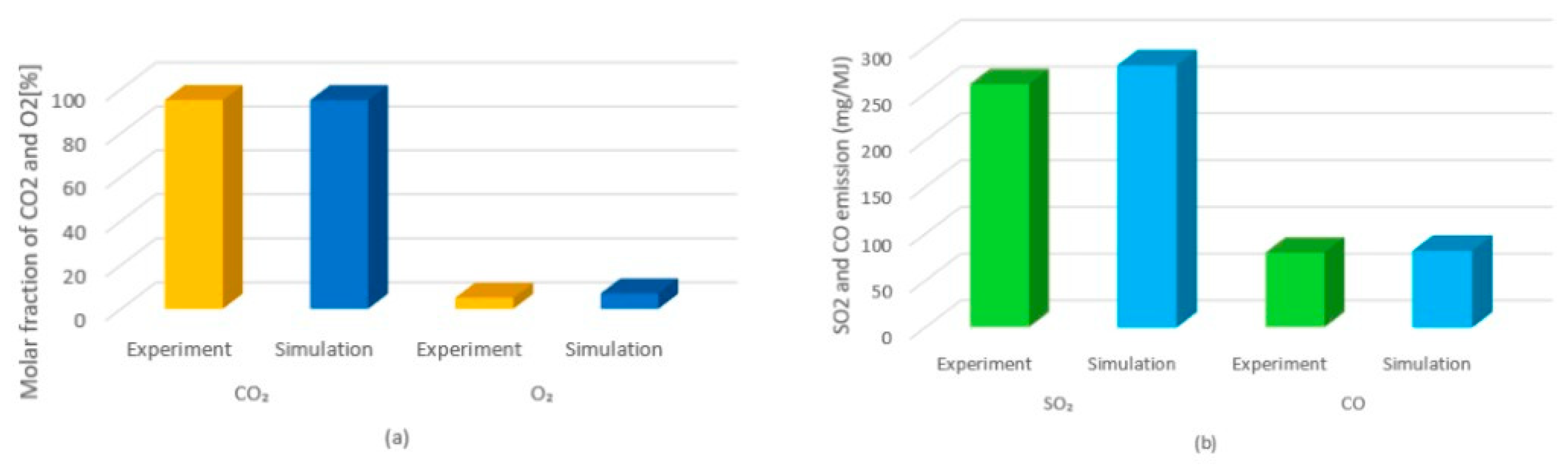
Figure 4.
Schematic diagram of electrodialysis purification [54].
Figure 4.
Schematic diagram of electrodialysis purification [54].
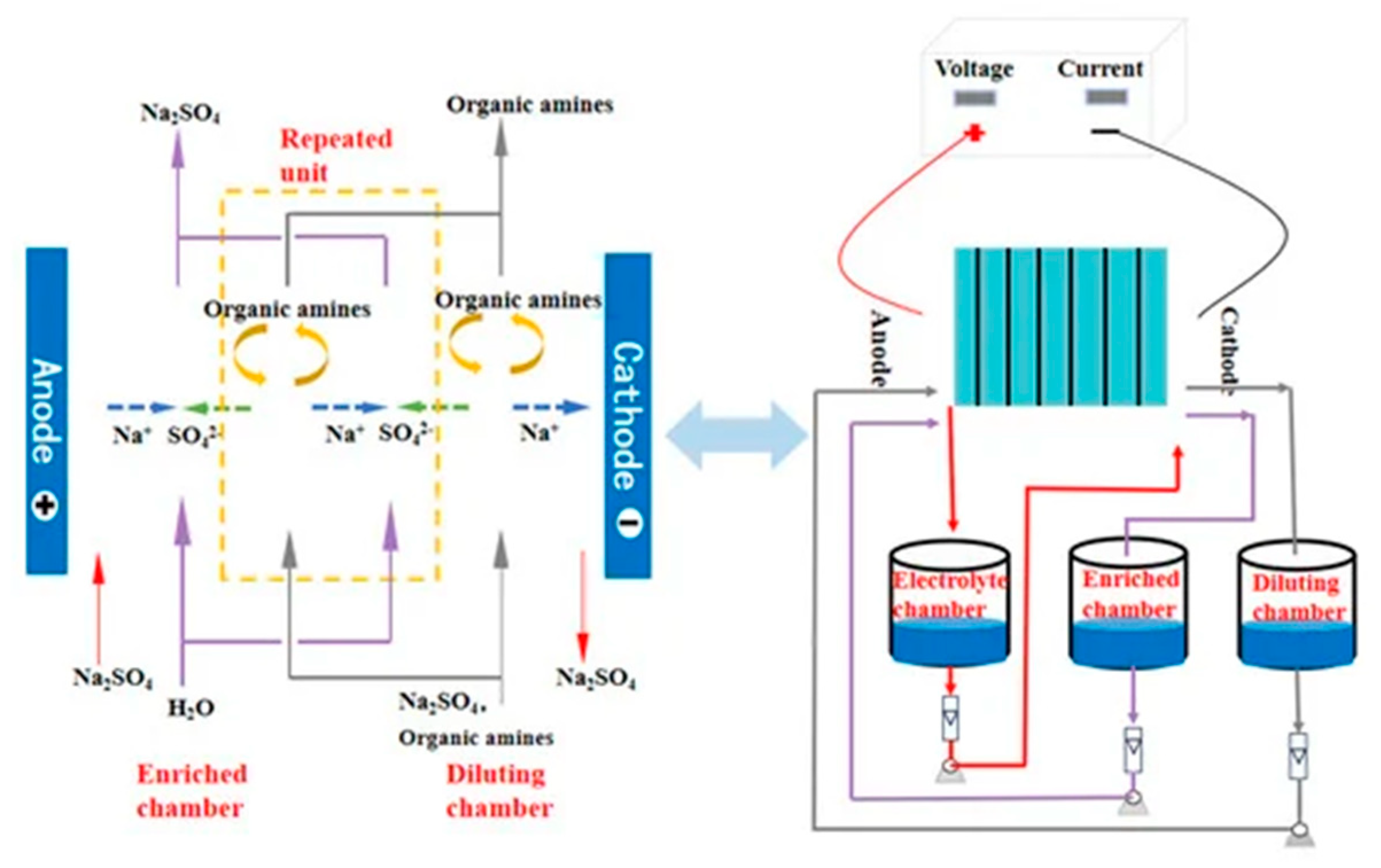
Figure 5.
The main trapping mechanisms used in CO2 geological storage: structural trapping, residual trapping, solubility trapping, and mineral trapping (The blue line represents the direction of CO2 injection) [78].
Figure 5.
The main trapping mechanisms used in CO2 geological storage: structural trapping, residual trapping, solubility trapping, and mineral trapping (The blue line represents the direction of CO2 injection) [78].
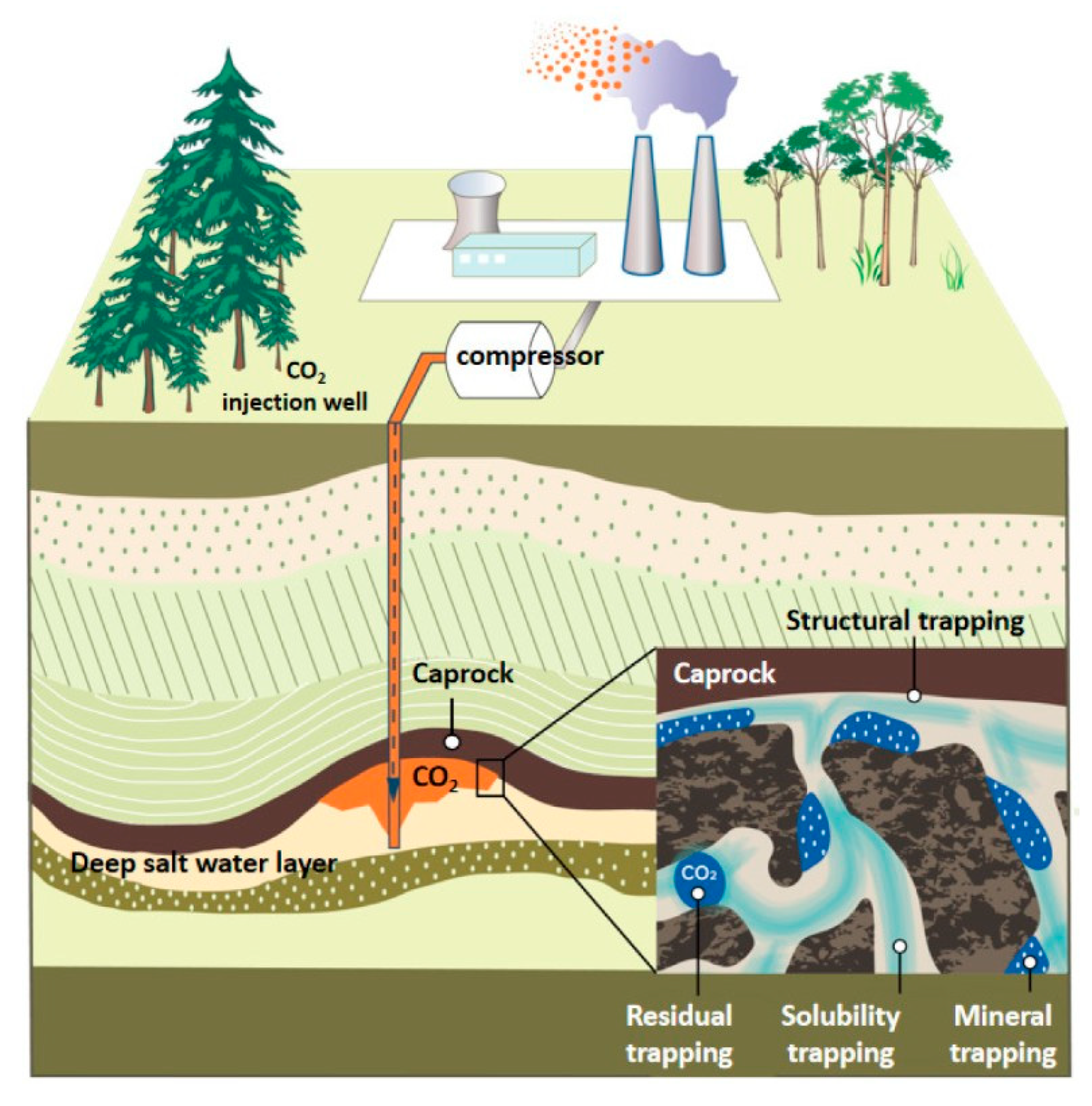
Figure 6.
The CO2% in clean flue gas with concentration of amine solvents (monoethanolamine, diethanolamine, diglycolamineand and methyldiethanolamine) at 200 m3/h permission. [100].
Figure 6.
The CO2% in clean flue gas with concentration of amine solvents (monoethanolamine, diethanolamine, diglycolamineand and methyldiethanolamine) at 200 m3/h permission. [100].
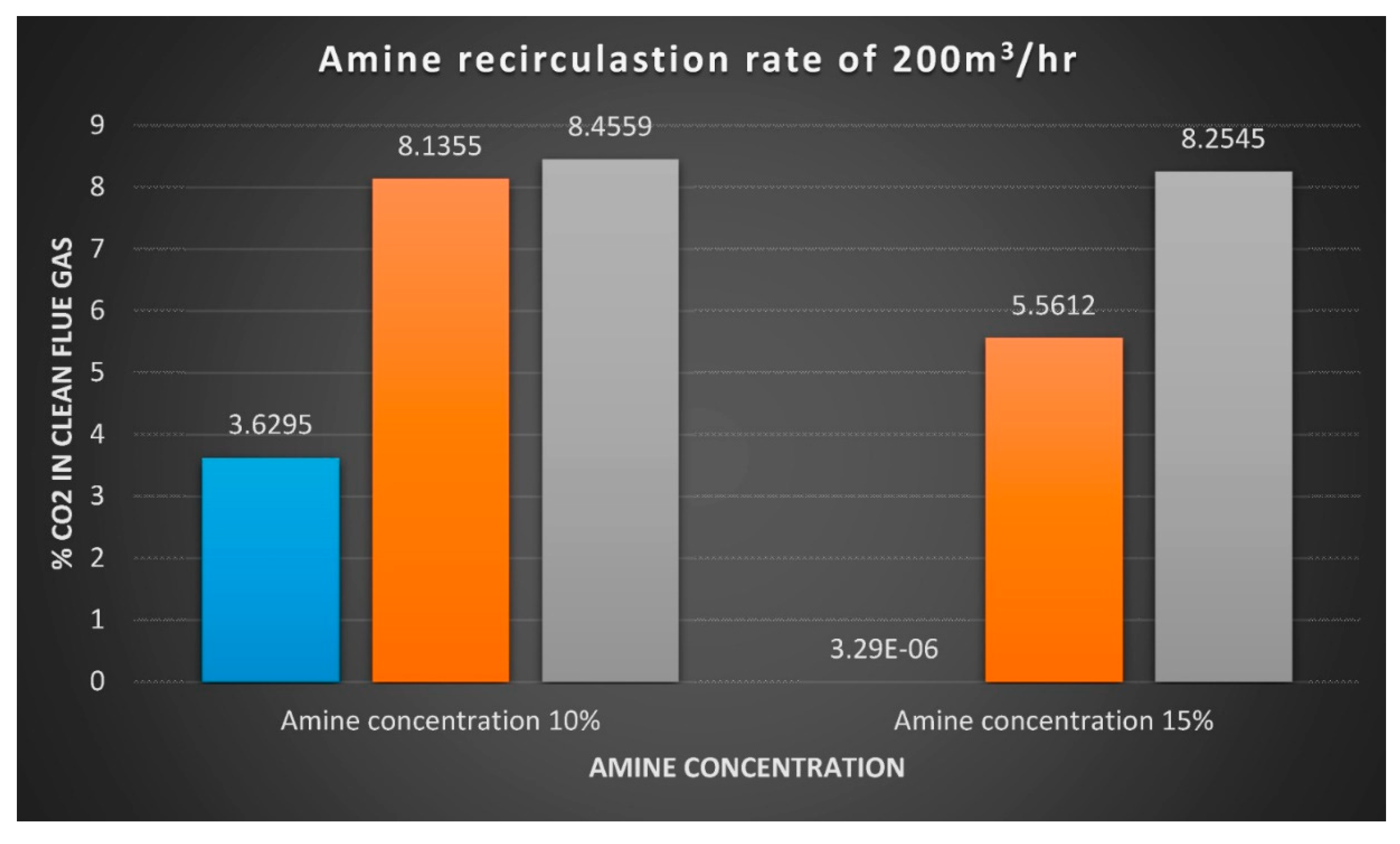
Figure 7.
Various precursor-derived porous carbon materials for CO2 adsorption [107].
Figure 7.
Various precursor-derived porous carbon materials for CO2 adsorption [107].
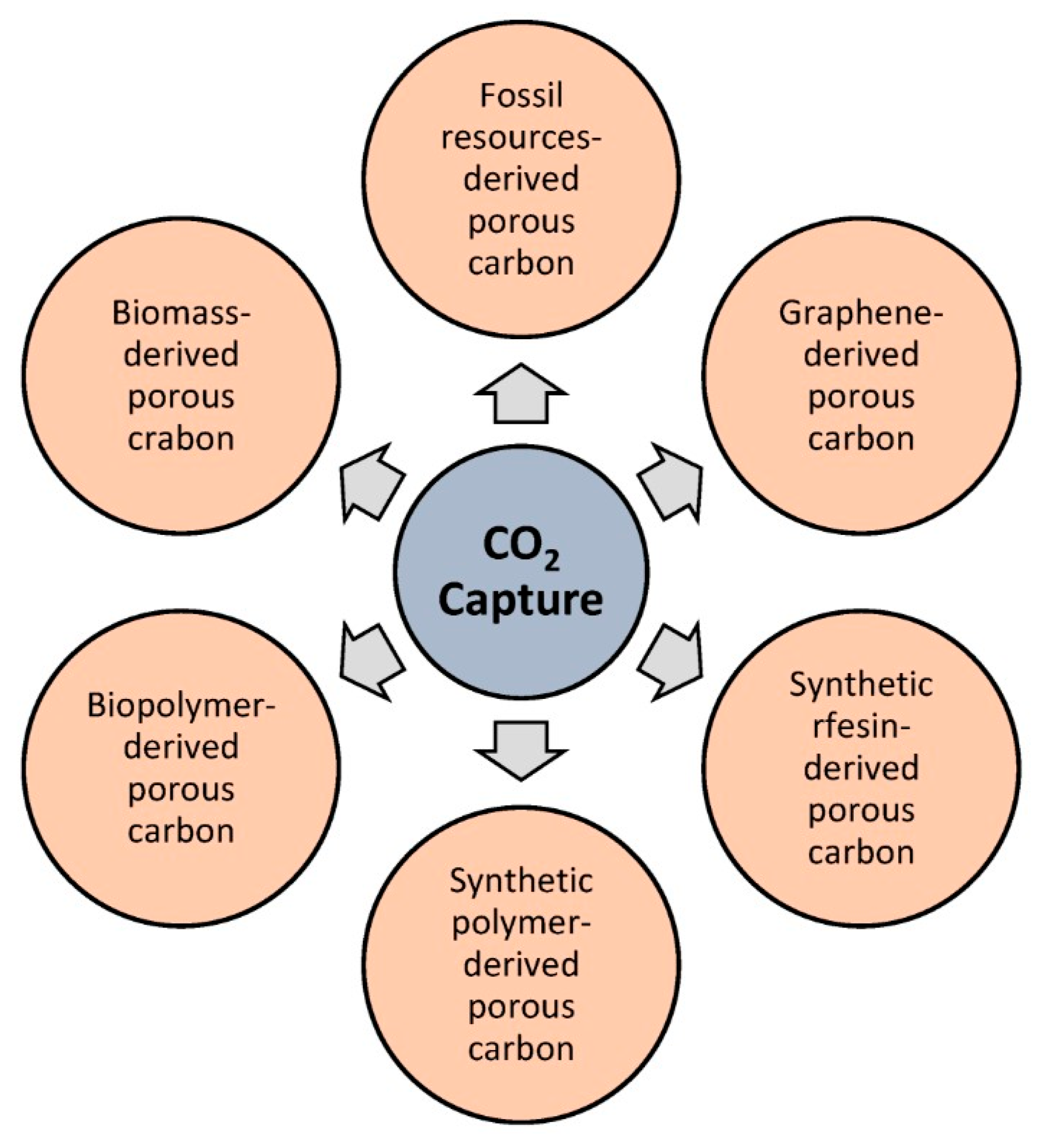
Figure 8.
Coupling principal model diagram [130].
Figure 8.
Coupling principal model diagram [130].

Figure 9.
Sotacarbo pilot plant platform layout, including the CO2 absorption and regeneration section [144].
Figure 9.
Sotacarbo pilot plant platform layout, including the CO2 absorption and regeneration section [144].
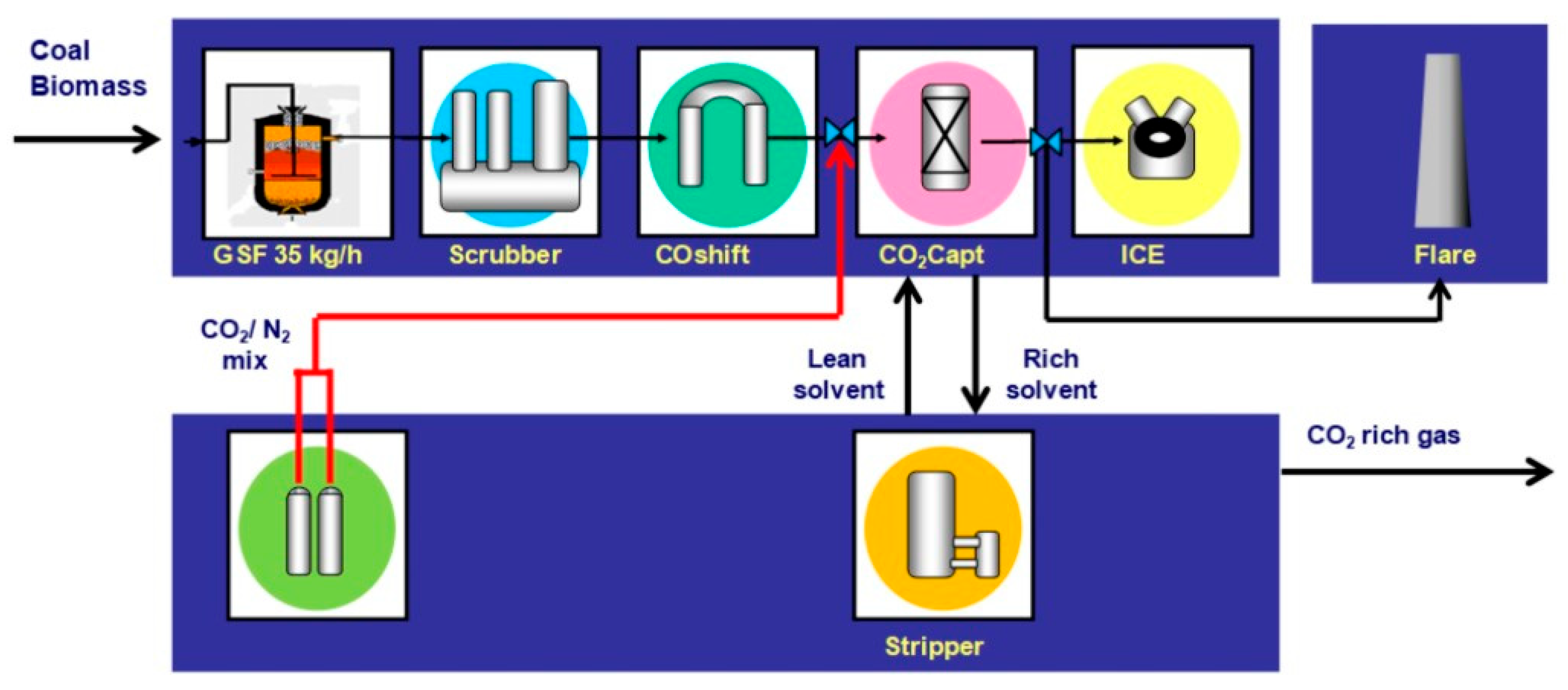
Figure 10.
Exporting the steady-state model to the dynamic environment [159].
Figure 10.
Exporting the steady-state model to the dynamic environment [159].
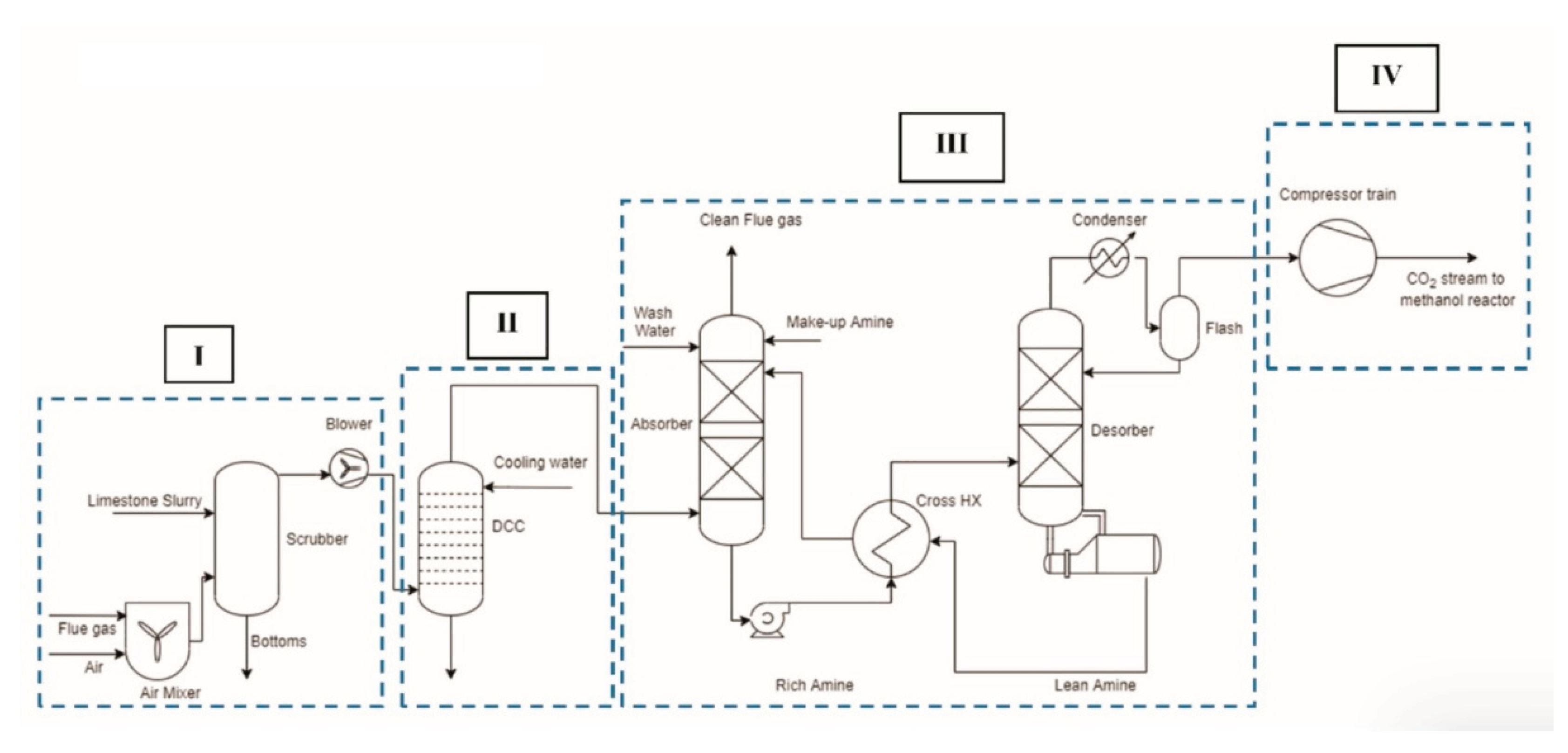

Table 1.
represents the most suitable EoS for each application.
| Application | Suitable EoS |
|---|---|
| CO2 compression and pipelines | Peng-Robinson |
| Phase behavior near critical point | Peng-Robinson/PC-SAFT |
| CO₂ + H₂O + impurities | PC-SAFT |
| CO₂–brine solubility | ePC-SAFT |
| Reactive transport modeling | SAFT-based |
Disclaimer/Publisher’s Note: The statements, opinions and data contained in all publications are solely those of the individual author(s) and contributor(s) and not of MDPI and/or the editor(s). MDPI and/or the editor(s) disclaim responsibility for any injury to people or property resulting from any ideas, methods, instructions or products referred to in the content. |
© 2026 by the authors. Licensee MDPI, Basel, Switzerland. This article is an open access article distributed under the terms and conditions of the Creative Commons Attribution (CC BY) license.
Copyright: This open access article is published under a Creative Commons CC BY 4.0 license, which permit the free download, distribution, and reuse, provided that the author and preprint are cited in any reuse.


