

Submitted:
10 February 2026
Posted:
12 February 2026
Read the latest preprint version here
Abstract
This paper critiques the established loss of simultaneity in special relativity which comes from Minkowski spacetime, and proposes a return to simultaneity through Lorentz transformation. Einstein's original thought experiment with a train (observer M’), an embankment (observer M) and lightning is shown, at first, to be inadequate for a test on simultaneity, and a new scenario is proposed. The new scenario posits that both observers M and M’ should be in the middle when the waves arrive (when waves leave is the original scenario). Despite time dilation and length contraction, simultaneity can be observed, suggesting that motion does not preclude simultaneity. But there is more; by using Lorentz invariance (therefore pure calculation), the conclusion of simultaneity will be reached with both the original and the new scenarios for both observers. This paper argues that Minkowski's oblique coordinates are probably unnecessary. Lorentz transformation maintains a consistent scale between observers, suggesting a shared background that supports simultaneity.
Keywords:
simultaneity
; spacetime
; invariance
; Lorentz transformation
; Minkowski diagrams
; special relativity
Introduction
This paper questions the well-established loss of simultaneity for a moving reference with special relativity. Papers presenting the return of simultaneity are difficult to find, and most lack coherence. In addition, it would be difficult to publish such papers as few journals would accept such a claim. That is probably why John Field’s papers questioning special relativity have never been published in a peer-reviewed journal. John Field is a professional retired from CERN, and he published many interesting papers on arXiv prior to 2015. This paper will explain several of his conclusions and his (Field,2009) paper presents an excellent review. However, although we have studied similar problems, our approaches differ.
First, we will question Einstein chosen example for the relativity of simultaneity. Then, to re-establish simultaneity, we will use Lorentz invariance: the fact that a spacetime distance between two events should be the same for an immobile and a moving reference if Lorentz transformation is applied correctly. We will calculate those invariances for two examples.
By doing so we will find a difference between Lorentz transformation (1904) and Minkowski spacetime diagram (1909). Until this paper, Minkowski and Lorentz concepts were interdependent, Minkowski space being the stage on which special relativity takes place and Lorentz transformation informing us what an observer would see on the stage. This paper will show that Lorentz requires solely a change of scale while Minkowski changes the Cartesian coordinates into oblique coordinates; the stages are not the same. There is only one Lorentz transformation but there seem to be many Minkowski (M) spacetimes (kappa-M, M-M, half M, T-M, M-Bouligand, Brunn-M, quantum M, φ-shell M, etc.); that is the first sign that Minkowski is not satisfactory. Questioning Minkowski is not new; for example, the geometric structure of Minkowski spacetime is discussed in (Zilber,2025). Literature shows papers on Lorentz invariance violation; it seems Lorentz transformation is not perfect. We will obtain one invariance violation, and on examination, we will find the limit of validity which may explain all other violations.
If papers on invariance violation and Minkowski spacetime are numerous, there does not appear to be one approaching the same conclusions as this paper; the closest is probably (Ganesan,2024) but that is about quantum theories.
The loss of simultaneity with special relativity in the original scenario
In section 9 of Relativity, Einstein (1916) uses the example of two bolts of lightning at equal distance from the observer M on the embankment. The bolts strike when the observer M’ is at the same place than observer M. After the strikes, observer M receives the two signals simultaneously while observer M’ has moved with the train since the strikes, and s/he receives one signal and then the other. This will be called the original scenario in this paper, and the conclusion is obviously the loss of simultaneity with motion. Figure 1 represents the situation when the bolts trike.
Einstein told us that the speed of light is constant for M and M’ which is a problem. Indeed, as distances AM’=BM’ when bolts strike, and as the speed of light is universal, it is not possible to conclude on the loss of simultaneity from the example alone. It is possible that I am the first to have queried the logic (Danis,2024).
To show the loss of simultaneity, a Minkowski diagram is needed. Minkowski’s solution indicates that there are two different spacetimes; one for M and one for M’. As they are different, what is simultaneous for one (strikes of A and B for M) is not for the other. So there is no surprise if one photon reaches M’ before the other.
But the principle of relativity says that a natural phenomenon observed from M should follow the same laws from M’. For me, simultaneity is a natural phenomenon, and the loss of simultaneity is breaking the principle of relativity.
A new scenario for the study of simultaneity
Is Einstein’s scenario a logical way to observe simultaneity? In section 8 of Relativity, Einstein describes how to determine simultaneity with an immobile observer. Because the observer is immobile, nothing changes between the moment of the bolts striking, and the moment of the observation.
Let’s use sound instead of light. The biggest advantage of sound waves is that, because the speed of sound is small compared to the speed of light, special relativity can be ignored. With sound, common sense tells us that it wouldn’t matter if you are immobile or not. As long as you are in the middle (and only at that position) when sound waves arrive you would observe simultaneity. The only difference would be a change of frequency due to the Doppler effect for the moving observer. Doppler effect is currently used with light to explain redshift; this fact is mentioned here only to show that sound and light are treated the same way, so replacing light by sound as above should be acceptable.
Therefore, what seems important is that the observer is at the right place (in the middle) when the photons reach her/him. So, logically it is the moment of the observation that is important, not the moment when the bolts strike. The new scenario is that M and M’ are in the middle when waves arrive. Which scenario is correct and does the observer have to be immobile to observe simultaneity?
To answer those two questions, we will use spacetime intervals between strikes (event1) and observations (event2) for the new scenario. Fig.1 can also represent the new scenario, i.e. the moment when the photons reach M and M’. In appendix A, we show that spacetime intervals AM’ and BM’ are equal for this second scenario. But as the events are defined with photons, spacetime interval is zero, the argument for simultaneity is not convincing yet. But the goal has now changed to the two questions: which scenario is correct and what is the effect of motion.
Lorentz transformation and the return of simultaneity
The spacetime intervals exercise uses Lorentz transformation and it shows that the time interval AM’ equals the time interval BM’. It also shows that the distance AM’ is equal to the distance BM’. As predicted with special relativity, there is length contraction and time dilation; so time and distance for M’ are different to M. Despite those differences, it shows there is no reason why M’ would not observe simultaneity. The Appendix starts with the observation of M solely; and concludes that M’ observes simultaneity as well. It would mean that the observer doesn’t need to be immobile to observe simultaneity.
Because there is a difference in time-flow between M and M’, to expect a loss of simultaneity seems logical. But the strikes (or events) are one instant, there is no duration. Duration would be affected by time-flow, but not one instant. Time dilation means that the time for light to reach M’ is different to the time for light to reach M but the time AM’ equals the time BM’ as shown in the appendix. Simultaneity is back. To state that the time AM’ is different to the time BM’ would mean that there are two different time-flows for M’, depending on the direction of the photon. It seems illogical.
The return of simultaneity was my original motivation, but this scenario shows a difference between Lorentz transformation and Minkowski spacetime diagram as we will see.
Minkowski spacetime diagram
Is simultaneity back? Apparently yes. Let’s see what’s going on with Minkowski; his spacetime diagram for the new scenario is drawn Figure 2. Photons A and B reach observer M’ at the same time; so simultaneity is back. It is difficult because we, scientists, are omnipotent; we can see everything instantaneously like the distance AM’ being smaller than the distance BM’, and the time AM’ being smaller too. But the real case is that observer M’ knows the direction of photons A and B but not their origin; and they arrive at the same time which is the requirement from Einstein to observe simultaneity; so observer M’ concludes there is simultaneity.
That is the easy way out; but Minkowski spacetime diagram still states that A and B are not simultaneous for M’ because they are not happening on a single x’ axis. With Minkowski diagram, M’ is not at equal distance from A and B in her/his own reference. The fact that photons A and B reach M’ simultaneously is just a fact without any significance.
Simultaneity is no longer the only problem for this paper: why the distances AM’ and BM’ are different with the diagram and not with Lorentz transformation?
Let’s check Lorentz transformation. One postulate of special relativity is that the speed of light is constant. Observer M knows that observer M’ also measures the speed of light. From M viewpoint, in order that M’ measures the speed of light, as M’ is travelling at a speed v, there is length contraction and time dilation. If, for observer M, contraction/dilation have the same value for the photon from A and photon from B (as with the appendix), observer M’ observes simultaneity. But that shouldn’t give the speed of light for M’ as the speed and direction of M’ are ignored. For observer M, to compensate for the speed v of M’, contraction/dilation should have one value for the photon from A, and another for the photon from B. So indeed, simultaneity would be lost. Why isn’t this the case in appendix A?
With Lorentz, M’ observes the speed of light for both photons with only one set of contraction/dilation, and we know this because the invariant spacetime intervals equal zero. Therefore Lorentz transformation is clever enough to recover that speed of light or the spacetime intervals wouldn’t have been zero. Lorentz transformation gives distance and time; from those we find the speed of light; v is ignored except in Lorentz factor. It seems that it works very well.
There doesn’t appear to be any other path to obtain a difference between AM’ and BM’ with Lorentz.
The reasoning with Minkowski diagram is more straightforward: seen from M, one photon has some catching up to do, so it starts with a smaller distance, the other photon goes in the opposite direction to observer M’ so it starts from a greater distance. The speed of light is “recovered” for M’ as the longer distance corresponds to a longer time for M’ as it seems on the diagram. The dashed lines on the diagram are the speed of light which is valid for M and M’, so observer M can see that the speed of light is recovered by observer M’. In fact, there was no question to raise because Minkowski diagrams seem to be based on the speed of light.
History of the original scenario
Now I am trying to make sense of this original scenario, and what follows is mostly assumptions. In 1905, Einstein explains special relativity with two postulates, spacetime doesn’t exists yet. To show the novelty and potential of special relativity, the original scenario is ideal. With the principle of relativity, M is immobile but M’ can also be considered as immobile. The conclusion is that both M and M’ observe simultaneity because both can be considered as immobile. Because when the waves arrive, M’ is not in the centre, it seems illogical to observe simultaneity but that is what the new special relativity is telling us. And if somebody complains that it doesn’t make sense, there is a second argument. The postulate of universality of the speed of light tells us that, as long as M and M’ are in the middle when lights leave, both should observe simultaneity. To explain simultaneity with the speed of light involves time dilation; that scenario is ideal to show the novelties of special relativity with the two postulates.
Common sense tells us that if one scenario gives simultaneity, the other shouldn’t. Minkowski was the maths professor of Einstein. As a mathematician, common sense is important. Before quantum mechanics (which arrived after Minkowski’s time), common sense has always won the day; so simultaneity should disappear. Minkowski invented spacetime and that is good, but he also invented the oblique coordinates probably to obtain the loss of simultaneity. That is an addition; Lorentz tells us that both scenarios predict simultaneity as in Appendix B.
After 1905, Einstein has moved to the next problem, and in 1907 he has the “happiest thought of my life”: the equivalence principle which is a first step towards general relativity. Meanwhile, Minkowski tries to give better foundation to 1905 Einstein’s special relativity; in 1908, he introduces spacetime and the oblique coordinates. Minkowski is a big name, if he says that simultaneity should disappear, he must be right; his diagrams are convincing, etc. Between 1905 and 1908, it becomes obvious that simultaneity should be observed with the original scenario. To obtain a loss of simultaneity, the original scenario is re-examined. Einstein’s mind is on general relativity, so he simply rewrites his section 9 using the original scenario.
This is my imaginary version of events; if you know the real history, please get in touch.
So, if my story is correct, if we use Lorentz with the original scenario, we should observe simultaneity for M’. Einstein stated that he couldn’t have found special relativity without the groundwork of Lorentz. I started to have some admiration for Lorentz transformation while studying photon clocks. But here, I am simply baffled; Lorentz transformation is able to predict simultaneity for observer M’ in the original scenario as presented in Appendix B. Please do check this Appendix as there is also an invariance violation.
Which theory is correct?
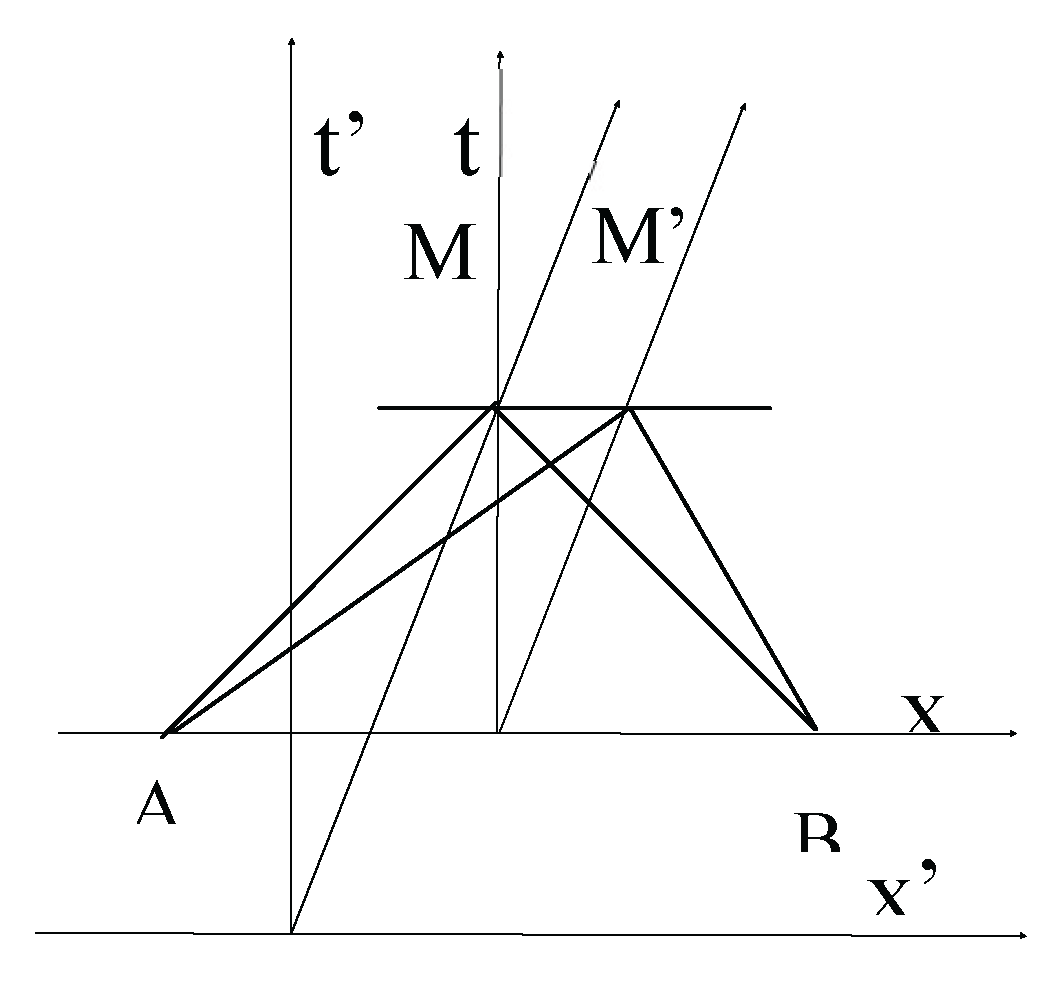
It seems that the two theories are reaching the right result: speed of light and an agreement on the observation (simultaneity) in a different way. But the intermediate results (distance and time) are different, hence the title of this paper. I would reject Minkowski because his spacetime is so strange (any curve is shorter than a straight line and noncommutativity (xy≠yx)). Minkowski seems to have taken the speed of light for his reference. Lorentz may have taken space for his reference, a space with aether: Lorentz never accepted special relativity and always stated that aether was real. The result is Cartesian coordinates for M and M’ with a change of scale identical for x and t (see Figure 3). So the background for M and M’ is the same with Lorentz, it seems it is not with Minkowski because there is a move from Cartesian coordinates to oblique coordinates. These oblique coordinates are the reason for the loss of simultaneity, which is also an addition to the two postulates of special relativity, therefore an addition to Lorentz transformation. Ockham razor would say that this additional dimension should disappear if not necessary (McFadden,2021).
Note: According to Appendix A, only the scales change between M and M’, the factor γ is identical for x and t. The arrows with M’ are the world line, not the t’ axis; the arrow on the right of M’ represents the original scenario, on the left is the new scenario. According to Appendix B, with the original scenario, photons A and B reach M’ at the same time as described with the dotted lines. At the same time (the horizontal dotted line), the identical photons reach M and M’ as described with the dashed lines. This disturbing result may have something to do with quantum mechanics, as presented in Further Discussion.
Further Discussion
With the original scenario, M’ detects a simultaneity (the right arrow of Fig.3) as shown with Appendix B. That is the result I wanted to reach. I am not impartial because, to explain the EPR paradox (Danis,2025), I needed simultaneity. While writing (Danis,2025), for me, Minkowski was simply a visualisation of the two original postulates. The result is in fact contrary to the accepted theory, except that it was based solely on the two original postulates. When I finally understood Minkowski (and the accepted theory), I realised my mistake and wanted to retract my previous paper. But the solution is so simple (Ockham again), it should be correct. As it depends on simultaneity, I decided to question simultaneity. That is why this paper exists.
The observation of Alain Aspect and others (Aspect,1999) are essential for this paper because Minkowski’s concept cannot explain the EPR paradox while Lorentz can. That is the main reason why Lorentz transformation should be preferred to Minkowski.
What does Appendix B show? The fact that, with special relativity (without Minkowski), both scenarios are correct to judge simultaneity; this is not intuitive, but such an illogical conclusion would be typical for quantum theories. The origin of quantum superposition could be found in Lorentz transformation; and it would be a spatial and temporal superposition as suggested in (Danis,2025).
I don’t like the term fundamental theory because what is fundamental today may not be so tomorrow; but for me, Lorentz transformation is today a fundamental theory. It is a 1D theory that can be applied to 3D, it should be at the foundation of quantum mechanics; the paper (Danis,2024) is far from perfect but arguments of the 1D idea and history of Lorentz transformation are presented. Lorentz transformation is so clever that I believe it is background independent (another requirement for a fundamental theory); but further studies are needed on that subject.
There are many other questions in my mind, but they are irrelevant for this paper. What was Einstein’s opinion on Minkowski diagram? With the train/embankment story, who decided that the starting moment of the photons should be considered as the important moment? Did Minkowski use the train/embankment to imagine his spacetime? It is said that Einstein used Minkowski’s maths for his general relativity. Is it correct? Did he really use the maths of Minkowski diagrams, or solely the idea of spacetime with the invariant spacetime interval? Can we explain all invariance violations as with appendix B?
Does appendix A really show simultaneity with the new scenario or is it that I have fixed too many variables?
Please do come back to me and leave a comment on PrePrint. Is there a mistake and where? Is it an important mistake? Do I jump to conclusions too fast and if so, where? Is there any observation that contradicts this work? Is it possible that I am on to something that you believe important? Whilst I don’t ask you to validate my work, it would be helpful to know that you haven’t found any mistake. I would greatly appreciate discussion, and not only from professionals.
Conclusion
If this paper is correct, simultaneity is back, Minkowski doesn’t represent reality, special relativity could explain quantum mechanics.
Acknowledgements
Thanks to Andreas for clarifying that A and A’ (A view from M’) are not the same with Minkowski, a small remark with such an important impact.
Appendix A: Spacetime interval new scenario
We will check that A’M’ and B’M’ are equal for the new scenario, i.e. M’ is above M when photons are received. M is at x=0, A is at -c, B is at +c so the time between the two events. Starting event: photon A or B leaves point A or B. Final event: photon A or B reaches observer M and M’. The time needed for M is 1s (one second). Spacetime interval squared is:
ds2 = (x2-x1)2 + (y2-y1)2 + (z2-z1)2 – c2 (t2-t1)2
Spacetime interval is an invariant; to recover it, Lorentz factor γ will be needed which is:
γ = 1/√(1-v2/c2)
A1: Spacetime interval for AM
Starting event: x1 = -c y1 = 0 z1 = 0 and t1 = 0 (photon leaves A)
Final event: x2 = 0 y2 = 0 z2 = 0 and t2 = 1 (photon reaches M)
ds2 = (c)2 + 0 + 0 – (1)2 c2 = 0
The same two events for M’ give:
x’1 = ? y’1 = 0 z’1 = 0 and t’1 = 0 (photon leaves A)
x’2 = 0 y’2 = 0 z’2 = 0 and t’2 = ? (photon reaches M’)
Lorentz transformation gives:
t’2 = γ (t2 - (v.x2/c2) = γ (1 - 0/c) = γ
x’1 = γ (x1 - v.t1) = γ (-c - 0) = -c γ
ds’2 = (c γ)2 + 0 + 0 – (γ)2 c2 = 0
The result ds2=0 is expected as what defines the two events is photon A. The speed v intervenes only in the Lorentz factor. γ is the scale factor for Fig.3.
A2: Spacetime interval for BM
Starting event: x1 = c y1 = 0 z1 = 0 and t1 = 0 (photon leaves B)
Final event: x2 = 0 y2 = 0 z2 = 0 and t2 = 1 (photon reaches M)
ds2 = (-c)2 + 0 + 0 – (1)2 c2 = 0
The same two events for M’ give:
x’1 = ? y’1 = 0 z’1 = 0 and t’1 = 0 (photon leaves B)
x’2 = 0 y’2 = 0 z’2 = 0 and t’2 = ? (photon reaches M’)
Lorentz transformation gives:
t’2 = γ (t2 - (v.x2/c2) = γ (1 - 0/c) = γ
x’1 = γ (x1 - v.t1) = γ (c - 0) = c γ
ds’2 = (-c γ)2 + 0 + 0 – (γ)2 c2 = 0
As stated in the main text, the two t’2 are equal, the two x’1 are opposite (but equal in value). The scale factor is identical.
If x’2 is not zero (as with Einstein’s original scenario), it seems we are not talking about the same events as ds’ won’t equal zero. But that is too fast as we will see in the next Appendix.
Appendix B: Spacetime interval original scenario
We try to check that time AM’ and BM’ are equal for the original scenario. We will use relative units: speed is 1 instead of c and distance is 1 instead of c.1s. M’ is moving at 0.99c (therefore 0.99) towards B (faster than on Fig.3). The question is when (and where) A and B meet M’.
B1: First study
If we use M reference, there is a problem (Lorentz invariance violation?) as we will see. M is at x=0, A is at -2c (therefore -2), B is at +2. I prefer +2 and -2 to have a difference with Appendix A.
Starting event: x1A = -2 y1 = 0 z1 = 0 and t1A = 0 (photon leaves A)
Final event: x2A = ? y2 = 0 z2 = 0 and t2A = ? (photon reaches M)
We don’t know where M’ is when the photon reaches her/him. The relation between x2A and t2A is obviously the speed of light: t2A = 2+ x2A
ds2 = (x2A + 2)2 + 0 + 0 – (2+ x2A)2 = 0
The same two events for M’ give:
x’1A = ? y’1 = 0 z’1 = 0 and t’1 = 0 (photon leaves A)
x’2A = ? y’2 = 0 z’2 = 0 and t’2A = ? (photon reaches M’)
Lorentz transformation gives:
t’2A = γ (t2A - (v.x2A) = γ ( 2+(1-v) x2A)
x’1A = γ (x1A - v.t1) = γ (-2 - 0) = -2 γ
x’2A = γ (x2A - v.t2A) = γ ((1-v)x2A – 2v )
ds’2 = ( γ ((1-v)x2A – 2v+2 ))2 + 0 + 0 – (γ ( 2+(1-v) x2A))2
From Appendix A, the value of x’1A was expected, but ds’2 is not = 0 except if v =0. It will be similar with B. The problem is the -2v which seems to come because the reference of M is used: xM is at zero. Lorentz transformation still has some mysteries to me. Next, A will start at xA=0 then B will start at xB=0.
This is probably a Lorentz invariance violation that will be tentatively explained at the end of B.4.
B2: Spacetime interval for AM
Starting event: x1A = 0 y1 = 0 z1 = 0 and t1A = 0 (photon leaves A)
Final event: x2A = ? y2 = 0 z2 = 0 and t2A = ? (photon reaches M)
We don’t know x2A and t2A because the event is the photon reaching M’ that interest us (not M where x2A = 2 and t2A = 2). The relation between x2A and t2A is obviously the speed of light: t2A = x2A in relative coordinates.
ds2 = (x2A )2 + 0 + 0 – (x2A)2 = 0
The same two events for M’ give:
x’1A = 0 y’1 = 0 z’1 = 0 and t’1 = 0 (photon leaves A)
x’2A = ? y’2 = 0 z’2 = 0 and t’2A = ? (photon reaches M’)
Lorentz transformation gives:
t’2A = γ (t2A - (v.x2A) = γ ((1-v) x2A)
x’2A = γ (x2A - v.t2A) = γ ((1-v)x2A)
Please notice that 1-v is 0.01 so the contribution of x2A is largely diminish. But our intuition tell us that x2A is about 200, way beyond point B.
ds’2 = ( γ (1-v)x2A )2 + 0 + 0 – (γ (1-v) x2A)2 = 0.
B3: Spacetime interval for BM
Starting event: x1B = 0 y1 = 0 z1 = 0 and t1B = 0 (photon leaves B)
Final event: x2B = ? y2 = 0 z2 = 0 and t2B = ? (photon reaches M)
As previously, x2B and t2B are linked by the speed of light: t2B = - x2B
We expect x2B to be between M and B. As M is on the left (negative), x2B will be negative but the time should be positive.
ds2 = (x2B )2 + 0 + 0 – (- x2B)2 = 0
The same two events for M’ give:
x’1B = 0 y’1 = 0 z’1 = 0 and t’1 = 0 (photon leaves B)
x’2B = ? y’2 = 0 z’2 = 0 and t’2B = ? (photon reaches M’)
Lorentz transformation gives:
t’2B = γ (t2B - (v.x2B) = γ (-x2B (1+v)) (as x2B will be negative, no problem)
x’2B = γ (x2B - v.t2B) = γ ( (1+v)x2B )
ds’2 = (γ (1+v)x2B)2 + 0 + 0 – (γ(-x2B (1+v))2 = 0.
B4: Joining the dots i.e. linking B2 and B3
Now we have to link x2A with x2B. We decided that the distance between A and B is 4, therefore for M: x2A - x2B = 4. We have to determine where photons A and B are meeting for M’ reference. Because x2B is negative, lets replace it by x2A.
x2B = x2A – 4.
t’2A = γ ((1-v) x2A)
t’2B = γ ((4-x2A) (1+v))
x’2A = γ ((1-v) x2A)
x’2B = γ ( (1+v) (x2A -4))
Remember that x’2A and x’2B don’t have the same reference despite replacing x2A by x2B; therefore one is positive the other negative. But reference shouldn’t matter for time interval. If I assume there is simultaneity, t’2A = t’2B then I can find one value of x2A.
t’2A = γ ((1-v) x2A) = γ ((4-x2A) (1+v)) = t’2B
My mathematical skill is not good enough; I have to replace v by its value: 0.99 and I found:
x2A = 3.98
With this value you will find that x’2A = x’2B. So for M’, 3.98 distance in M reference behind M’ (x’2A) equals 0.02 distance in M reference in front of M’ (x’2B). Lorentz transformation is very very cleaver in the sense that the deformation of spacetime seems to be different in front or at the back. The oblique coordinates of Minkowski are also recovering that effect but at the cost of the loss of simultaneity. With Lorentz it seems the change of scale is in front or at the back (the slope of the light trajectories of Fig.3); with Minkowski, it seems the effect is dictated by the direction of the photons.
This result tells us that the place where photon A, photon B and observer M’ meet is 1.98 away from M in M reference. How long does it take for M’ to travel 1.98c? 2s in M reference. So from M reference, we can deduce that M’ is at the right place and observes simultaneity. Not only M and M’ observe simultaneity but they observe it at the same time which obeys the principle of relativity.
About Lorentz violation; the observation that spacetime is deformed differently in front or at the back is probably essential for a correct Lorentz transformation (a similar observation has been made with photon clocks). Appendix B2, the photon is moving away from the origin. Appendix B3 the photon is approaching the origin. Appendix B1, the origin is in the middle: approaching then receding. This is probably not supported by Lorentz transformation therefore the violation of B1. The explanation is just an idea that needs further studies.
References
- Aspect, A. Bell's inequality test: more ideal than ever. Nature 1999, 398(6724), 189–90. [Google Scholar] [CrossRef]
- Danis, F. “Limit and potentials of Special Relativity”. Applied Physics Research 2024, Vol. 16(No. 2), 112. [Google Scholar] [CrossRef]
- Danis, F. “Making Sense of Quantum Superposition”. Applied Physics Research 2025, Vol. 17(No. 2), 1. [Google Scholar] [CrossRef]
- Einstein, A. Relativity: The Special and the General Theories.; The folio society: London, 1916. [Google Scholar]
- Field, J. The Space-Time Lorentz Transformation: Relativity of Simultaneity is Incompatible with Translational Invariance. arXiv 2009, arXiv:physics/0403127. [Google Scholar] [CrossRef]
- Ganesan, T. Relativistic Formulation in Dual Minkowski Spacetime. Symmetry 2024, 16(4), 482. [Google Scholar] [CrossRef]
- Lorentz, H. Electromagnetic phenomena in a system moving with any velocity smaller than that of light. Proceedings of the Royal Netherlands Academy of Arts and Sciences 1904, 6, 809–831. [Google Scholar]
- McFadden, J. Life is simple; Basic Books, 2021. [Google Scholar]
- Minkowski, H. "Raum und Zeit" [Space and time]. Physikalische Zeitschrift 1909, 10, 75–88. [Google Scholar]
- Zilber, B. Structural approximation and a Minkowski space-time lattice with Lorentzian invariance. arXiv doi:10.48550/arXiv.2508.04716. 2025, arXiv:2508.04716. [Google Scholar] [CrossRef]
Figure 1.
Train and embankment as used by Einstein's.
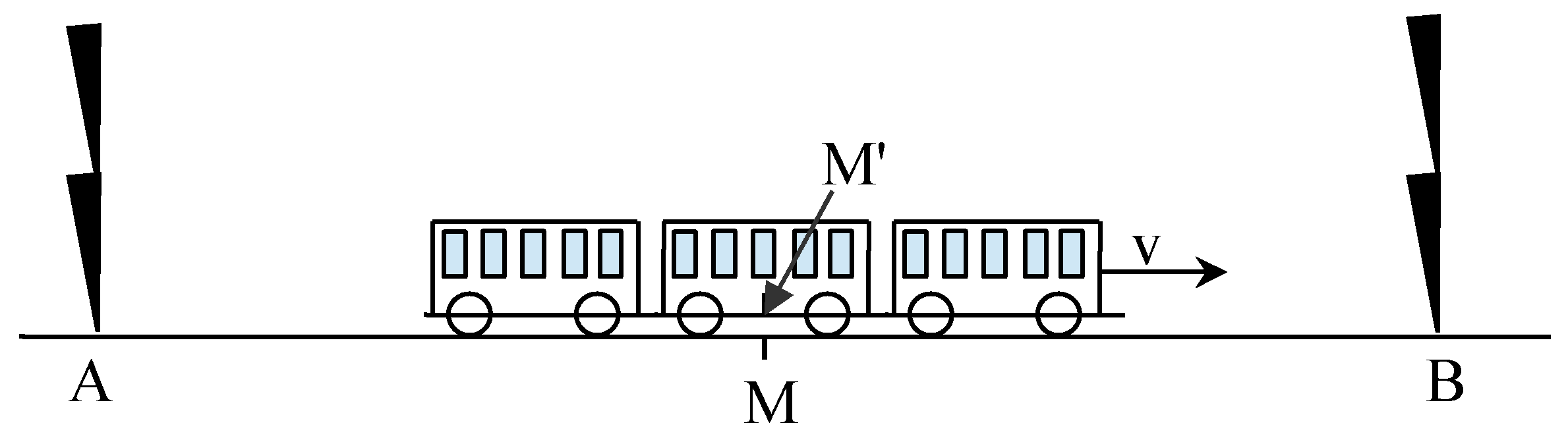
Figure 2.
Minkowski spacetime diagram.
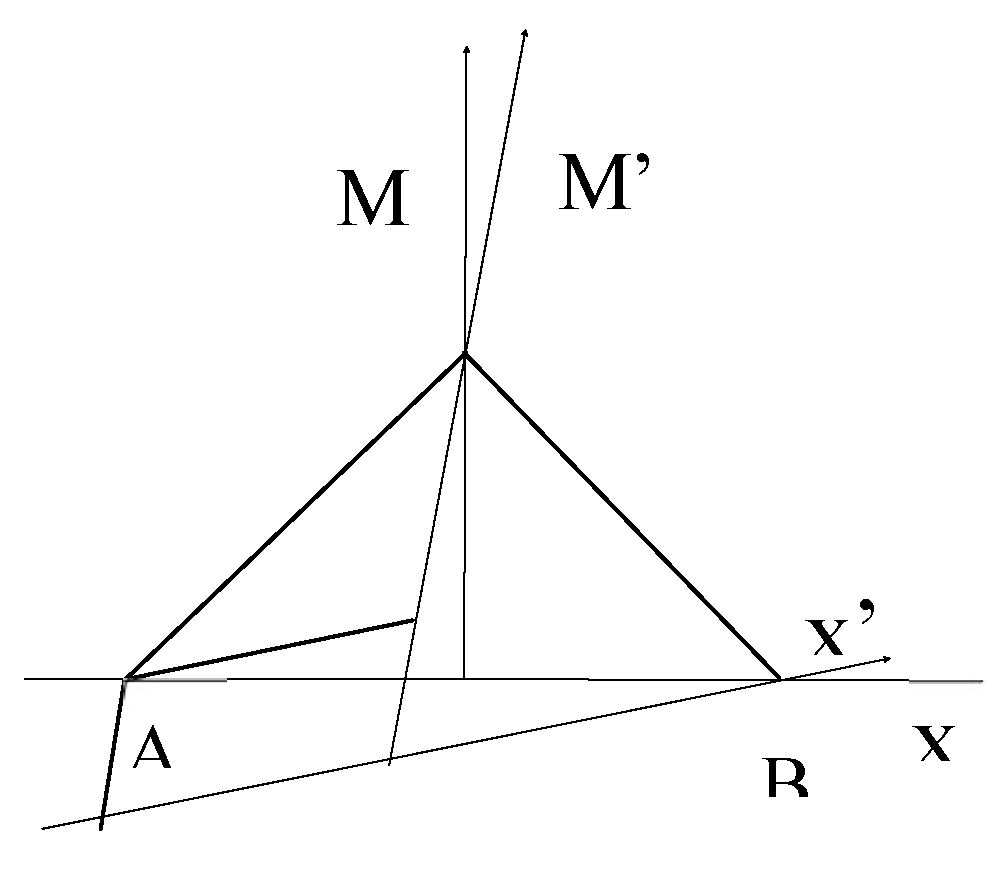
Figure 3.
Lorentz spacetime diagram for the two scenarios.
Disclaimer/Publisher’s Note: The statements, opinions and data contained in all publications are solely those of the individual author(s) and contributor(s) and not of MDPI and/or the editor(s). MDPI and/or the editor(s) disclaim responsibility for any injury to people or property resulting from any ideas, methods, instructions or products referred to in the content. |
© 2026 by the authors. Licensee MDPI, Basel, Switzerland. This article is an open access article distributed under the terms and conditions of the Creative Commons Attribution (CC BY) license (http://creativecommons.org/licenses/by/4.0/).
Copyright: This open access article is published under a Creative Commons CC BY 4.0 license, which permit the free download, distribution, and reuse, provided that the author and preprint are cited in any reuse.


