
Submitted:
11 February 2026
Posted:
13 February 2026
You are already at the latest version
Abstract
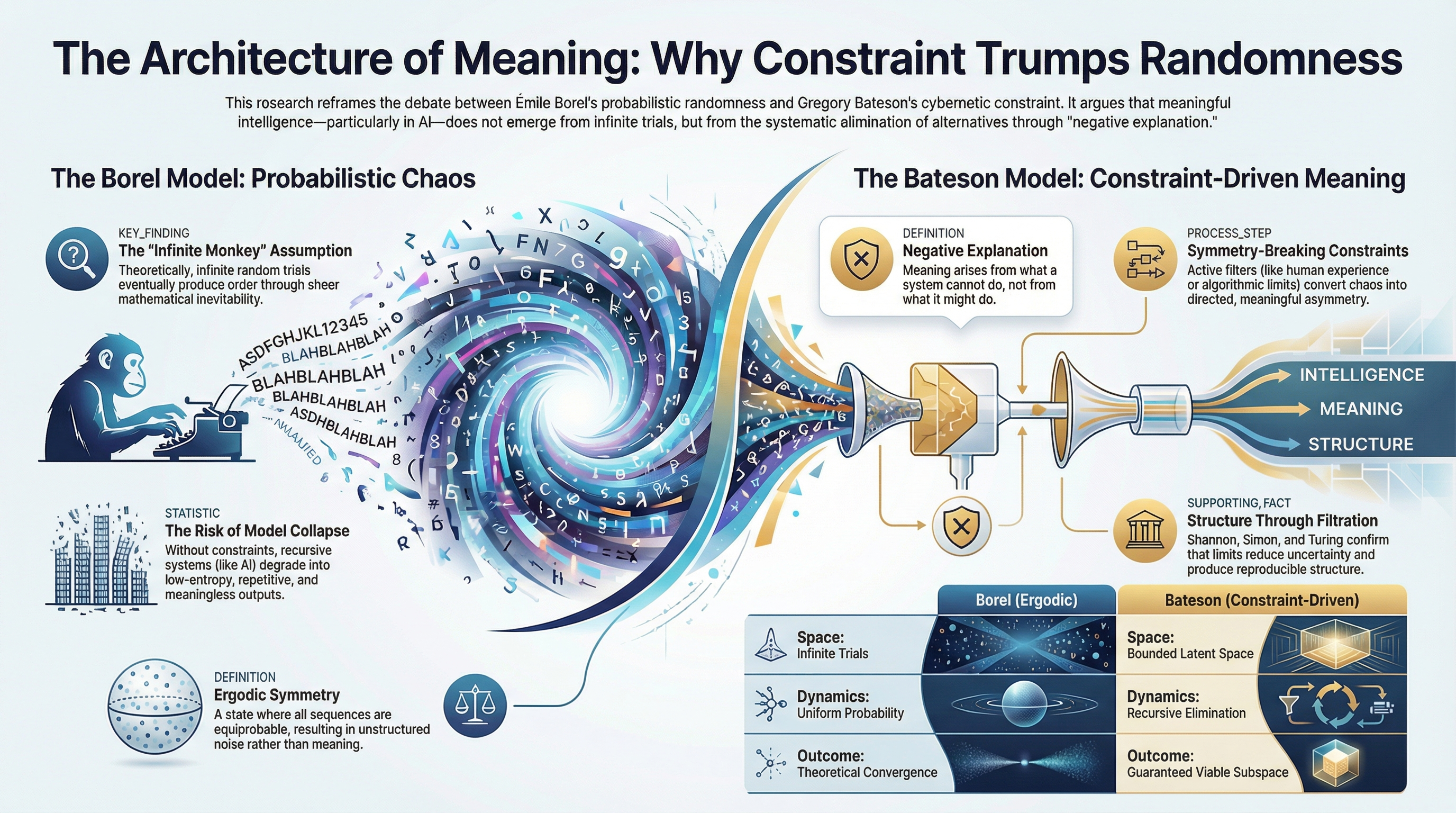
This study develops a Constraint-Driven Model of Intelligence to explain the emergence of structured meaning in complex systems, reconciling probability and cybernetics. Building on Émile Borel’s Infinite Monkey Theorem, which illustrates the theoretical inevitability of order through unbounded stochastic processes, and Gregory Bateson’s principle of negative explanation, which frames structure as the consequence of systematically eliminated alternatives, the analysis formalizes how constraints break ergodicity and generate asymmetry. Shannon’s entropy quantifies the informational effects of constraints, while Simon’s bounded rationality and Turing’s algorithmic limits illustrate how cognitive and computational boundaries produce tractable, reproducible outcomes. Applying this model to modern artificial intelligence, the study provides a formal account of model collapse in recursive training, showing that the loss of asymmetric constraints leads to low-entropy, repetitive outputs, demonstrating the epistemic necessity of constraint-driven regulation. By comparing probabilistic and cybernetic accounts of emergence, the analysis demonstrates that structured intelligence is not an inevitable product of stochastic exploration, but arises from bounded, recursive, and selective processes. Beyond computational systems, this model is transdisciplinary, showing how constraints ranging from socioeconomic pressures to subcultural circulation shape diversity, innovation, and functional asymmetry. By formalizing the transition from maximal stochastic symmetry to meaningful asymmetry, this model establishes a generalizable cybernetic epistemology for the generation of structured intelligence and meaning across numerous domains.
Keywords:
non-ergodic intelligence
; cybernetic constraint
; negative explanation
; infinite monkey theorem
; symmetry-breaking
; AI model collapse
; bounded rationality
; structured emergence
Copyright: This open access article is published under a Creative Commons CC BY 4.0 license, which permit the free download, distribution, and reuse, provided that the author and preprint are cited in any reuse.


