
Submitted:
11 February 2026
Posted:
12 February 2026
You are already at the latest version
Abstract
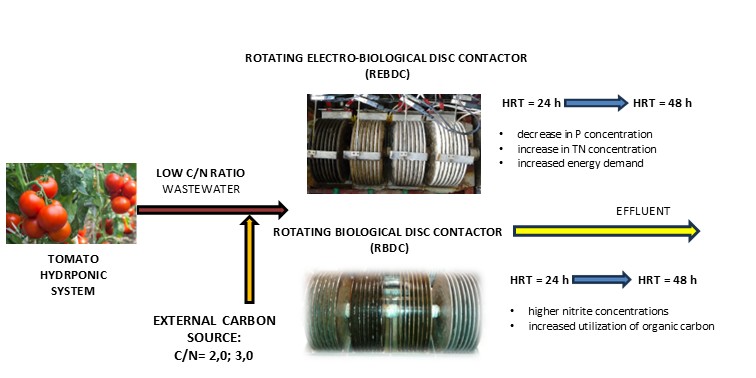
The removal of nitrogen and phosphorus from wastewater with low organic carbon content requires the addition of an external carbon source. The objective of this study was to assess the influence of hydraulic retention time (HRT) on the efficiency of external carbon source utilization and on nitrogen and phosphorus removal in a Rotating Electro-Biological Disc Contactor (REBDC). The energy demand was evaluated based on energy consumption (E) and current efficiency (CE). Hydroponic tomato wastewater was treated in the REBDC at a constant current density of 2.5 A/m². Sodium acetate was used as the carbon source. Two C/N ratios were tested: 2.0 and 3.0, under HRT conditions of 24 h and 48 h. For both C/N ratios, extending the HRT resulted in decreased nitrogen removal efficiency. At HRT = 48 h and C/N = 3.0, the nitrogen concentration in the effluent was more than three times lower compared with C/N = 2.0. The highest phosphorus removal efficiency was achieved at C/N = 3.0 and HRT= 48h (98.8%). Increasing the HRT led to reduced TOC utilization for both C/N ratios. As a consequence of extended HRT, lower CE values and higher E values were observed, indicating increased energy demand for nutrient removal.
Keywords:
nutrient removal
; external carbon source utilization
; rotating electro-biological disc contactor (REBDC)
; effects of HRT extension
; energy consumption
; current efficiency
Copyright: This open access article is published under a Creative Commons CC BY 4.0 license, which permit the free download, distribution, and reuse, provided that the author and preprint are cited in any reuse.


