
Submitted:
11 February 2026
Posted:
13 February 2026
You are already at the latest version
Abstract
This study explores the role of organic food within sustainable tourism
in Slovenia, with particular attention to consumer expectations, trust in
organic certification, willingness to pay a price premium, and the
interpretation of sustainability labels, especially the Slovenia Green scheme.
Data were collected through an online survey conducted in Slovenia in 2025 (n =
324) and analysed using descriptive statistics, non-parametric tests, and
exploratory factor analysis to examine key dimensions of sustainable tourism
perceptions. The results show that organic food is generally recognised as an
important element of sustainable tourism and is most often associated with
environmental protection, health benefits, and food safety. The study also
identified a clear gap between consumer expectations and certification
requirements, as many respondents associated the Slovenia Green label with
certified organic dishes, although organic food is not mandatory within the
scheme. Consumer trust in organic food was moderate to high, and most
respondents expressed willingness to pay a price premium for certified organic
menu items, indicating market potential within the tourism and hospitality
sector. The findings highlight the need for clearer communication of
certification scope, better alignment between sustainability labels and
consumer expectations, and targeted education and capacity building among
tourism providers. Overall, organic food remains an underutilised but
strategically relevant component of sustainable tourism development in
Slovenia.
Keywords:
organic food
; consumer expectations
; sustainable tourism
; certification
; Slovenia
1. Introduction
Sustainable tourism has become an important area of practice and research in recent decades, with an increasing focus on environmental protection, the preservation of local culture, and the overall well-being of host communities. To reduce the negative environmental impacts of the global tourism industry, tourists are increasingly required to adopt more environmentally friendly behaviours [1]. In this context, food consumption emerges as one of the key domains through which tourism can actively contribute to the achievement of sustainability goals. As part of this growing trend, organic food has become an important element in the tourism industry and is increasingly recognized as a key component of an authentic and sustainable tourist experience. Organic food, with its emphasis on environmentally friendly production methods, allows destinations to align their gastronomic offerings with the goals of sustainable tourism. Previous studies indicate that quality of life, with a particular emphasis on nutrition, has become an increasingly important concern for modern consumers as well as for the hospitality and tourism market. Within tourism settings, food consumption therefore represents not only a functional necessity but also a significant determinant of perceived experience quality and individual well-being. The growing focus on healthy and safe food has positioned organic products at the forefront of gastronomic trends, encouraging hospitality providers to incorporate organic foods into their offerings [2]. Gastronomy constitutes a core element of the tourism experience; local and regional food systems have increasingly become key factors in destination attractiveness. In the context of gastronomic tourism, growing interest in local cuisine, organic food, and slow food has led to the rise of organic restaurants as important providers of healthy and sustainable dining options. Destination managers should highlight both the availability of organic food and the ecological advantages associated with such offerings. Well-designed communication strategies that emphasize sustainability practices can enhance perceived value and increase consumers’ willingness to pay a price premium [3].
This paper examines consumer expectations and perceptions related to key sustainability attributes and explores the role of organic food in Slovenian sustainable tourism. The study focuses on the integration of organic products into the tourism sector, particularly within Slovenia Green, addressing three key aspects: consumer expectations regarding organic food offerings, their level of trust in organic products, and their willingness to pay a price premium for organic menu items. By analysing these aspects, the paper identifies key challenges and opportunities related to the integration of organic food into Slovenia’s tourism industry and contributes to the broader discourse on sustainable tourism development.
Based on research aims, the article proceeds as follows: Section 2 reviews the relevant literature on sustainable tourism, organic food, certification and labelling, and guest expectations. Section 3 outlines the methodology, including the study area, sample characteristics, survey questionnaire design, and the statistical methods used for data analysis. Section 4 presents the results, Section 5 discusses the findings, and Section 6 concludes the paper with implications and directions for future research.
2. Literature Review
2.1. Sustainable Tourism and Environmental Impacts
Tourism development is closely associated with the quality of the natural environment. A well-preserved and hospitable environment constitutes a fundamental condition for sustainable tourism development and simultaneously represents an important attraction for visitors. Accordingly, maintaining or improving environmental quality is widely regarded as a prerequisite for the long-term competitiveness and attractiveness of tourism destinations [4]. Environmental protection is therefore consistently identified as a core component of sustainable development [5].
Although tourism depends on natural resources, it also contributes significantly to environmental pressures. Previous research identifies tourism as one of the major sources of greenhouse gas emissions and energy consumption at the global level [6]. Tourism-related activities are estimated to account for approximately 8% of global greenhouse gas emissions [7]. Food production and consumption within tourism further contribute to environmental impacts, particularly through greenhouse gas emissions. As the environmental footprint varies substantially across food categories, food choices in tourism have been identified as a potential lever for climate change mitigation [8].
The interdependence between tourism and the environment suggests that the long-term viability of tourism is contingent upon effective environmental management and the promotion of sustainable consumption practices [9]. In this context, demand for green destinations has increased, positioning sustainable tourism development as an important determinant of destination competitiveness, visitor satisfaction, and long-term economic performance [10]. Environmentally sustainable tourist behaviour is commonly described as responsible participation in tourism activities, characterized by heightened environmental awareness and sensitivity [9]. Entrepreneurs are widely recognized as key actors in advancing sustainability transitions in tourism; however, their influence depends on interconnected dynamics across micro-, meso-and macro-level contexts [11]. Among the supporting measures, participation in training programs is frequently emphasized as a mechanism for increasing awareness of tourism’s environmental impacts and for strengthening the competencies required to implement sustainable practices [12].
2.2. Organic Food and Tourism
Locally produced food represents a distinctive destination resource that contributes to tourism competitiveness and attractiveness [13]. It plays a role in shaping destination image and functions as a tourist attraction by emphasizing regional identity and authenticity [14,15]. In recent years, scholarly attention has increasingly shifted toward organic food, which extends beyond the notion of locality by prioritizing environmentally friendly production methods, health considerations, and ethical principles. In tourism contexts, organic food addresses broader sustainability objectives and aligns with growing consumer demand for environmentally responsible and health-oriented food choice [16].
A substantial body of literature demonstrates that organic food production is associated with lower negative environmental impacts compared to conventional production systems [17,18,19]. Organic food is therefore produced using more environmentally sustainable practices and is widely perceived as healthier than conventional food products [20]. Organic farming systems prohibit the use of synthetic pesticides, fertilizers, antibiotics, hormones, additives, genetically modified organisms, nanotechnology, and ionizing radiation, thereby reducing potential health risks for consumers. Moreover, empirical studies indicate that organic farming promotes higher levels of health-enhancing compounds, including polyphenols, polyunsaturated fatty acids, vitamins, and minerals, compared to conventional farming methods [21].
Concerns regarding the potential negative health effects of conventional food have contributed to increasing interest in organic food consumption [22]. At the European Union level, organic production is defined as an overall system of farm management and food production that combines best environmental and climate action practices, a high level of biodiversity, the preservation of natural resources, and high animal welfare standards, in response to growing consumer demand for products produced using natural substances and processes [23]. Accordingly, organic farming is widely regarded as a promising agricultural approach with positive ecological and social implications [24].
2.3. Certification, Standards, and Regulatory Frameworks
The expansion of organic food production and sustainable tourism has been accompanied by the development of certification, inspection, and accreditation systems aimed at ensuring consumer protection, preventing fraudulent practices, and promoting fair competition. In parallel, stricter food safety and quality requirements have contributed to the proliferation of quality assurance schemes and certification programs within the agri-food sector [25].
The demand for sustainable products has encouraged the development of organic certification systems [26]. Organic farming legislation regulates inspection and certification across all stages of production, processing, packaging, and labelling. While the legal framework for organic production is harmonized at the European Union level, member states retain the authority to regulate specific aspects at the national level. References for organic production are permitted only for establishments included in official control and certification systems and must be clearly communicated to avoid misleading consumers. Traceability of organic food in catering is regulated by national legislation, which provides a legal basis for control and certification processes. Slovenia introduced its first legislation governing the certification of organic food and organic ingredients on menus in 2010. Subsequent minor amendments were introduced, and the current legislation is set out in the relevant national rulebook. In gastronomy, references to organic production are allowed in three cases: (i) when the entire operation complies with organic production requirements, (ii) when menus consist of at least 95% organic ingredients, and (iii) when mentioning one or more ingredients of a dish, if the ingredient is organically produced and it is indicated for each food which ingredients are organically produced. Certification bodies conduct on-site inspections at least once per year, and certified establishments are required to display valid certificates prominently. Despite the existence of a comprehensive regulatory framework, certified organic gastronomy remains relatively limited in Slovenia, with only 11 certified operators recorded as of December 2025 [27].
The European accommodation sector features a diverse array of ecolabels; each built on certification systems tailored to various types of lodging facilities. These ecolabels differ in their promotional strategies and exhibit varying levels of influence, as evidenced by the number and types of facilities they certify [28]. A notable national example is the Slovenia Green label, which functions as the umbrella brand of the Green Scheme of Slovenian Tourism and provides tourism providers with a structured framework for sustainability assessment and continuous improvement [29].
2.4. Consumer Expectations, Trust, and Willingness to Pay
Consumer expectations and perceptions play a central role in determining the effectiveness of sustainability labels and certification schemes. Despite regulatory efforts to limit misleading environmental claims, greenwashing remains widespread and continues to undermine progress toward sustainability [30]. Previous studies indicate that trust in eco-labels enhances their usage, while awareness of third-party certification further strengthens both trust and adoption [31].
Empirical evidence suggests that consumers increasingly consider green labelling when selecting tourism destinations and accommodation facilities. Approximately one-third of European tourists report paying attention to ecolabels when choosing a vacation, and clearly communicated green practices and certifications have been shown to increase demand and foster guest loyalty [32,33]. Furthermore, guests are more likely to revisit accommodation establishments that hold recognized green labels [33]. Tourist destination branding is a strategic process aimed at creating a distinctive and competitive identity for a destination. Its primary goal is to position the destination as an attractive choice for tourists in both domestic and international markets, while simultaneously emphasizing its potential for long-term economic development. Through effective branding, destinations can enhance their appeal, strengthen market competitiveness, and promote sustainable growth [34]. Moreover, people are increasingly willing to align their spending with their values; they are prepared to pay a premium for organizations that adopt environmentally responsible practices [35].
3. Materials and Methods
3.1. Study Area
Slovenia is an alpine and Mediterranean country located in the north-east of the Adriatic Sea. It has a wide variety of tourism assets such as mountain tourism, ski tourism, sun and beach tourism, spa tourism, city and cultural tourism, rural tourism and gambling. The country has two million inhabitants. In 2024, Slovenia recorded 6.6 million international and domestic tourist arrivals, resulting in approximately 16.9 million overnight stays. Among foreign visitors, Germany represented the most significant source market, accounting for nearly 2 million arrivals and contributing to 16% of all foreign overnight stays. The most represented age group was 55–64 years. The second most important source market was Italy, generating 9% of foreign overnight stays, with the majority of visitors belonging to the 45–54 age group. Austria followed, contributing 1 million overnight stays, equivalent to 8% of foreign overnights, where the 65+ age group was the most represented [36]. In 2023, average spending on organic food per person per year was in Austria – 292 eur in Germany 190,61 eur in Italy 65,80 eur and in Slovenia 26,60 eur [37].
Organic farming in Slovenia has expanded steadily over the past decade, both in terms of the number of organic farms and the share of agricultural land under organic management. Data from the organic production control system indicate that organically managed land increased from 41,237 ha in 2014 to 56,809 ha in 2024. Over the same period, the proportion of organic agricultural land rose from 8.7% to 12.7%, reflecting sustained growth of the organic sector. The structure of organic land use is largely shaped by Slovenia’s natural conditions, particularly its predominantly hilly and mountainous landscape, which results in the dominance of permanent grassland and a strong orientation toward organic livestock production. Sectoral development is further reflected in the increasing share of organic farms, which rose from 4.6% of all farms in 2014 to 7.8% in 2024. Overall, these trends indicate a gradual but consistent expansion of organic farming within Slovenia’s agricultural system [27]. By 2027 in Slovenia, the targets include achieving at least a 10% share of organic farms, increasing the share of organically managed agricultural land to at least 18%, reaching a minimum of 30% organic tourist farms, and establishing at least 25 certified organic gastronomy providers [38].
3.2. Questionnaire Design and Data Collection
The conceptual framework of this study was developed based on a literature review in the fields of sustainable tourism, organic food consumption, ecolabelling, and consumer behaviour. Data were collected through an online survey conducted in Slovenia between 26 March and 31 May 2025, with a total of 324 complete responses. A snowball sampling method was used, starting from the researchers’ networks, with participation being voluntary and anonymous.
The survey, consisting of 16 questions, assessed awareness and evaluation of environmental and sustainability labels, the perceived role of organic food in sustainable tourism, and the importance of sustainability claims—particularly for restaurants holding the Slovenia Green label. It also examined trust in organic food, willingness to pay a premium for certified organic dishes, and knowledge of ecolabels in Slovenia. Sociodemographic data were collected for profiling and comparative analyses. Prior to deployment, the survey was pre-tested with 20 consumers to ensure clarity and reliability.
3.3. Sample Characteristics
The sample included 324 respondents. Most were female (73.5%), with 25.0% male and 1.5% choosing not to disclose their gender. The age distribution was as follows: 7.4% were 18–24 years old, 11.4% were 25–34, 27.8% were 35–44, 29.6% were 45–54, 16.0% were 55–64, and 7.7% were 65 or older. Regarding educational attainment, 64.2% held a university degree, 17.9% had secondary education, 9.9% had college education, 7.7% held a doctoral degree, and 0.3% had primary education. For net monthly income, the largest groups were in the €1200–€1800 (33.0%) and €1800–€2500 (27.2%) ranges, while the smallest were above €3500 (2.5%) and up to €700 (9.0%). Most participants were employed (73.5%), with smaller proportions of retirees (9.9%), students (8.3%), self-employed (4.9%), farmers (2.5%), and unemployed (0.9%). Regarding place of residence, 48.8% lived in rural areas, 21.9% in small towns, 15.4% in medium towns, and 13.9% in large cities.
3.4. Statistical Methods
Data were analysed using R 4.5.0. Descriptive statistics (percentages, quartiles, means, and SD) summarized respondents’ characteristics and survey responses. Group differences were assessed using Mann–Whitney U tests with Benjamini–Hochberg correction to account for multiple correlated variables. To compare the perceived importance of conceptually related attributes measured on the same scale (e.g., organic versus seasonal food), paired differences were assessed using the Wilcoxon signed-rank test, with Bonferroni correction. The underlying structure of perceptions related to sustainable tourism was examined using exploratory factor analysis (EFA), conducted with principal axis factoring (PAF) and oblimin rotation. Data suitability for EFA was confirmed using Bartlett’s test of sphericity, and the number of factors was determined via parallel analysis. Model fit was evaluated using Tucker–Lewis Index (TLI) and the Root Mean Square Error of Approximation (RMSEA).
4. Results
The following section presents the results of the study, covering sample characteristics, environmental attitudes, motivations for selecting sustainable tourism products, expectations of sustainable tourism practices, expectations regarding organic food offerings in restaurants awarded the Slovenia Green label, trust in organic food, and willingness to pay a premium for organic restaurant offerings.
In response to the question of whether their current or past employment was related to hospitality or tourism, 21.6% of respondents answered affirmatively. Among these respondents, experience was most reported in accommodation facilities, farm tourism, hospitality services, and tourism-related activities. This information is important for understanding the background of the sample, as it partially explains differences in the perception of sustainable practices between respondents with and without professional experience in the sector.
Respondents generally exhibited pro-environmental attitudes, demonstrating low agreement with passive environmental statements and high agreement with personally responsible behaviours. Participants with hospitality/tourism experience tended to report slightly higher scores for positive environmental behaviours and slightly lower scores for negative behaviours compared to those without such experience. A statistically significant difference was observed for one statement, whereas differences for the remaining items were not significant. These findings suggest that professional experience in the sector may modestly enhance positive environmental attitudes, although overall support for sustainability is widespread across the whole sample (Figure 1).
Participants’ choices of sustainable tourism products were primarily influenced by support for the local community (75.9%) and preservation of local culture (63.3%), followed by environmental benefits (56.8%). Participants subsequently rated the importance of various elements for inclusion in sustainable tourism on a five-point scale (1 = not important; 5 = very important). The highest-rated elements were safe tap water (M = 4.74) and unspoiled nature (M = 4.58). Other highly valued factors included the inclusion of local food (M = 4.37), seasonal food offerings (M = 4.33), and water-saving measures (M = 4.27). In contrast, guaranteed taxi transfers to hotels (M = 2.62) and thermal water (M = 3.30) were considered less important. Overall, the results highlight participants’ prioritization of environmental safety, nature preservation, and support for local products and services in the context of sustainable tourism. The analysis focused on comparing preferences for organic, seasonal, and local food elements important in sustainable tourism. Results showed that local and seasonal food elements were rated significantly higher than the organic food element (Table 1).
These results provided the basis for examining the underlying structure of perceptions of sustainable tourism, which was subsequently explored using exploratory factor analysis (EFA). Data suitability for EFA was confirmed by Bartlett’s test of sphericity, which was statistically significant (χ²(171) = 2288.54, p < 0.001), indicating sufficient intercorrelations among variables. The number of factors was determined through parallel analysis using principal axis factoring, which suggested the retention of five factors, as observed eigenvalues exceeded those derived from randomly generated data. Accordingly, a five-factor solution was retained. EFA was then conducted using principal axis factoring with oblimin rotation, allowing for correlations among factors. The resulting model showed acceptable fit (TLI = 0.904; RMSEA = 0.06, 90% CI [0.049, 0.072]). For clarity of presentation, only the highest loading per variable is reported, using a cutoff of 0.30, facilitating concise interpretation of the factor structure (Figure 2).
Exploratory Factor Analysis (EFA) revealed five interrelated factors, accounting for 48% of the total variance, representing key dimensions of sustainable tourism considered important by respondents: Local Engagement, Naturalness, Resource Saving, Guest Services & Offer, and Eco & Natural Products. Most factors were positively correlated, indicating that respondents who value one dimension tend to also appreciate the other dimensions of sustainable tourism. Interestingly, accessibility via public transport did not load significantly on any factor, suggesting that this aspect largely depends on the destination’s location and infrastructure rather than the provider’s management practices.
Respondents were asked about their expectations regarding restaurants carrying the Slovenia Green label, a national sustainability certification in Slovenia. The largest proportion of respondents (66.4 %) expected that dishes would be prepared primarily from local ingredients, whereas 42.6 % expected the entire menu to be certified organic, and 33.3 % anticipated at least one certified organic meal. Expectations for individual certified organic dishes were lower (21.9 %), and relatively few respondents associated the label with predominantly plant-based meals (7.7 %) or Fairtrade ingredients (13.0 %). These results indicate that, within this sample, the Slovenia Green label is primarily perceived as a signal of local sourcing and community engagement, rather than as an indicator of organic certification.
Trust in organic products was generally moderate to high (M = 4.9, SD = 1.4). The majority of participants (64.5 %) reported high levels of trust (ratings 5–7), 21.6 % indicated a neutral stance, and a smaller proportion (13.9 %) expressed low trust. These findings suggest that, although organic foods are largely perceived as credible, a degree of hesitancy persists among a subset of consumers.
Participants’ knowledge of organic labels was assessed by asking them to identify recognized certifications from a list of nine options, of which only two were correct (Demeter and the official organic logo). Only 23.8 % of respondents correctly identified both labels without selecting any incorrect options, whereas 30.2 % correctly identified one label without choosing any incorrect ones. These results indicate that while more than half of respondents possess at least partial recognition of organic certifications, comprehensive knowledge remains limited.
Finally, respondents were asked about their willingness to pay a premium for certified organic menu items. A substantial majority (84%) reported willingness to pay a higher price, indicating that organic certification is perceived as a value-adding attribute. This suggests that restaurateurs and tourism providers could leverage organic certification within their sustainable offerings to better align with consumer expectations.
5. Discussion
The findings of this study provide insight into the role of organic food within sustainable tourism in Slovenia and into consumer expectations regarding its presence in tourism and hospitality services. Although organic food is widely recognised as one of the most sustainable food production systems, its integration into the HORECA sector remains relatively limited.
The results indicate that consumers most strongly associate sustainable tourism with the availability of local and seasonal food, both of which were rated significantly higher than organic food. These findings are consistent with previous studies highlighting the importance of local food in shaping destination image and tourist satisfaction [13,14,15]. At the same time, factor analysis results show that organic food is perceived as a distinct sustainability attribute rather than as a direct component of local and seasonal supply. Consumers primarily associate organic food with environmental protection, health, food safety, and ethical production practices, which is consistent with earlier research [20,21,22].
An important contribution of this study is the identification of an expectation–certification gap related to the Slovenia Green label. Although organic food is not a mandatory requirement within this umbrella sustainability scheme, a substantial share of respondents associated the label with certified organic dishes. This finding supports previous research indicating that sustainability labels often function as general signals of responsible practices rather than as precisely understood guarantees of specific measures [28,32,33].
Consumer trust in organic food was generally moderate to high, and most respondents expressed willingness to pay a price premium for certified organic dishes, indicating market potential for organic food integration in the Slovenian HORECA sector. However, transparent communication of sustainability claims remains essential to prevent greenwashing risks [30].
From a sustainability and policy perspective, the results highlight the need for improved alignment between sustainability certification schemes and consumer expectations, clearer communication of certification scope, and targeted education and capacity building among tourism providers. The gradual introduction of minimum organic food standards within sustainability schemes could further strengthen label credibility and contribute to broader sustainability and food system transition goals.
Overall, the findings suggest that organic food remains an underutilised but strategically relevant component of sustainable tourism development in Slovenia. Addressing the expectation gap through improved communication, education, and, where appropriate, strengthened certification frameworks could support the long-term integration of organic food into sustainable tourism.
6. Conclusions
The results confirm that organic food is recognised as an important component of sustainable tourism and is primarily associated with environmental protection, health benefits, and food safety. A key finding is the expectation–certification gap related to the Slovenia Green label. Although organic food is not a mandatory requirement within this scheme, a substantial share of respondents associated the label with certified organic dishes. This highlights the symbolic role of sustainability labels and the potential risk of misinterpretation or perceived greenwashing if sustainability claims are not communicated clearly and transparently. The results also indicate important opportunities for tourism and hospitality providers. Consumer trust in organic food was moderate to high, and most respondents expressed willingness to pay a price premium for certified organic dishes. These findings suggest that certified organic food can represent a value-adding element in the Slovenian HORECA sector.
In addition, it would be worthwhile to consider increasing the integration of organic food into tourism and hospitality offerings from the perspective of international demand. Slovenia attracts many tourists from countries where the consumption of organic products is already well established. It is therefore likely that foreign visitors would also perceive organic food as an important element of a sustainable gastronomic experience and would be willing to pay a price premium for it. Since domestic respondents expressed a moderate to high willingness to purchase certified organic dishes, similar behaviour could be expected among international tourists. Future research could therefore expand the sample to include foreign visitors and examine to what extent they miss organic food in Slovenian hospitality offerings, as well as their expectations regarding sustainability certifications in tourism.
From a policy perspective, the findings highlight the need for stronger alignment between sustainability labels and consumer expectations, clearer communication of certification scope, and targeted education and capacity building among tourism providers. Supporting the integration of organic food in tourism could contribute to achieving national organic development targets and strengthening the organic value chain.
Author Contributions
Conceptualization, literature review, methodological approach, M.R. and T.K.Š.; Data processing and discussed the results, T.K.Š. and M.R.; Writing—original draft, M.R. and T.K.Š. All authors have read and agreed to the published version of the manuscript.
Funding
This research received no external funding.
Informed Consent Statement
Not applicable.
Data Availability Statement
will be made available upon reasonable request by the corresponding author
Conflicts of Interest
The authors declare no conflicts of interest.
References
- Juvan, E. and S. Dolnicar, Drivers of pro-environmental tourist behaviours are not universal. Journal of cleaner production, 2017. 166: p. 879–890. [CrossRef]
- Dević, B.J., B. Kalenjuk, and S. Gagić, Organic food in the hospitality industry: Supply and demand. Zbornik radova Departmana za geografiju, turizam i hotelijerstvo, 2017(46-2): p. 89–95. [CrossRef]
- Rodrigues, Á., S.M.C. Loureiro, and J. Nascimento, Food appraisal: explaining tourists’ willingness to pay more for organic food. Journal of Hospitality and Tourism Insights, 2025. 9(1): p. 144–162. [CrossRef]
- Butler, R.W., Tourism, environment, and sustainable development. Environmental conservation, 1991. 18(3): p. 201–209. [CrossRef]
- Kabakchieva, D. and V. Vasileva, Eco-Trends in Modern Tourism Development. MODERN MANAGEMENT TOOLS AND ECONOMY OF TOURISM SECTOR IN PRESENT ERA, 2018: p. 359.
- Gössling, S., National emissions from tourism: An overlooked policy challenge? Energy Policy, 2013. 59: p. 433–442. [CrossRef]
- Lenzen, M., et al., The carbon footprint of global tourism. Nature climate change, 2018. 8(6): p. 522–528. [CrossRef]
- Gössling, S., et al., Food management in tourism: Reducing tourism’s carbon ‘foodprint’. Tourism Management, 2011. 32(3): p. 534–543. [CrossRef]
- Saltik, Z. and O. Akova, The perception over environmental issues: The impact on environmentally sustainable tourist behavior. Asia Pacific Journal of Tourism Research, 2024. 29(10): p. 1187–1203. [CrossRef]
- Mustapic, M.J., J. Dlacic, and B. Grbac, DEVELOPING THE TOURIST DESTINATION BRAND: IDENTIFYING THE IMPORTANCE OF INVESTING IN THE SUSTAINABLE DEVELOPMENT OF A TOURIST DESTINATION. Harnessing Networks to Drive Innovation and Achieve Sustanable Development Goals (SDGs)-(Book of Proceedings), 2025: p. 74.
- Baiocco, S., L. Leoni, and P.M.A. Paniccia, Entrepreneurship for sustainable development: co-evolutionary evidence from the tourism sector. Journal of Small Business and Enterprise Development, 2023. 30(7): p. 1521–1546. [CrossRef]
- Baiocco, S. and P.M. Paniccia, Integrating the natural environment into tourism firms’ business model for sustainability. Environmental Science and Pollution Research, 2023. 30(30): p. 75015–75028. [CrossRef]
- Stalmirska, A.M., Local food in tourism destination development: The supply-side perspectives. Tourism Planning & Development, 2024. 21(2): p. 160–177.
- Cohen, E. and N. Avieli, Food in tourism: Attraction and impediment. Annals of tourism Research, 2004. 31(4): p. 755–778. [CrossRef]
- Du Rand, G.E. and E. Heath, Towards a framework for food tourism as an element of destination marketing. Current issues in tourism, 2006. 9(3): p. 206–234.
- Vehapi, S. and Z. Šabotić, The organic food market as a factor in the development of tourism in the Republic of Serbia. Ekonomija-teorija i praksa, 2024. 17(4): p. 1–23. [CrossRef]
- Pimentel, D., et al., Organic and conventional farming systems: Environmental and economic issues. 2005.
- Seidel, R., et al., Studies on long-term performance of organic and conventional cropping systems in Pennsylvania. Organic Agriculture, 2017. 7(1): p. 53–61. [CrossRef]
- Chiriaco, M.V., et al., The contribution to climate change of the organic versus conventional wheat farming: A case study on the carbon footprint of wholemeal bread production in Italy. Journal of cleaner production, 2017. 153: p. 309–319. [CrossRef]
- Suciu, N.A., F. Ferrari, and M. Trevisan, Organic and conventional food: Comparison and future research. Trends in Food Science & Technology, 2019. 84: p. 49–51. [CrossRef]
- Bavec, M., et al., Healthy facts of organic food. Biomedical Journal of Scientific & Technical Research, 2019. 20(1): p. 14802–14805. [CrossRef]
- Popa, M.E., et al., Organic foods contribution to nutritional quality and value. Trends in Food Science & Technology, 2019. 84: p. 15–18. [CrossRef]
- Official Journal of the European Union. EUR-Lex, 2018/848, . 2018 [cited 2025 21.3.2025].
- Vogl, C.R., L. Kilcher, and H. Schmidt, Are standards and regulations of organic farming moving away from small farmers' knowledge? Journal of Sustainable Agriculture, 2005. 26(1): p. 5–26. [CrossRef]
- Borec, A. and M. Robačer, Certified food products and collective brands, in Podeželje in razvoj gastronomije v Sloveniji, T.L. Štuhec, Editor. 2021, University of Maribor, University Press.
- Jamal, T., M. Borges, and A. Stronza, The institutionalisation of ecotourism: Certification, cultural equity and praxis. Journal of Ecotourism, 2006. 5(3): p. 145–175. [CrossRef]
- MAFF. Ekološka pridelava. 2025 16. 1. 2025 18. 12. 2025]; Available from: https://www.gov.si/teme/ekoloska-pridelava/.
- Bučar, K., D. Van Rheenen, and Z. Hendija, Ecolabelling in tourism: The disconnect between theory and practice. Tourism: An International Interdisciplinary Journal, 2019. 67(4): p. 365–374.
- Slovenian Tourist Board. Slovenia green. 2025 [cited 2025 19.04.2025].
- Chen, Y.-S. and C.-H. Chang, Greenwash and green trust: The mediation effects of green consumer confusion and green perceived risk. Journal of business ethics, 2013. 114(3): p. 489–500. [CrossRef]
- Gorton, M., et al., What determines consumers' use of eco-labels? Taking a close look at label trust. Ecological Economics, 2021. 189: p. 107173. [CrossRef]
- Falk, M. and E. Hagsten, Ways of the green tourist in Europe. Journal of Cleaner Production, 2019. 225: p. 1033–1043. [CrossRef]
- Merli, R., et al., Why should hotels go green? Insights from guests experience in green hotels. International Journal of Hospitality Management, 2019. 81: p. 169–179. [CrossRef]
- Cetinski, V., J. Perić, and D. Smolčić Jurdana, The “umbrella” brand and branding process in the Kvarner destination. Tourism and hospitality management, 2006. 12(2): p. 103–110. [CrossRef]
- DiPietro, R.B., S. Gregory, and A. Jackson, Going green in quick-service restaurants: Customer perceptions and intentions. International Journal of Hospitality & Tourism Administration, 2013. 14(2): p. 139–156. [CrossRef]
- Statistical Office of the Republic of Slovenia. Tourist arrivals and overnight stays, detailed data, 2024. 2025 [cited 2025 22.09.2025].
- FiBL. Organic retail sales. 2025 [cited 2025 11.12.2025].
- APOF. Action plan for the Development of Organic Farming until 2027. 2022.
Figure 1.
Distribution of respondents’ agreement scores on environmental statements, shown as violin plots, grouped by hospitality/tourism experience (yes, no). Median scores are indicated by red points, mean scores by blue points, and adjusted p-values (Benjamini–Hochberg correction) from Mann–Whitney tests are displayed.
Figure 1.
Distribution of respondents’ agreement scores on environmental statements, shown as violin plots, grouped by hospitality/tourism experience (yes, no). Median scores are indicated by red points, mean scores by blue points, and adjusted p-values (Benjamini–Hochberg correction) from Mann–Whitney tests are displayed.
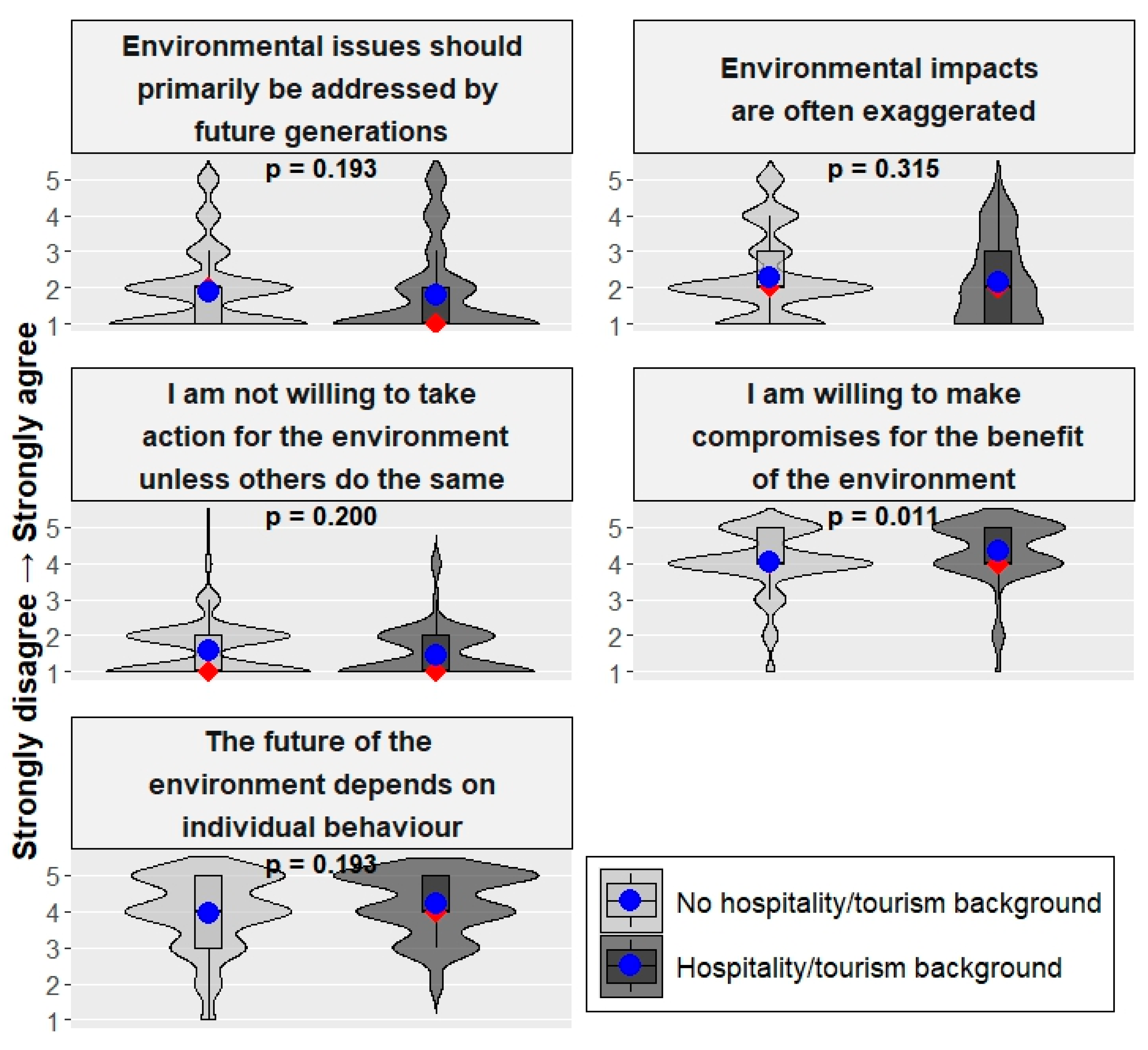
Figure 2.
Exploratory Factor Analysis (EFA) diagram showing factor loadings of sustainable tourism attributes. Five interrelated factors are depicted, with loadings ≥ 0.30 displayed.
Figure 2.
Exploratory Factor Analysis (EFA) diagram showing factor loadings of sustainable tourism attributes. Five interrelated factors are depicted, with loadings ≥ 0.30 displayed.
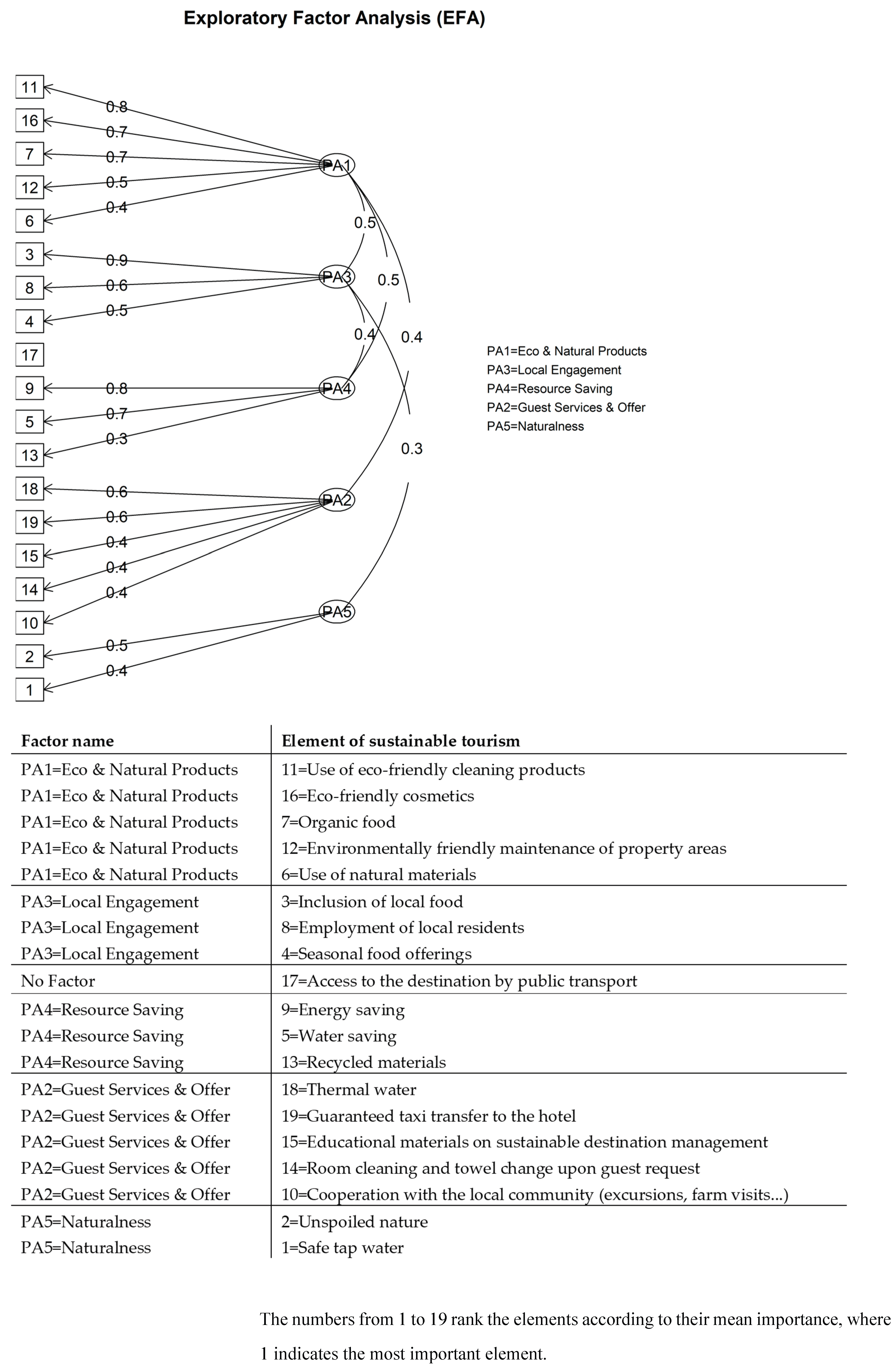

Table 1.
Descriptive Statistics (quartiles, mean, and standard deviation) of Participants’ Importance Ratings for Sustainable Tourism Attributes (1=least important, 5=most important).
Table 1.
Descriptive Statistics (quartiles, mean, and standard deviation) of Participants’ Importance Ratings for Sustainable Tourism Attributes (1=least important, 5=most important).
| Element of sustainable tourism | Q1 | Me | Q3 | M | SD |
|---|---|---|---|---|---|
| Safe tap water | 5 | 5 | 5 | 4.74 | 0.50 |
| Unspoiled nature | 4 | 5 | 5 | 4.58 | 0.59 |
| Inclusion of local foodb | 4 | 4 | 5 | 4.37 | 0.68 |
| Seasonal food offeringsb | 4 | 4 | 5 | 4.33 | 0.72 |
| Water saving | 4 | 4 | 5 | 4.27 | 0.63 |
| Use of natural materials | 4 | 4 | 5 | 4.23 | 0.74 |
| Organic fooda | 4 | 4 | 5 | 4.17 | 0.92 |
| Employment of local residents | 4 | 4 | 5 | 4.12 | 0.89 |
| Energy saving | 4 | 4 | 5 | 4.09 | 0.68 |
| Cooperation with the local community (excursions, farm visits, etc.) | 4 | 4 | 4.25 | 4.02 | 0.79 |
| Use of eco-friendly cleaning products | 3 | 4 | 5 | 3.96 | 0.94 |
| Environmentally friendly maintenance of property areas | 3 | 4 | 5 | 3.90 | 0.88 |
| Recycled materials | 3 | 4 | 4 | 3.81 | 0.84 |
| Room cleaning and towel change upon guest request | 3 | 4 | 4 | 3.64 | 1.10 |
| Educational materials on sustainable destination management | 3 | 4 | 4 | 3.55 | 0.97 |
| Eco-friendly cosmetics | 3 | 4 | 4 | 3.46 | 1.15 |
| Access to the destination by public transport | 3 | 4 | 4 | 3.39 | 1.05 |
| Thermal water | 3 | 3 | 4 | 3.30 | 1.03 |
| Guaranteed taxi transfer to the hotel | 2 | 3 | 3 | 2.62 | 1.08 |
Food-related items are indicated by superscript letters (a, b). Differences between values with different letters are statistically significant (Wilcoxon signed-rank test, Bonferroni-adjusted, α = 0.05); Q1=first quartile, Me=median, Q3=third quartile, M=mean, SD=standard deviation.
Disclaimer/Publisher’s Note: The statements, opinions and data contained in all publications are solely those of the individual author(s) and contributor(s) and not of MDPI and/or the editor(s). MDPI and/or the editor(s) disclaim responsibility for any injury to people or property resulting from any ideas, methods, instructions or products referred to in the content. |
© 2026 by the authors. Licensee MDPI, Basel, Switzerland. This article is an open access article distributed under the terms and conditions of the Creative Commons Attribution (CC BY) license.
Copyright: This open access article is published under a Creative Commons CC BY 4.0 license, which permit the free download, distribution, and reuse, provided that the author and preprint are cited in any reuse.


