

Submitted:
11 February 2026
Posted:
12 February 2026
You are already at the latest version
Abstract
Urban green space (UGS) is a critical component of sustainable cities and a modifiable determinant of mental health (MH). This review synthesizes 113 empirical studies and 929 bibliometric records to map theoretical advances, methodological evolution, and governance implications in the UGS–MH field. We integrate six validated pathways into a unified socio-ecological framework, including attention restoration, stress recovery, behavioral activation, physiological regulation, social cohesion, and environmental buffering. Methodological trends indicate a shift from static greenness proxies to street view and multimodal exposure measures, and from cross sectional correlations to models that address spatial heterogeneity, causal identification, and AI enabled prediction. Bibliometric mapping shows increasing interdisciplinarity, geographic diversification, and a growing focus on dynamic exposure science. Persistent challenges include exposure outcome spatial and temporal misalignment, reliance on single modality indicators, limited causal inference, and constrained cross cultural generalizability. Building on these insights, we propose a governance oriented framework to support sustainable and healthy cities through equitable green access, behavior informed planning, nature based interventions, and data driven decision support. Overall, this review strengthens the evidence to action bridge at the interface of urban sustainability and population mental health.
Keywords:
urban green space
; mental health
; dynamic exposure
; mechanism integration
; causal inference
; spatial equity
1. Introduction
As global urbanization accelerates, mental health has emerged as a major public health concern with substantial global disease burden. The World Health Organization (WHO) estimates that roughly one billion people worldwide are affected by mental disorders, with depression and anxiety consistently ranking among the leading contributors to disease burden, which threatens individual well-being and sustainable development[1,2,3,4]. Against the backdrop of high-density built environments, fast-paced lifestyles and rising risks of social isolation, the use of urban nature to strengthen psychological resilience and mental well-being has emerged as a core interdisciplinary agenda[5,6]. Within urban ecosystems, Urban Green Space (UGS), given its potential to alleviate stress, foster social interaction, and improve subjective well-being-has been increasingly regarded a form of “infrastructure for mental health intervention”[7,8]. However, despite a growing evidence base, fragmentation in the mechanistic explanation and uneven coverage of the research persist, underscoring the need for a systematic synthesis[9].
Since Olmsted’s nineteenth-century notion of the “lungs of the city,” the role of urban green space has expanded beyond aesthetics and recreation to encompass health promotion, ecological regulation, and social equity[10,11,12]. Recent empirical studies consistently document positive associations between green-space exposure and mental health outcomes-particularly reductions in depression and anxiety and improvements in subjective well-being[13]. To explain these links, multidisciplinary models have been advanced, including Attention Restoration Theory (ART), Stress Reduction Theory (SRT), social capital perspectives, and behavioral-activation pathways[14]. Collectively, these frameworks highlight the influence of natural environments across cognitive, affective, physiological, and social domains. Nevertheless, theoretical development remains fragmented and insufficiently integrated, underscoring the need for a systematic framework that consolidates multi-pathway mechanisms and strengthens explanatory power.
Concurrently, advances in remote sensing, spatial analytics, and artificial intelligence (AI) have shifted UGS exposure assessment from traditional static averages to high-resolution, multidimensional, individual-level dynamic modeling[15]. Researchers now integrate multi-source data—including the Normalized Difference Vegetation Index (NDVI), Green View Index (GVI), accessibility metrics, and subjective perceptions—and combine mobile devices with Ecological Momentary Assessment (EMA) to construct spatiotemporal couplings between environment and psychological states[16].This methodological evolution helps mitigate exposure misclassification arising from the Uncertain Geographic Context Problem (UGCoP) and advances the field toward causal identification and theory-informed mechanism building. However, the lack of harmonized assessment standards, incomplete causal chains, and limited cross-regional comparability continue to constrain external validity and policy translation[17].
Despite accumulating findings, three key gaps remain. First, mechanistic accounts are fragmented, with no coherent synthesis or unified pathway map [18]. Second, standards for spatial modeling vary widely, and further depth is needed for dynamic exposure assessment and moderation by individual heterogeneity[19]. Third, the literature remains concentrated in high-income settings, with limited attention to pathways relevant to the Global South and vulnerable populations, thereby restricting generalizability and equity in policy applications[12,20].
To address these gaps, this review conducts a global synthesis organized around mechanistic pathways, modeling approaches, and heterogeneity in exposure and mental health outcomes. We map empirical evidence from January 2013 to August 2025, trace the methodological evolution of exposure assessment and modeling, and compare spatial patterns and inequities across regions and population groups. Building on a dual-dataset design, we propose an integrated framework that links exposure, mechanisms, and modeling, thereby connecting study design to causal inference, equity-oriented evaluation, and policy translation for urban mental health.
2. Theoretical Framework and Mechanistic Pathways
2.1. Cognitive and Emotional Mechanisms
UGS influences mental health through six mechanistic pathways: attention restoration[21], stress reduction[22], behavioral activation[23](e.g., increased physical activity and reduced sedentary time), physiological regulation[24] (e.g., stress hormones and neuro-immune-endocrine responses), social interaction[25] (e.g., strengthened neighborhood cohesion and perceived support), and environmental buffering (e.g., reduced air pollution, noise, and urban heat). These pathways synthesize multiple theoretical traditions, including ART, SRT, social-capital perspectives, the biophilia hypothesis, and the old friends hypothesis[26,27].
A large body of evidence links green-space exposure to improved attention, relief of depressive symptoms, and higher subjective well-being[28,29]. Neuroimaging studies provide convergent and objective evidence: exposure to natural environments is associated with increased activation in the prefrontal cortex and anterior cingulate cortex[30,31], alongside reduced amygdala reactivity[32], thereby elucidating the neural underpinnings of ART and SRT, respectively. Longitudinal or repeated-exposure studies further suggest gains in the efficiency of emotion-regulation networks, implying experience-dependent plasticity[33]. Together, these findings strengthen the multi-level “environment-brain-mind” chain, extending ART/SRT explanations from psychometric outcomes to neural mechanisms[32,34]. That said, most neural phenotypes have been observed under short-term or repeated exposures; extrapolation to long-term structural change and clinical endpoints warrants caution and requires validation via longitudinal and quasi-experimental designs.
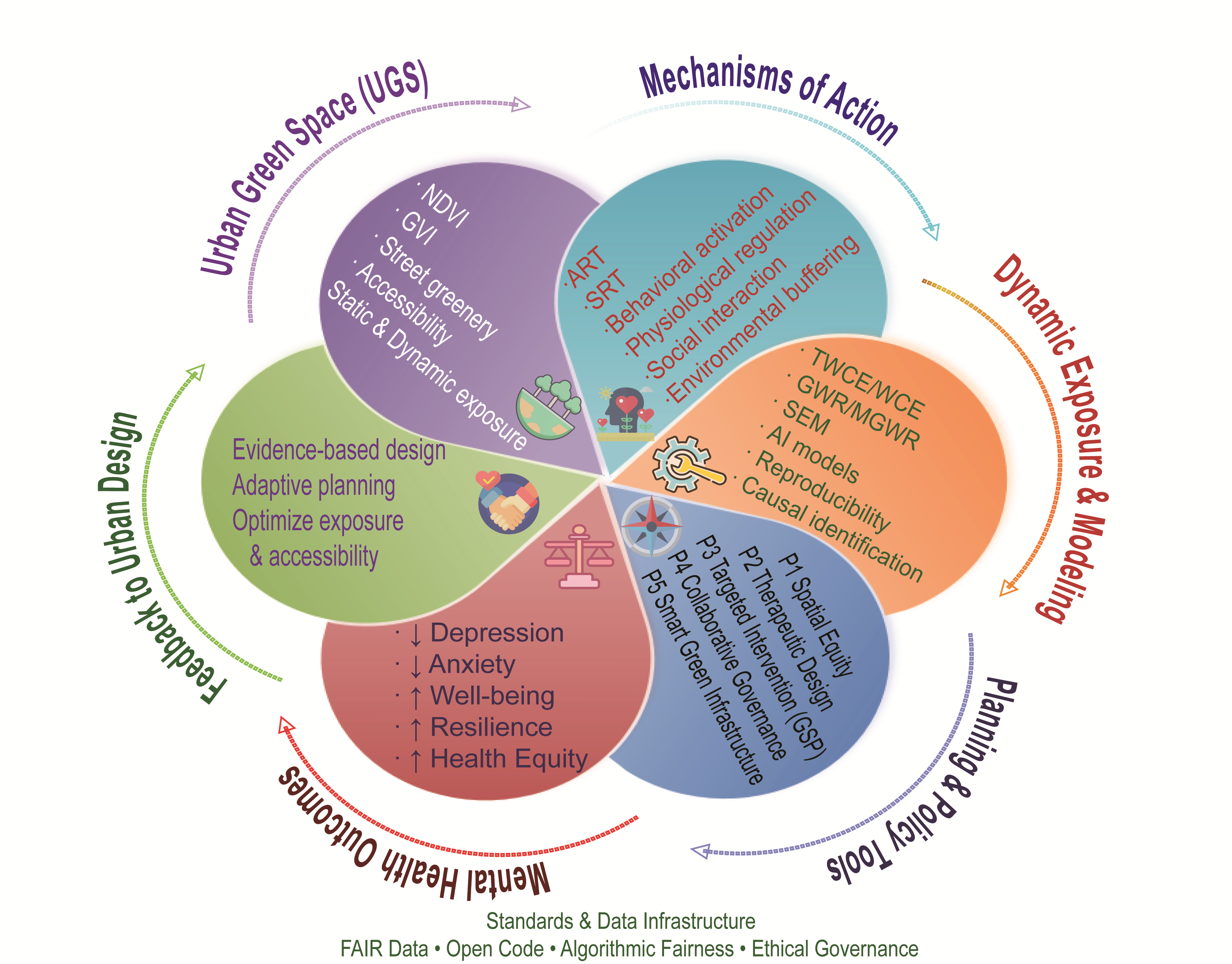
Accordingly, UGS is increasingly recognized as a social and environmental determinant of mental health. Its effects operate through coordinated cognitive, affective, physiological, and social processes. Structural (canopy cover, biodiversity), perceptual (aesthetics, safety), and functional (usage frequency, accessibility) attributes of UGS are summarized in Fig. 2B and map onto the six pathways in a one-to-many manner. Fig. 2A synthesizes key mechanistic variables and exemplar evidence, whereas Fig. 2C illustrates differences in pathway activation across population subgroups.
2.2. Physiological Mechanisms
Unlike the cognitive-affective phenotypes discussed in Section 2.1, urban green space also influences mental health through multiple physiological pathways involving the autonomic-endocrine-immune axes[35]. A large body of evidence shows that nature exposure reduces stress-related biomarkers—such as salivary cortisol, heart rate, and blood pressure—and improves autonomic function indexed by heart rate variability (HRV)[36]. In addition, green-space exposure is associated with lower levels of inflammatory markers, including C-reactive protein (CRP) and interleukin-6 (IL-6), suggesting mitigation of chronic inflammation and psychological stress via immune-endocrine routes[37,38].
This inflammation-immune pathway has attracted increasing attention in recent years. Individuals with regular or more frequent contact with green space show lower CRP and IL-6, higher HRV, and stronger indices of immunoregulation, suggesting that nature exposure can downregulate low-grade chronic inflammation via autonomic-immune interactions[39].This pathway also provides a biological explanation for stress relief, lower depression risk, and fewer cardiovascular and metabolic comorbidities[40]. Evidence from acute single-exposure studies remains mixed, underscoring the need to clarify dose-response relationships in future research[41,42].
Physiological mechanisms therefore provide a biological basis for psychological restoration and emotion regulation[34]. Empirical work indicates that green space not only relieves short-term stress but also reduces long-term risks of cardiovascular and metabolic disease, thereby indirectly promoting mental health[23]. Thus, physiology functions as a key mediator linking external environmental exposure to internal psychological experience, forming one of the core evidentiary chains through which urban green space benefits mental health[43].
2.3. Social Mechanisms
Not all populations benefit equally from UGS[44]. Inter-individual heterogeneity in mental health gains is now a critical variable in the literature. Evidence indicates that sex, age, Socioeconomic Status, physical health, and psychological vulnerability each moderates the UGS–MH association. For example, women-who often exhibit greater sensitivity to affective cues and higher frequencies of green-space use-tend to show stronger mood-alleviation effects; children and older adults, who depend more on outdoor activities, more readily obtain behavioral activation and social-interaction benefits from green space[45]. Although low-Socioeconomic Status groups may reside in greener-poor neighborhoods, equitable access can yield larger marginal improvements in mental health. Likewise, psychologically vulnerable individuals (e.g., those with anxiety or elevated depression risk) appear more responsive to the restorative stimuli of nature, exhibiting faster stress relief and attention restoration. This “high-susceptibility-high-benefit” pathway highlights the targeted value of green space for urban mental health interventions and underscores the need for policies that prioritize spatial equity and protection of socially vulnerable groups[46].
Heterogeneity is shaped not only by user characteristics but also by green-space type[47]. Forested environments are more often associated with deeper restorative experiences and cognitive recovery, whereas pocket parks or neighborhood green spaces more commonly facilitate day-to-day social interaction and stress buffering[48,49]. In short, a population-by-environment-type interaction jointly shapes the mental-health effects of UGS, implying that planning and interventions should be differentiated by population needs and by green-space typology to maximize overall effectiveness[50].
The moderation structure is depicted in Fig.1. This section highlights subgroup differences in the psychological benefits of UGS and forms the outer ring of the integrated framework in Fig.2. Coordinating Fig.1A (mechanisms), Fig.1B (attributes), and Fig.1C (populations) yields a coherent intervention logic-from mechanism identification to attribute configuration and, finally, to population prioritization. This differentiation directly underpins the policy implications in Chapter 6 (e.g., spatial equity and priority safeguards for vulnerable groups).
3. Methods
3.1. Research Design and Overall Framework
We adopted a mixed-methods framework that integrates a systematic review with bibliometric analysis to characterize the global landscape, methodological evolution, and knowledge structure of research on UGS and mental health. The full workflow follows the PRISMA 2020 reporting standards[51,52] and proceeds through systematic identification, screening, and quantitative-qualitative synthesis to ensure reproducibility and auditability[53].
To capture evidence at both macro and micro levels, we constructed two complementary datasets. Bibliometric corpus (N = 929): used to profile spatiotemporal publication trends, international collaboration networks, and topic clustering/evolution; Qualitative synthesis sample (N = 113): composed of eligible studies with sufficient empirical or methodological detail to synthesize evidence on mechanisms, methodological characteristics, and policy implications.
This dual-dataset design enables a coherent reconstruction of the field along three intertwined threads-research ecology, methodological progression, and mechanism integration-combining bibliometric insights at scale with fine-grained theoretical synthesis. Operational specifics (search strings, databases, inclusion/exclusion rules, and coding scheme) are detailed in Section 3.4
3.2. Data Sources and Search Strategy
We queried the Web of Science Core Collection (WoSCC) and PubMed for records published from January 2013 to August 2025. The last search was conducted on 11 September 2025. To balance coverage and precision across environmental and public-health literature, we used Topic searches with Boolean combinations of synonyms and related terms. Green-space terms included “urban green space”, “greenspace”, “park”, and “vegetation”; mental health terms included “mental health”, “depression”, “well-being”, and “psychological health”. An illustrative query was: ("urban green space" OR "greenspace" OR "park" OR "vegetation") AND ("mental health" OR "depression" OR "well-being" OR "psychological health").
Inclusion criteria limited records to English, peer-reviewed journal articles; we excluded conference abstracts, editorials, commentaries, and gray literature. Following pilot tests, we iteratively refined the search strings to ensure a balanced recall-precision trade-off. After format- and content-level deduplication across the two databases, we obtained 929 unique records for downstream analysis.
Because PubMed frequently lacks complete affiliation metadata, country/institutional collaboration analyses were conducted on WoS records (n = 499) to ensure accuracy, whereas other analyses drew on both databases.
3.3. Study Selection and Eligibility Criteria
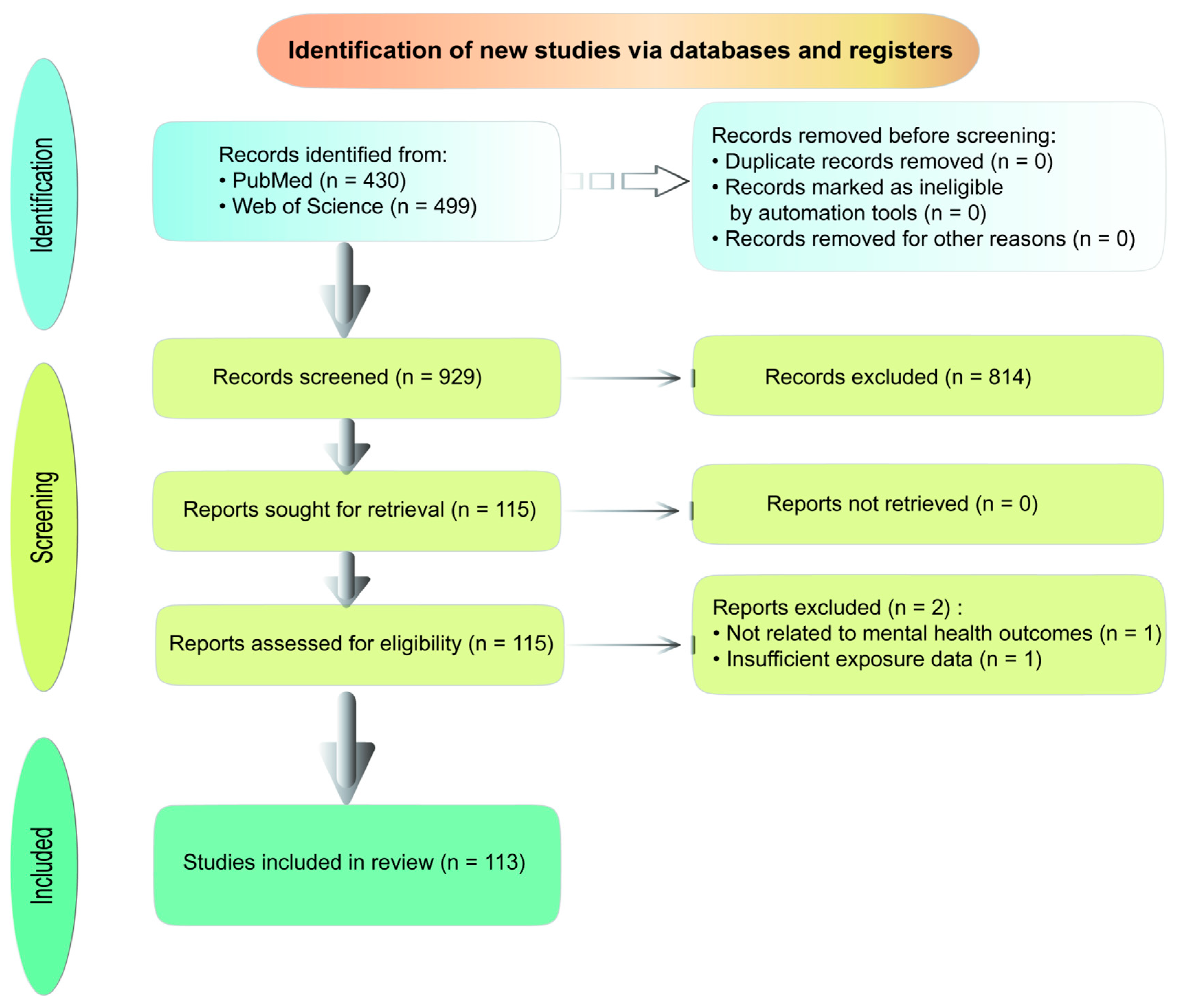
Following the PRISMA 2020 four-stage process—Identification → Screening → Eligibility → Inclusion[54]; we compiled 929 unique records (PubMed = 430; WoSCC = 499). No duplicates were identified across databases (duplicates removed = 0), and no records were excluded by automation tools or for “other reasons”. This zero-duplicate outcome is plausible because PubMed primarily indexes biomedical and life-science journals, whereas WoSCC aggregates multidisciplinary journals and conference proceedings; in addition, deduplication was performed using exact DOI matching (and, when DOI was unavailable, exact title + first author + year), yielding no cross-database overlaps in the exported records. During title/abstract screening, 814 records were excluded as out of scope. Full texts were sought and assessed for 115 articles, with none unavailable (n = 0). At eligibility assessment, two studies were excluded (non-mental-health outcome, n = 1; insufficient exposure data, n = 1). Consequently, 113 studies satisfied the inclusion criteria and entered the qualitative synthesis, while all 929 records were retained for bibliometric analyses. The inclusion/exclusion rules are aligned with Section 3.2.
Figure 2.
PRISMA 2020 flow diagram for study selection (PubMed = 430; WoSCC = 499; total = 929; included = 113).
Figure 2.
PRISMA 2020 flow diagram for study selection (PubMed = 430; WoSCC = 499; total = 929; included = 113).
3.4. Bibliometric Analysis and Tool Application
We conducted bibliometric mapping and visualization with VOSviewer 1.6.20 to identify keyword co-occurrence networks, country/institution collaboration networks, and topic-evolution trajectories[55,56]. To ensure input consistency and reproducibility, we first standardized fields and performed preliminary tabulation in Excel 2021, then used Python 3.9 to compute keyword frequencies and convert formats to meet VOSviewer import requirements.
Thresholds were set as follows: minimum keyword occurrences ≥ 6, country network publication count ≥ 5, and institution network ≥ 10. All Figures were exported as SVG and post-processed in Adobe Illustrator 2026 to standardize font sizes, color palette, line weights, and legend scales for journal-ready publication.
3.5. Evidence Synthesis and Analytic Framework
We applied a structured coding scheme to the 113 included studies, recording study design, sample and region, mental health indicators, exposure measures, and modeling approaches. Our synthesis proceeds in four steps: it first summarizes empirical associations, then consolidates mechanisms, next evaluates methodological advances, and finally distills policy implications that frame the subsequent chapters.
First, we evaluate exposure--outcome relationships to quantify links between UGS and mental health outcomes. Second, along behavioral and social-process dimensions, we identify six mediating pathways—attention restoration (ART), stress recovery (SRT), behavioral activation, physiological regulation, social interaction, and environmental buffering. Third, on the methodological front, we chart a transition from static indicators to dynamic exposure and finer spatial-heterogeneity modeling, and we incorporate machine- and deep-learning approaches for individualized exposure profiling and prediction of mental states; representative tools include GPS--EMA, time-weighted cumulative exposure (TWCE), and GWR/MGWR. Finally, we extend the chain to policy and intervention—covering green social prescribing (GSP), spatial equity and accessibility optimization, and blue--green infrastructure coordination. This integrative framework provides the evidentiary base that links themes, methods, and practice, and it structures the handoff to the following sections.
3.6. Methodological Reliability and Quality Control
We implemented dual independent screening, documenting inter-rater agreement and procedures for resolving discrepancies. Data extraction used cross-verification, item-by-item checks of key variables and coding outputs. For bibliometrics and visualization, we disclosed all primary parameters and conducted threshold perturbation and sensitivity analyses to assess robustness[53]. In line with reproducibility principles, the Appendix provides full search strings, the study list, core scripts/parameters, and database timestamps and version information, enabling replication of the main results along the same pipeline[51].
4. Research Results and Thematic Evolution
Building on the two datasets introduced in Section 3-the bibliometric corpus (N = 929) and the evidence-synthesis sample (N = 113)-this chapter presents temporal trends, spatial patterns, collaboration networks, keyword structures, and the methodological progression of research on UGS and mental health. All trend interpretations map one-to-one to Figure 3, Figure 4 and Figure 5 and Table 1 and Table 2, providing the empirical basis for the subsequent discussions on mechanisms and policy.
4.1. Global Distribution and Temporal Trends
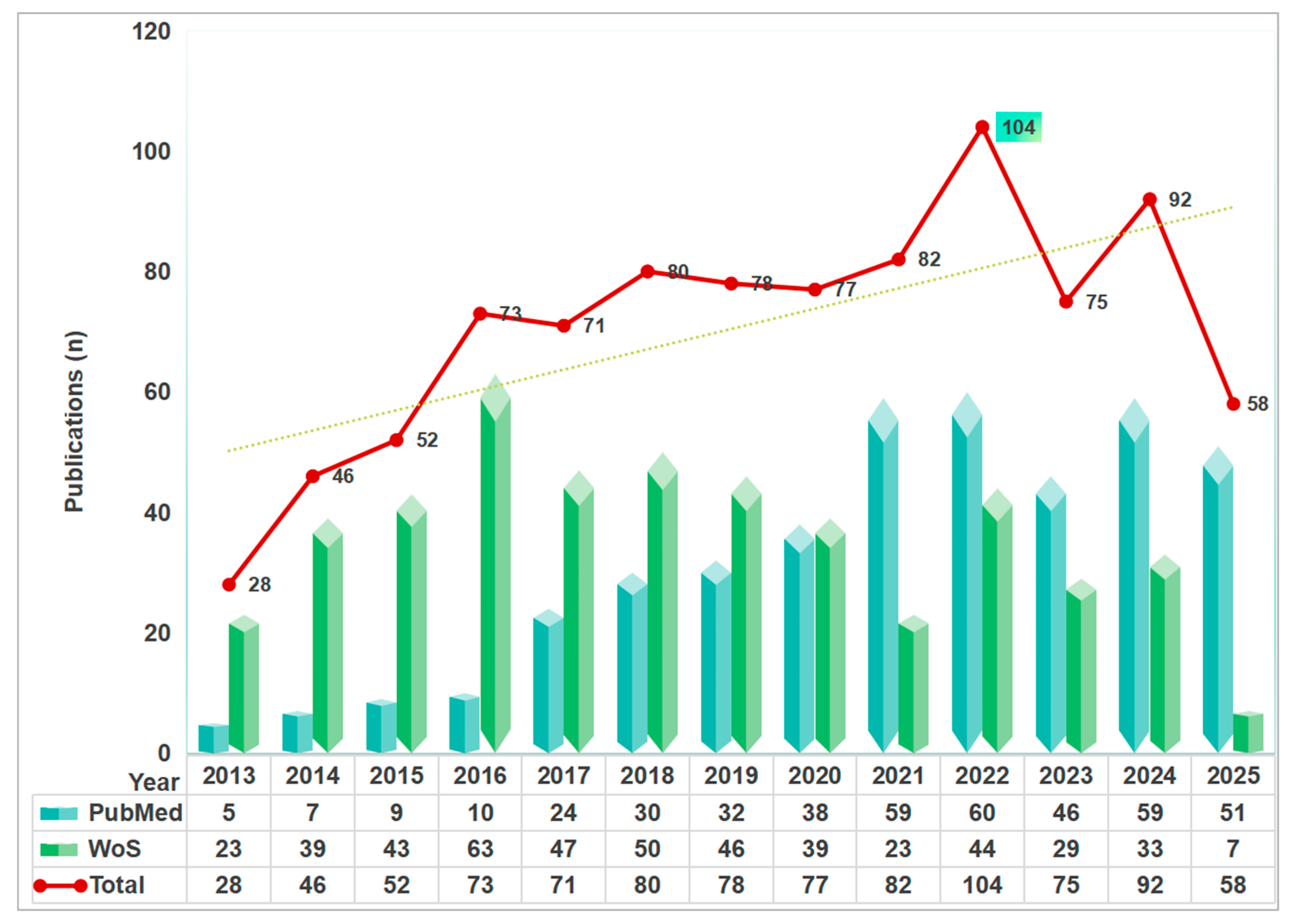
From 2013 to 2025 (through August 2025), annual publications increased overall (Figure 3). The 2013-2018 period marks an embryonic stage centered on broad UGS accessibility-MH associations; 2019-2021 shows an acceleration phase; and 2022 reaches a stage peak (104 papers) amid heightened public mental health concerns. Growth moderates thereafter, but the thematic scope becomes visibly more diversified, indicating a shift from “whether an association exists” toward mechanism-oriented modeling and evaluation. By database, WoS remains dominant for interdisciplinary and environmental-science outputs, whereas PubMed rises rapidly after 2017, reflecting convergence between environmental health and public health.
Figure 3.
Publication trends in UGS–MH research (2013-August 2025). Bars show annual counts from PubMed and WoS; the line indicates yearly totals (N = 929) and the dotted line the linear trend. Data source: PubMed and Web of Science Core Collection.
Figure 3.
Publication trends in UGS–MH research (2013-August 2025). Bars show annual counts from PubMed and WoS; the line indicates yearly totals (N = 929) and the dotted line the linear trend. Data source: PubMed and Web of Science Core Collection.
4.2. Geographical Patterns and International Collaboration
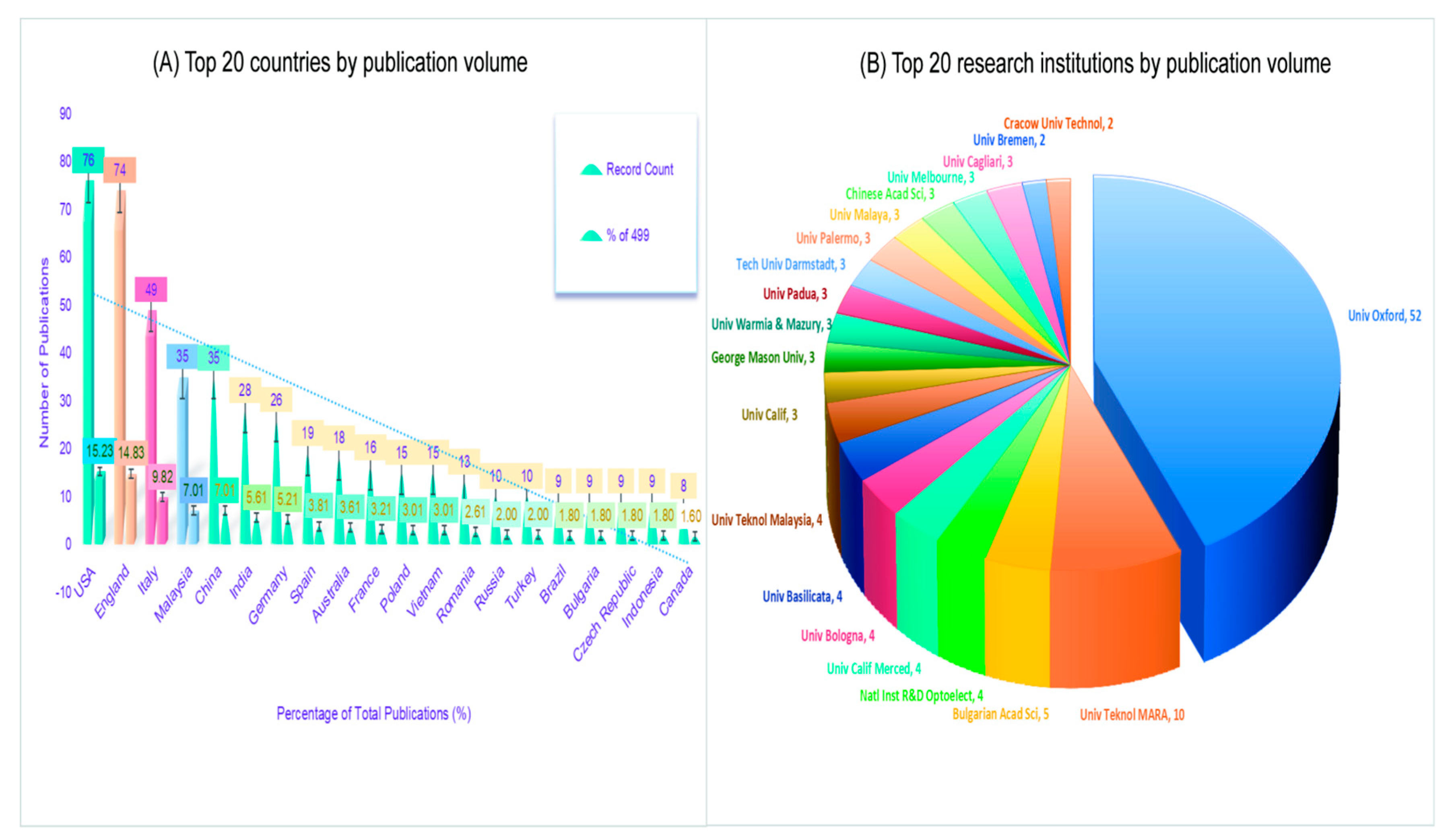
As shown in Figure 4A-B, the global distribution of studies is spatially uneven. Europe and North America-notably the UK, the Netherlands, Germany, and the Nordic countries-built an early comparative advantage that integrates urban ecological planning, restorative environments, and public health. In recent years, the UK has advanced GSP, embedding nature contact within the national mental health intervention system; its nationwide “Test and Learn” pilots (7 areas; >8,500 participants) report positive effects on mental health improvement and mitigation of health inequalities[57], with joint evaluations issued by NHS England and the European Centre for Environment & Human Health[58,59].
At the evidence-synthesis level, recent reviews frame urban nature as a nature-based solution, emphasizing multi-pathway mechanisms such as affective restoration, stress reduction, social cohesion, and equitable access, and translating findings into actionable public health and planning measures[60]. The WHO Regional Office for Europe further recommends integrating blue-green spaces into urban public health and mental health action frameworks, promoting a closed loop from evidence to planning to intervention[61].
Regionally, East Asia started later but has accelerated in the past five years, becoming active in GIS-based exposure modeling, forest-therapy experiments, and dynamic trajectory analysis; room remains for advances in intervention translation, policy practice, and equity evaluation. Low- and middle-income countries show lower overall output; during the pandemic, disparities in accessibility and mobility restrictions widened socioeconomic gaps in green-space use and associated health gains[62,63].
Collaboration networks indicate that the United States(US), the United Kingdom(UK), and Italy are major producers; China (including Hong Kong) is expanding both publication volume and international co-authorship, with Korea and Japan exhibiting steady growth (Figure 4A). At the institutional level, the University of Oxford and Universiti Teknologi MARA (Malaysia) make notable contributions (Figure 4B). Overall, the structure reflects a Euro-Atlantic core, East Asian catch-up, and underrepresentation of low- and middle-income countries. Collaboration is shifting from single-center to multi-polar coordination, a transition that promotes thematic and methodological convergence globally and sets the stage for the subsequent analysis of knowledge-structure evolution.
Figure 4.
Country and institution outputs in UGS–MH research, (2013-August 2025). (A) Top 20 countries; (B) Top 20 institutions. Counts are based on WoS records (n = 499; percentages relative to 499). Co-authorship networks are shown in A/4-2B.
Figure 4.
Country and institution outputs in UGS–MH research, (2013-August 2025). (A) Top 20 countries; (B) Top 20 institutions. Counts are based on WoS records (n = 499; percentages relative to 499). Co-authorship networks are shown in A/4-2B.
4.3. Research Hotspots and Network Structure
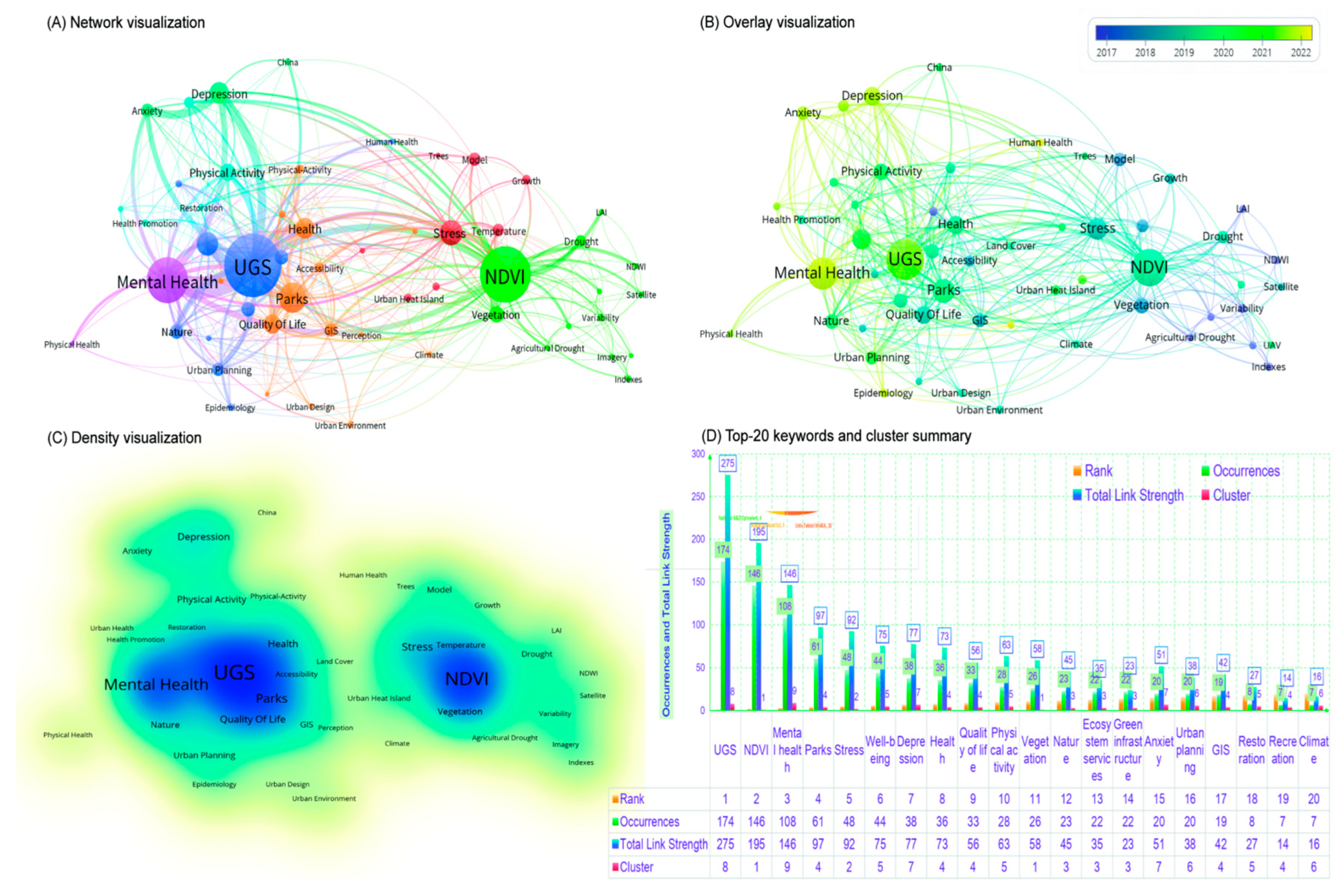
Under a minimum-occurrence threshold of six, VOSviewer identified 66 high-frequency keywords from the N = 929 corpus to construct a knowledge network (Figure 5). The map exhibits a triangular core centered on UGS (174 occurrences), NDVI (146), and Mental Health (108), corresponding to the three principal dimensions of exposure quantification, ecological indicators, and health outcomes. Peripheral nodes such as Stress, Quality of Life, Physical Activity, and Parks radiate outward and articulate a multilayer linkage from environmental exposure to psychophysiological and socio-behavioral processes (Figure 5A, 5D). Although Parks and Stress are not the most frequent, their high total link strength (TLS) and cross-cluster ties indicate a bridging function. The appearance of Urban Planning, Ecosystem Services, Green Infrastructure, and GIS signals a clear expansion toward governance and planning domains.
A temporal overlay (Figure 5B) shows a progression from macro-level exposure assessment to intelligent modeling and dynamic prediction. In the early stage (2013-2016), NDVI/vegetation-based exposure measures were paired with outcomes such as Depression, emphasizing general associations. The middle stage (2017-2020) introduced Stress, Well-being, Physical Activity, and Parks, marking a shift toward mechanism identification and multivariate interaction. The recent stage (2021-present) features Urban Planning, Ecosystem Services, AI modeling, and Dynamic Exposure, reflecting a turn to spatial equity, governance evaluation, and AI-enabled modeling.
The density view (Figure 5C) confirms UGS, NDVI, and mental health as stable anchors. Two high-density bands emanate from these cores: a behavioral-experiential band (Parks, Quality of Life, Physical Activity, Nature) and a psychophysiological-environmental band (Stress, Vegetation, Temperature), coupled through the triangular core. GIS sits adjacent to the core as a methodological hub.
Synthesizing the top-20 keyword profile and nine computational clusters (Figure 5D), four functional channels emerge: (i) environmental measurement and exposure assessment (NDVI, vegetation, GIS); (ii) psychological and physiological mechanisms (stress, restoration, well-being); (iii) behavioral interventions and health impacts (parks, physical activity, quality of life); and (iv) spatial equity and planning translation (urban planning, ecosystem services, green infrastructure, climate). Across these channels, mental health outcomes (mental health, depression, anxiety) form an integrative axis that links exposure, mechanisms, interventions, and policy.
In summary, Figure 5A-D jointly indicate an orderly evolution from quantitative assessment to mechanistic explanation, behavioral intervention, and policy and governance translation. Together, they establish a health outcome feedback loop and signal a shift from static correlation to dynamic modeling and causal identification.
Figure 5.
Keyword co-occurrence analysis of UGS–MH research (2013-August 2025). (A) Network; (B) Overlay; (C) Density; (D) Top-20 keywords and cluster summary. Settings: threshold ≥6 occurrences, keywords = 66; corpus N = 929 (PubMed + WoS).
Figure 5.
Keyword co-occurrence analysis of UGS–MH research (2013-August 2025). (A) Network; (B) Overlay; (C) Density; (D) Top-20 keywords and cluster summary. Settings: threshold ≥6 occurrences, keywords = 66; corpus N = 929 (PubMed + WoS).
4.4. Methodological Evolution and AI Modeling Trends
Mirroring the four functional channels discussed in Section 4.3, the field has converged on a research chain that links exposure quantification, mechanistic explanation, behavioral translation, and governance evaluation. Table~1 summarizes six methodological families and their representative techniques, and Table~2 traces their staged evolution. Building on these foundations, this section highlights three methodological turning points.
First, modeling spatial heterogeneity and spatial dependence has been pivotal for moving from association to robust inference. Studies have progressed from OLS to spatial regressions and multilevel models—including GWR/MGWR and spatial error/lag specifications-so that effects can vary by place and scale, thereby capturing nonstationarity and spatial dependence in the exposure-outcome relationship [64]. This transition reduces model misspecification and aggregation bias, improves external validity and generalizability, and lays the statistical groundwork for downstream mechanism testing and causal identification (corresponding to Table 1: spatial distribution/exposure-effect and the Stage I to Stage II deepening in Table 2).
Second, coupling dynamic exposure with causal identification moves the field from static indicators to process-based modeling. GPS-EMA and TWCE/WCE align dose-response estimation with individuals’ mobility contexts[65] In parallel, machine-and deep-learning-convolutional and graph convolutional networks on street-view imagery, plus tree-based models such as Random Forests and XGBoost-support individualized exposure profiling and prediction of mental states, strengthening causal interpretation and spatiotemporal extrapolation[65,66,67,68].Mobility-aware assessments reduce misclassification relative to home-based proxies [69].Together these advances curb model misspecification and aggregation bias, improve external validity and generalizability, and provide the statistical basis for downstream mechanistic testing and causal identification-building on place-varying models that capture spatial heterogeneity and dependence.
Third, contextualized translation from evidence to policy brings findings into operational governance. Multi-criteria decision analysis helps structure trade-offs and distributional (equity) impacts when comparing intervention portfolios[70]; system dynamics represents feedbacks and delays in urban health-environment systems to test policy robustness[71]; and agent-based modeling explores heterogeneous behaviors and neighborhood effects under alternative scenarios[72]. Together, these approaches inform planning choices and resource allocation, corresponding to our policy and scenario-simulation pathway and completing the loop from scientific evidence to policy action.

Table 1.
Methods-themes matrix of UGS–MH research (2013-August 2025).
| Theme | Analytical Approach | Representative Techniques / Models | Application Focus |
|---|---|---|---|
| Spatial Distribution & Clustering[73,74,75] | Spatial statistics & spatial autocorrelation | Global/Local Moran’s I; LISA; Getis-Ord Gi* | Detect clustering and regional disparity; inform equitable planning. |
| Exposure-Outcome Relationships[76,77] | Regression & spatial regression | OLS; GWR; MGWR; SEM | Model linear and spatially varying effects in UGS–MH links. |
| Temporal Dynamics & Trends[78,79] | Time-series & trend analysis | Mann-Kendall; Sen’s slope; AutoRegressive Integrated Moving Average | Quantify temporal patterns in exposure and mental health outcomes. |
| Mechanisms & Mediation Effects[65,69] | Structural-equation & path analysis | SEM; Partial Least Squares-SEM; multilevel models | Identify mediators: restoration, stress-buffering, cohesion, activity. |
| AI & Methodological Innovation[66,67,68] | Machine & deep learning | RF; XGBoost; CNN; GCN | Individualized exposure modeling and prediction; dynamic/causal inference (TWCE/WCE). |
| Policy Simulation & Scenario Modeling[70,71,72] | Multi-criteria & system-dynamics modeling | Multi-Criteria Decision Analysis; System Dynamics; agent-based modeling | Evaluate intervention scenarios, equity, and planning trade-offs. |
* This table summarizes the major methodological categories across four columns-theme, analytical approach, representative techniques/models, and application focus-outlining the pathway from spatial description to mechanism identification and policy translation. Method settings are provided in Section 3.4; abbreviations are listed in the glossary.
From a temporal perspective, methodological approaches have evolved through three stages (Table 2). Stage I relied on NDVI-based vegetation indicators and cross-sectional designs to establish macro-level associations between urban greenspace and mental health[80,81]. Stage II incorporated street-view greenness (GVI), accessibility metrics, and socio-psychological covariates, adopting SEM and multilevel models to test mediation or moderation and to identify pathways such as stress buffering, attention restoration, social cohesion, and physical activity[82,83]. Its methodological foundation followed standard SEM references [79,84].Stage III integrates multimodal data—remote sensing, street-view imagery, wearables, and social-media feeds-with dynamic exposure metrics (GPS-EMA, TWCE/WCE). It employs machine-and deep-learning approaches, including Random Forests, XGBoost, and convolutional or graph convolutional networks, to enable individualized exposure profiling and prediction, bringing causal identification and policy-scenario simulation to the forefront [19,65,85].
In parallel, to capture spatial heterogeneity and spatial dependence, studies have shifted from OLS to spatially explicit frameworks—most notably geographically weighted regression (GWR) and its multiscale extension (MGWR)-which reveal location-specific coefficients and scale effects[64,86]. Along the dose-response dimension, TWCE improves temporal alignment and consistency with mobility-aware exposure contexts[85].
Table 2.
Methodological evolution and modeling characteristics in UGS–MH research (2013-August 2025).
Table 2.
Methodological evolution and modeling characteristics in UGS–MH research (2013-August 2025).
| Stage | Data & Exposure Metrics | Methods & Theoretical Orientation | Key Outcomes / Findings | Representative Studies |
|---|---|---|---|---|
| Stage I (2013-2016): Macro-level Exposure Identification | Vegetation indices (NDVI); cross-sectional population and health surveys | Correlation and regression; macro-spatial description | Established macro-level associations between “green space and mental health”; limited causal mechanisms | [80]; [81] |
| Stage II (2017-2020): Mechanism Integration | Street-view greenness (GVI); accessibility; social/psychological covariates | SEM and multilevel models; mediation/moderation analysis; pathway identification | Identified pathways such as stress buffering, attention restoration, social cohesion, and physical activity | [83]; [82] |
| Stage III (2021-2025): Intelligent Modeling | Dynamic exposure (GPS-EMA, TWCE); multimodal data (remote sensing, street view, wearable, social) | machine learning/deep learning (RF, XGBoost, CNN, GCN); shift to causal identification; policy scenario modeling | Individualized exposure characterization and mental-state prediction; progress toward causal inference and planning translation | [19]; [65]; [85] |
* Stages I-III progress from macro-level exposure identification to mechanism integration to intelligent modeling. Methods emphasize dynamic exposure (GPS-EMA, TWCE/WCE), multimodal inputs, and machine/deep-learning approaches (RF, XGBoost, CNN, GCN).
Research on UGS–MH has progressed through a staged shift—from macro-level identification to mechanism-oriented modeling and, most recently, AI-enabled inference. The field is moving beyond static correlations toward mobility-aware, dynamic exposure metrics and causal identification; beyond population averages toward individualized profiling; and beyond description toward decision support and policy simulation. In short, methodological development follows a coherent trajectory: static → dynamic, association → causation, aggregate → individualized, observation → translation. Coupled with finer spatial and temporal resolution and interpretable ML/AI, UGS–MH is consolidating into a closed-loop pipeline of quantitative measurement → mechanism elucidation → intelligent prediction → governance translation, providing a reproducible toolkit for equitable greenspace planning and public-health decision-making.
5. Research Challenges and Methodological Reflections
This section synthesizes the major methodological bottlenecks in UGS–MH research, explains their root causes, and outlines actionable pathways toward a paradigm shift from descriptive association to causal, explainable, and policy-ready evidence. As summarized in Fig. 6, the discussion follows a stepwise logic from Methodological Challenges (bottom layer), to Methodological Reflections & Reorientation (middle layer), and finally to Future Pathways & Paradigm Shift (top layer).
5.1. Root Causes of the Methodological Pitfalls
Over the past decade, UGS–MH research has grown rapidly but still shows design-theory-data misalignment. Cross-sectional designs and single-shot exposure measures (such as a one-time NDVI) are ill-suited to long-term outcomes, yielding mostly associational findings; heterogeneity in spatial resolution, scales, and buffer choices undermines comparability; and misaligned timing between psychological assessments and environmental exposures further weakens inference. More fundamentally, many analytic pipelines under-integrate psychological and social theory, so that the cognition-behavior-environment mechanism is only partially specified.
In summary, today’s methodological impasse is shaped by four interlocking challenges: exposure misclassification from UGCoP and spatiotemporal mismatch, which bias exposure assessment[87]; limited model interpretability and fairness, with social heterogeneity often underexamined[88,89]; weak standardization and reproducibility, including inconsistent protocols and scarce open materials[90,91]; and insufficient cross-disciplinary integration and policy translation, which constrains the formation of actionable guidance[92].Together, these issues constitute the foundational architecture of current methodological challenges. We next diagnose key limitations and outline actionable remedies.
5.2. Spatial and Temporal Uncertainty
Urban residents move continuously through space, and their psychological states fluctuate over time, rendering the exposure-response relationship inherently uncertain. Even with GPS or wearables, differences in sampling frequency, buffer radii, and dwell-time rules can introduce systematic bias; high-rise obstruction, signal loss, and diverse daily activities further amplify error. In parallel, psychological assessments often lag behind environmental exposure, so affective changes are not synchronized with the surrounding context, weakening the stability of dose-response estimation.
This combination of UGCoP and spatiotemporal mismatch is among the most underestimated error sources in the field[87,93]. We recommend pre-registering spatiotemporal alignment at the design stage, and using stratified or multilevel models plus sensitivity analyses to locate error sources. Parameter settings and uncertainty bounds should be explicitly reported to enhance transparency and reproducibility. Along the exposure-response link, TWCE/WCE can improve temporal characterization and maintain consistency with mobility contexts[65]. This section corresponds to the orange module in Fig. 6 (“Static & NDVI-centric exposure measures / Spatiotemporal mismatch & UGCoP uncertainty”), underscoring the paradigm shift from static metrics to dynamic exposure modeling.
5.3. The Paradox of Intelligent Analytics
The introduction of AI has substantially widened the research frontier: deep learning can automatically extract green-space features from street-view and remote-sensing imagery, generating high-dimensional exposure data with finer spatial precision and stronger predictive power for mental health research. Yet when algorithmic performance becomes the overriding goal, scientific explanation is often relegated to a secondary concern; models may become “more accurate” without clarifying the why, thereby weakening the credibility of causal inference.
A further concern is algorithmic bias stemming from imbalanced samples: data-rich central districts and higher-income groups tend to be overrepresented, whereas the exposures and psychological responses of vulnerable populations are undercounted[88,89]. To mitigate these risks, studies should balance interpretability and fairness: incorporate explainable AI techniques-such as Shapley Additive explanations and Local Interpretable Model-agnostic Explanations-to enhance transparency[89,94], and routinely report fairness audits and ethical-governance assessments[88]. Going forward, combining theory-driven and data-driven approaches will be essential for advancing toward a fusion paradigm that integrates causal identification with smart governance.
5.4. Pathways Toward Integration and Standardization
The maturation of the field hinges on coupling data standardization and open science with cross-disciplinary integration and policy translation, in order to build a transparent, comparable, and sustainable research system[90,91]. Accordingly, future development should advance along three complementary directions. First, integrate multimodal data within causal inference and explainable AI frameworks so that psychological, social, and spatial factors are modeled jointly. This will support more realistic multilevel social-ecological representations and sharpen causal interpretation[95]. Second, standardize and share data and algorithms by adopting principles that ensure information is findable, accessible, interoperable, and reusable, and by establishing a minimum-information protocol for reproducible reporting in UGS–MH research. Such a protocol should specify data sources, parameter settings, and algorithm versions, enabling open verification and continual updating[90,91]. Third, strengthen cross-disciplinary collaboration and policy alignment to channel evidence from health, planning, and ecology into decision-making processes, forming a durable feedback loop between evidence and decisions[92].
Consistent with the green module at the top of Fig. 6, these directions mark a movement from descriptive association to causal reasoning, from static exposure assessment to intelligent dynamic modeling, and from single-discipline studies to systems integration grounded in open science. In short, the paradigm is shifting from asking whether a relationship exists to explaining how and why it operates, and ultimately to how it can be governed. As summarized in Fig.6, methodological challenges motivate methodological reflections, which in turn inform future pathways, together tracing a progression from descriptive statistics toward an integrated paradigm of causal identification and AI-enabled modeling.
6. Strategic Pathways for Green Interventions and Policy Implications
6.1. Spatially Equitable Provision
The primary goal of green space interventions, from a public health perspective, is to improve spatial equity in mental health-relevant exposure. Simply increasing total green area does not guarantee population-wide mental health benefits; what matters is accessibility and balanced distribution [61]. To address uneven patterns, embedded strategies-such as pocket parks, walkable greenways, and rooftop greening-are increasingly adopted to raise the share of green spaces that residents can routinely access. To avoid overestimating benefits based on nominal, residence-based accessibility alone, equity metrics should be aligned with observed individual exposure.
The field is advancing toward higher spatiotemporal-resolution exposure assessment by integrating remote sensing, street-view imagery, wearables, and physiological monitoring to reconstruct individual “psychological exposure trajectories” thereby reducing geographic misclassification[65]. Such high-precision assessment underpins equitable allocation of green resources and promotes a shift from quantity expansion to quality optimization.
6.2. Therapeutic Design Functions
Conventional UGS design has prioritized landscape aesthetics and ecological services while giving less systematic attention to psychological therapeutic effects. The Therapeutic Landscape framework foregrounds multisensory experience, spatial privacy, and cultural symbolism, enabling psychological restoration through cognitive recovery and affect regulation[96]. This orientation is consistent with core psychological mechanisms—attention restoration and stress recovery—that link environmental qualities to mental health outcomes[21].
Across East Asia and Europe, structured nature-based programs-such as forest therapy and sensory gardens—have demonstrably reduced anxiety, improved sleep, and enhanced well-being [97]. Together, these findings indicate that ecological remediation and psychological therapy are not parallel tracks but mutually reinforcing design logics. Going forward, green-space planning should embed psychological principles across planning, implementation, and maintenance, and adopt evidence-based therapeutic design standards, positioning UGS as a genuine spatial resource for mental health promotion within evidence-based planning and design.
6.3. Prioritizing Vulnerable Populations
Equity in green interventions hinges on whether high-risk and socially vulnerable groups truly benefit. In this context, several European countries pioneered GSP, integrating medical services with nature-based activities[57]. In the UK National Health Service (NHS), a dual model of physician referral + community nature activities has reached >8,500 participants, with nationwide “test-and-learn” pilots formally evaluated and showing improvements in mental health and reductions in health inequalities[59,98]. Comparable cross-sector models are being scaled in Australia within social-prescribing systems and embedded into local health and community-service networks[99], while East Asian cities are exploring nature/green activities as social-prescribing pathways[100] (Table 3).
6.4. Integrating Governance Systems
The effectiveness of green interventions hinges on cross-sector coordination and institutional integration. The EU’s Nature-based Solutions strategy emphasizes embedding health and mental health indicators within a coordinated architecture spanning urban planning, education, and ecological management[101].
At the theoretical level, the Social-Ecological Systems framework provides a robust basis for multi-level coupling of green interventions[102]. Pilot programs in Australia and selected Chinese cities show that multi-actor collaboration-among non-governmental organizations, health agencies, and community organizations-can deliver measurable social and psychological benefits, demonstrating the institutional potential of collaborative governance in mental health promotion ( Figure 7 and Table 3).
6.5. Intelligent Intervention Tools
The convergence of AI and IoT (Internet of Things) is reshaping the technical landscape of urban green interventions. Smart Green Infrastructure integrates environmental sensing, behavioral data, and algorithmic modeling to identify high-stress micro-areas in real time and to deliver targeted recommendations, forming a closed exposure-response-feedback governance loop[103]. For example, several cities have piloted AI+IoT green-space monitoring, linking sensors for air/noise/heat exposure with mobility and wearable data, and using spatiotemporal modeling for hotspot detection and intervention prioritization[19].
Innovation also raises new challenges for equity and ethics. Strengthening explainable AI and algorithmic fairness, and building human-centered, socially responsible smart health governance systems, will help ensure that technological advances support public psychological well-being and contribute to sustainable urban development [88,104].
6.6. Summary
Research on UGS interventions is shifting from an ecology focused approach to one that explicitly links psychological and ecological processes, supported by advances in environmental health research and data driven technologies. Future work should deepen methodological and theoretical foundations, refine modeling strategies, and better align governance instruments with empirical evidence, thereby building a predictive framework that can effectively guide practice in healthy cities. As practice evolves, from therapeutic design and green social prescribing to collaborative governance and smart green infrastructure, green space interventions are pushing urban health research beyond empirical accumulation toward more systematic conceptualization and theory building. Taken together, these developments point toward a more integrated paradigm for sustainable and psychologically resilient cities.
7. Conclusions and Scholarly Outlook
This review synthesizes more than a decade of work on UGS–MH, tracing shifts in theory, methods, and policy orientation. The field is moving from an eco-environmental and psychological effects focus toward a social systems and health equity orientation. UGS is increasingly conceptualized as a medium for mental health promotion and social cohesion. Research pathways are evolving from static exposure metrics to dynamic, mechanism informed modeling, from simple correlations to more robust causal identification, and from local experiential evidence to integrated, multi level governance[12,23].Using a dual-dataset design, we depict the global research landscape and synthesize operational evidence in a framework that links method choice, inferential strength, and policy usability.
Multimodal data, including remote sensing, street view imagery, and GPS based ecological momentary assessment, combined with artificial intelligence methods, are enhancing quantification and prediction. Attention is shifting from asking how much exposure people receive to examining interactions among perception, behavior, and social relations, and from single pathway explanations to multi level cognitive, affective, physiological, and social linkages. Mobility and time aware exposure metrics, quasi experimental designs, instrumental variable approaches, difference in differences estimators, and graph based learning methods strengthen causal inference [105,106].Routine evaluation and governance of interpretability and fairness, with reproducible and auditable workflows, are essential to prevent inequality amplification and enable policy uptake.
The core contribution of this review is an integrated, closed-loop framework that links mechanisms, modeling, equity, and governance. First, psychological and socio-ecological theory should be embedded in space-time modeling to connect the cognition-behavior-environment chain and advance mobility-sensitive dynamic exposure assessment. Second, causal-identification strategies, including mediation analysis and structural equation modeling, are needed to calibrate inference and clarify pathways. Third, interpretability and fairness assessment should be institutionalized in the use of artificial intelligence. On this basis, empirical evidence can be translated into five actionable policy pathways that align methodological choices with inferential strength and policy relevance.
This study also has limitations. Existing databases overweight English-language outputs and under-represent regional social-science work; cross-sectional designs still dominate [107], and alignment between space-time exposure measures and mental-health assessments needs improvement. Cross-disciplinary integration and the causal logic linking psychology and artificial intelligence remain uneven, and policy translation often lags behind model validation[108]. We therefore recommend minimum-information and reproducible-reporting standards, harmonized variables and alignment protocols, and open data and code with preregistration to reduce bias and improve portability.
In terms of value vision and scholarly outlook, We advocate the emotionally inclusive city - enhancing positive affect, social connection, and resilience through nature, activity, and social support, aligning mental health with health equity. UGS - MH research is moving from correlational observation toward causal and usable evidence; next steps are to deepen multimodal causal analysis, standardize dynamic-exposure modeling, institutionalize interpretability/fairness metrics, and accelerate translation via pilots, cross-sector collaboration, and smart green infrastructure - not only “beautifying cities,” but healing minds.
Supplementary Materials
The following supporting information can be downloaded at: https://pubmed.ncbi.nlm.nih.gov/, https://www.webofscience.com/.
Author Contributions
Conceptualization, Jianying Wang and Liang Wang; methodology, Jianying Wang, Heejung Byun; validation, Zunwei Fu, Liang Wang, and Heejung Byun; formal analysis, Jianying Wang; data curation, Jianying Wang and Zunwei Fu; resources, Liang Wang; writing—original draft preparation, Jianying Wang; writing—review and editing,Heejung Byun; visualization, Jianying Wang; supervision, Liang Wang; project administration, Heejung Byun. All authors have read and agreed to the published version of the manuscript.
Funding
This work was supported by the Humanities and Social Sciences Research Project of the Ministry of Education of China (Grant No. 24YJA63008) and the Shandong Provincial Natural Science Foundation (Grant No. ZR2023MD089). The APC was funded by the authors.
Institutional Review Board Statement
Not applicable.
Informed Consent Statement
Not applicable.
Data Availability Statement
The study is based on published literature and bibliographic records retrieved from the Web of Science Core Collection (WoSCC) and PubMed. The full search strategies and filters are provided in Table S1, and the PRISMA 2020 checklist is available in File S1. The list of included empirical studies (n = 113) and the extracted/coded dataset used for synthesis are provided as Supplementary Materials (Tables S3-S4). Due to database licensing restrictions, the raw exported WoSCC records may not be publicly redistributed; however, the search queries and retrieval dates (last search: 11 September 2025) enable replication of the dataset. Additional materials are available from the corresponding author upon reasonable request.
Acknowledgments
During the preparation of this manuscript, the authors used ChatGPT (OpenAI; accessed on 06 February 2026) for language editing and rephrasing; Python 3.9 and VOSviewer 1.6.20 for data processing and bibliometric mapping; and Adobe Illustrator 2026 for figure post-processing. The authors reviewed and edited the output and take full responsibility for the content of this publication.
Conflicts of Interest
The authors declare no conflict of interest.
Abbreviations
The following abbreviations are used in this manuscript:
| AI | Artificial Intelligence |
| ART | Attention Restoration Theory |
| CNN | Convolutional Neural Network |
| CRP | C-reactive Protein |
| EMA | Ecological Momentary Assessment |
| GCN | Graph Convolutional Network |
| GIS | Geographic Information Systems |
| GSP | Green Social Prescribing |
| GVI | Green View Index |
| GWR | Geographically Weighted Regression |
| HRV | Heart Rate Variability |
| IL-6 | Interleukin-6 |
| IoT | Internet of Things |
| MGWR | Multiscale GWR |
| NDVI | Normalized Difference Vegetation Index |
| NHS | National Health Service |
| OLS | Ordinary Least Squares |
| RF | Random Forest |
| SEM | Structural Equation Modeling |
| SRT | Stress Reduction Theory |
| TWCE | Time-Weighted Cumulative Exposure |
| UGCoP | Uncertain Geographic Context Problem |
| UGS–MH | Urban green space–mental health |
References
- Collaborators, G.M.D. Global, regional, and national burden of 12 mental disorders in 204 countries and territories, 1990–2019: a systematic analysis for the Global Burden of Disease Study 2019. The Lancet Psychiatry 2022, 9, 137–150. [Google Scholar] [CrossRef]
- Haywood, A.; Dayson, C.; Garside, R.; Foster, A.; Lovell, R.; Husk, K.; Holding, E.; Thompson, J.; Shearn, K.; Hunt, H.A.; et al. National evaluation of the preventing and tackling mental ill health through green social prescribing project: Final report – March 2021 to June 2023; Department for Environment, Food & Rural Affairs (Defra): London, UK, 2024. [Google Scholar]
- Organization, W.H. World mental health report: Transforming mental health for all; World Health Organization: Geneva, Switzerland, 2022. [Google Scholar]
- Vigo, D.; Thornicroft, G.; Atun, R. Estimating the true global burden of mental illness. The Lancet Psychiatry 2016, 3, 171–178. [Google Scholar] [CrossRef] [PubMed]
- Baker, E.; Barlow, C.F.; Daniel, L.; Morey, C.; Bentley, R.; Taylor, M.P. Mental health impacts of environmental exposures: A scoping review of evaluative instruments. The Science of the Total Environment 2024, 912, 169063. [Google Scholar] [CrossRef] [PubMed]
- Job, S.; Tao, X.; Cai, T.; Xie, H.; Li, L.; Li, Q.; Yong, J. Exploring Causal Learning Through Graph Neural Networks: An In-Depth Review. Wires Data Mining and Knowledge Discovery 2025, 15, e70024. [Google Scholar] [CrossRef]
- Gianfredi, V.; Buffoli, M.; Rebecchi, A.; Croci, R.; Oradini-Alacreu, A.; Stirparo, G.; Marino, A.; Odone, A.; Capolongo, S.; Signorelli, C. Association between Urban Greenspace and Health: A Systematic Review of Literature. International Journal of Environmental Research and Public Health 2021, 18, 5137. [Google Scholar] [CrossRef]
- Huang, W.; Lin, G. The relationship between urban green space and social health of individuals: A scoping review. Urban for Urban Gree 2023, 85, 127969. [Google Scholar] [CrossRef]
- Nguyen, P.; Astell-Burt, T.; Rahimi-Ardabili, H.; Feng, X. Green Space Quality and Health: A Systematic Review. International Journal of Environmental Research and Public Health 2021, 18, 11028. [Google Scholar] [CrossRef] [PubMed]
- Jones, K.R. Green Lungs and Green Liberty: The Modern City Park and Public Health in an Urban Metabolic Landscape. Social History of Medicine: The Journal of the Society for the Social History of 2022, 35, 1200–1222. [Google Scholar] [CrossRef]
- Kingsley, J.; Foenander, E.; Bailey, A. “It’s about community”: Exploring social capital in community gardens across Melbourne, Australia. Urban for Urban Gree 2020, 49, 126640. [Google Scholar] [CrossRef]
- Rigolon, A.; Browning, M.H.E.M.; McAnirlin, O.; Yoon, H.V. Green Space and Health Equity: A Systematic Review on the Potential of Green Space to Reduce Health Disparities. International Journal of Environmental Research and Public Health 2021, 18, 2563. [Google Scholar] [CrossRef]
- Barton, J.; Rogerson, M. The importance of greenspace for mental health. Bjpsych International 2017, 14, 79–81. [Google Scholar] [CrossRef]
- Grigoletto, A.; Toselli, S.; Zijlema, W.; Marquez, S.; Triguero-Mas, M.; Gidlow, C.; Grazuleviciene, R.; Van de Berg, M.; Kruize, H.; Maas, J.; et al. Restoration in mental health after visiting urban green spaces, who is most affected? Comparison between good/poor mental health in four European cities. Environ Res 2023, 223, 115397. [Google Scholar] [CrossRef]
- Chen, C.; Wang, J.; Li, D.; Sun, X.; Zhang, J.; Yang, C.; Zhang, B. Unraveling nonlinear effects of environment features on green view index using multiple data sources and explainable machine learning. Sci Rep-Uk 2024, 14, 30189. [Google Scholar] [CrossRef]
- Yu, C.; Kwan, M. Dynamic greenspace exposure, individual mental health status and momentary stress level: A study using multiple greenspace measurements. Health Place 2024, 86, 103213. [Google Scholar] [CrossRef]
- Freymueller, J.; Schmid, H.; Senkler, B.; Lopez Lumbi, S.; Zerbe, S.; Hornberg, C.; McCall, T. Current methodologies of greenspace exposure and mental health research-a scoping review. Front Public Health 2024, 12, 1360134. [Google Scholar] [CrossRef]
- Markevych, I.; Schoierer, J.; Hartig, T.; Chudnovsky, A.; Hystad, P.; Dzhambov, A.M.; de Vries, S.; Triguero-Mas, M.; Brauer, M.; Nieuwenhuijsen, M.J.; et al. Exploring pathways linking greenspace to health: Theoretical and methodological guidance. Environ Res 2017, 158, 301–317. [Google Scholar] [CrossRef]
- Helbich, M. Toward dynamic urban environmental exposure assessments in mental health research. Environ Res 2018, 161, 129–135. [Google Scholar] [CrossRef]
- Kleinschroth, F.; Savilaakso, S.; Kowarik, I.; Martinez, P.J.; Chang, Y.; Jakstis, K.; Schneider, J.; Fischer, L.K. Global disparities in urban green space use during the COVID-19 pandemic from a systematic review. Nature Cities 2024, 1, 136–149. [Google Scholar] [CrossRef]
- Kaplan, S. The restorative benefits of nature: Toward an integrative framework. J Environ Psychol 1995, 15, 169–182. [Google Scholar] [CrossRef]
- Ulrich, R.S.; Simons, R.F.; Losito, B.D.; Fiorito, E.; Miles, M.A.; Zelson, M. Stress recovery during exposure to natural and urban environments. J Environ Psychol 1991, 11, 201–230. [Google Scholar] [CrossRef]
- Twohig-Bennett, C.; Jones, A. The health benefits of the great outdoors: A systematic review and meta-analysis of greenspace exposure and health outcomes. Environ Res 2018, 166, 628–637. [Google Scholar] [CrossRef]
- Bratman, G.N.; Daily, G.C.; Levy, B.J.; Gross, J.J. The benefits of nature experience: Improved affect and cognition. Landscape Urban Plan 2015, 138, 41–50. [Google Scholar] [CrossRef]
- Jennings, V.; Larson, L.; Yun, J. Advancing Sustainability through Urban Green Space: Cultural Ecosystem Services, Equity, and Social Determinants of Health. International Journal of Environmental Research and Public Health 2016, 13, 196. [Google Scholar] [CrossRef] [PubMed]
- Kellert, S.R.; Wilson, E.O. The biophilia hypothesis; Island Press: Washington, D.C., USA, 1993; pp. 1–484. [Google Scholar]
- Rook, G.A. Regulation of the immune system by biodiversity from the natural environment: An ecosystem service essential to health. Proceedings of the National Academy of Sciences 2013, 110, 18360–18367. [Google Scholar] [CrossRef]
- Grassini, S.; Revonsuo, A.; Castellotti, S.; Petrizzo, I.; Benedetti, V.; Koivisto, M. Processing of natural scenery is associated with lower attentional and cognitive load compared with urban ones. J Environ Psychol 2019, 62, 1–11. [Google Scholar] [CrossRef]
- Jiang, X.; Hu, Y.; Larsen, L.; Chang, C.; Sullivan, W.C. Impacts of urban green infrastructure on attentional functioning: insights from an fMRI study. Front Psychol 2023, 14, 1047993. [Google Scholar] [CrossRef]
- Bratman, G.N.; Hamilton, J.P.; Hahn, K.S.; Daily, G.C.; Gross, J.J. Nature experience reduces rumination and subgenual prefrontal cortex activation. Proceedings of the National Academy of Sciences 2015, 112, 8567–8572. [Google Scholar] [CrossRef]
- Kim, G.; Jeong, G.; Kim, T.; Baek, H.; Oh, S.; Kang, H.; Lee, S.; Kim, Y.S.; Song, J. Functional Neuroanatomy Associated with Natural and Urban Scenic Views in the Human Brain: 3.0T Functional MR Imaging. Korean J Radiol 2010, 11, 507–513. [Google Scholar] [CrossRef]
- Sudimac, S.; Sale, V.; Kühn, S. How nature nurtures: Amygdala activity decreases as the result of a one-hour walk in nature. Mol Psychiatr 2022, 27, 4446–4452. [Google Scholar] [CrossRef]
- Kühn, S.; Forlim, C.G.; Lender, A.; Wirtz, J.; Gallinat, J. Brain functional connectivity differs when viewing pictures from natural and built environments using fMRI resting state analysis. Sci Rep-Uk 2021, 11, 4110. [Google Scholar] [CrossRef]
- Bratman, G.N.; Anderson, C.B.; Berman, M.G.; Cochran, B.; de Vries, S.; Flanders, J.; Folke, C.; Frumkin, H.; Gross, J.J.; Hartig, T.; et al. Nature and mental health: An ecosystem service perspective. Sci Adv 2019, 5, eaax903. [Google Scholar] [CrossRef]
- Hansen, M.M.; Jones, R.; Tocchini, K. Shinrin-Yoku (Forest Bathing) and Nature Therapy: A State-of-the-Art Review. International Journal of Environmental Research and Public Health 2017, 14, 851. [Google Scholar] [CrossRef]
- Song, S.; Tu, R.; Lu, Y.; Yin, S.; Lin, H.; Xiao, Y. Restorative Effects from Green Exposure: A Systematic Review and Meta-Analysis of Randomized Control Trials. International Journal of Environmental Research and Public Health 2022, 19, 14506. [Google Scholar] [CrossRef] [PubMed]
- Bikomeye, J.C.; Beyer, A.M.; Kwarteng, J.L.; Beyer, K.M.M. Greenspace, Inflammation, Cardiovascular Health, and Cancer: A Review and Conceptual Framework for Greenspace in Cardio-Oncology Research. International Journal of Environmental Research and Public Health 2022, 19, 2426. [Google Scholar] [CrossRef]
- Yang, L.; Chan, K.L.; Yuen, J.W.M.; Wong, F.K.Y.; Han, L.; Ho, H.C.; Chang, K.K.P.; Ho, Y.S.; Siu, J.Y.; Tian, L.; et al. Effects of Urban Green Space on Cardiovascular and Respiratory Biomarkers in Chinese Adults: Panel Study Using Digital Tracking Devices. Jmir Cardio 2021, 5, e31316. [Google Scholar] [CrossRef] [PubMed]
- Farrow, M.R.; Washburn, K. A Review of Field Experiments on the Effect of Forest Bathing on Anxiety and Heart Rate Variability. Global Advances in Health and Medicine 2019, 8, 544888526. [Google Scholar] [CrossRef]
- Zhang, Y.; Wu, T.; Yu, H.; Fu, J.; Xu, J.; Liu, L.; Tang, C.; Li, Z. Green spaces exposure and the risk of common psychiatric disorders: A meta-analysis. Ssm - Population Health 2024, 25, 101630. [Google Scholar] [CrossRef]
- Shanahan, D.F.; Bush, R.; Gaston, K.J.; Lin, B.B.; Dean, J.; Barber, E.; Fuller, R.A. Health benefits from nature experiences depend on dose. Sci Rep-Uk 2016, 6, 28551. [Google Scholar] [CrossRef]
- Struthers, N.A.; Guluzade, N.A.; Zecevic, A.A.; Walton, D.M.; Gunz, A. Nature-based interventions for physical health conditions: A systematic review and meta-analysis. Environ Res 2024, 258, 119421. [Google Scholar] [CrossRef]
- Frumkin, H.; Bratman, G.N.; Breslow, S.J.; Cochran, B.; Kahn, P.H.J.; Lawler, J.J.; Levin, P.S.; Tandon, P.S.; Varanasi, U.; Wolf, K.L.; et al. Nature Contact and Human Health: A Research Agenda. Environ Health Persp 2017, 125, 75001. [Google Scholar] [CrossRef] [PubMed]
- Marselle, M.R.; Hartig, T.; Cox, D.T.C.; de Bell, S.; Knapp, S.; Lindley, S.; Triguero-Mas, M.; Böhning-Gaese, K.; Braubach, M.; Cook, P.A.; et al. Pathways linking biodiversity to human health: A conceptual framework. Environ Int 2021, 150, 106420. [Google Scholar] [CrossRef]
- Lin, X.; Martin, D.; Chen, B. Towards cultural landscapes of care. Health Place 2022, 78, 102909. [Google Scholar] [CrossRef] [PubMed]
- Rigolon, A.; Osei Owusu, R.; Becerra, M.; Cheng, Y.D.; Christensen, J.; Connolly, J.J.T.; Corbin, C.N.E.; Douglas, J.A.; Fernandez, M.; Jennings, V.; et al. Advancing green space equity via policy change: A scoping review and research agenda. Environ Sci Policy 2024, 157, 103765. [Google Scholar] [CrossRef]
- Van den Berg, A.E.; Jorgensen, A.; Wilson, E.R. Evaluating restoration in urban green spaces: Does setting type make a difference? Landscape Urban Plan 2014, 127, 173–181. [Google Scholar] [CrossRef]
- Peschardt, K.K.; Stigsdotter, U.K. Associations between park characteristics and perceived restorativeness of small public urban green spaces. Landscape Urban Plan 2013, 112, 26–39. [Google Scholar] [CrossRef]
- Wang, P.; Han, L.; Hao, R.; Mei, R. Understanding the relationship between small urban parks and mental health: A case study in Shanghai, China. Urban for Urban Gree 2022, 78, 127784. [Google Scholar] [CrossRef]
- Browning, M.H.E.M.; Rigolon, A.; McAnirlin, O.; Yoon, H.V. Where greenspace matters most: A systematic review of urbanicity, greenspace, and physical health. Landscape Urban Plan 2022, 217, 104233. [Google Scholar] [CrossRef]
- Page, M.J.; McKenzie, J.E.; Bossuyt, P.M.; Boutron, I.; Hoffmann, T.C.; Mulrow, C.D.; Shamseer, L.; Tetzlaff, J.M.; Akl, E.A.; Brennan, S.E.; et al. The PRISMA 2020 statement: an updated guideline for reporting systematic reviews. The Bmj 2021, 372, n71. [Google Scholar] [CrossRef]
- Page, M.J.; Moher, D.; Bossuyt, P.M.; Boutron, I.; Hoffmann, T.C.; Mulrow, C.D.; Shamseer, L.; Tetzlaff, J.M.; Akl, E.A.; Brennan, S.E.; et al. PRISMA 2020 explanation and elaboration: updated guidance and exemplars for reporting systematic reviews. The Bmj 2021, 372, n160. [Google Scholar] [CrossRef]
- Higgins, J.P.T.; Thomas, J.; Chandler, J.; Cumpston, M.; Li, T.; Page, M.J.; Welch, V.A. Cochrane Handbook for Systematic Reviews of Interventions | Cochrane. Version 6.3 (updated February 2022); Wiley-Blackwell: Hoboken, New Jersey, 2019; Vol. 2025. [Google Scholar]
- Page, M.J.; Moher, D.; Bossuyt, P.M.; Boutron, I.; Hoffmann, T.C.; Mulrow, C.D.; Shamseer, L.; Tetzlaff, J.M.; Akl, E.A.; Brennan, S.E.; et al. PRISMA 2020 flow diagram — PRISMA statement. Available online: https://www.prisma-statement.org/prisma-2020-flow-diagram (accessed on 2025/10/22).
- Chen, C. CiteSpace II: Detecting and visualizing emerging trends and transient patterns in scientific literature. Journal of the American Society for Information Science and Technology 2006, 57, 359–377. [Google Scholar] [CrossRef]
- Van Eck, N.; Waltman, L. Software survey: VOSviewer, a computer program for bibliometric mapping. Scientometrics 2010, 84, 523–538. [Google Scholar] [CrossRef]
- England, N. Green social prescribing. Available online: https://www.england.nhs.uk/personalisedcare/social-prescribing/green-social-prescribing/ (accessed on 2025/10/23).
- Bragg, R. Green Social Prescribing Test and Learn Pilots National Evaluation Final Report Published. Available online: https://beyondgreenspace.net/2024/09/04/green-social-prescribing-test-and-learn-pilots-national-evaluation-final-report-published/ (accessed on 2025/10/23).
- European Centre For Environment Human Health ECEHH, U.O.E. Evaluating green social prescribing pilot schemes. Available online: https://www.ecehh.org/research/evaluating-the-green-social-prescribing-test-and-learn-pilots/ (accessed on 2025/10/23).
- van den Bosch, M.; Ode Sang, Å. Urban natural environments as nature-based solutions for improved public health – A systematic review of reviews. Environ Res 2017, 158, 373–384. [Google Scholar] [CrossRef] [PubMed]
- Organization, W.H. Green and blue spaces and mental health: New evidence and perspectives for action. In Green and blue spaces and mental health: new evidence and perspectives for action; Braubach, M., Kendrovski, V., Jarosinska, D., Eds.; World Health Organization Regional Office for Europe: Copenhagen, Denmark, 2021; p. 55. [Google Scholar]
- Lusseau, D.; Baillie, R. Disparities in greenspace access during COVID-19 mobility restrictions. Environ Res 2023, 225, 115551. [Google Scholar] [CrossRef]
- Patwary, M.M.; Bardhan, M.; İnan, H.E.; Browning, M.H.; Disha, A.S.; Haque, M.Z.; Helmy, M.; Ashraf, S.; Dzhambov, A.M.; Shuvo, F.K. Exposure to urban green spaces and mental health during the COVID-19 pandemic: evidence from two low and lower-middle-income countries. Front Public Health 2024, 12, 1334425. [Google Scholar] [CrossRef] [PubMed]
- Fotheringham, A.S.; Brunsdon, C.; Charlton, M. Geographically weighted regression. The Sage Handbook of Spatial Analysis 2009, 1, 243–254. [Google Scholar]
- Kelly, T.; Salter, A.; Pratt, N.L. The weighted cumulative exposure method and its application to pharmacoepidemiology: A narrative review. Pharmacoepidem Dr S 2024, 33, e5701. [Google Scholar] [CrossRef]
- Dai, L.; Zheng, C.; Dong, Z.; Yao, Y.; Wang, R.; Zhang, X.; Ren, S.; Zhang, J.; Song, X.; Guan, Q. Analyzing the correlation between visual space and residents' psychology in Wuhan, China using street-view images and deep-learning technique. City Environ Interac 2021, 11, 100069. [Google Scholar] [CrossRef]
- Li, C.; Managi, S. Mental health and natural land cover: a global analysis based on random forest with geographical consideration. Sci Rep-Uk 2024, 14, 2894. [Google Scholar] [CrossRef]
- Helbich, M.; Yao, Y.; Liu, Y.; Zhang, J.; Liu, P.; Wang, R. Using deep learning to examine street view green and blue spaces and their associations with geriatric depression in Beijing, China. Environ Int 2019, 126, 107–117. [Google Scholar] [CrossRef]
- Yoo, E.; Roberts, J.E.; Eum, Y.; Li, X.; Konty, K. Exposure to urban green space may both promote and harm mental health in socially vulnerable neighborhoods: A neighborhood-scale analysis in New York City. Environ Res 2022, 204, 112292. [Google Scholar] [CrossRef]
- Greco, S.; Figueira, J.; Ehrgott, M. Multiple Criteria Decision Analysis: State of the Art Surveys.
- 2nd editioned.; Springer: New York, NY, USA, 2016; Vol. 37, p 1346 .
- Sterman, J.D. System Dynamics: systems thinking and modeling for a complex world; McGraw-Hill Education: Boston, MA, USA, 2002; p. 982. [Google Scholar]
- Railsback, S.F.; Grimm, V. Agent-based and individual-based modeling: a practical introduction; Princeton university press: Princeton, NJ, USA, 2019; pp. 1–358. [Google Scholar]
- Anselin, L. Local Indicators of Spatial Association—LISA. Geogr Anal 1995, 27, 93–115. [Google Scholar] [CrossRef]
- Getis, A.; Ord, J.K. The Analysis of Spatial Association by Use of Distance Statistics. Geogr Anal 1992, 24, 189–206. [Google Scholar] [CrossRef]
- Moran, P.A. Notes on continuous stochastic phenomena. Biometrika 1950, 37, 17–23. [Google Scholar] [CrossRef]
- Mann, H.B. Nonparametric Tests Against Trend. Econometrica 1945, 13, 245–259. [Google Scholar] [CrossRef]
- Sen, P.K. Estimates of the Regression Coefficient Based on Kendall's Tau. J Am Stat Assoc 1968, 63, 1379–1389. [Google Scholar] [CrossRef]
- Hair, J.F., Jr.; Hult, G.T.M.; Ringle, C.M.; Sarstedt, M.; Danks, N.P.; Ray, S. Partial least squares structural equation modeling (PLS-SEM) using R: A workbook . In Classroom Companion: Businessed; Springer Nature: Cham, Switzerland, 2021; pp. 1–197. [Google Scholar]
- Kline, R.B. Principles and practice of structural equation modeling; The Guilford Press: New York, NY, USA, 2016; p. 534. [Google Scholar]
- Alcock, I.; White, M.P.; Wheeler, B.W.; Fleming, L.E.; Depledge, M.H. Longitudinal Effects on Mental Health of Moving to Greener and Less Green Urban Areas. Environ Sci Technol 2014, 48, 1247–1255. [Google Scholar] [CrossRef]
- Triguero-Mas, M.; Dadvand, P.; Cirach, M.; Martínez, D.; Medina, A.; Mompart, A.; Basagaña, X.; Gražulevičienė, R.; Nieuwenhuijsen, M.J. Natural outdoor environments and mental and physical health: relationships and mechanisms. Environ Int 2015, 77, 35–41. [Google Scholar] [CrossRef]
- Liu, Y.; Liao, W. Spatial characteristics of the tourism flows in China: A study based on the Baidu index. Isprs Int J Geo-Inf 2021, 10, 378. [Google Scholar] [CrossRef]
- Wang, R.; Helbich, M.; Yao, Y.; Zhang, J.; Liu, P.; Yuan, Y.; Liu, Y. Urban greenery and mental wellbeing in adults: Cross-sectional mediation analyses on multiple pathways across different greenery measures. Environ Res 2019, 176, 108535. [Google Scholar] [CrossRef]
- Hair, J.F.; Hult, G.T.M.; Ringle, C.M.; Sarstedt, M. A primer on partial least squares structural equation modeling (PLS-SEM); sage: Thousand Oaks, CA, USA, 2014; p. 307. [Google Scholar]
- Yoo, E.; Roberts, J.E. Static home-based versus dynamic mobility-based assessments of exposure to urban green space. Urban for Urban Gree 2022, 70, 127528. [Google Scholar] [CrossRef]
- Fotheringham, A.S.; Oshan, T.M.; Li, Z. Multiscale geographically weighted regression: Theory and practice; CRC Press: Boca Raton, FL, USA, 2023. [Google Scholar]
- Kwan, M. The Uncertain Geographic Context Problem. Annals of the Association of American Geographers 2012, 102, 958–968. [Google Scholar] [CrossRef]
- Mehrabi, N.; Morstatter, F.; Saxena, N.; Lerman, K.; Galstyan, A. A survey on bias and fairness in machine learning. Acm Computing Surveys (Csur) 2021, 54, 1–35. [Google Scholar] [CrossRef]
- Ribeiro, M.T.; Singh, S.; Guestrin, C. Why should i trust you?" Explaining the predictions of any classifier. In Proceedings of the 22nd ACM SIGKDD international conference on knowledge discovery and data mining; San Francisco, CA, USA, Krishnapuram, B., Shah, M.M., Smola, A.J., Aggarwal, C.C., Shen, D., Rastogi, R., Eds.; Association for Computing Machinery (ACM): San Francisco, CA, USA, 2016; pp. pp 1135–1144. [Google Scholar]
- Nosek, B.A.; Alter, G.; Banks, G.C.; Borsboom, D.; Bowman, S.D.; Breckler, S.J.; Buck, S.; Chambers, C.D.; Chin, G.; Christensen, G. Promoting an open research culture. Science 2015, 348, 1422–1425. [Google Scholar] [CrossRef]
- Wilkinson, M.D.; Dumontier, M.; Aalbersberg, I.J.; Appleton, G.; Axton, M.; Baak, A.; Blomberg, N.; Boiten, J.; Da Silva Santos, L.B.; Bourne, P.E. The FAIR Guiding Principles for scientific data management and stewardship. Sci Data 2016, 3, 1–9. [Google Scholar] [CrossRef]
- Hunter, R.F.; Nieuwenhuijsen, M.; Fabian, C.; Murphy, N.; O'Hara, K.; Rappe, E.; Sallis, J.F.; Lambert, E.V.; Duenas, O.L.S.; Sugiyama, T. Advancing urban green and blue space contributions to public health. The Lancet Public Health 2023, 8, e735–e742. [Google Scholar] [CrossRef]
- Goldberg, D.W.; Ballard, M.; Boyd, J.H.; Mullan, N.; Garfield, C.; Rosman, D.; Ferrante, A.M.; Semmens, J.B. An evaluation framework for comparing geocoding systems. Int J Health Geogr 2013, 12, 50. [Google Scholar] [CrossRef]
- Lundberg, S.M.; Lee, S. A unified approach to interpreting model predictions. Advances in Neural Information Processing Systems 2017, 30, 4765–4774. [Google Scholar]
- Diez-Roux, A.V. Multilevel analysis in public health research. Annu Rev Publ Health 2000, 21, 171–192. [Google Scholar] [CrossRef] [PubMed]
- Gesler, W.M. Therapeutic landscapes: Medical issues in light of the new cultural geography. Soc Sci Med 1992, 34, 735–746. [Google Scholar] [CrossRef]
- Park, B.J.; Tsunetsugu, Y.; Kasetani, T.; Kagawa, T.; Miyazaki, Y. The physiological effects of Shinrin-yoku (taking in the forest atmosphere or forest bathing): evidence from field experiments in 24 forests across Japan. Environ Health Prev 2010, 15, 18–26. [Google Scholar] [CrossRef] [PubMed]
- Prescribing, N.A.F.S. The Cross-Government Green Social Prescribing programme. Available online: https://www.england.nhs.uk/personalisedcare/social-prescribing/green-social-prescribing/.
- (accessed on 2025/10/24). accessed on.
- Baker, J.R.; Bissett, M.; Freak-Poli, R.; Dingle, G.A.; Zurynski, Y.; Astell-Burt, T.; Brymer, E.; Prassos, T.; Thomas, T.; Tognarini, C.; et al. Australian link worker social prescribing programs: An integrative review. Plos One 2024, 19, e309783. [Google Scholar] [CrossRef]
- Ganbaatar, G.; Ohashi, M.; Zaman, M.K.; Azahar, N.M.; Yamawaki, K.; Matsuo, H.; Pileap, S.; Nishiyama, A.; Inoue, S.; Yano, Y. Space Prescription: Initiative to Improve Health and Well-being in Tokyo. J Atheroscler Thromb 2025, 32, 1–10. [Google Scholar] [CrossRef] [PubMed]
- World Health Organization Regional Office For Europe Nature-based solutions and health; Copenhagen, Denmark, 2025.
- McPhearson, T.; Cook, E.M.; Berbés-Blázquez, M.; Cheng, C.; Grimm, N.B.; Andersson, E.; Barbosa, O.; Chandler, D.G.; Chang, H.; Chester, M.V. A social-ecological-technological systems framework for urban ecosystem services. One Earth 2022, 5, 505–518. [Google Scholar] [CrossRef]
- Zamani, S.; Nguyen, M.; Sinha, R. Integrating Environmental Data for Mental Health Monitoring: A Data-Driven IoT-Based Approach. Applied Sciences 2025, 15, 912. [Google Scholar] [CrossRef]
- Krueger, E.H.; Constantino, S.M.; Centeno, M.A.; Elmqvist, T.; Weber, E.U.; Levin, S.A. Governing sustainable transformations of urban social-ecological-technological systems. Npj Urban Sustainability 2022, 2, 10. [Google Scholar] [CrossRef]
- Abu, T.Z.; Elliott, S.J. The critical need for WASH in emergency preparedness in health settings, the case of COVID-19 pandemic in Kisumu Kenya. Health Place 2022, 76, 102841. [Google Scholar] [CrossRef]
- Saucy, A.; Gehring, U.; Olmos, S.; Delpierre, C.; de Bont, J.; Gruzieva, O.; de Hoogh, K.; Huss, A.; Ljungman, P.; Melén, E.; et al. Effect of residential relocation on environmental exposures in European cohorts: An exposome-wide approach. Environ Int 2023, 173, 107849. [Google Scholar] [CrossRef]
- Zhang, R.; Zhang, C.; Rhodes, R.E. The pathways linking objectively-measured greenspace exposure and mental health: A systematic review of observational studies. Environ Res 2021, 198, 111233. [Google Scholar] [CrossRef]
- Geary, R.S.; Thompson, D.; Mizen, A.; Akbari, A.; Garrett, J.K.; Rowney, F.M.; Watkins, A.; Lyons, R.A.; Stratton, G.; Lovell, R. Ambient greenness, access to local green spaces, and subsequent mental health: a 10-year longitudinal dynamic panel study of 2· 3 million adults in Wales. The Lancet Planetary Health 2023, 7, e809–e818. [Google Scholar] [CrossRef] [PubMed]
Figure 1.
Integrated UGS–MH framework. (A) Six mechanistic pathways-attention restoration (ART), stress recovery (SRT), behavioral activation, physiological regulation, social interaction, environmental buffering. (B) Structural, perceptual, and functional attributes mapping onto (A). (C) Population heterogeneity and mental health outcomes.
Figure 1.
Integrated UGS–MH framework. (A) Six mechanistic pathways-attention restoration (ART), stress recovery (SRT), behavioral activation, physiological regulation, social interaction, environmental buffering. (B) Structural, perceptual, and functional attributes mapping onto (A). (C) Population heterogeneity and mental health outcomes.
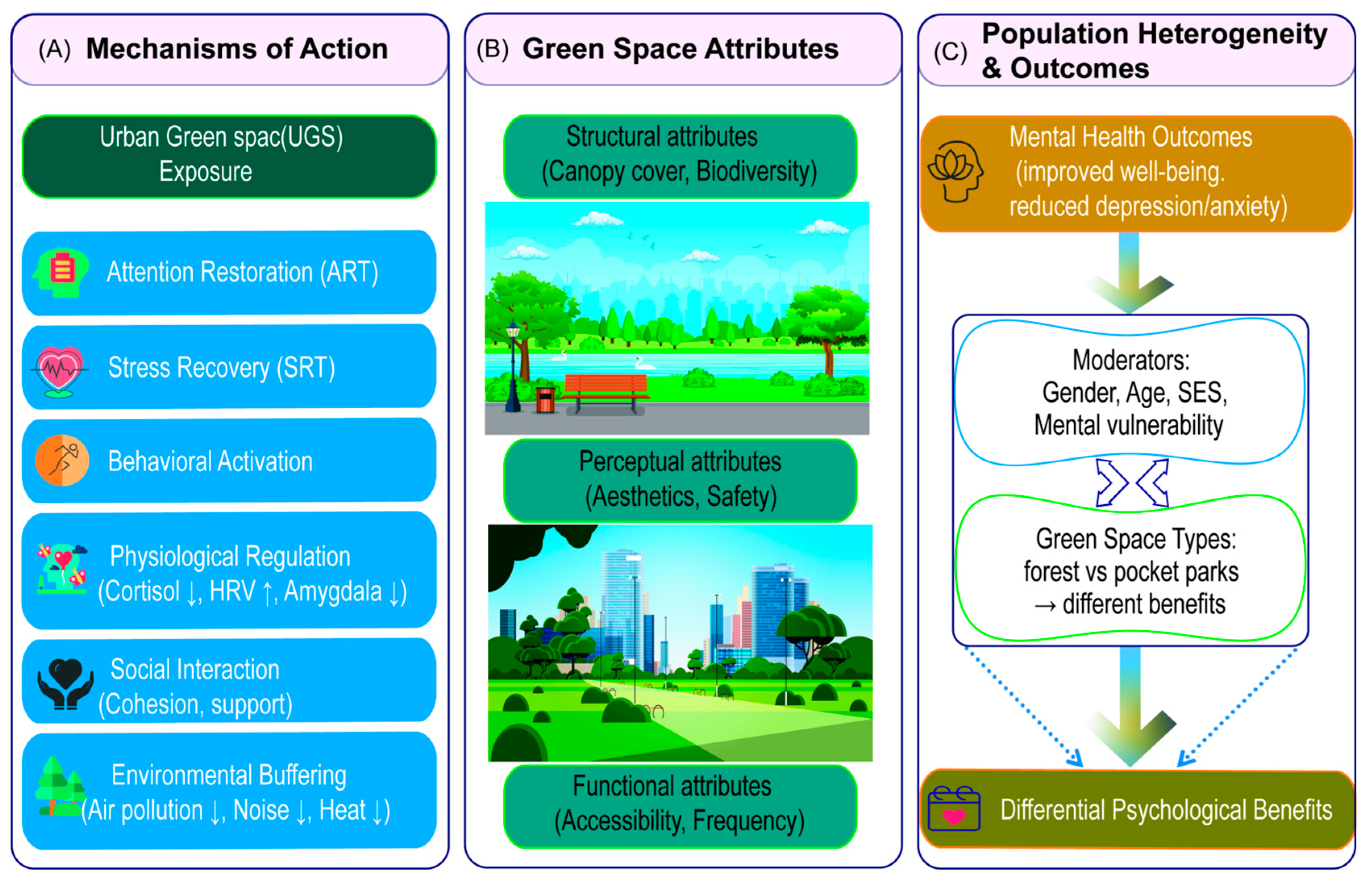
Figure 6.
Framework of methodological challenges, reflections, and paradigm shift. It summarizes a progression from challenges (e.g., NDVI-centric and spatiotemporal mismatch) through methodological reorientation (multi-scale/multimodal integration, interpretability and fairness governance) to future pathways-causal inference with explainable AI, multi-level socio-ecological modeling, standardization & open science, and transdisciplinary policy translation; arrows denote the stepwise shift.
Figure 6.
Framework of methodological challenges, reflections, and paradigm shift. It summarizes a progression from challenges (e.g., NDVI-centric and spatiotemporal mismatch) through methodological reorientation (multi-scale/multimodal integration, interpretability and fairness governance) to future pathways-causal inference with explainable AI, multi-level socio-ecological modeling, standardization & open science, and transdisciplinary policy translation; arrows denote the stepwise shift.
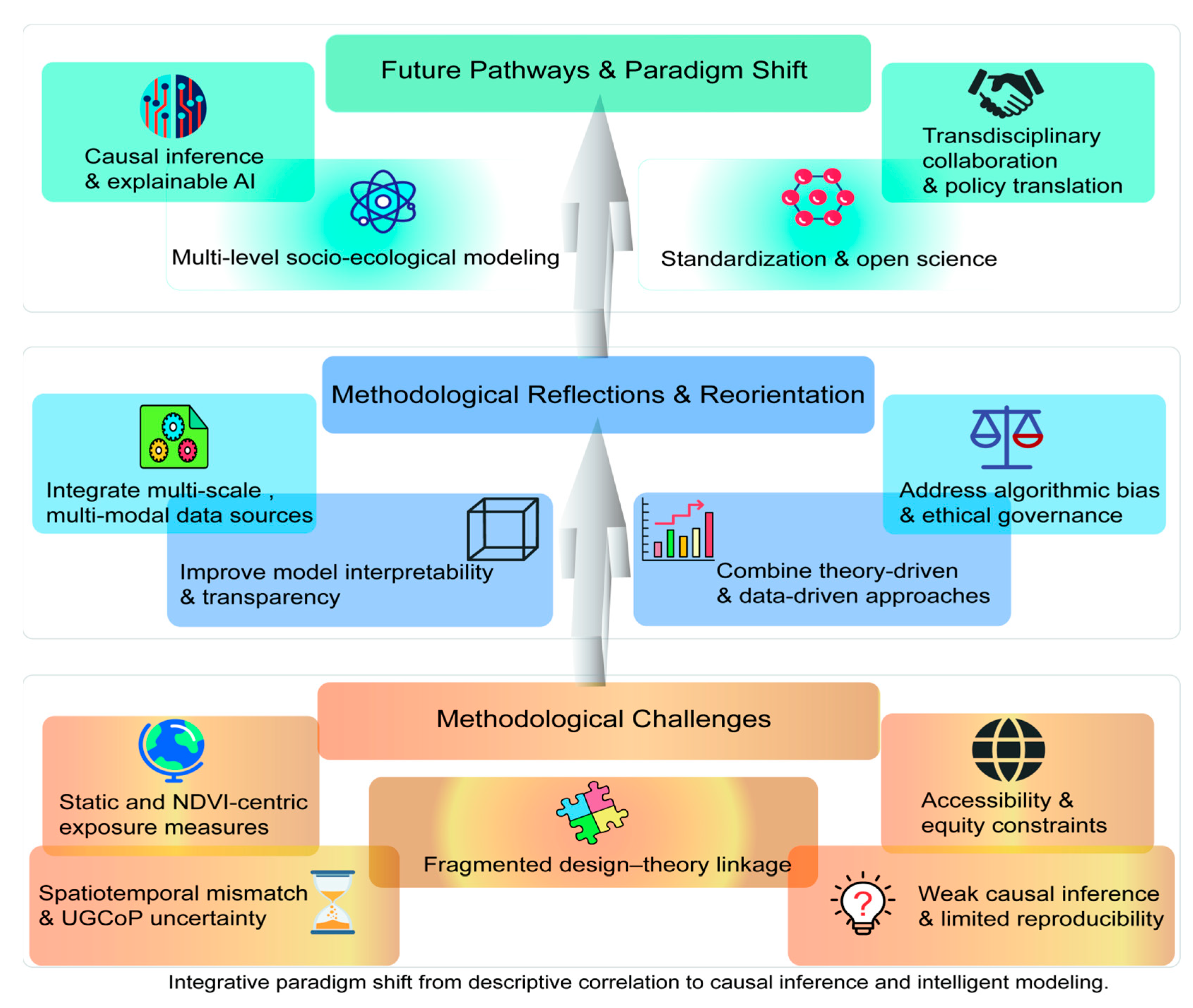
Figure 7.
Strategic pathways and integrated policy framework for green interventions in urban mental health.Governance/data and scientific foundations enable pathway-based interventions (P1-P5), informing policy and feeding back to improve societal outcomes.
Figure 7.
Strategic pathways and integrated policy framework for green interventions in urban mental health.Governance/data and scientific foundations enable pathway-based interventions (P1-P5), informing policy and feeding back to improve societal outcomes.
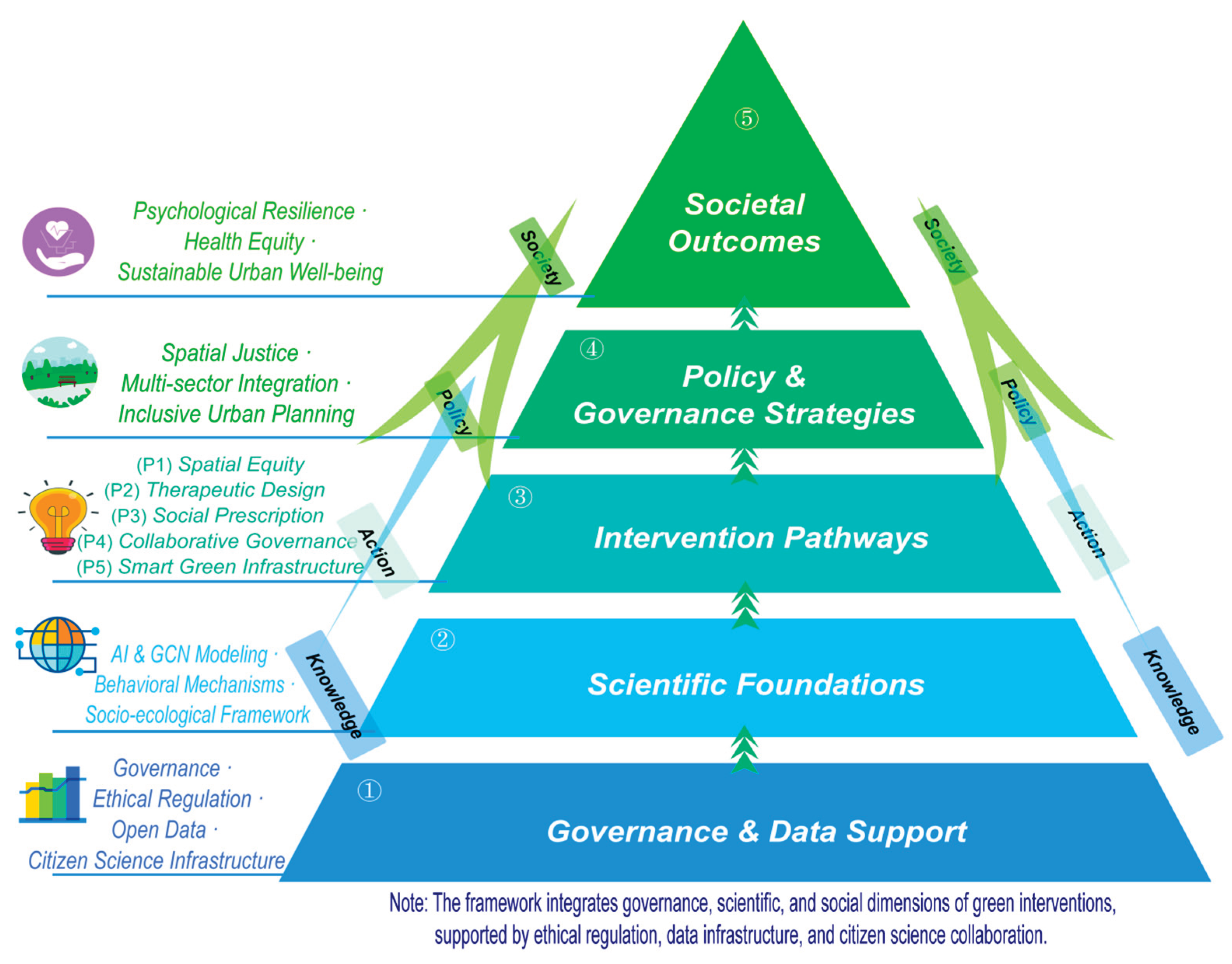
Table 3.
Selected international cases of green interventions.
| No. | Country / Region | Core Features | Target Outcomes |
|---|---|---|---|
| (P1) Spatial equity |
US · China · EU | Pocket parks; walkable green corridors; rooftop greening; high-resolution exposure assessment | Improved accessibility; reduced spatial disparities; more equitable mental health benefits |
| (P2) Therapeutic design |
Japan · Korea · EU | Diverse tree species; immersive experience; zoned healing spaces | Stress reduction; better sleep; enhanced well-being |
| (P3) Social prescription |
UK (NHS) | Healthcare referral system; link-worker model; community nature activities | Improved mental health; reduced inequalities |
| (P4) Collaborative governance | Australia · China | Non-governmental organizations-health department collaboration; community health-service integration | Stronger social support; enhanced community cohesion |
| (P5) Smart green infrastructure |
Korea | AI + IoT smart green monitoring; spatiotemporal hotspot detection; intervention prioritization | Targeted interventions; optimized policy design |
* Organized by five pathways-(P1) spatial equity, (P2) therapeutic design, (P3) social prescription, (P4) collaborative governance, and (P5) smart green infrastructure-this table presents representative countries/regions, core features, and target outcomes. Examples are illustrative rather than exhaustive; terminology and scope follow the main text.
Disclaimer/Publisher’s Note: The statements, opinions and data contained in all publications are solely those of the individual author(s) and contributor(s) and not of MDPI and/or the editor(s). MDPI and/or the editor(s) disclaim responsibility for any injury to people or property resulting from any ideas, methods, instructions or products referred to in the content. |
© 2026 by the authors. Licensee MDPI, Basel, Switzerland. This article is an open access article distributed under the terms and conditions of the Creative Commons Attribution (CC BY) license (http://creativecommons.org/licenses/by/4.0/).
Copyright: This open access article is published under a Creative Commons CC BY 4.0 license, which permit the free download, distribution, and reuse, provided that the author and preprint are cited in any reuse.


