
Submitted:
10 February 2026
Posted:
12 February 2026
You are already at the latest version
Abstract
To address inefficiencies caused by fragmented content delivery, inconsistent instructional pacing, and subjective evaluation in foundational art education, this study proposes a computer-assisted modular teaching system based on a unified training pathway. The system incorporates a digital platform structured on a browser–server (B/S) architecture, featuring modules for content scheduling, demonstration standardization, progress tracking, and evaluation automation. The five instructional stages—Imitation Reinforcement, Geometric Structure, Basic Still Life, Complex Composition, and Figure Drawing—are encoded as structured task units. A lightweight image analysis algorithm based on OpenCV extracts visual features (e.g., contour continuity, spatial alignment) from student work, generating quantitative indicators that support semi-automated evaluation and reinforce instructional decision-making. A 16-week teaching experiment involving 86 foundational-level students was conducted using this platform. Four metrics—teaching progress consistency, module achievement rate, modeling accuracy, and teaching effectiveness dispersion—were used to assess outcomes. Compared to traditional instruction, the system achieved a 24.8% reduction in progression deviation, a 14.6% increase in achievement rate, and a 43.3% reduction in inter-class variance (p < 0.05). This research demonstrates the viability of integrating computational control mechanisms and visual analysis tools into art instruction, enhancing the process stability and reproducibility of modular teaching in exam-oriented contexts.
Keywords:
art education
; modular teaching
; unified training pathway
; foundational formative skills
; teaching effectiveness validation
1. Introduction
Foundational art instruction remains a critical yet structurally unstable component in exam-oriented education systems, where variability in instructor methods and subjective pacing disrupt learning continuity and reduce the replicability of instructional outcomes. Despite curricular reforms aiming at pedagogical consistency, most implementations still rely on analog procedures and manual evaluations, which limit the precision, traceability, and scalability of instructional models. Prior studies have explored improvements in content integration, demonstration sequencing, and assessment expansion, yet few have addressed the problem from a computational perspective. Recent work by Su and Mokmin has emphasized the need for sustainable integration of AI into visual art education, highlighting the potential of intelligent systems to reduce instructional inconsistency while promoting individualized pacing[1]. Park further discusses the critical role of algorithmic systems in restructuring the learner's engagement with artistic processes, urging a shift from purely expressive paradigms to structured learning pathways[2]. From a technological implementation perspective, Tam and Hui investigated the impact of virtual exhibitions on visual arts learning, demonstrating that digitally mediated instruction can foster engagement but lacks automated formative assessment mechanisms[3]. Lopez-Chao provides compelling evidence from multi-cohort studies that guided sequencing and conceptual scaffolding significantly enhance students’ spatial reasoning and modeling accuracy[4]. Additionally, Xie et al. implemented an AI-cloud-based digital art education platform, showing that modularized instruction coupled with centralized control improves learning consistency and instructional traceability[5]. However, most of these approaches stop short of integrating digital evaluation metrics and progression logic into a unified teaching pathway. The absence of such systems impairs the ability to quantify progress, enforce module gating, or implement logic-based reinforcement strategies. Addressing this gap, the present study constructs a browser–server-based instructional system that formalizes modularized art instruction using computable progression rules and visual feature-based evaluation, offering a scalable, traceable solution for foundational art education. Recent developments in educational technology—especially in computer-assisted instruction, computer vision-based work analysis, and data-driven task progression—offer viable opportunities for transforming foundational art education from instructor-led heuristics to platform-governed, evaluation-consistent teaching models. However, foundational art training poses unique technical challenges due to the semi-structured nature of visual tasks, spatial-semantic skill requirements, and the limited interpretability of aesthetic outcomes by conventional automated systems. Unlike existing AI-assisted art teaching tools, which primarily focus on content generation, intelligent recommendation, or interactive feedback mechanisms, this study emphasizes the integration of structural instructional logic within a unified progression framework. Prior implementations often remain at the level of augmenting individual learning activities (e.g., AI-based sketch guidance or assessment feedback) without formalizing the sequence control or platform-level gatekeeping required for scalable, consistent instruction. This research distinctly differs by embedding module sequencing, progression gating, and visual evaluation indicators into a centralized platform logic. It transforms the instructional process from a set of fragmented heuristics into a data-governed, stage-coherent pedagogical model. Through this architectural shift, the system not only supports visual feature-based assessments but also ensures timing uniformity and logical progression across cohorts—capabilities largely absent in existing solutions.
2. Building a Modularized Teaching System for Art Courses Based on Unified Training Pathways
2.1. Principles of System Construction and Overall Framework Design
This study's modular teaching system organizes training around a "single path of progressive competency development." To address issues such as fragmented content, inconsistent pacing, and subjective instruction, the system is digitally deployed via a lightweight computer-assisted teaching platform. This platform integrates process management, real-time data monitoring, and automated evaluation support, forming a closed-loop system architecture that reinforces instructional consistency. The system design adheres to three principles. First, training units correspond to computationally trackable formative elements—such as structural proportion and spatial layout—which are embedded as metadata within each digital module. These become measurable inputs for system-level progress tracking. Second, a sequential gating mechanism is enforced via platform-side logic control: only students who meet module thresholds based on structured evaluation data (manually or semi-automatically assessed) can proceed to the next module. Third, standardized scoring templates are implemented through the backend interface to unify evaluation logic across instructors and minimize subjective variance. Technically, the system is built on a browser–server (B/S) architecture, with three core layers: (1) the instructional module layer, responsible for delivering unified digital content and real-time feedback mechanisms; (2) the data evaluation layer, which stores student progression data and supports scoring visualization; and (3) the visual scoring support layer, where student works are uploaded and processed via lightweight image feature extraction algorithms (based on edge detection and structural feature matching), providing auxiliary indicators such as contour integrity or proportional alignment. As shown in Figure 1, the overall framework features a five-module linear chain at the top, a unified control band that synchronizes teaching content, demonstration standards, and evaluation criteria in the middle, and a logic-based gate-and-reinforcement loop at the bottom. This loop is controlled by the digital platform, ensuring process uniformity and enabling digital decision logic for advancing or reinforcing modules. The progression logic can be formalized as:
where denotes the current module number, represents the stage quality score, is the module achievement threshold, and Iis the indicator function.
2.2. Core Module Division and Stage Objective Setting
2.2.1. Intensive Copying Module
As the initial unit in the unified training pathway, the core design objective of the Imitation Reinforcement Module is to establish students' stable perception of proportional relationships, contour direction, and basic structural responses through a highly controlled sketching training process, rather than pursuing the completeness of the final image. Within the overall system, this module is designed as a "low-degree-of-freedom, high-consistency" foundational input stage. All training revolves around standardized paradigm samples, ensuring students learn within a unified structural reference system.As illustrated in Figure 2, the imitation training process is decomposed into four sequential sub-processes: observation sequence limitation, proportional positioning, primary contour construction, and structural correction. These are unified by standardized demonstration criteria that clearly define the operational focus and key attention points for each stage.Building upon this, a phased gating mechanism evaluates learning outcomes, focusing assessment dimensions on major proportional deviations, contour continuity, and structural responsiveness. This prevents training rhythm imbalances caused by individual experience differences in early stages.By restructuring traditional experiential tracing into modular training units characterized by clear processes, unified standards, and assessable outcomes, this module provides homogeneous modeling input conditions for subsequent geometric structure modules. It plays a crucial role in establishing foundational constraints and stable input within the overall teaching pathway.
2.2.2. Geometric Structure Module
Building upon the proportional awareness and contour stability developed in the Imitation Reinforcement stage, the Geometric Structure Module aims to establish learners' internalized understanding of three-dimensional structures, spatial orientation, and perspective relationships through controlled abstract block training. It serves as a critical transitional phase within the unified training pathway.The module design centers on a hierarchical construction of "axis-volume-projection." Instructional content is uniformly restricted to fundamental forms such as cubes, cylinders, spheres, and their combinations. Standardized demonstrations clarify primary axis positioning, sectional division, and vanishing point orientation, preventing surface contours from supplanting structural comprehension.The phase objective is defined as consistent grasp of primary structural axes, volumetric relationships, and perspective shrinkage—not shadow or texture rendering. Consequently, evaluation metrics focus on structural accuracy and spatial consistency.Figure 2 illustrates the standard construction path and key constraints for geometric structure training: spatial orientation is established by the principal axis, followed by volume encapsulation and proportional verification, culminating in projection consistency checks. To implement module exit gating, a structural consistency assessment is introduced:
Where represents the deviation of the i-th individual block's primary axis, denotes the volumetric proportion error, indicates the perspective shrinkage deviation, and , , are weighting coefficients aligned with instructional objectives. Only when Cfalls below the module threshold may the subsequent still-life module proceed, ensuring structural cognition achieves homogeneous input through a unified pathway.
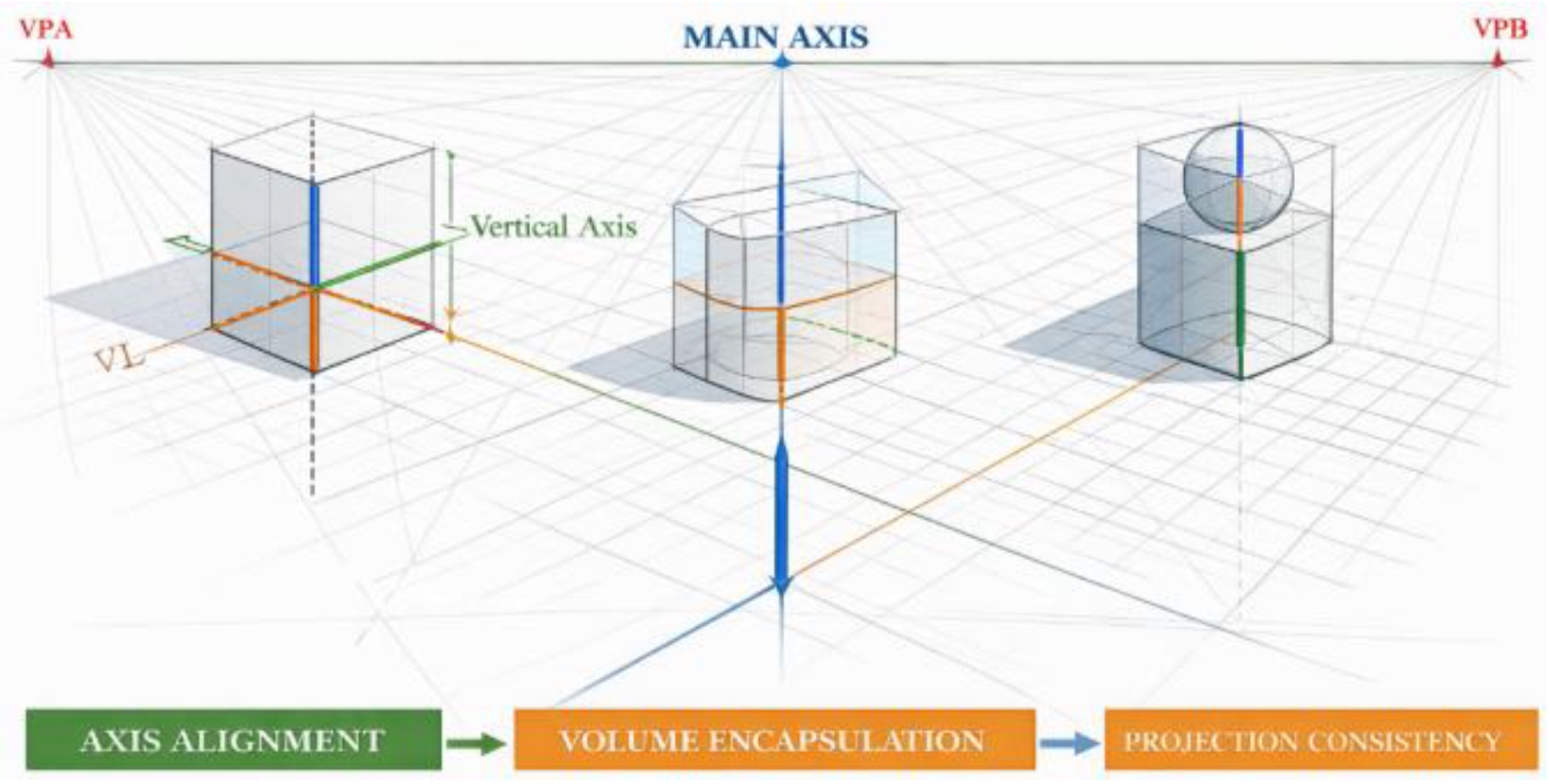
Figure 2.
Volume-Axis-Perspective Construction in the Geometric Structure Module.
2.2.3. Foundational Still Life Module
The Basic Still Life Module does not prioritize object complexity as its primary variable. Instead, it employs controlled settings for the number of still life elements, their spatial relationships, and viewpoint height to guide learners in stably mapping the axis awareness and volumetric construction methods developed in the previous stage onto real objects [6].Teaching materials uniformly select everyday objects with distinct form characteristics and decomposable structures. The demonstration process emphasizes a construction sequence of "overall structure first, local refinement later," avoiding regression to surface-level expression dominated by contour tracing. Stage objectives are defined as the ability to correctly organize objects in terms of front-back relationships, proportional alignment, and spatial positioning—rather than texture or detail completion—thus focusing evaluation metrics on structural correspondence and spatial consistency.To maintain controllability at module outputs, a still-life structural consistency assessment function is introduced:
Where denotes the deviation in proportional relationship between the jth object and the whole, represents occlusion and front-back sequence errors, indicates spatial positioning inconsistency, and , , are weighting coefficients aligned with instructional objectives. Only when Gmeets the module threshold requirement may learners advance to subsequent complex combination modules, ensuring structured modeling abilities progress continuously along a unified pathway [7].
2.2.4. Complex Combination Module
The Complex Combination Module centers on "structural hierarchy + compositional constraints": Object selection uniformly configures three scale levels—large blocks (container-like), medium blocks (fruit/vegetable-like), and small blocks (fragmentary pieces)—forcing learners to simultaneously manage primary/secondary relationships, center-of-gravity placement, and visual guidance.In placement relationships, typical challenges like overlapping, cutting into, and suspended boundaries are uniformly introduced, forcing structural inference to precede contour drawing [8]. The stage objective is defined as achieving overall proportional alignment, clear primary-secondary hierarchy, and consistent spatial depth relationships within a limited timeframe—not the completion of local textures. To ensure controlled progression at the module exit, a combination layout consistency metric is defined:
where denotes hierarchical scale allocation deviation (imbalance in large/medium/small volume proportions), represents compositional anchor point offset (deviation from center of gravity and primary visual anchor), indicates inconsistency between occlusion order and spatial depth, and , , serve as weighting coefficients.Only when H meets the module threshold requirement can the model proceed to the figure modeling module, ensuring learners possess the organizational capacity to handle high-complexity body relationships and stable input conditions.
2.2.5. Figure Modeling Module
The figure modeling module does not prioritize training in facial expressions or detailed rendering. Instead, it constructs a stable cognitive framework for figure modeling through abstract modeling of human proportions, structural axes, and primary mass relationships [9].Instruction uniformly follows the "proportional framework—structural axes—mass decomposition" sequence. Demonstrations explicitly define head-to-body ratio, shoulder-hip relationships, and torso tilt axes, avoiding contour sketching as a substitute for structural judgment. Stage objectives are defined as accurately establishing overall human proportions, major joint transitions, and center-of-gravity orientation within specified postural constraints, ensuring spatial consistency in static figures.Figure 3 illustrates the standardized structural modeling pathway within the figure modeling module: establishing overall scale through the proportional framework, connecting the torso and limbs with structural axes, and finally encapsulating and verifying volumetric relationships. This design transforms figure training from an isolated skill module into a comprehensive assessment point for structural modeling proficiency within a unified training pathway, providing a stable and controllable foundation for subsequent higher-complexity or applied training.
2.3. Unified Teaching Pathway Design: Instructional Content, Demonstration Standards, and Evaluation Criteria
The unified teaching pathway is not merely a pedagogical arrangement but is implemented as a computer-assisted process control mechanism that synchronizes instructional content delivery, demonstration standardization, and evaluation execution. By embedding these elements into a digital control framework, the modular training process is transformed into a system-governed linear progression, effectively reducing deviations caused by instructor subjectivity and asynchronous learner pacing.
At the instructional content level, each module is encapsulated as a digital task unit with predefined parameters, including task scope, structural constraints, and difficulty gradients. These task units are stored and dispatched through the platform’s content management module, ensuring identical training inputs for all learners within the same stage. The scheduling logic enforces temporal alignment across classes and records task completion status as structured data for subsequent analysis[10].
At the demonstration standard level, teaching demonstrations are no longer treated as individualized instructional behaviors. Instead, standardized demonstration processes are digitized into a reference resource library, including annotated exemplar images and stepwise structural decomposition sequences. Version control mechanisms ensure that demonstration updates propagate consistently across all instructional instances, thereby maintaining uniform operational references throughout the unified pathway.
At the evaluation scale level, stage objectives are decomposed into computationally interpretable indicators, such as proportional deviation, structural alignment, and spatial consistency. Student works are uploaded to the platform and processed through a semi-automatic evaluation pipeline, where lightweight visual feature extraction algorithms—including contour integrity detection and proportional ratio estimation—generate auxiliary quantitative descriptors. These descriptors serve as decision-support inputs for instructors, enhancing scoring consistency while preserving expert judgment.
As illustrated in Figure 4, the unified teaching pathway operates as a closed-loop control system. Digital instructional content is transformed into standardized operational references, student outputs are evaluated through structured criteria supported by algorithmic analysis, and progression decisions are executed via system-side logical gating. This mechanism replaces traditional multi-track advancement with a single-track, data-driven progression model, ensuring stable instructional pacing, traceable learning states, and reproducible teaching outcomes across modular art courses.
2.4. System Architecture and Computational Implementation of the Modular Teaching Platform
To effectively operationalize the unified modular teaching pathway, a computer-based digital platform has been developed to support end-to-end instructional control, student task management, and evaluation processing. The platform adopts a browser–server (B/S) architecture, facilitating centralized logic control and distributed client-side access across classroom terminals.
System Architecture Overview
The platform architecture consists of four core layers:
(1)Content Management Layer: This layer stores all modular instructional content, including digital drawing tasks, demonstration sequences, and annotated reference samples. Content units are classified by module stage and released according to synchronized scheduling logic.
(2)Task and Progress Control Layer: Each student account is associated with a task queue and stage marker. Upon completion of a module and system-verified evaluation, the next task unit is automatically activated. The platform tracks time-stamped operations, enabling structured logging of individual learning trajectories.
(3)Evaluation and Data Analytics Layer: Uploaded student works are processed using a lightweight visual feature extraction module. Algorithms identify contour edges, measure axis alignment, and compute proportional deviation from template standards. Quantitative metrics—such as contour integrity score, spatial ratio index, and volume alignment coefficient—are used to assist instructors in validating work quality. Evaluation outcomes are stored as structured data for performance trend analysis.
(4)Instructional Feedback and Reinforcement Layer: Based on system evaluation results, students are either promoted to the next module or rerouted into reinforcement loops. Feedback is visualized through a dashboard interface, showing historical accuracy trends and current proficiency scores.
Computational Mechanisms
Key computational components include:
(1)A proportional analysis algorithm, implemented using OpenCV, calculates alignment between user-submitted sketches and reference skeletons through pixel-wise geometric matching and vectorized overlay scoring.
(2)A module gating logic, scripted in Python, evaluates whether a student's average indicator score surpasses the predefined threshold. This gating mechanism controls task progression and dynamically adjusts reinforcement allocation.
(3)A MongoDB-based backend manages student records, evaluation logs, and learning sequences, supporting real-time querying and longitudinal tracking.
(4)The entire system is deployed via a Flask web framework, allowing scalable integration with external data visualization tools (e.g., D3.js, Plotly) for rendering student progress charts and class-wide statistical summaries.
By embedding instructional content, evaluation criteria, and progression logic within a technically robust and computationally interpretable framework, the platform realizes a digitally governed instructional cycle. It transforms traditional instructor-led advancement into a data-driven, feedback-rich, and performance-traceable learning environment for foundational art education.
3. Empirical Research Design and Instructional Effectiveness Validation
3.1. Experimental Subjects and Instructional Design
For the empirical design, this study selected 86 art majors in their foundational stage. They were divided into three natural classes based on enrollment time and specialization, creating a relatively balanced experimental sample structure.The 16-week experimental cycle fully covered the five core modules of the modular teaching system. Each module was implemented according to the "three unifications" principle—unified teaching content, unified demonstration standards, and unified evaluation criteria—by a fixed lead instructor and an auxiliary evaluation team to eliminate interference from individual teaching styles.The experimental pathway is detailed in Table 1, following a linear progression logic. All students must meet the standards of the preceding stage before advancing to the next module, establishing a progressive mechanism under a unified training pathway. Each module incorporates phased evaluation points, using quantitative metrics to assess proportional accuracy, structural rationality, and spatial organization capabilities, ensuring the controllability and rigor of the instructional intervention.Simultaneously, the instructional organization reinforced a "process-closed + outcome-open" mechanism. This entails closed and unified teaching content and evaluation standards, while allowing for variation in learning outcomes. This structure enables a teaching experiment where the process is controllable and the manifestations of effectiveness are diverse.
3.2. Development of a Quantitative Evaluation Indicator System
To achieve scientific and systematic quantitative validation of teaching outcomes within a modular art education system driven by a unified pathway, this paper constructs a multidimensional quantitative evaluation indicator system covering three logical layers: "process control—outcome evaluation—overall coordination."This system unfolds across four dimensions: synchrony of student learning progress, achievement of phased objectives, quality of specific modeling skill execution, and dispersion of teaching effectiveness across different classes. This ensures the ability to evaluate the consistency and effectiveness of teaching path execution at various scales. As shown in Table 2, teaching progress consistency reflects path advancement synchrony by calculating the standard deviation (σt) of student achievement timelines across each phase.Stage goal attainment rate is calculated as the proportion of students meeting the threshold within each module, measuring the coverage of each module in enhancing student abilities; Form accuracy is derived from a weighted average of a scoring system comprising elements like structural proportions and spatial positioning, directly reflecting the consistency between teaching content and training objectives; Teaching effectiveness dispersion examines the standard deviation of stage goal attainment rates across the three classes, evaluating whether the unified pathway effectively reduces fluctuations in teaching disparities.
3.3. Analysis of Teaching Effectiveness Outcomes
Based on the aforementioned teaching experiment and indicator system, this section compares the performance differences in teaching effectiveness between the modular teaching system driven by a unified training path and the traditional self-paced teaching model. As shown in Table 3: In terms of teaching progress consistency, the standard deviation (σ) of the time required for students in the experimental group to achieve stage-based goals decreased significantly from 3.55 weeks in the traditional model to 2.67 weeks, representing a 24.8% reduction. This indicates a clear advantage of the unified path in pacing control.The stage goal attainment rate increased from 72.3% to 82.9%, a 14.6% improvement, reflecting the modular structure's facilitation of competency development. Regarding modeling accuracy, student work scores rose from 7.12 to 8.01 (out of 10), with significant enhancement in structural and spatial handling abilities (p=0.038).More critically, the variance in teaching effectiveness across different classes (σb) decreased from 5.41 to 3.07, a reduction of 43.3%, demonstrating the system's significant optimization of teaching stability. All comparative results were validated for significance via two-tailed t-tests, with p-values consistently below 0.05. This supports the substantial improvement in teaching quality and consistency achieved by the modular unified teaching system, providing statistical backing for its future implementation.
4. Conclusion
This study demonstrates that the integration of a unified modular teaching pathway with a computer-assisted control system significantly improves the process reliability and instructional effectiveness of foundational art education. By embedding instructional content, demonstration standards, and evaluation metrics into a digitally orchestrated platform, the teaching process becomes traceable, consistent, and structurally controllable.The deployment of visual feature extraction algorithms—used to quantify proportional integrity and spatial accuracy in student works—and the implementation of platform-level progression gating mechanisms establish a technical foundation for automated evaluation and instructional logic enforcement. These computational components transform the modular system from a pedagogical blueprint into an operationalized, data-driven instructional framework.Experimental results confirm that this system not only enhances outcome stability but also reduces subjective deviation and inter-class disparities. More importantly, it validates the role of computer technologies in formalizing and verifying instructional pathways, offering replicable, scalable solutions for exam-oriented educational environments.Limitations remain in terms of system generalizability across diverse institutional contexts, the precision of visual recognition algorithms for creative tasks, and the integration of high-dimensional learning analytics. Future research will focus on expanding the computational modules, incorporating deep-learning-based assessment models, and embedding adaptive feedback systems based on student modeling. These enhancements will further strengthen the system’s capacity to support individualized learning while maintaining global pathway constraints, bridging art pedagogy and intelligent computing in a more systematic way.
References
- Su, H; Mokmin, N A M. Unveiling the canvas: Sustainable integration of AI in visual art education[J]. Sustainability 2024, 16(17), 7849. [Google Scholar] [CrossRef]
- Park, Y S. Creative and critical entanglements with AI in art education[J]. Studies in Art Education 2023, 64(4), 406–425. [Google Scholar] [CrossRef]
- Tam, C O; Hui, C K Y. Teaching visual arts using virtual exhibitions: An investigation of student usage and impact on learning[J]. Studies in Art Education 2024, 65(3), 371–387. [Google Scholar] [CrossRef]
- Lopez-Chao, V. Patterns in perceptions of learning to draw with guidance and conceptual scaffolding: Insights from a multi-cohort self-reported study[J]. Thinking Skills and Creativity 2026, 60, 102053. [Google Scholar] [CrossRef]
- Xie, J; Xie, K; Lin, Z. Design and Implementation of a Digital Art Education Platform Based on AI and Cloud Technologies[C]. In /Proceedings of the 2nd Guangdong-Hong Kong-Macao Greater Bay Area Education Digitalization and Computer Science International Conference, 2025; pp. 671–676. [Google Scholar]
- Hu, L. Topic Classification of Small Sample News Based on Prompt Engineering. Applied and Computational Engineering 2025, 170, 101–107. [Google Scholar] [CrossRef]
- Maras, K; Shand, B. Critical and Creative Thinking as a Form of Making in Art Education[J]. Studies in Art Education 2023, 64(1), 23–39. [Google Scholar] [CrossRef]
- Blanco-García, Y; Serrano, R M; Casanova, O. Toward a transversal education model: a review of digital and artistic-musical competencies (2014–2024)[J]. Arts Education Policy Review 2025, 1–15. [Google Scholar] [CrossRef]
- Ferreira-Santos, J; Pombo, L. The Art Nouveau Path: Promoting Sustainability Competences Through a Mobile Augmented Reality Game[J]. Multimodal Technologies and Interaction 2025, 9(8), 77. [Google Scholar] [CrossRef]
- Mohd Bakhir, N; Zhou, S B; Chen, S; et al. Transforming Arts Education in Digital Environments: Quasi-Experimental Study of the Impact of Game-Based Learning on Art Knowledge and Interest[J]. Journal of Educational Computing Research 2025, 63(2), 464–495. [Google Scholar] [CrossRef]
Figure 1.
Overall Framework of the Modularized Teaching System for Art Courses.
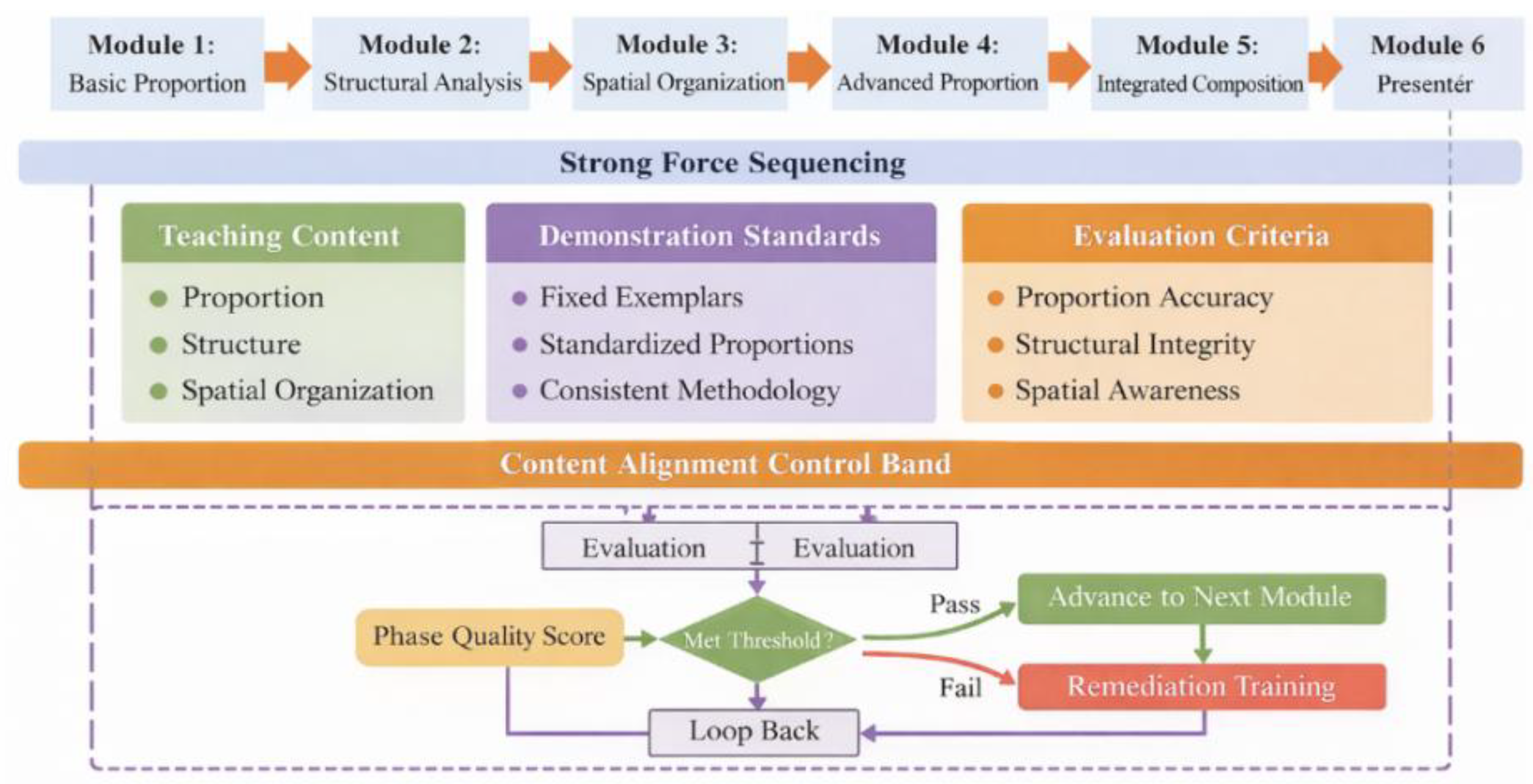
Figure 2.
Sketching Training Process and Stage Control Structure of the Imitation Reinforcement Module.
Figure 2.
Sketching Training Process and Stage Control Structure of the Imitation Reinforcement Module.
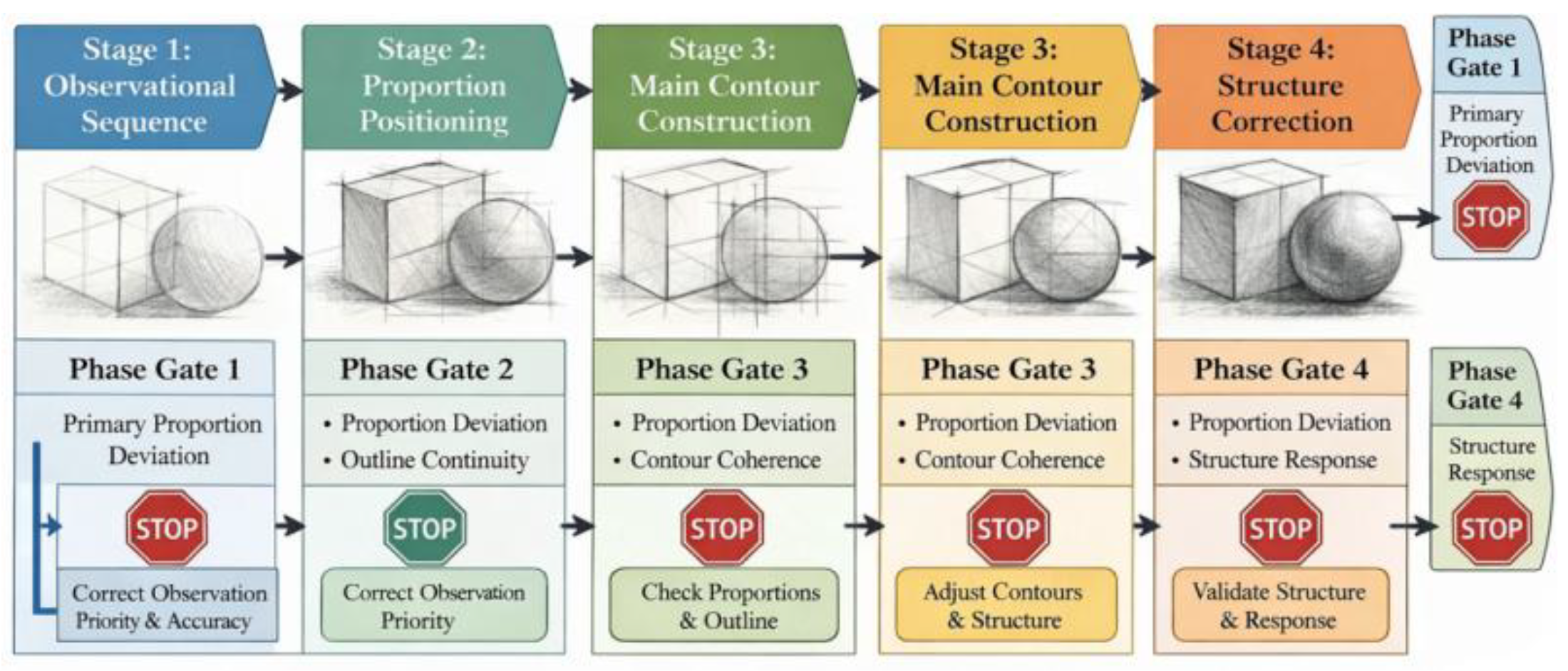
Figure 3.
Human Proportion–Structural Axis–Volume Modeling in the Figure Modeling Module.
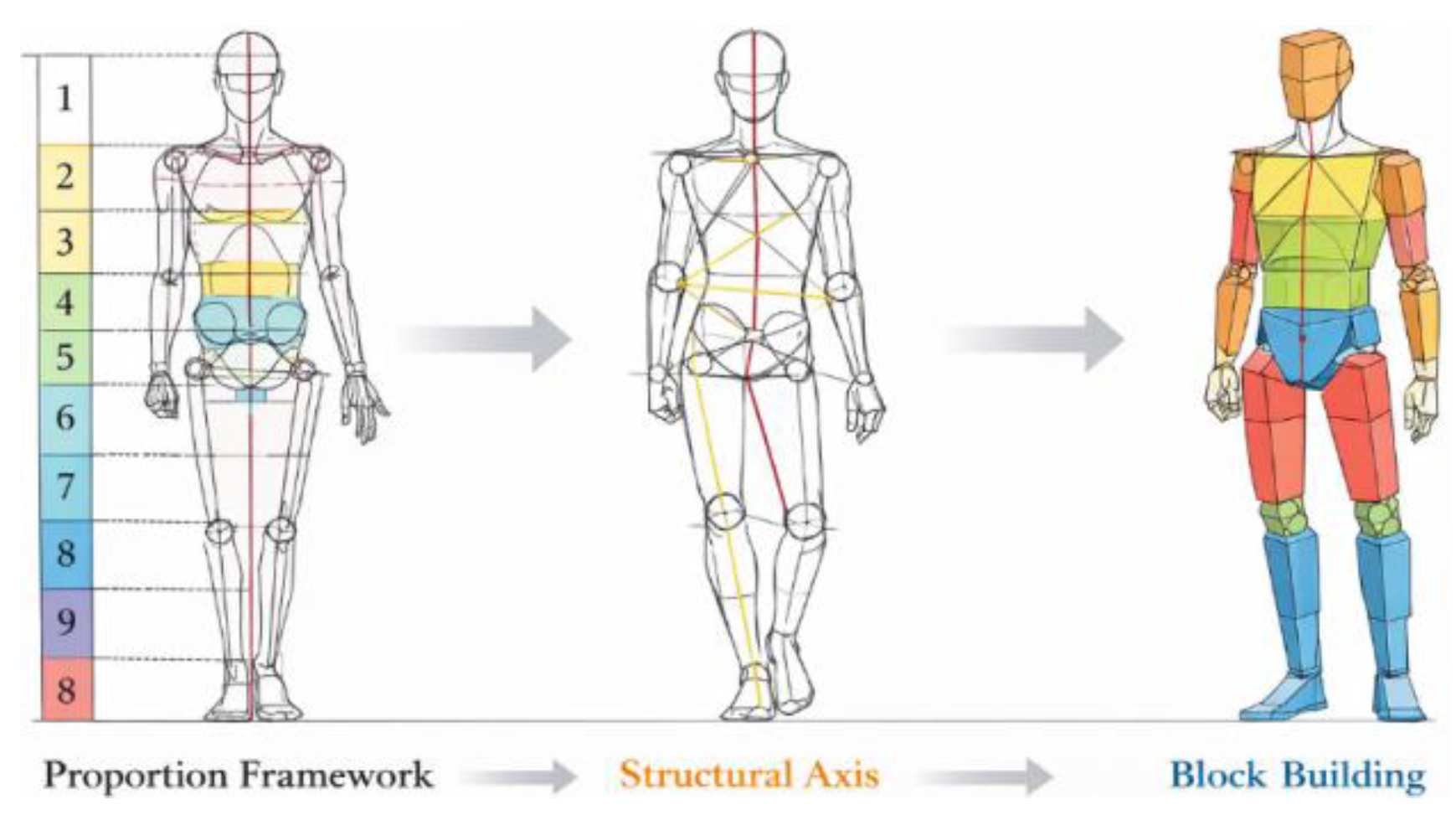
Figure 4.
Closed-loop operation of instructional content–demonstration standards–evaluation scale under the unified teaching pathway.
Figure 4.
Closed-loop operation of instructional content–demonstration standards–evaluation scale under the unified teaching pathway.
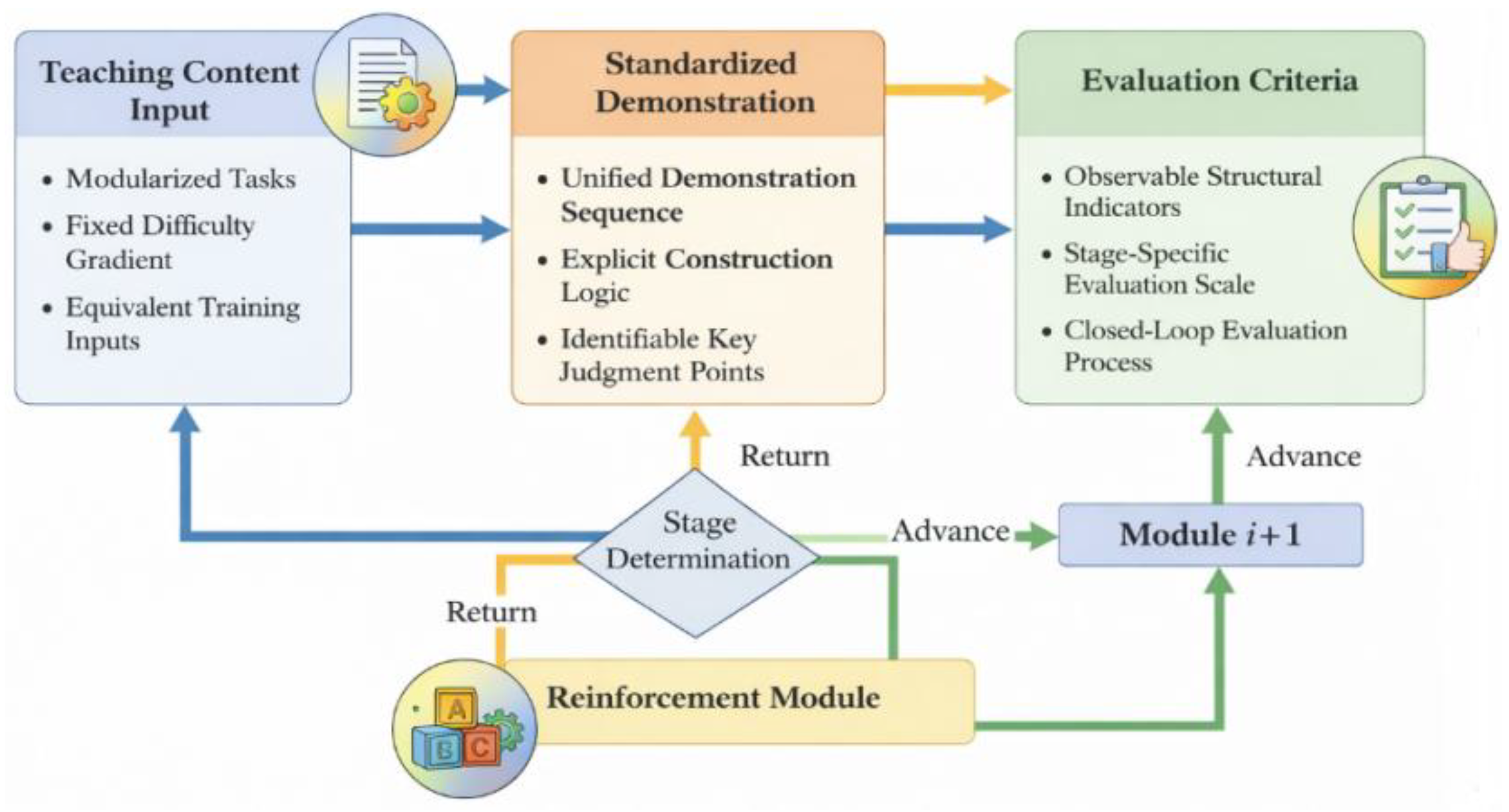

Table 1.
Modular Teaching Pathway Arrangement Within the Teaching Experiment Cycle.
| Teaching Phase | Module Name | Implementation Week | Teaching Content Control | Periodic Assessment Methods |
| Phase One | Intensive Copying Module | Weeks 1–3 | Homogeneous Paradigms/Proportional Line Drawing | Proportional Deviation, Structural Response Scoring |
| Phase Two | Geometric Structure Module | Weeks 4–6 | Volumetric Abstraction/Three-View Construction | Spindle Consistency, Perspective Error |
| Phase Three | Basic Still Life Module | Weeks 7–9 | Object Arrangement/Spatial Relationships | Occlusion Relationships, Accurate Spatial Placement |
| Stage Four | Complex Arrangement Module | Weeks 10–12 | Multi-scale still life + compositional guidance | Combination Proportions + Hierarchy of Emphasis Scoring |
| Phase Five | Figure Drawing Module | Weeks 13–16 | Human Skeletal Framework/Structural Axis Construction | Accurate Proportions and Center of Gravity Assessment |
Table 2.
Quantitative Evaluation Indicator System for Teaching Effectiveness.
| Indicator Name | Indicator Meaning | Calculation Method/Data Collection Method | Evaluation Dimension Type |
| Teaching Progress Consistency | Variation in pace among students within a class regarding module proficiency assessment | Calculate the standard deviation (σt) of achievement timelines across stages | Process-Based |
| Stage Target Achievement Rate | Percentage of students meeting standards in each module | Number of students meeting module standards / Total number of students × 100% | Result-based |
| Shape Accuracy | Average score across dimensions such as structural proportions and spatial placement | Teacher scoring sheet (out of 10 points: Structure 5 + Proportion 3 + Space 2) weighted statistics | Outcome Category |
| Teaching Effectiveness Dispersion | Dispersion of average effectiveness across different classes | Standard deviation of each class's target achievement rate relative to the overall mean | Overall Category |
Table 3.
Comparison Results Between Modular Unified Teaching System and Traditional Teaching Methods Across Four Metrics.
Table 3.
Comparison Results Between Modular Unified Teaching System and Traditional Teaching Methods Across Four Metrics.
| Indicator Name | Traditional Teaching Approach | Modular Unified Teaching | Relative Change | Significance (p-value) |
| Teaching Progress Consistency (σt) | 3.55 (weeks) | 2.67 (weeks) | ↓24.8% | 0.016 |
| Stage Objective Achievement Rate (%) | 72.3 | 82.9 | ↑14.6% | 0.021 |
| Shape Accuracy (Average Score/10) | 7.12 | 8.01 | ↑12.5% | 0.038 |
| Teaching Dispersion (σb) | 5.41 | 3.07 | ↓43.3% | 0.008 |
Disclaimer/Publisher’s Note: The statements, opinions and data contained in all publications are solely those of the individual author(s) and contributor(s) and not of MDPI and/or the editor(s). MDPI and/or the editor(s) disclaim responsibility for any injury to people or property resulting from any ideas, methods, instructions or products referred to in the content. |
© 2026 by the authors. Licensee MDPI, Basel, Switzerland. This article is an open access article distributed under the terms and conditions of the Creative Commons Attribution (CC BY) license (http://creativecommons.org/licenses/by/4.0/).
Copyright: This open access article is published under a Creative Commons CC BY 4.0 license, which permit the free download, distribution, and reuse, provided that the author and preprint are cited in any reuse.


