

Submitted:
11 February 2026
Posted:
12 February 2026
You are already at the latest version
Abstract
The origin of the arrow of time remains one of the most persistent conceptual problems in physics. While microscopic laws are largely reversible, the macroscopic universe exhibits unmistakable temporal directionality. This paper proposes that the arrow of time can be understood as the cumulative consequence of irreversible structural commitments that progressively reshape the accessible configuration space of the universe.Building on recent non-Markovian extensions of cosmology in which memory kernels link the present expansion to a weighted history of nonlinear structure, the paper elevates these results into a broader physical principle. Across simulations, observations, and phenomenological reconstructions, structure formation consistently generates retarded responses that act as an effective drag on cosmic expansion. The paper argues that such memory effects are not merely technical features of coarse-grained dynamics but are surface manifestations of a deeper constraint-forming process.This synthesis paper introduces the concept of \textit{structural commitment} as an irreversible transition that permanently restricts future dynamical possibilities. Within this framework, temporal direction emerges naturally from the accumulation of constraints rather than from entropy growth alone. Entropy describes evolution within an accessible state space; structural commitment governs how that space itself contracts over cosmic history.A minimal formal description is presented in which cosmological evolution proceeds on a progressively constrained manifold. The study shows how multiscale memory kernels provide empirical evidence for this process, forming a hierarchy that runs from fast, viscosity-like relaxation on nonlinear scales to slow horizon-level responses. Several observational and theoretical predictions follow, including increasing history sensitivity at late times and the generic emergence of long effective memory horizons from kernel mixtures.Rather than introducing new microphysics, this work synthesizes existing non-Markovian results into a unifying interpretation: the arrow of time is the macroscopic record of constraints the universe can no longer reverse.
Keywords:
arrow of time
; non-Markovian cosmology
; cosmological backreaction
; irreversibility
; large-scale structure
; gravitational dynamics
; memory effects
1. Introduction
The directional character of time is among the most familiar features of physical reality, yet its origin remains unsettled. Fundamental equations governing gravitation, field dynamics, and particle interactions are largely symmetric under time reversal, while the observed universe evolves irreversibly from a hot, nearly homogeneous state into a richly structured cosmos [1,2].
Traditional explanations appeal to entropy growth. Within statistical mechanics, the second law provides a probabilistic account of macroscopic irreversibility. However, entropy alone does not fully explain why the universe develops increasingly stable structures whose formation permanently alters future evolution. Discussions of gravitational entropy and the extraordinarily low-entropy character of the early universe have further emphasized that temporal asymmetry may be rooted in cosmological initial conditions rather than purely statistical arguments [3].
Recent developments in non-Markovian cosmology suggest a complementary perspective [4,5]. When nonlinear structure is coarse-grained, the effective expansion rate can depend on a weighted history of prior states rather than solely on instantaneous conditions [6]. Such formulations introduce causal memory kernels that encode how past structural activity feeds back on the present dynamics.
This paper argues that these memory effects point toward a deeper organizing principle. THe paper proposes that cosmic evolution proceeds through a sequence of irreversible structural commitments — physical transitions that permanently reshape the space of accessible futures. From this viewpoint, the arrow of time is not imposed externally nor derived solely from probabilistic reasoning; it emerges from the progressive accumulation of constraints generated by structure formation itself.
The goal is not to replace thermodynamic accounts but to extend them. Entropy tracks the dispersal of states within a configuration space. Structural commitment governs how that configuration space changes.
2. Structural Commitment
2.1. Definition
This paper defines a structural commitment as an irreversible physical transition that permanently reduces or reshapes the accessible configuration space of a dynamical system.
Examples appear throughout cosmic history:
- Symmetry breaking events that select specific vacuum states.
- Recombination, which enables stable atoms.
- Gravitational collapse leading to virialised structures.
- The formation of long-lived astrophysical systems.
Each transition closes off regions of phase space that were once dynamically reachable.
Importantly, structural commitment does not imply decreasing complexity. On the contrary, many forms of complexity require prior constraint. Stable chemistry depends on fixed constants; galaxies require dissipative collapse; long-lived structures emerge only after dynamical freedom narrows into persistent channels.
2.2. Commitment Versus Entropy
Entropy and structural commitment operate at distinct logical levels.
Entropy measures the distribution of microstates within an accessible region of phase space. Structural commitment determines the geometry of that region itself.
An evolving universe therefore exhibits two simultaneous processes:
- 1.
- Diffusion within the currently accessible state space.
- 2.
- Progressive restriction of that state space through irreversible transitions.
The second process provides a natural mechanism for temporal direction.
3. Memory as the Surface of Constraint
Non-Markovian cosmological closures derived in recent work demonstrate that coarse-grained expansion dynamics can depend on a weighted history of prior structural states [4,5,6]. In their minimal form, deviations in the effective expansion rate may be written as a retarded convolution,
where is a structural source and K is a causal kernel.
Such kernels should not be interpreted as evidence for exotic microphysics. Rather, they arise naturally when unresolved degrees of freedom are integrated out. The kernel represents the operational trace of past structural activity on present dynamics. Recent simulation-derived kernels and scale-dependent analyses provide empirical support for this interpretation, revealing hierarchical relaxation timescales that accumulate into long-horizon responses.
The study proposes the following interpretation:
The memory kernel is the mathematical shadow of accumulated structural commitments.
If irreversible transitions reshape future possibilities, the dynamical equations must implicitly retain information about those transitions. Memory is therefore not an added feature of the universe but a reflection of constraint formation.
4. Hierarchy of Structural Commitment
Empirical studies increasingly indicate that cosmological memory is scale dependent. Fast relaxation processes appear on nonlinear scales, while slower responses emerge when many such processes are aggregated.
This naturally suggests a hierarchy:
- Local commitments associated with virialisation and bulk flows.
- Intermediate commitments tied to large-scale structure.
- Global commitments encoded in the background expansion.
Short-timescale relaxation events may accumulate into broad effective kernels when viewed from the perspective of the smoothed background. Temporal direction thus emerges not from a single process but from the integration of many irreversible transitions across scales.
5. A Minimal Formal Framework
Let denote the primordial configuration space accessible to the early universe. Define a cumulative constraint operator representing the net effect of irreversible transitions up to time t. Here is understood abstractly as a constraint-generating functional that removes dynamically accessible regions from , without specifying a particular microscopic realization.
An effective configuration space can therefore be defined as:
on which subsequent evolution occurs.
Equivalently, dynamics unfold on a progressively constrained manifold embedded within the original state space.
This description remains deliberately minimal. It does not specify the microscopic origin of each constraint but captures the geometric consequence: the future is explored within a narrowing corridor of possibilities.
Within this framework, temporal direction emerges from the monotonic growth of , which serves as a minimal geometric condition for temporal asymmetry.
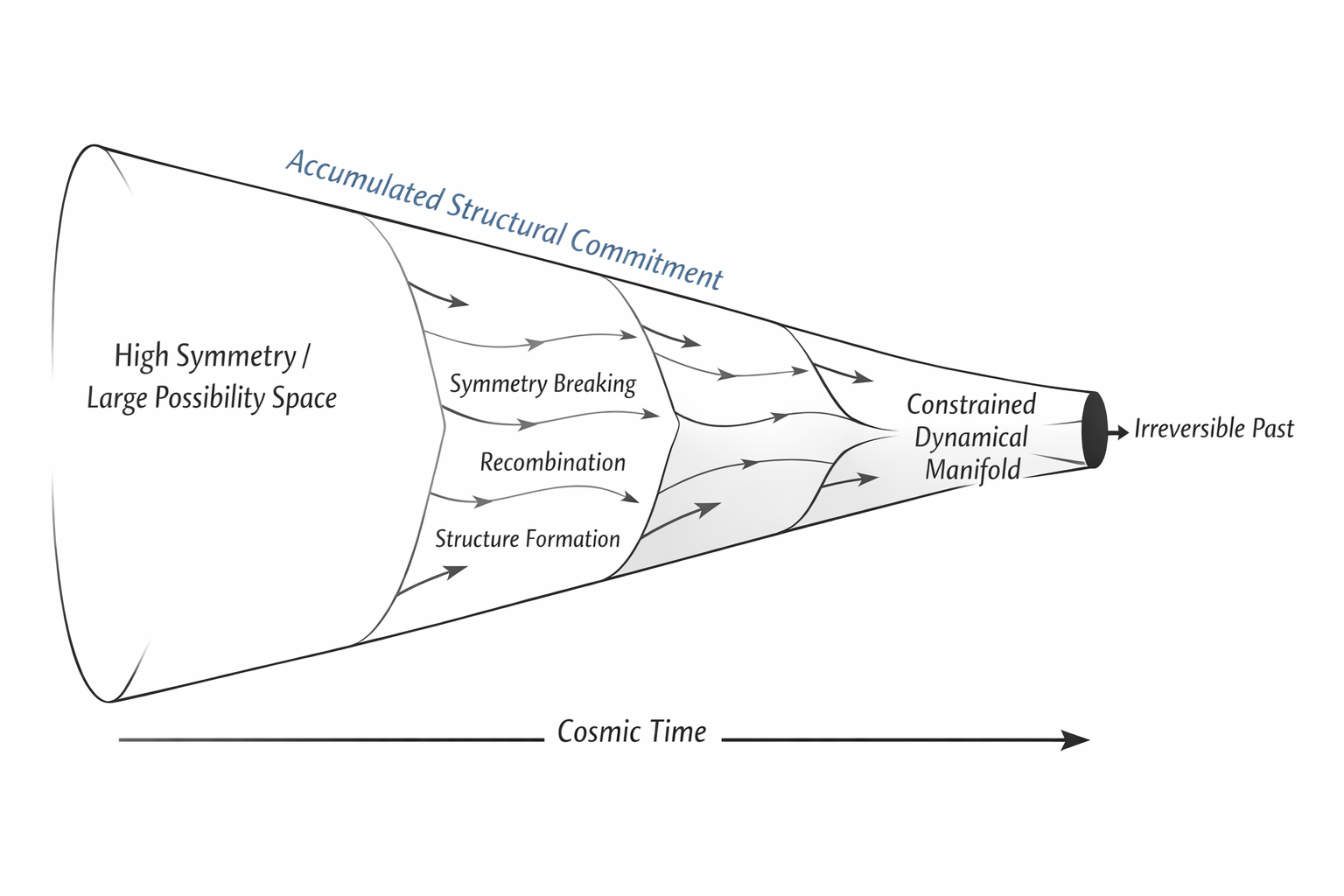
Figure 1.
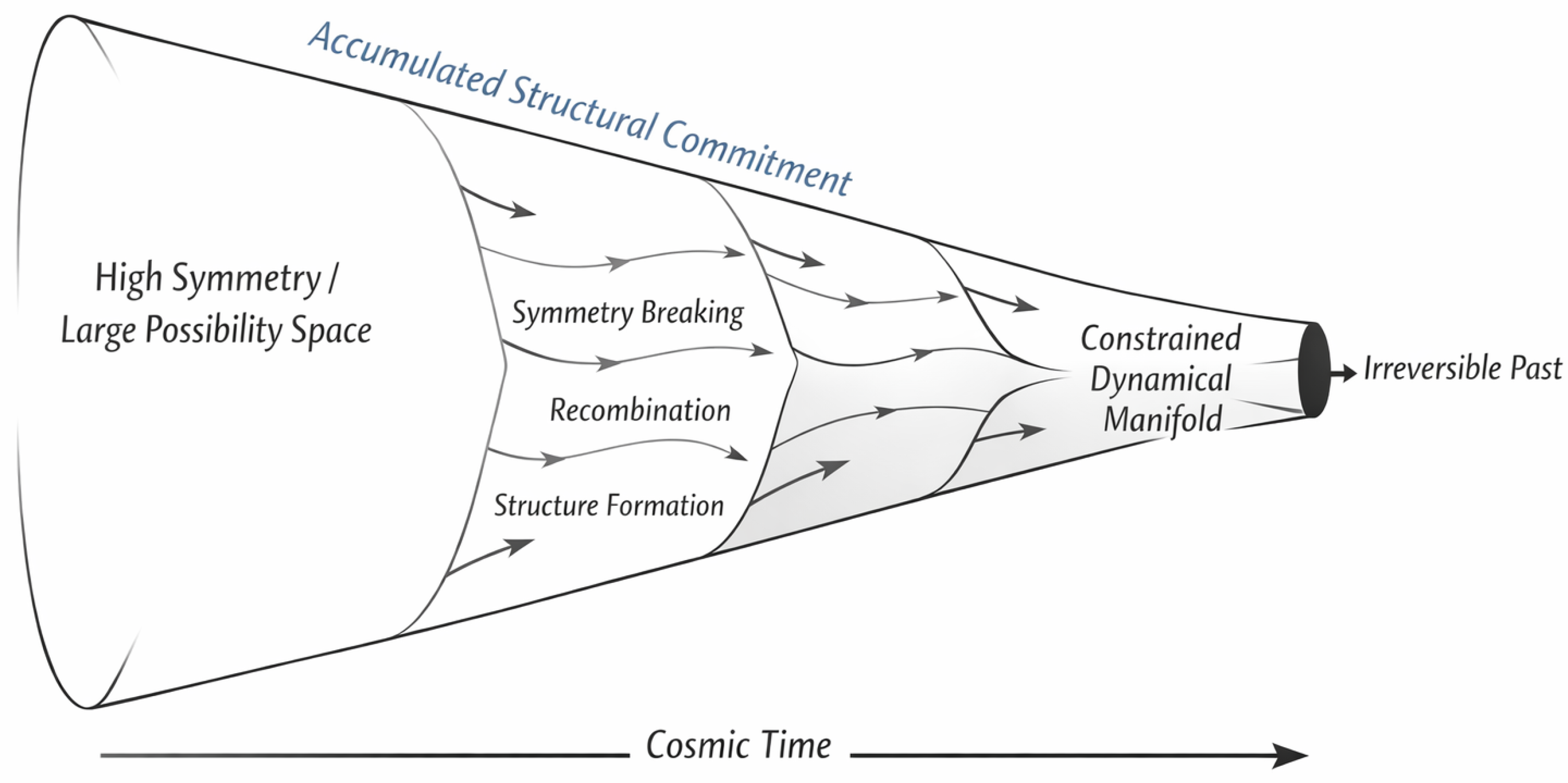
Schematic illustration of cosmic evolution as accumulated structural commitment. Early high-symmetry states correspond to a large accessible configuration space. Irreversible physical transitions progressively constrain this space, guiding evolution along a narrowing manifold. The arrow of time emerges as the macroscopic record of constraints the universe can no longer reverse.
Figure 1.
Schematic illustration of cosmic evolution as accumulated structural commitment. Early high-symmetry states correspond to a large accessible configuration space. Irreversible physical transitions progressively constrain this space, guiding evolution along a narrowing manifold. The arrow of time emerges as the macroscopic record of constraints the universe can no longer reverse.
6. The Arrow of Time Revisited
From this perspective, the arrow of time can be reinterpreted as the macroscopic record of constraints the universe can no longer reverse. This geometric perspective complements earlier arguments that associate temporal direction with gravitational entropy growth [3], while shifting emphasis toward constraint formation in configuration space.
Several features follow immediately:
- Irreversibility possesses a structural dimension beyond its statistical description.
- History becomes dynamically active through constraint geometry.
- Temporal asymmetry strengthens as structure accumulates.
This view complements thermodynamic reasoning while extending it beyond probabilistic arguments.
7. Predictions and Testable Consequences
Although primarily conceptual, the structural commitment framework leads to concrete expectations.
7.1. Increasing History Sensitivity
As constraints accumulate, effective dynamics should exhibit stronger non-Markovian signatures at late times. Memory amplitudes may therefore correlate with the maturity of structure formation.
7.2. Emergent Long Memory Horizons
Mixtures of many short relaxation processes should generically produce long effective memory scales when coarse-grained. Apparent horizon-scale responses need not reflect single physical clocks but integrated histories.
7.3. Constraint-Driven Stability
Regions with stronger structural locking — such as dense gravitational environments — should display more pronounced retarded responses than dynamically young regions.
Importantly, structural commitment is not merely a semantic reinterpretation of entropy growth. It implies that effective cosmological dynamics should become progressively less Markovian as irreversible structure accumulates, a prediction that can be tested through kernel reconstructions and late-time expansion analyses.
8. Implications for Cosmology
If cosmic evolution is fundamentally constraint-forming, several interpretive shifts follow.
First, the early universe may be better characterized as dynamically degenerate at the level of symmetry, while constrained in macroscopic entropy. High symmetry corresponds to large degeneracy of microphysical configurations, even if the macroscopic gravitational entropy was exceptionally low.
Second, complexity becomes a consequence of prior restriction rather than its opposite.
Third, cosmological prediction may require accounting not only for governing equations but also for the accumulated constraint landscape on which those equations act.
9. Gravity as a Generator of Commitment
Gravitational collapse provides a natural engine for irreversible structure formation. The connection between gravitational dynamics and entropy growth has long been emphasized in cosmological discussions of temporal asymmetry [3]. Dissipative processes transform kinetic freedom into bound configurations, while virialised systems act as long-lived attractors in phase space.
If nonlinear gravity continuously converts accessible motion into stable structure, it functions as a generator of commitment. Temporal direction would then arise as a natural consequence of structure formation rather than as an external boundary condition.
10. Scope and Outlook
This paper advances a synthesis rather than a new microphysical model. The aim is to provide a unifying interpretation that links memory, irreversibility, and cosmic structure within a single conceptual framework.
Future work may proceed along several directions:
- Embedding constraint operators within relativistic averaging schemes.
- Extending multiscale kernel measurements across simulations and surveys.
- Exploring connections between constraint formation and information-theoretic descriptions of gravity.
If confirmed, the structural commitment perspective suggests that the arrow of time is not a secondary feature of cosmology but one of its most fundamental outputs.
11. Conclusion
The universe does not merely evolve; it commits through irreversible structure formation. Each irreversible transition reshapes the landscape of what can happen next. Memory kernels, viscous backreaction, and scale-dependent relaxation processes all point toward the same underlying reality: history becomes physically binding.
The arrow of time may therefore be understood not simply as a tendency toward disorder, but as the cumulative imprint of doors the universe has permanently closed.
References
- Boltzmann, L. Further Studies on the Thermal Equilibrium of Gas Molecules. Wiener Berichte 1872. Foundational work underlying statistical interpretations of entropy.
- Buchert, T. On Average Properties of Inhomogeneous Fluids in General Relativity. General Relativity and Gravitation 2000, 32, 105–125.
- Penrose, R. The Emperor’s New Mind; Oxford University Press, 1989. Discussion of gravitational entropy and the arrow of time.
- Atalebe, S. Infinite Memory Horizons and Late-Time Cosmology. Preprint 2025. Constrains long-horizon kernels using H(z) and growth data.
- Atalebe, S. Scale Dependent Memory in Cosmological Backreactions: From Local Viscosity to Global Information Drag. zenodo 2026.
- Atalebe, S. Virialisation as Viscosity: Deriving the ITP Cosmological Memory Kernel from TNG300. Preprint 2026.
Disclaimer/Publisher’s Note: The statements, opinions and data contained in all publications are solely those of the individual author(s) and contributor(s) and not of MDPI and/or the editor(s). MDPI and/or the editor(s) disclaim responsibility for any injury to people or property resulting from any ideas, methods, instructions or products referred to in the content. |
© 2026 by the authors. Licensee MDPI, Basel, Switzerland. This article is an open access article distributed under the terms and conditions of the Creative Commons Attribution (CC BY) license (http://creativecommons.org/licenses/by/4.0/).
Copyright: This open access article is published under a Creative Commons CC BY 4.0 license, which permit the free download, distribution, and reuse, provided that the author and preprint are cited in any reuse.


