
Submitted:
10 February 2026
Posted:
11 February 2026
You are already at the latest version
Abstract
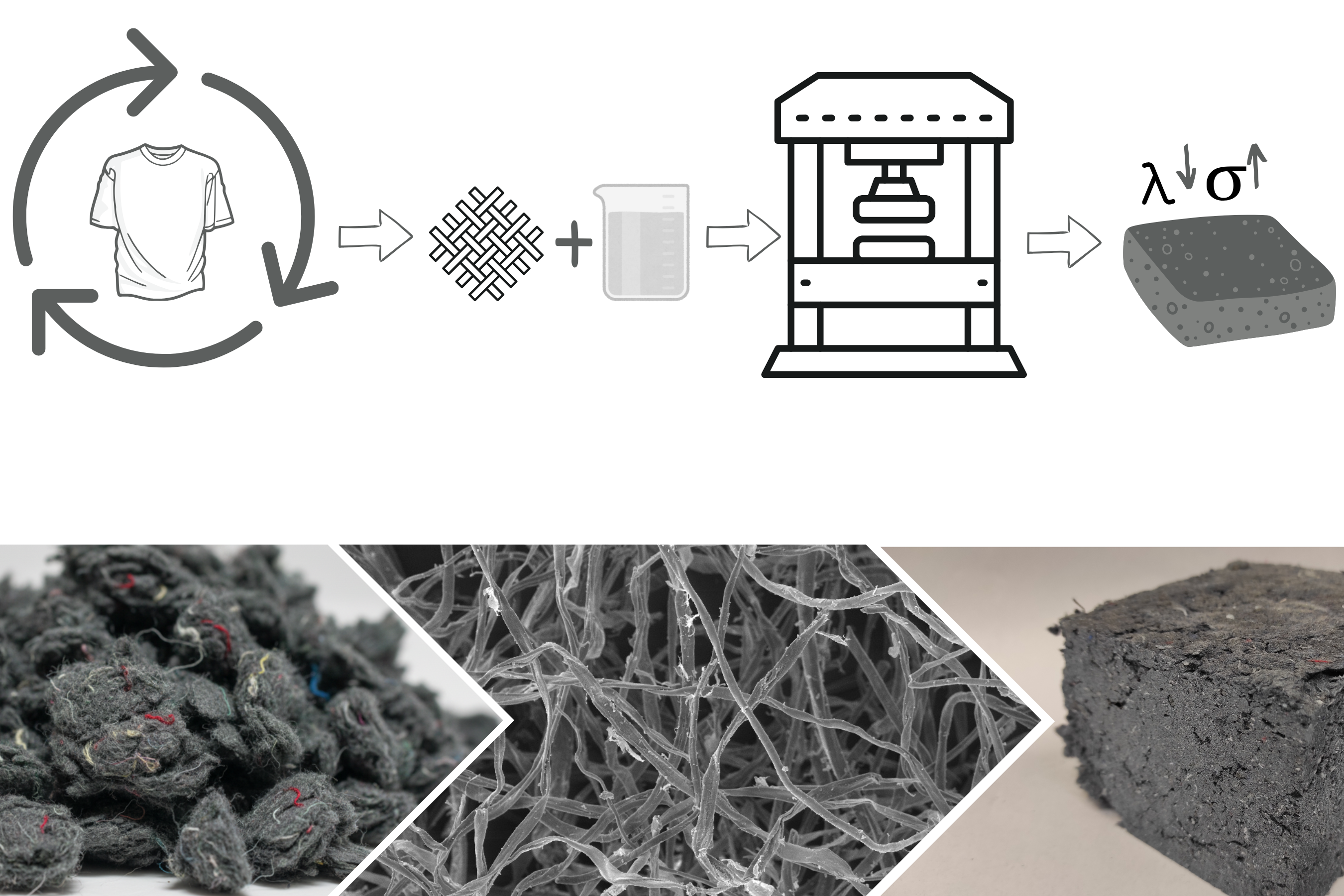
This study investigates the valorization of post-consumer and post-industrial recycled cotton fibers from textile waste into porous fiber-based insulation composites using a lowenergy cold-pressing process and a water-borne hybrid binder based on polyvinyl acetate (PVAc) and modified cornstarch. Insulation boards were produced with target densities ranging from 300 to 340 kg·m⁻³, achieved by systematically adjusting the percentage weight fractions of recycled cotton fibers and binder components. The influence of board density on microstructure, inter-fiber bonding, and structure-property relationships was evaluated. The resulting boards exhibited thermal conductivity values between 0.0710 and 0.0739 W·m⁻¹·K⁻¹. Compressive strength measured at 10% relative deformation of the specimen thickness ranged from 46 to 162 kPa, while internal bond strength varied between 2 and 6 kPa. Water absorption decreased by approximately 18% with increasing density, indicating improved binder distribution and reduced open porosity. The PVAc–starch binder system enabled effective inter-fiber bonding without formaldehyde-based resins or energy-intensive curing, supporting a low-energy and circular processing concept for textile waste valorization. Overall, the results demonstrate that recycled cotton fibers represent a viable feedstock for porous insulation composites combining balanced thermal, mechanical, and moisture-related performance with reduced environmental impact.
Keywords:
fiber-based composites
; recycled cotton fibers
; cold pressing
; water-borne binder
; thermal parameters
; moisture-related behavior
; mechanical properties
Copyright: This open access article is published under a Creative Commons CC BY 4.0 license, which permit the free download, distribution, and reuse, provided that the author and preprint are cited in any reuse.


