

Submitted:
08 February 2026
Posted:
10 February 2026
You are already at the latest version
Abstract
This paper first proposed the Yan Zijie's principle. Through further in-depth research on the new gravitational field theory and the grand unified theory (GUT), it is demonstrated that the force field mutual action points of the four fundamental forces (gravitation, electromagnetic force, strong force, and weak force) are all located on the middle position of the line connecting the two object particles via the logical reasoning method, and are described by a concise mathematical expression. Combined with the gravitational mechanism formula proposed in the early stage and the research on the GUT, the understanding of the nature and laws of the four known fundamental forces in nature is further improved, providing new ideas and directions for the development of theoretical physics.
Keywords:
Yan Zijie's principle
; four fundamental forces
; action point
; middle position
; gravitational mechanism formula
CLC No.: O412.2 Document Code: A
1. Introduction
In the field of theoretical physics research, the exploration of the four fundamental forces has always been the core content and the most cutting-edge research direction. Since Newton published “The Mathematical Principles of Natural Philosophy” in 1687 and proposed the law of universal gravitation,[1] people have continued to conduct in-depth research on the nature and laws of the four fundamental forces, including gravity. In 1916, Einstein published his paper ”The Foundation of the General Theory of Relativity”, putting forward the view that gravitation is a geometric effect of spacetime curvature. [2]He then embarked on research into unified field theory in 1922, aiming to describe both gravitation and electromagnetic force within a single theoretical framework. This endeavor continued until his death in 1955, yet the quest for such unification remained unaccomplished.[3]Subsequently, Glashow, Weinberg and Salam proposed the electroweak theory in 1967, achieving the unification of the weak interaction and the electromagnetic interaction.[4]Later, in the 1970s, scientists formulated the standard model theory; however, due to unresolved issues, including the mass gap problem and quark confinement, this theory failed to truly realize the unification of the electromagnetic force, strong nuclear force and weak nuclear force. [5]Since then, the academic community has successively proposed theories such as the Kaluza-Klein theory, string theory and superstring theory. [6,7,8]Nevertheless, these theories are purely based on mathematical models and have never been verified by experiments; and thus, they ultimately failed to gain recognition from the academic community.
The first author of this article first published a monograph titled “Yan Huixiang's Physics View” in Singapore in October 2024 by SG Global Press. He proposed a new gravitational field theory and GUT, a revised edition of which was subsequently republished by United Culture & Arts Press Co., Ltd. in July 2025. In this work, the author proposes a new gravitational field theory and GUT, expounding that all four fundamental forces follow the zero-distance contact principle and the inverse square law, with these relationships being described through four mathematical formulas. His gravitational mechanism formula F=GMm/(r1+ r2)² constitutes an innovative modification to the traditional gravitational theory.[9]However, the parameters related to the gravitational field radius in this formula had not been clearly determined. The key issue lied in the ambiguous position of the gravitational field interaction point (i.e., the intersection point of the two objects' gravitational fields). Until March 30, 2025, with the help of the second author of this article, Yan Zijie, it was successfully demonstrated by logical reasoning that the gravitational field interaction point between the two objects was located at the middle position of their center-of-mass connecting line, allowing the gravitational mechanism formula to be directly used for actual calculations, and an important universal principle of nature was further discovered- Yan Zijie's principle, also known as the "middle principle". According to this principle, it is also determined that the force field mutual action point of the electromagnetic force, strong force and weak force are also located on the middle position of the line connecting the two object particles. This article elaborates and demonstrates this principle, detailed as follows:
2. The Basis of Yan Huixiang's Early Theoretical Research:
1.1. New Gravitational Field Theory and Gravitational Mechanism Formula:
In the monograph titled “Yan Huixiang's Physical View”, an article of Yan Huixiang titled “What is the Essence of Gravity?”, a new gravitational field theory is proposed. It is an original new gravitational theory. This theory redefines gravity, believing that gravity is a real force, i.e., the interaction between the gravitational fields of two massive objects, and produces a zero-distance contact force towards the other party's center of mass. The propagation medium of gravity is the gravitational field, and the propagation speed of gravity is the speed of light in a vacuum. There are two necessary conditions for the generation of gravity: One is that the mass of the two objects cannot be zero; the other is that the distance between the gravitational fields of the two objects must be zero. At the same time, a gravitational mechanism formula is proposed, namely: F=GMm/(r1+ r2)². Where F denotes the gravity rushes encountered by the two objects, G represents the universal gravitational constant, M and m represent the masses of the two objects, r1and r2 represent the gravitational field radii of the two objects. [9]
In this paper, a thought experiment involving a planet and a small ball is designed to verify the existence of an invisible, massless gravitational field around a massive object. With an object particle as the center, it extends outward uniformly and infinitely at the speed of light at all times. By moving the small ball closer or farther away from the planet in space, and then observing the change in the acceleration of the small ball through instrument (accelerometer) measurements, it is verified that there is an invisible and intangible gravitational field material surrounding a massive object.
The planet and the small ball in this thought experiment can form a mathematical model, where the larger the mass of the planet and the small ball, the stronger the gravitational force they exert on each other., in other words, the gravitational force between the two is proportional to the product of their masses, that is: F∝Mm. If we take the planet as the center of mass and extend it outward to the center of mass of the ball, the middle is composed of countless invisible spheres overlapping each other. The gravity between the planet and the ball is inversely proportional to the area of these spheres. Since the formula for the area of the sphere is S=4πr2, where r represents the distance from the center of mass of the planet to the center of mass of the ball, we can infer that the gravity between the two is inversely proportional to the square of the distance between them. Gravitation arises when the gravitational fields of the two are in zero-distance contact; in this case, r=r1+r2, leading to the conclusion that the gravity between the planet and the ball is proportional to the product of their masses and inversely proportional to the square of the sum of their gravitational field radii. By introducing the universal gravitational constant, we get the formula for the gravitational mechanism: F=GMm/(r1+ r2)² . [9]
Although the gravitational mechanism formula can reveal the physical mechanism of gravity, the specific values of the parameters r1 and r2 in the formula cannot be determined, which makes the formula unable to be directly used for actual calculations. The main reason is that the position of the force field mutual action point of the two objects cannot be determined at that time.
1.2. GUT and Its Four Mathematical Formulas:
Based on the previous research on gravitational theory, Yan Huixiang cracked the gravitational mechanism and further carried out research on the grand unified theory, trying to establish a theoretical framework to include gravity, electromagnetic force, strong force, and weak force, and describe it with a natural law. After in-depth research, he finally made a breakthrough and found that all four basic forces were generated by the interaction between force fields, and the medium for transmitting the four forces was their own force field, instead of the boson previously postulated by academia[10] (According to quantum field theory, particles represent quantum excitations of fields.[11] Force fields can transmit forces at zero distance, but particles cannot transmit forces at zero distance no matter how close they are. If the forces between particles are to be transmitted, another medium is needed. However, the physical reality demonstrates the absence of such an additional medium. Therefore, the previous academic view that particles are the medium for transmitting the four forces is not self-consistent), and all four forces followed the zero-distance contact principle and the inverse square law. As the coupling constants of the four basic forces were of great difference and could not be described by a mathematical formula, Yan Huixiang chose to use four mathematical formulas to describe them, namely:
Fgravitational force=GMm/(r1+r2)²
(The parameters of this formula have been introduced in the previous article and will not be repeated here);
where Felectromagnetic force is the electromagnetic force between two point charges, q1 and q2 represent the charge of the particle, r1 denotes the radius of the q1 electromagnetic field, r2 is the radius of the q2 electromagnetic field, and K represents the Coulomb constant;
where Fstrong force refers to the weak force between two particles, q1 and q2 represent the weak charge of the particles, r1 denotes the radius of the q1 gluon gauge field (generated by gluon excitation), r2 is the radius of the q2 gluon gauge field, and Q represents the strong interaction force constant (to be measured);
where Fweak force denotes the weak force between two point charges, q1 and q2 represent the charge of the particle, r1 represents the radius of q1 W, the Z gauge field (generated by W, Z boson excitation), r2 is the radius of q2 W, the Z gauge field, and R represents the weak interaction force constant (to be measured).
Felectromagnetic force=Kq1q2/(r1+r2)2
Fstrong force= Qq1q2/(r1+r2)²
Fweak force=Rq1q2/(r1+r2)²
Since the four forces are generated by the same principle, they are all generated when the force fields are in zero-distance contact with each other. Therefore, the four forces are all members of the large family of zero-distance contact forces. The reasoning process of the gravitational mechanism formula has been introduced in detail in Section 1.1. The reasoning process of the mathematical formulas of the other three forces will not be described in detail here.
Yan Huixiang wrote the above research results into a paper titled “Yan Huixiang's Force Field Theory”, which was published in the monograph titled Yan Huixiang's Physics View. [9]
Although the research on the GUT has made decisive progress, certain shortcomings remain. The specific locations of the force field mutual action points of the four fundamental forces could not be determined at that time, nor could the values of the parameters r1 and r2 in the four mathematical formulas of the four fundamental forces. As a result, the four formulas could not be directly used for actual calculations, which hinders the practical application of the four formulas.
With the discovery of Yan Zijie's principle, an important breakthrough has been made for the improvement of the theory.
3. Overview of Yan Zijie's Principle and Definition of Related Concepts:
3.1. Complete Statement of Yan Zijie's Principle:
The force field mutual action points of the four fundamental forces in nature (gravity, electromagnetic force, strong force, and weak force) are all located in the middle position of the line connecting the two object points. This principle of nature is called "Yan Zijie's middle principle", abbreviated as "Yan Zijie's principle", or "middle principle". This principle is one of the most common principles in nature.
The schematic diagrams of the interaction plane of the four fundamental forces are as follows:
Notes:
1) In Figure 1, points M and m denote the center of mass of two objects, r1 and r2 represent the gravitational field radii of the two objects, r represents the distance between the center of mass of the two objects, and point L1 represents the interaction point of the gravitational fields of the two objects;
2) In Figure 2, points q1 and q2 denote the two point charges, r1 and r2 represent the electromagnetic field radii of the two charges, r represents the distance between the two charges, and point L2 represents the electromagnetic field interaction point of the two charges;
3) In Figure 3, points q1 and q2 represent the color charges of two particles, r1 and r2 represent the radii of the gluon gauge fields of the two particles, and point L3 represents the interaction point of the gluon gauge fields of the two particles;
4) In Figure 4, Points q1 and q2 denote the weak charges of two particles, r1 and r2 represent the radii of the W and Z gauge fields of the two particles, and point L4 represents the interaction point of the W and Z gauge fields of the two particles.
On March 30, 2025, Yan Zijie first discovered that the force field mutual action point was located in the middle of the line connecting the center of mass. As the four basic forces are generated by the same principle, they are all generated by the interaction between force fields. Therefore, it can be inferred that the force field mutual action points of electromagnetic force, strong force, and weak force are also located in the middle position of the line connecting the two object particles. For this reason, the gravitational field interaction point is named the "Yan Zijie's gravitational action point", the electromagnetic force field interaction point the "Yan Zijie electromagnetic force action point", the strong force field interaction point the "Yan Zijie strong force action point", and the weak force field interaction point the "Yan Zijie's weak force action point". The above four action points can be uniformly referred to as "Yan Zijie's points", namely points L1, L2, L3 and L4 in the above four figures.
3.2. Zero Distance Contact Principle
The force field between objects in nature can only produce force when the interaction maintains zero distance contact, which is called the zero distance contact principle. [9]
3.3. Inverse Square Law
It refers to the fact that the strength of an object or particle's interaction linearly decays with the square of the distance, that is, the interaction force is inversely proportional to the square of the distance. [12]
3.4. Gravitational Field
In nature, every massive object is enveloped by an invisible, massless, and spherically symmetric field extending uniformly outward at light speed from its center of mass. This field, known as the gravitational field, is a physically real entity that can be measured by instruments, just like the electromagnetic field. The gravitational field is the medium that transmits gravity. [9,13]
3.5. Gravitational Field Radius
It refers to the distance from the center of the gravitational field of a massive object (the same point as the center of mass of the object) to the interaction point (also called the intersection point) of the gravitational field of another massive object. [9]
3.6. Electromagnetic Field Radius
It refers to the distance from the center of the electromagnetic field of one charge (which is the same point as the center of mass of the charge) to the point of interaction (also called the intersection point) of the electromagnetic field of another charge. [9]
3.7. Gluon Gauge Field Radius
It denotes the distance from the gluon gauge field of one particle (which coincides with the particle's center of mass) to the mutual action point (or intersection point) with the gluon gauge field of another particle. [9]
3.8. W,Z Gauge Field Radius
It denotes the distance between the W and Z gauge fields of one particle (which coincide with the particle's center of mass) and the mutual action point (or intersection point) of the W and Z gauge fields of another particle. [9]
3.9. Force Field
A force field is a vector field in which the vector associated with each point can be measured by a force. A force field is invisible and intangible.[14] It is a special form of real matter. Gravitational fields, electromagnetic fields, and gauge fields all constitute fundamental force fields. The force field is also the medium for transmitting the four fundamental forces. The gravitational field is the medium for transmitting gravity, the electromagnetic field is the medium for transmitting electromagnetic force, the gluon gauge field (the field generated by gluon excitation) is the medium for transmitting strong force, and the W and Z gauge fields (the fields generated by W and Z boson excitation) are the media for transmitting weak force. [9]
4. Discovery and Demonstration of Yan Zijie’s Principle:
4.1. The Process of Discovering the Point of Gravity:
On Sunday, March 30, 2025, Yan Zijie (18 years old, a sophomore in high school back then) was on holiday. At around 16:00 in the afternoon, he made an appointment with his father Yan Huixiang, to go to the public bathhouse to take a bath. During the bath, Yan Zijie and his father talked about the problem of the radius of the gravitational field being uncertain. This problem has troubled his father for more than a year and remains unsolved. The main reason is the indeterminate position of the gravitational field interaction point between the two objects.
Yan Zijie has always had good grades in physics, but he has never learned what a gravitational field is. His father explained the definition of a gravitational field to him: Every object with mass in nature is surrounded by an invisible, massless gravitational field with the center of mass as the center of the circle, which extends outward uniformly and infinitely at the speed of light at all times (known as the gravitational field). The gravitational field is a real field substance that can be measured by instruments, just like the electromagnetic field. The gravitational field is the medium that transmits gravity. He further introduced his father's new gravitational field theory. When the gravitational field of one object extends outward, the gravitational field of another object also extends outward. When the two invisible gravitational field spherical materials maintain zero distance, gravity is generated, and then propagates toward the center of mass of each other using the gravitational field as a medium. The current problem is that the position of the interaction point of the two gravitational field spheres cannot be determined, that is, the gravitational field radius of the two objects cannot be determined. The gravitational field radius is the distance from the center of mass of an object to the interaction point of the gravitational field of the two objects.
When his father introduced the problem he encountered, Yan Zijie thought for a moment and said: "Dad, I know the answer. The radii of the two gravitational fields are equal, and the point of action of the two gravitational field spheres is located in the middle of the two centers of mass." His father was surprised at the moment. This problem had troubled him for more than a year. During this period, he also discussed this problem with many netizens including doctors and masters. Some netizens even used the Schwarzschild formula to solve the problem but failed.
Then, his father couldn't wait to ask him how he knew the answer. After his detailed explanation, his father finally realized that he had made a mistake, that is, he mistakenly believed that if the mass of the object is large, the gravitational field radius will be large, and the mass will be proportional to the gravitational field radius. In fact, this is not the case. When analyzing the movement of two objects, only the mass of the object is considered, instead of the volume of the object. [15]The two objects can be treated as point masses. Specifically, the gravitational fields of these two mass points extend outward at the speed of light at all times. At the moment when the spherical substances of the two gravitational fields emitted by the two mass points at a certain instant collide with each other at zero distance, the two gravitational field spheres have the same volume, this volume is independent of the mass and volume of the objects themselves, and only the intensity of the gravitational field is correlated with mass. Such a deduction leads to the conclusion that the radii of the gravitational fields of the two objects are equal, and the point of interaction between the two gravitational fields is located in the middle position of the line connecting the two objects' centers of mass.
Yan Huixiang has always been the idol Yan Zijie admired deeply. This time, he unexpectedly said to his father for the first time: "Dad, you’re not quite up to this". However, the dad was not angry when he heard it. Instead, he excitedly told his son: "Son, you have made a great contribution. You found the gravitational field mutual action point between the Sun and the Earth, which is the center-of-mass connecting line between the Sun and the Earth." That night, the father was so excited that he couldn't sleep all night.
4.2. Demonstration:
Assume that the gravitational field of an object with a center of mass of M extends outward infinitely and uniformly at the speed of light at all times with a particle as the center of the circle, and the gravitational field of another object with a center of mass of m also extends outward infinitely and uniformly at the speed of light at all times with a particle as the center of the circle. When the gravitational fields of the two objects are kept at zero distance, the two invisible spherical field materials collide to generate gravitational force F, which propagates toward the center of mass of the other party with the gravitational field as the medium. The gravitational forces generated by the two objects are equal in magnitude and opposite in direction. (See Fig. 1 for details)
When studying the movement of two objects in physics, usually only the mass of the objects is considered, instead of the volume of the objects. [15]The method used also involves first studying the state of the two objects at a certain moment, and then studying the process. Here, the two objects with masses M and m can be treated as point masses.
At time A, when the gravitational fields of the two particles M and m extend outward at the same speed of light, the two gravitational field spheres emitted by the two particles collide with each other, generating a gravitational force, which propagates toward the center of mass of the other party with the gravitational field as the medium. Then, the two gravitational field balls still extend infinitely outward at the speed of light. The extension process will inevitably merge with each other's gravitational field balls. The fusion process does not generate gravity, but only transmits gravity. Even if the fusion process encounters the gravitational field ball emitted by the other object at the next moment, it will only merge and will not generate gravity. That is to say, a gravitational field ball launched by particle M at time A can only have one chance to collide with a gravitational field ball launched by particle m at time A to generate gravity. At the moment of collision, the two gravitational field balls launched by the two particles are equal in volume and their gravitational field radii are also equal.
Let the gravitational field radius of the two particles be r1 and r2 respectively, then:
where c represents the speed of light in vacuum, t represents the time from time A to the collision of the two gravitational field balls, and r represents the distance between the centers of mass of the two objects.
r1=ct
r2=ct
That is, r1=r2
As r=r1+r2, then
Then, r1=r2=1/2r
According to formula (9), it can be concluded that the interaction point of the gravitational fields of the two objects is located in the middle of the line connecting the two centers of mass, that is, 1/2r.
As the gravitational field balls emitted by the two mass points have the same characteristics, similarly, at time B, the two gravitational field balls emitted by mass points M and m will also collide in the middle of the line connecting the two centers of mass to generate gravity. This collision point is the point of action of gravity. By analogy, gravity will be generated in this way at moments C, D, E, and so on until the entire movement process, that is, the interaction point of the gravitational fields of two objects at any moment is located in the middle of the line connecting the centers of mass of two objects.
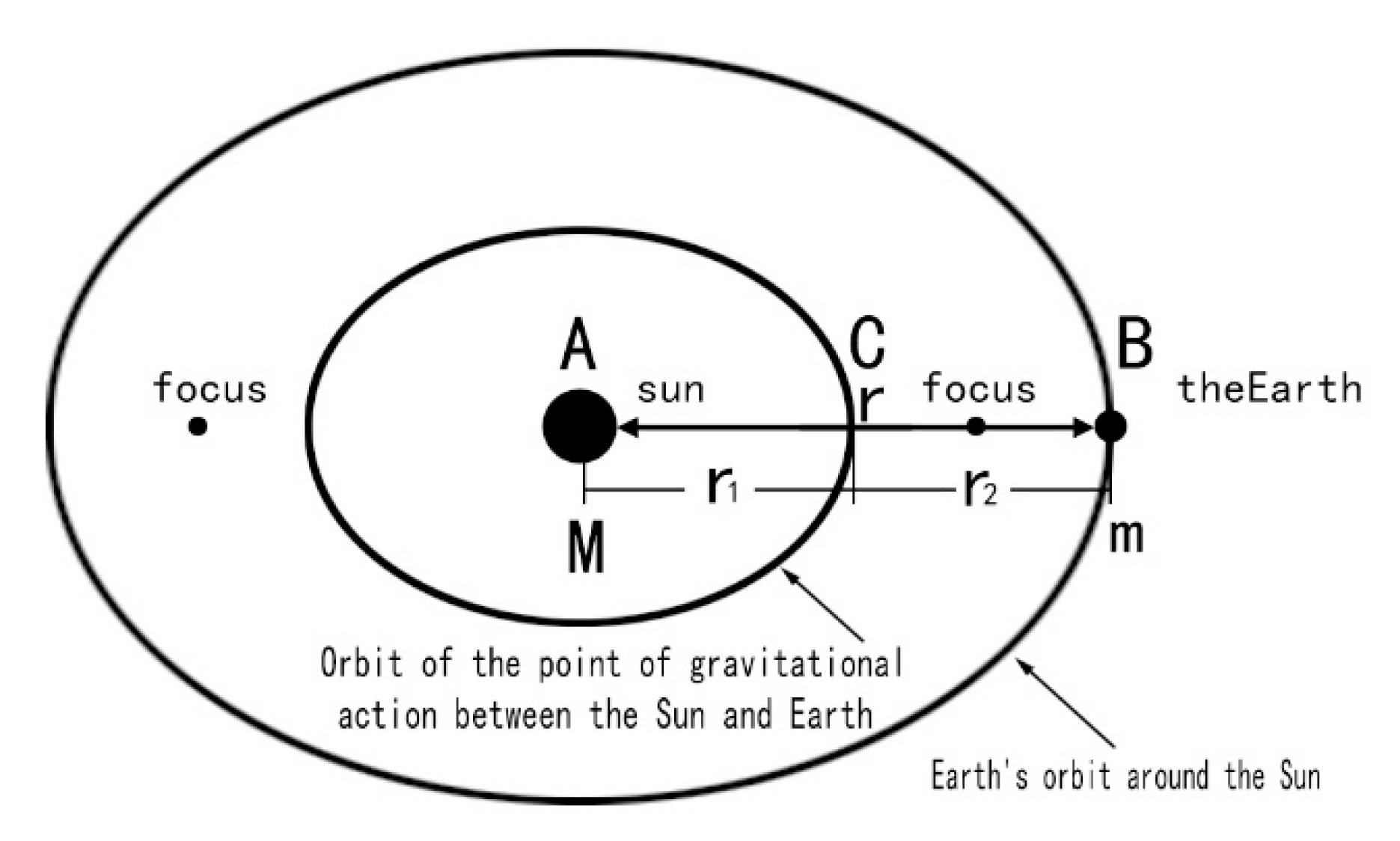
If these action points at all times are connected, the orbit of the gravitational field interaction point of the two objects is formed. [16]Taking the Earth's movement around the Sun as an example, the Earth's orbit around the Sun is an ellipse, and the gravitational interaction points of the two at any time are in the middle of the line connecting their centers of mass. Then, connecting the gravitational field interaction points at all times in the cycle will also form an elliptical orbit of the gravitational field interaction points, but the circumference of this orbit is half of that of the Earth's orbit around the Sun. The orbit formed by the interaction point of the Sun-Earth gravitational field is composed of countless "Yan Zijie Points," and this orbit can also be referred to as the "Yan Zijie Orbit." A schematic diagram of the orbit is shown in Figure 5.
Next, we mathematically calculate the orbit of the interaction point of the solar-terrestrial gravitational fields (Yan Zijie Orbit):
Let the mass of the Sun be M (M≈1.989×1030kg) with its center of mass at Point A, and the mass of the Earth be m (m≈5.972×1024kg) with its center of mass at Point B. Let Point C be the midpoint of the line connecting the centers of mass of the Sun and the Earth, and Point O be the center of mass of the Sun-Earth system. Both the Earth and the Sun revolve around Point O along elliptical orbits. For the Earth’s orbit, let the semi-major axis be a (a≈1.496×10¹¹m), the eccentricity be e (e≈0.0167), and the orbital period be T (T≈3.156×10⁷s). The gravitational constant is denoted as G (G=6.674×10⁻¹¹N.m2/kg2). [17,18]The mean anomaly of the Earth, which is a polar angle varies with time, is defined as θ(t), where θ(t)=ωt=T2π (ω represents the mean angular velocity). [19]
A two-dimensional Cartesian coordinate system is established with the center of mass O of the Sun-Earth system as the origin, which coincides with the plane of the Earth’s revolution. Since Point C is the midpoint between the centers of mass of the Sun and the Earth, the coordinate equation of Point C can be derived from the midpoint coordinate formula as follows:
where b represents the semi-minor axis of the Earth's elliptical orbit. Equation (10) can be split into two separate formulas, namely:
Rearranging the above equations yields:
According to Kepler’s First Law, [20]we can obtain the following:
Substituting Equation (15) into Equation (14) results in:
Substituting Equations (13) and (16) into Equation (17) gives:
Rearranging Equation (18), we obtain the orbit equation of the interaction point of the solar-terrestrial gravitational fields, which is also referred to as the Yan Zijie orbit equation:
Note: The orbit of the interaction point of the solar-terrestrial gravitational fields is a closed small ellipse. Its semi-major axis is aC=1/2a, which is half of the semi-major axis of the Earth’s orbit; its semi-minor axis is bC=, which is half of the semi-minor axis of the Earth’s orbit; and its eccentricity is eC=e, which is identical to the eccentricity of the Earth’s orbit. This orbit is only correlated with the Earth’s orbital parameters and is independent of the mass ratio between the Sun and the Earth.
The principles of the four basic forces are the same, and they are all generated by the interaction between force fields.[9] On this basis, it can be inferred that the force field interaction point of electromagnetic force, strong force, and weak force is also located in the middle of the line connecting the mass of center of the two objects, that is, 1/2r. (See Fig. 2, Fig. 3 and Fig. 4 for details)
4.3. Mathematical Expressions:
The mathematical expression of Yan Zijie's principle is r1=r2=1/2r, where r1 and r2 denote the field radii, and r represents the distance between the centers of mass of the two objects. See 3.2 for the specific demonstration process. That is to say, in formulas (1), (2), (3), and (4), the mathematical expression r1=r2=1/2r is valid, indicating that the force field interaction points of the four fundamental forces all follow the Yan Zijie's principle.
4.4. Equation of the Perpendicular Bisecting Plane
Definition: In three-dimensional space, the equation corresponding to the plane that passes through the midpoint of the line connecting two mass points and is perpendicular to this line is called the equation of the perpendicular bisecting plane, also referred to as the plane equation. It is primarily used to describe the locus of all spatial points that are equidistant from the two mass points. The force fields of the four fundamental interactions are all excited from point sources and propagate outward at the speed of light c at all times. Taking Figure 1 as an example, the derivation of the equation of the perpendicular bisecting plane is provided below:
In Figure 1, at a certain moment, two objects with masses M and m respectively excite a spherical gravitational field matter from their centers of mass, which propagates outward at the speed of light c. The distance between the centers of mass of the two objects is r, the radius of the gravitational field of the object M is r1, and the radius of the gravitational field of the object m is r2. The three-dimensional coordinates of any arbitrary point on the spherical surface of the gravitational field of the object M are denoted as (x1,y1,z1), whereas those of any arbitrary point on the spherical surface of the gravitational field of the object m are denoted as (x2,y2,z2). At an arbitrary moment t, the spherical surface equations (equations describing the coordinate positions of all points on the spherical surface) of the two gravitational field spheres are respectively given as follows:
(x-x1)2+(y-y1)2+(z-z1)2=(ct)2 =r12
(x-x2)2+(y-y2)2+(z-z2)2=(ct)2= r22
Combining and rearranging Equations (20) and (21), we obtain:
(x-x1)2+(y-y1)2+(z-z1)2=(x-x2)2+(y-y2)2+(z-z2)2
By transforming and rearranging Equation (22), we obtain the equation of the mid-perpendicular plane between the gravitational field spheres of the two objects:
2(x2-x1)x+2(y2-y1)y+2(z2-z1)z=x22+y22+z22-x12-y12-z12
Note: The mid-perpendicular plane equation defines a unique plane in three-dimensional space where every point is equidistant to both mass points. This plane serves as the central symmetry plane between the two masses, geometrically representing the "Yan Zijie’s middle principle." Remarkably, the force fields of all four fundamental interactions conform to the mathematical description provided by this mid-perpendicular plane equation.
5. Significance and Application of Yan Zijie's Principle:
5.1. Significance:
Yan Zijie's principle states that the force field action points of the four fundamental forces are located in the middle position of the line connecting the centers of mass of the two objects, and clarifies the unified law of the force field interaction points of the four fundamental forces. The proposed principle allows the gravitational mechanism formula and electromagnetic force formula in the GUT proposed by Yan Huixiang to be directly used in actual calculations. After the precise values of the strong force constant and the weak force constant are measured in the future, the strong force formula and the weak force formula can also be directly used in actual calculations. This has further improved the GUT and indicates a major breakthrough in the field of basic physics theory. It provides an important basis for the construction of subsequent new theories and the revision of existing theories, which will undoubtedly promote the development of physics, astronomy, and cosmology.
4.2. Application:
Yan Zijie's principle applies to all objects in nature, including macroscopic and microscopic. This principle is one of the most basic and fundamental laws in nature. In the future, people's scientific research in many aspects will be related to this principle, and the application of this principle will be very extensive. For example, in the fields of astronomy and cosmology, it can be used to accurately calculate the gravitational force between planets and their orbits; in microscopic research, it can be used to discover new particles and develop new materials; and in people's search for new energy, it can also bring new exploration ideas and research methods.
6. Conclusions
Based on the previous research work, this paper has verified the "middle principle" discovered by Yan Zijie through rigorous argumentation, and it has indeed revealed the unified law that the force field action points of the four basic forces are located in the middle of the line connecting the centers of mass of the two objects. This is an important supplement and improvement to the grand unified theory, and it has improved people's understanding of the four basic forces in nature. If further in-depth research is to be conducted on this basis, this principle may play an important role in more fields, thereby promoting the development of human science and technology.
Acknowledgments
Many thanks to Dr. Xiao Yikang for his guidance and support on this article!
References
- Ma Wenwei, Xie Xishun, Zhou Yuqing. Modified Physics Textbook (7th Edition) (Volume 1) [M], Beijing: Higher Education Press. 2020(10): 31.
- Zhao, Z. Einstein and the Birth of General Relativity——Commemorating the 100th Anniversary of the Publication of General Relativity [J]. College Physics 2015, 34(11), 6. [Google Scholar]
- Wu, Y L. Unified field theory of basic forces and elementary particles with gravitational origin of gauge symmetry in hyper-spacetime[J]. Science Bulletin 2017, 62, 1109–1113. [Google Scholar] [CrossRef] [PubMed]
- Quigg, C. Electroweak Symmetry Breaking in Historical Perspective. Annual Review of Nuclear and Particle Science 2013, 63, 1–39. [Google Scholar] [CrossRef]
- "The Status of Grand Unified Theories" (Raby, 2017).
- Overduin, J. M.; Wesson, P. S. Kaluza-Klein Gravity. Physics Reports 1997, 283, 303–380. [Google Scholar] [CrossRef]
- Green, M. B.; Schwarz, J. H.; Witten, E. (1987). Superstring Theory (Vol. 1 & 2). Cambridge University Press.
- Maldacena, J.M. The Large N Limit of Superconformal Field Theories and Supergravity. Advances in Theoretical and Mathematical Physics 1998, 2, 231–252. [Google Scholar] [CrossRef]
- Yan Huixiang. Yan Huixiang's Perspectives on Physics [M]. Hong Kong: United Culture & Arts Publishing Co., Ltd., 2025(07):33-93. ISBN 978-1-968753-88-7.
- Ma Wenwei, Xie Xishun, Zhou Yuqing (Adapted). Physics Textbook (7th Edition, Volume 1) [M]. Beijing: Higher Education Press, 2020, 432.
- (France) C. Itzykson, J.B. Zuber; Translated by Du Dongsheng. Quantum Field Theory (Volume 2) [J]. 1986.
- Li Sanxiu, Li Yong, Zhu Changming. Why Field Strengths Follow Inverse-Square Laws [J]. Guangxi Physics 2022, 51–54.
- Einstein, A. The Foundation of the General Theory of Relativity [J]. Annalen der Physik 1916, 49, 769–822. [Google Scholar] [CrossRef]
- Jin Xiaojing, Liu Boyang. Hidden Symmetry in Inverse-Square Law Force Fields [J]. Physics and Engineering 2024, 34, 94–98.
- Ban Liying, Zhang Aijun (Eds.). College Physics Textbook [M]. Shanghai: Shanghai Jiao Tong University Press, 2023, 8.
- Zhou Weibo, Li Yang, Lin Xiaoying. A Preliminary Framework for Integrating Core Physics Literacy: A Case Study of "The Discovery of Kepler's Three Laws" [J]. Physics Teaching Discussion 2019, 15–18.
- CODATA Task Group on Fundamental Constants ( 2022).
- IAU Resolution B3 (2015)."On the Nominal Conversion Constants for Selected Solar and Planetary Properties".
- Curtis, H. D. (2013). Orbital Mechanics for Engineering Students (3rd ed.). Elsevier.
- Carroll, B. W.; Ostlie, D. A. (2017). An introduction to modern astrophysics (2nd ed.). Cambridge University Press. (pp. 45-46).
Figure 1.
Schematic Diagram of the Gravitational Interaction Plane.
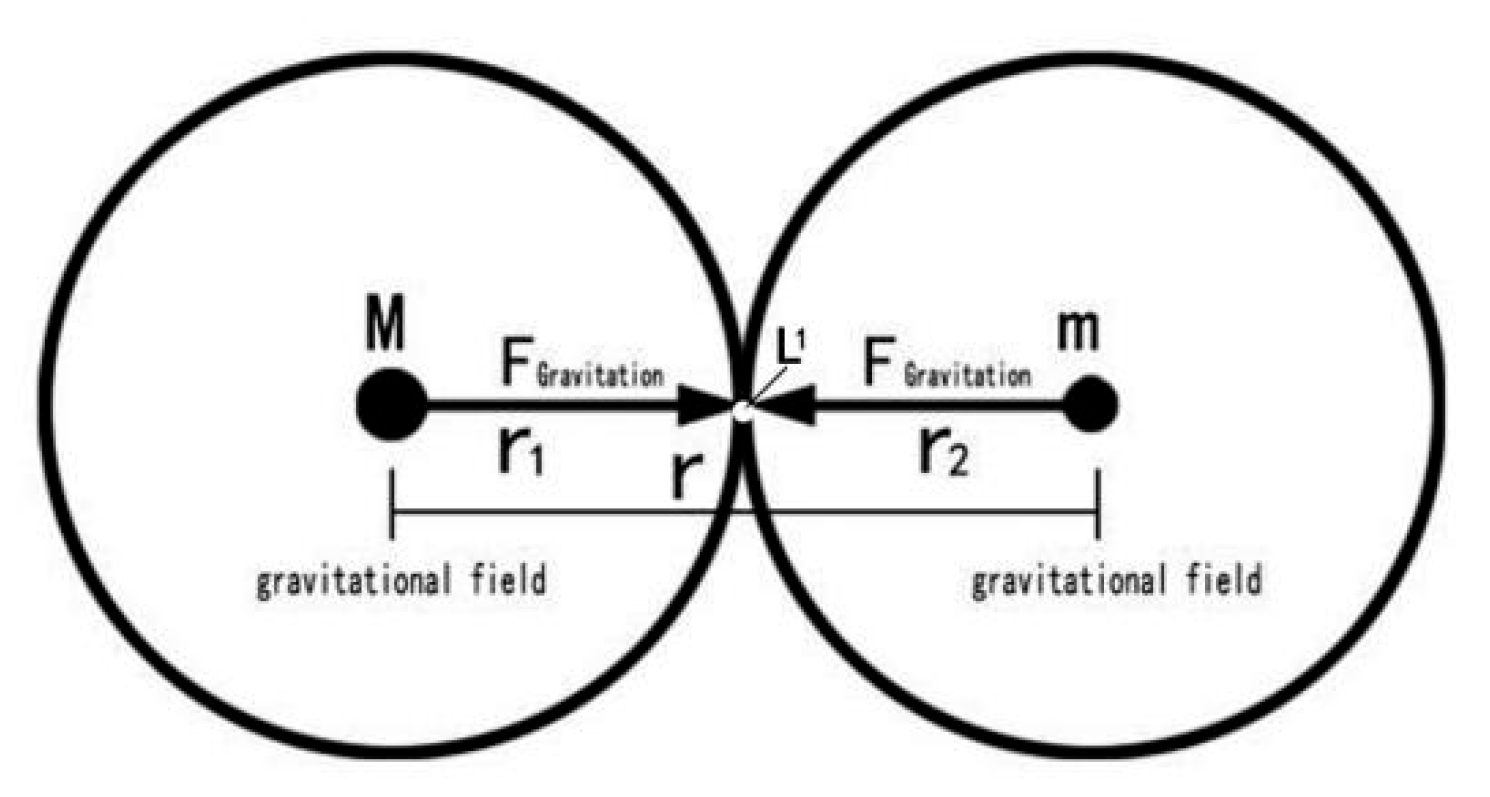
Figure 2.
Schematic Diagram of the Electromagnetic Force Interaction Plane.
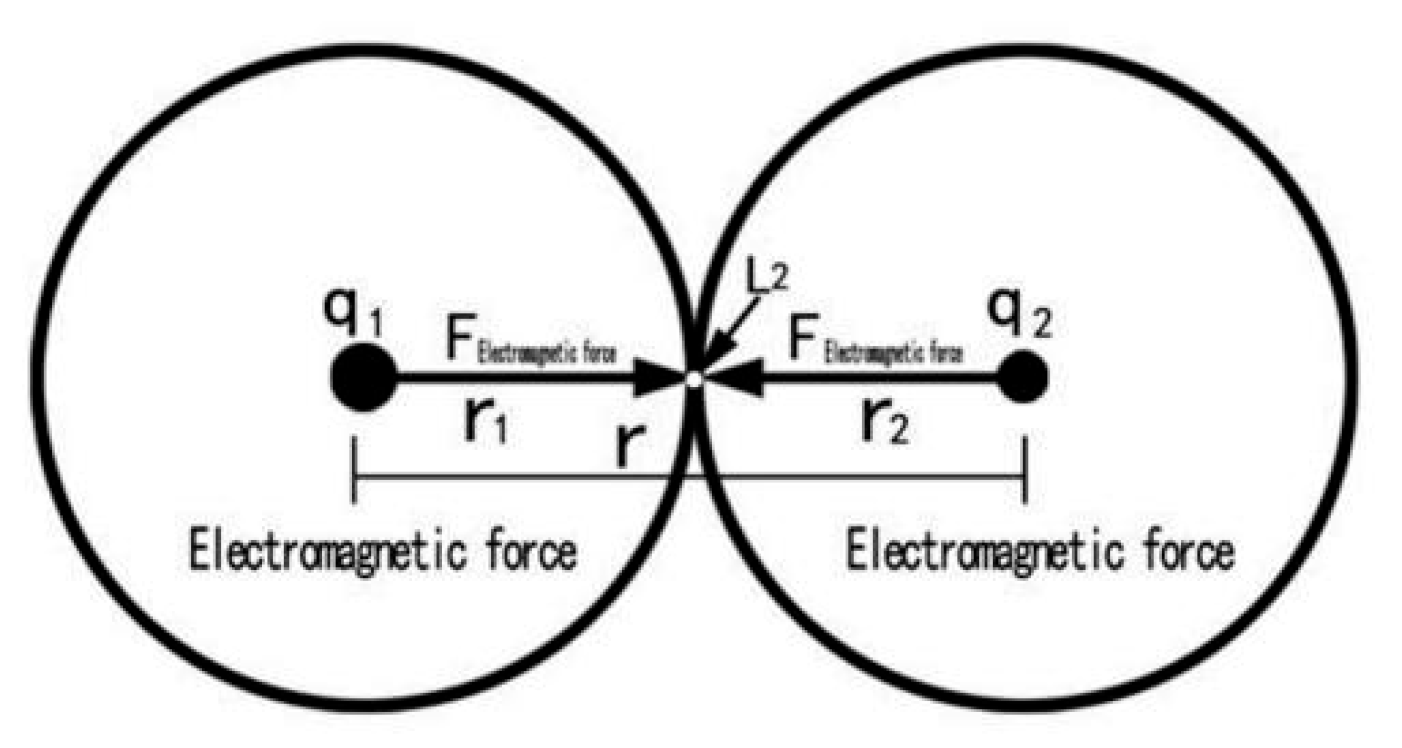
Figure 3.
Schematic Diagram of the Strong Force Interaction Plane.
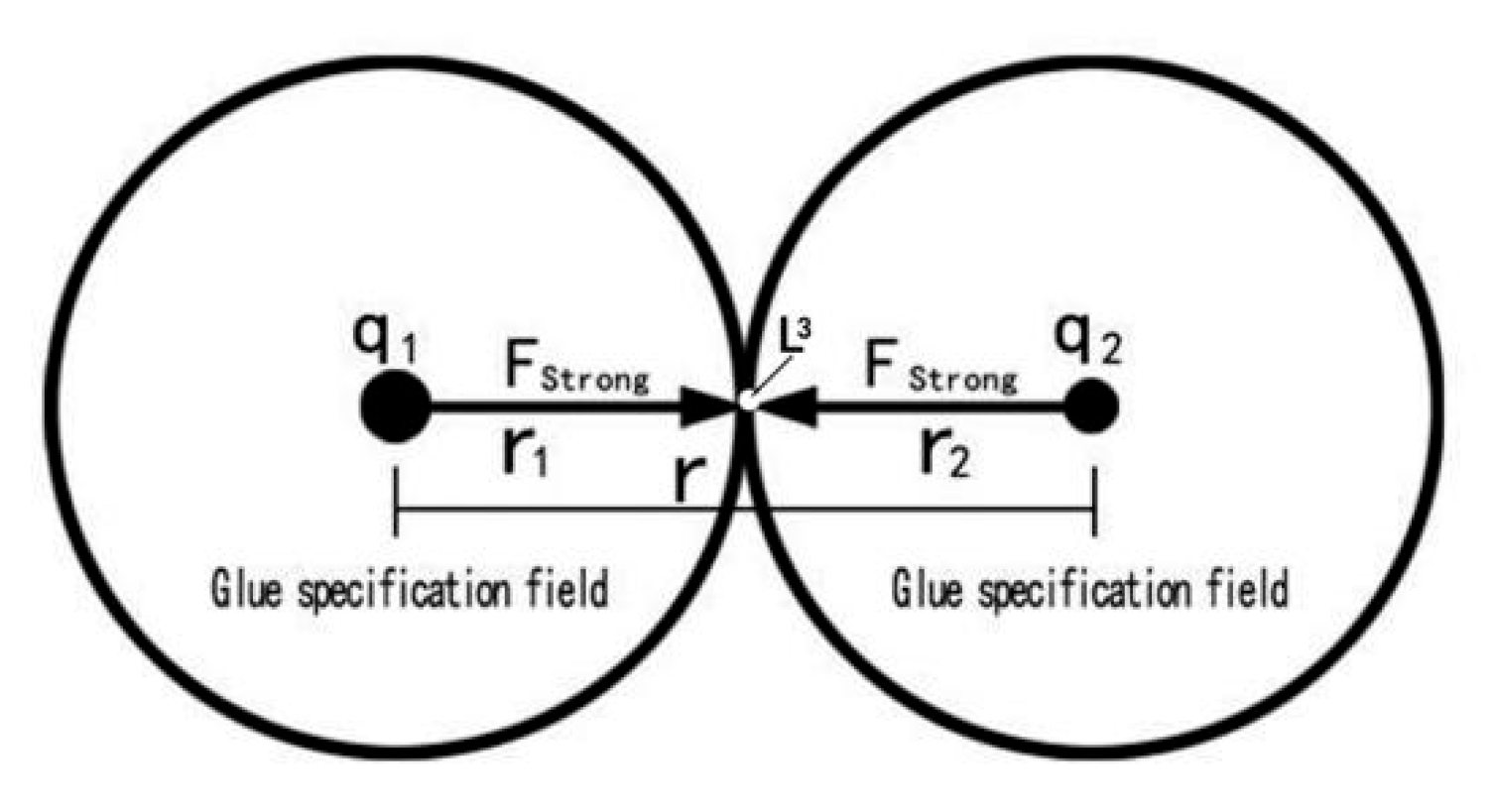
Figure 4.
Schematic Diagram of the Weak Force Interaction Plane.
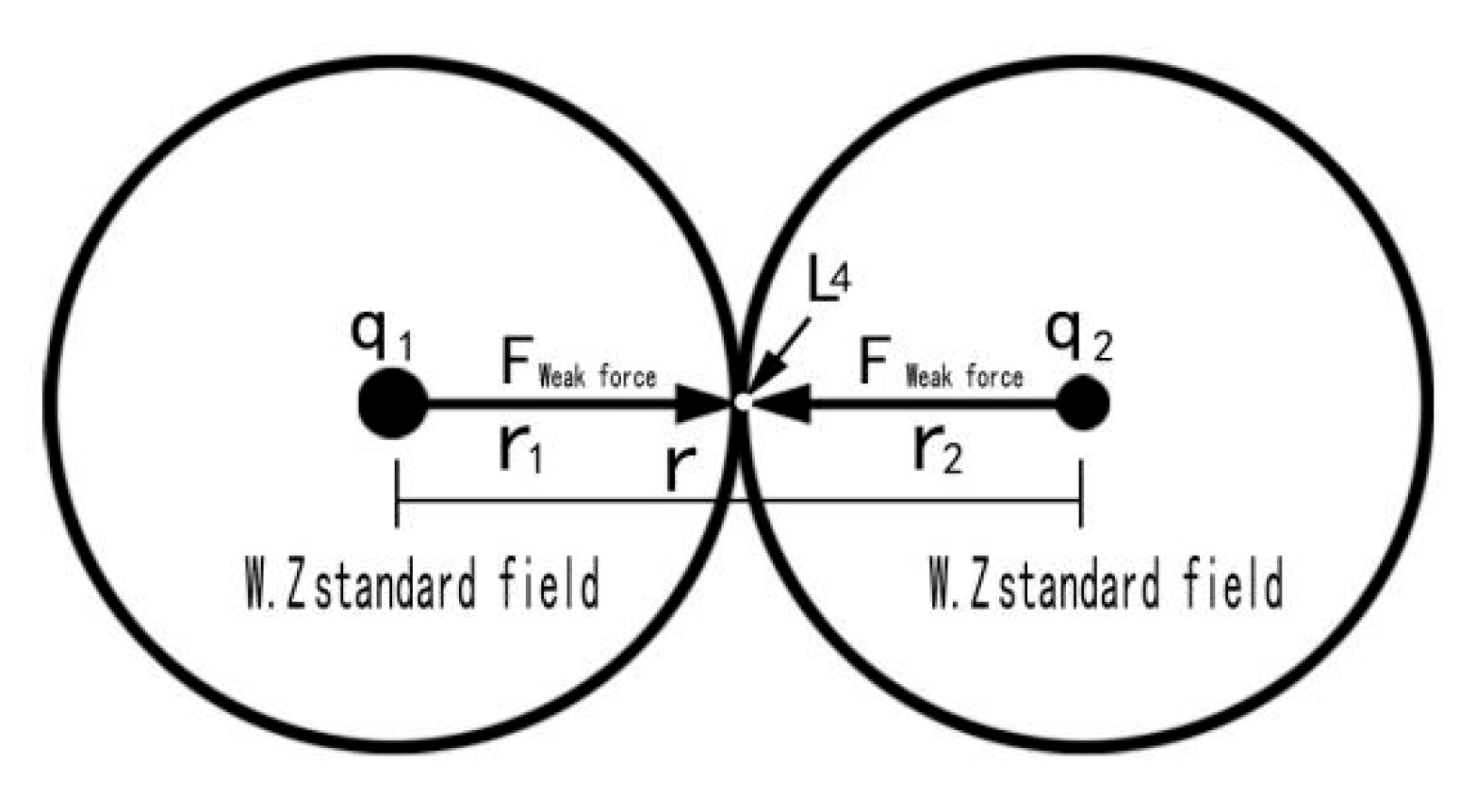
Figure 5.
Diagram of the Earth-Sun Gravitational Field Interaction Point Orbit.
Disclaimer/Publisher’s Note: The statements, opinions and data contained in all publications are solely those of the individual author(s) and contributor(s) and not of MDPI and/or the editor(s). MDPI and/or the editor(s) disclaim responsibility for any injury to people or property resulting from any ideas, methods, instructions or products referred to in the content. |
© 2026 by the authors. Licensee MDPI, Basel, Switzerland. This article is an open access article distributed under the terms and conditions of the Creative Commons Attribution (CC BY) license (http://creativecommons.org/licenses/by/4.0/).
Copyright: This open access article is published under a Creative Commons CC BY 4.0 license, which permit the free download, distribution, and reuse, provided that the author and preprint are cited in any reuse.


