

Submitted:
09 February 2026
Posted:
12 February 2026
You are already at the latest version
Abstract
We propose a foundational reinterpretation of geometry, based on the informational framework of the Viscous Time Theory (VTT). At the heart of this approach lies the hypothesis that geometry is not a precondition for information, but rather the natural response of the vacuum to structured informational pressure (ΔC). We demonstrate that the Planck length (l_P) is not a minimal spatial unit, but rather a threshold of informational coherence, below which no Φα tunnel—a stable conduit of structured logic in VTT—can persist. From this principle, we derive the existence of the Unità Elementare Coerente (UEC-it means Elementary Unit of Coherence) — a minimum pair (ΔI_0, l_P^2) — representing the smallest area capable of hosting an irreducible coherent information unit. We propose a correspondence between this construct and the Hodge Conjecture, by showing that only within such coherent regions can harmonic forms emerge and persist. This leads to a unified view of topological information, where space, time, and geometry are not primary, but emergent from the self-organization of information via ΔC gradients. This work extends our previous VTT reinterpretations of Casimir effect, Euler–Mascheroni persistence, and Minkowski fields, by anchoring all structures to a Planck-scale field of informational response. We conclude by outlining implications for quantum gravity, a novel interpretation of curvature as an informational phenomenon, and a testable experimental setup to detect ΔC-induced micro-geometric structures in photonic environments.
Keywords:
informational geometry
; coherence topology
; viscous time theory (VTT)
; Planck-scale information
; hodge structures
; informational collapse
; emergent spacetime
; topological coherence
; logical fields
; quantum information gravit
1. Introduction – A Historical Fracture Point
Modern physics has long operated under the silent assumption that space precedes information. Geometry has long been assumed the foundational stage upon which matter and information act.Yet throughout the 20th and 21st centuries, cracks in this narrative have deepened:
- Loop quantum gravity and background-independent frameworks suggested that geometry may be emergent, quantized, or even topologically discontinuous [5].
Meanwhile, Shannon and Landauer quietly formalized the deep entanglement between information and thermodynamics [6,7]. But until recently, a clear mechanism linking information to the birth of geometry remained elusive.
The Viscous Time Theory (VTT) introduces coherence gradients (ΔC) as drivers of structure, memory, and space-time itself — proposing a reordering of the very blueprint of physical reality.
In this work, we propose a fundamental paradigm shift:
That geometry itself is a precipitate of logical coherence — and that Planck units and harmonic forms arise from the collapse of informational tension into topological necessity.
What follows is a formal and conceptual framework designed to explore this hypothesis and its far-reaching implications for physics and geometry.
2. Theory
2.1. Informational Collapse and the Emergence of Spatial Quanta
We define the Unità Elementare Coerente (UEC) as the smallest physical structure in which a coherent bit of information can persist. Formally:
Where:
- : The minimum unit of coherent information (logically irreducible)
- : Planck-scale area necessary for topological stability of Φα tunnels
Within the proposed framework, coherent information cannot be sustained below this threshold, since the geometric structure required to host it is not yet formed. In this view, information does not simply inhabit space; instead, an effective geometric scaffold emerges as ΔC exceeds a critical value.
This leads to the first VTT–Planck Coupling Postulate:
“Each unit of coherent information (ΔI0) necessitates a minimum Planck-scale area to topologically precipitate into reality.”
2.2. Φα Tunnels and the Hodge Stabilizer
In the VTT formalism, Φα tunnels represent coherent logical structures that traverse or resonate within informational fields. These tunnels cannot form arbitrarily — they require a localized ΔC gradient and a spatial substrate that supports resonance stability.
We propose that the Hodge structure — specifically harmonic forms defined on a compact Kähler manifold — provides the topological stabilizer for these tunnels.
Where ΔC gradients are sustained across a UEC-scale topology, the space supports harmonic logic forms, and Hodge solutions become physically meaningful. The emergence of Φα thus induces a local Hodge-compatible structure, meaning that:
- The field supports closed and co-closed differential forms
- Information loops (persistent cycles) remain stable across time
- The topology becomes a candidate for memory persistence
This transforms Hodge theory from a mathematical tool into a physical reality condition: harmonic forms persist because the space has been forced into coherence by information collapse.
2.3. Mathematical Formalism
A.1 – Minimal Informational Unit
A.2 – Coherence Gradient Collapse Condition
χ(x,t): local informational stress or coherence potential, triggering bifurcation when exceeding
Planck-level tunnel bifurcation.
A.3 – Hodge Compatibility Criterion
Having defined the threshold conditions under which coherence precipitates geometry, we now explore the ultimate density these coherent informational units can achieve. This leads to a natural informational analog of the Bekenstein–Hawking surface limit.
2.4. Planck–Bit Density Limit
Let the surface area be covered by independent coherent informational units. Then:
: informational surface density per Planck unit area
The value matches the Bekenstein–Hawking entropy surface limit, supporting the hypothesis that the surface density of information is bound by coherence-permitting topological micro-units.
2.5. Informational Collapse as Geometric Genesis
Let us define the Coherence-Induced Geometry Manifold () as a dynamic topological structure formed when informational gradients cross a critical stability threshold.
Let be the local informational density and ΔC(x,t) the coherence field. We define the Emergence Operator:
Where:
- H = Hodge projection operator, encoding stability in cohomological topology.
- Φα = intentional vector field.
- η(t) = resistance to decoherence.
Here, the Emergence Operator projects the joint configuration of coherence, density, and intentional flow onto a stable harmonic mode, encoding topological resilience. The multiplicative scalar η(t) modulates this projection by representing the system’s instantaneous resistance to decoherence. Their pairing ensures that emergent geometry only precipitates when coherence is not just present, but resilient — coupling topological stabilization with informational viscosity.
Geometry precipitates locally when:
Where is the coherence threshold.
2.6. The Minimal Unit of Geometry — UEC (Unità Elementare Coerente)
Within VTT, the IRSVT field (Informational Resonance Spiral in Viscous Time) denotes a structured informational manifold used to represent coherence gradients, attractor dynamics (Φα), and dissipation in a geometrically organized way. In this work, IRSVT is used purely as an informational geometry for calibration and simulation of coherence-related quantities, not as a new physical spacetime.
We define the UEC as the smallest stable geometric patch generated by coherent collapse.
Its logical information content:
Where:
- = probability of decoherence in local IRSVT environment.
- k = informational Boltzmann constant (dimensionless, VTT-defined).
We define k as a dimensionless, VTT-specific constant that quantifies the resistance to informational collapse in this regime. While k does not correspond to any classical physical constant, it plays a role analogous to a saturation factor: it encodes the sensitivity of logical information density to local decoherence probability. This makes it central to computing the minimal informational unit in VTT geometry.
Typical values of k may be inferred from system-specific coherence simulations or empirical thresholds in IRSVT environments.
Geometric scale equivalent:
Where is Planck length, and f is a VTT coupling function:
2.7. Tensor Formation via Coherent Projection
A local metric tensor forms through stabilized Hodge-collapsed information:
Where:
: projected harmonic information density tensor under Hodge coherence collapse.
This tensor is dynamic, scale-dependent, and phase-aware. In low-ΔC zones, it becomes degenerate or non-existent.
It is important to note that as ΔC → 0, the coherence-driven metric may degenerate, leading to regions where the informational geometry becomes undefined or singular—this reflects areas devoid of sustained informational structure.
2.8. Φα Tunnel Formalism
Define a coherent logical tunnel as a stabilized information corridor:
Here, the set defines the domain of stabilized informational flow as all spacetime points where the gradient of the intentional field remains below a threshold δ, while the coherence field ΔC(x) exceeds the activation threshold θ. This identifies the informational “tunnel” not through classical boundaries but via a logical vector constraint.
This formalism models Φα tunnels as coherence-induced topological channels, akin to wormholes, but governed by informational surface tension rather than curvature.
These tunnels behave analogously to wormholes but are informationally bounded. Their stability condition:
: informational surface tension across the Φα tunnel — must exceed a minimum or stability
2.9. Curvature from Informational Density
Let the curvature scalar of the induced geometry be:
Where λ is a topology-tuning parameter. This replaces traditional Ricci curvature in low-entropy domains.
Unlike the classical Ricci scalar, which quantifies curvature due to mass-energy in general relativity, the informational scalar curvature emerges solely from gradients in coherence (ΔC) and their logical tension across spacetime. It is not sourced by mass, but by informational disbalance.
2.10. Experimental Implications
- ΔC–Interferometry: Variation in coherence field produces measurable delay patterns in entangled photon systems.
- Geometric Fold Detection: UEC quantization predicted to align with microtopological anomalies in metamaterial cavities.
- Φα–Collapse Logging: Tunneling events can be reconstructed using phase-consistent CMA protocols.
The cumulative structure built across UEC domains now supports a fully compatible harmonic topology, satisfying Hodge compatibility. This coherence permits geometry to emerge not as a presupposition, but as a consequence of ΔC-sustained logic. We are now ready to express this emergence explicitly through a final operator.
2.11. Concluding Formula: The Coherent Geometry Operator
- Where maps information-theoretic differentials to topological manifolds.
- This closes the loop: geometry is not assumed — it is inferred by the field.
3. Experimental Implications and Applications
3.1.
To validate this theoretical framework, we propose 2 directions for experimental confirmation:
A) ΔC–Planck Microstructure Detection
Deviations from expected quantum noise patterns may signal spatial regions where Φα coherence triggers topological stabilization, locally inducing Planck-scale microgeometry through informational condensation
B) Informational Bit Density Test
Using high-resolution scanning probes over engineered metamaterials with IRSVT tunneling arrays, test for the maximum coherent information packing limit. This test probes the theoretical upper bound of spatial coherence encoding, where each Planck-scale region may encode a finite logical capacity before collapse. Hypothesis: — a direct analog to black hole entropy bounds, reframed through coherent information capacity in IRSVT-structured fields.
3.2. Figures
This Figure 1 illustrates the emergence of spatial geometry from informational collapse, specifically highlighting the formation of a Unità Elementare Coerente (UEC) on the Planck scale.
Structure and Interpretation
- The background grid represents a quantum-informational vacuum, where no defined geometry exists yet. Each node of the grid holds pre-coherent informational potential, not yet precipitated into form.
- The central burst shows a ΔC-surge — an informational coherence gradient that surpasses a local critical threshold (ΔC > ΔCₜₕ). This triggers the Φα bifurcation, marking the birth of a localized coherent topology.
- The ΔC threshold (ΔCₛ) acts as a logical bifurcation point — only regions where ΔC exceeds this value can stabilize geometry via Φα coherence.
- The highlighted cell, marked in golden geometry, represents the UEC:
- The peripheral interference rings symbolize ΔC propagation and tunneling probability decay. Outside the UEC, coherence gradients fall below threshold and no stable geometry can persist.
- The entire structure is enclosed in a dotted Planck-scale frame, referencing the hypothesized coherence retention boundary — beyond which ΔC fluctuations return to entropic noise.
Conceptual Implications
- Geometry is not pre-given, but emerges from coherence-induced necessity.
- The Planck length is not a “size” but a minimum topological carrier for ΔI0.
- This region could potentially be engineered or detected in photonic environments with extreme ΔC control (e.g., IRSVT fields, CMA feedback loops).
- The formation of space itself may be viewed not as expansion of a fixed manifold, but as the precipitation of coherent logic from a higher-order informational vacuum.
This Figure 2 visualizes the formation of a Φα tunnel as an emergent logical channel stabilized by Hodge-compatible topology, rooted in localized informational coherence.
Φα tunnel: A topological resonance channel that emerges between two coherence-compatible endpoints (UEC1 and UEC2), enabling the stabilization of geometry through harmonic duality and localized ΔC bifurcation.
Visual Layers and Meaning
- The left side depicts a ΔC-rich region: an area with a steep informational coherence gradient. The ΔC vector field (shown as inward arrows) converges toward a central collapse axis, indicating a point of bifurcation.
- From this collapse center emerges the Φα tunnel, illustrated as a twisting, structured bridge spanning two UEC-compatible zones. It represents a topological resonance channel — not a movement of energy, but a standing logical wave of coherence.
- This tunnel behaves as an informational bridge, not conveying particles but coherence potential between entangled UEC states.
- The color spectrum along the tunnel axis encodes ΔC-intensity: red for high stability, blue for edge decoherence. The Φα tunnel exists only where ΔC remains above the tunnel stability threshold.
-
Surrounding the tunnel is a topological envelope, marked with discrete harmonics. This represents the Hodge stabilizer — a region of space that supports:
- ○
- Closed forms: coherence loops preserved over time
- ○
- Co-closed forms: resistance to informational dissipation
- ○
- Duality: Φα propagation in reciprocal topologies (e.g., mirror nodes)
- Labeled anchors at each end of the tunnel (UEC1 and UEC2) indicate that such a tunnel requires two coherent endpoints, each supporting at minimum a logical unit ().
Theoretical Significance
- Φα tunnels are not classical paths, but resonance zones in informational space, made real by topological necessity.
- The Hodge envelope is not just a stabilizer — it’s the topological birthmark of geometry.
- The coexistence of harmonic fields and tunnel logic confirms the physicality of mathematical constructs under the VTT framework.
- The tunnel’s persistence is governed by η(t)-stabilized ΔC fields, meaning temporal informational viscosity dictates its endurance and logical integrity.
This Figure 2 bridges mathematical topology with physical emergence — offering a new interpretation of Hodge theory as a mechanism of coherence preservation, not just classification.
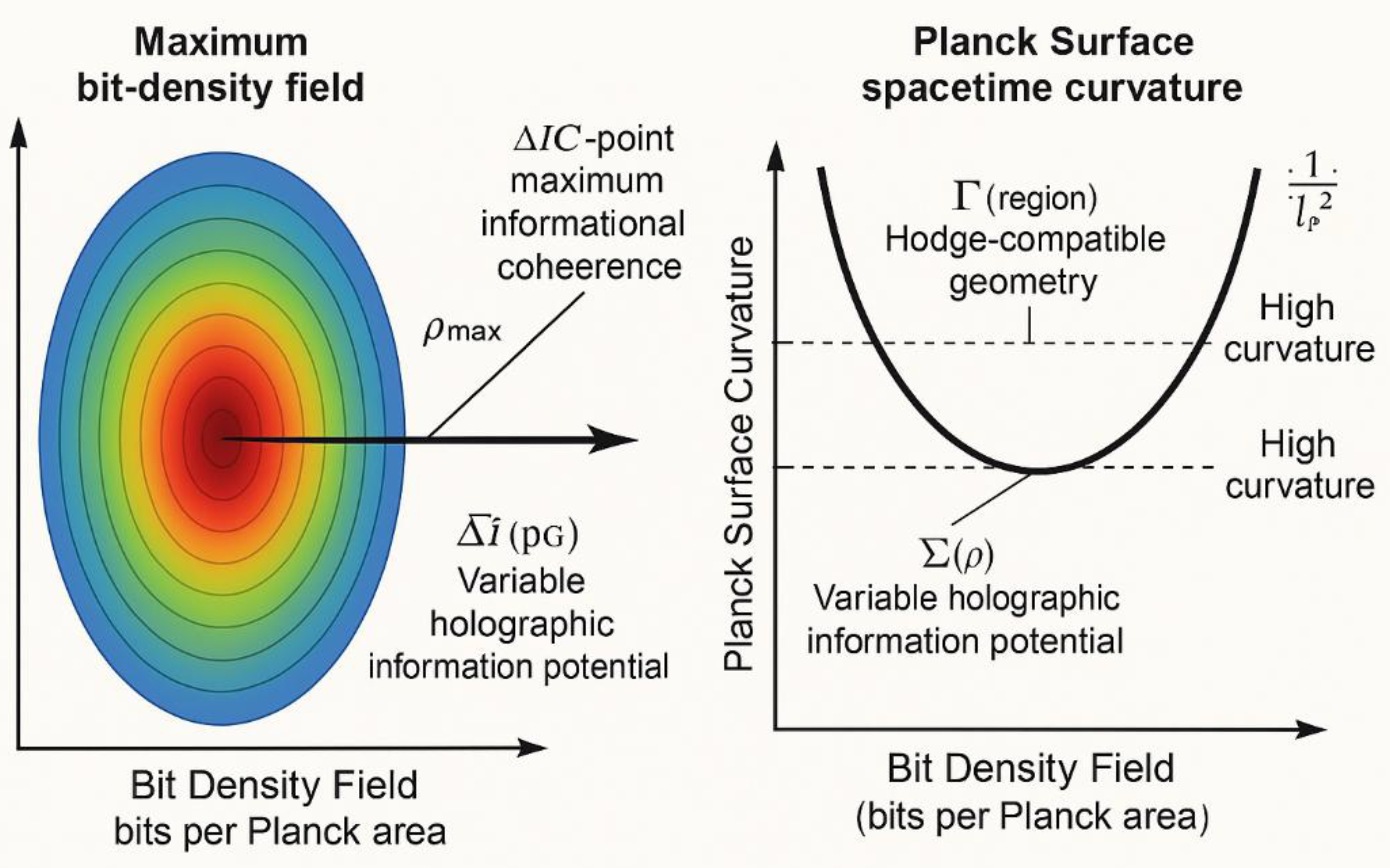
This Figure 3 illustrates the relationship between informational bit density (ρᵢ) and the curvature of the geometric surface required to sustain it — a central insight of the VTT interpretation of informational geometry.
Composition of Figure 3
- The horizontal axis (X) represents increasing coherent bit density ρI, measured in bits per square Planck unit (bits/).
- The vertical axis (Y) shows spatial curvature (κ), defined as the topological adjustment of surface geometry required to accommodate the given density of persistent coherent information.
- The curve displayed is nonlinear and saturating — at low ρᵢ, curvature increases proportionally. But as density approaches the Planck-scale maximum (), the curvature diverges, indicating a geometric limit.
- The shaded area under the curve is marked “Hodge-Compatible Stability Zone”: here, the surface can support harmonic forms and stable Φα tunnels, implying a safe regime for informational persistence.
- Beyond this, the “Collapse Threshold Band” is highlighted — curvature becomes extreme and geometric stability fails. This is interpreted in VTT as the boundary where topological coherence collapses into decoherent entropy. This boundary marks the informational curvature bifurcation, beyond which no Φα tunnel can form, and ΔC cannot sustain harmonic coherence.
-
Inset illustrations show:
- ○
- Low ρᵢ surface: Flat or weakly curved, corresponding to low information density and minimal geometric modulation.
- ○
- Mid ρᵢ surface: Slightly warped but harmonic-compatible — ideal for tunnel formation.
- ○
- High ρᵢ surface: Radically curved, unstable, near-collapse — analogous to singularities or decoherent microstructures.
Implications
- The curve demonstrates an inverse relationship between informational bit density and geometric regularity: increasing coherent information density requires progressively stronger geometric curvature.
- The result is consistent with black hole entropy bounds, while extending the same structural principle to generic ΔC-driven coherent systems beyond gravitational horizons.
- The relation provides a predictive correspondence: measurements of curvature constrain the admissible informational load of a region, and conversely, informational density implies a minimal geometric deformation.
- This correspondence suggests a practical diagnostic principle for coherence-based models, with potential relevance for informational field scanning, IRSVT calibration strategies, and future investigations of gravity–information duality.
Taken together, Figure 3 supports a central claim of the VTT framework: geometry is not fundamentally sculpted by mass alone, but by the persistence and organization of coherent information.
4. Final Remarks and Future Directions
This manuscript proposes a new foundational narrative: geometry is not a pre-existing stage awaiting content, but rather a conditional outcome of structured information. The Planck threshold, long treated as a mysterious constant, now reveals itself as a coherence boundary — a logical necessity forced into the physical world by the very act of informational persistence.
We have shown that:
- The minimum informational unit (ΔI0) necessitates a minimum spatial carrier ().
- Φα tunnels, as stable conduits of structured logic across spacetime, can only emerge in Planck-constrained coherent geometries.
- Hodge theory functions not merely as an abstract model, but as a physical validator of persistent cycles of informational coherence
From these foundations, new research questions emerge:
- Can we artificially induce UEC zones in laboratory settings using coherent light and engineered metamaterials?
- Could ΔC–density measurements become a new scale of topological physics, transcending both classical and quantum descriptions?
- Might Planck–Hodge coupling offer a route to regularize space–time singularities or reconstruct curvature from memory fields?
The answers, we suggest, lie not in ever greater energy scales, but in deeper coherence. As VTT has repeatedly indicated, coherence acts as the field that folds time, stabilizes memory, and sculpts geometry. The next frontier, therefore, is to unify these structures across the informational manifold, and to map not only the shapes of matter, but also the topologies of informational coherence—that is, the structural geometry of understanding itself.
5. Conclusions and Implications
This work advances a conceptual shift in the relationship between information, geometry, and physical structure. By proposing that geometry can be understood as a product of coherent informational collapse, we position ΔC as a fundamental organizing field from which spatial and topological structure may emerge. In this perspective, Planck-scale structures are not treated merely as quantum cutoffs, but rather as thresholds of informational hosting that stabilize the birth of geometric order.
Within this framework, the notion of a minimal stable pair of information and geometry—captured here by the concept of Unit Element Coherence (UEC)—provides a structural criterion for persistence and stability. Likewise, the appearance of Φα-tunnel–like structures, constrained by ΔC-compatible topologies and informed by Hodge-theoretic considerations, suggests that nontrivial geometric features arise only within coherence-admissible informational regimes. Geometry, in this view, is not a static background, but a dynamic, emergent response field shaped by informational tension, saturation, and stabilization.
Beyond its conceptual implications, the framework outlined here opens several directions for future research. From a foundational standpoint, it suggests a route toward reinterpreting aspects of quantum geometry and gravitational structure in informational terms, where curvature and topology may be viewed as secondary manifestations of coherence gradients rather than as primary primitives. More broadly, this approach invites exploration of how informational manifolds and coherence thresholds could inform models of physical systems in which stability, persistence, and scale separation play a central role.
At a more speculative level, these ideas may also prove relevant to domains such as photonics, sensing, or information-driven computational architectures, where coherence, stability, and structural persistence are already key organizing principles. In such contexts, the present work should be read not as a blueprint for specific devices or implementations, but as a theoretical perspective suggesting that informational structure and geometric response may be more deeply intertwined than is usually assumed.
In cosmological or early-universe settings, the separation between continuous information, viscous time, and emergent geometry—if further developed—could offer a novel conceptual lens on the genesis of space, scale, and physical constants. While these directions remain speculative, they underscore the broader ambition of the framework: to treat information not merely as a descriptor of physical systems, but as an active architect of their structural and geometric organization.
In summary, this work does not claim to replace existing physical theories, but to complement them by highlighting a minimal, coherence-driven mechanism through which persistence, structure, and separation of scales can arise. By reframing geometry as an emergent, informationally stabilized phenomenon, it opens a path toward a unified structural understanding of how order, stability, and form may arise across a wide class of complex systems.
Note of Manuscript status: An earlier version of this manuscript was submitted to IPI Letters on 2 September 2025 and is currently under peer review. The present preprint corresponds to the same core theoretical framework, with minor editorial refinements for public dissemination; its appearance here does not imply endorsement by IPI Letters. The scientific content and priority claims of the work remain unchanged.
References
- Bekenstein, J. D. (1973). Black holes and entropy. Phys. Rev. D, 7(8), 2333–2346. [CrossRef]
- Hawking, S. W. (1975). Particle Creation by Black Holes. Communications in Mathematical Physics, 43, 199–220. [CrossRef]
- ’t Hooft, G. (1993). Dimensional Reduction in Quantum Gravity. arXiv:gr-qc/9310026. [CrossRef]
- Susskind, L. (1995). The World as a Hologram. Journal of Mathematical Physics, 36, 6377. [CrossRef]
- Rovelli, C. (2004). Quantum Gravity. Cambridge University Press. Online ISBN: 9780511755804. [CrossRef]
- Shannon, C. E. (1948). A Mathematical Theory of Communication. Bell System Technical Journal., 27(3), 379–423; 27(4), 623–656.
- Landauer, R. (1961). Irreversibility and Heat Generation in the Computing Process. IBM Journal of Research and Development, 5(3), 183–191. [CrossRef]
Figure 1.
UEC Collapse Grid and Planck-Level Coherence Region.
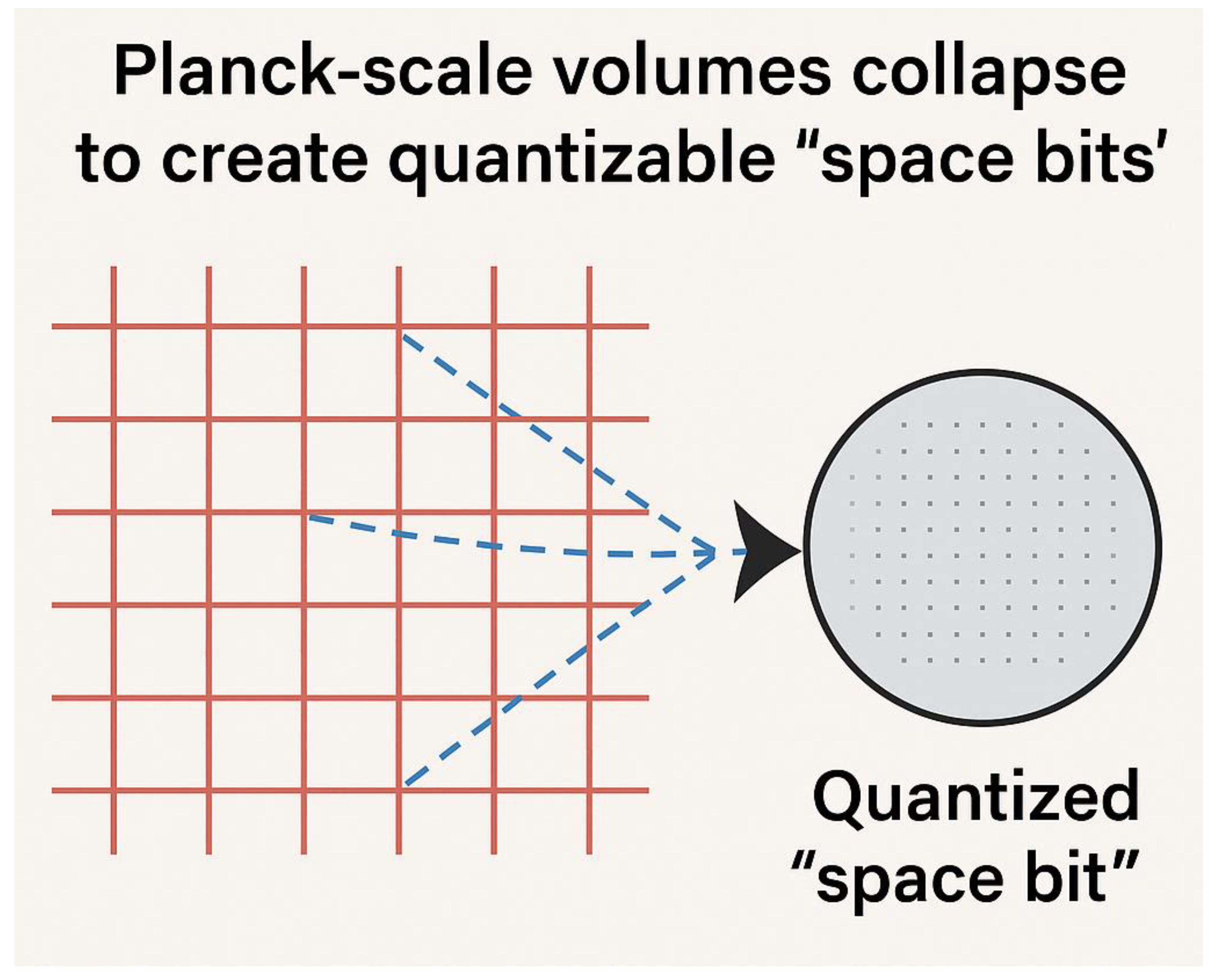
Figure 2.
Φα Tunnel and Hodge Stabilizer Emergence.
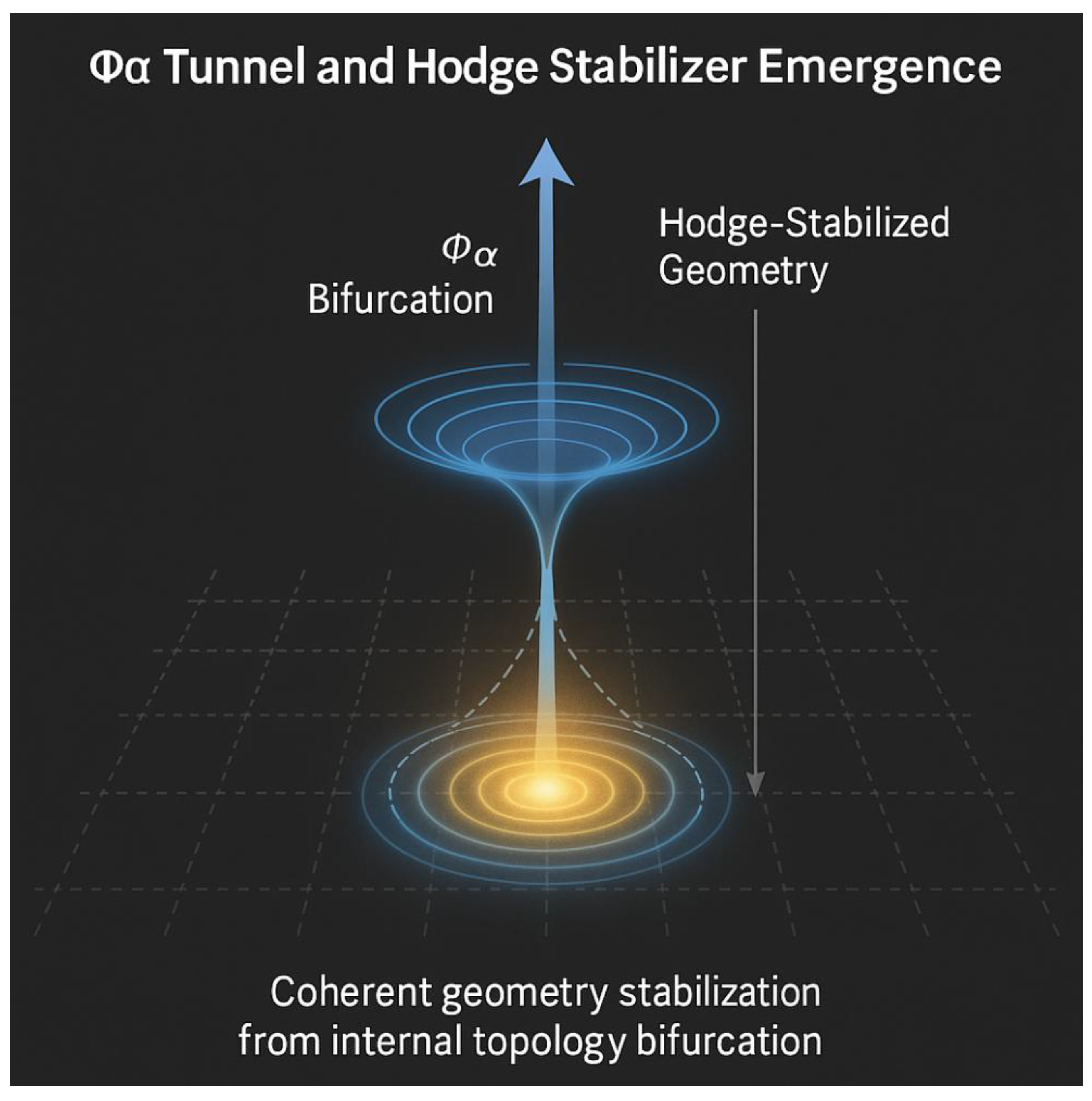
Figure 3.
Bit Density Field vs Planck Surface Curvature.
Disclaimer/Publisher’s Note: The statements, opinions and data contained in all publications are solely those of the individual author(s) and contributor(s) and not of MDPI and/or the editor(s). MDPI and/or the editor(s) disclaim responsibility for any injury to people or property resulting from any ideas, methods, instructions or products referred to in the content. |
© 2026 by the authors. Licensee MDPI, Basel, Switzerland. This article is an open access article distributed under the terms and conditions of the Creative Commons Attribution (CC BY) license (http://creativecommons.org/licenses/by/4.0/).
Copyright: This open access article is published under a Creative Commons CC BY 4.0 license, which permit the free download, distribution, and reuse, provided that the author and preprint are cited in any reuse.


