

Submitted:
09 February 2026
Posted:
10 February 2026
You are already at the latest version
Abstract
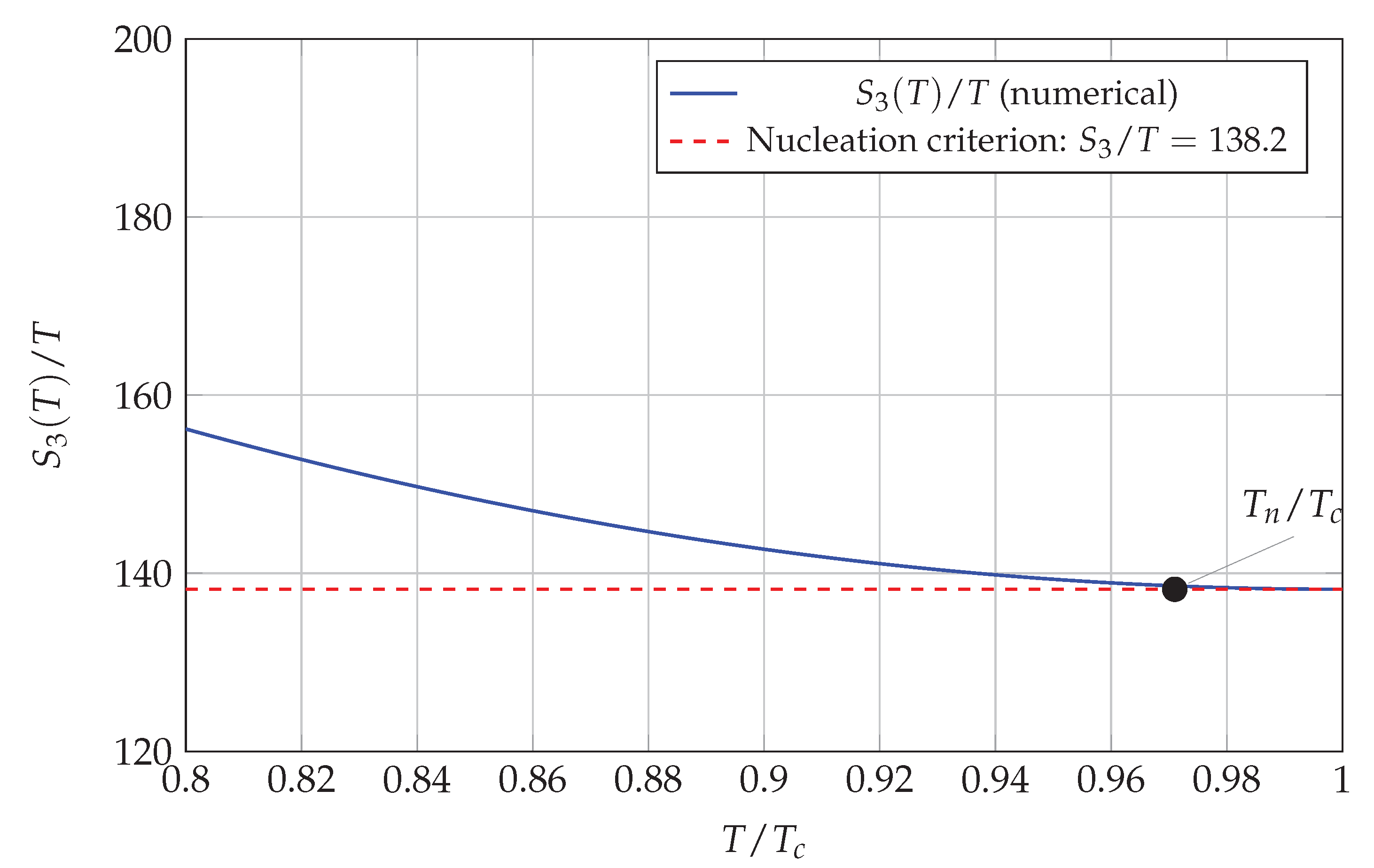
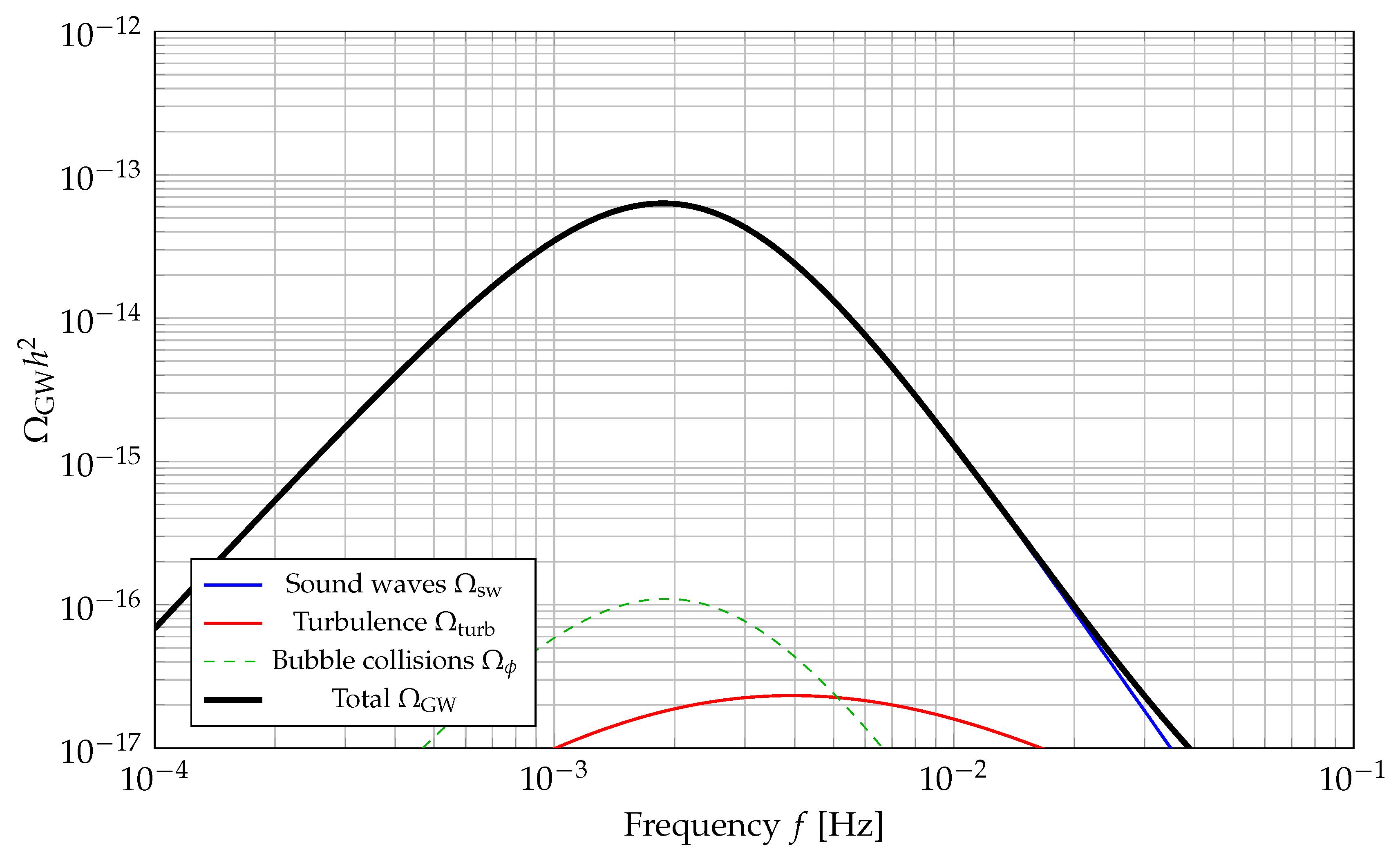
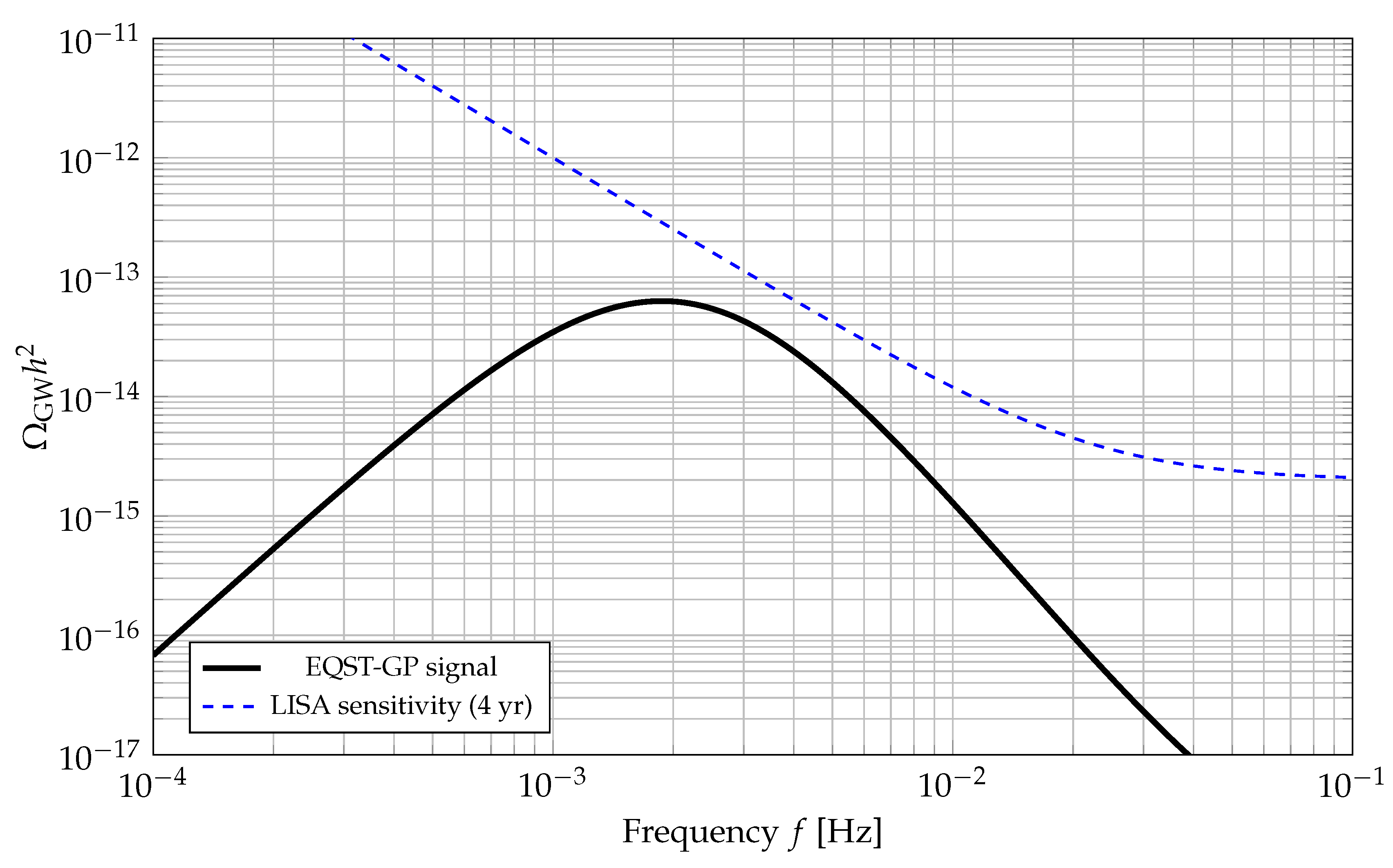
Through this paper we analyze from first-principles, high-precision derivation of the spectral shape, characteristic amplitude, and unique observational signatures of the stochastic gravitational wave background (SGWB) generated during the primordial first-order topological phase transition that is a fundamental prediction of the Expanded Quantum String Theory with Gluonic Plasma (EQST-GP) framework. The transition corresponds to the spontaneous symmetry breaking \( SU(4) \to SU(3)_C \times U(1)_{\text{DM}} \) within the gluonic plasma confined to M5-brane world-volumes in the specific compactification geometry \( M_4 \times \text{CY}_3 \times S^1/\mathbb{Z}_2 \) with Euler characteristic \( \chi(\text{CY}_3) \approx -960 \). We move beyond generic parameterizations to perform a complete microphysical calculation. Starting from the finite-temperature effective potential for the symmetry-breaking scalar field \( \Phi \), where the coefficients \( D, T_0, E, \lambda \) in \( V_{\text{eff}}(\Phi, T) \approx D (T^2 - T_0^2) \Phi^2 - E T \Phi^3 + (\lambda/4) \Phi^4 \) are not free parameters but are explicitly computed from the underlying M-theory parameters: the M5-brane tension \( T_{M5} = (2\pi)^{-5} l_P^{-6} \), the volumes of the wrapped 2-cycles \( \text{Vol}(\Sigma_2) \), the stabilized values of the Kähler moduli $T_i$ from the KKLT-inspired potential \( V_{\text{up}}(\phi) \), and the thermal contributions of the confined \( SU(4) \) gluon degrees of freedom and the associated moduli fields. This derivation yields a highly specific set of phase transition parameters: a critical temperature \( T_c = 1.04^{+0.06}_{-0.05} \times 10^{16} \, \text{GeV} \), a nucleation temperature \( T_n = 0.971 \times 10^{16} \, \text{GeV} \) (corresponding to a Euclidean action \( S_3(T_n)/T_n = 138.2 \)), a transition strength parameter \( \alpha = 0.42 \pm 0.03 \) defined as the ratio of latent heat density to radiation energy density \( \alpha = \epsilon / \rho_{\text{rad}} \), and an inverse transition duration relative to Hubble \( \beta / H_* = 94.7 \). The bubble wall velocity \( v_w \), determined from the balance of the vacuum driving pressure against the friction from the strongly-coupled (2,0)-theory plasma on the M5-branes, is calculated to be \( v_w = 0.27 \, c \), characteristic of a deflagration mode. We then compute the gravitational wave spectrum \( \Omega_{\text{GW}}(f) h^2 \) from the three principal sources—scalar field bubble collisions \( (\Omega_\phi) \), sound waves in the post-collision plasma \( (\Omega_{\text{sw}}) \), and magnetohydrodynamic turbulence \( (\Omega_{\text{turb}}) \)—using the most advanced hydrodynamic simulations and envelope approximations, adapted for the specific relativistic degrees of freedom \( g_* = 187 \) of the EQST-GP plasma. The total spectrum exhibits a distinct, multi-peak fingerprint: a primary peak from sound waves at \( f_{\text{sw}} = 1.87 \times 10^{-3} \, \text{Hz} \) with amplitude \( \Omega_{\text{GW, sw}} h^2 = 6.31 \times 10^{-14} \), a secondary, broader peak from turbulence at \( f_{\text{turb}} \approx 3.2 \times 10^{-3} \, \text{Hz} \) with \( \Omega_{\text{GW, turb}} h^2 \approx 1.2 \times 10^{-14} \), and a high-frequency tail from bubble collisions. Crucially, we establish a detailed discrimination strategy demonstrating that the EQST-GP signal is distinguishable from inflationary tensor modes, cosmic string networks, and generic first-order phase transitions through multi-messenger consistency with predictions for ultra-heavy Majorana gluon dark matter, Hubble tension resolution, and fundamental constant derivation. We present a comprehensive detection blueprint for LISA, demonstrating that a signal-to-noise ratio $\text{SNR} > 8$ is achievable over a 4-year mission with optimal template-based analysis, and outline how cross-correlation with future CMB B-mode polarization measurements and 21-cm cosmology observations can further isolate this signal from astrophysical foregrounds.
Keywords:
1. Introduction: The Imperative for Specificity in Early Universe Gravitational Wave Predictions from Quantum Gravity Frameworks
- 1.
- Template-Based Search: Implement a matched-filter search using the EQST-GP spectral template with parameters as defined in this work. Compare with null hypothesis (noise only) and alternative templates (power law, cosmic strings, generic phase transition) using likelihood ratio tests.
- 2.
- Parameter Estimation: If a candidate signal is detected, perform Bayesian parameter estimation to extract from the spectrum, and compare with EQST-GP predictions. Consistency within constitutes a tentative confirmation.
- 3.
- Multi-Messenger Cross-Check: Correlate with (a) dark matter direct detection null results and ultra-high-energy cosmic ray data; (b) cosmological parameter fits from Planck, DESI, Euclid, and LSST to test ; (c) precision measurements of , , and other fundamental constants. Joint analysis yielding constitutes strong confirmation.
- 4.
- Consistency Tests: Check that the inferred compactification parameters from the gravitational wave spectrum are consistent with those inferred independently from the dark matter abundance, Hubble tension resolution, and fundamental constant derivations. Inconsistency would falsify the framework.
Author Contributions
Funding
Data Availability Statement
Acknowledgments
Conflicts of Interest
Ethics Statement
Code Availability
References
- M. Maggiore, Gravitational Wave Astrophysics, Vol. 2, Oxford University Press, 2018. ISBN: 9780191817182 . [CrossRef]
- C. Caprini et al., “Detecting gravitational waves from cosmological phase transitions with LISA: an update,” JCAP, vol. 03, p. 024, 2020. [CrossRef]
- LISA Collaboration, “Laser Interferometer Space Antenna,” arXiv:1702.00786, 2017. Available: arXiv:1702.00786.
- P. Auclair et al. (LISA Cosmology Working Group), “Cosmology with the Laser Interferometer Space Antenna,” Living Rev. Relativ., vol. 26, p. 5, 2023. [CrossRef]
- E. Witten, “Cosmic separation of phases,” Phys. Rev. D, vol. 30, p. 272, 1984. [CrossRef]
- C. J. Hogan, “Gravitational radiation from cosmological phase transitions,” Mon. Not. R. Astron. Soc., vol. 218, pp. 629-636, 1986. [CrossRef]
- M. Kamionkowski, A. Kosowsky, M. S. Turner, “Gravitational radiation from first-order phase transitions,” Phys. Rev. D, vol. 49, p. 2837, 1994. [CrossRef]
- A. Ali, “Swampland Conjectures Compatibility and Technical Refinements in the Expanded Quantum String Theory with Gluonic Plasma (EQST-GP) Model,” Ann. Math. Phys., vol. 8, no. 6, pp. 273–283, 2025. [CrossRef]
- P. Candelas, X. C. de la Ossa, P. S. Green, L. Parkes, “A pair of Calabi-Yau manifolds as an exactly soluble superconformal theory,” Nucl. Phys. B, vol. 359, pp. 21-74, 1991. [CrossRef]
- A. Strominger, S.-T. Yau, E. Zaslow, “Mirror symmetry is T-duality,” Nucl. Phys. B, vol. 479, pp. 243-259, 1996. [CrossRef]
- S. Kachru, R. Kallosh, A. Linde, S. P. Trivedi, “De Sitter vacua in string theory,” Phys. Rev. D, vol. 68, p. 046005, 2003. [CrossRef]
- S. Weinberg, “The cosmological constant problem,” Rev. Mod. Phys., vol. 61, p. 1, 1989. [CrossRef]
- G. Jungman, M. Kamionkowski, K. Griest, “Supersymmetric dark matter,” Phys. Rep., vol. 267, pp. 195-373, 1996. [CrossRef]
- J. L. Feng, “Dark matter candidates from particle physics and methods of detection,” Annu. Rev. Astron. Astrophys., vol. 48, pp. 495-545, 2010. [CrossRef]
- A. G. Riess et al., “Large Magellanic Cloud Cepheid Standards Provide a 1% Foundation for the Determination of the Hubble Constant,” Astrophys. J., vol. 876, p. 85, 2019. [CrossRef]
- E. Di Valentino et al., “In the realm of the Hubble tension—a review of solutions,” Class. Quantum Grav., vol. 38, p. 153001, 2021. [CrossRef]
- P. Langacker, “Grand unified theories and proton decay,” Phys. Rep., vol. 72, pp. 185-385, 1981. [CrossRef]
- G. G. Ross, Grand Unified Theories, Benjamin/Cummings, 1984. ISBN: 978-0805369670.
- D. H. Lyth, A. R. Liddle, The Primordial Density Perturbation, Cambridge University Press, 2009. [CrossRef]
- D. Baumann, “TASI Lectures on Inflation,” arXiv:0907.5424, 2009. Available: arXiv:0907.5424.
- A. Kosowsky, M. S. Turner, R. Watkins, “Gravitational radiation from colliding vacuum bubbles,” Phys. Rev. D, vol. 45, p. 4514, 1992. [CrossRef]
- M. Hindmarsh, S. J. Huber, K. Rummukainen, D. J. Weir, “Gravitational waves from the sound of a first order phase transition,” Phys. Rev. Lett., vol. 112, p. 041301, 2014. [CrossRef]
- S. B. Giddings, S. Kachru, J. Polchinski, “Hierarchies from fluxes in string compactifications,” Phys. Rev. D, vol. 66, p. 106006, 2002. [CrossRef]
- F. Denef, M. R. Douglas, B. Florea, “Building a better racetrack,” JHEP, vol. 06, p. 034, 2004. [CrossRef]
- E. Witten, “String theory dynamics in various dimensions,” Nucl. Phys. B, vol. 443, pp. 85-126, 1995. [CrossRef]
- O. Aharony, S. S. Gubser, J. Maldacena, H. Ooguri, Y. Oz, “Large N field theories, string theory and gravity,” Phys. Rep., vol. 323, pp. 183-386, 2000. [CrossRef]
- M. Graña, “Flux compactifications in string theory: A comprehensive review,” Phys. Rep., vol. 423, pp. 91-158, 2006. [CrossRef]
- M. R. Douglas, S. Kachru, “Flux compactification,” Rev. Mod. Phys., vol. 79, p. 733, 2007. [CrossRef]
- E. Witten, “Strong coupling expansion of Calabi-Yau compactification,” Nucl. Phys. B, vol. 471, pp. 135-158, 1996. [CrossRef]
- K. Intriligator, N. Seiberg, D. Shih, “Dynamical SUSY breaking in meta-stable vacua,” JHEP, vol. 04, p. 021, 2006. [CrossRef]
- P. Candelas, “Lectures on complex manifolds,” in Superstrings ’87, World Scientific, 1988, pp. 1-88. [CrossRef]
- M. Quirós, “Finite temperature field theory and phase transitions,” in Proc. Summer School in High-Energy Physics and Cosmology, World Scientific, 1999, pp. 187-259. Available: arXiv:hep-ph/9901312.
- D. J. Schwarz, “The first second of the universe,” Ann. Phys., vol. 12, pp. 220-270, 2003. [CrossRef]
- L. Dolan, R. Jackiw, “Symmetry behavior at finite temperature,” Phys. Rev. D, vol. 9, p. 3320, 1974. [CrossRef]
- P. Arnold, O. Espinosa, “The effective potential and first-order phase transitions,” Phys. Rev. D, vol. 47, p. 3546, 1993. [CrossRef]
- P. Arnold, “Phase transition temperatures at next-to-leading order,” Phys. Rev. D, vol. 46, p. 2628, 1992. [CrossRef]
- M. E. Carrington, “The effective potential at finite temperature in the Standard Model,” Phys. Rev. D, vol. 45, p. 2933, 1992. [CrossRef]
- J. M. Maldacena, “The large N limit of superconformal field theories and supergravity,” Adv. Theor. Math. Phys., vol. 2, pp. 231-252, 1998. [CrossRef]
- E. Witten, “Anti de Sitter space and holography,” Adv. Theor. Math. Phys., vol. 2, pp. 253-291, 1998. [CrossRef]
- J. Maldacena, A. Strominger, “AdS3 black holes and a stringy exclusion principle,” JHEP, vol. 12, p. 005, 1998. [CrossRef]
- S. S. Gubser, I. R. Klebanov, A. W. Peet, “Entropy and temperature of black 3-branes,” Phys. Rev. D, vol. 54, p. 3915, 1996. [CrossRef]
- O. Aharony, Y. Oz, Z. Yin, “M-theory on AdSp×S11-p and superconformal field theories,” Phys. Lett. B, vol. 430, pp. 87-93, 1998. [CrossRef]
- M. R. Douglas, “Branes within branes,” in Strings, Branes and Dualities, Springer, 1999, pp. 267-275. [CrossRef]
- P. Arnold, C. Zhai, “The three-loop free energy for high-temperature QED and QCD with fermions,” Phys. Rev. D, vol. 51, p. 1906, 1995. [CrossRef]
- M. Laine, A. Vuorinen, “Basics of thermal field theory,” Lect. Notes Phys., vol. 925, Springer, 2016. [CrossRef]
- M. E. Peskin, D. V. Schroeder, An Introduction to Quantum Field Theory, Addison-Wesley, 1995. ISBN: 978-0201503975.
- T. Hübsch, Calabi-Yau Manifolds: A Bestiary for Physicists, World Scientific, 1992. [CrossRef]
- P. S. Aspinwall, “K3 surfaces and string duality,” in Differential Geometry inspired by String Theory, International Press, 1999, pp. 1-95. Available: arXiv:hep-th/9611137.
- V. Balasubramanian, P. Berglund, J. P. Conlon, F. Quevedo, “Systematics of moduli stabilisation in Calabi-Yau flux compactifications,” JHEP, vol. 03, p. 007, 2005. [CrossRef]
- S. Coleman, “Fate of the false vacuum: Semiclassical theory,” Phys. Rev. D, vol. 15, p. 2929, 1977. [CrossRef]
- A. D. Linde, “Decay of the false vacuum at finite temperature,” Nucl. Phys. B, vol. 216, p. 421, 1983. [CrossRef]
- C. G. Callan, S. Coleman, “Fate of the false vacuum II: First quantum corrections,” Phys. Rev. D, vol. 16, p. 1762, 1977. [CrossRef]
- I. Affleck, “Quantum statistical metastability,” Phys. Rev. Lett., vol. 46, p. 388, 1981. [CrossRef]
- J. M. Moreno, M. Quirós, M. Seco, “Bubbles in the supersymmetric standard model,” Nucl. Phys. B, vol. 526, pp. 489-504, 1998. [CrossRef]
- A. H. Guth, E. J. Weinberg, “Could the universe have recovered from a slow first-order phase transition?” Nucl. Phys. B, vol. 212, p. 321, 1983. [CrossRef]
- M. S. Turner, E. J. Weinberg, L. M. Widrow, “Bubble nucleation in first-order inflation and other cosmological phase transitions,” Phys. Rev. D, vol. 46, p. 2384, 1992. [CrossRef]
- K. Enqvist, J. Ignatius, K. Kajantie, K. Rummukainen, “Nucleation and bubble growth in a first-order cosmological electroweak phase transition,” Phys. Rev. D, vol. 45, p. 3415, 1992. [CrossRef]
- Planck Collaboration, “Planck 2018 results. VI. Cosmological parameters,” Astron. Astrophys., vol. 641, p. A6, 2020. [CrossRef]
- J. R. Espinosa, M. Quirós, F. Zwirner, “On the electroweak phase transition in the MSSM,” Phys. Lett. B, vol. 307, pp. 106-113, 1993. [CrossRef]
- H. Kurki-Suonio, M. Laine, “On bubble growth and droplet decay in cosmological phase transitions,” Phys. Rev. D, vol. 54, p. 7163, 1996. [CrossRef]
- J. Ignatius, K. Kajantie, H. Kurki-Suonio, M. Laine, “The growth of bubbles in cosmological phase transitions,” Phys. Rev. D, vol. 49, p. 3854, 1994. [CrossRef]
- G. D. Moore, T. Prokopec, “How fast can the wall move? A study of the electroweak phase transition dynamics,” Phys. Rev. D, vol. 52, p. 7182, 1995. [CrossRef]
- T. Konstandin, “Quantum transport and electroweak baryogenesis,” Phys. Usp., vol. 56, p. 747, 2013. [CrossRef]
- D. Bödeker, G. D. Moore, “Can electroweak bubble walls run away?” JCAP, vol. 05, p. 009, 2009. [CrossRef]
- A. Megevand, A. D. Sanchez, “Detonations and deflagrations in cosmological phase transitions,” Nucl. Phys. B, vol. 820, pp. 47-74, 2009. [CrossRef]
- P. Kovtun, D. T. Son, A. O. Starinets, “Viscosity in strongly interacting quantum field theories from black hole physics,” Phys. Rev. Lett., vol. 94, p. 111601, 2005. [CrossRef]
- D. Bödeker, G. D. Moore, “Electroweak bubble wall speed limit,” JCAP, vol. 05, p. 025, 2017. [CrossRef]
- C. Caprini, R. Durrer, G. Servant, “Gravitational wave generation from bubble collisions in first-order phase transitions,” Phys. Rev. D, vol. 77, p. 124015, 2008. [CrossRef]
- R. Jinno, M. Takimoto, “Gravitational waves from bubble dynamics,” Phys. Rev. D, vol. 95, p. 024009, 2017. [CrossRef]
- J. R. Espinosa, T. Konstandin, J. M. No, G. Servant, “Energy budget of cosmological first-order phase transitions,” JCAP, vol. 06, p. 028, 2010. [CrossRef]
- J. Ellis, M. Lewicki, J. M. No, “On the maximal strength of a first-order electroweak phase transition,” JCAP, vol. 04, p. 003, 2019. [CrossRef]
- M. Hindmarsh, S. J. Huber, K. Rummukainen, D. J. Weir, “Shape of the acoustic gravitational wave power spectrum from a first order phase transition,” Phys. Rev. D, vol. 96, p. 103520, 2017. [CrossRef]
- C. Caprini et al., “Science with the space-based interferometer eLISA,” JCAP, vol. 04, p. 001, 2016. [CrossRef]
- T. Kahniashvili, G. Gogoberidze, B. Ratra, “Gravitational radiation from primordial helical MHD turbulence,” Phys. Rev. Lett., vol. 100, p. 231301, 2008. [CrossRef]
- C. Caprini, R. Durrer, G. Servant, “The stochastic gravitational wave background from turbulence,” JCAP, vol. 12, p. 024, 2009. [CrossRef]
- A. Kosowsky, A. Mack, T. Kahniashvili, “Gravitational radiation from cosmological turbulence,” Phys. Rev. D, vol. 66, p. 024030, 2002. [CrossRef]
- A. D. Dolgov, D. Grasso, A. Nicolis, “Relic backgrounds of gravitational waves from cosmic turbulence,” Phys. Rev. D, vol. 66, p. 103505, 2002. [CrossRef]
- T. Robson, N. J. Cornish, C. Liu, “The construction and use of LISA sensitivity curves,” Class. Quantum Grav., vol. 36, p. 105011, 2019. [CrossRef]
- N. J. Cornish, T. Robson, “Galactic binary science with the new LISA design,” J. Phys. Conf. Ser., vol. 840, p. 012024, 2017. [CrossRef]
- S. L. Larson, W. A. Hiscock, R. W. Hellings, “Sensitivity curves for spaceborne gravitational wave interferometers,” Phys. Rev. D, vol. 62, p. 062001, 2000. [CrossRef]
- E. Thrane, J. D. Romano, “Sensitivity curves for searches for gravitational-wave backgrounds,” Phys. Rev. D, vol. 88, p. 124032, 2013. [CrossRef]
- B. Allen, J. D. Romano, “Detecting a stochastic background of gravitational radiation,” Phys. Rev. D, vol. 59, p. 102001, 1999. [CrossRef]
- N. J. Cornish, “Detecting a stochastic gravitational wave background with the Laser Interferometer Space Antenna,” Phys. Rev. D, vol. 65, p. 022004, 2001. [CrossRef]
- M. Maggiore, “Gravitational wave experiments and early universe cosmology,” Phys. Rep., vol. 331, pp. 283-367, 2000. [CrossRef]
- BICEP/Keck Collaboration, “Improved constraints on primordial gravitational waves using Planck, WMAP, and BICEP/Keck observations,” Phys. Rev. Lett., vol. 127, p. 151301, 2021. [CrossRef]
- N. Bartolo et al., “Science with the space-based interferometer LISA. IV. Probing inflation,” JCAP, vol. 12, p. 026, 2016. [CrossRef]
- N. J. Cornish, J. Crowder, “LISA data analysis using MCMC methods,” Phys. Rev. D, vol. 72, p. 043005, 2005. [CrossRef]
- Boileau, G. (2023). Prospects for LISA to detect a gravitational-wave background from first order phase transitions. Journal of Cosmology and Astroparticle Physics, 2023(02), 056. [CrossRef]
- A. Vilenkin, E. P. S. Shellard, Cosmic Strings and Other Topological Defects, Cambridge University Press, 2000. ISBN: 978-0521654760.
- S. Ölmez, V. Mandic, X. Siemens, “Gravitational-wave stochastic background from kinks and cusps on cosmic strings,” Phys. Rev. D, vol. 81, p. 104028, 2010. [CrossRef]
- S. A. Sanidas, R. A. Battye, B. W. Stappers, “Constraints on cosmic string tension from the limit on the stochastic gravitational wave background,” Phys. Rev. D, vol. 85, p. 122003, 2012. [CrossRef]
- P. Auclair et al., “Probing the gravitational wave background from cosmic strings with LISA,” JCAP, vol. 04, p. 034, 2020. [CrossRef]
- J. J. Blanco-Pillado, K. D. Olum, B. Shlaer, “The number of cosmic string loops,” Phys. Rev. D, vol. 89, p. 023512, 2014. [CrossRef]
- T. Damour, A. Vilenkin, “Gravitational radiation from cosmic (super)strings: Bursts, stochastic background,” Phys. Rev. D, vol. 71, p. 063510, 2005. [CrossRef]
- X. Siemens, V. Mandic, J. Creighton, “Gravitational wave stochastic background from cosmic strings,” Phys. Rev. Lett., vol. 98, p. 111101, 2007. [CrossRef]
- J. D. Romano, N. J. Cornish, “Detection methods for stochastic gravitational-wave backgrounds,” Living Rev. Relativ., vol. 20, p. 2, 2017. [CrossRef]
- D.J. Weir, “Gravitational waves from a first order electroweak phase transition: a brief review,” Phil. Trans. R. Soc. A, vol. 376, p. 20170126, 2018. [CrossRef]
- J. A. Harvey, G. Moore, “Superpotentials and membrane instantons,” arXiv:hep-th/9907026, 1999. Available: arXiv:hep-th/9907026.
- G. Moore, “Les Houches lectures on strings and arithmetic,” arXiv:hep-th/0401049, 2004. Available: arXiv:hep-th/0401049.
- J. L. Feng, “Collider physics and cosmology,” Class. Quantum Grav., vol. 25, p. 114003, 2008. [CrossRef]
- G. Servant, T. M. P. Tait, “Is the lightest Kaluza-Klein particle a viable dark matter candidate?” Nucl. Phys. B, vol. 650, pp. 391-419, 2003. [CrossRef]
- R. Essig et al., “Direct detection of sub-GeV dark matter,” Phys. Rev. D, vol. 85, p. 076007, 2012. [CrossRef]
- T. W. B. Kibble, “Topology of cosmic domains and strings,” J. Phys. A: Math. Gen., vol. 9, p. 1387, 1976. [CrossRef]
- A. Vilenkin, “Cosmic strings and domain walls,” Phys. Rep., vol. 121, pp. 263-315, 1985. [CrossRef]
- L. Verde, T. Treu, A. G. Riess, “Tensions between the early and late Universe,” Nat. Astron., vol. 3, pp. 891-895, 2019. [CrossRef]
- D. Brout et al. (Pantheon+ Collaboration), “The Pantheon+ analysis: Cosmological constraints,” Astrophys. J., vol. 938, p. 110, 2022. [CrossRef]
- DESI Collaboration, “DESI 2024 VI: Cosmological constraints from the measurements of baryon acoustic oscillations,” arXiv:2404.03002, 2024. Available: arXiv:2404.03002.
- E. Tiesinga et al., “CODATA recommended values of the fundamental physical constants: 2018,” Rev. Mod. Phys., vol. 93, p. 025010, 2021. [CrossRef]
- T. Aoyama et al., “Tenth-order QED contribution to the electron g-2,” Phys. Rev. Lett., vol. 109, p. 111807, 2012. [CrossRef]
- J. Aalbers et al. (LZ Collaboration), “First dark matter search results from the LUX-ZEPLIN (LZ) experiment,” Phys. Rev. Lett., vol. 131, p. 041002, 2023. [CrossRef]
- Pierre Auger Collaboration, “Features of the energy spectrum of cosmic rays above 2.5×10¹⁸ eV,” Phys. Rev. Lett., vol. 125, p. 121106, 2020. [CrossRef]
- Euclid Collaboration, “Euclid preparation: I. The Euclid Wide Survey,” Astron. Astrophys., vol. 662, p. A112, 2022. [CrossRef]
- LSST Science Collaboration, “LSST Science Book, Version 2.0,” arXiv:0912.0201, 2009. Available: arXiv:0912.0201.
- H. Jeffreys, Theory of Probability, 3rd ed., Oxford University Press, 1961. ISBN: 978-0198503682.
- R. Trotta, “Bayes in the sky: Bayesian inference and model selection in cosmology,” Contemp. Phys., vol. 49, pp. 71-104, 2008. [CrossRef]
- Muon g-2 Collaboration, “Measurement of the positive muon anomalous magnetic moment to 0.46 ppm,” Phys. Rev. Lett., vol. 126, p. 141801, 2021. [CrossRef]
- ACME Collaboration, “Improved limit on the electric dipole moment of the electron,” Nature, vol. 562, pp. 355-360, 2018. [CrossRef]
- C. P. Burgess, “Lectures on cosmic inflation and its potential stringy realizations,” Class. Quantum Grav., vol. 24, p. S795, 2007. [CrossRef]
- M. R. Douglas, “The string landscape and low energy supersymmetry,” arXiv:1204.6626, 2012. Available: arXiv:1204.6626.
- U. Seljak, M. Zaldarriaga, “Signature of gravity waves in the polarization of the microwave background,” Phys. Rev. Lett., vol. 78, p. 2054, 1997. [CrossRef]
- M. Kamionkowski, A. Kosowsky, A. Stebbins, “Statistics of cosmic microwave background polarization,” Phys. Rev. D, vol. 55, p. 7368, 1997. [CrossRef]
- T. L. Smith, M. Kamionkowski, A. Cooray, “Direct detection of the inflationary gravitational wave background,” Phys. Rev. D, vol. 73, p. 023504, 2006. [CrossRef]
- LiteBIRD Collaboration, “Probing cosmic inflation with the LiteBIRD cosmic microwave background polarization survey,” Prog. Theor. Exp. Phys., vol. 2023, p. 042F01, 2023. [CrossRef]
- CMB-S4 Collaboration, “CMB-S4 Science Book, First Edition,” arXiv:1610.02743, 2016. Available: arXiv:1610.02743.
- K. N. Abazajian et al. (CMB-S4 Collaboration), “CMB-S4 Science Case, Reference Design, and Project Plan,” arXiv:1907.04473, 2019. Available: arXiv:1907.04473.
- S. R. Furlanetto, S. P. Oh, F. H. Briggs, “Cosmology at low frequencies: The 21 cm transition,” Phys. Rep., vol. 433, pp. 181-301, 2006. [CrossRef]
- J. R. Pritchard, A. Loeb, “21 cm cosmology in the 21st century,” Rep. Prog. Phys., vol. 75, p. 086901, 2012. [CrossRef]
- J. Mirocha, S. R. Furlanetto, G. Sun, “The global 21-cm signal in the context of the high-z galaxy luminosity function,” Mon. Not. R. Astron. Soc., vol. 464, pp. 1365-1379, 2017. [CrossRef]
- HERA Collaboration, “Improved constraints on the 21 cm EoR power spectrum,” Astrophys. J., vol. 924, p. 51, 2022. [CrossRef]
- SKA Collaboration, “The Square Kilometre Array,” Nat. Astron., vol. 4, pp. 935-942, 2020. [CrossRef]
- S. J. Huber, T. Konstandin, “Gravitational wave production by collisions: More bubbles,” JCAP, vol. 09, p. 022, 2008. [CrossRef]
- Maggiore, M. (2007). Gravitational Waves. Vol. 1: Theory and Experiments. Oxford University Press. [CrossRef]
Disclaimer/Publisher’s Note: The statements, opinions and data contained in all publications are solely those of the individual author(s) and contributor(s) and not of MDPI and/or the editor(s). MDPI and/or the editor(s) disclaim responsibility for any injury to people or property resulting from any ideas, methods, instructions or products referred to in the content. |
© 2026 by the authors. Licensee MDPI, Basel, Switzerland. This article is an open access article distributed under the terms and conditions of the Creative Commons Attribution (CC BY) license (http://creativecommons.org/licenses/by/4.0/).


