

Submitted:
06 February 2026
Posted:
10 February 2026
You are already at the latest version
Abstract
Trees located on private property constitute a substantial portion of the urban forest canopy, yet management responsibilities vary widely across different jurisdictions. While property owners are granted freedom over their land-use decisions, some governments promote tree preservation by regulating and restricting how property owners manage trees on their properties. Incentive-based policies for tree protection can serve as an alternative to enact behavior change through positive reinforcement. In this study, we provide a comprehensive national review in the United States (U.S.) to identify, consolidate, and organize existing urban forest incentives offered by local governments targeting private property owners. In reviewing codes and official government websites across all U.S. states and the District of Columbia, focusing on communities with populations of over 50,000 (n=1839), we found that 27.90% of these locations included provisions for offering some type of incentive to property owners, and 6.14% indicated plans to add such practices in future updates. We organized these mechanisms into 15 broad categories to improve navigation and highlighted some examples to present a wide range of possible approaches for adopting and implementing these practices. Our results indicate that incentives are not always substantiated in official documents, can vary in ease of implementation, and often target only one stage of a tree’s life cycle. We align with previous research that there is no “one-size-fits-all” approach and conclude that it is important to consider the holistic process of a tree’s life cycle, the specific and individual details for each situation, as well as evaluate long-term impacts before tailoring the most suitable incentive mechanism for context-appropriate urban forest management plans.
Keywords:
urban forest policy
; tree ordinance
; governance
; private property
; landscape planning
; sustainability
1. Introduction
Urban trees are found on both public and private lands worldwide (Daniel et al., 2016; Konijnendijk et al., 2006). In most areas of the United States, the majority of urban tree canopy exists on private property (Ordonez-Barona et al., 2021; Clark et al., 2020; Nowak & Greenfield, 2018; Nguyen et al., 2017; Troy et al., 2017). In the absence of a national urban forest policy, the responsibility for managing urban trees has been delegated to local governments, with each adopting their own unique program (Hargrave et al., 2022) in the context of state laws, funding, and programs (Koeser et al., 2021). As a result, the authority to regulate trees on private land also varies across jurisdictions—some local governments include privately owned trees in their regulations, while others leave their management largely to the discretion of property owners (Clark et al., 2020; Landry & Pu, 2010; Sung, 2012; Profous & Loeb, 1990; Coughlin et al., 1988).
Research has shown that local governments that protect their urban trees tend to have an enhanced tree canopy and may lessen future canopy loss (Salisbury et al., 2022; Ordonez-Barona et al., 2021; Hilbert et al., 2019). Specifically, the existence of regulations has been associated with an increase in tree canopy coverage, as demonstrated by studies comparing canopy imagery before and after the implementation of tree ordinances with similar locations lacking such protection (Sung, 2012; Landry & Pu, 2010). Efficient regulations, along with planning and zoning ordinances, high-quality environmental projects (Hill et al., 2010), heritage tree protection ordinances (Salisbury et al., 2022; Hilbert et al., 2019), and residents’ willingness to comply with these measures (Conway & Lue, 2018), have been identified as additional factors linking tree regulation to tree preservation.
However, tree regulation on private properties can lead to challenges in achieving tree preservation. The homeowners’ freedom to manage trees on their lands is a competing right that is regulated by the U.S. Constitution and is supported by the public as private property rights (Norton et al. 2024; Ordonez-Barona et al., 2021). For example, Norton et al. (2024) analyzed judicial cases that enforced property rights over tree protection ordinances, embodied by federal and state courts' decisions, where courts ruled in favor of the owners' right to remove trees from their private land. The courts decided that the owners should not be charged with fines or replanting requirements, overruling any mitigation that was predetermined in their local by-laws (Norton et al., 2024). Additionally, local tree ordinances may be preempted by state regulation updates, limiting local governments' authority to oversee tree protection on private residential properties, as seen in Florida (Willis et al., 2024; Koeser et al., 2021). Florida state statutes restrict municipalities from imposing fees or fines for tree removal on private property when residents have documentation from an International Society of Arboriculture Certified Arborist or state-licensed landscape architect confirming that the tree poses an unacceptable risk to people or property (Willis et al., 2024; Koeser et al., 2021). This leaves the decision to remove a mature tree to the discretion of the homeowner, based on the expertise and mitigation options provided by their arborist. Likewise, tree protection regulations may be undermined by exemptions (Clark et al., 2020; Lavy & Hagelman, 2019) and may be difficult to enforce when dealing with property owners (Clark et al., 2020). Furthermore, when such protections are only regulatory and punitive, they might not be enough to improve tree canopy coverage (Willis et al., 2024; Salisbury et al., 2022; Hill et al., 2009).
Tree regulations usually operate in two different ways: by enforcing their regulation on those who disobey their requirements or encouraging voluntary compliance through incentives (Ordonez-Barona et al., 2021; Profus & Loeb, 1990; Coughlin et al., 1988). Punitive regulations that rely on fees and fines for tree removal and permit applications for trees on private properties, also known as command-and-control mechanisms (Hahn & Stavins, 1991), encounter different opinions among residents. Koeser et al. (2023) have found that more than half (54%) of the residents surveyed in Florida support municipal policies that manage trees on their private properties. Some studies have similarly reported neutral or positive perceptions of such interventions (Conway & Lue, 2018; Conway & Bang, 2014). However, other studies indicate these policies are unpopular with residents due to perceived restrictions on property rights (Clark et al., 2020; Conway & Lue, 2018; Conway & Bang, 2014). Incentives, on the other hand, encourage voluntary participation in tree protection programs without conflicting with regulatory ordinances or individual property rights (Willis et al., 2024; Ordonez-Barona et al., 2021; Watson, 2015). Considering they are less common than traditional command-and-control approaches (Hahn & Stavins, 1991), many urban forest managers and property owners may not be as familiar with them (Willis et al., 2024; Clark et al., 2020). Furthermore, to our knowledge, there is a lack of research on current incentive-based local tree policies. A recently published review examining tree ordinances from a legal perspective underscores that incentive-based policies for tree protection remain “underdeveloped and understudied” relative to the extensive body of research focused on command-and-control regulatory mechanisms, thereby reinforcing the existence of a significant gap in the literature (Holzman-Gazit & Kaplinski, 2026).
To address this management need and research gap, we conducted a comprehensive review of U.S. national codes and official government websites to identify urban forest incentive programs targeting trees on private properties. The goal was to showcase a variety of incentive-based alternatives already implemented by governments to overcome obstacles to private tree protection. We asked the following questions: (1) what type of urban tree incentives are currently available for property owners to have (preserve, plant or manage) a tree on their private property, (2) what terms are used by the government to communicate incentives with its residents, and (3) what conditions for implementing an incentive-based policy to protect private trees.
2. Methods
2.1. Sample
From September 2024 to May 2025, we conducted a search to identify urban forest incentives currently used in the U.S. Our search focused on incentives adopted at the state, county, and local levels across the 50 U.S. states and the District of Columbia, including all 992 counties and 796 incorporated places or communities with populations over 50,000 according to the U.S. Census Bureau (2020). The incorporated places correspond to urbanized areas as defined by Nowak and Greenfield (2018), and our sampling approach followed Hauer and Peterson (2017).
2.2. Procedure and Materials
We conceptualized “incentive” as any additional benefit offered to a property owner to do the following with trees on their private land: preserve, plant and conduct early care, maintain, receive technical assistance, remove and replace. In addition, as defined by Ordonez-Barona et al. (2021), we also included any practices that exceeded minimum standards or were beyond “business-as-usual", as long as they addressed trees on private property. Lands owned by developers, homeowners’ associations (HOA), communities, commerce, industries, private institutions, and single or multiple-family owners were all considered as private properties for this search.
We specifically focused on incentives tied to urban trees on private property, excluding those related to publicly-maintained street trees, timber production, reforestation, and watershed protection. We also excluded general landscape incentives, stormwater, and rain garden programs unless they explicitly required tree preservation, planting, or management as a condition for granting the benefit.
To focus our analysis on substantial incentives, we excluded incentives that only include a ratio of 1:1 compensation, such as one tree preserved or planted corresponds to the credit of one tree required, which would be considered business-as-usual (Ordonez-Barona et al., 2021). Likewise, a simple general mention of “tree protection is encouraged” or “we provide incentives for tree protection” and without any other detail, did not qualify for this data collection, following the procedure adopted by Jepson and Haines (2014). Awards, recognition programs, and certificates, when also promoted as incentives by municipalities, were removed from our list, for the same reasons.
Although we identified 183 locations offering programs promoted by the government as urban forest incentives for property owners, we operationalized that public campaigns involving free or low-cost sapling distributions, tree giveaways, coupons, vouchers, discounts, and shared costs for purchasing new trees were outside the scope of this analysis. This decision was based on several factors. First, there is no guarantee that distributed trees will be planted in the ground (Roman et al., 2014); even when planted, species or site selection may be inappropriate, or utilities may not be properly located before planting, potentially creating long-term management issues. Second, many tree giveaway programs do not conduct follow-up evaluations among residents to assess the status of the plants received (Dinkins et al., 2025). Additionally, distribution program costs could be more effectively invested in strategies that secure canopy benefits over time, given that established trees provide significantly greater ecosystem services than newly planted ones (McPherson, 1997; Nowak et al., 2006; Nowak & Dwyer, 2007) along with recognizing that small trees may require decades to deliver comparable benefits (Dwyer et al., 2003). Given these uncertainties, we included only high impact programs that involved tree installation by trained professionals, thereby ensuring a greater likelihood of survival and future contribution to the tree canopy.
In Phase One, we began by using the Policy Commons database (Coherent Digital, LLC, Alexandria, US), which houses documents from more than 34,000 public organizations, to search for publications classified as 'acts, decisions, instruments,' 'administrative documents,' 'regulations,' and 'legal' materials. Our search was limited to English-language documents published by U.S. government entities between 2020 and 2024 to identify current urban tree incentives. Publications were explored by entering the keywords “tree” along with “incentive.”
In Phase Two, inaddition to our initial database search, and for the locations not explored through the Policy Commons, we conducted a manual review of each state, county, and city in our sample (Figure 1, Addendum 1), examining codes and ordinances on various third-party hosting sites (Municode library, www.municode.com; the American Legal Publishing’s Corporation database, www.amlegal.com; General Code Library, www.generalcode.com; enCodePlus library, www.encodeplus.com) and individual government webpages to assess the presence or absence of tree ordinances and incentive programs. We followed the path indicated in the flowchart “A” for ordinances and legal database, and the path indicated in the flowchart “B” for general tree programs on government websites (Figure 1). Two researchers collaboratively performed this portion of the assessment to find any general mention of what could qualify as an incentive idea.
For codes, ordinances, and policies (Figure 1, “A”), we started on the Google search engine using the “[name of the location]” plus the word “code.” Once in the legal database, we used the term “tree.” If we received 49 or fewer hits, we explored all the options to identify what could be considered an urban forest incentive. When we got 50 or more responses, we narrowed down the results by combining the term “tree” using the Boolean “AND” with the words “incentive,” “credit,” “mitigation,” “reward,” “rebate,” “tradeoff,” and “variance” (tree AND incentive; tree AND credit, and so forth), then examined those results. If no relevant results appeared on the website, as a final step to identify legal information, we searched for files or pages related to tree ordinances, historic trees, urban forestry, planning, zoning, or sustainability to find potential incentives. If no incentive was found in our searches within codes and policies, we moved to investigate the respective government website.
For urban tree programs on official government websites (Figure 1, “B”), we used a similar approach: “[name of the location]” plus the word “government.” Within the official website, we conducted a general “tree” search, observed the number of hits received, and if 49 or fewer, we analyzed the responses. When we got 50 hits, we looked for an advanced search option and combined the word “tree” with the same set of words mentioned earlier to narrow down the results. From the outcomes, we used the sorting tool to display answers from newest or most recent first, and examined the responses, going back to those dated up to 2024. As a last resort to find tree programs on government websites, when no “search” or “sorting tool” was located on the initial webpage, we searched for a forestry department. If none were found in both searches for codes and policies, and government websites, we marked the place as “no incentive found” and moved on to the next location in our sample.
2.3. Data Analysis
We used an inductive approach for this qualitative research and thematic literature review to analyze the data (Bhattacherjee, 2012; Newing et al., 2011). In qualitative research, an inductive method is a bottom-up analytical approach in which patterns, categories, and theoretical insights are derived directly from the data itself. Instead of beginning with a predetermined framework, researchers enter the field with an open mind, allowing concepts and themes to arise through iterative coding and interpretation (Newing et al., 2011). This study draws on a thematic analysis approach (Braun & Clarke, 2022) to identify patterned meanings across our data. This iterative process of breaking data into smaller pieces, coding, and comparing elements allowed us to identify similar incentive mechanisms that were arranged into 15 broad categories based on the type of management they seek to support. These categories were then analyzed and organized from the perspective of urban forestry management, along with the care needed by the tree in each stage of its life cycle (Figure 2).
3. Results
The search on the Policy Commons database – Phase One – yielded 972 results, with 134 unique locations having information related to our topic and 30 locations that, after thorough examination, did not meet our requirements. Of the initial list of 1839 jurisdictions with populations over 50,000 and excluding 164 locations already reviewed through the Policy Commons database, we investigated an additional 1675 codes or statutes along with 1675 government websites in Phase Two. In this second phase, we ultimately identified extra 379 locations offering what we qualified as an urban forest incentive to private property owners. Besides that, we found 113 (6.14%) locations planning to include incentives in their future updates, as mentioned on their websites or on management plans drafted and published for public comments. The final report comprised 513 distinct locations with incentives, or 27.90% of the total sample (n=1839) (Figure 3).
As themes emerged from our analysis, we named our incentive categories using the most commonly adopted terminology from the data reviewed. To enhance navigability and coherence within the code of ordinances, related provisions were consolidated into unified categories. This organizational approach grouped items based on shared subject matter, oversight by the same departmental authority, or relevance to the same regulatory context. For instance, within “Flexible design requirements”, we considered any mechanisms regarding the modification of project standards to accommodate tree preservation or planting. Since they were usually located in the same portion of the code of ordinances due to referring to project implementation, expedited analysis, approved variances, change in lot lines and size, development of overlay districts, they were all placed under the category “Flexible design requirements” (Table 1). Next, we will introduce each category and provide a few examples, organized not by the frequency of occurrence but by their connection and similarities to the previous category explained.
3.1. Flexible Design Requirements
Flexible design requirements (n=158) comprised the most frequently observed mechanism for tree planting and early care, which consists of modifying design requirements to facilitate the integration of additional trees. This mechanism also operates by granting developers flexibility in design standards to accommodate the preservation of existing trees. Design-based incentives, such as substituting non-mandated tree planting or tree preservation for some required parking spaces, eliminating sidewalk requirements as a whole or in part, reducing curbs, sidewalk gutters, and other drainage abatement practices, or expediting permit applications, are valuable because they align a less bureaucratic process for urban development projects with environmental outcomes. By easing rigid design constraints, projects can be adapted around established canopy resources, reducing conflicts between development requirements and tree preservation.
An example of flexible design requirements as an incentive for tree planting and early care is demonstrated in Yuma, AZ, where the installation of two non-mandated trees may substitute one required parking space that should be constructed within a development project (City of Yuma, AZ, 2024). Parking requirements are often rigid and encourage excessive impervious surfaces, which contribute to heat island effects, stormwater runoff, and reduced livability. Allowing developers to trade a small portion of parking capacity for tree planting or preservation not only mitigates these impacts but also provides long-term ecological and social benefits, such as shade, improved air quality, and enhanced neighborhood aesthetics. It reduces potential conflicts between development standards and environmental objectives while lowering developers’ costs, since installing trees may be less expensive than constructing additional parking infrastructure. One example of this rationale can be seen in San Antonio, TX (2023, Sec. 35-523, Code of Ordinances):
“Sec. 35-523. - Tree Preservation.
STATEMENT OF PURPOSE
While allowing the reasonable improvement of land within the city and city's ETJ, it is stated public policy of the city to maintain, to the greatest extent possible, existing trees within the city and the ETJ, and to add to the tree population within the city and the ETJ to promote a high tree canopy goal. The planting of additional trees and preservation of existing trees in the city and the ETJ is intended to accomplish, where possible, the following objectives:
• To preserve trees as an important public resource enhancing the quality of life and the general welfare of the city and enhancing its unique character and physical, historical and aesthetic environment.
• To encourage the preservation of existing trees and the planting of new trees for the enjoyment of future generations.
• To encourage the preservation of existing trees and the planting of new trees to provide health benefits by the cleansing and cooling of the air and contributing to psychological wellness.
• To encourage the preservation of existing trees and the planting of new trees to provide environmental elements by adding value to property, and reduction of energy costs through passive solar design utilizing trees.
• To encourage the preservation of existing trees and the planting of new trees to provide environmental elements necessary to reduce the amount of pollutants entering streams and to provide elements crucial to establishment of the local ecosystem.
• To provide tree preservation requirements and incentives to exceed those requirements that encourage the maximum preservation of trees and planting that will achieve greater overall tree canopy.
• To promote and protect the health, safety and welfare of the public by creating an urban environment that is aesthetically pleasing and that promotes economic development through an enhanced quality of life.
• To encourage the preservation of environmentally sensitive areas that protect and enhance the water quality, ecosystem and the aesthetic environment.
• To increase tree canopy coverage for the city and ETJ.
• To recognize the economic value added to properties with trees and high tree canopy coverage.
• To ensure that the City of San Antonio maximizes tree canopy as a tool to address climate change, as trees sequester carbon, mitigate extreme heat, and improve air quality. This is particularly important in areas with a high combined equity score in the City of San Antonio's Equity Atlas, as well as areas with significant Urban Heat Island (UHI) impacts. Tree species selection should consider future climate change impacts to ensure that San Antonio's overall tree population is more resilient to climate trends as outlined in the SA Climate Ready Plan.
[…]
(i) Tree Preservation Incentives. An individual may apply for, and subject to verification, shall receive incentives for tree preservation as follows:
(1) Parking Space Reduction. Upon application and verification by the city arborist, an individual shall be entitled to a reduction in the minimum parking requirements of section 35-526 of this chapter to help meet the minimum tree preservation requirements. For the purpose of providing an incentive, the said minimum parking requirements of section 35-526 of this chapter may be reduced by one (1) parking space for every four (4) diameter inches of trees that have been protected or mitigated on a site. The city arborist shall issue a certificate to the appropriate city department(s) confirming that a reduction has been earned under this section. Up to fifteen (15) percent of the required spaces may be waived, however, a waiver in excess of fifteen (15) percent of the required spaces must be approved by the director of planning and development services or his designee, and no waiver may exceed thirty (30) percent of the required spaces. A waiver of up to fifty (50) percent of the minimum parking spaces required by table 526-3 may be granted if the plan will result in the preservation of woodlands or significant stands of trees in a natural state as in section 35-526. If used, the incentive provided by this subsection shall control over any other conflicting provision of this chapter.
(2) Sidewalks. Where the director of planning and development services determines that preservation of trees warrants the elimination, reduction in width, or modification to the sidewalk and curb requirements in accordance with the tree preservation standards, a waiver may be granted.
(3) Tree Cluster(s). In order to emphasize the importance of preserving trees in a cluster during development, additional tree preservation credit will be given as follows:
A. Cluster(s) of three (3) or more trees less than ten (10) feet apart without existing understory will be calculated at one hundred five (105) percent for each tree within the cluster with a minimum DBH size of two and one-half (2½) inches.
B. Cluster(s) of three (3) or more trees less than ten (10) feet apart with existing understory will be calculated at one hundred fifteen (115) percent for each tree within the cluster with a minimum DBH size of two and one-half (2½) inches.
(4) Landscape Credits. Landscape credits may be awarded as provided in section 35-511, above. Trees installed to meet the requirements of the landscape buffer section 35-510 and/or landscape ordinance section 35-511 may be used to meet the requirements of the final tree canopy section 35-523.
(5) Understory. The city arborist, may determine that the preservation of existing predevelopment native understory plants together with trees grouped in significant stands or native "natural" areas may result in a reduction of new tree plantings needed to meet the requirements of tree canopy in subsection (e). Such areas may receive up to one and one-half (1.5) tree canopy credit. In addition, such areas can be used to meet the landscape requirements and/or an increase of credit given for elective points and/or the elimination of an irrigation system requirement of section 35-511.
(6) Minimum Lot Size and Setbacks. The board of adjustment may waive the minimum lot size and setback requirements of the applicable zoning district for an individual lot or lots where the applicant demonstrates the following:
A. Compliance with the minimum lot size or setback requirement is needed to preserve a significant tree or heritage tree; and
B. If the tree permit application is pursuant to a proposed subdivision plat, the average lot size of the proposed subdivision will equal or exceed that of the applicable zoning district; and
C. The public purpose involved in protecting the tree exceeds the public purpose of complying with minimum lot size or setback requirements; and
D. The resulting lot sizes or setbacks do not violate the master plan or the applicable neighborhood, community, perimeter, sector, or sub-area plan.
(7) State Certification in Lieu of Compliance. The city arborist shall assist those who wish to have a site certified under the Texas Parks and Wildlife, Texas Wildscape Program in lieu of meeting city requirements in this division as long as twenty (20) percent of existing trees on-site are preserved.
(8) Energy Conservation Credit. Planted or preserved large canopy shade trees (medium to large designated in
Appendix E) located on the western or southern exposures of a habitable building may receive additional tree canopy credit for final tree canopy cover requirements. The trees must be located a minimum of ten (10) feet but a maximum of thirty (30) feet in distance from the building. Tree canopy cover may be credited at one and one-half (1.5) times the existing or newly planted trees meeting the aforementioned specifications.
(9) Woodland Canopy Cover Credit. Woodlands, as defined excluding regulatory floodplains, that are preserved beyond the minimum preservation requirements shall receive a tree canopy cover credit of one and one-half (1.5) times the area and two (2) times if the area joins with an abutting contiguous tree canopy area on the adjacent property. To receive credit, the adjoining properties must indicate tree save areas in perpetuity through subdivision platting or a dedicated conservation easement.
(10) Significant Tree Canopy Credit. A canopy cover credit of one and one-half (1.5) times the tree canopy area of a significant tree preserved beyond the minimum preservation requirements may be counted toward meeting the final canopy coverage using the tree survey method only.
(11) Heritage Tree Canopy Credit. A canopy cover credit of two (2) times the tree canopy area of a heritage tree preserved beyond the minimum preservation requirements may be counted toward meeting the final tree canopy coverage using the tree survey or tree stand delineation method. To use this credit when using the tree stand delineation method a heritage tree survey is required. The minimum root protection zone requirements shall be met to receive this credit. A heritage tree with a tree warranty does not receive two (2) times the tree canopy area credit.
(12) Athletic Fields. Athletic fields shall be deleted from the gross area for the final tree canopy cover requirements, however the tree preservation requirements shall remain at twenty-five (25) percent for both methods tree survey or tree stand delineation.
(13) Use of Landscaped Low Impact Development (LID) Practices. A canopy cover credit of one and one-half (1.5) times the existing canopy cover of trees shall be provided for areas where tree preservation is maintained in conjunction with LID practices such as the use of structured soils including infiltration trenches, bioswales, micro-bioretention areas and where such locations receive appropriate amounts of stormwater runoff. To receive one and one-half (1.5) times credit, the landscaped LID must be approved by application of the standards in section 35-210 and Appendix H of this chapter.
Such LID areas may also be used to comply with the buffer and/or landscape requirements of section 35-510 and section 35-511.”
A similar approach was observed for preserving trees in private properties. Specifically, it involves modifications to parking requirements by reducing the total number of required spaces (City of Bellevue, WA, 2024) or eliminating parking lot islands to protect mature trees already established on site (City of Cary Town, NC, n.d.). Other jurisdictions extend flexibility to lot size and design, including reductions in front and rear setbacks to a minimum threshold (City of Charlotte, NC, 2021) or even waiving minimum lot size and dimensional standards altogether (City of Nashua, NH, 2021). Greenville County, SC, allows developers who preserve trees or exceed the required tree density unit credit by ten percent in their land to reduce the installation of curbs and gutters, stormwater pipes and inlets, along with receiving a variation on retention ponds and other drainage abatement practices to ease construction (Greenville County, SC, 2008). To illustrate the financial incentive, the costs of installing 25 linear feet of concrete curb and gutter in a construction site in the ZIP code 33598 (Wimauma/FL) with values updated from October 2025, are roughly estimated from US$1,482 to US$1,822 versus US$557.62 to US$684.90 for planting one tree at the same location, according to the Homewyse website (Homewyse.com) used for construction estimates.
3.2. Design Requirement Credit
Design requirement credits (n=161), the second most frequently observed incentive strategy, constitute mechanisms through which developers may obtain additional credits for preserving existing healthy trees on-site, planting more trees than required by codes, or planting trees following specific required standards. Trees planted in better conditions simultaneously meet regulatory standards and improve their ability to thrive. These additional credits may be applied to fulfill a range of regulatory requirements, including plant material minimums, landscaping, shade provision, stormwater, energy efficiency, canopy coverage, tree density, and tree canopy area, among others, thereby lowering some project costs. This is the most diverse category, with a different terminology used by each government. Some jurisdictions may refer to a system of points, a tree matrix, bonus, credits, units, while others calculate credits based on a retained tree’s drip line area, canopy spread, number of trees, caliper, or diameter at breast height (DBH). The goal is to foster creative site design that integrates green infrastructure into the built environment, while preserving or expanding tree canopy cover beyond minimum requirements.
As an example of a design requirement credit incentive for planting trees, in Jersey City, NJ, the system used to calculate the green area ratio requirement gives a higher point multiplier to incentivize tree planting in the project, rather than relying solely on a conventional landscape without trees. This means that if the developer includes trees in the landscape project, they will receive more credits toward green area ratio requirements (City of Jersey, NJ, 2022). Similarly, Lake County, FL, awards greater credits when larger trees, which exceed the minimum size, are installed, as measured by DBH, thereby linking credit allocation directly to the ecological value of bigger tree stock (Lake County, FL, 2019). In Woodbury, MN, additional credits are granted when plantings adhere to specific standards, such as the provision of at least 14.16 cubic meters (500 cubic feet) of suitable soil per tree, distributed at a minimum depth of 60.96 centimeters (two feet) across an area at least 243.84 centimeters (eight feet) wide, to promote healthy tree establishment (City of Woodbury, MN, 2012). Furthermore, South Fulton, GA (n.d.), offers double credits for plantings on long-barren land and permits alternative compliance through a municipal tree bank when site space is insufficient for full mitigation of the trees lost. Under this arrangement, developers collaborate with city arborists to establish the surplus trees in designated areas, assuming responsibility for their maintenance during the first year to ensure successful establishment. In Anne Arundel County, MD, a forest mitigation bank enables property owners to plant trees and sell the resulting credits to developers needing to offset removals elsewhere. Participants must place the land under a conservation easement or perpetual protection agreement, ensuring long-term canopy preservation (Anne Arundel County, MD, n.d.). Although structured as a mitigation bank, the mechanism functions similarly to a design requirement credit in that preserved or newly planted trees are converted into quantifiable credits that reduce developers’ regulatory obligations. In this case, trees are treated as a form of compliance currency: meeting or exceeding specific forest conservation standards creates a transferable benefit that can be applied to other regulatory requirements, thereby benefiting both the landowners who plant trees and sell credits, along with developers who may offset mitigation requirements.
Design requirement credit mechanisms can also be used for tree preservation. Usually, when the location gives credit for saving trees, it is on a 1:1 basis, or number of trees retained versus the number that should be planted, which we did not consider as an incentive per se. The allocation of additional credits is reputed to be an incentive when it gives more credit for preserved trees, or when credits can be scaled depending on the size of a preserved tree, in which larger trees receive greater value. For example, in Brookhaven, GA, one preserved tree with a 61 cm (24-inch) DBH counts as the equivalent of ten required additional plantings (City of Brookhaven, GA, 2018), while in Indianapolis, IN, heritage trees with a DBH exceeding 91.4 cm (36-inch) may receive credits equivalent to fifteen replacement trees (City of Indianapolis, IN, 2023). This means that instead of receiving credit for one tree preserved as one tree that does not need to be planted, developers received more credits for preserving and protecting larger trees.
Other systems link credits to project scoring mechanisms: Grundy County, IL, awards extra five points for preserved trees or planting trees larger than the minimum size required, rather than installing only regular vegetation, that count toward landscape approval thresholds (Grundy County, IL, 2010), while Chesapeake, VA, employs multipliers to expand the canopy area credited to existing mature trees, boosting compliance with preservation requirements (City of Chesapeake, VA, 2010). Some jurisdictions refine these systems by awarding additional credits for trees preserved under specific conditions, such as those located on slopes or connected within a continuous drip line (County of Forsyth, GA, 2021). Others condition the award of bonus credits on the establishment of a permanent protection area around the root zone to ensure long-term viability. For instance, Columbus, GA, requires that for every 2.54 cm (1-inch) of DBH, 45.72 cm (1.5 feet) of root zone radius must be legally safeguarded in perpetuity (City of Columbus, GA, 2009). Collectively, these mechanisms demonstrate how design requirement credits can serve as an incentive.
3.3. Density Bonus
While similar to flexible design requirements and often codified in the same portion within an ordinance, density bonus mechanisms (n= 44) differ in their orientation. Density bonus is an incentive that permits developers to exceed standard zoning limits—typically in terms of total number of dwelling units, floor area ratio (FAR – land-use regulation metric that expresses the proportional relationship between total floor area of all buildings and the size of the parcel itself, higher FAR means more allowable built area), impervious surface ratio (ISA – percentage of a property covered by hard surfaces that prevent water infiltration, additional ISA can be permitted when trees are planted), or building height—in exchange for meeting and exceeding specified planting standards or preserving trees. The underlying logic is to create a win–win scenario, as appointed by developers in the study from Willis et al. (2024): property owners gain opportunities for increased profit through higher density, while municipalities secure the ecological, social, and aesthetic benefits of planting more trees in more suitable conditions. The same approach is mentioned in the City of Maple Grove (MN, 2021, Sec. 36-718, Code of Ordinances)
“Density bonus and transfer for residential development. As an incentive to retain trees, density bonuses can be considered for preservation. Density bonuses are based on the percentage of trees retained over 50 percent and apply to the area of a project that is in a T zone.”
A few cities recommended planting more trees in exchange for bonus in the form of additional percentage over total density approved for the land (City of Santa Monica, CA, 2023); an increase in structure height, lot coverage, and FAR (City of Diamond Bar, CA, 2024); or an increase in the number of residential dwelling unit per net acre (one acre of land excluding all areas that cannot be developed or used for the intended land-use calculation) (City of Fort Lauderdale, FL, 1997). A comparable approach was identified in Temecula, CA, where increased floor area ratio allowances were applied to commercial properties when additional trees are planted (City of Temecula, CA, 2023). In some jurisdictions, the granting of such bonuses is contingent upon specific tree selection criteria. Simi Valley, CA requires species that provide summer shade to mitigate the urban heat island effect by shading paved surfaces (City of Simi Valley, CA, 2010). Other jurisdictions stipulate minimum tree caliper and height standards at the time of planting as conditions for receiving the bonus (City of Overland Park, KS, n.d.). Similarly, certain locations permit the mitigation of excess impervious surface through the installation of additional trees on site (City of Bloomington, MN, 2024; City of New Rochelle, NY, 2004).
Density bonuses and floor-area ratio incentives are often associated with other design requirements—such as affordable housing, senior residences, LEED (Leadership in Energy and Environmental Design) Certification, or open space mandates—but some jurisdictions have explicitly included additional tree planting as a condition for awarding the bonus. For instance, in Redmond, WA, to qualify for an additional FAR, developers must comply with the city’s tree canopy strategic plan by supplementing planting requirements while pursuing LEED Certification (City of Redmond, WA, 2022). In the same way, in Costa Mesa, CA, developers may add extra dwelling units as an incentive for design excellence, considering that one of the criteria for which is tree preservation (City of Costa Mesa, CA, 2001). In Brevard County, FL, the number of bonus units is tied to canopy retention: while a baseline percentage of canopy must be preserved, any additional canopy conserved beyond that threshold is converted into bonus units that may be built on-site (Brevard County, FL, 2009).
These incentives can also extend beyond density allowances to include building height bonuses. Pensacola, FL, enables additional height for projects that demonstrate superior architectural and site design, particularly when environmentally sensitive areas are conserved (City of Pensacola, FL, 2024). Bellevue, WA, similarly allows the implementation of up to 365.76 cm (12 feet) in additional building height where maximum density cannot be achieved without encroaching into a tree protection root zone, thereby encouraging the retention of groves or landmark trees in exchange for the additional height (City of Bellevue, WA, 2024). Further, some jurisdictions enhance flexibility by allowing density bonuses earned through tree preservation to be transferred between sites. In Maple Grove, MN, the transfer of development rights (TDR) mechanism enables developers to preserve trees on one property while applying the associated development benefits elsewhere, aligning canopy protection with profit maximization through land management strategies (City of Maple Grove, MN, 2021).
3.4. Tax/Fee Abatement
Tax or fee abatement mechanisms (n=36) are strategies to reduce financial burdens on residents through tax relief, fee waivers, monetary development credits, or via discounts calculated by deducting the costs of improving and preserving tree-covered areas from fees otherwise attributed to the land. This mechanism can be used to encourage tree planting, maintenance, removal and replacement, or preservation.
Two states have tax-based incentives for tree planting by exempting the value added to a property through the installation of additional trees from inclusion in subsequent property tax assessments (Colorado, 2023; Nebraska, 2024). At the municipal level, Tulare, CA, permits developers who enhance dedicated parkland with trees to apply the cost of such improvements as credit against either the required parkland contribution or the in-lieu fee (City of Tulare, CA, 2023). In Colorado Springs, CO, developers may obtain a waiver of the street tree fee if they plant the minimum required number of trees, provided the trees meet specified size requirements (City of Colorado Springs, CO, 2001). Additional financial incentives have also been identified in Virginia: Arlington County offers discounts applied to the following year’s property tax bill, while the City of Harrisonburg provides reductions to stormwater utility fees, both contingent on the planting of additional trees on private property (Arlington County, VA, n.d.; City of Harrisonburg, VA, n.d.).
Hawaii introduced a gross income tax deduction of up to $3,000 every three years for the maintenance of exceptional trees, thereby assisting residents in offsetting the costs of hiring qualified arboricultural professionals (Hawaii, 2024). Hawaii’s approach directly targets long-term stewardship by reducing the financial burden of specialized maintenance. Another tax incentive—although we could not confirm whether it remains in effect—was identified in South Dakota, and we considered it noteworthy as a distinct example of tax abatement. They had a program exempting from sales tax the “service of removing pine trees infested with mountain pine beetles” (SD, 2012). While highly specific in scope, this measure illustrates an alternative approach to assisting residents during an extreme ecological event and offers a potential model for adaptation in future implementations elsewhere.
As an example of using tax and fee abatement for preserving trees, there is Elk Grove, CA. Privately owned and maintained open space or recreation facilities located there receive financial credits when they preserve trees. These discounts may be applied toward dedication requirements, fee reductions, or both (City of Elk Grove, CA, 2016). Similarly, Orland Park, IL, grants $150 per caliper inch for each healthy tree preserved, applying the total amount as a credit to offset and reduce mitigation fees associated with the same property (City of Orland Park, IL, 2018).
3.5. Rebate
Rebates (n=44) constitute a common monetary mechanism of incentive. The difference from tax and fee abatement is that, through rebates, residents receive reimbursement after demonstrating the successful planting of trees on their properties. These programs are often linked to broader sustainability initiatives, such as replacing turf grass with trees or establishing water-efficient landscapes, and may apply cumulatively to multiple plantings depending on jurisdictional rules. The monetary value of rebates varies widely: Portland, OR, provides $10 for each fruit tree planted; La Mesa, CA, offers $25 for planting a one-gallon tree; Georgetown, TX, awards up to $250 per 30-gallon tree, capped at two trees per year; and Oakland County, MI, provides as much as $2,000 when tree planting is combined with rain barrel or rain garden installation (City of Portland, OR, n.d.; City of La Mesa, CA, n.d.; City of Georgetown, TX, n.d.; Oakland County, MI, 2025). In addition, the line between grants and rebates is sometimes blurred. For example, Hampton, VA, reimburses up to $1,000 per property after tree planting, which, although referred to as a grant, effectively functions as a rebate incentive, according to our criteria (City of Hampton, VA, n.d.).
Rebate programs may also be associated with tree maintenance initiatives. Albuquerque, NM, offers a distinct variation in which, with the help of the Water Authority, it provides rebates of $100 to residential and $500 for nonresidential properties for hiring professional tree care companies to perform tree maintenance and/or buy irrigation equipment for trees on private property (City of Albuquerque, NM, n.d.). This approach targets the long-term sustainability of existing trees. In doing so, Albuquerque’s program highlights how rebate mechanisms can be adapted not only to promote planting but also to ensure proper care and preservation, thereby extending the functional lifespan and ecological benefits of the urban forest.
3.6. Grants, Allowances, Loans
Another form of financial incentives are grants, allowances, or no-interest loans (n=83) to help residents alleviate the costs of tree ownership or facilitate their access to monetary sources. Usually, residents apply for the program, and when the money is received, it can be used for project completion, such as installing trees, maintenance services, or removal of hazardous trees and their replacement. Although tree removal may appear to contradict the objective of canopy preservation, many cities contend with aging urban forests where mature trees have reached the end of their lifespan. When a tree becomes diseased and is deemed an irremediable hazard, removal and replacement are necessary to maintain the overall integrity of canopy cover. However, this process can impose high costs on residents, often generating fear and negative perceptions about the long-term responsibilities associated with sick or declining trees on private property (Pearsall et al., 2024; Riedman et al., 2022). When governments collaborate with property owners by offering financial incentives to offset these expenses, such assistance not only alleviates the monetary burden but may also help shift residents’ attitudes toward greater acceptance of, and support for, tree planting and long-term protection.
Most incentives in this category take the form of grants for tree installation, typically framed within broader goals such as community beautification or neighborhood energy efficiency. Nearly one-third of the planting grants is administered at the state level (16 states: CT, GA, HI, IN, LA, ME, MA, MI, MT, NE, NM, NC, PA, RI, VT, WI). While modest grants reduce barriers to participation in planting programs, there are a couple of higher-value or matched programs that include professional installation and maintenance to ensure long-term canopy success. The value of programs varies considerably, ranging from the support of $200 per recipient (Forsyth County, NC, n.d.) to more substantial awards of up to $2,000 for planting trees and native vegetation on private land (City of Shoreline, WA, n.d.). Notably, Union County, NJ, has adopted a matched-grant model that provides a “tree-for-tree” exchange. The neighborhood buys a couple of trees and the city matches that number including professional installation by forestry staff and a one-year maintenance guarantee of trees installed in a community (Union County, NJ, 2024). Among programs directed toward individual property owners, eligibility criteria may reflect an emphasis on maximizing public benefit. For example, Noblesville, IN, restricts grants to properties with “high visibility to the public,” such as those located along high-traffic corridors, to ensure broader community impact (City of Noblesville, IN, 2024).
While planting grants frequently aim to expand canopy cover, maintenance-focused funding is designed to maintain existing trees, extend their lifespan, and mitigate risks associated with neglect. In many cases, grants require matching funds for approval and may be applied to the care of trees on private property or to street trees when responsibility lies with the adjacent property owner (City of Santa Cruz, CA, n.d.). Some programs provide allowances at set intervals, such as Miami Beach, FL, which authorizes funding every four years for the professional trimming of heritage trees (City of Miami Beach, FL, 2019), and Miramar, FL, with a similar program but which includes root pruning among the eligible services (City of Miramar, FL, n.d.). Other jurisdictions condition financial support on sociodemographic factors, such as Visalia, CA, which directs grants to income-qualified residents for private tree maintenance (City of Visalia, CA, n.d).
Through this mechanism, governments also assist property owners in offsetting the costs of tree removal and replacement. Funding is often flexible, allowing residents to use resources not only for removing dead or hazardous trees but also for replanting, maintaining existing trees, or enhancing landscapes with native vegetation. Several programs specifically target income-qualified residents. For instance, Moreno Valley, CA, provides home repair grants for low-income households and includes tree removal as one option of service (City of Moreno Valley, CA, 2024), while Lincoln, NE, extends eligibility to residents earning at or below 80% of the Area Median Income (City of Lincoln, NE, 2023). Other jurisdictions promote proactive hazard management through cost-sharing approaches. Flint, MI, offers matching funds of up to $1,000 for tree removal on private property (City of Flint, MI, 2024), and Olathe, KS, provides similar assistance, but extends it to communities, homeowners’ associations, and neighborhoods (City of Olathe, KS, 2019). Beyond grants, states and municipalities also employ loan-based mechanisms to facilitate access to resources. Rockford, IL, allows residents to access no-interest loans repaid through their water bills (City of Rockford, IL, n.d.), and Murfreesboro, TN, offers one-year forgivable loans to eligible homeowners for the removal of hazardous trees (City of Murfreesboro, TN, n.d.). Together, these approaches illustrate how municipalities and states adapt financial tools to reduce private costs while safeguarding both urban canopy health and public safety.
3.7. Mulch
Some cities provide residents with free mulch or wood chips (n=10) generated from public tree grinding and trimmings. A ring of mulch around a tree that does not touch its stem, and it is of the appropriate depth, is found to improve soil health and moisture, reduce weed competition, increase the reach of nutrients, and avoid mechanical damage on young trees (Chalker-Scott, 2007; Martin et. al., 2026). These programs may operate seasonally or year-round, depending on the availability of materials (City of Clearwater, FL, n.d.; City of Fort Collins, CO, n.d.; City of Long Beach, CA, n.d.). Garland, TX, produces mulch not only for free distribution to residents – as an incentive – but also for sale in retail and wholesale markets (City of Garland, TX, 2017), gathering resources for urban tree management.
3.8. New Tree Installation
New tree installation refers to incentive programs where the government, through its crews or contractors, plants trees on private property. From our sample, seventeen jurisdictions offered programs supporting tree planting, either free of charge or for a below-market fee. Some jurisdictions extend these programs to include post-planting care, providing tree maintenance for up to one year (Montgomery County, AL, 2007) or, as long as two years (City of Fall River, MA, 2023). These extended maintenance commitments suggest a recognition of the high mortality rates of young urban trees and reflect a policy emphasis on ensuring long-term canopy establishment rather than merely increasing short-term planting numbers.
In jurisdictions that charge a below-market fee, the incentive structure often includes value-added services, such as tree delivery and professional installation by municipal crews. For instance, Greeley, CO, incorporates installation according to industry standards, thereby reducing risks associated with improper planting and increasing the likelihood of tree survival (City of Greeley, CO, 2024). Compared to programs that provide trees at no cost but without follow-up care, such service-oriented approaches may foster higher survival rates, ensure consistency in planting quality, and ultimately yield greater ecological and social returns on municipal investment.
3.9. Tree Service
The concept of this mechanism (n=24) is very similar to the ‘new tree planting’, where the government crews or contractors perform work on trees on private property. Municipalities are often reluctant to intervene in private matters, typically limiting their role to notifying residents when privately owned trees create nuisances or encroach upon public spaces. Nevertheless, some municipalities have advanced toward more active involvement by offering direct assistance with tree maintenance on private land. Such programs are commonly structured around specific criteria like household income, or the historical or heritage condition of the specific specimen tree (Escambia County, FL, 2024; City of Folsom, CA, 1996).
The tree service incentive mechanism also enables municipal crews or their contractors to remove trees from private properties under specific conditions. In some cases, eligibility is based on geographic criteria, such as residence in a designated neighborhood (City of Oklahoma, OK, n.d.), while in others it is tied to economic or sociodemographic factors, including income-qualified households, for elderly, or disabled citizens (City of Detroit, MI, 2023). Additional programs operate through partnerships with utility companies, which remove trees that interfere with power lines and provide residents with replacement plantings of more suitable species (City of Palo Alto, CA, n.d.; City of Ocala, FL, n.d.; City of Richland, WA, 2004).
3.10. Stewards
This incentive mechanism (n=24) facilitates the training of volunteers to plant, care for, and prune small trees, either in collaboration with municipal crews during public events or independently within their neighborhoods. They build local capacity for tree care by increasing the number of trained individuals within a community. In this case, property owners gain greater access to informed neighbors and volunteer networks who can share expertise, assist with maintenance, and encourage best practices. These programs typically combine classroom instruction with field practice, offering modules on basic tree biology, the rationale and priorities for pruning, and essential safety protocols when working with urban trees (City of Redwood, CA, 2025; City of Ann Arbor, MI, 2025; City of New York, NY, 2025). Some programs establish partnerships with universities or extension master gardener programs to extend collaboration into long-term tree maintenance once participants have completed their training (City of Providence, RI, 2025; City of Rio Rancho, NM, 2025). Others provide more specific technical instruction, such as training residents to install and monitor watering devices attached to young trees (City of Minnetonka, MN, 2024; Bernalillo County, NM, 2024).
At a regional scale, the Chesapeake Bay watershed has institutionalized this model through the Chesapeake Tree Canopy Network. They connect tree steward programs across Maryland, Delaware, Virginia, Baltimore, Washington, and Pennsylvania. This network, developed in partnership with the Chesapeake Bay Program Forestry Workgroup, the U.S. Forest Service, and the Alliance for the Chesapeake Bay, facilitates shared training opportunities, standardizes knowledge, and fosters a collaborative community of practice (Chesapeake Tree Canopy Network, n.d.).
3.11. Advice
Although research indicates that many local governments provide technical assistance for citizens (Koeser et al., 2021), some jurisdictions explicitly recommend that municipal arborists or staff refrain from advising private property owners regarding tree care, as in the City of Austin, TX (n.d., https://www.austintexas.gov/):
“City Arborist staff are responsible for administering the Land Development Code's tree preservation regulations. Staff does not perform site visits or tree assessments outside of the permit review process. We encourage you to contact a qualified private arborist to assess your tree and make recommendations.”
In this context, when municipal staff are authorized to provide even general, non-binding advice to residents (n=17), such support may be perceived as an incentive by the property owner. Pearsall et al. (2024) found that a lack of general knowledge is one of the primary barriers to residents’ participation in tree planting initiatives, ranking second only to concerns about maintenance. Therefore, the advice is presented as a category of incentive related to the technical assistance type of management, carried out by qualified public staff or certified municipal arborists. It is characterized by the monitoring of trees and the provision of general support to residents and private property owners. The advice mechanism enables staff to offer technical referrals or general information to residents concerning private tree care issues through phone consultations, online platforms, or in-person interactions. Importantly, this mechanism does not necessarily involve a visual site inspection of the tree in question. For example, which are not exhaustive but illustrative, Huntsville, AL, and Concord, NC, provide general guidance to residents, yet emphasize that trees remain the property owner's responsibility (City of Huntsville, AL, 2004; City of Concord, NC, n.d.).
3.12. Inspection
In the inspection category (n=19), municipal arborists are authorized to enter private property to conduct tree assessments and provide more specific professional guidance to residents. In some cases, as in Athens-Clarke County, GA, these services are explicitly offered at no cost to the residents, provided they are tax-funded tree management consultations (Athens-Clarke County, GA, n.d.). Other municipalities extend this model in various ways: Lakeville, MN, permits its ISA-certified arborists to inspect private trees for pests and diseases (City of Lakeville, MN, n.d.); Elk Grove, CA, offers free consultation and advice for landmark trees, accompanied by discounts for recommended tree work (City of Elk Grove, CA, 2016); and Fayetteville, AR, entitles residents to consultations with the Urban Forestry Advisory Board or the Urban Forester, including evaluations of tree condition and recommendations for proper care (City of Fayetteville, AR, 2017). Orem, UT, broadens the scope further by extending similar assistance not only to residents but also to business owners responsible for managing both public and private trees (Orem City, UT, n.d.).
Minneapolis, MN, tracks and monitors trees distributed to residents through municipal giveaways, checking on their health years after planting. This demonstrates a long-term commitment not only to distribution but also to survival and canopy success (City of Minneapolis, MN, n.d.). Although not framed as an “inspection incentive” per se, this practice aligns directly with the logic of inspection-based support: municipal staff provide ongoing technical oversight that reduces uncertainty for residents and increases the likelihood that trees will survive and deliver future canopy benefits.
3.13. Green Jobs
This category (n=6) qualifies as an incentive by establishing exclusive channels of communication between residents and municipal authorities. Such mechanisms enhance accessibility to technical support, guidance, and program oversight, thereby reducing barriers to participation in urban forest programs. The biggest difference between these jobs and regular positions in urban forestry is that they were created and are specifically oriented to assist private property owners with trees on their land. For instance, Portland, OR, created a dedicated position specifically to manage the tree planting program on private properties, institutionalizing direct support for residents (City of Portland, OR, 2025).
Some jurisdictions invested in creating dedicated roles or programs to support private tree maintenance. Since tree care is often perceived as costly, technically complex, and risky for untrained individuals, it can discourage property owners from maintaining or even planting trees on their land. By investing in workforce development, municipalities reduce these barriers, ensuring that residents will have access to qualified professionals for caring for their trees. For example, Charlotte, NC, established both a full-time staff position and an internship to manage the “Canopy Care Account,” a program that provides services for maintaining the tree canopy on private properties (City of Charlotte, NC, 2025). Similarly, Cambridge, MA, created a three-year contract position to oversee volunteers engaged in tree care and community garden maintenance on private land (City of Cambridge, MA, n.d.).
Other jurisdictions have linked workforce development to private tree care services. Saint Paul, MN, partnered with a contractor to implement a multi-year job training program that combines youth employment readiness with paid work experience in tree planting and ongoing maintenance (City of Saint Paul, MN, 2023). Likewise, Milwaukee, WI, developed an apprenticeship program to increase qualified participation in the green industry. Through state funding, employees are paid to gain skills while assisting in planting and maintenance programs in both public and private properties (City of Milwaukee, WI, 2022). Fresno, CA, established a dedicated fund to support youth green jobs, thereby advancing proactive efforts in tree maintenance on private properties while fostering workforce capacity in the environmental sector (City of Fresno, CA, 2022). When compared to more tangible incentives such as grants, rebates, or fee waivers, this form of institutional investment highlights the role of governance infrastructure itself as an incentive—providing residents with clarity, responsiveness, and sustained engagement that can improve program uptake and long-term success.
3.14. Mediation
Neighbor disputes over tree branches are generally treated as private matters that municipalities prefer not to address directly. Nevertheless, some jurisdictions have adopted mediation services (n=2) as an incentive to prevent conflict escalation. For example, Lakewood, CA, offers residents a low-cost mediation service, while Tigard, OR, partners with the Dispute Resolution Center to provide free mediation for disagreements involving shared trees or trees encroaching onto neighboring properties (City of Lakewood, CA, n.d.; City of Tigard, OR, n.d.). These initiatives aim to ease tensions, encourage collaborative problem-solving, and reduce the likelihood that unresolved disputes will lead to tree removal.
3.15. Other Incentives
This category (n=68) was created as an umbrella to highlight a set of unique mechanisms that address specific challenges of urban forest management while fostering innovation in tree canopy governance. These measures can be considered incentives insofar as they assist in resolving issues that might otherwise burden private property owners in managing their trees. Moreover, by easing such challenges, they may contribute to shifting citizens’ perceptions toward engagement with urban tree protection on private lands.
3.15.1. Insurance and Risk Management
Evanston, IL, provides insurance for elm trees on private properties that were previously enrolled and tested for Dutch elm disease. Enrolled trees are monitored, and if symptoms extend to more than 5% of the canopy, the city covers the cost of tree removal (City of Evanston, IL, 2025). This approach reduces financial risk for property owners while supporting disease management.
3.15.2. Nursery and Propagation Programs
Several municipalities have introduced creative nursery-based incentives. South Bend, IN, launched a program in 2023 to identify vacant lots, stormwater basins, and school grounds capable of hosting trees for three to five years before their transplantation into the urban canopy. This strategy lowers procurement costs while engaging youth and volunteers in nurturing young trees (City of South Bend, IN, 2023). A similar “fostering” program in Des Moines, IA, distributed containerized saplings to residents, who were allowed to keep one tree they had raised as a reward (City of Des Moines, IA, n.d.). Auburn, AL, implemented a heritage-based program using scions from historic trees to create a seed orchard that produces genetically significant saplings, marketed to residents as opportunities to “grow a piece of history” (City of Auburn, AL, 2005).
3.15.3. Certification and Professionalization
Charlotte, NC, is developing a credentialing program to certify tree care companies and landscape contractors as “Canopy Care Certified.” The initiative combines training with compliance by publishing a list of certified providers, giving residents assurance that hired professionals will adhere to municipal regulations and industry standards (City of Charlotte, NC, under development).
3.15.4. Comprehensive Community Programs
Cedar Rapids, IA, developed a holistic urban forestry initiative that integrates multiple strategies: tree giveaways, training at least one volunteer worker per neighborhood for technical assistance and maintenance (known as tree keeper), planting projects in rental properties and apartment complexes, partnership with nurseries and garden centers through a certification program, and collaborations with colleges and universities. This multifaceted approach reflects an effort to embed canopy management into both residential life and the broader community infrastructure (City of Cedar Rapids, IA, n.d.).
3.15.5. Financing Urban Forest Programs
A limited budget can be another challenge for urban tree incentive-based programs. Several jurisdictions have experimented with new funding streams. Since 2014, Madison, WI, has levied a special charge, collected through the monthly water utility bill, to finance canopy management (City of Madison, WI, 2014). In Nashville, TN, the Metro Water Division collaborates with municipal agencies to co-fund canopy restoration and private tree maintenance programs (Metro Government of Nashville-Davidson, TN, 2022). Columbia, MO, employed a participatory approach by placing a ballot before citizens to extend a one-fourth percent Capital Improvement Sales Tax for ten years, dedicating part of the revenue to planting public trees. The measure passed with 71.2% approval, signaling public support for collective investment in urban forestry programs (City of Columbia, MO, 2024).
4. Discussion
Our investigation into urban tree incentive-based policies indicates the complexity of urban forest management. This aligns with extensive literature on the topic (Holzman-Gazit & Kaplinsky, 2026; Morgenroth et al., 2025; Hargrave et al., 2022; Ordoñez-Barona et al., 2021; Lavy & Hagelman, 2019; Dawes et al., 2018; Nguyen et al., 2017; Vogt et al., 2015; Pearce et al., 2015; Rines et al., 2011; Nowak & Dwyer, 2010). Such complexity results in a lack of standardization of how incentives are documented and shared with the population. Some jurisdictions include incentives in ordinances, statutes, master plans, or policy manuals, while others only mention them on government websites. Even within codes, incentives may be found under different sections—tree ordinances, zoning or planning chapters, sustainability and green infrastructure provisions, or landscape requirements—without a consistent system. On websites, incentives are often scattered across various departments, such as urban forestry, parks and recreation, sustainability, environmental protection, waste management, public works, planning, and zoning. It is not rare for urban forests to be managed by one municipal department, while incentives are handled by another.
This fragmented nature of urban forest governance, where responsibility for tree-related activities is often divided across departments, may lead to complex interpersonal relationships. The official who oversees canopy programs may not be the same as the one approving mitigation plans, supervising pruning, or managing planting initiatives. This fragmentation complicates long-term supervision of incentive programs. As Dwyer et al. (2003) suggest, practices that strengthen interdepartmental coordination and clarify responsibilities could yield more consistent and transparent strategies for canopy protection. From the residents' perspective, as demonstrated by Pearsall et al. (2024), limited knowledge about how to request a tree, understand applicable regulations, or identify the appropriate authority from whom to seek permission to plant may be factors hindering residents’ participation in tree planting programs.
Our results also highlight that there is no jurisdiction we analyzed that implements a holistic approach covering all stages of tree management. While a couple of locations offer more than one incentive and assist more than one type of management, governments seem to prioritize planting and early care strategies. Even planting budgets remain heavily concentrated in initial tree purchase and installation (Eisenman et al., 2021). Therefore, residents are often left unsupported during later stages of tree care, which may discourage them from maintaining trees on private property (Pearsall et al., 2024; Riedman et al., 2022; Dinkins et al., 2025). Given that trees often outlive the individuals responsible for them, an integrated management model would ensure canopy preservation across the full tree life cycle.
As an example, the holistic management approach (Figure 2) begins with the basics: planting the right tree in the right place. Proper species selection and site placement, with utilities located, reduce costs across a tree’s life cycle (McPherson, 1997) by minimizing maintenance, externalities, opportunity costs, and infrastructure conflicts (Vogt et al., 2015). Similarly, some tree disservices can be prevented by correct planning before planting a tree (Roman et al., 2021). Once installed, many trees on private property receive little follow-up care, as government officers are often restricted from providing advice, inspections, or services for trees on private land (Dinkins et al., 2025). The “costs of maintenance are clearer than are the costs of not maintaining trees in the urban forest” (Vogt et al., 2015, p. 315) and significantly influence future ecological benefits and economic returns (Nowak & Dwyer, 2007). Accordingly, since the costs of long-term tree maintenance for residents may be perceived as a factor hindering participation in urban forestry programs (Pearsall et al., 2024; Riedman et al., 2022), any form of governmental assistance that reduces the burden on the property owners may be regarded as an urban forest incentive. Research indicates that programs that maintain trees in the first years help tree establishment (Roman et al., 2015; Koeser et al., 2014), as well as young trees pruned correctly require less maintenance as they mature, live longer, and remain healthier (Nowak et al., 2002). Monitoring trees in regular intervals was also suggested as an important step in urban forest management (Roman & Scatena, 2011). Because these services are most effective when performed by trained professionals, any form of assistance – whether through professional inspections, technical advice, or simple educational outreach – could help alleviate residents’ burden, while giving more conditions for the tree to thrive.
In the context of emergencies—such as extreme weather events, including hurricanes and severe storms, as well as pest outbreaks or tree diseases—the availability of municipal assistance for tree removal and replacement may significantly influence residents’ willingness to engage in urban tree planting and preservation programs. When residents are aware that local governments can provide support in managing hazardous or compromised trees, uncertainty and perceived risk associated with tree ownership may be reduced. This assistance can take multiple forms as observed in some communities, including referrals to qualified professionals, coordinated removal and replacement services, loans that facilitate access to funds through an easy and fair repayment process, or other forms of technical and logistical support, thereby fostering greater confidence and long-term participation in urban forestry initiatives.
Another alternative to strengthen the design and effectiveness of incentive-based policies for tree protection would be applying a SMART framework (specific, measurable, achievable, resourced, and time-bound), similar to the recommended approach for urban tree canopy (UTC) goals (Morgenroth et al., 2025). When incentives are clearly defined, measurable in their outcomes, realistically achievable through clear communication with residents, adequately and creatively resourced, and structured within an appropriate timeframe, they are more likely to align municipal canopy objectives with residents’ capacities and motivations. Such an approach moves toward a more participatory governance model, in which residents and the government become active partners in achieving shared canopy goals. This can also provide a structured pathway for operationalizing incentive-based policies within a holistic urban forest management approach. Rather than focusing on a single intervention, SMART-oriented incentives can be strategically aligned with each stage of the tree life cycle – planting and early care, ongoing maintenance, technical assistance, removal and replacement, and preservation. By embedding incentives within a SMART framework across all management stages, incentive programs move beyond isolated actions and instead promote continuity, enhance transparency, accountability, and collaboration, fostering long-term stewardship and more equitable outcomes for urban forest protection on private property.
Incentives have been found to be more politically acceptable and represent an alternative approach to encouraging tree protection prior to mitigation (Holzman-Gazit & Kaplinski, 2026). This aligns with the Mitigation Hierarchy referred to by Holzman-Gazit & Kaplinski (2026), which prioritizes avoiding adverse impacts, minimizing damages that cannot be avoided, rehabilitating or restoring affected areas, and finally, offsetting residual impacts. Notice that once a centenary tree is removed, there is no easy “rehabilitation or restoration” of the affected area. No matter how many trees are planted to mitigate the damage, it will take time for the ecosystem services to return to the same level as before. That said, the idea of incentive as a partnership to avoid irreversible damages is even more enticing than just a way to encourage voluntary participation in preservation.
Our results also reinforce prior research showing that incentives are highly context-specific and that no “one-size-fits-all” model exists (Holzman-Gazit & Kaplinski, 2026; Morgenroth et al., 2025; Willis et al., 2024; Ordoñez-Barona et al., 2021; Hill et al., 2010). Even when using similar terminology, policies vary significantly by region. A creative blending of approaches, tailored to local conditions, may yield the most effective outcomes (Ordonez-Barona et al., 2021; Nowak & Dwyer, 2007). In some locations, explanations were highly technical and detailed, while in others they were presented in simple and accessible terms. This suggests that, along with context, incentives need not always be formal and embedded in law to exert meaningful influence; clear communication and accessibility may be equally powerful in shaping citizen engagement with urban tree management in private property.
Taken together, these observations suggest that urban tree management is intricate and often hampered by fragmented governance, a lack of standardization in management processes, and the absence of holistic or integrated approaches, which leave key stages of management unsupported. Nevertheless, a blended strategy, since we found examples for each stage of the trees’ life cycle—one that adapts to local context and prioritizes clear communication, regardless of formality—may function as a reference for the development of a holistic incentive-based policy for property owners and communities to engage in tree preservation.
Limitations and Recommendations for Future Research
First, we do not claim to provide an exhaustive list; we rather present selected examples that illustrate how similar mechanisms can be adapted in diverse ways depending on regional contexts. These cases were chosen to highlight the range of possibilities and ideas available for supporting urban forest management, without implying that the jurisdictions cited are the only ones employing such approaches. Due to space and time constraints, we focused on summarizing representative examples and have included an addendum (Addendum 2) that outlines the language used by the respective governments and provides links to the sources, allowing interested readers to consult more details of each incentive.
Second, the distinction between incentives for trees on private property and those for street trees managed by adjacent property owners is not always clearly articulated in municipal codes or government websites. In some cases, incentives are described as targeting private property owners, yet without specifying whether they apply to trees located on private land. In our analysis, we sought to focus as closely as possible on incentives that pertain to trees on private property, while acknowledging this difference. The research on street trees maintained for the property owners may be subject to future research.
Another limitation of this study concerns the variability and inconsistency of terminology used across jurisdictions. To better organize and present the mechanism ideas, we adopted commonly used terms, even though we encountered instances where the same label was applied with different meanings. For example, some programs used the term grant to describe what functioned as a rebate. Credit sometimes refers to mitigation efforts, not included in this work. While we sought to classify each incentive according to its underlying purpose and contextual application, these interpretive choices may have influenced the categorization and, consequently, the frequency of incentives reported in this article.
A further limitation concerns the treatment of invasive tree species. Jurisdictions vary considerably in their approaches: some extend protections to invasive trees once they exceed a certain size, others exclude them from preservation design requirement credits, and still others mandate their removal as a condition of project approval. Because our study did not systematically assess species-specific provisions, we generally referred to “urban trees on private properties” without distinguishing invasive from non-invasive, or native from non-native species. This variation should be taken into account when interpreting the incentives described and evaluating how individual jurisdictions implement their policies.
In addition, our objective was to capture a snapshot within a specific timeframe of what was currently available, rather than to evaluate efficiency, effectiveness, or outcomes of each practice—questions that remain for future research. Further investigation is also suggested for incentives implemented in smaller jurisdictions with fewer than 50,000 inhabitants, which were outside the scope of this study, as well as for international communities, since this work only investigated locations within the U.S. Continuing this project, and to better understand the citizens’ perceptions of incentive programs for urban tree preservation, we plan to interview community leaders using the findings of this first study as a guide.
5. Conclusions
Overall, our analysis revealed that 27.9% of the locations investigated implemented some form of urban tree incentive for private properties. This finding underscores the potential of incentives as a strategy to address barriers arising from legislation that limits governmental authority to protect trees on private land without conflicting with private property rights. We conclude by suggesting that, as a best management practice, governments may adopt a holistic approach when designing incentive mechanisms. This requires considering all stages of a tree’s life cycle, identifying the type of management needed at each stage, clarifying which agency or department is responsible for providing support, and tailoring assistance to property owners who are already contributing by maintaining trees that benefit the wider community. We hope this study offers a useful reference for planners, urban forest managers, government arborists, and other private stakeholders involved in monitoring and managing tree canopy indicators. By drawing on existing practices, these actors can foster more positive public perceptions of urban forest management and expand the role of incentives as tools for long-term canopy protection.
Author Contributions
Aline OTS. Kuzma, Conceptualization, Methodology, Formal analysis, Investigation, Data Collection, Writing – original draft, Writing – review & editing, Visualization, Supervision, Project administration. Andrew K. Koeser, Conceptualization, Methodology, Formal analysis, Writing – review & editing, Visualization, Supervision, Project administration, Funding acquisition. Gail Hansen, Methodology, Formal analysis, Writing – review & editing, Visualization, Funding acquisition. Laura A. Warner, Methodology, Formal analysis, Writing – review & editing, Visualization, Funding acquisition. Lara A. Roman, Methodology, Formal analysis, Writing – review & editing, Visualization, Funding acquisition. Mysha Clarke, Methodology, Formal analysis, Writing – review & editing, Visualization, Funding acquisition. Mary G. Lusk, Methodology, Formal analysis, Writing – review & editing, Visualization, Funding acquisition.
Acknowledgments
This study was made possible through funding in part from the University of Florida’s Center for Land Use Efficiency (CLUE) 2024-2025 Program Enhancement, Graduate Student Support Grant and the School of Natural Resources and Environment (SNRE), and the Grinter Fellowship. We thank the colleagues in our laboratory, Joseph Leone, for the website development, Alyssa Vinson, Christy Cecilia Veronica Suhendy (Suzie), and Dr. Richard Hauer, who enriched the discussions and provided thoughtful internal reviews. The findings and conclusions of this publication are those of the authors and should not be construed to represent any official USDA or US Government determination or policy.
Conflicts of Interest
The authors declare that they have no known competing financial interests or personal relationships that could have appeared to influence the work of this paper.
Data availability Statement
Data is available on the website https://www.uftreelab.com/research/incentive-based-tree-management-practices.
Notes
We used the free version of Grammarly Inc. (San Francisco, CA, 2025) retrieved from https://www.grammarly.com; and Packback Inc. (Chicago, IL, 2025) retrieved from https://packback.co/ ; both for grammar correction.
Appendix A. Locations reviewed
Appendix B. Results
States:
Chesapeake Tree Canopy Network, n.d. Retrieved on 07/17/2025 from https://chesapeaketrees.net/category/tree-stewards/
Connecticut, n.d. Retrieved on 07/16/2025 from https://www.ctgreenbank.com/home-solutions/smart-e-loans/
Georgia, 2025. Retrieved on 07/16/2025 from https://gatrees.org/urban-community-forestry/community-forestry-assistance/
Hawaii, 2023. Retrieved on 07/16/2025 from https://dlnr.hawaii.gov/forestry/lap/kaulunani/grants/
Hawaii, 2024. Retrieved on 06/03/2025 from https://law.justia.com/codes/hawaii/title-14/chapter-235/section-235-19/#:~:text=(a)%20Subject%20to%20subsection%20(,on%20the%20taxpayer's%20real%20property%2C
Indiana, 2023. Retrieved on 07/16/2025 from https://www.kosciusko.in.gov/egov/documents/1696867378_64207.pdf
Louisiana, 2004 (may have been voided on June 30, 2010, not found current information). Retrieved on 07/16/2025 from https://www.legis.la.gov/legis/law.aspx?d=285438
Maine, 2024. Retrieved on 07/16/2025 from https://www.maine.gov/dacf/mfs/policy_management/project_canopy/documents/2024_grant_info/2024%20planting%20guidelines.pdf
Massachusetts, 2018. Retrieved on 07/16/2025 from https://malegislature.gov/Laws/SessionLaws/Acts/2018/Chapter209
Michigan, updated in 2024. Retrieved on 07/16/2025 from https://www.michigan.gov/dnr/about/newsroom/releases/2024/09/20/100000-available-for-community-tree-planting-projects
Montana, 2025. Retrieved on 07/16/2025 from https://dnrc.mt.gov/Forestry/Grants/UrbanGrants/Arbor-Day
Nebraska, 1994. Retrieved on 07/16/2025 from https://nebraskalegislature.gov/laws/statutes.php?statute=72-1903
Nebraska, updated in 2024. Retrieved on 06/02/2025 from https://nebraskalegislature.gov/laws/statutes.php?statute=77-202
New Mexico, 1990. Retrieved on 07/16/2025 from https://nmonesource.com/nmos/nmsa-historical/en/item/4087/index.do?zoupio-debug#!fragment/zoupio-_Toc2930293/(hash:(chunk:(anchorText:zoupio-_Toc2930293),notesQuery:'',searchQuery:'tree%20AND%20incentive',searchSortBy:RELEVANCE,tab:search))
New York, NY, 2025. Retrieved on 06/04/2025 from https://www.nycgovparks.org/reg/advanced-stewardship
North Carolina, 2025. Retrieved on 07/16/2025 from https://www.ncagr.gov/divisions/nc-forest-service/urban
Pennsylvania, n.d. Retrieved on 07/14/2025 from https://www.pa.gov/services/dcnr/apply-for-dcnr-community-and-watershed-forestry-grants
Rhode Island, 2024. Retrieved on 07/16/2025 from https://dem.ri.gov/natural-resources-bureau/agriculture-and-forest-environment/forest-environment/tree-equity-grant-program
South Dakota, 2012. Retrieved on 06/16/2025 from https://dor.sd.gov/media/kvwbd3iv/pine-beetle.pdf
Vermont, 2025. Retrieved on 07/16/2025 from https://vtcommunityforestry.org/municipal-assistance/financial-assistance/community-tree-fund
Wisconsin, 2025. Retrieve on 07/16/2025 from https://dnr.wisconsin.gov/topic/urbanforests/grants
Counties:
Anne Arundel County, MD, n.d. Retrieved on 06/21/2025 from https://www.aacounty.org/inspections-and-permits/forestry/forest-mitigation-banks-program
Arlington County, VA, current. Retrieved on 06/02/2025 from https://www.arlingtonva.us/Government/Programs/Sustainability/Stormwater/Stormwater-Utility-Fee/Stormwater-Utility-Credit-Program
Athens-Clarke County, GA, n.d. Retrieved on 06/13/2025 from https://www.accgov.com/faq.aspx?TID=74#:~:text=Can%20someone%20come%20and%20take%20a%20look%20at,you%20as%20these%20consultations%20are%20a%20tax-funded%20service
Bernalillo County, NM, 2024. Retrieved on 06/04/2025 from https://www.bernco.gov/community-services/open-space/open-space-hidden-pages/abc-tree-stewards/
Brevard County, FL, updated in 2009. Retrieved on 05/27/2025 from https://library.municode.com/fl/brevard_county/codes/code_of_ordinances?nodeId=COORBRCOFLVOII_CH62LADERE_ARTXIIILATRPRLACLLAAL_DIV2LACLLATRPR_S62-4344ININCATRPRINLA
County of Escambia, FL, 2024. Retrieved on 06/03/2025 from https://myescambia.com/our-services/neighborhood-human-services/community-redevelopment-agencies/programs-and-services/residential-programs/residential-hazardous-tree-program
Forsyth County, GA, 2021. Retrieved on 05/23/2025 from https://library.municode.com/ga/forsyth_county/codes/code_of_ordinances?nodeId=PTIICOOR_CH86VE_ARTIITRPRRE_DIV2APPE_S86-57SITR
Forsyth County, NC, n.d. Retrieved on 06/09/2025 from https://www.forsyth.cc/CES/Documents/Tree_Endowment.pdf
Greenville County, SC, 2008. Retrieved on 10/08/2025 from https://codelibrary.amlegal.com/codes/greenvillecounty/latest/greenvilleco_sc/0-0-0-6177#JD_Ch.17Art.IV
Grundy County, IL, 2010. Retrieved on 05/23/2025 from https://codelibrary.amlegal.com/codes/grundycountyil/latest/grundycounty_il/0-0-0-7808
Lake County, FL, 2019. Retrieved on 05/28/2025 from https://library.municode.com/fl/lake_county/codes/code_of_ordinances?nodeId=APXALOLA_CHIXDEDEIMST_9.01.00LAST
Metro Government of Nashville-Davidson, TN, 2022. Retrieved on 06/24/2025 from https://library.municode.com/tn/metro_government_of_nashville_and_davidson_county/codes/code_of_ordinances?nodeId=CD_TIT5REFI_DIVIFIPO_CH5.11TRCAREMAIN_5.11.050DUMEWASESTDI
Montgomery County, AL, 2007. Retrieved on 06/02/2025 from https://library.municode.com/al/montgomery/codes/code_of_ordinances?nodeId=COOR_CH12EN_ARTIVPLMAREPUTR_S12-163DE
Oakland County, MI, 2025. Retrieved on 07/14/2025 from https://www.oakgov.com/government/water-resources-commissioner/rainsmart-rebates
Union County, NJ, 2024. Retrieved on 07/10/2025 from https://ucnj.org/greening-union-county-grant-application/
Cities:
City of Albuquerque, NM, n.d. Retrieved on 06/03/2025 from https://www.abcwua.org/conservation-rebates-tree-rebates/
City of Ann Arbor, MI, 2025. Retrieved on 06/04/2025 from https://www.a2gov.org/forestry/citizen-pruner-program/
City of Auburn, AL, 2005. Retrieved on 06/23/2025 from https://www.auburnal.gov/trees/historic-tree-trail/
City of Bellevue, WA, 2024. Retrieved on 05/27/2025 from https://bellevue.municipal.codes/LUC/20.20.900
City of Bloomington, MN, updated in 2024. Retrieved on 05/30/2025 from https://codelibrary.amlegal.com/codes/bloomington/latest/bloomington_mn/0-0-0-110626
City of Brookhaven, GA, 2018. Retrieved on 05/23/2025 from https://library.municode.com/ga/brookhaven/codes/code_of_ordinances?nodeId=PTIICOOR_CH27ZO_ARTIXLASIFE_DIV1LASC_S27-929PLLAMA
City of Cambridge, MA, n.d. Retrieved on 06/11/2025 from https://www.cambridgema.gov/participatorybudgeting/pbcycles/pbcycle10/treeandcommunitygardenengagementcoordinator
City of Carry Town, NC, n.d. Retrieved on 05/27/2025 from https://codelibrary.amlegal.com/codes/cary/latest/cary_nc/0-0-0-70814
City of Cedar Rapids, IA, n.d. Retrieved on 07/01/2025 from https://www.cedar-rapids.org/residents/parks_and_recreation/private_trees/index.php
City of Charlotte, NC, 2021. Retrieved on 05/27/2025 from https://www.charlottenc.gov/files/sharedassets/city/v/1/growth-and-development/getting-started/documents/tree_ordinance20210621.pdf
City of Charlotte, NC, updated in 2025. Retrieved on 06/09/2025 from https://read.charlotteudo.org/articles/article-20-landscaping-screening-tree-protecton/
City of Charlotte, NC, under development. Retrieved on 06/21/2025 from https://www.charlottenc.gov/Growth-and-Development/Getting-Started-on-Your-Project/Urban-Forestry
City of Chesapeake, VA, updated in 2010. Retrieved on 05/23/2025 from https://library.municode.com/va/chesapeake/codes/zoning?nodeId=ZO_ART19DEDEPEST_S19-602TRPRCARE
City of Clearwater, FL, n.d. Retrieved on 06/03/2025 from https://www.myclearwater.com/Trash-Recycling/Pick-Up-Free-Mulch
City of Colorado Springs, CO, updated in 2001. Retrieved on 06/02/2025 from https://codelibrary.amlegal.com/codes/coloradospringsco/latest/coloradosprings_co/0-0-0-5976
City of Columbia, MO, 2024. Retrieved on 06/21/2025 from https://www.como.gov/cist/
City of Columbus, GA, 2009. Retrieved on 05/23/2025 from https://library.municode.com/ga/columbus/codes/code_of_ordinances?nodeId=APXAUNDEOR_CH4GEDEST_ART6TRPRRE_S4.6.14ADSTREPR
City of Concord (NC), n.d. Retrieved on 09/11/2025. https://concordnc.gov/Departments/Buildings-Grounds/Urban-Forestry
City of Costa Mesa, CA, updated in 2001. Retrieved on 05/27/2025 from https://ecode360.com/42617303#42617342
City of Des Moines, IA, n.d. Retrieved on 06/21/2025 from https://www.dsm.city/departments/public_works-division/forestry/urban_nursery_program.php
City of Detroit, MI, 2023. Retrieved on 06/17/2025 from https://detroitmi.gov/news/detroit-launches-dead-dangerous-and-diseased-tree-program-new-initiative-help-residents-clean-trees
City of Diamond Bar, CA, updated in 2024. Retrieved on 05/30/2025 from https://library.municode.com/ca/diamond_bar/codes/code_of_ordinances?nodeId=CICO_TIT22DECO_ARTIIISIPLGEDEST_CH22.16GEPRDEUSST_S22.16.070OPSPCOPR
City of Elk Grove, CA, updated in 2016. Retrieved on 05/27/2025 from https://www.codepublishing.com/CA/ElkGrove/#!/ElkGrove22/ElkGrove2240.html#22.40.065
City of Elk Grove, CA, updated in 2016. Retrieved on 06/13/2025 from https://www.codepublishing.com/CA/ElkGrove/#!/ElkGrove19/ElkGrove1912.html#19.12.030
City of Evanston, IL, 2025. Retrieved on 06/20/2025 from https://www.cityofevanston.org/government/departments/public-works/services/private-dutch-elm-disease-insurance
City of Fall River, MA, 2023. Retrieved on 06/02/2025 from https://view.officeapps.live.com/op/view.aspx?src=https%3A%2F%2Fcms2.revize.com%2Frevize%2Ffallriver%2FDocument%2520Center%2FDepartments%2FPublic%2520Works%2FCemeteries%2520%26%2520Trees%2FCity%2520Trees%2FFront%2520Yard%2520Tree%2520Planting%2520Program.docx&wdOrigin=BROWSELINK
City of Fayetteville, AR, updated in 2017. Retrieved on 06/13/2025 from https://library.municode.com/ar/fayetteville/codes/code_of_ordinances?nodeId=CD_ORD_TITXVUNDECO_CH167TRPRPR_167.03TRREURFOAN
City of Flint, MI, 2024. Retrieved on 06/19/2025 from https://www.cityofflint.com/mayor-neeley-proposes-matching-funds-to-remove-hazardous-trees-on-homeowners-private-property/
City of Folsom, CA, 1996. Retrieved on 06/03/2025 from https://www.folsom.ca.us/government/community-development/arborist-services/landmark-tree-program
City of Fort Collins, CO, n.d. Retrieved on 06/03/2025 from https://www.fcgov.com/forestry/
City of Fort Lauderdale, FL, 1997. Retrieved on 05/30/2025 from https://library.municode.com/fl/fort_lauderdale/codes/unified_land_development_code?nodeId=UNLADERE_CH47UNLADERE_ARTIIIDERE_S47-23SPLORE_S47-23.12BODERMRMRMDIREHILAUSDE
City of Fresno, CA, 2022. Retrieved on 06/11/2025 from https://www.fresno.gov/citycouncil/district-4/policy-initiatives/#1000-tree
City of Garland, TX, 2017. Retrieved on 06/03/2025 from https://ecode360.com/40080157?highlight=tree&searchId=14848226955897654#40080157
City of Georgetown, TX, n.d. Retrieved on 07/14/2025 from https://cms3.revize.com/revize/georgetowntx/Documents/Utilities/Water/Conservation%20Programs/Texas%20Grown%20Trees%20Residential%20Rebate%20Requirements.pdf
City of Greeley, CO, 2024. Retrieved on 07/16/2025 from https://greeleygov.com/docs/default-source/forestry/share-the-shade-administrative-rules_final-version_no-quotations613dddc09bcf6c2b8a5fff0500bd1d61.pdf
City of Hampton, VA, n.d. Retrieved on 06/09/2025 from https://www.hampton.gov/3749/RAIN-grant
City of Harrisonburg, VA, current. Retrieved on 06/02/2025 from https://www.harrisonburgva.gov/residential-credit
City of Huntsville, AL, 2004. Retrieved on 07/14/2025 from https://library.municode.com/al/huntsville/codes/code_of_ordinances?nodeId=COOR_CH27VE_ARTIITR_DIV2TRMAPR_S27-52TRPRLA
City of Indianapolis, IN, updated in 2023. Retrieved on 05/23/2025 from https://library.municode.com/in/indianapolis_-_marion_county/codes/code_of_ordinances?nodeId=TITIIIPUHEWE_CH744DEST_ARTVLASC_S744-503GELAST
City of Jersey, NJ, 2022. Retrieved on 05/28/2025 from https://library.municode.com/nj/jersey_city/codes/code_of_ordinances?nodeId=CH345ZO_ARTVZODEST_S345-66GRARRAGAST
City of Lakeville, MN, n.d. Retrieved on 06/13/2025 from https://www.lakevillemn.gov/988/Shade-Tree-Epidemic-Pest-Control-Program
City of Lakewood, CA, n.d. Retrieved on 06/16/2025 from https://www.lakewoodca.gov/Residents/Tree-maintenance-and-concerns
City of La Mesa, CA, n.d. Retrieved on 07/14/2025 from https://www.cityoflamesa.us/1494/Community-Forestry
City of Lincoln, NE, 2023. Retrieved on 06/19/2025 from https://www.lincoln.ne.gov/files/sharedassets/public/v/2/urban-development/housing/tree-removal/tree-program-polices-and-procedures-3.6.23-version-1.pdf
City of Long Beach, CA, n.d. Retrieved on 06/03/2025 from https://www.longbeach.gov/sustainability/programs/mulch-delivery-and-pickup/
City of Louisville, KY, n.d. Retrieved on 06/09/2025 from https://louisvilleky.gov/government/urban-forestry/tree-assistance-fund
City of Madison, WI, 2014. Retrieved on 06/23/2025 from https://www.cityofmadison.com/streets/urban-forestry/urban-forestry-special-charge/urban-forestry-special-charge-policy
City of Maple Grove, MN, updated in 2021. Retrieved on 05/27/2025 from https://library.municode.com/mn/maple_grove/codes/code_of_ordinances?nodeId=COOR_CH36ZO_ARTVIISPDI_DIV6TTRPRDI_S36-718TRPRSTASSIDE
City of Miami Beach, FL, 2019. Retrieved on 06/09/2025 from https://library.municode.com/fl/miami_beach/codes/code_of_ordinances?nodeId=SPAGEOR_CH46EN_ARTIICAMATRPL_DIV2TRPRPR_S46-63CRCOHETRDEHETRRERE
City of Milwaukee, WI, 2019. Retrieved on 06/24/2025 from https://www.milwaukeewatercommons.org/_files/ugd/69a667_a87c27a988374c409715479544df9de6.pdf
City of Minneapolis, MN, n.d. Retrieved on 06/21/2025 from https://www.minneapolismn.gov/government/programs-initiatives/environmental-programs/city-trees/survey/
City of Minnetonka, MN, 2024. Retrieve on 06/04/2025 from https://www.minnetonkamn.gov/Home/Components/News/News/1197/
City of Miramar, FL, n.d. Retrieved on 06/09/2025 from https://www.miramarfl.gov/Departments/Building-Planning-Zoning/Sustainable-Living
City of Moreno Valley, CA, 2024. Retrieved on 06/19/2025 from https://moval.org/departments/financial-mgmt-svcs/pdf/CDBG/FY24-25-GrantProgramDescriptions.pdf
City of Murfreesboro, TN, n.d. Retrieved on 06/20/2025 from https://www.murfreesborotn.gov/731/Tree-Removal-Program
City of Nashua, NH, updated in 2021. Retrieved on 05/27/2025 from https://ecode360.com/8731297?highlight=incentive,trees&searchId=20283180894940948#8731297
City of New Rochelle, NY, 2004. Retrieved on 06/01/2025 from https://ecode360.com/6735561?highlight=mitigate,mitigation,tree,trees&searchId=20717366853038726#6735559
City of Noblesville, IN, 2024. Retrieved on 06/09/2025 from https://www.noblesville.in.gov/topic/index.php?topicid=668&structureid=15
City of Ocala, FL, n.d. Retrieved on 06/18/2025 from https://www.ocalafl.gov/government/electric-utility/vegetation-management/energy-savings-trees/tree-power-tree-replacement-program
City of Oklahoma, OK, n.d. Retrieved on 06/17/2025 from https://www.okc.gov/departments/planning/programs/strong-neighborhoods-initiative/hazardous-tree-form
City of Olathe, KS, 2019. Retrieved on 06/19/2025 from https://www.olatheks.gov/home/showpublisheddocument/15713/637904577647370000
City of Orem, UT, n.d. Retrieved on 06/16/2025 from https://orem.gov/urban-forestry/
City of Orland Park, IL, 2018. Retrieved on 05/27/2025 from https://codelibrary.amlegal.com/codes/orlandpark/latest/orlandpark_il_ldc/0-0-0-15977
City of Overland Park, KS, n.d. Retrieved on 05/29/2025 from https://online.encodeplus.com/regs/overlandpark-ks/doc-viewer.aspx?secid=6633&keywords=tree%27s%2Ctreed%2Ctreeing%2Ctrees%2Ctrees%27%2Ctree%2Cincentive%27s%2Cincentives%2Cincentives%27%2Cincentive#secid-6633
City of Palo Alto, CA, n.d. Retrieved on 06/18/2025 from https://www.paloalto.gov/Departments/Public-Works/Public-Services/Palo-Altos-Urban-Forest/Programs-for-Private-Trees/Right-Tree-Right-Place-Program
City of Pensacola, FL, updated in 2024. Retrieved on 07/13/2025 from https://library.municode.com/fl/pensacola/codes/code_of_ordinances?nodeId=PTIICOOR_TITXIILADECO_CH12-3ZODI_ARTVIIDEPLREDESTGU_S12-3-121DESTGU
City of Portland, OR, n.d. Retrieved on 07/14/2025 from https://www.portland.gov/bes/grants-incentives/about-treebate
City of Portland, OR, n.d. Retrieved on 06/03/2025 from https://www.portland.gov/trees/get-involved/funds-supplies-assistance
City of Portland, OR, 2025. Retrieved on 06/02/2025 from https://www.governmentjobs.com/careers/portlandor/jobs/4919561-0/tree-planting-supervisor-supervisor-i-e-extended
City of Providence, RI, 2025. Retrieved on 06/04/2025 from https://pnpp.org/stewardship/pvdtreekeepers/
City of Redmond, WA, 2022. Retrieved on 05/29/2025 from https://redmond.municipal.codes/RZC/21.13.220
City of Redwood, CA, 2025. Retrieved on 06/04/2025 from https://www.redwoodcity.org/Home/Components/Calendar/Event/83775/
City of Richland, WA, since 2004. Retrieved on 06/18/2025 from https://www.ci.richland.wa.us/departments/energy-services/tree-maintenance-information
City of Rio Rancho, NM, 2025. Retrieved on 06/04/2025 from https://rrnm.gov/1739/Tree-Steward-Program
City of Rockford, IL, n.d. Retrieved on 06/20/2025 from https://rockfordil.gov/353/Private-Property-Tree-Removal-Program
City of San Antonio, TX, 2023. Retrieved on 01/21/2026 from https://library.municode.com/tx/san_antonio/codes/unified_development_code?nodeId=ARTVDEST_DIV5NAREPR_S35-523TRPR
City of Saint Paul, MN, 2023. Retrieved on 06/11/2025 from https://www.stpaul.gov/departments/parks-and-recreation/natural-resources/forestry/grant-funded-programs
City of Santa Cruz, CA, n.d. Retrieved on 06/09/2025 from https://www.cityofsantacruz.com/home/showpublisheddocument/46017/636542002924930000
City of Santa Monica, CA, updated in 2023. Retrieved on 05/30/2025 from https://ecode360.com/42747436?highlight=trees&searchId=15974729703508831#42747436
City of Shoreline, WA, n.d. Retrieved on 06/09/2025 from https://www.shorelinewa.gov/our-city/environment/trees
City of Simi Valley, CA, 2010. Retrieved on 05/29/2025 from https://library.municode.com/ca/simi_valley/codes/code_of_ordinances?nodeId=TIT9DECOSIVAMUCO_CH9-31DEBOAFHOPR_9-31.020DEBOINCOWA
City of South Bend, IN, 2023. Retrieved on 06/21/2025 from https://southbendin.gov/city-awarded-1-87m-to-grow-south-bends-urban-forest/
City of South Fulton, GA, n.d. Retrieved on 05/28/2025 from https://library.municode.com/mn/woodbury/codes/code_of_ordinances?nodeId=CICO_CH24ZO_ARTVSUDIRE_DIV3LA_S24-248LASTRE
City of Temecula, CA, updated in 2023. Retrieved on 05/30/2025 from https://ecode360.com/42691113?highlight=incentives,tree,trees&searchId=17517033478288630#42691113
City of Tigard, OR, n.d. Retrieved on 06/16/2025 from https://www.tigard-or.gov/community-support/tree-programs
City of Tulare, CA, 2023. Retrieved on 05/27/2025 from https://codelibrary.amlegal.com/codes/tulare/latest/tulare_ca/0-0-0-33148
City of Visalia, CA, n.d. Retrieved on 06/09/2025 from https://www.visalia.city/civicax/filebank/blobdload.aspx?BlobID=51069
City of Woodbury, MN, 2012. Retrieved on 05/28/2025 from https://library.municode.com/mn/woodbury/codes/code_of_ordinances?nodeId=CICO_CH24ZO_ARTVSUDIRE_DIV3LA_S24-248LASTRE
City of Yuma, AZ, updated in 2024. Retrieved on 06/02/2025 from https://codelibrary.amlegal.com/codes/yuma/latest/yuma_az/0-0-0-51954
References
- Bhattacherjee, A. (2012). Social Science Research: Principles, Methods, and Practices. Textbooks Collection. Book 3. http://scholarcommons.usf.edu/oa_textbooks/3.
- Braun, V., & Clarke, V. (2022). Conceptual and Design Thinking for Thematic Analysis. American Psychological Association. 9, 1, 3–26 ISSN: 2326-3601 . [CrossRef]
- Clark, C.; Ordóñez, C.; Livesley, S. J. (2020). Private tree removal, public loss: Valuing and enforcing existing tree protection mechanisms is the key to retaining urban trees on private land. Landscape and Urban Planning. 203 103899. [CrossRef]
- Chalker-Scott L. 2007. Impact of mulches on landscape plants and the environment—A review. Journal of Environmental Horticulture. 25(4):239-249. [CrossRef]
- Coherent Digital LLC. (2025). Policy Commons. Coherent Digital. https://policycommons.net/landing/.
- Conway, T.M. and A. Lue. (2018). Resident Knowledge and Support for Private Tree By-Laws in the Greater Toronto Area. Arboriculture and Urban Forestry 44(4): 185-200. [CrossRef]
- Conway, T. M., Bang, E. (2014). Willing partners? Residential support for municipal urban forestry policies. Urban Forestry & Urban Greening. 13: 234–243. [CrossRef]
- Coughlin, R. E., Mendes, D. C., & Strong, A. L. (1988). Local programs in the United States for preventing the destruction of trees on private land. Landscape and Urban Planning, 15(1–2), 165–171. [CrossRef]
- Daniel, C., Morrison, T. H., Phinn, S. (2016). The governance of private residential land in cities and spatial effects on tree cover. Environmental Science & Policy. 62: 79–89. [CrossRef]
- Dawes, L.C., Adams, A.E., Escobedo, F.J. et al. (2018). Socioeconomic and ecological perceptions and barriers to urban tree distribution and reforestation programs. Urban Ecosyst 21, 657–671. [CrossRef]
- Dinkins, L., Clarke, M., & Klein, R. (2025). Branching Out: The under examined role of urban tree giveaway programs and urban greening in Florida. Urban Forestry & Urban Greening, 128924.
- Dwyer, J. F., Nowak, D. J., Noble, M. H. (2003). Sustaining urban forest. Journal of Arboriculture 29(1). [CrossRef]
- Eisenman, T. S., Flanders, T., Harper, R. W., Hauer, R. J., Lieberknecht, K. (2021). Traits of a bloom: A nationwide survey of U.S. urban tree planting initiatives (TPIs). Urban Forestry & Urban Greening 61 127006. [CrossRef]
- Hahn, R. W.; Stavins, R. N. (1991). Incentive-Based Environmental Regulation: A New Era from an Old Idea? Ecology Law Quarterly I. 18(1-42). 1–42. http://heinonline.org/HOL/Page?handle=hein.journals/eclawq18&id=11&div=&collection=journals.
- Hargrave, J. R., Harper, R. W., Butler, B. J., & Mullins, J. T. (2022). Municipal Forest Program Management in the United States of America: A Systematic Review. Forests, 14(1), 35. [CrossRef]
- Hauer, R., & Peterson, W. (2017). Effects of emerald ash borer on municipal forestry budgets. Landscape and Urban Planning, 157, 98-105. [CrossRef]
- Hill, E.; Dorfman, J.; Kramer, E. (2010). Evaluating the impact of government land use policies on tree.
- canopy coverage. Land Use Policy. 27. 407-414. 10.1016/j.landusepol.2009.05.007.
- Hilbert, D. R., Koeser, A. K., Roman, L. A., Hamilton, K., Landry, S. M., Hauer, R. J., Campanella, H., McLean, D., Andreu, M., Perez, H. (2019). Development practices and ordinances predict inter-city variation in Florida urban tree canopy coverage. Landscape and Urban Planning, 190, 103603, ISSN 0169-2046. [CrossRef]
- Holzman-Gazit, Y.; Kaplinsky, E. S. (2026). Urban forest regulations and incentives for preserving trees on private land: A legal perspective. Urban Forestry & Urban Greening, 117, 129281. [CrossRef]
- Homewyse (n.d.). Cost to install concrete curb and gutter. https://www.homewyse.com/services/cost_to_install_concrete_curb_and_gutter.html.
- Jepson Jr., E. J., & Haines, A. L. (2014) Zoning for Sustainability: A Review and Analysis of the Zoning Ordinances of 32 Cities in the United States, Journal of the American Planning Association, 80:3, 239-252. [CrossRef]
- Koeser, A. K., Gilman, E. F., Pazc, M., Harchick,C. (2014). Factors influencing urban tree planting.
- program growth and survival in Florida, United States. Urban Forestry & Urban Greening. [CrossRef]
- Koeser, A.K.; Hauer, R.J.; Downey, E.E.; Hilbert, D.R.; McLean, D.C.; Andreu, M.G.; Northrop, R.J. (2021) Municipal response to state legislation limiting local oversight of private urban tree removal in Florida, Land Use Policy, 105, 105398. [CrossRef]
- Koeser, A. K., Hauer, R. J., Andreu, M., Northrop, R., & Hilbert, D. R. (2023). Attitudes towards tree protections, development, and urban forest incentives among Florida (United States) residents. Urban Forestry & Urban Greening, 86, 128032. [CrossRef]
- Konijnendijk, C., Ricard, R., Kenney, A., & Randrup, T. (2006). Defining urban forestry—A comparative perspective of North America and Europe. Urban Forestry & Urban Greening, 4(3-4), Pages 93-103. [CrossRef]
- Landry, S.; Pu, R. (2010). The impact of land development regulation on residential tree cover: An empirical evaluation using high-resolution IKONOS imagery. Landscape and Urban Planning, 94 (2), 94-104. [CrossRef]
- Lavy B. L.; Hagelman, R. R. (2019). Protecting the urban forest: Variations in standards and sustainability dimensions of municipal tree preservation ordinances. Urban Forestry & Urban Greening. 44 126394. [CrossRef]
- Martin, A. J. F.; Klein, R. W.; Koeser, A. K.; Hauer, R. J. (2026). Does Excess Mulch Depth Lead to Poor Tree Growth and Condition, Root Girdling, and Decay? A Systematic Literature Review. Arboriculture & Urban Forestry (AUF), 52 (1) 93;. [CrossRef]
- McLean, D., Andreu, M., Perez, H. (2019). Development practices and ordinances predict inter-city variation in Florida urban tree canopy coverage. Landscape and Urban Planning, 190, 103603, ISSN 0169-2046. [CrossRef]
- McPherson, E. G., Nowak, D., Heisler, G., Grimmond, S., Souch, C., Grant, R., Rowntree, R. (1997). Quantifying urban forest structure, function, and value: The Chicago Urban Forest Climate Project. Urban Ecosystems. 1: 49-61. [CrossRef]
- Morgenroth, J.; Doick, K.; Hauer, R.; Locke, D. H.; Ordonez Barona, C.; Roman, L. A.; Conway, T. M.; Dobbs, C.; Duinker, P.; Gulsrud, N. M.; Jim, C. Y.; Koeser, A. K.; Landry, S.; Livesley, S.; Nesbitt, L.; Shackleton, C. M.; Tan, P. Y.; Yang, J. (2025). Urban tree cover targets: The good, the bad and the SMART. Urban Forestry & Urban Greening 112, 128979. [CrossRef]
- Newing, H.; Eagle, C. M.; Puri, R. K.; Watson, C. W. (2011). Conducting research in conservation: Social science methods and practice. Routledge is an imprint of the Taylor & Francis Group. ISBN 0-203-84645-1 Master e-book ISBN.
- Nguyen, V. D., Roman, L. A., Locke, D. H., Mincey, S. K., Sanders, J. R., Fichman, E. S., Duran- Mitchell, M., Tobing, S. L. (2017). Branching out to residential lands: Missions and strategies of five tree distribution programs in the U.S. Urban Forestry & Urban Greening 22 24–35.. [CrossRef]
- Norton, R. K., Mueller, L., Palacios, E., Sicheneder, K. & Wyckoff, M. (2024): Who Should Pay to Protect Trees? Tree Protection, Regulatory Takings, and Unconstitutional Conditions, Journal of the American Planning Association. [CrossRef]
- Nowak, D. J., Crane, D. E., & Stevens, J. C. (2006). Air pollution removal by urban trees and shrubs in the United States. Urban Forestry & Urban Greening, 4(3–4), 115–123. [CrossRef]
- Nowak, D. J., & Dwyer, J. F. (2007). Understanding the Benefits and Costs of Urban Forest Ecosystems. In J. E. Kuser (Ed.), Urban and Community Forestry in the Northeast (pp. 25–46). Springer Netherlands. [CrossRef]
- Nowak, D. J., Stevens, J. C., Sisinni, S. M., & Luley, C. J. (2002). Effects of Urban Tree Management and Species Selection on Atmospheric Carbon Dioxide. Arboriculture & Urban Forestry, 28(3), 113–122. [CrossRef]
- Nowak, D.J.; Greenfield, E.J. (2018). US Urban Forest Statistics, Values, and Projections, Journal of Forestry, 116(2), 164–177. [CrossRef]
- Nowak, D.J.; Greenfield, E.J. (2018). Declining urban and community tree cover in the United States, Urban Forestry & Urban Greening, 32, 32-55. [CrossRef]
- Ordóñez-Barona, C., Bush, J., Hurley, J., Amati, M., Juhola, S., Frank, S., Ritchie, M., Clark, C., English, A., Hertzog, K., Caffin, M., Watt, S., & Livesley, S. J. (2021). International approaches to protecting and retaining trees on private urban land. Journal of Environmental Management, 285, 112081. [CrossRef]
- Page, M.J., McKenzie, J.E., Bossuyt, P.M., Boutron, I., Hoffmann, T.C., Mulrow, C.D.; et al. 2021. The PRISMA 2020 statement: An updated guideline for reporting systematic reviews. Syst. Rev. 10(1). [CrossRef]
- Pearce, L. M.; Davison, A.; Kirkpatrick, J. B. (2015). Personal encounters with trees: The lived significance of the private urban forest. Urban Forestry & Urban Greening, 14 1–7. [CrossRef]
- Pearsall, H.; Riedman, E.; Roman, L. A.; Grant, A.; Davis, A.; Dentice, D.; Ifill, T.; Maslin, M.; Samaha, J. (2024). Barriers to resident participation in tree-planting initiatives across a metropolitan area. Urban Forestry & Urban Greening 95, 128326. [CrossRef]
- Profous, G.V., Loeb, R.E. (1990). The legal protection of urban trees: A comparative world survey. J. Environ. Law 2, 179–193. Stable URL: https://www.jstor.org/stable/44247850.
- Riedman, E.; Roman, L. A.; Pearson, H.; Maslin, M.; Ifill, T.; Dentice, D. (2022). Why don’t people plant trees? Uncovering barriers to participation in urban tree planting initiatives. Urban Forestry & Urban Greening 73 127597. [CrossRef]
- Rines, D.; Kane, B.; Kittredge, D. B.; Ryan, H. D. P.; Butler, B. (2011). Measuring urban forestry performance and demographic associations in Massachusetts, USA. Urban Forestry & Urban Greening 10 (2011) 113–118. [CrossRef]
- Roman, L. A., & Scatena, F. N. (2011). Street tree survival rates: Meta-analysis of previous studies and application to a field survey in Philadelphia, PA, USA. Urban Forestry & Urban Greening, 10(4), 269–274. [CrossRef]
- Roman, L. A., Battles, J. J., McBride, J. R. (2014). Determinants of establishment survival for residential.
- trees in Sacramento County, CA. Landscape and Urban Planning 129 22–31. [CrossRef]
- Roman, L. A.; Conway, T. M.; Eisenman, T. S.; Koeser, A. K.; Ordonez-Barona, C.; Locke, D. H.; Jenerette, G. D.; Ostberg, J.; Vogt, J. (2021). Beyond ‘trees are good’: Disservices, management costs, and tradeoffs in urban forestry. Ambio 50, 615–630. [CrossRef]
- Salisbury, A. B., Koeser, A. K., Hauer, R. J., Hilbert, D. R., Abd-Elrahman, A. H., Andreu, M. G., Britt, K., Landry, S. M., Lusk, M. G., Miesbauer, J. W., Thorn, H. (2022). The Legacy of Hurricanes, Historic Land Cover, and Municipal Ordinances on Urban Tree Canopy in Florida (United States). Front. For. Glob. Change 5:742157. [CrossRef]
- Sung, C. Y. (2012). Evaluating the efficacy of a local tree protection policy using LiDAR remote sensing data. Landscape and Urban Planning, 104, Issue 1, 19-25, ISSN 0169-2046, . [CrossRef]
- Troy, A.R., Grove, J.M., O’Neil-Dunne, J.P.M. et al. (2007) Predicting Opportunities for Greening and Patterns of Vegetation on Private Urban Lands. Environmental Management 40, 394–412. [CrossRef]
- Vogt, J., Hauer, R., & Fischer, B. (2015). The Costs of Maintaining and Not Maintaining the Urban Forest: A Review of the Urban Forestry and Arboriculture Literature. Arboriculture & Urban Forestry, 41(6). [CrossRef]
- Watson, J. (2015). Preserving tomorrow’s urban trees with financial incentives: The choice of a new (tree) generation. Alternative Law J. 40, 261 –265. [CrossRef]
- Willis, E. M., Koeser, A. K., Clarke, M., Hansen, G., Hilbert, D. R., Lusk, M. G., Roman, L. A., & Warner, L. A. (2024). Greening development: Reducing urban tree canopy loss through incentives. Urban Forestry & Urban Greening, 91, 128184. [CrossRef]
- U.S. Census Bureau (2020). State Population. Available online at https://www.census.gov/data/tables/time-series/demo/popest/2020s-national-total.html (accessed August 26, 2024).
- U.S. Census Bureau (2020). State Housing. Available online at https://www.census.gov/data/tables/time-series/demo/popest/2020s-total-housing-units.html (accessed August 26, 2024).
- U.S. Census Bureau (2020). County Population. Available online at https://www.census.gov/data/tables/time-series/demo/popest/2020s-counties-total.html (accessed August 26, 2024).
- U.S. Census Bureau (2020). Counties Housing. Available online at https://www.census.gov/data/tables/time-series/demo/popest/2020s-total-housing-units.html (accessed August 26, 2024).
- U.S. Census Bureau (2020). City Population. Available online at https://www.census.gov/data/tables/time-series/demo/popest/2020s-total-cities-and-towns.html (accessed August 26, 2024).
- U.S. Census Bureau (2020). City Population. Available online at https://data.census.gov/table?q=P1&g=010XX00US$0500000,$1600000&d=DEC%20Demographic%20and%20Housing%20Characteristics (accessed September 04, 2024).
Figure 1.
Google search flow for government codes (A) and government official websites (B), created on Lucidchart.com.
Figure 1.
Google search flow for government codes (A) and government official websites (B), created on Lucidchart.com.
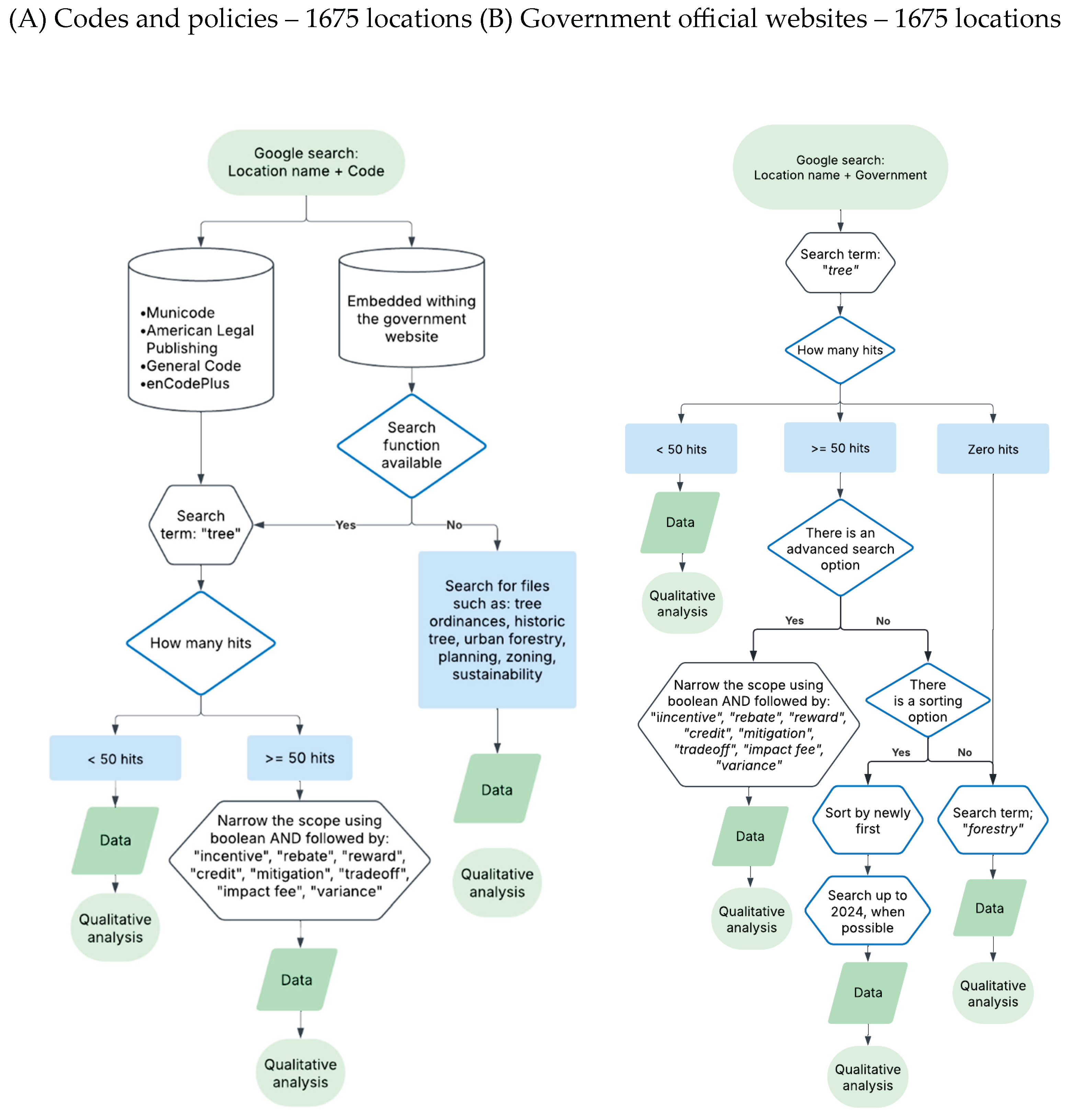
Figure 2.
Different aspects of each type of tree management. Not organized chronologically, but considering the stages observed in an urban forest management plan.
Figure 2.
Different aspects of each type of tree management. Not organized chronologically, but considering the stages observed in an urban forest management plan.
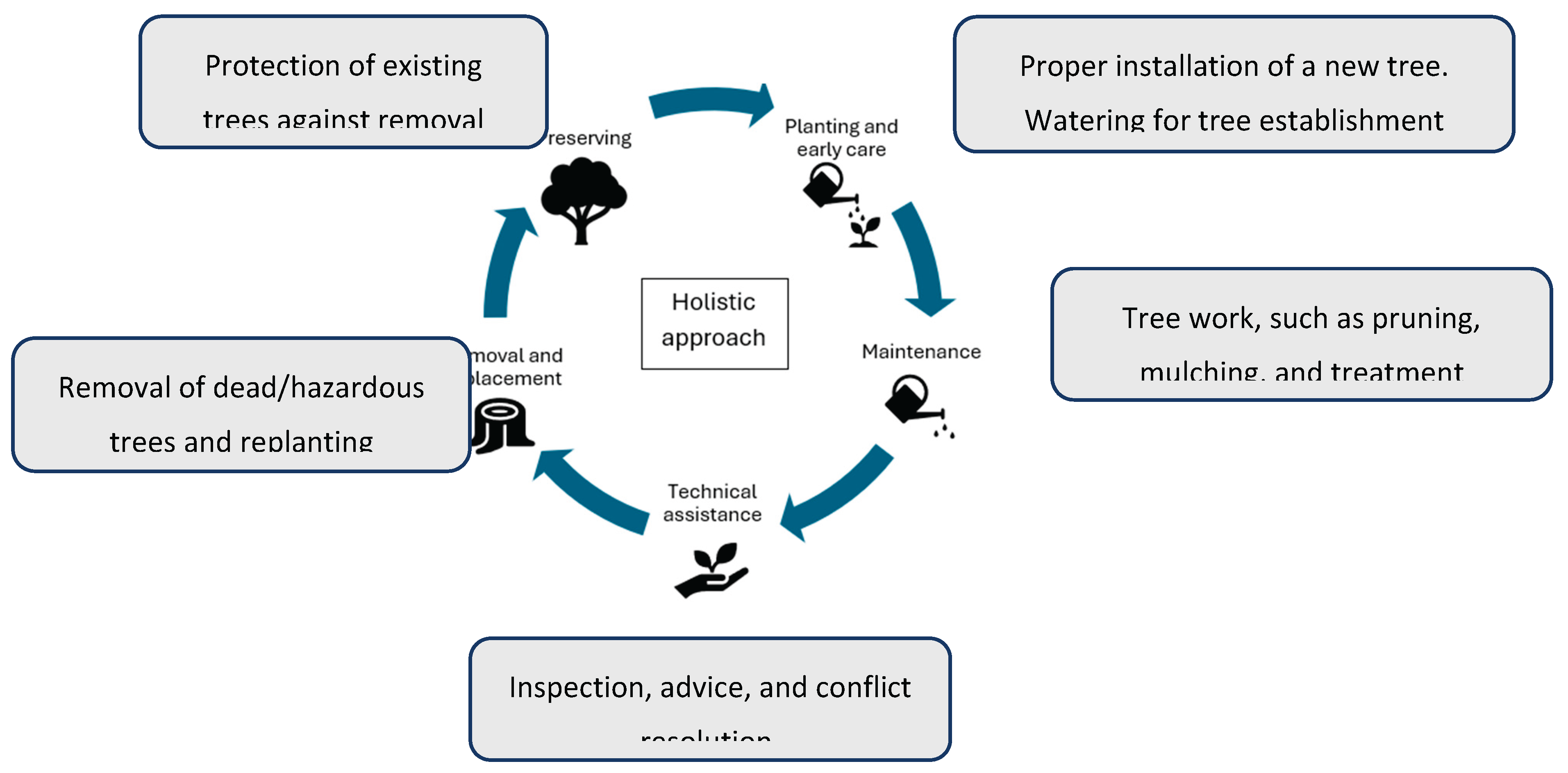
Figure 3.
Flow based on the PRISMA 2020 (Page et al., 2021) diagram for systematic reviews, adapted to include locations investigated on the database (Phase One) and on the internet for codes and policies and official government websites (Phase Two) searches.
Figure 3.
Flow based on the PRISMA 2020 (Page et al., 2021) diagram for systematic reviews, adapted to include locations investigated on the database (Phase One) and on the internet for codes and policies and official government websites (Phase Two) searches.
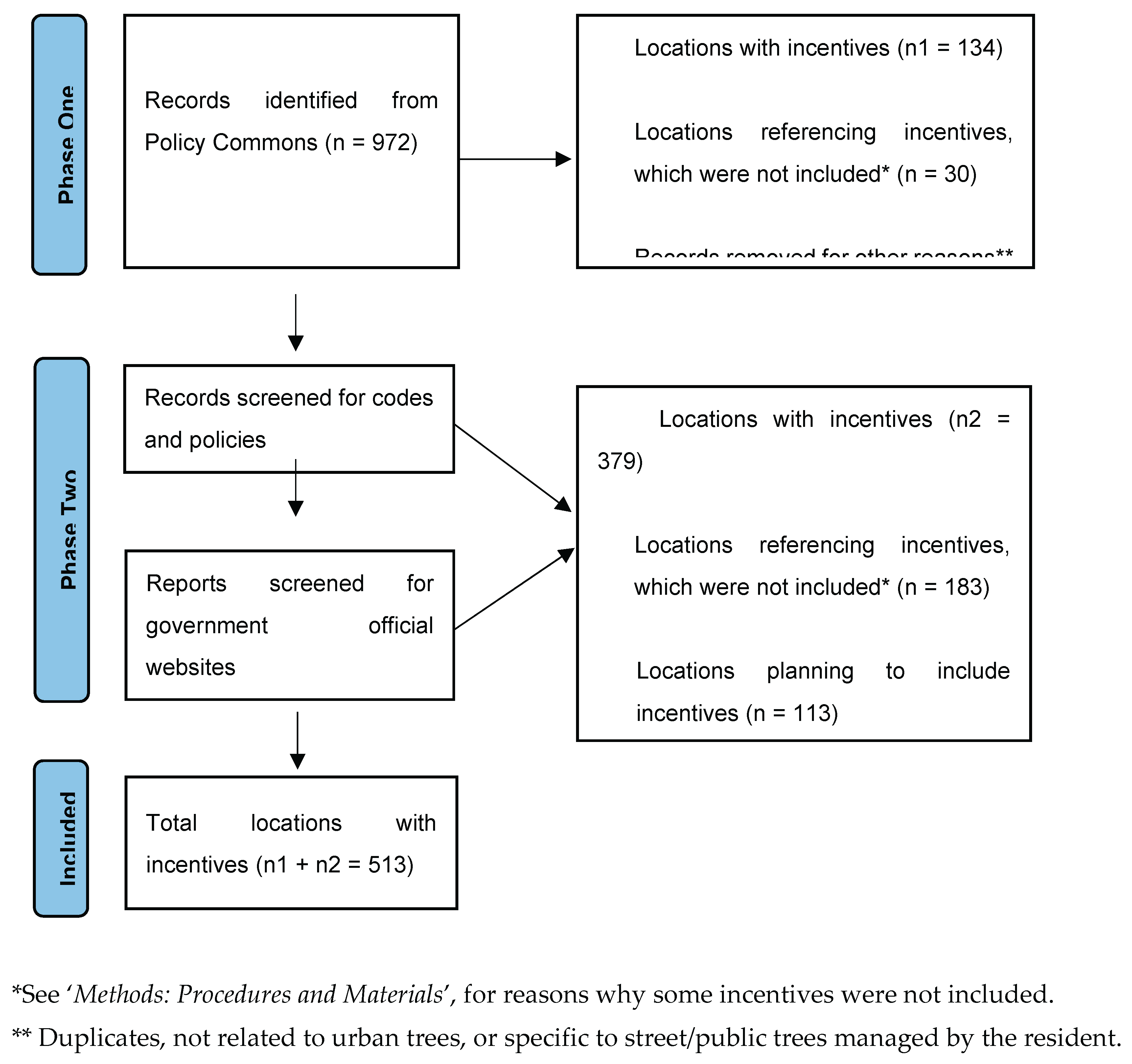

Table 1.
Coding book of categories for incentives based on similar characteristics.
| Categories | Definition | Type of management | Frequency (N = 713) |
| Flexible design requirements | Modify standards required for new construction, such as reducing parking requirements, expediting analysis of projects/permits, approving variances, changing lot lines, or endorsing development of overlay districts/flexible lots/planning regulations | Planting, preserving | 158 (22.2%) |
| Design requirement credit | System of compensation used for landscape design requirements, considered when the ratio reflects an incentive for preserving or planting more trees (more than 1:1 credit) | Planting, preserving | 161 (22.6%) |
| Grants, allowances, loans | The government awarded grants, allowances, shared costs, matched funding, and non-interest loans to residents and/or neighborhoods for tree planting, maintenance, removal and replacement | Planting, maintenance, removal | 83 (11.6%) |
| Rebate | The government reimburses residents after confirming that the tree is planted or the work is completed | Planting, maintenance, removal | 44 (6.2%) |
| Density bonus | Increase building density, building height, impervious surface ratio, or floor area ratio (FAR) | Planting, preserving | 44 (6.2%) |
| Tax/fee abatement | Deduction/credit/relief/exemption of property tax or development/landscape/stormwater/impact fee granted to the property where the tree is located | Planting, maintenance, removal, preserving | 36 (5.0%) |
| Tree service | Government crews or contractors execute tree work without charge or at a below-market rate on trees | Maintenance, removal | 24 (3.4%) |
| Stewards | Government arborists train and certify volunteers/citizens to help with tree maintenance | Planting, maintenance | 24 (3.4%) |
| Inspection | Government arborists inspect the tree and provide technical information or risk assessment without charge or at a below-market payment | Technical assistance | 19 (2.7%) |
| New tree installation | A new tree is installed on private property by a government crew or contractor without charge or at a below-market payment. | Planting | 17 (2.4%) |
| Advice | Government staff provide general technical information by phone or email, without inspecting the tree | Technical assistance | 17 (2.4%) |
| Mulch | The government provides mulch at no charge or at a below-market payment | Maintenance | 10 (1.4%) |
| Green jobs | The government allocates resources for green jobs, community leadership, with the intent to bridge communication between the government and residents | Planting, maintenance | 6 (0.8%) |
| Mediation | The government offers free or at below-market rate mediation services for neighboring properties with tree issues | Technical assistance | 2 (0.3%) |
| Other | The government makes a general reference to “incentive”, offers more than one incentive, or creates a particular and unique type of incentive | Unique | 68 (9.5%) |
Disclaimer/Publisher’s Note: The statements, opinions and data contained in all publications are solely those of the individual author(s) and contributor(s) and not of MDPI and/or the editor(s). MDPI and/or the editor(s) disclaim responsibility for any injury to people or property resulting from any ideas, methods, instructions or products referred to in the content. |
© 2026 by the authors. Licensee MDPI, Basel, Switzerland. This article is an open access article distributed under the terms and conditions of the Creative Commons Attribution (CC BY) license (http://creativecommons.org/licenses/by/4.0/).
Copyright: This open access article is published under a Creative Commons CC BY 4.0 license, which permit the free download, distribution, and reuse, provided that the author and preprint are cited in any reuse.


