

Submitted:
07 February 2026
Posted:
09 February 2026
You are already at the latest version
Abstract
This paper introduces the Generalized Coordinate System (GCS) as a framework for analyzing and generating rhetorical modes---the conventional patterns of discourse. The GCS is composed of ten axes: Thing, Feature, Quantitative Attribute, Qualitative Attribute, Formal Attribute, Basic Element, Rhetorical Mode, Cognitive Function, Epistemic Purpose, and the Five-Level Expression Staircase. The first six axes represent lower-dimensional components, the seventh serves as the ontological axis for rhetorical modes, and the final three constitute higher-dimensional components. Three types of semantic or modal mapping are defined: low-dimensional mapping (from lower-dimensional axes to the ontological axis), high-dimensional mapping (from the ontological axis to higher-dimensional axes), and full-dimensional mapping. These mappings form a pyramidal hierarchy, progressing from foundational elements (things, features, and attributes) to higher-order cognitive functions and epistemic purposes. By employing three core logical structures---combinatory, parallel, and embedded---the GCS consolidates infinite expressive possibilities within the finite intersections of its axes. The system's generative capacity, quantifiable by the number of axis intersections (generalized mode number), enables the navigation of nearly infinite expressive variations while steering practical applications toward finite, purpose-driven goals. The GCS transitions rhetorical modes from a static taxonomy to a dynamic analytical system for discourse construction and analysis, offering possibly insights for the development of large language models through the integration of a programmable rhetorical mode system.

Keywords:
rhetorical modes
; generalized coordinate system
; cognitive functions
; low-dimensional mapping
; high-dimensional mapping
; full-dimensional mapping
1. Introduction
Rhetorical modes have a long and rich history of development, dating back to the foundational works of Aristotle (c. 335 BCE/2007), Bain (1866), Hill (1895), and Connors (1997). Modern comprehensive composition textbooks continue to highlight an overlapping cluster of rhetorical modes (e.g., Corbett & Connors, 1999; Hacker & Sommers, 2022; Kirszner & Mandell, 1986; Lunsford, 2021; Lunsford, Ruszkiewicz & Walters, 2021; Nadell, Langan & Coxwell-Teague, 2019; Oshima & Hogue, 2007; Smalley, Ruetten & Kozyrev, 2011). These modes are primarily known through their application in writing practice. For example, rhetorical modes serve as the second layer in the progressive four-level writing method that progresses from the basic expression layer, through the academic mapping layer, to the functional unit layer, and finally, to the thesis integral layer (Wu, 2026).
In contemporary times, despite the ongoing evolution of academic discourse, a core group of rhetorical modes remains central in numerous authoritative writing and rhetoric textbooks (e.g., Corbett & Connors, 1999; Lunsford, 2021). This enduring presence underscores the theoretical vitality and practical utility of rhetorical modes, both as analytical tools and pedagogical methods. While the spectrum of rhetorical modes continues to evolve, recent proposals, such as Wu’s (2025) duality mode operation method, offer new ways to generate and expand these modes.
However, a review of this tradition reveals that much of the research and pedagogical focus has centered on identifying and imitating rhetorical modes, often treating them as isolated textual techniques. Despite the growing diversity of modes, there remains a lack of an integrated theoretical framework that bridges linguistic form, cognitive processes, and real-world applications. Specifically, existing systems have yet to systematically address several interconnected core questions:
- What specific objects (entities) do these modes operate upon?
- What multimodal semiotic resources (media) do they rely on?
- How do they align with fundamental human cognitive functions (mind)?
- How do they ultimately serve real-world social practices (purpose)?
- More importantly, how does an individual’s competence in utilizing these modes progressively develop and differentiate (agent development)?
To address these questions, this paper proposes a theoretical framework: the General Coordinate System (GCS) of Rhetorical Modes. The GCS consists of ten dimensions, each corresponding to a generalized coordinate axis, with specific expressions represented as generalized coordinate points within this system. These axes include: the Thing Axis (Object Category), the Feature Axis (Analytic Feature), the Quantitative Attribute Axis, the Qualitative Attribute Axis, the Formal Attribute Axis, the Basic Element Axis (Multimodal Symbolic Resources), the Rhetorical Mode Axis (Various Rhetorical Modes), the Cognitive Function Axis (Cognitive Function), the Epistemic Purpose Axis (Application Level), and the Five-Level Expression Staircase Model Axis (User Competency Development Ladder). Section 2 further defines these ten axes.
The GCS allows for the construction of a pyramid-like mapping model that spans from "what acts upon" (things, features, and attributes), "what to express with" (basic elements), "how to express" (mode types), "what is the purpose" (cognition and application), to "who expresses" (competency development). This model converges infinite expressive possibilities within the finite intersections of the ten axes. Section 3 delves into the transition from static "axes" to a dynamic "system," exploring how various mapping methods can generate and operationalize meaning. The nesting functions mentioned in Section 3 will be defined in Appendix A.
Based on the exposition of the coordinate system’s static composition and dynamic mapping in the preceding sections, Section 4 subjects the descriptive power of this framework to quantitative verification. By calculating the "Generalized Modes Number" (GMn) under mappings from low-dimensional to high-dimensional and full-dimensional configurations, this section visually reveals the near-infinite combinatorial possibilities inherent within the system, thereby providing mathematical confirmation of its richness and expansive potential as a powerful engine for meaning generation.
Section 5 provides a short summary of the work and limitation.
2. The Generalized Coordinate Axes of Rhetorical Modes
Ontologies explicitly represent domains by defining the entities, properties, and relationships that constitute the real world. These ontologies serve as semantic models, capturing and representing various aspects of reality (Obrst et al., 2007). Inspired by this concept, we propose a system of generalized coordinate axes designed to encompass all elements relevant to the application of rhetorical modes. Table 1 lists the ten generalized coordinate axes, each divided into several representative, though not necessarily exclusive, subcategories dubbed major ticks (MS) in this paper. The representativeness of these major ticks can be further clarified by minor ticks beneath them. These generalized coordinate axes are categorized into three types: low-dimensional axes, the ontological axis, and high-dimensional axes. In this paper, "low-dimensional" refers to the foundational, more basic generalized coordinate axes, while "high-dimensional" refers to higher-level axes, such as cognitive functions and epistemic purposes. Their definitions and relationships are introduced below and discussed further in the following sections.
2.1. Low-Dimensional Coordinate Axes
Low-dimensional axes include the Thing Axis, Analytic Feature Axis, Quantitative Attribute Axis, Qualitative Attribute Axis, Formal Attribute Axis, and Basic Element Axis.
2.1.1. Axis One: Thing Type Axis (Th)
The first generalized coordinate axis is the Thing Type Axis. We denote the set of major ticks on the Thing Axis (Things) as , where denotes the total number of major ticks on this axis, and (for ) represents the name of each major tick, i.e., the thing category. Here, we introduce five basic thing categories, setting . The major ticks are:
1. Physical Entity (k=1)
2. Abstract Thing (k=2)
3. Event and Process (k=3)
4. Relation and System (k=4)
5. Mind and Experience (k=5)
Each major tick can be further divided into minor ticks, with varying numbers, potentially inexhaustible. For example, minor ticks under "Physical Entity" include: - Natural Entities (mountains, rivers, minerals, celestial bodies, etc.) - Artificial Entities (tools, books, buildings, vehicles, daily items, etc.) - Living Organisms (plants, animals, humans, etc.).
2.1.2. Axis Two: Analytic Feature Axis (Ft)
The second generalized coordinate axis is the Analytic Feature Axis. We denote the set of major ticks on the Feature Axis (Features) as , where denotes the total number of major ticks on this axis, and (for ) is the name of each major tick, i.e., the feature category. This paper classifies seven basic feature types, setting . The major ticks are:
1. Morphology and Composition (k=1)
2. State (k=2)
3. Dynamic (k=3)
4. Function (k=4)
5. Relation (k=5)
6. Cognition and Representation (k=6)
7. Origin and History (k=7)
Each major tick can be further divided into minor ticks. For example, minor ticks under "Morphology and Composition" include: - External form - Internal composition - Organizational structure, etc. The specific meanings of each major tick will be clarified further in the following sections.
2.1.3. Axis Three: Quantitative Attribute Axis (Qt)
The third generalized coordinate axis is Quantitative Attribute. We denote the set of major ticks on the Quantitative Attribute Axis (Quantitative Attributes) as , where denotes the total number of major ticks on this axis, and (for ) is the name of each major tick, i.e., the quantitative attribute category. This paper classifies three basic quantitative attribute types, setting . The major ticks are: 1. Basic Measurement (k=1) 2. Quantity and Frequency (k=2) 3. Ratio and Intensity (k=3)
Each major tick can be further divided into minor ticks. For example, minor ticks under "Basic Measurement" include: - Size - Length - Area - Volume - Mass - Temperature - Time point - Coordinates, etc.
2.1.4. Axis Four: Qualitative Attribute Axis (Ql)
The fourth generalized coordinate axis is Qualitative Attribute. We denote the set of major ticks on the Qualitative Attribute Axis (Qualitative Attributes) as , where denotes the total number of major ticks on this axis, and (for ) is the name of each major tick, i.e., the qualitative attribute category. This paper classifies five basic qualitative attribute types, setting . The major ticks are:
1. Shape and Configuration (k=1)
2. Color and Pattern (k=2)
3. Texture and Perception (k=3)
4. Position and Orientation (k=4)
5. Material and Composition (k=5)
Each major tick can be further divided into minor ticks. For example, minor ticks under "Shape and Configuration" include: - Geometric form - Contour - Spatial arrangement among physical components, etc.
2.1.5. Axis Five: Formal Attribute Axis (Fm)
The fifth generalized coordinate axis is Formal Attribute. We denote the set of major ticks on the Formal Attribute Axis (Formal Attributes) as , where denotes the total number of major ticks on this axis, and (for ) is the name of each major tick, i.e., the formal attribute category. This paper classifies four basic formal attribute types, setting . The major ticks are:
1. Logical Relation (k=1)
2. Action Structure (k=2)
3. Rule and Constraint (k=3)
4. Symbol and Formula (k=4)
Each major tick can be further divided into minor ticks. For example, minor ticks under "Logical Relation" include: - Inclusion - Equivalence - Causality - Implication, etc.
2.1.6. Axis Six: Basic Element Axis (Be)
The sixth generalized coordinate axis is the Basic Element Axis. We denote the set of major ticks on the Basic Element Axis (Basic Elements) as , where denotes the total number of major ticks on this axis, and (for ) is the name of each major tick, i.e., the basic element category. In practical applications, the types of basic elements are diverse. This paper summarizes them into seven major types of expressive resources, setting . The major ticks are:
1. Language (k=1)
2. Numbers and Symbols (k=2)
3. Mathematical Formulas and Equations (k=3)
4. Images and Diagrams (k=4)
5. Data and Relation Visualization (k=5)
6. Sound, Gesture, and Dynamic Demonstration (k=6)
7. Notation/Markup (k=7)
Each major tick can be further divided into numerous and diverse minor ticks. For example, minor ticks under "Language" include: - Terms and directional words - Topic sentences of paragraphs - Transitional phrases - Cross-references - Outline and heading hierarchy, etc.
Gesture, though difficult to appear in text, may have importance in oral communication (Rizzo, Berger, & Zhou, 2025). Note that rhetorical modes are not only used in written text but also in oral communication. The use of gestures can play a significant role in enhancing meaning and engagement in face-to-face communication, helping to express nuances that are difficult to convey through words alone.
2.2. Ontological Axis: Rhetorical Modes
The ontological axis, placed at the seventh, refers to rhetorical modes (Rm), and is a mediating layer between low- and high-dimensional coordinate axes.
We denote the set of major ticks on the Rhetorical Mode Axis as , where denotes the total number of major ticks on this axis, and () is the name of the major tick, i.e., the specific rhetorical mode.
This paper considers 18 rhetorical modes (), the major ticks and simple meaning are presented in Table 2. In Table 2, rhetorical modes are presented and divided into four major categories: foundational rhetorical modes, relational rhetorical modes, organizational rhetorical modes, and comprehensive rhetorical modes.
2.3. High-Dimensional Coordinate Axes
High-dimensional axes include the Rhetorical Mode Axis itself, the Cognitive Function Axis, the Epistemic Purpose Axis, and the Five-Level Expression Staircase Model Axis. Within the Generalized Coordinate System of Rhetorical Modes, elements on high-dimensional axes primarily serve as dependent variables, although some can also act as independent variables.
2.3.1. Axis Eight: Cognitive Function Axis (Cf)
The eighth generalized coordinate axis is the Cognitive Function Axis. We denote the set of major ticks on the Cognitive Function Axis (Cognitive functions) as , where denotes the total number of major ticks on this axis, and (for ) represents the name of each major tick, i.e., the specific cognitive function.
This paper considers the 14 cognitive functions introduced by Wu (2025), thus setting . The major ticks are:
1. Observation (k=1)
2. Identification (k=2)
3. Comparison/Alignment (k=3)
4. Classification (k=4)
5. Abstraction (k=5)
6. Hypothesis (k=6)
7. Modeling (k=7)
8. Inference (k=8)
9. Testing/Verification (k=9)
10. Explanation (k=10)
11. Evaluation (k=11)
12. Prediction (k=12)
13. Integration/Synthesis (k=13)
14. Reflection/Metacognitive Evaluation (k=14)
2.3.2. Axis Nine: Epistemic Purpose Axis (Ep)
The ninth generalized coordinate axis is the Epistemic Purpose Axis. We denote the set of major ticks on the Epistemic Purpose Axis (Epistemic functions) as , where denotes the total number of major ticks on this axis, and (for ) represents the name of each major tick, i.e., the specific epistemic purpose category.
We consider the 8 categories introduced by Wu (2025), thus setting . The major ticks are:
1. Knowledge Formation (k=1)
2. Scientific Discovery (k=2)
3. Writing and Communication (k=3)
4. Teaching/Learning (k=4)
5. Problem-Solving (k=5)
6. Innovation/Design (k=6)
7. Evaluation/Decision-Making (k=7)
8. Policy/Action Implementation (k=8)
2.3.3. Axis Ten: Five-Level Expression Staircase Axis (Es)
The tenth generalized coordinate axis is the Five-Level Expression Staircase Model of Rhetorical Modes (level of competence). We denote the set of major ticks on the Expression Staircase Axis (Expression staircase) as , where denotes the total number of major ticks on this axis, and (for ) represents the name of each major tick, i.e., the specific expression level.
This paper adopts a five-layer developmental model from basic to high-order, thus setting . The major ticks are:
1. Sensory Level (k=1)
2. Autonomous Expression Level (k=2)
3. Academic Standard Level (k=3)
4. Methodological Level (k=4)
5. Knowledge Enlightenment Level (k=5)
See Table 3 for explanation of each level.
2.4. From Axes to System: Dimensional Interactions and Theoretical Positioning
The power of the generalized coordinate system lies not in a simple listing of dimensions, but in their dynamic, structured interactions. The crucial shift from static "axes" to a dynamic "system" is key to understanding how the system operates and generates meaning.
Dimensional interactions follow a fundamental logic: low-dimensional axes (Things, Features, Attributes, Elements) typically serve as "independent variables" or "building materials," providing objective objects, analytical perspectives, and symbolic resources for expression. In contrast, the ontological axis (Rhetorical Modes) and high-dimensional axes (Cognitive Functions, Epistemic Purposes, Expression Staircase) often function as "dependent variables" or "organizational frameworks," reflecting active cognitive operations, social purposes, and the expresser’s developmental level based on the aforementioned materials.
For example, when we choose to "evaluate" (Rhetorical Mode Axis) the "function" (Feature Axis) of an "artificial entity" (Thing Axis), a cross-dimensional combination of meaning occurs.
It is important to emphasize that this role division is functional rather than absolute. For instance, a "rhetorical mode" itself, when analyzed and classified, can be considered a low-dimensional "thing"; yet when actively invoked to organize thought, it becomes a high-dimensional cognitive tool.
This design distinguishes the Generalized Rhetorical Coordinate System from traditional static category systems. Category systems aim to provide a comprehensive, exhaustive list of all types through complete enumeration (Thomasson, 2004). In contrast, the Generalized Rhetorical Coordinate System does not attempt to exhaustively list all rhetorical phenomena but instead provides a limited set of foundational analytical dimensions. Its core purpose is to discretely represent, analyze, and generate nearly infinite, specific rhetorical practices through the combination and projection of these dimensions at "coordinate intersections." This creates a generative path of "approaching the infinite with the finite"—similar to how limited musical notes can generate endless melodies through combination.
Furthermore, this framework possesses strong integrative and explanatory power. For example, various isolated phenomena (such as organizational structures, components, abstract essence, universality, stability, functional roles, and value attributes) and the relations between them (e.g., interrelations, coexistence, covariation, opposition, causality) as pointed out by Davis (1971) can be incorporated into different dimensions.
Therefore, the Generalized Coordinate System of Rhetorical Modes is a dynamic, generative analytical system. It serves both as a grid for "parsing" existing discourse and as a blueprint for "designing" and "innovating" effective expression. It elevates rhetorical modes from a traditional, isolated typological list to an ecological system rooted in cognitive laws and social practices, where dimensions mutually define and drive each other. This system provides a theoretical map and methodological foundation for advancing rhetorical competence from "unconscious use" to "conscious construction."
4. The Potential of the Generalized Coordinate System
This section explores the number of coordinate points in the generalized coordinate system when mapping from low-dimensional to high-dimensional to full-dimensional, aiming to reveal the near-infinite modal possibilities generated by various combinations within the system. This quantification will help intuitively demonstrate the descriptive potential and expressive richness contained in the framework.
4.1. Generalized Modes Number (GMn)
The number of coordinate points corresponds to the total number of combinatorial possibilities, called the Generalized Modes Number (GMn), which varies depending on the chosen "dependent variable axis."
Definition: For a chosen dependent variable axis, its Generalized Modes Number (GMn) equals the product of the number of major ticks on all axes considered as independent variables.
According to the above definition, we can calculate the GMn for four core application layers, from basic to advanced, step by step.
Recall the number of major ticks for each axis given in Section 2: , , , , , , , , , .
Let
The quantity is shown in Table 4.
Table 4 quantifies the explosive growth of descriptive possibilities within the framework. As the mapping scope expands, progressively incorporating the Rhetorical Mode axis (Rm), the Cognitive Function axis (Cf), the Epistemic Purpose axis (Ep), and finally the Five-Level Expression Staircase (Es) as independent variables, the Generalized Modes Number escalates from 14,700 to nearly 148 million.
This exponential increase, governed by the product formula , means nearly infinite modal possibilities. It visually substantiates the role of the Ontological Axis (Rm) as a pivotal mediator: by combining low-dimensional elements (axes 1–6), it generates a vast, structured space of options that serve higher-dimensional cognitive and epistemic purposes. The global GMn value (approximately 1.5) defines the comprehensive combinatorial space available for computational text analysis under this model.
4.2. From Infinite Possibilities to Finite Purposes
The data of Generalized Modes reveals the fact that the modal number is extremely large. This fact, on one hand, illustrates the infiniteness of rhetorical mode expression; on the other hand, it indicates the need to consider finite goals in specific practice.
The combinatorial calculations based on major ticks have revealed a structurally hierarchical modal landscape of staggering scale: without considering minor tick refinements, the Generalized Modes Number for Rhetorical Modes has reached 14,700; the Cognitive Function modal number leaps to 264,600; the Epistemic Purpose modal number soars to 3,704,400; and the modal number for the Five-Level Expression Staircase reaches an astronomical 29,635,200. This is merely the combination of major ticks. If minor ticks under each major coordinate axis, with quantities not less than an order of magnitude of 10, are taken into account, the number of unique modes that can be generated for rhetorical modes alone will surpass , while the modal numbers for the rest will move towards profound mathematical spaces difficult for human intuition to grasp.
This nearly infinite modal number is not a theoretical fiction but a faithful mapping of the infinite complexity of the world and cognition itself. It symbolizes four aspects:
- 1.
-
Infinite Details of the Objective WorldAll things exhibit infinite details due to their wide spectrum of kinds, multi-dimensional features, and triple attributes.
- 2.
-
Infinite Paths of Cognitive ProcessesHuman understanding and interpretation of things inherently have countless possible entry points and combinations of thought.
- 3.
-
Infinite Possibilities of Meaning GenerationLanguage and expression are not closed boxes but open, creative systems that can be infinitely combined and regenerated.
- 4.
-
Infinite Levels of Competency AdvancementFrom sensory capture to wisdom enlightenment, the ascent of expressive ability is a never-ending, finely describable process, not merely divisible into Sensory Level, Autonomous Expression Level, Academic Standard Level, Methodological Level, and Knowledge Enlightenment Level.
Therefore, the Generalized Modes Number is not a fixed list to be memorized but a coordinate system capable of navigating infinite possibilities, a powerful meaning generation engine.
A mechanical application of the Generalized Coordinate System of Rhetorical Modes is to create static classification tables, mechanically applying low-dimensional, high-dimensional, and full-dimensional mapping methods. Such mechanical application can be achieved with the help of artificial intelligence tools like large language models. The Generalized Coordinate System of Rhetorical Modes we propose provides a viable path for how future large language models might approach rhetorical modes.
However, in human practice, we need to jump out from static classification table mode and adopt a dynamic, dialectical method to construct rhetorical modes and cognitive functions. For this purpose, there are three directions to choose from.
- 1.
-
Forward NavigationForward navigation is the most direct application logic. We start from insights into things, features, and attributes, select and combine multimodal resources from the basic element library to form rhetorical modes, ultimately aiming to achieve specific cognitive functions and application purposes. This is the goal of low-dimensional and high-dimensional mapping.
- 2.
-
Reverse NavigationHowever, this process can also operate in reverse: when we have clear intentions for cognitive functions and epistemic purposes, the coordinate system will guide us in reverse to discover or design the rhetorical modes and basic elements that best achieve these purposes. This is a method that can be considered for full-dimensional mapping.
- 3.
-
Omni-directional NavigationThis is precisely the essence of the "map and compass" metaphor: the map shows the whole picture, the compass guides the direction—only by combining the two can one chart their own course amidst infinite possibilities. We are no longer confined to irreversible thinking; reversible thinking allows us to navigate in various directions.
Regardless of the direction of navigation, achieving cognitive functions and purposes, and advancing along the Five-Level Expression Staircase, will be the yardstick by which we measure the height and depth of navigation, marking the competency progression from sensory depiction to knowledge creation.
5. Summary, limitation and Future Directions
The core contribution of this work lies in the construction of the Generalized Coordinate System of Rhetorical Modes, an integrative theoretical framework. This system unifies the operational logic of rhetorical modes across five dimensions: Acting Upon What (objects, features, attributes), Expressed With What (multimodal basic elements), What They Are (four categories of 18 core modes), How to Express (cognitive functions and epistemic purposes), and Who Expresses (the Five-Level Expression Staircase). By doing so, it elevates rhetorical modes from a static typology to a dynamic, navigable cognitive and practical operating system.
This coordinate system reveals the tripartite nature of rhetorical modes: they serve as formal discourse structures, functional cognitive tools, and strategic communicative acts. Its fundamental value lies in providing a set of "grammars of thought" that converge infinite expressive possibilities into a finite, structured, and analyzable space, guiding practitioners from unconscious use to methodological awareness.
This paper presents a complete theoretical coordinate system and paradigm, rather than an exhaustive enumeration of its near-infinite combinations. Its "finiteness" serves as the starting point for practical application. The primary future direction is to develop a formal, derivable, and programmable theory based on this Generalized Coordinate System. Specific pathways for future development include:
- Formal Modeling: Transforming the axes and their relationships into computable formal rules and constraint logics.
- Algorithmic Implementation: Exploring the integration of this formal system into computational architectures, such as Large Language Models (LLMs), enabling them to understand, generate, and evaluate complex rhetorical structures aligned with cognitive purposes.
- Tool Development: Building intelligent assistants for analysis, writing, and pedagogy based on the above model.
Ultimately, by empowering various applications with this structured "grammar of thought," this research aims to provide a solid theoretical foundation and a programmable pathway for enhancing the level of deep cognitive collaboration and creative expression between humans and machines.
Acknowledgments
This paper was initially drafted in Chinese. Large language models, including ChatGPT and DeepSeek, were utilized interchangeably to assist in translating the text into English. The translated content was then cross-checked for consistency.
Appendix A Three Basic Logical Structures of Nesting Functions
Nesting functions are defined as organizational methods among elements from various axes. Nesting functions can be divided into three basic logical structures: Combinatory, Parallel, and Embedded. They correspond to combination operations of different scales and natures, collectively determining the form, density, and complexity of information flow. The three logical structures can also be mixed to form comprehensive logical structures. When introducing nesting functions, we also introduce symbolic expressions. Similarly, it needs to be stated that the current symbolic expressions are only for illustrative purposes and are not strict mathematical expressions.
Appendix A.1. Combinatory Structure
Definition: Combinatory Structure refers to the direct combination of basic elements (from Th, Ft, Qt, Ql, Fm, Be) across different independent variable dimensions at the lexical, phrasal, or simple sentence level to form a meaningful expression unit. This is the atomic operation for constructing all complex expressions.
Manifestation: Often manifested as multiple modifiers, compound noun phrases, or closely related short sentences.
Example: “The fitness trainer’s waist-to-hip ratio is 0.80.” This sentence combines elements from three dimensions: Thing, Feature, and Quantitative Attribute.
- Thing (Th): Person among living organisms (fitness trainer)
- Feature (Ft): Morphology and composition (waist-to-hip ratio)
- Quantitative Attribute (Qt): Ratio and intensity (0.80)
Symbolic representation: When describing the combination of basic elements, use the multiplication symbol “|” to connect elements from different dimensions, emphasizing their cross-composite relationship. The general expression is , where .
For example: , where .
Function: Achieving precise reference and basic propositional statements. It is the most basic and frequently invoked operation in the base mapping function , responsible for “gluing” discrete coordinate ticks into expression blocks with specific meanings. We focus on explaining core combinatory patterns such as “” (Feature–Quantitative), “” (Feature–Qualitative), “” (Feature–Formal), etc.
Appendix A.2. Parallel Structure
Definition: Parallel Structure refers to multiple elements (Rm or Cf) of the same dimension being deployed sequentially in text or thought flow, with equal status and relatively independent semantics. They are related by jointly serving the same higher-level goal, akin to parallel circuits.
Symbolic representation: Use “” to connect elements in a sequence, emphasizing their parallel nature and cumulative relationship. For example:
Function: Expanding breadth and coverage. Suitable for situations requiring multi-angle, multi-evidence, modular coverage of a complex topic.
Appendix A.3. Embedded Structure
Definition: Embedded Structure refers to the organic integration of one or more other elements (often from the same dimension) within the unfolding process of an element (Rm or Cf), forming a hierarchical and encapsulating relationship, like Russian nesting dolls.
Symbolic representation: Use “→” to denote embedding, with the main element on the left and the embedded element on the right. For example, “” means “comparing within description.” Another example: “” means “identifying while observing.” Sometimes, multiple nested structures can be formed, e.g.,
Function: Increasing depth and complexity. Suitable for situations requiring instant completion of multi-layer cognitive processing within a core operation, or making expression more precise and thinking more economical.
Appendix A.4. Comprehensive Example
A complex “Scientific Discovery” purpose () realization can clearly demonstrate the coordination of the three structures:
This sequence indicates that scientific discovery begins with an observation activity embedded with identification, followed by the parallel proposal of hypotheses. It then achieves the “testing” function through a combination of two parallel modes: experimental procedures and data analysis (which is embedded with comparison). Finally, inference and evaluation are conducted in parallel. Moreover, the generation of each rhetorical mode itself relies on the combination of fundamental dimensional elements through a large number of combinatory structures at the underlying level.
By formalizing nesting relationships () and the three logical structures (), pyramid mapping transforms from a theoretical diagram into an operational blueprint that can be parsed, designed, and replicated. This provides a key methodological bridge for readers to move from understanding the framework to actively constructing with it.
References
- Aristotle. On rhetoric: A theory of civic discourse, 2nd ed.; Kennedy, G. A., Translator; Oxford University Press, 2007. [Google Scholar]
- Bain, A. English composition and rhetoric: A manual . In Alexander and Shepheard; 1866. [Google Scholar]
- Baldwin, J.; Ulusoy, E.; Durfee, M.; Busselle, R.; Ewoldsen, D. R. Watching one more episode and reading one more chapter: What entertainment contexts lead to retrospective imaginative involvement? Acta Psychologica 2025, 242, 105101. [Google Scholar] [CrossRef] [PubMed]
- Carroll, L. Through the Looking-Glass, and What Alice Found There (Chapter 4: Tweedledum and Tweedledee); Macmillan, 1871. [Google Scholar]
- Connors, R. J. Composition-rhetoric: Backgrounds, theory, and pedagogy; University of Pittsburgh Press, 1997. [Google Scholar]
- Corbett, E. P. J.; Connors, R. J. Classical rhetoric for the modern student, 4th ed.; Oxford University Press, 1999. [Google Scholar]
- Davis, M. S. That’s interesting!: Towards a phenomenology of sociology and a sociology of phenomenology. Philosophy of Social Society 1971, 1(2), 309–344. [Google Scholar] [CrossRef]
- Hacker, D.; Sommers, N. A Writer’s Reference, 10th ed.; Bed ford/St. Martin’s, 2020. [Google Scholar]
- Hill, A. S. The principles of rhetoric and their application; Harper & Brothers, 1895. [Google Scholar]
- Kirszner, L. G.; Mandell, S. R. Patterns for College Writing: A Rhetorical Reader and Guide; St. Martin’s Press, 1986. [Google Scholar]
- Krasznahorkai, L. Satantango; Szirtes, G., Translator; Harvill Press, 1992. [Google Scholar]
- Lunsford, A. A. The St. Martin’s handbook, 9th ed.; Bedford/St. Martin92256a9a, 2021. [Google Scholar]
- Lunsford, A. A.; Ruszkiewicz, J. J.; Walters, K. Everything’s an Argument, 9th ed.; Bedford/St. Martin’s, 2021. [Google Scholar]
- Nadell, J.; Langan, J.; Coxwell-Teague, D. The Longman Reader, 12th ed.; Pearson, 2019. [Google Scholar]
- Obrst, L.; Ceusters, W.; Mani, I.; Ray, S.; Smith, B. The Evaluation of Ontologies. In Semantic Web; Baker, C.J.O., Cheung, KH., Eds.; Springer: Boston, MA, 2007. [Google Scholar]
- Oshima, A.; Hogue, A. Writing Academic English, 4th ed.; Pear- son Longman, 2007. [Google Scholar]
- Rizzo, G. L. C.; Berger, J.; Zhou, M. EXPRESS: Talking with Your Hands: How Hand Gestures Influence Communication. Journal of Marketing Research 2025, 2025. [Google Scholar] [CrossRef]
- Smalley, R. L.; Ruetten, M. K.; Kozyrev, J. R. Refining Composition Skills: Rhetoric and Grammar for ESL Students, 6th ed.; Heinle Cengage, 2011. [Google Scholar]
- Thomasson, A. Categories. In The Stanford Encyclopedia of Philosophy; Zalta, E. N., Ed.; 2004. [Google Scholar]
- Wu, Z. N. Duality-based mode operation and pyramid multilayer mapping for rhetorical modes. arXiv 2025, arXiv:2511.06601. [Google Scholar] [CrossRef]
- Wu, Z. N. The Four-Level Approach to Thesis Writing. Shaanxi Normal University Press, 2026. [Google Scholar]
Figure 1.
Schematic display of low- dimensional and high- dimensional mappings.
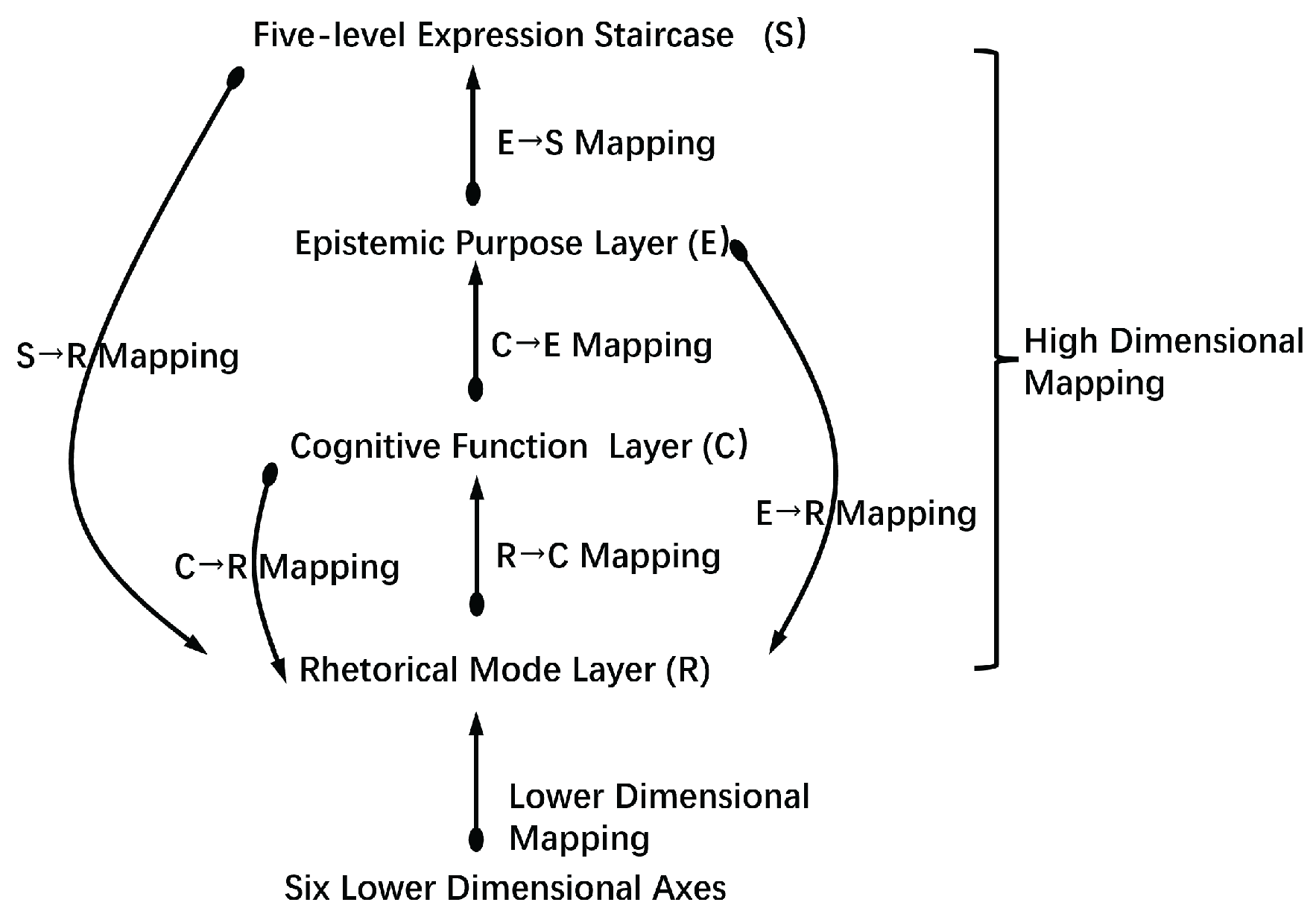

Table 1.
Generalized Coordinate Axes of Rhetorical Modes
| No. | Axis | MT Number | Example | Dimension Level |
|---|---|---|---|---|
| 1 | Thing | 5 | Physical Entity, etc. | Low Dimension |
| 2 | Features | 7 | Morphology and Composition, etc. | Low Dimension |
| 3 | Quantitative Attributes | 3 | Basic Measurement, etc. | Low Dimension |
| 4 | Qualitative Attributes | 4 | Shape and Configuration, etc. | Low Dimension |
| 5 | Formal Attributes | 4 | Logical Relation, etc. | Low Dimension |
| 6 | Basic Elements | 7 | Language, etc. | Low Dimension |
| 7 | Rhetorical Modes | 18 | Description Mode, etc. | Ontological/Mediating Layer |
| 8 | Cognitive Functions | 14 | Observation, etc. | High Dimension |
| 9 | Epistemic Purposes | 8 | Knowledge Formation, etc. | High Dimension |
| 10 | Five-Level Expression Staircase | 5 | Sensory Level, etc. | High Dimension |
Table 2.
List of Rhetorical Modes
| No. | Rhetorical Mode | Brief Introduction (Function) | Category |
|---|---|---|---|
| 1 | Description | Depicts sensory or factual attributes in detail. | Foundational Modes |
| 2 | Comparison | Highlights similarities between entities. | Relational Modes |
| 3 | Contrast | Highlights differences between entities. | Relational Modes |
| 4 | Analogy | Explains an unfamiliar idea by mapping to a familiar one. | Relational Modes |
| 5 | Cause and Effect | Traces relationships between actions/events and outcomes. | Relational Modes |
| 6 | Exemplification | Uses specific examples to illustrate or support a point. | Organizational Modes |
| 7 | Evidence | Introduces and interprets data or facts as proof. | Organizational Modes |
| 8 | Classification | Groups items into categories based on shared principles. | Organizational Modes |
| 9 | Division | Breaks a whole into its constituent parts. | Organizational Modes |
| 10 | Process Analysis | Explains the sequence of steps in a procedure. | Organizational Modes |
| 11 | Narration | Presents events or experiences in chronological order. | Organizational Modes |
| 12 | Definition | Establishes the meaning or scope of a concept. | Comprehensive Modes |
| 13 | Evaluation | Makes a judgment about value or significance based on criteria. | Comprehensive Modes |
| 14 | Argumentation | Constructs reasoned claims supported by logic and evidence. | Comprehensive Modes |
| 15 | Persuasion | Aims to influence beliefs, attitudes, or actions. | Comprehensive Modes |
| 16 | Exposition | Provides a clear, factual explanation of an idea. | Comprehensive Modes |
| 17 | Question | Raises inquiries to probe issues or guide discourse. | Comprehensive Modes |
| 18 | Answer | Offers responses or solutions to posed questions. | Comprehensive Modes |
Table 3.
The Five-Level Expression Staircase of Rhetorical Modes
| Level | Name | Explanation | Corresponding Stage |
|---|---|---|---|
| 1 | Sensory Level | Expressing what is directly perceived; knowledge of things and features stems primarily from senses and personal experience. Rhetorical modes emerge in natural language. | Childhood / Early Development |
| 2 | Autonomous Expression Level | Actively selecting, organizing, and combining rhetorical modes to serve one’s own expressive purposes. | Basic Education and Beyond |
| 3 | Academic Standard Level | Transitioning from personal expression to using rhetorical modes within the formal norms and conventions of the academic community. | Undergraduate to Academic Career |
| 4 | Methodological Level | Integrating rhetorical modes into a methodological framework to conduct and disseminate research, guided by cognitive and epistemic purposes. | Research Career (Graduate level and beyond) |
| 5 | Knowledge Enlightenment Level | Using rhetorical modes at the epistemic level to design understanding for others, deconstructing complex knowledge to create teachable pathways. | Teaching, Advanced Authorship, Knowledge Leadership |
Table 4.
Number of generalized modes for five cases of mapping
| No. | Dependent Axis | Independent Axes | ||
|---|---|---|---|---|
| 1 | Rhetorical Mode (Rm) | Th, Ft, Qt, Ql, Fm, Be | 6 | 14,700 |
| 2 | Cognitive Function (Cf) | Th, Ft, Qt, Ql, Fm, Be, Rm | 7 | 264,600 |
| 3 | Epistemic Purpose (Ep) | Th, Ft, Qt, Ql, Fm, Be, Rm, Cf | 8 | 3,704,400 |
| 4 | Five-Level Staircase (Es) | Th, Ft, Qt, Ql, Fm, Be, Rm, Cf, Ep | 9 | 29,635,200 |
| 5 | (All Axes) | Th, Ft, Qt, Ql, Fm, Be, Rm, Cf, Ep, Es | 10 | 148,176,000 |
Disclaimer/Publisher’s Note: The statements, opinions and data contained in all publications are solely those of the individual author(s) and contributor(s) and not of MDPI and/or the editor(s). MDPI and/or the editor(s) disclaim responsibility for any injury to people or property resulting from any ideas, methods, instructions or products referred to in the content. |
© 2026 by the author. Licensee MDPI, Basel, Switzerland. This article is an open access article distributed under the terms and conditions of the Creative Commons Attribution (CC BY) license.
Copyright: This open access article is published under a Creative Commons CC BY 4.0 license, which permit the free download, distribution, and reuse, provided that the author and preprint are cited in any reuse.


