

Submitted:
06 February 2026
Posted:
09 February 2026
You are already at the latest version
Abstract
.Climate change has emerged as a significant global crisis, with the frequency and intensity of climate-induced disasters rising sharply and imposing disproportion-ate costs on developing economies and small island states. This article examines the role of climate-resilient infrastructure as a key aspect of climate-smart growth, integrating mitigation, adaptation, and long-term development objectives. It frames climate-resilient infrastructure not merely as an engineering solution, but as a public good that generates significant positive externalities, reduces systemic macroeconomic risk, and delivers welfare gains that exceed private financial re-turns. Furthermore, the study also highlights substantial cross-country heteroge-neity in resilience outcomes, driven by differences in geographic exposure, eco-nomic capacity, institutional quality, and political economy constraints. The pa-per argues for a welfare-based approach to infrastructure prioritization that ac-counts for service disruptions, distributional impacts, and fiscal risk, rather than asset values alone. It further outlines policy and financing strategies to bridge the gap between social and private returns, including public investment, concessional finance, blended instruments, and nature-based solutions. Heavy premise is placed on strengthening climate-resilient infrastructure not only for safeguarding lives and livelihoods, but also for enabling inclusive, sustainable, and cli-mate-smart economic growth
Keywords:
climate-resilient infrastructure
; infrastructure governance
; adaptation finance
1. Introduction
In an era of diverse global threats, climate change stands out as one of the most defined crises of our time. The number of climate-induced catastrophes has increased fivefold in the past five decades [1] (Figure 1). The growing frequency and intensity of extreme weather events like heatwaves, floods, droughts, and rising sea levels has caused global average temperatures to rise by approximately 1.4 degrees Celsius above pre-industrial levels, setting a record in 2023. Efforts to halve 2019 levels of greenhouse gas emissions by 2030 fall alarmingly short, targeting only a 11 percent reduction [2]. Without stronger action, the overlap between climate and non-climate risks will persist, leading to compounded effects and unprecedented losses to human societies and ecosystems. This hits climate-stressed economies and SIDS hardest, where financing for Loss and Damage remains the biggest barrier.
Well-targeted and timely infrastructural investments can not only protect lives and livelihoods but also play a key role in meeting the mitigation targets of the Paris Agreement. The increasing frequency and intensity of climate-induced disasters and extreme weather events like floods, droughts, and heatwave demand the urgent prioritization of climate-resilient infrastructure, including physical measures like flood defenses, adaptive urban planning, and early warning systems. Given that infrastructure investments can have thirty-year economic life expectancies, transitioning to climate-smart growth can emphasize sustainable economic development while ensuring both mitigation and adaptation efforts towards hazardous climatic conditions, which brings together the irreconcilable trinity of environment, economy and society [3].
Climate resilient infrastructure refers to physical and digital systems such as transport networks, electricity grids, water and sanitation systems, ports, and telecommunications that are designed to withstand, adapt to, and recover from climate-related shocks, including floods, droughts, heatwaves, storm surges, and cyclones, while continuing to deliver essential services. From an economic perspective, resilience is not simply an engineering attribute but a socially valuable characteristic of infrastructure that generates benefits extending well beyond the asset owner. This feature places climate-resilient infrastructure firmly within the realm of public goods and public investment.
Figure 1.
Growing number of reported extreme events and economic losses. Source: OECD report, 2024 [4] (Note: Monetary value calculated in USD, adjusted for inflation with 2021 as base year).
Figure 1.
Growing number of reported extreme events and economic losses. Source: OECD report, 2024 [4] (Note: Monetary value calculated in USD, adjusted for inflation with 2021 as base year).
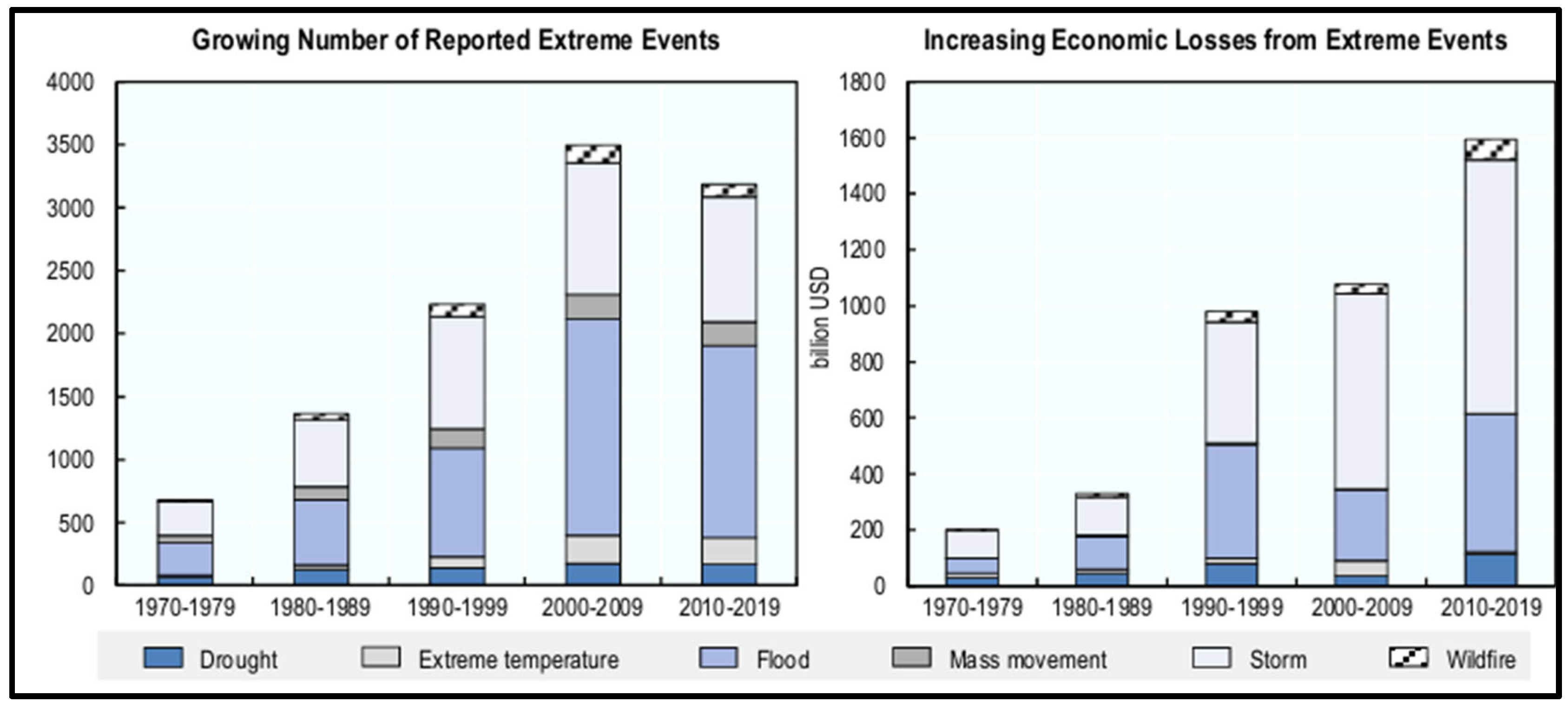
At COP29, India gave voice to the Global South’s frustration with the lack of climate-resilient infrastructure, as the $300 billion annual climate finance pledge falls far short of the $4.5 trillion SDG funding gap, with roughly half tied directly to climate needs. In numbers, countries in the Asia-Pacific region are at risk of losing 35 percent of gross domestic product by 2050 due to the impacts of climate change and natural hazards, effectively undoing over 30 years of efforts to reduce poverty, tackle food security and advance human development [5]. Besides the direct costs on housing, crops and roads, there are several indirect costs involved that are even harder to measure- slowdown in economic activity due to business interruption, disrupted supply chains, reduced worker productivity and worsening health conditions.
Though developing countries contribute the least to global greenhouse gas emissions in per capita terms, they often bear the maximum brunt of climate-related disasters due to their geographical location, limited adaptive capacity and socio-economic vulnerabilities. In addition, the lack of resilient infrastructure hampers their efforts in achieving the sustainable development goals, perpetuating cycles of poverty and inequality. Significant infrastructure gaps in a range of sectors – from transport to energy, water and digital infrastructure, hinder their development prospects, international competitiveness and domestic industrialization efforts [6].
The pursuit of industrialization and economic growth in these countries is driving increased demands and plans for infrastructure development, especially to support trade and production. This calls for building climate resilient infrastructure: one that is planned, designed, and operated in a way that anticipates, prepares for, and adapts to changing climate conditions. Such infrastructure has the power to withstand and recover rapidly from disruptions caused by changing climatic conditions throughout its lifetime. While climate resilience can increase the lifespan of infrastructure, they also play a crucial role in protecting investment returns and lowering the cost of damages and repairs, thereby ensuring business continuity.
2. Climate- Smart Resilient Growth
Equitable development is a foundational principle when implementing smart growth activities and supporting infrastructure resilience, while facing the challenge of a changing climate. By prioritizing low carbon technologies, renewable energy and sustainable urban development, economies can create a pathway that integrates economic growth strategies with climate mitigation and adaptation efforts. Rather than a choice, smart growth is an absolute necessity for destressed economies who are susceptible to the dual pressures of economic instability and climate change.
The return on investment in emerging and developing economies, and the benefits for productivity and growth, can be even greater if the investments are accompanied by other reforms that increase institutional capacity [7]. According to a 2022 report on climate finance, an estimated USD 1.2 to 1.7 trillion of investment in sustainable infrastructure is required per year by 2030, which is double the approximately USD 600 to USD 800 billion that is contributed annually at the present time [8]. While the climate smart growth objective offers some lofty agendas to be fulfilled, a plethora of hurdles needs to be addressed including infrastructural investment gap, fragmented policy frameworks and the challenge of balancing short term economic priorities with long term sustainable goals.
Given the cross-cutting nature of adaptation, tracking of public domestic spending and private sector financing also serve as considerable impediments to adaptation. While multinational development banks (MDBs) have made significant progress on tracking finance for adaptation, they still face challenges in mainstreaming their use internally and disseminating this expertise to use the results of climate risk assessment, combined with insufficient data and partnership with developing country governments [9]. As India stressed at COP29, MDBs prioritize donor interests over adaptation funding. Catering to these multifaceted challenges requires a comprehensive approach that combines targeted policy interventions through public-private partnerships, international collaborations and recognizing the opportunity for leveraging market mechanisms and credit instruments.
3. Climate – Resilient Infrastructure Heterogeneities Across Countries
Climate-resilient infrastructure exhibits substantial heterogeneity across countries. Geographic exposure constitutes a primary source of the said variation. Countries located in tropical, coastal, or arid regions face higher frequencies and intensities of climate hazards such as; floods, cyclones, heatwaves, and droughts place disproportionate stress on transport, energy, and water systems [10]. Small island states and low-lying coastal economies face heightened vulnerability due to sea-level rise, limited land for relocation, and constrained options for spatial adaptation. Similarly, mountainous regions exposed to landslides or flash floods face localized infrastructure risks that may differ dramatically even within a single country, underscoring the importance of context-specific adaptation strategies.
Economic capacity strongly conditions resilience outcomes. High-income countries generally possess greater fiscal space, access to capital markets, and technological capabilities to invest in climate-proof infrastructure, including redundancy, modular design, and advanced early-warning systems [11]. In contrast, low- and middle-income countries often face infrastructure gaps, underinvestment in maintenance, and higher capital costs, increasing the likelihood that climate shocks translate into persistent service disruptions and growth losses [12].Furthermore, constrained economic capacity can limit the ability to leverage innovative financing mechanisms such as climate bonds, catastrophe insurance, or blended finance, leaving developing countries more dependent on international aid and concessional funding.
Institutional quality and governance further explain cross-country heterogeneity. Effective public investment management, regulatory enforcement, and coordination across government levels are critical for translating climate risk assessments into resilient infrastructure planning. Weak institutions, fragmented planning processes, and political instability reduce the efficiency of infrastructure spending and bias investment toward short-term priorities rather than long-term resilience [13]. Additionally, inadequate enforcement of building codes, lax environmental regulations, or poorly defined land-use policies can exacerbate vulnerability, even when technical solutions are available.
Political economy factors also play a role [14]. Electoral incentives, lobbying by incumbent infrastructure operators, and distributional conflicts can delay adaptation investments, particularly where climate risks are unevenly distributed across regions or social groups. Finally, historical development paths and legacy infrastructure constrain adaptation options, as aging or carbon-intensive systems are often costly to retrofit. In many countries, the existing stock of infrastructure was designed for historical climate conditions, leaving it ill-suited to withstand emerging hazards. This path dependence highlights the importance of integrating long-term climate projections into planning, rather than relying solely on reactive or incremental adaptations.
Together, these factors imply that climate resilience is not solely a function of exposure but reflects deep structural differences across countries, with important implications for global inequality and the effectiveness of climate adaptation policies.
4. Climate – Resilience as a Public Good
Climate resilient infrastructure is ultimately a public good, and public goods are subject to market failure, and hence it is imperative to look at the very provision aspect of climate resilient infrastructure.
A public good is defined by non-rivalry and non-excludability. Many aspects of climate-resilient infrastructure satisfy these conditions. Once an electricity grid is hardened against extreme heat or flooding, the benefits accrue simultaneously to households, firms, hospitals, schools, and public services that rely on uninterrupted power. These benefits cannot be easily restricted to paying users, nor does one user’s benefit reduce another’s. As a result, private markets systematically underprovide resilience.
The Intergovernmental Panel on Climate Change explicitly frames climate adaptation and resilience investments as public goods that generate positive externalities [15]. The IPCC notes that many adaptation measures “create public goods that benefit many actors,” and because the implementing agent cannot capture the full benefits, market incentives alone lead to underinvestment relative to the social optimum.
This logic is particularly strong for network infrastructure. Infrastructure services are interconnected, and failures propagate across sectors. The World Bank’s Lifelines: The Resilient Infrastructure Opportunity shows that infrastructure disruptions generate cascading effects through supply chains, labour markets, and public service delivery, magnifying welfare losses well beyond the direct physical damage to assets [16]. There is also a strong equity dimension. The same report documents that poorer households experience higher welfare losses from service disruptions because they lack coping mechanisms like backup generators or alternative water sources. [17]. As a result, resilience investments produce distributional benefits that are not reflected in market prices, strengthening the public-good justification for state intervention
From a macroeconomic perspective, climate-resilient infrastructure also functions as a systemic risk reducer. By lowering the probability and severity of service disruptions during extreme events, resilience investments reduce output volatility, protect tax bases, and limit contingent fiscal liabilities. The IMF highlights that preventive adaptation investments reduce long-term fiscal risks and help stabilize public finances in climate-vulnerable economies [18].
A central question in infrastructure economics is whether climate-resilient investments pass a cost-benefit test once avoided damages and service disruptions are properly valued. The empirical literature overwhelmingly suggests that they do, particularly in hazard-exposed regions.
The World Bank’s Lifelines report estimates that incorporating resilience into new infrastructure increases upfront capital costs by only around 3 percent 3 percent on average. At the same time, it generates net benefits of approximately USD 4.2 trillion over the lifetime of infrastructure investments in developing countries [19]. This corresponds to roughly USD 4 in benefits for every USD 1 invested.
From a Net Present Value (NPV) standpoint, climate-resilient infrastructure improves project economics through three main channels. First, it reduces expected repair and replacement costs by lowering physical damage during extreme events. Second, it reduces economic losses associated with service interruptions, including lost output, reduced labour productivity, health impacts, and increased household coping expenditures. Third, it lowers tail risks associated with low-probability but high-impact disasters, which standard expected-value NPV calculations often underweight. Crucially, many of these benefits accrue to society rather than to the infrastructure owner. While the economic NPV of resilient infrastructure may be strongly positive, private investors may see weak or even negative financial NPV because tariff revenues do not account for avoided welfare losses or macroeconomic stabilization benefits. This creates a persistent gap between social and private returns.
This wedge helps explain why private finance alone has been insufficient to scale up climate-resilient infrastructure. UNEP’s Adaptation Gap Report 2025 shows that adaptation financing needs in developing countries are rising sharply, reaching hundreds of billions of dollars annually by the 2030s, while actual adaptation finance flows remain far below these levels [20].
Discounting and uncertainty further complicate appraisal. The benefits from resilience often materialize as avoided losses decades later, making NPV estimates sensitive to discount rate assumptions. The broader climate economics literature, including the Stern Review, demonstrates how lower discount rates substantially increase the present value of long-term climate benefits [21]. Moreover, climate risks involve deep uncertainty rather than known probability distributions. The World Bank therefore advocates robust decision-making approaches that prioritize investments that perform well across a wide range of climate scenarios rather than optimizing for a single forecast [22].
A key policy question is how governments should prioritize limited public resources for climate-resilient infrastructure. While exposure to climate hazards clearly matters, economic efficiency requires moving beyond asset-based risk metrics toward welfare-based prioritization.
The World Bank shows that prioritization outcomes change significantly based on whether decision-makers consider expected asset damages, service disruptions, or well-being losses. [23]. When poverty impacts and household welfare losses are incorporated, infrastructure investments that protect vulnerable populations often rise in priority, even if asset values are lower
Disaster proneness should therefore be filtered through at least three economic lenses. First, system criticality refers to infrastructure assets that serve as hubs within economic and social networks, such as substations supplying hospitals or transport corridors essential for food supply, which generate larger spillovers when they fail. Second, distributional impact considers how service disruptions can push poor households into poverty traps. Second, distributional impact considers how service disruptions can push poor households into poverty traps. Third, fiscal risk refers to the increase in reconstruction spending and threats to debt sustainability caused by climate shocks in vulnerable states.
The IMF’s Climate-Public Investment Management Assessment framework emphasizes integrating climate risk into project appraisal, selection, and budgeting to manage long-term fiscal and macroeconomic risks. Importantly, funding priorities should not focus solely on large grey infrastructure [24]. Nature-based solutions such as wetlands, mangroves, and watershed restoration can deliver significant resilience benefits while also providing biodiversity and ecosystem services. The Global Commission on Adaptation highlights evidence that many nature-based adaptation investments deliver benefit-cost ratios of 2:1 to 4:1, yet they remain underfunded because ecosystem benefits are poorly monetized [25].
From an economics standpoint, climate-resilient infrastructure is a public good generating significant positive externality, reducing systemic risk, and delivering welfare benefits that far exceed private financial returns.
An economically coherent strategy prioritizes projects based on expected welfare losses avoided, adjusted for uncertainty and distributional impacts, rather than asset values alone. Financing frameworks must explicitly bridge the gap between economic and financial returns through public funding, risk-sharing instruments, and institutional reforms. The persistence of the global adaptation finance gap This under provision of standard market mechanisms justifies a strong role for public investment, regulation, and concessional finance. [26]
5. Designing Climate-Resilient Infrastructure
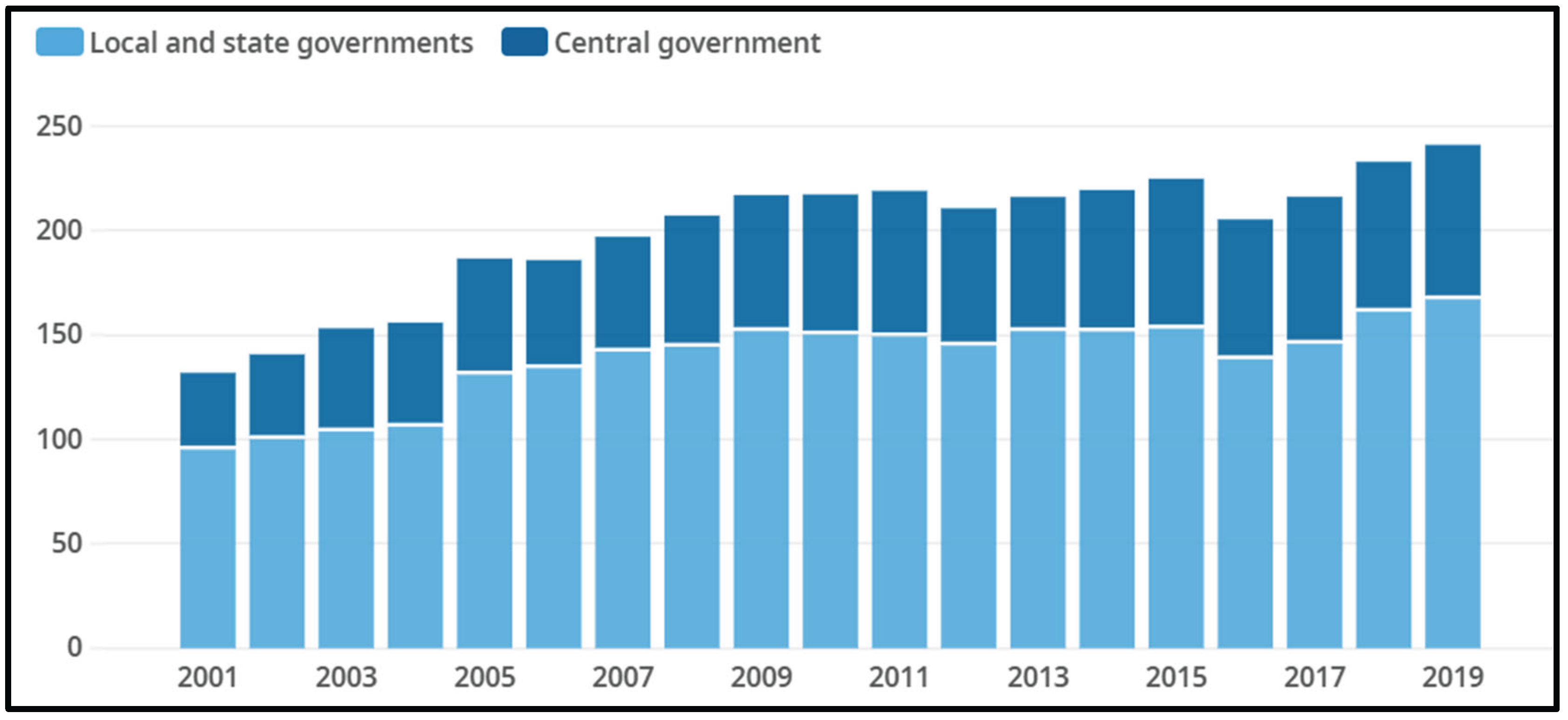
In order to implement a structured approach, financiers and developers should try to integrate climate data into their design process, considering factors such as temperature, rainfall patterns, extreme weather events, as well as their future evolutions under plausible climate scenarios over time. Climate risks to infrastructure can be reduced through this data-driven approach by locating assets in areas that are less exposed to climate hazards and by making the assets better able to cope with climate impacts through design modifications, such as improved drainage systems, elevated structures, deploying alternative materials, or introducing flexible infrastructure systems. Climate investments, must take place at all layers of governance (Figure 2).
Simultaneously, climate resilience requires collaboration among various stakeholders. The MDBs, IDFC, and other financial institutions are developing approaches to align their activities with the goals of the Paris Agreement. In this regard, MDBs can support developing countries in mobilizing private sector financing for adaptation through a wider range of innovative financial instruments that blend new and traditional resources. They should prepare infrastructure projects, providing technical expertise in climate risk assessments, engineering design, project management, monitoring and evaluation. The MDBs, IDFC, and other financial institutions are developing approaches to align their activities with the goals of the Paris Agreement.
Traditional investments like primarily debt, equity and grants, while foundational and critical needs to be upgraded to meet the growing demands of climate adaptation [27]. Disaster risk instruments, namely parametric insurance products, regional insurance pools, and catastrophe bonds, are gaining momentum to mitigate climate-related financial risks. These instruments are designed to provide quick liquidity and debt relief after climate disasters. Additionally, pooled investment funds can combine financing from various sources into different risk-return tranches for projects with specific climate adaptation and resilience goals. Furthermore, the government should reinforce nature-based solutions to protect infrastructure assets in a cost-effective and synergistic manner. For example, Sri Lanka supported a project that pioneered the use of urban wetlands as a nature-based solution in 2022 [28]. The project used green and grey infrastructure to restore and protect the wetlands and maintain its hydraulic integrity, which in turn regulated the local climate, improved water quality and wastewater treatment, providing the entire city with a better quality of life. While climate change is a global phenomenon, its impacts are felt at the local level. To plan, deliver, and maintain local climate-resilient infrastructure, subnational governments need to adopt new funding approaches, update regulatory frameworks, and define effective measurement and monitoring systems. They must also identify appropriate stakeholder consultation mechanisms and harness multi-level governance to align climate resilience actions across government levels.
Figure 2.
Climate investment for OECD countries by levels of government, USD per capita, 2001-2019. Source: OECD 2022 [29].
Figure 2.
Climate investment for OECD countries by levels of government, USD per capita, 2001-2019. Source: OECD 2022 [29].
International Cooperation and Policy
Countries around the world have collectively pledged to address global environmental challenges through conventions, highlighting the importance of international collaborations. Initiatives such as the International Climate Change Partnership (ICCP), the Global Climate Change Alliance Plus (GCCA+), the Coalition for Climate Resilient Investment, the Green Climate Fund, and the One Planet Summit are actively working to combat climate change while promoting resilient infrastructure. The transition to low-carbon economies is underway in the Asia-Pacific but needs to be accelerated. [30] Africa’s progress in phasing out coal, along with Latin America’s successful renewable energy transition, can serve as a guide for Asia in advancing climate resilience. Indonesia’s tax holidays and allowances for renewable energy projects are mirrored by policies in India, where renewable energy projects benefit from tax incentives. This reduces the financial burden on investors, accelerating the transition to a low-carbon economy. Additionally, Asia spearheads efforts to harmonize sustainable finance standards. The ASEAN Taxonomy, which aligns with global frameworks like the European Union’s, ensures that regional financial flows support sustainable development. This alignment is critical for boosting investor confidence and facilitating cross-border green investments.
6. Conclusions
Devoid of sincere mitigation and adaptation efforts, climate change is likely to have a significant impact on developing countries and the poor are likely to suffer most. The longer serious actions are delayed, the worse the impacts and the higher the future costs. Resilient infrastructure serves as a cornerstone of climate smart growth, encompassing the vision of sustainable development and environmental fortitude. A strategic focus on climate robustness not only protects communities and ecosystems, but drives economic recovery transforming challenges to opportunities in the future.
Funding
This research received no external funding.
Acknowledgments
During the preparation of this manuscript, the authors used a generative artificial intelligence tool solely to improve English language clarity and to assist in scanning and organizing relevant literature. The tool was not used for study design, conceptualization, or content generation. All outputs were reviewed and edited by the authors, who take full responsibility for the content of this publication.
Conflicts of Interest
The authors declare no conflicts of interest.
References
- OECD. Infrastructure for a Climate-Resilient Future; OECD Publishing: Paris, France, 2024. [CrossRef]
- Lim, C.H.; Basu, R. Explainer: How Asia Can Unlock $800 Billion of Climate Financing. IMF Blog. 2024, 29 January. Available online: https://www.imf.org/en/blogs/articles/2024/01/29/explainer-how-asia-can-unlock-800-billion-of-climate-financing (accessed on 24 January 2026).
- United Nations Development Programme (UNDP). Paving the Way for Climate-Resilient Infrastructure: Guidance for Practitioners and Planners; United Nations Development Programme: New York, NY, USA, 2011. Available online: https://www.uncclearn.org/wp-content/uploads/library/undp_paving_the_way.pdf (accessed on 24 January 2026).
- Organisation for Economic Co-operation and Development (OECD). Infrastructure for a Climate-Resilient Future; OECD Publishing: Paris, France, 2024. Available online: https://www.oecd.org/content/dam/oecd/en/publications/reports/2024/04/infrastructure-for-a-climate-resilient-future_c6c0dc64/a74a45b0-en.pdf (accessed on 24 January 2026). [CrossRef]
- World Economic Forum. Catalysing Climate Action in Asia: Unlocking the Power of Philanthropic-Public-Private Partnerships; World Economic Forum: Geneva, Switzerland, November 2023. Available online: https://www3.weforum.org/docs/WEF_Catalysing_Climate_Action_in_Asia_2023.pdf (accessed on 24 January 2026).
- Organisation for Economic Co-operation and Development (OECD). Infrastructure for a Climate-Resilient Future; OECD Publishing: Paris, France, 2024. Available online: https://www.oecd.org/content/dam/oecd/en/publications/reports/2024/04/infrastructure-for-a-climate-resilient-future_c6c0dc64/a74a45b0-en.pdf (accessed on 24 January 2026). [CrossRef]
- Rydge, J.; Jacobs, M.; Granoff, I. Ensuring New Infrastructure Is Climate-Smart; The Global Commission on the Economy and Climate: London, UK, 2015. Available online: https://ppp.worldbank.org/public-private-partnership/sites/ppp.worldbank.org/files/2022-01/Ensuring-infrastructure-is-climate-smart.pdf (accessed on 24 January 2026).
- Wagner, D. Addressing the Climate Finance Shortfall: The Role of Multilateral Development Banks, Institutional Investors and Insurers. Asian Infrastructure Investment Bank Blog, 19 June 2023. Available online: https://www.aiib.org/en/news-events/media-center/blog/2023/Addressing-the-Climate-Finance-Shortfall-The-Role-of-Multilateral-Development-Banks-Institutional-Investors-and-Insurers.html (accessed on 24 January 2026).
- Murphy, D.; Parry, J.-E. Filling the Gap: A Review of Multilateral Development Banks’ Efforts to Scale Up Financing for Climate Adaptation; International Institute for Sustainable Development: Winnipeg, MB, Canada, 2020. Available online: https://www.iisd.org/system/files/2020-12/filling-gap-financing-climate-adaptation.pdf (accessed on 24 January 2026).
- Kovarik, J.-B.; Evans, C.; Godart, B.; Mendoza Sánchez, J.F.; Palhol, F.; Starnes, M. Evaluating Resilient Infrastructure Sytems: A Policy Brief; Global Solutions Initiative: Berlin, Germany, 2020. Available online: https://www.global-solutions-initiative.org/publication/evaluating-resilient-infrastructure-sytems/ (accessed on 24 January 2026).
- World Bank. Unlocking Private Investment in Climate Adaptation and Resilience. World Bank Blog, 4 March 2021. Available online: https://www.worldbank.org/en/news/feature/2021/03/04/unlocking-private-investment-in-climate-adaptation-and-resilience (accessed on 24 January 2026).
- Calderón, C.; Servén, L. Infrastructure, Growth, and Inequality: An Overview; Policy Research Working Paper 7034; World Bank: Washington, DC, USA, 2014. Available online: http://documents.worldbank.org/curated/en/322761468183548075/pdf/WPS7034.pdf (accessed on 24 January 2026). [CrossRef]
- Fay, M.; Andres, L.A.; Fox, C.; Narloch, U.; Straub, S.; Slawson, M. Rethinking Infrastructure in Latin America and the Caribbean: Spending Better to Achieve More; International Bank for Reconstruction and Development / The World Bank: Washington, DC, USA, 2017. Available online: https://documents1.worldbank.org/curated/en/676711491563967405/pdf/114110-REVISED-Rethinking-Infrastructure-Low-Res.pdf (accessed on 24 January 2026).
- Van der Straten, Y.; Perotti, E.; Van der Ploeg, F. The Political Economy of Adapting to Climate Change. VoxEU Column, 2024, 6 April. Available online: https://cepr.org/voxeu/columns/political-economy-adapting-climate-change (accessed on 24 January 2026).
- Chambwera, M.; Heal, G.; Dubeux, C.; Hallegatte, S.; Leclerc, L.; Markandya, A.; McCarl, B.A.; Mechler, R.; Neumann, J.E. Chapter 17: Economics of Adaptation. In Climate Change 2014: Impacts, Adaptation and Vulnerability. Part A: Global and Sectoral Aspects. Contribution of Working Group II to the Fifth Assessment Report of the Intergovernmental Panel on Climate Change; Field, C.B., Barros, V.R., Mach, K.J., Mastrandrea, M.D., Eds.; Cambridge University Press: Cambridge, UK and New York, NY, USA, 2014. Available online: https://www.ipcc.ch/site/assets/uploads/2018/02/WGIIAR5-Chap17_FINAL.pdf (accessed on 24 January 2026).
- Hallegatte, S.; Rentschler, J.; Rozenberg, J. Lifelines: The Resilient Infrastructure Opportunity; International Bank for Reconstruction and Development/The World Bank: Washington, DC, USA, 2019. Available online: https://documents1.worldbank.org/curated/en/111181560974989791/pdf/Lifelines-The-Resilient-Infrastructure-Opportunity.pdf (accessed on 24 January 2026). [CrossRef]
- Hallegatte, S.; Rentschler, J.; Rozenberg, J. Lifelines: The Resilient Infrastructure Opportunity; International Bank for Reconstruction and Development/The World Bank: Washington, DC, USA, 2019. Available online: https://documents1.worldbank.org/curated/en/111181560974989791/pdf/Lifelines-The-Resilient-Infrastructure-Opportunity.pdf (accessed on 24 January 2026). [CrossRef]
- Bellon, M.; Massetti, E. Planning and Mainstreaming Adaptation to Climate Change in Fiscal Policy; IMF Staff Climate Note No. 2022/003; International Monetary Fund: Washington, DC, USA, 2022. Available online: https://www.imf.org/-/media/files/publications/staff-climate-notes/2022/english/clnea2022003.pdf (accessed on 24 January 2026). [CrossRef]
- Hallegatte, S.; Rentschler, J.; Rozenberg, J. Lifelines: The Resilient Infrastructure Opportunity; International Bank for Reconstruction and Development/The World Bank: Washington, DC, USA, 2019. Available online: https://documents1.worldbank.org/curated/en/111181560974989791/pdf/Lifelines-The-Resilient-Infrastructure-Opportunity.pdf (accessed on 24 January 2026). [CrossRef]
- United Nations Environment Programme (UNEP). Adaptation Gap Report 2025: Running on Empty; United Nations Environment Programme: Nairobi, Kenya, 2025. Available online: https://www.unep.org/resources/adaptation-gap-report-2025 (accessed on 24 January 2026).
- Stern, N. The Economics of Climate Change: The Stern Review; Cambridge University Press: Cambridge, UK, 2007. Available online: https://assets.pc.gov.au/research/supporting/stern-review/sternreview.pdf (accessed on 24 January 2026).
- Hallegatte, S.; Rentschler, J.; Rozenberg, J. Lifelines: The Resilient Infrastructure Opportunity; International Bank for Reconstruction and Development/The World Bank: Washington, DC, USA, 2019. Available online: https://documents1.worldbank.org/curated/en/111181560974989791/pdf/Lifelines-The-Resilient-Infrastructure-Opportunity.pdf (accessed on 24 January 2026). [CrossRef]
- Hallegatte, S.; Rentschler, J.; Rozenberg, J. Lifelines: The Resilient Infrastructure Opportunity; International Bank for Reconstruction and Development/The World Bank: Washington, DC, USA, 2019. Available online: https://documents1.worldbank.org/curated/en/111181560974989791/pdf/Lifelines-The-Resilient-Infrastructure-Opportunity.pdf (accessed on 24 January 2026). [CrossRef]
- International Monetary Fund. Climate-Public Investment Management Assessment (C-PIMA). IMF Infrastructure Governance. Available online: https://infrastructuregovern.imf.org/content/PIMA/Home/PimaTool/C-PIMA.html (accessed on 24 January 2026).
- Global Center on Adaptation. Adaptation Insights – Pathways to Scale Investments in Nature-based Solutions for Climate Adaptation; Global Center on Adaptation: Rotterdam, The Netherlands, 2025. Available online: https://gca.org/reports/adaptation-insights-pathways-to-scale-investments-in-nature-based-solutions-for-climate-adaptation/ (accessed on 24 January 2026).
- United Nations Environment Programme (UNEP). *Adaptation Gap Report 2025: Running on Empty*; United Nations Environment Programme: Nairobi, Kenya, 2025. Available online: https://www.unep.org/resources/adaptation-gap-report-2025 (accessed on 24 January 2026).
- Sivaprasad, D.; Tan, I.; Pande, V. Climate Adaptation and Resilience Needs More Innovative Funding; World Economic Forum: Geneva, Switzerland, 2024. Available online: https://www.weforum.org/stories/2024/02/climate-adaptation-and-resilience-innovative-funding/ (accessed on 24 January 2026).
- Organisation for Economic Co-operation and Development (OECD). Subnational Government Climate Finance Hub. OECD Regional, Rural and Urban Development. Available online: https://web-archive.oecd.org/temp/2023-11-17/627817-sngclimatefinancehub.htm (accessed on 24 January 2026).
- World Bank. What You Need to Know About Nature-Based Solutions to Climate Change; World Bank: Washington, DC, USA, 19 May 2022. Available online: https://www.worldbank.org/en/news/feature/2022/05/19/what-you-need-to-know-about-nature-based-solutions-to-climate-change (accessed on 24 January 2026).
- Parjiono; Hernawan, B.W. Asia’s Path to Climate-Resilient Infrastructure. East Asia Forum, 12 October 2024. Available online: https://eastasiaforum.org/2024/10/12/asias-path-to-climate-resilient-infrastructure/ (accessed on 24 January 2026).
Disclaimer/Publisher’s Note: The statements, opinions and data contained in all publications are solely those of the individual author(s) and contributor(s) and not of MDPI and/or the editor(s). MDPI and/or the editor(s) disclaim responsibility for any injury to people or property resulting from any ideas, methods, instructions or products referred to in the content. |
© 2026 by the authors. Licensee MDPI, Basel, Switzerland. This article is an open access article distributed under the terms and conditions of the Creative Commons Attribution (CC BY) license (http://creativecommons.org/licenses/by/4.0/).
Copyright: This open access article is published under a Creative Commons CC BY 4.0 license, which permit the free download, distribution, and reuse, provided that the author and preprint are cited in any reuse.


