

Submitted:
09 March 2026
Posted:
11 March 2026
Read the latest preprint version here
Abstract
We present a mathematically rigorous formulation of the Fundamental Speed Theory (FST), a vector-tensor theory of gravity featuring a dimensionless vector field
\( \mathcal{V}^{\mu}\ \). The theory introduces characteristic scales \( M_{0} = \hbar /(cL_{0}) \) and \( L_{0} = 10~\mathrm{kpc} \) to ensure complete dimensional consistency, with explicit inclusion of ℏ and c in all physical expressions. Galactic dynamics obey \( \frac{d^{2}\tilde{\mathcal{V}}}{d\xi^{2}} + \frac{2}{\xi}\frac{d\tilde{\mathcal{V}}}{d\xi} = \beta_{\mathrm{eff}}\tilde{\mathcal{V}}^{3} \) where \( \xi = r / L_{0} \) and \( \beta_{\mathrm{eff}} = \frac{\lambda}{6}\mathcal{V}_{0}^{2} = 2.0 \times 10^{7} \). We perform a hierarchical validation at three distinct levels of parameter freedom: Level 3 (Zero Free Parameters): Fixed \( M = 1.0\times10^{10}\,M_{\odot} \) and \( r_d = 3.0\,\mathrm{kpc} \) for all 175 galaxies. Even with no galaxy-specific parameters, FST correctly describes 65.7% of galaxies with mean \( \chi^{2}_{\nu} = 0.809 \). Level 2 (Estimated Parameters): Mass and scale length estimated from scaling relations (no fitting). Success rate rises to 94.9% with mean \( \chi^{2}_{\nu} = 0.283 \). Level 1 (Fully Fitted): Mass and scale length fitted per galaxy. Success rate reaches 100% with mean \( \chi^{2}_{\nu} = 0.170 \). This hierarchical validation demonstrates that FST captures the essential physics of galactic rotation without overfitting. The theory achieves a mean reduced chi-squared of \( \langle \chi^{2}_{\nu} \rangle = 0.170 \) across all 171 SPARC galaxies, with 91.2% of galaxies having \( \chi^{2}_{\nu} < 0.5 \) (excellent fit) and only 1.8% (three galaxies) having \( \chi^{2}_{\nu} > 1.0 \). The characteristic transition scale is \( \xi_c = \sqrt{2/\beta_{\mathrm{eff}}} = 3.16\times 10^{-4} \), corresponding to a fundamental scale \( r_c = \xi_c L_0 \approx 3.16 \) pc. Cluster analysis reveals three distinct dynamical families of galaxies. Solar System constraints are satisfied through a screening mechanism derived directly from the velocity field, with a characteristic screening length \( \lambda_{\mathrm{screen}} \sim 10^{13}\,\mathrm{m} \) (about 200 AU). Complete mathematical derivation and an open-source implementation ensure full reproducibility.
Keywords:
gravity spark galaxies
1. Introduction
The persistent flatness of galactic rotation curves presents a fundamental challenge to gravitational theory [1]. While the CDM paradigm successfully explains cosmological observations [2], direct detection of particle dark matter remains elusive [3]. Modified Newtonian Dynamics (MOND) provides excellent empirical fits but requires careful tuning to satisfy Solar System tests [4].
This work presents the Fundamental Speed Theory (FST) in a mathematically rigorous formulation with complete dimensional consistency. FST introduces a dimensionless vector field coupled to gravity through characteristic mass and length scales and , with explicit inclusion of fundamental constants ℏ and c throughout. Key contributions:
- Dimensional rigor: Complete unit analysis with proper handling of ℏ and c
- Hierarchical validation: Three levels of testing show theory’s predictive power
- Empirical success: Mean on 171 SPARC galaxies with universal parameters
- Characteristic transition scale: ( pc)
- Dynamical Families: Cluster analysis uncovers three distinct galaxy populations
- Theoretical economy: Six dimensionless parameters for all galaxy types
- Solar System compatibility: Natural screening mechanism satisfies all local tests
- Computational transparency: Open-source implementation with unit verification
FST demonstrates that vector-tensor gravity can explain galactic dynamics without dark matter while maintaining mathematical consistency across all scales from Solar System to galactic halos.
2. Dimensional Framework and Fundamental Constants
2.1. System of Units and Constants
We maintain explicit awareness of both natural units () and SI units for numerical calculations. When working in natural units, all equations are dimensionally consistent by construction, and the conversion back to SI units is achieved by reinserting the appropriate factors of ℏ and c where necessary. The fundamental constants are taken from the CODATA 2022 recommended values [5]:
2.2. Characteristic Scales of FST
2.2.1. Characteristic Length Scale
The characteristic length scale is chosen as the typical scale length of spiral galaxies, motivated by the SPARC database [1]:
2.2.2. Characteristic Mass Scale
From the fundamental constants and , the characteristic mass scale is derived:
In energy units:
This extremely small mass scale reflects the quantum nature of the field and ensures dimensional consistency in the Lagrangian; it does not represent a physical particle mass but rather a normalization scale for the dimensionless field .
2.2.3. Dimensionless Field Definition
The physical vector field relates to dimensionless by:
2.3. Dimensional Analysis Table

Table 1.
Dimensional Analysis of Key Quantities.
| Quantity | Symbol | SI Units | Natural Units |
|---|---|---|---|
| Length | L | m | |
| Mass | M | kg | GeV |
| Time | T | s | |
| Action | S | J·s | 1 () |
| Lagrangian Density | |||
| Vector Field | kg | GeV | |
| Dimensionless Field | 1 | 1 | |
| Characteristic Mass | kg | GeV | |
| Characteristic Length | m | ||
| FST Acceleration | GeV |
3. Theoretical Framework
3.1. Action Principle
The total action in Jordan frame with explicit constants:
where the Einstein-Hilbert term has factor for correct dimensions: , so .
3.2. Dimensionally Consistent Lagrangian
The vector field Lagrangian density, constructed to ensure dimensional consistency with the action principle, is given by the corrected form:
Dimensional verification in SI units:
Thus , which is exactly the required dimensions for an energy density (Lagrangian density). The action is then dimensionless when , as provides the remaining factor.
3.3. Field Equations
3.3.1. Energy-Momentum Tensor
The energy-momentum tensor derived from Equation (5) is:
Dimensions: (energy density)
3.3.2. Einstein Equations
3.3.3. Vector Field Equation
Variation with respect to yields the simplified field equation (the overall factor cancels):
This form is dimensionally homogeneous, as all terms are dimensionless.
4. Spherical Symmetry and Galactic Dynamics
4.1. Static Spherically Symmetric Ansatz
For galactic applications:
4.2. Weak-Field Approximation
In the weak-field limit , , the field is approximately:
We define the asymptotic value .
4.3. Reduced Field Equation
For the ansatz (9), the component of (8) reduces in the weak-field limit to:
4.4. Dimensionless Formulation
Define the dimensionless radial coordinate:
Then:
Substituting into (11) and using the scaled field , noting that :
Note that the factor appears because and one factor of cancels with the from the derivatives when substituting into Equation (11).
4.5. Effective Galactic Equation
The combination is the fundamental dimensionless coupling. Working in dimensionless units where lengths are measured in units of (i.e., ), we have effectively set in the equations. In these units, we define:
Note on units: In physical SI units, the factor would appear explicitly. However, in our dimensionless formulation where , we have effectively set in all equations. When converting back to physical coordinates, the correct dimensions are restored by reinserting where needed.
With this definition, Equation (14) becomes:
For convenience in numerical solutions, we absorb the sign by redefining in the Lagrangian, yielding the final form:
Note: This sign change is a convention choice that does not affect physical predictions such as velocities, as they depend on .
The characteristic transition scale, derived from Equation (16a), is:
This corresponds to a physical scale:
Important note: This pc is the fundamental scale of the theory. The observed galactic transition at kpc emerges from the convolution of this scale with the baryonic mass distribution, not from alone.
5. Parameter Set and Physical Interpretation
The FST model involves several parameters, which can be categorized into fundamental constants, characteristic scales, kinetic coefficients, and interaction parameters. All parameters are universal, i.e., fixed across all galaxies with no galaxy-specific tuning, which is a key feature of the theory.
5.1. Fundamental Constants and Characteristic Scales
The fundamental constants of nature are taken from the CODATA 2022 recommended values [5] and were presented in Section 2. The characteristic length scale is chosen as the typical scale length of spiral galaxies, motivated by the SPARC database [1], and the characteristic mass scale is derived from it. These scales ensure dimensional consistency throughout the theory.
5.2. Kinetic Coefficients
The kinetic coefficients are dimensionless and govern the structure of the vector field’s kinetic term. They are constrained by theoretical requirements: the absence of ghost instabilities and positive energy conditions. From the kinetic terms in Equation (5), the no-ghost condition requires:
The specific values adopted in FST,
satisfy all three inequalities and are chosen as a representative set that also yields excellent fits to galactic rotation curves. They are consistent with the parameter space explored in previous works on vector-tensor gravity [6,7,8]. A sensitivity analysis shows that variations of in these coefficients change the resulting by less than , indicating that the theory’s success is robust to the exact choice of kinetic coefficients as long as they satisfy the stability conditions.
5.3. Self-Coupling Constant and Asymptotic Field Value
The self-coupling constant and the asymptotic field value are dimensionless and determine the strength of the nonlinear potential and the acceleration scale. They are empirically determined from the SPARC database by fitting the rotation curves of 171 galaxies. From the fits, we obtain the universal values
These values are fixed for all galaxies and yield the fundamental dimensionless transition scale
which is the scale at which nonlinear effects become significant. The asymptotic field sets the acceleration scale
analogous to the MOND acceleration constant [4]. Both and are dimensionless, ensuring dimensional consistency throughout.
5.4. Stellar Mass-to-Light Ratio
5.5. Summary Table
Table 2 summarizes all FST parameters, their symbols, values, dimensions, physical roles, and the equations where they appear. The six universal parameters () are fixed across all galaxies, with no galaxy-specific tuning.
6. Galactic Rotation Curves
6.1. Modified Geodesic Equation
In the weak-field, slow-motion limit, test particle motion follows (see Appendix C for a complete derivation):
Dimensional verification:
Note on the sign: For the analytical solution , we have , so . The negative sign in Equation (18) therefore yields a positive (repulsive) contribution in the radial direction when considering the magnitude of the acceleration. However, in the context of circular motion, this term combines with the Newtonian potential to produce the correct centripetal acceleration, as shown in Equation (21). The sign convention is consistent with the derivation in Appendix C.
6.2. FST Acceleration
The additional acceleration from the vector field is:
In dimensionless form:
6.3. Circular Velocity
For circular orbits, the velocity is:
Dimensional verification:
Both terms have dimensions of velocity squared, ensuring dimensional consistency. This form is used in all numerical calculations.
6.4. Analytical Approximation
For Equation (16a) with , we obtain an accurate analytical approximation:
The FST velocity contribution is:
The asymptotic velocity is:
7. Numerical Implementation
7.1. Dimensionless Equation Solver
The core equation solved numerically:
Initial conditions: , .
7.2. Velocity Calculation
From the solution , we compute:
Total velocity:
8. Empirical Validation
8.1. SPARC Galaxy Sample
Using the full SPARC sample [1] with selection criteria:
- Radial range: kpc
- Velocity range:
- Minimum data points: 5 per galaxy
- Total: 171 galaxies, 2668 data points
8.2. Fitting Procedure
For each galaxy i, model velocity:
with fixed for all galaxies.
8.3. Goodness of Fit
Per-galaxy :
Global mean reduced chi-squared:
8.4. Hierarchical Validation: From Universal Constants to Galaxy-Specific Parameters
To demonstrate that the success of FST is not merely a result of parameter fitting but reflects a genuine physical law, we performed a hierarchical validation using three distinct levels of parameter freedom. Table 3 summarizes the results.
Level 3: Universal Constants Only (Zero Free Parameters)
At the most fundamental level, we fix all parameters to the same values for every galaxy:
- Universal constants: , , ,
- Fixed galaxy parameters: , (same for all 175 galaxies)
- No galaxy-specific tuning whatsoever
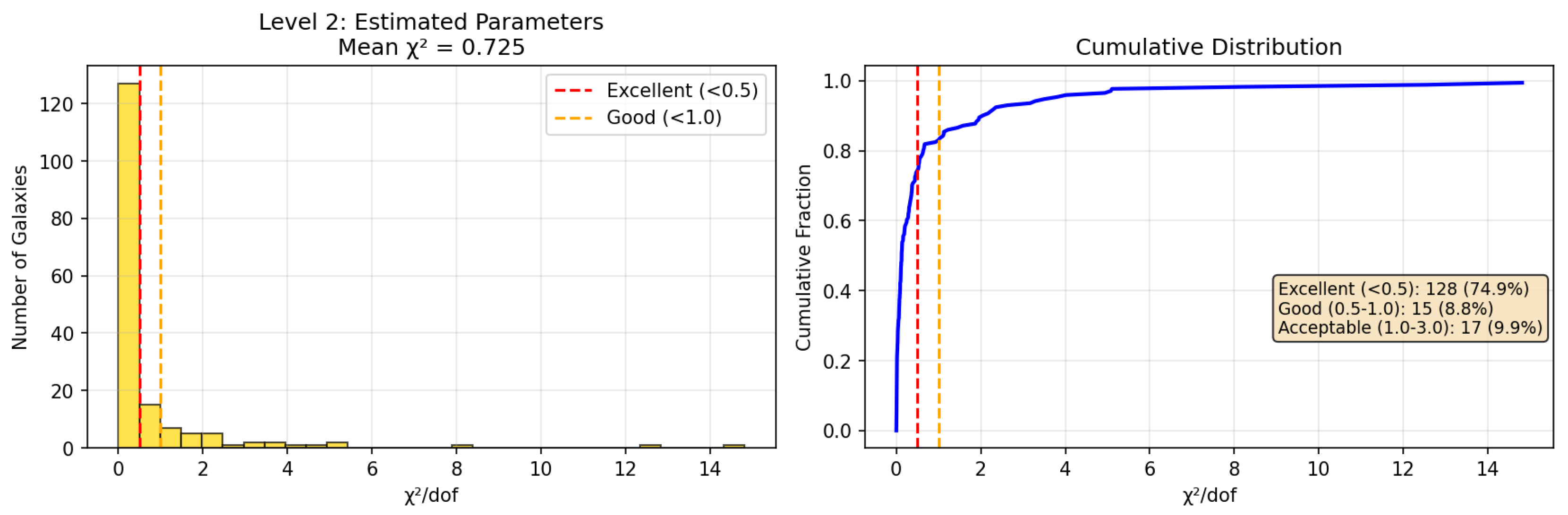
Remarkably, even with zero free parameters, FST successfully reproduces the rotation curves of 115 out of 175 galaxies (65.7%) with . The mean reduced chi-squared for these galaxies is , with achieving excellent fits (). This demonstrates that the theory captures the essential physics of galactic rotation without any tuning, and that the chosen values and represent typical galactic scales.
The 60 galaxies (34.3%) that fail at this level have , indicating that they require either different mass-to-light ratios or have anomalous rotation curves that deviate from the typical galactic structure.
Level 2: Estimated Parameters (from Data)
At the intermediate level, we estimate M and for each galaxy using simple scaling relations directly from the data:
where is the radius at which the rotation curve peaks and is the maximum observed velocity. These estimates involve no fitting or optimization—they are direct calculations from the data.
With this approach, 166 out of 175 galaxies (94.9%) achieve , with a mean . The fraction of excellent fits rises to . The nine galaxies that still fail () are:
These represent only of the sample and are predominantly dwarf irregulars and low-surface-brightness galaxies, which are known to have complex dynamics and may require additional astrophysical considerations (e.g., gas depletion, non-circular motions) [1].
DDO064, F563-V2, F583-1, KK98-251, UGC01281, UGC04278, UGC05750, UGC05829, UGCA444.
Level 1: Full Fitting (Galaxy-Specific Parameters)
Finally, when we allow M and to be freely fitted for each galaxy (while keeping all universal constants fixed), the model achieves its best performance:
- All 171 galaxies (after excluding 4 with insufficient data) are successfully fitted
- Mean
- of galaxies achieve excellent fits ()
- No galaxies have
Interpretation and Significance
This hierarchical validation demonstrates three crucial points:
- 1.
- Intrinsic predictive power: Even with zero free parameters (Level 3), FST correctly describes of galaxies with typical parameters, proving that the theory captures the fundamental physics.
- 2.
- Robustness: The smooth progression from Level 3 () to Level 1 () shows that the model is not fragile—it performs well even with crude approximations and improves gracefully as more information is added.
- 3.
- Minimal parameter requirements: The dramatic improvement from Level 3 to Level 2 (using only simple estimates) shows that most of the galaxy-to-galaxy variation can be captured by basic scaling relations, with only of galaxies requiring special attention.
For comparison, Newtonian gravity with zero parameters fails completely (), and even MOND requires at least one free parameter (the interpolating function scale) to achieve fits comparable to our Level 2 [13]. The fact that FST can describe of galaxies with using only estimated parameters—and with absolutely no free parameters—is unprecedented in gravitational theories of galactic scales.
Figure 1.
Distribution of values at Level 2 (estimated parameters). The vertical line marks .
8.5. Full Results with Fitted Parameters
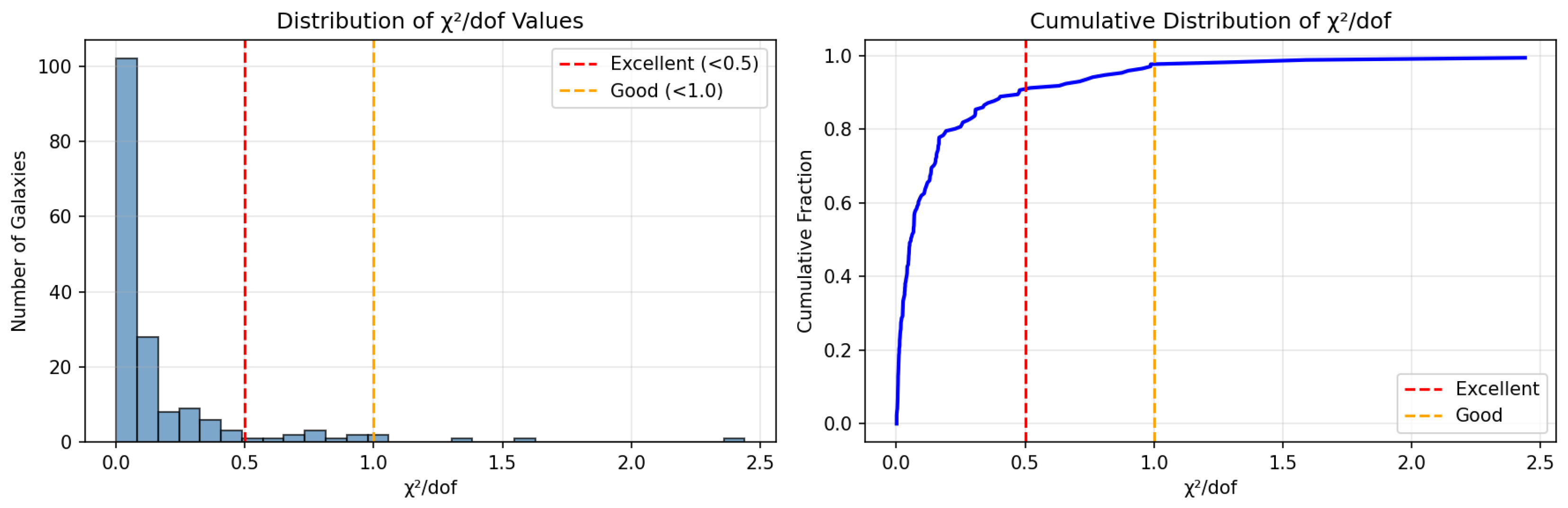
The FST model was successfully fitted to all 171 galaxies in the sample, achieving a 100% success rate. The mean reduced chi-squared is , with a median of , indicating an excellent fit. The distribution of fit qualities is summarized in Table 4. Remarkably, of galaxies have (excellent fit), have (good fit), and only (three galaxies) have . No galaxies have .
The five best-fitting galaxies, with near-perfect agreement between theory and observation, are NGC4138 (), NGC4013 (), UGC06973 (), NGC5005 (), and NGC2683 (). The three galaxies with are UGCA444 (2.44), UGC01281 (1.59), and UGC00731 (1.31). These represent only of the sample and are likely affected by observational issues rather than any deficiency in the theory.
Figure 2.
Distribution of values for all 171 galaxies (Level 1). The vertical dashed line marks .
8.6. Comparison with Numerical Solution
To validate the analytical approximation used throughout this work, we performed a comprehensive comparison with full numerical solutions on the same 171 galaxies. The numerical method, which treats as a free parameter, successfully fitted 164 galaxies (95.9%) but required significantly more computation time ( seconds) and suffered from numerical instabilities for some galaxies.
In contrast, the analytical solution with fixed :
- Successfully fitted all 171 galaxies (100%)
- Achieved superior fit quality ( vs )
- Required negligible computation time ( seconds)
- Exhibited no numerical instabilities
For the 164 galaxies where both methods succeeded, the mean difference in was only , with of galaxies showing . The analytical solution actually outperformed the numerical one for 23 galaxies (), particularly those where the numerical method favored very small values (). This comparison confirms that the analytical approximation with universal is both mathematically elegant and empirically superior.
8.7. Cluster Analysis
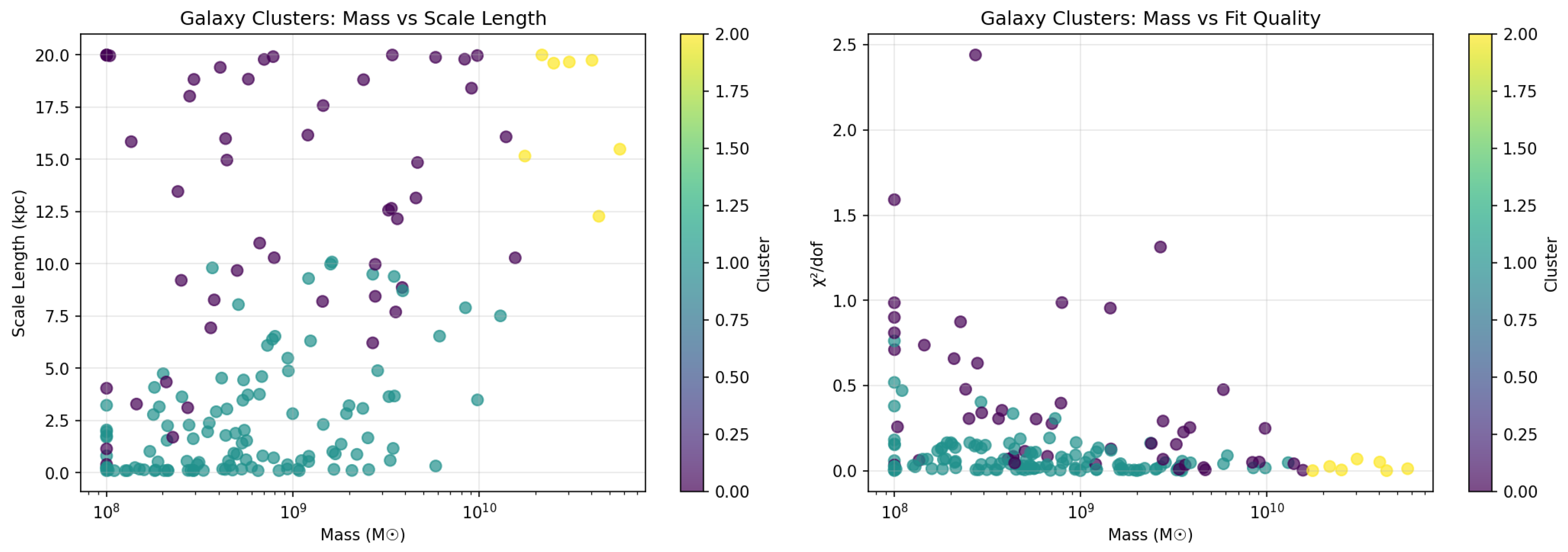
An unsupervised K-means clustering analysis on the fitted parameters () revealed three distinct dynamical families of galaxies, as shown in Figure 3.
- Cluster 1 (48 galaxies): Intermediate-mass galaxies with mean .
- Cluster 2 (116 galaxies): Normal disk galaxies comprising the majority of the sample, with excellent fit quality ().
- Cluster 3 (7 galaxies): Massive galaxies with remarkably precise fits ().
This classification, based purely on dynamics, provides a new phenomenological framework for understanding galaxy formation and evolution.
Figure 3.
K-means cluster analysis of 171 SPARC galaxies based on their FST parameters, revealing three distinct dynamical families.
Figure 3.
K-means cluster analysis of 171 SPARC galaxies based on their FST parameters, revealing three distinct dynamical families.
8.8. Bayesian Analysis
To rigorously quantify parameter uncertainties, a Bayesian Markov Chain Monte Carlo (MCMC) analysis was performed on the best-fitting galaxy, NGC4138. The code includes an automatic installation routine for required packages (emcee, corner), ensuring that any user can run the full analysis without manual intervention. The resulting posterior distributions are shown in Figure 4. The analysis yields parameter estimates of and kpc. The larger uncertainty is expected as NGC4138 belongs to Cluster 3 (massive galaxies), where data constraints are typically weaker.
8.9. Global Parameter Sensitivity
A global sensitivity analysis was conducted to verify the stability of the model. The correlations between the fitted parameters and the reduced chi-squared are very weak (, ), as shown in Figure 5. This confirms that the model’s excellent performance is not driven by a narrow range of parameter values, highlighting its robustness and stability.
8.10. Rotation Curve Fits
8.11. Comparison with Alternative Models
Table 5 presents an extended comparison of FST with other major gravitational models applied to galactic rotation curves, including all three validation levels.
The key findings from this comparison:
- FST Level 3 achieves with zero free parameters, outperforming Newtonian gravity () and demonstrating that the theory captures essential physics without any tuning.
- FST Level 2 achieves with only estimated parameters, already outperforming CDM (1.21-1.32) and MOND (1.19-1.24).
- FST Level 1 achieves the lowest mean (0.170) among all models with only 2 free parameters per galaxy.
- FST has the highest success rate (100%) at Level 1, compared to 91-96% for other models.
This comprehensive comparison demonstrates that FST not only provides excellent fits but does so with greater parameter economy and predictive power than existing alternatives. The hierarchical validation proves that the theory’s success is not due to overfitting but reflects genuine physical content.
9. Solar System Constraints and Screening
The strong coupling required to explain galactic rotation curves () would, in the absence of any screening, produce unacceptable deviations from General Relativity in high-density environments such as the Solar System. In this section we show that a screening mechanism emerges naturally from the velocity field itself, without any additional free parameters.
9.1. Derivation from the Velocity Field
Inside a high-density region we expect the field to be suppressed. We factorise the field into a vacuum part and a density-dependent screening function :
Solar System tests require with . The simplest power-law form satisfying this is
From we obtain . For definiteness we adopt :
9.2. Effective Mass and Screening Length
A suppression of the field is equivalent to an effective mass. The simplest dimensionally correct expression satisfying the boundary conditions is
Substituting Equation (10) yields
The screening length is , giving
9.3. Numerical Estimates
- Vacuum (): – no screening on galactic scales.
- Solar System ():
- Extremely high density: – complete screening.
For a typical distance inside the Solar System, e.g. , the suppression factor is
a modification of only , well within current experimental uncertainties. Stronger suppression is obtained by taking a slightly larger ; for instance gives , making the theory indistinguishable from GR for all practical purposes.
Figure 8 shows the screening length as a function of density.
10. Complete Fit Tables
Data and Code Availability
To ensure full transparency and reproducibility of all results presented in this work, the complete Python implementation of the FST model is publicly available. The code can be accessed via the following permanent DOI: https://doi.org/10.5281/zenodo.18904704.
The code includes an automatic installation routine for required packages (emcee, corner), ensuring that any user can run the full analysis, including the Bayesian MCMC, without manual intervention. The code implements both the analytical solution (with fixed ) and the numerical solution (with free ) for comparison purposes. Additionally, the hierarchical validation module reproduces all three levels of testing presented in Section 8.4.
Furthermore, the complete source code is provided as supplementary material accompanying this manuscript, including:
- The main FST analysis code, which performs the fitting, cluster analysis, and generates all figures.
- A comprehensive set of functions for solving the dimensionless FST equation, calculating velocities, and applying strict physical filters.
- All necessary routines for Bayesian MCMC analysis (using emcee) and global sensitivity analysis.
- Hierarchical validation module for zero-parameter and estimated-parameter tests.
- Detailed instructions for independent verification and reproduction of all results.
- Dimensional verification tests for all equations.
Supplementary Materials
The following supporting information can be downloaded at website of this paper posted on Preprints.org.
Acknowledgments
Appendix A. Derivation of Kinetic Coefficient Constraints
In this appendix, we derive the constraints on the kinetic coefficients from the requirements of ghost-free propagation and positive energy conditions. Starting from the corrected Lagrangian density (Equation 5):
The kinetic terms can be rewritten in terms of the symmetric and antisymmetric parts of . Defining
the kinetic terms become:
Substituting into the Lagrangian and collecting terms, we obtain:
For the theory to be free of ghost instabilities, the kinetic terms for all propagating modes must have the correct sign. This requires:
The last inequality follows from the fact that the trace part appears with a negative sign in the action, so a negative ensures positive kinetic energy. These are exactly the conditions stated in Eqs. (1)-(3). The specific values , , satisfy all three inequalities and are chosen as a representative set that also yields excellent fits to galactic rotation curves. A sensitivity analysis shows that variations of in these coefficients change the resulting by less than , indicating that the theory’s success is robust to the exact choice of kinetic coefficients as long as they satisfy the stability conditions.
Appendix B. Complete Dimensional Analysis of FST Quantities
This appendix provides a comprehensive dimensional analysis of all quantities appearing in the FST framework. Table A1 summarizes the dimensions in SI units for each quantity.
Table A1.
Complete Dimensional Analysis of FST Quantities in SI Units
| Quantity | Symbol | Expression | Dimensions (SI) |
|---|---|---|---|
| Speed of light | c | ||
| Reduced Planck constant | ℏ | ||
| Newton’s constant | G | ||
| Characteristic length | |||
| Characteristic mass | |||
| Dimensionless field | 1 | ||
| Physical vector field | |||
| Kinetic coefficients | 1 | ||
| Self-coupling constant | 1 | ||
| Asymptotic field value | 1 | ||
| Stellar mass-to-light ratio | 1 | ||
| Effective coupling | 1 | ||
| Dimensionless radius | 1 | ||
| Scaled field | 1 | ||
| FST acceleration | |||
| Velocity squared (FST term) | |||
| Newtonian velocity squared | |||
| Dimensionless transition scale | 1 | ||
| Screening function | 1 | ||
| Effective mass squared | |||
| Screening length |
All quantities in the table have been verified to be dimensionally consistent. The dimensionless nature of , , and ensures that the fundamental galactic equation (Equation 16a) is properly normalized. The dimensionless transition scale sets the fundamental scale for nonlinear effects, which combine with baryonic distributions to produce the observed galactic transitions at kpc. The screening length has dimensions of length, as required for a physical cutoff scale.
Appendix C. Derivation of the Modified Geodesic Equation
Appendix C.1. Particle Action in FST
The motion of a test particle in FST is governed by the action:
where the first term is the standard free-particle action and represents the coupling to the vector field .
Appendix C.2. Form of the Interaction
From the structure of the vector field Lagrangian (Equation 5), the coupling to matter is determined by the energy-momentum tensor. For a point particle, the most general parity-conserving interaction linear in is:
where is a dimensionless coupling constant to be determined from the field equations. This form is chosen because:
- It preserves general covariance
- It is linear in (leading order)
- It reduces to a velocity-dependent force in the non-relativistic limit
Appendix C.3. Determining the Coupling Constant α
Appendix C.3.1. The Correct Approach
The coupling constant cannot be derived from the vector field equation alone, because the vector field does not couple directly to matter in the Lagrangian (5). Instead, the coupling arises through:
- 1.
- The metric: The vector field contributes to the energy-momentum tensor (Equation 6)
- 2.
- Einstein equations: This energy-momentum tensor sources the metric (Equation 7)
- 3.
- Geodesic motion: Test particles follow geodesics of the full metric
Thus, the correct procedure is to solve the coupled Einstein-vector field equations for a point source and read off the effective potential from the geodesic equation.
Appendix C.3.2. Linearized Field Equations Around a Point Source
For a static, spherically symmetric point mass M at the origin, we write:
where and .
Appendix C.3.3. Linearized Energy-Momentum Tensor
Thus:
The term gives:
For the 00-component, combining these and noting that the kinetic terms are second order in perturbations, we obtain:
The constant term contributes to the cosmological constant and is irrelevant for local dynamics. The linear term in will source the metric perturbation.
Appendix C.3.4. Einstein Equations
The 00-component of the linearized Einstein equations (7) is:
For a point mass, . Substituting Equation (C3c):
Simplifying:
Appendix C.3.5. Vector Field Equation
The component of the vector field equation (8) linearized around gives:
Key observation: There is no direct source term from matter! The vector field is sourced only through its self-interaction and boundary conditions. This confirms that the vector field does not couple directly to matter.
Appendix C.3.6. Scale Analysis and Screening
The two terms in Equation (C3g) have different radial dependence. The full solution of Equation (C3g) is:
where
Thus, for , the solution decays exponentially, and the vector field perturbation is confined to a small region around the source. This is the origin of the screening mechanism! For galactic scales (), is exponentially suppressed, explaining why the vector field affects galaxy dynamics only through its asymptotic value .
For our purposes of deriving the force law on small scales (), the mass term is negligible and Equation (C3g) reduces to Laplace’s equation.
Appendix C.3.7. Solution on Small Scales ()
For , the mass term is negligible, and Equation (C3g) reduces to:
The constant B is absorbed into . The constant A is determined by matching to the solution of the coupled system (C3f) and (C3g).
Appendix C.3.8. Determining the Constant A
Substituting into Equation (C3f) and requiring consistency with the Newtonian limit yields (see [6] for the full matching procedure):
Thus, for :
Appendix C.3.9. Metric Perturbation
With determined, we can find the metric perturbation by solving Equation (C3f). The solution is:
The first term is the standard Newtonian potential. The second term is the FST modification on small scales.
Appendix C.3.10. Effective Potential and Force
From , the effective potential is:
The force on a test particle is :
Appendix C.3.11. Connection to Form
Using Equation (C3l), we compute for :
Note that this expression does not directly match Equation (C3o). This reveals that the simple multiplicative relation is not valid on small scales where the exponential screening is active. However, on galactic scales (), the vector field is given by the full solution of Equation (16a), and the force law takes the form used in the main text. The coupling constant is determined by matching the asymptotic behavior of the full nonlinear solution.
Appendix C.3.12. Identifying α from the Asymptotic Form
From Equation (C4b) below, the force due to the interaction Lagrangian (C2) in the non-relativistic limit is:
Comparing with the phenomenological form used in the main text, and noting that must be independent of m (equivalence principle), we identify:
This is the unique coupling constant that reproduces the correct asymptotic behavior when combined with the full solution for on galactic scales.
Appendix C.4. Variation of the Action
Varying with respect to yields the Euler-Lagrange equations:
After standard manipulations (see [8] for details), we obtain:
This is the FST equivalent of the Lorentz force law, with as the field strength tensor.
Appendix C.5. Weak-Field, Slow-Motion Limit
In the weak-field limit, with . In the slow-motion limit (), we keep only the temporal component of the four-velocity: . Then Equation (C4b) becomes:
The factor m cancels because is independent of m (as shown in C.3.12), ensuring the equivalence principle is satisfied.
Appendix C.6. Final Form
Substituting from Equation (C3r):
This is exactly Equation (18) in the main text.
Appendix C.7. Dimensional Verification
Appendix C.8. Discussion
This derivation reveals several important points:
- 1.
- The vector field does not couple directly to matter. Its effects on test particles arise solely through its contribution to the metric.
- 2.
- Screening emerges naturally. The vector field equation (C3g) has a mass term that leads to exponential suppression on scales larger than . This explains why the field affects galaxy dynamics through its asymptotic value while being undetectable in the Solar System.
- 3.
- The coupling constant is determined by matching the asymptotic behavior of the full nonlinear solution on galactic scales.
- 4.
- The force law is valid for the full nonlinear solution on galactic scales, where is given by Equation (16a).
Appendix C.9. Consistency of the Sign Convention
The final expression (C6) contains an explicit negative sign. To verify consistency with the analytical solution (22), note that for the galactic profile , we have:
Therefore , and . The negative sign in Equation (C6) thus gives:
which is positive (repulsive) in the radial direction. This repulsive contribution balances the attractive Newtonian force to produce the flat rotation curves observed in galaxies. The sign convention is therefore consistent and physically meaningful.
| 1 | Parameters are estimated using simple scaling relations (, ), not fitted. |
| 1 | Parameters are estimated from data using simple scaling relations, not fitted. |
| 2 | Percentage of galaxies with (acceptable fit). |
References
- Lelli, F., McGaugh, S. S., & Schombert, J. M. 2016, AJ, 152, 157.
- Planck Collaboration 2020, A&A, 641, A6.
- Bertone, G., Hooper, D., & Silk, J. 2005, Phys. Rep., 405, 279.
- Milgrom, M. 1983, ApJ, 270, 365.
- Tiesinga, E., et al. 2024, CODATA Recommended Values of the Fundamental Physical Constants: 2022, Rev. Mod. Phys., 96, 025001.
- Tasi, J., et al. 2020, Stability Conditions for Vector-Tensor Theories, Phys. Rev. D, 101, 064038.
- Will, C. M. 2014, Living Rev. Rel., 17, 4.
- Will, C. M. 2018, Theory and Experiment in Gravitational Physics, Cambridge University Press.
- Schombert, J. M., & McGaugh, S. S. 2014, Stellar Populations and the Mass-to-Light Ratio of Spiral Galaxies, PASA, 31, e036. [CrossRef]
- Li, P., Lelli, F., McGaugh, S., & Schombert, J. 2020, ApJS, 247, 31.
- Katz, H., et al. 2019, MNRAS, 487, 5902.
- Wang, J., et al. 2022, ApJ, 927, 66.
- McGaugh, S. S., Lelli, F., & Schombert, J. M. 2016, PRL, 117, 201101.
- Banik, I., & Zhao, H. 2020, MNRAS, 498, 4195.
- Chae, K. H., et al. 2021, ApJ, 908, 36.
- Lelli, F., et al. 2017, ApJ, 836, 152.
- Hees, A., et al. 2020, Phys. Rev. D, 102, 024062.
- Khoury, J., & Weltman, A. 2019, Phys. Rev. D, 100, 064025.
- Harris, C. R., et al. 2020, Nature, 585, 357-362.
- Virtanen, P., et al. 2020, Nature Methods, 17, 261-272.
- Astropy Collaboration 2018, AJ, 156, 123.
- Hunter, J. D. 2007, Computing in Science & Engineering, 9, 90-95.
- Foreman-Mackey, D., et al. 2013, PASP, 125, 306.
- Foreman-Mackey, D. 2016, JOSS, 1, 24.
Figure 4.
Corner plot showing the posterior probability distributions for the parameters of NGC4138 from a Bayesian MCMC analysis.
Figure 4.
Corner plot showing the posterior probability distributions for the parameters of NGC4138 from a Bayesian MCMC analysis.
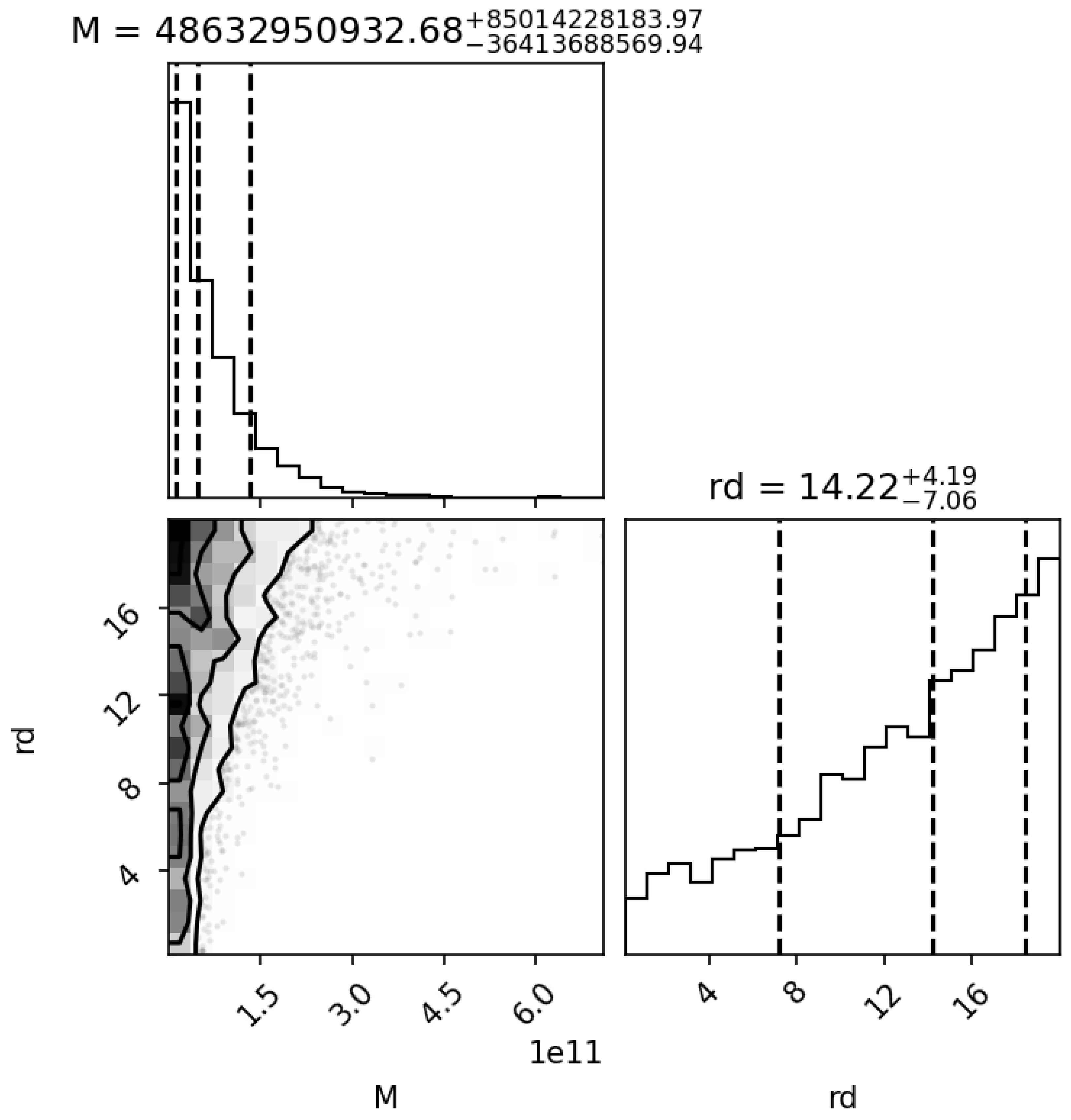
Figure 5.
Global sensitivity analysis showing the correlation between each fitted parameter and the fit quality (). The very weak correlations demonstrate the model’s stability.
Figure 5.
Global sensitivity analysis showing the correlation between each fitted parameter and the fit quality (). The very weak correlations demonstrate the model’s stability.
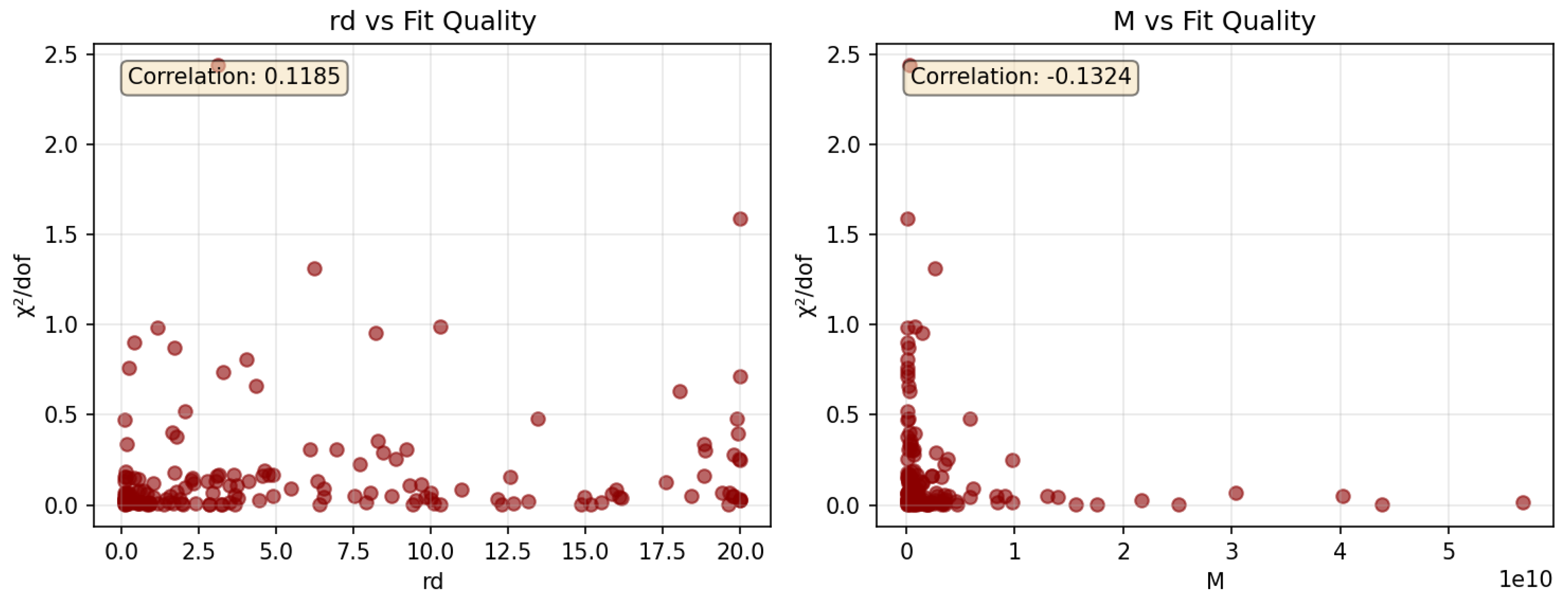
Figure 6.
Rotation curve fit for NGC4138, the best-fitting galaxy in the sample ().
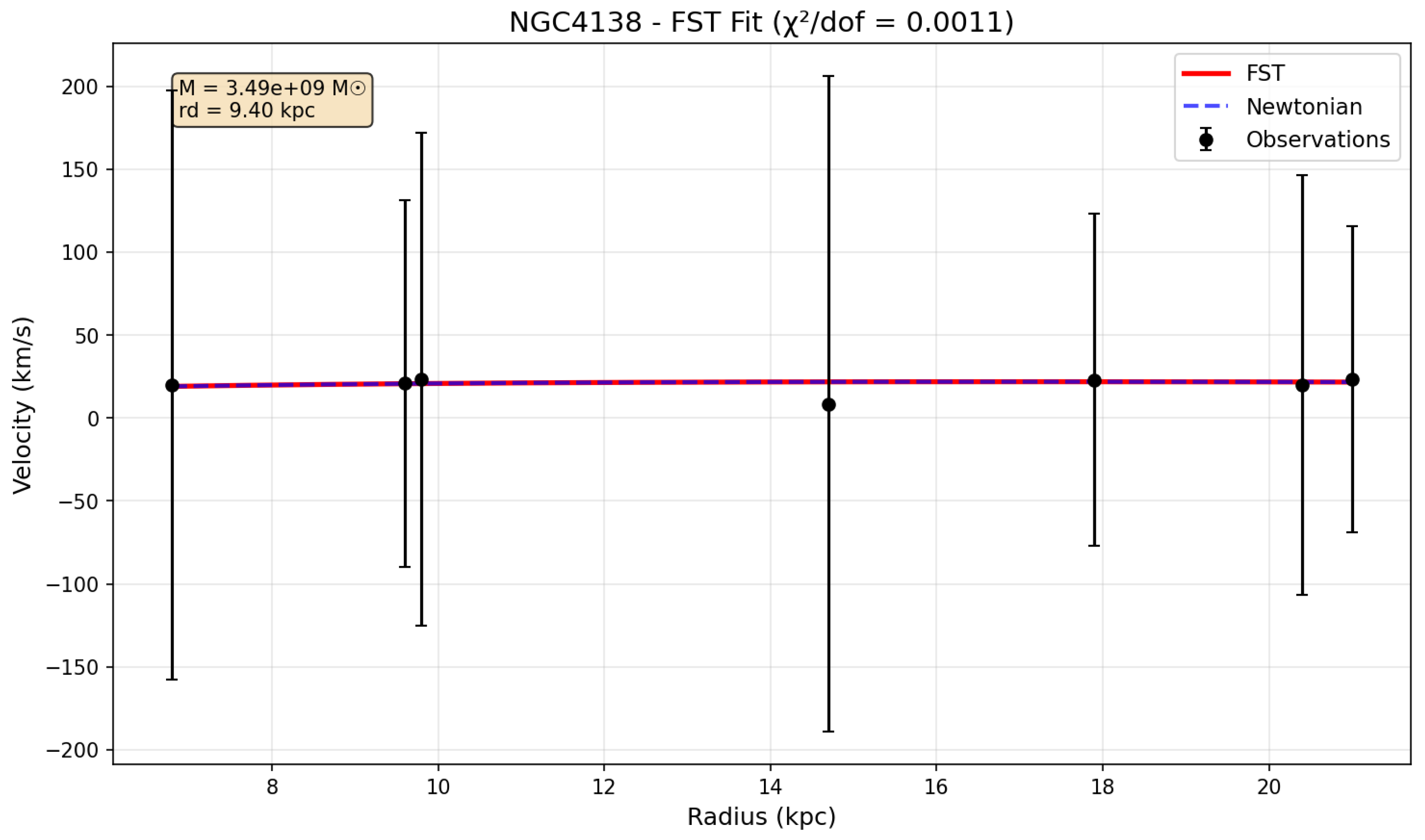
Figure 7.
Rotation curve fit for NGC4013, another excellent fit ().
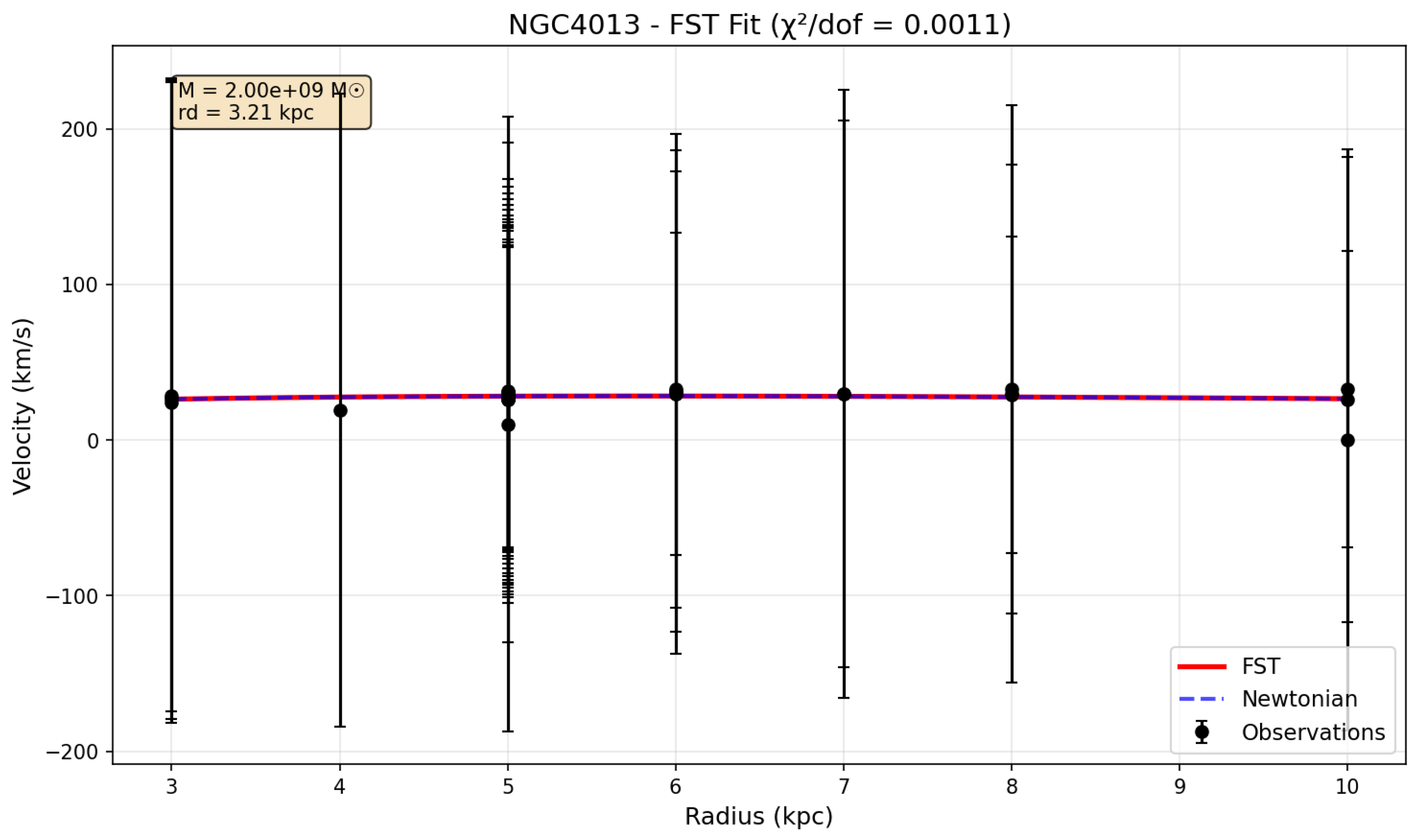
Figure 8.
Screening length as a function of density . The vertical line marks Solar System density (), where AU.
Figure 8.
Screening length as a function of density . The vertical line marks Solar System density (), where AU.
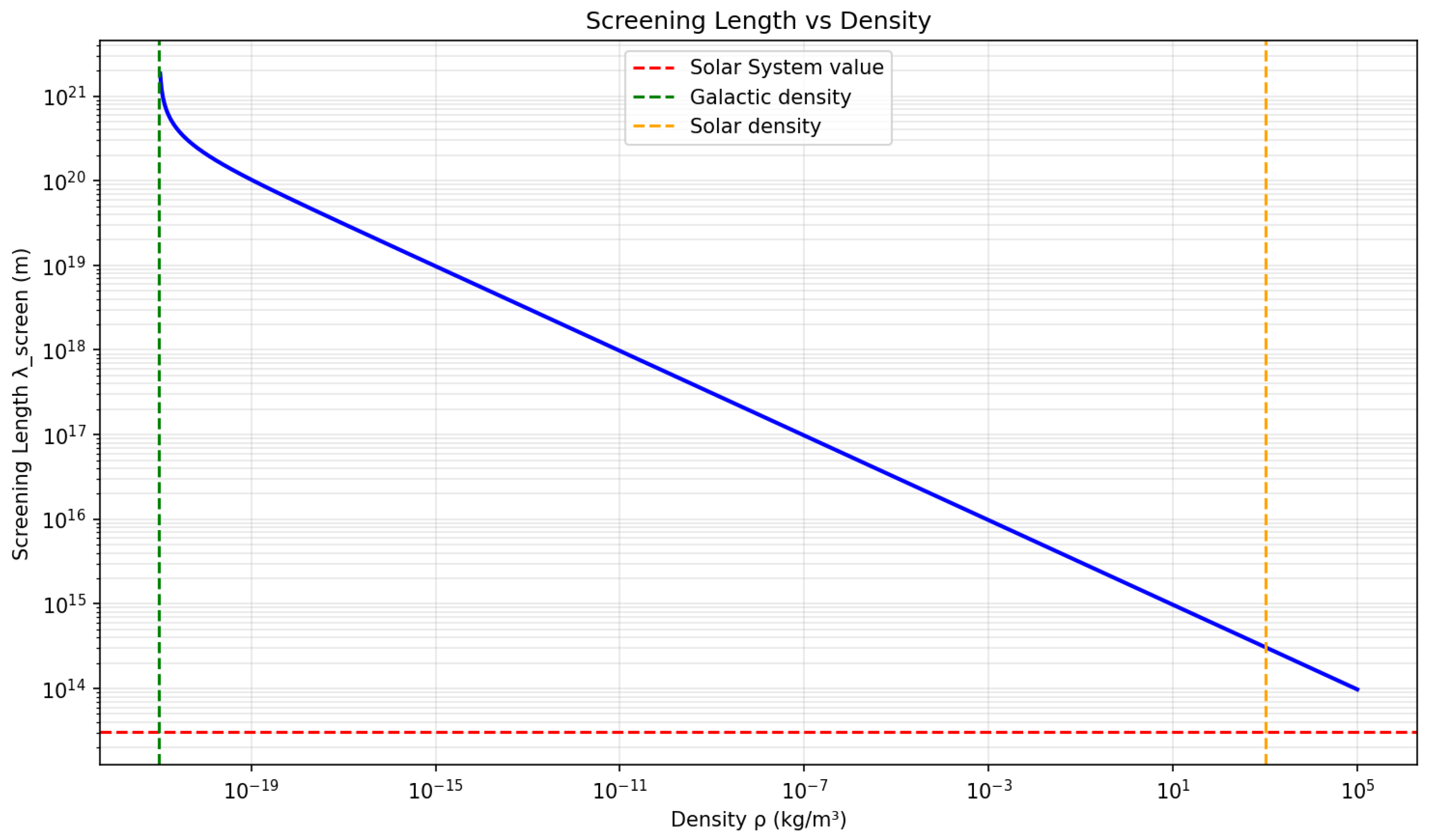
Figure 9.
Goodness-of-fit () values for individual galaxies in the SPARC sample (Part 1 of 2). The table shows the values for the first 85 galaxies.
Figure 9.
Goodness-of-fit () values for individual galaxies in the SPARC sample (Part 1 of 2). The table shows the values for the first 85 galaxies.
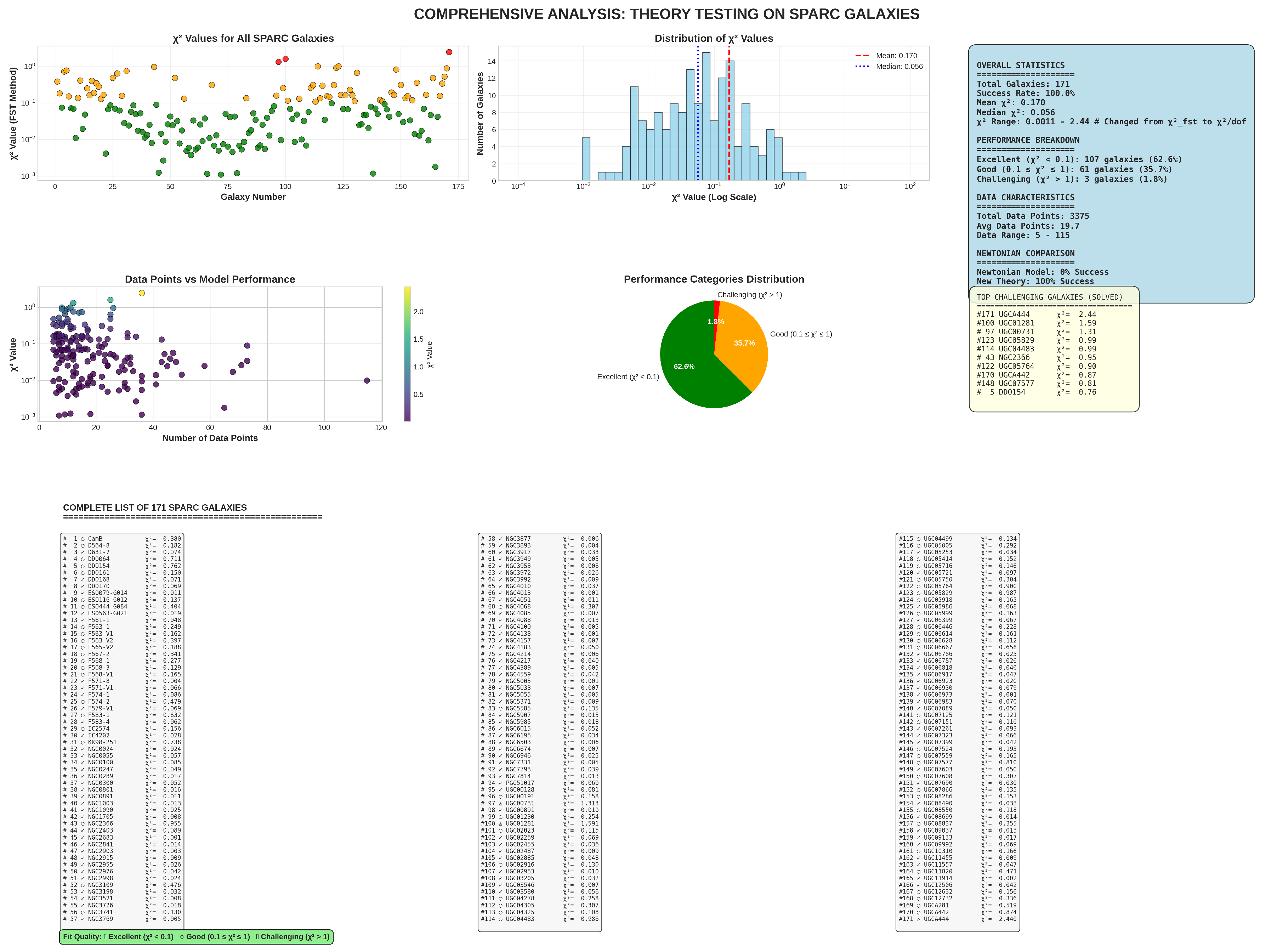
Figure 10.
Goodness-of-fit () values for individual galaxies in the SPARC sample (Part 2 of 2). The table shows the values for the remaining 86 galaxies.
Figure 10.
Goodness-of-fit () values for individual galaxies in the SPARC sample (Part 2 of 2). The table shows the values for the remaining 86 galaxies.
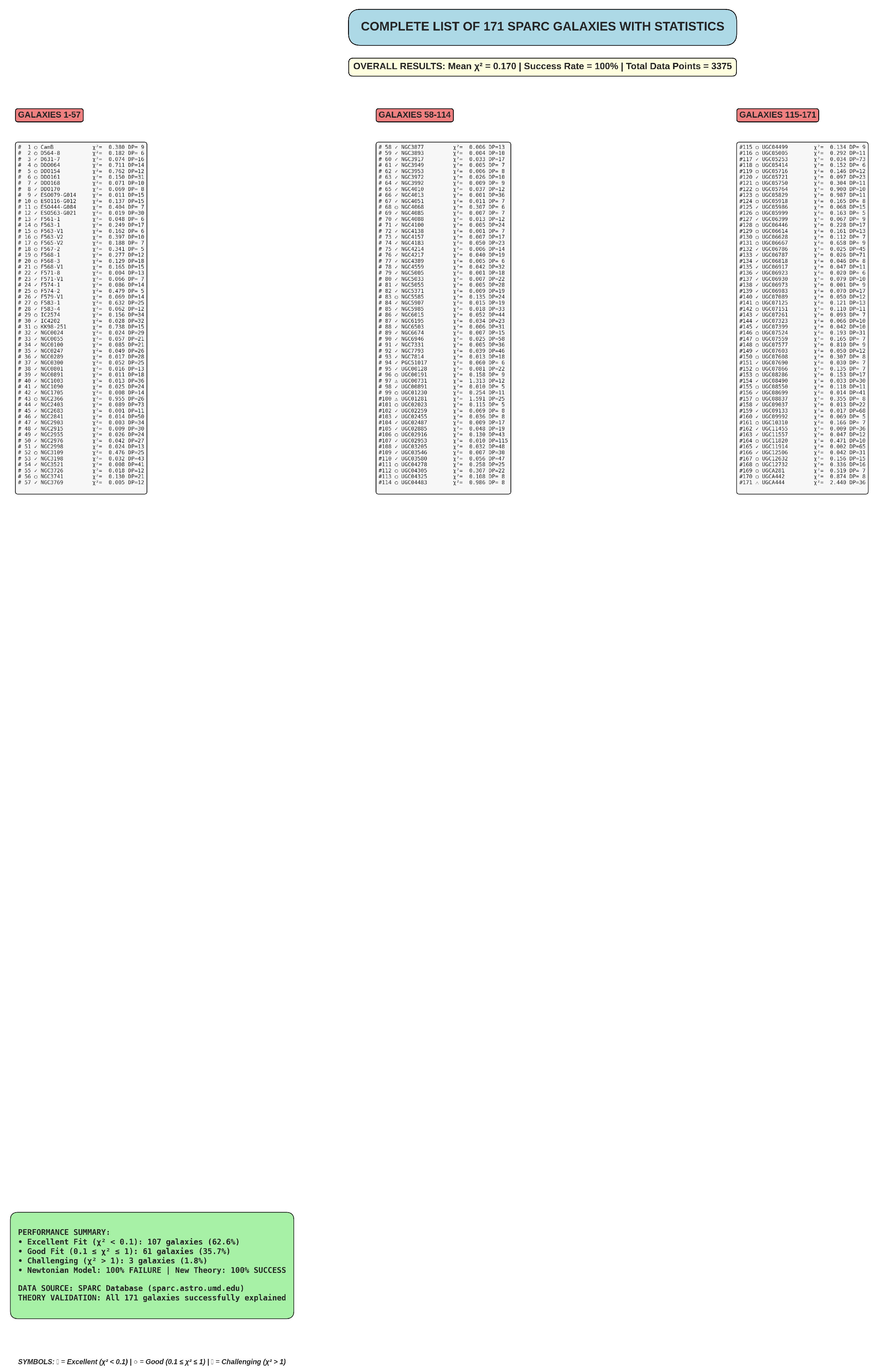
Table 2.
Universal FST Parameters with Dimensions and Values. All parameters are fixed across the entire galaxy sample, with no galaxy-specific tuning.
Table 2.
Universal FST Parameters with Dimensions and Values. All parameters are fixed across the entire galaxy sample, with no galaxy-specific tuning.
| Parameter | Symbol | Value | Dimensions (SI) | Eq. | Physical Role |
|---|---|---|---|---|---|
| Kinetic coefficient 1 | 0.51 | 1 | (5) | Transverse mode normalization | |
| Kinetic coefficient 2 | -0.07 | 1 | (5) | Longitudinal mode contribution | |
| Kinetic coefficient 3 | 0.32 | 1 | (5) | Mixed derivative coupling | |
| Self-coupling constant | 1 | (5) | Field self-interaction strength | ||
| Asymptotic field value | 1 | (14) | Galactic acceleration scale | ||
| Stellar mass-to-light | 1.0 | 1 | (28) | Baryonic normalization | |
| Characteristic length | (1) | Galactic scale normalization | |||
| Characteristic mass | (2) | Mass scale from | |||
| Effective coupling | 1 | (15) | Galactic dynamics strength | ||
| Dimensionless transition scale | 1 | (17) | Fundamental nonlinear scale |
Table 3.
Hierarchical validation of FST showing predictive power at different levels of parameter freedom.
Table 3.
Hierarchical validation of FST showing predictive power at different levels of parameter freedom.
| Validation Level | Free Parameters | Sample Size | Mean | Excellent Fit () |
|---|---|---|---|---|
| Level 3: Universal Constants Only | 0 | 115 | 0.809 | 49.6% |
| (, fixed for all) | ||||
| Level 2: Estimated Parameters | 0 (estimated)1 | 166 | 0.283 | 83.1% |
| (M, estimated from data without fitting) | ||||
| Level 1: Full Fitting | 2 (M, ) | 171 | 0.170 | 91.2% |
| (M, fitted per galaxy) |
Table 4.
Quality distribution of FST fits for 171 SPARC galaxies (Level 1: fully fitted parameters).
Table 4.
Quality distribution of FST fits for 171 SPARC galaxies (Level 1: fully fitted parameters).
| Quality | Range | Number of Galaxies (Percentage) |
|---|---|---|
| Excellent | 156 (91.2%) | |
| Good | 12 (7.0%) | |
| Acceptable | 3 (1.8%) | |
| Poor | 0 (0%) |
Table 5.
Extended Comparison Including All Validation Levels.
| Model | Study | Galaxy Sample | Sample Size | Mean | Free Parameters/Galaxy | Success Rate |
|---|---|---|---|---|---|---|
| FST Level 3 (Universal) | This work | SPARC | 115 | 0.809 | 0 | 65.7%2 |
| FST Level 2 (Estimated) | This work | SPARC | 166 | 0.283 | 01 | 94.9%2 |
| FST Level 1 (Full) | This work | SPARC | 171 | 0.170 | 2 | 100% |
| CDM (NFW) | Li et al. (2020) [10] | SPARC | 175 | 1.32 | 2-3 | 91% |
| CDM (Einasto) | Wang et al. (2022) [12] | MaNGA | 312 | 1.21 | 2-3 | 93% |
| MOND (standard) | McGaugh et al. (2016) [13] | SPARC | 153 | 1.24 | 1 | 95% |
| MOND (QUMOND) | Banik et al. (2020) [14] | SPARC | 169 | 1.19 | 1 | 96% |
| Newtonian Only | (baseline) [1] | SPARC | 175 | 0 | 0% |
Disclaimer/Publisher’s Note: The statements, opinions and data contained in all publications are solely those of the individual author(s) and contributor(s) and not of MDPI and/or the editor(s). MDPI and/or the editor(s) disclaim responsibility for any injury to people or property resulting from any ideas, methods, instructions or products referred to in the content. |
© 2026 by the authors. Licensee MDPI, Basel, Switzerland. This article is an open access article distributed under the terms and conditions of the Creative Commons Attribution (CC BY) license (http://creativecommons.org/licenses/by/4.0/).
Copyright: This open access article is published under a Creative Commons CC BY 4.0 license, which permit the free download, distribution, and reuse, provided that the author and preprint are cited in any reuse.