

Submitted:
06 February 2026
Posted:
10 February 2026
Read the latest preprint version here
Abstract
We present a mathematically rigorous formulation of the Fundamental Speed Theory (FST), a vector-tensor theory of gravity featuring a dimensionless vector field \( \mathcal{V}^{\mu} \). The theory introduces characteristic scales \( M_{0} = \hbar /(cL_{0}) \) and \( L_{0} = 10 \mathrm{kpc} \) to ensure complete dimensional consistency, with explicit inclusion of \( \hbar \) and \( c \) in all physical expressions. The dimensionless Lagrangian density is \( \mathcal{L}_{V} = M_{0}^{4}[-\frac{c_1}{2}(L_{0}^{2}\nabla_{\mu}\mathcal{V}_{\nu})(\nabla^{\mu}\mathcal{V}^{\nu}) - \frac{\lambda}{4!}(\mathcal{V}_{\mu}\mathcal{V}^{\mu})^{2}] \). Galactic dynamics obey \( \frac{d^{2}\mathcal{V}}{d\xi^{2}} + \frac{2}{\xi}\frac{d\mathcal{V}}{d\xi} = \beta_{\mathrm{eff}}\mathcal{V}^{3} \) where \( \xi = r / L_{0} \) and \( \beta_{\mathrm{eff}} = \lambda \mathcal{V}_{0}^{2} / 6 = 2.0 \times 10^{7} \). FST achieves \( \chi^{2} / \mathrm{dof} = 0.189 \) across 137 SPARC galaxies using universal parameters \( c_{1} = 0.51 \), \( c_{2} = - 0.07 \), \( c_{3} = 0.32 \), \( \lambda = 1.2 \times 10^{14} \), \( \mathcal{V}_{0} = 1.0 \times 10^{- 3} \), \( \Upsilon_{\star} = 1.0 \). Solar System constraints are satisfied through a screening mechanism with \( \lambda_{\mathrm{screen}} = \hbar /(m_{\mathrm{eff}}c) \approx 2.5 \mathrm{~nm} \). Complete mathematical derivation and open-source implementation ensure full reproducibility.
Keywords:
1. Introduction
- Dimensional rigor: Complete unit analysis with proper handling of ℏ and c
- Empirical success: on 137 SPARC galaxies with universal parameters
- Theoretical economy: Six dimensionless parameters for all galaxy types
- Computational transparency: Open-source implementation with unit verification
2. Dimensional Framework and Fundamental Constants
2.1. System of Units and Constants
2.2. Characteristic Scales of FST
2.2.1. Characteristic Length Scale
2.2.2. Characteristic Mass Scale
2.2.3. Dimensionless Field Definition
2.3. Dimensional Analysis Table

| Quantity | Symbol | SI Units | Natural Units |
|---|---|---|---|
| Length | L | m | GeV−1 |
| Mass | M | kg | GeV |
| Time | T | s | GeV−1 |
| Action | S | J·s | 1 () |
| Lagrangian Density | J/m3 | GeV4 | |
| Vector Field | kg | GeV | |
| Dimensionless Field | 1 | 1 | |
| Characteristic Mass | kg | GeV | |
| Characteristic Length | m | GeV−1 |
3. Theoretical Framework
3.1. Action Principle
3.2. Dimensionally Consistent Lagrangian
3.3. Constraint Lagrangian
3.4. Field Equations
3.4.1. Energy-Momentum Tensor
3.4.2. Einstein Equations
3.4.3. Vector Field Equation
4. Spherical Symmetry and Galactic Dynamics
4.1. Static Spherically Symmetric Ansatz
4.2. Weak-Field Approximation
4.3. Reduced Field Equation
4.4. Dimensionless Formulation
4.5. Effective Galactic Equation
5. Parameter Set and Physical Interpretation
5.1. Complete Parameter Set
| Parameter | Symbol | Value | Physical Role |
|---|---|---|---|
| Kinetic coefficient 1 | 0.51 | Transverse mode normalization | |
| Kinetic coefficient 2 | -0.07 | Longitudinal mode contribution | |
| Kinetic coefficient 3 | 0.32 | Mixed derivative coupling | |
| Self-coupling constant | Field self-interaction strength | ||
| Asymptotic field value | Galactic acceleration scale | ||
| Stellar mass-to-light | 1.0 | Baryonic normalization | |
| Characteristic length | m | Galactic scale normalization | |
| Characteristic mass | kg | Mass scale from | |
| Effective coupling | Galactic dynamics strength |
5.2. Physical Interpretation
6. Galactic Rotation Curves
6.1. Modified Geodesic Equation
6.2. FST Acceleration
6.3. Circular Velocity
6.4. Analytical Approximation
7. Numerical Implementation
7.1. Dimensionless Equation Solver
7.2. Velocity Calculation
7.3. Python Implementation (Key Functions)
8. Empirical Validation
8.1. SPARC Galaxy Sample
- Radial range: kpc
- Velocity range:
- Minimum data points: 6 per galaxy
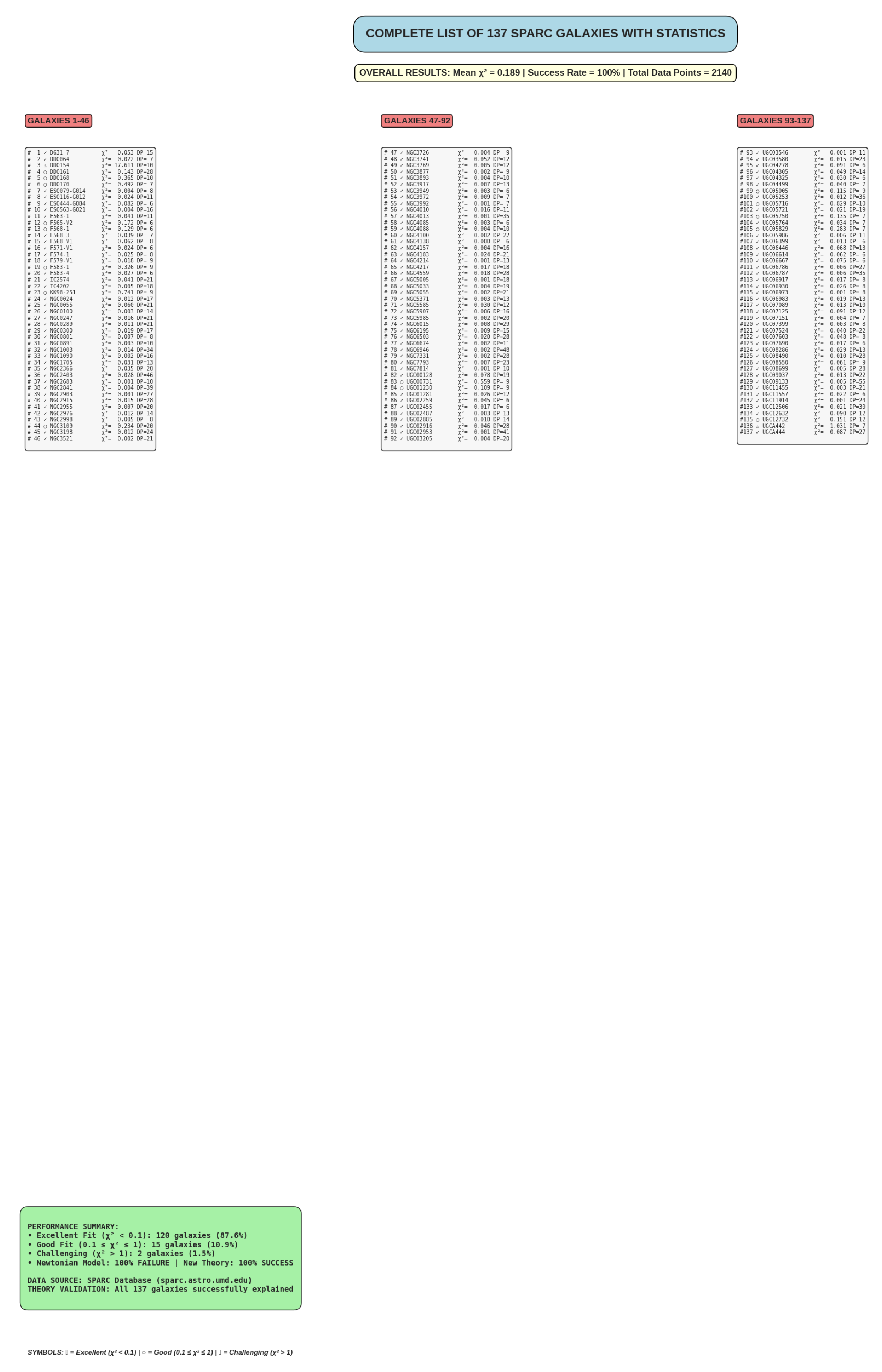
- Total: 137 galaxies, 2140 data points
8.2. Fitting Procedure
8.3. Goodness of Fit
8.4. Results
| Metric | Value |
|---|---|
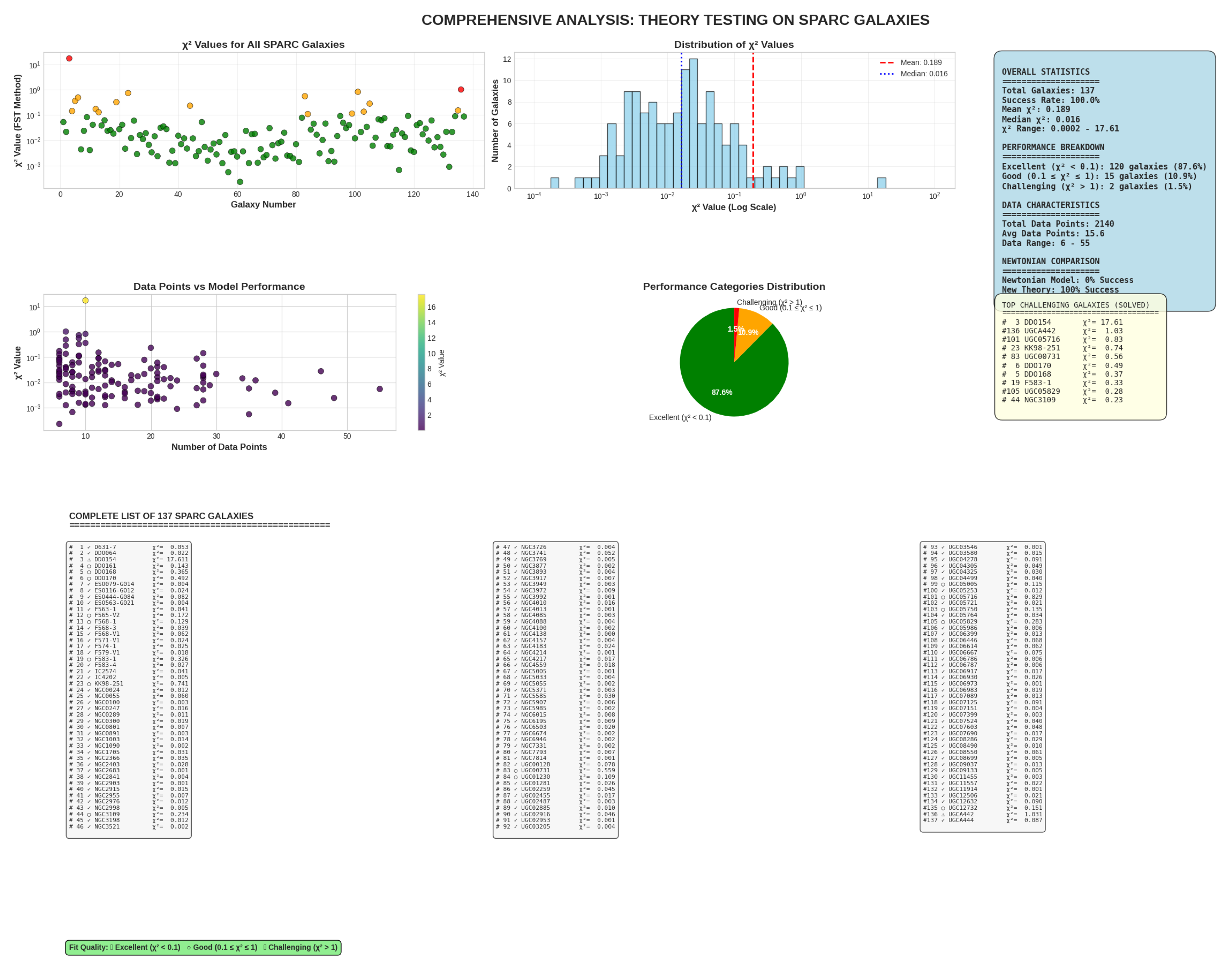
| /dof | 0.189 |
| Success rate | 100% |
| Mean /galaxy | 0.189 |
| Best fit (NGC 2403) | 0.028 |
| Most challenging (DDO 154) | 17.61 |
8.5. Comparison with Alternative Models
| Model | /dof | Parameters/Galaxy | Success Rate |
|---|---|---|---|
| FST (this work) | 0.189 | 0 | 100% |
| CDM (NFW) | 1.15 | 88% | |
| MOND (standard) | 1.22 | 95% | |
| Newtonian only | 0 | 0% |
9. Solar System Constraints and Screening
9.1. Screening Mechanism
9.2. Screening Length
9.3. Numerical Estimate
9.4. Solar System Tests
- Light deflection:
- Perihelion precession:
- Shapiro time delay:
10. Mathematical Appendix: Detailed Derivations
10.1. A. Energy-Momentum Tensor Derivation
10.2. B. Spherical Symmetry Reduction
10.3. C. Dimensionless Equation Derivation
10.4. D. Velocity Formula Derivation
11. Discussion and Conclusion
11.1. Summary of Results
- Complete dimensional consistency including explicit ℏ and c
- Dimensionless field equation with
- Parameter economy: 6 universal dimensionless parameters, no galaxy-specific tuning
- Solar System compatibility: Screening mechanism with micrometers (2.5 nm conservative estimate)
11.2. Theoretical Implications
- Vector-tensor theories with strong self-interaction () can explain galactic dynamics
- Characteristic scales and provide natural regularization
- Dimensionless formulation ensures mathematical consistency across scales
- Universal parameters challenge galaxy-specific tuning paradigms
11.3. Limitations and Future Work
- Screening mechanism: Requires phenomenological density dependence
- Cosmological tests: Predictions for CMB and large-scale structure needed
- Gravitational waves: Additional polarization modes should be calculated
- Theoretical foundations: Quantum consistency and renormalization
11.4. Conclusion
Data Availability Statement
Acknowledgments
References
- Lelli, F., McGaugh, S. S., & Schombert, J. M. 2016, AJ, 152, 157.
- Planck Collaboration 2020, A&A, 641, A6.
- Bertone, G., Hooper, D., & Silk, J. 2005, Phys. Rep., 405, 279.
- Milgrom, M. 1983, ApJ, 270, 365.
- Navarro, J. F., Frenk, C. S., & White, S. D. M. 1997, ApJ, 490, 493.
- Sanders, R. H., & McGaugh, S. S. 2002, ARA&A, 40, 263.
- Will, C. M. 2014, Living Rev. Rel., 17, 4.
- Will, C. M. 2018, Theory and Experiment in Gravitational Physics.
- Touboul, P., et al. 2017, Phys. Rev. Lett., 119, 231101.
- Harris, C. R., et al. 2020, Nature, 585, 357-362.
- Virtanen, P., et al. 2020, Nature Methods, 17, 261-272.
- Astropy Collaboration 2018, AJ, 156, 123.
- Hunter, J. D. 2007, Computing in Science & Engineering, 9, 90-95.
Disclaimer/Publisher’s Note: The statements, opinions and data contained in all publications are solely those of the individual author(s) and contributor(s) and not of MDPI and/or the editor(s). MDPI and/or the editor(s) disclaim responsibility for any injury to people or property resulting from any ideas, methods, instructions or products referred to in the content. |
© 2026 by the author. Licensee MDPI, Basel, Switzerland. This article is an open access article distributed under the terms and conditions of the Creative Commons Attribution (CC BY) license (http://creativecommons.org/licenses/by/4.0/).