

Submitted:
06 February 2026
Posted:
09 February 2026
You are already at the latest version
Abstract
Bacteria-based cancer therapies have re-emerged as a promising modality due to the intrinsic capacity of certain bacterial species to preferentially colonize hypoxic and necrotic tumor regions [1, 2]. However, planktonic motile systems are frequently limited by rapid immune clearance, transient persistence, and uncontrolled payload release [2, 3]. This review introduces a synthetic biology framework that reframes bacterial biofilms from pathological barriers into programmable therapeutic scaffolds. By utilizing programmable microbial therapeutic chassis, researchers can enhance therapeutic duration within the tumor microenvironment (TME) while potentially minimizing systemic exposure [4, 5]. Central to this framework is the genetic modulation of matrix density, primarily via curli fiber-associated csgA expression. This approach may enable drug release kinetics governed by Fickian diffusion principles, allowing for sustained and controllable therapeutic delivery [6, 7].
Keywords:
synthetic biology
; biofilm engineering
; tumor-targeting bacteria
; synthetic microbial therapeutics
; biocontainment
; csgA
; diffusion-controlled drug delivery
1. Introduction
Modern oncology continues to face significant challenges regarding the selectivity and localized delivery of therapeutics [8]. Bacteria-based therapy exploits the natural tumor-homing capacity of certain species as part of emerging bacterial therapeutic strategies [4,9]. However, the translational success of these systems depends not only on targeting efficiency but also on achieving a sustained and controllable therapeutic presence without inducing systemic toxicity [1,10].
2. Limitations of Current Planktonic Systems
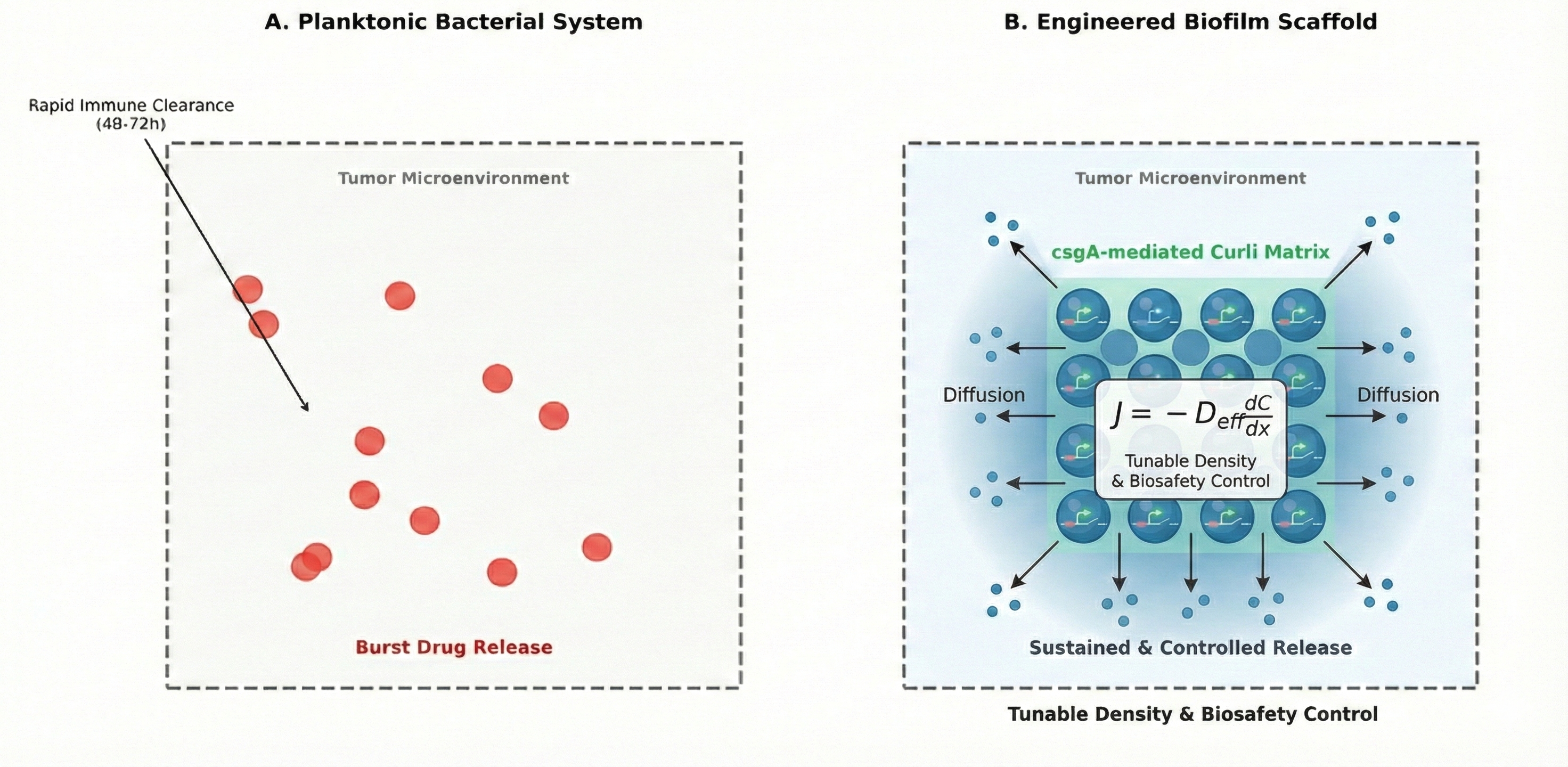
Existing therapies primarily rely on planktonic motile bacteria. Preclinical evidence suggests these systems often suffer from rapid immune recognition and are typically cleared within 48–72 hours following administration [3,11]. The absence of a protective structural matrix renders individual bacteria susceptible to phagocytosis and complement-mediated killing, which may lead to suboptimal persistence in the tumor core [11,12]. Furthermore, uncontrolled payload release in these systems often results in burst kinetics that can increase the risk of off-target toxicity [13].
3. Biofilms: From Clinical Obstacle to Therapeutic Opportunity
Historically viewed as pathological barriers, biofilms offer unique opportunities for synthetic biology engineering [14,15]. Within the TME, biofilm-associated bacteria are expected to achieve prolonged persistence compared to planktonic counterparts due to EPS-mediated immune shielding [4,11]. Advances in genetic circuit design now enable the precise regulation of matrix assembly, effectively transforming biofilms into programmable biological scaffolds [6,7]. However, the inherent complexity of biofilm development requires rigorous control to prevent unintended tissue obstruction, vascular occlusion risk, or localized inflammatory overload [14,15].
4. Engineered Biofilm Scaffolds: The Conceptual Framework
This framework involves the design of bacterial biofilms as stable, long-lived therapeutic structures within solid tumors [4]. Programmability is achieved by integrating synthetic regulatory elements, such as hypoxia-inducible or pH-responsive promoters [6,10]. By modulating the expression of curli fibers via csgA regulation, the effective diffusion coefficient (D_eff) of the matrix can be genetically tuned, enabling therapeutic release kinetics consistent with Fick’s law [7,13]:
where D_eff reflects matrix porosity and cross-link density. This relationship may facilitate controlled therapeutic payload delivery, ensuring that the payload is released at a predictable rate rather than through spontaneous burst release.
J = −D_eff ∂C/∂x
5. Biosafety, HGT, and Biocontainment
For clinical viability, biofilm scaffolds must incorporate multi-layered biosecurity protocols [16]. A critical consideration in biofilm engineering is that dense microbial communities may increase the risk of horizontal gene transfer (HGT), necessitating integrated biocontainment switches. Biofilm-associated close cellular proximity may further facilitate genetic exchange, reinforcing the need for robust genetic isolation. Beyond simple lysis circuits, strategies including engineered auxotrophy and "deadman" switches are essential to prevent HGT and unintended environmental persistence [6,16].
6. Experimental and Translational Roadmap
Validation of this framework requires a transition from traditional 2D cultures to biomimetic models. Microfluidic "tumor-on-chip" systems are proposed to replicate the physiological flow and oxygen gradients necessary for biofilm maturation [4,7]. These platforms allow for the real-time quantification of payload diffusion as a function of genetically tuned matrix porosity [12,13]. Future clinical translation requires the integration of regulatory science, host-microbiome interaction studies, and scalable GMP-compatible microbial engineering pipelines.
7. Conclusions
Engineered biofilm scaffolds represent a conceptually distinct paradigm shift in bacterial cancer therapy. By integrating advanced biocontainment strategies with diffusion-controlled release principles, this framework holds the potential to improve localized cancer treatment outcomes and durability. Further experimental validation will determine clinical feasibility and the ultimate safety profile of these systems.
References
- Forbes, NS. Engineering the perfect bacterial cancer therapy. Nat Rev Cancer 2010, 10, 785–794. [Google Scholar] [CrossRef] [PubMed]
- Li, Z; et al. Precision tumor treatment utilizing bacteria: principles and future perspectives. Signal Transduct Target Ther. 2023, 8, 156. [Google Scholar] [CrossRef] [PubMed]
- Wang, C; et al. Bacteria-based immunotherapy for cancer. J Immunother Cancer 2023, 11, e006543. [Google Scholar]
- Zhou, S. Tumour-targeting bacteria engineered to fight cancer. Nat Rev Cancer 2018, 18, 727–743. [Google Scholar] [CrossRef] [PubMed]
- Chowdhury, S; et al. Programmable bacteria induce durable tumor regression and systemic antitumor immunity. Nat Med. 2019, 25, 1057–1063. [Google Scholar] [CrossRef] [PubMed]
- Riglar, DT; Silver, PA. Engineering bacteria for diagnostic and therapeutic applications. Nat Rev Microbiol. 2018, 16, 214–225. [Google Scholar] [CrossRef] [PubMed]
- Siepmann, J; Siepmann, F. Mathematical modeling of drug delivery. Int J Pharm. 2008, 364, 328–343. [Google Scholar] [CrossRef] [PubMed]
- Hanahan, D. Hallmarks of cancer: New dimensions. Cancer Discov. 2022, 12, 31–46. [Google Scholar] [CrossRef] [PubMed]
- Liu, L; et al. Engineering bacteria for tumor therapy. Nano Today 2022, 43, 101444. [Google Scholar]
- Danino, T; et al. Programmable probiotics for detection of cancer in urine. Sci Transl Med. 2015, 7, 289ra84. [Google Scholar] [CrossRef] [PubMed]
- Morales-Cano, D; et al. Biofilm-mediated immune shielding. Front Immunol. 2022, 13, 890521. [Google Scholar]
- Hall-Stoodley, L; et al. Bacterial biofilms and infectious diseases. Nat Rev Microbiol. 2004, 2, 95–108. [Google Scholar] [CrossRef] [PubMed]
- Harimoto, T; et al. A programmable probiotic for cancer therapy. Nat Commun. 2019, 10, 3742. [Google Scholar]
- Flemming, HC; Wingender, J. The biofilm matrix. Nat Rev Microbiol. 2010, 8, 623–633. [Google Scholar] [CrossRef] [PubMed]
- Choi, E; et al. Biofilm and cancer interactions. Int J Mol Sci. 2023, 24, 12836. [Google Scholar] [CrossRef]
- Chan, CTY; et al. Deadman and Passcode microbial kill switches for bacterial containment. Nat Chem Biol. 2016, 12, 82–86. [Google Scholar] [PubMed]
Disclaimer/Publisher’s Note: The statements, opinions and data contained in all publications are solely those of the individual author(s) and contributor(s) and not of MDPI and/or the editor(s). MDPI and/or the editor(s) disclaim responsibility for any injury to people or property resulting from any ideas, methods, instructions or products referred to in the content. |
© 2026 by the authors. Licensee MDPI, Basel, Switzerland. This article is an open access article distributed under the terms and conditions of the Creative Commons Attribution (CC BY) license (http://creativecommons.org/licenses/by/4.0/).
Copyright: This open access article is published under a Creative Commons CC BY 4.0 license, which permit the free download, distribution, and reuse, provided that the author and preprint are cited in any reuse.


