

Submitted:
05 February 2026
Posted:
06 February 2026
You are already at the latest version
Abstract
Immersive virtual environments are increasingly investigated as tools capable of modulating conscious experience, yet the specific contribution of graded immersion to altered states of consciousness (ASC), time perception, and cognition remains unclear. The present study examined how different levels of immersion during videogame play influence subjective experience and post-experience cognitive performance. Seventy-two participants played an identical 35-minute segment of the videogame Half-Life: Alyx under one of three conditions: desktop PC (low immersion), head-mounted virtual reality (VR; medium immersion), or VR combined with full-body locomotion via an omnidirectional treadmill (high immersion). Following gameplay, participants completed validated measures of presence (IPQ), immersion (IEQ), ASC (5D-ASC), retrospective time estimation, and cognitive flexibility (Stroop task and Alternative Uses Test). Presence was selectively enhanced in VR relative to desktop play, whereas immersion was highest in the VR plus treadmill condition. Specific ASC dimensions related to embodiment and self-experience (disembodiment, depersonalization, derealization, and altered perception of time and space) were significantly elevated in immersive conditions. Retrospective time estimation accuracy was reduced in the highest immersion condition, indicating increased temporal distortion. Cognitive flexibility measures showed no broad modulation by immersion, with only subtle differences in Stroop accuracy. Overall, the findings indicate that increasing immersion during videogame play selectively reshapes specific dimensions of conscious experience, particularly embodiment- and time-related aspects, without globally altering executive function.
Keywords:
virtual reality
; immersion
; presence
; altered states of consciousness
; executive functions
; time perception
; videogames
; cognitive flexibility
; predictive processing
; entropic brain
1. Introduction
Virtual reality (VR) and immersive videogames are not only entertainment media but also emerging tools for modulating human consciousness and cognition. Players often report losing track of time during gameplay, and a large survey identified altered time perception as one of the primary reasons people play videogames [1]. Notably, a distorted sense of time is a hallmark of altered states of consciousness (ASCs) [2], suggesting that engaging digital environments can induce mild ASC-like experiences. In recent years, researchers have increasingly explored the capacity of immersive technologies to evoke ASC in a controlled, non-pharmacological manner [3,4]. This trend has given rise to the concept of digitally induced ASC (DIAL), referring to ASC experiences facilitated by modern media [5]. Early examples include attempts to induce trance-like states with binaural beat audio programs [6] and pervasive reports of profound absorption in videogames. More recent approaches leverage VR’s multisensory simulations, for instance VR-generated hallucinatory visuals, aimed at safely reproducing aspects of ASCs such as self-transcendence, disembodiment, and altered reality [3]. Fundamentally, ASCs have long been recognized as an important part of human experience [7], and technology now provides a novel means to access some of their features without pharmacological agents [8,9,10].
A crucial distinction in this domain is between immersion and presence. Immersion denotes the objective qualities of a system that make a virtual experience perceptually convincing, such as high-fidelity graphics, surround sound, and interactive content [11,12]. In contrast, presence refers to the subjective psychological state of “being there” in the virtual world [13]. Prior work has shown that greater technological immersion generally leads to a stronger sense of presence [13,14]. Immersion can therefore be considered the cause, built by hardware and software, and presence the effect, namely the user’s mental acceptance of the virtual environment as real. In VR games, higher immersion is achieved not only via rich sensory input (e.g., wide field-of-view visuals, spatial audio, haptic feedback), but also through interactivity and embodiment.
Embodiment refers to providing the user with a virtual body that moves in synchrony with their real movements, while agency refers to the user’s ability to intentionally act on the virtual world [15]. These factors are known to amplify presence and engagement. For example, allowing natural locomotion and full-body movement in VR, through motion tracking or omnidirectional treadmills, can heighten the feeling of incorporation into the virtual space. When a VR system lines up with the user’s sensorimotor expectations, such that visual and proprioceptive feedback match real movements, the brain more readily treats the virtual body as its own and the virtual environment as real [15,16].
From a theoretical perspective, these effects can be interpreted through predictive processing accounts of perception. The VR experience generates sensory inputs that fulfil the brain’s learned predictions for normal interaction, thereby minimizing prediction errors and creating a compelling illusion of reality [17,18]. In simple terms, a well-designed immersive system “tricks” the brain’s predictive model into accepting the virtual scenario, resulting in high presence. By contrast, mismatches in expected feedback, such as tracking latency or sensorimotor incongruence, can disrupt presence or induce unusual sensations, highlighting how tightly embodiment and presence are linked to multisensory integration mechanisms.
The intensity of an immersive experience has important consequences for subjective state and cognitive processes. Deep immersion is often accompanied by a state of focused attention and reduced self-awareness akin to flow [19]. In a flow state, individuals become so absorbed in the task at hand that they lose track of external factors, including time. Highly immersive games readily induce this phenomenon: players engaging in immersive games (even non-VR experiences) frequently underestimate how much time has passed when reflecting afterward [1]. According to attentional models of time perception, when attention is fully occupied by the environment, fewer cognitive resources remain available to monitor the passage of time [20]. Thus, greater immersion can lead to greater temporal distortion, often experienced as time “flying by” during play.
Immersion may also temporarily alter cognitive control and self-referential processing. Individuals deeply absorbed in an activity can experience diminished awareness of their physical self or surroundings, sometimes described as a mild dissociative state [21]. In the context of VR, a strong sense of presence can overwrite everyday reality, leading users to respond to virtual situations as if they were real [17]. While this property has beneficial applications (e.g., eliciting genuine emotional responses in therapeutic settings), it also demonstrates the profound impact of immersive presence on cognition. Indeed, VR immersion has been shown to induce temporary reductions in real-world presence and symptoms of dissociation, particularly in individuals predisposed to absorption [21]. Other research similarly indicates that highly immersive experiences can momentarily reduce executive control; for example, problem gamblers often report trance-like dissociative states during gameplay [22]. Together, these observations suggest that increasing immersion is associated with more pronounced subjective alterations of consciousness, including changes in time perception, self-awareness, and cognitive control.
Time perception is particularly sensitive to immersion because subjective time is not directly perceived but reconstructed from internal signals related to attention, memory, and contextual cues [23,24]. Temporal judgments are commonly distinguished into retrospective and prospective paradigms, which rely on partially distinct mechanisms [20]. Retrospective timing depends primarily on memory encoding and contextual change, with richer or more eventful experiences yielding longer reconstructed durations [25,26]. Prospective timing, in contrast, is governed by attentional allocation and arousal, as formalized in the attentional-gate model [27]. Immersive videogame play, especially in VR, simultaneously increases attentional load, emotional engagement, and sensorimotor complexity, making it a powerful context for disrupting temporal metacognition.
Empirical findings on time perception in VR remain mixed. While altered time passage is robustly reported in videogames, VR studies have documented underestimation, overestimation, or null effects [28,29,30,31]. These discrepancies likely reflect differences in duration, embodiment, emotional content, and the availability of external temporal cues. Time and space are tightly coupled cognitive dimensions, and visual or spatial manipulations can directly influence perceived duration [32]. Moreover, embodiment itself modulates temporal experience: recent work shows that the presence of a virtual body accelerates the felt passage of time without necessarily affecting explicit duration estimates, revealing a dissociation between experiential and reconstructive aspects of time perception [33]. Emotional valence further shapes temporal judgments, with enjoyable experiences compressing perceived duration and boredom producing temporal dilation [34,35,36]. Importantly, it appears that affective engagement, rather than the medium per se, primarily drives temporal distortion [37].
Beyond temporal effects, immersive videogames can induce broader ASC-like phenomena. A recent systematic review identified numerous altered experiences reported in virtual environments, ranging from visual pseudo-hallucinations and spatial disorientation to feelings of unity and “out-of-body” experiences [38]. For example, a multi-person VR experience designed to elicit mystical-type feelings successfully produced strong self-transcendent states, with ratings of unity and bliss comparable to those induced by moderate doses of psychedelics [39]. Follow-up work demonstrated that such VR experiences can lead to significant ego attenuation and increased feelings of social connectedness, paralleling the effects of serotonergic psychedelics [40]. Similarly, exposure to surreal, dream-like 360° VR panoramas generated using DeepDream neural networks significantly elevated scores on the 5D-ASC questionnaire, indicating alterations in perception, insight, and sense of self comparable to those reported after psilocybin administration [3]. Notably, these participants also showed concurrent improvements in cognitive flexibility, suggesting a link between ASCs phenomenology and cognitive outcomes [3]. Collectively, these findings support the notion that immersive digital media can, under appropriate conditions, induce mild and controlled versions of classic ASC phenomena such as derealization, depersonalization, and intense absorption [38,39].
From a neurocognitive standpoint, two complementary theoretical frameworks may help explain how immersive experiences alter conscious states and cognition. The entropic brain hypothesis proposes that the richness and flexibility of conscious experience correlate with the entropy, or complexity, of brain activity [41]. According to this view, normal waking consciousness is a relatively ordered state, whereas ASCs involve transient increases in neural entropy, allowing brain networks to explore a wider repertoire of states [41]. In VR, highly immersive multisensory stimulation may similarly perturb habitual neural dynamics, albeit to a lesser degree than pharmacological agents. A second framework is the Global Neuronal Workspace theory, which conceptualizes consciousness as the global broadcasting of information across distributed brain networks [42]. In altered states, the usual gating of information may relax, allowing atypical or normally suppressed information to enter conscious awareness. In both frameworks, immersive VR could influence this process by simultaneously engaging multiple sensory and cognitive systems, thereby shifting the balance of global workspace dynamics. Immersive VR may reconfigure brain network activity in ways that echo specific features of ASCs, for example by downregulating habitual self-referential processing and promoting a more present-centred, exploratory mode of cognition. While direct neurophysiological evidence in VR users remains limited, these frameworks suggest that immersive experiences may modulate both the complexity and integration of brain activity, leading to altered subjective experience and cognitive flexibility.
Cognitive flexibility, defined as the ability to adapt to new rules, shift perspectives, and break out of rigid thought patterns, is an executive function of particular interest in this context [43]. Prior research indicates that certain ASCs can transiently enhance cognitive flexibility and creativity. Psychedelic compounds, at low or moderate doses, have been associated with reduced cognitive rigidity and improved set-shifting performance [44]. Similarly, VR experiences explicitly designed to be psychedelic-like have been shown to facilitate creative insight and idea generation, presumably by reducing cognitive fixation [3,44]. Experimental work further suggests that even simple task-switching interventions can enhance creativity by disrupting habitual cognitive loops [45]. High-immersion VR may operate in a similar manner by placing participants in novel, sensorimotor-rich contexts that require continuous adaptation. Enriched and complex environments are known to benefit executive functions [46], and VR provides an especially potent instantiation of such environments. Consistent with this view, participants exposed to a “digital hallucination” VR session not only reported ASC effects but also demonstrated increased cognitive flexibility on post-experience measures [3].
These findings resonate with the entropic brain perspective, suggesting that states of elevated neural variability or plasticity may temporarily loosen cognitive constraints and facilitate novel associations [41]. However, not all studies have observed cognitive benefits from VR, indicating that outcomes likely depend on the nature of the content, pacing, and balance between cognitive load and stimulation.
In summary, existing literature suggests that (1) the level of immersion provided by a digital experience modulates the intensity of presence and ASC-like effects, and (2) these altered experiences may influence subsequent cognitive performance, including creativity and flexibility. Nevertheless, important gaps remain. Few controlled experiments have systematically compared graded levels of immersion while holding task content constant. Most studies either examine VR in isolation or compare VR with non-VR conditions that differ substantially in context, making it difficult to isolate the specific contribution of immersion. In particular, the role of active locomotion and whole-body engagement, such as VR treadmills or motion platforms, has been hypothesized to amplify immersion and presence [39] but remains rarely tested with validated psychological outcome measures. Moreover, although presence and engagement questionnaires are commonly used, relatively few studies have incorporated standardized ASC instruments, such as the 5D-ASC, alongside cognitive measures.
The present study addresses these gaps by experimentally manipulating immersion level during a continuous, naturalistic videogame experience and assessing its effects on presence, subjective ASC, time perception, and cognitive flexibility. Using a between-subjects design, participants played the same 35-minute segment of the videogame Half-Life: Alyx under three conditions: desktop PC (low immersion), head-mounted VR (medium immersion), and VR combined with full-body locomotion via an omnidirectional treadmill (high immersion). This graded manipulation isolates the contribution of embodied movement and sensory immersion while keeping narrative and gameplay constant. Following gameplay, participants completed validated measures of presence, immersion, ASC, retrospective time estimation, and cognitive flexibility. We hypothesized that increasing immersion would enhance presence and ASC-like experiences, increase temporal estimation error, and potentially modulate post-experience cognitive flexibility. By testing these hypotheses, the study aims to clarify how graded immersion in VR reshapes conscious experience and cognition, informing both theoretical models of presence and practical applications of immersive technologies.
2. Materials and Methods
2.1. Procedure
Participants were individually guided into a laboratory room with pre-closed curtains to prevent exposure to zeitgebers that might indicate the passage of time. Upon entering the room, participants were instructed to remove their watches and place their mobile phones on a designated table near the entrance to eliminate external cues regarding time.
Following this, participants were briefed about the experiment's objectives and procedure. They then completed an informed consent form and a questionnaire assessing their gaming habits.
Pre-Gameplay Preparation
All participants completed a Stroop task training session consisting of 10 trials to familiarize themselves with the task mechanics, but they did not perform the full task on this occasion. They subsequently filled out the Gaming Habits and Demographics questionnaire.
Experimental Conditions
Participants were randomly assigned to one of three experimental conditions:
- 1.
- Low Immersion Condition:
Participants sat at a desktop computer and played Half-Life: Alyx (noVR) using a mouse and keyboard.
- 2.
- Medium Immersion Condition:
Participants were instructed to stand at the centre of the room and to minimize physical movement. They used a Meta Quest 3 VR headset and handheld controllers with joystick functionality to navigate the game environment.
- 3.
- High Immersion Condition:
Participants first put on specialized footwear for the KATVR platform and stepped onto the platform, where they secured safety belts. They completed a brief familiarization session to practice walking on the platform and finally donned a Meta Quest 3 VR headset and handheld controllers.
Gameplay Session
Participants in all conditions engaged in free, uninstructed, and unrestricted gameplay for exactly 35 minutes.
Post-Gameplay Assessments
Upon completion of the gameplay session, all participants underwent the following assessments:
- Temporal Perception: Participants completed a modified version of the Subjective Time, Self, Space (STSS) to estimate the duration of the gaming session [47].
- State of Consciousness: Participants filled out the 5D-ASC questionnaire to assess alterations in their state of consciousness [2].
- Cognitive Flexibility: Participants performed two cognitive tasks:
- ○
- The Alternative Uses Task (AUT)
- ○
- The Stroop task
- Cybersickness: Participants completed the CSQ-VR to identify any symptoms of cybersickness felt during the gaming session [50]
To minimize order effects, the administration of the questionnaires (IPQ and IEQ) was counterbalanced with the cognitive tasks (AUT and Stroop task).
STSS and 5D-ASC were always administered right after the end of the gaming session, while the CSQ-VR was administered as the last questionnaire of the experiment.
2.2. Participants and Recruitment
A total of 93 participants were initially recruited for the study. However, 21 participants were excluded from the final analysis. Specifically, five participants were excluded due to a technical issue with the online platform used for collecting Stroop task data, which resulted in the loss of their responses. An additional sixteen participants were excluded because they did not complete the gaming session, primarily due to cybersickness, with reported symptoms including nausea and dizziness.
The final sample consisted of 72 participants, with a mean age of 21.07 years (SD = 2.07). Of these, 58.33% identified as male. All participants were native Italian speakers.
Participants were recruited via flyers posted throughout the Department of Cognitive Science at the University of Trento, and through the SONA research participation platform, where students can sign up for studies and obtain a certificate of participation that may be eligible for university credit (CFU).
Prior to the experiment, participants were informed that the study involved videogames and whether they would be playing on a PC or in VR. Those assigned to the VR condition were not informed in advance whether they would use the KATVR locomotion platform, as assignment to conditions was randomized.
Based on their responses on the Gaming Habits and Demographic questionnaire, participants were categorized into three groups reflecting gaming experience: light, moderate, and heavy. Participants who reported playing daily for more than two hours per session were classified as heavy players; those playing one to three times per week for sessions lasting at least four hours were considered moderate players; and those playing less frequently and for shorter durations were categorized as light players.
The study was reviewed and approved by the University of Trento Ethics Committee (Approval Code: 2024-074). All participants provided written informed consent before taking part in the experiment.
2.3. Materials
2.3.1. Self-Report Questionnaires
During the protocol, all participants were asked to complete six questionnaires:
- -
- A custom-designed questionnaire collected demographic data (age and gender) and information about participants' gaming habits, using multiple-choice items.
- -
- A modified version of the STSS [47] was used to assess subjective time perception. It consists of one open-ended question estimating the duration of the gaming session and two 10-point scale items evaluating the perceived passage of time.
- -
- The 5D-ASC [2] is a 94-item questionnaire rated on a 10-point Likert scale designed to assess various dimensions of ASC.
- -
- The IEQ [49] comprises 31 items rated on a 7-point Likert scale and an additional single-item immersion measure rated on a 10-point scale. It evaluates the level of cognitive and emotional engagement experienced in virtual environments, reflecting the participant's immersion.
- -
- The IPQ [48] includes 14 items scored on a 5-point Likert scale and yields a composite score that reflects the participant’s overall sense of presence in the virtual environment.
- -
- The CSQ-VR [50] consists of six items rated on a 7-point Likert scale, which measure symptoms of cybersickness experienced during the VR session.
The custom questionnaire was administered before the gaming session, while all other questionnaires were completed afterward.
2.3.2. Stimuli
Half-Life: Alyx was selected for this study due to its high level of interactivity and visually realistic virtual environments, making it particularly well-suited for assessing constructs related to presence and immersion.
Participants in the VR conditions interacted with Half-Life: Alyx (Valve Corporation, 2020), a first-person VR game designed for high-immersion environments. Participants assigned to the low immersion condition played a modded version of the game, known as Half-Life: Alyx (NoVR). Participants in the VR conditions donned a Meta Quest 3 headset and controllers and used Steam Link to connect to a VR-ready machine where the game was played. Participants in the low immersion condition directly accessed the game through the Steam application.
Each participant engaged with a 35-minute segment drawn from the early stages of the game (Chapter 1: Entanglement and Chapter 2: The Quarantine Zone), which feature environmental exploration, object interaction, and introductory narrative content. These chapters were selected because they require players to manipulate virtual objects and resolve spatial or logical challenges to progress.
To assess cognitive flexibility the AUT and the Stroop test were administered. Stroop test’s visual stimuli consisted of 120 coloured words in Italian (10 practice items and 110 experimental trials) presented on a black background. The task included both congruent trials (e.g., the word “GIALLO”, which means “yellow”, displayed in yellow) and incongruent trials (e.g., the word “ROSSO”, which means “red”, displayed in blue). Each stimulus was preceded by a white fixation cross on a black background.
After each response, participants received visual feedback in the form of a message displayed in black text on a grey background, indicating whether their answer was correct or incorrect.
In the AUT, participants were presented with a common object and asked to write down as many creative alternative uses as possible on a sheet of paper. For each object, participants were given two minutes to produce their responses. The objects used were a ping-pong ball, a wooden plank, and a paperclip, presented in this order.
2.3.3. Platform
All self-report measures were delivered using the Qualtrics XM platform, a secure, web-based survey tool for collecting participant responses.
The Stroop test was administered using PsyToolkit [51,52], an online software package for programming and conducting psychological experiments. The test was run on Google Chrome.
Participants responded to the AUT task by using pen and paper.
The Stroop test was conducted on a PC running Windows 10 Enterprise, equipped with an Intel Core i7-10700K processor, 32 GB RAM, a NVIDIA GeForce GTX 1660 GPU, and a 512 GB Western Digital SN730 NVMe SSD.
For all conditions, the game Half-Life: Alyx (Valve Corporation, 2020) was accessed and launched through the Steam platform (Valve Corporation, n.d.; v. 1.0.0.81). The low immersion condition was conducted on a PC running Windows 11 Education, equipped with an Intel Core i7-4790 processor, 16 GB RAM, a NVIDIA GeForce GTX 1060 GPU, and a 250 GB Samsung SSD 850 EVO, and an additional 1 TB Barracuda ST1000DM003 HDD.
The keyboard used for input controls was an HP KU-1469 model, and the mouse was a Dell MS111-P.
The medium and high immersion conditions were conducted on a PC running Windows 11 Enterprise, featuring an Intel Core i7-14700F processor, 32 GB RAM, a NVIDIA GeForce RTX 4060 GPU, and 1 TB of a Samsung MZVL41T0HBLB-00BH1 SSD. The connection between the VR headset and such PC was established using Steam Link.
In the medium immersion condition, participants used the standard Meta Quest 3 controllers in room-scale mode, allowing for physical movement within a 3×3 meters area. The Meta Quest 3 offers a display resolution of 2064×2208 pixels per eye, a refresh rate of 120 Hz, and a 110° horizontal field of view. Participants were instructed to stand at the centre of the room and to minimize physical movement, navigating the environment primarily through the controllers’ joysticks.
In the high immersion condition, the KAT Walk C2 Plus was used. This is an omnidirectional treadmill designed to enable full-body locomotion in VR within a confined physical space. The device allows users to walk, run, turn, and crouch while remaining in place, translating lower-body motion into corresponding in-game movement.
Participants stood on a concave, low-friction platform wearing specialized footwear provided by the manufacturer. They were secured with a waist harness attached to a rear-mounted support arm, which stabilized posture while allowing for natural gait and lower-body freedom. The treadmill and the shoes include an integrated motion-tracking system that detects steps, walking direction, and rotational movement in real time.
For this study, the KAT Walk C2 Plus was used in combination with the Meta Quest 3 headset, connected to the PC via Steam Link. Locomotion data were synchronized with SteamVR, allowing participants to navigate the virtual environment using natural gait. Object interaction and menu navigation were performed using the handheld controllers.
Before starting the experimental task, participants completed a brief familiarization phase. During this phase, the treadmill was calibrated to their walking style, and they were trained in basic actions such as walking, stopping, and turning.
2.4. Data Analysis Techniques
All statistical analyses were performed using RStudio (version 2024.09.0). The analyses were designed to address the main research questions regarding ASCs, time perception, and cognitive flexibility, across the three experimental conditions.
Descriptive statistics (mean, standard deviation, median) were computed for all key variables, stratified by group and experimental condition. Data visualization techniques such as histograms, together with density lines and box plots, were used to assess distribution shapes and potential violations of normality. Assumptions for parametric testing were evaluated through Shapiro-Wilk tests (normality) and Levene’s tests (homogeneity of variance). In cases of non-normality, histograms and density lines were visually inspected. If distributions were right-skewed, logarithmic or square-root transformations were applied. When assumptions remained unmet even after transformation, the Kruskal-Wallis nonparametric test was employed. In case of a significant result, Dunn's post hoc test with Bonferroni’s correction was applied.
Pearson correlation coefficients were calculated to examine relationships between IEQ, IPQ, and the 5D-ASC subscales, providing additional insights into the link between immersion and ASCs.
Raw Stroop task files were pre-processed to retain only the relevant columns: congruency, accuracy, and reaction time (RT). Participants were assigned to experimental groups based on their numeric ID.
RT data were analysed using one-way ANOVA or Welch’s ANOVA in the case of unequal variances, followed by appropriate post hoc comparisons (Tukey HSD or Games-Howell). The Stroop effect was calculated for each participant as the mean RT difference between incongruent and congruent trials. Group differences in Stroop effects were analysed using ANOVA.
Accuracy data were analysed through logistic regression models with experimental groups as a predictor.
Responses to the AUT were rated for creativity based on the guidelines developed by [53], which define creativity along three subjective dimensions: Uncommon, Remote, and Clever. Ratings were made on a 5-point Likert scale, where 1 indicated a response that was not at all creative and 5 indicated a highly creative response. According to these criteria, uncommon responses are those that occur infrequently in the sample, remote responses are conceptually distant from typical uses, and clever responses are marked by insight, irony, or aesthetic appeal.
The scoring was performed by an independent psychologist who had no involvement in the experimental design, data collection, or hypotheses of the study. The rater reviewed all responses, initially gaining an overview of response commonness, and then evaluated each according to the creativity dimensions described. The rater was instructed to use the full scale, overlook minor spelling errors, and apply consistency checks, in line with the original rubric.
All statistical tests were two-tailed, and a significance threshold of p < .05 was adopted. Adjustments for multiple comparisons were applied where appropriate.
3. Results
The classification developed from the Gaming Habits and Demographic questionnaire was used to verify whether the gaming experience was evenly distributed across experimental conditions (see Table 1). A chi-square test of independence was conducted between the variables group and gaming habits, which yielded a nonsignificant result, χ²(4) = 2.53, p = .639, indicating no evidence of association between condition and prior gaming experience.
To ensure that immersion and presence scores were not confounded by gaming habits, both IEQ and IPQ scores were compared across gaming experience groups. Descriptive statistics did not reveal obvious differences (see Table 2). To further verify this, two linear regression models were fitted, one predicting IEQ scores and one predicting IPQ scores from gaming experience. The regression model predicting IEQ yielded no significant effect, F(2, 69) = .078, p = .925, R² = .002, adjusted R² = - .027. Similarly, the model predicting IPQ was also nonsignificant, F(2, 69) = 1.86, p = .164, R² = .051, adjusted R² = .024. These small R² values support the interpretation that immersion and presence are more likely influenced by other factors than participants’ prior gaming habits (see Figure 1).
Then the analysis focused on verifying if the experimental manipulation of immersion levels was effective. To this end, scores from the IPQ and the IEQ were analysed. IPQ scores met both the normality assumption (Shapiro–Wilk = .085) and the homogeneity of variance assumption (Levene’s test = .154), permitting the use of a one-way ANOVA. The analysis revealed a significant main effect of condition on IPQ scores, F(2, 69) = 6.36, p = .003. Tukey’s Honestly Significant Difference (HSD) test indicated that the medium immersion condition (VR) differed significantly from the low immersion condition (p = .002) (see Figure 2).
For the IEQ scores, the normality assumption was not met. A Kruskal-Wallis test was therefore conducted, yielding a significant result (H(2) = 11.6, p = .003). Post hoc comparisons using the Dunn’s test revealed significantly higher IEQ scores in the KAT condition compared to the PC condition (p = .002) (see Figure 3).
Overall, the results support the effectiveness of the experimental manipulation of immersion. Both questionnaires detected significant differences between immersion conditions, suggesting that the experimental setup successfully elicited varying levels of immersive experience.
3.1. Altered States of Consciousness
The results of the 5D-ASC questionnaire showed an overall mean score of 310.94 (SD = 132.50) out of a possible maximum of 940. The high immersion group (KAT) had the highest mean score (M = 332.75, SD = 120.62), followed by the medium immersion (VR) group (M = 327.13, SD = 135.67), and the low immersion (PC) group (M = 270.71, SD = 137.06).
The distribution of total 5D-ASC scores was not normal (Shapiro–Wilk = .003), although homogeneity of variance was confirmed (Levene’s test = .808). Given the right-skewed distribution, a logarithmic transformation was applied, resulting in normally distributed and homoscedastic data (Shapiro–Wilk = .073; Levene = .327). A one-way ANOVA was conducted and did not reveal a statistically significant difference between groups, F(2, 69) = 2.432, p = .095.
Subsequent analyses focused on the subscales of the 5D-ASC (see Figure 4):
- Spiritual Experience: The original distribution violated normality, so a log transformation was applied. The transformed data met ANOVA assumptions (Shapiro–Wilk = .060; Levene = .104), and a significant group effect emerged, F(2, 69) = 4.453, p = .0152. Post hoc Tukey HSD tests indicated a significant difference between the high (KAT) and low (PC) immersion groups (p = .011).
- Disembodiment: Log-transformed data met ANOVA assumptions (Shapiro–Wilk = .062; Levene = .180). ANOVA results were significant (F(2, 69) = 5.714, p = .005), and Tukey HSD revealed a difference between the low and both the high (p = .006) and medium (p = .035) immersion groups.
- Positive Derealization: Violated ANOVA assumptions; the Kruskal–Wallis test was used instead and yielded a significant result (H(2) = 7.515, p = .023). Post hoc Dunn’s test (adjusted using Bonferroni's method) revealed a significant difference between the medium and low immersion conditions (p = .031).
- Positive Depersonalization: Log-transformed data met ANOVA assumptions (Shapiro–Wilk = .106; Levene = .400). ANOVA showed significance (F(2, 69) = 5.36, p = .005), with Tukey’s test revealing higher scores in the high and medium (VR) immersion groups compared to the low immersion group (ps = .011 and .013, respectively).
- Altered Perception of Time and Space: The Kruskal-Wallis test showed a significant result (p = .022). Post hoc Dunn’s test (adjusted using Bonferroni's method) revealed a significant difference between the medium and low immersion conditions (p = .035).
The remaining 5D-ASC subscales: Experience of Unity, Audio-Visual Synesthesiae, Complex Imagery, Elementary Imagery, Impaired Control and Cognition, Anxiety, Insightfulness, Blissful State, and Changed Meaning of Percepts, did not show significant differences between immersion groups (all p > .05).
3.2. Time Perception
The overall mean of participants’ retrospective time estimations was 38.60 minutes (SD = 13.61). Both the low and medium immersion groups showed similar means and standard deviations, 36.54 (SD = 8.29) and 35.26 (SD = 11.54), respectively. In contrast, the high immersion group (KAT) reported a higher average estimated time (41.51 minutes), along with greater variability (SD = 16.81) (Figure 5). Although descriptive statistics indicated differences in estimated time across groups, this difference, according to a Welch’s ANOVA, was not statistically significant, F(2, 42.88) = 1.08, p = .35.
To assess time estimation accuracy, the absolute error (i.e., the absolute value of the difference between estimated and actual time) was selected because of its quality of being irrespective of under- or over-estimation. A square root transformation was applied to normalize the distribution, resulting in data that met the assumptions of normality (Shapiro–Wilk = .076) and homogeneity of variance (Levene’s test = .106). A one-way ANOVA on the transformed absolute error revealed a significant effect of immersion condition, F(2, 69) = 5.269, p = .007 (see Figure 6).
Tukey’s HSD post hoc test indicated that participants in the high immersion condition (KAT) had significantly greater estimation error than those in the low immersion condition (p = .005), while no differences were found between the other conditions.
Beyond time estimation accuracy, the modified version of the STSS questionnaire included two additional items to assess the perceived passage of time: (1) how frequently participants thought about time and (2) how fast time seemed to pass. Both were rated on a 10-point Likert scale.
For both items tests revealed no significant differences between the three immersion conditions.
3.3. Cognitive Flexibility
Cognitive flexibility was assessed using two tasks: the Stroop Test and the AUT.
First, descriptive statistics were computed for participants’ accuracy in the Stroop task (see Table 3).
The Stroop effect was then calculated for each participant by computing the difference between the average reaction time (RT) for incongruent trials and that for congruent trials (see Figure 7):
Stroop effect = RTincongruent – RTcongruent
Group-level means and standard deviations of RTs were calculated both overall and by congruency condition, as shown in Table 4 and Table 5.
Next, a one-way ANOVA was conducted on the Stroop effect scores across the three experimental conditions. The analysis indicated no significant differences between groups, F(2, 69) = .23, p = .792.
To assess the effect of immersion on task accuracy, a logistic regression was conducted including experimental condition, congruency, and their interaction as predictors. The expected Stroop effect emerged across all conditions; accuracy differed significantly between immersion groups. Participants in the high-immersion condition (KAT) showed higher overall accuracy, whereas the medium immersion condition (VR) showed reduced accuracy compared to the low immersion condition.
RTs were also analysed using a mixed-design ANOVA on log-transformed mean RTs. The analysis confirmed the presence of the Stroop effect (p = .031) but showed no differences between immersion conditions, indicating that the accuracy effects were not driven by changes in response speed.
Given that the Stroop task automatically assigned a maximum response time of 2000 milliseconds to trials with missing responses, these trials could artificially inflate mean RTs. To address this, an additional mixed-design ANOVA was conducted after excluding such capped trials. The results remained consistent, indicating that the observed group differences in RT were not due to a ceiling effect.
Two separate scores were derived from the AUT: the mean creativity score per participant and the total number of responses provided. Descriptive statistics for both scores by group are presented in Table 6.
Each score was analysed. Neither the mean score (p = .279) nor the number of responses (p = .246) showed significant group effects. To create a composite flexibility score, the number of responses was multiplied by the participant's average creativity score. However, a one-way ANOVA on this flexibility score also revealed no significant differences among groups, p = .657.
Correlation analyses revealed several significant positive associations between immersion-related measures (IPQ and IEQ) and selected 5D-ASC subscales. Specifically:
- -
- IPQ scores and Altered Perception of Time and Space showed significant positive correlations in the low immersion group (ρ = .741, p < .001) and in the medium immersion group (ρ = .628, p = .001).
- -
- IEQ scores and Positive Derealization were positively correlated in all immersion conditions (low: ρ = .767, p < .001; medium: ρ = .540, p = .006; high: ρ = .458, p = .025).
- -
- IPQ scores and Positive Derealization showed significant positive correlations across all groups (low: ρ = .748, p < .001; medium: ρ = .471, p = .020; high: ρ = .679, p < .001).
- -
- IEQ scores and Blissful State were positively correlated in all immersion conditions (low: ρ = .463, p = .023; medium: ρ = .415, p = .044; high: ρ = .631, p = .001).
- -
- IPQ scores and Blissful State showed significant positive correlations in the low (ρ = .687, p < .001) and high (ρ = .465, p = .022) immersion groups.
4. Discussion
The present study investigated whether graded levels of immersion during a continuous videogame experience modulate subjective presence, ASC, time perception, and cognitive flexibility. By keeping narrative content, duration, and task structure constant and manipulating only the mode of interaction and embodiment (from desktop play to head-mounted VR and VR combined with full-body locomotion), this design enabled a focused examination of immersion as a causal factor shaping conscious experience and post-experience cognition.
The experimental manipulation successfully dissociated two closely related but conceptually distinct experiential dimensions. Presence, as measured by the IPQ, was selectively enhanced in VR relative to desktop play, whereas immersion, indexed by the IEQ, was highest in the VR plus treadmill condition. This pattern lines up with theoretical distinctions between place illusion (presence) and engagement or absorption (immersion), which are often correlated but not identical [54,55]. Standard VR appears sufficient to establish a compelling sense of “being there,” whereas the addition of embodied locomotion further intensifies experiential involvement without necessarily increasing spatial presence per se.
Importantly, prior gaming experience did not account for these differences, indicating that the observed effects primarily reflect the experimental manipulation rather than familiarity or expertise. This suggests that immersion-related changes in conscious experience could emerge even in samples characterized by relative youth and variability in gaming experience.
Although total 5D-ASC scores did not differ significantly across conditions, several specific ASC dimensions were robustly modulated by immersion level, particularly those related to self-experience and perceptual organization. Disembodiment, positive depersonalization, positive derealization, and altered perception of time and space were elevated in immersive conditions, whereas other classical ASC dimensions (e.g., vivid imagery, synaesthesia, anxiety, insightfulness) remained unaffected.
This selective pattern is theoretically informative. Rather than inducing a global or undifferentiated altered state, immersive videogame play appears to preferentially reshape embodiment- and self-related aspects of consciousness. These findings are consistent with prior VR research emphasizing changes in body ownership, agency, and self-location, and with recent work suggesting that VR-induced ASCs overlap phenomenologically with psychedelic states along specific dimensions while remaining more constrained and controllable [3,39,40].
The absence of effects on many ASC dimensions underscores an important boundary condition: naturalistic immersive gameplay induces structured and domain-specific alterations of consciousness rather than full-spectrum ASCs. This distinction is critical both theoretically and ethically, particularly when VR is discussed as a non-pharmacological analogue of psychedelic experience [3] or of highly evocative naturalistic settings such as caves [4].
A central contribution of the present study concerns the relationship between immersion and time perception. While subjective ratings of time passage did not differ reliably across conditions, participants in the highest immersion condition exhibited significantly greater retrospective time estimation error. This dissociation between felt passage of time and accuracy of duration reconstruction is consistent with contemporary models distinguishing experiential and reconstructive components of temporal cognition.
Retrospective time estimation relies primarily on memory encoding, contextual change, and the density of stored events rather than on online temporal monitoring. Full-body locomotion likely increased sensorimotor engagement and contextual variability, thereby reducing the availability of temporal markers for accurate post hoc reconstruction. From this perspective, increased estimation error reflects disrupted temporal metacognition rather than a simple acceleration or deceleration of subjective time.
These findings refine common assumptions that immersion straightforwardly makes time “fly.” Instead, immersive embodiment appears to impair memory-based duration reconstruction while leaving explicit awareness of temporal flow largely unchanged. This pattern is consistent with attentional and contextual models of retrospective timing and highlights the importance of distinguishing between different components of temporal experience in immersive environments.
The absence of differences in perceived speed of time further supports the view that emotional and experiential factors, rather than the technological medium itself, primarily drive temporal distortion. Correlational analyses revealed consistent associations between immersion-related measures and ASC dimensions such as positive derealization and blissful states, suggesting that affective engagement mediates the relationship between immersion and temporal experience.
This interpretation is consistent with prior work showing that enjoyable or engaging experiences compress perceived duration, whereas boredom or frustration produce temporal dilation [34,35,36,37]. In immersive videogames, emotional valence and engagement may therefore play a more decisive role than immersion level alone, helping to explain inconsistencies in the VR time-perception literature [20,33,47]
Contrary to some expectations derived from psychedelic and cyberdelic literature [56], immersion did not produce broad enhancements in cognitive flexibility. Reaction-time–based Stroop interference and divergent thinking measures were largely unaffected by condition. However, participants in the highest immersion condition exhibited higher Stroop accuracy without corresponding changes in RT, suggesting subtle modulation of response monitoring or cautiousness rather than changes in core inhibitory control.
The absence of effects on the AUT further indicates that brief, goal-directed immersive gameplay may be insufficient to induce measurable changes in divergent thinking. This contrasts with studies using explicitly psychedelic-like or contemplative VR experiences, which typically involve slower pacing, reduced task demands, and intentional introspection [3,44]. Together, these findings suggest that the cognitive consequences of immersion depend critically on experiential framing, pacing, and intentionality, not immersion alone.
Correlational analyses further clarified the relationship between immersion-related constructs and ASC phenomenology. Presence and immersion were consistently associated with positive derealization and blissful states across conditions, and with altered perception of time and space particularly in VR conditions. These associations support models in which presence reflects a reallocation of attentional and perceptual resources toward the virtual environment, effectively suppressing real-world contextual cues and habitual self-monitoring [18,57].
From a predictive processing perspective, highly immersive VR may transiently relax high-level priors about bodily location and environmental stability, allowing alternative interpretations of sensory input to dominate conscious experience [14,58]. In this view, ASC-like effects emerge not from sensory overload alone, but from a temporary rebalancing of top-down and bottom-up constraints within perceptual and self-modelling systems.
Taken together, the results support a view of immersive VR as a graded modulator of conscious-state dimensions, particularly those related to embodiment, self-boundaries, and temporal organization. Rather than inducing a unitary altered state, increasing immersion selectively reshapes the structure of experience, consistent with network-based and predictive models of consciousness.
Within the entropic brain framework, immersive gameplay may induce modest, localized increases in experiential variability without globally destabilizing cognitive control systems [41]. Similarly, from a global neuronal workspace perspective, immersive VR may reorient conscious broadcasting toward sensorimotor and environmental representations while leaving executive control largely intact [42].
Several limitations warrant consideration. First, the between-subjects design, while minimizing carryover effects, limits sensitivity to subtle cognitive changes. Second, cybersickness-related attrition, particularly in the highest immersion condition, may constrain generalizability. Third, the absence of neurophysiological measures precludes direct testing of mechanistic hypotheses derived from predictive processing or entropic brain models. Finally, the findings are necessarily constrained by the characteristics of the specific videogame used.
Future studies would benefit from combining immersive manipulations with within-subject designs, longitudinal follow-ups, and multimodal measures such as EEG, pupillometry, or autonomic indices. Moreover, comparing different videogames as well as contemplative or non-goal-directed VR experiences may clarify how intention and pacing shape ASC and cognitive outcomes.
5. Conclusions
This study demonstrates that increasing immersion during videogame play systematically modulates specific dimensions of conscious experience, particularly embodiment-related ASC and temporal metacognition, without broadly altering executive function or creativity. These findings position immersive VR as a powerful yet constrained tool for experimentally probing altered consciousness, bridging ecological validity with theoretical rigor. Rather than functioning as a digital analogue of psychedelic states in general, immersive gameplay appears to selectively target the structure of self-experience, offering new avenues for research at the intersection of virtual worlds, consciousness science, and cognitive neuroscience.
Author Contributions
Conceptualization, N.D.P. and A.P.; methodology, N.D.P. and A.P.; software, A.P.; validation, N.D.P., A.P. and A.S.; formal analysis, A.P.; investigation, A.P. and A.S.; resources, N.D.P.; data curation, A.P.; writing—original draft preparation, N.D.P. and A.P.; writing—review and editing, N.D.P., A.P. and A.S.; visualization, A.P.; supervision, N.D.P.; project administration, N.D.P.; funding acquisition, N.D.P. All authors have read and agreed to the published version of the manuscript.
Funding
This research received no external funding.
Institutional Review Board Statement
The study was conducted in accordance with the Declaration of Helsinki and approved by the Ethics Committee of the University of Trento (protocol code 2024-074).
Informed Consent Statement
Informed consent was obtained from all subjects involved in the study.
Data Availability Statement
The datasets generated and analysed during the current study are not publicly available because participants did not provide explicit written consent for their data to be shared on public repositories. Additionally, the dataset contains demographic information and detailed open-ended textual responses that could potentially compromise participant privacy. Data are available from the corresponding author upon reasonable request. This study was not preregistered.
Acknowledgments
We thank Giosuè Addis for his support in data collection.
Conflicts of Interest
The authors declare no conflicts of interest.
Abbreviations
The following abbreviations are used in this manuscript:
| ASC | Altered States of Consciousness |
| AUT | Alternative Uses Task |
| CSQ-VR | Cybersickness in Virtual Reality Questionnaire |
| DIAL | Digitally Induced Altered States of Consciousness |
| IEQ | Immersive Experience Questionnaire |
| IPQ | Igroup Presence Questionnaire |
| IRB | Institutional Review Board |
| PC | Personal Computer |
| RT | Reaction Time |
| SD | Standard Deviation |
| STSS | Subjective Time, Self, and Space Questionnaire |
| VR | Virtual Reality |
References
- Wood, R.T.A.; Griffiths, M.D.; Parke, A. Experiences of time loss among videogame players: An empirical study. CyberPsychol. Behav. 2007, 10, 38–44. [Google Scholar]
- Dittrich, A. The standardized psychometric assessment of altered states of consciousness (ASCs) in humans. Pharmacopsychiatry 1998, 31, 80–84. [Google Scholar] [CrossRef]
- Rastelli, C.; Greco, A.; Kenett, Y.N.; Finocchiaro, C.; De Pisapia, N. Simulated visual hallucinations in virtual reality enhance cognitive flexibility. Sci. Rep. 2022, 12, 4027. [Google Scholar] [CrossRef]
- De Pisapia, N.; Penazzi, G.; Herrera Ibarra, I.D.J.; Rastelli, C.; Zancanaro, M. Immersive cave environments in VR: A tool for exploring altered states of consciousness and creativity in archaeology. Appl. Sci. 2024, 14, 11916. [Google Scholar] [CrossRef]
- Belousov, A.; Ojell-Järventausta, T.; Bujić, M.; Macey, J.; Hamari, J. Digitally-induced altered states of consciousness and playful HCI: Future research agenda of a novel perspective. In Companion Proceedings of the Annual Symposium on Computer-Human Interaction in Play (CHI PLAY ’23); ACM: New York, NY, USA, 2023; pp. 127–134. [Google Scholar]
- The impacts of binaural beats. In Proceedings of the Fifth HCT Information Technology Trends (ITT 2018); IEEE: Abu Dhabi, UAE, 2018; pp. 353–357.
- Ludwig, A.M. Altered states of consciousness. Arch. Gen. Psychiatry 1966, 15, 225–234. [Google Scholar] [CrossRef]
- Persinger, M.A. The sensed presence within experimental settings: Implications for the male and female concept of self. J. Psychol. 2003, 137, 5–16. [Google Scholar] [CrossRef]
- Gackenbach, J. Video Game Play and Consciousness; Nova Science Publishers: New York, NY, USA, 2012. [Google Scholar]
- Preston, J.M. From mediated environments to the development of consciousness. In Psychology and the Internet, 2nd ed.; Gackenbach, J., Ed.; Academic Press: San Diego, CA, USA, 2007; pp. 277–307. [Google Scholar]
- Nilsson, N.C.; Nordahl, R.; Serafin, S. Immersion revisited: A review of existing definitions of immersion and their relation to different theories of presence. Hum. Technol. 2016, 12, 108–134. [Google Scholar]
- Triberti, S.; Sapone, C.; Riva, G. Being there but where? Sense of presence theory for virtual reality applications. Humanit. Soc. Sci. Commun. 2025, 12, 1–6. [Google Scholar] [CrossRef]
- Lombard, M.; Ditton, T. At the heart of it all: The concept of presence. J. Comput.-Mediat. Commun. 2006, 3, 0. [Google Scholar]
- Baños, R.M.; Botella, C.; Alcañiz, M.; Liaño, V.; Guerrero, B.; Rey, B. Immersion and emotion: Their impact on the sense of presence. CyberPsychol. Behav. 2004, 7, 734–741. [Google Scholar] [CrossRef] [PubMed]
- Kilteni, K.; Groten, R.; Slater, M. The sense of embodiment in virtual reality. Presence 2012, 21, 373–387. [Google Scholar] [CrossRef]
- Jeunet, C.; Albert, L.; Argelaguet, F.; Lécuyer, A. “Do you feel in control?”: Toward novel approaches to characterize, manipulate and measure the sense of agency in virtual environments. IEEE Trans. Vis. Comput. Graph. 2018, 24, 1486–1495. [Google Scholar] [CrossRef]
- Sanchez-Vives, M.V.; Slater, M. From presence to consciousness through virtual reality. Nat. Rev. Neurosci. 2005, 6, 332–339. [Google Scholar] [CrossRef] [PubMed]
- Riva, G.; Waterworth, J.A.; Waterworth, E.L.; Mantovani, F. From intention to action: The role of presence. New Ideas Psychol. 2011, 29, 24–37. [Google Scholar] [CrossRef]
- Csikszentmihalyi, M. Flow: The Psychology of Optimal Experience; Harper & Row: New York, NY, USA, 1990. [Google Scholar]
- Block, R.A.; Zakay, D. Prospective and retrospective duration judgments: A meta-analytic review. Psychon. Bull. Rev. 1997, 4, 184–197. [Google Scholar] [CrossRef]
- Aardema, F.; O’Connor, K.; Côté, S.; Taillon, A. Virtual reality induces dissociation and lowers sense of presence in objective reality. Cyberpsychol. Behav. Soc. Netw. 2010, 13, 429–435. [Google Scholar] [CrossRef]
- Griffiths, M.D.; Wood, R.T.A.; Parke, J.; Parke, A. Dissociative states in problem gambling. In Psychology and the Internet, Chapter 11, 2nd ed.; Gackenbach, J., Ed.; Academic Press: San Diego, CA, USA, 2006. [Google Scholar]
- Pöppel, E. Time perception. In Handbook of Sensory Physiology; Held, R., Leibowitz, H.W., Teuber, H.-L., Eds.; Springer: Berlin, Germany, 1978; Vol. 8, pp. 713–729. [Google Scholar]
- Grondin, S. Timing and time perception: A review of recent behavioral and neuroscience findings. Atten. Percept. Psychophys. 2010, 72, 561–582. [Google Scholar]
- Tobin, S.; Bisson, N.; Grondin, S. An ecological approach to prospective and retrospective timing. Psychol. Res. 2010, 74, 312–320. [Google Scholar]
- Bisson, N.; Grondin, S. Time estimates of internet surfing and video gaming. Timing Time Percept. 2013, 1, 39–64. [Google Scholar] [CrossRef]
- Zakay, D.; Block, R.A. An attentional-gate model of prospective time estimation. Time and the dynamic control of behavior 1995, 5, 167–178. [Google Scholar]
- Bruder, G.; Steinicke, F. Time perception during walking in virtual environments. In Proceedings of the IEEE Virtual Reality (VR); IEEE: Piscataway, NJ, USA, 2014; pp. 67–68. [Google Scholar]
- Lugrin, J.-L.; Unruh, F.; Landeck, M.; Lamour, Y.; Latoschik, M.E.; Vogeley, K.; Wittmann, M. Experiencing waiting time in virtual reality. In Proceedings of the 25th ACM Symposium on Virtual Reality Software and Technology; ACM: New York, NY, USA, 2019; pp. 1–2. [Google Scholar]
- Mallam, S.C.; Nazir, S.; Renganayagalu, S.K. Rethinking time perception in immersive virtual environments. Hum. Factors 2020, 62, 752–764. [Google Scholar]
- Borgon, J.; Högerl, J.; Kocur, M.; Wolff, C.; Henze, N.; Riemer, M. Validating virtual reality for time perception research. Behav. Res. Methods 2024, 56, 4553–4562. [Google Scholar] [CrossRef]
- Morat, P.; Schwerdtfeger, A.; Heidmann, F. Framework for a VR application that manipulates time perception through spatial distortion. Proceedings of Mensch und Computer 2021; ACM: New York, NY, USA, 2021; pp. 609–613. [Google Scholar]
- Unruh, F.; Slater, M.; Spanlang, B. Embodiment accelerates the subjective passage of time in virtual reality waiting situations. Sci. Rep. 2023, 13, 1147. [Google Scholar]
- Droit-Volet, S. Time perception, emotions and mood disorders. J. Physiol. Paris 2013, 107, 255–264. [Google Scholar] [PubMed]
- Jokic, T.; Zakay, D.; Wittmann, M. Individual differences in impulsivity and subjective passage of time. Timing Time Percept. 2018, 6, 1–21. [Google Scholar]
- Witowska, J.; Zajenkowski, M.; Wittmann, M. Integration of emotion and time perception. Front. Psychol. 2020, 11, 572437. [Google Scholar]
- van der Ham, I.J.M.; Klaassen, F.; van Schie, K.; Cuperus, A. Elapsed time estimates in virtual reality and the physical world: The role of arousal and emotional valence. Comput. Hum. Behav. 2019, 94, 77–81. [Google Scholar] [CrossRef]
- Jung, S.; Buruk, O.Ö.; Hamari, J. Altered states of consciousness in human–computer interaction: A review. In Proceedings of the Nordic Human-Computer Interaction Conference (NordiCHI ’22) Article 4; ACM: New York, NY, USA, 2022. [Google Scholar]
- Glowacki, D.R.; Wonnacott, M.D.; Freire, R.; Glowacki, B.R.; Gale, E.M.; Pike, J.E.; De Haan, T.; Chatziapostolou, M.; Metatla, O. Isness: Using multi-person VR to design peak mystical-type experiences comparable to psychedelics. In Proceedings of the 2020 CHI Conference on Human Factors in Computing Systems; ACM: New York, NY, USA, 2020; pp. 1–14. [Google Scholar]
- Glowacki, D.R.; Williams, R.R.; Wonnacott, M.D.; Maynard, O.M.; Freire, R.; Pike, J.E.; Chatziapostolou, M. Group VR experiences can produce ego attenuation and connectedness comparable to psychedelics. Sci. Rep. 2022, 12, 8995. [Google Scholar] [CrossRef] [PubMed]
- Carhart-Harris, R.L.; Leech, R.; Hellyer, P.J.; Shanahan, M.; Feilding, A.; Tagliazucchi, E.; Chialvo, D.R.; Nutt, D.J. The entropic brain. Front. Hum. Neurosci. 2014, 8, 20. [Google Scholar] [CrossRef]
- Mashour, G.A.; Roelfsema, P.R.; Changeux, J.-P.; Dehaene, S. Conscious processing and the global neuronal workspace hypothesis. Neuron 2020, 105, 776–798. [Google Scholar] [CrossRef]
- Cañas, J.J.; Fajardo, I.; Salmeron, L. Cognitive flexibility. In International Encyclopedia of Ergonomics and Human Factors; Karwowski, W., Ed.; Taylor & Francis: Boca Raton, FL, USA, 2006; Vol. 1, pp. 297–301. [Google Scholar]
- Siimon, T.; Tulver, K.; Kaup, K.K.; Aru, J. Facilitating real-life creative insight through psychedelic virtual reality. PsyArXiv 2023, preprint. [Google Scholar] [CrossRef]
- Lu, J.G.; Akinola, M.; Mason, M.F. Switching on creativity. Organ. Behav. Hum. Decis. Process. 2017, 139, 63–75. [Google Scholar] [CrossRef]
- Green, C.S.; Bavelier, D. Action video game training for cognitive enhancement. Curr. Opin. Behav. Sci. 2015, 4, 103–108. [Google Scholar] [CrossRef]
- Rutrecht, H.; Wittmann, M.; Khoshnoud, S.; Igarzábal, F.A. Time speeds up during flow states in virtual reality. Timing Time Percept. 2021, 9, 353–376. [Google Scholar] [CrossRef]
- Schubert, T.; Friedmann, F.; Regenbrecht, H. The experience of presence. Presence 2001, 10, 266–281. [Google Scholar] [CrossRef]
- Jennett, C.; Cox, A.L.; Cairns, P.; Dhoparee, S.; Epps, A.; Tijs, T.; Walton, A. Measuring and defining the experience of immersion in games. Int. J. Hum.-Comput. Stud. 2008, 66, 641–661. [Google Scholar] [CrossRef]
- Kourtesis, P.; Linnell, J.; Amir, R.; Argelaguet, F.; MacPherson, S.E. Cybersickness in virtual reality questionnaire (CSQ-VR). Virtual Worlds 2023, 2, 16–35. [Google Scholar] [CrossRef]
- Stoet, G. PsyToolkit: A software package for programming psychological experiments. Behav. Res. Methods 2010, 42, 1096–1104. [Google Scholar] [CrossRef]
- Stoet, G. PsyToolkit: A novel web-based method for running online questionnaires and reaction-time experiments. Teach. Psychol. 2017, 44, 24–31. [Google Scholar] [CrossRef]
- Silvia, P.J.; Winterstein, B.P.; Willse, J.T.; Barona, C.M.; Cram, J.T.; Hess, K.I.; Martinez, J.L.; Richard, C.A. Assessing creativity with divergent thinking tasks. Psychol. Aesthet. Creat. Arts 2008, 2, 68–85. [Google Scholar]
- Slater, M. Place illusion and plausibility can lead to realistic behaviour in immersive virtual environments. Philos. Trans. R. Soc. B 2009, 364, 3549–3557. [Google Scholar]
- van der Linden, D.; Tops, M.; Bakker, A.B. Go with the flow. Eur. J. Neurosci. 2021, 53, 947–963. [Google Scholar]
- Hartogsohn, I. Cyberdelics in context: On the prospects and challenges of mind-manifesting technologies. Front. Psychol. 2023, 13, 1073235. [Google Scholar] [CrossRef] [PubMed]
- Friston, K. The free-energy principle. Nat. Rev. Neurosci. 2010, 11, 127–138. [Google Scholar] [CrossRef] [PubMed]
- Carhart-Harris, R.L.; Friston, K.J. REBUS and the anarchic brain. Pharmacol. Rev. 2019, 71, 316–344. [Google Scholar] [CrossRef] [PubMed]
Figure 1.
Boxplots showing Immersive Experience Questionnaire (IEQ; a) and Igroup Presence Questionnaire (IPQ; b) scores as a function of experience level in gaming (light, moderate, heavy). No significant differences were observed between experience levels for either measure.
Figure 1.
Boxplots showing Immersive Experience Questionnaire (IEQ; a) and Igroup Presence Questionnaire (IPQ; b) scores as a function of experience level in gaming (light, moderate, heavy). No significant differences were observed between experience levels for either measure.
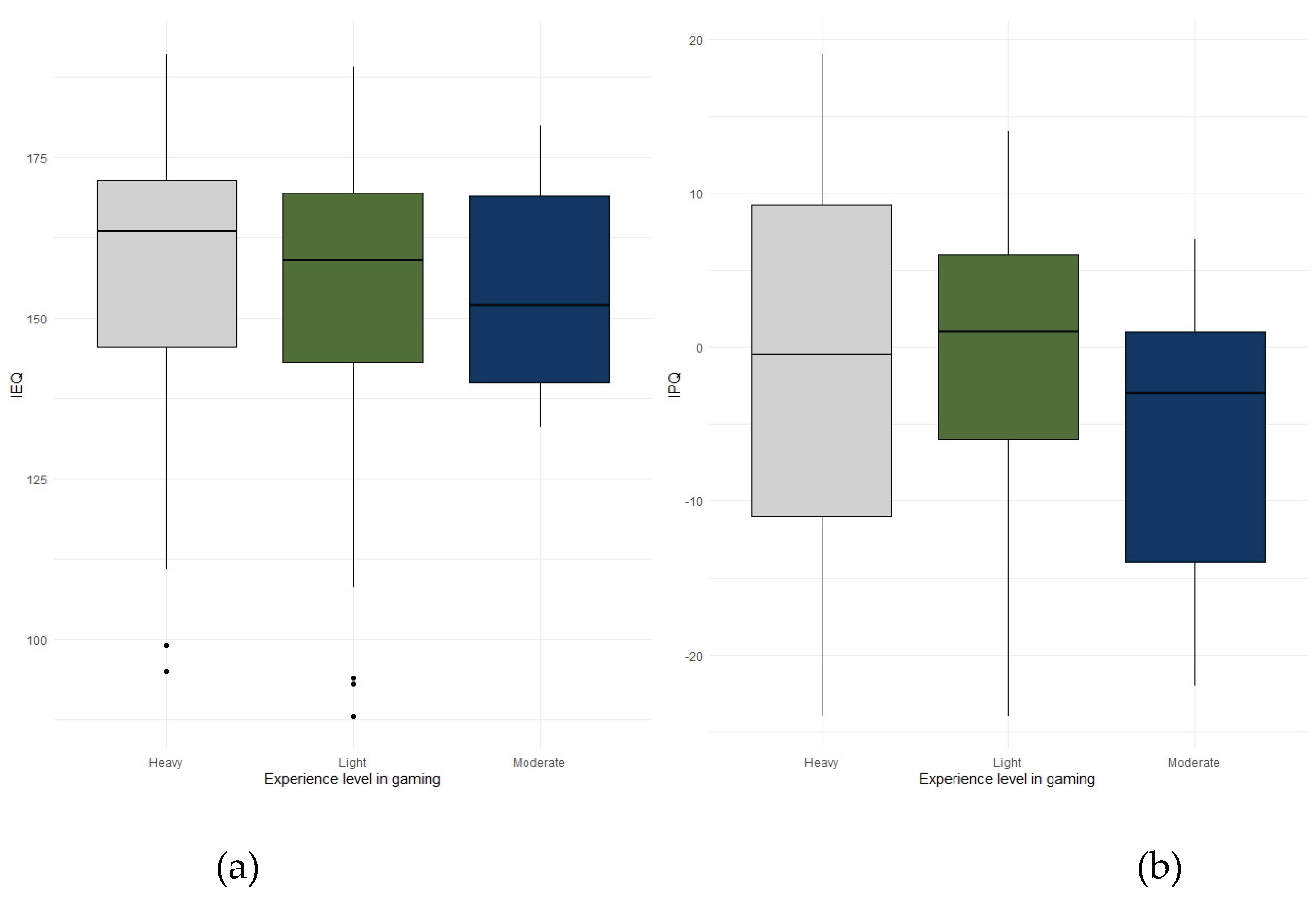
Figure 2.
Boxplots showing IPQ presence scores across experimental conditions (PC, VR, KAT). A significant main effect of immersion condition was observed, with higher presence scores in the VR condition compared to PC (p = .002).
Figure 2.
Boxplots showing IPQ presence scores across experimental conditions (PC, VR, KAT). A significant main effect of immersion condition was observed, with higher presence scores in the VR condition compared to PC (p = .002).
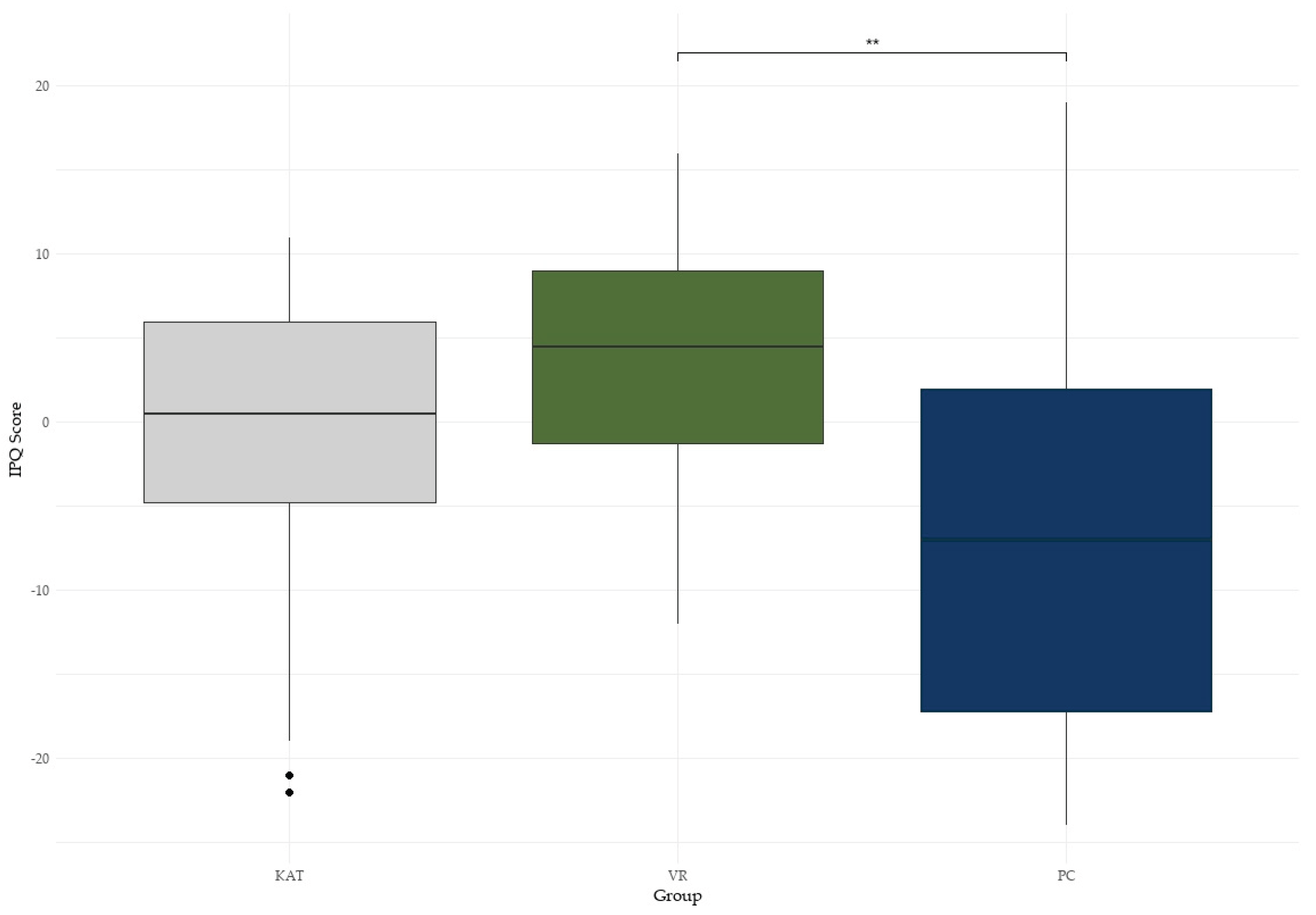
Figure 3.
Boxplots showing IEQ immersion scores across experimental conditions (KAT, VR, PC). Immersion scores were significantly higher in the KAT condition compared to PC (p = .002), while no difference emerged between VR and PC.
Figure 3.
Boxplots showing IEQ immersion scores across experimental conditions (KAT, VR, PC). Immersion scores were significantly higher in the KAT condition compared to PC (p = .002), while no difference emerged between VR and PC.
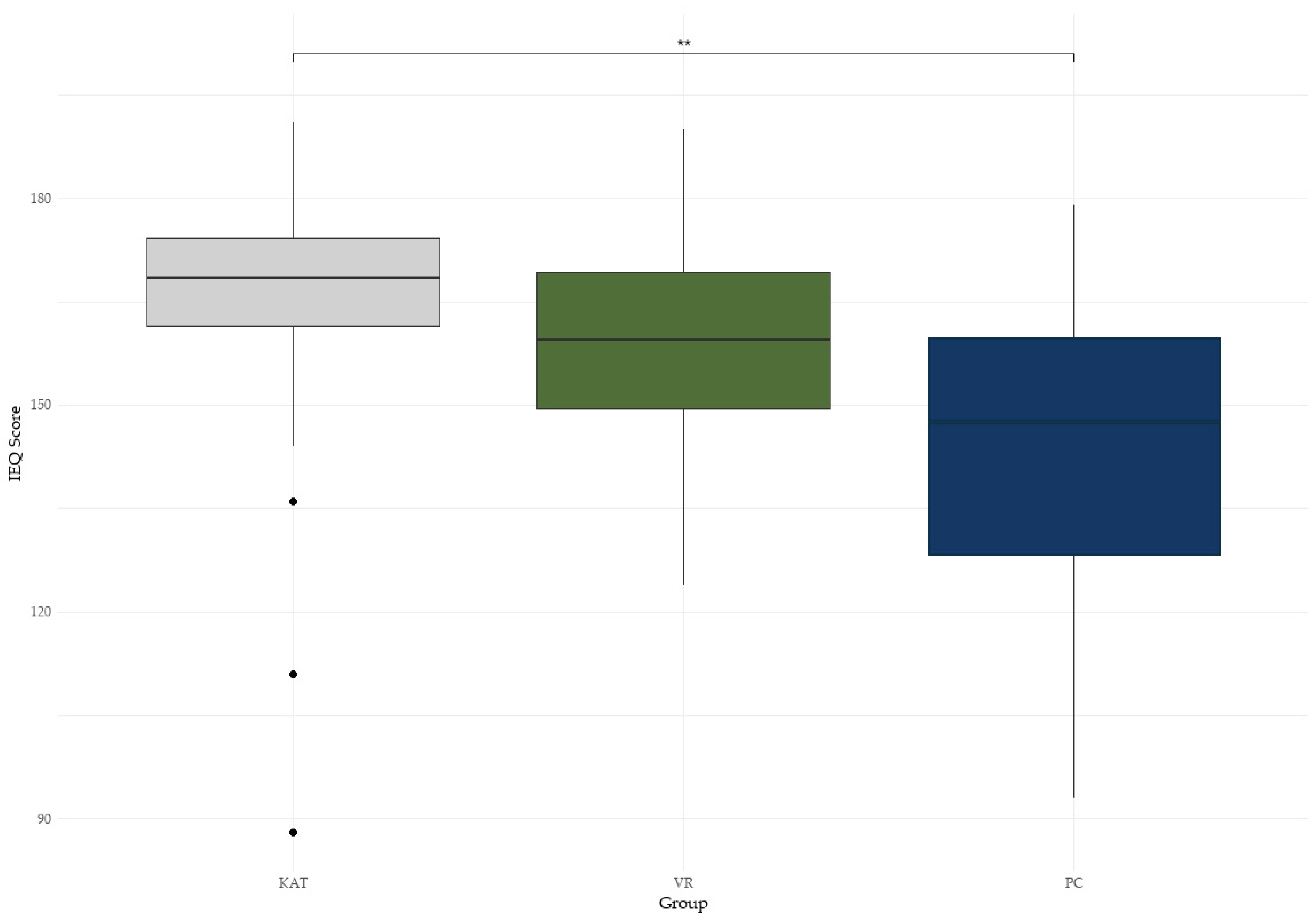
Figure 4.
Radar plot showing mean scores across the 11 subdimensions of 5D-ASC for each experimental condition (PC, VR, KAT). Higher immersion conditions showed increased scores in selected self- and embodiment-related dimensions, whereas other ASC dimensions remained comparable across groups.
Figure 4.
Radar plot showing mean scores across the 11 subdimensions of 5D-ASC for each experimental condition (PC, VR, KAT). Higher immersion conditions showed increased scores in selected self- and embodiment-related dimensions, whereas other ASC dimensions remained comparable across groups.
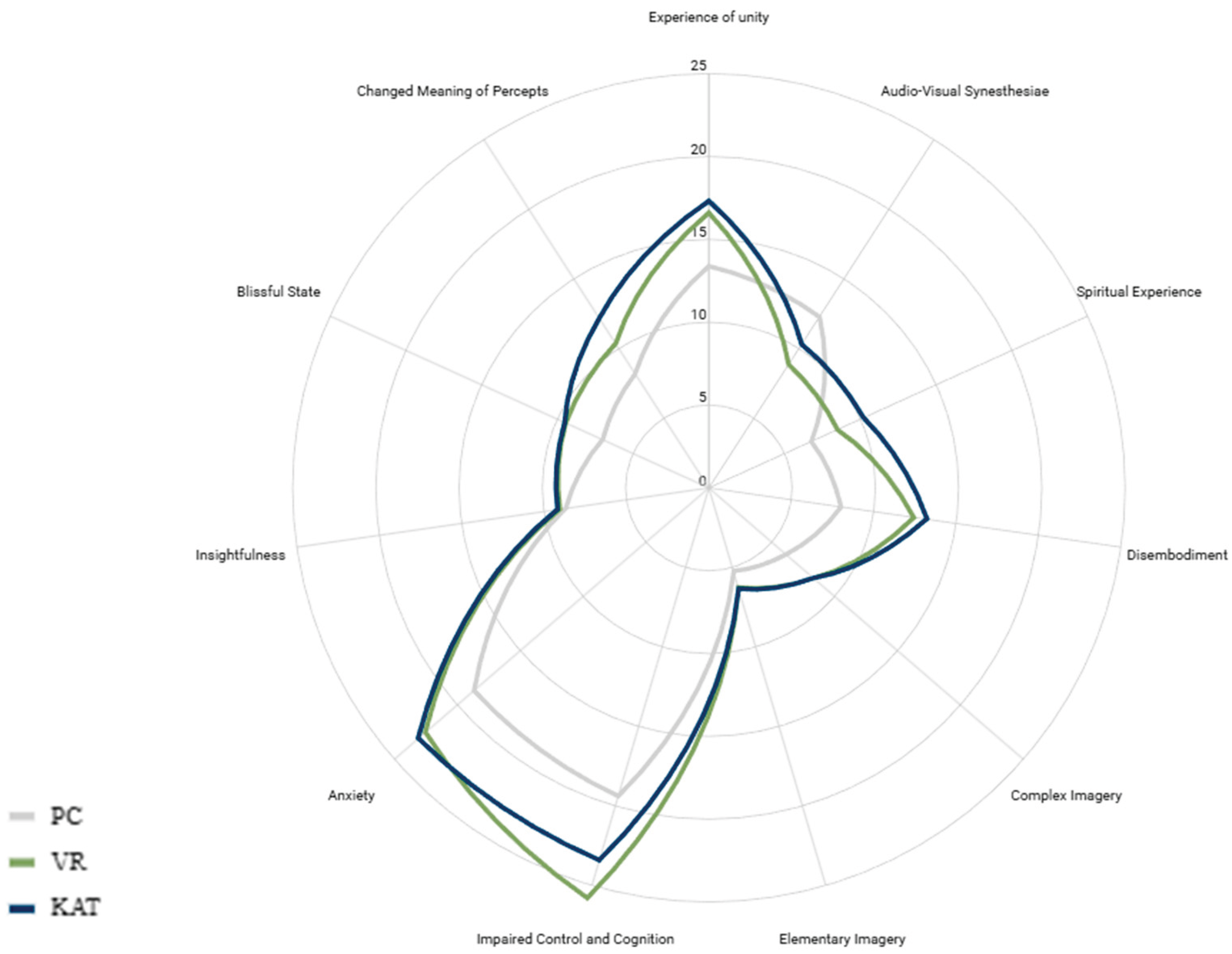
Figure 5.
Boxplots showing retrospective time estimations for the 35-minute gameplay session across experimental conditions (PC, VR, KAT). No statistically significant differences were observed between groups.
Figure 5.
Boxplots showing retrospective time estimations for the 35-minute gameplay session across experimental conditions (PC, VR, KAT). No statistically significant differences were observed between groups.
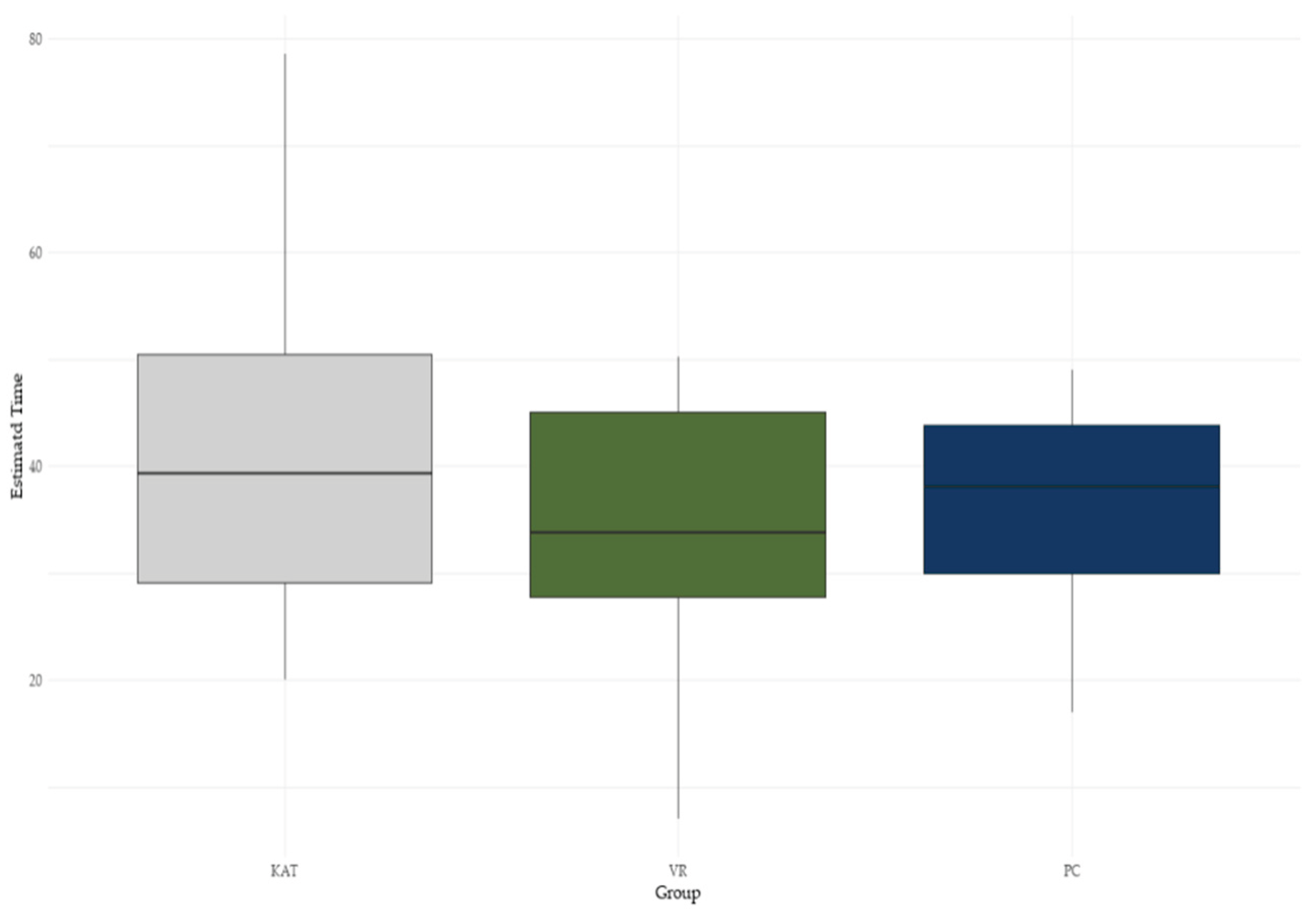
Figure 6.
Boxplots showing absolute error in retrospective time estimation across immersion conditions (PC, VR, KAT). Absolute error represents the deviation from the actual gameplay duration (35 minutes), irrespective of under- or overestimation. Participants in the KAT condition showed significantly greater estimation error than those in the PC condition (p = .005).
Figure 6.
Boxplots showing absolute error in retrospective time estimation across immersion conditions (PC, VR, KAT). Absolute error represents the deviation from the actual gameplay duration (35 minutes), irrespective of under- or overestimation. Participants in the KAT condition showed significantly greater estimation error than those in the PC condition (p = .005).
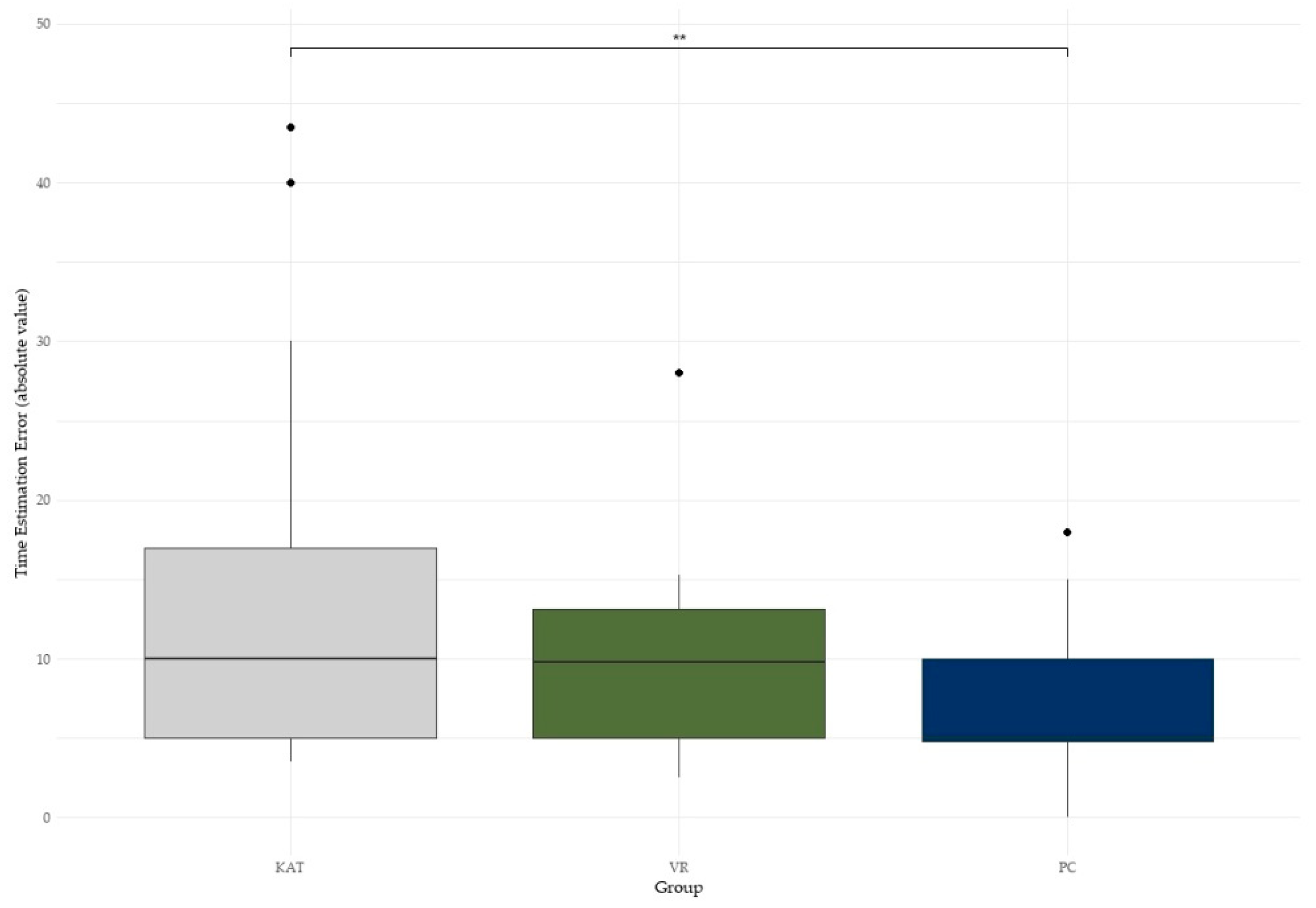
Figure 7.
Boxplots showing the Stroop effect across immersion conditions (PC, VR, KAT), calculated as the difference between RTs for incongruent and congruent trials. No significant differences were observed between conditions.
Figure 7.
Boxplots showing the Stroop effect across immersion conditions (PC, VR, KAT), calculated as the difference between RTs for incongruent and congruent trials. No significant differences were observed between conditions.
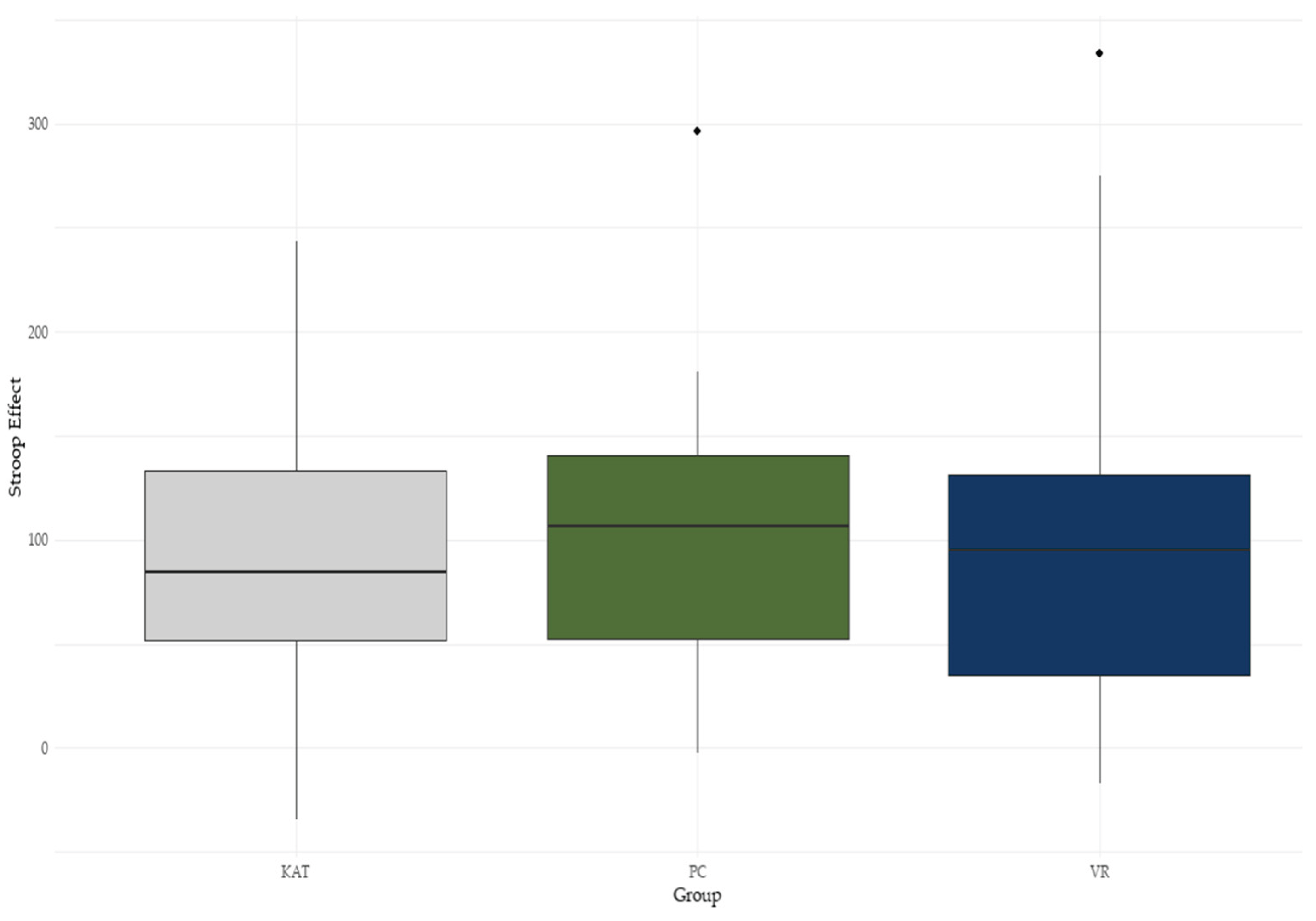

Table 1.
Distribution of participants by immersion condition (PC, VR, KAT) and gaming experience level (light, moderate, heavy). No significant association was observed between condition and prior gaming experience.
Table 1.
Distribution of participants by immersion condition (PC, VR, KAT) and gaming experience level (light, moderate, heavy). No significant association was observed between condition and prior gaming experience.
| Experimental group | Light | Moderate | Heavy |
|---|---|---|---|
| PC | 12 | 3 | 9 |
| VR | 13 | 6 | 5 |
| KAT | 14 | 4 | 6 |
Table 2.
Mean (SD) scores of the IEQ and IPQ by gaming experience level. Descriptive statistics are reported for light, moderate, and heavy gamers.
Table 2.
Mean (SD) scores of the IEQ and IPQ by gaming experience level. Descriptive statistics are reported for light, moderate, and heavy gamers.
| Experience level in gaming | IEQ Mean (SD) | IPQ Mean (SD) |
|---|---|---|
| Light | 152.7 (24.1) | -0.6 (9.7) |
| Moderate | 155.5 (17.0) | -6.9 (10.5) |
| Heavy | 154.3 (28.3) | -1.0 (12.2) |
Table 3.
Mean accuracy rates in the Stroop task by experimental condition (PC, VR, KAT) and trial congruency (congruent, incongruent). Values represent the proportion of correct responses.
Table 3.
Mean accuracy rates in the Stroop task by experimental condition (PC, VR, KAT) and trial congruency (congruent, incongruent). Values represent the proportion of correct responses.
| Condition | Congruency | Mean Accuracy |
|---|---|---|
| PC | Incongruent | .934 |
| Congruent | .962 | |
| VR | Incongruent | .902 |
| Congruent | .941 | |
| KAT | Incongruent | .951 |
| Congruent | .964 |
Table 4.
Overall mean RTs (in ms) by experimental condition (PC, VR, KAT). Values represent mean RT across all trials, regardless of congruency.
Table 4.
Overall mean RTs (in ms) by experimental condition (PC, VR, KAT). Values represent mean RT across all trials, regardless of congruency.
| Condition | Mean (SD) |
|---|---|
| PC | 783.98 (283.25) |
| VR | 790.47 (312.78) |
| KAT | 787.31 (306.92) |
Table 5.
Mean RTs (in ms) by experimental condition (PC, VR, KAT) and trial congruency. Number of trials and standard deviations are reported for each condition.
Table 5.
Mean RTs (in ms) by experimental condition (PC, VR, KAT) and trial congruency. Number of trials and standard deviations are reported for each condition.
| Condition | Congruency | Number of trials | Mean RT (SD) |
|---|---|---|---|
| PC | Incongruent | 1977 | 805.03 (284.51) |
| Congruent | 663 | 721.21 (270.10) | |
| VR | Incongruent | 1983 | 814.16 (323.46) |
| Congruent | 657 | 718.97 (265.77) | |
| KAT | Incongruent | 1984 | 811.33 (314.85) |
| Congruent | 656 | 714.66 (269.03) |
Table 6.
Descriptive statistics for Alternative Uses Task (AUT) performance by experimental condition (PC, VR, KAT), including mean creativity score and mean number of responses per participant.
Table 6.
Descriptive statistics for Alternative Uses Task (AUT) performance by experimental condition (PC, VR, KAT), including mean creativity score and mean number of responses per participant.
| Condition | Mean Creativity Score | Mean Number of Responses |
|---|---|---|
| PC | 2.57 | 19.6 |
| VR | 2.80 | 18.7 |
| KAT | 2.76 | 21.1 |
Disclaimer/Publisher’s Note: The statements, opinions and data contained in all publications are solely those of the individual author(s) and contributor(s) and not of MDPI and/or the editor(s). MDPI and/or the editor(s) disclaim responsibility for any injury to people or property resulting from any ideas, methods, instructions or products referred to in the content. |
© 2026 by the authors. Licensee MDPI, Basel, Switzerland. This article is an open access article distributed under the terms and conditions of the Creative Commons Attribution (CC BY) license (http://creativecommons.org/licenses/by/4.0/).
Copyright: This open access article is published under a Creative Commons CC BY 4.0 license, which permit the free download, distribution, and reuse, provided that the author and preprint are cited in any reuse.


