

Submitted:
05 February 2026
Posted:
06 February 2026
You are already at the latest version
Abstract
As knowledge-driven growth becomes central to long-term economic sustainability, universities are increasingly expected to expand their role beyond teaching and research to support innovation, entrepreneurship, and resilient regional development. This study investigates how entrepreneurial universities emerge and evolve within China’s innovation-driven development strategy, using Shenzhen as an in-depth regional case. Building on the Triple, Quadruple, and Quintuple Helix frameworks, the study adopts a mixed-methods design that integrates policy analysis, original survey data, and semi-structured interviews with key actors from universities, industry, government, and venture capital. This approach enables a systematic examination of governance arrangements, collaboration patterns, and institutional dynamics shaping sustainable innovation capacity in an industry-led innovation ecosystem. The findings reveal that Shenzhen’s innovation system is characterized by industry-driven technological upgrading, state-enabled entrepreneurial governance, and adaptive university transformation, resulting in a hybrid Helix configuration that departs from conventional Western university-centered models. The study identifies distinctive pathways through which universities in late-developing contexts build entrepreneurial capacity despite limited traditional research infrastructure, including boundary-spanning partnerships, practice-oriented knowledge transfer, and market-responsive organizational reforms. By theorizing novel coordination mechanisms among Helix actors, this research advances scholarship on entrepreneurial universities and innovation systems, while offering policy-relevant insights for strengthening sustainable university entrepreneurship, multi-actor collaboration, and long-term regional innovation resilience in emerging economies.
Keywords:
entrepreneurial university
; triple helix
; innovation systems
; sustainable innovation
1. Introduction
As innovation-driven growth becomes increasingly central to long-term economic sustainability, universities are being called upon to expand their roles beyond traditional teaching and research missions to support entrepreneurship, technology transfer, and sustainable regional development (Perkmann et al., 2013; Audretsch & Belitski, 2021; Guerrero & Urbano, 2019). In contemporary innovation ecosystems, universities function not only as knowledge producers but also as institutional anchors that shape talent circulation, firm formation, and long-term regional competitiveness—particularly in emerging economies undergoing rapid structural and industrial transformation (Cai & Etzkowitz, 2020; Breznitz & Zhang, 2019).
A growing body of research has examined the entrepreneurial university and evolving university–industry–government relationships through the lens of the Triple Helix and innovation systems frameworks (Etzkowitz & Zhou, 2018; Ranga & Etzkowitz, 2013; Carayannis & Campbell, 2019). This literature highlights how institutional configurations, governance structures, and inter-organizational networks influence universities’ entrepreneurial engagement and the sustainability of innovation outcomes (Cunningham, Lehmann, & Menter, 2020; Benneworth et al., 2021). However, much of the existing empirical evidence remains concentrated in advanced Western innovation systems, where universities typically possess strong research infrastructure, high institutional autonomy, and mature technology transfer capabilities (Perkmann et al., 2021).
By contrast, comparatively little is known about how entrepreneurial universities emerge in late-developing and industry-led innovation systems, where universities may operate under constrained research capacity and play a more adaptive or complementary role relative to firms and state actors (Breznitz & Murphree, 2011; Cai, Ferrer, & Lastra, 2022). In such contexts, universities often face the dual challenge of building entrepreneurial capacity while aligning with state-led innovation strategies and responding to market-driven industrial upgrading. Existing Triple Helix models, largely derived from Western cases, therefore require empirical refinement to account for alternative institutional pathways and hybrid governance configurations in emerging economies.
This study addresses this gap by examining how entrepreneurial universities evolve within China’s innovation-driven development strategy, using Shenzhen as an in-depth regional case. Shenzhen provides a theoretically revealing setting: despite historically limited higher education and research infrastructure, it has emerged as one of China’s most dynamic innovation hubs, driven by private-sector leadership, strong entrepreneurial culture, and proactive municipal experimentation in innovation governance (Breznitz & Zhang, 2019; Zeng, 2020). This apparent tension raises important questions about how universities cultivate entrepreneurial roles, establish cross-sector partnerships, and contribute to sustainable innovation in an industry-led and state-coordinated Triple Helix system.
Specifically, this study investigates three interrelated research questions:
(1) How do Triple Helix interactions shape the evolution of entrepreneurial universities in an industry-led innovation system?
(2) How do regional institutional conditions influence collaboration among universities, industry, and government?
(3) Through what organizational and partnership mechanisms do universities build entrepreneurial capacity under conditions of limited traditional research infrastructure?
To address these questions, the study adopts a mixed-methods research design combining policy analysis, original survey data, and semi-structured interviews with key stakeholders from universities, industry, government, and venture capital organizations in Shenzhen. This approach enables a multi-level examination of governance arrangements, collaboration patterns, and institutional dynamics shaping sustainable innovation capacity in emerging economies.
This study contributes to the literature in three main ways. First, it extends Triple Helix theory by theorizing how entrepreneurial universities evolve in industry-led and late-developing innovation systems, where universities are not necessarily the primary knowledge drivers. Second, it provides novel mixed-methods empirical evidence from Shenzhen, offering rare systematic insights into university–industry–government collaboration under China’s innovation-driven development strategy. Third, it generates policy-relevant implications for strengthening sustainable university entrepreneurship, enhancing multi-actor innovation ecosystems, and building long-term regional innovation resilience in emerging economies.
2. Literature Review
2.1. National Innovation System and Triple Helix Concept
The National Innovation System (NIS) perspective emphasizes that innovation is not a linear process but emerges from systemic interactions among firms, universities, governments, and other institutional actors, mediated through knowledge flows, organizational linkages, and labor mobility (OECD, 2006, 2020; Lundvall, 2016). This systemic view highlights that innovation performance depends not only on individual organizations but also on the structure, governance, and coordination of inter-organizational networks.
Building on this systems perspective, the Triple Helix framework conceptualizes innovation as a dynamic outcome of interactions among universities, industry, and government, where each sphere may partially assume the roles of the others, giving rise to hybrid institutional arrangements (Etzkowitz & Zhou, 2018; Ranga & Etzkowitz, 2013). Rather than treating universities solely as knowledge producers, the framework recognizes their evolving roles as entrepreneurial actors, intermediaries, and co-creators of innovation ecosystems (Cai & Etzkowitz, 2020; Cunningham et al. , 2020).
Prior research demonstrates that Triple Helix configurations vary across institutional regimes, with innovation leadership shifting among government, industry, and universities depending on political, economic, and technological conditions (Carayannis & Campbell, 2019; Benneworth et al., 2021). However, much of this evidence remains grounded in advanced Western innovation systems, where universities typically possess strong research capacity and institutional autonomy.
Scholars have increasingly questioned whether Triple Helix assumptions hold in late-developing or industry-led innovation systems, where universities may lack strong scientific infrastructure or play a subordinate role to firms and state actors (Breznitz & Zhang, 2019; Cai, Ferrer, & Lastra, 2022). Critics further note that the framework risks becoming conceptually broad or metaphorical unless grounded in context-sensitive empirical analysis (Carayannis & Campbell 2019). These debates point to a persistent theoretical and empirical gap regarding how hybrid Triple Helix arrangements emerge, stabilize, and operate in developing contexts.
This study addresses the gap by examining how entrepreneurial universities evolve within China’s innovation-driven development strategy, focusing on Shenzhen as a case of an industry-led and policy-driven regional innovation ecosystem. By analyzing how universities adapt their organizational roles, governance structures, and external partnerships under conditions of strong industrial leadership and state coordination, the study contributes new empirical evidence and theoretical refinement to Triple Helix and innovation systems scholarship.
2.2. Triple Helix Dynamics and Innovation Policy in China
Since the late 1990s, China has positioned science, technology, and innovation (STI) as a strategic pillar for transitioning toward a knowledge-based and innovation-driven economy (Fu, Li, & Min, 2020; Zhang, Patton, & Kenney, 2021). The Medium- and Long-Term Plan for Science and Technology Development (2006–2020), together with subsequent Five-Year Plans, institutionalized innovation as a national priority, emphasizing indigenous innovation, technological upgrading, and entrepreneurship as key drivers of long-term economic competitiveness (OECD, 2021; World Bank, 2019).
Despite substantial increases in R&D expenditure and scientific output over the past two decades, China continues to face structural challenges in translating research investments into high-quality and sustainable innovation outcomes, including regional disparities, fragmented policy implementation, and coordination gaps among innovation actors (Breznitz & Zhang, 2019; Liu,et al., 2020). To address these challenges, national initiatives such as the “Mass Entrepreneurship and Innovation” agenda have sought to strengthen linkages among universities, firms, research institutes, financial intermediaries, and government agencies, with the goal of enhancing coherence within the national innovation system (State Council of China, 2015; OECD, 2021).
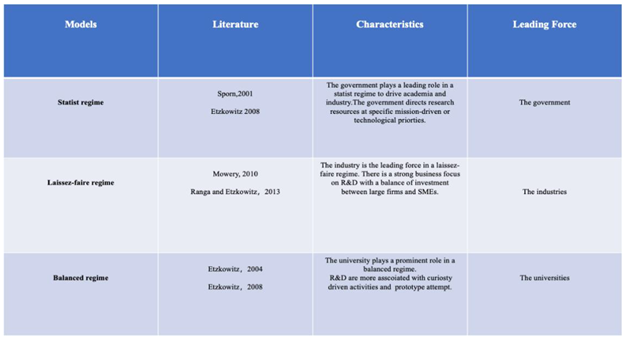
From a Triple Helix perspective, China’s innovation system differs from the balanced, university-centered model often observed in advanced Western economies. Instead, it exhibits a state-coordinated and industry-led configuration, in which government actors play a dominant role in steering innovation priorities, shaping institutional incentives, and constructing enabling infrastructures such as high-tech development zones, science parks, and incubators (Zhou, 2018). This hybrid regime—combining government steering, corporate dynamism, and evolving university engagement—aligns with a statist variant of the Triple Helix typology, in which innovation leadership rests primarily with state and industrial actors (Ranga & Etzkowitz, 2013; Carayannis & Campbell, 2019).
China’s innovation trajectory is also characterized by pronounced regional heterogeneity. While national STI policies provide a unified framework, provincial and municipal governments retain significant autonomy in implementing innovation strategies, allocating fiscal resources, regulating business activity, and supporting entrepreneurship (OECD, 2017; Breznitz & Murphree, 2011). As a result, regional innovation ecosystems vary considerably in institutional capacity, knowledge infrastructure, collaboration intensity, and entrepreneurial vitality, producing divergent innovation pathways and outcomes (Audretsch & Belitski, 2021; Prodi et al., 2017). Coastal regions tend to demonstrate stronger innovation performance than central and western provinces due to superior access to talent, capital, and global production networks.
China’s stratified higher education system further reinforces these dynamics. Public investment has been heavily concentrated in a small number of elite universities—such as Tsinghua University and Peking University—to enhance global research competitiveness and international collaboration capacity (Marginson, 2018; Welch, 2018). At the same time, universities have increasingly been embedded in innovation-oriented infrastructures, including university-affiliated science parks, incubators, and technology transfer platforms, which serve as organizational vehicles for innovation (Cai & Etzkowitz, 2020).
While China’s dramatic economic rise and formidable scientific output are well known, the innovation model demonstrates significant regional differences. Regarding technology development and innovation, although the central government enacts a universal S&T policy for all provinces, different regions differ significantly in the implementation of national policies and the launch of local programs to supplement national policies (OECD,2017; World Bank, 2019). Regional and local governments are administratively and economically independent in many aspects. Chinese provincial governments have the autonomy to formulate regional economic and social development policies, set local tax rates, grant business licenses, coordinate local business development, and manage their budgets to foster regional entrepreneurship. As a result, Chinese regions’ performances on innovation pathways and entrepreneurship outcomes vary, attributed to various innovation and entrepreneurship environments (Wadhwa et al., 2016; Manson& Brown, 2014). In general, eastern coastal areas are far more developed than central and western provinces. A recent study (Prodi et al.,2017) further indicates that the disparity in regional innovation infrastructures, such as knowledge production, access, knowledge transfer, and collaborations, results in distinct innovation performance. Against this national backdrop, Shenzhen provides a theoretically revealing case. Unlike Beijing or Shanghai, which host dense clusters of top-tier research universities and national laboratories, Shenzhen has historically lacked a strong academic base. Until recently, its higher education sector consisted primarily of Shenzhen University and the Southern University of Science and Technology. Nevertheless, Shenzhen has emerged as one of China’s most dynamic innovation hubs, driven by private-sector leadership, entrepreneurial dynamism, and proactive municipal experimentation in innovation governance (Breznitz & Zhang, 2019; Zeng, 2020).
This apparent tension raises important questions about how universities cultivate entrepreneurial roles, form cross-sector partnerships, and contribute to innovation in an industry-led and state-coordinated Triple Helix system. The Shenzhen case therefore provides a valuable empirical setting for examining how entrepreneurial universities evolve under conditions of strong industrial dominance and constrained academic resources, contributing to ongoing debates on the adaptability of Triple Helix configurations in late-developing contexts.
The next section outlines the research methodology, followed by an analysis of Shenzhen’s transformation into a leading innovation hub and the evolving interactions among university, industry, and government actors.Distinguished from the balanced mode of Triple Helix Innovation (Table 1), where universities underpin a conspicuous role in the innovation system, it is apparent that the government plays a dominant role in the Chinese context. The government leads the direction of innovation by owning most research-led universities and institutions, leading strategic decisions of state-owned enterprises, and establishing innovative infrastructures such as high-tech development zones, science parks, and incubators, as well as initiating and reforming regulations and policies related to the promotion of innovation and entrepreneurship. Zhou (2008, 2018) thus argues that the Chinese NIS, a mixture of government-pulled, corporate-led, and university-pushed models, could also be classified as a statist regime based on Etzkowitz (2018)’s typology.
The next section outlines the research methodology, followed by an analysis of Shenzhen’s transformation into a leading innovation hub and the evolving interactions among university, industry, and government actors.
3. Research Methodology
This study used literature review techniques and semi-structured interviews to explore the emergence of entrepreneurial universities in Shenzhen, China. Before the study, archives and primary documents are analysed to understand the local context of E&I. These sources include investigating local policies relevant to the entrepreneurial movement in universities.
The study conducted semi-structured interviews, including structured and open-ended questions, to explore the relationship between universities and their local partners. These methods give insight into how university staff understands and value different support mechanisms. The interview protocol contains a mix of structured and tightly defined questions (the survey) and more open-ended questions for participants (the semi-structured interviews).
Interviews were conducted in two phases: Nov 2021 to Mar 2022 and Oct 2022 to Mar 2023. The interview questions are prepared in English and translated into Chinese. Items were backtranslated to ensure that the meaning of the original items is maintained. Because the questionnaire requires respondents to choose in the form of options, the final response can be simplified into digitized data, so a translation of the responses is not needed. From open-ended questions, phrases, emerging themes/ patterns, and different reactions are gathered and used to sort analytic leads, assumptions, and potential codes.
According to preliminary information on regional entrepreneurship environment and entrepreneurship activities from the literature review and the archival documentary analysis, this study selects participants with the following criteria: (1) Participants above the age of 18. (2) Participants have at least three years of related (practical or theoretical) experience in university entrepreneurship. (3) Participants obtain relevant research backgrounds in academic entrepreneurship and entrepreneurial universities. (3) Participants play as key stakeholders in entrepreneurial activities in the region. All participants answered survey questions, and selected respondents were invited to participate in semi-structured interviews. Our focus groups of interviewees consisted of 42 members, including directors in universities’ technology transfer offices (TTO) or innovation centers (5), Academics in universities and institutes (12), Entrepreneurs or business executives in hi-tech enterprises (12), Director in venture capital institutions (3) Government officials (6) Director of an innovation center in quasi-public institutions (4). We also revised our survey questions based on gathered suggestions from these focus group members. We randomly asked questions on various constructs to reduce common method bias in the survey design.
Ethical approval was obtained for this study, and all participants provided informed consent prior to participation. Interview data were anonymized to protect confidentiality.
3.2. Data Collection and Analysis
A series of semi-structured interviews with representatives from universities, enterprises, and the government to test the reliability and clarity of our survey questions was then conducted. The in-person interviews then deeply explore different opinions and situations of entrepreneurial universities in practice. The open-ended questions are best characterized as semi-structured because in answering open-ended questions, participants will be encouraged to share their thinking fully, which may involve asking follow-up questions.
Data analysis began with reading the transcripts of the interview. In this study, we interpreted the qualitative and quantitative data on the basis of the definition, which involves collecting and analyzing non-numerical data (e.g., text, video, or audio) to examine concepts in terms of their meaning and interpretation in specific contexts of inquiry and quantitative research. Qualitative interview data were coded thematically using an initial coding scheme informed by the entrepreneurial university literature. Descriptive statistics were used to summarize survey responses.
Themes, patterns, and analytical dimensions (e.g., university and city entrepreneurial culture, funding and policy environment, spin-off experiences, and individual self-efficacy) were deductively derived from the research questions and used as codes to structure the analysis of the empirical material collected in this study. A coding scheme informed by the conceptual framework of the entrepreneurial university was developed to guide the organisation and analysis of the data. Codes were grouped into higher-level categories to identify key dimensions, elements, and variables. These categories were further refined to capture different aspects of the phenomenon and to identify recurring patterns within the innovation system. The resulting themes and variables were validated through systematic empirical analysis supported by qualitative data analysis.
4. Findings
4.1. Shenzhen: From a Small Fishing Village to Silicon Valley in China
Shenzhen has experienced rapid transformation from a small fishing village into a major innovation hub and one of the super tier1 cities in China. However, the city lacks top-tier HE resources and only has two universities- Shenzhen University and Southern University of science and technology until 2017. Despite the lack of innovative talents, the key driver of economic success is attributed to its spirit of reform and innovation.
Here, innovation performance is measured using patent applications and PCT filings. Shenzhen ranked among China’s leading cities in patent applications and high-tech firm activity. The number of patents granted in Shenzhen exceeded 1.66 million, accounting for 6.73 percent of the total number of patents granted in China.
The Chinese economy’s unparalleled growth since enacting Reform and Opening policies in 1978 started in Guangdong. When reformers decided on a socialist market economy in 1978, they feared it would cause political tension. Located 140 km from Guangzhou and with 30,000 residents, a small village was renamed Shenzhen and awarded Special Economic Zone status, granting it the autonomy to conduct experimental trials , including allowing foreign direct investment (FDI) in 1980s. Benefiting from its proximity to Hong Kong and abundant cheap labor resources, Shenzhen soon became a global manufacturing and assembly center, with annual average GDP growth rates of around 30% (1980–2000). Seizing the opportunity of WTO membership Shenzhen’s export-oriented industries soared after 2000. Since 2017, the GDP volume of Shenzhen (Figure 3) has surpassed Guangzhou, Beijing, and Shanghai, and in early 2019, it surpassed Hong Kong.
Now it is regarded as Silicon Valley in China for its success and fame in tech innovation and entrepreneurship. Despite the shortage of higher education resources, both local universities also have the fame of strong performance in innovation and entrepreneurship (THE,2022; Tao, 2019). Taking the first local university in Shenzhen-Shenzhen University, for example, the university submitted the most (201) patent cooperation treaty (PCT) application in 2018, surpassing Tsinghua University, the most renowned research-led university, with the number of 137 PCT applications in the same year.
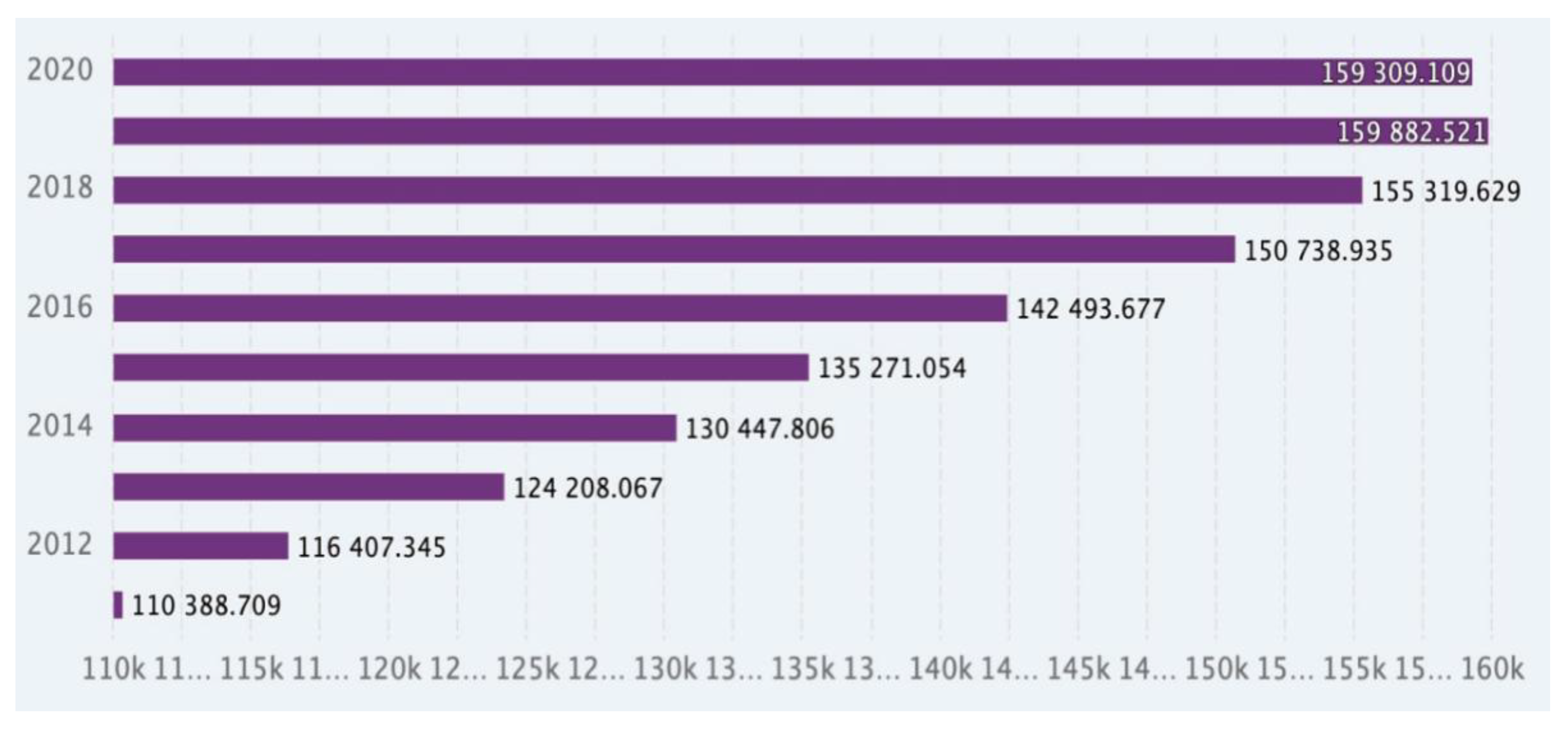
Figure 2.
Shenzhen GDP Per Capita; Shenzhen Municipal Bureau of Statistics,2020.
4.2. Industry-Oriented Innovation to Upgrade Global Supply Chain
Overall, the critical driver of innovation in Shenzhen is industry and entrepreneurs in the local or regional economy. Enterprises trigger in-house innovation to stimulate new growth points and broader revenues, increase market competitiveness and broaden opportunities for R&D and new products. Shenzhen’s innovation capability ranks first in the country, with the number of core intellectual property indicators ranking first (national technology department, 2021). By 2020, Shenzhen’s high-tech industries will achieve an added value of ¥974.7 billion, accounting for more than 35% of GDP. It is the first pillar of Shenzhen’s four pillar industries, and a significant economic growth point Shenzhen also ranks first in the number of patent applications and authorizations among first-tier cities (Figure 5 and Figure 6). Among them, the number of patent applications from an enterprise account for 89.58%, much higher than the national average of 65%. In 2020, the number of PCT applications reached 20,209, accounting for 30.2% of the national total (Shenzhen S&T committee,2021), ranking as 17 consecutive championships in China and performing outstanding when compared to international cities ranking, just behind Tokyo and ahead of Silicon Valley, New York, and Israel (WIPO,2021).
The entrepreneurial spirit underpins the core culture in Shenzhen. Driven by young grassroots, alumni, and global talents, Shenzhen is the city with the highest density of start-ups and the most active small and medium-sized enterprises. Among the 3.6546 million commercial entities, small and medium-sized enterprises account for 63.49%, and there are 131.5 people owning enterprises per 1,000 people in the city. Notably, private commercial entities account for 97.65% of the economic entities in Shenzhen, contributing to 67% of gross capital in the same year(Shenzhen Government, 2018).In the high-tech industry sector, private companies account for 93%.
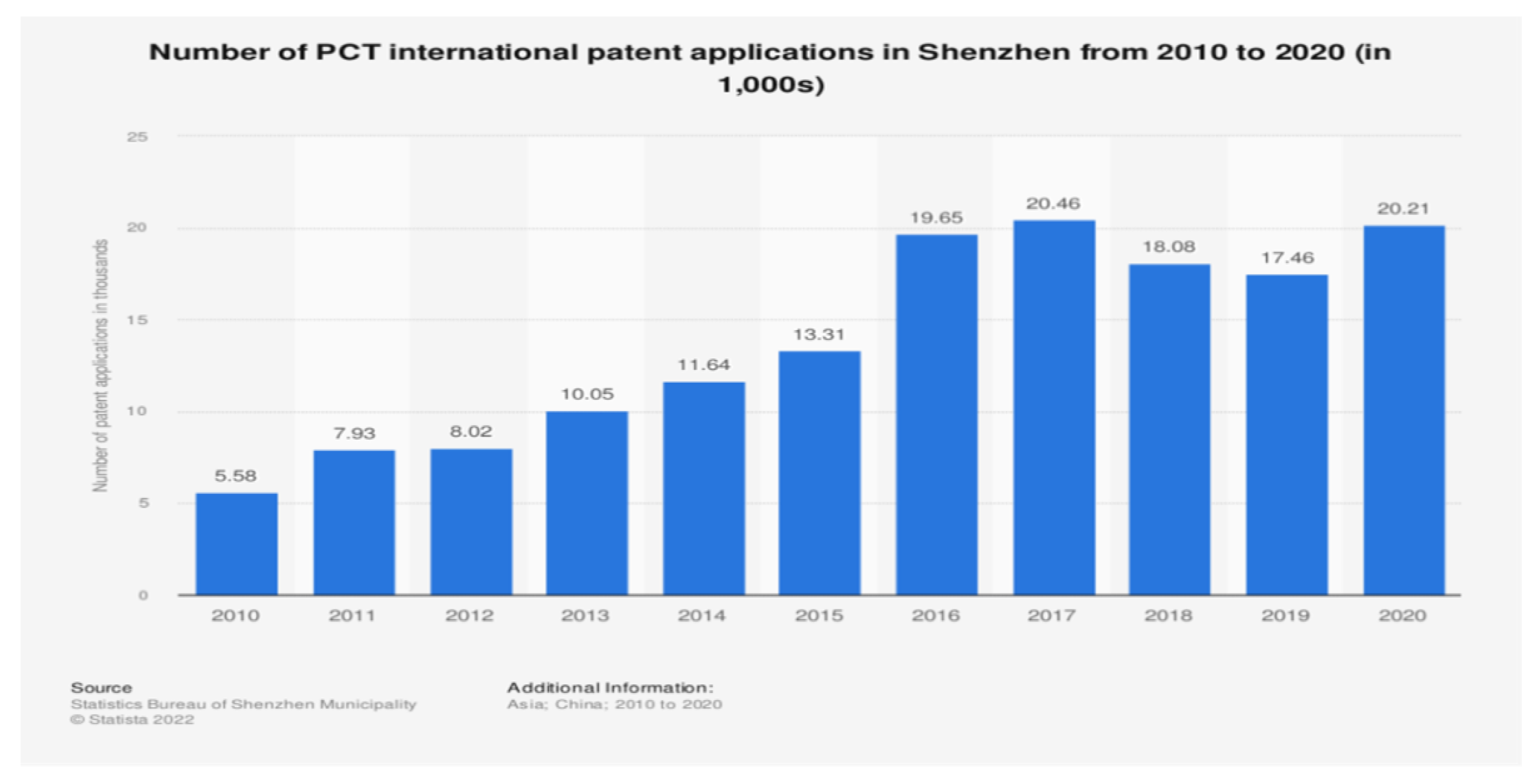
Figure 3.
Number of PCT international patent application Shenzhen Data. Source: World International Property Organization, 2020.
Figure 3.
Number of PCT international patent application Shenzhen Data. Source: World International Property Organization, 2020.
4.3. Towards Entrepreneurial Governance for Innovation
The local government in Shenzhen takes an entrepreneurial approach to policymaking, aiming for long-term success in the economic-specific zone. It acts as a platform constructor and policy-oriented investor in the innovation model. Instead of focusing solely on state-owned enterprises (SOEs), the government issues strategic guidelines and policies to encourage the development of private high-tech enterprises, promoting a shift to a high-tech industry. Notable policies include the Technology Innovation Regulations for the Shenzhen Special Economic Zone, the first local legislation in China for the technology innovation ecosystem. The government invests in the hi-tech industry, both financially and through infrastructure development and software environment improvement, to facilitate knowledge transfer. Various innovation centers, such as national infrastructure and engineering platforms, key laboratories, innovation incubators, and public service platforms, support industries and attract talent resources. Recognizing the importance of higher education resources for innovation, the Shenzhen government aims to attract global higher education resources to support its innovation-driven strategy. To tackle the issue of lacking higher education resources, a developmental strategy was launched in 2018 to establish around 20 higher education institutions by 2025 and attract global talents to build internationally competitive universities. Most universities in Shenzhen prioritize innovation and entrepreneurship as key development strategies. The next section will delve into the role of universities in Shenzhen’s innovation system and analyze the process of institutional transformation toward a more entrepreneurial model.
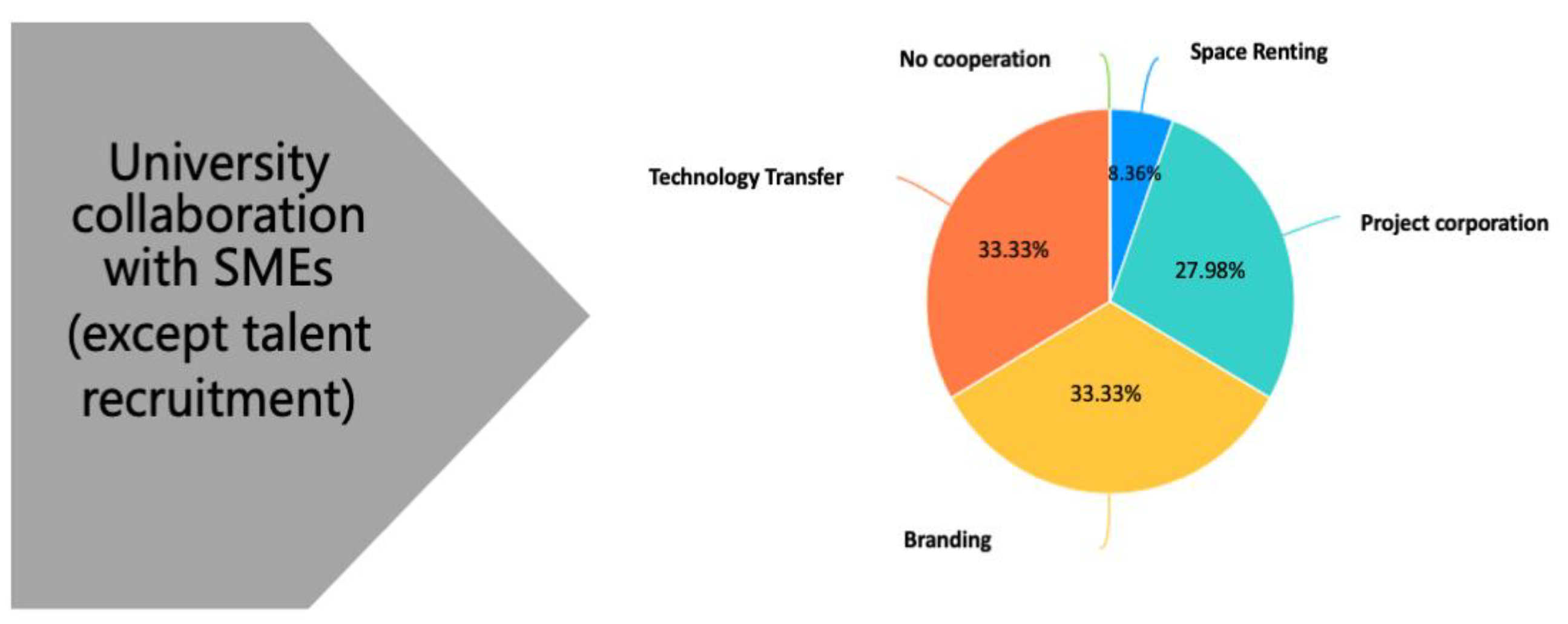
Figure 4.
University cooperation with SMEs.
4.4. University: Knowledge Resources for Local Innovation and Grassroots Entrepreneurship
Unlike research-led universities such as Tsinghua University, where entrepreneurship is typically driven by research commercialization, university entrepreneurship in Shenzhen is more bottom-up and community-led. Technology transfer and entrepreneurship are triggered by a desire to cooperate with surrounding collaborations and broader avenues for university support, stimulating local growth and creating graduate career and entrepreneurship opportunities. A dynamic and inclusive ecosystem is gradually created through solid partnerships of trust between surrounding entrepreneurial community and the university. This type of entrepreneurship focuses more on external influence rather than institutional capacity. Universities also downplay the importance of IP ownership and many technology transfer activities outside the university in the early stages. Enjoying a successful entrepreneurship image through start-ups and spin-offs, universities in Shenzhen gradually realize that entrepreneurship is a differentiation advantage that could strengthen competitive advantage among universities. Therefore, universities in Shenzhen actively involve innovation and entrepreneurship in the universities’ strategic development and seek to regulate and institutionalize their entrepreneurship profile.
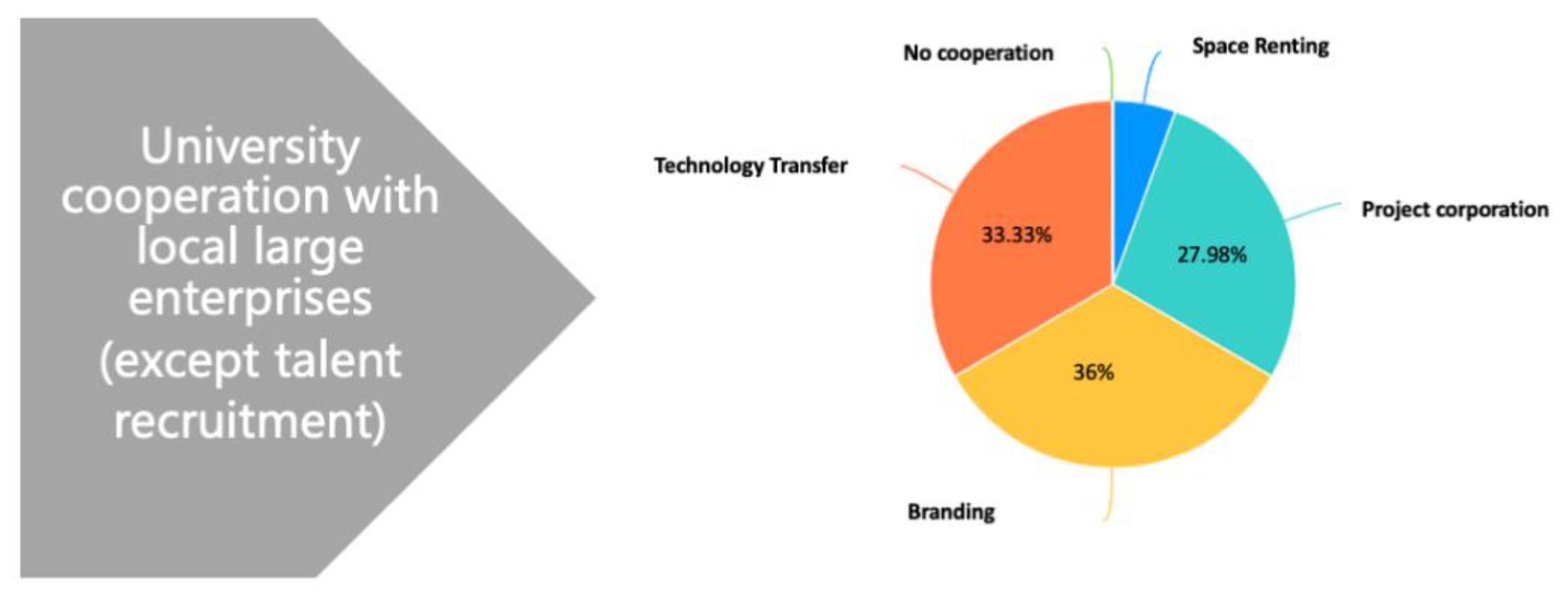
Figure 5.
University cooperation with SMEs.
The primary role of universities in the innovation system in Shenzhen is regarded as a pool of talent resources and the first seed of entrepreneurship. 90% of entrepreneurs and managers in different institutions approve that an essential role of the university is providing talents. For 80% of SMEs, talent recruitment is the most frequent collaboration with universities. Other types of collaborations with the university include technology transfer (33.33%), project collaboration in a specific program (24.98%), branding (33.33%), and entrepreneurial space renting (8.36%) (Figure 8). For a large cooperation, talent recruitment is a regular collaboration with universities. Other types of collaboration with the university include technology collaboration & transfer on a university level (32%), technology collaboration on department and individual level(63%), corporate in a specific program(50%), branding (65%) and co-spin off (23%) (Figure 9).
Higher education serves as a catalyst for entrepreneurship, with more than 50% of young entrepreneurs attributing their initial ideas to university and 20% starting their first entrepreneurial ventures while in college. The exposure to new trends and technology during university studies can spark entrepreneurial aspirations. Collaboration between research labs and hi-tech industries extends beyond the university, with over 60% of academics and research staff at Shenzhen University engaging in partnerships with companies. The Media Lab at Shenzhen University, for instance, provides advanced equipment to local entertainment companies, reducing their costs and creating internship opportunities. Similarly, hi-tech companies involved in VR device development find valuable business opportunities by collaborating with university laboratories. Universities actively encourage entrepreneurship on campus, leveraging the surrounding industrial environment and support from alumni. Shenzhen University, for instance, embraces a tradition of fostering entrepreneurship due to the success of its notable alumnus, Pony Ma, the founder of Tencent. The university organizes entrepreneurship and innovation (E&I) competitions at various levels, simulating real business environments.
Recently, E&I had further become a brand for universities in a regional area to win the competition among universities. Driven by successful bottom-up entrepreneurship stories and the external environment, the university not only actively encourages E&I on campus with a package of policies but also involves E&I in the universities’ strategic development plan. Within the fierce competition among universities in the regional area, Shenzhen university recently has the ambition to involve entrepreneurship in the strategic development plan at the university leadership level to promote the whole university as a brand of innovation and entrepreneurship.
5. Discussion
5.1. Current Model of Innovation in Shenzhen
The study argues that the current innovation model in Shenzhen is driven by industries and supported by local government and universities. In this innovation model, E&I mainly derives from the industrial upgrade and grass-root entrepreneurship culture. Meanwhile, the government has a strategic goal of innovation-driven development. It provides various support from policy incentives and resources to strategic platforms and institutional innovation to prompt the construction of an innovation ecology. Universities are critical in innovative talent resources as public higher education institutions. Experimental innovation and technology transfer from university also accelerate innovation from initial thought to a demo product. Due to the support of the industry and the entrepreneurial culture in the region, although Shenzhen is a young city that lacks higher education resources, universities collaborate closely with the industry and have the most potential to develop an entrepreneurial university. The universities also start a strategic plan to combine the entrepreneurial genes in the city to develop an entrepreneurial university as core competitiveness in terms of long-term development.
5.2. Trilateral Collaborations in an Innovation System
In our research, trilateral collaboration relationships exist among three entities (government, industry, and universities) in the Shenzhen area. The Triple Helix model of innovation and trilateral collaborations plays a role in the development of Shenzhen, yet the model remains dynamic and continues to evolve in response to government innovation strategies. Society and community participating in research and innovation especially opening access to innovation is rising during the Covid that may point to the emerging Quadruple Helix of innovation in Shenzhen.
At the institutional level, the city has started a higher level of innovation since 2013 by implementing trial measures and practices in four aspects of establishing a high-level innovation system to support the development goal of a socialist market economy system, service-oriented government, institutions for independent innovation and environmental-friendly society. Since states’ initiative for economic reform and marketization from 1980s, the objective of innovation system is to maintain Shenzhen’s continued innovation and development.
For industries, this is the inexhaustible motive force for innovation. An innovation system and robust trilateral collaborations have essential impacts on the sustainable development of high-tech industries and market vitality in Shenzhen. It could systematically reduce the uncertainty and risks of innovation in a business context, thereby overcoming market and organizational failures to enhance investment and long-term competitiveness. Secondly, establishing technological transformation, enterprise derivative, and incubator is a testing trial to convert R&D achievement to profitable products for market growth. As the first pillar of industry in Shenzhen, the government introduced various policies and measures to spur business start-ups and investment, attract various professionals, and build systematic policies for technological innovation, as discussed above.
While enterprises are still key innovators in Shenzhen’s city innovation ecosystem that generates 90% of R&D patents, including personnel and funding, and has close collaboration with local government, universities and research institutes have gradually become pioneering innovators since 2008, when Shenzhen became China’s first National Innovative City. Realizing the importance of talents for STI and long-term competitiveness, Shenzhen has implemented several measures to attract talents and introduce HEI resources.
By strengthening local universities’ development and improving incentives and services to introduce world-class higher education resources, the local government gradually builds a variety of policies to attract and retain global talents. Taking the “Peacock Plan” for instance, this well-known municipal talent policy for oversea talents had attracted 2954 people. In 2021 alone, the plan attracted 19 R&D teams in biology, life sciences, pharmaceuticals, software, telecommunications, microelectronics, and new energy, which are pillar industries of the local economy.
Also, more resources have been allocated to tertiary education and research institutes to compensate for the lack of higher education and research institutes. Besides the measures to support local universities, Shenzhen has introduced the Research Institute of Tsinghua University in Shenzhen, the PKU-HKUST Shenzhen- Hong Kong Institution, the Shenzhen Virtual University Park, and other research organizations. These have become a continuous source of knowledge and technology. According to the Shenzhen Municipal Government plan, the total number of universities will be 20 by 2025.
The spontaneous partnership between the universities research lab and surrounding hi-tech industries is comprehensive. Due to its industrial system, Shenzhen also introduced and attracted the establishment of a national R&D infrastructure, including national research labs and engineering research centres. Equipped with ambitious national strategic R&D projects and newly developed R&D infrastructure, Shenzhen promotes self-reliant innovation in its six pillar industries and innovation-driven development strategy. Besides the rising trilateral collaborations among industry governments and universities, innovation intermediaries have become another player in Shenzhen’s innovation ecosystem. These innovation intermediaries include incubators, professional services firms, financial consultancies, technology consultancies, trade associations, and recruitment agencies. Services provided by innovation intermediaries—including information exchange, decision-making advice, resource allocation, technical service, and technology evaluation—enable innovators and entrepreneurs to mitigate risks and commercialize technology faster. The city has become an important innovation hub in China by establishing an independent market driven STI system and improving collaborations in the innovation system. It has ambitions to sustain its competitiveness in E&I. In the current innovation system, the demand for market and enterprise is the leading force. In contrast, the university’s role becomes prominent in the evolving process. The model is still dynamic and evolving to the government’s ambition to promote innovation-driven development and university attempts to put entrepreneurship as a brand and play a prior role in innovative talent resources and technology pioneering. These findings extend Triple Helix theory by illustrating how entrepreneurial universities emerge in developing innovation systems characterized by industry-led growth.
5.3. Limitations of the Current Model of Innovation
Despite a high degree of innovative vitality and proactive interactions in the innovation system, the Triple-helix model in Shenzhen still faces certain challenges and uncertainty. Government, even though it adopts an entrepreneurial approach and service-oriented stance and provides strong incentives to encourage innovation, lacks the follow-up work to know the situation on the ground. One main issue in Shenzhen is the rational use of public resources that government initially wants to support E&I. Taking the innovation center, for instance, the whole city has 2660 spaces for innovation acceleration. For the development, except for 37% of the public resources, developers can obtain land at a meager cost than land for commercial or residential use and renovations. However, many innovation spaces, tiny ones, whose primary function is not to provide space for early enterprises at lower prices but to let for profit. Some well-known innovation spaces with geographical advantages want to attract well-known high-tech enterprises or scientific research institutions. Innovative companies with high growth potentials, however, cannot afford the rent. Therefore, while the government invests massive public resources and policies to build an environment that supports innovation, how much of the resources are flowing into technological innovation and its output is difficult to measure and evaluate. A group of recent literature examining innovation centre or labs have echoed the chaos (Aitken, et al., 2021; Simone, 2019).
Another main challenge faced by the government is that the multiple-departmental management model leads to a lack of awareness of who should be responsible for policy implementation. The development & reform department, the S&T innovation commission, and the SMEs promotion department have relevant policies to support innovation. However, if the municipal leadership team does not lead the project at the implementation level, many innovative projects may face barriers. Some R&D projects are forced to suspend or take prolonged procedures when it faces the collaborations and responsibilities across the department, which can exemplify the lack of collaboration across institutions and policy support consistence (Wei et al., personal Interviews, 2022). Considering the balance of different stakeholders and potential competition and political balance in the different management departments, not every department is willing to promote it actively. Paradoxically, advancing innovation needs the persevering supports from public sectors and ensure stability in polices at the same time (Rainer et al, 2022).
Due to the policy uncertainty and continuity, universities, as quasi-public institutions, also face the challenge of developmental policies to consistently support E&I on the leadership level and the policy implementation. Although university in the Shenzhen area has ambitions to develop entrepreneurial university as a competitive image, the balance between the traditional function as a higher education institution and the third mission, e.g., entrepreneurship & innovation, remains an issue. For one thing, regarding providing talent resources as the university’s primary function, voices from entrepreneurs argue that the current talent development of universities cannot satisfy their needs (Peng, 2021). While R&D talents are considered the first driving force for the development of high-tech enterprises, 52% of high-tech enterprises in the survey list the lack of talents as the most crucial obstacle to enterprise innovation (Figure 10).
63% of companies regard R&D talent recruitment and development as the biggest challenges in human resource development. It takes at least one year for university graduates to become qualified employees, and innovative talents with both technical and market sense are even rarer (Wang, 2021, Dec 10th, Personal interview). Venture capital institutions in the survey also state that at least 80% of E&I programs from universities are immature for universities may be good at knowledge production in a specific discipline, and they have less sensitivity to market or enough experience in running an enterprise (Sui& Xu, 2022 Jan 10th, personal interview). Currently, feasible cooperation is regarding the university as a testing ground for innovation. Some cutting-edge and early-stage entrepreneurial projects can experiment at a relatively small cost.
Due to the fundamental function of universities as research-led institutions and emphasis on knowledge production, most technological innovations from universities concern less about their applications to the industry and costs. However, for high-tech enterprises, especially SMEs, whether the R&D can quickly transfer into competitive products and profits is crucial for the survival of enterprises. One of the most apparent barriers in current university-industry collaborations is that for enterprises that need R&D for competitiveness. While a cutting-edge technology from the university may be advanced and expensive, the practical value of the technology in industry is still a doubt. Most R&D companies emerging from university laboratories are overly dependent on capital investment rather than their capability of marketing profit.Once the capital investment exit or business financing fails, the enterprise without enough profitability faces the risk of bankruptcy.
Another important barrier (58%) is the dual pressure of academics to balance academic research and innovation application (Figure 9, Appendix). While most academics have patents in their research field, compared to patent transfer or industrialization, they prefer to spend more time and attention on their academic research, especially those young professors who are pressured to obtain tenure position(Cui &Huang, personal interview). In the current higher education system, 80% of academic evaluation metrics focus on attaining research funding, research outputs, and publications rather than industrialization. Therefore, even though young professionals have the patent to translate ideas of entrepreneurship, they have limited time on it.
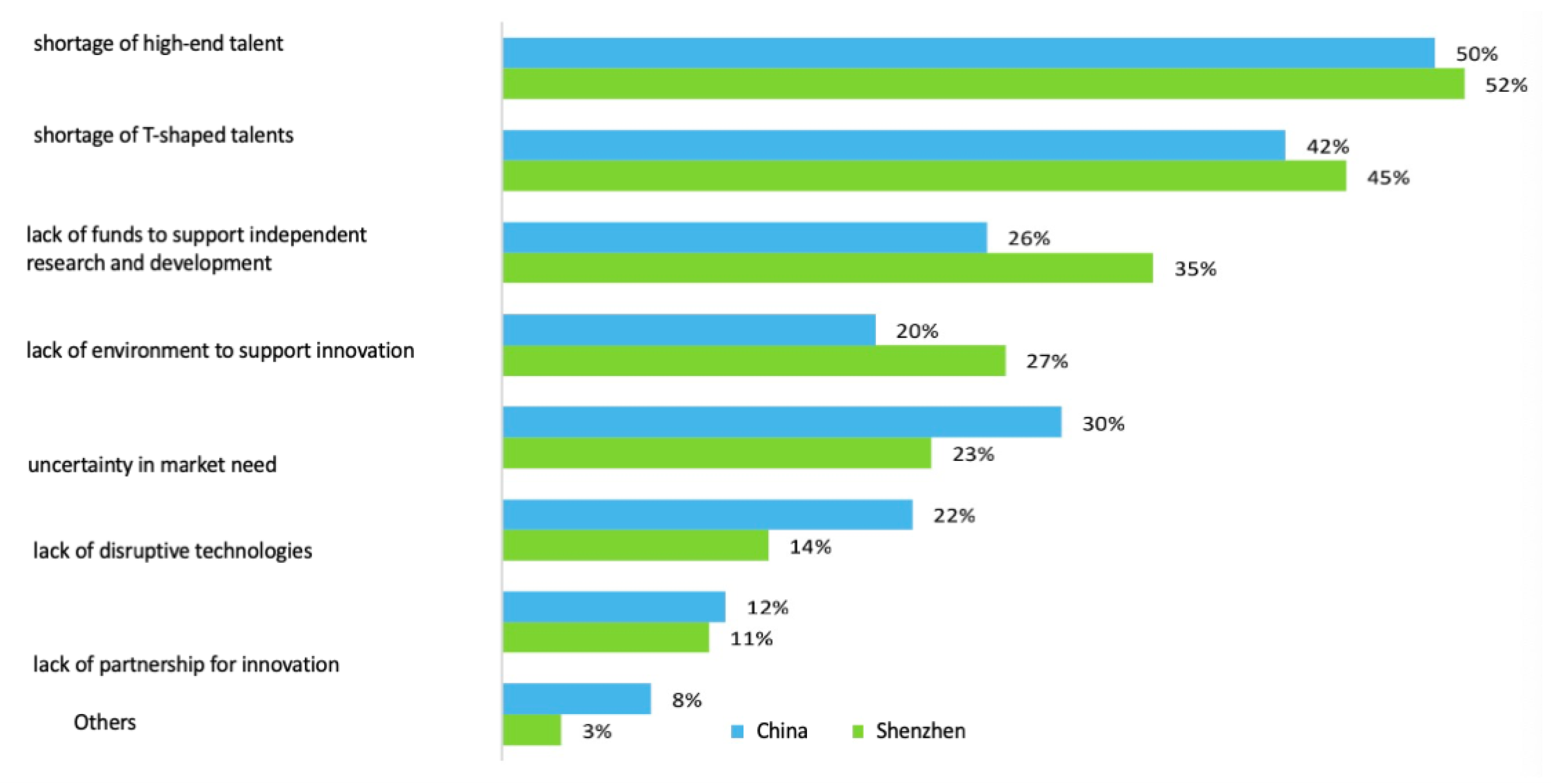
Figure 6.
Obstacles that have a greater impact on the scientific and technological innovation in hi-tech enterprises in Shenzhen.
Figure 6.
Obstacles that have a greater impact on the scientific and technological innovation in hi-tech enterprises in Shenzhen.
6. Conclusion
The purpose of this study is to investigate whether the Triple Helix model applies to the Chinese context and how interactions between the three spheres in the Triple Helix model may vary across the Chinese context in the emergence of entrepreneurial universities. The study analyzes whether regional institutional context will result in different patterns of the E&I model.
The Triple Helix model of university-industry-government collaboration provides an analytical framework to explain the dynamic innovation processes and complex network relationships among universities, industries, and the government. This study utilizes this framework to examine university entrepreneurship in the Shenzhen area. Although the Triple Helix is a widely recognized heuristic principle for studying interactions among innovation spheres, how the model promotes the emergence of hybrid institutions like the entrepreneurial university still lacks the empirical analysis in developing regions. Theoretically, the study adds to the development of the Triple Helix system thinking and innovation studies concepts by untangling the underlying evolutionary process of the Triple Helix system in promoting E&I in the Chinese context. We examine each innovation agent’s function separately with the following analysis of the trilateral collaboration relationships among these entities. The Triple Helix innovation model applies in the Shenzhen area, yet the model remains dynamic and continues to evolve. Quadruple Helix of innovation is evolving that provides a further research direction. Neither does Shenzhen’s innovation model represent a purely statist regime nor a laissez-faire system dominated by industry; rather, it reflects a hybrid and evolving Triple Helix configuration shaped by regional institutional dynamics. The industry and enterprise are the leading force in the current innovation model, whereas the university’s role becomes prominent in the evolving process.
Empirically, by utilizing first-hand survey data collected from industrial, academic, and governmental institutions in a representative Chinese city of entrepreneurship, the study finds that the university-industry-government collaboration positively influences the entrepreneurial environment. The study highlights the prominent role of regional contexts and governance stance in influencing the pattern of Triple Helix alliance and E&I performance. We demonstrate that variations in regional context and governance stance affect the innovation system’s functioning as well as interaction patterns. By analyzing the individual function of each entity in the innovation system, the study argues that the current key driver of innovation in the study area is industry and is supported by governments and universities.
However, the model is dynamic and evolving for the government’s strategy of innovation-driven development and university attempts to put entrepreneurship as a brand and play a prior role in innovative talent resources and technology pioneering. By analyzing the current innovation model’s current limitations, the study also stresses the crucial role of synergies in the innovation system. Promoting information exchange and interactions, strengthening trust between partners (e.g. individuals, universities, and industries), and encouraging long-term cooperation and joint development between universities, industries, and governmental agencies can vigorously promote the E&I system.
6.2. Policy Implications
This study provides evidence-based insights for policymakers, university leaders, and regional innovation stakeholders seeking to strengthen sustainable innovation ecosystems and entrepreneurial universities in emerging economies. The findings highlight the importance of aligning policy design, institutional incentives, and long-term sustainability objectives in innovation-driven development strategies.
First, policymakers should prioritize policy coherence, continuity, and evaluation mechanisms to ensure that public resources allocated to innovation and entrepreneurship generate sustainable long-term impact. While Shenzhen has introduced a wide range of policy instruments and innovation infrastructures, gaps in monitoring, accountability, and cross-departmental coordination risk undermining policy effectiveness and leading to inefficient or speculative use of public funds. Establishing systematic evaluation frameworks, performance metrics, and feedback loops can enhance policy learning, improve resource allocation, and strengthen the long-term sustainability of regional innovation systems.
Second, local governments should strengthen cross-sector and cross-departmental governance to support stable and integrated innovation ecosystems. Fragmented responsibilities across science, industry, finance, and education agencies can create administrative bottlenecks and reduce policy impact. This study suggests the value of coordinated governance platforms, inter-agency task forces, and shared policy instruments that facilitate collaboration among government bodies, universities, industry, and innovation intermediaries. Such arrangements can reduce institutional frictions and promote more resilient and adaptive innovation governance.
Third, universities should embed entrepreneurship and knowledge transfer more deeply into their long-term institutional strategies while maintaining academic quality and research integrity. Rather than treating entrepreneurship as a peripheral activity, university leadership can integrate innovation and entrepreneurial missions into faculty evaluation systems, organizational structures, and resource allocation models. Encouraging interdisciplinary collaboration, industry engagement, and practice-oriented research can help universities build sustainable entrepreneurial capacity, particularly in contexts with limited traditional research infrastructure.
Fourth, policies supporting university–industry collaboration should focus on enhancing the commercial viability, societal relevance, and sustainability of academic innovation. Beyond promoting patenting or spin-off creation, policymakers and universities should incentivize projects that demonstrate market feasibility, long-term financial viability, and positive social or environmental impact. Mechanisms such as proof-of-concept funding, translational research grants, and joint industry–academic platforms can help bridge the gap between academic research and sustainable commercialization.
Finally, innovation policies should place greater emphasis on talent development, inclusive entrepreneurship, and long-term regional resilience. The Shenzhen case demonstrates that universities play a critical role in cultivating entrepreneurial talent and supporting grassroots innovation. Expanding training programs, mentorship networks, and career pathways that combine technical, entrepreneurial, and societal skills can strengthen human capital pipelines and support more inclusive and sustainable innovation-led growth.
Taken together, these policy recommendations underscore the need to move beyond short-term innovation performance metrics toward governance models that foster sustainable entrepreneurial ecosystems, resilient regional development, and enduring university–industry–government partnerships.
References
- Audretsch, D.B.; Belitski, M. Entrepreneurial ecosystems in cities: Establishing the framework conditions. The Journal of Technology Transfer 2021, 46, 1415–1433. [Google Scholar] [CrossRef]
- Benneworth, P.; Pinheiro, R.; Karlsen, J. Universities and regional economic development: The changing role of higher education in innovation ecosystems. Regional Studies 2021, 55, 1227–1239. [Google Scholar]
- Breznitz, D.; Murphree, M. (2011). Run of the red queen: Government, innovation, globalization, and economic growth in China. Yale University Press.
- Breznitz, D.; Zhang, M. Determinants of innovation in emerging economies: The case of China. Industrial and Corporate Change 2019, 28, 277–299. [Google Scholar]
- Cai, Y.; Etzkowitz, H. Theorizing the Triple Helix model: Past, present, and future. Triple Helix 2020, 7, 189–226. [Google Scholar] [CrossRef]
- Cai, Y.; Ferrer, J.; Lastra, J.L. Entrepreneurial universities in developing economies: Institutional transformation and regional innovation systems. Industry and Higher Education 2022, 36, 381–395. [Google Scholar]
- Carayannis, E.G.; Campbell, D.F.J. The Triple Helix, Quadruple Helix, and Quintuple Helix innovation frameworks. Journal of the Knowledge Economy 2019, 10, 343–356. [Google Scholar]
- Cunningham, J.A.; Lehmann, E.E.; Menter, M. The role of universities in regional innovation ecosystems. The Journal of Technology Transfer 2020, 45, 714–739. [Google Scholar]
- Etzkowitz, H. Research groups as ‘quasi-firms’: The invention of the entrepreneurial university. Research Policy 2003, 32, 109–121. [Google Scholar] [CrossRef]
- Etzkowitz, H. (2008). The Triple Helix: University–industry–government innovation in action. Routledge.
- Etzkowitz, H.; Zhou, C. (2018). The Triple Helix: University–industry–government innovation and entrepreneurship (2nd ed.). Routledge.
- Fu, X.; Li, J.; Min, Y. Innovation in China: The role of global knowledge flows. Research Policy 2020, 49, 103875. [Google Scholar]
- Guerrero, M.; Urbano, D. Entrepreneurial universities: Mapping the pathways of transformation. The Journal of Technology Transfer 2019, 44, 345–362. [Google Scholar]
- Guerrero, M.; Urbano, D.; Fayolle, A. Entrepreneurial activity and regional competitiveness: Evidence from European entrepreneurial universities. Sustainability 2016, 8, 1–21. [Google Scholar] [CrossRef]
- Liu, F.; Simon, D.F.; Sun, Y.; Cao, C. China’s innovation policies: Evolution, institutional structure, and trajectory. Research Policy 2020, 49, 103942. [Google Scholar] [CrossRef]
- Marginson, S. Higher education and the common good. Higher Education Quarterly 2018, 72, 4–19. [Google Scholar]
- Marques, P.; Caraça, J. Universities and regional development in innovation ecosystems. European Planning Studies 2020, 28, 1581–1601. [Google Scholar]
- Mason, C.; Brown, R. (2014). Entrepreneurial ecosystems and growth-oriented enterprises. OECD LEED Programme.
- OECD. (2006). Innovation and knowledge-intensive service activities. OECD Publishing.
- OECD. (2020). Science, technology and innovation outlook 2020. OECD Publishing.
- OECD. (2021). OECD science, technology and innovation outlook 2021. OECD Publishing.
- Perkmann, M.; Tartari, V.; McKelvey, M.; Autio, E.; Broström, A.; D’Este, P.; Fini, R.; Geuna, A.; Grimaldi, R.; Hughes, A.; Krabel, S.; Kitson, M.; Llerena, P.; Lissoni, F.; Salter, A.; Sobrero, M. Academic engagement and commercialisation: A review of the literature on university–industry relations. Research Policy 2013, 42, 423–442. [Google Scholar] [CrossRef]
- Perkmann, M.; Fini, R.; Ross, J.-M.; Salter, A.; Silvestri, C. Universities and the innovation ecosystem: A global perspective. The Journal of Technology Transfer 2021, 46, 1607–1633. [Google Scholar]
- Prodi, G.; Fratesi, U.; Menghini, M. Regional innovation disparities and innovation systems. Regional Studies 2017, 51, 1197–1210. [Google Scholar]
- Ranga, M.; Etzkowitz, H. Triple Helix systems: An analytical framework for innovation policy and practice in the knowledge society. Industry and Higher Education 2013, 27, 237–262. [Google Scholar] [CrossRef]
- State Council of the People’s Republic of China. (2015). Guidelines on promoting mass entrepreneurship and innovation. Beijing.
- Welch, A. China’s higher education transformation. Higher Education 2018, 75, 541–556. [Google Scholar]
- Wadhwa, A.; Phelps, C.; Kotha, S. Corporate venture capital portfolios and firm innovation. Journal of Business Venturing 2016, 31, 95–112. [Google Scholar] [CrossRef]
- World Bank. (2019). Innovation in China: New drivers of growth. World Bank Group.
- Zeng, D.Z. (2020). Innovative China: New drivers of growth. World Bank Publications.
- Zhang, J.; Patton, D.; Kenney, M. Building global innovation ecosystems: Evidence from China. Research Policy 2021, 50, 104267. [Google Scholar]
- Zhou, C. (2018). The Chinese Triple Helix model: Government-led innovation and institutional dynamics. In Etzkowitz, H., Zhou, C., Eds., The Triple Helix. 143–165.

Disclaimer/Publisher’s Note: The statements, opinions and data contained in all publications are solely those of the individual author(s) and contributor(s) and not of MDPI and/or the editor(s). MDPI and/or the editor(s) disclaim responsibility for any injury to people or property resulting from any ideas, methods, instructions or products referred to in the content. |
© 2026 by the authors. Licensee MDPI, Basel, Switzerland. This article is an open access article distributed under the terms and conditions of the Creative Commons Attribution (CC BY) license (http://creativecommons.org/licenses/by/4.0/).
Copyright: This open access article is published under a Creative Commons CC BY 4.0 license, which permit the free download, distribution, and reuse, provided that the author and preprint are cited in any reuse.