
Submitted:
05 February 2026
Posted:
06 February 2026
You are already at the latest version
Abstract
The philanthropic sector faces persistent challenges in transparency and accountability that fundamentally undermine donor trust. While blockchain technology offers an immutable transaction ledger, it cannot inherently verify whether donated funds achieve their intended real-world impact. This paper presents a novel decentralized application that addresses this critical gap through the integration of Ethereum Smart Contracts with an AI-driven auditing pipeline. The system introduces a milestone-based fund release mechanism requiring NGOs to submit vendor invoices as documentary proof of expenditure. These documents undergo Optical Character Recognition followed by credibility assessment using Google Gemini, a Large Language Model that performs semantic analysis of financial documents. A two-thirds multi-signature consensus by platform administrators authorizes direct on-chain payments to verified ven dors. The primary innovation lies in bridging the oracle problem through automated AI verification of off chain documentary evidence controlling on-chain fund disbursement. Experimental validation demonstrates that this hybrid approach effectively automates credibility verification while ensuring every released fund is backed by verifiable evidence, achieving significant performance improvements in fraud detection and accountability enforcement compared to purely manual or purely blockchain-based systems.
Keywords:
blockchain
; Web3
; smart contracts
; AI auditing
; OCR
; NGO transparency
; ethereum
; invoice verification
; decentralized applications
; large language models
I. Introduction
PHILANTHROPY addresses critical global challenges including poverty alleviation, educational access, healthcare delivery, disaster relief, and environmental sus- tainability. Despite its societal importance, the philanthropic sector confronts persistent challenges surrounding opera- tional efficiency, financial transparency, and institutional accountability [1]. Donors frequently lack comprehensive visibility into fund utilization pathways, and empirical re- search indicates that substantial portions of charitable con- tributions may be diverted through administrative overhead, misallocation, or systematic corruption [2].
Blockchain technology has emerged as a transformative solution due to its inherent properties of decentralization, immutability, and transparent ledger maintenance [3]. Early platforms including BitGive and Alice demonstrated the technical feasibility of creating traceable charitable trans- action flows by recording donation movements on public distributed ledgers [4]. However, these pioneering systems expose a fundamental limitation known as the Oracle Prob- lem—while blockchain can immutably record digital asset transfers, it inherently lacks the capability to verify the au- thenticity of corresponding real-world events. Specifically, existing systems cannot autonomously confirm whether do- nated funds genuinely procured goods and services or merely transferred between accounts without tangible impact.
Current verification approaches rely predominantly on manual auditing processes conducted by trusted intermedi- aries. These traditional mechanisms prove time-consuming, financially expensive, inherently difficult to scale across mul-tiple organizations, and remain susceptible to human error and subjective interpretation. The philanthropic ecosystem requires an automated yet reliable verification mechanism capable of validating off-chain expenditure proofs before authorizing irreversible on-chain fund disbursements.
This research makes three distinct contributions address- ing this critical gap:
- 1)
- AI-Oracle Bridge Architecture: A novel integration framework where Large Language Models validate off- chain invoice documents against on-chain expenditure claims, enabling automated semantic credibility as- sessment of financial documentation.
- 2)
- Milestone-Locked Escrow Mechanism: A smart con- tract system implementing conditional fund custody where cryptocurrency assets remain locked until spe- cific granular milestones are verified through docu- mentary evidence submission and multi-party valida- tion.
- 3)
- Probabilistic Credibility Scoring: A non-binary ver- ification model assigning numerical credibility scores to invoice submissions, gracefully handling inherent noise and ambiguity in real-world OCR-extracted data rather than forcing premature binary decisions.
The remainder of this paper is structured as follows: Sec- tion II reviews pertinent literature, Section III articulates the problem statement and research objectives, Section IV details the proposed methodology, Section V presents implementa- tion specifics, Section VI discusses experimental results and analysis, Section VII acknowledges system limitations, and Section VIII concludes with future research directions.
II. Related Work
A. Blockchain-Based Donation Tracking
The application of distributed ledger technology for chari- table giving has been extensively explored in recent litera- ture. Nairi et al. [1] proposed Smart Blockchain Networks, demonstrating how Web 3.0 architectures can revolutionize donation tracking by eliminating traditional intermediaries. This perspective is corroborated by independent research from Sahithi et al. [2] and Mariyam et al. [3], who developed frameworks showing that immutable ledgers significantly re- duce donor skepticism through enhanced transparency. Raut and Shevtekar [4] and Avdoshin and Pesotskaya [5] further elaborated by implementing fundraising prototypes enabling real-time fund tracking capabilities. Sanjay [7] termed this paradigm “Transparent Giving,” emphasizing its psychologi- cal impact on long-term donor retention and engagement.
B. Governance and Operational Patterns
Beyond simple transaction tracking, charitable fund gover- nance encompasses complex operational requirements. The Charity 4.0 case study [6] highlights the necessity for au- tomated management systems in modern philanthropic op- erations. Liu et al. [12] explored smart-contract governance patterns, demonstrating that programmable logic enforces public fund transparency more effectively than traditional board-based oversight. Zhang and Wen [11] proposed op- timized routing mechanisms ensuring funds reach urgent causes efficiently, while Mousa et al. [10] focused on trust mechanisms inherent in transparent ledger architectures.
C. Hybrid Architectures and Supply Chain Integration
A critical limitation of early blockchain-based systems was their inability to interface with physical-world operations. Khan et al. [8] introduced hybrid on-chain/off-chain architec- tures, acknowledging that purely blockchain-based systems cannot autonomously verify real-world relief distribution. Kamble et al. [13] extended this concept to supply-chain transparency, ensuring goods purchased by NGOs are ver- ifiably delivered to intended recipients. Rahman et al. [9] utilized Hyperledger Fabric specifically for relief distribution traceability in humanitarian contexts.
D. Privacy and Advanced Auditability
While transparency remains crucial for donor trust, privacy considerations persist for sensitive operational data. Chen et al. [14] discussed privacy risks associated with completely open decentralized systems. More recently, Alam et al. [15] proposed Zero-Knowledge Proof techniques for public fund audits, enabling verification without exposing sensitive ven- dor data or operational details.
E. Research Gap
Despite extensive literature on donation tracking and supply chain integration, a fundamental disconnect remains between financial release mechanisms and documentary evidence ver- ification. Existing systems either track monetary flows or physical goods movements, but rarely automate the critical bridge between these domains. Specifically, manual verifi- cation of vendor invoices remains a significant bottleneck in hybrid architectures. None of the reviewed frameworks utilize Generative AI to perform automated semantic auditing of off-chain fiscal documents to control on-chain smart con- tract state transitions—this represents the primary innovation addressed by the proposed system.
III. Problem Statement and Objectives
A. Problem Statement
Despite widespread blockchain adoption for donation track- ing, existing platforms fail to reliably verify whether off- chain expenditures genuinely correspond to authorized on- chain fund disbursements. Expense validation remains pre- dominantly manual, temporally inefficient, and difficult to scale across multiple organizations and jurisdictions. The absence of milestone-based conditional fund release mech- anisms exposes donation systems to potential misuse and systematically erodes donor confidence. These limitations collectively undermine long-term donor engagement and re- duce the sustainability of transparent charitable ecosystems.
B. Hypothesis
The research hypothesizes that enforcing a milestone-bound expenditure model—where each fund release requires autho- rization through a single verifiable invoice—coupled with an AI-assisted auditing pipeline can significantly reduce fraudulent or non-compliant disbursements. Furthermore, by introducing a fixed-value abstraction mapping between blockchain-native assets and real-world currency, the system can reliably model and validate realistic budgets in testnet environments without compromising economic consistency. A Generative AI agent analyzing OCR-extracted invoice data is expected to identify discrepancies between claimed and evidenced expenditures with high reliability, substantially minimizing continuous manual audit requirements while maintaining accountability.
C. Objectives
The primary research objectives are:
- To design a smart contract-based escrow architecture implementing conditional fund release mechanisms that activate only upon verified milestone completion with documentary evidence.
- To implement an automated invoice verification pipeline combining Optical Character Recognition with Large Language Model-based semantic auditing of off-chain financial documents.
- To develop a transparent and intuitive user interface enabling donors to monitor real-time status updates for causes, milestone progress, and detailed fund utiliza- tion.
- To experimentally evaluate system effectiveness in iden- tifying discrepancies, anomalies, and potential fraud in- dicators in invoice submissions under varying document quality conditions and adversarial scenarios.
IV. Methodology
The proposed system adopts a modular, layered architec- ture ensuring separation of concerns, horizontal scalabil- ity, and end-to-end verifiability. The methodology integrates blockchain-based fund custody, AI-assisted off-chain verifi- cation, and application-level governance into a unified work- flow enforcing accountability at every operational stage.
A. System Architecture
Figure 1 illustrates the comprehensive end-to-end operational flow from donor participation through verified vendor pay- ment. The workflow implements intentional milestone-driven progression, ensuring funds release only upon verifiable progress demonstration.
In the initial stage, donors contribute funds to selected causes through the application interface. These contributions transfer on-chain and become locked within a Treasury smart contract functioning as an escrow mechanism. At this stage, funds are cryptographically immutable and cannot be with- drawn without satisfying predefined conditions encoded in contract logic.
Once an NGO completes a specific milestone—such as procuring educational materials or medical supplies—it ini- tiates a claim by uploading the corresponding vendor invoice through the platform interface. This invoice serves as docu- mentary evidence of real-world expenditure and represents a formal request for fund release authorization.
In the verification stage, the backend processes uploaded invoices using Optical Character Recognition to extract raw textual data from PDF or image formats. This extracted text, combined with structured metadata including claimed amount and vendor address, is supplied to a Generative AI model functioning as an automated financial auditor. The AI evaluates semantic consistency between invoice contents and claimed expenditure values, producing a numerical credibil- ity score and explanatory anomaly flags.
Following automated verification, the platform enters a governance phase where multiple administrators review AI- generated assessments alongside original invoices and ex- tracted data. A predefined supermajority consensus requiring two-thirds approval authorizes the transaction. This hybrid approach ensures that while AI reduces manual effort sub- stantially, final authority remains with accountable human actors, preventing complete automation-driven errors.
Upon reaching consensus, the system triggers an on-chain settlement operation. The Treasury smart contract releases the approved cryptocurrency amount directly to the vendor’s wallet address specified in the invoice. This direct payout mechanism eliminates intermediary dependencies and en- sures donated funds reach intended recipients only after successful multi-layer verification.
B. Technology Stack
The system employs a combination of decentralized tech- nologies and modern web frameworks balancing trans- parency, usability, and extensibility:
- Blockchain Layer: Ethereum’s Sepolia test network enables safe experimentation with real smart contract
- logic without mainnet financial risks. Smart contracts are developed using the Hardhat development frame- work and interfaced through Ethers.js library.
- Frontend Application: Built using React.js with Vite as the build tool, enabling a responsive, performant user interface for donors and administrators with hot module replacement during development.
- Document Processing: Dual OCR strategy utilizing pdf-parse for digitally generated PDFs and Tesseract.js for image-based invoices requiring optical character recognition from scanned documents.
- AI Verification: Google Gemini 1.5 Flash functions as a financial auditor, evaluating extracted invoice data against claimed expenditures and producing structured outputs including credibility scores and anomaly flags based on semantic analysis.
- Storage Layer: InterPlanetary File System (IPFS) with Pinata pinning service stores invoice documents and metadata off-chain, with only cryptographic con- tent identifiers (CIDs) retained on-chain to minimize blockchain storage costs.
C. Threat Model and Trust Assumptions
The system operates under a hybrid trust model combining cryptographic guarantees, AI-assisted analysis, and human governance. The following threat vectors are explicitly con- sidered:
Fraudulent Expenditure Claims: An NGO may submit fabricated or inflated invoices to unlock funds improperly. This threat is mitigated through AI-assisted semantic analysis detecting inconsistencies and mandatory multi-administrator approval requiring consensus.
OCR-Induced Ambiguity: Low-quality scans or image artifacts may introduce errors during text extraction, poten- tially causing false rejections. The system adopts probabilis- tic credibility scoring rather than binary decisions, ensuring ambiguous cases are escalated for human review rather than automatically rejected.
Administrator Collusion: A subset of administrators may attempt coordinated approval of invalid claims. The system assumes fewer than one-third of administrators are mali- cious, enforcing a two-thirds supermajority requirement that remains secure under this assumption.
Blockchain Integrity: The platform assumes the under- lying blockchain provides standard security guarantees in- cluding transaction immutability and resistance to tampering, consistent with established Ethereum security properties.
The system does not attempt to eliminate trust entirely; rather, it minimizes blind trust by constraining authority through transparent, auditable, and cryptographically verifi- able mechanisms with multiple validation layers.
V. Implementation Details
A. Smart Contracts
The core transactional logic is implemented through a suite of Ethereum smart contracts designed to enforce fund custody, verification authority, and controlled disbursement mecha- nisms.
DonationRegistry.sol: Records donor interactions with the platform, maintaining persistent mappings between donor identifiers and supported causes. It functions purely as a registry without participating in fund custody, reducing ar- chitectural complexity and security attack surface.
Treasury.sol: Serves as an escrow vault for all donated assets. Donations are locked within this contract and can- not be withdrawn arbitrarily by any party. The contract ex- poses a controlled payout function invocable exclusively by an authorized verifier entity after predefined conditions are cryptographically verified, ensuring funds cannot be released without proper authorization.
InvoiceVerifier.sol: Governs the verification and approval process for expenditure claims. It records invoice attestations from administrators, tracks individual votes, and enforces su- permajority consensus before approving payouts. By encod- ing governance logic directly on-chain, the system ensures approval decisions are transparent, immutable, and publicly auditable by any participant.
B. AI Verification Logic
The invoice verification pipeline combines deterministic pre- processing with probabilistic semantic analysis to handle inherent uncertainty in real-world documents effectively.
Upon invoice submission, the system applies Optical Char- acter Recognition to extract raw textual content, normalizing heterogeneous invoice formats into machine-readable rep- resentations. The extracted text, combined with structured metadata including claimed amount, vendor address, and milestone context, is provided to the Generative AI model through a carefully designed prompt.
The prompt instructs the model to function as a financial auditor, specifically tasked with identifying numerical evi- dence corresponding to the claimed amount within OCR- extracted text. The model accounts for common currency representations (INR, USD, rupee symbols) and minor OCR- induced artifacts such as character substitutions or spacing irregularities.
Rather than producing binary approval decisions, the AI outputs structured JSON responses containing credibility scores ranging from 0 to 100 and explanatory flags. These flags capture detected anomalies including mismatched to- tals, missing invoice identifiers, or ambiguous textual evi- dence. This probabilistic approach enables graceful handling of noisy or partially legible documents by routing borderline cases to human review rather than forcing premature deci- sions.
Critically, AI-generated output does not directly trigger fund release. Instead, it functions as decision-support for administrators, augmenting human judgment while preserv- ing final accountability with human actors rather than fully automated systems.
C. Economic Abstraction and Currency Mapping
Evaluating real-world donation workflows on a blockchain test network introduces inherent economic constraints, as testnet assets lack real monetary value. To address this limita- tion, the platform employs fixed economic abstraction map- ping blockchain-native assets to real-world currency values.
A constant conversion rate is defined between Sepolia ETH and Indian Rupees to simulate realistic NGO budgets and expenditure claims. This abstraction enables the system to validate invoice amounts, enforce milestone budgets, and release proportional on-chain funds without requiring real monetary transfers. The conversion rate is intentionally fixed and transparently communicated to all participants, ensuring consistency across verification, governance, and payout logic throughout the system lifecycle.
VI. Results and Analysis
This section evaluates the proposed system across three di- mensions: effectiveness of AI-assisted invoice verification, governance-driven decision outcomes, and end-to-end oper- ational correctness from donation through vendor payout.
A. AI-Assisted Invoice Verification Performance
To evaluate pipeline robustness, the system was tested using invoices of varying quality, structural complexity, and con- sistency. The objective was assessing whether the AI agent could reliably assist administrators by identifying discrepan- cies and ambiguity in real-world documents.
Table 1 demonstrates that the system reliably distinguishes between compliant, non-compliant, and ambiguous invoices. Clean documents consistently receive high credibility scores, while intentional mismatches are flagged with low confi- dence. Importantly, invoices affected by OCR noise are not prematurely rejected but instead routed for administrator re- view, reducing false negative risks that could delay legitimate fund releases.
B. Evaluation Metrics and Observations
The system was evaluated primarily on its ability to correctly categorize invoice submissions into approval, rejection, and review classes. Rather than optimizing for raw classification accuracy, evaluation prioritized minimizing false approvals, as erroneous fund release represents the highest-risk failure mode in philanthropic systems.
Qualitative observations indicate that the AI-assisted pipeline consistently rejected invoices with material mis- matches and reliably flagged ambiguous cases for manual inspection. No instances of false positive approvals were observed during testing, demonstrating the system’s conser- vative bias toward safety and proper fund stewardship.
Latency measurements showed that AI-assisted verifica- tion reduced manual review time by providing administrators with structured evidence and anomaly indicators, improv- ing decision efficiency without compromising correctness or thoroughness of evaluation.
C. Governance and Decision Outcomes
The platform employs a supermajority two-thirds approval mechanism to authorize fund release. This governance layer ensures no single administrator, nor the AI agent itself, can unilaterally trigger payouts without broader consensus.
During evaluation, invoices classified as APPROVE by the AI were still subjected to human voting, reinforcing account- ability. REVIEW cases required administrators to examine raw invoices, OCR output, and AI flags before voting. This process effectively balanced automation benefits with human oversight requirements, preventing both blind trust in AI and excessive manual effort.
Rejected invoices consistently failed to reach quorum, demonstrating that AI flags meaningfully influenced admin- istrator decisions without overriding human judgment or creating undue bias in the decision process.
D. End-to-End System Validation
The complete operational flow—from donation through ver- ified vendor payout—was validated on the Ethereum Sepolia test network. Donor interactions, milestone claims, verifica- tion workflows, and fund releases were executed in sequence without manual intervention beyond governance voting.
Figure 2 presents the donor-facing interface where active causes, milestones, and donation options are transparently displayed. Donors can track progress and observe milestone completion status in real time through an intuitive dashboard.
Figure 3 shows the administrator dashboard highlighting invoices under review along with corresponding credibility scores and anomaly flags. The interface enables side-by-side inspection of raw invoice files and AI analysis, facilitating informed voting decisions.
Upon successful consensus, the Treasury smart contract executed a payout directly to the vendor’s wallet address. The resulting transaction was verified using a public blockchain explorer, as shown in Figure 4, confirming the integrity and traceability of final settlement on the Ethereum network.
E. Key Observations and Discussion
Experimental observations indicate that the proposed hybrid approach significantly reduces manual burden of invoice verification while preserving decision accountability. The AI component excels at early anomaly detection, while gover- nance mechanisms prevent erroneous automation. Together, these components enable a scalable and auditable donation workflow aligning on-chain fund movement with verifiable off-chain evidence.
The system demonstrated robustness across varying doc- ument qualities, successfully handling clean PDFs, scanned images, and partially degraded documents. The probabilistic credibility scoring mechanism proved effective in routing uncertain cases to human review rather than making prema- ture decisions, balancing automation efficiency with safety requirements.
VII. Limitations
While the proposed system demonstrates feasibility and op- erational correctness, several limitations merit acknowledg- ment:
- Backend Persistence: The current implementation re- lies on in-memory backend state, which is not persistent across server restarts and would require database inte- gration for production deployment scenarios.
- Currency Abstraction: The fixed currency abstraction does not reflect real-time exchange rate volatility and is intended solely for controlled test environments, not production economic conditions.
- OCR Dependency: The AI verification component, while effective at anomaly detection, depends funda- mentally on OCR quality and prompt engineering, po- tentially exhibiting reduced reliability on severely de- graded documents.
- Governance Model: The current model assumes a bounded number of honest administrators and does not comprehensively address large-scale adversarial collu- sion scenarios or Sybil attacks.
These limitations present clear directions for future re- search and system hardening toward production readiness.
VIII. Conclusion And Future Work
This paper presented a hybrid blockchain-based donation platform designed to address persistent challenges of trans- parency, accountability, and trust in philanthropic systems. By integrating milestone-bound fund escrow with AI-assisted invoice verification and on-chain governance, the proposed framework ensures donated funds are released exclusively when supported by verifiable real-world documentary evi- dence.
The combination of cryptographic guarantees, probabilis- tic AI auditing, and multi-administrator consensus bridges the long-standing gap between on-chain financial integrity and off-chain operational truth. Experimental evaluation demonstrated that the system effectively distinguishes com- pliant, fraudulent, and ambiguous expenditure claims while maintaining human oversight for accountability-critical deci- sions.
The end-to-end deployment on a public blockchain test network validates the feasibility of aligning decentralized fund management with practical NGO operational work- flows. Future work will focus on enhancing privacy and scal- ability by incorporating Zero-Knowledge Proofs for selective disclosure of invoice attributes, implementing persistent off- chain storage for long-term analytics and auditing, and de-veloping adaptive governance models responsive to varying organizational trust levels. Together, these extensions aim to evolve the platform into production-ready infrastructure for transparent, accountable, and trustworthy charitable ecosys- tems serving global philanthropic needs.
References
- V. Nairi et al., “Smart Blockchain Networks: Revolutionizing Donation Tracking in Web 3.0,” arXiv preprint, 2023.
- S. Sahithi et al., “A Blockchain Based Solution for Transparent Charity Donations,” International Journal of Engineering Research and Technol- ogy, 2025.
- K. Mariyam et al., “A Blockchain-Based Framework for Enhancing Trans- parency and Traceability in Charity Donations,” IARCS, 2025.
- A. Raut and P. Shevtekar, “Fundraising Tracking System for NGOs Using Blockchain,” in Proc. URASET, 2023.
- A. Avdoshin and E. Pesotskaya, “Blockchain in Charity Platform for Tracking Donations,” ResearchGate, 2021.
- Springer Case Study, “Managing Charity 4.0 with Blockchain,” Springer, 2021.
- Sanjay K. R., “Transparent Giving: Revolutionizing Donation Manage- ment with Blockchain,” ResearchGate, 2024.
- H. Khan et al., “Hybrid On/Off-Chain Architectures for Secure Charity Systems,” 2022.
- S. Rahman et al., “Hyperledger Fabric for Transparent Relief Distribution and Traceability,” 2021.
- S. A. Mousa et al., “Enhancing Donor Trust Using Transparent Blockchain Ledgers,” 2020.
- Y. Zhang and J. Wen, “Optimized Donation Routing and Consensus Mechanisms,” 2021.
- Y. Liu et al., “Smart-Contract Governance Patterns for Public Fund Trans- parency,” 2021.
- V. Kamble et al., “Blockchain for Supply-Chain Transparency in NGOs,” 2021.
- C. Chen et al., “Privacy Risks and Hybrid Solutions for Decentralized Charity Systems,” 2020.
- M. S. Alam et al., “Zero-Knowledge Proof Techniques for Public Fund Audits,” 2022.
Figure 1.
System Architecture Flow: From Donation to Vendor Payout.
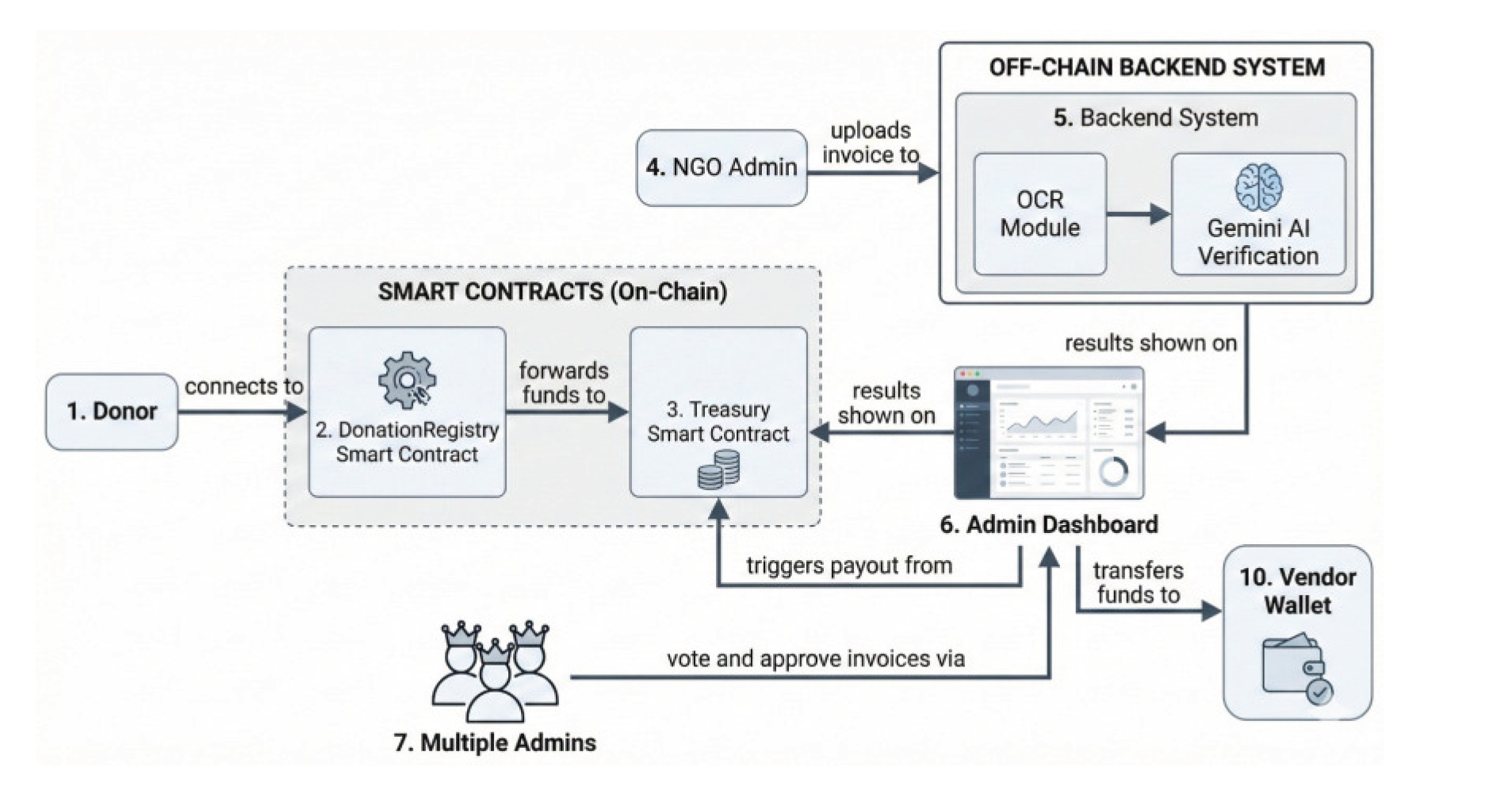
Figure 2.
Donor Interface Displaying Active Causes and Milestone Progress.
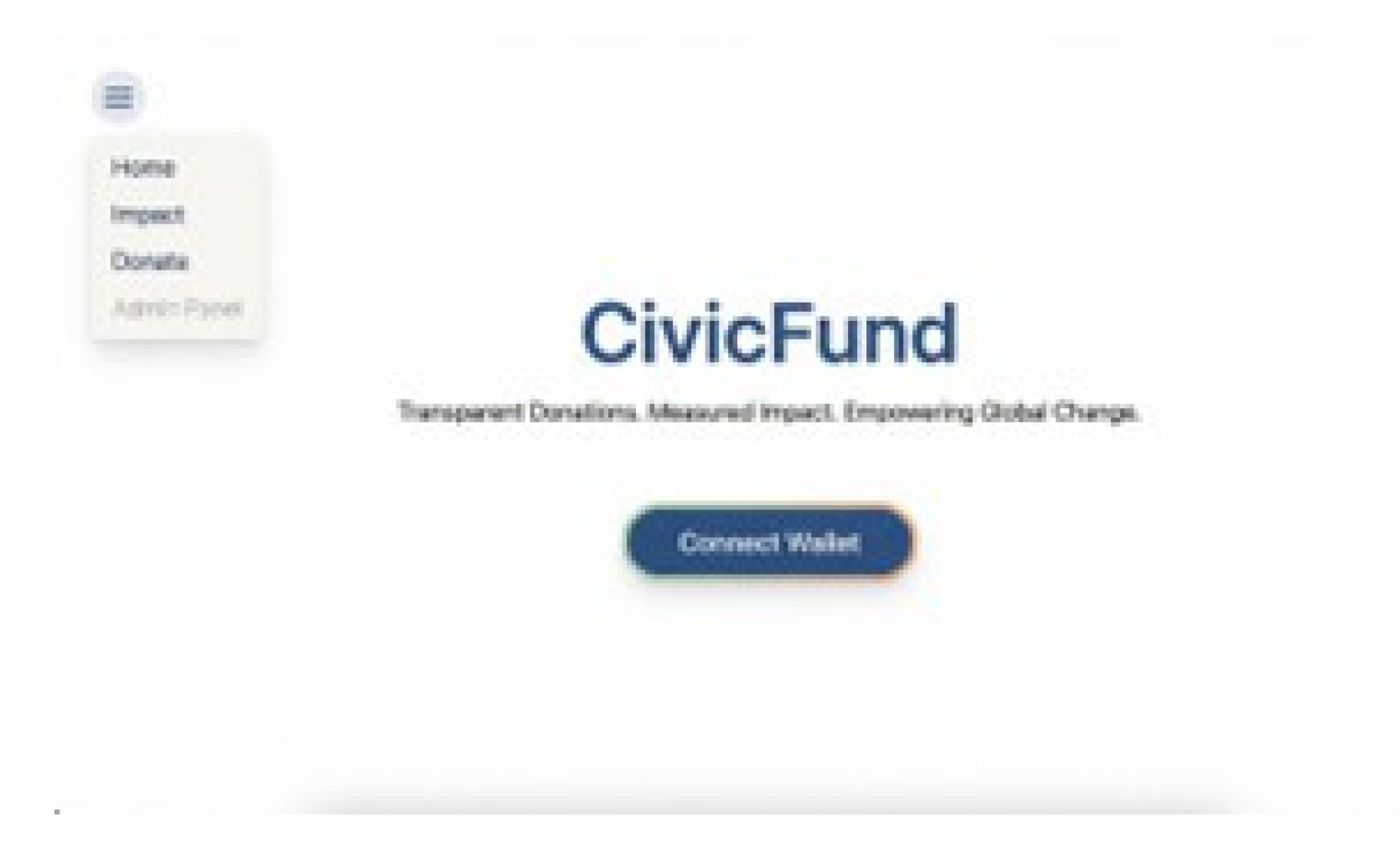
Figure 3.
Administrator Dashboard with Invoice Review and AI Analysis.
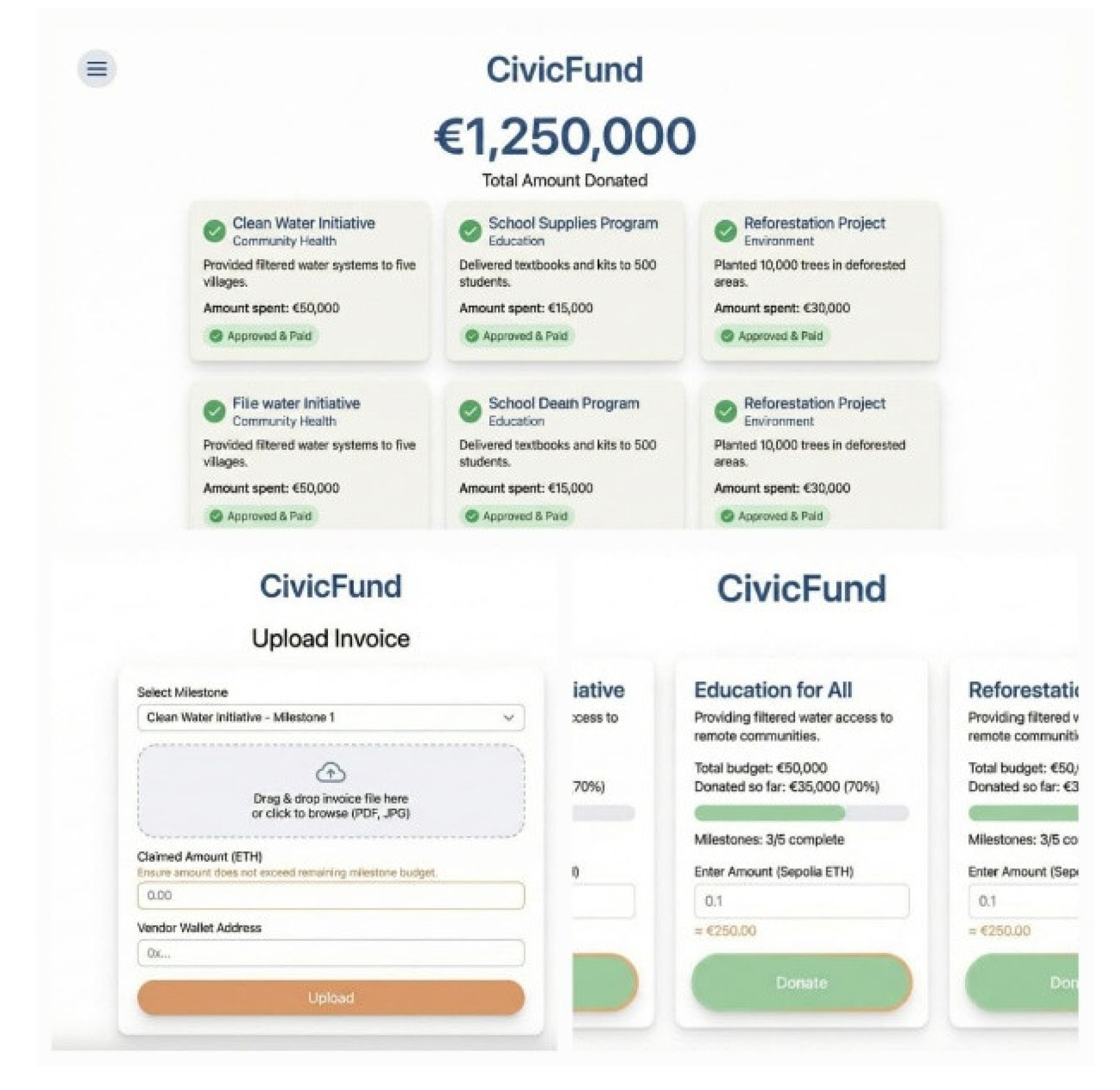
Figure 4.
On-Chain Verification of Vendor Payout on Ethereum Sepolia.
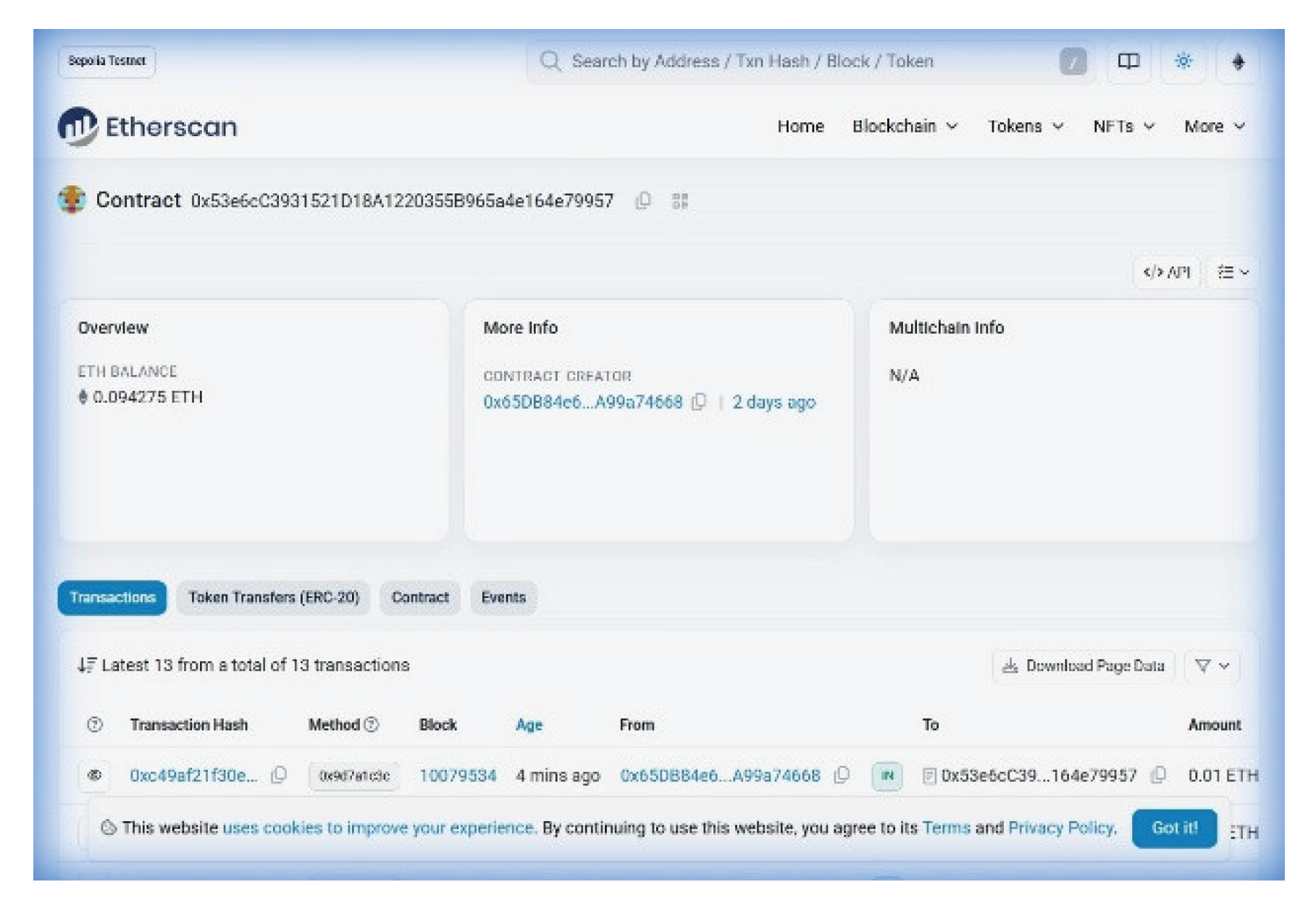

Table 1.
Invoice Verification Outcomes Under Varying Conditions.
| Case | Claimed |
OCR Evi- dence |
AI Decision | Remarks |
| Clean |
5000 | Exact match |
APPROVE (100) |
High confidence, no anomalies |
| Clean Im- age |
5000 | Clear match |
APPROVE (95) |
Minor OCR noise tolerated |
| Mismatch | 5000 | Lower total | REJECT (20) |
Claim exceeds in- voice total |
| Partial OCR |
5000 | Inferred | REVIEW (72) |
Human review recommended |
| No Amount |
5000 | Missing | REJECT (15) |
Insufficient evidence |
| Noisy Im- age |
5000 | Ambiguous | REVIEW (68) |
OCR artifacts de- tected |
Disclaimer/Publisher’s Note: The statements, opinions and data contained in all publications are solely those of the individual author(s) and contributor(s) and not of MDPI and/or the editor(s). MDPI and/or the editor(s) disclaim responsibility for any injury to people or property resulting from any ideas, methods, instructions or products referred to in the content. |
© 2026 by the authors. Licensee MDPI, Basel, Switzerland. This article is an open access article distributed under the terms and conditions of the Creative Commons Attribution (CC BY) license (http://creativecommons.org/licenses/by/4.0/).
Copyright: This open access article is published under a Creative Commons CC BY 4.0 license, which permit the free download, distribution, and reuse, provided that the author and preprint are cited in any reuse.