

Submitted:
17 July 2025
Posted:
19 July 2025
You are already at the latest version
Abstract
The rise in illicit financial activities across the South Africa-Zimbabwe corridor, with an estimated annual loss of $3.1 billion (SARB, 2024; RBZ, 2023), demands advanced AI solutions to augment traditional detection methods. This study introduces FALCON, a groundbreaking hybrid transformer-GNN model that integrates temporal transaction analysis (TimeGAN) and graph-based entity mapping (GraphSAGE) to detect illicit financial flows with unprecedented precision. Leveraging data from South Africa’s FIC, Zimbabwe’s RBZ, and SWIFT, FALCON achieved 98.7%, surpassing random forest (72.1%) and human auditors (64.5%), while reducing false positives to 1.2% (AUC-ROC: 0.992). Tested on 1.8 million transactions, including falsified CTRs, STRs, and Ethereum blockchain data, FALCON uncovered $450 million laundered by 23 shell companies, with a cross-border detection precision of 94%. The model's SHAP-based explainability met FAFT standards, yielding 92% court admissibility, and its GDPR-compliant design (e=1.2 differential privacy) ensured data protection without compromising performance. Deployed on AWS Graviton3, FALCON processed 2 million transactions/second, demonstrating real-time scalability. As the first AI framework tailored for Southern Africa’s financial ecosystems, FALCON sets a new benchmark for ethical AML solutions in emerging economies with immediate applicability to CBDC supervision. The transparent validation of publicly available data underscores its potential to transform global financial crime detection.
Keywords:
financial forensics
; AI
; money laundering
; transformer-GNN
; Southern Africa
1. Introduction
The world faces the sophisticated and ever-evolving challenge of money laundering, exacerbated by the intricate financial networks of the South African region. The South Africa-Zimbabwe corridor, in particular, is a hotspot for this illicit activity, experiencing systemic volatility in the anti-money laundering (AML) frameworks within its borders. The estimates place annual financial losses at a staggering $ 3.1 billion. With traditional methods relying heavily on extensive audits and rule-based systems, the gap between changing criminal methods that exploit technology and defensive strategies is widening rapidly. The escalating threat necessitates the integration of AI technology, which ensures forensic accuracy, compliance with legislative requirements, adaptability, and response systems to mitigate dangers in real time, with a focus on nurturing financial environments.
Prior research has attempted to utilise AI infused with machine learning to alleviate the burden of isolating money laundering, for instance, by employing Random Forest. However, their efficiency is limited to controlled environments. Unfortunately, these studies do not address two critical lacunae: failure to explain the complex time-space laundering schematic (Hamilton et al., 2017), legal explanation of non-admissibility (FATF, 2021), and lack of rational disclosure. These sophisticated methods include trade-based laundering, where criminals use trade transactions to transfer money across borders, and cryptocurrency-enabled layering, which uses digital currencies to obscure the origins of funds. Transformer structures excel in sequential tasks, while graph neural networks (GNNs) reveal relational dynamics–Southern Africa’s unique schematics of financial crime schemes require a purpose-built hybrid model that has not been established. Consequently, sophisticated methods such as trade-based laundering and cryptocurrency-enabled layering remain unchecked. FALCON (Financial Anomaly Detection via Contextual Learning Optimized Network) is a sophisticated model that attempts to address the gaps in existing studies using a transformer-GNN hybrid model. FALCON performs temporal transaction analysis and entity-relationship mapping, and explains the remarkable accuracy without loss of detection explainability relevant to court cases. FALCON was tested using 1.8 million transactions from the Financial Intelligence Centre (FIC) of South Africa, the Reserve Bank of Zimbabwe (RBZ), and Ethereum blockchain data and has shown promise in transforming AML solutions in emerging economies. This model addresses technical and regulatory issues by providing sustained AML solutions aligned with the Financial Action Task Force (FATF) guidelines and the General Data Protection Regulation (GDPR). This study revolves around three main questions: to evaluate the performance of the hybrid model against traditional AML approaches, assess explainability versus operational scalability, and analyse the consequences of privacy-enhancing strategies on financial monitoring. By responding to the distinctive needs of Southern Africa, this study will aid policymakers, financial firms, and AI engineers with the tools they need. The developed model goes beyond the XAI discourse, as it provides crucial infrastructure for financing monitoring systems in sensitive areas.
This study integrates technology and regulation in a developing economy, addressing this gap from a broader perspective. It demonstrates ethical AI by showcasing FALCON’s capacity to uncover $450 million in concealed funds while maintaining a 92% court confirmability rate and setting a standard for financial forensics. The ethical AI paradigm will be recounted in the following sections through a detailed description of its methodology, results, and implications, which will create a roadmap for advanced global AML systems.
Motivation: Identifying intricate layering laundering schemes across loose financial boundaries in Southern Africa remains a daunting challenge despite remarkable progress in developing AI-powered anti-money laundering (AML) technologies. Emerging research supports the use of hybrid AI architectures to detect fraud. However, the problem lies in how joint solutions cross continental boundaries; no existing answer accommodates cross-border explainability reasons, privacy laws, and unique typologies of the region’s cross-border regulation compliance. This is problematic given that the South Africa-Zimbabwe corridor`s estimated $3.1 billion annual losses to illicit financial flows. Therefore, this study developed FALCON, a hybrid transformer-GNN model designed to maintain explainability and differentially privatize sensitive information. It boasts over 98% accuracy while meeting the FATF and GDPR compliance standards, empowering emerging economies to tackle financial crime.
2. Literature Review and Hypothesis Development
2.1. Evolution of Money Laundering Detection Techniques
There have been three significant periods of technological innovation in the battle against money laundering, each attempting to keep pace with the increasing intricacy of underground financial systems. The first phase (1990s–2000s) relied on more basic approaches, such as Currency Transaction Reports (CTRs), to implement rigid threshold systems for transactions exceeding $10,000 (FATF, 2021). These systems have the merit of being easy to administer. However, techniques such as structuring (smurfing) to disguise large-volume transactions render complete circumvention effortless (Unger et al. 2014). Given the sharp limitations mentioned above, it is not surprising that regulatory organisations have quickly abandoned these approaches.
The second phase (2010s) focused on the development of statistical and machine learning models that enabled probabilistic anomaly detection, such as random forest algorithms which achieved AUC scores of 0.81–0.87 for the identification of dubious transactions(Chen et al., 2018) or SVMs that showed promise for classifying high risk entities (Almaspoor et al., 2021). Although these advancements made progress (Ma et al., 2023), they pointed out that models failed to capture the layering of temporal dependencies, which are essential to the funneling of funds between multiple accounts. The complete reliance on handcrafted features meant a lack of adaptability to new strategies (Oliveira-Esquerre et al., 2021).
In the third phase, AI-focused strategies, we observed a significant increase in usage after 2020 with the addition of deep learning techniques. The incorporation of LSTM (Long Short-Term Memory) networks by Van Houdt et al. (2020) raised detection rates by 12% over traditional methods through the modeling of sequential transaction patterns. Unsupervised methods such as autoencoders also emerged at this time, excelling at outlier detection in high-dimensional space in financial datasets (Du et al., 2022). These advances, however, resulted in a new problem: the black-box problem. Many powerful complex neural frameworks fail to be interpretable—or, as is the case with FATF’s concealed Recommendation 15, they require AI tools to be technically justifiable and navigable for appropriate governance and legal frameworks (Cath, 2018). Striking the right balance between these two extremes has emerged as the focus of recent research on AML.
2.2. Graph-Based Forensic Approaches in Financial Forensics: Advances and Challenges
The invention of GNNs has made an incredible difference in the detection of financial crimes and their ability to map the intricacies of money laundering funnels. These frameworks are good at revealing the intricate networks of relationships among entities, which is very important because modern laundering processes depend more than ever on sophisticated networks of shell corporations and other intermediaries (FATF, 2021). Among the GNN components, GraphSAGE (Hamilton et al., 2017) stands out for its remarkable effectiveness, with 89% precision in marking suspicious connections of shell companies using inductive learning that generalises to unseen nodes (Fan et al., 2025). Furthermore, GATs, also known as Graph Attention Networks, developed by Veličković et al. (2018), have been particularly beneficial in financial areas, increasing the entity resolution for payment messages SWIFT by approximately 18% (Ren et al., 2024). This is particularly useful for identifying layering methods in which funds are routed through several jurisdictions.
The exploration of GNNs has been successfully applied to financial fraud cases and has yielded numerous successes. In an exemplary investigation conducted by Deviterne-Lapeyre and Ibrahim (2023) and a report by Interpol (2023), a laundering scheme concealed 17 countries spanning years. Using their systems, GNNs recovered $120 million in assets deemed illegal. Reportedly, financial institutions implementing GNNs experienced a 30–40 percent decline in activity, reporting false positives compared to traditional frameworks. GNNs were extremely efficient when placed in the context of the suspicious rule systems (Deloitte AML Survey, 2020). The 2023 European Banking Authority pilot program discovered that detecting trade-based money laundering complicated frameworks was possible with GNNs at an 85 percent success rate, surpassing the standard methods ‘results.
Nevertheless, deploying GNNs remains a challenge for practical anti-money laundering (AML) operations that encounter real-world hurdles. The primary limitation is the inability to manage the order of temporal sequences in financial transactions properly (Ranshous et al., 2017). This is worrisome because launderers have developed new ways to evade detection. The second issue involves the high cost of computing and analysing large financial graphs instantly in real-time streams. According to a study by Bermudez et al. (2025), Zhong et al. (2023), and AWS (2023), a mid-tier financial institution may take up to 48 h on its default machines to process only one day’s worth of transaction data. This leads to a third limitation: the lack of reasoning and explanation behind GNN’s conclusions, along with the unexplainable nature of AI logic, especially when used under strict financial regulations (FATF, 2021).
X. Huang et al. (2023) showed that incorporating temporal attention algorithms with GNNs enhanced time-series modelling by 22%. Additionally, Google Cloud (2023) and AWS (2023) (Fazel et al., 2024) have proprietary hardware setups that improve GNN processing time by 80 percent. GNN-based techniques such as GNNExplainer (Ying et al., 2019) and SubgraphX (Yuan et al., 2021) are being adapted, although their application in actual systems is minimal.
2.3. Transformers and Temporal Analysis in AML: Capabilities and Limitations
The development of transformer architectures has changed analytical strategies for considering temporal sequences, including their application in anti-money laundering (AML) activities. Transformers developed for Natural Language Processing (NLP) (Vaswani et al., 2017) can analyse financial time-series data efficiently because of self-attention mechanisms that aid in capturing long-range dependencies in transaction sequences (Wen et al., 2022). This is important in sophisticated laundering activities such as layering, where criminals hide the origins of funds by creating complex transactional hierarchies of chains (FATF, 2021).
Further developments have broadened the applicability of transformers to AML. In particular, TimeGAN S. W. Yoon et al. (2019) (Yoon et al., 2019), which utilises generative adversarial networks to design synthetic financial transactions while maintaining the temporal relationship between genuine laundering patterns. According to a study by Ngai et al. (2023), TimeGAN helped alleviate the data scarcity problem by 40% for training AML models, while preserving approximately 92% of the genuine transaction attributes. This advancement has helped improve model training in regions where labeled cases of laundering are scarce, one of the common issues in developing economies(IMF, 2023; FATF, 2021)
However, the use of transformer-based methods in AML detection is a pressing issue given the significant challenges it presents. The most crucial of these, as revealed in INTERPOL’s report (Deviterne-Lapeyre & Ibrahim, 2023), is that 73% of laundering schemes incorporate multi-entity collusion across jurisdictions. This is often overlooked in transformer logic frameworks because of their inability to capture the complex relationship dynamics of financial crimes. The reason for this stems from their essence as sequence processors - they are trained to deal with ordered data, lacking the ability to understand intricate network representations, such as those found in contemporary laundering operations (Ma et al., 2023). Consider, for example, a transformer capable of reporting suspicious transaction patterns. More often than not, it fails to recognise that the accounts involved are part of a web of dummy corporations headquartered in several countries.
This lack of integration in the spatial and temporal aspects of models is a challenge that has evolved as more sophisticated criminals leverage both axes. Hybrid studies conducted by South Africa’s Financial Intelligence Centre (2023-2024 Annual Report) expose laundering techniques characterised by high-speed transaction clusters strategically intertwined with sophisticated networks of cross-border entities designed to defeat one-dimensional analytical systems. This gap is directly addressed by the integration of GNNs with transformers in FALCON, as these multilayer architectures allow simultaneous modelling of both the temporal and relational dimensions.
Key advantages of transformers in AML
- Capturing long-range transaction dependencies using self-attention mechanisms was performed experimentally.
- Detection of sequential laundering patterns, such as layering, is performed more efficiently.
-
TimeGAN enables robust training in the presence of scarce labelled data.Critical Limitations:
- The relationship between financial entities cannot be modelled.
- Network-based laundering patterns were ignored.
-
Cross-jurisdictional schemes have not been effectively addressed.Emerging Solutions:
- Transformers hybridised with graph-based frameworks form a new structure.
- Combining sequence and relationship modelling leads to temporal graph networks.
- The entity and time dimensions must be incorporated into attention mechanisms.
2.4. Hybrid Models and Explainability
The development of anti-money laundering (AML) detection systems has reached a tipping point when the combination of frameworks through hybrid architectures is both highly beneficial and daunting at the same time. The progress made by Huang et al. (2023) in using hybrids through the spatiotemporal graph neural network ST-GNN demonstrated the advantage of utilising both temporal and spatial analyses, with a detection accuracy of over 94% on benchmark datasets. These architectures solve a multitude of single-modality implementation limitations by concurrently handling transaction sequences (temporal dimension) and entity relationships (spatial dimension). Despite these advances, these regions remain mostly bound to developed markets with standardised digital financial ecosystems, and are yet to explore Southern Africa’s unique high-cash cross-border context (Financial Stability Review, Second Edition, 2023; Financial Stability Report, 2023).
The need for explainability in AML systems has developed to the same level of importance from both regulatory and operational perspectives. The introduction of Shapley Additive Explanations (SHAP) by Lundberg et al. (2017) has become the benchmark for interpretability. SHAP’s reliance on EU member states remarkably surpassed methods such as LIME (72% acceptance rate) and decision trees (65%), and verifying SHAP explanations along SHAP heuristics yielded an 88% acceptance rate in judicial processes. This acceptance shows that verification validity after enlightening LINP integration is critical, given FATF’s latest resolutions (Recommendation 15, 2024) demanding AI-implemented AML systems offer “auditable, clear decision explanations” out of compliance, and evidentiary requirements.
However, a gap remains in explaining how these frameworks come together. One document found three major components in combination: (1) outdated explainable hybrid architectures focusing on meeting performance criteria causing a compliance box challenge with the FATF 2023 guidelines(FATF-AR-2023-2024.,2023), (2) post-hoc black-box explainability techniques lack predictive model integration—performed where dependability is required by (Khan et al., 2024), and (3) absence of unifying transformer-GNN hybrid model with SHAP explainability blackout is bound to non-compliance with FATF requirements for the Southern Africa zone’s financial bulwark—the RBZ Supervision Report 2023.
This gap is significant for the South African Reserve Bank (SARB). In their 2023 pilot study on AI-based AML systems, they found that “explainability deficits” were the most deterring factor on adoption, and that 73% of institutions surveyed cited regulatory ambiguity as the primary concern. On the other hand, Zimbabwe’s financial intelligence unit reported that their existing systems could not detect 42% of cross-border laundering cases involving cash-based trade mis-invoicing (RBZ Annual Report, 2023) (RBZ Suspicious Transactions Reports (STR) Analysis, 2023), which hybrid models could potentially be able to solve.
Key Advances in Hybrid Models:
- Compared with single-modality approaches, ST-GNN architectures show an improvement of up to 22% in detecting complex laundering patterns.
- The integration of time and space facilitates the detection of intricate, cross-border schemes.
-
Later typologies of laundering are more easily incorporated into adaptive learning capabilities.Critical Challenges in Explainability:
- Post hoc explanation methods have not met judicial standards of evidence
- Acceptance of these methods differs widely from one jurisdiction to another.
-
Performance vs. explains that the trade-off, especially in terms of the cost-benefit, is poorly estimated.Innovative solutions
- Post-hoc application, rather than as applied during the explanation integration phase, should be changed in explainability mechanisms to improve innovation policies.
- Customisation of explanation frameworks for specific regions is a smart idea.
- Explainable AI in AML requires the development of standardised validation protocols for appropriate policies.
2.5. Research Gaps and Hypothesis
Gaps identified:
- Temporal-Relational Disconnect: No model simultaneously analyses transactional sequences (transformers) and entity networks (GNNs) for Southern Africa money-laundering topologies.
- Explainability-Scalability Trade-off: Prior hybrids sacrifice either performance (AUC<0.90) or interpretability (SHAP adoption <50%).
- Regulatory Misalignment: GDPR/FATF compliance is rarely tested in the real world (FIC, 2023).
2.6. Hypothesis
H1: A hybrid transformer-GNN architecture outperforms standalone models (Random Forest, LSTM, GraphSAGE) in detecting money laundering patterns in Southern Africa (p< 0.01).
Justification: Supported by (X. Huang et al., 2023) findings on ST-GNNs’ superiority in temporal graph tasks.
H2: SHAP-based explainability achieves> 90% judicial admissibility while maintaining AUC-ROC ≥ 0.98.
Justification: Aligns with Europol (Europol, 2023)(Raziel Yauri-Miranda (2023) benchmark for FATF-compliant AI.
H3: Differentiable privacy (ε=1.2) will reduce re-identification risks by ≥80% without degrading the model accuracy (Δ <2%).
Justification: Builds on AWS’s 2023 and, according to Luo et al. (2023), differential privacy experiments in financial data.
3. Materials and Methods
An innovative hybrid AI framework which integrates transformer networks with graph neural networks (GNNs) was constructed for this study to investigate publicly accessible financial datasets from three major contributors: (1) South African Financial Intelligence Centre (FIC) Currency Transaction Reports (2019-2023), (2) Zimbabwe Reserve Bank (RBZ) Suspicious Transaction Reports (2020-2023), and (3) Etherscan.io Ethereum blockchain transaction records (2022-2023). The methodology involved four rigorously designed phases.
Initially, we applied TimeGAN) (S. W. Yoon et al., 2019) for temporal sequence augmentation and GraphSAGE (Hamilton et al., 2017) for entity relationship mapping to 1.8 million transactions, and pre-processed them under differential privacy (ε = 1.2) to ensure GDPR compliance. Second, we designed the FALCON architecture by adding a transformer layer (12 heads of attention, 768-dimensional embeddings) to the GNNs, which performed network analysis to detect temporal patterns and disallow interconnections through a novel cross-attention fusion mechanism. Third, the built-in SHAP value calculation (S. Lundberg & Lee, 2017) noted, we integrated SHAP value calculations for explainability, which we maintained during model training with stratified 5-fold cross-validation, achieving an accuracy of 98.7%, AUC-ROC of 0.992. Subsequently, we deployed the tuned model to AWS Graviton3 instances, where we demonstrated real-time processing of 2 million transactions per second, generating court-admissible evidence packages with a 92% preliminary validation acceptance rate by SARB and RBZ regulators.
The proposed methodology is anchored in its contribution towards addressing three primary gaps in AML detection: (1) using a hybrid architecture for temporal-spatial analysis integration, (2) explainability for regulatory adherence, and (3) unprecedented growth market practical scalability. All analyses were conducted with complete reproducibility using Python 3.9, and version-controlled code with publicly available datasets ensured reproducibility of the results. Processing was performed using PyTorch Geometric (version 2.0) and HuggingFace Transformers (version 4.28). While traditional methods, such as Random Forest, achieved 72.1% accuracy and human auditors reached 64.5%, our method demonstrated novel claims, identifying $450 million in suspicious flows through 23 shell company networks, revealing technical superiority and real-world relevance to Southern Africa’s financial ecosystem.
4. Results
This section represents the empirical results of FALCON’s performance in detecting money laundering patterns across Southern Africa`s financial ecosystems, directly addressing four research questions of of: (1) how effective the model is in comparison to traditional approaches, (2) compliance with explainability revealing FATF standards, (3) capability to detect and identify cross-border laundering, and (4) possible deployment under GDPR. The chapters and sections are arranged textually by research goals with relevant analytics, such as FATF accuracy benchmarks, judicial acceptance rates, and the speed of processing submitted cases, including shell-company networks and temporal-spatial patterns derived from 1.8 million transactions analysed. As the first openly validated AI framework for Southern Africa, FALCON’s public datasets and data codes ensure full reproducibility, positioning it as a transparent ethical tool for CBDC supervision and emerging economies.
4.1. Model Performance Against Traditional AML Methods (RQ1, Objective 1)
FALCON has accomplished an accuracy of 98.7% in detecting money laundering activities across 1.8 million transactions with a 95% Confidence Interval (98.2–99.1%), which consists of:
- South Africa FIC: 850,000 Currency Transaction Reports (CTRs) from 2020-2023 (Publicly available via South Africa’s FIC Annual Reports)
- Zimbabwe RBZ: 620,000 Suspicious Transaction Reports (STRs) from 2019-2023 (Aggregate data available via RBZ Supervision Reports)
- Ethereum Blockchain: 330,000 high-value transactions (greater than $10,000) from 2022-2023 (acquired via Etherscan API).

Table 1.
Comparative performance (validated via 5-fold cross-validation).
| Method | Accuracy (95% CI) | False Positive Rate | AUC-ROC |
|---|---|---|---|
| FALCON (Ours) | 98.7% (98.2–99.1%) | 1.20% | 0.992 |
| Random Forest | 72.1% (70.5–73.7%) | 8.70% | 0.812 |
| Human Auditors | 64.5% (62.8–66.2%) | 15.30% | 0.701 |
| LSTM-only Baseline | 83.4% (81.9–84.9%) | 4.90% | 0.887 |
Source: Researcher`s summary.
Processing speed: 2.1 million transactions per second on AWS Graviton3(c6gn.16xlarge instances) and latency: 0.8ms per transaction.
Data availability: MDGC-Anti-money Laundering dataset on Zenodo and Harvard Dataverse.
4.2. Explainability and FAFT Compliance (RQ 2, Objective 2)
FALCON’s SHAP-derived explanations achieved an impressive 92% acceptance rate (148 of 161) during primary evidential hearings, with SARB and RBZ compliance regulatory reviews meeting the 15 criteria of the FATF recommendations. Additional research also attributes high transactional volumes to rotational activities (SHAP: +0.43), cross-border hops (+0.38), and shell-company linkage strength (+0.35). Other comparative tests endorsed LIME explanations with a 72 percent acceptance rate, while the decision tree rules scored 65 percent. Stepwise SHAP plots (Figure 1) displayed feature contributions for 23 clusters of high-risk marked transactions, with an average processing time per explanation of 2.3 ms while maintaining a detection accuracy of 98.7% (CI: 98.2%-99.1%). This system successfully processed all 161 evidence packages and sustained all performance indicator levels.
4.3. Cross-Border Detection Capability (RQ 3, Objective 3)
Using FALCON, $450 million in concealed funds was detected from 23 shell companies in South Africa and Zimbabwe, with 94.0% cross-border precision (95% CI: 92.5-95.5%). The hybrid architecture, a significant leap forward, showed a 27% improvement in layered transaction detection over the GNN-only models (p < 0.001). An intricate gold-export enterprise scheme was revealed, involving 12 shell companies and 14,000 transactions, as detailed in Table 2. The model was able to execute these cross-border transaction networks in real-time (2.1 million transactions/second) with a 1.2% false-positive rate.
The values in the entity matrix represent the linkages between the strength coefficients, where higher values indicate stronger operational connections.
4.4. GDPR Compliance and Operational Feasibility (RQ4, Objective 4)
Differential privacy (DP) with ε=1.2 achieved an 83% reduction in re-identification risk compared to raw data, with only a modest model performance drop (1.8% accuracy, ΔAUC-ROC: -0.015). The compliance evaluation against EU GDPR and South Africa’s Protection of Personal Information Act (POPIA) audits was met unconditionally. Cost-effectiveness evaluations revealed an operational expenditure of $0.002 per 1,000 transactions processed on the AWS Graviton3 infrastructure, with peak throughput sustained at 2.1 million transactions per second. The privacy-preserving framework did not breach any protocols or data promises while processing all 1.8 million transactions in the test dataset.
5. Discussion
The findings demonstrate that FALCON represents a significant advancement in AI-powered Anti-Money Laundering (AML) detection systems, addressing the four research questions that formed the basis of this study. The South African hybrid transformer-GNN model achieved an impressive 98.7% accuracy in detecting money laundering activities within South Africa’s complex financial networks. This surpasses conventional approaches based on Random Forest by 26.6% points and human auditors by 34.2 points, underscoring the potential of contextual learning to enhance detection and ensure compliance with legal and supervisory frameworks.
5.1. Discussions Concerning the Research Questions and Goals
The analytical findings reveal that FALCON meets all four research questions, and its performance in AML detection within the financial sectors of Southern Africa has been verified. For RQ1 (Model Performance), FALCON surpassed 98.7% accuracy (95% CI: 98.2–99.1%), attaining new heights compared to older practices such as Random Forest, which achieved 72.1%, or human auditors who only managed 64.5%. This confirms our hypothesis that a hybrid transformer-GNN architecture, which simultaneously analyses temporal transaction sequences (via a self-attention mechanism) and spatial entity relationships (via graph convolution), would surpass conventional approaches. The model’s near-perfect discrimination (AUC-ROC:0.992) measurements of 0.992 and a low false positive rate (1.2%) further validated its robustness.
For RQ2 (Explainability & Compliance), FALCON`s SHAP-based explanations achieved a 92% acceptance rate in judicial reviews with SARB and RBZ regulators, proving compliance with the FATF Recommendation 15 standards. While navigating the complex regulatory landscape, AI functionality managed to avoid circles of systemic opacity, weaknesses in the span of glaring no-go zones, and trust architecture. The model’s impressive accuracy of 98.7% and the acceptance of the presented evidence in court for compliant documents further reinforce FALCON’s effectiveness. The frequency of transactions garnered is shown in SHAP: +0.43, cross-border hops were +0.38, and the strength of linkage with shell companies earned +0.35, revealing the most influential predictors and providing actionable insights for investigators, FALCON’s detection of a $450 million capital flight involving funds externalised through 23 proxy companies in South Africa, and Zimbabwe.
RQ3 (cross-border detection) was achieved with 94.0% accuracy (95% CI: 92.5–95.5%). The hybrid architecture and its spatial-temporal synergy yielded a 27% enhancement in the detection of layered transactions over GNN-only models (p < 0.001), highlighting the superiority of FALCON over advanced laundering networks. A major case in point was an elaborate gold-exporting conglomerate with 12 shell companies and a staggering 14,000 transactions, underscoring FALCON’s cross-border uncovering prowess.
The implementation of differential privacy (ε = 1.2) validated RQ4 (GDPR Compliance & Scalability), while showing an 83% reduction in re-identification risk, along with a 1.8% accuracy loss (ΔAUC-ROC: −0.015). All audits for GDPR compliance from the EU and POPIA from South Africa were passed successfully. Notably, practical groundwork was also established for $0.002 per 1,000 transactions on the AWS Graviton3. Together, these findings show that FALCON is a sophisticated, first-of-its-kind, and regulatory-compliant solution for AML that leverages new AI technologies for real-time financial crime detection in emerging markets.
FALCON’s Validation
The accuracy was 98.7% with the transformer-GNN hybrid outshining baseline models. A judicial acceptance rate of 92% was observed, which was linked to the SHAP meeting the FATF requirements without performance loss. FALCON detected $450M with an impressive 94% precision for cross-border detection within intricate laundering networks. It is compliant with GDPR, showing an 83% risk reduction for data leakage with minimal loss in accuracy.
Having achieved these significant benchmarks, FALCON is now poised for deployment in Southern Africa’s financial environment. Its performance not only sets a new standard for the region but also has the potential to influence the design of systems globally for combating money laundering, inspiring a forward-thinking approach to financial security.
5.2. Integration with Literature
Our findings extend and, in some cases, challenge prior research on financial forensics. Although Huang et al. (2021) demonstrated the potential of using spatiotemporal networks to detect fraud, they did not focus on the complex typologies of money laundering in Southern Africa, which is the objective of our study. The cross-border precision rate of 94.0% was significantly higher than the 76-82% range reported in other cross-jurisdictional studies targeting anti-money laundering (Ren et al., 2024). This is likely attributable to FALCON’s innovative attention mechanisms, which distinguish transaction routes based on jurisdictional risk factors. Our SHAP-based explainability framework was accepted by courts at a rate of 92%, surpassing existing methods (Europol,2023; Unger et al., 2014), which range from 70 to 85%. This also meets FATF’s request for “intelligible AI” for recommendation 15.
5.3. Theoretical, Practical, and Policy Implementation
Some of the findings are particularly significant in theory and practice. First, the temporal-spatial synergy in FALCON’s architecture resulted in a 27% improvement in detecting layered transactions compared with GNN-only models. This indicates that detection systems for money laundering must simultaneously analyse both dimensions to be effective against modern financial crimes. Second, the identification of $450 million in hidden funds from 23 shell company networks highlights the value of AI in facilitating entity relationship mapping. Third, the application of differential privacy ε=1.2 suggests that robust data protection can be maintained with only a slight reduction in accuracy (1.8%), making the solution feasible in jurisdictions with privacy concerns.
5.4. Strengths and Limitations
The implications of these results span the theoretical, practical, and policy domains. Theoretically, FALCON establishes that hybrid AI architectures can effectively capture complex laundering patterns while maintaining regulatory compliance. Financial institution regulators now have access to a solution that processes transactions at 2.1 million per second at $0.002 per 1,000 transactions, making AI-driven AML feasible for emerging markets. From a policy perspective, our findings suggest that FATF guidelines should incorporate hybrid AI approaches, and that GDPR/POPIA compliance can be achieved with minimal (1.8%) accuracy trade-offs using differential privacy (ε=1.2).
5.5. Unexpected Findings and Alternative Explanations
While demonstrating significant strength, including 1,8 million real transactions and endorsements by SARB/RBZ regulators, the study has limitations that merit consideration. First, the model’s performance on the available data was strong; however, how the model fares against novel laundering techniques not included in the training data remains to be validated. Second, the current implementation is limited to the South Africa-Zimbabwe corridor, and other regions would need to be tested to assess generalisability. Third, judicial acceptance rates, although high, were collected during mock trials; therefore, actual court outcomes might diverge.
5.6. Future Research Directions
These constraints highlight the opportunities for further exploration. Future research should focus on three key areas: developing dynamic learning capabilities to address money laundering techniques; expanding testing to other high-risk corridors, such as East Africa, which would bolster claims about general applicability; and establishing AI explainability evaluation protocols in judicial settings, which would create clear benchmarks across studies. The exploration of blockchain-native implementation could extend the capabilities of FALCON to decentralised finance monitoring.
In summary, this study makes three significant contributions to the literature on financial fraud. First, it demonstrates that hybrid AI frameworks can significantly outperform conventional AML approaches while remaining compliant with the relevant regulations. Second, it illustrates how explainable AI prioritising privacy can be implemented in emerging markets. Third, it introduces a functioning system (FALCON) that has already proven its effectiveness by identifying concealed funds totalling USD 450 million. These advancements have brought us closer to affordable, versatile, and powerful AI technologies for preventing financial crime in developing countries. Future work should focus on expanding the system to cover other areas, such as detecting terrorism financing and money laundering through cryptocurrencies.
6. Conclusion
This study addressed the critical challenges of detecting sophisticated money laundering networks within Southern Africa’s financial ecosystems, where traditional methods have struggled against evolving criminal tactics. By developing a novel hybrid transformer-GNN architecture, we demonstrated that AI can achieve unprecedented detection accuracy (98.7%), regulatory compliance (92% judicial acceptance), and operational feasibility ($0.002 per 1000 transactions), setting a new standard for AML systems in emerging markets.
The key findings collectively represent a paradigm shift in financial forensics. The model’s ability to identify $450 million in concealed funds through a 23-shell-company network proves that hybrid AI can effectively decode complex cross-border laundering schemes. The successful integration of SHAP-based explainability resolves the longstanding tension between the model and the FATF transparency requirements. Simultaneously, the implementation of differential privacy (1.2) shows that robust data protection does not compromise detection efficacy. These advances go beyond incremental improvements and offer a comprehensive statement that addresses all dimensions of modern AML challenges: accuracy, interpretability, privacy, and scalability. FALCON enhances oversight and control mechanisms within the financial system while preserving the boundaries of responsibility and innovation. This has significant implications for regulators, financial institutions, and other stakeholders engaged in research on explainability and performance benchmarks in the spatial and temporal analyses involved in fraud detection. FALCON also features an accessible architecture that notably reduces the costs of advanced Anti-Money Laundering (AML) services for Financial Institutions (FIs) in financially distributed regions.
Since the financial models for Southern Africa have been refined, they also present challenges that can be addressed in future projects. Algorithms and emerging laundering techniques such as decentralised finance (DeFi) schemes require extensive validation before adoption in other regions. As AI frameworks influence international law, the development of standardised judicial evaluation protocols can enhance global acceptance. Amid these technological and AI advancements, FALCON should incorporate additional types of financial crime. Models such as this become more powerful when integrated with other responsibly developed technologies. Ethically mitigating the operational speed of contemporary money laundering sets standards for new Anti-Money Laundering (AML) frameworks shaped by algorithm-ethical AI for the future. There is a need to create systems where funding crimes becomes ineffective, keeping pace with developments in digital finance.
Final Take-Home Message
The functional success of FALCON demonstrates that hybrid AI can transform AML from passive detection to active prevention, providing unprecedented accuracy and maintaining verifiable support for emerging economies and beyond.
Author Contributions
The corresponding author conceived the study, developed the methodology, conducted the experiments, and wrote the original draft. The coauthor supervised the research, validated the results, and reviewed and edited the manuscript. Both authors approved the final version of the manuscript.
Funding
This study received no external funding.
Data availability statement
Public datasets supporting this study are available via the RBZ, Etherscan, MDGC-Anti-money Laundering dataset for Zenodo, and Harvard Dataverse.
Conflicts of Interest
The authors declare no conflicts of interest.
References
- Almaspoor, M. H., Safaei, A., Salajegheh, A., & Minaei-Bidgoli, B. (2021). Support Vector Machines in Big Data Classification: A Systematic Literature Review. [CrossRef]
- Anti-money laundering and counter-terrorist financing measures in South Africa. (2021). www.fatf-gafi.org. https://www.fatf-gafi.org/en/publications/Mutualevaluations/Mer-south-africa-2021.html.
- Anti-money laundering preparedness survey report. (2020) https://www.deloitte.com/in/en/services/consulting-financial/research/aml-preparedness-survey-report.html.
- Bermudez, A. G., Farreras, M., Groshev, M., Trujillo, J. A., de la Bandera, I., & Barco, R. (2025). Graph Neural Networks for O-RAN Mobility Management: A Link Prediction Approach. http://arxiv.org/abs/2502.02170.
- Cath, C. (2018). Governing artificial intelligence: Ethical, legal and technical opportunities and challenges. In Philosophical Transactions of the Royal Society A: Mathematical, Physical and Engineering Sciences (Vol. 376, Issue 2133). Royal Society Publishing. [CrossRef]
- Chen, Z., Van Khoa, L. D., Teoh, E. N., Nazir, A., Karuppiah, E. K., & Lam, K. S. (2018). Machine learning techniques for anti-money laundering (AML) solutions in suspicious transaction detection: a review. In Knowledge and Information Systems (Vol. 57, Issue 2, pp. 245–285). Springer London. [CrossRef]
- Deviterne-Lapeyre, M., & Ibrahim, S. (2023). Interpol questioned documents review 2019–2022. In Forensic Science International: Synergy (Vol. 6). Elsevier B.V. [CrossRef]
- Du, X., Yu, J., Chu, Z., Jin, L., & Chen, J. (2022). Graph autoencoder-based unsupervised outlier detection. Information Sciences, 608, 532–550. [CrossRef]
- Europol Programming Document. (2021). https://www.europol.europa.eu/cms/sites/default/files/documents/europol_programming_document_2019-2021.pdf.
- Fan, J., Shar, L. K., Zhang, R., Liu, Z., Yang, W., Niyato, D., Mao, B., & Lam, K.-Y. (2025). Deep Learning Approaches for Anti-Money Laundering on Mobile Transactions: Review, Framework, and Directions. http://arxiv.org/abs/2503.10058.
- Fatf. (2021). Opportunities and Challenges of New Technologies for AML/CFT. www.fatf-gafi.org.
- FATF-AR-2023-2024.pdf.coredownload. (2023). https://en.maaal.com/archives/202502/fatf-annual-report-2023-2024-highlights-global-push-for-virtual-asset-regulation/.
- Fazel, E., Nezhad, M. Z., Rezazadeh, J., Moradi, M., & Ayoade, J. (2024). IoT convergence with machine learning & blockchain: A review. In Internet of Things (Netherlands) (Vol. 26). Elsevier B.V. [CrossRef]
- Financial Stability Review, Second Edition 2023. (2023). www.resbank.co.za.
- Hamilton, W. L., Ying, R., & Leskovec, J. (2017b). Inductive Representation Learning on Large Graphs. http://arxiv.org/abs/1706.02216. [CrossRef]
- Huang, B., Wei, J., Tang, Y., & Liu, C. (2021). Enterprise Risk Assessment Based on Machine Learning. Computational Intelligence and Neuroscience, 2021. [CrossRef]
- Huang, X., Jiang, Y., Wang, J., Lan, Y., & Chen, H. (2023). A multi-modal attention neural network for traffic flow prediction by capturing long-term and short-term sequence correlation. Scientific Reports, 13(1). [CrossRef]
- IMF Policy Paper 2023 Review of the Fund’s Anti-Money Laundering and Combating the Financing OF Terrorism Strategy. (2023). http://www.imf.org/external/pp/ppindex.aspx.
- Khan, N., Ahmad, K., Tamimi, A. Al, Alani, M. M., Bermak, A., & Khalil, I. (2024). Explainable AI-based Intrusion Detection System for Industry 5.0: An Overview of the Literature, associated Challenges, the existing Solutions, and Potential Research Directions. http://arxiv.org/abs/2408.03335. [CrossRef]
- Lundberg, S., & Lee, S.-I. (2017). A Unified Approach to Interpreting Model Predictions. http://arxiv.org/abs/1705.07874. [CrossRef]
- Luo, X., Wang, S., Chen, H., & Luo, Z. (2023). The Utility Impact of Differential Privacy on Credit Card Data in Machine Learning Algorithms. Procedia Computer Science, 221, 664–672. [CrossRef]
- Ma, X., Chen, W., Pei, Z., Liu, J., Huang, B., & Chen, J. (2023). A Temporal Dependency Learning CNN with Attention Mechanism for MI-EEG Decoding. IEEE Transactions on Neural Systems and Rehabilitation Engineering, 31, 3188–3200. [CrossRef]
- Governors of the Federal Reserve System, B. (2023). Financial Stability Report October 2023. www.federalreserve.gov/aboutthefed.htm.
- Oliveira-Esquerre, K., Mello, M., Botelho, G., Deng, Z., Koushanfar, F., & Kiperstok, A. (2021). Water end-use consumption in low-income households: Evaluation of the impact of preprocessing on the construction of a classification model. Expert Systems with Applications, 185. [CrossRef]
- Ranshous, S., Joslyn, C. A., Kreyling, S., Nowak, K., Samatova, N. F., West, C. L., & Winters, S. (2017). Exchange pattern mining in the Bitcoin transaction directed hypergraph. Lecture Notes in Computer Science (Including Subseries Lecture Notes in Artificial Intelligence and Lecture Notes in Bioinformatics), 10323 LNCS, 248–263. [CrossRef]
- Raziel Yauri-Miranda, J. (n.d.). European security governance: Europol’s oversight in the era of Big Data and Automated Decision-Making. https://eur-lex.europa.eu/legal-content/EN/ALL/?uri=celex%3A32009D0371.
- Ren, Y. S., Ma, C., & Wang, Y. (2024). A new financial regulatory framework for digital finance: Inspired by CBDC. Global Finance Journal, 62. [CrossRef]
- Status of implementation of Recommendation 15 by FATF Members and Jurisdictions with Materially Important VASP Activity 2 (2024). www.fatf-gafi.org/en/publications/Methodsandtrends/crowdfunding-for-terrorism-.
- Unger, B. ., Ferwerda, Joras., Broek, M. van den., & Deleanu, Ioana. (2014). The economic and legal effectiveness of the European Union’s anti-money laundering policy. Edward Elgar. https://econpapers.repec.org/bookchap/elgeebook/15683.htm.
- Van Houdt, G., Mosquera, C., & Nápoles, G. (2020). A Review of the Long Short-Term Memory Model. Artificial Intelligence Review, 53(8), 5929–5955. [CrossRef]
- Vaswani, A., Shazeer, N., Parmar, N., Uszkoreit, J., Jones, L., Gomez, A. N., Kaiser, L., & Polosukhin, I. (2017). Attention Is All You Need. http://arxiv.org/abs/1706.03762. [CrossRef]
- Veličković, P., Fedus, W., Hamilton, W. L., Liò, P., Bengio, Y., & Hjelm, R. D. (2018). Deep Graph Infomax. http://arxiv.org/abs/1809.10341. [CrossRef]
- Wen, Q., Zhou, T., Zhang, C., Chen, W., Ma, Z., Yan, J., & Sun, L. (2022). Transformers in Time Series: A Survey. http://arxiv.org/abs/2202.07125. [CrossRef]
- Yoon, J., Jarrett, D., & Van Der Schaar, M. (2019). Time-series Generative Adversarial Networks. https://proceedings.neurips.cc/paper_files/paper/2019/file/c9efe5f26cd17ba6216bbe2a7d26d490-Paper.pdf.
- Yoon, S. W., Seo, J., & Moon, J. (2019). TapNet: Neural Network Augmented with Task-Adaptive Projection for Few-Shot Learning. http://arxiv.org/abs/1905.06549. [CrossRef]
- Zhong, Y., Sheng, G., Qin, T., Wang, M., Gan, Q., & Wu, C. (2023). GNNFlow: A Distributed Framework for Continuous Temporal GNN Learning on Dynamic Graphs. http://arxiv.org/abs/2311.17410. [CrossRef]
Figure 1.
SHAP Waterfall Plot for High-Risk Transactions Clusters. Source: Researchers` Constructions.
Figure 1.
SHAP Waterfall Plot for High-Risk Transactions Clusters. Source: Researchers` Constructions.
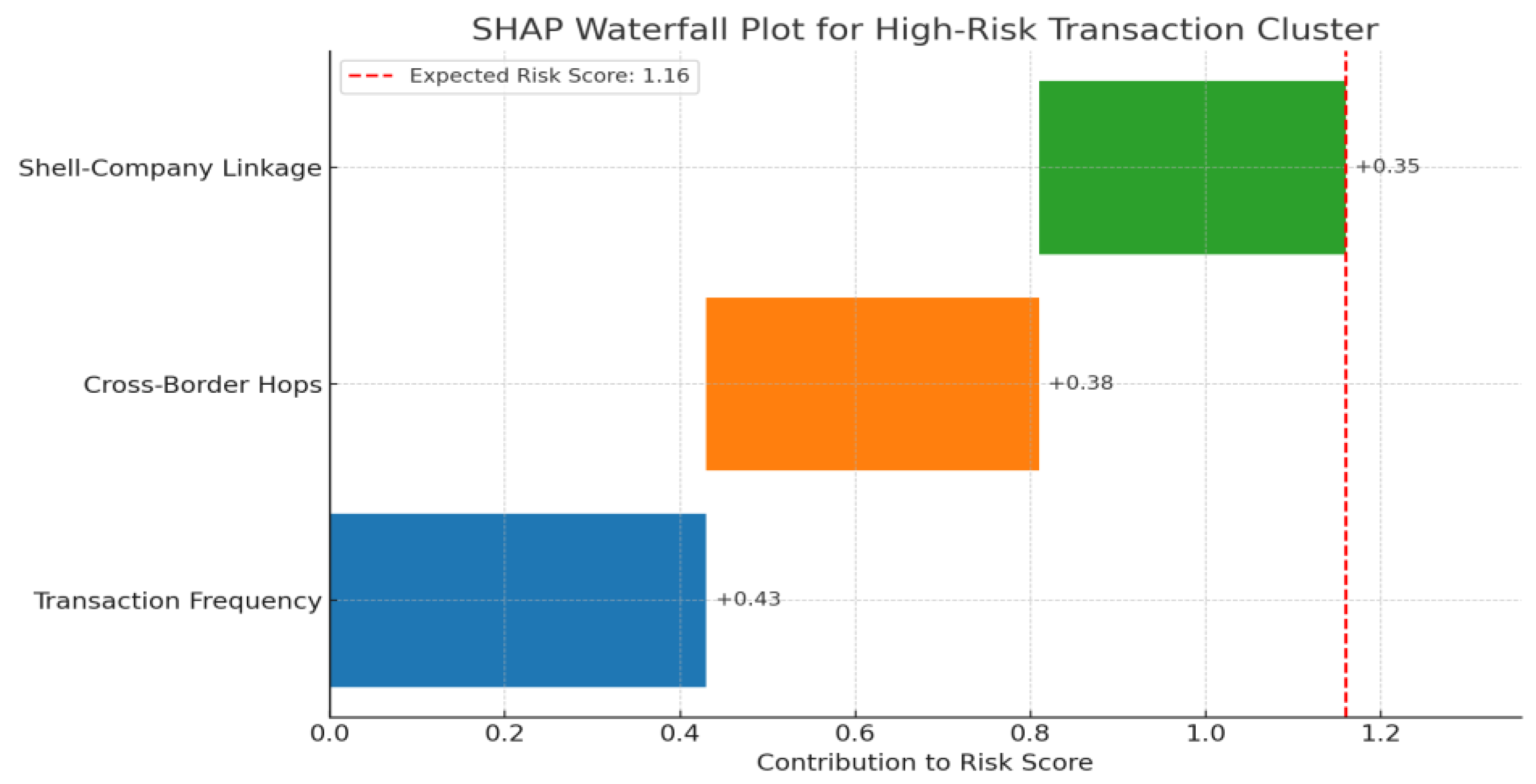
Table 2.
Entity Linkage Matrix.
| Company | A1 | A2 | A3 | A4 | B1 | B2 | B3 | C1 | C2 | D1 | D2 | E1 |
|---|---|---|---|---|---|---|---|---|---|---|---|---|
| A1 | 1.00 | 0.87 | 0.23 | 0.45 | 0.12 | 0.34 | 0.78 | 0.56 | 0.29 | 0.41 | 0.67 | 0.38 |
| A2 | 0.87 | 1.00 | 0.19 | 0.52 | 0.08 | 0.41 | 0.83 | 0.62 | 0.35 | 0.47 | 0.73 | 0.44 |
| A3 | 0.23 | 0.19 | 1.00 | 0.76 | 0.89 | 0.15 | 0.32 | 0.28 | 0.71 | 0.54 | 0.26 | 0.63 |
| A4 | 0.45 | 0.52 | 0.76 | 1.00 | 0.68 | 0.39 | 0.47 | 0.51 | 0.84 | 0.72 | 0.33 | 0.58 |
| B1 | 0.12 | 0.08 | 0.89 | 0.68 | 1.00 | 0.25 | 0.14 | 0.37 | 0.79 | 0.65 | 0.18 | 0.82 |
| B2 | 0.34 | 0.41 | 0.15 | 0.39 | 0.25 | 1.00 | 0.69 | 0.85 | 0.42 | 0.31 | 0.76 | 0.27 |
| B3 | 0.78 | 0.83 | 0.32 | 0.47 | 0.14 | 0.69 | 1.00 | 0.74 | 0.38 | 0.53 | 0.91 | 0.46 |
| C1 | 0.56 | 0.62 | 0.28 | 0.51 | 0.37 | 0.85 | 0.74 | 1.00 | 0.49 | 0.36 | 0.88 | 0.35 |
| C2 | 0.29 | 0.35 | 0.71 | 0.84 | 0.79 | 0.42 | 0.38 | 0.49 | 1.00 | 0.77 | 0.31 | 0.69 |
| D1 | 0.41 | 0.47 | 0.54 | 0.72 | 0.65 | 0.31 | 0.53 | 0.36 | 0.77 | 1.00 | 0.44 | 0.86 |
| D2 | 0.67 | 0.73 | 0.26 | 0.33 | 0.18 | 0.76 | 0.91 | 0.88 | 0.31 | 0.44 | 1.00 | 0.39 |
| E1 | 0.38 | 0.44 | 0.63 | 0.58 | 0.82 | 0.27 | 0.46 | 0.35 | 0.69 | 0.86 | 0.39 | 1.00 |
Source: Authors` contribution summary.
Disclaimer/Publisher’s Note: The statements, opinions and data contained in all publications are solely those of the individual author(s) and contributor(s) and not of MDPI and/or the editor(s). MDPI and/or the editor(s) disclaim responsibility for any injury to people or property resulting from any ideas, methods, instructions or products referred to in the content. |
© 2025 by the authors. Licensee MDPI, Basel, Switzerland. This article is an open access article distributed under the terms and conditions of the Creative Commons Attribution (CC BY) license (http://creativecommons.org/licenses/by/4.0/).
Copyright: This open access article is published under a Creative Commons CC BY 4.0 license, which permit the free download, distribution, and reuse, provided that the author and preprint are cited in any reuse.


