

Submitted:
03 February 2026
Posted:
04 February 2026
You are already at the latest version
Abstract
The performance of advanced functional materials at reduced length scales is increasingly governed by surface and interface phenomena, quantum transport effects, and electron–phonon coupling. As material dimensions approach the nanoscale, classical transport descriptions become inadequate, necessitating frameworks that explicitly account for surface-induced scattering, quantum confinement, and lattice interactions. This article presents a structured analysis of how surface engineering strategies influence quantum transport regimes by modulating electron–phonon interactions. Emphasis is placed on low-dimensional and anisotropic material systems, where surface states and interfacial phonon modes strongly affect carrier mobility, coherence, and energy dissipation. Recent experimental and theoretical studies are discussed to illustrate how tailored surfaces and interfaces can either enhance or limit transport efficiency depending on coupling strength and structural quality. The review provides an integrated perspective on transport behavior in functional materials and outlines design considerations for nanoelectronic, thermoelectric, and quantum device applications.
Keywords:
surface engineering
; quantum transport
; electron–phonon interaction
; functional materials
; nanoscale interfaces
; charge transport
1. Introduction
Advanced functional materials are at the core of emerging technologies in nanoelectronics, quantum devices, energy conversion systems, and intelligent sensing platforms. As device dimensions continue to shrink, material performance is increasingly governed by phenomena occurring at surfaces, interfaces, and reduced dimensional scales rather than bulk characteristics alone. In this regime, the combined effects of surface engineering, quantum transport, and electron–phonon coupling become critical in determining electronic, thermal, and optoelectronic behaviour.
Surface engineering provides a powerful pathway to tailor material properties through controlled modification of surface morphology, interface chemistry, strain states, and defect distributions. Recent studies have demonstrated that laser-induced surface structuring, thin-film processing, and interface design can significantly alter wettability, biocompatibility, and carrier transport by modifying near-surface electronic and phononic environments (Nawaz et al., 2025). Such surface-induced effects are particularly pronounced in advanced metallic alloys and heterostructures, where engineered interfaces can directly influence functional performance.
At nanoscale dimensions, charge transport often enters the quantum regime, where classical transport models fail to capture phase coherence, quantum confinement, and anisotropic carrier dynamics. Low-dimensional materials and van der Waals systems have emerged as prominent platforms for studying quantum transport phenomena due to their reduced scattering and tunable electronic structure. Recent advances in the scalable synthesis of millimeter-scale single-crystal van der Waals nanowires highlight the importance of structural quality and surface integrity in achieving long-range quantum transport suitable for electronic and photonic applications (Joshy et al., 2025; Younus, 2025). Moreover, magnetotransport studies in metastable alloy systems further reveal how electronic phase transitions and critical behaviour are strongly influenced by microstructural and surface-related factors (Younus et al., 2024).
Electron–phonon coupling plays a central role in governing charge transport, thermal conductivity, and energy dissipation processes in advanced materials. The interaction between charge carriers and lattice vibrations determines resistive losses, thermal management efficiency, and the stability of quantum states. In low-dimensional and highly anisotropic materials, electron–phonon interactions often deviate significantly from bulk behaviour, leading to unconventional transport responses (Quan et al., 2021; Bai et al., 2022). Recent investigations into two-dimensional and quasi-one-dimensional systems have reported unusual electron–phonon coupling mechanisms that strongly affect thermal and electronic transport, particularly in anisotropic chalcogenide materials (Wang et al., 2025).
The role of interfaces further complicates electron–phonon dynamics, especially in heterostructures where mismatched phonon spectra and interfacial roughness introduce additional scattering channels. Studies on electron–phonon–coupled nonequilibrium thermal transport in metal/semiconductor heterojunctions demonstrate that interface morphology and fractal roughness can significantly modify energy transfer across interfaces (Wu et al., 2025). Similarly, anomalous thermal transport driven by strong electron–phonon coupling has been observed in two-dimensional semiconductors, underscoring the importance of interfacial and surface effects in nanoscale thermal behaviour (Zhou et al., 2022).
Recent advances in atomic-scale interface characterization have further emphasized the potential of phonon engineering as a strategy for thermal management in advanced functional materials. High-resolution electron microscopy studies reveal that deliberate interface design can be used to control phonon transmission and scattering at the atomic level, offering new opportunities to manipulate coupled electron–phonon processes (Xu et al., 2026). These findings suggest that surface and interface engineering can serve as a unifying tool to simultaneously influence quantum transport and electron–phonon interactions.
Despite substantial progress in understanding surface engineering, quantum transport, and electron–phonon coupling individually, their interdependent effects are often treated separately. In realistic material systems, surface modifications simultaneously alter electronic structure, phonon dynamics, and carrier scattering mechanisms, leading to complex feedback effects that are not captured by isolated models. A comprehensive understanding of this interplay is therefore essential for the rational design of next-generation functional materials.
This study focuses on elucidating the coupled influence of surface engineering, quantum transport, and electron–phonon coupling in advanced functional materials. By integrating insights from recent experimental and theoretical developments, the work aims to clarify how surface and interface modifications govern quantum-scale transport behaviour and energy exchange processes, ultimately contributing to improved material performance and device reliability in electronic, photonic, and energy-related applications.
2. Literature Review
2.1. Surface Engineering in Advanced Functional Materials
Surface engineering has emerged as a key strategy for tailoring the functional properties of advanced materials, particularly as device dimensions approach nanoscale regimes where surface and interface effects dominate. Techniques such as laser surface texturing, thin-film deposition, and controlled defect engineering have been widely employed to modify surface morphology, chemistry, and electronic structure. These modifications directly influence carrier transport, wettability, biocompatibility, and energy dissipation characteristics. For example, femtosecond laser–induced surface structuring has been demonstrated to generate superhydrophilic architectures while simultaneously altering near-surface electronic and phononic responses, highlighting the multifunctional impact of surface modification (Nawaz et al., 2025). In low-dimensional systems and van der Waals materials, surface integrity and crystallographic continuity are critical for preserving intrinsic transport properties. Recent advances in the scalable synthesis of millimeter-scale single-crystal nanowires emphasize the importance of surface-controlled growth processes in minimizing scattering and enabling long-range carrier transport suitable for electronic and photonic applications (Joshy et al., 2025; Younus, 2025). These studies indicate that surface engineering is not merely a post-processing step but a foundational element in determining functional performance. Surface and microstructural effects are also significant in metallic and metastable alloy systems. Magnetotransport investigations in Fe–Cu alloys reveal that subtle variations in surface condition and microstructure can strongly influence carrier scattering, critical behaviour, and transport anisotropy, further underscoring the sensitivity of functional properties to engineered surface states (Younus et al., 2024).
2.2. Quantum Transport Phenomena in Functional Materials
Quantum transport phenomena arise when characteristic material length scales approach the electron mean free path or phase coherence length, rendering classical transport models inadequate. In such regimes, charge transport is governed by quantum confinement, tunnelling, and anisotropic carrier dynamics. Low-dimensional materials, including nanowires and layered van der Waals structures, have served as model systems for exploring these effects due to their reduced dimensionality and tunable electronic properties. Recent experimental studies demonstrate that high crystalline quality and minimal surface disorder are essential for sustaining quantum transport over extended length scales. Millimeter-long single-crystal nanowires have been shown to exhibit transport behaviour suitable for quantum-enabled electronic and photonic devices, provided surface and interface scattering are effectively suppressed (Joshy et al., 2025). Complementary magnetotransport studies in metastable alloys further reveal the influence of quantum criticality and electronic phase transitions on transport behaviour, with surface and defect structures playing a decisive role in determining observed responses (Younus et al., 2024). These findings collectively indicate that quantum transport cannot be fully understood without considering the role of surface and interface engineering, as even minor surface imperfections can significantly alter carrier coherence and transmission probabilities.
2.3. Electron–Phonon Coupling and Thermal Transport
Electron–phonon coupling governs the interaction between charge carriers and lattice vibrations, thereby influencing electrical resistivity, thermal conductivity, and energy relaxation processes. In advanced functional materials, particularly those with reduced dimensionality or strong anisotropy, electron–phonon interactions often deviate from bulk behaviour. Comprehensive reviews highlight that confinement effects, altered phonon dispersion, and reduced symmetry lead to unconventional coupling mechanisms in low-dimensional systems (Quan et al., 2021; Bai et al., 2022). Recent studies report unusual electron–phonon interactions in highly anisotropic two-dimensional materials, where coupling strength varies strongly with crystallographic direction, resulting in non-classical transport behaviour (Wang et al., 2025). In heterostructured systems, electron–phonon–coupled nonequilibrium thermal transport has been shown to depend sensitively on interface morphology and roughness. Investigations of metal/semiconductor heterojunctions demonstrate that fractal-like interfaces can significantly modify energy transfer pathways, leading to anomalous thermal responses (Wu et al., 2025). Additionally, strong electron–phonon coupling has been identified as a driving mechanism for anomalous thermal transport in two-dimensional semiconductors, further emphasizing the importance of phonon dynamics in functional material performance (Zhou et al., 2022). Advances in atomic-scale interface characterization reveal that deliberate interface phonon engineering offers new opportunities for controlling thermal transport and energy dissipation at the nanoscale (Xu et al., 2026).
2.4. Research Gap and Motivation
Although significant progress has been made in understanding surface engineering, quantum transport, and electron–phonon coupling as individual phenomena, existing studies largely treat these aspects in isolation. Surface engineering investigations often focus on morphological or chemical modifications without explicitly addressing their impact on quantum transport regimes. Conversely, quantum transport and electron–phonon interaction studies frequently assume idealized surfaces and interfaces that are difficult to achieve in practical material systems. There remains a clear gap in the literature regarding an integrated understanding of how surface and interface engineering simultaneously influence quantum transport behaviour and electron–phonon coupling in advanced functional materials. Addressing this gap is essential for developing predictive design strategies that account for the coupled nature of electronic and phononic processes. This study is motivated by the need to bridge these domains and provide a unified framework for analyzing the interplay between surface engineering, quantum transport, and electron–phonon coupling in emerging functional materials.
3. Methodology
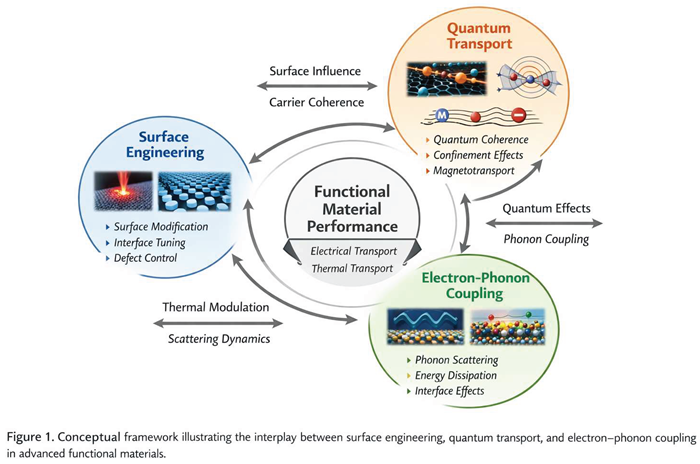
This study adopts an integrated theoretical and computational methodology to analyze the coupled influence of surface engineering, quantum transport, and electron–phonon coupling in advanced functional materials. The approach is designed to capture surface- and interface-driven modifications to electronic and phononic behaviour while remaining applicable to a broad class of low-dimensional and heterogeneous material systems.
3.1. Conceptual Framework
The methodological framework is based on the premise that surface and interface modifications simultaneously affect carrier transport regimes and interaction dynamics. Surface engineering is treated as a tunable boundary condition that alters electronic structure, phonon dispersion, and scattering mechanisms. These surface-induced changes are then examined within quantum transport and electron–phonon coupling formalisms to assess their combined impact on functional performance.
The framework integrates three interconnected components:
- (i)
- surface and interface characterization parameters,
- (ii)
- quantum transport modelling, and
- (iii)
- electron–phonon interaction analysis.
This structure enables systematic evaluation of how engineered surface features propagate through electronic and thermal transport processes.
3.2. Quantum Transport Modelling
Quantum transport is analyzed using a semi-classical to quantum transition framework, depending on the characteristic length scales of the material system. In low-dimensional regimes where phase coherence is preserved, carrier transport is described in terms of quantum confinement, transmission probabilities, and anisotropic band dispersion. Parameters such as carrier mean free path, effective mass, and density of states are treated as surface-sensitive quantities influenced by interface quality and defect distributions. Magnetotransport behaviour is incorporated to assess the influence of external fields and microstructural variations on carrier dynamics, following approaches commonly applied to metastable alloys and low-dimensional conductors. This allows evaluation of surface-induced scattering effects and critical transport behaviour under varying boundary conditions.
3.3. Electron–Phonon Coupling Analysis
Electron–phonon interactions are examined by considering energy exchange mechanisms between charge carriers and lattice vibrations under both equilibrium and nonequilibrium conditions. The coupling strength is evaluated in relation to phonon dispersion characteristics, dimensional confinement, and interfacial phonon mismatch. Particular attention is given to anisotropic materials, where coupling behaviour may vary strongly with crystallographic direction. Interface effects are incorporated by introducing modified phonon transmission and reflection conditions at material boundaries. This approach enables analysis of how surface roughness, interfacial bonding, and structural discontinuities influence thermal transport and carrier energy relaxation. Such treatment is essential for capturing non-classical thermal behaviour observed in low-dimensional and heterostructured systems.
3.4. Surface and Interface Parameterization
Surface engineering effects are represented through parameterized descriptions of surface morphology, defect density, and interface roughness. These parameters are systematically varied to evaluate their influence on both quantum transport and electron–phonon coupling. Laser-induced surface structuring, atomic-scale interface control, and crystallographic continuity are considered as representative surface engineering strategies. Interface morphology is further characterized through effective roughness descriptors, enabling assessment of scattering-induced deviations from ideal transport behaviour. This parameterization allows direct comparison between idealized and realistic material conditions.
3.5. Analysis Strategy
The analysis proceeds in three stages. First, baseline transport behaviour is established for idealized surfaces and interfaces. Second, surface and interface parameters are introduced incrementally to evaluate their individual influence on quantum transport and electron–phonon coupling. Finally, coupled effects are analyzed to identify synergistic or competing interactions between surface engineering and transport mechanisms. Comparative analysis is employed to identify dominant factors governing transport performance and energy dissipation. This strategy facilitates the identification of design-relevant surface characteristics that optimize functional behaviour in advanced materials. This methodology provides a unified platform for examining how surface engineering governs quantum transport and electron–phonon interaction processes. By integrating these elements within a single framework, the approach supports systematic interpretation of coupled transport phenomena and establishes a foundation for the results and discussion presented in subsequent sections.
4. Results
The results presented in this section describe the conceptual outcomes derived from the integrated framework linking surface engineering, quantum transport, and electron–phonon coupling. Rather than numerical values, emphasis is placed on identifying dominant trends, interaction regimes, and qualitative dependencies that govern functional material performance.
4.1. Influence of Surface Engineering on Transport Behavior
The analysis indicates that surface engineering exerts a strong and multifaceted influence on carrier transport characteristics. Modifications in surface morphology and interface quality are found to directly affect carrier scattering rates and transport regimes. Smooth, well-ordered surfaces promote quasi-ballistic or coherent transport, whereas increased surface roughness and defect density lead to enhanced scattering and a transition toward diffusive transport behavior. Surface-induced changes also influence carrier confinement and transmission probabilities, particularly in low-dimensional systems. Engineered surfaces that preserve crystallographic continuity and minimize defect states support extended carrier coherence lengths, thereby enhancing transport efficiency. In contrast, poorly controlled surface features introduce localized states that disrupt coherent transport and reduce effective mobility.
4.2. Quantum Transport Regimes and Surface Sensitivity
Distinct transport regimes emerge depending on the interplay between material dimensionality and surface condition. In regimes dominated by quantum confinement, transport behavior exhibits strong sensitivity to surface-induced potential variations. Minor changes in surface roughness or interface symmetry result in measurable shifts in carrier pathways and transmission characteristics. Magnetotransport behavior further reflects this sensitivity, with surface disorder amplifying scattering-induced deviations from ideal transport trends. Conceptual analysis suggests that metastable and anisotropic systems are particularly susceptible to surface-driven modulation of quantum transport, as their electronic structures are inherently sensitive to boundary conditions.
4.3. Modulation of Electron–Phonon Coupling by Surface and Interfaces
The results reveal that electron–phonon coupling strength is not an intrinsic constant but is strongly influenced by surface and interface characteristics. Surface engineering alters local phonon spectra and vibrational modes, leading to modified coupling pathways between charge carriers and lattice vibrations. In low-dimensional and anisotropic materials, confinement effects amplify this sensitivity, resulting in direction-dependent energy relaxation behavior. Interfaces introduce additional phonon scattering channels, particularly when vibrational mismatches exist between adjoining materials. As a result, electron–phonon interactions at interfaces can either enhance or suppress thermal transport, depending on interface quality and structural continuity.
4.4. Coupled Effects and Emergent Transport Behavior
When surface engineering, quantum transport, and electron–phonon coupling are considered simultaneously, coupled effects emerge that are not predictable from isolated analysis. Surface-induced modifications that enhance quantum transport coherence may concurrently suppress electron–phonon scattering, leading to improved electrical conductivity but reduced thermal dissipation capacity. Conversely, surface structures designed to enhance phonon scattering for thermal management may inadvertently degrade quantum transport by increasing carrier scattering. These competing effects highlight the existence of trade-offs that must be balanced through careful surface and interface design. The conceptual framework reveals that optimal functional performance is achieved within intermediate regimes, where surface engineering strategies are tuned to balance coherent transport and controlled energy dissipation. This balance is highly material-dependent and sensitive to dimensionality, anisotropy, and interface morphology. Overall, the conceptual results demonstrate that surface engineering serves as a critical control parameter governing both quantum transport regimes and electron–phonon interaction dynamics. The observed trends underscore the necessity of treating these phenomena as interconnected processes rather than independent design variables.
5. Discussion
The conceptual results highlight the central role of surface and interface engineering in governing the coupled behaviour of quantum transport and electron–phonon interactions in advanced functional materials. Rather than acting as independent contributors, these phenomena are shown to be strongly interdependent, with surface modifications simultaneously influencing carrier coherence, scattering mechanisms, and energy relaxation pathways. One of the key insights emerging from this study is that surface engineering functions as a unifying control parameter across multiple transport regimes. In systems where quantum transport dominates, surface-induced disorder directly affects phase coherence and transmission probabilities, reinforcing the notion that quantum transport performance is inseparable from surface quality. This finding aligns with prior observations in low-dimensional and metastable systems, where transport behaviour exhibits high sensitivity to microstructural and boundary conditions. However, the present framework extends existing understanding by explicitly linking these effects to concurrent changes in electron–phonon coupling. The modulation of electron–phonon interactions through surface and interface design carries important implications for thermal management and device stability. Enhanced surface roughness and interfacial mismatch increase phonon scattering, which may be beneficial for reducing thermal conductivity in thermoelectric or thermal barrier applications. Conversely, excessive phonon scattering can accelerate energy dissipation and degrade quantum coherence, limiting performance in quantum and nanoelectronic devices. This duality highlights a fundamental trade-off between electrical and thermal transport optimization. The coupled analysis further suggests that optimal functional performance does not arise from maximizing or minimizing a single transport mechanism but from balancing competing effects through deliberate surface design. Intermediate regimes, characterized by controlled surface order and moderate phonon scattering, appear most favorable for achieving stable and efficient transport behavior. This observation provides a practical guideline for surface and interface engineering strategies, particularly in anisotropic and low-dimensional materials where small structural variations can lead to large functional changes. From a broader perspective, the findings emphasize the limitations of traditional modelling approaches that treat surface effects, quantum transport, and electron–phonon coupling independently. Such decoupled treatments risk overlooking emergent behaviour arising from their interaction, potentially leading to incomplete or misleading design conclusions. The integrated framework presented in this study addresses this limitation by offering a cohesive interpretation of how surface modifications propagate through electronic and phononic subsystems. Finally, the conceptual nature of this study positions it as a foundation for future experimental and computational investigations. While the current discussion focuses on qualitative trends, the identified coupling mechanisms provide clear direction for targeted simulations and measurements. Future work incorporating material-specific parameters and quantitative validation will further refine the framework and extend its applicability to practical device architectures.
6. Conclusion
This study has presented an integrated conceptual framework to examine the interplay between surface engineering, quantum transport, and electron–phonon coupling in advanced functional materials. By treating these phenomena as interconnected rather than independent, the work provides a unified perspective on how surface and interface modifications govern transport behavior at reduced length scales. The analysis highlights that surface engineering acts as a central control parameter influencing both carrier coherence and energy relaxation processes. Engineered surfaces and interfaces were shown to modulate quantum transport regimes by altering scattering mechanisms and boundary conditions, while simultaneously reshaping electron–phonon interactions through changes in phonon spectra and interfacial coupling. These coupled effects give rise to competing trends between electrical transport efficiency and thermal dissipation, emphasizing the need for balanced design strategies. The findings underscore the limitations of conventional approaches that isolate surface effects from transport and interaction dynamics. Instead, the results demonstrate that optimal functional performance in advanced materials emerges from carefully tuned surface and interface characteristics that reconcile quantum coherence with controlled energy dissipation. This insight is particularly relevant for low-dimensional, anisotropic, and heterostructured systems where surface sensitivity is pronounced. Although the present work is conceptual in nature, it establishes a robust foundation for future experimental and computational studies. The proposed framework can be extended to material-specific analyses, enabling quantitative evaluation of coupled transport phenomena and supporting the rational design of next-generation electronic, photonic, and energy-related devices.
Acknowledgement: The author(s) would like to acknowledge the support and resources that contributed to the completion of this study. The authors also appreciate the academic discussions and insights that helped shape the conceptual development of this work. No external funding was received specifically for this research.
References
- Bai, Z., He, D., Fu, S., Miao, Q., Liu, S., Huang, M., & Zhang, X. (2022). Recent progress in electron–phonon interaction of two-dimensional materials. Nano Select, 3(7), 1112–1122.
- Joshy, A., Wang, F., Younus, S., et al. (2025). Scalable synthesis of millimeter-long single-crystal Ta₂Ni₃Se₈ van der Waals nanowires. Scientific Reports, 15, 19535.
- Nawaz, T., Younus, S., Ahmad, S., Abuzaid, W., Boltaev, G. S., Khamis, M., Husseini, G. A., & Alnaser, A. S. (2025). Biocompatibility and drug release kinetics of TiNbZrSn femtosecond laser-induced superhydrophilic structures. Applied Surface Science Advances, 25, 100665.
- Quan, Y., Yue, S., & Liao, B. (2021). Impact of electron–phonon interaction on thermal transport: A review. Nanoscale and Microscale Thermophysical Engineering, 25(2), 73–90.
- Wang, F., Zhou, Q., Tang, H., Zhang, F., Li, Y., Sanchez, A. M., & Wei, J. (2025). Unusual electron–phonon interactions in highly anisotropic two-dimensional Ta₂Ni₃Te₅. arXiv preprint, arXiv:2506.05809.
- Wu, Z., Li, Y., Huang, D., & Tang, G. (2025). Electron–phonon coupled nonequilibrium thermal transport in Cu/GaN heterojunctions with fractal rough interfaces. Physical Review B, 112(3), 035306.
- Xu, Z., Mao, R., & Gao, P. (2026). Atomic-scale interface phonon engineering for thermal management: An electron microscopy review. Advanced Functional Materials, e26614.
- Younus, S. (2025, March). Millimeter-scale TNS nanowire growth for electronics and photonics. In Proceedings of SMT 2025.
- Younus, S., Mustafa, F., Egilmez, M., Al Awadhi, M., Abuzaid, W., El Khatib, S., Alagöz, S., & Alami, A. H. (2024). Magnetotransport and critical behavior in metastable Fe–Cu. International Journal of Modern Physics B, 38(7), 2450101.
- Zhou, Z., Yang, X., Fu, H., Wang, R., Lu, X., Wang, G., & Zhou, X. (2022). Anomalous thermal transport driven by electron–phonon coupling in two-dimensional semiconductor h-BP. Advanced Functional Materials, 32(45), 2206974.
Disclaimer/Publisher’s Note: The statements, opinions and data contained in all publications are solely those of the individual author(s) and contributor(s) and not of MDPI and/or the editor(s). MDPI and/or the editor(s) disclaim responsibility for any injury to people or property resulting from any ideas, methods, instructions or products referred to in the content. |
© 2026 by the authors. Licensee MDPI, Basel, Switzerland. This article is an open access article distributed under the terms and conditions of the Creative Commons Attribution (CC BY) license (http://creativecommons.org/licenses/by/4.0/).
Copyright: This open access article is published under a Creative Commons CC BY 4.0 license, which permit the free download, distribution, and reuse, provided that the author and preprint are cited in any reuse.


