

Submitted:
03 February 2026
Posted:
03 February 2026
You are already at the latest version
Abstract
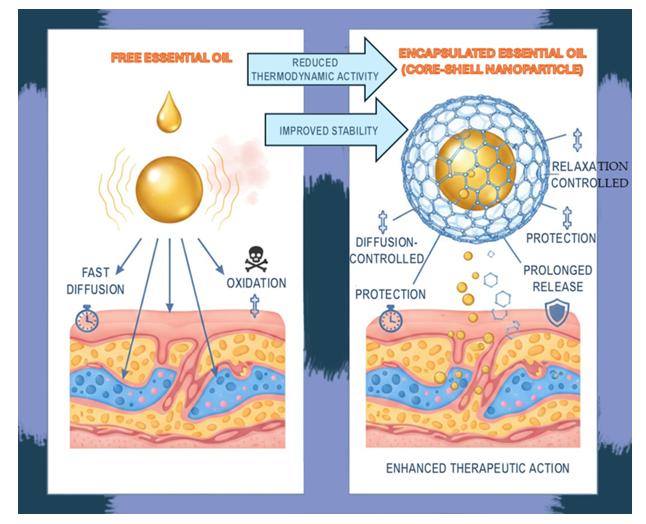
This review examines biodegradable polymer-based core–shell nanoformulations encapsulating essential oils for acne treatment through the lens of physicochemical design and controlled delivery mechanisms. Acne is a common inflammatory skin disorder closely associated with sebum overproduction and microbial imbalance, while conventional therapies, although effective, may present long-term side effects. Increasing attention has therefore turned to sustainable dermatological materials derived from eco-friendly polymers combined with naturally active compounds. Recent advances show that core–shell nanostructures fabricated from biodegradable polymers function as physicochemically engineered carriers for volatile essential oils, enhancing their stability, protecting them from premature degradation, and enabling controlled release governed by diffusion, polymer relaxation, interfacial interactions, and degradation kinetics. The review highlights how polymer chemistry, interfacial properties, particle morphology, and processing routes determine encapsulation efficiency, release profiles, and skin permeation behavior. Particular emphasis is placed on structure–property–function relationships, including mass transport phenomena, thermodynamic compatibility between polymers and essential oils, surface charge, wettability, and nanostructure architecture, which collectively influence bioavailability and therapeutic performance. By integrating concepts from polymer physical chemistry, colloid and interface science, and drug delivery kinetics, these sustainable nanoformulations emerge as promising platforms for acne and sebum control. Overall, essential oil-loaded biodegradable polymeric core–shell systems represent a sustainable and scientifically grounded approach to acne management, although further physicochemical characterization and in vivo validation are required to support clinical translation.
Keywords:
biodegradable polymers
; core/shell polymers
; eco-friendly polymers
; nanoformulations
; essential oils
; acne
; sebum
; physical chemistry
Copyright: This open access article is published under a Creative Commons CC BY 4.0 license, which permit the free download, distribution, and reuse, provided that the author and preprint are cited in any reuse.


