

Submitted:
02 February 2026
Posted:
03 February 2026
You are already at the latest version
Abstract
The left-handedness of neutrinos is an undeniable physical phenomenon. Because the first principles of the Standard Model are insufficient to explain this property, the issue is addressed through the chirality postulate, which implies that the weak interaction violates parity. While postulates are acceptable tools in a descriptive theory, they are less satisfactory in a conceptual theory that seeks to eliminate such assumptions. In this article, we show how the left-handedness of neutrinos emerges from first principles within the Structural Model of particle physics.
Keywords:
neutrino
; weak interaction
; left-handedness
; chirality
; spin
; parity violation
1. Introduction
To explain physical phenomena and the results of experiments, a theoretical framework is required. Any consistent theory is grounded in first principles, which may take the form of mathematical axioms. These axioms need not be purely algebraic; they may also be geometric in nature. The well-known Standard Model of particle physics exemplifies the algebraic approach [1], whereas the less widely known Structural Model represents a geometric approach [2]. In this article, we show that, while the phenomenon of neutrino single-handedness requires an explicit algebraic axiom within the algebraic framework, it arises naturally within the geometric approach.
In the Standard Model, single-handedness is explained through the introduction of chirality alongside helicity. This distinction is established by decomposing Dirac spinors into two components, followed by the postulate that the weak interaction couples only to one of these components [3,4]. This assumption applies both to Dirac particles within hadronic structures and to leptonic Dirac particles. As a consequence, single-handedness appears in both cases. However, because leptons are elementary particles, they form chiral eigenstates, making their single-handedness directly observable. In contrast, Dirac particles such as quarks are confined within hadronic structures, so their single-handedness is not directly observable and is instead effectively masked.
Encoding an empirical fact—such as the left-handedness of neutrinos—into a theory through a postulate is a common practice in descriptive models. When a phenomenon cannot be derived from first principles, the introduction of a postulate is often sufficient to restore the theory’s internal consistency. Such postulates have contributed significantly to the Standard Model’s reputation as one of the most successful scientific theories ever developed [5,6]. Some postulates are supported by clear physical interpretations, while others, despite their empirical effectiveness, may appear artificial. The chirality postulate belongs to this latter category.
A well-known example of a counterintuitive phenomenon is provided by the classic 1957 experiment of Chien-Shiung Wu on beta decay in cobalt-60 [7]. Her experiment, illustrated in Figure 1, was designed to test the doubts raised by Tsung-Dao Lee and Chen-Ning Yang concerning parity conservation in weak interactions [8]. When the spins of the cobalt nuclei are unpolarized, the emitted electrons are distributed isotropically. Upon polarization of the nuclei, one would naively expect symmetric emission in opposite directions. Instead, one direction is clearly preferred. Moreover, reversing the polarity of the applied magnetic field reverses the preferred direction of the emitted electrons as well.
Since then, the sensitivity of emission directionality to the polarization of the nuclear spin by the external magnetic field B has been regarded as compelling evidence for parity violation in the weak interaction. Whereas the other three fundamental forces—gravity, electromagnetism, and the strong interaction—are isotropic, the weak interaction appears to exhibit a preferred direction. When the Standard Model was formulated in the 1970s, this phenomenon was accepted as an intrinsic property of nature and formally incorporated through the concept of chirality. However, the deeper question of why nature exhibits such directional preference has remained unanswered and has instead been treated as an unquestioned empirical fact.
2. Why the Weak Interaction Differs from the Other Fundamental Forces
As noted earlier, the use of postulates is an effective tool for providing descriptive theories with adequate mathematical representations of empirical physical phenomena. The discussion of parity violation in weak interactions illustrates this approach. Unlike electromagnetism and gravitation, the weak and strong interactions are treated within the Standard Model primarily as empirical phenomena, without a fully intuitive physical interpretation. Consequently, they are formulated through postulates that specify their mathematical structure [9]. These two forces are described in terms of algebraically constructed gauge fields, to which interaction-sensitive particles couple through specific coupling constants, typically determined by experimental curve fitting. As a result, understanding weak and strong interactions within this framework largely involves algebraic evaluation based on abstract mathematical assumptions.
In the Structural Model, the strong force is described in terms of a shielded Maxwell-type field generated by monopole sources, analogous in form to the classical fields of gravitation and electromagnetism. Quarks are treated as monopoles and modeled as Dirac particles. However, unlike electrons, which possess one real and one imaginary dipole moment, quarks are characterized by two real dipole moments. One corresponds to angular momentum (spin), while the other is non-angular and associated with isospin [10,11]. Over the years, the author has developed a consistent theoretical framework based on these principles. A brief summary relevant to the discussion of parity will be presented in the following section.
The essential feature that distinguishes the weak interaction from the other three fundamental forces lies in the nature of its field. Whereas gravitation, electromagnetism, and the strong interaction are associated with monopole fields, the weak interaction is characterized by a dipole field. This dipolar structure breaks the spatial isotropy inherent in monopole fields and provides a natural explanation for the distinctive symmetry properties of the weak interaction.
3. Left-Handedness in the Structural Model
Within the Structural Model, the left-handedness of neutrinos can be explained through a detailed structural analysis. As a preliminary step toward understanding the results of the Wu experiment at the baryonic level, it is instructive to first consider the mesonic level.
3.1. At the Meson Level
Let us consider the decay of a pion into a muon and a muon neutrino. Denoting the momenta of the pion, muon, and neutrino by , , and , respectively, and their corresponding relativistic energies by , , and , conservation of momentum yields
while conservation of energy implies
In the classical approach, it is commonly assumed that , which reduces the momentum relation to [12]
However, there is no compelling physical justification for this assumption. As shown in the non-classical analysis of [13], there are strong arguments in favor of adopting instead. The spatial spread of the leptons governed by the parameter is reflected in Fermi’s energy distribution between electrons and (anti)neutrinos. When , the (anti)neutrino carries most of the energy, whereas for the electron dominates the energy distribution [14,15]. In both cases, the dominant momentum component is aligned with the momentum of the parent boson. In beta decay, electrons dominate statistically, implying that their momentum tends to follow the boson’s direction. The same behavior is observed for muons produced in pion decay.
We now examine more closely the relationship between the momenta of the pion and the muon. Figure 2 illustrates the Structural Model of the pion developed in [2]. The upper part of the figure shows a quark–antiquark system stabilized by two nuclear monopole forces and two sets of dipole moments. The quarks are modeled as Dirac particles endowed with two real dipole moments, represented by specific gamma matrices. The vertical dipole corresponds to the analogue of the magnetic dipole moment of the electron, while the horizontal dipole is the real counterpart of the electron’s imaginary electric dipole moment [10,11].
Subsequent work showed that this structure admits a Maxwellian interpretation, allowing quarks to be described as magnetic monopoles within Comay’s Regular Charge Monopole Theory (RCMT) [16,17]. In this framework, the second dipole moment of the quark coincides with the magnetic dipole moment of an electric kernel, providing a physical explanation for electric charge.
This description permits the nuclear force to be interpreted as the origin of both baryonic mass and electric charge, through the ground-state energy of an anharmonic oscillator. As shown in Figure 2, two configurations are possible, corresponding to negative and positive pions. The distinction arises from the polarity of the non-angular dipole moments.
When one quark is transformed into its antiparticle state, stability is preserved by a simultaneous reversal of its non-angular dipole moment. Under this transformation, a pion is converted into a muon or an anti-muon. The two resulting configurations are shown in the lower part of Figure 2. A negative pion can produce only a muon, whereas a positive pion can produce only an anti-muon. By adopting the configuration in which both quarks are in particle states as the reference for the muon, all ambiguities are removed, since horizontal interchanges have no physical consequence. At first sight, assigning a fermionic character to the muon may appear to conflict with the conventional distinction between bosons and fermions based on spin counting. This apparent paradox is resolved by recognizing that the muon bond is an anyonic bond [18]. In such a bond, one particle cannot rotate around the other without altering the system’s properties. This makes the bond fundamentally different from bosonic diquark bonds, such as Cooper pairs, or from unstable electron pairs stabilized by magnetic interactions [19]. Anyonic bonds allow half-integer spin states, whereas bosonic bonds permit only integer spins. Consequently, charged leptons can be interpreted as anyonic bound states of (anti)quarks.
Having identified the muon as an anyonic bound state, we now address the assignment of its spin state. Because the (magnetic) angular dipole moments of the electric kernels in the pion correspond to the (magnetic) non-angular dipole moments of the quarks, the muon’s spin orientation is not arbitrary. The momentum of the pion and the spin of the resulting muon are directionally correlated. It is one of the two: either the spin of the muon is opposite to the momentum of the W boson or it is aligned. But one of these possibilties is excluded. Once free, the muon’s spin can be altered by external magnetic fields. In contrast, the accompanying (anti)neutrino, being electrically neutral, remains permanently in its original spin state. This property applies to all neutrino species. The only question is whether the spin of the neutrinos is opposite or aligned with their momentum. One of the two options is excluded by theory. Neutrinos are single-handed. Left or right has to be found from deeper analysis or by experiment.
Experimental evidence from beta decay at the baryonic level shows that the electron’s spin projection is opposite to its momentum. Consequently, the associated antineutrino has its spin aligned with its momentum.
It follows that neutrinos, in general,
- have spin opposite to their momentum,
- possess negative helicity,
- are left-handed.
This property arises from the physical identification of the non-angular dipole moment of quarks with the angular dipole moment of charged kernels. It provides a concrete interpretation of chirality. Chirality corresponds to the decomposition of the Dirac spinor into two independent components. Both charged leptons (electrons, muons, tauons) and neutral leptons (neutrinos and antineutrinos) are Dirac particles and are therefore intrinsically chiral. The weak interaction postulate that only one chiral component participates implies that neutrinos are left-chiral. Within the Structural Model, however, chirality has a deeper physical meaning: it reflects the structural origin of electric charge and marks a fundamental asymmetry in the formation of matter.
3.2. At the Baryon Level
As noted earlier, the analysis of pion decay into a muon and a muon antineutrino serves as a stepping stone toward understanding electron production in beta decay. While pion decay represents the archetypal process for muon generation, the corresponding archetype for electron production is neutron decay,
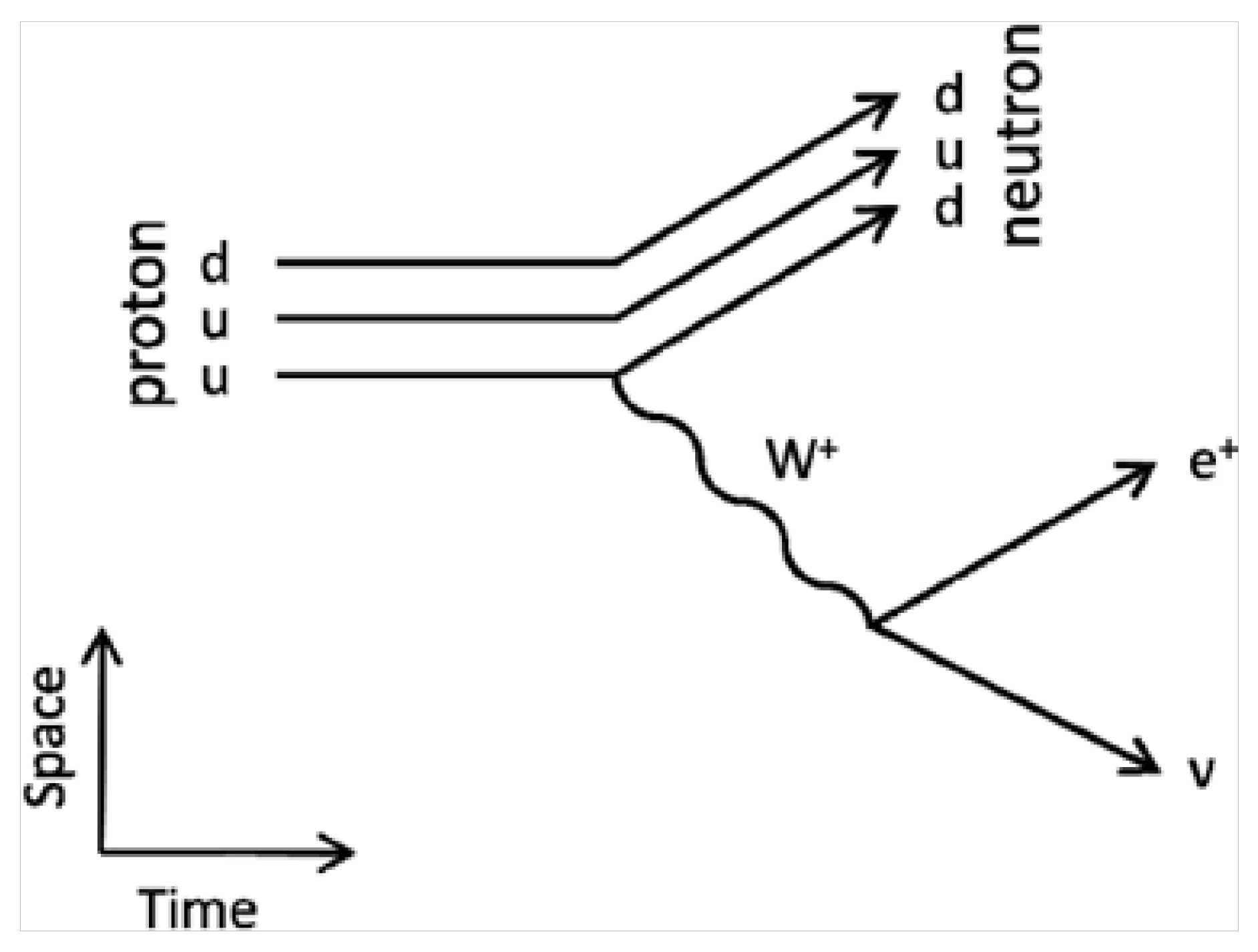
This process is commonly represented schematically, as shown in Figure 3. The diagram illustrates how, through the emission of an electron and its antineutrino, the internal structure of the neutron is transformed into that of a proton. Fundamentally, this transformation results from an isospin flip of a d quark into a u quark. Within the Standard Model, this transition is mediated by a W boson. In the Structural Model, however, it is shown [20] that this intra-nucleon boson exists in a virtual state, distinct from the free W boson with mass , which may be interpreted as the relativistic manifestation of the pion’s rest mass. This interpretation allows neutron decay to be viewed as a process analogous to pion decay, with the distinction that the former is mediated by a virtual W boson.
The virtual W boson possesses the same internal structure as a free W boson; the essential difference lies in the magnitude of its source strength. To clarify this point, we briefly summarize the properties of the W boson within the Structural Model. As documented in [2,20], quarks are characterized by a potential function which, under confinement, may be approximated in one dimension by
The exponential term models the screening effect of the omnipresent background energy, identified in the Standard Model with the Higgs field, where . The variable x is normalized such that the physical coordinate is . The reciprocal quadratic term represents the field of a dipole moment, which is imaginary in Dirac’s original theory but real in its generalized formulation [13]. The reciprocal linear term corresponds to the classical monopole field. The gyrometric factor quantifies the balance between dipole and monopole interactions. Two such quarks form an anharmonic quantum oscillator describing a meson.
In the Structural Model, the muon is also described as an anharmonic oscillator. Unlike the pion, its field is unscreened, since the vacuum is transparent to electromagnetism. Two kernels form an anyonic bond with potential
The algebraic difference between these two potentials (5) and (6) defines the kernel structure of the muon neutrino.
This framework can be extended to nucleons. In the Structural Model, nucleons possess a triangular configuration. The proton’s triangular structure has a slightly larger perimeter than that of the neutron due to the distribution of electric charge associated with isospin. This difference allows one to compute distinct gyrometric factors for the effective one-body oscillators representing the proton and neutron. Following the same reasoning as for pion decay, the one-body component of the virtual W boson is given by
Two such components combine to form the virtual boson. The strengths and and the gyrometric factors and differ only slightly. Defining
we obtain
Apart from the scaling factor , this expression closely resembles the muon kernel in Eq. (6). Since , the two models are nearly identical. This enables the construction of a harmonic oscillator model for the virtual W boson,
Readers familiar with [20] will recognize this equation as analogous to the neutrino mass equation, differing only in scale. The coupling constant is defined as
At the minimum-energy configuration ,
For the present discussion, further details are unnecessary. The essential point is that the potential has the same form as that of a free W boson, but with a much smaller strength. The boson emitted in neutron decay is therefore a weakW boson.
4. Interpretation of Wu’s Experiment
We now apply this model to Wu’s experiment. In cobalt nuclei, an external magnetic field aligns the nuclear spins, thereby orienting the triangular nucleon structures in a common direction. As a result, weak W bosons are emitted in a uniform manner. By symmetry, these bosons are ejected orthogonally to the triangular plane from the center of mass. The meson-level analysis has shown that the electron spin has an unambiguous orientation with respect to the boson momentum. Furthermore, the electron momentum follows the direction of the emitted weak W boson. Thus, as at the meson level, two possibilities exist: electron spins may be aligned with or opposite to their momentum. One of these possibilities is excluded by theory. Measurements show that in beta decay the electron spin is opposite to its momentum. Combined with the preceding analysis, this result establishes that neutrinos are left-handed.
Finally, it should be emphasized that the external magnetic field in Wu’s experiment plays only an auxiliary role. It does not exchange energy with the emitted electrons. Its sole function is to align the nuclear spins, thereby rendering the weak interaction mechanism observable.
5. Conclusions
This study has shown that, whereas in the Standard Model the not fully understood parity violation of the weak interaction is described by the algebraic postulate of selective chirality, the Structural Model explains it as a physical consequence of the real non-angular dipole moment of the quark-type Dirac particle, associated with modified gamma matrices. The underlying mechanism is the equivalence between the non-angular dipole moment in weak interactions and the angular dipole moment in electromagnetic interactions.
Previous work has demonstrated how the 0.511 MeV/ mass of the electron emerges from this same framework, and how the neutrino rest mass can be predicted and verified to be approximately 80 meV/. Moreover, this approach has led to further developments, including the establishment of a connection with gravity by expressing the gravitational constant in terms of quantum-mechanical parameters.
Taken together, the results presented here further demonstrate the conceptual coherence and viability of the Structural Model of particle physics. [2].
References
- Cottingham, W.M.; Greenwood, D.A. An Introduction to the Standard Model of Particle Physics; Cambridge University Press, 2012. [Google Scholar]
- Roza, E. Introduction to the Structural Model of particle physics; Kindle Books, 2025; ISBN 978-90-90401-461. [Google Scholar]
- Lee, T.D.; Yang, C. N. Parity Noncerservation and a two-component theory of the neutrino. Phys. Rev. 1957, 105, 1671. [Google Scholar] [CrossRef]
- Feynman, R.; Gell-Mann, M. 1958: Theory of the Fermi Interaction. Phys. Rev. 109, 193. [CrossRef]
- Available online: https://www.quantamagazine.org/videos/the-standard-model-the-most-successful-scientific-theory-ever/.
- Oerter. R 2006: The most succesful theory of almost everything; Plume E-book 9781101126745.
- Wu, C.S; Ambler, E; Hayward, R.W; et al. Experimental test of parity conservation in beta decay. Phys. Rev 1957, 105(4), 1413. [Google Scholar] [CrossRef]
- Lee, T.D; Yang, C.N. 1956: Question of parity conservation in weak interactions. Phys. Rev. 104(1), 254. [CrossRef]
- Yang, C.N.; Mills, R.L. 1954: Conservation of Isotopic Spin and Isotopic Gauge Invariance. Phys. Rev. 96.
- Roza, E. On the second dipole moment of Dirac’s particle. Found. of Phys. 2020, 50(8), 828–849. [Google Scholar] [CrossRef]
- Roza, E. On the second dipole moment of Dirac’s particle. 2021. Available online: www.preprints.org.
- Energetics of pion decay. http:hyperphysics.phy-astr.gsu.edu/hbase/Particles/piondec.html.
- Roza, E. On the mass of neutrinos in flavour state. www.preprints.org. 2025. [CrossRef]
- Fermi, E. 1934: Versuch einer Theorie der Beta- strahlen I. Zetschrift fur Physik 88, 161. [CrossRef]
- Griffiths, D. Introduction to elementary particles; John Wiley an Sons, 2008; p. 309. [Google Scholar]
- Comay, E. Comments on the charge-monopole canonical formalism. Lett. Nuovo Cimento 1985, 80B, 159. [Google Scholar] [CrossRef]
- Comay, E. Charge, monopoles and duality relations. Lett. Nuovo Cimento 1995, 110B, 1347. [Google Scholar] [CrossRef]
- Stern, A. Anyons and the quantum Hall effect — A pedagogical review”. Annals of Physics 2008, 323(1), 204–249. [Google Scholar] [CrossRef]
- Mikhailichenko, A.A. To the possibiiity of bound states between two electrons. Proc. IPAC2012, New Orleans, Louisiana, USA, 2012; p. 2792. [Google Scholar]
- Roza, E. The prediction and the verification of neutrino masses. www. preprints.org. 2026. [CrossRef]
Figure 1.
Madame Wu’s proof to demonstrate the parity violation of weak interaction. If the polarity of the magnetic field (an axial vector) is reversed, the polarity of the electron beam (momentum vector) is reversed as well, while parity imposes that axial vectors cannot change the polarity of momentum vectors. Source: http://hyperphysics.phy-astr.gsu.edu/hbase/quantum/parity.html.
Figure 1.
Madame Wu’s proof to demonstrate the parity violation of weak interaction. If the polarity of the magnetic field (an axial vector) is reversed, the polarity of the electron beam (momentum vector) is reversed as well, while parity imposes that axial vectors cannot change the polarity of momentum vectors. Source: http://hyperphysics.phy-astr.gsu.edu/hbase/quantum/parity.html.
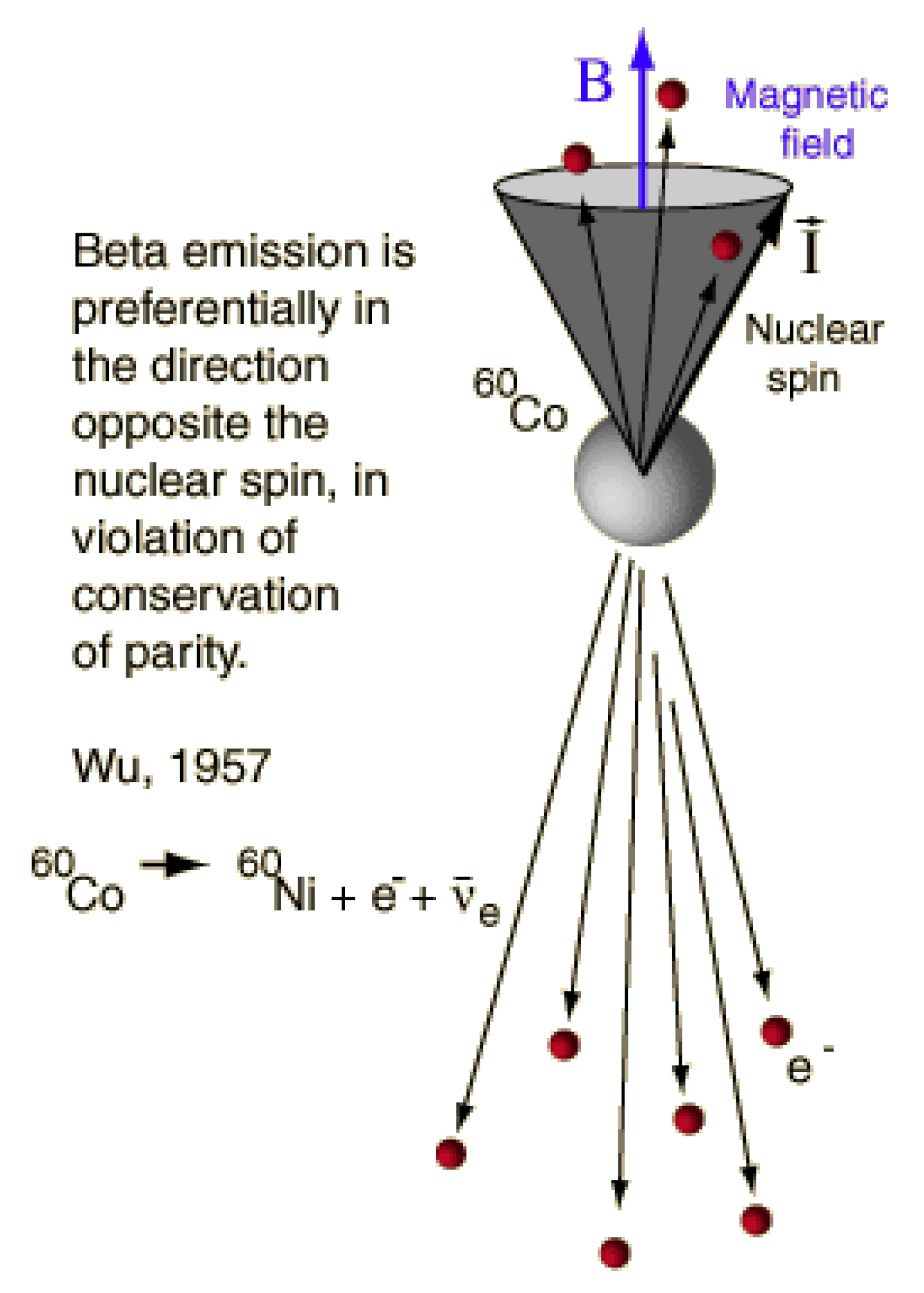
Figure 2.
Structural model of pions and (anti)muons. Defining the two-particle configuration as a reference state for the muon removes ambiguities in the description. Interchanging the horizontal positions of the particles has no physical effect.
Figure 2.
Structural model of pions and (anti)muons. Defining the two-particle configuration as a reference state for the muon removes ambiguities in the description. Interchanging the horizontal positions of the particles has no physical effect.
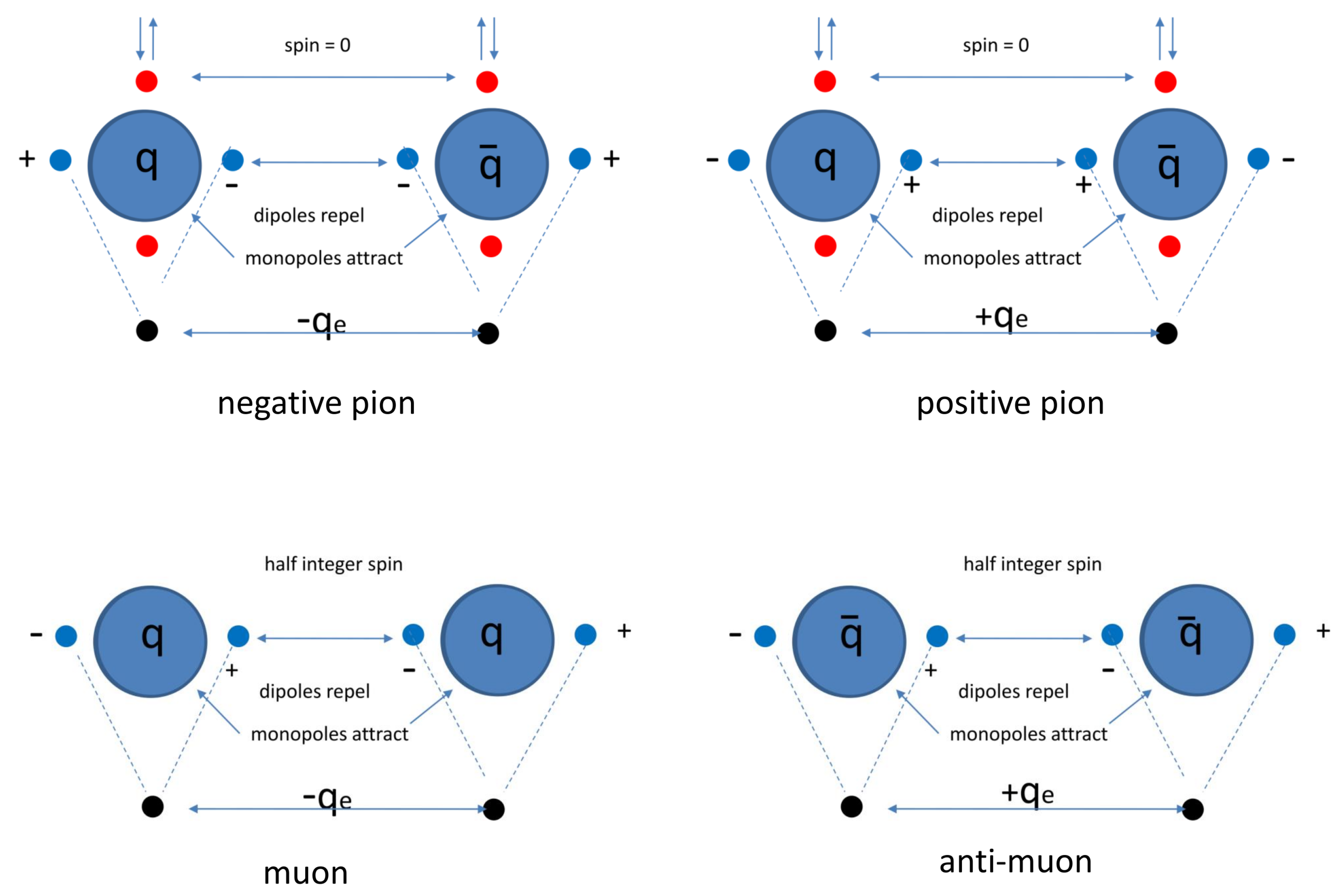
Figure 3.
Neutron decay into a proton through an isospin flip.
Disclaimer/Publisher’s Note: The statements, opinions and data contained in all publications are solely those of the individual author(s) and contributor(s) and not of MDPI and/or the editor(s). MDPI and/or the editor(s) disclaim responsibility for any injury to people or property resulting from any ideas, methods, instructions or products referred to in the content. |
© 2026 by the author. Licensee MDPI, Basel, Switzerland. This article is an open access article distributed under the terms and conditions of the Creative Commons Attribution (CC BY) license (http://creativecommons.org/licenses/by/4.0/).
Copyright: This open access article is published under a Creative Commons CC BY 4.0 license, which permit the free download, distribution, and reuse, provided that the author and preprint are cited in any reuse.


