

Submitted:
02 February 2026
Posted:
03 February 2026
You are already at the latest version
Abstract
Rising damp is one of the most common problems affecting older buildings. This phenomenon also leads to material degradation, reduced indoor air quality, increased energy consumption, and possible respiratory diseases in people who are exposed to such an environment for long periods of time. This article presents the results of long-term research focused on assessing the effectiveness of undercutting masonry as a remediation measure against rising damp. The moisture condition of the structure was monitored for several years at several designated locations, both before and after remediation. The results obtained show a gradual but permanent reduction in moisture. This fact confirms the high effectiveness of the proposed remediation technology. The study further discusses the consequences of possible residual moisture for the possibility of subsequent application of thermal insulation. It pays particular attention to the limitations of some contact insulation systems and the potential of active thermal protection as a possible alternative approach. This proposal is identified as a promising strategy for improving the thermal and moisture properties of the structure.
Keywords:
rising damp
; moisture
; active thermal protection moisture remediation
; case study
1. Introduction
Many buildings gradually deteriorate as a result of aging structures and inappropriate or neglected maintenance, which can lead to their partial or complete destruction. For this reason, it is often necessary to carry out repeated renovation work using various construction technologies and rehabilitation procedures. As in other areas of building restoration, the development of construction technologies and building products has had a significant impact on the restoration of damp structures. Many of these solutions are based on historically proven principles which, in combination with modern materials, procedures and application technologies, enable significantly positive and long-term sustainable results to be achieved. Their effect is not only to stop the process of masonry dampness, but also to limit or completely eliminate the destructive effects of the crystallization of water-soluble salts, which are transported in structures along with moisture.
Currently, many buildings face the problem of unwanted moisture penetration into masonry. There are several causes for this phenomenon, which in practice are often incorrectly simplified to the absence of water insulation. However, it should be emphasized that various forms of moisture protection have been widely used in the past. These included clays backfill, drainage systems to lower the groundwater level, asphalt coatings, and brickwork using sharply fired, low-absorbent bricks. However, these systems have deteriorated over time, lost their functionality, or required regular maintenance that was not provided. For this reason, it can be observed today that a significant proportion of historic and newer buildings are affected by various forms of unwanted moisture. The consequences are not only damage to masonry and surface layers, but also increased heat loss and deterioration of the indoor environment, which can lead to health problems for residents. From this point of view, it is appropriate to use the term remediation, derived from the Latin word sanus (healthy), which captures the complex nature of interventions aimed at restoring the functionality and hygienic safety of buildings.
The presence of water in building structures is one of the most significant and widespread problems affecting older buildings, not only in our climate zone, but also on a global scale[1,2,3,4,5,6].
As an example, approximately half of the renovation work on old buildings in Belgium is related to high humidity and salt contamination of masonry [7]. The origin of moisture can be attributed to several factors, including accidental failures of water and sewage pipes, damage to rain gutters and roof structures, water vapor condensation, diffusion, absorption, material absorbency, and capillary rise. Moisture significantly threatens the preservation and functionality of structures, as it reduces the mechanical properties of masonry, promotes biological degradation, cyclic freezing and thawing of materials, and salt migration with subsequent crystallization. At the same time, it increases the thermal conductivity of structures, resulting in increased energy consumption for heating.
As early as the end of the 19th century, H. R. Kenwood pointed out in his 1892 work [8] the negative impact of a damp indoor environment on the health of residents and its connection to the occurrence of various diseases. However, this fact remained underestimated for a long time. It was not until the adoption of the Construction Products Directive by the European Council in 1989 that the requirement for the absence of excessive moisture in masonry was officially defined as a basic condition for the hygiene and health safety of buildings [9].
Rising damp is one of the most common and technically challenging problems in older masonry buildings. It is characterized by the capillary transport of water from the subsoil into porous building materials above ground level, a phenomenon that was described in the past by Laplace and Jurin and analyzed in detail in current literature [7]. Rising damp occurs mainly in cases where masonry comes into direct contact with damp soil [10] and there is no functional horizontal waterproofing, or the original insulation has lost its effectiveness. The interconnected network of pores in the masonry acts as a capillary system that allows water to be transported against the direction of gravity [11]. It is therefore important to focus on systematic solutions to this problem [12]. The height of rising damp depends on the complex interaction of several factors, such as the size and distribution of pores, the surface tension of water, and the rate of evaporation from the surface of the masonry, and individual visible traces of moisture may vary [13,14,15]. The effects of rising damp are varied and include the formation of damp patches, salt efflorescence, degradation of plaster, peeling paint, and deterioration of joint mortar. These defects pose a serious threat, especially to historic masonry structures, but also to older residential buildings, as evidenced by laboratory research on the effects of moisture on structures [16], or laboratory research on models of brick masonry exposed to capillary rising damp [17,18]. Since it is clear that a humid environment promotes the growth of mould, fungi and other microorganisms that negatively affect indoor air quality and the health of users [19], it is essential to address the problem of rising damp. Despite the seriousness of these problems, the issue of dehumidification methods for older structures is still relatively narrowly addressed in the international context. The number of professional publications focused on evaluating the effectiveness of remediation technologies is significantly lower compared to literature devoted to the mechanisms of moisture formation themselves. This situation contributes to the spread of inaccurate, unverified, or even ineffective solutions in practice that are not supported by systematic research and can be caused by several variables. The lack or complete absence of any technical or technological records about the examined object that would capture its original condition at the start of the research. Older masonry is a heterogeneous composite of stone, brick, and various binders, which makes it impossible to achieve exact repeatability of measurements. This material variability means that the results of remediation methods from one building are difficult to transfer to another object. The creation of a universal methodology therefore requires a large number of samples, which makes the research logistically and methodologically extremely demanding. Another variable is that moisture transport in massive structures is very slow, and the real effect of remediation often only becomes apparent after long time, which complicates data collection. Serious research requires long -term studies that would eliminate seasonal influences and fluctuations.
New modern technologies, technological processes, methods, and materials could be beneficial in addressing the issue at hand. Progressive technologies are increasingly used in construction practice, and in the case of 3D laser scanning and photogrammetry in older buildings, which are geometrically inconsistent, they can provide effective and accurate recording of the existing conditions of the object as a starting point for research work [20,21,22]. Technologies such as microwave sensory technology and resistance multi-electrode tomography allow the distribution of moisture in masonry to be mapped without invasive interventions [23]. Modern construction methods use materials with controlled porosity and modified diffusion properties. During remediation remediation plaster systems are applied to optimize the evaporation capacity of the structure, thereby preparing the structure for the integration of new technical and technological systems [24]. One of these modern systems that can improve a building in the long term is Active Thermal Protection (ATP). Unlike passive insulation, ATP works with dynamic control of the temperature gradient in the structure. Precise diagnostics and digital recording of the actual condition (obtained using modern methods in the absence of documentation) are essential prerequisites for the correct dimensioning of ATP. This system is not only a thermal barrier, but also an active remediation element that stabilizes the moisture condition of the structure in real time.
This paper focuses on building defects caused by rising damp and analyzes selected remediation measures designed to eliminate it. The article includes results obtained from in situ research, which allow for an objective assessment of the effectiveness of the applied technologies. At the same time, the article discusses the possibility of linking remediation measures through the integration of active thermal protection (ATP) elements, which can significantly complement the improvement of the indoor environment. Significant progress has been made in this area in recent years, as documented by several studies, such as the Solinterra system developed on the basis of principles already used in ancient architecture [25], as well as modern systems of pipe-integrated walls for heating and cooling buildings [26,27]. The combination of renovation technologies with energy-active structures thus represents a progressive approach to the sustainable renovation of older buildings, as demonstrated by other research addressing the use and design of green roofs to improve the thermotechnical condition of older renovated buildings [28].
2. General Description of Remediation Technologies with Emphasis on the Technology Under Investigation In Situ Research
There are several technologies available for solving problems with rising damp. Individual technologies are implemented in various ways, either invasively or non-invasively. When selecting these technologies, several factors play a role in helping to achieve the functionality of the technology [29]. When making your selection, it is therefore necessary to analyze and take into account several factors, such as:
- Access to the structure to be remediated,
- Possible structural disruption (excavation, shocks, vibrations, etc.),
- Size of the work area,
- Financial costs,
- Salinity and pH, which may also limit some technologies.
That is why it is important to pay attention to the classification of individual technologies. There are several classifications, and many publications classify technologies differently. In 1977, Sharpe described the classification of remediation technologies in his publication [30] as traditional and non-traditional. He included technologies that provide an additional insulating layer in the first group. Injection and electro-osmotic systems were classified as non-traditional methods.
A second example of a description of division could be a publication based on the EMERISDA project [31], which divides remediation methods into two main categories. This division is illustrated in Figure 1.
This classification is mentioned in several foreign publications, but it has not been possible to determine the basis on which the technologies were divided into these groups.
Another classification of these technologies is according to the publication [32]. The author divides remediation technologies into seven main groups according to their structural-physical and implementation aspects:
- Technologies ensuring ventilation;
- Technologies for creating additional impermeable layers;
- Technologies for creating crystalline screens;
- Technologies using electro-physical principles;
- Technologies for heating structures;
- Supplementary technologies;
- Related technologies.
At the same time, this division (Figure 2) is supported by divisions within Czech professional literature [29], which divides these methods into direct and indirect methods. Direct methods include those belonging to the first six main groups described below. Indirect methods include group no. 7. Related technologies.
Technology Used in the Case Study
As mentioned above, there are a number of remediation technologies, the implementation and use of which vary. This publication will focus exclusively on evaluating the effectiveness of the undercutting technology used in the examined building.
The principle of this technology consists in gradual, step-by-step cutting of masonry in working sections ideally 0.3 to 0.5 meters long. The cut joint is then cleaned for optimal insertion of additional insulation. After cleaning, a waterproofing layer is inserted and the gap is wedged to prevent possible settling. After wedging, the next section is carried out. This procedure is repeated across the entire area, and it is necessary to ensure that the individual waterproofing strips overlap. This overlap should be approximately 5-10 cm. PVC pipes are then installed in the structure, and the surface is sealed with mortar. Once the mortar has hardened, the joint is filled with expansion mortar.
The advantage of this technology is that current technological capabilities have enabled the application of this method to a wide range of masonry, including brick, stone, and mixed masonry, even in structures of varying thicknesses. The effectiveness of this technology has been confirmed by several scientific studies, including previous research by the authors, as well as various international publications. An example is the published research documenting the use of masonry undercutting technology on the Pristina University building [33]. Another example is the study [34], describing the use of undercutting technology on a building in the Serbian city of Zrenjanin. The authors state that the technology used can be considered effective with 100% elimination of rising damp, as the technology ensures that all horizontal walls are cut as low as possible from the floor. The authors justify the use of this technology due to high moisture levels, which required effective and radical intervention. At the same time, they consider this technology to be fast, effective, and economically advantageous. This statement can be followed up with Schmidt's statement, which describes undercutting technology in detail in his publication [35] and characterizes it as an invasive and economically more demanding intervention, but with the significant advantage of rapid onset of action and a high degree of reliability.
Despite these positive characteristics, it is essential to pay attention to the importance of professional implementation, as incorrect application can lead to a reduction or complete loss of the functionality of the remediation measure [36]. For the reasons mentioned above, undercutting technology can be considered a globally widespread method for dealing with rising damp.
3. Methodology
The research methodology consisted of a series of sequential steps. The first step was to analyze the available literature, which helped to create a general overview. This was followed by a description of the issue and in situ research. The first step in the case study was to inspect the building under examination. During this inspection, the actual condition was assessed, which served as a basis for determining the exact measurement points. This process is not a standard step, but during the inspection it was found that the project documentation for the building under investigation was missing and that it would be necessary to mark the exact measurement points in order to ensure objective measurement results. At the same time, the locations for future moisture measurements were also determined during the initial inspection. These locations were marked on a sketch, which was later processed into a floor plan (Figure 3). As part of the research, measurements were always taken at the marked locations (at two research levels) and the values were recorded in a table.
A set of moisture meters listed in Table 1 was used to examine moisture.
These devices were used to take measurements at each point, which were then evaluated and recorded. The purpose of taking measurements with multiple devices was to eliminate measurement inaccuracies that occur when using only one device and possible errors caused by conditions. These values were then assessed according to the Czech standard ČSN P 73 0610 [37] (Table 2).
Based on the initial measurements, a suitable remediation was also proposed. In the case of this research, this is the undercutting technology described above. After implementing this technology, measurements were taken again and the individual values were recorded. Based on these values, the effectiveness of the technology used and the current moisture condition of the examined building were evaluated.
4. Results of In Situ Research
4.1. Description of the Examined Building
The building that was examined in situ as part of this case study can be defined as a family house intended for permanent residence. For this reason, it was necessary to solve the problem of rising damp in order to optimize the indoor environment and then theoretically propose the application of active thermal protection as a possible addition to improve the indoor environment of the examined building.
From a structural point of view, the building under examination can be classified as a single-storey building with a gable roof and an area of approximately 120 m2. The perimeter shell consisted of a load-bearing brick structure without thermal insulation with a plaster finish. The surrounding buildings are 5.5 meters on the west side and 5.0 meters on the east side. However, the building is located several dozen meters from a larger watercourse, which may result in fluctuations in the groundwater level and thus also in the degree of moisture in individual periods in places where the waterproofing layer is not functioning.
4.2. Result of the Measurements
During the initial inspection and preliminary test measurements, high moisture levels were confirmed just below floor level. At the same time, the measured moisture levels decreased towards higher areas, thus ruling out the possibility of water vapor condensation. Actions were planned based on results of the inspection. Specifically, the use of undercutting technology was chosen to radically prevent rising damp. During the initial inspection, measurement points were marked, which are shown in Figure 3 as P1, P2, P3, etc...
Moisture was monitored at the above-marked locations before and after the application of the planned remediation. The individual values were recorded in tables for heights up to 30 cm from the floor (Table 4) and for heights 150 cm from the floor (Table 5).
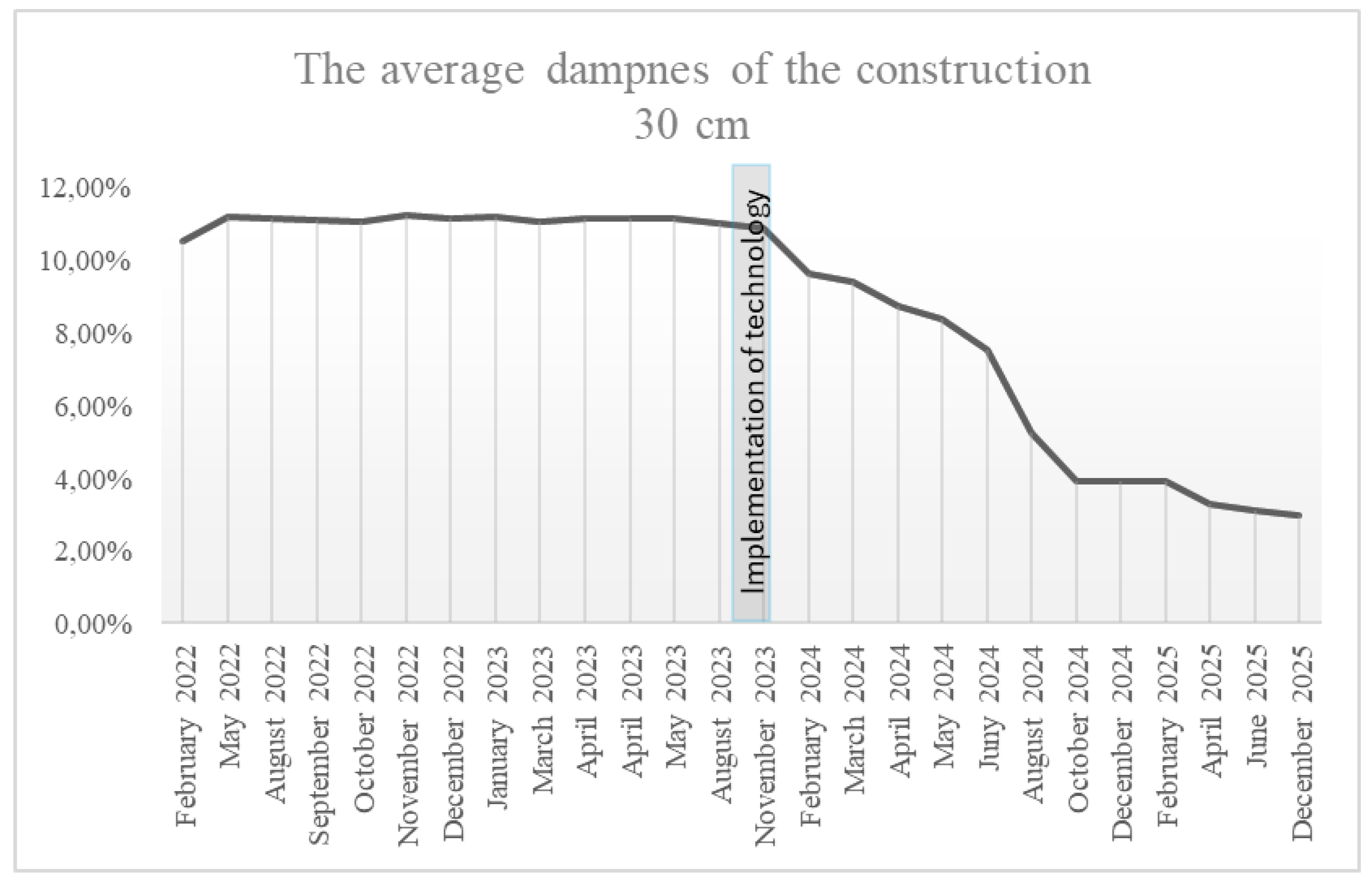
The tables show selected moisture values during the research. For a better overview, the total average moisture content of the structure, including the date of implementation of remediation measures, can be seen in Graph 1 for a height of up to 30 cm and in Graph 2 for a height of up to 150 cm from the floor.
Graph 1.
Graph showing the average moisture content of the examined structure at a height of 30 cm from the floor.
Graph 1.
Graph showing the average moisture content of the examined structure at a height of 30 cm from the floor.
Graph 2.
Graph showing the average moisture content of the examined structure over time, at a height of 150 cm from the floor.
Graph 2.
Graph showing the average moisture content of the examined structure over time, at a height of 150 cm from the floor.
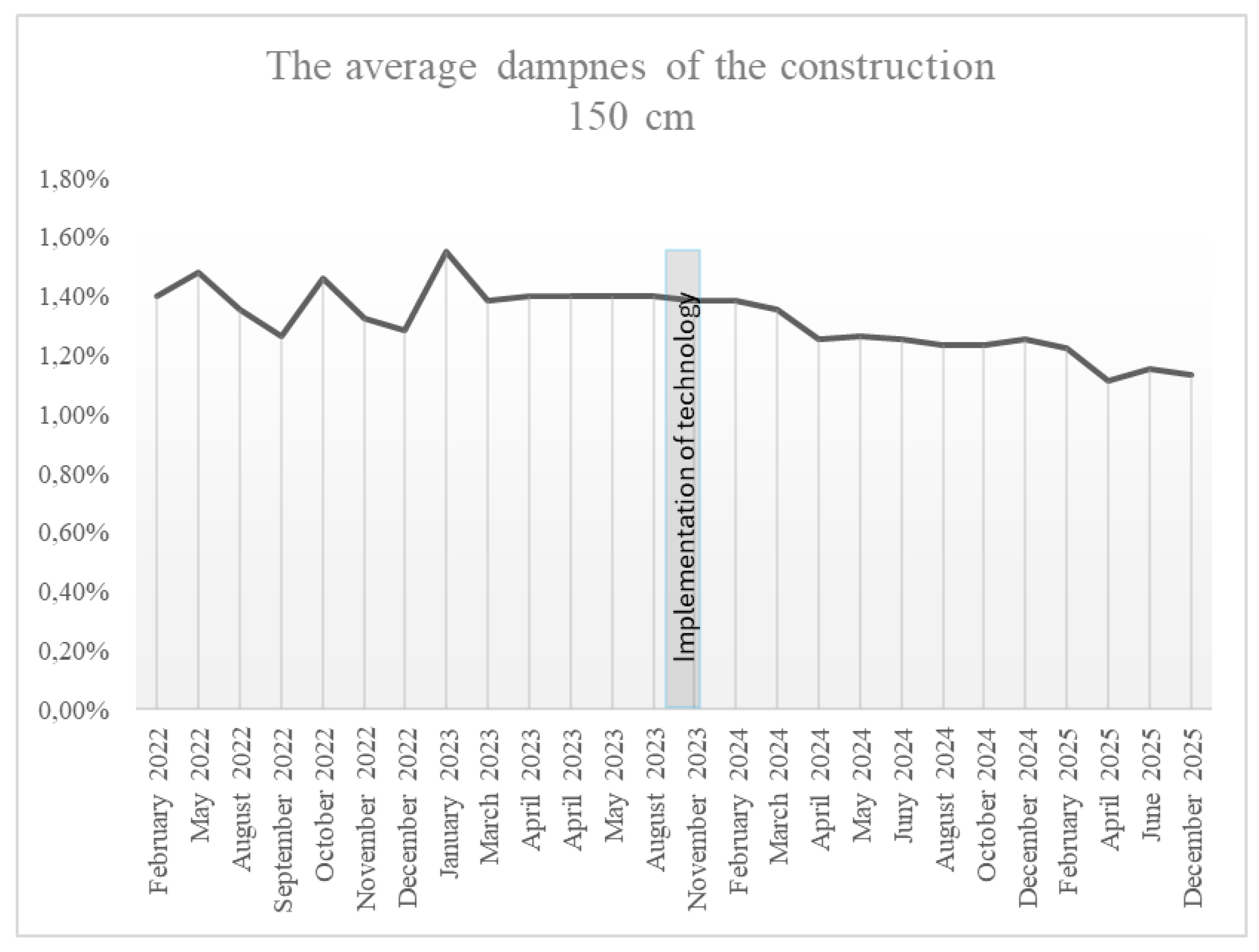
Table 4 and Graph 1 confirm that, prior to the implementation of remediation measures, the building showed a very high level of moisture according to ČSN P 73 0610, which was around 10%. On the contrary, in higher places (150 cm above the floor), the moisture content according to Table 5 and Graph 2 appeared acceptable with relatively constant values. Graph 1 shows the moisture content after the implementation of the undercutting technology and the period of remediation measures. The graph shows a significant drying of the structure over time. Calculations and analyses determined the average moisture content of the structure during the last measurements to be 2.98%, which proves that the structure is dry.
Such a dry structure also brought a number of positive factors, including the reduction of degradation of the affected masonry, but especially a positive impact on the indoor climate of the building. The last measurements already showed a noticeable improvement in the perceived indoor air humidity, which also has a positive effect on the residents of this building.
4.3. Possibility of Applying Active Thermal Protection (ATP)
In an effort to reduce the energy consumption of buildings and simultaneously improve the quality of the indoor environment, the application of additional thermal insulation is considered for the evaluated perimeter structure. However, in the case of older buildings with a long-term increased moisture and salt content in the masonry, the residual moisture of the structure represents a significant risk even after the implementation of renovation measures. Enclosing the originally damp masonry in a contact thermal insulation system with a relatively high diffusion resistance significantly limits the transport of water vapor to the exterior. The result is the accumulation of moisture in the structure, or on the inner surface of the perimeter walls, which creates favorable conditions for mold growth and can lead to failure to meet hygiene criteria for the protection of the health of users.
One option for reducing the residual moisture load in renovated older buildings is the use of ventilated insulation systems. However, these systems have several limitations, including increased laboriousness of implementation, limited applicability in case of complex facades and high demands on the accuracy of installation of load-bearing and anchoring elements. The economic cost of ventilated facades is significantly influenced by the type of cladding and compared to contact systems, can reach up to twice the implementation costs. The basic principle of a ventilated system is the presence of an air gap in the structure of the external cladding, the main function of which is to remove moisture from the thermal insulation layer.
The issue of air flow in ventilated facades and their potential to reduce the energy consumption of buildings was addressed in research into ventilated facades integrated with HVAC systems for cold climatic conditions [38]. The aim of the research was to design a closed ventilation circuit with convective heat transfer, which would contribute to increasing the thermal comfort of the indoor environment and at the same time reducing operating costs. The experimentally verified system uses convective heat transfer in a ventilated facade to recover energy in the buffer zone, thereby reducing the environmental impact and consumption of primary energy sources. However, the functionality of this solution is conditional on the absence of moisture in the air gap, which significantly limits its application to renovated buildings with residual moisture. The use of vapor-proof or regulating membranes in such cases would again lead to the risk of condensation and moisture accumulation on the inner surface of the structure.
An alternative approach to eliminating the risks associated with residual moisture in renovated older buildings is the application of active thermal protection (ATP) to dehumidified perimeter walls. Active thermal protection introduces an internal energy source into the structure of the building structure, which is integrated between the load-bearing and thermal insulation parts of the structure. This energy system works with a low-temperature heat transfer fluid, the energy of which is obtained from solar and geothermal sources and subsequently accumulated. ATP represents a controlled dynamic process characteristic of structures with integrated energetically active elements that perform one or more energy functions depending on the operating mode of the heat sources. The basic functions of active thermal protection include:
- creation of a thermal barrier,
- large-area radiant heating or cooling,
- heat and cold storage,
- collection of solar energy and energy from the surrounding environment,
- heat or cold recuperation,
- combinations of thesee.
For the above reasons, after the implementation of renovation measures aimed at reducing the moisture load, the application of active thermal protection to the perimeter wall structures appears to be a more suitable solution compared to classic thermal insulation systems.
As an illustration of the use of ATP, a fragment of a perimeter wall made of solid burnt brick, shown in Figure 4, can be cited. In the case of meeting the standard requirements for static thermal resistance, the supporting structure is insulated with expanded polystyrene (EPS) with a thickness of 210 mm, with the resulting average temperature in the structure reaching the value θₘ = 18.04 °C. After integrating active thermal protection into the composition of the contact insulation and using EPS thermal insulation with a thickness of 50 mm, the temperature in the structure drops to θₘ = 13.27 °C. By regulating the temperature of the heat transfer medium in the ATP pipes, it is possible to influence the temperature field of the structure. When the water temperature is set to 18°C, the achieved effect is equivalent to 210 mm thick thermal insulation.
The benefit of the proposed solution is not only the stabilization of the temperature of the perimeter wall, but also the support of further drying of the structure and the reduction of the risk of mold formation in the interior. By appropriately setting the ATP operating parameters, it is also possible to reduce the thickness of the thermal insulation by up to 160 mm. The system designed in this way has a positive effect on the energy efficiency of the building even when using a significantly thinner thermal insulation layer, which leads to a smaller volume increase of the building, saving material resources and a positive impact on the sustainability of the construction.
5. Discussion
The results of the research in the case study clearly confirm the high effectiveness of the masonry undercutting technology. Before the remediation work was carried out, the humidity values measured 30 cm above the floor were very high by the standards of ČSN P 73 0610, with occasional fluctuations caused by external factors such as changes in the groundwater level and weather conditions. After applying the undercutting technology, a gradual but long-term stable decrease in moisture was recorded. In the final measurements, this process reached values that can be defined as a dry structure.
In terms of interpreting the results, it should also be noted that the decrease was not immediate, but the structure dried out gradually, which is also reflected in the measured values. The long-term nature of the measurements carried out as part of the in-situ research is therefore a significant contribution, as it allows for an objective assessment of the impact of the remediation measure on the moisture in the structure.
At the same time, measurements taken at a height of 150 cm from the floor confirmed that rising damp had a dominant effect on the lower part of the masonry, while higher areas showed consistent values that can be assessed as a dry structure. This measurement result supports the correctness of the initial identification of the problem and the suitability of the planned remediation measure.
The discussion also ties in with the broader context of the renovation of older buildings, where successful moisture remediation is often followed by measures to increase the energy efficiency of buildings. However, as the presented findings show, the application of classic contact thermal insulation systems to originally damp masonry can lead to the trapping of residual moisture in the structure, creating a risk of condensation, mold growth, and deterioration of indoor hygiene conditions.
For this reason, the paper describes the possibility of implementing active thermal protection as a possible step after the implementation of remediation measures and drying of the structure. Calculations indicate that active thermal protection can achieve a comparable effect to thick layers of thermal insulation, even when using significantly thinner thermal insulation. In addition to its energy benefits, this application also has the ability to positively influence the temperature and humidity of the structure, which can promote further drying and reduce the risk of biological degradation.
6. Conclusions
The paper focused on the problem of damage to older buildings caused by rising damp and on the evaluation of the effectiveness of selected remediation technology based on long-term in situ research. Measurements showed that the masonry undercutting technology is a reliable and effective way to stop rising damp, even in significantly damp older buildings.
The measurement results confirmed that after the remediation, there was a gradual but permanent decrease in the moisture content of the structure. At the end of the research, the structure achieved values that correspond to a dry structure according to the standard. This condition had a positive effect not only on the technical condition but also on the quality of the indoor environment. This had a significant impact on improving the comfort and health protection of the residents of the building under examination.
The authors also sought to point out that successful moisture remediation in older buildings should not be seen as an isolated intervention, but as part of a comprehensive renovation of the building. In this context, the issue of additional insulation of remediated buildings and the design of active thermal protection as a promising alternative that could improve the energy efficiency of the building while stabilizing the temperature and humidity regime of the perimeter structures was discussed.
Based on the results, it can be concluded that the application of renovation measures creating an additional impermeable layer can ensure an effective reduction in the moisture content of the structure. In combination with an active thermal protection system, it also represents a promising direction of development in the field of sustainable renovation of older buildings.
This research can also serve as a basis for the experimental verification of the proposed solutions in real conditions and for monitoring these solutions in terms of energy efficiency and moisture behavior.
Author Contributions
For research articles with several authors, a short paragraph specifying their individual contributions must be provided. The following statements should be used “Conceptualization, P.Š. and A.H.; methodology, P.Š. and A.H.; software, P.Š. and A.H.; validation, P.Š. and A.H.; formal analysis, P.Š. and A.H.; investigation, P.Š; resources, P.Š. and A.H.; data curation, P.Š. and A.H.; writing—original draft preparation, P.Š. and A.H.; writing—review and editing, P.Š. and A.H.; visualization, P.Š. and A.H.; supervision, P.Š.; project administration, P.Š.; funding acquisition, P.Š. All authors have read and agreed to the published version of the manuscript.”.
Funding
Funded by the EU NextGenerationEU through the Recovery and Resilience Plan for Slovakia under the project No. 09I03-03-V05-00005.
Conflicts of Interest
The authors declare no conflicts of interest.
References
- Delgado, J.M.P.Q.; Guimarães, A.S.; de Freitas, V.P.; Antepara, I.; Kočí, V.; Černý, R. Salt Damage and Rising Damp Treatment in Building Structures. Advances in Materials Science and Engineering 2016, 2016, 1280894. [Google Scholar] [CrossRef]
- Franzoni, E.; Berk, B.; Bassi, M.; Marrone, C. An integrated approach to the monitoring of rising damp in historic brick masonry. Construction and Building Materials 2023, vol. 370, 130631. [Google Scholar] [CrossRef]
- Halim, A. A.; Halim, A. : An Analysis of Dampness Study on Heritage Building: A Case Study Ipoh Old Post Office Building and Suluh Budiman Building, UPSI, Perak, Malaysia. Journal of Sustainable Development 2010, 3, 171–182. [Google Scholar] [CrossRef]
- Lubelli, B; van Hees, R. P. J; Groot, C. W. P. Investigation on the behaviour of a restoration plaster applied on heavy salt loaded masonry. Construction and Building Materials 2006, 20(9), 691–699. [Google Scholar] [CrossRef]
- Tetteh, S. A.; Akwei, I.; Andoh, G. Rising Damp in Buildings: Causes, Impacts, and Mitigation Strategies in Krofrom and Ampabame New Sites. Asian Journal of Advanced Research and Reports 2025, vol. 19(no. 3), 179–200. [Google Scholar] [CrossRef]
- Torres, I. M. Wall base ventilation system to treat rising damp: The influence of the size of the channels. Journal of Cultural Heritage 2014, 15(2), 121–127. [Google Scholar] [CrossRef]
- Franzoni, E. Rising damp removal from historical masonries: A still open challenge. Construction and Building Materials 2014, 54, 123–136. [Google Scholar] [CrossRef]
- Kenwood, H. R. Dampness in and about houses. Public Health 1892, 5, 247–250. [Google Scholar] [CrossRef]
- Council Directive 89/106/EEC of 21 December 1988 on the approximation of laws, regulations and administrative provisions of the Member States relating to construction products, vol. 040. 1988. Accessed: Dec. 01, 2025. [Online]. Available online: http://data.europa.eu/eli/dir/1989/106/oj.
- Park, S. C. Holding the Line, Controlling Unwanted Moisture in Historic Buildings. TPS Preservation Briefs 1996, no. 39, pp. 18. [Google Scholar]
- Maj, M.; Tamrazyan, A.; Ubysz, A. Considerable cracking in the foundation slab in a multi-storey underground garage. MATEC Web Conf. 2019, vol. 284, 06003. [Google Scholar] [CrossRef]
- Tulakov, E.; et al. Experimental analysis of moisture protection of buildings. E3S Web of Conf. 2024, vol. 559, 04018. [Google Scholar] [CrossRef]
- Šťastný, P.; Gašparík, J.; Makýš, O.; Chamulová, B.; Szalayová, S. Application of Anti-Moisture Technologies in Historical Constructions from the Perspective of Sustainability. Appl. Sci. 2021, 11, 9659. [Google Scholar] [CrossRef]
- Šťastný, P.; Gašparík, J.; Makýš, O. Analysis of moisture and salinity of historical constructions before and after the application of REMEDIATIONS. J. Build. Eng. 2021, 41, 102785. [Google Scholar] [CrossRef]
- Hoła, A. Methodology for the in situ testing of the moisture content of brick walls: an example of application. Archiv.Civ.Mech.Eng 2020, vol. 20(no. 4), 114. [Google Scholar] [CrossRef]
- Hernández, I. E. V.; Collazo, A. A.; López, E. C. Crystallization Cycles in Masonry Walls: Experimental Technique to Develop Accelerated Aging on a Real Scale. Periodica Polytechnica Architecture 2024, vol. 55(no. 1), 1–11. [Google Scholar] [CrossRef]
- Guolo, E.; Falchi, L.; Cimino, D.; Balliana, E.; Peron, F.; Zendri, E. Investigation of capillary rise in brick masonry models under controlled conditions. Construction and Building Materials 2025, 483, 141793. [Google Scholar] [CrossRef]
- Franzoni, E.; Gentilini, C.; Santandrea, M.; Carloni, C. Effects of rising damp and salt crystallization cycles in FRCM–masonry interfacial debonding: Towards an accelerated laboratory test method. Construction and Building Materials 2018, 175, 225–238. [Google Scholar] [CrossRef]
- Baxi, S.N.; et al. Exposure and Health Effects of Fungi on Humans. The Journal of Allergy and Clinical Immunology: In Practice 2016, 4, 396–404. [Google Scholar] [CrossRef]
- Karasaka, L.; Ulutas, N. Point Cloud-Based Historical Building Information Modeling (H-BIM) in Urban Heritage Documentation Studies. Sustainability 2023, 15, 10726. [Google Scholar] [CrossRef]
- Cheng, H.-M.; Yang, W.-B.; Yen, Y.-N. BIM applied in historical building documentation and refurbishing. ISPRS Archives of the Photogrammetry, Remote Sensing and Spatial Information Sciences 2015, XL-5-W7, 85–90. [Google Scholar] [CrossRef]
- Funtík, T.; Šťastný, P.; Erdélyi, J.; Honti, R. Dátovo-orientovaný prístup na zníženie vlhkosti v pamiatkových budovách. Czech Journal of Civil Engineering 2023, 9, 23–34. [Google Scholar] [CrossRef]
- Rymarczyk, T.; Kłosowski, G.; Hoła, A.; Hoła, J.; Sikora, J.; Tchórzewski, P.; Skowron, Ł. Historical Buildings Dampness Analysis Using Electrical Tomography and Machine Learning Algorithms. Energies 2021, 14, 1307. [Google Scholar] [CrossRef]
- Tariq, L.R.; Jafaar, A.M. A Review of Nanotechnology in Self-Healing of Ancient and Heritage Buildings: Heritage Buildings, Nanomaterial, Nano Architecture, Nanotechnology in Construction. International Journal of Nanoelectronics and Materials 2024, 17, 153–163. [Google Scholar] [CrossRef]
- Isomax–Terrasol Building Technologies. Successor to Isomax—Solinterra. Available online: https://www.solinterra.si/en/about-solinterra.html (accessed on 15 December 2025).
- Li, A.; Xu, X.; Sun, Y. A study on pipe-embedded wall integrated with ground source-coupled heat exchanger for enhanced building energy efficiency in diverse climate regions. Energy and Buildings 2016, 121, 139–151. [Google Scholar] [CrossRef]
- Krzaczek, M.; Florczuk, J.; Tejchman, J. Improved energy management technique in pipe-embedded wall heating/cooling system in residential buildings. Applied Energy 2019, 254, 113711. [Google Scholar] [CrossRef]
- Tkachenko, T.; et al. Planning of green roofs for the best thermotechnical effect. Scientific Review Engineering and Environmental Sciences 2025, 34, 42–54. [Google Scholar] [CrossRef]
- Witzany, J. Poruchy a Rekonstrukce Zděných Budov; ČKAIT: Prague, Czech Republic, 1999. [Google Scholar]
- Sharpe, R.W. A mortar for rising damp studies. Building and Environment 1978, 13, 261–265. [Google Scholar] [CrossRef]
- EMERISDA Summary report on existing methods against rising damp D2.1 FINAL version 31-07-2014. Available online: https://www.emerisda.eu/wp-content/uploads/2014/07/D-2_1.pdf (accessed on 3.1.2026).
- Makýš, O. Technológia Obnovy Budov, Ochrana a Oprava Spodných a Obalových Konštrukcií; Spektrum STU: Bratislava, Slovakia, 2018; pp. 27–80. [Google Scholar]
- Gavrilović, D. J. Building waterproofing remediation applying the “total cut” method. Facta Universitatis Series: Architecture and Civil Engineering 2011, 9(1), 105–118. [Google Scholar] [CrossRef]
- Harmati, N.L.; Jakšić, Ž.; Trivunić, M.; Milovanović, V. Rising damp analysis and selection of optimal handling method in masonry construction. Periodica Polytechnica Civil Engineering 2014, 58, 431–444. [Google Scholar] [CrossRef]
- Schmidt, H. Historische Bauwerksabdichtungen—Traditionelle und neuzeitliche Maßnahmen zum Schutz gegen Bodenfeuchtigkeit und zur Trockenlegung feuchter Wände. Bautechnik 1999, 76, 581–598. [Google Scholar] [CrossRef]
- Møller, E. B.; Olsen, B. Rising damp, a reoccurring problem in basements: a case study with different attempts to stop the moisture. In 9th Nordic Symposium on Building Physics: Proceedings, 1.ed.; Tampere University of Technology, Finland: Tampere, 29 May 2011 - 2 Jun 2011; Volume 2, pp. 765–772. [Google Scholar]
- ČSN P 73 0610. Hydroizolace Staveb, Sanace Vlhkého Zdiva, Základní Ustanovení, 2000. [Waterproofing of buildings - The rehabilitation of damp masonry and additional protection of buildings against ground moisture and against atmospheric water - Basic provision]. Available online: http://seznamcsn.agentura-cas.cz/Vysledky.aspx (accessed on 3 January 2026).
- Petrichenko, M.; Nemova, D.; Kotov, E.; Andreeva, D.; Sergeev, V. Ventilated facade integrated with the HVAC system for cold climate. Magazine of Civil Engineering 2018, 77, 47–58. [Google Scholar] [CrossRef]
Figure 1.
Division of methods intended for the rehabilitation of constructions [31].
Figure 1.
Division of methods intended for the rehabilitation of constructions [31].
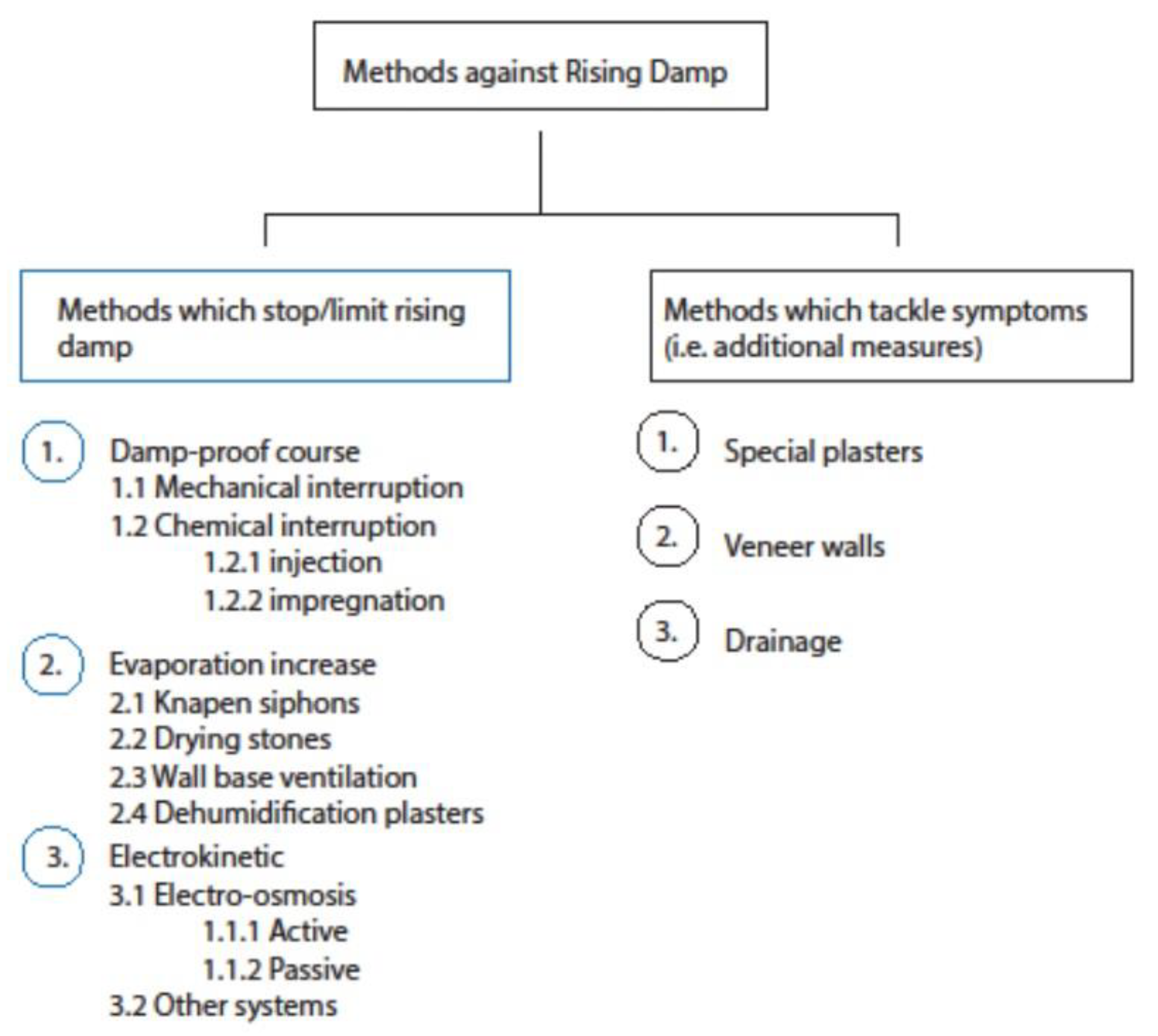
Figure 2.
Division of methods intended for the rehabilitation of constructions [32].
Figure 2.
Division of methods intended for the rehabilitation of constructions [32].
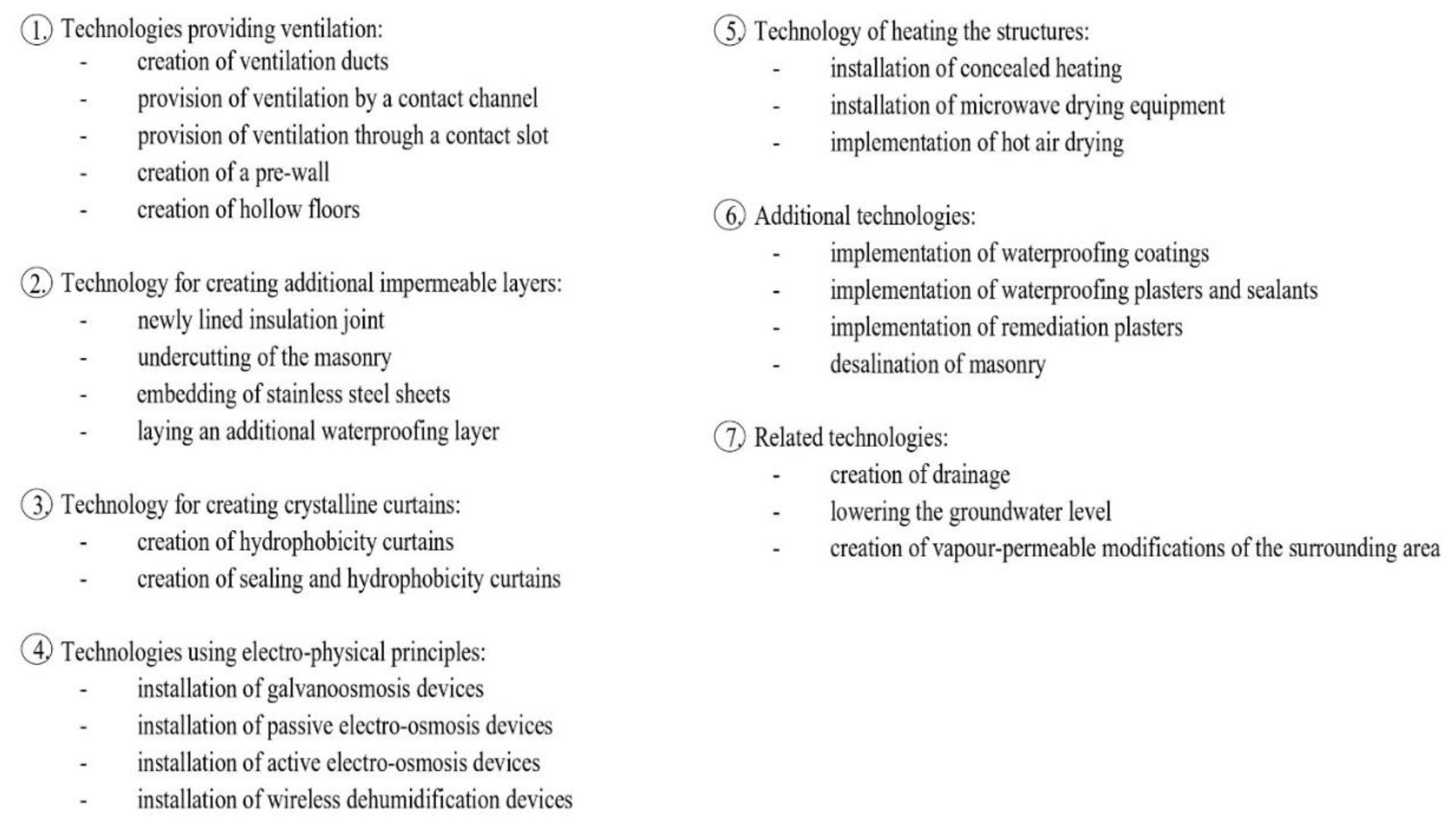
Figure 3.
Floor plan of the building under examination with measurement points marked [Authors].
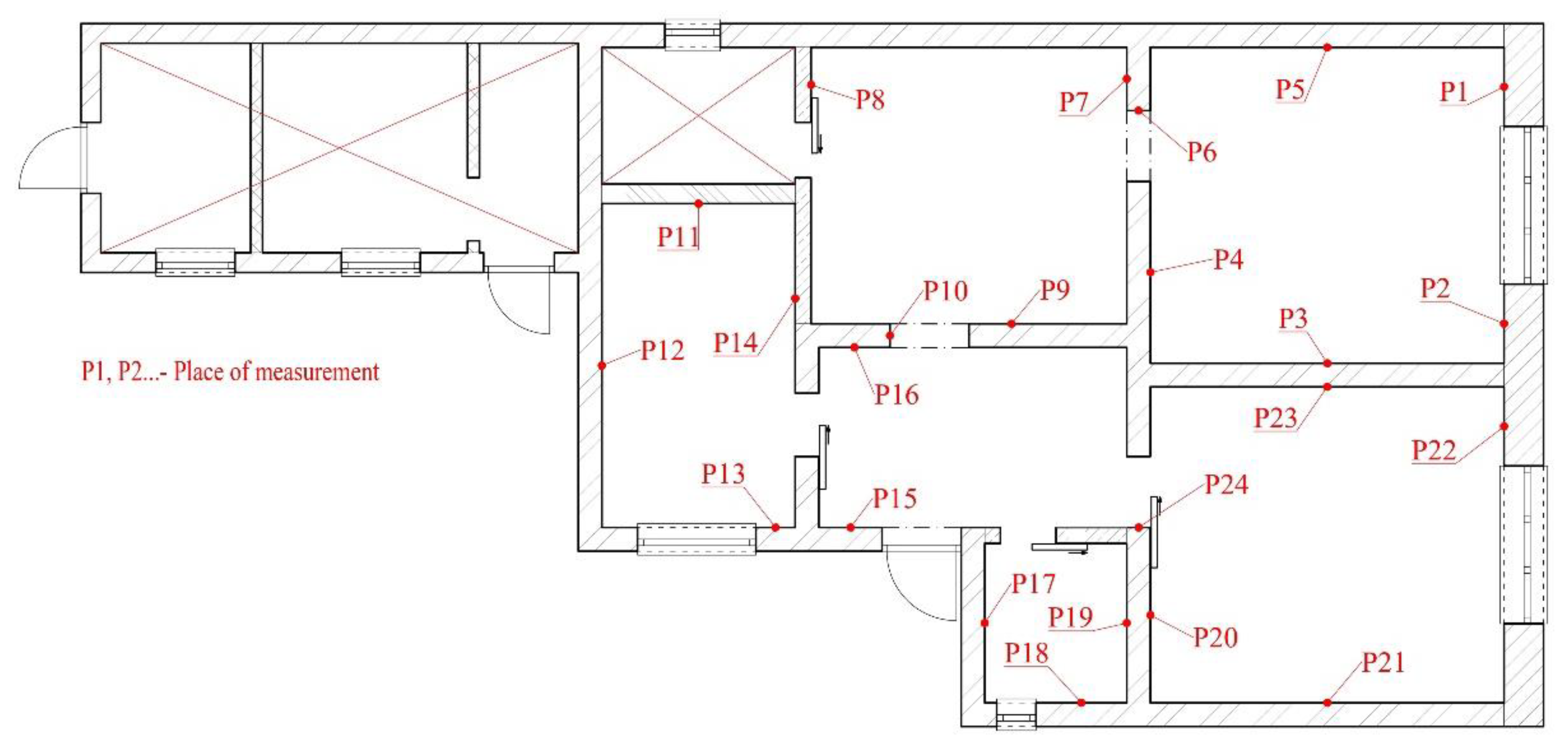
Figure 4.
Fragment of the wall perimeter construction: full burnt brick. θm - the temperature in construction (°C), Δθ - temperature difference (°C), d - construction thickness (mm), e - exterior, i - interior.
Figure 4.
Fragment of the wall perimeter construction: full burnt brick. θm - the temperature in construction (°C), Δθ - temperature difference (°C), d - construction thickness (mm), e - exterior, i - interior.
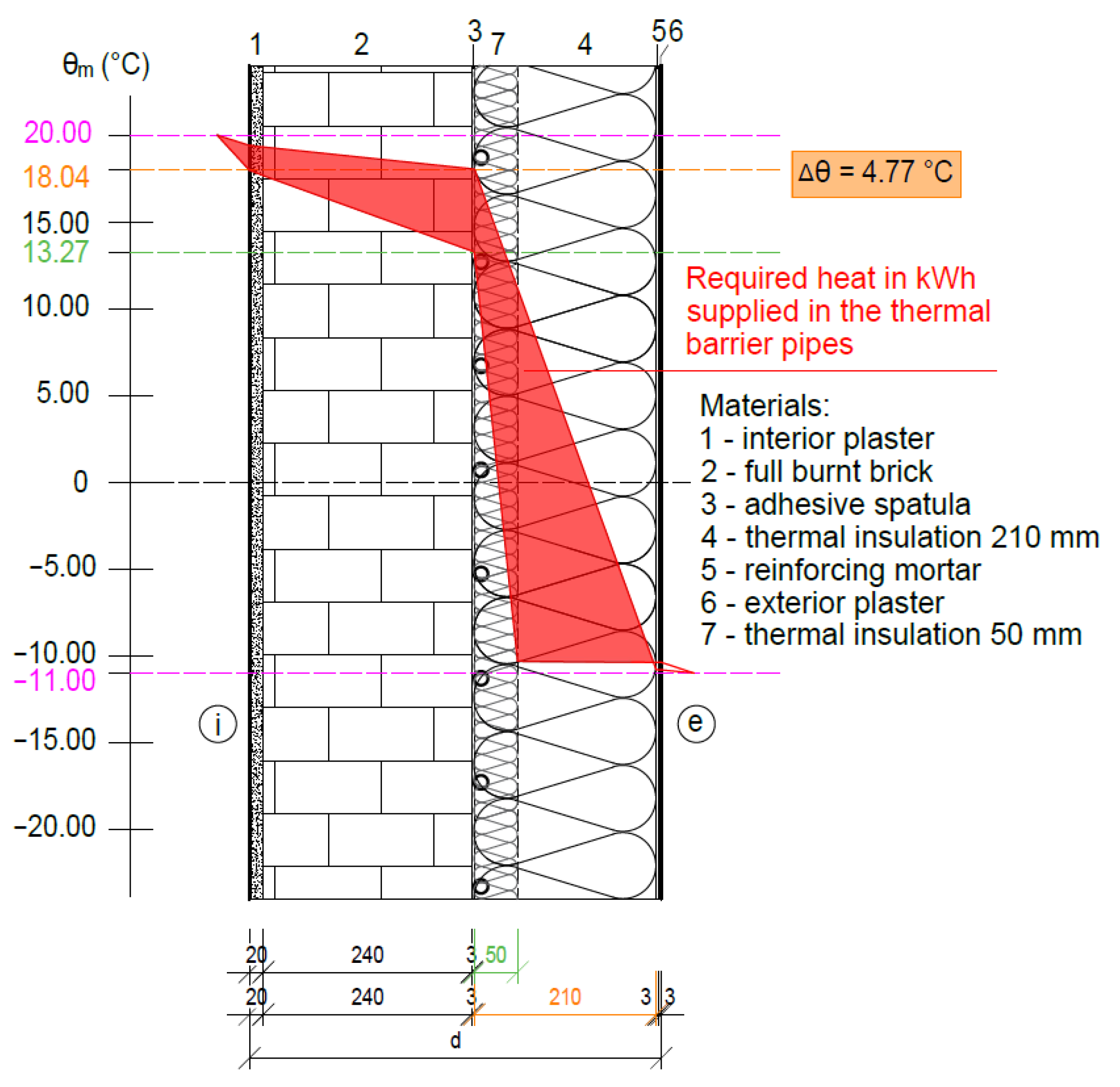

Table 1.
Parameters of the meters used in the research.
| Device name | Power supply | Measuring range [%] | Measuring depth [mm] | Resolution [%] | Operating temperature [°C] |
|---|---|---|---|---|---|
| Hygrometer Dosier DM4A-C | 9V | 0-20 | 40.00 | 0.10 | from 5 to 40 |
| Testo 616 | 9V | 0-20 | 50.00 | 0.10 | from 5 to 40 |
| GANN BL Compact B 2 | 9V | 0.3-11 | 120.00 | 0.10 | from 5 to 40 short term -10 to 60 |
Table 2.
Degree of moisture of constructions based to ČSN P 73 0610 [37].
Table 2.
Degree of moisture of constructions based to ČSN P 73 0610 [37].
| Degree of Humidity | Moisture (uM) [%] | |
|---|---|---|
| 1 | Very low moisture | <3.0 |
| 2 | Low moisture | 3.0–5.0 |
| 3 | Increased moisture | 5.0–7.5 |
| 4 | High moisture | 7.5–10 |
| 5 | Very high moisture (to waterlogging) | >10 |
Table 4.
Selected values of moisture content in the structure before and after the application of the undercutting technology at a height of 30 cm from the floor.
Table 4.
Selected values of moisture content in the structure before and after the application of the undercutting technology at a height of 30 cm from the floor.
| Months of the years | Selected measurement points (height 30 cm from the floor) | ||||||||||||||||
|---|---|---|---|---|---|---|---|---|---|---|---|---|---|---|---|---|---|
| P1 | P3 | P4 | P5 | P7 | P8 | P9 | P11 | P12 | P13 | P14 | P15 | P17 | P20 | P21 | P22 | P24 | |
| February 2022 | 12.62 | 10.52 | 12.05 | 11.69 | 12.62 | 12.25 | 9.11 | 10.38 | 10.50 | 10.79 | 8.42 | 8.42 | 9.85 | 8.42 | 12.62 | 11.09 | 8.42 |
| May 2022 | 10.96 | 11.17 | 12.83 | 10.15 | 12.41 | 12.57 | 10.14 | 13.01 | 11.72 | 10.77 | 11.42 | 9.37 | 13.43 | 10.89 | 9.87 | 8.95 | 10.88 |
| August 2022 | 9.66 | 11.11 | 9.69 | 10.41 | 10.70 | 12.60 | 9.12 | 12.74 | 13.34 | 11.00 | 11.91 | 11.29 | 13.34 | 8.90 | 12.85 | 12.59 | 9.94 |
| September 2022 | 8.87 | 10.42 | 9.63 | 11.04 | 11.08 | 9.47 | 8.93 | 11.29 | 11.39 | 12.63 | 12.37 | 10.73 | 12.23 | 11.56 | 13.31 | 12.56 | 10.16 |
| October 2022 | 13.24 | 9.36 | 11.03 | 12.37 | 8.82 | 10.02 | 8.82 | 9.94 | 12.53 | 11.16 | 10.83 | 10.10 | 12.89 | 11.87 | 10.16 | 10.15 | 9.95 |
| November 2022 | 12.93 | 10.37 | 11.67 | 13.08 | 11.24 | 9.53 | 11.32 | 11.88 | 13.46 | 10.45 | 11.02 | 10.00 | 10.56 | 11.06 | 11.62 | 10.65 | 10.22 |
| December 2022 | 12.30 | 11.28 | 9.98 | 11.74 | 10.08 | 11.28 | 10.22 | 13.14 | 13.41 | 11.02 | 12.61 | 11.76 | 10.68 | 11.20 | 10.33 | 10.01 | 10.90 |
| January 2023 | 11.37 | 9.34 | 9.91 | 13.45 | 11.45 | 13.45 | 9.98 | 10.61 | 10.60 | 12.25 | 11.12 | 12.41 | 11.86 | 10.17 | 10.93 | 12.43 | 10.19 |
| March 2023 | 12.58 | 11.44 | 10.59 | 10.83 | 9.15 | 9.08 | 9.46 | 9.61 | 9.50 | 11.46 | 10.81 | 12.48 | 12.09 | 11.54 | 12.76 | 11.62 | 11.89 |
| April 2023 | 12.18 | 9.42 | 10.85 | 13.43 | 9.26 | 11.84 | 9.46 | 13.43 | 13.43 | 12.68 | 12.97 | 9.45 | 10.08 | 10.25 | 9.46 | 11.67 | 8.98 |
| May 2023 | 13.40 | 10.35 | 11.61 | 13.32 | 10.21 | 11.27 | 9.51 | 12.66 | 11.38 | 11.39 | 10.25 | 9.85 | 11.47 | 10.91 | 10.17 | 12.14 | 10.47 |
| August 2023 | 11.73 | 10.67 | 10.10 | 11.00 | 10.09 | 9.99 | 9.06 | 10.72 | 12.63 | 10.87 | 10.23 | 10.93 | 13.22 | 11.68 | 11.92 | 11.76 | 11.11 |
| November 2023 | 9.93 | 9.47 | 9.88 | 10.65 | 10.99 | 11.65 | 9.40 | 11.97 | 9.51 | 12.45 | 10.37 | 9.45 | 12.76 | 10.34 | 12.76 | 12.04 | 9.68 |
| January 2024 | 8.96 | 10.55 | 8.84 | 9.32 | 10.76 | 10.74 | 9.19 | 11.21 | 9.89 | 10.80 | 9.86 | 9.40 | 8.09 | 9.35 | 9.11 | 9.70 | 9.34 |
| March 2024 | 9.55 | 8.74 | 8.45 | 9.94 | 8.89 | 9.66 | 8.07 | 11.21 | 10.15 | 9.52 | 9.68 | 9.31 | 8.65 | 7.95 | 9.25 | 10.44 | 9.59 |
| April 2024 | 11.82 | 8.05 | 9.32 | 11.82 | 11.30 | 11.40 | 8.38 | 10.66 | 9.60 | 8.79 | 9.01 | 8.50 | 10.89 | 9.79 | 9.65 | 8.46 | 11.28 |
| May 2024 | 10.15 | 7.41 | 8.74 | 10.15 | 8.58 | 9.67 | 7.19 | 8.94 | 6.80 | 8.55 | 7.96 | 7.08 | 9.58 | 8.00 | 7.46 | 8.20 | 8.18 |
| June 2024 | 9.78 | 7.69 | 8.73 | 10.48 | 8.47 | 10.33 | 7.39 | 10.54 | 11.08 | 10.98 | 9.64 | 9.95 | 8.18 | 8.77 | 11.08 | 8.62 | 8.98 |
| August 2024 | 6.07 | 4.49 | 4.81 | 6.06 | 5.12 | 6.32 | 4.70 | 5.21 | 6.32 | 5.57 | 5.87 | 4.61 | 4.40 | 4.90 | 5.35 | 5.42 | 5.29 |
| October 2024 | 3.89 | 4.42 | 4.17 | 3.28 | 3.49 | 3.99 | 3.35 | 4.16 | 4.37 | 4.55 | 4.55 | 4.24 | 4.08 | 3.73 | 3.21 | 3.12 | 3.51 |
| December 2024 | 6.91 | 5.47 | 6.46 | 7.08 | 5.34 | 6.23 | 5.22 | 6.57 | 5.77 | 6.07 | 5.35 | 6.15 | 6.00 | 5.47 | 5.93 | 4.74 | 6.59 |
| February 2025 | 3.73 | 3.48 | 4.20 | 4.69 | 4.16 | 3.84 | 3.13 | 3.86 | 3.98 | 4.69 | 3.71 | 4.16 | 4.69 | 3.76 | 3.15 | 4.12 | 3.95 |
| April 2025 | 3.92 | 2.62 | 3.51 | 3.78 | 3.00 | 3.07 | 2.73 | 2.82 | 3.55 | 3.92 | 2.63 | 3.74 | 3.48 | 3.06 | 3.77 | 2.85 | 2.85 |
| June 2025 | 3.18 | 3.33 | 2.71 | 3.55 | 3.09 | 2.73 | 3.00 | 2.99 | 3.53 | 3.38 | 3.69 | 3.32 | 3.22 | 2.90 | 2.48 | 2.83 | 2.88 |
Table 5.
Selected values of moisture content in the structure before and after the application of the undercutting technology at a height of 150 cm from the floor.
Table 5.
Selected values of moisture content in the structure before and after the application of the undercutting technology at a height of 150 cm from the floor.
| Months of the years | Selected measurement points (height 150 cm from the floor) | ||||||||||||||||
|---|---|---|---|---|---|---|---|---|---|---|---|---|---|---|---|---|---|
| P1 | P3 | P4 | P5 | P7 | P8 | P9 | P11 | P12 | P13 | P14 | P15 | P17 | P20 | P21 | P22 | P24 | |
| February 2022 | 1.54 | 1.26 | 1.54 | 1.54 | 1.51 | 1.54 | 1.26 | 1.47 | 1.37 | 1.44 | 1.26 | 1.26 | 1.49 | 1.26 | 1.54 | 1.53 | 1.26 |
| May 2022 | 1.58 | 1.38 | 1.56 | 1.56 | 1.46 | 1.63 | 1.34 | 1.49 | 1.59 | 1.56 | 1.41 | 1.34 | 1.63 | 1.34 | 1.51 | 1.35 | 1.34 |
| August 2022 | 1.22 | 1.22 | 1.22 | 1.40 | 1.22 | 1.49 | 1.22 | 1.49 | 1.49 | 1.39 | 1.43 | 1.30 | 1.49 | 1.22 | 1.49 | 1.49 | 1.22 |
| September 2022 | 1.21 | 1.15 | 1.15 | 1.35 | 1.16 | 1.15 | 1.15 | 1.21 | 1.41 | 1.41 | 1.25 | 1.18 | 1.41 | 1.21 | 1.41 | 1.41 | 1.15 |
| October 2022 | 1.61 | 1.32 | 1.37 | 1.61 | 1.32 | 1.33 | 1.32 | 1.32 | 1.59 | 1.49 | 1.32 | 1.32 | 1.61 | 1.52 | 1.59 | 1.49 | 1.32 |
| November 2022 | 1.47 | 1.20 | 1.32 | 1.47 | 1.20 | 1.20 | 1.27 | 1.36 | 1.47 | 1.34 | 1.31 | 1.20 | 1.37 | 1.27 | 1.47 | 1.40 | 1.20 |
| December 2022 | 1.40 | 1.14 | 1.14 | 1.40 | 1.14 | 1.35 | 1.14 | 1.40 | 1.40 | 1.16 | 1.35 | 1.40 | 1.39 | 1.27 | 1.40 | 1.30 | 1.14 |
| January 2023 | 1.72 | 1.42 | 1.42 | 1.73 | 1.42 | 1.73 | 1.43 | 1.62 | 1.53 | 1.63 | 1.53 | 1.50 | 1.63 | 1.42 | 1.58 | 1.73 | 1.49 |
| March 2023 | 1.52 | 1.52 | 1.38 | 1.52 | 1.25 | 1.25 | 1.25 | 1.25 | 1.29 | 1.50 | 1.33 | 1.29 | 1.52 | 1.28 | 1.52 | 1.49 | 1.36 |
| April 2023 | 1.55 | 1.27 | 1.43 | 1.55 | 1.27 | 1.55 | 1.27 | 1.55 | 1.55 | 1.48 | 1.53 | 1.27 | 1.34 | 1.27 | 1.46 | 1.45 | 1.27 |
| May 2023 | 1.57 | 1.29 | 1.51 | 1.57 | 1.29 | 1.42 | 1.29 | 1.57 | 1.57 | 1.36 | 1.29 | 1.29 | 1.55 | 1.29 | 1.41 | 1.57 | 1.29 |
| August 2023 | 1.53 | 1.26 | 1.29 | 1.51 | 1.26 | 1.26 | 1.26 | 1.36 | 1.54 | 1.54 | 1.26 | 1.27 | 1.54 | 1.44 | 1.54 | 1.54 | 1.29 |
| November 2023 | 1.42 | 1.26 | 1.32 | 1.44 | 1.40 | 1.49 | 1.26 | 1.54 | 1.30 | 1.51 | 1.35 | 1.27 | 1.54 | 1.26 | 1.54 | 1.54 | 1.26 |
| January 2024 | 1.49 | 1.42 | 1.25 | 1.52 | 1.45 | 1.52 | 1.25 | 1.52 | 1.47 | 1.42 | 1.29 | 1.33 | 1.39 | 1.25 | 1.47 | 1.44 | 1.30 |
| March 2024 | 1.47 | 1.22 | 1.22 | 1.49 | 1.27 | 1.42 | 1.22 | 1.49 | 1.45 | 1.38 | 1.24 | 1.34 | 1.39 | 1.22 | 1.41 | 1.49 | 1.31 |
| April 2024 | 1.38 | 1.13 | 1.21 | 1.38 | 1.35 | 1.27 | 1.13 | 1.38 | 1.38 | 1.27 | 1.21 | 1.13 | 1.38 | 1.19 | 1.35 | 1.17 | 1.27 |
| May 2024 | 1.40 | 1.15 | 1.33 | 1.40 | 1.22 | 1.32 | 1.15 | 1.35 | 1.25 | 1.34 | 1.15 | 1.15 | 1.40 | 1.15 | 1.37 | 1.26 | 1.15 |
| June 2024 | 1.38 | 1.13 | 1.22 | 1.38 | 1.14 | 1.38 | 1.13 | 1.38 | 1.38 | 1.36 | 1.25 | 1.24 | 1.18 | 1.13 | 1.38 | 1.33 | 1.15 |
| August 2024 | 1.32 | 1.12 | 1.19 | 1.30 | 1.14 | 1.35 | 1.15 | 1.30 | 1.35 | 1.32 | 1.25 | 1.13 | 1.20 | 1.19 | 1.34 | 1.25 | 1.15 |
| October 2024 | 1.27 | 1.26 | 1.25 | 1.19 | 1.13 | 1.30 | 1.15 | 1.31 | 1.34 | 1.35 | 1.24 | 1.22 | 1.26 | 1.18 | 1.14 | 1.15 | 1.14 |
| December 2024 | 1.39 | 1.16 | 1.36 | 1.39 | 1.19 | 1.31 | 1.14 | 1.34 | 1.30 | 1.35 | 1.20 | 1.19 | 1.22 | 1.18 | 1.34 | 1.19 | 1.27 |
| February 2025 | 1.29 | 1.17 | 1.26 | 1.34 | 1.18 | 1.21 | 1.10 | 1.22 | 1.26 | 1.33 | 1.18 | 1.19 | 1.28 | 1.15 | 1.24 | 1.31 | 1.21 |
| April 2025 | 1.22 | 1.02 | 1.15 | 1.22 | 1.04 | 1.08 | 1.03 | 1.06 | 1.13 | 1.19 | 1.03 | 1.10 | 1.20 | 1.05 | 1.22 | 1.11 | 1.01 |
| June 2025 | 1.22 | 1.13 | 1.07 | 1.23 | 1.11 | 1.13 | 1.10 | 1.15 | 1.25 | 1.18 | 1.22 | 1.16 | 1.23 | 1.09 | 1.07 | 1.17 | 1.09 |
Disclaimer/Publisher’s Note: The statements, opinions and data contained in all publications are solely those of the individual author(s) and contributor(s) and not of MDPI and/or the editor(s). MDPI and/or the editor(s) disclaim responsibility for any injury to people or property resulting from any ideas, methods, instructions or products referred to in the content. |
© 2026 by the authors. Licensee MDPI, Basel, Switzerland. This article is an open access article distributed under the terms and conditions of the Creative Commons Attribution (CC BY) license (http://creativecommons.org/licenses/by/4.0/).
Copyright: This open access article is published under a Creative Commons CC BY 4.0 license, which permit the free download, distribution, and reuse, provided that the author and preprint are cited in any reuse.


