

Submitted:
01 February 2026
Posted:
03 February 2026
You are already at the latest version
Abstract
Background: Circulating tumor cells (CTCs) are key intermediates of hematogenous metastasis, yet their phenotype is shaped by transit through distinct anatomical niches. The cisterna chyli is the central lymphatic conduit draining lipid-rich intestinal lymph and peripheral lymphatics into the venous system. We investigated whether the cisterna chyli functions as a phenotypic “incubator” for aggressive CTC states.
Methods: In a 7-year prospective study, intraoperative samples (7.5 mL each) were collected from the cisterna chyli, peripheral lymph, and peripheral blood of 496 patients with stage III–IV solid tumors (21 tumor types). A control cohort of 118 non-oncological patients undergoing surgery after trauma was sampled with the same protocol. CTCs were enumerated by CellSearch and phenotyped using multi-marker immunocytochemistry for proliferation (Ki-67), invasion/migration (MMP-9, CXCR4), epithelial–mesenchymal transition (EMT), and stemness markers. Cell-free DNA (cfDNA) and circulating tumor DNA (ctDNA) were quantified across compartments.
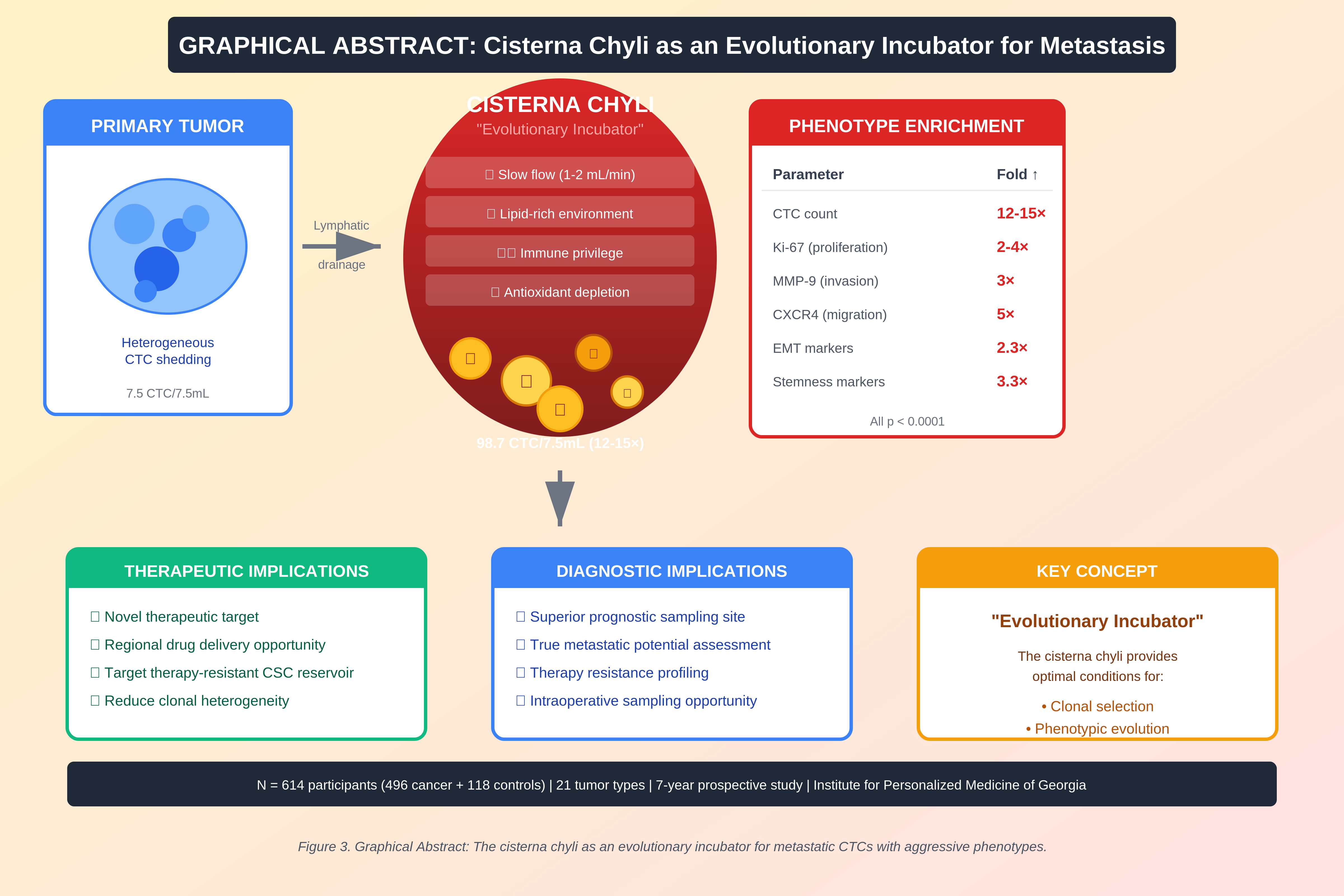
Results: In the cancer cohort, cisterna chyli CTC counts were markedly higher than in peripheral blood or peripheral lymph (12–15× enrichment across tumor types). Cisterna chyli CTCs showed increased proliferative and invasive phenotypes (Ki-67 ~2.7×; MMP-9 ~3×; CXCR4 ~5×) and enrichment of EMT and stemness programs (Any EMT+ ~2.3×; Any stemness+ ~3.3×; ≥2 stemness markers ~3.4×). cfDNA and ctDNA levels were comparable across the three compartments. In controls, CTC-like events were detected in 23/118 participants (19.5%) with no enrichment reported between compartments.
Conclusions: The cisterna chyli harbors a substantially enriched and biologically aggressive CTC subpopulation, consistent with an “evolutionary incubator” model in which lymphatic transit promotes clonal selection and phenotypic plasticity. These findings support cisterna chyli sampling as a high-yield site for intraoperative liquid biopsy and suggest new regional therapeutic opportunities to target lymph-borne metastatic precursors.
Keywords:
cisterna chyli
; circulating tumor cells
; lymphatic metastasis
; EMT
; cancer stem cells
; liquid biopsy
; phenotypic plasticity
Copyright: This open access article is published under a Creative Commons CC BY 4.0 license, which permit the free download, distribution, and reuse, provided that the author and preprint are cited in any reuse.


