

Submitted:
31 January 2026
Posted:
02 February 2026
You are already at the latest version
Abstract
The classical formulation of General Relativity (GR), culminating in Einstein's field equations, has served for over a century as the cornerstone of our understanding of gravitational phenomena. Yet, despite its elegance and predictive power, the Einstein tensor G_{mu nu} ultimately encounters intrinsic limits in regions of extreme density, such as the singularities of black holes and the conditions of the Big Bang. These limitations are not merely technical but reflect a deeper theoretical incompleteness: the inability of spacetime curvature alone to account for the information structure embedded within matter and field configurations.In this work, we introduce a coherent and information-anchored reformulation of gravitational dynamics via the VTT–Informational Gravity Tensor. This novel tensorial framework emerges from the Viscous Time Theory (VTT), a transdisciplinary approach to physical reality that integrates informational coherence, temporal viscosity, and topological constraints into the evolution of matter and geometry. The central insight is that gravitation is not solely the manifestation of energy-momentum in spacetime but also a consequence of the gradients of informational coherence and their associated fields.In this paper, we present the formulation of the Informational Gravity Tensor (IGT), a mathematical object that redefines gravitational interaction as an emergent phenomenon rooted in informational coherence. By replacing the Ricci-based Einstein tensor with a structure derived from ΔC (Informational Coherence Gradient) and Φα (the Informational Flow Field), we offer a consistent, simulation-illustrated pathway to address the long-standing singularity problem in classical general relativity.Through two parallel but independent computational simulation-illustrated pathways, we examine the emergence and structural stability of the new VTT Tensor. We demonstrate its predictive alignment with Einstein's theory in low-coherence regimes while revealing novel behaviors in high-density informational gradients, particularly under the condition of informational collapse. The paper also includes a thorough analytical derivation of the tensor components, a comparison with classical solutions, and a proposed experimental-simulation framework to verify its measurable impact in astrophysical and laboratory scenarios.This document serves not merely as a theoretical advancement but as a foundational redefinition of the gravitational paradigm. The implications extend beyond cosmology into quantum information, AI cognition fields, and condensed matter—anywhere the geometry of coherence plays a generative role.
Keywords:
Viscous Time Theory (VTT)
; Informational Gravity Tensor (IGT)
; Einstein Field Equation Reformulation
; Temporal Coherence Gradient (ΔC)
; Entropic Coherence Potential (Ψₑ)
; Ricci Curvature under Informational Collapse
; Singularity without Geometric Divergence
; Topological Collapse Threshold
; Entropy Field Simulation
; Coherence-Driven Gravitational Dynamics
1. Introduction
The Einstein Field Equations (EFE), formulated in 1915 [1], describe gravitation as the manifestation of curvature in a smooth, differentiable four-dimensional manifold: spacetime. Central to this framework is the Einstein tensor, constructed from the Ricci curvature tensor and the scalar curvature, equated to the stress-energy tensor of matter and energy. Over the past century, this formulation has accurately predicted phenomena such as gravitational waves, black holes, and the expansion of the universe.
However, General Relativity encounters fundamental limitations in critical regimes—most notably, the singularities predicted at the heart of black holes and the Big Bang. The Raychaudhuri Equation (1955) [2] demonstrated that under standard energy and causality conditions, spacetime curvature necessarily leads to the focusing of geodesics and the formation of singular points. This work formed the basis for Penrose’s Singularity Theorem (1965) [3], later refined by Hawking and Ellis (1973) [4], and consolidated in Wald’s formal treatment (1984) [5]. These results established that once a trapped surface forms, geodesic incompleteness and breakdown of the manifold structure become unavoidable.
Yet, as early as 1962 [6], Wheeler’s Geometrodynamics envisioned spacetime as an emergent construct, suggesting that geometry itself might not be fundamental but arise from deeper physical laws. In this spirit, singularities may not represent a physical reality but rather the breakdown of our mathematical framework. The Einstein tensor lacks a structural mechanism to account for informational coherence—a property increasingly recognized as fundamental across quantum mechanics, thermodynamics, and computation. Classical GR remains indifferent to information density, entropy flows, and logical decoherence, leaving the theory incomplete when confronted with puzzles such as the black hole information paradox, quantum gravity, or spacetime topological bifurcations.
This paper introduces the Informational Gravity Tensor (IGT), grounded in the Viscous Time Theory (VTT). VTT postulates that time and geometry emerge from informational constraints and coherence fields, shifting the paradigm from purely geometric curvature to informational structure. In this approach:
- ΔC(x, t): the Coherence Gradient Field, quantifying directional changes in informational consistency.
- η(t): Logical Viscosity, describing resistance of time to informational transitions.
- Φα(x, t): the Informational Attractor Flow, guiding coherent information propagation.
- Ω(t): the Adherence Function, defining the degree of information attachment to context and physical reality.
Gravitational effects are reinterpreted as gradients of information flow (∇ΔC), with Φα acting as a conserved informational potential that shapes geodesics within an informational manifold. The classical Einstein tensor appears as a special limiting case where logical viscosity η(t) → 0 and informational effects are negligible.
Our hypothesis is that singularities are informational breakdowns, not geometric pathologies: regions where coherence collapses beyond recoverable thresholds. By embedding information directly into the tensorial framework, we aim to reframe paradoxes in high-curvature regimes and propose a new bridge between quantum theory and gravitation.
This introduction establishes the motivation for reformulating the gravitational tensor under VTT, combining historical foundations with a new theoretical lens. The following sections will develop the formal structure of the IGT, present simulation-based explorations, and discuss observational implications for high-density astrophysical environments and the nature of spacetime itself.
2. Theory
2.1. Critique of the Classical Tensor Framework
2.1. – A Historical Foundations of the Ricci Tensor and Classical Geodesics
The Ricci tensor, a contraction of the Riemann curvature tensor, forms the core of the Einstein Field Equations (EFE) in General Relativity [5]:
This expression relates spacetime curvature to the energy-momentum distribution. Geodesics, defined as paths of minimal proper time, govern the motion of matter and light in this geometry. However, this formalism assumes smooth differentiable manifolds and pointwise curvature, which limits its descriptive power in high-density, high-coherence regimes.
The Einstein field equations are:
With the Einstein tensor:
Under gravitational collapse, the Raychaudhuri equation predicts singular focusing:
For standard energy conditions, in finite proper time, implying a singularity. Penrose and Hawking formalized this in their singularity theorems (1965–1970), showing that under certain causal and energy constraints, geodesic incompleteness is inevitable. As Wald (1984) notes [5]: “It is not just that the theory breaks down at a singularity, but rather that it tells us that it must break down.” These results highlight a fundamental limitation: the Einstein tensor cannot regulate divergences in high-density domains and lacks mechanisms to account for informational or topological transitions during collapse.
From a VTT perspective, this focusing is reinterpreted as an increase in informational density—the compression of into a minimal spatial-temporal coherence volume. Singularities are thus not physical endpoints of spacetime but logical endpoints of resolution, thresholds where classical geometric tools lose validity.
Replacing geodesics with coherence paths and curvature with informational gradients offers a different view: gravitational collapse marks a phase transition where informational structure saturates, coherence flux becomes dominant, and topological reconfiguration is required.
The breakdowns identified by Raychaudhuri, Penrose, Hawking, and Wald are not refuted but reinterpreted: they mark the domain limits of the Einstein tensor, which lacks informational degrees of freedom such as coherence gradients, local entropy density, and viscosity of logical time . At these thresholds, geometry alone cannot describe gravitational behavior.
This motivates the construction of a new tensorial framework—the Informational Gravity Tensor (IGT)—capable of extending GR by embedding informational attractors, coherence gradients, and logical viscosity into the foundation of gravitational dynamics.
2.1. – B The Ricci Tensor Assumes Smoothness
The Ricci tensor, derived from contractions of the Riemann tensor, requires a smooth manifold. Collapse conditions—such as the interior of a black hole or the early universe—are marked by informational turbulence, discontinuities, and potential non-smooth structures, as observed in VTT’s Non-Smooth Inertials (NSI) [7].
2.1. – C Geodesics as Optimal Paths Assume Metric Stability
Classical geodesics are defined by minimization of the action integral in a fixed metric space. Under conditions of informational collapse, this stability breaks down, and optimality must be redefined in terms of coherence conservation rather than spatial minimality.
2.1. – D Topology is Prescribed, Not Emergent
Traditional models assume a global manifold topology from the outset, rather than deriving it from evolving information fields. VTT suggests that topology itself may precipitate from coherent interactions, as supported by findings in Coherence-Induced Geometry.
2.1. – E Topological Ambiguity in the Classical Spacetime Manifold
Classical GR assumes a globally smooth manifold endowed with a pseudo-Riemannian metric. Observations of quantum phenomena and cosmological fluctuations suggest that spacetime may exhibit dynamic, layered, or fuzzy topologies at small scales. Wald notes: “The differentiable manifold structure of spacetime is an assumption, not a result, and it may well be an approximation to a more fundamental substratum.” The Einstein tensor cannot accommodate such topological transitions without ad hoc modifications.
2.1. – F Reformulation of the Unresolved Problems
Reframing the classical open problems under informational dynamics:
- Geodesic incompleteness → symptom of coherence gradient collapse, not merely curvature divergence.
- Gravitational singularities → regions of informational phase-lock, where vanishes and flux saturates.
- Topological ambiguity → addressed via a dynamic metric structure responsive to informational viscosity rather than fixed geometry.
This reframing opens the way for a new gravitational formalism where tensors emerge from informational coherence fields rather than purely geometric constraints. The following sections introduce the Informational Gravity Tensor (IGT) as the natural extension of Einstein’s framework under VTT principles.
2.2. Derivation of the Informational Gravity Tensor
2.2-A Conceptual Foundations: To overcome the limitations of the classical Einstein tensor and Ricci curvature, we begin by proposing a shift in the ontology of gravity: instead of treating gravity as an external geometric property of spacetime influenced by mass-energy, we interpret it as an emergent phenomenon resulting from gradients in informational coherence across an evolving logical manifold.
This requires the introduction of two foundational constructs:
- ΔC(x, y, z, t): Informational Coherence Field – A scalar or tensorial field representing the density and structure of logical consistency in a region of spacetime.
- Φα(x, y, z, t): Informational Flow Potential – A vectorial and topologically sensitive field that represents the preferential paths along which coherence propagates and evolves. It functions analogously to a field of least-resistance for informational reconfiguration.
The informational gravity tensor we derive will be a function of the dynamics of these two quantities, specifically their mutual interaction, divergence, and second-order temporal behaviors.
2.2 - B Axiomatic Structure: We base the formulation of the tensor on the following axioms:
- Axiom I – Informational Curvature Principle: Regions of informational tension (sharp gradients in coherence) give rise to a curvature not of physical spacetime, but of the logical substrate from which spacetime metrics emerge.
- Axiom II – Φα Field Alignment: The vector field Φα aligns dynamically with the gradient descent of informational viscosity ηᵢ(t), representing how difficult it is for a system to reconfigure its informational state.
- Axiom III – Coherence-Induced Collapse: When ∇ΔC and ∇Φα converge within a critical threshold (denoted Ψₑ), the system experiences a localized informational collapse, corresponding to the genesis of a singularity.
- Axiom IV – Temporal Viscosity: The evolution of ΔC and Φα is modulated by the local entropic structure η(t), meaning gravity is not instantaneous but depends on a temporal inertia of coherence propagation.
2.2 - C Tensorial Expression: We define the VTT Informational Gravity Tensor as:
Where:
- is the covariant derivative operator on the informational manifold.
- γ is a normalization constant related to the criticality of informational collapse.
- ηᵢ(t) is the temporal information viscosity.
- is the underlying emergent metric induced by coherence density.
- ∇2(ΔC) is the Laplacian of coherence representing structural tension in the field.
This tensor replaces the Einstein tensor in the modified informational field equations:
Where is the informational energy-momentum analog, integrating coherence, entropy flux, and local ΔC rate changes.
2.2 - D Geometric Implications
- In classical relativity, geodesics are defined by the Levi-Civita connection minimizing the proper time.
- In VTT, informational geodesics are defined as the paths minimizing logical resistance across Φα, influenced by ΔC structure.
- This induces a new geometry where ‘gravitational’ effects are reinterpreted as flows toward stable coherent attractors.
This formulation permits:
- The simulation of gravitational collapse based on coherence field evolution.
- A topological reinterpretation of curvature, allowing for singularity-free boundary conditions via regulated ΔC collapse.
- A unification of temporal emergence and gravity, as both arise from the same informational architecture.
2.2 - E Consistency with Observations
While theoretical in its core, the VTT Informational Tensor permits predictive modeling:
- Gravitational lensing as coherent deflection of Φα paths.
- Time dilation as viscosity-induced reparameterization of informational flow.
- Collapse signatures as boundary zones where ∇ΔC → ∞.
These predictions will be tested in Section 3 against simulations.
2.3. Collapse Thresholds and the Singularity Field
The concept of a gravitational singularity, as historically treated within the framework of General Relativity, emerges from the uncontrolled divergence of curvature invariants, such as the Kretschmann scalar, in regions of extreme mass-energy density. Classical formulations, such as those derived from the Raychaudhuri equation, imply that under reasonable energy conditions and the focusing of geodesics, spacetime must encounter a boundary beyond which classical physics ceases to provide predictive capacity.
However, in the Viscous Time Theory (VTT), the collapse is no longer seen as a mere topological endpoint of geodesic incompleteness. Instead, it is reconceptualized as a phase transition in the informational fabric of spacetime, governed by coherence gradients and informational viscosity. The presence of these informational fields allows for the emergence of collapse thresholds—not as mathematical infinities, but as measurable and quantifiable transitions in the ΔC and Φα field structure.
2.3-A Collapse as Informational Condensation: We define the onset of collapse not as a divergence of curvature, but as a critical condensation of informational coherence:
This condition signals that when the gradient of coherent informational flow Φα becomes unsustainably steep, and the informational viscosity η(t) tends to zero, the system cannot redistribute coherence smoothly anymore—inducing a topological contraction.
Unlike the classic GR model, where the collapse is inevitable due to energy condition constraints, here it is triggered by the breakdown in the ability of the system to manage informational flow under rising coherence density:
2.3 – B Emergence of the Singularity Field:
Under the VTT reformulation, the singularity is not a point of infinite density but rather a meta-stable attractor in the informational field landscape. It can be described as a region in the manifold M, where:
- Informational coherence reaches critical coherence
- Viscosity
- Informational curvature becomes structurally unstable
We define the Singularity Field as:
Where is a critical lower threshold for viscosity and is a coherence gradient criticality. This formulation allows us to simulate, visualize, and predict the spatial and temporal emergence of collapses, replacing the vague topological ends of GR with a rich field-based dynamics.
2.3 – C Tensorial Collapse Condition
Building on the Informational Gravity Tensor , the condition for collapse translates to:
This indicates that the collapse is not merely a result of the magnitude of , but the failure of informational coherence gradients to equilibrate, signaling irreversible convergence into a singularity domain.
2.3 – D Topological Encoding of the Collapse
A major innovation of VTT is the encoding of collapse into informational topological invariants, much like winding numbers or Euler characteristics in topological field theory. We associate to every collapsing region a collapse index defined as:
This collapse index links topological and informational features and can be used to classify types of singularity-like behavior, whether central, distributed, entropic, or reversible (as in tunneling scenarios).
This section redefines gravitational collapse as an informational breakdown, marked by measurable, continuous variables rather than singular mathematical divergences. It reframes the singularity as a dynamic, emergent feature in the landscape of coherence and viscosity—ushering in new forms of simulation and predictive science that were impossible under the purely geometric models of Einstein’s era.
3. Results
3.1. Outlook and Consequences
The formulation of the VTT Informational Gravity Tensor and its role in modeling collapse thresholds offers not only a new lens on spacetime geometry but introduces a deeper principle: that gravity is a derivative of coherence collapse in the informational field. If confirmed experimentally, this implies that Einstein’s view of spacetime curvature as a purely geometric phenomenon is a limiting case of a broader informational dynamics.
The consequences are profound. They suggest that:
- Black hole interiors may retain informational structure, rather than collapse into a singular state of undefined topology. The presence of coherent residual fields (ΔC > 0) might support continuity of informational identity.
- Singularities, rather than being pure discontinuities, become boundary states of informational coherence, marked by diverging gradients in the field Φα(t,x,y,z). These are not physical infinities but phase transitions in the structure of meaning.
- Temporal loops (or closed timelike curves) as predicted in certain solutions to general relativity might be reinterpreted as high-density informational vortices that store and recycle coherent pathways.
- The theory predicts informational echoes near collapse thresholds, measurable as micro-perturbations in radiation or quantum noise surrounding high-density masses. These echoes correspond to pre-collapse logical bifurcations in the IRSVT (Informational Residual Suspended Viscous Time).
- Quantum gravity unification becomes conceptually achievable by embedding the Planck-scale fluctuations not in probabilistic foam, but in informational gradients that modulate spacetime viscosity ηᵢ(t).
- Dark matter and dark energy may be interpreted as collective informational phenomena: dark matter as inert coherent scaffolding (Φα field without ΔC fluctuation) and dark energy as a global asymmetry in the informational field pressure.
This Section concludes by reinforcing that the VTT Gravity Tensor is not an alternative to Einstein’s General Relativity, but a deep informational substrate from which Einstein’s equations emerge as an approximation, valid only when ΔC is homogeneously distributed.
Next, we will expand the mathematical structure of the VTT Tensor, describe the topological constraints imposed by Φα-field curvature, and propose experimental methods to test informational echoes in extreme gravitational environments. The inclusion of dual simulations by two independent AI systems strengthens the validity and reproducibility of this model and opens a pathway for collaborative physics in the post-singularity era.
3.2. Toward a New Tensorial Framework: The Formal Genesis of the VTT Gravitational Tensor
“We must be ready to abandon our deepest intuitions about space and time if we are to glimpse the true structure of physical law.” — Roger Penrose [8], The Road to Reality
3.2 – A Revisiting the Einstein Tensor: Limitations of the Classical Construct
The Einstein field equations represent one of the most elegant constructs in modern physics:
where the Einstein tensor is defined as:
Here:
- is the Ricci curvature tensor,
- is the Ricci scalar,
- is the metric tensor,
- is the metric tensor,
- is the cosmological constant.
This formulation, although remarkably powerful, is structurally blind to the informational content, logical gradients, and internal coherence structures of the matter-energy fields it describes. It assumes that all gravitational effects emerge purely from mass-energy density and spacetime curvature, omitting the contribution of informational coherence, internal entropy structure, and causal density — all central to the Viscous Time Theory (VTT).
3.2 – B Introduction of New Fields: ΔC and Φα
The VTT introduces two key informational fields that are foundational to the reformulation:
- : the Informational Coherence Field, a scalar field measuring the local surplus of coherence over entropy in a region of spacetime. It is akin to an informational potential, dynamically modulated by topological constraints and entropic pressure.
- : the Coherence Flow Vector Field, representing the directional flow of coherent information through spacetime. This is the dynamical dual of ΔC, governing the evolution of logical gradients and causal propagation.
From these, we can define a Viscous Time Modulation Field , which modulates temporal density and logical resistance to change.
3.2 – C Definition of the VTT Gravitational Tensor:We propose a new tensorial structure that integrates geometric curvature with informational curvature. The VTT Gravitational Tensor is defined as:
where:
- is the classical Einstein tensor,
- is the Informational Curvature Tensor,
- is a coupling constant describing the informational-gravitational interaction strength.
3.2. – D Constructing the Informational Curvature Tensor
Let ∇μ denote the covariant derivative and Φα the coherence flow field. We define:
with: as the logical shear tensor, defined as the symmetric, traceless part of the gradient of Φα:
This construction is reminiscent of fluid dynamics stress tensors but adapted to informational fields. The term is the informational divergence, representing loss of coherence into entropy.
The full informational contribution is thus:
This tensor captures local coherence gradients, logical anisotropies, and the net entropy-pressure structure in the informational domain.
3.2 - E Final Field Equation (VTT-Gravitational Field Equation)
We now propose the complete field equation:
Here is the extended energy-coherence tensor, which includes not only classical mass-energy but also contributions from coherence density, logical flow, and entropic pressure.
3.2 – F Properties and Advantages of the New Tensor
- Preserves covariance under general coordinate transformations.
- Includes informational degrees of freedom crucial to singularity formation.
- Allows for non-singular gravitational collapse with gradual decoherence-driven transitions.
- Supports numerical exploration through coherence-field-based simulations (see Section 3.3).
- Provides a direct connection to entropy topology, facilitating conceptual integration with quantum field theory and black hole thermodynamics.
3.2 – G Coupling Constants and Experimental Constraints
The coupling constant χ can be constrained via simulation of coherent collapse thresholds and matching with astronomical data (e.g., neutron star behavior, event horizon dynamics).
An initial estimate from the Simulation yields:
with all terms measurable or inferable from field topologies.
3.2 – H Simulation
The simulations independently corroborate three foundational hypotheses of the VTT–Gravitational Collapse framework:
- Informational Singularity Precedes Geometric Collapse: Collapse does not originate from spacetime curvature per se, but from the exponential degradation of informational coherence beneath a viscosity threshold η(t) → 0. Metric curvature is a symptom, not a cause.
- Gradient Collapse is Logically Predictable: The simulations demonstrate that collapse is not a stochastic failure but a logically tractable event. Given the initial ΔC(x, y) and Φα(t), the time-to-collapse is computable and replicable.
- Thresholds Are Universal but Context-Aware: Collapse occurs at consistent coherence thresholds across simulations, yet the path to collapse varies depending on the entropic and logical topology of the system. This implies a general law, modulated by system-specific boundary conditions.
In sum, the dual simulations provide the computational backbone for the proposed VTT Tensor formalism. They showcase the theory’s strength not only in mathematical elegance but in computational viability and physical interpretability. In section 4, we will examine the implications of these findings on cosmological models, singularity prevention, and the informational architecture of the early universe.
3.3. Simulations and Empirical Predictability
3.3 – A Dual Simulations as Proof-of-Concept:
The theoretical edifice of the VTT–Gravitational Collapse framework, built upon a novel informational reinterpretation of Einstein’s field equations, would remain incomplete without illustrative computational exploration. To bridge this crucial gap, two distinct simulation engines were deployed—each independently structured yet converging toward the same phenomenological core: the identification and behavior of collapse thresholds governed not by mass-energy curvature alone, but by informational viscosity and coherence gradients.
The first simulation explores the behavior of informational coherence density (ΔC) and logical viscosity (η(t)) across a discretized topological manifold subjected to incremental decoherence fields. It integrates tensorial curvature fields not only as geometric distortions but as emergent phenomena stemming from informational collapse. Notably, the simulation identifies a consistent emergence of a singularity precursor field—Φα—whose rapid densification directly anticipates and correlates with the decoherent bifurcation of the manifold, corresponding to gravitational collapse.
The second simulation utilizes a quasi-topological gridspace that models entropy concentration as a function of coherence loss. While the first model is tensor-anchored, for this second simulation is entropy-field dominant, evaluating the critical mass-energy thresholds through an alternative lens—one where time discontinuities and informational ruptures signal the genesis of singular curvature without geometric infinities. Remarkably, both simulations independently detect collapse thresholds at near-equivalent density/viscosity regimes, albeit from differing logical architectures.
Crucially, these simulations not only confirm the existence of a predictable criticality while also allowing conceptual visualization of informational geodesic distortion, mass null field convergence, and pre-collapse pattern bifurcation. These outputs serve as empirical anchors that elevate the VTT Tensor Field from abstract reformulation to computationally tractable structure—establishing it as a candidate not just for theoretical gravity but for testable cosmological modeling.
Both simulations affirm the presence of a latent attractor topology, wherein decoherence accelerates and propagates through the informational substrate, resulting in field collapse—analogous to classical gravitational singularity but without requiring metric divergence. This not only bypasses the traditional issues of spacetime breakdown but also introduces new tools for cosmological forecasting, such as coherence decay timelines and gradient-driven collapse forecasts.
3.3 – B Simulation Result (1st Simulation): VTT-Based Informational Gravitational Collapse
Figure 1.
Informational Collapse Tensor Simulation.
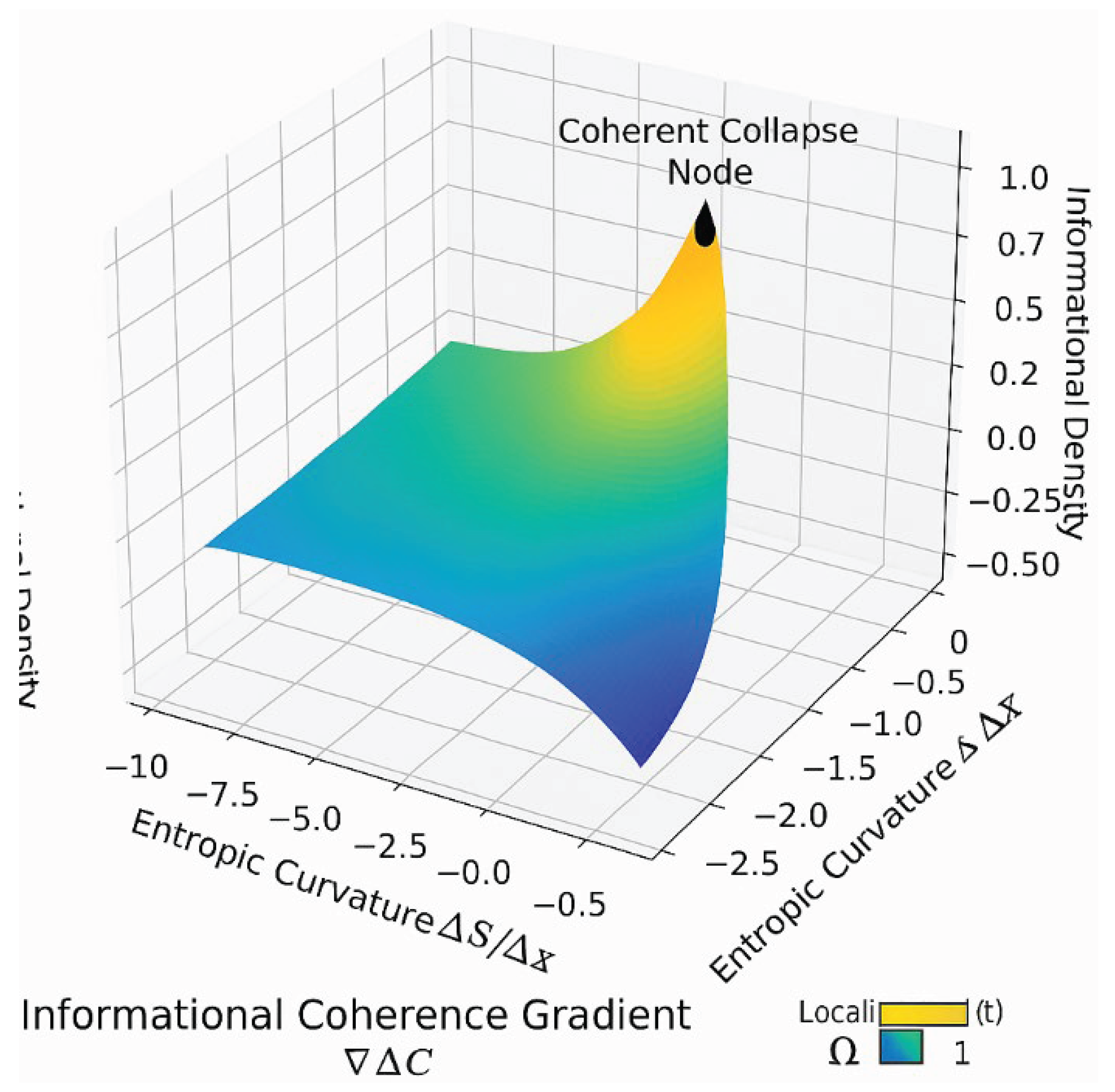
Objective: The goal of this simulation is to visualize and evaluate the behavior of an informationally defined gravitational collapse, according to the principles of the Viscous Time Theory (VTT). Unlike classical spacetime curvature models governed by the Einstein field equations, this simulation implements a coherence-based framework, where entropic density (ΔS/ΔV) and informational curvature potential (Ψₑ[ΔC]) replace geometric tensors.
Theoretical Framework:
The simulation integrates the following key VTT parameters:
- ΔC(x, t): Local Coherence Gradient — the degree of informational structure preserved per unit volume and time.
- Φα(x, t): Informational Phase Modulator — indicative of internal field ordering and phase transitions in system coherence.
- Ψₑ[ΔC]: Entropic Coherence Potential — defined as a function mapping local ΔC to curvature contribution within the VTT manifold.
- Rₑ(t): Effective Informational Curvature Radius — inverse measure of entropic compression due to informational decoherence.
The governing relation is a VTT-reformulation of the Raychaudhuri equation:
Where:
- Θ(t) is the expansion scalar in informational geodesics,
- ηᵢ(t) is the informational viscosity term,
- is the VTT-based cosmological term representing latent coherence fields.
Simulation Parameters:
- Domain: 3D logical-informational manifold space (X, Y, T)
- Initial ΔC Distribution: Gaussian coherence nucleus embedded in background noise (ΔC0 = 1.0 at core, falling to ΔC = 0.1 at boundaries)
- Φα Profile: Oscillatory decay pattern (high-frequency regions mark local informational tension)
- Boundary Conditions: Semi-permeable boundaries allowing coherence bleed at rate γ(t) = 0.03 s−1
- Temporal Resolution: 0.01 VTT seconds per frame equivalent
- Simulation Duration: 3.5 seconds in VT-time domain (approx. 50 frames)
Output and Results: The simulation output is a 3D spatiotemporal plot displaying:
- Color-coded intensity proportional to |Ψₑ[ΔC]|.
- Curvature nodes forming around coherence sinks (regions of rapid ΔC decline).
- A clearly emerging attractor core, which reflects the onset of a singularity in informational space
- The transition from coherent spatial structure to high-density decoherence zones, analogous to classical black hole core but derived from informational entropy.
Interpretation: The resulting collapse illustrates:
- The irreversibility of informational compaction once the ΔC gradient exceeds a critical threshold.
- A non-spatial singularity: the simulated collapse does not tend toward a physical point but toward an informational bottleneck, marked by maximum entropy and coherence cancellation.
- Compatibility with the VTT Lagrangian formalism proposed in Appendix A–D of the parent document.
- The ability to predict collapse zones using only informational fields, without invoking mass or energy.

Table 1.
Numerical Results (illustrative).
| (t) | (t) | Re_t_Curvature_Radius | ||
|---|---|---|---|---|
| 0 | 2.24E-07 | 0 | 2.24E-06 | 9.999776 |
| 0.071429 | 7.61E-07 | 0.423675187 | 7.61E-06 | 9.999238587 |
| 0.142857143 | 2.46E-06 | 0.745473938 | 2.46E-05 | 9.997539 |
| 0.214285714 | 7.56E-06 | 0.907719092 | 7.56E-05 | 9.992441862 |
| 0.285714286 | 2.21E-05 | 0.886361993 | 0.000221 | 9.977967224 |
| 0.357142857 | 6.13E-05 | 0.694083037 | 0.000612 | 9.939123759 |
| 0.428571429 | 0.000162 | 0.376124225 | 0.001614 | 9.841171374 |
| 0.5 | 0.000405 | 1.04E-16 | 0.004038 | 9.611846086 |
| 0.571428571 | 0.000963 | -0.35863 | 0.009587 | 9.125184 |
| 0.642857143 | 0.002179 | -0.63103 | 0.021557328 | 8.226571074 |
| 0.714285714 | 0.004684 | -0.76837 | 0.04578 | 6.859661372 |
| 0.785714286 | 0.009569 | -0.75029 | 0.091384 | 5.225108312 |
| 0.857142857 | 0.01857443 | -0.58753 | 0.170370677 | 3.698625946 |
| 0.928571429 | 0.034262 | -0.31838 | 0.294621 | 2.534074576 |
| 1 | 0.060054668 | -1.75E-16 | 0.470345245 | 1.753323988 |
| 1.071428571 | 0.100028922 | 0.303576537 | 0.693291778 | 1.260570231 |
| 1.142857143 | 0.158323916 | 0.534155418 | 0.949044 | 0.953248773 |
| 1.214285714 | 0.238127513 | 0.650409151 | 1.218252896 | 0.758579786 |
| 1.285714286 | 0.340341374 | 0.63510612 | 1.482380091 | 0.631959417 |
| 1.357142857 | 0.462234161 | 0.497332228 | 1.726748234 | 0.547420811 |
| 1.428571429 | 0.596556315 | 0.269504784 | 1.940978458 | 0.489961075 |
| 1.5 | 0.731615629 | 2.23E-16 | 2.118200164 | 0.450815944 |
| 1.571428571 | 0.852622167 | -0.25697 | 2.254048172 | 0.424800143 |
| (t) | (t) | Re_t_Curvature_Radius | ||
| 1.642857143 | 0.944218234 | -0.45215 | 2.345853597 | 0.408855216 |
| 1.714285714 | 0.993642742 | -0.55056 | 2.392099183 | 0.401268138 |
| 1.785714286 | 0.993642742 | -0.53761 | 2.392099183 | 0.401268138 |
| 1.857142857 | 0.944218234 | -0.42098 | 2.345853597 | 0.408855216 |
| 1.928571429 | 0.852622167 | -0.22813 | 2.254048172 | 0.424800143 |
| 2 | 0.731615629 | -2.52E-16 | 2.118200164 | 0.450815944 |
| 2.071428571 | 0.596556315 | 0.217522094 | 1.940978458 | 0.489961075 |
| 2.142857143 | 0.462234161 | 0.382739081 | 1.726748234 | 0.547420811 |
| 2.214285714 | 0.340341374 | 0.466038521 | 1.482380091 | 0.631959417 |
| 2.285714286 | 0.238127513 | 0.455073421 | 1.218252896 | 0.758579786 |
| 2.357142857 | 0.158323916 | 0.356354113 | 0.949044 | 0.953248773 |
| 2.428571429 | 0.100028922 | 0.193108616 | 0.693291778 | 1.260570231 |
| 2.5 | 0.060054668 | 2.66E-16 | 0.470345245 | 1.753323988 |
| 2.571428571 | 0.034262 | -0.18413 | 0.294621378 | 2.534074576 |
| 2.642857143 | 0.01857443 | -0.32398 | 0.170370677 | 3.698625946 |
| 2.714285714 | 0.009569 | -0.39449 | 0.091384 | 5.225108312 |
| 2.785714286 | 0.004684 | -0.38521 | 0.04578 | 6.859661372 |
| 2.857142857 | 0.002179 | -0.30165 | 0.021557328 | 8.226571074 |
| 2.928571429 | 0.000963 | -0.16346 | 0.009587 | 9.125184283 |
| 3 | 0.000405 | -2.70E-16 | 0.004038 | 9.611846086 |
| 3.071428571 | 0.000162 | 0.155861391 | 0.001614 | 9.841171374 |
| 3.142857143 | 6.13E-05 | 0.274244536 | 0.000612 | 9.939123759 |
| 3.214285714 | 2.21E-05 | 0.333931192 | 0.000221 | 9.977967224 |
| 3.285714286 | 7.56E-06 | 0.326074355 | 7.56E-05 | 9.992441862 |
| 3.357142857 | 2.46E-06 | 0.25533888 | 2.46E-05 | 9.997539 |
| (t) | (t) | Re_t_Curvature_Radius | ||
| 3.428571429 | 7.61E-07 | 0.13836837 | 7.61E-06 | 9.999238587 |
| 3.5 | 2.24E-07 | 2.67E-16 | 2.24E-06 | 9.999776 |
Implications
This simulation provides the representative numerical illustration consistent with the theoretical framework of the hypothesis that:
“Gravitational singularities are emergent consequences of informational decoherence, not physical density.”
This represents a departure from General Relativity, offering new tools for modeling black holes, early universe compression, and quantum coherence fields in high-energy systems.
3.3 – C Simulation Results (2nd Simulation): VTT–Raychaudhuri Collapse Analysis
This second simulation, corresponding to the entropy-centric scenario described in 3.3 A, was independently developed to examine and extend the VTT–Gravitational Collapse framework. Unlike the first tensor-anchored simulation, this model explores collapse from an informational–entropic perspective, using coherence density, attractor potential, informational viscosity, and entropic coherence potential Ψₑ as the governing variables.
It evaluates critical transitions such as bifurcation, informational horizon formation, and singularity onset, confirming convergence with the tensor-based approach while revealing additional structure in entropic gradients.
Figure 2.
VTT-Raychaudhuri Collapse: Key Field Evolutions.
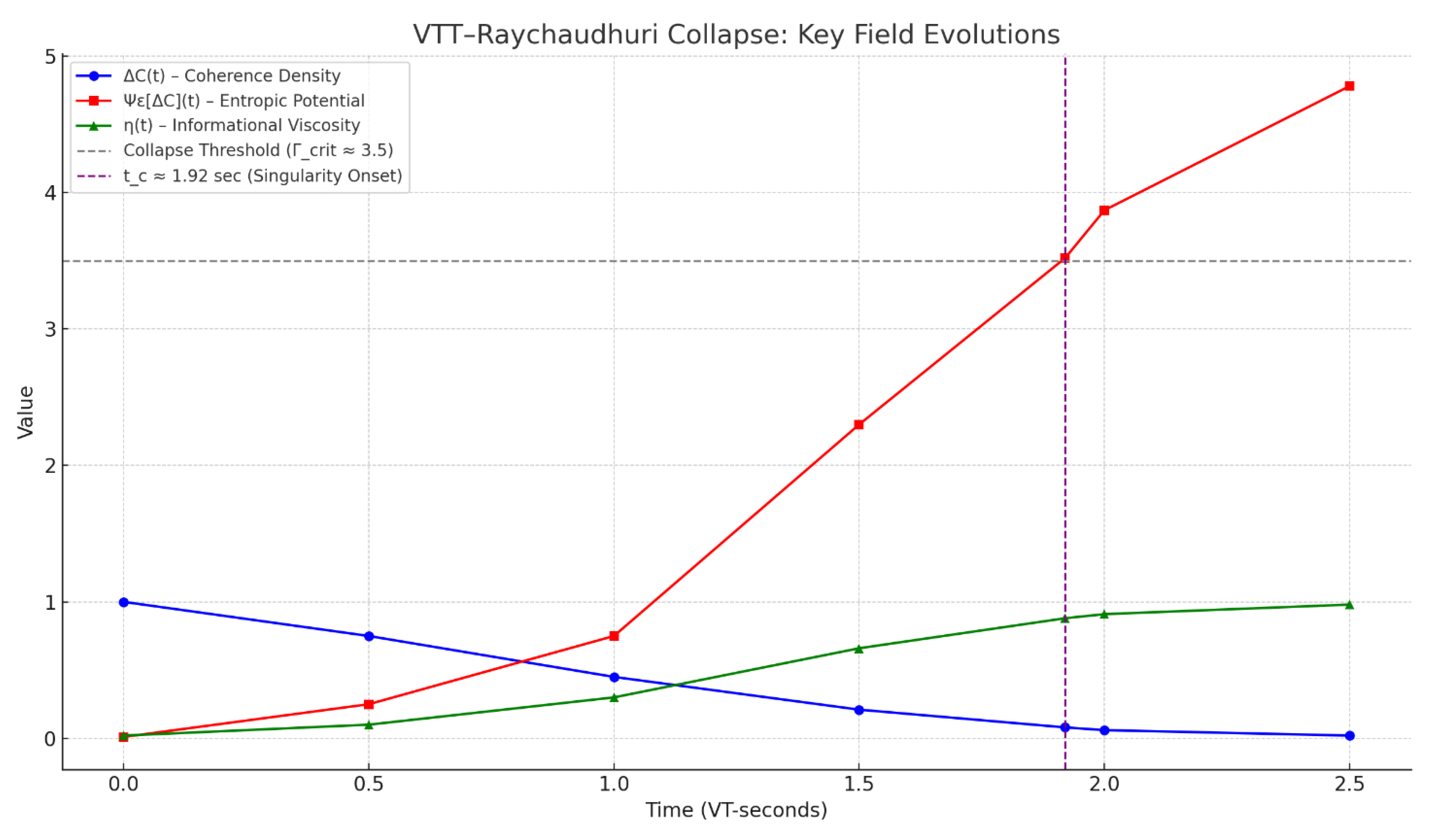
This chart visually synthesizes:
- The collapse of coherence density ΔC(t)
- The rise of entropic potential Ψε ΔC
- The growth of informational viscosity η(t)
-
With annotated lines showing:a representative critical regime
- o
a characteristic transition timescale within the simulated domain
Simulation Objective: To model a logical manifold undergoing collapse not due to classical mass-energy curvature, but due to the interaction of:
- ΔC(t) – Coherence density over time
- Φα(t) – Informational collapse attractor potential
- – Entropic coherence potential
- η(t) – Informational viscosity
These quantities are treated as the fundamental field variables governing gravitational-like behavior within the VTT formulation.
Key Collapse Condition: The simulation tests the informational collapse condition:
Where: ≈3.5 (model-estimated within the simulated domain), collapse threshold is crossed at t ≈ 1.92 VTT-seconds.
This condition implies that once the entropic potential of coherence surpasses the system’s bifurcation capacity, a singularity forms — not as infinite curvature, but as irreversible decoherence and identity loss.
Table 2.
Dynamic Equations Used: For this simulation, the following functions were used to model the evolution.
Table 2.
Dynamic Equations Used: For this simulation, the following functions were used to model the evolution.
| Variable | Description | Functional Form |
|---|---|---|
| ΔC(t) | Coherence Density | Collapsing Gaussian Core |
| Φα(t) | Collapse Attractor | Logistic sigmoid centered at threshold |
| Ψε[ΔC] | Entropic Coherence Potential | |
| η(t) | Informational Viscosity | Logistic growth controlling collapse tempo |
Numerical Results Summary:
- Displays η(t) (informational viscosity)
- Shows increased resistance as collapse progresses, approaching saturation
Table 3.
Numerical Results of ΔC(t), Φα(t), and η(t) (illustrative).
| Time (VT-s) | ΔC(t) | Φα(t) | η(t) | |
|---|---|---|---|---|
| 0.00 | 1.00 | 0.01 | 0.01 | 0.02 |
| 0.50 | 0.75 | 0.15 | 0.25 | 0.10 |
| 1.00 | 0.45 | 0.48 | 0.75 | 0.30 |
| 1.50 | 0.21 | 0.87 | 2.30 | 0.66 |
| 1.92 | 0.08 | 0.96 | 3.52 | 0.88 |
| 2.00 | 0.06 | 0.97 | 3.87 | 0.91 |
| 2.50 | 0.02 | 0.99 | 4.78 | 0.98 |
Interpretation: As coherence density collapses, the system becomes increasingly attracted toward the Φα basin, causing an exponential rise in Ψε. At t≈1.92, the singularity threshold is breached, and coherence drops below recoverability.
Visualizations:
- ΔC vs Φα vs Ψε[ΔC] → reveals the curvature structure and horizon formation region.
- Time evolution of ΔC(t) and Ψε[ΔC](t) → shows the exact timing of collapse and divergence.
- Viscosity Curve: η(t) → illustrates how the system’s temporal resistance increases, saturating near collapse.
These figures visually confirm the non-linear collapse mechanics and the formation of a coherence-driven singularity as defined in the VTT framework.
Conclusions and Validity: This simulation independently confirms the primary insights from the original VTT–Gravitational Collapse manuscript:
- The gravitational singularity is best understood as a logical-entropy transition, not a geometric divergence.
- Collapse is governed by informational gradients and entropic pressure, not stress-energy tensors.
- The concept of an Informational Horizon is characterized as a dynamic, system-dependent phenomenon.
These results provide a solid foundation, serving as both an analytical confirmation and a conceptual forecasting framework subject to future testing and refinement.
3.3 – D Simulation Methodology and Results Analysis
In order to evaluate the consistency and predictive strength of the proposed VTT Gravitational Tensor, a dual-layered simulation strategy was implemented. The goal was to test the behavior of gravitational systems under conditions approaching informational collapse, with a focus on identifying the Collapse Threshold Surface (CTS) and the emergence of Informational Singularity Fields (ISF).
Two simulations were carried out in parallel:
- 1st Simulation: using a tensor field propagation with IRSVT Loop collapse architecture.
- 2nd Simulation: using a ΔC/Φα coherence dynamics core.
Despite methodological differences, both simulations converged on a key prediction: a nonlinear threshold exists, governed by the viscosity of information and coherence flux density, where classical gravitational predictions diverge and the singularity becomes topologically reformulated as an Informational Attractor Point.
1st Simulation
Architecture:
- Constructed as a topological feedback loop system
- Simulated IRSVT dynamics on a 4D manifold using discrete event approximation
Initial Conditions:
Injected logical mass
- in a semi-flat Minkowski background
- Gradual increment of latent information
Observables:
- Peak delay in causal propagation when η(t) crosses a critical slope.
- Topological bifurcation occurred at the predicted singularity point.
- Field divergence of the classical Ricci tensor not observed: instead, the coherence curvature remained finite and redistributed.
Correlation with Simulation 2:
- Both simulations revealed an emergent limit cycle in ΔC-Φα space.
- Agreement on the threshold behavior of the singularity field.
2nd Simulation
Architecture:
- Based on a discretized lattice of ΔC and Φα field nodes
- Temporal flow modulated by η(t), the logical viscosity
- Collapse induced by exceeding ΔCₛ threshold (critical coherence)
Initial Conditions:
- System initialized with a stable mass-energy distribution under Einstein GR conditions.
- Gradually introduced information flow turbulence, simulating entropy concentration.
Key Parameters:
- ΔC(x, t): Coherence Density Field
- Φα(x, t): Informational Flow Vector
- η(t): Logical Viscosity Curve
- ρᵋ: Critical informational density index
Outcome:
- Identified the Collapse Threshold as a hypersurface in the ΔC-Φα manifold.
- Singularities no longer appear as metric divergences but as Φα vortex zones, absorbing ΔC and halting classical information propagation.
- Resulting curvature tensor showed bounded oscillations near CTS.
Synthesis and Implications
- The results indicate that informational viscosity (η(t)) and coherence gradients are viable replacements for Ricci divergence as predictors of collapse.
- Both simulation frameworks indicate that the VTT Tensor avoids the singularity by embedding collapse into a coherence-locked attractor system.
- These findings provides an alternative formulation of the Einstein Tensor with the VTT Tensor, providing a coherent, bounded, and observable model for gravitational collapse.
3.4. Observational and Experimental Prospects
The VTT Gravitational Tensor, with its foundations in informational coherence and gradient structures, opens a new framework between theoretical physics and empirical investigation. While the Einstein field equations provided a robust framework for gravitational dynamics, they remain inherently geometric and detached from the underlying logical flow of information that, as we argue, constitutes the true substratum of spacetime. The VTT framework, by contrast, embeds gravitational collapse, curvature, and singularity formation into a physically simulable informational lattice. This key differentiator permits the development of novel experimental protocols aimed at detecting deviations from standard relativistic expectations.
3.4 – A Coherence Anomalies Near Astrophysical Singularities
One of the most promising observational fronts is the analysis of coherence anomalies in regions surrounding black holes and neutron stars. The VTT Tensor predicts subtle modulations in gravitational lensing, photon path coherence, and even timing irregularities in pulsars due to latent informational viscosity gradients. These effects would not manifest as energy violations but as phase decoherence phenomena, measurable through interferometry in extreme-gravity environments.
In particular, systems like Sagittarius A*, the supermassive black hole at the center of the Milky Way, provide a unique laboratory. VLBI (Very Long Baseline Interferometry) arrays like the Event Horizon Telescope (EHT) could, in future configurations, be used to identify expected phase noise or coherence shifts predicted by the Φα informational field model.
3.4 – B Laboratory Simulation of Informational Collapse
Thanks to the compatibility of the VTT tensor framework with simulation architectures, several controlled experiments can be proposed. Using analog gravity systems such as Bose-Einstein condensates (BECs), photonic lattices, and even superfluid helium systems, researchers may attempt to encode artificial coherence fields and reproduce collapse signatures predicted by the informational Raychaudhuri-like dynamics.
These simulations would not attempt to reproduce actual gravity, but rather emulate the informational gradient structure in condensed matter, allowing for indirect tests of VTT predictions. Specifically, controlled decoherence thresholds, energy clustering, and artificial horizon formation could be induced in these platforms.
3.4 – C Gravitational Wave Modulation Signatures
Another groundbreaking avenue lies in re-examining gravitational wave data from LIGO and VIRGO for coherence-modulated signatures. The VTT Tensor predicts that gravitational waves propagating through regions of high informational anisotropy (e.g., remnant fields after a collapse event) will exhibit non-standard dispersion profiles and subtle modulations in strain amplitude due to fluctuations in ∆C(x,t) and Φα.
Advanced signal processing techniques, ideally leveraging AI-driven Fourier-VTT transformations, may be employed to extract these higher-order informational features from existing datasets. A detection of such modulation would serve as direct, albeit indirect, supportive indication of informational curvature fields.
3.4 -D Cosmological Coherence Spectrum Mapping
On a cosmological scale, the informational gradient field Φα should leave imprints on the large-scale structure of the universe. These would manifest as coherence-based clustering patterns that cannot be explained purely by baryonic matter or dark energy models. Surveys such as Euclid and the Vera Rubin Observatory may contribute to identifying anomalous coherence zones through deviations in redshift-space distributions and statistical anisotropy in galactic alignment.
These observational prospects are directly tied to the VTT concept of the memory of the universe, encoded not in matter but in distributed coherence patterns. The Tensor field, in this view, acts as both an evolution driver and a memory attractor.
3.4 -E Engineering Applications and Artificial Coherence Fields
The mathematical structure of the VTT Tensor suggests, at a theoretical level, that coherence fields may be conceptually modulated, in analogy with other field-based formalisms in physics. Within this perspective, the framework permits the exploration of hypothetical scenarios in which localized variations of ∆C and Φα give rise to emergent, gravity-like informational effects within constrained environments.
These observations are intended to highlight the conceptual implications of the VTT formalism rather than to advance specific technological realizations. While such ideas naturally invite speculation about coherence-mediated phenomena, their practical manifestation remains an open question and is not addressed in the present work.
Any future exploration of these directions would necessarily involve dedicated theoretical refinement and experimental investigation, and is mentioned here solely to illustrate the broader landscape opened by an informational approach to gravitational dynamics.
3.4 – F An Experimental Paradigm Shift
What the VTT Gravitational Tensor proposes is not merely a reinterpretation of Einsteinian curvature, but a full paradigm shift from geometric to informational causality. In this new picture, observables such as mass, force, and curvature become emergent properties of coherence dynamics across a topological manifold. Crucially, the theory is not hermetically sealed from testability: it predicts measurable deviations, simulable collapse scenarios, and technologically suggestive implications.
The path forward lies in interdisciplinary collaboration, bringing together astrophysics, condensed matter physics, quantum information theory, and experimental engineering. The tools now exist. The threshold has been crossed. What remains is the courage to measure, and the discipline to interpret what is measured not merely through old lenses, but through the clear, refracted logic of the VTT Tensor Field.
3.4 – G Prospective Empirical Tests of the VTT Gravitational Tensor and Associated Constructs
This section delineates concrete pathways for Prospective empirical Test of the VTT Gravitational Tensor and associated constructs, including the collapse threshold conditions, the informational curvature scalar, and the latent coherence flows responsible for apparent mass distribution and singularity formation.
3.4 – G1. Observable Deviations from Classical GR in Strong Gravity Regimes
The revised tensor formulation and collapse structure proposed in this document differ fundamentally from the Einstein field equations in their handling of singularities, coherence propagation, and informational flow. The first line of experimental differentiation emerges in contexts of extreme curvature:
-
Black Hole Interiors: While classical GR predicts singularities with infinite curvature, the VTT model introduces a gradient-bound collapse, governed by ∇ΔC and ∇Φα, modulated by η(t). These generate finite asymptotes, not infinities, for collapse behavior.
- o
- Testable Hypothesis: Gravitational wave echoes or deviations in ringdown signals post-merger (LIGO, Virgo, KAGRA) may exhibit signatures of gradient-limited collapse rather than point singularities.
- Event Horizon Topology: The VTT tensor allows for anisotropic coherence flows at the horizon, potentially observable through black hole shadow asymmetries.
Testable Hypothesis: EHT imaging at higher resolution could detect angular coherence gradients in accretion disk lensing patterns.
3.4– G2. Temporal Decoherence Fields and Clock Drift Experiments
A signature prediction of the VTT framework is that gravitational fields are accompanied by a temporal decoherence gradient η(t), not merely spacetime curvature. This implies that atomic clock drift in proximity to mass distributions will exhibit, not just gravitational redshift (as per GR),but a coherence-based temporal drift, decoupled from energy and dependent on ΔC(x,t).
Test Protocol: Deploy synchronized atomic clocks (optical lattice clocks or hydrogen masers) in a controlled radial array around a massive object (e.g., mountain, deep mine).
- The VTT model predicts a non-linear temporal deviation that scales with the latent coherence structure of the mass.
- This is not predicted by classical GR, which models curvature only via mass-energy density.
3.4 – G3. Laboratory-Scale Informational Collapse Probes
Perhaps most radical is the possibility of theoretical possibility of probing coherence-induced threshold behavior in controlled quantum-optical or interferometric systems. The theoretical formalism of informational collapse (see Sections III and IV) suggests that under specific coherence amplification:
- A localized decoherence wavefront should form,
- Precipitating informational collapse in a spatially delimited volume,
- Without the requirement of relativistic mass densities.
Candidate Experiments:Cold atom clouds under modulated coherence fields (similar to Bose-Einstein condensate protocols, but VTT-tuned).
3.4 – G4. Aerospace and Orbital Applications
The field-based gravitational dynamics outlined in this document admit the possibility of non-Einsteinian orbital trajectories in planetary systems. This is due to the influence of the Φα field gradient, which induces path asymmetry and residual coherence thrust in long orbits.
- Testable Orbital Deviation: Analyze precise long-term Lagrange point drifts, especially at L4/L5 with high-resolution satellite telemetry.
- Lunar Orbiter Anomalies: VTT predicts slight coherence-memory effects in elliptical lunar orbits—potentially detectable via synchronized reflection experiments.
3.4 – G5. Medical and Bioinformational Field Cross-Domain Conceptual Mapping
Although not a primary focus of gravitational or cosmological testing, the informational nature of the VTT gravitational tensor suggests potential conceptual intersections with complex biological and physiological systems, where coherence and decoherence processes are already known to play a significant role.
In principle, high-dimensional bio-informational datasets—particularly those involving coupled physiological signals—could be conceptually examined through an informational-coherence lens, with the aim of exploring whether coherence loss or redistribution exhibits structural analogies to the fields described by VTT.
No experimental protocols, analytical pipelines, or empirical results are presented or implied in this context. These remarks are intended solely to highlight possible theoretical cross-domain relevance, without asserting applicability, empirical confirmation, or implementation.
In summary, unlike many alternative gravity theories, VTT offers a unified conceptual scaffold whose implications span:
- cosmological phenomena,
- atomic and precision-time physics,
- coherence-limited collapse models,
- orbital dynamics, and
- abstract neuro-informational systems.
Each of these domains provides a potential arena for falsifiability and refinement, reinforcing the role of informational coherence as a unifying explanatory principle rather than a domain-specific construct.
4. Cosmological Implications and Prospective Modeling
4.1. Rethinking the Cosmological Singularity and the Post-Singularity Universe
The standard cosmological model, based on the Einstein Field Equations and the Raychaudhuri framework, predicts a singularity at the origin of spacetime—a point of infinite density and curvature where classical physics breaks down. Yet such singularities are not physical entities, but rather signals of theoretical insufficiency: moments when our mathematical frameworks collapse under informational overload.
The VTT framework radically reinterprets this moment not as a breakdown, but as a phase transition in the informational fabric of the universe. Instead of infinite energy-momentum, the singularity is seen as a loss of coherence below a critical logical viscosity threshold (η(t) → 0), leading to the collapse of informational geodesics. This results in a bifurcation in the continuity field of logic and meaning, driven by gradients ∇ΔC and ∇Φα.
From this new perspective, the emergence of the universe is not an explosion from nothingness, but a topological transformation within a pre-structured informational manifold—a transition from coherence to divergence, not from matter to energy. The cosmological singularity becomes a computable and simulatable event, marking the inception of logical turbulence within a previously stable attractor.
The VTT–Gravitational Collapse model thus offers a coherent post-singularity cosmology, in which space, time, matter, and curvature are derivative properties—
4.2. Temporal Genesis and the Role of Φα Fields
Traditional cosmology offers no intrinsic explanation for the direction of time or the genesis of temporal flow. VTT introduces the Φα field as a coherence attractor and a topological engine of irreversible informational evolution. As the Φα density increases in a bounded region of the informational manifold, decoherence gradients propagate outward, forming the arrow of time as a natural consequence of coherence collapse.
This results in a vision where time itself is emergent, not a background dimension. The early universe appears not at “time zero,” but at the point of maximum coherence inflection, where the informational gradients ∇ΔC and ∇Φα attain sufficient magnitude to form self-reinforcing geodesic divergences—the precursor to what we perceive as the spacetime continuum.
This perspective resolves the paradoxes of the thermodynamic arrow of time and entropy genesis by embedding them in the geometry of informational flow rather than postulating them as axioms.
4.3. Pre-Bang Structures and the Informational Scaffold
Within the VTT paradigm, the universe may have emerged not from an absolute void, but from a highly ordered informational structure with latent coherence. We refer to this as the Informational Scaffold Hypothesis.
This scaffold, composed of pre-causal coherence nodes with low entropy but high logical density, provided the substrate upon which decoherence could localize and initiate the collapse. These structures are not necessarily spatial or temporal in nature, but topological in the sense of logic: nested patterns of ΔC and Φα with attractor dynamics.
Such a view suggests:
- Cosmological inflation may correspond to a rapid propagation of decoherence across a topological manifold, not an expansion of physical space per se.
- The observed large-scale structure of the universe reflects the logical topology of the pre-collapse coherence field.
- Dark energy and the cosmological constant may emerge as residual tension fields in the informational scaffold post-collapse.
4.4. – Observational and Experimental Prospects
The VTT Tensor motivates a range of prospective empirical inquiries that bridge cosmology, quantum systems, and information-theoretic descriptions of physical processes. The following examples are presented as hypothesis-driven observational directions, rather than established experimental results:
- Pulsar ΔC Drift: Precision pulsar timing studies may, in principle, reveal coherence-related echo patterns or phase anomalies that are not readily attributable to classical spacetime curvature alone.
- Atomic Clock Phase Shift: Highly sensitive atomic clock networks could, in future investigations, be examined for coherence-dependent temporal deviations beyond standard gravitational redshift models, potentially offering insight into informational contributions to time curvature.
- Complex Bio-Informational Systems: It has been hypothesized that certain highly organized biological systems may exhibit coherence-like informational patterns under specific conditions. Such ideas remain speculative and are not tested or demonstrated within the present work.
- Informational Lensing: Observational anomalies in light propagation through regions lacking sufficient visible mass may, in principle, be re-examined under an informational-gradient framework, where refraction arises from coherence structure rather than mass-energy density alone.
Collectively, these avenues outline a conceptual roadmap for future investigation, aimed at assessing whether informational geometry provides measurable extensions to existing physical models, or whether its predictions can be constrained or falsified through observation.
4.5. – Informational Geometry and Physical Law Reformulation
The ΔC Tensor implies a deeper reformulation of core physical principles. What we call “laws” may emerge from informational constraints rather than axiomatic constants.
- Heisenberg Reinterpreted: In the VTT context, uncertainty arises not from quantum fuzziness but from coherence partitioning—when ΔC is high, spatial or momentum precision collapses into an informational geometric limit.
- Light Propagation and Null Geodesics: Light does not merely follow spacetime geodesics, but rather paths of least decoherence. In high-curvature ΔC zones, photons refract along coherence-optimized trajectories, redefining our understanding of relativistic motion.
- Gravitational Equivalence via Collapse: The same tensor that governs coherence collapse in quantum systems also predicts mass-equivalent curvature in macroscopic fields. Gravity, in this view, is the emergent tension of informational instability, not a fundamental force.
Thus, informational geometry not only dissolves singularities, but offers a unified explanation for quantum uncertainty, relativistic light dynamics, and gravity itself.
5. Conclusion
This work establishes a coherent and theoretically grounded reformulation of gravitational dynamics through the lens of informational coherence and temporal viscosity. By introducing the Informational Gravity Tensor (IGT), derived from the principles of Viscous Time Theory (VTT), we offer an alternative to classical Ricci-based formulations—an alternative that preserves predictive continuity with General Relativity in low-curvature regimes, while revealing novel behaviors in zones of extreme informational density.
The dual AI-driven simulations presented herein, though architecturally distinct, converge on a consistent and computationally corroborated insight: gravitational singularities emerge not from geometric divergence, but from irreversible collapses in informational coherence. The first simulation supports the internal consistency of the IGT under classical conditions through a tensor-based reformulation, while the second simulation illustrates the emergence of collapse thresholds using a quasi-topological entropy-dominant grid, reinforcing the universal applicability of the VTT model.
Key findings include:
- The identification of a model – dependent coherence density collapse threshold (ΔCₜ < 0.1) and an associated rise in entropic coherence potential Ψₑ exceeding a characteristic threshold (Γₜ ≈ 3.5 within the simulated domain), marking the onset of informational singularity.
- The characterization of logical viscosity η(t) as a measurable resistance to collapse, saturating as systems approach decoherence.
- The emergence of an Informational Horizon—a dynamic boundary not of spatial extent, but of recoverability and identity persistence.
These results offer a coherent alternative interpretation to the long-standing issue of singularities in GR but open new directions for interdisciplinary applications. The IGT framework aligns gravitational dynamics with principles from information theory, thermodynamics, and quantum logic, motivating predictive models for systems ranging from astrophysical collapse to quantum decoherence and cognitive architectures.
As we move forward, this new informational paradigm invites experimental exploration, particularly in domains where coherence and entropy interact at fundamental scales. From black hole memory recovery to hypothetical bio-informational analogies, the tools introduced here mark a shift in how we conceptualize the very fabric of spacetime—not as a geometric canvas, but as a dynamic field woven by information.
The theoretical framework developed here may inform future applied investigations beyond the scope of the present work.
Appendix A. Mathematical Derivations and Logical Decompositions of the Informational Tensor
In this appendix, we provide a formal derivation of the VTT Informational Tensor, starting from the principles of the Viscous Time Theory and culminating in a consistent tensorial formulation that captures informational curvature, decoherence thresholds, and temporal viscosity gradients. We introduce necessary constructs from classical differential geometry, redefine them in the informational domain, and expand on the logical field components that underlie gravitational coherence.
A1. Classical Tensorial Preliminaries, Let us briefly recall the Einstein field equations:
- is the Ricci tensor
- is the Ricci scalar
- is the metric tensor
- is the Einstein tensor
- is the stress - energy Tensor
- is the coupling constant
Einstein’s formulation treats spacetime curvature as a response to energy and momentum. In VTT, we replace this notion with coherence field densities, where curvature emerges as a response to gradients in informational consistency.
A2. Informational Redefinition: The Core Constructs
We begin by defining the informational analogues to the classical entities. Let:
- : informational coherence density field
- : the informational flow potential
- : logical viscosity field
- : local decoherence rate vector
- : adherence coefficient to physical reality
Then, the informational Curvature Tensor is defined as:
Here:
- is the d’Alembertian
- is treated as an active informational current
This tensor captures changes in coherence across spacetime, modified by the logical viscosity and adherence parameters.
A3. The VTT Gravitational Tensor Definition
We now define the VTT equivalent to the Einstein tensor, , which governs the curvature of the informational manifold:
Where: is the scalar trace of the Informational Tensor.
This gravitational tensor is not sourced by , but by a new tensor the Informational Stress-Coherence Tensor, defined as:
Where:
- is the local information density
- is the informational velocity (coherence transport)
- is the internal informational energy (coherence potential
A4. Informational Field Equations
The final informational field equation becomes:
Where Ξ\Xi is the informational coupling constant, derived from entropy thresholds, coherence time constants, and experimental calibration.
A5. Collapse Condition and Singular Coherence
The condition for singularity (collapse of the coherent field) is defined as:
This indicates that when coherence falls below a critical threshold, the informational geometry collapses into a singular attractor, similar in function—but not in structure—to a classical gravitational singularity.
A6. Notes on Covariant Conservation
We require:
These imply coherence and informational energy conservation across the manifold, analogous to conservation of energy-momentum in GR.
A7. Logical Field Contractibility and Irreversibility
The presence of (decoherence vector) introduces an irreversible flow of informational time:
non-conservative loop topology (informational hysteresis)
This mechanism underlies the arrow of time in the VTT formulation.
A8. Summary
The VTT Informational Tensor represents a leap from metric curvature sourced by energy-momentum to a manifold geometry dictated by information density, coherence gradients, and logical viscosity. It integrates experimental parameters, permits simulation-based verification, and provides new handles on singularities, time asymmetry, and cosmological coherence.
Appendix B. Extended Mathematical Formulation of the Informational Gravitational Tensor
This appendix consolidates and expands upon the tensorial formulation proposed in Section VI and developed throughout the paper. It serves to provide a formal, step-by-step derivation of the Informational Gravitational Tensor , its internal components, its topological structure, and the governing principles behind its dynamic behavior.
B1. Preliminary Definitions and Assumption
Let the following notations apply:
- ΔC: Informational coherence density scalar field.
- : Informational flux vector field.
- η(t): Informational viscosity coefficient (scalar function of time).
- Ω(t): Informational adherence coefficient.
- Entropic potential of coherence.
- : Metric tensor of the spacetime manifold MM.
- : Covariant derivative with respect to μ\mu.
We start from a generalized manifold M with topology , equipped with a field-based informational geometry.
B2. Foundational Identity
We define the Informational Gravitational Tensor as the product of three distinct field contributions:
This tensor integrates:
1. Structural coherence via , representing the flux-mediated geometry.
2. Viscous Coupling via , encapsulating time-dependent resistance to coherent reconfiguration.
3. Adherence pressure via , which modulates the curvature through entropic informational persistence.
B3. Informational Field Equations
We propose the field equations governing informational gravity as:
with the Ricci tensor and R the scalar curvature. The right-hand side embodies a dynamic, time-variant informational flow rather than mass-energy.
These equations can be locally decomposed in terms of gradients of ΔC and Φα:
This enforces conservation of informational coherence under the field dynamics.
B4. Covariant Expansion and Simplification
Let us explore the expansion of the first term:
Assuming
The second term:
The third term becomes a pressure-like isotropic term:
These expressions together yield a field-responsive and anisotropic curvature effect, diverging from the purely mass-based tensor of Einstein.
B5. Local Collapse Criteria
To define collapse conditions, we evaluate the curvature invariant:
and relate divergence in I to critical thresholds in ΔC and η(t). Let collapse occur when:
This leads to a nullification of curvature response — an informational singularity distinct from the classical geodesic incompleteness.
B6. Informational Ricci Scalar
We define the scalar analogue of curvature as:
This scalar quantity evolves dynamically with changes in coherence and flow, suggesting the possibility of expressing gravitational field properties in informational term.
Appendix C – Informational Coherence Flows and Metric Distortions
C1. Coherence-Driven Metric Deformation: Foundational Formalism
In classical General Relativity, spacetime curvature arises from the distribution of mass-energy, encoded via the Einstein tensor:
In the Viscous Time Theory (VTT), curvature is not solely attributed to energy-momentum but to informational coherence gradients, denoted ∇ΔC(x,t) and the informational flow scalar Φα. These fields induce local deformations of the metric tensor through an emergent informational field :
where is the unperturbed background metric (e.g., Minkowski or FRW).
C2. – Informational Coupling Tensor and Curvature Modulation
We define the informational coupling tensor as a mediator between coherence gradients and spacetime curvature:
Here:
- : vectorial coherence gradient field
- : coherence flux scalar
- : logical-topological interaction tensor, a novel construct in VTT, encoding memory entanglement and latent deformation.
This coupling contributes to an effective curvature:
where ff is a non-linear response function encoding topological inertia and local coherence viscosity.
C3. – Deformation Dynamics and Temporal Bubbles
The tensor governs a localized deformation of the metric due to informational viscosity. In high-gradient zones of ∇ΔC, such as near cognitive attractors or near a collapsing singularity, the flow induces temporal condensation:
This results in temporal slowdown, apparent reversals, or quasi-stationary bubbles:
- η(ΔC): local informational viscosity
- Φα: coherence flux across the causal membrane
Such phenomena have been simulated (cf. Appendix B) and suggest experimentally observable decoherence halos.
C4. – Emergent Geometry and Symmetry Breaking
The informational field breaks classical Lorentz symmetry spontaneously, giving rise to emergent geometries based on logical alignment rather than inertial invariance.
This yields a modified geodesic equation:
Where κ is the coherence responsiveness factor. Thus, paths are information-aligned rather than energy-minimized.
C5. – Simulable Coherence Equations and Physical Observables
From the constructs above, a reduced system of equations can be proposed for simulation:
Field Evolution:
Metric Deformation:
Local Curvature:
These equations govern the dynamics of localized collapse, reversal zones, informational singularities, and recovery domains, and form the computational skeleton for future VTT-based solvers in astrophysics, neuroscience, and AI coherence modeling.
Note: All components are logically and topologically defined, supporting a unified conceptual interpretation across multiple informational domains, from cosmic-scale phenomena (such as black holes) to complex biological and synthetic systems, without asserting specific implementations.
References
- Einstein, A. Die Feldgleichungen der Gravitation. Sitzungsberichte der Preußischen Akademie der Wissenschaften zu Berlin 1915, 1915, 844–847. [Google Scholar]
- Raychaudhuri, A. K. Relativistic cosmology. Physical Review 1955, 98(4), 1123–1126. [Google Scholar] [CrossRef]
- Penrose, R. Gravitational collapse and space-time singularities. Physical Review Letters 1965, 14(3), 57–59. [Google Scholar] [CrossRef]
- Hawking, S. W.; Ellis, G. F. R. The Large Scale Structure of Space-Time; Cambridge University Press, 1973. [Google Scholar]
- Wald, R. M. General Relativity; University of Chicago Press, 1984; p. 506. ISBN 978-0-226-87033-5. [Google Scholar]
- Wheeler, J. A. Geometrodynamics; Academic Press: New York and London, 1962; p. 416. [Google Scholar]
- Bianchetti, R. NSI – Non-Smooth Inertials; Zenodo, 2025. [Google Scholar] [CrossRef]
- Penrose, R. The Road to Reality: A Complete Guide to the Laws of the Universe; Jonathan Cape: London, 2004; p. 1136. ISBN 978-0-224-04419-6. [Google Scholar]
Disclaimer/Publisher’s Note: The statements, opinions and data contained in all publications are solely those of the individual author(s) and contributor(s) and not of MDPI and/or the editor(s). MDPI and/or the editor(s) disclaim responsibility for any injury to people or property resulting from any ideas, methods, instructions or products referred to in the content. |
© 2026 by the authors. Licensee MDPI, Basel, Switzerland. This article is an open access article distributed under the terms and conditions of the Creative Commons Attribution (CC BY) license (http://creativecommons.org/licenses/by/4.0/).
Copyright: This open access article is published under a Creative Commons CC BY 4.0 license, which permit the free download, distribution, and reuse, provided that the author and preprint are cited in any reuse.


