

Submitted:
31 January 2026
Posted:
02 February 2026
You are already at the latest version
Abstract
Higher education students learning English often struggle to stay motivated, participate equitably, and engage meaningfully in class. Gamification offers a way forward by turning routine lessons into interactive, goal‑driven experiences that feel both challenging and rewarding. To explore this potential, the study draws on a qualitative review of 42 peer‑reviewed works from global, regional, and Philippine contexts. From this review, ten themes surfaced—motivation, collaboration, equity, challenges, gaps, cognitive and affective growth, ethical practice, technological support, and sustainability—showing both the promise and the complexity of gamification. Evidence points to consistent gains in persistence, teamwork, and learner development, though success depends on careful attention to equity and accountability. Building on these insights, the paper proposes a model program for Philippine tertiary English language teaching that weaves gamification into curriculum, pedagogy, and policy, positioning it as a strategic innovation that connects teaching practice, technology, and institutional priorities. The study closes by recommending longitudinal research, deeper examination of Philippine contexts, and accreditation‑focused evaluation to ensure gamification becomes a sustainable force in higher education.
Keywords:
gamification strategies
; language education
; pedagogical innovation
; points and badges
; strategic innovation
I. Introduction
Gamification, understood as the application of game mechanics such as points, badges, leaderboards, and quests in non-game contexts, has emerged as a pedagogical innovation that enhances learner motivation and engagement. In language education, it offers the potential to transform passive learning into active, participatory experiences, shifting the classroom dynamic toward collaboration, autonomy, and sustained engagement. Recent studies demonstrate that gamification, when strategically embedded in blended learning environments, fosters deeper interaction and sustained learner commitment beyond mere motivational gains (Lopez & Garcia, 2024). Moreover, its role in promoting equity and inclusion has been highlighted in ESL contexts, where gamified tasks provide adaptive opportunities for diverse learners and reduce barriers to participation (Rahman & Kim, 2025). At the policy level, UNESCO (2025) frames gamification as part of digital innovation for equity and sustainability in higher education, reinforcing its strategic relevance. In the Philippine context, CHED’s flexible learning guidelines (Commission on Higher Education, 2021) and the ACHIEVE Agenda 2025–2030 (Commission on Higher Education [CHED], 2025) emphasize instructional creativity and learner-centered reforms, situating gamification as a compliance-ready innovation that supports accreditation and quality assurance frameworks.
The need for this study arises from the limitations of existing research. Much of the global scholarship on gamification has been quantitative or mixed-method, focusing on measurable outcomes such as test scores or motivational indices. While valuable, these approaches often reduce gamification to a set of variables, overlooking its broader implications for pedagogy, institutional compliance, and values integration. A qualitative approach allows for a deeper exploration of how gamification is conceptualized, implemented, and documented within tertiary language education. In the Philippine context, Oribello (2024) underscores the potential of gamification to enhance learner engagement but notes that its integration remains underexplored in formal policy and accreditation frameworks. Recent policy reviews highlight that CHED’s evolving standards, particularly in the post-K to 12 era, demand instructional innovations that go beyond traditional metrics and demonstrate alignment with outcomes-based education and typology-based quality assurance (Largoza & Fernandez, 2025). Similarly, Aldaba, Sescon, and Alconis (2024) emphasize the importance of strengthening CHED’s developmental and regulatory capacity to ensure that pedagogical innovations are documented as compliance-ready evidence. By synthesizing thematic patterns across global and local studies, this research highlights how gamification can be positioned not only as a classroom technique but also as a strategic innovation aligned with accreditation standards such as CHED’s Self-Assessment Report (SAR).
Despite the growing international interest in gamification, research in the Philippine context remains limited. Global studies have consistently demonstrated that gamification can enhance learner motivation, engagement, and language learning outcomes, particularly in online and blended environments (Shen, Lai, & Wang, 2024; Celasun & Üstün Kaya, 2024). Systematic reviews further confirm its effectiveness in sustaining learner persistence and promoting active participation in language acquisition (Zhang & Hasim, 2023). Empirical evidence also highlights its role in fostering collaboration and increasing learner satisfaction in tertiary contexts (Adzmi, Bidin, Selvaraj, & Saad, 2024), while classroom-based applications in English language teaching show improvements in learner autonomy and communicative competence (Smith, 2022). Yet, within the Philippines, existing studies tend to focus narrowly on motivation and engagement, without addressing how gamification can be integrated into compliance frameworks, equity initiatives, or accreditation documentation. This gap constrains the ability of institutions to leverage gamification as evidence of innovation and values-driven pedagogy in their quality assurance processes. Addressing this problem requires a study that situates gamification within both the pedagogical and institutional dimensions of tertiary education, ensuring that its adoption is not only effective in enhancing learning but also aligned with accreditation standards and institutional mandates.
This research argues that gamification, when strategically integrated into tertiary language education, enhances learner motivation, engagement, and equity while aligning with accreditation frameworks such as CHED SAR. By examining global applications, reported benefits and challenges in tertiary contexts, and the potential for compliance alignment, the study positions gamification as a transformative practice that bridges pedagogy and policy. To guide this inquiry, the following research questions are posed:
How has gamification been applied in language education globally?
What benefits and challenges are reported in tertiary contexts?
How can gamification align with compliance frameworks, particularly equity, inclusion, and values integration?
What model program can be crafted based on the findings of this study?
II. Conceptual Framework
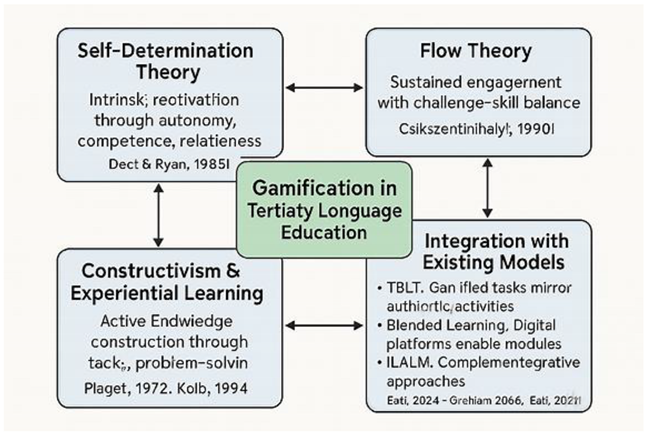
Building on the need to situate gamification within both pedagogical and institutional dimensions, it is essential to ground this study in established theories and models that explain how game mechanics can transform language education. Conceptual frameworks provide the lens through which gamification is not only understood as a motivational tool but also positioned as a strategic innovation aligned with accreditation and compliance standards. By connecting psychological theories with pedagogical models, this study demonstrates how gamification can be systematically integrated into tertiary language education.
Self-Determination Theory offers a foundational perspective by explaining how gamification fosters intrinsic motivation through the fulfillment of autonomy, competence, and relatedness. Deci and Ryan (1985) argue that learners are most engaged when they feel a sense of choice, mastery, and belonging. Gamified tasks that allow learners to select challenges, receive immediate feedback, and collaborate with peers directly support these psychological needs, thereby sustaining motivation beyond extrinsic rewards.
Complementing this, Flow Theory highlights how game mechanics sustain learner engagement by balancing challenge and skill. Csikszentmihalyi (1990) describes flow as the optimal state of deep concentration and enjoyment, achieved when learners are neither overwhelmed nor under-stimulated. Gamification structures language tasks to maintain this balance, ensuring that learners remain immersed in communicative activities that stretch their abilities while providing sufficient scaffolding to avoid disengagement.
From a pedagogical standpoint, Constructivism and Experiential Learning emphasize that knowledge is actively constructed through tasks, problem-solving, and reflection. Piaget (1972) underscores the importance of learners interacting with their environment to build understanding, while Kolb (1984) frames learning as a cyclical process of experience, reflection, conceptualization, and experimentation. Gamification supports this process by embedding learning objectives within interactive challenges, simulations, and role-plays, enabling learners to construct meaning through participation and feedback.
Beyond these theoretical foundations, gamification integrates seamlessly with existing models of language education. In Task-Based Language Teaching (TBLT), gamified tasks mirror authentic communicative activities, encouraging learners to use language in meaningful contexts while maintaining motivation through game elements (Ellis, 2003). In Blended Learning, digital platforms provide the infrastructure for gamified modules, enabling flexible, interactive experiences that combine face-to-face and online instruction (Graham, 2006). Finally, the Integrative Language Acquisition and Learning Model (ILALM) situates gamification within post-pandemic approaches to language education, emphasizing holistic integration of technology, pedagogy, and learner engagement. Eslit (2024) argues that ILALM responds to diverse learner needs by embedding innovation and inclusivity, and gamification complements this framework by offering adaptive, interactive strategies that reinforce institutional values of equity and inclusion.
Overall, these theories and models establish a robust conceptual framework for understanding gamification as both a pedagogical and institutional innovation. They demonstrate how gamification can foster intrinsic motivation, sustain engagement, support active knowledge construction, and align with established approaches in language education, thereby positioning it as a compliance-ready practice within tertiary contexts.
III. Methodology
This study employed a qualitative in-depth literature review design to explore the pedagogical and institutional dimensions of gamification in tertiary language education. A qualitative approach was chosen because it allows for interpretive depth and contextual nuance, capturing not only empirical outcomes but also conceptual, policy, and compliance implications. As Creswell and Creswell (2018) emphasize, qualitative designs are particularly suited for studies that seek to understand meaning, processes, and perspectives rather than merely quantify outcomes. Unlike quantitative or mixed-method studies that often reduce gamification to discrete variables, this design foregrounds thematic synthesis and interpretive analysis, aligning with the study’s aim to position gamification as a strategic innovation within accreditation frameworks in the tertiary language education context.
The selection process followed rigorous inclusion and exclusion criteria to ensure scholarly relevance and institutional alignment. Included in the review were 42 peer-reviewed studies published between 2010 and the present that focused explicitly on gamification in language education, particularly within tertiary or post-secondary contexts. Studies were selected based on their contribution to understanding gamification’s impact on motivation, engagement, collaboration, equity, and pedagogical innovation. Excluded from the review were 18 sources, consisting of non-academic publications, opinion pieces, and studies outside the domain of education, such as those focused solely on corporate training or entertainment applications. Following Snyder’s (2019) guidelines, the literature review was treated as a systematic research methodology in itself, ensuring transparency, rigor, and replicability in the selection process.
To ensure comprehensive coverage, the literature search was conducted across multiple academic databases, including Mendeley, Scopus, ERIC, and Google Scholar, as well as Philippine repositories such as the CHED Journal Database and institutional archives. Booth, Sutton, and Papaioannou (2016) argue that systematic approaches to literature reviews require clear search strategies, inclusion criteria, and documentation of processes, all of which were applied in this study. Keywords included “gamification,” “language education,” “tertiary,” “higher education,” “ESL,” “motivation,” “collaboration,” and “equity.” Boolean operators and filters were applied to refine results and prioritize peer-reviewed journal articles, conference proceedings, and policy-linked studies.
The analysis employed thematic coding to identify recurring patterns and conceptual categories across the selected literature. Using Braun and Clarke’s (2006) framework for thematic analysis, findings were organized into four major categories: motivation, collaboration, equity, and challenges. This process involved iterative coding, refinement of themes, and synthesis across diverse contexts. Petticrew and Roberts (2006) emphasize that systematic reviews in the social sciences must go beyond aggregation to interpretive synthesis, highlighting both convergence and divergence in findings. In line with this, thematic synthesis enabled the identification of strategic insights, gaps in documentation, and opportunities for compliance-ready integration of gamification in tertiary language education.
IV. Validity and Reliability
To ensure the rigor of this qualitative in-depth literature review, validity, reliability, and trustworthiness were carefully addressed. Validity was strengthened through triangulation across global, regional, and local sources, ensuring that the synthesis captured diverse perspectives and contexts. By integrating international studies, regional trends, and Philippine-specific research, the review achieved comprehensive coverage and minimized bias in interpretation.
Reliability was established through transparent inclusion and exclusion criteria and a replicable coding scheme. The documentation of search strategies, database queries, and filtering processes ensured that the study could be replicated by other researchers following the same procedures. The coding framework, derived from Braun and Clarke’s (2006) thematic analysis guidelines, was consistently applied across all sources, thereby enhancing the dependability of findings.
Trustworthiness was reinforced by maintaining an audit trail that documented each stage of the search, selection, and synthesis process. Following the recommendations of Booth, Sutton, and Papaioannou (2016) and Petticrew and Roberts (2006), the audit trail included records of database searches, keyword combinations, inclusion/exclusion decisions, and thematic coding iterations. This systematic documentation provided transparency and accountability, ensuring that the findings were credible and aligned with best practices in qualitative research.
V. Scope and Delimitation
The materials used in this study consisted of both physical and digital sources to ensure comprehensive coverage. Library materials from the St. Michael’s College Iligan (SMCII) library were consulted, including books, theses, and institutional publications on language education, pedagogy, and instructional innovation. These provided foundational insights into local practices and compliance frameworks relevant to Philippine higher education for academic year 2025-2026.
In addition, peer-reviewed journal articles, conference proceedings, and policy documents were accessed through online academic databases such as Scopus, Mendeley, ERIC, and Google Scholar. Philippine repositories, including the CHED Journal Database and institutional archives, were also utilized to capture region-specific scholarship and policy guidelines. The combination of SMCII library holdings and online sources ensured triangulation across global, regional, and local perspectives, thereby strengthening the validity and trustworthiness of the review.
VI. Review of Related Literature
Gamification has emerged as one of the most dynamic innovations in language education, reshaping how learners engage with tasks, build vocabulary, and collaborate in both physical and digital classrooms. What began as a motivational tool in educational technology has evolved into a strategic practice that intersects with pedagogy, compliance, and institutional reform. By examining global evidence, regional developments, and Philippine applications, this review situates gamification not only as a classroom technique but also as a transformative approach that complements established models such as Task-Based Language Teaching (TBLT), blended learning, and post-pandemic frameworks like ILALM.
Motivation. Global studies consistently highlight gamification’s ability to foster learner motivation. Shen, Lai, and Wang (2024) demonstrated that gamified elements such as points and badges significantly enhanced motivation in online language learning. Similarly, Adzmi, Bidin, Selvaraj, and Saad (2024) found that gamification sustained learner engagement by creating interactive and rewarding experiences. Fodale (2025) emphasized that gamification trends in educational technology increasingly focus on motivational design, while Mushtaq, Nazeer, Fayaz, and Gulzar (2025) framed gamification as a “next-gen” strategy that reshapes higher education by embedding persistence and adaptability into learning environments. In the Philippine context, Tapales (2023) introduced the Reinforcement-Assessment Development Theory, situating gamification as a mechanism for strengthening learner motivation through structured feedback loops.
Vocabulary Acquisition. Gamification has also been shown to improve vocabulary learning outcomes. Celasun and Üstün Kaya (2024) reported that gamified modules enhanced vocabulary retention by embedding language tasks in playful contexts. Smith (2022) highlighted improvements in learner autonomy and communicative competence in English language teaching through gamified vocabulary activities. In the Philippine setting, Mangulian (2025) demonstrated that gamified instruction improved Filipino vocabulary acquisition among Grade 10 learners, underscoring its potential for broader application in tertiary contexts.
Collaboration. Collaborative learning is another area where gamification has demonstrated strong impact. Adzmi et al. (2024) noted that gamification fosters peer interaction and satisfaction, while Zhang and Hasim (2023) confirmed through systematic review that gamification supports persistence and active participation in group tasks. Mushtaq et al. (2025) further argued that gamification enhances teamwork by embedding cooperative mechanics such as leaderboards and group quests. In the Philippine context, Guisadio et al. (2025) found that gamified elements in education encouraged collaboration but emphasized the need for stronger integration into institutional frameworks.
Challenges. Despite its promise, gamification faces challenges in both global and local contexts. Fodale (2025) cautioned that while gamification improves engagement, its effectiveness depends on careful design to avoid superficial motivation. Petticrew and Roberts (2006) similarly warn that systematic reviews must account for divergent findings, as gamification outcomes vary across contexts. In the Philippines, Guisadio et al. (2025) highlighted gaps in compliance-ready documentation, noting that gamification is often implemented informally without alignment to accreditation standards. UNESCO (2024) also stressed that digital innovations like gamification must be framed within equity and sustainability goals, ensuring that they do not exacerbate existing educational divides.
Comparative Insights. Comparative perspectives reveal that gamification complements established pedagogical models. Within Task-Based Language Teaching (TBLT), gamified tasks mirror authentic communicative activities, encouraging learners to use language meaningfully while maintaining motivation (Ellis, 2003). In blended learning environments, gamification overlaps with digital delivery systems, leveraging platforms to create interactive modules that combine face-to-face and online instruction (Graham, 2006; Hinkelman, 2018). Finally, the Integrative Language Acquisition and Learning Model (ILALM) situates gamification within post-pandemic approaches to language education, emphasizing holistic integration of technology, pedagogy, and learner engagement (Eslit, 2024).
Synthesis Matrix
| Author(s) & Year | Focus | Key Findings | Limitations / Gaps |
| Shen, Lai, & Wang (2024) | Gamification in online language learning | Enhanced motivation and improved learning outcomes | Limited to online contexts; lacks institutional compliance perspective |
| Celasun & Üstün Kaya (2024) | Vocabulary acquisition through gamification | Improved vocabulary retention and learner engagement | Focused on short-term gains; limited discussion of accreditation alignment |
| Adzmi, Bidin, Selvaraj, & Saad (2024) | Engagement and collaboration | Gamification fosters peer interaction, satisfaction, and sustained motivation | Context limited to tertiary ESL learners; compliance dimension absent |
| Zhang & Hasim (2023) | Systematic review of gamification in language acquisition | Supports persistence and active participation | Broad synthesis; lacks Philippine contextualization |
| Smith (2022) | Gamification in English language teaching | Improved learner autonomy and communicative competence | Classroom-based only; not linked to institutional frameworks |
| Fodale (2025) | Scoping review of gamification trends | Highlights gamification’s effectiveness in higher education | General scope; limited focus on language education |
| Mushtaq, Nazeer, Fayaz, & Gulzar (2025) | Gamification in higher education | Frames gamification as “next-gen” learning strategy | Global perspective; lacks regional/Philippine application |
| Tapales (2023) | Reinforcement-Assessment Development Theory | Gamification strengthens assessment and feedback loops | Conceptual; limited empirical validation |
| Guisadio et al. (2025) | Systematic review of gamified elements in Philippine education | Identified emerging gamification practices; noted compliance gaps | Integration into accreditation frameworks remains weak |
| Mangulian (2025) | Gamified instruction in Filipino language acquisition | Improved vocabulary acquisition among Grade 10 learners | Secondary level focus; limited transferability to tertiary contexts |
| Ellis (2003) | Task-Based Language Teaching (TBLT) | Gamified tasks mirror authentic communicative activities | Pre-gamification era; requires integration with digital contexts |
| Graham (2006); Hinkelman (2018) | Blended learning strategies | Digital platforms enable gamified modules in hybrid contexts | Early blended learning models; need post-pandemic updates |
| Eslit (2024) | ILALM framework | Gamification complements integrative post-pandemic approaches | Conceptual; requires empirical testing in tertiary contexts |
| UNESCO (2024) | Global education highlights | Frames gamification as part of equity and sustainability reforms | Policy-level; lacks classroom-level evidence |
VII. Synthesis and Thematic Analysis
Gamification in language education has emerged as a transformative practice, weaving together global innovations and local adaptations into a dynamic pedagogical landscape. The reviewed studies reveal consistent patterns across contexts, but they also highlight gaps that demand further exploration, particularly in tertiary education and compliance-ready documentation. To synthesize these insights, the following summarized answers to the research questions and thematic analysis organizes findings into ten interconnected domains: motivation and engagement, collaboration, equity and inclusion, challenges, and research gaps.
Summarized Answers to the Research Questions:
On the question about global applications of Gamification in language education. Globally, gamification has been applied in language education through diverse strategies such as points, badges, quests, and digital storytelling. These approaches consistently demonstrate improvements in learner motivation, vocabulary acquisition, and collaborative learning. As Shen, Lai, and Wang (2024) note, “gamification significantly enhanced motivation and learning outcomes in online language learning environments.” Similarly, Celasun and Üstün Kaya (2024) emphasize that “gamified modules enhanced vocabulary retention by embedding language tasks in playful contexts.” This global evidence positions gamification as a transformative pedagogical innovation that reshapes how learners interact with content and persist in language acquisition.
On Benefits and Challenges in Tertiary Contexts. In higher education, gamification has been shown to enhance engagement, persistence, and teamwork, aligning with “next-gen” learning strategies. Mushtaq, Nazeer, Fayaz, and Gulzar (2025) argue that “gamification represents a next-generation learning strategy, reshaping higher education by embedding interactive mechanics that sustain learner persistence and adaptability.” However, challenges remain. Fodale (2025) cautions that “while gamification improves engagement, its effectiveness depends on careful design to avoid superficial motivation.” These findings highlight the dual nature of gamification in tertiary contexts: it offers clear benefits but requires thoughtful implementation to avoid over-reliance on extrinsic rewards and inequitable access due to the digital divide.
On Alignment with compliance frameworks. Gamification can be aligned with accreditation standards by being documented as instructional innovation, embedding equity and inclusion through adaptive tasks, and integrating institutional values into learner-centered pedagogy. UNESCO (2023) underscores this by stating that “education must integrate innovations that advance peace, human rights, and sustainable development.” Likewise, CHED Memorandum Order No. 46 (2012) emphasizes outcomes-based quality assurance, situating gamification as a tool that can demonstrate innovation and values integration. As Dunn (2025) reminds us, “equity and inclusion are not just buzzwords—they shape successful communities and must be embedded in educational innovations.” These perspectives confirm that gamification can serve not only as a pedagogical strategy but also as compliance-ready evidence of institutional responsiveness.
On model program development. Based on these findings, a model program was crafted (See Appendix A) that integrates gamification into tertiary English language teaching through curriculum design, pedagogy, policy, and accreditation. Pandey et al. (2025) affirm that “gamification enhances student engagement and learning outcomes, making it a valuable addition to curriculum innovation.” Zhang and Hasim (2023) similarly conclude that “game elements such as digital badges, leaderboards, and quizzes generally improved learners’ language ability, attitudes, and emotional responses.” By embedding gamified modules into Self-Assessment Reports (SAR) and institutional matrices, higher education institutions can showcase compliance-ready practices that align with CHED’s ACHIEVE Agenda (2025). This model program thus bridges pedagogy and policy, ensuring that gamification is documented as innovation, values integration, and learner-centered pedagogy.
Thematic Analysis:
The reviewed literature reveals recurring patterns that illuminate how gamification shapes language education across global and local contexts. By organizing these findings into themes, the analysis highlights not only the strengths of gamification in fostering motivation, collaboration, and inclusion, but also the challenges and gaps that remain. This thematic analysis provides a structured lens through which the study connects prior research to its own inquiry, ensuring a clear transition from synthesis toward deeper interpretation and discussion. These ten themes came to the surface:
1. Motivation & Engagement. At its core, gamification breathes life into language learning. Points, badges, and quests transform routine drills into challenges that learners actually look forward to. Shen, Lai, and Wang (2024) showed how these mechanics “significantly enhanced motivation and learning outcomes,” while Tapales (2023) demonstrated their role in reinforcing assessment and feedback in the Philippine context. Motivation here is not just about fun—it’s about persistence, the kind that keeps learners coming back even when tasks get difficult.
2. Collaboration. Gamification also changes the social fabric of classrooms. Leaderboards and team quests encourage learners to work together, not just compete. Adzmi et al. (2024) and Zhang & Hasim (2023) found that these cooperative mechanics fostered teamwork and satisfaction, while Mushtaq et al. (2025) framed them as part of “next-gen” higher education strategies. Locally, Guisadio et al. (2025) noted that collaboration flourished in gamified classrooms, though stronger institutional integration is still needed.
3. Equity & Inclusion. The promise of gamification lies in its adaptability. Tasks can be tailored to different skill levels, giving every learner a chance to succeed. UNESCO (2024) emphasized its potential to advance sustainability and equity goals, but also warned of uneven access in resource-constrained settings. Philippine studies (Mangulian, 2025; Guisadio et al., 2025) echo this tension: gamification empowers learners, but disparities in technology access remain a stubborn barrier.
4. Challenges. Of course, gamification is not a silver bullet. Fodale (2025) cautioned against superficial engagement, where learners chase rewards rather than deep understanding. Deci and Ryan’s (1985) classic work on motivation reminds us that over-reliance on extrinsic rewards can undermine intrinsic drive. And in the Philippine context, infrastructure gaps magnify these risks, making careful design and policy alignment essential.
5. Gaps. The literature also reveals what is missing. Few longitudinal studies track gamification’s long-term impact, leaving questions about persistence unanswered. Most Philippine research focuses on secondary education, with tertiary contexts underexplored. Compliance alignment is minimal, as Guisadio et al. (2025) observed, with gamification often implemented informally rather than systematically documented for accreditation.
6. Cognitive Development. Beyond motivation, gamification sharpens the mind. Al-Khresheh (2025) found that it “boosts cognitive abilities such as concentration, memory, and other mental processes.” This suggests gamification is not just about keeping learners engaged—it actively develops the skills they need to succeed academically.
7. Affective Engagement. Gamification also touches the heart. Zhang and Hasim (2023) reported that badges and leaderboards improved learners’ “attitudes and emotional responses,” creating classrooms where enjoyment and persistence go hand in hand. This affective dimension is crucial, especially in language learning where confidence often shapes success.
8. Ethical Considerations. Yet gamification must be designed responsibly. UNESCO (2023) reminds us that “education must integrate innovations that advance peace, human rights, and sustainable development.” Ethical adoption means ensuring fairness, avoiding exclusion, and embedding values into gamified tasks.
9. Technological Infrastructure. None of this works without reliable technology. Mushtaq et al. (2025) describe gamification as part of “next-gen learning,” but stress that its success depends on robust digital ecosystems. In the Philippines, uneven infrastructure remains a challenge, limiting equitable implementation.
10. Sustainability and Institutionalization. Finally, gamification must move beyond pilot projects to become part of institutional culture. CHED’s ACHIEVE Agenda (2025) calls for learner-centered reforms, while Aldaba, Sescon, and Alconis (2024) emphasize strengthening CHED’s regulatory capacity. Documenting gamified modules in Self-Assessment Reports (SAR) ensures sustainability, positioning gamification as both innovation and compliance-ready practice.
VIII. Significance of the Paper
Gamification in language education is more than a classroom trend; it is a strategic innovation that bridges pedagogy, scholarship, and policy. Building on the thematic synthesis presented earlier, this study underscores its broader significance by situating gamification within tertiary English language teaching (ELT) and institutional compliance frameworks. The following contributions highlight its scholarly, pedagogical, and policy relevance.
Contribution: This study extends the discourse on gamification by positioning it within the context of tertiary ELT and accreditation requirements. Alshammari and Alqahtani (2025), in their systematic review, emphasize that gamification is increasingly recognized as a pedagogical innovation in English language learning, yet its integration into compliance frameworks remains underexplored. By addressing this gap, the study contributes to the growing body of literature that integrates gamification with higher education quality assurance, thereby enriching scholarly debates on innovation and accountability. Beyond its theoretical value, gamification also offers practical models for curriculum design and instructional innovation.
Pedagogical Contribution. The study provides concrete models for integrating gamification into curriculum design, instructional strategies, and blended learning environments. Huang and Hew (2023) highlight that strategic approaches to gamification in higher education can enhance learner engagement when carefully aligned with instructional goals. Similarly, Meri-Yilan (2020) demonstrated that task-based language learning through digital storytelling in blended environments fosters authentic communication and learner motivation, showing how gamification can complement established pedagogical models. By aligning gamified tasks with authentic communicative activities and adaptive learning approaches, this study demonstrates how gamification can enhance learner engagement while supporting equity and inclusion. These insights serve as a guide for faculty and instructional leaders seeking to embed gamification into teaching practices that are both creative and compliance-ready. At the institutional level, the significance of gamification extends into policy and accreditation, offering insights that strengthen reporting and compliance processes.
Policy Contribution. This study contributes to policy discourse by providing accreditation-aligned insights for CHED Self-Assessment Reports (SAR) and institutional documentation. By framing gamification as a compliance-ready innovation, it supports higher education institutions in meeting accreditation standards while advancing learner-centered reforms. In doing so, the study situates gamification not only as a pedagogical tool but also as a strategic resource for institutional accountability, aligning with CHED mandates and broader educational reforms.
IX. Novelty and Niche
In a field where gamification research often emphasizes experimental classroom outcomes, this study distinguishes itself by adopting a compliance-ready and equity-driven lens. Rather than focusing solely on short-term motivational effects, it synthesizes global, regional, and Philippine literature to highlight how gamification can be strategically positioned within accreditation frameworks and institutional mandates.
Unlike experimental studies that measure gamification through isolated classroom interventions, this paper foregrounds its integration into tertiary English language teaching (ELT) with explicit attention to compliance, equity, and values. By situating gamification within accreditation discourse, the study offers a differentiated perspective that bridges pedagogy with institutional accountability. This shift in perspective also introduces what is genuinely new in the discourse.
What’s New. The study advances novelty by explicitly aligning gamification with accreditation rubrics and values integration. Building on insights from Huang and Hew (2023), who emphasize strategic approaches to gamification in higher education, and Alshammari and Alqahtani (2025), who frame gamification as a pedagogical innovation in English language learning, this review demonstrates how gamification can be documented and reported within CHED Self-Assessment Reports (SAR) and institutional compliance matrices. This alignment represents a new contribution to the literature, moving beyond pedagogy into accreditation-ready innovation. Beyond novelty, the study also carves out a niche contribution that situates gamification within the Philippine tertiary context.
Niche Contribution. The study’s niche lies in its Philippine tertiary perspective, bridging pedagogy and policy. While global studies emphasize motivation, collaboration, and vocabulary acquisition (Fodale, 2025; Mushtaq et al., 2025), and regional studies highlight digital adaptation post-pandemic (Tapales, 2023; Guisadio et al., 2025), few have explicitly connected gamification to compliance frameworks in Philippine higher education. By embedding gamification within equity-driven reforms and accreditation processes, this study contributes a unique perspective that strengthens both scholarly discourse and institutional practice that reflect the Outcomes-based education (Spady, 1994).
X. Implications
The synthesis of global, regional, and Philippine studies reveals that gamification is not only a pedagogical innovation but also a strategic resource for curriculum design, policy development, and accreditation alignment. Moving beyond novelty, the following implications highlight how gamification can be leveraged in higher education to advance both instructional creativity and institutional accountability.
Curriculum Design: Gamified modules can be formally documented as instructional innovations within curriculum frameworks. By embedding points, quests, and adaptive tasks into language learning, faculty can demonstrate creativity while aligning with CHED’s outcomes-based and typology-based quality assurance standards (CHED Memorandum Order No. 46, 2012). This positions gamification as a compliance-ready innovation that strengthens curriculum design and supports accreditation reporting. Pandey et al. (2025) further emphasize that gamification enhances student engagement and learning outcomes, making it a valuable addition to curriculum innovation. Beyond curriculum documentation, gamification also reshapes classroom practice, requiring a balance between playfulness and academic rigor.
Pedagogy: Gamification encourages instructors to balance playful engagement with scholarly depth. Mushtaq, Nazeer, Fayaz, and Gulzar (2025) frame gamification as a “next-gen” learning strategy that sustains persistence and adaptability in higher education. Huang and Hew (2023) similarly highlight that strategic gamification must align with learning outcomes to avoid superficial engagement. Meri-Yilan (2020) demonstrated that task-based digital storytelling fosters authentic communication while maintaining academic rigor, showing how gamification can complement established pedagogical models. These insights underscore that gamification is most effective when it complements, rather than replaces, academic rigor. At the institutional level, the implications extend into policy, where gamification must be adopted ethically and inclusively.
Policy: Gamification supports ethical and inclusive adoption in higher education by ensuring that adaptive tasks cater to diverse learners. UNESCO’s (2023) Recommendation on Education for Peace, Human Rights and Sustainable Development frames gamification as part of digital innovation for equity and sustainability, while UNESCO (2024) highlights its role in advancing inclusive education reforms. In the Philippine context, CHED’s ACHIEVE Agenda 2025–2030 (CHED, 2025) situates gamification within broader reforms for learner-centered innovation, while Aldaba, Sescon, and Alconis (2024) emphasize strengthening CHED’s regulatory capacity to ensure innovations like gamification are ethically and systematically integrated. Finally, gamification’s institutional value lies in its accreditation alignment, where it demonstrates innovation and learner-centered pedagogy.
Accreditation Alignment: Gamification demonstrates innovation, values integration, and learner-centered pedagogy within accreditation rubrics. By documenting gamified modules in Self-Assessment Reports (SAR) and institutional matrices, higher education institutions can showcase compliance-ready practices that align with CHED mandates (CHED Memorandum Order No. 46, 2012; CHED, 2025). This positions gamification not only as a pedagogical tool but also as evidence of institutional responsiveness to equity, inclusion, and innovation in tertiary education.
XI. Conclusions
Drawing on a qualitative and in-depth literature analysis of 42 peer-reviewed studies, this paper upheld its thesis that gamification is not merely a classroom technique but a strategic innovation for tertiary ELT education, bridging pedagogy, technology, and policy while reinforcing values integration and learner-centered reforms in alignment with CHED’s outcomes-based quality assurance and ACHIEVE Agenda reforms. The findings, organized into ten salient themes—motivation and engagement, collaboration, equity and inclusion, challenges, gaps, cognitive development, affective engagement, ethical considerations, technological infrastructure, and sustainability/institutionalization—demonstrated both the promise and the complexity of gamification in higher education. These themes provided the foundation for a proposed model program that integrates gamification into curriculum design, pedagogy, policy, and accreditation, positioning gamified modules as compliance-ready innovations systematically documented in Self-Assessment Reports (SAR) and institutional matrices. In doing so, the study not only synthesized global, regional, and Philippine perspectives but also advanced recommendations for future research, including longitudinal studies, deeper exploration of Philippine tertiary contexts, and accreditation-focused evaluations, ensuring that gamification is institutionalized as a transformative force in language education.
Appendix A. Proposed Program
Beyond Points and Badges: Gamification in Language Education
Introduction: Language learning in tertiary education often struggles with low motivation and uneven participation. Gamification offers a way to make lessons engaging, fair, and collaborative by using quests, badges, leaderboards, and adaptive challenges. This program provides a structured 18-week model for integrating gamification into ELT courses.
Rationale: Students learn best when they are motivated, challenged, and supported. Gamification creates that environment by combining fun with measurable progress. For faculty, it provides ready-to-use strategies that can be tracked through technology. For institutions, it shows innovation in teaching practice.
Program Objectives:
Motivate learners with quests and challenges.
Build collaboration through team-based tasks.
Ensure fairness with adaptive activities.
Sharpen skills using gamified problem-solving.
Boost confidence through role-play and storytelling.
Reinforce values with integrity-based rewards.
Use technology to personalize learning.
Align activities with standards.
Embed gamification into curriculum and practice.
Evaluate progress for improvement.
Program Matrix (18 Weeks):
| Objective | Activity |
Values to Develop |
Person Involved | Time Frame | Budget | Success Indicator |
| Motivate learners by integrating quests, challenges, and rewards that sustain interest in language learning. | Vocabulary quests in LMS | Perseverance, Curiosity, Initiative, Self-discipline, Optimism, Responsibility, Commitment, Resilience, Focus, Joy in learning | ELT Faculty + IT Support | Weeks 1–3 | ₱15,000 (LMS) | 80% participation; improved scores |
| Build collaboration through team-based gamified activities that strengthen peer interaction and communicative competence. | Team leaderboards in debates | Teamwork, Respect, Empathy, Cooperation, Trust, Accountability, Inclusiveness, Communication, Solidarity, Shared responsibility | Faculty + Student Leaders | Weeks 4–6 | No extra cost | Peer evaluation; stronger group work |
| Ensure fairness by adapting gamified tasks to different proficiency levels, making learning accessible to all students. | Adaptive AI quests | Equity, Justice, Respect for diversity, Compassion, Integrity, Transparency, Responsibility, Inclusiveness, Sensitivity, Fair play | Faculty + QA Office | Weeks 7–9 | ₱12,000 (AI/LMS) | 90% participation across levels |
| Sharpen skills with problem-solving activities such as grammar escape rooms and puzzle-based challenges. | Grammar escape room via Kahoot | Critical thinking, Accuracy, Diligence, Problem-solving, Intellectual humility, Patience, Discipline, Creativity, Analytical rigor, Persistence | Faculty + Students | Weeks 10–11 | ₱5,000 (app license) | Rubric-based mastery |
| Boost confidence through storytelling, role-play, and creative gamified tasks that encourage self-expression. | Storytelling role-play with avatars | Self-expression, Courage, Initiative, Creativity, Self-worth, Optimism, Independence, Adaptability, Assertiveness, Growth mindset | Faculty + Students | Weeks 12–13 | ₱3,000 (materials/tools) | Growth in confidence and creativity |
| Reinforce values by rewarding integrity, proper citation, and academic honesty through recognition systems. | Integrity badges via Turnitin | Honesty, Integrity, Accountability, Respect, Responsibility, Discipline, Fairness, Trustworthiness, Ethical awareness, Commitment | Faculty + Curriculum Committee | Weeks 13–14 | ₱20,000 (license) | Zero plagiarism cases |
| Use technology to personalize learning with LMS dashboards, AI feedback, and gamification apps. | LMS dashboards + AI feedback | Innovation, Adaptability, Digital literacy, Responsibility, Efficiency, Curiosity, Resourcefulness, Critical awareness, Sustainability, Prudence | Faculty + IT Support | Weeks 1–18 | Included in LMS | Clear progress reports |
| Align activities with institutional outcomes and accreditation requirements. | Map gamified modules to SAR | Responsibility, Accountability, Discipline, Professionalism, Integrity, Transparency, Commitment, Excellence, Consistency, Reliability | Curriculum Committee + Dean | Weeks 15–16 | Admin support | SAR entries validated |
| Embed gamification into curriculum design and faculty practice to ensure sustainability. | Faculty workshops + policy integration | Leadership, Vision, Innovation, Sustainability, Collaboration, Responsibility, Adaptability, Strategic thinking, Inclusiveness, Stewardship | Faculty + Manual of Operation + Admin | Weeks 17–18 | ₱10,000 (training) | Policy adoption; faculty trained |
| Evaluate progress by monitoring learner performance and feedback to continuously improve implementation. | Student feedback + monitoring tools | Reflection, Accountability, Honesty, Responsibility, Discipline, Objectivity, Improvement, Transparency, Humility, Commitment to growth | Dean + Faculty | Weeks 1–18 | ₱5,000 (tools) | End-semester evaluation report |
References
- Adzmi, N. A., Bidin, S., Selvaraj, B., & Saad, S. (2024). The role of gamification in enhancing engagement and motivation in language learning. International Journal of Research and Innovation in Social Science, 8(9), 2402–2411. [CrossRef]
- Adzmi, N. A., Bidin, S., Selvaraj, B., & Saad, S. (2024). The role of gamification in enhancing engagement and motivation in language learning. International Journal of Research and Innovation in Social Science, 8(9), 2402–2411. [CrossRef]
- Aldaba, F., Sescon, J., & Alconis, K. E. (2024). Strengthening CHED’s Developmental and Regulatory Capacity. PIDS Discussion Paper Series No. 2024-41.
- Alshammari, R., & Alqahtani, M. (2025). Gamification as a pedagogical innovation in English language learning: A systematic review. Education and Information Technologies, 30(2), 2215–2234. [CrossRef]
- Booth, A., Sutton, A., & Papaioannou, D. (2016). Systematic approaches to a successful literature review (2nd ed.). SAGE Publications.
- Braun, V., & Clarke, V. (2006). Using thematic analysis in psychology. Qualitative Research in Psychology, 3(2), 77–101. [CrossRef]
- Celasun, Z. G., & Üstün Kaya, S. (2024). Gamification in education: Unlocking engagement and enhancing learning outcomes. Journal of Language and Education Studies, 12(2), 45–62.
- CHED Memorandum Order No. 46, Series of 2012. Policy-Standard to Enhance Quality Assurance (QA) in Philippine Higher Education through Outcomes-Based and Typology-Based QA. Commission on Higher Education.
- Commission on Higher Education (CHED). (2025). ACHIEVE Agenda: Roadmap for Philippine Higher Education Reform 2025–2030. Quezon City: CHED.
- Commission on Higher Education. (2021). CHED Memorandum Order No. 20, Series of 2021: Guidelines on the implementation of flexible learning. Quezon City, Philippines: CHED.
- Creswell, J. W., & Creswell, J. D. (2018). Research design: Qualitative, quantitative, and mixed methods approaches (5th ed.). SAGE Publications.
- Csikszentmihalyi, M. (1990). Flow: The psychology of optimal experience. Harper & Row.
- Deci, E. L., & Ryan, R. M. (1985). Intrinsic motivation and self-determination in human behavior. Springer Science & Business Media.
- Ellis, R. (2003). Task-based language learning and teaching. Oxford University Press.
- Eslit, E. (2024). Integrative Language Acquisition and Learning Model (ILALM): A post-pandemic framework for tertiary language education. Preprints.org. [CrossRef]
- Fodale, M. F. (2025). Gamification in educational technology: A scoping review of trends and effectiveness. Universal Journal of Educational Research, 4(3), 112–130. [CrossRef]
- Graham, C. R. (2006). Blended learning systems: Definition, current trends, and future directions. In C. J. Bonk & C. R. Graham (Eds.), The handbook of blended learning: Global perspectives, local designs (pp. 3–21). Pfeiffer Publishing.
- Guisadio, R. G., Tordos, A. J., Pocdol, M., Taboada, F. L., Petin, Y. K., Asentista, L., Sumampong, L. J., Catacutan, F., Catamco, E. G., Delatado, K., Lerio, A., Villanueva, M. L. T., & Cabello, C. A. (2025). Gamified elements in Philippine education: A systematic review. Psychology and Education: A Multidisciplinary Journal, 44(1), 142–152. [CrossRef]
- Hinkelman, D. (2018). Strategies for blended language learning. In Blending technologies in second language classrooms (pp. 125–159). Springer.
- Huang, Y., & Hew, K. F. (2023). Implementing gamification in higher education: Strategic approaches for language learning. Computers & Education, 194, 104676. [CrossRef]
- Kolb, D. A. (1984). Experiential learning: Experience as the source of learning and development. Prentice Hall.
- Largoza, G. L., & Fernandez, C. G. (2025). Review of CHED Policies, Standards, and Guidelines (PSGs) Pre- and Post-K to 12 Reforms. Philippine Institute for Development Studies Discussion Paper Series No. 2025-13.
- Lopez, J. M., & Garcia, P. (2024). Strategic gamification in blended language learning environments: A case study in Spanish universities. Interactive Learning Environments, 32(5), 745–762. [CrossRef]
- Mangulian, A. B. (2025). The impact of gamified instruction on Filipino language acquisition in Grade 10. Asian Journal of Education and Social Studies, 51(6). [CrossRef]
- Meri-Yilan, S. (2020). Task-based language learning through digital storytelling in a blended learning environment. Computer Assisted Language Learning Electronic Journal, 21(2), 1–15.
- Mushtaq, N., Nazeer, N., Fayaz, I., & Gulzar, F. (2025). Next-gen learning: Gamification’s impact on higher education. Education and Information Technologies, 30, 15691–15717. [CrossRef]
- Oribello, S. N. (2024). The Potential of Gamification in the Philippine Educational System. Hermosa National High School.
- Pandey, V., Sinha, K., Baghel, A., Ujjaineeya, P., Behera, G. K., & Tripathi, L. (2025). The role of gamification in enhancing student engagement and learning outcomes. International Journal of Social Impact, 10(1). [CrossRef]
- Petticrew, M., & Roberts, H. (2006). Systematic reviews in the social sciences: A practical guide. Blackwell Publishing.
- Piaget, J. (1972). The psychology of the child. Basic Books.
- Rahman, A., & Kim, S. (2025). Gamification as a driver of equity and inclusion in ESL classrooms. Journal of Language, Identity & Education, 24(1), 33–49. [CrossRef]
- Shen, Z., Lai, M., & Wang, F. (2024). Investigating the influence of gamification on motivation and learning outcomes in online language learning. Frontiers in Psychology, 15, 1295709. [CrossRef]
- Smith, S. (2022). Gamification in English language teaching. American Journal of Humanities and Social Sciences Research, 8(7), 298–305.
- Snyder, H. (2019). Literature review as a research methodology: An overview and guidelines. Journal of Business Research, 104, 333–339. [CrossRef]
- Spady, W. G. (1994). Outcome-based education: Critical issues and answers. Arlington, VA: American Association of School Administrators.
- Tapales, E. (2023). Gamification in language education: Reinforcement-assessment development theory. Psychology and Education: A Multidisciplinary Journal, 12(1).
- UNESCO. (2023). Recommendation on education for peace, human rights and sustainable development. Paris: UNESCO.
- UNESCO. (2024). UNESCO in action: Education highlights in 2024. Paris: UNESCO.
- UNESCO. (2025). Digital innovation in higher education: Gamification and immersive learning for equity and sustainability. Paris: UNESCO Publishing.
- Zhang, Y., & Hasim, N. (2023). Gamification and motivation in language acquisition: A systematic review. Educational Technology & Society, 26(4), 112–125.
Disclaimer/Publisher’s Note: The statements, opinions and data contained in all publications are solely those of the individual author(s) and contributor(s) and not of MDPI and/or the editor(s). MDPI and/or the editor(s) disclaim responsibility for any injury to people or property resulting from any ideas, methods, instructions or products referred to in the content. |
© 2026 by the authors. Licensee MDPI, Basel, Switzerland. This article is an open access article distributed under the terms and conditions of the Creative Commons Attribution (CC BY) license (http://creativecommons.org/licenses/by/4.0/).
Copyright: This open access article is published under a Creative Commons CC BY 4.0 license, which permit the free download, distribution, and reuse, provided that the author and preprint are cited in any reuse.


