

Submitted:
31 January 2026
Posted:
02 February 2026
You are already at the latest version
Abstract
A significant number of numerical coincidences were discovered among the masses of all elementary particles and their ratios.The mechanism of figure formation due to the close packing of identical elements with a minimum surface area is examined. This is the packing of soap foam and cells in nature. It occurs in accordance with Plateau's laws. In this case, each element is transformed into a polyhedron. Close packing is characterized by many pentagonal faces, few hexagonal faces, and a minimum of quadrangular faces. A shell of 12 elements fits perfectly on the surface of the first element. After this, the central element transforms into a dodecahedron—a polyhedron whose surface is 12 pentagons. This is the most advantageous polyhedron. Figure 13 appears. 32 elements of the new shell fit into the holes on its surface. Figure 45 appears. The 12 elements of the first shell transform into dodecahedrons. In the same way, adding new shells, we obtain figures 137 and 259, and the last one—421. The especially strong figure 61 is obtained when the second shell contains 16 elements. A fourth shell does not fit on this figure. All these round figures combine into larger ones according to the same rules. Thus, 45 figures of 45 combine into figure 45*45. And 13 figures of 137 produce figure 13*137, and so on. From these round figures, even larger ones emerge, for example, 13*45*137. If the number of elements in such figures and their combinations is divided by four, the mass of the elementary particles (in MeV) is obtained quite accurately. For example: 421 is a muon, its mass is 105.66; 421+137 is a charged pion, its mass is 139.57; 2*45*45 is the ϕ meson; 2*45*137 is the charm meson; 2*137*137 is the beauty meson; 45*137+137*137 is the charm-beauty meson; 4*13*45*137 is the W boson; 4*45*45*45 is the Z boson; 2*45*45*45+4*13*45*137 is the Higgs boson; 61*61 – proton; 61*61+137*137 – beauty baryon;1 – electron (half its mass is the mass of its electric field). Maxwell derived his equations by describing a mechanical model. In it, space is densely filled with large and small round gears that transmit rotation to each other, creating a magnetic field. One might imagine space as being like soap foam, in which the aforementioned gear-shaped figures occupy the entire space. Dirac proposed that space is filled with particles. As long as they lie in a densely packed space, they are invisible and massless. But if a particle is dislodged, a particle and its hole – an antiparticle – appear, expanding space. This is how defects in crystals arise. Particles repel each other, and particles and antiparticles attract. Let's combine the ideas of Maxwell, Dirac, and Plateau's laws. We obtain a space from which various figures can be dislodged. They will create strong positive electrical field. But they can be completely shielded by holes of the same volume. If different shapes and holes combine, they cannot annihilate. For example, the equation for the muon: 421 + 1 = 259 + 137 + 2 * 13 shows that the electric field of the gear “421” can be almost completely shielded by four holes of smaller gears. The difference of 1 is the electric charge of this combined defect. And its mass is the volume of all the gears and holes. And now the formula for the charmed quark, its charge is 2: 45 * 137 + 2 * 13 + 2 = 13 * 421 + 13 * 45 + 3 * 45. This "quark" and its "antiquark," by shielding each other, form a charmed meson.And this is the "quark" of the Z boson: 2 * 45 * 45 * 45 + 137 + 2 = 421 * 421 + 13 * 259 + 13 * 137. The volumes of gears are extremely inconvenient for mutual compensation. Compact combinations are very few. Elementary particles are precisely such combinations. Moreover, in all elementary particles, 13 * 137 is strange; 45 * 137 is charm; 137 * 137 is beauty; 61 * 61 is a baryon.
Keywords:
elementary particles
; standard model
; mass
; electric charge
; quarks
; baryons
; gluon
; antiparticles
; Maxwell model
; minimal surface
; dense packing
; Plateau's Laws
; soap foams
; gravity
; black holes
Introduction
According to the Standard Model, elementary particles are composed of quarks [1].
The lightest quarks are the down quark (d) and the up quark (u); they are similar in mass. The mass of the strange quark (s) is larger, and the mass of the charm quark (c) is even larger. And the largest is the beauty quark (b).
In the chemical world, the mass of molecules is equal to the mass of the atoms they are composed of. Therefore, for example, the mass of an ethanol molecule is equal to the sum of the masses of hydrogen, methane, and carbon monoxide molecules.
But the masses of elementary particles are not calculated from the mass of quarks. Therefore, it is assumed that their mass is primarily the mass of the binding energy between quarks [1].
Chapter 1. Rhythms and Numerical Ratios of the Masses of Elementary Particles
Now let's take a fresh look at the masses of elementary particles. Let's use the updated list of all elementary particles (https://pdg.lbl.gov/ ) [2]. Let's select all mesons from this list. These are particles consisting of a quark and an antiquark.
Figure 1.
Masses of mesons and their resonances.
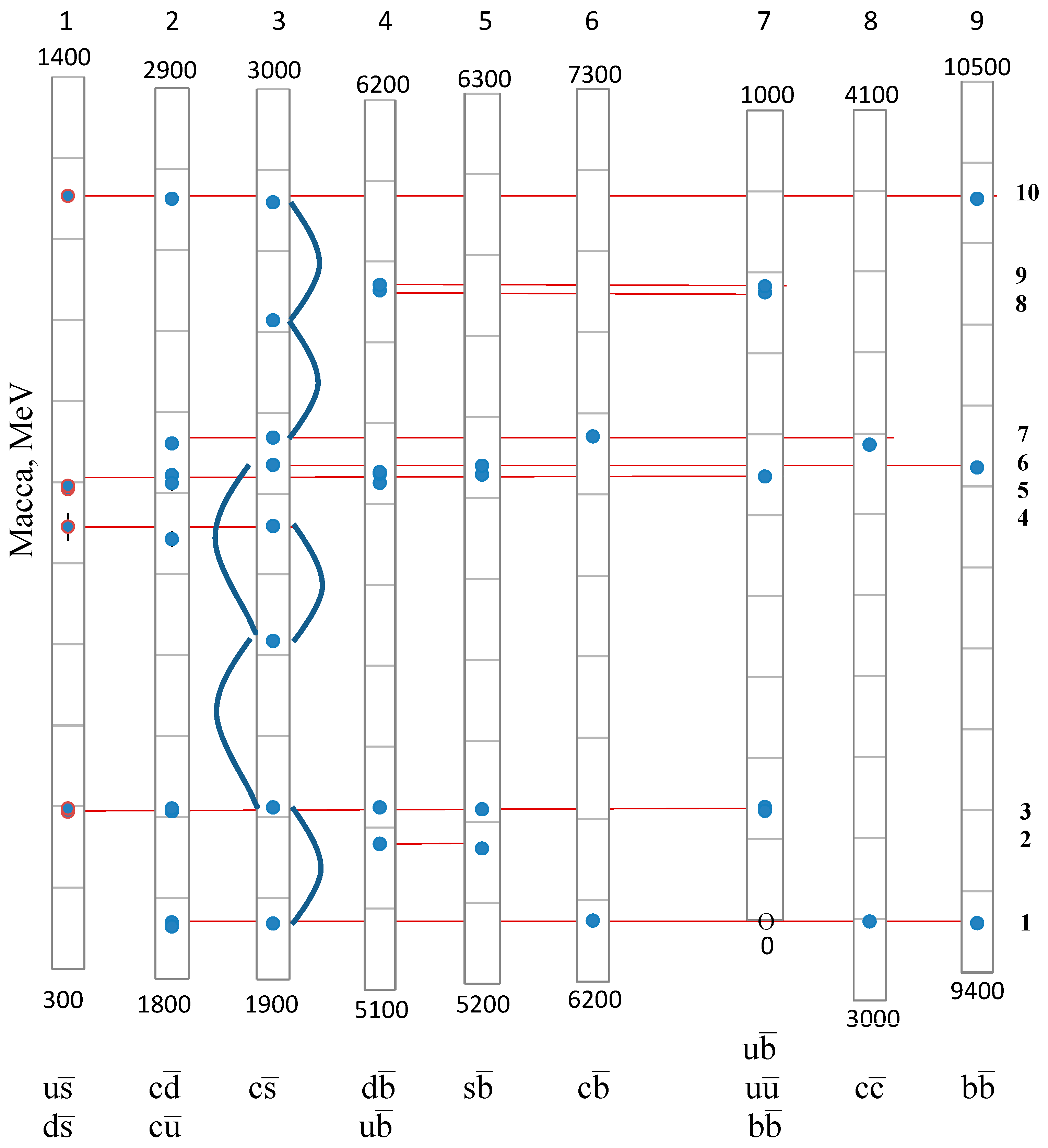
The meson summary contains nine tables. All data from them is transferred to the figure. Each table has its own column. Below the columns, the quarks that make up the mesons in that column are shown.
Columns 1-6 contain different quarks and antiquarks. Annihilation between them is impossible, and therefore they have relatively long lifetimes. The lowest point in each of these columns is the long-lived ground state. Above these lie the resonance mesons. These are believed to be excited states of the ground particle. They are short-lived.
In column 7, the bottom two merged points represent the lightest mesons—neutral and charged pions. Their masses are 134.98 and 139.57 MeV. The neutral pion is believed to be a superposition of down and up quarks, their continuous interconversion. The dots above are their resonances. The table for column 7 and column 1 also contains more massive resonances, they are out of the figure.
The base of the two rightmost columns (8 and 9) shows the charm and beauty quarkonias, which consist of a quark and its antiquark. Therefore, they annihilate quickly, and their lifetime is only about 10-20 seconds. The dots above indicate their main resonances, which have the same lifetime. These mesons also have many other resonances with much shorter lifetimes. To avoid overloading columns 8 and 9, they are not shown.
All the mesons shown in the figure have very accurate mass measurements; only for two resonances (in columns 1 and 2) is the measurement error greater than the dot.
Now let's try to see patterns in this figure. Let's start by comparing columns 4 and 5. They are similar. All the dots in the fifth column correspond to the dots in the fourth. Columns 4 and 7 are also similar. Columns 2 and 3 are similar. Here, opposite all the points in the second column are points in the third column.
The figure shows that everything is interconnected. Opposite each point are one, two, three, and even five points in other columns. Only two resonances in the third column are not on the highlighted horizontal lines showing the rhythm boundaries. But they also fall within the same rhythms. To see this, move this column up and down. In the third column, four identical rhythms are shown in right brackets. It is equal to the mass of the pion. All horizontal lines are numbered. Line 3 passes through the pion points in column 7. Therefore, the width of the band between lines 1 and 3 is equal to the mass of the pion.
The distance between lines 10 and 7 is equal to the distance between lines 9 and 4. It is equal to two pions.
The distance between lines 10 and 9 is equal to the distance between lines 7 and 4, and also between 2 and 1, but with less precision. This rhythm is equal to a muon. It is equal to 105.66 MeV.
An interesting coincidence: the mass of the lepton (heavy electron) is included among the meson mass values. The figure also shows the muon mass in other cases. For example, the distance between lines 9 and 6, and 8 and 5 is the same and equals a double muon. Also visible in the third column are two rhythms equal to the mass of muon (left brackets).
The distance between lines 6 and 3 is the same as between lines 10 and 4. It is equal to four muons.
The distance between lines 4 and 3 is equal to the distance between lines 10 and 5. It is equal to the sum of two muons and a pion.
The rhythm, equal to two pions and three muons, is marked five times. Four times between lines 7 and 1, and once more, shifted by a pion, it is repeated in the third column. Random coincidences are possible in all of this, but they cannot be numerous. And among mesons, rhythms are everywhere. Moreover, all of them are numerically equal to the mass composed of the mass of the lightest particles—pions and muons.
The charm quarkonium J/Ψ, consists of a charm quark and its antiquark, according to the Standard Model (bottom dot in column 8), while beauty quarkonium ϒ(1S), consists of a beauty quark and its antiquark, accordingly (bottom dot in column 9). We can imagine that half the mass of these mesons is attributed to the quark, and the other half to the antiquark. Let's write the masses for these halves in MeV:
The long-lived meson Bc+ is the bottom dot in column 6 in the figure. According to the Standard Model, it consists of a beauty quark and a charm antiquark. Let's sum the masses of the halves of these mesons and compare them with the mass of the beauty-charm meson:
J/Ψ:2 = 1548.45 ϒ(1S):2 = 4730.15
J/Ψ:2 + ϒ(1S):2 = 6278.60
6274.47 = Вс+
It turns out that the mass of this meson is the sum of the masses of the halves of which it is composed.
Now let's show what elementary particles can be assembled by adding muons to the charm or beauty halves.
The mass of mesons with a charm quark (these are the bottom points in columns 2) is obtained by adding three muons to the charm half:
J/Ψ:2 +3μ = 1865.43
1864.84 = D0
The mass of mesons with a charm and strange quarks (these are the bottom points in columns 3) is obtained by adding four muons to the charm half:
J/Ψ:2 +4μ = 1971.09
1968.35 = Ds+
The mass of a meson with a beauty quark (the bottom point in column 5) is obtained by adding six muons to the beauty half.
ϒ(1S):2 + 6μ = 5364.11
5366.92 = Bs0
A baryon with a charm quark is made up of a charm half and 7 muons.
J/Ψ:2 + 7μ = 2288.07
2286.46 = Λс+
A baryon with two charm quarks is made up of two charm half with the addition of 5 muons.
J/Ψ:2 + J/Ψ:2 + 5μ = 3625.2
3621.6 = Ξсс++
There are only seven basic mesons and baryons with charm or beauty quarks. And for five of them, as we see, the mass is composed by adding muons to these heavy halves.
And now another example. In the figure, columns 8 and 9, the top dots are meson resonances, which contain charm and beauty quarks, their antiquarks, and something else. Here are the masses of their halves:
Ψ(2S):2 = 1843.05 ϒ(3S):2 = 5177.6
Now let's write down the masses of baryons with charm and beauty quarks. They also contain charm and beauty quarks, and something else.
Λc+ = 2286.46 Λb0 = 5619.6
Now, let's write a simple relationship for these halves of mesons and baryons:
ϒ(3S):2 – Ψ(2S):2 = 3334.55
Λb0 – Λc+ = 3333.14
This precise coincidence implies that mesons and baryons, in addition to the charm and beauty quark, also share something else of equal mass.
Column 7 shows three pion resonances. They can also be divided into halves:
ɳ:2 = 273.93 ρ:2 = 387.63 ꙍ:2 = 391.33
We can also attempt to assemble mesons and baryons from these.
The lightest mesons-kaons are the beauty points in the first column. They are obtained by adding the mass of one muon to the meson halves:
ρ:2 + μ = 493.29 ꙍ:2 + μ = 497.00
493.677 = K+ 497.611 = K0
According to the Standard Model, the proton and neutron are composed of three light quarks. Their masses are trivially composed of the halves of three light mesons—three "quarks."
ɳ:2 + ɳ:2 + ρ:2 = 935.49 ɳ:2 + ɳ:2 + ꙍ:2 = 939.19
938.27 = p 939.57 = n
The proton mass was calculated with less accuracy than the neutron mass. However, the proton is a charged particle, and its mass consists of its own mass and the mass of its electric field. Taking this into account, we obtained a very close match.
And this is the numerical match for a baryon with a beauty quark:
ϒ(1S):2 + ꙍ + μ = 5618.47
5619.6 = Λb0
And this is the match for a meson with a beauty quark (this is the bottom dot in the fourth column in the figure):
ϒ(1S):2 + ɳ = 5278.01
5279.34 = B+
As a result, it turns out that the masses of all long-lived mesons and baryons can be assembled, in some cases trivially, in others more complexly, from a small set of masses of half-mesons, and muons. Since the ɳ meson is close in mass to four pions, and two muons are close in mass to three half-pions, other combinations are possible.
And now for the most massive particles.
These are the intermediate vector bosons
W = 80377+12 and Z = 91187.6+2.1;
The Higgs boson
H = 125250+170;
And the top quark
t = 172690+300.
The masses of these particles and their halves are related, not very precisely, but quite simply:
W + Z = 171564.6 W + Z:2 = 125970.8
172690.0 = t 125250.0 = H
Another example demonstrating the similarities in the mass ratios of different particle classes. Besides the electron and muon, there is another, the heaviest lepton, the tau lepton: τ = 1776.86 . We divide its mass by the proton mass, and below we write the ratio for superheavy particles—the top quark and the Z boson:
τ:ρ = 1.89376
t:Z = 1.893788
It turns out to be a coincidence. Other coincidences can be cited, such as the neutron - neutral kaon ratio and the charm meson-charged kaons ratio:
n:K0 = 1.88816
D0:2K+ = 1.88872
The set of elementary particles is small, but the coincidences are numerous. They can't all be random coincidences.
Look again at columns 4 and 5 in the figure. They are clearly similar. Columns 4 and 7 are also similar, as are columns 2 and 3. And the mass of the charm-beauty meson is trivially equal to the sum of the masses of charm and beauty halves. These examples alone show that the masses of elementary particles can be composed of the masses of simpler elements.
Chapter 2. Figures with Closely Packed Elements
The masses of elementary particles vary by more than five orders of magnitude. Let's try to find simple principles that can be used to derive numerical expressions with such variation.
Crystals are an example of diversity arising from simplicity. Their diversity is explained by simple ideas that date back to antiquity. These include the idea of identical atoms, the idea of minimal surface area (the idea of a sphere), and the postulate that nature abhors a vacuum. Atoms in crystals are packed so as to minimize the voids between them. This is achieved through regular crystal packing. But in the world of crystals, in the world of inert nature, pentagons are very rare, while in living nature they abound. For example, sea urchins and starfish, or the blossom of an apple tree. And inside each apple, the seeds are arranged in the shape of a five-pointed star.
In crystals, voids tend to a minimum, and in living tissues, there is none at all. Living cells are not spheres, but polyhedra, tightly pressed together without voids. Cells grow, divide, grow, divide again, and densely fill the space without voids.
Living nature, in packing cells, uses the principle of packing soap foam. A single soap bubble is round due to surface tension. At the same time, it has a minimal surface area. When these bubbles merge, striving for a minimal surface area, they turn into polyhedra.
Figure 2.
The cells in a watermelon are packed like bubbles in soap foam.
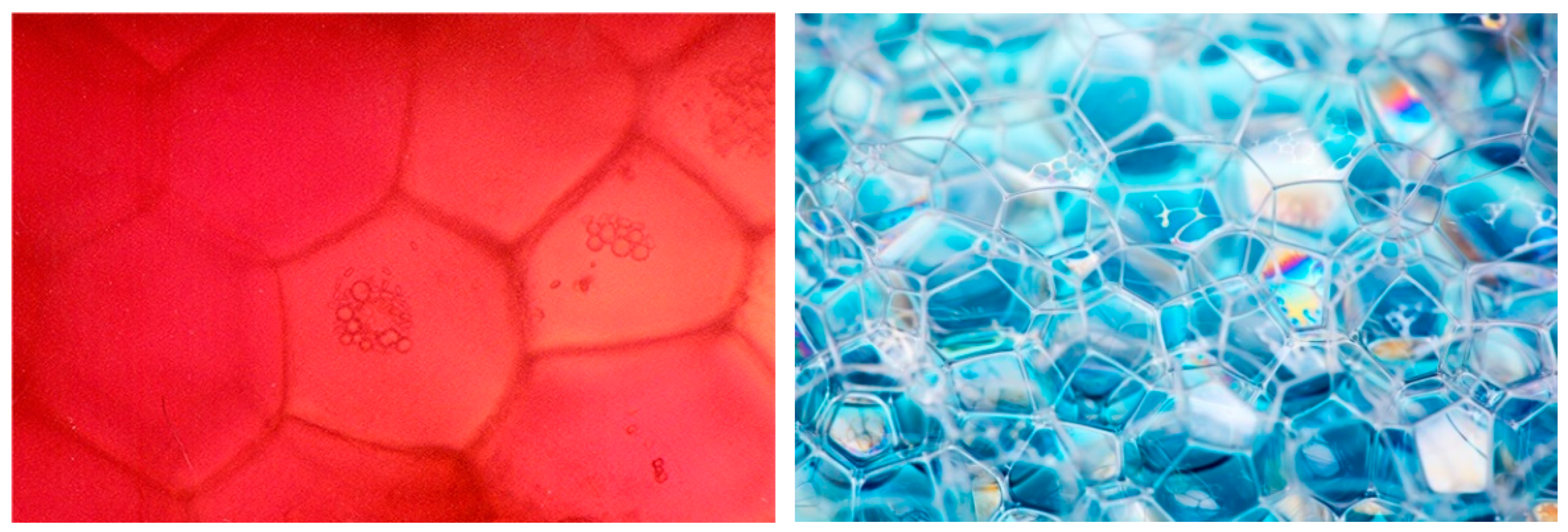
Soap foams are gas and a little water. But these mobile substances form a solid due to surface tension – soap foams retain their shape. Drops of oil floating in a watery liquid of the same density are round. But when they combine, these droplets also form polyhedrons, separated by thin films. And this "foam" also retains its shape. Mayonnaise is composed of liquids, but it is solid.
Soap foams contain only films (bubble faces), edges, and vertices. Soap bubbles are packed according to Plateau's laws:
Within each face, the surface curvature is constant.
Faces intersect in groups of three at one edge. All faces pull equally in their direction, and equilibrium is achieved when the angles between faces are equal and equal to 120°.
Edges always intersect at a vertex in groups of four at the same angle of 109.47° (the tetrahedral angle). In this case, a balance of forces is achieved.
The packing of bubbles in foam tends to minimize film surfaces, and all cells are polyhedra. Foam, consisting of cells of equal volume, has pentagonal, hexahedron, and quadrangular faces. Moreover, all polyhedra have the same angles – 109.47°. A regular pentagon has angles of 108°, which is close to 109.47°. Therefore, pentagonal faces are the most numerous in soap foam. They are almost flat, and their edges are almost straight. And the most favorable shape for a foam cell is the highest Platonic polyhedron – the dodecahedron, its surface area is 12 pentagons.
Figure 3.
Dodecahedron, Platonic figure.
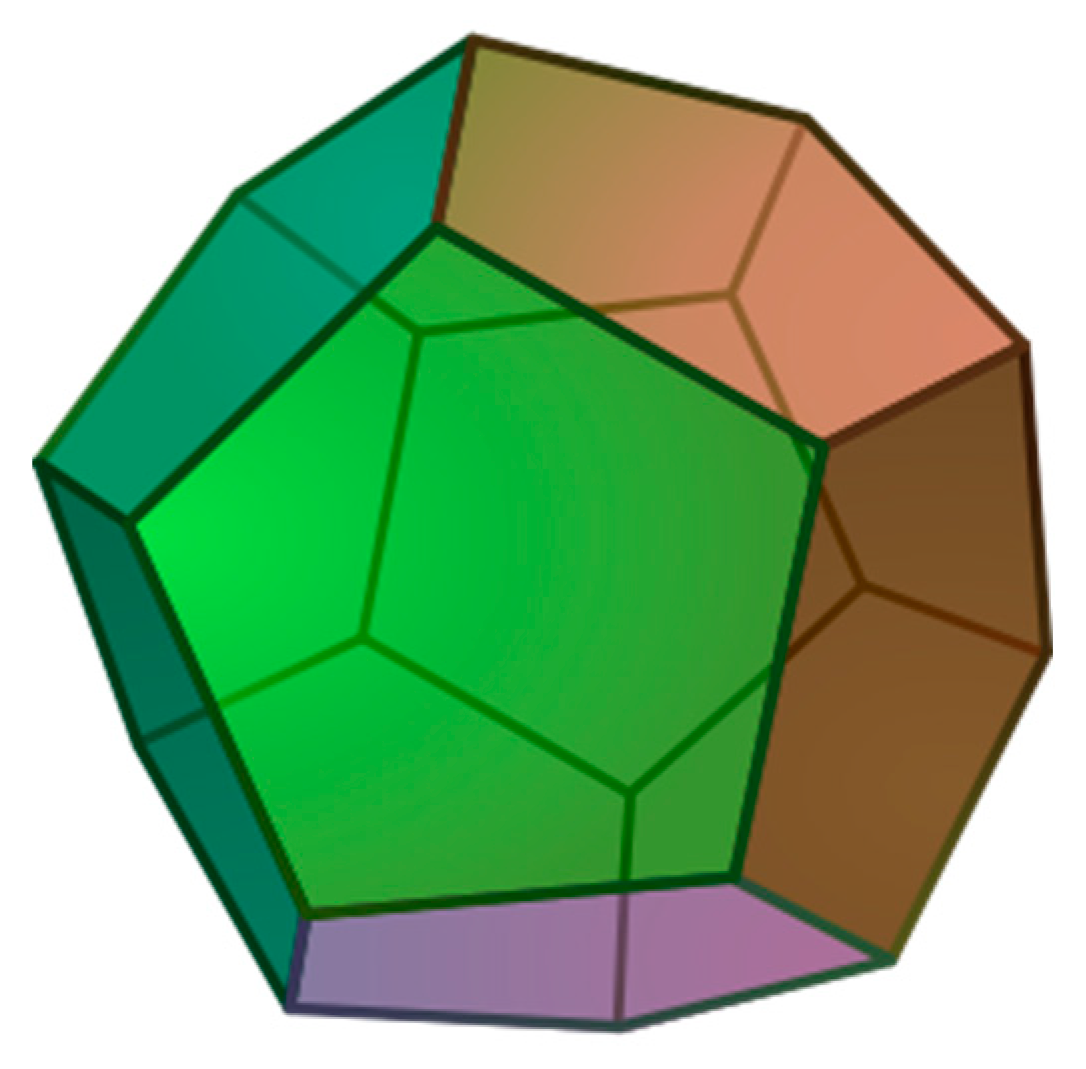
But dodecahedrons alone cannot fill space (just as equiangular pentagons cannot fill a plane). Therefore, pentagons predominate in soap suds, but hexagons and even quadrangles also exist.
A regular quadrilateral has angles equal to 90°. And by 109.47°, they will only be equal if the edges of the quadrilateral are strongly curved, and the face is not flat, but strongly curved into a "saddle." A regular hexagon has angles equal to 120°. This is closer to 109.47° than an angle of 90°. Therefore, the hexagons in soap suds have straighter edges and flatter faces than the quadrilaterals. For surface area minimization, hexagonal faces are more advantageous than quadrilateral ones.
For any convex polyhedron, Euler's formula holds: the sum of the vertices and faces equals the number of edges plus two. Therefore, soap foam does not contain polyhedra with a single hexagonal face. There must be either 2, 3, or 4, plus 12 pentagons. Hexagons, and especially quadrilaterals, greatly increase the surface area of soap films. Therefore, the surface area of a rounded polyhedron containing hexagons and quadrilaterals will be larger due to its increased ribbing than that of a flattened or elongated, but smoother, dodecahedron.
The Kelvin problem, posed by Lord Kelvin in 1887, is to find an arrangement of cells, or bubbles, of equal volume, so that the total surface area of the walls between them is as small as possible [3,4].
Kelvin suggested that the solution to his problem was a structure made up of slightly curved copies of a truncated octahedron: a shape with six square faces and eight hexagonal faces, which you get when you cut the corners off a three-dimensional diamond shape. Kelvin's structure, as his foam became known, was believed to be the most efficient solution for over 100 years, until the physicists Denis Weaire and Robert Phelan showed in 1993 that there is an even better foam. The Weaire-Phelan structure consists of two different bubble shapes: an irregular dodecahedron, which has twelve irregular pentagonal faces, and a solid with two hexagonal and twelve pentagonal faces, known succinctly as a tetrakaidecahedron [3,4,5,6].
Figure 4.
The Weaire-Phelan structure (top) is made up tetracaidecathedra (bottom left) and irregular dodecahedra (bottom right) [3].
Figure 4.
The Weaire-Phelan structure (top) is made up tetracaidecathedra (bottom left) and irregular dodecahedra (bottom right) [3].
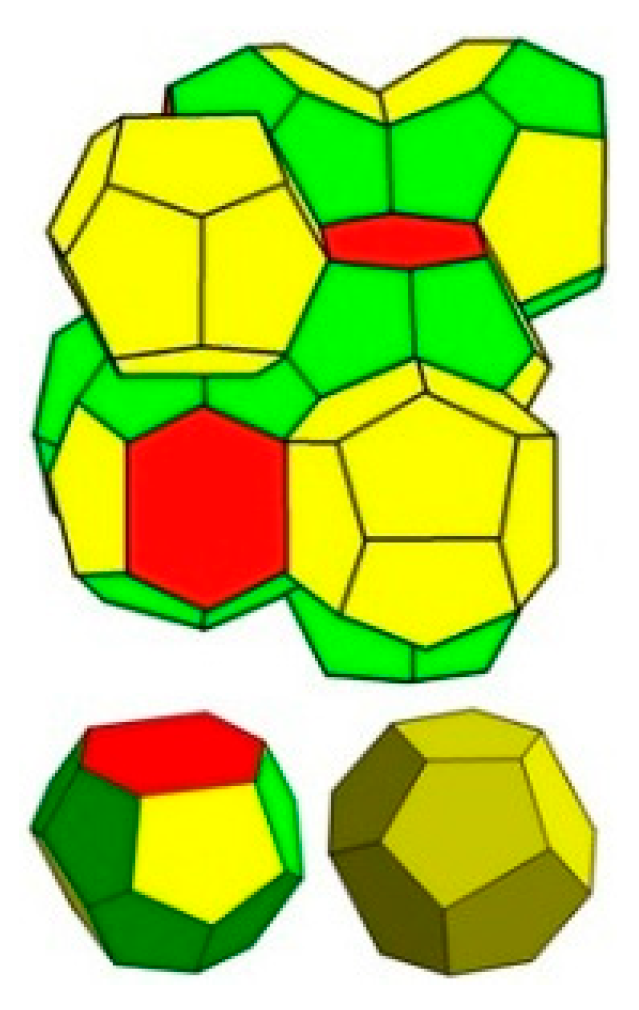
Although an infinite number of foams that beat Kelvin's structure have been found since 1993, the Weaire-Phelan structure remains the most efficient of them all. But whether or not there is an even more efficient foam out there, waiting to be discovered, still isn't known [3].
We are not trying to fill the entire space with soap bubbles yet, but we will try to create compact dense shapes using the laws of the Plateau.
Real soap foam contains many dodecahedrons. They have 12 faces, and the surface of each dodecahedron hosts 12 neighboring bubbles. This situation can be simulated using identical plasticine balls. Twelve other balls can easily fit on the surface of such a ball without leaving any gaps. If the resulting figure of 13 balls is pressed firmly and uniformly, the contacts between the balls will flatten, eliminating the void (Figure 5). (To squeeze out the void between the plasticine balls in such a figure, the plasticine can be heated slightly.) If the figure is then cooled and broken apart, we will see that the central ball has become a dodecahedron.
We've achieved a dense packing—a dodecahedron in a shell. Now let's add another shell to the "13" figure. Twenty pits are visible on the surface of the "13" figure. New bubbles in the soap suds will nestle in these convenient pits. Each pit forms at the junction of three bubbles. When another bubble fits into it, the surfaces merge, forming a node connecting four edges. The angles between them will be 109.470. After all 20 pits are filled, 12 deep holes will remain between the new bubbles in the new shell, each accommodating 12 more bubbles. As a result, a shell of 32 bubbles will form around the "13" figure (Figure 6).
On the surface of this figure, each of the 20 gray balls is surrounded by six neighbors. And each of the 12 yellow balls is surrounded by five neighbors. On the surface of the ball are 20 hexagons and 12 pentagons. The gray balls in this figure (there are 20 of them) are those that fit into the holes between three. And the yellow ones are those that fit into the larger holes. Under each of these 12 balls lies a yellow ball from the first shell. The resulting figure of 45 balls is not only visually harmonious but also perfectly packed. All 12 balls from the first shell have transformed into dodecahedrons: each of them lies on the central ball, surrounded by five balls from its (second) shell, and covered by six balls from the third shell. As a result, it has 12 pentagonal faces. All 13 balls hidden in the figure "45" are dodecahedrons.
The difference between the angles of 108° and 109.47° is small, so the balls in the first shell are only slightly deformed. They are almost round. But in the second shell, the angle difference noticeably accumulates, and the 12 yellow balls of the second shell fit into their dimples loosely, with a slight gap. After this figure is compressed (after squeezing out the void) and the gaps close, these balls are slightly flattened. This increases their surface area. But it's better to be slightly flattened, with nearly flat edges, than rounded, but with curved edges and saddle-like faces.
Now let's add another shell to the "45" figure. Its surface is covered with 60 identical dimples, formed at the junction of three balls. And 60 gray balls fit easily and tightly into these dimples, without gaps. Within this mesh of balls, 32 holes are formed. Twelve of them have a yellow ball at the bottom, and 20 have a gray ball. These holes fit another 32 balls snugly. We placed 12 yellow balls in the holes with yellow balls at the bottom, and 20 red balls in the gray holes. After compressing these new balls, a dense, harmonious shell of 92 round balls will form, creating the figure "137" (Figure 7).
Inside this new figure (in the second shell), 12 yellow balls have become dodecahedrons, and 20 gray ones have become polyhedra, each with four hexagons and 12 pentagons on their surface. As a result, there are no quadrangles inside the new figure, and there are relatively few dodecahedrons—25—but in the upper shell, all the balls are rounded. This figure is easy to assemble, without variations, with minimal effort.
Figure 8.
Matryoshka of figures "1"; "13"; "45"; "137".
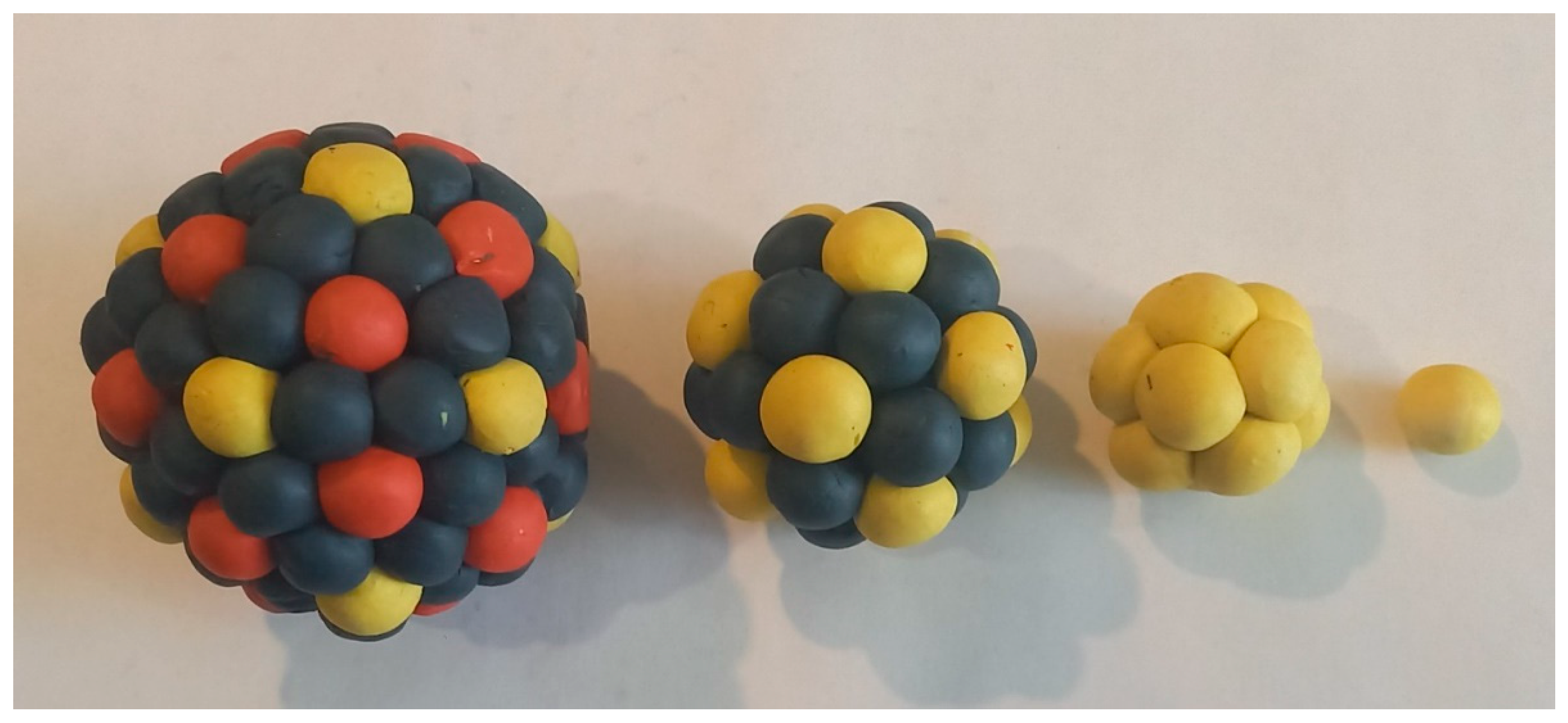
The numbers 13, 45, and 137 follow arithmetically from the number of shells in the figure and from the geometry of the dodecahedron at its center. It has 12 faces, 20 vertices, and 30 edges. This geometry determines the number of balls in each shell and in each figure.
We glued identical balls together without gaps, but we can repeat all these procedures for these larger balls.
The "13" figures are angular and join together very awkwardly. Each of them contains only one dodecahedron. The figures formed by merging them will contain few dodecahedrons. But the "45" and "137" figures are smooth and rounded. We can, for example, join 13 "137" figures together to get a "13*137" figure. Or we can join 45 "45" figures together to get a “45*45” figure. And if you take 45 such figures, you can assemble a figure of "45*45*45" without any voids. Excess surfaces may arise at the junctions of the larger spheres, where hexagons and quadrilaterals may appear. But most of the volume within these large combined figures will be tightly packed.
Now let's return to elementary particles and see these numbers in them.
Let's compare the masses of the most notable long-lived and important bosons, from which we made "quarks," with the number of spheres in the packing figures without voids. Let's start with the mass of the smallest pion, π0, which contains 45.
π0 = 134.9768
135 = 45*3
The next meson after the pion, its "first resonance," is the ɳ meson, which contains 137:
its heavier counterpart, ɳ´, also contains 137:
ɳ = 547.862
548 = 137*4
ɳ´ = 957.78
959 = 137*7
And now for the heavyweights. Z boson. It is equal to 45*45*45
Z = 91187.6
91125 = 45*45*45
W boson.
W = 80377
80145 = 13*45*137
Higgs boson H.
H = 125250
121998.5 = 13*137*137:2
The mass of the beauty quarkonium is half that of 137*137
ϒ(1S) = 9460.3
9384.5 = 137*137:2
The mass of the charm quarkonium is half that of 45*137
J/Ψ = 3096.9
3082.5 = 45*137:2
Mass of the Ψ quarkonium meson half as much as 45*45
Ψ = 1019.461
1012.5 = 45*45:2
To all these coincidences, we can add a close coincidence for the mass of the tau lepton
τ = 1776.86
1781 = 13*137
As a result, for all the elementary particles of the "first magnitude" under consideration, the mass is related through a simple factor to the set of numbers 13, 45, and 137.
By squeezing plasticine figures assembled from balls, it is impossible to squeeze out all the empty space. Therefore, a plasticine figure is larger than the same figure assembled from soap bubbles of the same volume. And in the new shell, the plasticine balls will fit less tightly. Therefore, to estimate the density of the new shell, the previous figure must be molded from a monolithic piece of plasticine. First, mold a sphere of the required volume. Then, precisely mark it, press indentations into its surface, and then place the balls of the new shell into these indentations.
Now let's add another shell to the "137" figure. A shell of 122 balls naturally fits onto the "137" figure using the same simple method, without effort or gaps. The result is the figure "259." All 72 yellow and gray balls lying on the surface of the figure "137" are transformed into dodecahedrons. And the 20 red balls from the previous shell are transformed into tetrakaidecahedra. This is a polyhedron with 2 hexagons and 12 pentagons.
Figure 9.
Figure "259" with figure "137" in the center.
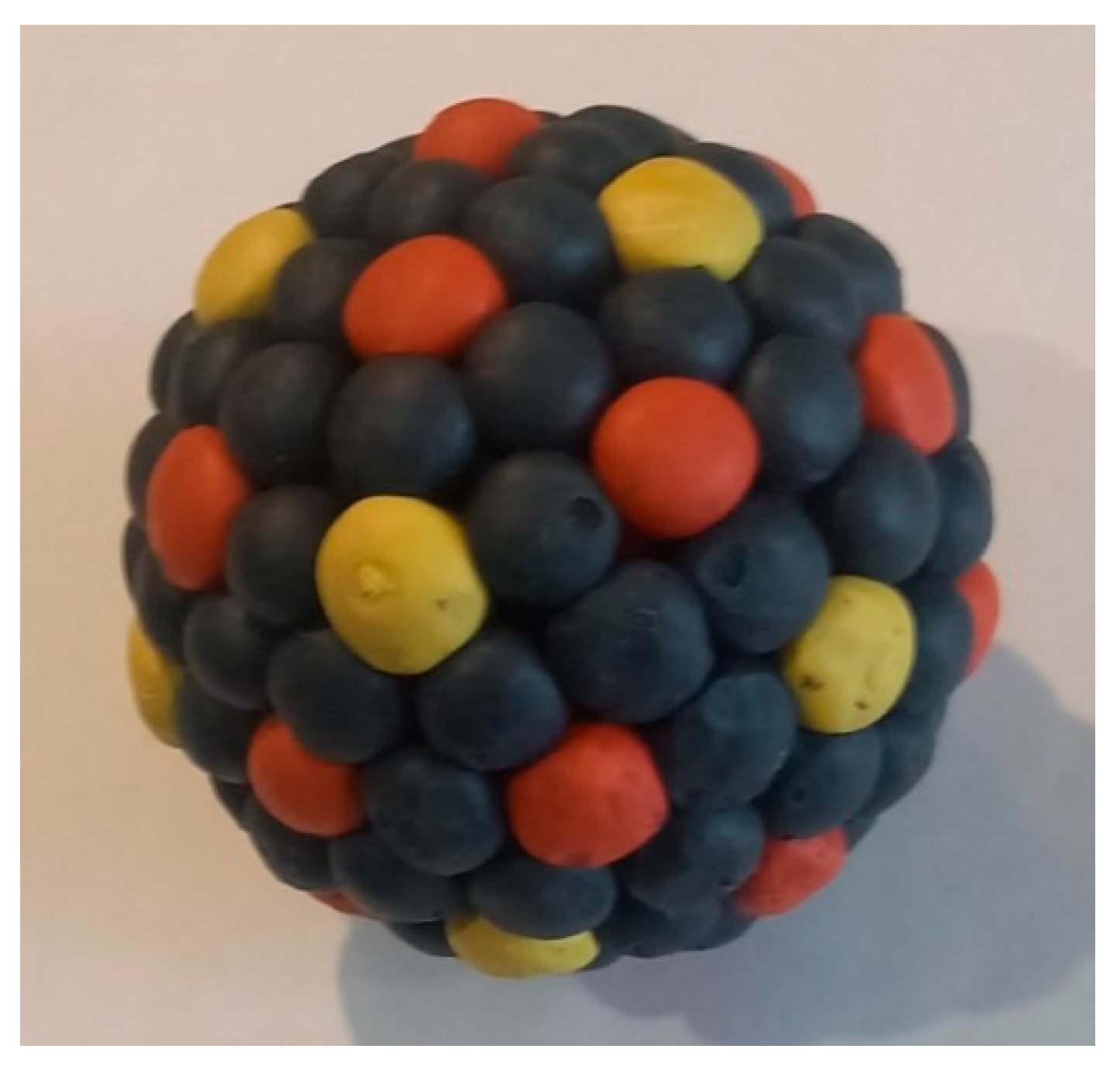
The yellow balls in all the figures shown rest on yellow balls from the previous layer. They all rest on dodecahedrons. A dodecahedron has opposite faces parallel, so they can be stacked into neat chains.
Figure 10 shows how a column with a chain of dodecahedrons in the center is assembled. In all the figures shown, columns of dodecahedrons rise from all 12 faces of the central first dodecahedron. All these figures share the same skeleton—a 12-pointed star of dodecahedron columns. All these figures replicate the symmetry of the dodecahedron.
Let's extend the dodecahedron columns of figure "259." Place another yellow ball on top of each yellow ball and surround it with five gray ones, lowering them into the holes. The remaining space between these columns can be densely and beautifully filled with balls, as shown in Figure 11. This is the fifth shell of 162 balls.
The result is a harmonious figure of 421 spheres. On its surface, the spheres are packed like in a crystal. This is the last harmonious figure. From this point on, quadrilaterals appear in the shells.
There are no elementary particles with a mass multiple of 259. However, for many particles, the mass ratio, as shown, is 1.89. If 259 is divided by 137, we obtain the number 1.89051. Accordingly, if we replace 137 with 259 in the formula for some complex figure, we obtain a new figure 1.89 times more massive. Multiples of 421 are common among the masses of elementary particles. The mass of the heaviest particle, the t quark, 172690+300, can be obtained using the formula 3*137*421=137031. The mass of the lightest particle—the muon—105.66 can be obtained by dividing 421 by four (421:4 = 105,25).
We've looked at the simplest shapes that can be assembled without voids from identical bubbles or spheres—shapes with a dodecahedron at the center. But you can also place, for example, a knot formed by the junction of four spheres in the center. Between these spheres (on the surface of the small pyramid), there will be four pits, into which you can place four more spheres, creating the shape "8," then "14," and so on. Ultimately, you'll create the shape "26," with four dodecahedrons at its center. You can also place an edge in the center, creating the shape "11," then "17," and so on. You can also place four "137" shapes in the center, or four "137 * 259" shapes.
Now let's compare our figures with the figures that can be obtained using the Weaire-Phelan dense packing principle. This package also has a dodecahedron surrounded by 12 balls. This is figure “13” (Figure 5). The next shell should be placed on this figure so that all these 12 balls turn into tetrakaidecahedra. This is a polyhedron with parallel hexagons at the poles and 12 pentagons between them. Straight chains can be made from these polyhedra. Columns of these polyhedra fill the entire space in three directions. And the dodecahedra are located in the cells between them.
It is not a trivial task to assemble figures according to this scheme. Figure “13” is easy to assemble. And to assemble the next shell, you need to take the figure “45” (Figure 6) and pull apart any two gray balls and insert one orange one between them. The same should be done at the opposite pole of the figure, and then place 4 more orange balls on the equator of this figure in the same way. As a result, 6 orange balls will connect all 12 yellow balls in pairs. After that, you need to remove all 12 yellow balls from the figure and put two gray balls in each hole, so that both of them touch the orange ball. As a result, the figure “63” will appear (Figure 12). The toothpicks in this figure show the direction of the axes, the tetrakaidecahedra columns surrounding the central dodecahedron.
The upper shell of the figure "45" has 32 balls, and this figure has 50 balls, 18 more. And inside, both figures have the same figure "13". The balls in the new shell are very cramped. They are severely deformed. This shape is very difficult to assemble and difficult to compress tightly. It is not rounded, but angular. If you put the next shell on top of this shell according to the Weaire-Phelan scheme, then the 6 orange balls in the figure "63" will turn into dodecahedra, and there will be only 7 of them inside. For comparison, there are 25 dodecahedra in the figure "137". There is no mass multiple of 63 among the elementary particles.
Alternatively, instead of a dodecahedron, a polyhedron with tetrahedral symmetry could be placed in the center of the figure—with four hexagons separated by 12 pentagons. (Such polyhedrons are common in soap suds. They also appear in the second shell of the figures discussed above.) This polyhedron is formed by placing a shell of 16 balls on the surface of the central sphere. The 12 balls on the central sphere fit easily and tightly. However, the 12 yellow balls of the next shell (figure “45”, Figure 6) fit loosely. They require compression to squeeze out the void. They become slightly flattened. Only the next shell fits snugly into the depressions without much effort. Placing a shell of 16 balls on the central sphere is difficult. They feel cramped. They require compression from the sides. However, the 44 balls of the next shell fit easily and tightly into the depressions of the "17" figure. The result is a solid figure "61".
Figure 13.
Figures “17” and “61”.
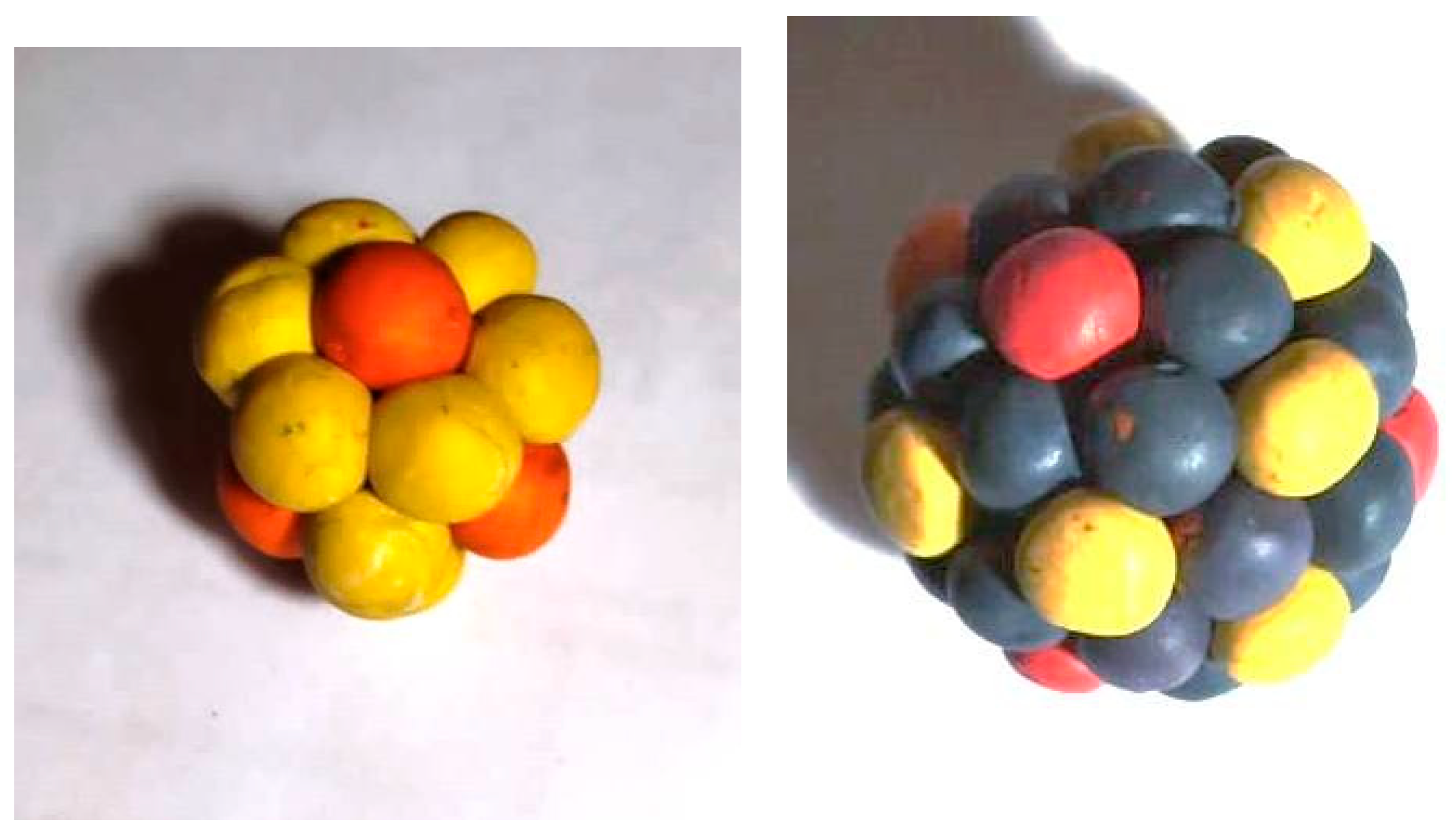
But the new shell doesn't fit harmoniously onto the solid figure. It just falls chaotically, without falling into the pits. From the "61" figures, you can assemble a particularly strong "61 * 61" figure. It contains 3721 balls. If we divide this number by four, we get a value of 930.25, close to the mass of the indestructible proton (938.27), the lightest baryon. The mass of the beauty baryon is Λ b0 = 5619.6. This particle contains both a baryon and a beauty. If we trivially sum the number of elements in the "61 * 61" baryon figure and the "137 * 137" beauty figure and divide by four, we get 5622.5, which is very close to the mass of the beauty baryon.
(61*61 + 137*137):4 = 5622.5
Λ b0 = 5619.6
Of all the figures considered, the lightest is figure "1." This figure is comparable to the mass of the eternal electron (0.511 MeV).
As a result, we see that from the simple principles that nature uses to create foam and living organisms, we can obtain a set of numbers that are multiples of the masses of elementary particles. From the elementary, we obtain diversity. Such figures can be found both in living tissues and among gas hydrates.
Now, using known models, let's try to derive electric charges, interactions, and antiparticles.
Chapter 3. The Elementary Particle Model
The Maxwell-Boltzmann Mechanical Model
Boltzmann brought atoms back from antiquity to science. He was also the most enthusiastic admirer and supporter of Maxwell's model. His commentary on this model is deeper and more extensive than Maxwell's description [7].
Today, there's no need to wonder why particles in a magnetic field deviate from a straight trajectory and begin to move in a circle. To calculate their trajectory, it's enough to use Maxwell's equations. He derived them by devising a mechanical model describing electromagnetic phenomena—the mechanical model of the ether. He then described this model mathematically, deriving his system of equations [8].
At that time, it was believed that all space was filled with the ether. Electromagnetic fields were viewed as stresses in the ether, and light waves as its sound waves. The phenomenon of light polarization showed that light is a transverse vibration, meaning that only shear deformations are possible in the ether, and therefore the ether is a solid, incompressible medium. There are no compression waves in it (or rather, their speed is infinite) [7,8].
According to Maxwell, the ether is an elastic, incompressible medium. The ether undulates like jelly, with almost no longitudinal waves. Its displacements weaken with distance, but do not disappear, as in compressible crystals [7,8].
At that time, much effort was expended in understanding the molecules and atoms that make up the ether. To imagine the phenomenon of electromagnetic induction, it was necessary to assume that the ether could be twisted, that something could rotate within it. Maxwell proposed that the ether consists of large and small particles—"molecules and atoms." Between these particles, there is friction and adhesion [7,8].
Maxwell's ether is densely filled with gear-like particles, like soap suds filled with bubbles. The contact zones between these large gears are filled with small gear-like atoms, which lie in a single layer (see Figure 13).
Figure 14.
James Clerk Maxwell's diagram of the ether from his paper "On Physical Lines of Force", 1861, In Philosophical Magazine [8].
Figure 14.
James Clerk Maxwell's diagram of the ether from his paper "On Physical Lines of Force", 1861, In Philosophical Magazine [8].
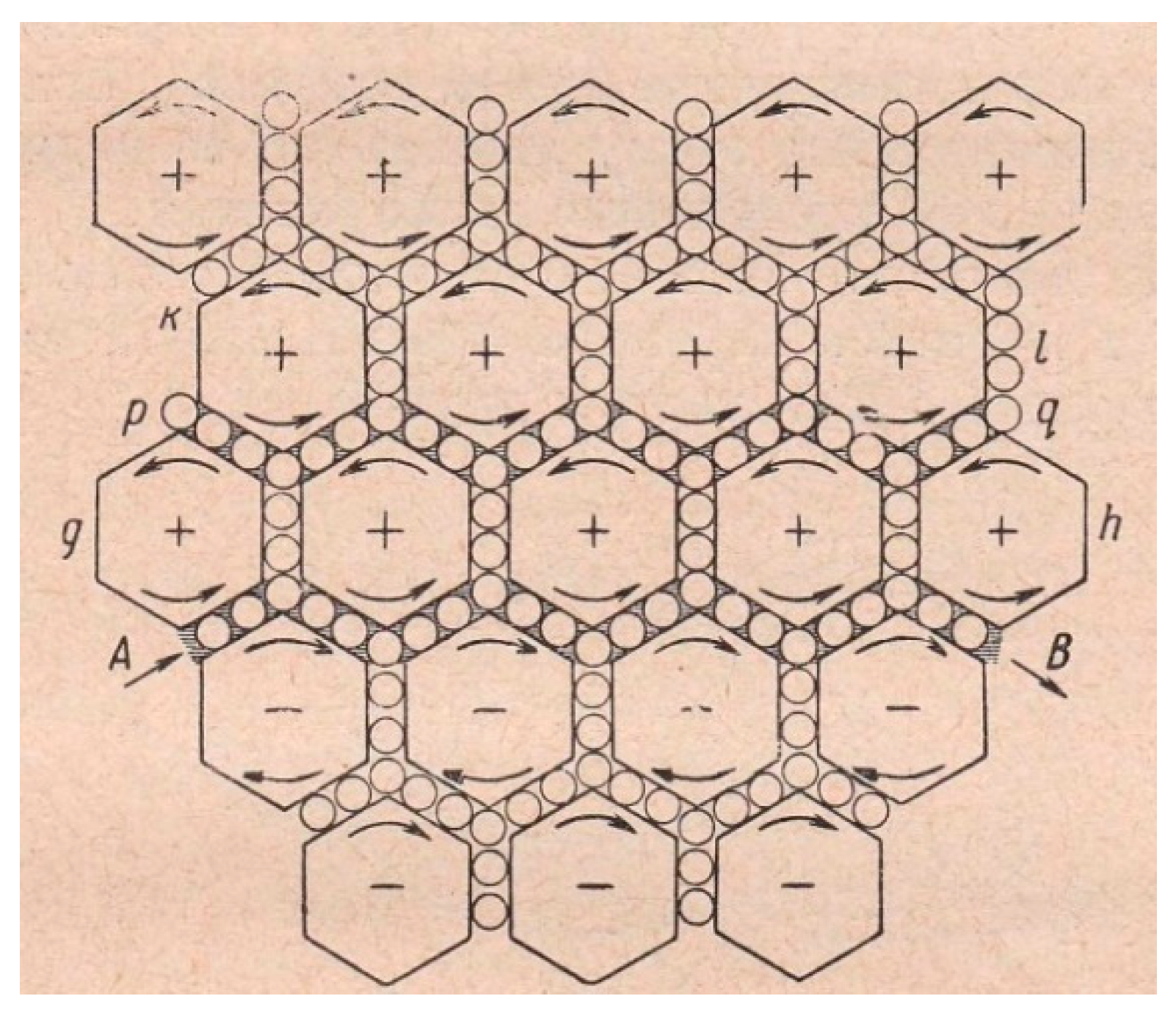
If a large gear is made to rotate, its interlocking arrangement will cause the smaller gears in its vicinity to rotate as well. If the large gear rotates clockwise, the smaller gears in contact with it will rotate counterclockwise. These smaller gears, in turn, will transmit rotation to another adjacent large gear. This gear will then rotate in the opposite direction relative to the smaller gears. In other words, it will rotate in the same direction as the first large gear. Ultimately, if one large gear is spun, all the large gears in the vicinity will rotate in the same direction. This creates a swirling ether. A magnetic field has appeared within it. Imaginary magnetic lines run parallel to the axes of rotation of the gears. If any particle or set of particles begins to move through the stationary ether, they, in contact and interlocking with neighboring particles, will cause them to rotate. Closed circular magnetic lines will appear around the electric current line. Maxwell's diagram shows that the movement of atoms along the broken line from A to B causes the rotation of neighboring molecules, and then of the remaining molecules. Below this line, molecules rotate clockwise (-), and above, counterclockwise (+). Conversely, if neighboring molecules are forced to rotate in opposite directions, atomic motion—an electric current—will occur between them. All movements in such ether, including shear waves, are accompanied by rotations of gears. Therefore, waves in the ether are electromagnetic. The rotational speed of large gears is low, while that of small ones is high, but the surface rotational velocity is the same.
In Maxwell's model, a discrepancy can be seen. The large gears are pressed tightly against each other and therefore deformed. But the small gears are not pressed tightly, leaving a void between them. If this void exists, the ether will be compressible. Therefore, the small atoms of the gears must be pressed tightly, until they are completely interlocked, to push out the void. Let's eliminate this discrepancy and, at the same time, reduce the number of entities in the model. We'll assemble molecules, as expected, from atoms.
We'll fill the entire space tightly, without gaps, with identical, nedelim atoms, not large or small. The ancient Greek term "atom"—indivisible—is occupied and has lost its meaning. What we call an atom today consists of many particles. Therefore, we'll use another word with the same meaning: "nedelim." And so, quickly and chaotically, we'll fill the entire space with nedelims, without gaps. An nedelim has only volume and minimal surface area. The ether will look like soap suds. It contains nothing but the thicknessless partitions between the nedelims. This chaotic foam will contain many highly deformed hexagonal and quadrangular faces. Therefore, optimization will occur in the ether. Because of this, it will be mobile and fluid. As crystallization proceeds in this "mother liquor," more and more indivisibles will transform into dodecahedrons. Each nedelim dodecahedron is pressed against 12 other nedelims. This is a finished gear with 12 teeth. But it is also the core for subsequent crystallization. Thus, a gear of 45 nedelims is formed, then of 137; 259; and then of 421 nedelims. The ether will be filled with all these gears, and single nedelims will remain only at their contacts. Then the large gears will begin to combine into gears of "13*45" ... "137*137" ... "259*421" ... "45*45*137" ... . For the large gears, not only gear "1" but also gears "13" and "45" will be small.
When large gears combine to form larger ones, the nedelim and smaller gears separating them are released and can combine into larger gears. Some gears, of which there are excess numbers, can melt again and recrystallize into more useful gears. For example, melting six "137" gears yields 822 nedelims, which combine to form three "259" gears and one "45." And if we melt three "13*45" gears and two "13" gears, we release 1781 nedelims, which is precisely enough to form a "13*137" gear.
Ultimately, after numerous recrystallizations in the ether, an ideal gear packing will be found with a minimum surface area and a minimum of hexagons and quadrangles on the faces of the nedelims. This packing will likely be complex, with several sublattices and a fractal-like pattern. The ether will become solid. Only thin films of nedelim particles, separating large gears, will remain semi-liquid with multiple quadrangles as in biological crystals. In these, large solid organic molecules are separated by a thin layer of liquid (usually water molecules) [9].
While the ether is "hot," mobile, and liquid, shear waves do not propagate. As the ether solidifies, waves will begin to propagate through it. First short, then long. The energy of surface tension released during crystallization will be converted into the energy of oscillations, waves, and rotations. Externally induced rotation, perceived as a magnetic field, can be superimposed on this complex pattern of rotation.
Maxwell stipulated that there must be cohesion between particles. These should not be smooth shapes, but gears. In the ether of soap foam, all particles are truly gears of three-dimensional rotation. Moreover, they all have identical teeth—nedelim. And on them are common, and therefore identical, faces. Moreover, these faces are self-consistent. Nedelims, rigidly transmitting rotation from one large gear to another, can slip relative to the adjacent nedelim. When they contact, and rotate in opposite directions, the surface of each will continually collapse, creating new common faces.
For Maxwell's model to work, the key is that there be smaller ones between the large gears. He didn't specify their sizes; it's not essential. Large gears can be of different sizes. Regardless of the size of the gears, the surface velocity of rotation will be the same for all of them. Such an ether is quantized. If Maxwell's equations correctly describe the ether of atoms and molecules, they are also valid for the ether of soap suds. An ether with mechanics that obeys Maxwell's equations can be assembled from a minimum of entities: from identical nedelims and the idea of a minimal surface.
Dirac's Model and Defects in Crystals
Dirac was the first to calculate and conceive of antiparticles. According to his model, all space is densely filled with particles; it is smooth, and they are invisible. This appears as a void. If a particle is torn from this order, it becomes visible, real, and massive, and, pushing against its neighboring hidden particles, it will wander through the void. In its place, a hole appears in the void—its antiparticle.
This happens in every crystal—some atoms are torn from its order, forming a quasiparticle and its antiparticle—a hole [9,10]. The particles push the crystal apart, creating a compressive strain around them. And the holes pull together, creating a tensile strain. Particles with the same sign repel each other, while those with the opposite sign attract each other. If a quasiparticle falls into its hole, they disappear, annihilate, and the energy of the associated deformations is converted into the energy of other, less massive defects or into the energy of elastic waves. The higher the crystal temperature, the more frequently pairs of quasiparticles and their antiparticles are produced, and the higher their speed. An extra atom, moving through the crystal, dislodges the next atom and settles into its hole, after which a new atom moves. As the hole moves, it remains stationary, but an atom moves toward it and closes the hole. A new hole appears ahead, meaning that the movement of holes is the movement of atoms in the opposite direction.
Many crystals consist of several types of atoms, ions, and molecules. For example, in a crystal of NaCl, each chloride ion lies within a cube of eight sodium ions, and, accordingly, each sodium ion is surrounded by eight chloride ions. In this crystal, a chlorine ion moving through it can fall not only into its own hole, but also into the hole created by a sodium ion. This creates a new quasiparticle, and its antiparticle is the sodium in the chlorine hole. The chlorine ion is larger than the sodium ion, so even after falling into the sodium hole, albeit to a lesser extent, it will continue to expand the crystal and attract both the chlorine and sodium holes. If the chlorine in the sodium hole attracts the chlorine hole, then after the fusion of these two quasiparticles, a new quasiparticle is formed – the sodium hole.
In a perfect crystal, there is nothing – it is like a void, only elastic waves move through it. All that is noticeable in a crystal are its defects. There are many of them [9,10]. These can be microzones with a different type of atomic packing. Microzones of local melting can move across the crystal. A crystal can contain local excitation zones that move from atom to atom. Crystals contain color centers, excitons, polarons, fluctuons, and magnons. All of these quasiparticles have their own effective mass, momentum, and spin. They include fermions and bosons. The smallest defects in a crystal are conduction electrons and their holes. This multitude of quasiparticles resembles the multitude of elementary particles: phonons in a crystal and photons in the ether. As in the world of elementary particles, when the velocity of defects approaches the speed of sound in a crystal, their behavior is affected by relativistic effects: the linear dimensions of the deformation fields decrease, and oscillations, rotations, and interactions slow down. At high defect velocities, Lorentz transformations must be used to describe them.
Defects in Ideal Ether
Let's combine the ether of soap foam with the defect model. From this ether, we can extract and move what it contains—nedelims and gears. Ordinary crystals are compressible. They are "strong balls connected by springs," and it's not difficult to insert an extra atom into them. Extracting a single nedelim from the semi-liquid film separating the large gears, in which the nedelims are already heavily deformed, and moving it sideways along the moving films is also not difficult. Strong localized excess compression from the extra nedelim and rarefaction from its hole in the semi-liquid films will not occur. They will disperse within some vast volume. The only thing that can be observed from the surrounding weak stress fields is that in one region an extra nedelim has appeared, acquiring a +1 charge, while in another region one nedelim has disappeared, acquiring a -1 charge. As a result, a very light charged defect and its anti-defect have appeared in the ether.
However, it's impossible to roughly move large, fragile gears in the incompressible foam of the ether. This will cause high stresses that will destroy (melt) these gears or the surrounding gears. Large gears can be pushed into the ether by removing other gears of similar volume from it. To push "chlorine ions" somewhere, you need to remove "sodium ions" from there. These, in turn, can be placed in the holes left by the "chlorine." This allows elementary defects and their anti-defects to be created in the ether. If the volume of the excess gears in a defect is equal to the volume of the holes, i.e., complete compensation occurs, then we obtain a defect with zero charge. This creates excess surface area around itself. Essentially, it creates mass. But such a defect does not deform the ether at a distance from itself. It is imperceptible to both its anti-defect and other defects and is felt only upon direct impact. If the gears' compensation for holes is incomplete and extra or missing nedelims appear in the defect area, a charge develops. If a defect acquires two extra nedelims (a charge of 2), the charge of its anti-defect will be minus 2. The sizes of these elementary defects may vary, but the charges will always be integer-valued and small; otherwise, the resulting stresses will destroy the defect. All these defects, being in the twisted ether and meshed with it, will also rotate. The rotation frequency will vary depending on their size, but the torque will be the same, the same as that of the ether. This medium is a quantized gearbox; everything in it is interlocked and rotates at the same surface velocity.
Charged defects will interact. If the charge is the same, they will repel each other. If the charge is opposite, they will attract each other. In this case, bound states of these defects are possible for a time. If this connection is between a defect and its antidefect, they will eventually merge and annihilate. If these are different defects, with different gears and holes, and one, for example, has a charge of 2 and the other has a charge of -1, they will merge and form a new composite defect with a charge of +1 and a summed rotation. Two fermions with spin 1/2 will combine to form a boson. If the original elementary defects had parallel spin, the resulting rotation will double. If they had opposite spin, the spin will be zero.
When large gears move through the ether, local disruption and melting of its structure occurs. The gears in the defect zones become intermovable. Not only can the structure of the ether be destroyed, but individual gears can also melt: some strong gears, torn from their place, crush adjacent weaker gears and force this melt into their own holes, where the melt will re-solidify and re-form into the same gears that will sit in the holes left by the strong gears. Ideal ether is solid, with large gears jammed against each other. But if one such gear melts, a free space appears, liquefying everything in the defective area.
The greater the volume of gears involved in a defect, the greater the melting volume, the more hexagons and quadrangles in this zone, the greater the additional area of the "soap" partitions, and the greater the excess energy—the mass of this defect.
In the world of elementary particles, their electric charge, with one exception, is 0 or +1. This implies that the ether is fragile and cannot withstand concentrated loads. It can be assumed that hypothetical quarks are elementary defects and antidefects with a small net electric charge of 2. But the ether cannot withstand such stresses. Therefore, quarks are not found in a free state. However, in a bound state, they partially shield each other and can be stable. Only the largest quarks and defects, whose charge is distributed over a large volume, can have a charge greater than 2.
Synthesis of Elementary Defects
Let's consider the near-zero combinations that can be obtained by adding, multiplying, and subtracting digits: 13; 45; 137; 259; 421. It's like a cashier changing money, preferably in large denominations. The denominations of banknotes are specially selected to ensure easy exchange. But even here, complications arise. You hand the cashier a 10 bill to change it, and the cashier says, "I don't have enough 5 bills, give me two more 1-denomination bills, and then I'll give you four 3-denomination bills." The denominations of gears in the ether are extremely inconvenient for exchange. Only the 45-denomination gear is divisible by anything. With a lot of change, changing the gears is relatively easy, for example, "137" + "45" = 14 * "13." Fourteen 13s? The "13" gear is energetically disadvantageous; it contains only one dodecahedron. Their density in an ideal ether cannot be high. Accordingly, they cannot be numerous in defects. Let's note again that there is no 13*13 gear; it doesn't stick together. And with a limited amount of change and without small denominations, composing a near-zero combination of digits that are not divisible by anything is not a trivial task. Let's note right away that such compact combinations with a minimum of "change" are rare, and they numerically coincide with the mass of elementary particles.
If we don't overuse the 13 gear, the smallest combination with zero charge that can be assembled from ether digits is:
3*45 + 137 = 259 + 13 = 272
Let's call it a "neutrino." In this equation, the left side represents gears, and the right side represents holes. And for an antiparticle, the opposite is true. By slightly modifying this notation, we can obtain a "quark" with a charge of 2 and the same mass, the same number of nedelims.
6 * 45 + 2 = 259 + 13 = 272
From this fermion-quark and its antiquark, we can assemble a bound state with a total mass of 544. Dividing by four, we get 136, which is close to the mass of a neutral pion: 134.977 MeV.
Another similar "quark" with a charge of 2 is slightly heavier in mass:
2*137 = 259 + 13 + 2 = 274
And now the lightest combinations, yielding a charge of 1. There are four of them:
421 = 137 + 6*45 + 13 + 1 and 421 = 259 + 3.45 + 2*13 + 1 = 421 / 4 = 105.25
421 + 1 = 2*137 + 3*45 + 13 and 421 + 1 = 259 + 137 + 2*13 = 422 / 4 = 105.5
105.66 = μ
You can go from the left-hand equations to the right-hand ones by adding or subtracting the equation shown above, called "neutrino." Dividing these equalities by four, we obtain values close to the muon mass.
Now let's combine these combinations with the previously obtained quarks with charge 2. Attracted by each other, they will merge, and partial annihilation (arithmetic cancellation) of some gears will occur. As a result, from the two fermions, the "pion" and "muon," bosons emerge with a charge of 1 and a mass close to that of a charged pion. Here are their formulas:
421 + 3*45 + 1 = 2*259 + 3*13 = 557 / 4 = 139.25
421 + 137 = 2*259 + 3*13 + 1 = 558 / 4 = 139.5
139.57 = π+
We see that the masses of the lightest model elementary particles are close to the masses of real ones. It turns out that their mass is the volume of the gears and holes that make up this defect (the sum of the nedelims), divided by four. And the charge is the difference in the volumes of the gears and holes—the difference between the left and right sides of the equation.
If an electron is one nedelim, then, according to this procedure, its charge is 1, and its mass is 1 divided by four, which is 0.25. In reality, it is 0.511 MeV. The mass of any charged particle consists of its own mass and the mass of its electric field. The closer to a charged particle, the stronger the electrical deformation. And, accordingly, the smaller the radius of a charged particle, the greater the mass of its electric field. If the electron were a point, its mass would be infinite. The classical radius of an electron is the one at which the electron itself has no mass, and its entire mass is the mass of its electric field. It is equal to 2.82 x 10⁻¹⁵ m. This is three and a half times the size of a proton. In our case, it turns out that the electron's gear mass is 0.25 MeV. Then, 0.261 MeV is the mass of its electric field. This means that its charge is spread across the semi-fluid contacts between the large gears over a range of 5.76 x 10⁻¹⁵ m. For comparison, the proton's radius, as currently measured, is 0.85 x 10⁻¹⁵ m, and its charge is 1, meaning its electric field mass is 1.7 MeV.
We see that simple numbers can be used to assemble both fermions and bosons, and interconversions between them are easy. The four lightest theoretical combinations correspond to the four lightest elementary particles.
We will show that the masses of all accurately measured elementary particles can be composed, down to the mass of their electric field, of gears and holes in the ether.
The Standard Model assumes that a neutral pion is a superposition of two states. Part of the time, it is an up quark and its antiquark, and the other time, it is a down quark and its antiquark. These pairs, by interconverting, create the final neutral pion. Above, we saw that the mass of both the neutral and charged pion and muon can be composed of several similar formulas. It can be assumed that these particles are also a superposition of several states. For many other particles, additional possibilities exist. Moreover, it can be assumed that the defects that most frequently appear in the ether are those that can arise in several ways; these defects are a superposition of several states. Below, for the formulas of some notable particles, their possible analogs will be shown.
Quarkonia
Let's start with quarkonia bosons, particles consisting of a pair of a particle ("quark") and its antiparticle. They annihilate rapidly. The formulas for their antiquarks look the same as those for quarks, only the charges are opposite. Therefore, we won't show them, and to obtain the quarkonium mass, we divide the number of nedelims by 2 instead of 4. Let's start with the halves of the lightest mesons.
Note that in all these equations, the figures on the left are never repeated on the right. This is a strict and complex condition. Therefore, such combinations are rare. Thanks to this rule, there is nothing inside these quarks to annihilate.
8*137 = 4*259 + 45 + 13 + 2 = 1096 /2 = 548
547.862 = η
3*421 + 259 + 2*13 + 2 = 10*137 + 4*45 = 1550 /2 = 775
775.25 = ρ
3*421 + 2*137 + 2*13 + 2 = 5*259 + 6*45 = 1565 /2 = 782.5
782.66 = ω
3*421 + 2*259 + 137 = 13*137 + 3*45 + 2 = 1918 /2 = 959
13*137 + 137 = 7*259 + 2*45 + 13 + 2 = 1918 /2 = 959
13*137 + 3*45 = 10*137 + 2*259 + 2*13 + 2 = 1916 /2 = 958
13*137 + 3*45 = 421 + 259 + 9*137 + 3 = 1916 /2 = 958
957.78 = ηˈ
45*45 + 13 +2 = 13*137 + 259 = 2040 /2 = 1020
ϕ (1020) = 1019.461
2*45*45 + 259 + 13 +2 = 13*259 + 6*137 + 3*45 = 4324 /2 = 2162
2162 = ϕ (2170)
And now the quarks with charm – with a gear 45*137.
45*137 + 2*13 + 2 = 13*421 + 13*45 + 3*45 = 6193 / 2 = 3096.5
3096.8 = J/φ (1S)
45*137 + 2*13*45 + 3*13 = 2*13*259 + 4*137 + 2*45 = 7374 / 2 = 3687
3686. 1 = φ (2S)
Now the quarks with beauty – a gear 137*137.
137*137 + 2*13 + 3 = 45*259 + 2*13*259 + 2*137 + 3*45 = 18798 /2 = 9399
9398.7 = η (1S)
137*137 + 137 + 13 = 45*259 + 2*13*259 + 2*259 + 6*45 +1 = 18919 /2 = 9459.5
9460.3 = ϒ(1S)
137*137 + 3*421 + 13 +3 = 45*421 + 13*45 + 2*259 = 20048 /2 = 10024
10023.26 = ϒ (2S)
137*137 + 4*421 + 259 +1 = 45*421 + 3*13*45 + 13 = 20713 /2 = 10356. 5
10355.2 = ϒ (3S)
And now the halves of the heaviest bosons. The W+ boson is short-lived, meaning its quark is similar to its antiquark. But they are not identical. This boson is charged, meaning the charge of its quark differs by one unit from the charge of its antiquark. That's what quarks are like.
dividing these values by 2, we get 80375.5
2*13*45*137 + 3*137 + 45 + 3 = 45*45*45 + 259*259 + 45*45 + 2*259 = 160749
2*13*45*137 + 421 + 3*13 = 45*45*45 + 259*259 + 45*45 + 2*259 + 1 = 160750
2*13*45*137 + 2*137 + 3*45 + 4*13 = 45*45*45 + 259*259 + 45*45 + 2*259 + 2 = 160751,
80377+12 = W+
Between these three possible "quarks", the difference in charge is one unit, there is almost no difference in mass, and there is a difference in structure into a muon. You can go from one formula to another by adding or subtracting from the muon formula. Note that in the same way, by adding an equation with a charge of unity to an equation, you can change the sign of this "quark" and the resulting particle.
Now, here are two formulas for the neutral Z boson with the same mass:
2*45*45*45 + 137 + 2 = 421*421 + 13*259 + 13*137 = 182389
2*45*45*45 + 3*45 + 4 = 13*45*259 + 137*137 + 45*259 + 3*137 + 3*13 = 182389
Divide by 2 and you get = 91194.5
91187.6 + 2.1 = Z
These are very compact and mass-accurate formulas. But perhaps another less precise but more compact formula is briefly realized in oscillation mode:
2*45*45*45 + 2 = 13*45*259 + 137*137 + 45*259 + 2*137 + 3*13 = 182252
Now, the Higgs boson. Its mass is also assembled precisely and very compactly, from the largest gears, with almost no small change, and in two variations:
421*421 + 259*259 + 45*137 +2 = 13*137*137 + 13*421 + 13*45 + 421 + 13 = 250489
421*421 + 259*259 + 45*137 +1 = 13*137*137 + 3*.45*45 + 2*137 + 2*45 + 4*13 = 250488
Divide by 2 and you get 125244
125250 (+170) = H
Remarkably, a quarter of a million nedelims in one place and in just three gears. There's also another combination here, without any small change at all, only "large bills" made up of three gears on the left and four on the right.
45*45*45 + 2*13*45*137 = 13*137*137 + 13*259 + 2*45*45 + 1 = 251415
Considering that the mass of this boson is not precisely measured, this formula may also be involved in the oscillations.
Now the heaviest particle is the t quark. What it is unclear. But its mass (172690 + 300) can be obtained by dividing by 2 the sum obtained from three similar compact equalities. The transition between them occurs using the neutrino equation:
Here are the three equalities:
13*137 = 3*13*45 + 2*13.
6*137*421+3*13+1=2*45*45*45+2*13*45*137+2*13*137 = 346102
6*137*421+13+1=2*45*45*45+2*13*45*137+13*137+3*13*45 = 346076
6*137*421+1=2*45*45*45+2*13*45*137+6*13*45+13 =346063
Dividing the last equality by 2, we get 173031.5.
If we look closely at all the defects already examined and those shown below, we'll see that they all contain a 13-digit gear. The interactions that exist between all these defects are called strong. They are strong and short-ranged, similar to the interactions of powerful dipoles. Moreover, the electric charges of most of the resulting quarks are only +2. The standard model assumes that strong interactions are mediated by hypothetical gluing particles—gluons. It can be assumed that strong interactions are mediated by "13-digit" gears and holes. They are relatively light and have a chance to temporarily, virtually escape from the fused zone of the defect. Then a powerful dipole with a charge of 13 appears. This raises the question: why isn't the simple equation 137 = 3 * 45 + 2 realized in the form of a quark? The first hypothesis is that this is a very small combination, and a charge of 2 cannot be contained within such a defect; it breaks it. Second hypothesis: there is no 13 in this defect. Without this “gluon” the defect cannot be glued together.
Long-Lived Bosons
Quarks and antiquarks quickly attract, merge, and annihilate. If two oppositely charged quarks meet, they also quickly attract and merge. However, they do not annihilate, or annihilate incompletely; something remains: two fermions form a single boson. They are destroyed only after a long time through the recrystallization of the gears (due to the weak interaction). There are only ten such long-lived particles. The lightest of these is the already discussed charged pion and its antiparticle. There are also charged and neutral kaons—strange particles and their antiparticles. They contain a 13x137 gear or its hole. Note that this is a combined defect, so the sum of the nedelims is divided by four. Here are the kaons:
13*137 + 4*45 +13 +1 = 421 +6*259 = 1975 / 4 = 493.75
493.677 = K+
13*137 + 4*45 + 2*13 = 421 + 2*13*45 + 259 + 137 = 1987 / 4 = 496.75
497.611 = K0
Next are three options for a neutral charm meson. They contain the charm gear 45*137.
45*137 + 3*421 + 2*13 = 13*421 + 13*45 + 4*259 + 8*45 = 7454
45*137 + 3*421 + 2*13 = 2*13*259 + 13*45 + 3*45 = 7454
45*137 + 5*259 = 13*421 + 13*137 + 4*45 + 2*13 = 7460 /4 = 1865
1864.84 = D0
And now the charged charm meson:
45*137 + 2*13*45 + 137 + 1 = 13*421 + 13*137 + 4*45 + 3*13 = 7473/4 = 1868.25
1869.66 = D+
A charm strange meson:
45*137 + 4*421 + 2*13 + 1 = 13*421 + 2*13*45 + 9*137 = 7876/4 = 1969
1968.35 = Ds+
As follows from experimental observations, this meson's strangeness differs by one unit compared to the previous two. But this may not only be because it has it and the others don't, but because the previous two have it, while this meson doesn't.
Now, the beauty neutral and charged mesons. They have the beauty gear of 137*137.
137*137 + 11*137 + 2*421 = 5*13*259 + 45*45 + 2*13*45 + 4*259 + 4*13 = 21118 / 4 = 5279.5
B0 = 5279.66
137*137 + 11*137 + 2*421 = 5*13*259 + 2*45*45 + 4*45 + 4*13 +1 = 21118 / 4 = 5279.5
B+ = 5279.34
And now a beauty strange meson, it has both beauty and strange:
137*137 + 13*137 + 3*137 + 421 + 2*45 = 45*259 + 13*259 + 45*137 + 259 + 2*13 = 21472/4 = 5368
5366.92 = Bs0
And finally, the charm beauty meson. It is the most massive. This meson is composed of the beauty and charm quarks, which were already noted above. The components of these quarks are shown in brackets. And to reduce the mass a little, the lightest "neutrino" equation has been added here.
(137*137 + 137) + [13*421 + 13*45 + 3*45] = [45*137 + 2*13] + (45*259 + 2*13*259 + 2*259) + 1 = 25099/4 = 6274.75
6274.45 = Bc+
Leptons
Mesons are complex defects. They have a complex genesis. They all went through the dipole stage. To survive, they had to merge with something, turning from fermions into bosons. With this "memory," they sometimes have the ability to separate again. They have a complex rotation field (this is a difficult topic to understand and discuss).
Leptons are the simplest elementary defects, capable of long-term independent existence. It is believed that there are only six leptons in the Standard Model [1]. The electron is simply an extra, nedelim one. The muon is essentially the largest, solitary elementary gear "421" surrounded by holes. They were described above. And then there are neutrinos. It is assumed that there are three of them [1]. But arithmetically, there could be many more. For example, here are four attractive potential neutrinos, each with no free gears "13":
6 * 137 = 3 * 259 + 45; 13*137 = 3*421 + 2*259;
45*45 = 11*137 + 2*259; 6*259 = 421 + 4*137 + 13*45
And if we multiply these equalities by, say, 45 or 259, we get more massive "neutrinos." But what can we compare these equalities to? Neutrinos have no charge, they are elusive, and little is known about them. And there may also be weightless neutrinos.
45*137 = 137*45; 137*259 = 259*137, etc.
These are pairs of round gears with different structures, but they have the same volume. They can fit into another hole of the same volume with almost no deformation or excess mass. The last lepton on the list is the tau lepton, a heavy analogue of the electron and muon. Its mass and charge correspond to the formula:
45*137 + 421 + 2*259 + 1 = 13*259 + 2*13*137 + 137 + 3*13 = 7105 / 4 = 1776.25
1776.86 = τ
This formula contains a charmed gear. In this regard, let's consider the lifetimes of elementary particles.
All particles with charm (45*137), both mesons and baryons, live equally long. This means that the lifetime of all these particles corresponds to the lifetime of the "45*137" gear. The lifetime of the tau lepton is the same. Indeed, this lepton's formula contains charm.
It should also be noted that particles with strange have a very wide range of lifetimes. Most likely, in addition to the "13*137" gear, the "13*45"; "45*45" and even "259" gears behave "strangely"; otherwise, how can we explain the fact that a light charged pion lives as long as some charged kaons? This means these kaons do not have the "13*137" gear. Above, we showed two formulas for kaons with the "13*137" gear. But there are also formulas for them without these gears.
The tau lepton formula looks ordinary compared to the others. Why was this particular defect able to remain a fermion, while all the others merged with something, lost their individuality, and turned into bosons? We don't yet know the structure or pattern of the ether, and for now we can only guess that the defects in it will most likely consist of those gears that are numerous and those that are easier to remove, but the latter may be precisely the fewest. The cashier will try to change the larger ones, but will most likely exchange them with the ones that are plentiful in the register and those on top. The criterion of beauty doesn't always apply; besides beauty and charm, there are also strangeness. We haven't considered the issue of parity. We'll just note that in all gears, the number of nedelims is odd, but in equalities, the number of gears can be both even and odd.
Baryons
Baryons are believed to be composed of an odd number of quark-fermions. Therefore, they are fermions [1]. Heavy baryons can possess strangeness, charm and beauty. But over time, these extra attributes decay, and the baryons become lighter, eventually transforming into the lightest baryon—the proton. Unless it encounters its antiparticle, the proton is eternal. Baryons are thought to contain some sort of eternal baryon charge. One could attempt to assemble baryons from the same gears as mesons and leptons. They are easy to assemble. But baryons cannot be assembled from them. Furthermore, for bosons and leptons, to create a defect-antidefect pair, one must expend at least as much energy as the defects contain. And to create a proton-antiproton pair, one must expend twice the mass of the pair. Of the gears considered, only the nedelim one is eternal. Therefore, only the electron is eternal. All other gears disintegrate. Therefore, an eternal proton cannot be made from them.
According to the logic of ether defects, some kind of super-strong, indestructible gear resides in the baryons, balanced by the holes left by ordinary gears. Let's try to estimate the mass of this strong baryonic gear. The proton is stable, but if protons and neutrons (these are neutral analogues of the proton) are glued together to form atomic nuclei, they significantly lose mass. And in heavy nuclei, the loss per nucleon averages almost 9 MeV. Most likely, there is a small appendage near the baryonic gear in the nucleon formula, which is destroyed in atomic nuclei, and in the unified form of the atomic nucleus, only the baryonic gears remain on the left.
The proton's mass is 938.27 MeV, the neutron's 939.57 MeV, and on average, they lose 9 MeV in heavy nuclei. This means their non-vanishing fraction is slightly more than 930 MeV. In nedelims, this is 3721, and such a gear exists. It's "61 * 61." We discussed it above.
Since the "61 * 61" gear is the strongest, it's probably the most numerous in the ether; its main framework is made up of them. The rest are spacers used to smooth out misalignments and are therefore easily dislodged. With this gear, the proton formula might look like this:
61*61 + 2*13 = 2*8*137 + 6*259 + 1 = 3747 /4 = 936.75
938.27 = p
This notation was chosen because, back in the first chapter, it was shown that the proton's mass is numerically equal to two halves of an ɳ meson (8*137) and half of a ρ meson (6*259). This is precisely what happened in this formula. It can be assumed that creating a proton-antiproton pair requires double the energy, because two ɳ mesons and one ρ meson must first be created. Only then, during their partial annihilation, does this energy knock gear 61*61 out of place. This gear and its hole are compensated by the remnants of the gears and holes from these three mesons. A more complex scheme is possible.
Additionally, the following formulas can be written for the proton:
61*61 + 2*13 = 45*45 + 4*259 + 5*137 +1 = 3747
61*61 + 2*13 = 13*137 + 421 + 3*259 + 137 +13*45 +45 +1= 3747
The calculated proton mass is significantly smaller than the actual mass. We showed above that the electric mass of the proton is 1.7 MeV, and then, adding this mass to the calculated gear mass, we get 938.45 MeV, which is very close to 938.27.
For the neutron, we can write:
61*61 + 3*13 = 2*13*45 + 10*259 = 3760 /4 = 940
939.57 = n
The left-hand side of the proton and neutron formulas cannot be written any other way, but for the right-hand side, using the "neutrino" equations we demonstrated in the "Leptons" section, many combinations can be created for the same mass. That is, protons and neutrons can be defects with a superposition of multiple states. Initially, the proton and neutron may emerge from three separate quarks, but then nothing prevents them from combining into a single oscillating defect.
With the "61*61" gear, the baryon masses are assembled as easily as the meson masses. The formula for the lambda hyperon, a baryon with strange, is as follows (it contains 13*137):
61*61 + 13*45 + 2*45 + 5*13 = 45*45 + 13*137 + 137 + 2*259 = 4461 / 4 = 1115.25
1115.683 = Λ0
For a baryon with charm:
61*61+13*259+3*421+2*259+2*137=45*137+5*13*45 +4*13+1=9143/4 =2285.75
Λ c+ = 2286.46
For a baryon with two charms (it has a charge of 2):
61*61 + 3*13*259 + 3*137 = 2*45*137 + 45*45 + 3*45 + 2 = 14492/4 = 3623
3621.6 = Ξcc++
For the baryon with beuty:
61*61 + 137*137 = 4*13*421 + 13*45 + 13 = 22490 / 4 = 5622.5
5619.6 = Λb0
Here the left-hand side is trivial. There are only the baryon and the beauty.
Now, for an example, how nucleons can lose mass when combining into atomic nuclei. This is a possible formula for an alpha particle (helium nucleus):
4*61*61+2*13 = 3*45*45+2*13*259+2*13*45+2*259+3*137 + 2 = 14910/4 = 3727.5
3727.38 = α
Using the neutrino equations shown above, we can create several more compact formulas for the same mass and charge.
Initially, the two protons and two neutrons that make up the alpha particle had ten thirteens, and now only two remain. It turns out that thermonuclear fusion of a helium nucleus is accompanied by the release of eight thirteens from four nucleons, with a corresponding energy release. In heavy atomic nuclei, there are almost no thirteens. Some thirteens remain in unstable isotopes; by losing these gears, they lose mass—energy—and become stable.
The super-strong baryon gear "61*61" helps explain the matter-antimatter asymmetry. A proton with this gear is eternal. But an antiproton lacks this gear. It only has a hole, compensated by weak gears, which can eventually recrystallize into a "61*61" gear, which will close the hole. The antiproton will disappear. In other words, proton-antiproton pairs appear in the universe, but only protons accumulate. Many questions remain. If the ether contains a "61x61" gear, then why not a "61" gear? And then, for example, for the proton and neutron, we can additionally write the following compact formulas:
61*61 + 2*13 + 1 = 13*259 + 259 + 2*61
61*61 + 3*13 = 2*13*137 + 137 + 61
Interesting Consequences
Everything shown is only the first steps in understanding the structure of the ether. But this already allows us to see new possibilities.
The ideal ether is the most densely packed gears possible. Maxwell's equations indicate that there are moving layers of nedelim and small gears between them. This means that the ether is a two-component medium. Any defect in such an ether is a violation of the ideal packing—an increase in the gaps and crevices between the gears. The lattice of large gears in the defect area is bulged, but the ether is incompressible. To compensate for this infinitely expanding bulge, matter from the semi-fluid layers must be drawn into the defect from the surrounding space. In the lattice of large gears, there is a positive force—bulging, and in the lattice of semi-fluid layers, there is a negative force—vacuum. As a result, there are no electrical deformations. But some kind of anomalous, distant deformation field has emerged. It resembles a gravitational field. Between two defects, the ether is more disrupted, less strong, and it's easier for the defects to move in this direction—toward each other.
Another consideration. The velocity of elastic waves in ether disrupted by defects decreases, and the wave front turns toward the defect. Waves loses its energy at defects and their fields. This further increases the mass of the defects. Absorption of wave energy increases even more, leading to self-focusing and total internal reflection. This causes a concentration and accumulation of energy in the ether in a localized region, which can ultimately lead to its melting. Shear waves don't pass through a liquid. This relates to the question of black holes. If you raise the "temperature" of the ether, first the "45" gears will melt, then the "421," then the "137," and eventually only the "61*61" gears will float in this liquid ocean-drop. Is it possible to melt them too?
The "61*61" gears are the strongest, but their strength is not infinite. And perhaps, until we know everything, we should be more careful when hitting them. There are many different holes around them, into which their fragments would quickly fall.
In the End
The Standard Model doesn't explain what mass is or why different elementary particles have the mass they do. A simple analysis shows that the relationships between their masses are characterized by many non-random arithmetic regularities.
Ideally, everything in theory should follow naturally from simple truths and ideas. The first, simplest idea is that everything must be made of something. You can't get anything out of nothing. The simplest version of this idea, with a minimum of entities, is that everything consists of identical atoms. Initially, the idea emerged that atoms retain their size and shape. And only from this can we calculate the full diversity of forms in the vast world of crystals.
An even simpler idea is that atoms retain only their volume. In this case, the number of entities is reduced—the void between atoms disappears. And the condition of preserving the shape of atoms is not necessary. Only the condition of minimal surface area is added. These ideas underlie the world of foam and the world of multicellular living nature.
Dodecahedrons inevitably appear in foam. Plato (that's his figure) associated it with the ether. The geometry of this figure is such that, when densely packed, the numbers 13, 45, 137, 259, 421 inevitably appear.
Maxwell showed that both qualitatively and quantitatively, the stress fields, dynamics, and waves in the ether of gears correspond to the electromagnetic world.
The world isn't perfect. Crystals contain numerous defects; they must also exist in the ether. Dirac guessed that the world of defects is similar to the world of elementary particles. And quantitatively, the masses of defects in the ether and the masses of elementary particles coincide.
Unlike a vacuum, which is empty by definition, the ether, created from the simplest ancient ideas, contains waves, Maxwell's equations, and numerous defects. A dedicated coordinate system has long been in existence. The cosmic microwave background radiation always and everywhere shows where everything is moving relative to the ether.
References
- Nagashima Y. Elementary Particle Physics: Foundations of the Standard Model. Wiley. 2013, Vol. 2. 614 P.
- (https://pdg.lbl.gov/).
- Freiberger M. Kelvin's bubble burst again. 2009. Plus.
- Weaire D. Th Kelvin Problem. CRC Press, 1997, 176 P.
- Cantat I., Cohen-Addad S., Elias F., Graner F., Hogler R., Flatman R., Pitois O. Foams, Structure and Dynamics. 2013. Oxford: Oxford University Press. 265 P.
- Sullivan J. M. New Tetrahedrally Close-Packed Structures. Reprinted from: Foams, Emulsions, and their Applic (P. Zitha, J. Banhart, G Verbist, eds., Proc. Eurofoam 2000, Delft.) Verlag MIT (Bremen), pp. 111-119.
- Maxwell J.C. Selected essays on the theory of the electromagnetic field (Perevod Ceitlin Z.A. Ed. Kudryavtceva P.S.). M.: Gostehizdat. 1954. 688 P.
- Maxwell J.C. On Physical Lines of Force, 1861, In Philosophical Magazine.
- Physical Encyclopedic Dictionary. Ed. A.M. Prokhorov, M.: Soviet Encyclopedia. 1984. 944 P.
- Kelly A, Knowles K. M. Crystallography and Crystal Defects, 3 ed. Wiley. 2020. 584 P.
Figure 5.
Figure "13" with a dodecahedron in the center.
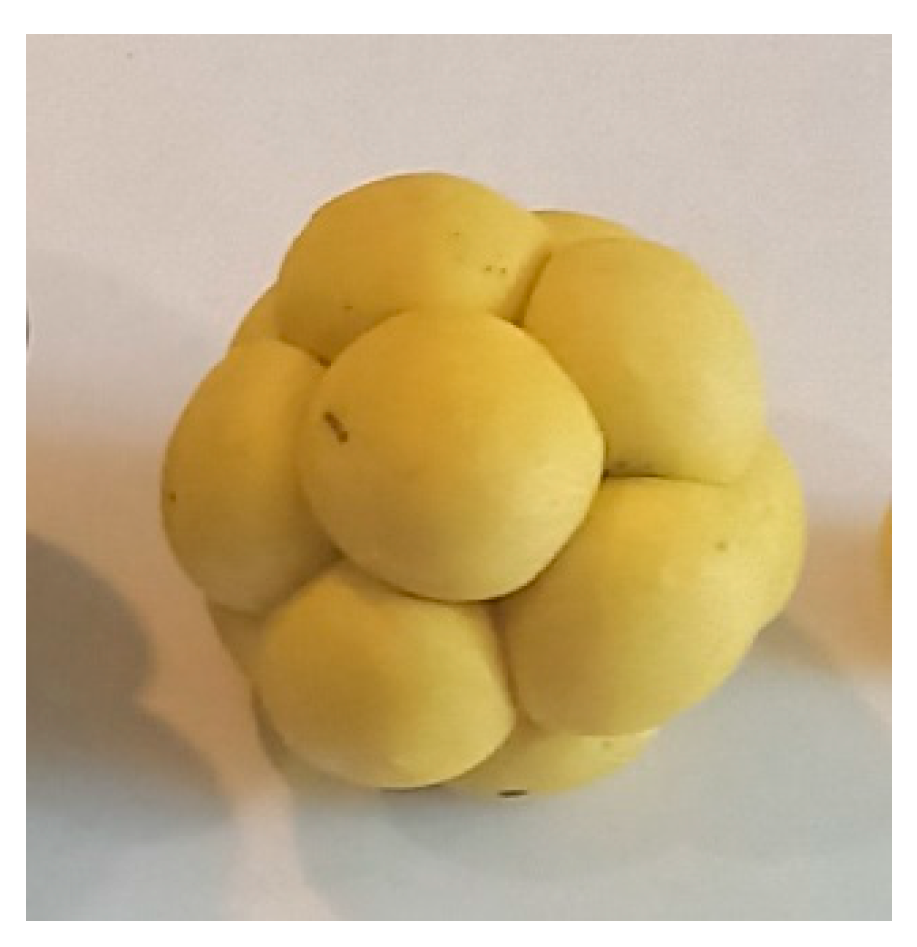
Figure 6.
Figure "45" with figure "13" in the center. It looks like a classic ball.
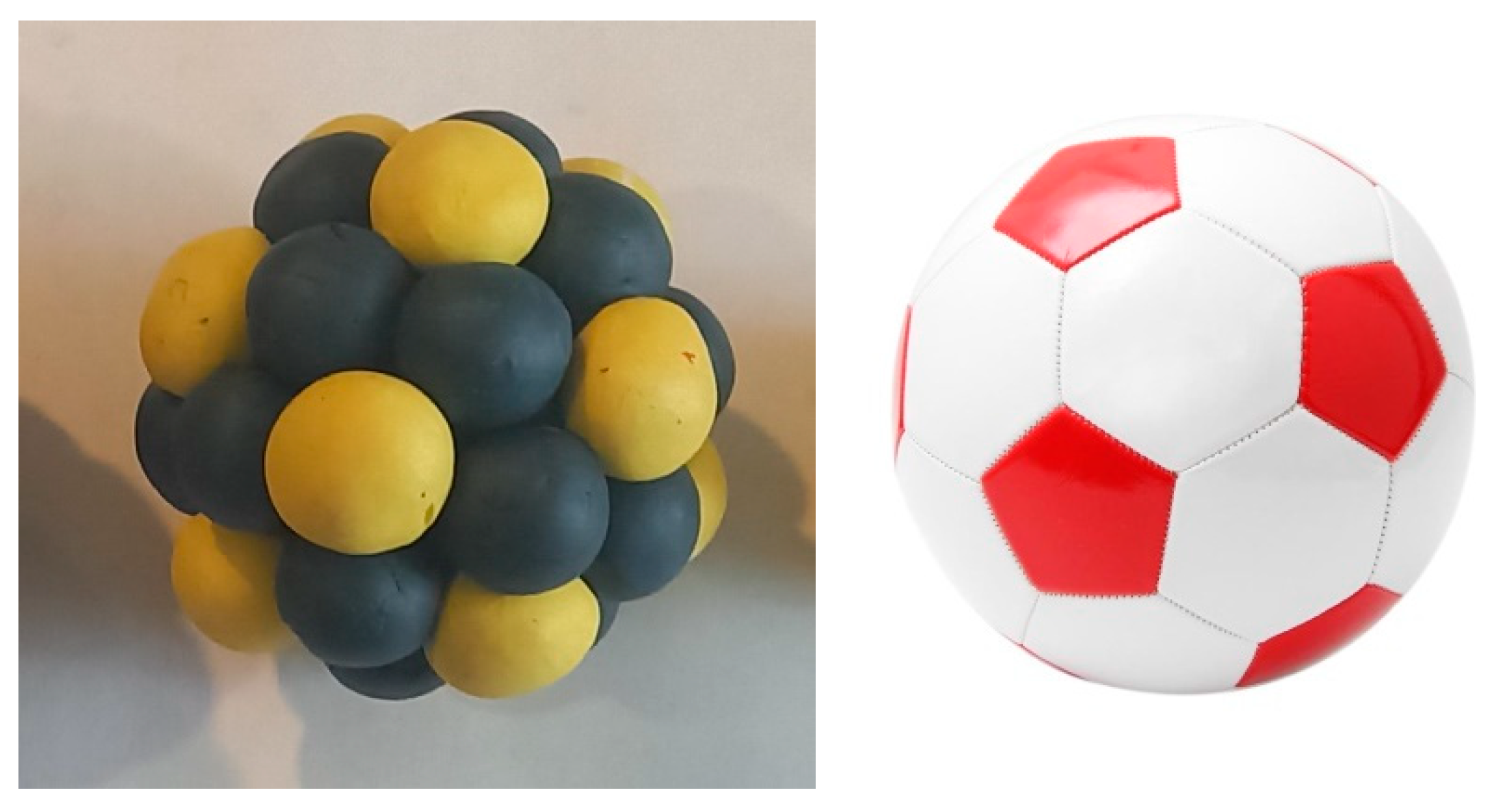
Figure 7.
Figure "137" with figure "45" inside.
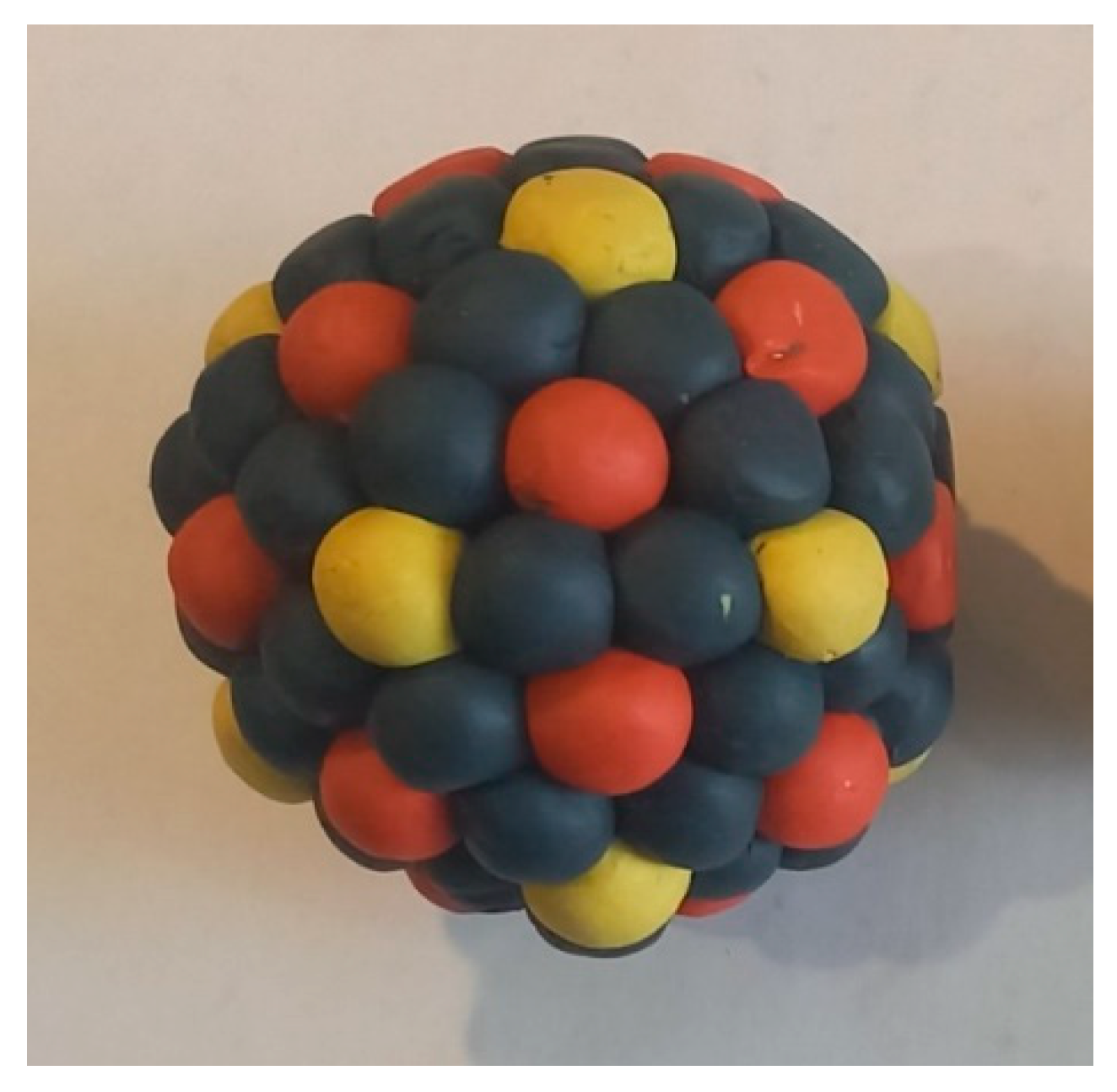
Figure 10.
Dodecahedral column in a shell.
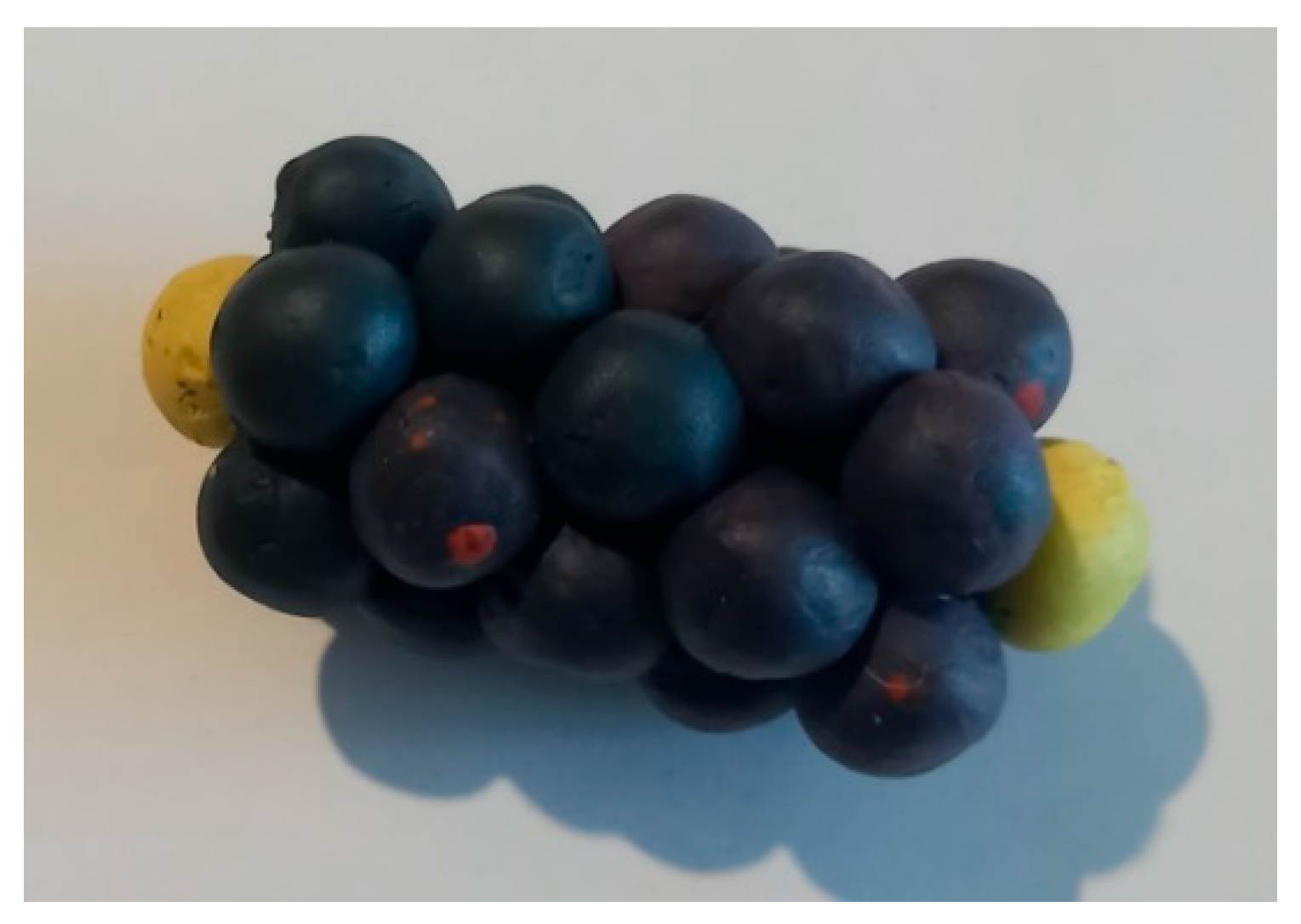
Figure 11.
Figure "421" with figure "259" in the center.
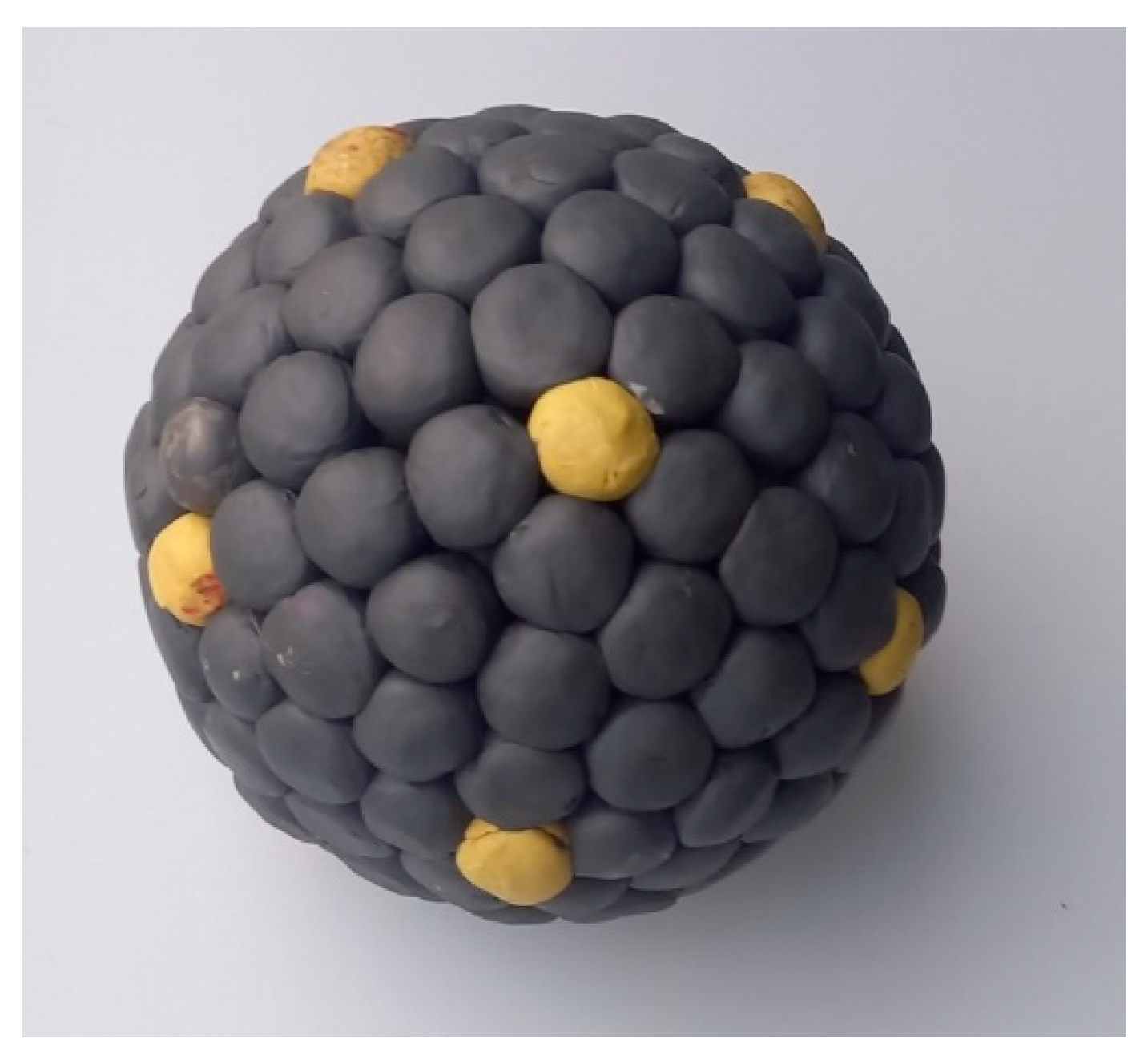
Figure 12.
Figure “63”, figure created by Weaire-Phelan scheme. Figure “13” is inside.
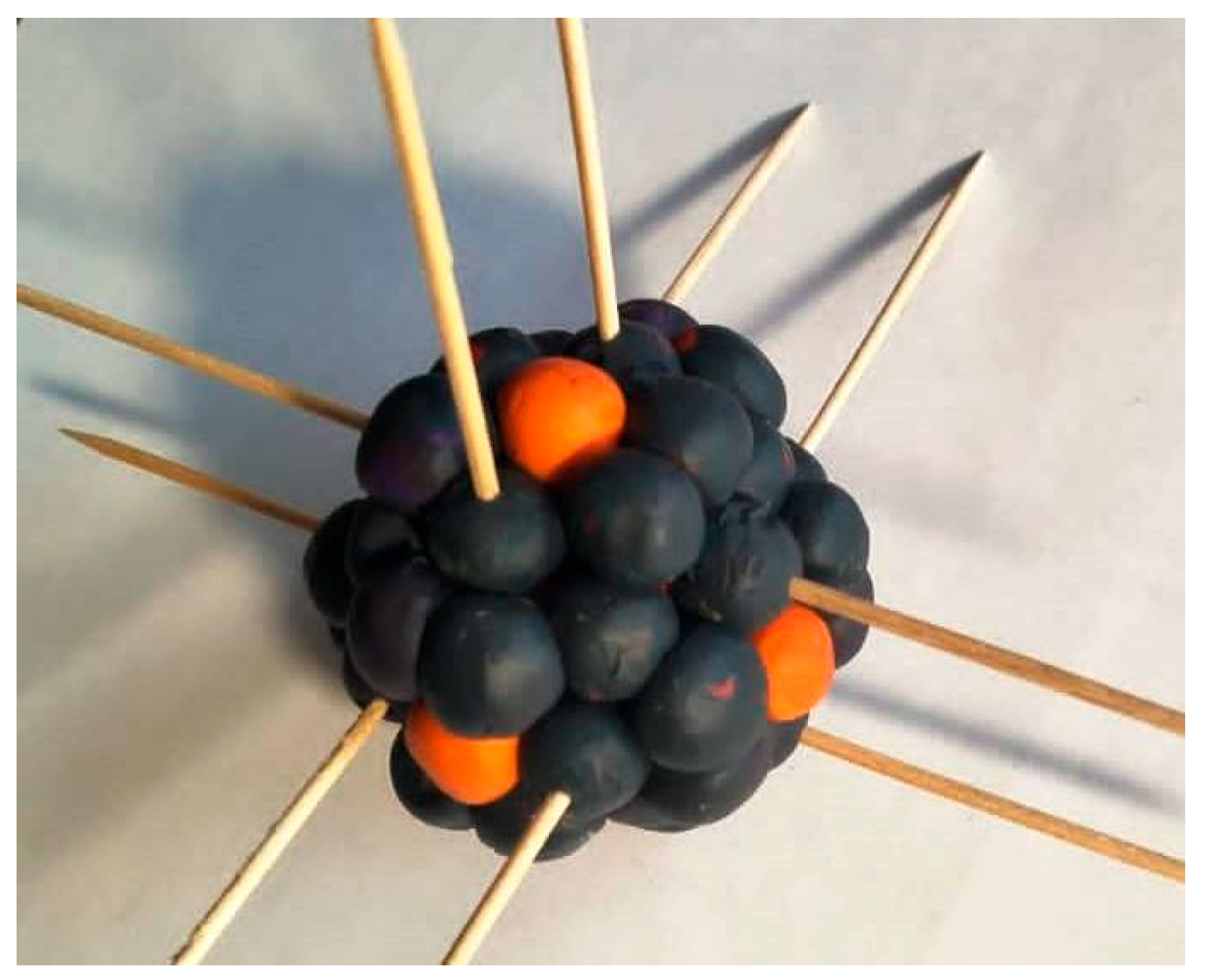
Disclaimer/Publisher’s Note: The statements, opinions and data contained in all publications are solely those of the individual author(s) and contributor(s) and not of MDPI and/or the editor(s). MDPI and/or the editor(s) disclaim responsibility for any injury to people or property resulting from any ideas, methods, instructions or products referred to in the content. |
© 2026 by the authors. Licensee MDPI, Basel, Switzerland. This article is an open access article distributed under the terms and conditions of the Creative Commons Attribution (CC BY) license (http://creativecommons.org/licenses/by/4.0/).
Copyright: This open access article is published under a Creative Commons CC BY 4.0 license, which permit the free download, distribution, and reuse, provided that the author and preprint are cited in any reuse.


