

Submitted:
30 January 2026
Posted:
02 February 2026
You are already at the latest version
Abstract
We investigate a random field of mutually dependent random variables ("spins"), indexed by a finite one-dimensional lattice, called in physical sciences the one-dimensional Ising model, in which the random variables can take only ±1 values (see the text for a precise definition). One of the couplings, termed a "bond," that describes the mutual influence of two adjacent random variables is altered—it does not equal the others, thereby introducing a single "defect" bond. This defect bond represents a localised perturbation within an otherwise uniform system. Utilising the recurrence relations of Chebyshev polynomials and the bijective map between the number of spins and the polynomial index, we present a new method for calculations and systematically explore, using it, the system’s properties across different chain lengths and boundary conditions. As an application, we derive analytical expressions for the dependence of the average values of the random variables on their position within the chain, which we refer to as the "local magnetisation profile". From the findings related to the system with a defect bond, we present a novel result for this profile under free (Dirichlet) boundary conditions and re-derive the corresponding result for antiperiodic boundary conditions.
Keywords:
dependent random variables
; mutual probability distributions
; probability theory
; statistical mechanics
; Ising model
; average values
; correlation functions
; Chebyshev polynomials
1. Introduction
The one-dimensional Ising model occupies a central place in statistical physics, primarily due to its analytical tractability and its capacity to illustrate fundamental aspects of cooperative behaviour and phase transitions (at ) in many-body systems. Beyond the extensively used transfer matrix method [1,2], numerous alternative analytical and numerical methodologies have been considered [3,4,5,6,7,8,9,10,11], further substantiating the model’s significance as a benchmark for theoretical investigations—despite its simplicity This is especially true when studying the finite-size model under various boundary conditions. The most commonly studied cases are those with periodic and free (Dirichlet) boundary conditions. A suitable selection of references for the latter case is represented by works [5,12,13,14,15,16,17]. Recent studies of correlation functions can be found in [18,19].
It is worth noting some disparity in the terminology used in the literature. In their seminal monograph, McCoy and Wu [1] use the term ’free boundary conditions’ to refer to boundary spins that are unconstrained. Alternatively, the name open boundary conditions is also often used, as well as Dirichlet boundary conditions, in the connotation of mathematical analysis.
Let us mention that the finite-size one-dimensional Ising model exemplifies the considerable increase in mathematical complexity that arises when transitioning from the thermodynamic, i.e., infinite limit system, to systems of finite size—particularly in the rigorous analysis of correlation functions (see, e.g., Eq. (3.4) and Eq. (3.12) in [1]). It is, furthermore, worth noting that the study of finite-size effects and the influence of boundary conditions provides a crucial conceptual bridge between idealised theoretical models and realistic, experimentally attainable one-dimensional systems.
The present study reaffirms the status of the one-dimensional Ising model as a paradigmatic system for the deployment and illustration a of complicated and structurally insightful mathematical techniques.
The method we propose, which utilises the properties of Chebyshev polynomials, offers distinct advantages, particularly in analysing the effects of different boundary conditions in finite-sized systems in conjunction with the presence of term , called in physical sciences a "magnetic field", linearly coupled to the sum of random variables . Effects due to the finite number of random variables, or, more generally of "finite-size effects", and the influence of boundary conditions, are naturally encoded in the structure of the corresponding Chebyshev polynomials, making the approach particularly well-suited for the analysis of finite, i.e., of non-thermodynamic-limit systems.
The article presents two types of results, discussed in Sections 2–4 and 5–8, respectively. Sections 2–4 revisit, in a streamlined manner, selected known results that serve as an introduction to the proposed method and illustrate its compactness and efficiency. By contrast, Sections 5–8 present new results concerning the properties of a more complex version of the model, namely the case with a defective bond. The main findings are summarised in the Conclusion, whereas Appendix A provides a complete list of the recurrence relations among Chebyshev polynomials referenced in the main text.
2. One Dimensional Ising Model
We consider a finite chain of length (a is the lattice spacing) with sites labelled by and bonds . At each site there is a discrete random variable, called in physical science spin, taking two values . The system has a nearest-neighbour interaction J and an external magnetic field . The probability of each configuration depends on a parameter which is linearly coupled to the sum of the random variables. It the physical sciences it is called external field h. The mutual probability distribution of the random variables in is
where
and
with the sum running over all configurations . The quantity has the meaning of the energy of the configuration , sometimes called also Hamilton of the discrete system, while is termed partition function.
The term provides the mutual influence of the boundary random variables (spins) and , and determine the so-called boundary conditions imposed on the system. One normally considers: (periodic, PBC), (antiperiodic, ABC), and (free boundary, FB) and we use the following dimensionless quantities and , where is the inverse temperature T ( is the Boltzmann’s constant ).
Different expectation values, e.g. called site magnetisation (or correlation functions), are computed with respect to this distribution , namely
For simplicity, we adopt a slight abuse of notation by omitting the explicit dependence on the boundary conditions in the formulas above; these dependencies will be made explicit wherever necessary below.
From the perspective of computation, the central observation is that the partition function can be formulated as a suitable power of the transfer matrix
namely the partition function. In the case of periodic boundary conditions (PBC), the partition function can be written as the trace of the N-th power of the transfer matrix ,
The standard approach to evaluating this expression is to perform a change of basis in which the transfer matrix becomes diagonal and to determine its eigenvalues by solving the associated equation. Difficulties arise, however, when the trace operator involves products of non-commuting matrices raised to different powers. The approach developed in the current article renders such cases considerably more tractable.
3. Chebyshev Polynomials and the Transfer Matrix Approach
In this section, we summarise some the properties of the Chebyshev polynomials of the first and second kinds, and , respectively, which are polynomials of degree N of some variable x. The definitions needed and all necessary recurrence relations, connecting Chebyshev polynomials with different indices, are collected, for a convenience of the reader, in Appendix A.
3.1. On the Use of Chebyshev Polynomials in Mathematical Physics
An approach, based on Chebyshev polynomials, arises naturally and systematically in a wide class of problems in mathematical physics, particularly in the study of superlattices, photonic crystals, and more general stratified media. The use of these polynomials in such contexts originates with the works of Abelès [20] and Jones [21], and their subsequent applications in transfer-matrix and wave-propagation problems are documented in [22,23,24], as well as in standard references [25] [§ 1.5.1, p. 69], [26] [§ 1.6.2, p. 55], and in comprehensive reviews. [27,28]. One of the defining features of this approach is that finite-size effects, together with intrinsic structural periodicity, play a central role, and must be treated explicitly in any consistent theoretical formulation. More recently, this approach has proven effective for other periodic systems, notably for studding some quantities in the one-dimensional Ising model under periodic, antiperiodic and Dirichlet boundary conditions [29,30,31]. It is important to present a systematic, but simple, formulation of the concept necessary for using the Chebyshev polynomials in the statistical mechanics of one-dimensional Ising systems for studding more complicated cases, or quantities.
3.2. Key Properties of the Transfer Matrix
It is convenient to work with theunimodular transfer matrix associated with the one-dimensional Ising model in an external magnetic field h, and with dimensionless inverse temperature
Here the normalisation factor r is chosen to ensure unimodularity:
The eigenvalues of are
Accordingly, the standard (non-normalized) transfer matrix can be expressed in terms of as
Our analysis is based on a structural result from the theory of the group , which plays a central role in the transfer-matrix formulation of the one-dimensional Ising model. We formulate this result in the form of Lemma 2 and provide a transparent proof that elucidates the structure of real matrices and their fundamental connection with Chebyshev polynomials, as naturally realized by the Ising transfer matrix.
Lemma 1.
Let be defined as in Eq. (4.1), and set
Then, for all integers , its powers satisfy
where is the Chebyshev polynomial of the second kind.
Proof.
The characteristic polynomial of is
with distinct roots . By the Cayley–Hamilton theorem,
which immediately gives the second-order matrix recurrence relation
This recurrence relation is formally identical to that satisfied by the Chebyshev polynomials of the second kind, providing the rigorous mathematical foundation of Lemma 2: the powers of can be expressed linearly in terms of and .
The general solution of this recurrence relation is
with
Using the Binet formula for Chebyshev polynomials of the second kind,
we solve for and and substitute into the above solution, which yields
This completes the proof. □
In the physical context of the one-dimensional Ising model, consider a segment of length p, represented by the transfer matrix , while the remainder of the chain of length is represented by the matrix . Lemma 2 shows that the powers of remain closed within the two-dimensional linear algebra spanned by and , so that
Consequently, traces of products of such segments, for example
can be computed directly, reducing the problem to simple multiplication of matrices, without any unitary transformation or diagonalisation. The representation in terms of Chebyshev polynomials ensures an elegant and efficient solution while making the dependence on segment length p explicit.
Remark 1.
Lemma 2 is purely a mathematical statement about powers of and does not depend on the position of p along the chain. In physical applications, the integer p serves as a segment index, representing the length of a subchain. For chains with non-periodic boundary conditions, the trace generally depends on p, and the Chebyshev-polynomial form makes this dependence both explicit and computationally convenient.
Remark 2.
The sequences and are polynomials with integer coefficients, i.e., elements of the polynomial ring . This property reflects the underlying algebraic structure connecting the unimodular Ising transfer matrix with the recurrence relations defining the Chebyshev polynomials. In particular, it guarantees that the powers of the transfer matrix—and any derived quantities, such as the partition function, correlation functions, etc.—can be expressed in a fully exact, closed form, without introducing irrational numbers or fractions.
This integer-coefficient property highlights both the predictability and universality of the recurrence relation: the same algebraic structure applies to any unimodular matrix. Historically, a general formula, for the N-th power of any unimodular matrix has been rediscovered repeatedly in the literature (see, e.g., [28]). It was derived using classical methods, most commonly via the Cayley–Hamilton theorem, or by direct mathematical induction. Our proof is simple and straightforward.
From Lemma 2, using the recurrence relation between Chebyshev polynomials of the first kind and second kind , defined in (A.5), one obtains the elegant formula
An elementary proof of Eq. (4.6), based on the Newton–Girard identities, was given in Ref. [32]. In the present setting, this identity establishes a direct connection between the partition function
and the Chebyshev polynomials [29], thereby underscoring the interplay between statistical mechanics and classical mathematics. The Chebyshev polynomials of the first kind, , are central to this framework, with the argument a explicitly depending on physical parameters such as the coupling K and external field h. Thus, they encode the spectral properties of the transfer matrix, enabling explicit calculation of thermodynamic quantities and revealing the model’s algebraic structure and characteristic behaviour.
4. Chebyshev and Lucas Polynomial Algebras in the One-Dimensional Ising Model
Recently, it has been demonstrated that the emergence of Chebyshev polynomials—either of the first kind, , or of the second kind, —provides a powerful and systematic computational framework. Their appearance is closely tied to the choice of finite-size boundary conditions imposed on the model, as discussed in Refs. [29,30,31]. This correspondence highlights the effective role of underlying recurrence relations, which naturally encode both the finite-size geometry and the associated boundary constraints. The existence of polynomials defined by second-order linear recurrence relations in the one-dimensional Ising model is, of course, not a new observation. The effective use of generalised Fibonacci and Lucas polynomials in this context has already been reported in [8,33,34]. This naturally leads to an exploration of whether the Lucas or Chebyshev polynomials might be more suitable for the analysis. The answer is most likely determined by the relationship that exists between these two families of polynomials.
The Lucas polynomials satisfy the recurrence relation
where , when and .
The Chebyshev polynomials of the first and second kinds, and , satisfy the common recurrence relation (see, Appendix A)
with arbitrary initial conditions and . The choice and yields , whereas and yields . Even for the Chebyshev polynomials, the literature introduces a special convention to remove powers of two in the explicit formulas for and , as these powers are cumbersome in analytical calculations.; see [35,36].
Specifically, for the Chebyshev polynomials of the first kind , the relation reads:
The situation, however, differs for the second-kind Chebyshev polynomials , provide a minimal, canonical basis for representing powers of the transfer matrix across all boundary conditions. By applying the recurrence relations for Chebyshev polynomials Eq. (A.7) in conjunction with Eq. (5.3), one obtains the following identity:
For comprehensive bibliographical comments on the links between Chebyshev polynomials and other well-studied polynomial families, such as the Lucas polynomials, see Ref. [37].
To further demonstrate the utility of our Chebyshev polynomial-based method, we consider in the next section some analytically more involved case.
5. Partition Function of One-Dimensional Ising Chain with a Defect Bond
Definition 1.
The one-dimensional Ising model with a defect bondis defined as a spin system on a ring of N sites, with spin variables , , subject to periodic boundary conditions. Nearest-neighbor interactions are uniform with coupling constant K, except for a single bond of strength that breaks translational invariance. The energy of a spin configuration is given by
Remark 3.
The presence of the defect bond with coupling breaks the translational invariance of the homogeneous one-dimensional Ising chain. As a consequence, thermodynamic quantities acquire additional contributions associated with the defect, which persist in the finite-size system and may give rise to surface or interface effects. In the homogeneous limit , the standard translationally invariant one-dimensional Ising model with periodic boundary conditions is recovered.
The partition function of the chain with a "defect" at a site obviously is:
where we have introduced the standard transfer matrix , see Eq.(2.5), with elements
The "defect" transfer matrix given by
Recently, certain aspects of this model have been investigated using standard techniques; see Ref. [38]. In contrast, the approach adopted here offers several advantages, which are discussed below. We now proceed with the following result.
Theorem 1.
The partition function Eq.(6.2) is given by the relation
Proof.
The corresponding partition function Eq. (6.2) can be expressed as a product of matrices:
By using the relation (which follows from Lemma 2):
we have
After some simple algebra we obtain
and
Then, Eq.(6.8), can be rewritten as
Now, using the definitions of "a’ and "r", it is easy to obtain
Finally, after using the recurrence relation (see Section 3) between Chebyshev polynomials for , explicitly:
one can transform the algebraic sum of first and third therms in Eq.(6.12) exactly in the rhs of Eq.(6.5), which proves the theorem. □
In [39], this result was derived through an alternative approach, without using the Chebyshev polynomial properties, which explicitly involves the eigenvalues of the transfer matrix.
Eq. (6.5) provides an unified representation that includes, as special cases, the results corresponding to periodic (see Eq. (4.7), and antiperiodic boundary conditions (see Eq. (3.11) in Ref. [29]), as well as the case of free (Dirichlet) boundaries , cf. Eq. (6.19), as derived in [30]. We now verify this statement.
Corollary 1.
Let us consider the tree boundary condition mentioned.
- For periodic boundary conditions we set in Eq. (6.5). Immediately, using Eq. (A.5) we find thatThis result coincides exactly with the expression for the grand-canonical partition function under periodic boundary conditions, as given in Eq. (4.7).
- For antiperiodic boundary conditions we set in Eq. (6.5). Then:which coincides with the known result for the grand-canonical partition function under antiperiodic boundary conditions, see Eq.(3.11) in ref.[29] .
- For free boundary conditions we set in Eq. (6.5). Then, the result is:
Note to Section. 6
Since the numerous recurrence relations among Chebyshev polynomials allow the final result to be expressed in different forms depending on the chosen calculation path, we will illustrate this property by presenting several equivalent forms of the partition function in the case of free (Dirichlet) boundary conditions.
In Ref. [30], the following expression for the grand canonical partition function was obtained:
After applying the recurrence relation Eq.(A.5)
one can verify that Eq. (6.17) is equivalent to
Furthermore, applying the recurrence relation Eq.(A.3)
one obtains the compact expression Eq.(6.16).
6. Asymptotic Expansion of the Partition Function with a Defect Bond
Now we need the following preparatory proposition for the asymptotes of the Chebyshev polynomials for :
Proposition 1.
Theorem 2.
For , the following presentation of the partition takes place
where the amplitude is
while the correlation length is [2]
Proof.
From Eq.(7.1), one finds
Substituting these expressions into the grand-canonical partition function with a defect bond yields
which is the statement in Eq. (7.3). Note that does not depend on N. □
The representation given by Eq. (7.3) clearly separates the different contributions into the partition function based on their dependence on the system size N. This is most clearly seen in the quantity , called the free energy of the system in statistical physics, defined as:
where
is called the bulk free energy, independent of and N, while
is termed surface (interface) free energy, independent on N, but dependent on . The remaining term, , contains higher-order corrections that vanish as . Consequently, the manner in which approaches its bulk limit as depends crucially on the behaviour of , which is a generic feature in the presence of boundary conditions imposed on the system. At this stage, it is convenient to briefly discuss the most important values of , corresponding to different boundary conditions.
Corollary 2.
For the periodic (), antiperiodic () and free (Dirichlet) (), also known as free or missing neighbours boundary conditions one has, consequently:
- If (periodic boundary conditions) we getand, thusTherefore, approaches the bulk result exponentially in N.
- If (antiperiodic boundary conditions) one haswhere the antiperiodic surface free energy iswhich coincides with the result, Eq.(3.9) in Ref. [29].
- If (free boundary conditions) the result iswhere the free surface free energy isThis, after some algebraic manipulations, coincides with the well-known result of McCoy and Wu [1].
Note that expansion Eqs. 7.11, 7.12, and Eq. 7.14 make sense only if . When we are in the realm of the finite-size scaling theory [41,42,43,44,45]. Then a much more complicated theory is needed, which is out of the scope of the current article and will be considered elsewhere.
The behaviour of and is visualised in Figure 1.
The surface free energy of the chain with defect bond as a function of , for specific choices of the parameters K and h is shown in Figure 2.
7. Local Magnetisation in the Case of Defect Bond
The average value of the random variable under boundary conditions in a chain with N random variables is called in physical sciences site, or local, magnetisation. It dependence on the position n provides the so-called order parameter profile, which is of a special interest there.
In what follows, we compute the local magnetisation at lattice site p. By definition,
The matrix at a position p after the defect bond, is the Pauli matrix .
In what follows, we omit the superscript , with the understanding that we work throughout with the model subject to periodic boundary conditions; this convention introduces no ambiguity. Initial models with alternative boundary conditions are not considered in the present study.
We next introduces two auxiliary operator constructions,
Using Eq. (8.2), the definition for local magnetisation can be rewritten as
An immediate consequence of Lemma 2, which applies to matrix powers appearing under the trace, is that
and
Consequently, the trace appearing on the right-hand side of Eq. (8.3) becomes
Expanding the product and using linearity of the trace, the expression decomposes into four contributions:
The trace terms appearing as four separate contributions in Eq. (8.7) can be evaluated explicitly by direct matrix multiplication. These straightforward, though somewhat tedious, calculations yield the following results:
- the first term in Eq. (8.7)
- the second term in Eq. (8.7)
- the third term in Eq. (8.7)
- the forth term in Eq. (8.7)
We note that the observed coincidence of the second and third terms does not arise from cyclic permutation under the trace, but as a consequence of direct calculation. Upon substituting these results into Eq. (8.7), and employing the recurrence relation (A.2) for the Chebyshev polynomials of the second kind, we obtain
where
To complete our further consideration we need the following statement:
Proposition 2.
Proof.
Factoring out from the first term and group it with the second and third terms in Eq. (8.12), we obtain:
This expression equals to
Using the standard recurrence relation for Chebyshev polynomials of the second kind (see, Eq. (A.2)), Eq. (8.14) reduces to a single product . Finally, substituting this back into the trace expression and keeping the remaining term, we obtain
which proves the proposition. □
Using the result of Proposition 2, together with Eq. (8.3), we arrive at
Theorem 3.
Let denote the local magnetisation at site p of a periodic spin chain containing a single defect bond with arbitrary coupling . Then
Proof.
Starting from Eq. (8.3) and using Proposition 2, as well as the identities
for the numerator in Eq. (8.16) we obtain
Realising that denominator arises from the partition function Eq. (6.5) we immediately arrive at Eq. (8.16). □
8. Limiting Cases of
The behaviour of the order parameter profile under different boundary conditions is shown in Figure 3.
Below we derive analytical expressions for the order parameter profiles for the special cases free (Dirichlet), (periodic), and (antiperiodic) boundary conditions, of interest in physical sciences.
Corollary 3.
We obtain consequently:
-
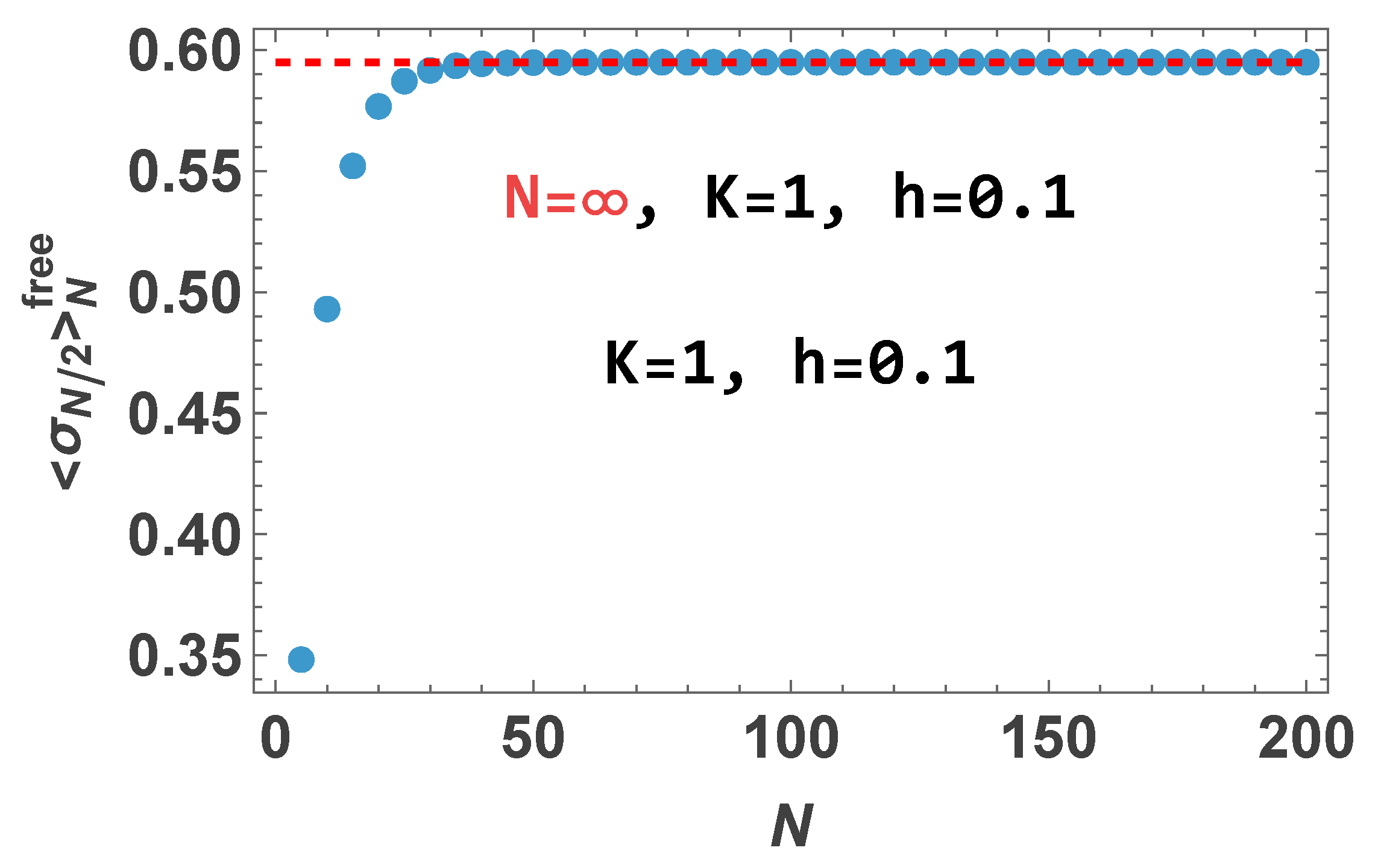
free (Dirichlet) boundary conditions:Setting in Theorem 3, we getwhere it was used that for , the grand-canonical partition function reduces toAnother representation of the , but in terms of Chebyshev , instead of polynomials isComparing Eq. (9.3) with Eq. (8.13), one establishes the equivalence of both results.Remark 4.The explicit dependence on p remains because the system is not translation invariant. Different positions p correspond to different relative locations of the insertion “defect bond matrix” in the product . This manifests mathematically in the appearance of the modes and in the trace formula.The behaviour of the order parameter profile given by Eq. (9.3) is depicted in Figure 4.Figure 5 shows how fast, with the increase of N, the average value of the random variable positioned in the middle of the chain approaches the corresponding limit of the infinite (bulk) system.
-
Periodic Boundary Conditions:In this case . Setting in Eq. (8.3) , and using the w partition function in this case is given by:we deriveThis result was recently obtained in [31]. It demonstrates that the site magnetisation is independent of p, which is consistent with the expectation for periodic boundary conditions.
-
Antiperiodic Boundary ConditionsIn this case , i.e., all bonds have the same coupling constant K, except for one with . Then, the local magnetisation at site p is given by:In this casewhere we have used the recurrence relationThe partition function is given byThenThis result was recently obtained in [31].
Remark 5.
The explicit dependence on p reflects the absence of translation invariance in the system. Indeed, the trace contains a multiplication by the "defect matrix" at a position p, so different values of p are not related by symmetry. Mathematically, this manifests itself in the appearance of the mode , which encodes the relative distance of the insertion of the defect bond from the boundaries. Only in a translation-invariant limit, as in periodic boundary conditions, the p-dependence disappear.
Note to Section. 9 In conclusion, we note that by varying the parameter , we can model a continuum of boundary conditions imposed on the chain, which include as special cases the most important ones: periodic (), antiperiodic (), and free (Dirichlet) () boundary conditions.
9. Conclusions
We have proposed a new method for calculating quantities in the one-dimensional Ising model based on the properties of the Chebyshev polynomials. We have shown that the recurrence structure of the Chebyshev polynomials of the second kind is naturally embedded in the transfer-matrix formulation of the model, especially suitable for studies of the cases with broken translational invariance. One example, which we employed, is caused by a defective bond at a specific site. The mathematical framework of our approach relies on two key elements: the algebra of matrices and the systematic exploitation of various recurrence relations among Chebyshev polynomials. This formulation provides a unified and technically convenient method.
Using the method suggested in the article, we obtain explicit expressions for the expectations of the random variables , see Eq. (8.1), in a one-dimensional Ising chain, highlighting their dependence on the site index p relative to the defect bond ; this defines the profile of the local magnetisation. In physical sciences this profile is also called order parameter profile. The analytical result is given in Eq. (8.16). The visualisation of the expression for different values of is presented in Figure 3. Note that by varying the value of , one recovers periodic boundary conditions for , antiperiodic boundary conditions for , and Dirichlet (free) boundary conditions for . We stress that the result for the last case is also new, and to the best of our knowledge, has never been derived before. Eq. (9.1) provides an expression for the profile linear in terms of Chebyshev polynomials, while Eq. (9.3) provides an equivalent expression in terms of products of polynomials. Figure 4 demonstrates the behaviour of the profile for free boundary conditions when , and two set of values of the parameters governing the system. Finally, Figure 5 illustrates how fast, with the increase of N, the behaviour of the system approaches the corresponding one of the infinite chain.
The normalisation factor in the denominator of (2.1) is called the partition function in statistical physics. Through it, one defines the free energy of the system (see Eq. (6.5) and (7.9)), which is of primary interest in physical sciences. In Sec. 6 we briefly discuss the behaviour of this quantity for periodic, antiperiodic and Dirichlet (free) boundary conditions, as well as for the case of a system with a defect bond. As shown there, for a large number N of random variables, i.e., when , the free energy can be decomposed into a part which does not depend on N, characterising the system with an infinite number of random variables, plus one term, called surface free energy, see Eq. (7.10). The behaviour of the surface free energy as a function of the parameters of the model is shown in Figure 1 and Figure 2.
We close this short discussion by stressing that the method proposed here is by no means limited to studying of the quantities considered in the current article. It can be straightforwardly extended, e.g., to investigate other quantities of interest in physical sciences, say, the correlation functions, the role of impurities, or the existence of some structures inside of the finite system.
Author Contributions
Conceptualization, N. T. and D.D.; methodology, N. T. and D.D.; software, D.D.; validation, D.D.; formal analysis, N. T. and D.D. ; investigation, N. T. and D.D.; writing—original draft preparation, N. T.; writing—review and editing, N. T. and D.D.; visualization, D.D.; All authors have read and agreed to the published version of the manuscript.
Funding
This work is supported by Grant KP-06-H72/5, competition for financial support for basic research projects—2023, Bulgarian National Science Fund.
Data Availability Statement
No new data were created in the current article.
Acknowledgments
This work was accomplished by the Center of Competence for Mechatronics and Clean Technologies “Mechatronics, Innovation, Robotics, Automation and Clean Technologies” – MIRACle, with the financial support of contract No. BG16RFPR002-1.014-0019-C01, funded by the European Regional Development Fund (ERDF) through the Programme “Research, Innovation and Digitalisation for Smart Transformation” (PRIDST) 2021–2027.
Conflicts of Interest
The authors declare no conflicts of interest.
Appendix A. Chebyshev Polynomials: Recurrence Relations
For , the Chebyshev polynomials of the first and second kind are defined as follows (see, e.g. in Ref. [35] [p. 97], Ch. 1.5 in Ref. [40] and Ref. [36] [p.371]). Polynomials and , are defined for by
together with the standard recurrence relations
These definitions extend uniquely to all negative integers via
or equivalently, using the trigonometric forms
Notably, the Chebyshev polynomials of the second kind, , play a more fundamental role, as the polynomials of the first kind can be expressed in terms of .
For all integers , one has
which remains valid under the negative-index extension
Other expressions for positive indices are
and
which follows algebraically from the standard recurrence relation. A comprehensive list of relations between Chebyshev polynomials of different indices is presented in [35,36], see also the important recurrence relations:
in [35], and
in [36], Section 41.4, p. 412, Eq. (47)).
References
- McCoy, B.M.; Wu, T.T. The two-dimensional Ising model; Harvard Univ. Press: Cambridge, 1973. [Google Scholar]
- Baxter, R.J. Exactly Solved Models in Statistical Mechanics; Academic: London, 1982. [Google Scholar]
- Marchi, E.; Vila, J. Recursive Method in One-Dimensional Ising Model. Journal of Physics A: Mathematical and General 1980, 13, 2465. [Google Scholar] [CrossRef]
- Kassan-ogly, F.A. One-dimensional Ising model with next-nearest-neighbour interaction in magnetic field. Phase Transitions: A Multinational Journal 2001, 74, 353–365. [Google Scholar] [CrossRef]
- Antal, T.; Droz, M.; Rácz, Z. Probability distribution of magnetization in the one-dimensional Ising model: effects of boundary conditions. Journal of Physics A: Mathematical and General 2004, 37, 1465. [Google Scholar] [CrossRef]
- Bellucci, S.; Ohanyan, V. Correlation functions in one-dimensional spin lattices with Ising and Heisenberg bonds. The European Physical Journal B 2013, 86, 446. [Google Scholar] [CrossRef]
- Seth, S. Combinatorial Approach to Exactly Solve the 1D Ising Model. European Journal of Physics 2016, 38, 015104. [Google Scholar] [CrossRef]
- da Conceição, C.S.; Maia, R. Recurrence relations in one-dimensional Ising models. Physical Review E 2017, 96, 032121. [Google Scholar] [CrossRef]
- Kharchenko, Y.N. On the Solution of One-Dimensional Ising Models. Journal of Applied Mathematics and Physics 2018, 6, 84525. [Google Scholar] [CrossRef]
- Magare, S.; Roy, A.; Srivastava, V. 1D Ising model using the Kronecker sum and Kronecker product. Eur. J. Phys. 2022, 43, 035102. [Google Scholar] [CrossRef]
- Ferreira, L.S.; Plascak, J.A. Finite-Size Effects of the One-Dimensional Ising Model. Braz. J. Phys. 2023, 53, 77. [Google Scholar] [CrossRef]
- Wortis, M. Griffiths singularities in the randomly dilute one-dimensional Ising model. Physical Review B 1974, 10, 4665. [Google Scholar] [CrossRef]
- Shigematsu, H. Asymptotic behavior of fluctuations for the 1D Ising model in zero-temperature limit. Journal of statistical physics 1993, 71, 981–1002. [Google Scholar] [CrossRef]
- García-Pelayo, R. Distribution of magnetization in the finite Ising chain. Journal of mathematical physics 2009, 50. [Google Scholar] [CrossRef]
- Rudnick, J.; Zandi, R.; Shackell, A.; Abraham, D. Boundary conditions and the critical Casimir force on an Ising model film: Exact results in one and two dimensions. Phys. Rev. E 2010, 82, 041118. [Google Scholar] [CrossRef] [PubMed]
- Taherkhani, F.; Daryaei, E.; Parsafar, G.; Fortunelli, A. Investigation of size effects on the physical properties of one-dimensional Ising models in nanosystems. Molecular Physics 2011, 109, 385–395. [Google Scholar] [CrossRef]
- Chiruta, D.; Linares, J.; Miyashita, S.; Boukheddaden, K. Role of open boundary conditions on the hysteretic behaviour of one-dimensional spin crossover nanoparticles. Journal of Applied Physics 2014, 115. [Google Scholar] [CrossRef]
- Balcerzak, T. Application of the integral operator method for multispin correlation function calculations in the one-dimensional Ising model. Physical Review E 2024, 109, 024133. [Google Scholar] [CrossRef]
- Balog, I.; Rançon, A. Constraint correlation functions of the one-dimensional Ising model in the scaling limit. Phys. Rev. E 2025, 112, 054127. [Google Scholar] [CrossRef]
- Abelès, F. Recherches sur la propagation des ondes électromagnétiques sinusoïdales dans les milieux stratifiés. Applications aux couches minces. Ann. Phys. (Paris) 1950, 12, 596–640 and 706–782. English title: "Research on the propagation of sinusoidal electromagnetic waves in stratified media. Applications to thin films".
- Jones, H. The electron energy spectrum in long period superlattices. Journal of Physics F: Metal Physics 1973, 3, 2075–2085. [Google Scholar] [CrossRef]
- Sprung, D.W.L.; Wu, H.; Martorell, J. Scattering by a finite periodic potential. Am. J. Phys. 1993, 61, 1118–1123. [Google Scholar] [CrossRef]
- Wu, H.; Sprung, D.W.L.; Martorell, J. Periodic Quantum Wires and Their Quasi-One Dimensional Nature. Journal of Physics D: Applied Physics 1993, 26, 798–803. [Google Scholar] [CrossRef]
- Griffiths, D.J.; Steinke, C.A. Waves in locally periodic media. American Journal of Physics 2001, 69, 137–154. [Google Scholar] [CrossRef]
- Furman, S.A.; Tikhonravov, A.V. Basics of optics of multilayer systems; Atlantica Séguier Frontieres, 1992. [Google Scholar]
- Born, M.; Wolf, E. Principles of Optics: Electromagnetic Theory of Propagation, Interference and Diffraction of Light, 7th ed.; Cambridge University Press: Cambridge, UK, 1999; chapter 1.6, pp. 54–65. Section 1.6: Wave propagation in a stratified medium. Theory of dielectric films.
- Sánchez-Soto, L.L.; Monzón, J.J.; Barriuso, A.G.; Cariñena, J.F. The transfer matrix: A geometrical perspective. Physics Reports 2012, 513, 191–227. [Google Scholar] [CrossRef]
- Pereyra, P. The transfer matrix method and the theory of finite periodic systems. From heterostructures to superlattices. physica status solidi (b) 2022, 259, 2100405. [Google Scholar] [CrossRef]
- Dantchev, D.M.; Tonchev, N.S.; Rudnick, J. Casimir versus Helmholtz forces: Exact results. Annals of Physics 2023, 459, 169533. [Google Scholar] [CrossRef]
- Dantchev, D.M.; Tonchev, N.; Rudnick, J. Casimir and Helmholtz forces in one-dimensional Ising model with Dirichlet (free) boundary conditions. Annals of Physics 2024, 464, 169647. [Google Scholar] [CrossRef]
- Tonchev, N.S.; Dantchev, D. Chebyshev Polynomials in the Physics of the One-Dimensional Finite-Size Ising Model: An Alternative View and Some New Results. Condensed Matter 2024, 9, 53. [Google Scholar] [CrossRef]
- Brandi, R.; Ricci, P.E. Composition Identities of Chebyshev Polynomials via 2×2 Matrix Powers. Symmetry 2020, 12, 746. [Google Scholar] [CrossRef]
- Doman, B.; Williams, J. Low-temperature properties of frustrated Ising chains. Journal of Physics C: Solid State Physics 1982, 15, 1693. [Google Scholar] [CrossRef]
- Rehn, J.; Santos, F.; Coutinho-Filho, M. Combinatorial and topological analysis of the Ising chain in a field. Brazilian Journal of Physics 2012, 42, 410–421. [Google Scholar] [CrossRef]
- Snyder, M. Chebyshev Methods in Numerical Approximation; Prentice Hall, Inc., 1966. [Google Scholar]
- Koshy, T. Fibonacci and Lucas Numbers with Applications, Volume 2; Vol. 2, John Wiley & Sons, 2019.
- Smajlović, L.; Šabanac, Z.; Šćeta, L. Relations between Chebyshev, Fibonacci and Lucas polynomials via trigonometric sums. The Fibonacci Quarterly 2025, 63, 439–455. [Google Scholar] [CrossRef]
- Dantchev, D.; Tonchev, N. A Brief Survey of Fluctuation-induced Interactions in Micro-and Nano-systems and One Exactly Solvable Model as Example. arXiv 2024, arXiv:2403.17109. [Google Scholar]
- Dantchev, D.; Tonchev, N. A Brief Survey of Fluctuation-Induced Interactions in Micro and Nano-Systems and One Exactly Solvable Model as Example. In Advanced Computing in Industrial Mathematics. BGSIAM 2023; Lilkova, E.; Datcheva, M.; Aleksandrova, T., Eds.; Springer, Cham, 2025; Vol. 1219, Studies in Computational Intelligence, pp. 44–58. [CrossRef]
- Mason, J.C.; Handscomb, D.C. Chebyshev polynomials; CRC press, 2002. [Google Scholar]
- Binder, K. Critical Behaviour at Surfaces. In Phase Transitions and Critical Phenomena; Domb, C.; Lebowitz, J.L., Eds.; Academic, London, 1983; Vol. 8, chapter 1, pp. 1–145.
- Privman, V. Finite-size scaling theory. In Finite Size Scaling and Numerical Simulations of Statistical Systems; Privman, V., Ed.; World Scientific, Singapore, 1990; pp. 1–98.
- Privman, V. (Ed.) Finite Size Scaling and Numerical Simulation of Statistical Systems; World Scientific: Singapore, 1990; p. 1. [Google Scholar]
- Brankov, J.G.; Dantchev, D.M.; Tonchev, N.S. The Theory of Critical Phenomena in Finite-Size Systems - Scaling and Quantum Effects; World Scientific: Singapore, 2000. [Google Scholar]
- Dantchev, D.M.; Dietrich, S. Critical Casimir effect: Exact results. Phys. Rep. 2023, 1005, 1–130. [Google Scholar] [CrossRef]
Figure 1.
The "surface" free energy of the Ising chain with free antiperiodic boundary conditions (left) and free (Dirichlet) boundary conditions (right). Note that in both cases the excess free energy is not monotonic, can be positive as well as negative and is symmetric with respect to h.
Figure 1.
The "surface" free energy of the Ising chain with free antiperiodic boundary conditions (left) and free (Dirichlet) boundary conditions (right). Note that in both cases the excess free energy is not monotonic, can be positive as well as negative and is symmetric with respect to h.
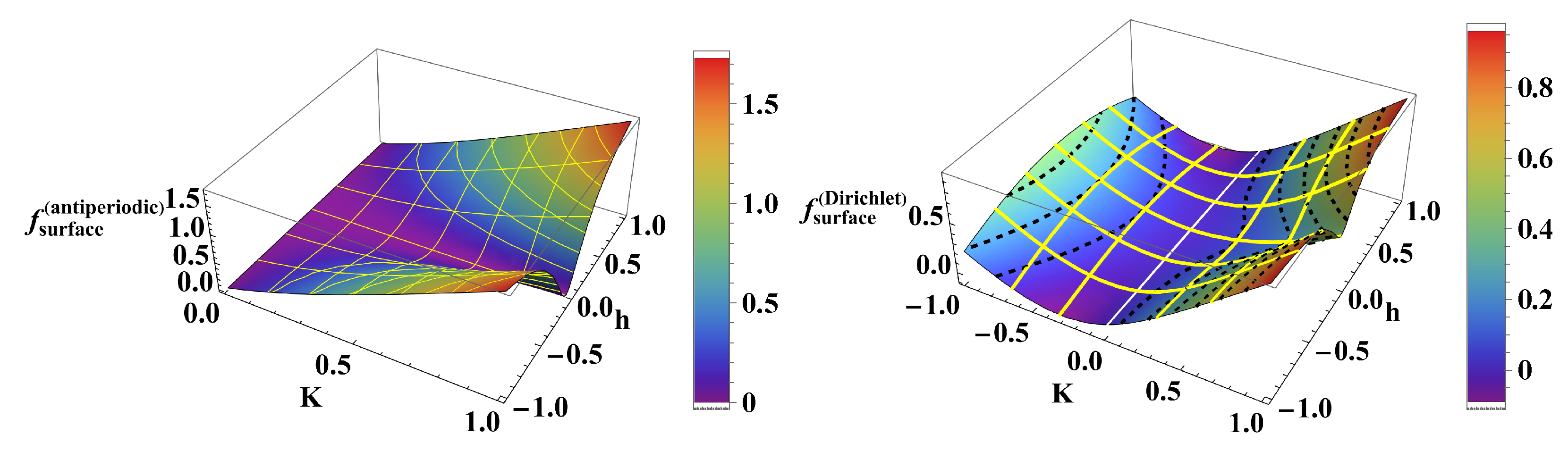
Figure 2.
The "surface" free energy of the Ising chain with defect bond as a function of and h for (left), and as a function of K and for (right).
Figure 2.
The "surface" free energy of the Ising chain with defect bond as a function of and h for (left), and as a function of K and for (right).
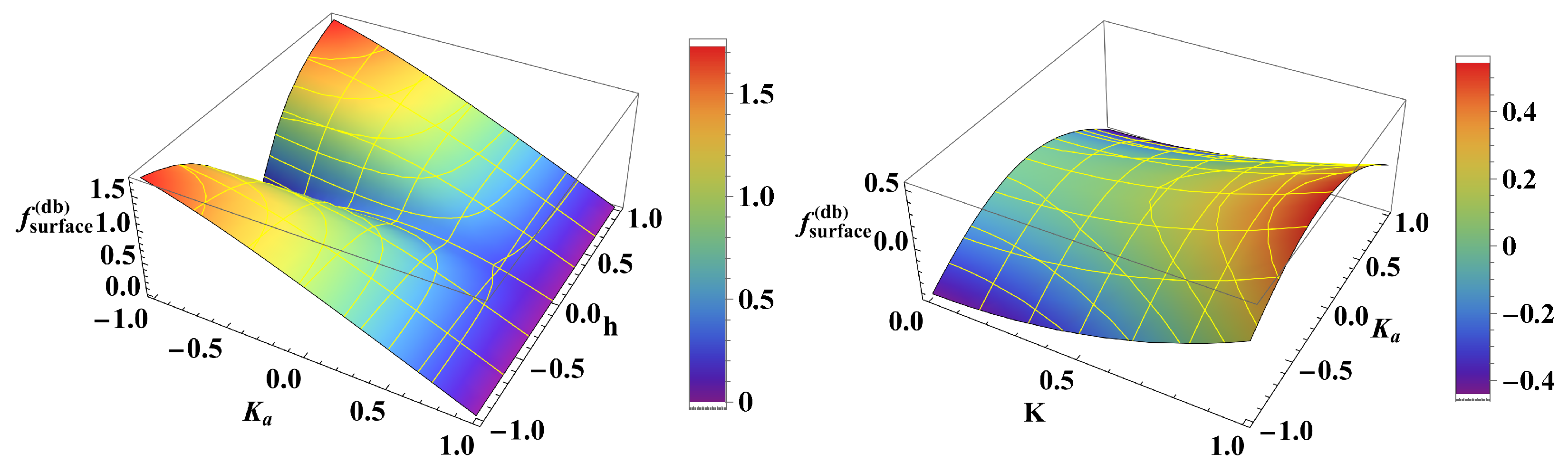
Figure 3.
The order parameter profile under various boundary conditions for , and with . The red dashed line shows the value of the bulk magnetisation for those values of K and h. Note that for all boundary conditions away from the ends of the chain the average magnetisation coincides with the one for the infinite (bulk) system, with the same values of K and h. That is why the curves for periodic boundary conditions and the bulk ones practically coincide. The other reason why that is so is the fact that we do consider the case for whish . The special case is not a topic of the current article and will be considered elsewhere. Furthermore, we observe that when , starting from approach the curves monotonically approach the case of antiperiodic boundary conditions.
Figure 3.
The order parameter profile under various boundary conditions for , and with . The red dashed line shows the value of the bulk magnetisation for those values of K and h. Note that for all boundary conditions away from the ends of the chain the average magnetisation coincides with the one for the infinite (bulk) system, with the same values of K and h. That is why the curves for periodic boundary conditions and the bulk ones practically coincide. The other reason why that is so is the fact that we do consider the case for whish . The special case is not a topic of the current article and will be considered elsewhere. Furthermore, we observe that when , starting from approach the curves monotonically approach the case of antiperiodic boundary conditions.
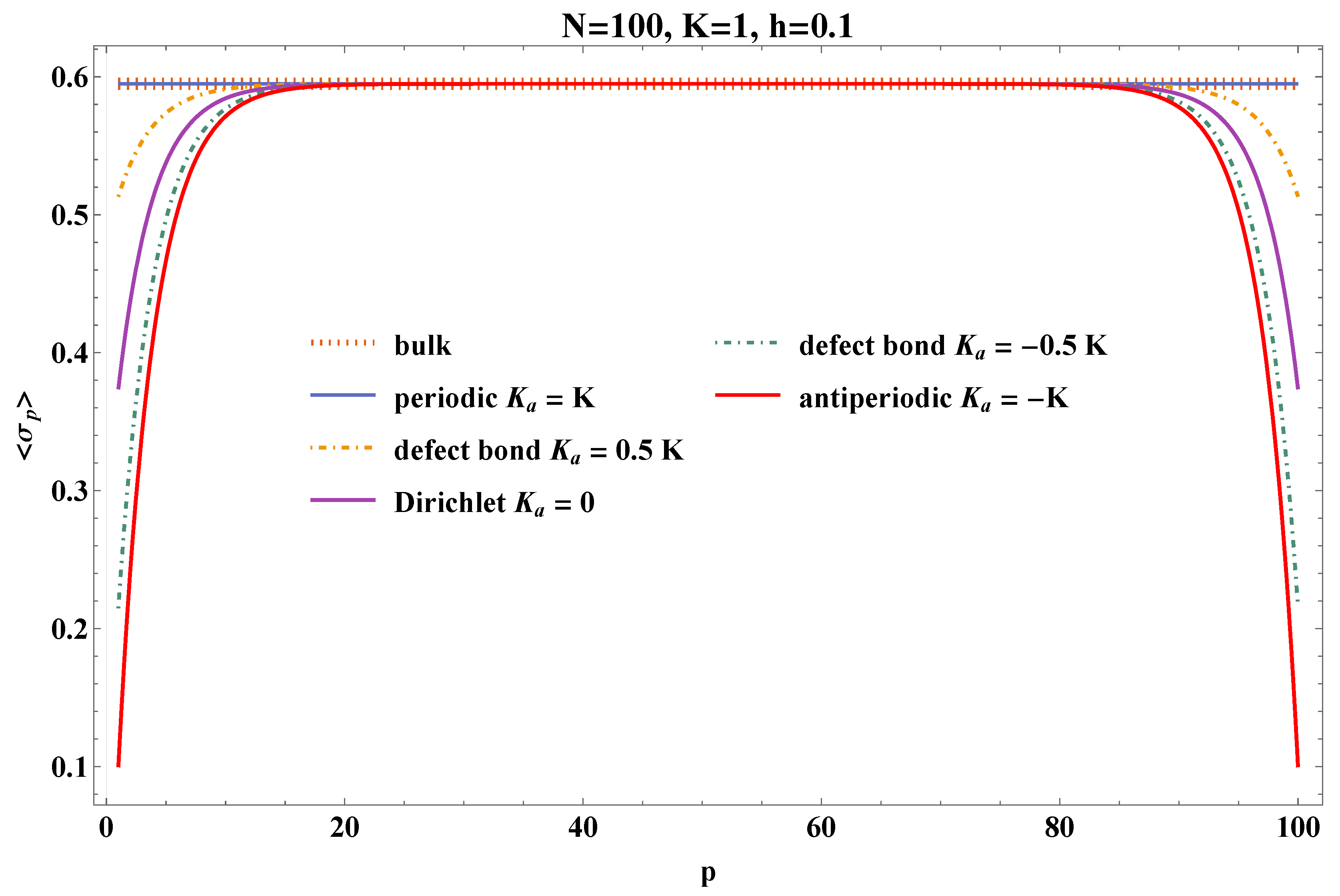
Figure 4.
The order parameter profile under free (Dirichlet) boundary conditions for with and . The red dashed line shows the value of the bulk magnetisation for those values of K and h.
Figure 4.
The order parameter profile under free (Dirichlet) boundary conditions for with and . The red dashed line shows the value of the bulk magnetisation for those values of K and h.
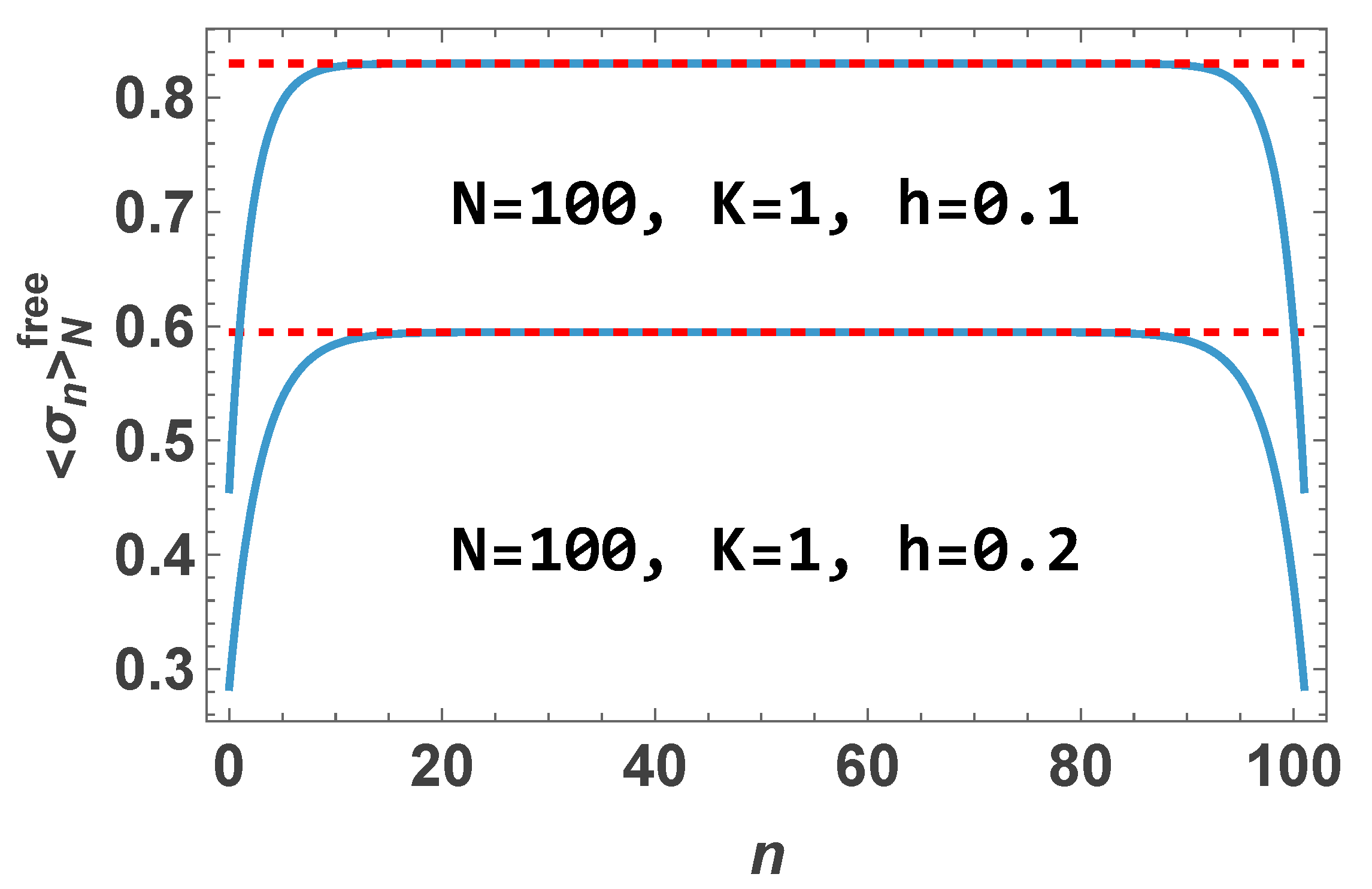
Figure 5.
The blue dots demonstrate the values of the magnetisation when and in the middle of an Ising chain with N dynamical random variables under free (Dirichlet) boundary conditions. The dashed red line shows the corresponding value of the infinite system with the same K and h. We see that value si achieved for .
Figure 5.
The blue dots demonstrate the values of the magnetisation when and in the middle of an Ising chain with N dynamical random variables under free (Dirichlet) boundary conditions. The dashed red line shows the corresponding value of the infinite system with the same K and h. We see that value si achieved for .
Disclaimer/Publisher’s Note: The statements, opinions and data contained in all publications are solely those of the individual author(s) and contributor(s) and not of MDPI and/or the editor(s). MDPI and/or the editor(s) disclaim responsibility for any injury to people or property resulting from any ideas, methods, instructions or products referred to in the content. |
© 2026 by the authors. Licensee MDPI, Basel, Switzerland. This article is an open access article distributed under the terms and conditions of the Creative Commons Attribution (CC BY) license (http://creativecommons.org/licenses/by/4.0/).
Copyright: This open access article is published under a Creative Commons CC BY 4.0 license, which permit the free download, distribution, and reuse, provided that the author and preprint are cited in any reuse.


