

Submitted:
29 January 2026
Posted:
30 January 2026
You are already at the latest version
Abstract
Place-based approaches have gained significant attention as a means of addressing en-trenched disadvantage through collaborative, locally-responsive service delivery, yet implementation has yielded mixed results and the systemic factors that facilitate or im-pede inter-organisational collaboration remain inadequately understood. This study ap-plied participatory systems mapping as part of a systemic inquiry to identify leverage points for place-based integrated service delivery in the City of Casey, an out-er-metropolitan municipality in Melbourne, Australia. Twenty-one representatives from the Casey Futures Partnership engaged in group model building workshops, co-producing a causal loop diagram containing 33 factors and 107 directional connec-tions. The resulting map was analysed using a blended analytical approach combining network metrics with the Action Scales Model. Funding availability and criteria emerged as the most central factor within the system, while belief-level factors, including territorial behaviour and resource and collaboration mindset, were found to be substantially shaped by upstream structural conditions. Factors combining network influence with deeper system positioning and amenability to local action included awareness of community needs and priorities, trust and willingness to collaborate from funders, in-ter-organisational communication, and advocacy effectiveness. The findings support multi-level place-based approaches that address underlying beliefs and structural condi-tions alongside operational improvements.
Keywords:
place-based approaches
; participatory systems mapping
; group model building
; service integration
; leverage points
; action scales model
1. Introduction
Local government and community service organisations (CSOs) operate at the interface of diverse community needs, complex funding environments, and the particular history and conditions of place. These intersecting factors culminate in intricate interactions that challenge conventional approaches to service delivery. Communities experiencing disadvantage often face multiple, interrelated problems—including housing stress, unemployment, family breakdown, and health inequities—that do not respect organisational boundaries or funding silos. These 'wicked problems' defy clear problem definitions, possess no definitive solutions, and involve contested values and evolving interdependencies [1,2].
In response to these challenges, place-based approaches have gained significant attention across jurisdictions as a means of addressing entrenched disadvantage through collaborative, locally-responsive service delivery [3,4]. Place-based approaches are typically characterised by collaboration between multiple stakeholders, community inclusion in decision-making, responsiveness to local priorities, and efforts to address complex issues within a specific geographic location [5,6]. Rather than delivering standardised services determined by central authorities, place-based models seek to mobilise resources around local contexts, individuals, and community needs, facilitating continuous adaptive learning rather than prescriptive one-size-fits-all solutions [7]. Importantly, the concept of 'place' in this context extends beyond mere geographic territory to encompass the subjective attachments, shared identities, and sense of collective responsibility that emerge when actors see themselves as jointly accountable for a locality's challenges [8]. This relational understanding of place helps explain why place-based approaches can generate collaborative dynamics that purely territorial or sectoral initiatives do not—when organisations develop genuine attachment to place, they are more likely to accept shared ownership of its problems and commit resources to collective solutions.
Despite the intuitive appeal of such approaches, implementation has yielded mixed results across different contexts. Systematic reviews have found that while most place-based initiatives demonstrate at least some positive outcomes, evidence of sustained population-level impact remains limited, with evaluation design limitations, changing contextual factors, and insufficient implementation timeframes frequently cited as contributing factors [9,10]. Traditional programs that reinforce existing political and bureaucratic processes have been identified as significant barriers to collaborative modes of policymaking, governance, and delivery [6]. Moreover, while CSOs operating in shared geographic areas often possess similar broad social justice aims, the factors that facilitate or impede their collaboration remain inadequately understood at a systemic level [11].
Service integration refers to the coordination of services across organisational boundaries to provide more coherent, person-centred support to individuals and communities [12]. Integration can occur at multiple levels, from case-level coordination between individual workers, to program-level partnerships, to system-level alignment of funding, governance, and accountability structures [13]. The benefits of integration are well-documented: reduced service duplication, improved client outcomes, more efficient resource utilisation, and enhanced capacity to address complex, multi-factorial problems [12,14].
Much existing research on service integration has focused on specific issue areas—such as child protection, mental health, or family violence—examining how services can better coordinate around particular client cohorts [11,15]. While valuable, this issue-based framing can obscure the higher-level systemic factors that span organisations operating in place and shape their collective capacity for integration regardless of the specific presenting issue. If collaboration is beneficial and organisations share compatible goals, understanding what systematically enables or constrains their integration becomes crucial for more effective place-based practice.
However, achieving meaningful integration remains challenging. Studies consistently identify barriers including fragmented funding arrangements, incompatible information systems, professional siloes, competitive dynamics between organisations, and misaligned accountability requirements [16,17]. Less examined are the deeper factors—organisational cultures, mindsets, and underlying beliefs about collaboration—that shape whether integration initiatives succeed or fail. Understanding these systemic dynamics requires analytical approaches capable of capturing interconnections, feedback loops, and the multi-level factors that influence organisational behaviour.
Systems thinking provides conceptual and methodological resources for understanding complex, interconnected problems. Rather than reducing problems to isolated components amenable to linear solutions, systems thinking emphasises holistic analysis, feedback dynamics, and the emergent properties that arise from interactions between system elements [18,19]. This perspective acknowledges that interventions in one part of a system may produce intended and unintended consequences elsewhere, and that sustainable change often requires addressing underlying structures and mental models rather than surface-level symptoms [20]. The application of systems approaches to place-based work has gained momentum in recent years, with researchers arguing that the complexity, emergence, and context-dependence characteristic of place-based initiatives demand analytical methods capable of capturing non-linear dynamics and multi-level interactions [21,22]. Place-based systems change efforts seek not merely to coordinate existing services but to address the root causes of complex social problems through locally-embedded, adaptive interventions that alter underlying system structures.
Within the broader systems thinking tradition, system dynamics offers specific tools for mapping and analysing complex systems. Causal loop diagrams (CLDs) provide visual representations of the factors influencing a phenomenon of interest and the causal connections between them [23,24]. CLDs distinguish between reinforcing loops, where change in one direction amplifies further change in the same direction, and balancing loops, where change triggers countervailing forces that resist or moderate the initial change. These feedback structures help explain why systems often behave in counterintuitive ways and why well-intentioned interventions sometimes fail or produce unintended consequences [18,24].
Participatory approaches to systems mapping, including group model building, engage diverse stakeholders in collectively constructing system representations [25,26]. This participatory dimension serves multiple purposes: it draws on distributed knowledge that no single actor possesses, it surfaces implicit assumptions and competing perspectives, and it builds shared understanding and ownership of the resulting analysis [27]. Research indicates that group model building can improve communication among stakeholders, create consensus around system dynamics, and generate commitment to collective action [27,28,29].
This study emerged from an existing partnership between a local government authority and community service organisations in the City of Casey, a large and rapidly growing municipality in outer south-eastern Melbourne, Australia. The Casey Futures Partnership (CFP) was established to enable collaborative approaches to improving outcomes for Casey residents, with a particular focus on those experiencing disadvantage. As a nascent collaboration, the CFP sought to understand the systemic factors that would influence its capacity to achieve integrated service delivery.
The research was opportunity-driven, coinciding with the CFP's early developmental phase and the local council's commitment to systems-informed approaches. This context provided an empirical opportunity to explore: What are the barriers and enablers to place-based integrated service delivery in the City of Casey? The authors were engaged to collaborate with the City of Casey and the CFP on this work.
The study applies participatory systems mapping to address this question, using group model building techniques to develop a causal loop diagram representing the collective understanding of CFP members. The resulting map is analysed using both network metrics and systems change frameworks to identify potential leverage points for intervention. Beyond generating locally relevant insights, the study aims to demonstrate an approach that can be replicated in other place-based contexts and contribute to the growing methodological literature on participatory systems dynamics in public and community settings.
2. Materials and Methods
2.1. Case Study: The City of Casey and the Casey Futures Partnership
The City of Casey is one of Australia’s largest and fastest-growing municipalities, located approximately 35 kilometres south-east of Melbourne’s central business district. With a population now exceeding 400,000 residents, Casey comprises a mix of long-established suburbs and rapidly developing growth-corridor communities. While the municipality continues to experience significant expansion - particularly in the remaining growth areas - many of Casey’s most pronounced socio-economic challenges are concentrated in its older, established suburbs. These areas have historically recorded lower levels of educational attainment, higher unemployment, and greater reliance on income support, reflecting forms of disadvantage that have accumulated over time.
At the same time, growth-corridor suburbs face a different set of pressures associated with rapid population increase, including infrastructure lag, emerging service demand, and the need for timely access to transport, education, health, and community facilities. Forecasts indicate that Casey’s population will continue to grow substantially over the next two decades, reaching approximately 614,000 residents by 2046, with much of this growth occurring in these new development areas 1.
The Casey Futures Partnership (CFP) is an initiative of the Community Services Organisations (CSO) Growth and Attraction Framework, which brings together the City of Casey (local government) with multiple CSOs delivering services across the municipality. Member organisations vary in size, scope, and focus, including large multi-service providers, specialist services, community development, and volunteer-based organisations. The CFP provides a vehicle for collective planning, coordination, and advocacy, with an underlying premise that collaboration among service providers can improve outcomes for Casey residents beyond what individual organisations can achieve in isolation. This is achieved through collaborative efforts to address service gaps, plan solutions, implement strategic frameworks, advocate for better health outcomes, foster networking, map services, and build capacity.
At the time of the workshop, the CFP was in an early developmental phase, establishing shared purpose, working norms, and initial projects. Systems mapping served as early-stage infrastructure to enhance collective sense-making, reveal feedback structures, and create a basis for targeted action [28]. It also allowed the partnership to surface authorising environment constraints (e.g., funding criteria, reporting regimes) and to identify where Council and partners could mobilise influence.
2.2. Approach to Participatory Systems Mapping
This study applied a participatory systems mapping approach as part of a systemic co-inquiry design. Co-inquiry was proposed by John Heron and expanded on by Peter Reason. In short, it involves researching with people, rather than on people [30]. Systemic co-inquiry is a particular form of co-inquiry which draws on systems theories, methodologies, and techniques [19]. A defining feature of systemic co-inquiries is their adaptability: there is no single correct approach, nor must they follow a predetermined timeline. They can serve as groundwork for future initiatives, operate concurrently with existing programs, or be woven into project activities, with their duration shaped by participant engagement rather than external constraints [31].
Systemic co-inquiry has been used to explore questions of complexity such as water governance [32], and recently in place-based contexts such as land-use planning [25]. It is an investigative process that is open to changing situations, and drawing on different frameworks as the work progresses [19]. The mapping approach drew on group model building processes and causal loop diagramming techniques adapted for the CFP context. Group model building is a facilitated process engaging stakeholders in collectively representing their understanding of a complex problem, using visual mapping tools to externalise and integrate diverse perspectives [27,29].
The approach was designed to be accessible for participants with varying familiarity with systems concepts. Given that systems mapping can be conceptually demanding—particularly for those unfamiliar with feedback dynamics and causal reasoning—the research team implemented scaffolding measures to support engagement. Prior to the workshop, participants received briefing materials introducing key systems thinking principles. The workshop itself was structured to build understanding progressively, moving from individual reflection to small group discussion to collective mapping.
2.3. The Systems Mapping Workshop
An in-person workshop was held with 21 participants drawn from across CFP member organisations, with representation from large multi-service providers, specialist services, community development organisations, volunteer-based organisations, and local government. Participants occupied a range of roles including senior managers, program coordinators, and service delivery leads, providing perspectives from both strategic and operational levels. Approximately 15-18 participants attended in person, with an additional three colleagues joining online through a hybrid format supported by dedicated facilitation.
The workshop session opened with a short, accessible presentation designed to introduce systems thinking approaches and establish the framing for the day's activities. This presentation covered the rationale for systems mapping, foundational principles of systems thinking, boundary setting, stakeholder engagement, mapping techniques, and the basics of causal loop diagramming. An overview of the workshop workflow followed, providing participants with clarity about what to expect. Participants also received an accompanying information sheet summarising key concepts and practical guidance from the presentation.
Following the introductory session, participants were divided into three in-person table groups, with online attendees forming a fourth group. Each group was presented with the central prompt: 'What are the barriers and enablers to integrated place-based service delivery in Casey?' Participants first reflected individually on their experience, then discussed collectively to identify what they regarded as key factors. Importantly, these factors were to be framed as causal variables that could operate in either direction (that is, as potential enablers or barriers depending on context) rather than as inherently positive or negative states.
The next step involved plotting identified factors on butcher's paper and drawing connections between factors that represented influence relationships. Connections were marked with '+' or '−' to capture whether the relationship was one of positive influence (variables moving in the same direction) or negative influence (variables moving in opposite directions). This exercise prompted substantial discussion within groups, requiring participants to articulate and negotiate their understanding of how different factors related to one another within the system. See Figure 1 for an example output.
Following a lunch break, groups revisited their systems maps, using this as an opportunity to clarify relationships and discuss patterns of interconnectedness that had become visible through the mapping process. Facilitators circulated among the discussion tables throughout, providing guidance and answering questions about the mapping process. In total, three physical maps were produced on butcher's paper, and one virtual map was produced using Miro by the online group.
2.4. Transcribing and Consolidating the Maps
Following the workshop, each of the four group maps was transcribed into spreadsheets to support further analysis. Every factor and connection from each map was documented, enabling cross-map comparison. This stage required extensive quality assurance, checking that the recorded content accurately reflected group intent and that positive and negative influences were correctly represented. Facilitator notes proved essential for clarifying ambiguous entries, particularly where factors were initially expressed as barriers (for example, 'not enough funding'), which were reframed as neutral variables ('funding availability') to standardise terminology across maps.
The next phase involved consolidating the four maps into a single composite representation, following an approach consistent with other participatory systems mapping studies [33,34,35]. Consolidation proceeded through iterative thematic analysis: factors from each map were first compared to identify conceptual overlaps, then clustered into unified codes at a consistent level of specificity. For example, factors relating to workforce capacity, staffing levels, and volunteer availability across different maps were consolidated into 'Paid and volunteer workforce size'.
Where maps contained factors that appeared similar but reflected meaningfully different concepts, these were retained as distinct variables. Relational connections were preserved and merged where multiple groups had identified the same causal relationship; where groups identified conflicting relationship directions, facilitator notes and the original mapping discussions were consulted to resolve ambiguities.
Consistent with the co-inquiry orientation of the study, consolidation was undertaken collaboratively by the research team through ongoing dialogue rather than independent parallel coding. The draft consolidated map was then sense-checked with workshop participants through two rounds of feedback—one in-person session and one via email—allowing participants to verify that the consolidated representation accurately reflected their collective understanding and to flag any factors or connections that had been misrepresented or omitted. The validated map was then uploaded into Kumu.io, a web-based network visualisation platform. The final consolidated map contained 33 unique factors and 107 directional connections, forming a shared systems representation co-produced with the 21 workshop participants.
2.5. Analytical Framework: Leverage Point Identification
To identify potential leverage points for intervention, the study employed a blended analytical approach combining network analysis metrics with the Action Scales Model (ASM). This triangulation was designed to take advantage of the complementary strengths of quantitative network measures and qualitative systems change frameworks while addressing critiques that network metrics alone fail to account for content meaning and intervention feasibility [23]. This blended analytical approach aligns with recent applications in whole-systems research. Brinkley et al. [34] employed a similar two-phase process in their study of physical activity promotion in Suffolk, using network analysis markers alongside the Action Scales Model to identify leverage points, which were then validated through participatory workshops with system stakeholders.
The ASM provides a complementary interpretive framework by categorising factors according to their 'depth' within the system [36]. The ASM aligns with other leverage-focused frameworks, including Donella Meadows' influential work on leverage points [18], Senge’s Iceberg Model [20], and the Intervention Level Framework [37], and was developed for people working in practice. Like these other frameworks, the ASM posits that interventions targeting deeper levels (goals and beliefs) offer greater potential for sustained system change, though they are typically more difficult to influence than surface-level events. The ASM describes four levels: events (observable behaviours and outcomes), structures (patterns, relationships, and information flows that produce events), goals (explicit targets and ambitions driving system behaviour), and beliefs (foundational norms, values, and attitudes that shape goals and structures).
Network analysis calculated in-degree (the number of incoming connections to a factor) and out-degree (the number of outgoing connections from a factor) for each variable in the consolidated map. Factors with high out-degree and low in-degree represent potential intervention points - variables that influence many other factors but are themselves less determined by other elements in the system. Such factors may offer leverage because changes to them can propagate through multiple pathways [38].
Each of the 33 factors was categorised according to the four ASM levels. Of these, seven factors were mapped as events, sixteen as structures, three as goals, and five as beliefs, with two factors bridging the structure-belief boundary. This categorisation enabled analysis of where change efforts might be most effectively targeted and why the system generates the outcomes it does.
The co-occurring interpretation process followed these steps: (1) initial ranking of factors by total degree (combined in-degree and out-degree); (2) ordering by ASM level; (3) review of sub-degree patterns (examining in-degree and out-degree separately); and (4) assessment of intervention feasibility. This last step acknowledged that not all high-influence factors are amenable to direct action by the CFP—some represent contextual conditions that shape but cannot readily be changed by local actors.
3. Results
3.1. Overview of the Systems Map
The participatory systems mapping process identified 33 distinct factors and 107 directional connections influencing place-based service integration in Casey (see Figure 2). The factors were organised into six thematic categories based on their substantive focus: Community Profile (6 factors relating to the characteristics and conditions of the local population and place); Human and Financial Resources (5 factors concerning people, skills, and funding); Organisational Culture, Governance and Values (7 factors relating to norms, behaviours, and authorising environments); Policy Environment and Service System Setting (4 factors concerning wider policy and political contexts); Relationships (4 factors relating to inter-organisational and interpersonal connections); and Service Delivery and Infrastructure (7 factors concerning the design, scope, and accessibility of services).
The systems map visualises connections using two types of relationships, solid connections and dashed connections These connection types allow the map to represent both reinforcing dynamics (where change amplifies) and balancing dynamics (where change moderates or counteracts). These are defined as follows: Solid connections indicate that a change in the originating factor produces change in the same direction at the receiving factor—for example, an increase in partnership quality increases high-quality referral pathways. Dashed connections indicate that change in the originating factor produces change in the opposite direction—for example, a decrease in funding availability increases time pressure.
3.2. Factors, Descriptions, and Analytical Measures
Table 1 presents the 33 factors, thematic categories, ASM classifications, and network metrics (in-degree and out-degree). Factors are ordered by total degree (combined in-degree and out-degree) to highlight those with the most connections within the system.
Analysis of network metrics revealed considerable variation in how factors were positioned within the system. The factor with the highest total degree was 'Funding availability and criteria' (19 connections: 11 in-degree, 8 out-degree), indicating its centrality to the system - both influenced by many factors and influencing many others in turn. However, its high in-degree suggests that funding availability is itself substantially determined by other system elements, potentially limiting its tractability as a direct intervention point for local actors.
More promising from an intervention perspective are factors with high out-degree relative to in-degree—that is, factors that influence many other elements while being less determined by the system. 'Awareness of community needs and priorities' emerged as particularly influential (8 out-degree, 3 in-degree), suggesting that efforts to improve shared understanding of local needs could propagate through multiple pathways. Similarly, 'Socio-economic conditions of place' (8 out-degree, 1 in-degree) exerts substantial influence but represents a contextual factor largely outside the CFP's direct control.
Among factors more amenable to direct action, 'Commitment to cultural responsiveness' (6 out-degree, 2 in-degree), 'Trust and willingness to collaborate from funders' (4 out-degree, 1 in-degree), and 'Advocacy effectiveness' (6 out-degree, 1 in-degree) demonstrated favourable ratios of influence exerted to influence received. These patterns suggest potential intervention points where targeted action could generate broader system effects.
3.3. Action Scales Model
The ASM classification revealed that the majority of identified factors (16 of 33) operated at the structural level—the patterns, relationships, and information flows that produce observable events. Seven factors were classified as events (including 'Changes in available services', 'Physical accessibility of services', and 'Time pressure'), three as goals ('Intra-organisational goals, culture and authorising environment', 'Outcomes focused approach', and 'Outputs driven reporting'), and five as beliefs ('Awareness of community needs and priorities', ‘Commitment to cultural responsiveness’, 'Resource and collaboration mindset', 'Territorial behaviour', and 'Trust and willingness to collaborate from funders').
The belief-level factors are particularly noteworthy given the ASM's premise that interventions at deeper system levels offer greater potential for sustainable change. 'Territorial behaviour'—characterised as organisations acting competitively to protect their own resources or influence—had a notably high in-degree (7) and moderate out-degree (3), indicating that it is substantially shaped by other system dynamics and itself influences several downstream factors. This suggests that territorial behaviour may be symptomatic of deeper systemic pressures, particularly those related to funding competition and organisational survival.
'Resource and collaboration mindset'—the orientation of organisations toward sharing resources and working collectively—displayed a contrasting pattern (7 in-degree, 3 out-degree), again being substantially influenced by other factors. Both 'territorial behaviour' and 'resource and collaboration mindset' appear to be shaped by similar upstream factors, including funding availability, supportive policy environment, and intra-organisational goals. This suggests that belief-level change may require addressing the structural conditions that reinforce competitive or collaborative orientations.
3.4. Integrated Leverage Points
Integrating the network analysis and ASM findings, several factors emerged as potential leverage points warranting attention from the CFP. These were selected based on their: (a) position within the network (favourable out-degree to in-degree ratio); (b) depth within the system (operating at goal or belief levels); and (c) feasibility of influence by local actors (not entirely determined by external contextual factors). See Figure 3 and Figure 4 for visual summaries.
Awareness of community needs and priorities: This belief-level factor demonstrated the highest out-degree among belief-level factors (8) with moderate in-degree (3). It represents the extent to which communities, organisations, and funders recognise and understand local needs and priorities. Improved shared awareness could influence multiple downstream factors including 'Changes in available services', 'Diversity of service provision', and ‘Advocacy effectiveness'.
Trust and willingness to collaborate from funders: This belief-level factor had low in-degree (1) but moderate out-degree (4), suggesting it is relatively independent of other system factors while influencing several important elements including 'Funding availability and criteria' and 'Supportive policy environment'. While funders are external to the CFP, targeted advocacy and demonstration of collaborative value may influence funder orientations over time.
Inter-organisational communication: This structural factor had moderate in-degree (2) and relatively high out-degree (5), influencing 'Partnership quality', 'High quality referral pathways', 'Understanding of available services', and 'Uncoordinated service duplication'. Improving communication between organisations represents a tractable intervention that could generate multiple beneficial effects.
Outcomes focused approach: This goal-level factor (5 in-degree, 4 out-degree) represents an emphasis on achieving and demonstrating meaningful results for communities. It influences 'Partnership quality', 'Workforce development', and 'Workforce resilience', while being influenced by factors including 'Funding availability and criteria' and 'Intra-organisational goals'. Strengthening outcomes-focused practice could shift organisational attention from competitive service delivery toward collaborative impact.
Advocacy effectiveness: This structural factor had low in-degree (1) but high out-degree (6), influencing 'Funding availability and criteria', 'Supportive policy environment', 'Changes in available services', and 'Awareness of community needs and priorities'. Collective advocacy by the CFP could potentially influence external factors that shape the operating environment for service integration.
4. Discussion
4.1. Interpreting the System Dynamics
The systems map co-produced through this study reveals a complex web of interconnected factors influencing place-based service integration in Casey. Several observations emerge from the analysis that have implications for how the CFP and similar initiatives might approach their work.
First, the centrality of funding-related factors within the system is striking but not surprising. 'Funding availability and criteria' had the highest total degree of any factor, and 'Trust and willingness to collaborate from funders' emerged as a significant belief-level factor. This reflects the well-documented influence of funding arrangements on service integration [6,13]. However, the map reveals nuance beyond the simple observation that 'more funding helps'—it suggests that how funding is structured (including criteria, time horizons, and accountability requirements) and the underlying orientations of funders toward collaboration shape multiple downstream dynamics. Research on Australian place-based approaches has identified that Treasury and Finance reporting requirements pose significant limitations for joined-up funding, while short-term funding cycles are particularly destructive because trust-building takes time and organisations often only reach full operational effectiveness midway through funding periods [6]. The presence of multiple funders can create additional burdens through differing confidentiality rules, delegation levels, and accountability frameworks.
Second, the prominence of belief-level factors in shaping system dynamics warrants attention. 'Territorial behaviour' and 'Resource and collaboration mindset' represent opposing orientations that fundamentally shape how organisations engage with one another. The map suggests these are not simply individual organisational characteristics but are substantially shaped by systemic conditions—particularly funding competition, policy settings, and organisational goals. This aligns with research on competitive dynamics in the not-for-profit sector, which has documented how funding arrangements can incentivise territorial behaviour even among organisations with compatible missions [6,13,16].
Notably, research has found that transitions to competitive tendering arrangements can have detrimental effects on collaborative culture, with leaders sometimes blocking partnerships working by defending territorial or organisational interests. This suggests that territorial behaviour should be understood not as an inherent organisational trait but as a rational response to systemic pressures that can be addressed through changes to funding structures and collaborative governance arrangements [6,13].
Third, the map highlights the importance of relationship and communication factors that operate somewhat independently of resource constraints. 'Inter-organisational communication' and 'Partnership quality' emerged as influential structural factors that are amenable to local action regardless of external funding environments. This suggests that the CFP can make meaningful progress on service integration through relational work, even while advocating for more supportive external conditions.
4.2. Implications for Place-Based Practice
The findings support a multi-level approach to strengthening place-based service integration. At the belief level, efforts to build shared awareness of community needs and foster collaborative orientations among organisations may yield substantial downstream benefits. This could involve regular joint needs assessment processes, shared community engagement activities, and structured opportunities for cross-organisational learning. Such activities address multiple leverage points simultaneously while building the relational foundations for deeper integration.
At the structural level, investing in inter-organisational communication infrastructure appears valuable given its influence on multiple downstream factors. This might include shared information systems, regular communication forums, and protocols for coordinated referral pathways. The map suggests that improved communication could reduce uncoordinated service duplication while enhancing partnership quality—addressing both efficiency and effectiveness concerns.
At the goal level, promoting outcomes-focused approaches rather than outputs-driven reporting could shift organisational attention toward collaborative impact. This represents a potentially challenging shift given that funding accountability requirements often emphasise outputs, but the map suggests that outcomes-orientation influences partnership quality and workforce factors in ways that may ultimately serve organisational interests as well as community outcomes.
Perhaps most importantly, the analysis highlights the value of collective advocacy targeting the external conditions that shape local service integration. The relatively high out-degree of ‘Advocacy effectiveness' suggests that CFP efforts to influence funders, policymakers, and system architects could generate substantial effects across multiple factors. This advocacy might focus on funding arrangements that enable rather than impede collaboration, policy settings that support place-based approaches, and accountability frameworks that reward integrated service delivery.
4.3. Methodological Contributions and Considerations
This study contributes a novel application of participatory systems mapping to the challenge of place-based service integration. Systems methods have been applied to specific topic areas such as sleep health [39], land-use planning [25], determinants of wellbeing [35], and energy policy [40]. However, applications to place-based contexts addressing cross-cutting factors across diverse service organisation contexts appear less common. The approach demonstrates that systems mapping can support collective sense-making at an inter-organisational level beyond individual presenting problems to a broader place-based level.
The combination of network metrics and the ASM provides a blended analytical approach that addresses some limitations of using either framework alone. Network metrics identify structurally significant factors but do not distinguish between surface-level events and deeper systemic drivers. The ASM provides this depth dimension but does not quantify the relative influence of factors. Together, they enable identification of factors that are both quantitatively significant and qualitatively meaningful as potential intervention points.
The participatory process itself generated value beyond the analytical outputs. Workshop participants reported that the mapping exercise helped them visualise interconnections that are often implicit in their work, and that the cross-organisational dialogue built understanding of different sectoral perspectives. This aligns with research on group model building that emphasises process benefits alongside the value of the models produced [41,42].
4.4. Limitations
Several limitations should be noted. First, the systems map represents the perspectives of CFP member organisations and may not capture factors relevant to community service organisations not engaged with the CFP, and other stakeholders, including service users, funders, and policymakers. Expanding participation to include these perspectives could enrich the system representation.
Second, the map is necessarily a simplification of complex dynamics, and the process of consolidating four group maps into a single representation involved interpretive judgments by the research team. Third, network metrics applied to causal loop diagrams have known limitations—connection counts do not capture loop dynamics or the relative strength of different relationships, and recent methodological critiques have argued that network metrics can lead to false inference about leverage points because they cannot accommodate feedback loop structures or higher-order interactions between variables [23].
Fourth, the identification of leverage points does not automatically translate into effective intervention. Factors identified as influential may still prove difficult to change, and interventions may produce unintended consequences not captured in the map. The leverage point analysis should be understood as hypothesis-generating rather than definitively prescriptive [34]. Finally, the study represents a snapshot of system dynamics at a particular point in the CFP's development. As the partnership evolves and external conditions change, the relative importance of different factors may shift.
5. Conclusions
Place-based initiatives are often encouraged to collaborate, yet the systemic conditions shaping whether collaboration succeeds or fails remain poorly understood. This study demonstrates that participatory systems mapping can surface these dynamics in ways that support collective sense-making and strategic action. Through group model building with 21 representatives of the Casey Futures Partnership, a causal loop diagram containing 33 factors and 107 connections revealed that funding arrangements sit at the centre of the system - but crucially not simply as a resource constraint. Rather, funding structures shape organisational beliefs and orientations, influencing either territorial competition or collaborative mindsets depending on how criteria, timeframes, and accountability requirements are configured.
The blended analytical approach - combining network metrics with the ASM - identified leverage points that are both systemically influential and amenable to local action: building shared awareness of community needs, fostering funder trust in collaboration, strengthening inter-organisational communication, and coordinating advocacy efforts. Critically, the analysis suggests that addressing surface-level structural barriers without attending to underlying beliefs may yield limited results; territorial behaviour and collaborative mindset are not fixed organisational traits but rational responses to systemic pressures that can be shifted through deliberate changes to funding and governance arrangements.
While the specific factors identified are contextual to Casey, the methodology offers a replicable framework for place-based collaborations elsewhere. As place-based approaches continue to proliferate as responses to complex social problems, practitioners and policymakers need rigorous methods for understanding local system dynamics - not to produce definitive answers, but to generate actionable hypotheses and build the shared understanding necessary for collective action. Future research should track how systems evolve as interventions are implemented, compare dynamics across different place-based contexts, and include perspectives beyond service providers - particularly service users, funders, and policymakers whose actions shape the conditions within which local collaboration occurs.
Author Contributions
Conceptualisation, M.H., J.L. and V.H.; methodology, M.H. and J.L.; software, M.H. and J.L.; validation, M.H., J.L. and V.H.; formal analysis, M.H. and J.L.; data curation, M.H. and J.L.; writing—original draft preparation, M.H. and J.L.; writing—review and editing, M.H., J.L. and V.H.; visualisation, M.H. and J.L.; supervision, M.H.; project administration, J.L. and V.H. All authors have read and agreed to the published version of the manuscript.
Funding
This research was supported by the City of Casey as part of a consultancy engagement to facilitate participatory systems mapping with the Casey Futures Partnership. The City of Casey had no role in the analysis or interpretation of data, the writing of the manuscript, or the decision to publish the results.
Institutional Review Board Statement
This study did not require ethical approval as it was conducted as a participatory capacity-building activity embedded within an existing organisational partnership. No individual-level data were collected; the workshop produced collective systems representations that are not attributable to individual participants.
Informed Consent Statement
Verbal informed consent was obtained from all participants prior to the workshop. Participants were informed that only collective outputs would be used, that no individual contributions would be identifiable, and that they could withdraw consent at any time during the session.
Data Availability Statement
The primary data generated by this study—the consolidated systems map including all factors, descriptions, Action Scales Model classifications, and network metrics—are presented in Table A1 of this article. The original workshop maps from which the consolidated map was derived are not publicly available as they were produced as collective outputs during a facilitated participatory process and were superseded by the validated consolidated map. No individual-level data were collected during this study.
Acknowledgments
The authors thank the members of the Casey Futures Partnership who contributed their time, expertise, and candid perspectives to the systems mapping workshop. During the preparation of this manuscript, the authors used Claude (Anthropic) to assist with proofing and grammatical edits. The authors have reviewed and edited the output and take full responsibility for the content of this publication.
Conflicts of Interest
M.H. and J.L. were engaged by the City of Casey as external consultants to facilitate the participatory systems mapping process. V.H. is an employee of the City of Casey. While these professional relationships should be acknowledged, the City of Casey had no role in the design of the study, the analysis or interpretation of data, the writing of the manuscript, or the decision to publish the results. The research was conducted independently, and the findings reflect the collective perspectives of workshop participants rather than the positions of any single organisation.
Abbreviations
The following abbreviations are used in this manuscript:
| ASM | Action Scales Model |
| CFP | Casey Futures Partnership |
| CLD | Causal Loop Diagram |
| CSO | Community Service Organisation |
Appendix A
Appendix A.1
Table A1 contains the full list of factors identified through the study, along with a description, their type, alignment to the ASM, and degree centrality scores.

Table A1.
Systems map factors, type, Action Scales Model categorisation, description and degree (total, in- and out-) centrality scores.
Table A1.
Systems map factors, type, Action Scales Model categorisation, description and degree (total, in- and out-) centrality scores.
| Label | Type | Action Scales Model category | Description | Degree | Indegree | Outdegree |
| Advocacy effectiveness | Policy environment and system setting | Structures | The extent to which advocacy efforts influence government and funding body decisions. | 7 | 1 | 6 |
| Awareness of community needs and priorities | Community profile | Beliefs | The extent to which communities, organisations, and funders recognise and understand local needs and priorities. | 11 | 3 | 8 |
| Changes in available services | Community profile | Events | Adjustments in the type, scope, or availability of services offered to the community. | 10 | 4 | 6 |
| Client eligibility for services | Community profile | Events | The rules and criteria that determine who can access particular services. | 2 | 2 | 0 |
| Commitment to cultural responsiveness | Community profile | Beliefs | The valuing of tailoring services to the range of cultural backgrounds and language needs within the community. | 8 | 2 | 6 |
| Digital access and inclusion | Service delivery and infrastructure | Events | The ability of communities to access and use digital services. | 2 | 1 | 1 |
| Diversity of service provision | Service delivery and infrastructure | Structures | The variety of organisations, models, and approaches delivering services in the community. | 3 | 1 | 2 |
| Effective IT systems and data | Service delivery and infrastructure | Structures | The quality and reliability of IT systems and data management that support service delivery. This includes ability | 4 | 1 | 3 |
| Election policy shifts | Policy environment and system setting | Events | The impact of election cycles and political changes on service priorities and funding. | 2 | 1 | 1 |
| Funding availability and criteria | Human and financial resources | Structures | The amount, availability, criteria, and stability of funding accessible to organisations for service delivery. | 19 | 11 | 8 |
| Government system reliability | Policy environment and system setting | Structures | The consistency and dependability of government processes and systems. | 4 | 1 | 3 |
| High quality referral pathways | Service delivery and infrastructure | Structures | The clarity and reliability of processes for referring clients between services. | 6 | 3 | 3 |
| Information sharing, privacy, and client trust | Relationships | Structures | The systems and practices that balance safe information sharing with privacy and trust. | 3 | 2 | 1 |
| Inter-organisational communication | Relationships | Structures | The quality and frequency of communication between organisations. | 7 | 2 | 5 |
| Intra-organisational goals, culture and authorising environment | Relationships | Goals | The internal priorities, culture, and governance that shape how organisations operate and collaborate. | 10 | 6 | 4 |
| Organisational recruitment and retention capability | Organisational culture, governance and values | Structures | The ability of organisations to attract, recruit, and retain skilled staff and volunteers. | 4 | 2 | 2 |
| Organisations' physical infrastructure and assets | Service delivery and infrastructure | Structures | The facilities, equipment, and resources that support service delivery. | 4 | 2 | 2 |
| Outcomes focused approach | Organisational culture, governance and values | Goals | An emphasis on achieving and demonstrating meaningful results for communities. | 9 | 5 | 4 |
| Outputs driven reporting | Organisational culture, governance and values | Goals | A prioritised focus on meeting activity targets and reporting requirements. | 6 | 3 | 3 |
| Paid and volunteer workforce size | Human and financial resources | Structures | The number of paid staff and volunteers available to deliver services. | 11 | 9 | 2 |
| Partnership quality | Relationships | Structures | The strength and effectiveness of collaborative relationships between organisations. | 6 | 4 | 2 |
| Physical accessibility of services | Service delivery and infrastructure | Events | The ease with which people can physically reach and use services (e.g. location, transport). | 9 | 8 | 1 |
| Resource and collaboration mindset | Organisational culture, governance and values | Beliefs | The orientation of organisations toward sharing resources and working collectively. | 10 | 7 | 3 |
| Sharing of assets or resources | Organisational culture, governance and values | Structures | The practice of organisations making their resources available for others to use. | 5 | 4 | 1 |
| Socio-economic conditions of place | Community profile | Events | The conditions of the community, including housing, income, and employment. | 9 | 1 | 8 |
| Supportive policy environment | Policy environment and system setting | Structures | The degree to which policy settings enable service integration and collaboration. | 5 | 2 | 3 |
| Territorial behaviour | Organisational culture, governance and values | Beliefs | When organisations act competitively to protect their own resources or influence. | 10 | 7 | 3 |
| Time pressure | Human and financial resources | Events | The extent to which limited time and competing demands constrain organisations and staff. | 6 | 4 | 2 |
| Trust and willingness to collaborate from funders | Organisational culture, governance and values | Beliefs | The degree to which funders trust organisations to achieve outcomes, and support collaborations. | 5 | 1 | 4 |
| Uncoordinated service duplication | Service delivery and infrastructure | Structures | The extent to which similar services are provided by multiple organisations. | 5 | 3 | 2 |
| Understanding of available services | Community profile | Structures | The level of awareness among the community about what services exist and how to access them. | 5 | 2 | 3 |
| Workforce development | Human and financial resources | Structures | The availability of training and professional development for staff and volunteers. | 4 | 1 | 3 |
| Workforce resilience | Human and financial resources | Structures | The capacity of the workforce to adapt, remain healthy, and sustain services under pressure. | 3 | 1 | 2 |
References
- Head, B.W.; Alford, J. Wicked Problems: Implications for Public Policy and Management. Adm. Soc. 2015, 47, 711–739. [Google Scholar] [CrossRef]
- Rittel, H.W.J.; Webber, M.M. Dilemmas in a General Theory of Planning. Polic. Sci. 1973, 4, 155–169. [Google Scholar] [CrossRef]
- Barca, F. An Agenda for a Reformed Cohesion Policy A Place-Based Approach to Meeting European Union Challenges and Expectations; EERI Research Paper Series EERI_RP_2008_06; Economics and Econometrics Research Institute (EERI)., 2009. [Google Scholar]
- Beer, A. The Governance of Place-Based Policies Now and in the Future? Background paper for the OECD-EC High-Level Expert Workshop Series on “Place-Based Policies for the Future”, Workshop 5. 2023.
- Klepac, B.; Mowle, A.; Riley, T.; Craike, M. Government, Governance, and Place-Based Approaches: Lessons from and for Public Policy. Heal. Res. Polic. Syst. 2023, 21, 126. [Google Scholar] [CrossRef]
- Lata, L.N.; Reddel, T.; Head, B.W.; Craven, L. Advancing Collaborative Social Outcomes through Place-Based Solutions—Aligning Policy and Funding Systems. Polic. Soc. 2024, puae018. [Google Scholar] [CrossRef]
- Marsh, I.; Crowley, K.; Grube, D.; Eccleston, R. Delivering Public Services: Locality, Learning and Reciprocity in Place Based Practice. Aust. J. Public Adm. 2017, 76, 443–456. [Google Scholar] [CrossRef]
- Larrea, M.; Arrona, A.; Barandiaran, X. A Place-Based Approach in Collaborative Governance. Oñati Socio-Leg. Ser. 2024. [Google Scholar] [CrossRef]
- Burgemeister, F.C.; Crawford, S.B.; Hackworth, N.J.; Hokke, S.; Nicholson, J.M. Place-Based Approaches to Improve Health and Development Outcomes in Young Children: A Scoping Review. PLoS ONE 2021, 16, e0261643. [Google Scholar] [CrossRef] [PubMed]
- McGowan, V.J.; Buckner, S.; Mead, R.; McGill, E.; Ronzi, S.; Beyer, F.; Bambra, C. Examining the Effectiveness of Place-Based Interventions to Improve Public Health and Reduce Health Inequalities: An Umbrella Review. BMC Public Heal. 2021, 21, 1888. [Google Scholar] [CrossRef]
- Stuart, J.; Krahe, M.A.; Branch, S.; Gibson, M. Mapping the Service System That Supports Children and Families in the Context of Place-Based-Disadvantage: Potential Leverage Points for Intervention. Wellbeing, Space Soc. 2023, 5, 100165. [Google Scholar] [CrossRef]
- Duijn, S.v.; Zonneveld, N.; Montero, A.L.; Minkman, M.; Nies, H. Service Integration Across Sectors in Europe: Literature and Practice. Int. J. Integr. Care 2017, 18, 6. [Google Scholar] [CrossRef]
- Auschra, C. Barriers to the Integration of Care in Inter-Organisational Settings: A Literature Review. Int. J. Integr. Care 2017, 18, 5. [Google Scholar] [CrossRef] [PubMed]
- Mitchell, C.; Tazzyman, A.; Howard, S.J.; Hodgson, D. More That Unites Us than Divides Us? A Qualitative Study of Integration of Community Health and Social Care Services. BMC Fam. Pr. 2020, 21, 96. [Google Scholar] [CrossRef]
- Winkworth, G.; White, M. Australia’s Children ‘Safe and Well’?1 Collaborating with Purpose Across Commonwealth Family Relationship and State Child Protection Systems. Aust. J. Public Adm. 2011, 70, 1–14. [Google Scholar] [CrossRef]
- Alderwick, H.; Hutchings, A.; Briggs, A.; Mays, N. The Impacts of Collaboration between Local Health Care and Non-Health Care Organizations and Factors Shaping How They Work: A Systematic Review of Reviews. BMC Public Heal. 2021, 21, 753. [Google Scholar] [CrossRef]
- Michgelsen, J.; Glimmerveen, L.M.; Pittens, C.A.C.M.; Minkman, M.M.N. Decision-Making Dilemmas within Integrated Care Service Networks: A Systematic Literature Review. Int. J. Integr. Care 2022, 22, 11. [Google Scholar] [CrossRef]
- Meadows, D.H. Thinking in Systems: A Primer.; Wright, D., Ed.; Earthscan: London, UK, 2008; ISBN 978-1-84407-726-7. [Google Scholar]
- Ison, R. Systems Practice: How to Act. In Situations of Uncertainty and Complexity in a Climate-Change World; 2017. [Google Scholar] [CrossRef]
- Senge, P.M. The Fifth Discipline: The Art and Practice of the Learning Organisation; Doubleday: New York, 1990; ISBN 0385260946. [Google Scholar]
- Allen, K.; March, A.; Alexandrescu, B.; Harris, J.; Stemp, R.; Li, S.; Kennedy, L.; Davies, K.; Malhotra, T.; Lima, E.S.d.; et al. Developing Programme Theory for a Place-Based, Systems Change Approach to Adolescent Mental Health: A Developmental Realist Evaluation. PLOS Ment. Heal. 2025, 2, e0000226. [Google Scholar] [CrossRef]
- Doherty, R.; Quinn, N.; Colson, A.; Tucker, A.; Cameron, J. Developing a Theory of Change Methodology to Support the Evaluation of Place-Based Systems Change Interventions to Support Child and Adolescent Mental Health and Well-Being. Evaluation 2022, 28, 466–483. [Google Scholar] [CrossRef]
- Crielaard, L.; Quax, R.; Sawyer, A.D.M.; Vasconcelos, V.V.; Nicolaou, M.; Stronks, K.; Sloot, P.M.A. Using Network Analysis to Identify Leverage Points Based on Causal Loop Diagrams Leads to False Inference. Sci. Rep. 2023, 13, 21046. [Google Scholar] [CrossRef]
- Sterman, J. Business Dynamics: Systems Thinking and Modeling for a Complex World; McGraw-Hill Education, 2000; ISBN 9780072389159. [Google Scholar]
- Dissanayake, B.L.; Faggian, R.; Healey, M. A Participatory Systems Inquiry into Land Use Planning in Regional Victoria: Insights from Causal Loop Diagramming. Syst. Pr. Action Res. 2025, 38, 24. [Google Scholar] [CrossRef]
- Cruden, G.; Powell, B.J.; Frerichs, L.; Lanier, P.; Brown, C.H.; Saldana, L.; Lich, K.H. Leveraging Group Model Building to Operationalize Implementation Strategies across Implementation Phases: An Exemplar Related to Child Maltreatment Intervention Selection. Implement. Sci. Commun. 2024, 5, 134. [Google Scholar] [CrossRef]
- Gerritsen, S.; Harré, S.; Rees, D.; Renker-Darby, A.; Bartos, A.E.; Waterlander, W.E.; Swinburn, B. Community Group Model Building as a Method for Engaging Participants and Mobilising Action in Public Health. Int. J. Environ. Res. Public Heal. 2020, 17, 3457. [Google Scholar] [CrossRef]
- Siokou, C.; Morgan, R.; Shiell, A. Group Model Building: A Participatory Approach to Understanding and Acting on Systems. Public Heal. Res. Pr. 2014, 25. [Google Scholar] [CrossRef] [PubMed]
- Keenan, M.; Freeman, L.; Lima, E.S.d.; Potter, K.; Hobbs, T.; Ballard, E.; Fonagy, P. A Systemic Approach to Identifying Sustainable Community-Based Interventions for Improving Adolescent Mental Health: A Participatory Group Model Building and Design Protocol. Heal. Res. Polic. Syst. 2025, 23, 9. [Google Scholar] [CrossRef]
- Heron, J.; Reason, P. The Practice of Co-Operative Inquiry. Research with Rather than on People. In Handbook of Action Research: Participative Inquiry and Practice; Reason, P., Bradbury, H., Eds.; Sage Publications Limited: London, UK, 2001. [Google Scholar]
- Ison, R.; Steyaert, P.; Roggero, P.P.; Hubert, B.; Jiggins, J. The SLIM (Social Learning for the Integrated Management and Sustainable Use of Water at Catchment Scale) Final Report; The Open University: Milton Keynes, UK, 2004. [Google Scholar]
- Foster, N.; Collins, K.; Ison, R.; Blackmore, C. Water Governance in England: Improving Understandings and Practices through Systemic Co-Inquiry. Water 2016, 8, 540. [Google Scholar] [CrossRef]
- Pinzon, A.L.; Stronks, K.; Emke, H.; Eynde, E.v.d.; Altenburg, T.; Dijkstra, S.C.; Renders, C.M.; Hermans, R.; Busch, V.; Chinapaw, M.J.M.; et al. Understanding the System Dynamics of Obesity-Related Behaviours in 10- to 14-Year-Old Adolescents in Amsterdam from a Multi-Actor Perspective. Front. Public Heal. 2023, 11, 1128316. [Google Scholar] [CrossRef] [PubMed]
- Brinkley, A.J.; Cusimano, K.M.; Freeman, P.; Southall-Edwards, R.; Gladwell, V.F. ‘It’s about Collaboration’: A Whole-Systems Approach to Understanding and Promoting Movement in Suffolk. Int. J. Behav. Nutr. Phys. Act. 2025, 22, 7. [Google Scholar] [CrossRef]
- Healey, M.; Miller, M.; Lea, J.; Fraser, L. Using Systems Methods for Systemic Problems: A Case Study of Poor Lawyer Wellbeing. Eval. J. Australas. 2025. [Google Scholar] [CrossRef]
- Nobles, J.D.; Radley, D.; Mytton, O.T.; team, T.W.S.O. programme The Action Scales Model: A Conceptual Tool to Identify Key Points for Action within Complex Adaptive Systems. Perspect. Public Heal. 2022, 142, 328–337. [Google Scholar] [CrossRef]
- Malhi, L.; Karanfil, Ö.; Merth, T.; Acheson, M.; Palmer, A.; Finegood, D.T. Places to Intervene to Make Complex Food Systems More Healthy, Green, Fair, and Affordable. J. Hunger Environ. Nutr. 2009, 4, 466–476. [Google Scholar] [CrossRef]
- Murphy, R.; Jones, P. Leverage Analysis: A Method for Locating Points of Influence in Systemic Design Decisions. FormAkademisk - forskningstidsskrift Des. og Des. 2020, 13. [Google Scholar] [CrossRef]
- Heemskerk, D.M.; Busch, V.; Piotrowski, J.T.; Waterlander, W.E.; Renders, C.M.; Stralen, M.M. van A System Dynamics Approach to Understand Dutch Adolescents’ Sleep Health Using a Causal Loop Diagram. Int. J. Behav. Nutr. Phys. Act. 2024, 21, 34. [Google Scholar] [CrossRef] [PubMed]
- Barbrook-Johnson, P.; Penn, A. Participatory Systems Mapping for Complex Energy Policy Evaluation. Evaluation 2021, 27, 57–79. [Google Scholar] [CrossRef]
- Riley, T.; Hopkins, L.; Gomez, M.; Davidson, S.; Chamberlain, D.; Jacob, J.; Wutzke, S. A Systems Thinking Methodology for Studying Prevention Efforts in Communities. Syst. Pr. Action Res. 2021, 34, 555–573. [Google Scholar] [CrossRef]
- Michail, M.; Waring, J.; Occhipinti, J.-A.; Witt, K.; Skinner, A.; Lamblin, M.; Veresova, M.; Kartal, D.; Robinson, J. An Evaluation of the Feasibility, Value and Impact of Using Participatory Modelling to Inform the Development of a Regional System Dynamics Model for Youth Suicide Prevention. Heal. Res. Polic. Syst. 2025, 23, 88. [Google Scholar] [CrossRef] [PubMed]
Figure 1.
Example output map from the workshop.
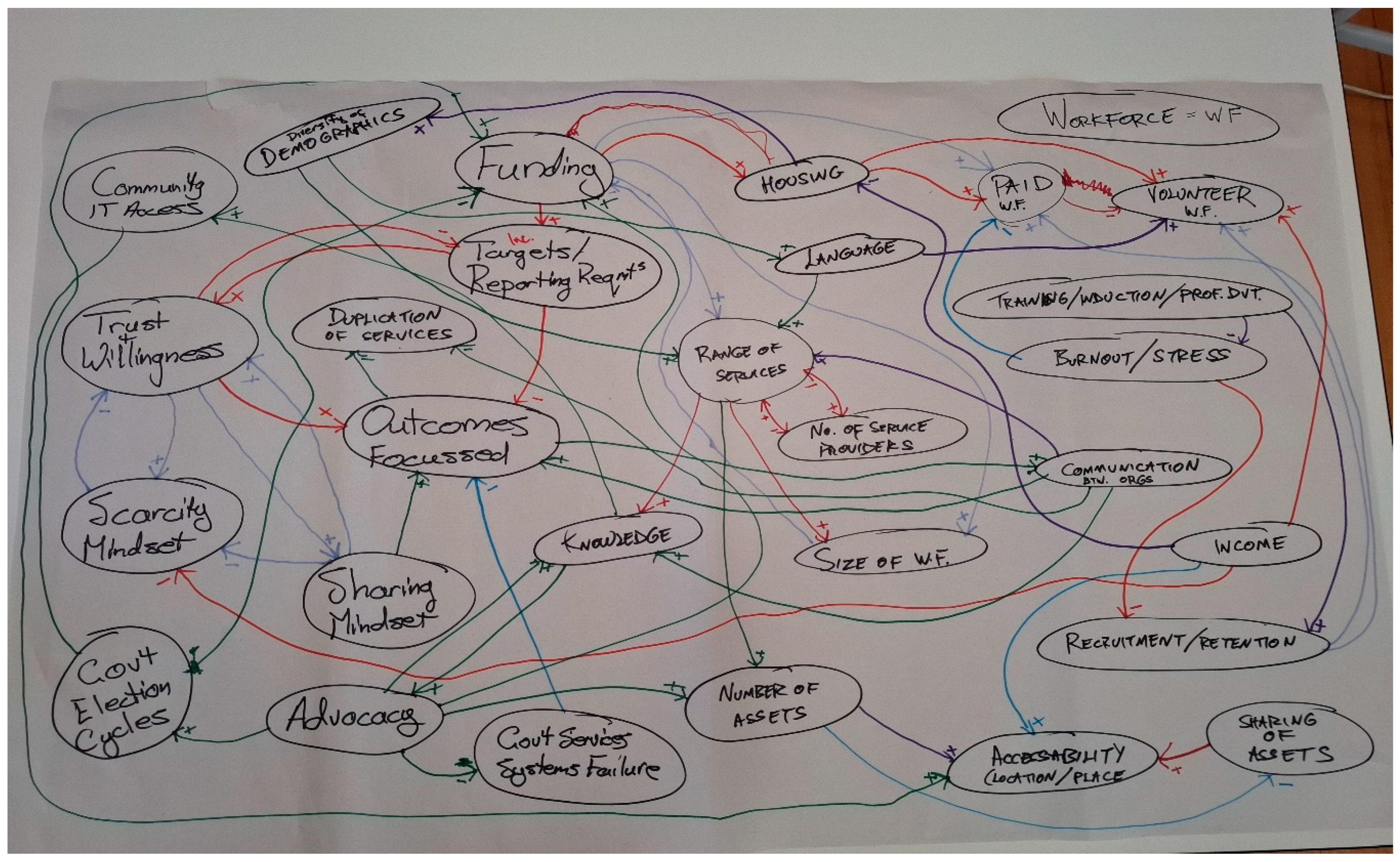
Figure 2.
Participatory systems map of the factors influencing place-based service integration in the City of Casey.
Figure 2.
Participatory systems map of the factors influencing place-based service integration in the City of Casey.
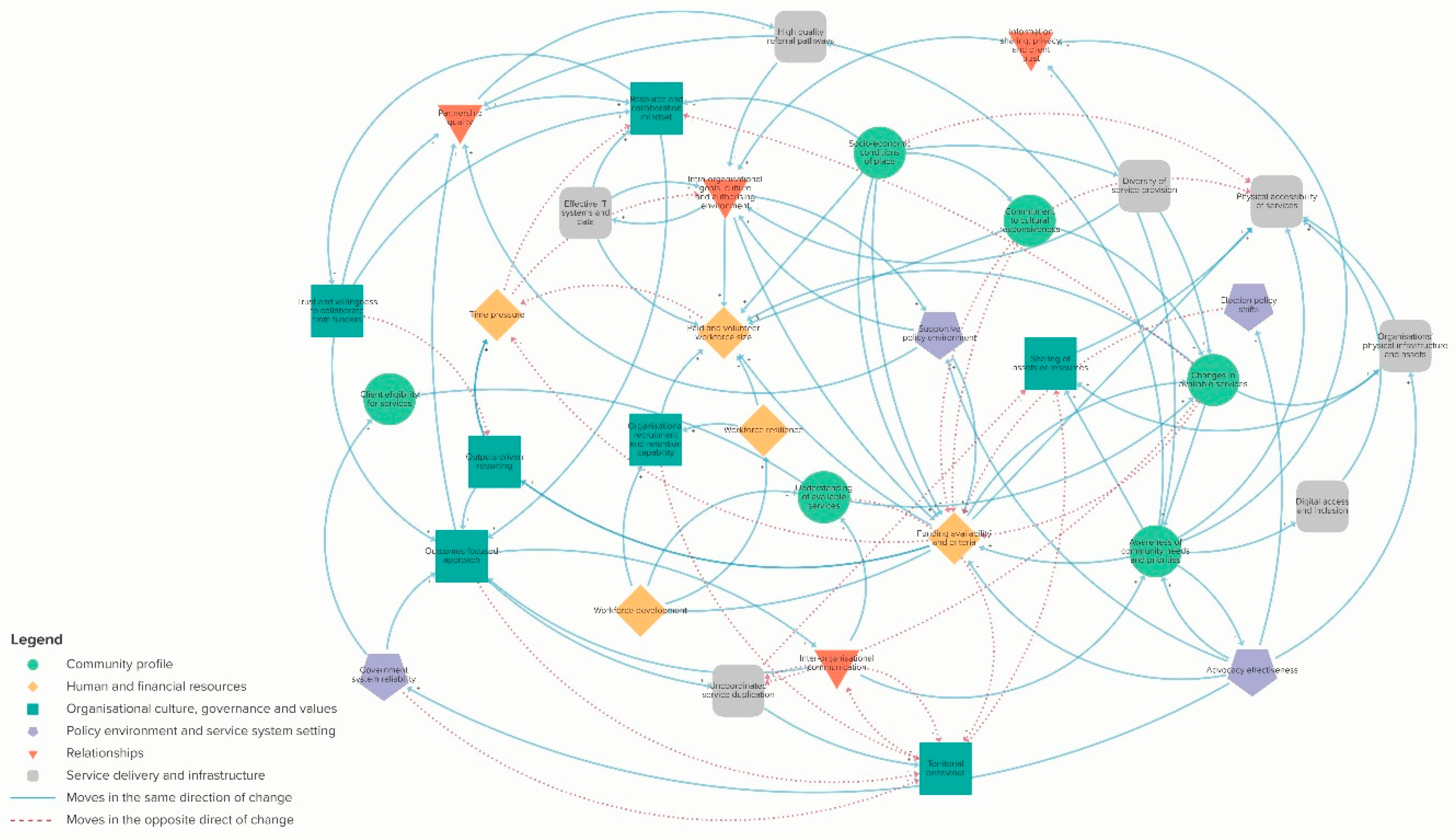
Figure 3.
Participatory systems map with factors by ASM and out-degree.
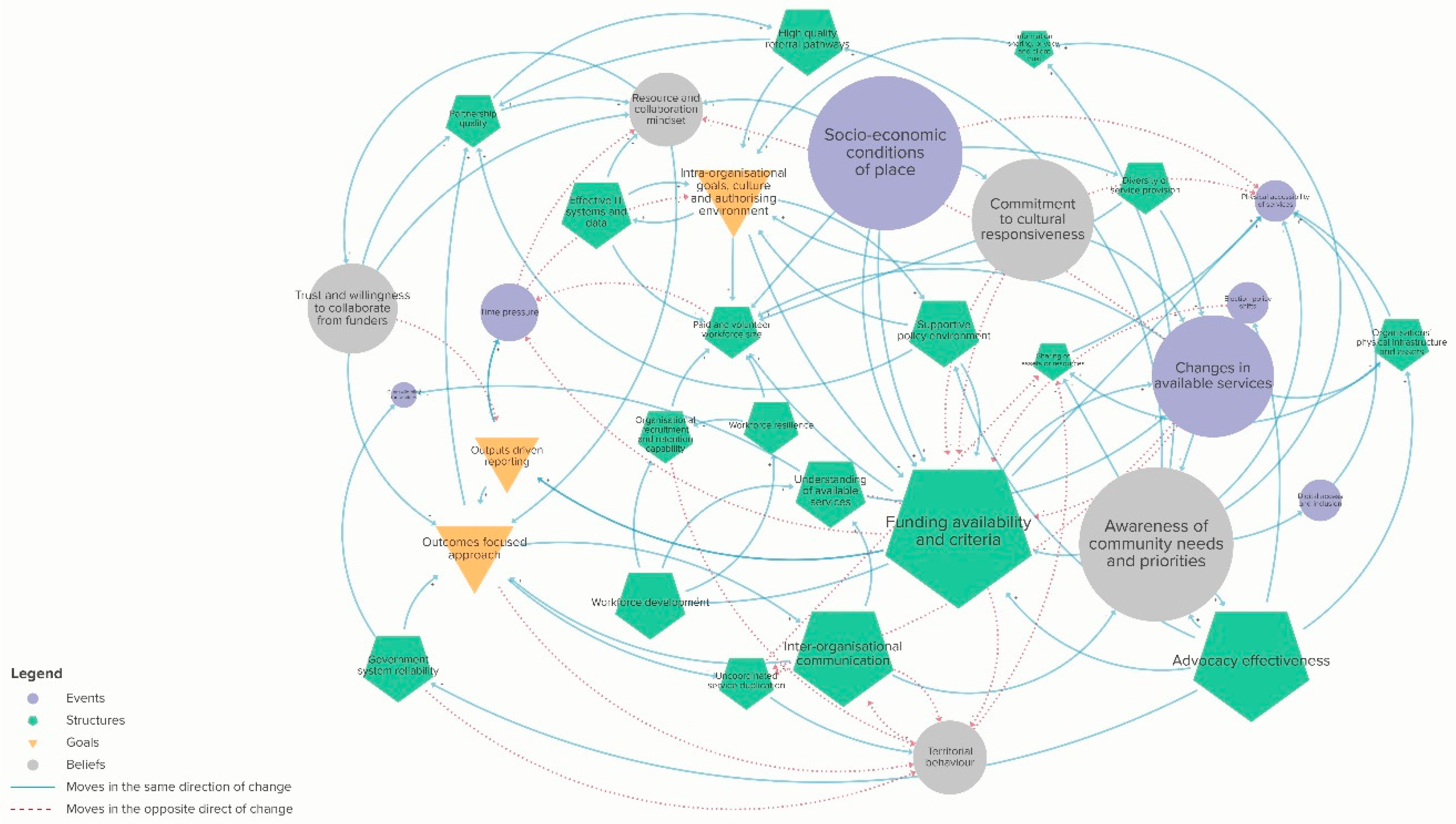
Figure 4.
Participatory systems map with factors by ASM and in-degree.
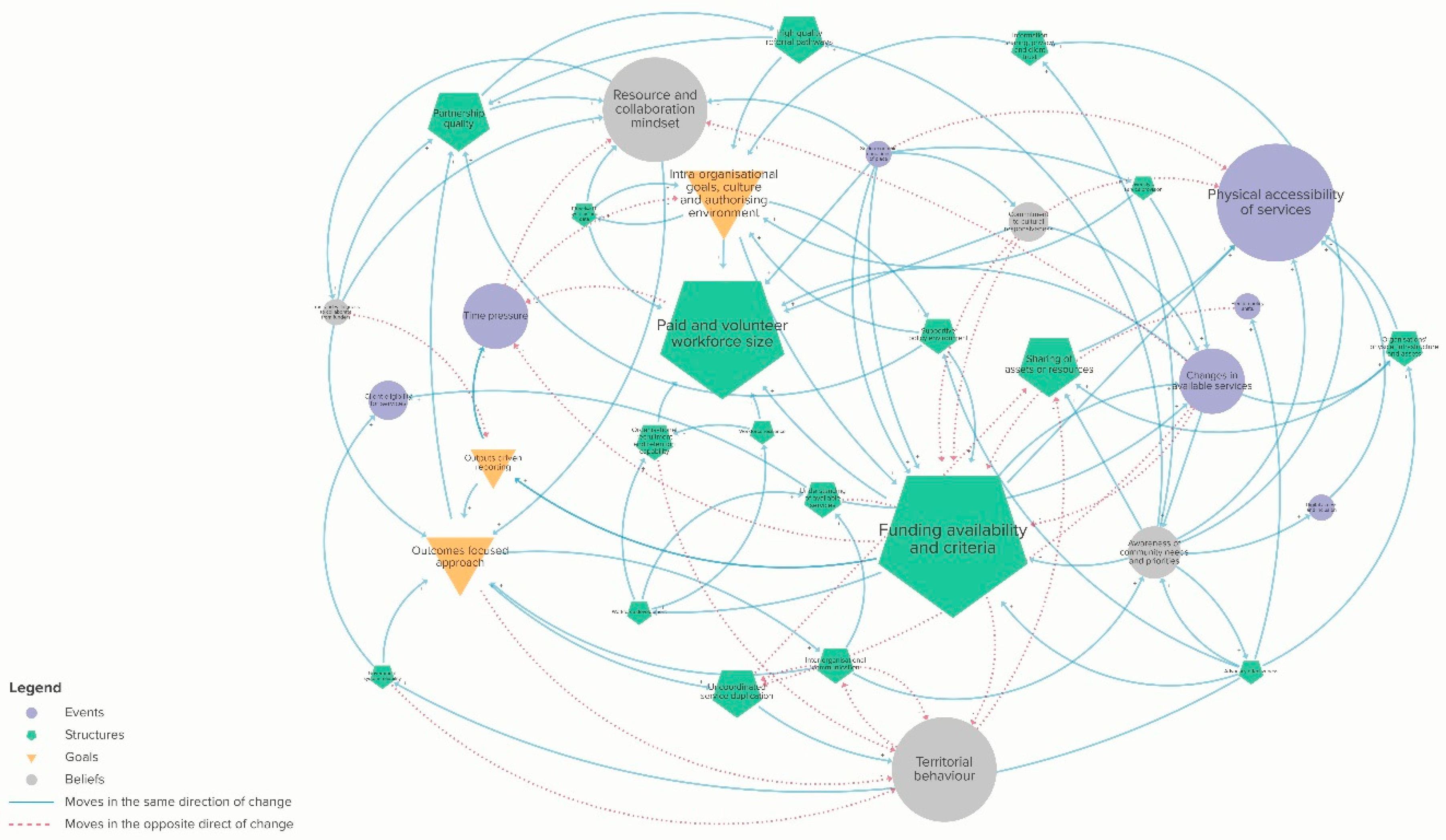
Table 1.
Factors influencing place-based service integration in Casey, including descriptions, thematic categories, Action Scales Model classification, and network metrics.
Table 1.
Factors influencing place-based service integration in Casey, including descriptions, thematic categories, Action Scales Model classification, and network metrics.
| Factor | Category | ASM classification | Degree | Indegree | Outdegree |
| Advocacy effectiveness | Policy environment and system setting | Structures | 7 | 1 | 6 |
| Awareness of community needs and priorities | Community profile | Beliefs | 11 | 3 | 8 |
| Changes in available services | Community profile | Events | 10 | 4 | 6 |
| Client eligibility for services | Community profile | Events | 2 | 2 | 0 |
| Commitment to cultural responsiveness | Community profile | Beliefs | 8 | 2 | 6 |
| Digital access and inclusion | Service delivery and infrastructure | Events | 2 | 1 | 1 |
| Diversity of service provision | Service delivery and infrastructure | Structures | 3 | 1 | 2 |
| Effective IT systems and data | Service delivery and infrastructure | Structures | 4 | 1 | 3 |
| Election policy shifts | Policy environment and system setting | Events | 2 | 1 | 1 |
| Funding availability and criteria | Human and financial resources | Structures | 19 | 11 | 8 |
| Government system reliability | Policy environment and system setting | Structures | 4 | 1 | 3 |
| High quality referral pathways | Service delivery and infrastructure | Structures | 6 | 3 | 3 |
| Information sharing, privacy, and client trust | Relationships | Structures | 3 | 2 | 1 |
| Inter-organisational communication | Relationships | Structures | 7 | 2 | 5 |
| Intra-organisational goals, culture and authorising environment | Relationships | Goals | 10 | 6 | 4 |
| Organisational recruitment and retention capability | Organisational culture, governance and values | Structures | 4 | 2 | 2 |
| Organisations' physical infrastructure and assets | Service delivery and infrastructure | Structures | 4 | 2 | 2 |
| Outcomes focused approach | Organisational culture, governance and values | Goals | 9 | 5 | 4 |
| Outputs driven reporting | Organisational culture, governance and values | Goals | 6 | 3 | 3 |
| Paid and volunteer workforce size | Human and financial resources | Structures | 11 | 9 | 2 |
| Partnership quality | Relationships | Structures | 6 | 4 | 2 |
| Physical accessibility of services | Service delivery and infrastructure | Events | 9 | 8 | 1 |
| Resource and collaboration mindset | Organisational culture, governance and values | Beliefs | 10 | 7 | 3 |
| Sharing of assets or resources | Organisational culture, governance and values | Structures | 5 | 4 | 1 |
| Socio-economic conditions of place | Community profile | Events | 9 | 1 | 8 |
| Supportive policy environment | Policy environment and system setting | Structures | 5 | 2 | 3 |
| Territorial behaviour | Organisational culture, governance and values | Beliefs | 10 | 7 | 3 |
| Time pressure | Human and financial resources | Events | 6 | 4 | 2 |
| Trust and willingness to collaborate from funders | Organisational culture, governance and values | Beliefs | 5 | 1 | 4 |
| Uncoordinated service duplication | Service delivery and infrastructure | Structures | 5 | 3 | 2 |
| Understanding of available services | Community profile | Structures | 5 | 2 | 3 |
| Workforce development | Human and financial resources | Structures | 4 | 1 | 3 |
| Workforce resilience | Human and financial resources | Structures | 3 | 1 | 2 |
| 1 |
https://forecast.id.com.au/casey, accessed 22 January 2026 |
Disclaimer/Publisher’s Note: The statements, opinions and data contained in all publications are solely those of the individual author(s) and contributor(s) and not of MDPI and/or the editor(s). MDPI and/or the editor(s) disclaim responsibility for any injury to people or property resulting from any ideas, methods, instructions or products referred to in the content. |
© 2026 by the authors. Licensee MDPI, Basel, Switzerland. This article is an open access article distributed under the terms and conditions of the Creative Commons Attribution (CC BY) license.
Copyright: This open access article is published under a Creative Commons CC BY 4.0 license, which permit the free download, distribution, and reuse, provided that the author and preprint are cited in any reuse.


