

Submitted:
09 June 2025
Posted:
09 June 2025
You are already at the latest version
Abstract
Deliberative approaches to governance systems analysis and improvement are rare. Using a case study from Australia’s Great Barrier Reef, we outline an innovative approach that combines reflexive and interactive engagement processes to: a) develop and design a framework to assess the health of a complex governance system; and b) undertake a benchmark assessment of governance system health. Multiple lines of evidence, including reviewed literature, data visualisation and appreciative inquiry effectively engaged key actors in value judgements about key attributes of governance system health, enabling consensus-building around priorities for transformative action. This was achieved through the inclusion of diverse perspectives about the governance system, analysis of rich datasets, and guidance from the project’s Steering Committee and Technical Working Group. Our inclusive, collaborative approach, its analytical depth and the framework’s repeatability enable continuous monitoring and improvement of the GBR governance system and can be readily applied to complex governance systems elsewhere.
Keywords:
Deliberative monitoring and evaluation
; governance systems analysis
; Great Barrier Reef
1. Introduction
Robust, accountable, and transparent governance systems are essential for the long-term protection and resilience of large and complex ecosystems. The governance of complex ecosystems across spatial and institutional scales (i.e. ‘multi-scalar systems’) is sometimes referred to as ‘polycentric governance’, comprising multiple, interdependent decision-making centres [1] and different governance domains. These complex systems are increasingly disrupted by global challenges such as climate change impacts and political uncertainty, and there are few available frameworks available that can monitor and evaluate their health and impact [1].
This paper first outlines and then reflects on, the stepped methodological process employed to develop and test an evaluative framework to facilitate a comprehensive understanding of a multi-dimensional and complex governance system [51]. Given relatively few cases of systemic governance analysis at the ecosystem level, we seek to be transparent about our experience. We reflect on the multi-pronged approach we took to engage actors in a process of building a shared language and knowledge base about policy, planning and program health and reform priorities. We do this to offer a theoretically grounded methodological innovation that stewards of complex systems might consider when establishing initiatives to assess and improve governance system health. Our objective is to support stewards of complex ecosystems through a repeatable, deliberative approach that provides opportunities to nudge governance systems towards better outcomes. Our paper is structured as follows. We begin by outlining the most salient aspects of healthy or good governance, which underpins our work. This leads into our methodology, followed by the results arising from its application. We then provide our conclusive remarks and ideas for future use of the methodology developed in this project.
- ‘Healthy’ or ‘good’ governance
By ‘governance’ we refer to the processes and structures through which individuals and institutions interact in a complex decision-making system [2]. This includes the wide range of intersecting processes and mechanisms at multiple scales which impact decision-making and active behaviours in complex environmental contexts. The ecological and administrative boundaries of multi-scalar contexts are often overlapping or mismatching, while issues of policy fragmentation, siloed approaches to decision-making, limited coordination and power and knowledge imbalances hinder the capacity of governance systems to flexibly respond to dynamic socio-economic change [3].
‘Good governance’ or ‘healthy governance’ refers to key system attributes such as transparency, accountability, fairness, inclusion, and effectiveness of decision-making processes to achieve positive societal and sustainable outcomes across multiple domains [2,4]. This systemically includes multiple levels of government policy, corporate, group and individual decision-making as well as social norms and structures, processes, plans and culture which regulate behaviour and impact on societal outcomes [2,5,6].
Ideally, good governance is underpinned by careful collaborative policy and planning, where success is highly dependent on the social context, engagement methods and incentive structures [7,8]. Social infrastructure underpinning collaborative governance is its ‘social capital’ and consists in its relational and normative foundations [9,10]. Good governance can strengthen social capital through inclusive and participatory processes which enable stakeholders and rights holders to reflect and deliberate on environmental challenges [11,12]. Deliberation moves beyond merely expanding opportunities for public participation in governance, to providing discursive settings which invite discussion and reflection [13]. It emphasises reasoned, inclusive, and reflective public discourse as the foundation for legitimate and collective decision-making [14]. In reference to environmental governance, positive deliberation is also likely to contribute to ecological reflexivity, intended as the capacity of socio-ecological ecosystems to recognise change; reflect on the implications of change; and adapt to change through learning [15].
Establishing good (or healthy) governance across various tenures and jurisdictions is critically important for effectively managing large landscape-scale conservation areas, and should involve state, communities, non-government organisations, industries, Indigenous people and others acting together at different scales to equitably address management challenges [16]. Management effectiveness has been at the heart of protected area governance for well over a decade [17] and has been central to GBR governance since the first Great Barrier Reef Outlook Report in 2009 [18]. Since 2009, the Reef Authority has been required to prepare the GBR Outlook Report every five years, under amendments to the GBRMPA 1975. This comprehensive report provides an assessment of GBR health. At the same time an independent assessment of the effectiveness of GBR management is conducted [18]. Evaluating management effectiveness for the GBR requires an assessment of how well its values are being protected, and whether objectives and goals are being met [19]. The assessment is conducted using a widely applied framework (the IUCN-WCPA Framework) and examines fourteen priority topics. Each topic is assessed against specific indicators within six management elements (context, planning, inputs, processes, outputs, outcomes). The assessment is undertaken independently, although evidence for each indicator includes information assembled and discussed by GBR management staff with the independent assessors [18,19].
By contrast, the method that we implemented for our research seeks to involve a much wider range of participants (beyond managers) in the monitoring and evaluation (M&E) process, and the focus is on exploring the health of wider polycentric and multi-domain governance systems rather than more specific management actions. This creates opportunities to examine more contextual issues and for diverse theories of change and voices to be heard. We assert that this provides deeper insights into management effectiveness within a much broader governance system. Reviewed literature suggests that collaborative, deliberative approaches to the assessment of governance systems can address challenges in relation to cross-scale partnerships, power asymmetries that hinder equitable participation, and how best to integrate diverse knowledges needed for effective governance [13,20].
Involving stakeholders and rights holders in the M&E of complex ecologically-focused governance systems also addresses the need for more public accountability and trust-building; genuine stakeholder and Indigenous engagement; and opportunities for co-ownership of, and commitment to M&E processes and outcomes [21,22]. Heeding diverse voices across various governance jurisdictions from local to global scales can amplify efforts and modify trajectories, as each brings a different perspective to the detection and resolution of potential problems [23,24]. Despite this, methods to realise collaborative and deliberative governance in M&E are rare [1,25,26,27]. As we discuss below, our research seeks to address this gap through an M&E framework underpinned by a collaborative and participatory approach.
The purpose of this paper then is to outline our approach to the analysis and M&E of complex governance systems. The approach combines reflexive and interactive processes for engaging stakeholders and Indigenous people with the intention of identifying strengths and weaknesses of current governance arrangements. Results from such an inclusive approach can indicate where and how structural and functional shifts are needed to ensure governance goals and objectives are met. At the same time, it can create opportunities to re-evaluate and modify actions and strategies where needed [28]. Our approach is rooted in inclusive dialogue and participatory processes involving local actors that live and work in the GBR and its catchment and, as such, potentially have a deep and meaningful understanding of its governance.
- Great Barrier Reef (GBR) context
The GBR is one of the world’s greatest natural wonders and one of the most awe-inspiring places on Earth. Composed of more than 3000 individual reefs and 900 islands, this incredibly complex ecosystem is home to thousands of species of fish, coral, molluscs, sea turtles, and birds, and supports iconic marine species such as dugongs, manta rays, and whale sharks [29,30]. Over 70 Traditional Owner (Aboriginal and Torres Strait Islander) clans share a deep cultural, spiritual, and economic connection to the GBR, going back in time over thousands of years [29]. Major industries such as tourism, agriculture, and fisheries are supported by the GBR, making it a significant economic asset and a much-treasured social and cultural icon [31].
The GBR was inscribed on the World Heritage List in 1981 in recognition of its Outstanding Universal Value (OUV) as one of the most remarkable places on earth [32]. Australia has a duty under the World Heritage Convention to ‘identify, protect, and conserve’ the GBR’s OUV [33]. Such duty is of paramount importance especially as the GBR is facing severe, multiple, and interconnected threats to its resilience and survival. These are primarily due to anthropogenic climate change impacts, but also those related to deteriorating water quality, dredging, coastal development, impacts of industries, inconsistent governance and enforcement issues [31,34].
The GBR governance system is a complex and polycentric space, consisting of nested sub-systems within wider governance systems that influence and are influenced by social and ecological outcomes at other scales. For example, the failure of one domain or component (e.g. coastal management) to deliver its intended outcomes (e.g. healthy coastal ecosystems) needs to be understood within the much wider and more complex GBR social-ecological system [35]. The boundaries of various complex governance system domains are at times overlapping, blurry and potentially contradictory [36].
A specific but very significant subset of this overall GBR governance system is the governance system related to the Reef 2050 Long-Term Sustainability Plan (the Reef 2050 Plan), which was jointly released by the Australian and Queensland governments in March 2015 [37]. The Reef 2050 Plan is living document takes a holistic approach to GBR governance, mobilising government agencies, industries, communities and non-government organisations to set objectives and instigate actions to address key threats identified through the GBR Strategic Assessment Report 2013 and the GBR Coastal Zone Strategic Assessment Report 2013 [18]. The Reef 2050 Plan has undergone two formal reviews since its first release. The Plan is Australia’s overarching framework aimed at protecting the GBR’s OUV and improving its resilience through several goals and objectives focused on GBR health, including its governance [38]. The Reef 2050 Plan directly stresses the importance of governance with a major objective that ‘governance systems are inclusive, coherent, and adaptive’ [38].
To be inclusive implies that all relevant stakeholders and Traditional Owners should be part of the decision-making processes related to GBR management. Although a long-held aspiration for many Traditional Owners, inclusivity in decision-making is a relatively recent development [39]. A Traditional Owner-led Implementation Plan developed through an independent Reef 2050 Traditional Owner Steering Group, enabled Traditional Owners to engage with and respond to the objectives and goals of the Reef 2050 Plan. The Implementation Plan marks a strong transition from government-led decision-making to a more inclusive approach to vision building [40]. The focus of the Implementation Plan has empowered Traditional Owners to develop a platform to implement Traditional Owner-led actions while working with other Reef 2050 Plan actors [41]. A GBR Traditional Owner Taskforce has been established to provide a strong and representative voice to achieve Traditional Owner aspirations for the Reef, capacity-building through and within the Implementation Plan, and coordination of monitoring and evaluation of Plan actions [40].
To avoid conflict or repetition of efforts, promote alignment of policies and regulations and encourage cross-sectoral collaboration between GBR actors, the wider GBR governance system needs to be coherent. As such, a multi-tiered approach to GBR management is crucially important to enable diverse actors at multiple scales opportunities to collaborate and influence each other in their efforts to protect and manage the GBR ecosystem and its catchments [42]. Governance systems must also be adaptive to the dynamic and constantly changing environmental and socio-economic conditions of the GBR. Adaptability allows for flexibility in management approaches and for adjustments and fixes where issues arise. For example, in relation to prioritising adaptive approaches in the governance of the GBR, McHugh, et al. [43] have previously suggested adopting a ‘reflexive governance’ approach, whose focus is on governance structure being responsive and inclusive to improve effectiveness in addressing climate challenges.
Despite the Reef 2050 Plan’s emphasis on governance health, there has been no long-term monitoring system for its assessment. This was identified as a critical monitoring gap [44] and, as such, an investment priority by the Reef 2050 Integrated Monitoring and Reporting Program (RIMReP), whose purpose is to drive GBR management and track progressing against the Reef 2050 Plan goals and objectives [45]. Resolving this gap is crucial for achieving resilience and conservation outcomes for the GBR, due to the multi-level, polycentric system of governance integrating national, state, and local actors, along with Indigenous groups, scientific and government bodies, industry, and communities [45].
- Complexities and challenges of GBR governance
Across the GBR World Heritage Area and adjacent catchment, multiple actors including government agencies, Traditional Owners, landholders, community members and broader groups and individuals take particular actions and at times, work through partnerships or through collective action to achieve shared goals [35]. On occasions, however, the multiple agencies and actors involved in the GBR governance system have different priorities and goals, sometimes resulting in different (and sometimes negative) consequences for different parties. Taken together, these human actions represent and are mediated by the wider governance system that guides behaviour impacting the GBR [46].
GBR governance is characterised by inconsistencies in policy implementation and enforcement, due to the interconnected and often overlapping responsibilities of diverse actors and institutions [47]. These involve state, regional, and local governments, in addition to Indigenous institutions, industries, and non-governmental organisations such as conservation groups. Such multi-layered context is often affected by issues of fragmentation which often leads to conflicting policies and inefficiencies [48]. Such issues include, for example, variable enforcement standards, resource constraints, and differing accountability mechanisms. These issues are embedded within the overarching impacts of anthropogenic climate change, from coral bleaching to extreme weather events, which increase the urgency for adaptive approaches to governance monitoring even further [49].
The Reef 2050 Plan recognises and aims to integrate and resolve these issues. However, policy responses are often fragmented and disconnected from long-term outcomes, especially where strong silo-based behaviour is in place between various Reef 2050 Plan actors [48,50]. In turn, a lack of a dedicated and long-term monitoring system to address progress of the Reef 2050 Plan further constraints governance health [51].
Monitoring and reporting on the health of the governance system underpinning the Reef 2050 Plan’s implementation and review reveals how well Reef 2050 Plan objectives and goals are progressing. The health of the Reef 2050 Plan governance system refers to how well the policies, programs, instruments and other activities involved with GBR management interact and impact on key outcomes for delivery through the Plan. In our view, the system is considered ‘healthy’ when it can achieve intended outcomes across different scales (i.e. across the whole Reef 2050 Plan governance system).
2. Methodological Approach
This project’s action-based methodology was epistemologically framed by post-positivism [52] and practically framed by deliberative action, appreciative inquiry and a collaborative approach. This was achieved through a multi-method program of research over three years (2022-2024), as characterised in Figure 1 below.
In alignment with the participatory ethos of this research design, the appreciative inquiry approach provided a constructive framing to the investigation. Co-inquiry encouraged collective problem-solving and the development of a shared vision [53]. The project benefitted from contributions and support of the Reef 2050 Traditional Owner Steering Group; an independently chaired Project Steering Committee and a Project Technical Working Group. The Project Steering Committee comprised fifteen individuals including the independent chair; one person from Griffith University; staff from state and Commonwealth marine park management agencies and staff from the Great Barrier Reef Foundation. There were three Technical Working Group members drawn from state and Commonwealth agencies. The Steering Committee periodically reviewed project progress and provided strategic advice and direction. The Committee met regularly over the course of the project. The Technical Working Group was established to assist and support the research team with the development of the monitoring framework.
The steps involved in developing the framework and assessing governance health are presented in two major phases: 1) developing the framework (literature review; reef governance network mapping key actor interviews, focus groups; Technical Working Group and Steering Committee inputs; theory of change: finalising the framework); and 2) applying the framework (multiple lines of evidence; assessment; data visualisation and reporting) to benchmark the Reef 2050 Plan governance system.
2.1. Developing the Framework
The framework was developed in a number of stages (i.e. literature review, key actor interviews, network mapping and focus group discussions). It builds on the Governance System Analysis (GSA) method to systematically assess risk management in large, polycentric governance systems to support system improvement [54]. This theoretically informed and empirically tested method analysed the many components of complex governance systems through evaluative criteria with the aim to support system improvement. Initially trialed in the GBR between 2012 and 2016, the GSA approach identified and analysed the multiple governance domains and sub-domains contributing to the overall health of the governance system [46]. Although developed for the GBR, the GSA has since been applied internationally; for example, in relation to the governance of Sustainable Development Goals (SDGs) in Japan and Indonesia by Morita, et al. [55].
2.1.1. Literature Review
A literature review conducted between February and March 2023 provided a global overview of monitoring and evaluation frameworks relevant to assessing reef governance systems. The focus was the identification of potential attributes and clusters of these attributes that could be used to describe and monitor the Reef 2050 Plan governance system. These clustered attributes included scholarly and applied suggestions on measurements and proxy indicators. Some of the key attributes considered and found in an abundance included factors such as ‘transparency of process’, or ‘shared vision’, while fewer studies were found for others key attributes (e.g., such as ‘timeliness of effort taken’). Results of the preliminary literature review highlighted that:
- globally, there is interest and attention at a range of scales (international to local) in measuring the extent to which complex governance systems are ‘good’ or ‘healthy’; and
- a strong governance monitoring system is needed to support the review, implementation, and delivery of the Reef 2050 Plan to improve outcomes in the GBR.
2.1.2. Key Actor Interviews to Inform Framework Design
Detailed interviews were conducted with twenty-one GBR actors to learn from their perspectives about what was important to include in a governance monitoring framework and system for the Reef 2050 Plan. Of these, seven interviews were conducted with Traditional Owner members of the Reef 2050 Reef Traditional Owner Steering Group. Overall, the interviews reflected many factors that were uncovered in the literature scan and highlighted the:
- need to develop a monitoring framework that works within a governance context characterised by complexity and inter-connectedness;
- value in supporting all actors and agencies to come together to jointly build an agreed understanding of the Reef 2050 Plan governance system and develop a platform for taking shared approaches to continuous improvement of the system; and
- need to include particular attributes and/ or indicators in the monitoring framework, for example, connectivity, transparency, and coherence.
2.1.3. Reef Governance Network Mapping
Maps of GBR actors, institutions and policy arrangements connected with the Reef 2050 Plan were developed using the program ‘R’. These mapped the wide range of actors (e.g. government agencies, industry bodies, land managers, universities, etc.) involved in the Reef 2050 Plan governance system. More than 300 interconnected, nested and layered instruments (e.g. funding programs, legislative actions, formal partnerships, etc.) affecting action within the Reef 2050 Plan system were identified (depicted in Figure 2 below). These maps helped explore connectivity, linkages and power-relationships across the complex Reef 2050 governance system. This was important for understanding the needs for monitoring the health of the system [51].
2.1.4. Interviews, Focus Groups, Steering Committee and Technical Working Group Inputs
Key actor engagement for this project was paramount to ensure a collaborative approach to developing this monitoring framework. A diverse range of GBR actors from government and non-government sectors, including (industry groups, peak bodies and researchers) were engaged through focus groups, the Steering Committee and the Technical Working Group. Detailed contributions from a wide cross-section of GBR Traditional Owners was achieved through Reef 2050 Traditional Owner Steering Group.
A Stakeholder Engagement Plan supported targeted one-on-one interviews and focus groups with experienced GBR actors. The first round of targeted interviews, conducted with twenty-one participants, focused on interviewees’ experience in developing and implementing the Reef 2050 Plan. Perceptions of the Reef 2050 Plan governance system were visualised through a mapping exercise to identify elements of the system. Next, focus groups in Brisbane and Cairns (sixteen participants) gathered GBR expert perspectives on the monitoring framework being developed by the project team.
2.1.5. Theory of Change
We applied ‘theory of change’ thinking to provide a blueprint for how and why a desired change is expected to happen. The process illustrated the causal links and sequences of an intervention leading to a desired outcome and articulated the assumptions underlying each step in the chain [56]. We began by articulating the context in which the change effort will occur [57] – e.g. the context for achieving a healthy GBR governance system involves a multi-scale decision-making system; connectivity within the system; effective use of diverse knowledge sets (including the incorporation of Traditional Owner views); system capacity for effective action; and the use of targeted monitoring, evaluation, and learning processes.
Applying a theory of change highlighted several implications for implementation in practice including the necessity for qualitative as well as quantitative monitoring of the performance, clarity about assumptions and willingness to be open to learning [58,59]. It enabled us to gain an overall perspective of the impact and outcomes through focusing on ‘if’ things were to change, ‘then’ what will happen, leading to ‘impact’ and then considering how this will contribute to ‘transformation and change’. Table 1 outlines the theory of change applied in our consideration of the Reef 2050 Plan governance system if particular outcomes were to happen, and then how it would lead to transformation and change.
2.1.5. Finalising the Framework
- We developed a preliminary monitoring framework and its attributes by combining the results from the literature review, the mapping exercise, and analysis of the first round participant interviews and focus group discussions.
- We then held two in-person workshops in two Queensland locations with sixteen diverse GBR actors and Traditional Owners to gain deeper perspectives on governance health and provide feedback on an emerging evaluation framework. A third online workshop was held to accommodate participants who could not attend in person. A further six conversations were held with members of the Reef 2050 Traditional Owner Steering Committee, and with the Project Steering Committee and the Technical Working Group for input and feedback.
- We integrated the results of those conversations into emerging versions of the framework until we developed the final version. The latter consists of 20 attributes for a healthy governance system, grouped in four clusters: coherence, connectivity and capacity, knowledge, and operational governance. (See Consistent with GSA thinking, our proposed final version of the framework, presented in Figure 3.)
- To accompany the framework, and to be used in the assessment process, we developed a Likert scale to rate each attribute and provide narratives to support each score.
Figure 3.
Key clusters of attributes in the preliminary monitoring framework.
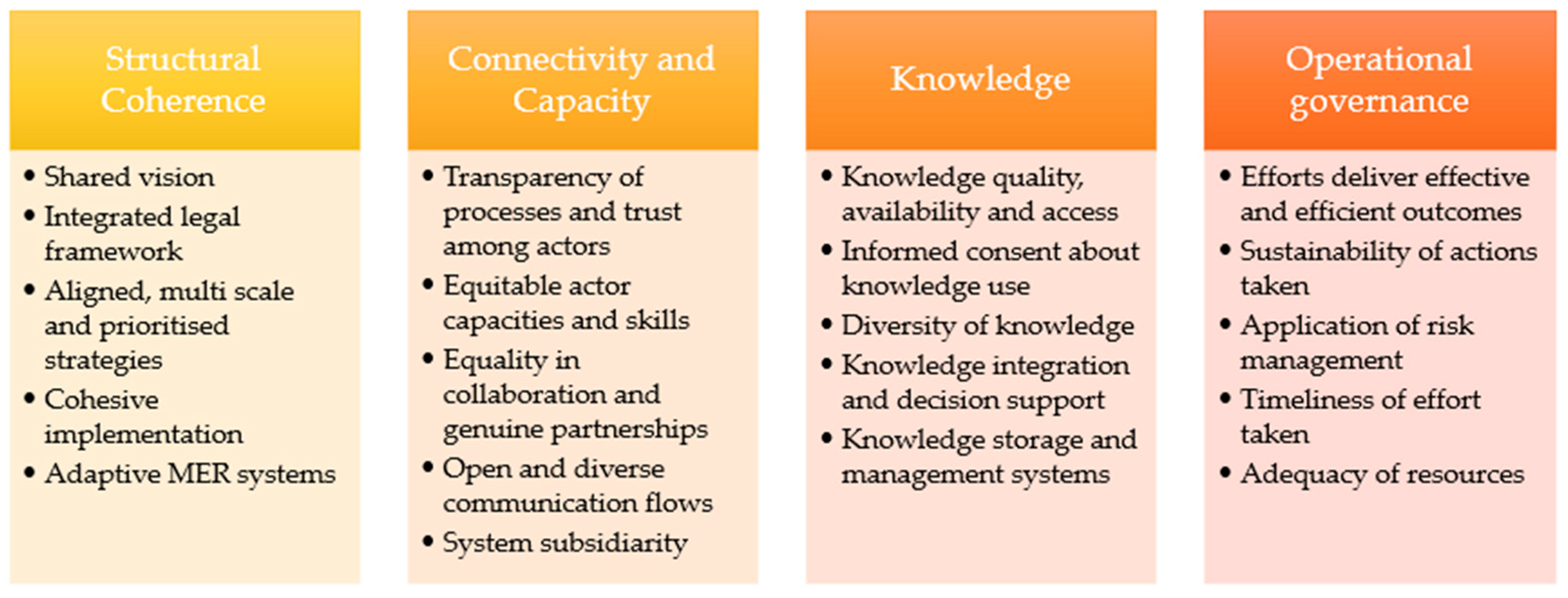
While developing the monitoring framework attributes, we focused on the strengths of the system and how to reinforce them to mobilise change toward our desired goal of a healthy Reef 2050 governance system. To do this, as mentioned previously, we applied an ‘appreciative inquiry’ approach that seeks ways to strengthen its potentialities, instead of focusing on the weaknesses and deficits in a system [60].
In summary, the key steps leading to the development and refinement of the governance systems attribute framework are outlined in Figure 4.
2.2. Applying Multiple Lines of Evidence for Benchmarking Against the Framework
As illustrated in Figure 5 below, we populated the attributes for the framework through a multiple lines of evidence approach comprising the following components:
- First, for each attribute, we conducted a literature scan that included international and Australian academic literature, government reports, policies, and consultancy documents. Although a scan of the international literature was important to develop attribute definitions and analysis on a larger scale, the main focus of this exercise has been on literature and documents related to the GBR, when possible;
- Second, we investigated case studies of governance practice in the context of the GBR related to each attribute. For example, in the case of ‘Shared Vision’, the first attribute in the ‘Coherence’ cluster of the framework, we explored the case of the 2022 Traditional Owner Implementation Plan. The latter is an example of how a shared vision for GBR governance was developed over time through collaboration and conversations on how to achieve the goal of a healthier and more resilient GBR; and
- We again invited deliberation with GBR experts through twenty in-depth interviews; three focus group discussions; and through the Steering Group and Technical Working group. Separate conversations were held with members of the Reef Traditional Owners Steering Committee. During the interviews participants used a Likert scale to rate each attribute (from healthy to unhealthy) and provided narratives to support their scores. Focus group participants were invited to review a draft consolidated evaluation derived from interviews, case studies and reviewed literature, and to discuss findings of the benchmark.
2.2.1. Data Visualisation and Reporting
There was much discussion within the Steering Committee and Technical Working Group about data visualisation and reporting. The multiple lines of evidence approach adopted by the project led to qualitative assessments of each attribute and case examples. The evaluative conversations held through the interviews and focus groups used an appreciative enquiry framework to review and refine assessments of attribute health. Although the Steering Committee confirmed that a qualitative assessment was a useful outcome, attribute relationships were also considered important to communicate. The Committee also confirmed that data visualisation to support the communication of the rich text-based evaluation results was also important. Reasons for this included enhancing the accessibility of the work for non-technical/non-governance experts; improved ability to present findings in briefing notes and summary documents; and ability to support the measurement of trends over time. Following exploration of options such as buckets, box plots, traffic light schemas, and existing reporting arrangement (e.g. GBR Outlook reports), it was agreed to combine qualitative data and graphic summary using a ‘bucket’ concept aligned to appreciative inquiry.
Depicted in Figure 6, the visualisation adopted in this assessment incorporates a definition of a healthy attribute and a visual summary of attribute health depicted in a bucket. In the bucket visual, a full bucket denotes a healthy governance attribute. Systemic issues associated with a particular attribute may result in a developmental stage that is considered to be either ‘healthy’, ‘maturing’, emergent’ or ‘unhealthy’. The visual tool represents a high-level summary of the qualitative assessment drawn from literature, case examples, interviews and focus group discussions. The visualisation also summarises the health trend of the attribute and provides a summary of confidence ratings. The grade and trend and confidence ratings were expertly (through internal team dialogue) derived using data from the multiple lines of evidence assessment.
3. Discussion and Conclusions
In Australia, as van Bommel [3] noted, collaborative approaches to governance are emerging but not yet routinely embedded in research, perhaps due to challenges such as institutional barriers, issues with coordinating between multiple parties, and managing differing expectations [61]. Collaborative approaches to monitoring and evaluation of governance systems are even rarer. Our research stands as an exception to this reality, as it is based on a highly participatory research design to ensure that perspectives and knowledges of diverse groups were captured and integrated throughout all stages of the research process. We believe that participation in M&E of large polycentric governance systems provides actors with a safe space to start a conversation about governance, and in doing so, moves the whole system towards deliberative governance. By deliberative governance we mean opportunities for individuals, groups, agencies, industries, rights holders and other actors to come together to discuss, reflect upon and act on pressing issues [13].
Within the GBR Marine Park numerous advisory groups, committees and agreements, each focusing on a particular GBR issue or location, are already well established and have been functioning extremely well for many decades [62]. However, there has yet to be a comprehensive deliberative process for assessing the effectiveness of the whole GBR governance system. As such, we believe this paper makes significant methodological contributions to the concept of deliberative governance, by using inclusive and collaborative M&E processes for the assessment of a large polycentric governance system. We borrowed from deliberative and collaborative research and practice approaches to develop a framework to monitor the governance health of the GBR, a complex and dynamic ecosystem where networks of interactions are managed through numerous agencies for different purposes (e.g. conservation, fisheries, tourism, traditional use), sometimes resulting in conflicting outcomes.
In particular, we focused on monitoring and reporting on the health of the governance system underpinning the Reef 2050 Plan to illustrate progression of its objectives and goals. A comprehensive literature review investigated the global context of governance monitoring and evaluation, with implications for the GBR. Concurrently, to start shaping the GBR monitoring framework, we gathered insights through interviews and focus group discussions with GBR governance experts and Traditional Owners. We next created a network map of GBR governance; and developed a theory of change to identify transformative pathways for a robust governance system. We then invited participants to visualise their understandings of the GBR governance system through an interactive mapping exercise to highlight the interconnections between key actors and policies. Underpinning these activities was a collaborative philosophy emphasising inclusive, communicative, and participatory processes to solve complex problems and foster informed decision-making [63]. Finally, we benchmarked the framework through applied, multiple lines of evidence, which included a second round of interviews, and a series of workshops (focus groups) framed within an appreciative inquiry approach; in addition to the development of a visual tool based on a ‘bucket’ concept to illustrate our results. This evaluative approach is independent of, but well embedded within, the existing Reef 2050 Plan governance system, ensuring high levels of transparency and trust.
Over the course of our research, we encountered a series of challenges (or limitations), due to the nature of our research work. For example, we found that at times conversations about some aspects of governance were contentious, especially when broaching sensitive topics. We also found that some of our key informants, despite having a long involvement in GBR management, found it difficult to visualise various relationships and networks associated with different elements of GBR governance. Indeed, some had quite a narrow view of ‘governance’ and were more likely to associate the term solely with institutional policies, plans strategies and procedures, whereas the focus of our research was to establish how well GBR actors were working together in implementing formal and informal instruments and activities within the Reef 2050 Plan governance system.
To resolve this issue, and to approach the topic of governance in more accessible terms, we were initially advised to refrain entirely from using the term ‘governance’ and use the term ‘collective capacity’ instead. However, as our first round of interviews revealed, the suggested alternative term ‘collective capacity’ was not intellectually accurate and also was somewhat confusing. So, following deliberated advice from the GBR governance experts on the project’s Steering Committee, it was later agreed to use the term ‘governance’ as more comprehensively suited to the focus of our analysis. Perhaps more importantly, the conversation about governance served to build a deep collective understanding of its meaning and importance.
Another challenge was in relation to how to measure governance health, as previously developed rating scales and qualitative data were considered not appropriate in the context of our project. This was due to several reasons, for example, the potential for culturally sensitive issues to arise when using ‘traffic light’ scoring/ranking systems, or difficulties in representing trends over time in the case of purely using qualitative data [64]. After reviewing several options, and consulting with the Technical Working Group and the Steering Committee, it was decided to combine qualitative and quantitative analysis descriptors through an appreciative inquiry approach and a more positive language for representing scores with the concept of ‘buckets’ representing attribute grades. Mitigating the limitations, a crucial support system was provided by the project Steering Committee, with its independent Chair, and the Technical Working Group.
Deliberative dialogue through focus group discussions enabled a total of twenty buckets to be created, each accompanied by explanatory text. Figure 7 provides an example of the results of this process.
The bucket-based approach to enabling a dialogue about the health of each attribute and the overall system provides a way to develop an attribute health index (including trend and confidence) that can be repeated reliably over time if the method is applied consistently. It also enables the development of an integrated index that can absorb the important information sources from a wide evidential base (e.g. the literature, surveys, focus groups, etc.). This means that, even with a new team of analysts undertaking this work in the future, a reliable approach to measurement of the health of each attribute has been established. To maintain this robust deliberative approach we recommend that a regular benchmark and progress report be completed every two-to-three years, in line with key reporting cycles. Importantly, the research team, the Reef 2050 Plan Executive Steering Committee (senior executives from state and Commonwealth government agencies with jurisdictional responsibility for the GBR), and other key GBR actors should continue to work together to co-design responses to the most importance governance systems weaknesses identified.
Although developed for the GBR, we believe our methodology is both cost-effective and adaptable to other governance systems globally. We demonstrated that our approach provided a safe place for diverse actors to reflect on multiple lines of evidence, develop a shared language and articulate value judgements on a range of topics pertaining to polycentric governance. Inspired by the international application of the GSA from which this work is adapted e.g. Morita, Okitasari and Masuda [54] and having successfully completed the first benchmark of our monitoring framework, we suggest that the latter can be applicable to assess the governance health of complex ecosystems beyond the GBR.
Author Contributions
Karen Vella: Conceptualisation, data curation, formal analysis, funding acquisition, investigation, methodology, project administration, supervision, validation, visualisation, writing – original draft, review and editing. Allan Dale: Conceptualisation, data curation, formal analysis, funding acquisition, investigation, methodology, project administration, resources, supervision, validation, writing – original draft, review and editing. Diletta Calibeo: writing – original draft, review and editing. Mark Limb: Conceptualisation, data curation, formal analysis, funding acquisition, methodology, supervision, software, validation, visualisation, writing – original draft, review and editing. Margaret Gooch: Validation, Writing – original draft, review and editing. Rachel Eberhard: Formal analysis, methodology, validation, writing – review and editing. Hurriyet Babacan: Writing – review and editing. Jennifer McHugh: Project administration. Umberto Baresi: Writing – review and editing.
Funding
This research was funded by the Australian Government and the Great Barrier Reef Foundation (GBRF) through the Reef Trust Partnership.
Institutional Review Board Statement
Human Ethics Application approved by the Queensland University of Technology (Application N.5201).
Informed Consent Statement
Informed consent was obtained from all subjects involved in the study.
Data Availability Statement
Data generated from this research were gathered in confidence from participants, and may be available on request from the corresponding author.
Acknowledgments
We pay particular thanks to the Project Steering Committee members: Josh Gibson, Kiorion (Chair), Ed Morgan, Griffith University (Independent), Julia Playford, DESTI, Louise Smyth, DESTI, Lara Johnson, DCCEEW, Matthew Fullerton, DESTI, Stephen Briggs, DCCEEW, Margaret Johnson, Michelle Dyer, Chloe Schauble and Lisa Pennisi, the Reef Authority, John Foster, DCCEEW, Chrissy Grant, and Charlie Morgan and James Wran, GBRF. We also pay thanks to our Technical Working Group members, Michelle Dyer, Lara Johnson, and Matthew Fullerton. The project also deeply thanks the contributions and support of the Reef 2050 Traditional Owner Steering Group.
Conflicts of Interest
The authors declare no conflicts of interest. The funders had no role in the design of the study; in the collection, analyses, or interpretation of data; in the writing of the manuscript.
Abbreviations
The following abbreviations are used in this manuscript:
| DESTI | Department of Environment, Science, Tourism and Innovation (Queensland) |
| DCCEEW | Department of Climate Change, Energy, the Environment and Water (Commonwealth) |
| GBR | Great Barrier Reef |
| GBRF | Great Barrier Reef Foundation |
| GBRMP | Great Barrier Reef Marine Park |
| GBRMPA | Great Barrier Reef Marine Park Authority |
| GSA | Governance Systems Analysis |
| IUCN | International Union for the Conservation of Nature |
| IUCN-WCPA | International Union for the Conservation of Nature - World Commission on Protected Areas |
| JCU | James Cook University |
| M&E | Monitoring and Evaluation |
| NGOs | non-governmental organisations |
| OUV | Outstanding Universal Value |
| Reef Authority | Great Barrier Reef Marine Park Authority |
| Reef 2050 Plan | Reef 2050 Long-Term Sustainability Plan |
| RIMReP | Reef 2050 Integrated Monitoring and Reporting |
| TO | Traditional Owner |
| QUT | Queensland University of Technology |
References
- Baldwin, E.; Thiel, A.; McGinnis, M.; Kellner, E. Empirical research on polycentric governance: Critical gaps and a framework for studying long-term change. Policy Studies Journal 2024, 52, 319–348. [Google Scholar] [CrossRef]
- Fukuyama, F. Governance: What Do We Know, and How Do We Know It? Annual Review of Political Science 2016, 19, 89–105. [Google Scholar] [CrossRef]
- van Bommel, S. Embracing collaborative research in political science in Australia and beyond. Australian Journal of Political Science 2025, 1–14. [Google Scholar] [CrossRef]
- Lockwood, M.; Julie, D.; Allan, C.; Elaine, S.; Griffith, R. Governance Principles for Natural Resource Management. Society & Natural Resources 2010, 23, 986–1001. [Google Scholar] [CrossRef]
- Haldrup, S. How to measure governance: a new assessment tool. Oxford Policy Management 2020. [Google Scholar]
- Sarkki, S.; Jokinen, M.; Nijnik, M.; Zahvoyska, L.; Abraham, E.M.; Alados, C.L.; Bellamy, C.; Bratanova-Dontcheva, S.; Grunewald, K.; Kollar, J.; et al. Social equity in governance of ecosystem services: Synthesis from European treeline areas. Climate Research 2017, 73, 31–44. [Google Scholar] [CrossRef]
- Marzouki, A.; Mellouli, S.; Daniel, S. Understanding issues with stakeholders participation processes: A conceptual model of SPPs’ dimensions of issues. Government Information Quarterly 2022, 39, 101668. [Google Scholar] [CrossRef]
- Kinzer, K. Picking up speed: public participation and local sustainability plan implementation. Journal of Environmental Planning and Management 2018, 61, 1594–1611. [Google Scholar] [CrossRef]
- Holman, N.; Rydin, Y. What Can Social Capital Tell Us About Planning Under Localism? Local Government Studies 2013, 39, 71–88. [Google Scholar] [CrossRef]
- Brondizio, E.S.; Ostrom, E.; Young, O.R. Connectivity and the Governance of Multilevel Social-Ecological Systems: The Role of Social Capital. Annual Review of Environment and Resources 2009, 34, 253–278. [Google Scholar] [CrossRef]
- Eriksson, M.; van Riper, C.J.; Leitschuh, B.; Bentley Brymer, A.; Rawluk, A.; Raymond, C.M.; Kenter, J.O. Social learning as a link between the individual and the collective: evaluating deliberation on social values. Sustainability Science 2019, 14, 1323–1332. [Google Scholar] [CrossRef]
- Craig, A.; Storr, V. Social capital facilitates emergent social learning. The Review of Austrian Economics 2023. [Google Scholar] [CrossRef]
- Hendriks, C.M. Deliberative governance in the context of power. Policy and Society 2009, 28, 173–184. [Google Scholar] [CrossRef]
- Dryzek, J.S. Foundations and Frontiers of Deliberative Governance; Oxford University Press: 2010.
- Dryzek, J.S.; Pickering, J. Deliberation as a catalyst for reflexive environmental governance. Ecological Economics 2017, 131, 353–360. [Google Scholar] [CrossRef]
- Nyaupane, G.P.; Poudel, S.; York, A. Governance of protected areas: an institutional analysis of conservation, community livelihood, and tourism outcomes. Journal of Sustainable Tourism 2022, 30, 2686–2705. [Google Scholar] [CrossRef]
- Day, J.; Dudley, N.; Hockings, M.; Holmes, G.; Laffoley, D.; Stolton, S.; Wells, S.; Wenzel, L. Guidelines for applying the IUCN protected area management categories to marine protected areas. Second edition; IUCN: Gland. Switzerland, 2019. [Google Scholar]
- Leverington, A.; Hockings, M.; Leverington, F.; Trinder, C.; Polglaze, J. Independent assessment of management effectiveness for the GBR Outlook Report 2019; Great Barrier Reef Marine Park Authority: 2019.
- Hockings, M.; Leverington, F.; Cook, C. Protected area management effectiveness. Protected area governance and management 2015, 889–928. [Google Scholar]
- Allen, C.; Malekpour, S.; Mintrom, M. Cross-scale, cross-level and multi-actor governance of transformations toward the Sustainable Development Goals: A review of common challenges and solutions. Sustainable Development 2023, 31, 1250–1267. [Google Scholar] [CrossRef]
- Reed, M.S. Stakeholder participation for environmental management: A literature review. Biological Conservation 2008, 141, 2417–2431. [Google Scholar] [CrossRef]
- Pahl-Wostl, C. A conceptual framework for analysing adaptive capacity and multi-level learning processes in resource governance regimes. Global Environmental Change 2009, 19, 354–365. [Google Scholar] [CrossRef]
- Ratner, B. Collaborative governance assessment; Worldfish: Penang, Malaysia, 2012; Volume Guidance Note: AAS-2012-27.
- Glass, L.-M.; Newig, J. Governance for achieving the Sustainable Development Goals: How important are participation, policy coherence, reflexivity, adaptation and democratic institutions? Earth System Governance 2019, 2, 100031. [Google Scholar] [CrossRef]
- Hatanaka, M. Technocratic and deliberative governance for sustainability: rethinking the roles of experts, consumers, and producers. Agriculture and Human Values 2020, 37, 793–804. [Google Scholar] [CrossRef]
- Bäckstrand, K. Civic Science for Sustainability: Reframing the Role of Experts, Policy-Makers and Citizens in Environmental Governance. Global Environmental Politics 2003, 3, 24–41. [Google Scholar] [CrossRef]
- Fischer, F. Citizens, Experts, and the Environment: The Politics of Local Knowledge; Duke University Press: 2000.
- Rohracher, H.; Coenen, L.; Kordas, O. Mission incomplete: Layered practices of monitoring and evaluation in Swedish transformative innovation policy. Science and Public Policy 2023, 50, 336–349. [Google Scholar] [CrossRef]
- The Reef Authority. Great Barrier Reef Blueprint for Climate Resilience and Adaptation; The Great Barrier Reef Marine Park Authority: Townsville, 2024.
- Taylor, J.; Litchfield, C.; Le Busque, B. Australians’ perceptions of species diversity of, and threats to, the Great Barrier Reef. Marine and Freshwater Research 2025, 76. [Google Scholar] [CrossRef]
- Lockie, S.; Bartelet, H.A.; Ritchie, B.W.; Demeter, C.; Taylor, B.; Sie, L. Australians support multi-pronged action to build ecosystem resilience in the Great Barrier Reef. Biological Conservation 2024, 299, 110789. [Google Scholar] [CrossRef]
- Hawkins, E.; Huggins, A. Chapter 20: Climate change litigation before the World Heritage Committee: subject to negotiation? Research Handbook on Climate Change Litigation. Edward Elgar Publishing: Cheltenham, UK, 2024; pp. 384–402.
- Hamman, E. Governing the great barrier reef: Australia’s obligations under the world heritage convention. Precedent (Sydney, N.S.W.) 2021, 36–40. [Google Scholar]
- Quigley, K.M.; Baird, A.H. Future climate warming threatens coral reef function on World Heritage reefs. Global Change Biology 2024, 30, e17407. [Google Scholar] [CrossRef] [PubMed]
- Dale, A.; Vella, K.; Pressey, R.; Brodie, J.; Yorkston, H.; Potts, R. A method for risk analysis across governance systems: a Great Barrier Reef case study. Environmental Research Letters 2013, 8, 015037. [Google Scholar] [CrossRef]
- Douvere, F.; Badman, T. Reactive monitoring mission to the Great Barrier Reef (Australia): mission report. 2012.
- Australian Government; Queensland Government. Reef 2050 plan - implementation strategy; 2015.
- Commonwealth of Australia. Reef 2050 Long-Term Sustainability Plan 2021–2025. 2023.
- Dale, A.; Wren, L.; Fraser, D.; Talbot, L.; Hill, R.; Evans-Illidge Libby; Forester Traceylee; Winer Michael; George Melissa; Gooch, M.; et al. Traditional Owners of the Great Barrier Reef: the next generation of Reef 2050 actions; Australian Government Canberra, 2018.
- Reef 2050 Traditional Owner Steering Group. Traditional Owner Implementation Plan.; 2022.
- REEFTO. Traditional Owner Implementation Plan. Available online: https://reefto.au/ (accessed on 14 June 2023).
- Dale, A.; Vella, K.; Pressey, R.L.; Brodie, J.; Yorkston, H.; Potts, R. A method for risk analysis across governance systems: a Great Barrier Reef case study. Environmental Research Letters 2013, 8, 015037. [Google Scholar] [CrossRef]
- McHugh, L.H.; Lemos, M.C.; Margules, C.; Barnes, M.L.; Song, A.; Morrison, T.H. Divergence over solutions to adapt or transform Australia’s Great Barrier Reef. npj Climate Action 2024, 3, 115. [Google Scholar] [CrossRef]
- Gooch, M.; Dale, A.; Marshall, N.; Vella, K. Assessment and monitoring of the human dimensions within the Reef 2050 Integrated Monitoring and Reporting Program: final report of the Human Dimensions Expert Group. 2019.
- The Reef Authority. Reef 2050 integrated monitoring and reporting program strategy. 2015.
- Dale; Vella, K.; Pressey, R.; Brodie, J.; Gooch, M.; Potts, R.; Eberhard, R. Risk analysis of the governance system affecting outcomes in the Great Barrier Reef. Journal of Environmental Management 2016, 183, 712–721. [CrossRef]
- Day, J.C.; Dobbs, K. Effective governance of a large and complex cross-jurisdictional marine protected area: Australia’s Great Barrier Reef. Marine Policy 2013, 41, 14–24. [Google Scholar] [CrossRef]
- Dale, A.; Vella, K.; Gooch, M.; Potts, R.; Pressey, R.; Brodie, J.; Eberhard, R. Avoiding Implementation Failure in Catchment Landscapes: A Case Study in Governance of the Great Barrier Reef. Environmental Management 2018, 62, 70–81. [Google Scholar] [CrossRef]
- Barnes, M.L.; Datta, A.; Morris, S.; Zethoven, I. Navigating climate crises in the Great Barrier Reef. Global Environmental Change 2022, 74, 102494. [Google Scholar] [CrossRef]
- Olvera-Garcia, J.; Neil, S. Examining how collaborative governance facilitates the implementation of natural resource planning policies: A water planning policy case from the Great Barrier Reef. Environmental Policy and Governance 2020, 30, 115–127. [Google Scholar] [CrossRef]
- Vella, K.; Dale, A.; Calibeo, D.; Limb, M.; Gooch, M.; Eberhard, R.; Babacan, H.; McHugh, J.; Baresi, U. Monitoring the governance system underpinning the implementation and review of the Reef 2050 Plan: A preliminary benchmark; Great Barrier Reef Foundation (GBRF): Brisbane, 2024; p. 223. [Google Scholar]
- Tekin, A.K.; Kotaman, H. The epistemological perspectives on action research. Journal of Educational and Social Research 2013, 3, 81–91. [Google Scholar]
- Hung, L.; Phinney, A.; Chaudhury, H.; Rodney, P.; Tabamo, J.; Bohl, D. Appreciative Inquiry:Bridging Research and Practice in a Hospital Setting. International Journal of Qualitative Methods 2018, 17, 1609406918769444. [Google Scholar] [CrossRef]
- Dale, A.; Vella, K.; Potts, R. Governance Systems Analysis (GSA): A Framework for Reforming Governance Systems. Journal of Public Administration and Governance; Vol 3, No 3 (2013) 2013. [CrossRef]
- Morita, K.; Okitasari, M.; Masuda, H. Analysis of national and local governance systems to achieve the sustainable development goals: case studies of Japan and Indonesia. Sustainability Science 2020, 15, 179–202. [Google Scholar] [CrossRef]
- Biggs, D.; Cooney, R.; Roe, D.; Dublin, H.T.; Allan, J.R.; Challender, D.W.; Skinner, D. Developing a theory of change for a community-based response to illegal wildlife trade. Conservation Biology 2017, 31, 5–12. [Google Scholar] [CrossRef]
- Reinholz, D.L.; Andrews, T.C. Change theory and theory of change: what’s the difference anyway? International Journal of STEM Education 2020, 7, 1–12. [Google Scholar] [CrossRef]
- Thornton, P.K.; Schuetz, T.; Förch, W.; Cramer, L.; Abreu, D.; Vermeulen, S.; Campbell, B.M. Responding to global change: A theory of change approach to making agricultural research for development outcome-based. Agricultural Systems 2017, 152, 145–153. [Google Scholar] [CrossRef]
- Funnell, S.C.; Rogers, P.J. Purposeful program theory: Effective use of theories of change and logic models; John Wiley & Sons: 2011.
- Alvarez-Robinson, S.M.; Arms, C.; Daniels, A.E. The social, emotional and professional impact of using appreciative inquiry for strategic planning. Journal of Higher Education Policy and Management 2024, 1–23. [Google Scholar] [CrossRef]
- Lima, V. Collaborative Governance for Sustainable Development. In Peace, Justice and Strong Institutions; Leal Filho, W., Marisa Azul, A., Brandli, L., Lange Salvia, A., Özuyar, P.G., Wall, T., Eds.; Springer International Publishing: Cham, 2021; pp. 79–90. [Google Scholar]
- Day, J.C. Key principles for effective marine governance, including lessons learned after decades of adaptive management in the Great Barrier Reef. Frontiers in Marine Science 2022, 9. [Google Scholar] [CrossRef]
- Gollagher, M.; Hartz-Karp, J. The Role of Deliberative Collaborative Governance in Achieving Sustainable Cities. Sustainability 2013, 5, 2343–2366. [Google Scholar] [CrossRef]
- Grewatsch, S.; Kennedy, S.; Bansal, P. Tackling wicked problems in strategic management with systems thinking. Strategic Organization 2023, 21, 721–732. [Google Scholar] [CrossRef]
Figure 1.
Multi-method collaborative approach to the monitoring and evaluation of the Reef 2050 Plan governance system.
Figure 1.
Multi-method collaborative approach to the monitoring and evaluation of the Reef 2050 Plan governance system.
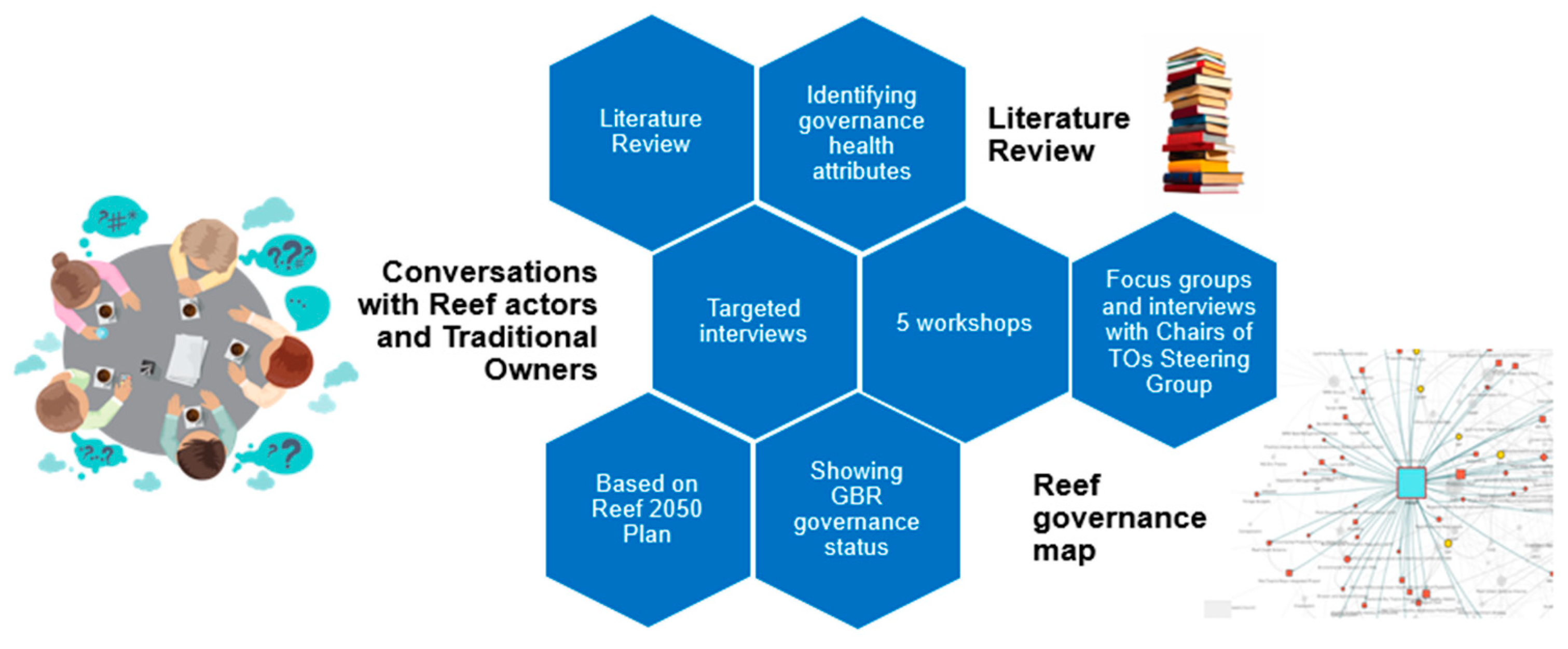
Figure 2.
An example of a static GBR governance network map showing connections between complex institutions and instruments involved in GBR management linked to the Reef 2050 Plan.
Figure 2.
An example of a static GBR governance network map showing connections between complex institutions and instruments involved in GBR management linked to the Reef 2050 Plan.
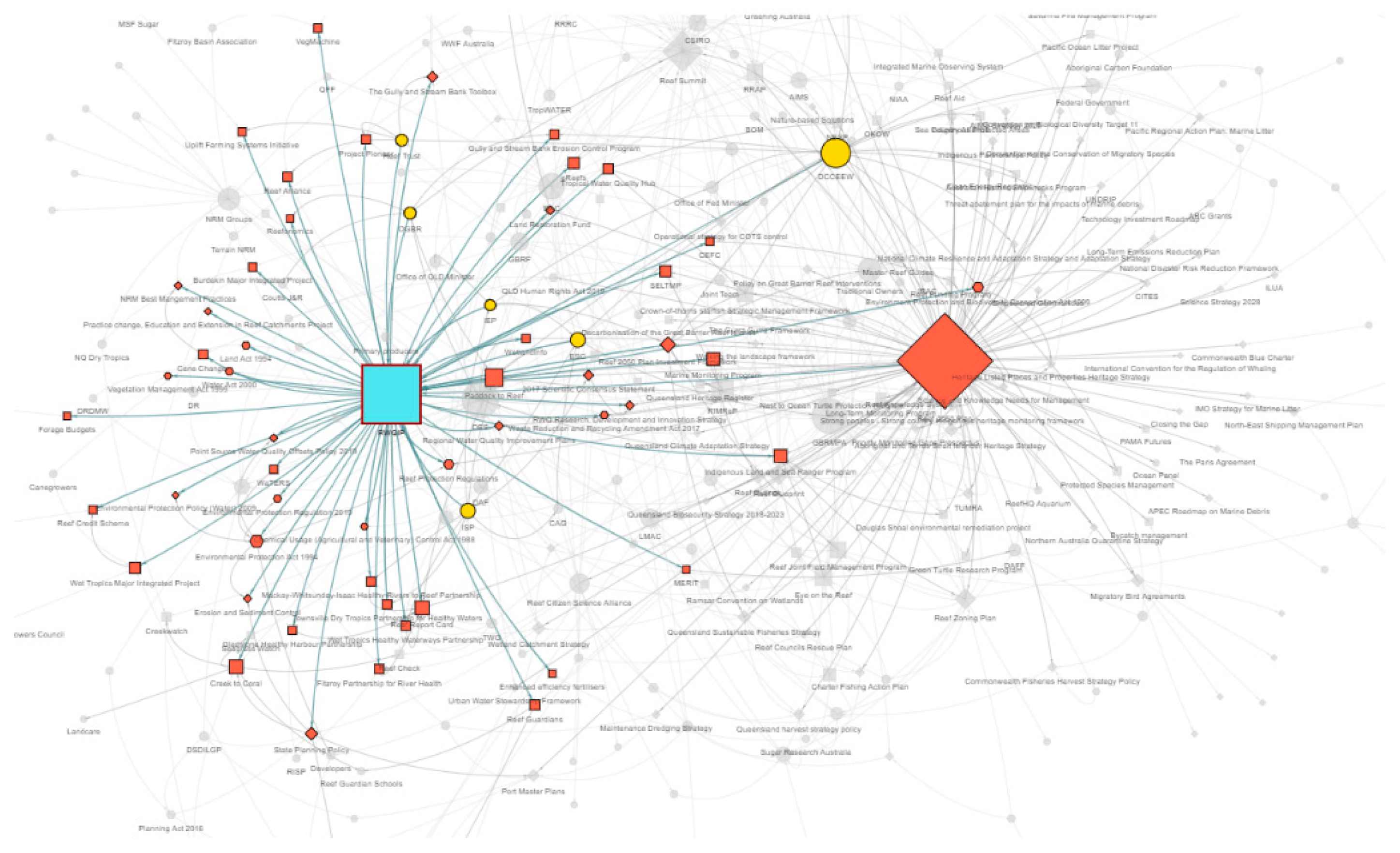
Figure 4.
Steps in developing and refining the monitoring framework.

Figure 5.
Steps in populating and measuring the attributes framework.
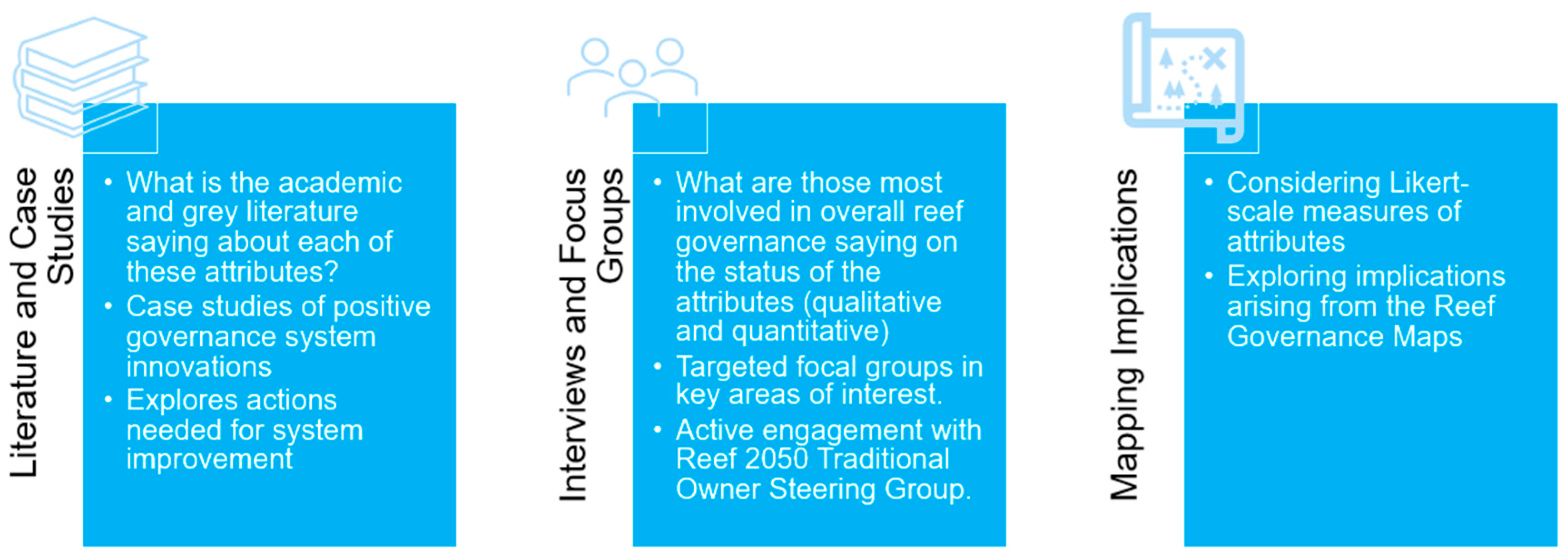
Figure 6.
Example of bucket data visualisation for a healthy attribute. Note: The bucket represents the health of the attribute when considered in the context of the whole Reef 2050 Plan governance system. Up arrows (beside the bucket) indicate an improving trend. Down arrows indicate a declining trend. Up and down arrows appearing together represent no change. A black circle indicates high confidence, a grey circle indicates medium levels of confidence, and a clear (white) circle) indicates very little if any confidence in either the trend or the grade.
Figure 6.
Example of bucket data visualisation for a healthy attribute. Note: The bucket represents the health of the attribute when considered in the context of the whole Reef 2050 Plan governance system. Up arrows (beside the bucket) indicate an improving trend. Down arrows indicate a declining trend. Up and down arrows appearing together represent no change. A black circle indicates high confidence, a grey circle indicates medium levels of confidence, and a clear (white) circle) indicates very little if any confidence in either the trend or the grade.
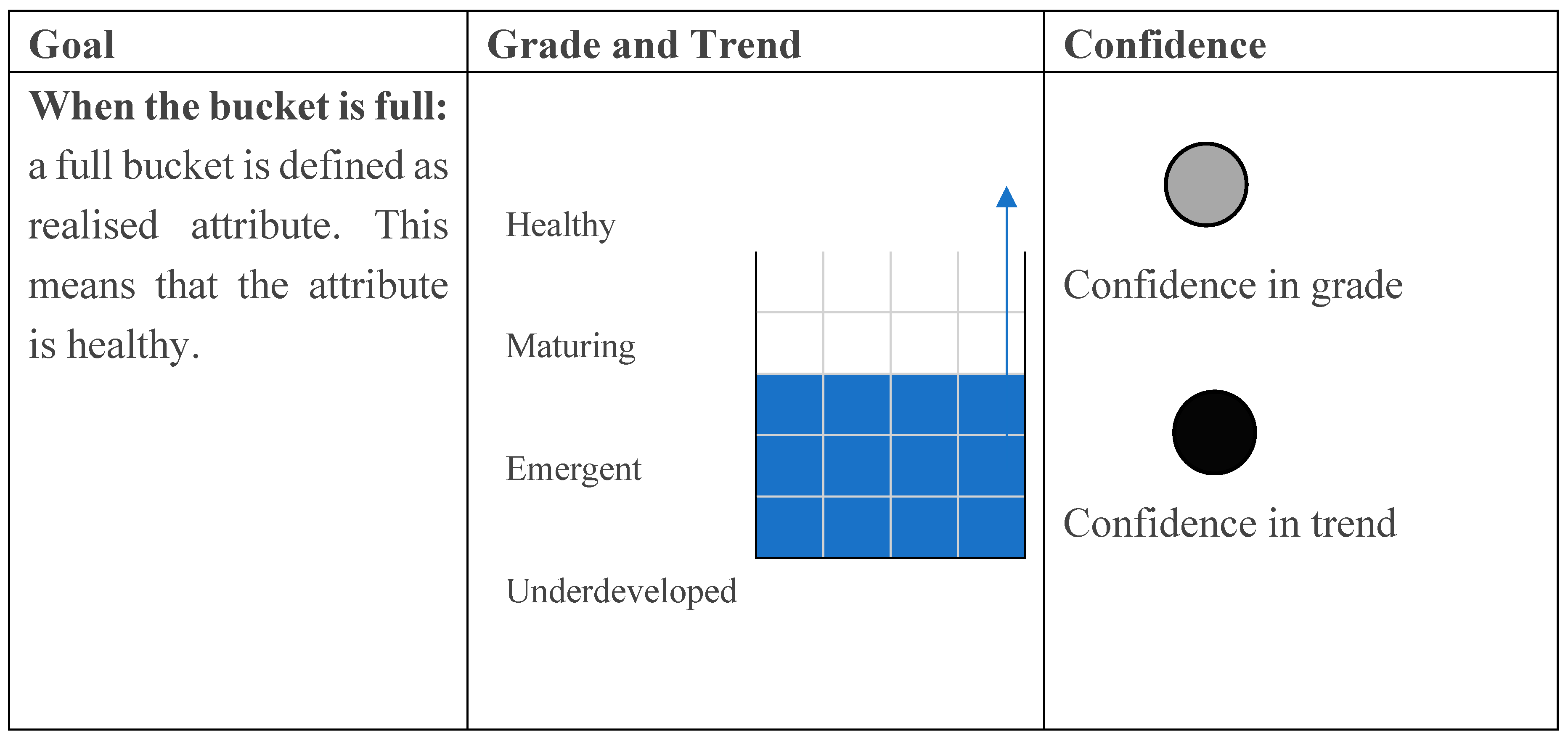
Figure 7.
Example of results obtained through deliberation.
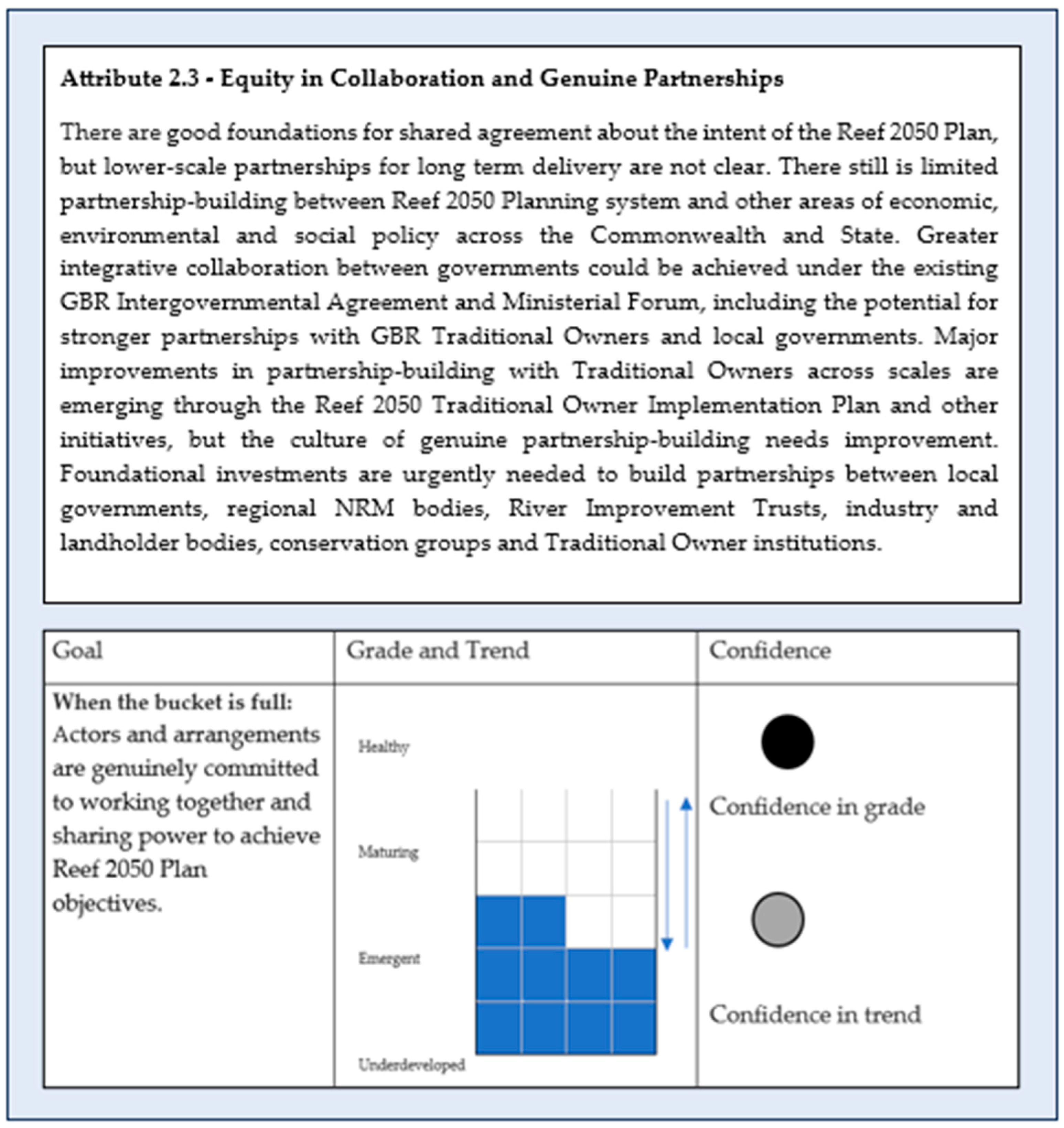

Table 1.
- The theory of change approach applied in this Reef 2050 Plan system governance analysis.
| If … | Then… | Has the Impact of | Contributes to Transformation and Change |
|---|---|---|---|
| If we understand how governance attributes operate including strengths and risks | We see the strategic importance of different attributes We understand the way different knowledges are applied Have insight into decision making capacity and processes of different actors |
Better decision-making capacity in each attribute Addressing the gaps, contradictions, and alignments within and between attributes |
Healthy integrated governance systems to manage the Reef 2050 Plan governance system Jointly determined strategic multi-scale outcomes are achieved and sustained over time Impact and outcomes are measured across the governance system and iterative learning supports governance health |
| If there is integration/connectivity across different governance attributes | Overall governance integrity is achieved with alignment of attributes within the complex system Adaptive use and management of diverse knowledge sets is more likely to occur |
Common strategic vision and aligned multi-scale strategies are achieved Joint science/knowledge priorities are determined, knowledge integration is achieved System wide coordinated planning and cohesive action and implementation are achieved Improved accountability and transparency are achieved |
|
| If there is wide genuine GBR actor participation in improving the health of the Reef 2050 Plan governance system | There is improved understanding of the role and contribution of different actors Strengths/weaknesses of connectivity among actors are identified in governance systems |
Improved connectivity within and between key decision making institutions and sectors Genuine partnerships for system improvement emerge Improved trust across actors is achieved Capacity of actors for GBR governance is improved |
|
| If we situate the Reef 2050 governance system into the wider governance systems | Line of sight across the whole governance system impacting GBR outcomes improves Better risk assessment is enabled |
Mitigates risk of system failures across the whole governance system or specific attributes Enables adequate resources and efficiency outcomes for planning and implementation Provides line of sight for improving effectiveness in outcomes across the system |
|
| If the Reef 2050 governance system can effectively undertake monitoring, learning and governance systems reform | The evidence base for iterative governance is improved Continuous observations of the governance systems spanning strategy and implementation are enabled |
Improved adaptive governance capacity of key decision making institutions & sectors Learning informs adaptive governance system reform |
Disclaimer/Publisher’s Note: The statements, opinions and data contained in all publications are solely those of the individual author(s) and contributor(s) and not of MDPI and/or the editor(s). MDPI and/or the editor(s) disclaim responsibility for any injury to people or property resulting from any ideas, methods, instructions or products referred to in the content. |
© 2025 by the authors. Licensee MDPI, Basel, Switzerland. This article is an open access article distributed under the terms and conditions of the Creative Commons Attribution (CC BY) license (http://creativecommons.org/licenses/by/4.0/).
Copyright: This open access article is published under a Creative Commons CC BY 4.0 license, which permit the free download, distribution, and reuse, provided that the author and preprint are cited in any reuse.


