
Submitted:
29 January 2026
Posted:
31 January 2026
You are already at the latest version
Abstract
Since the 1950s, nuclear physicists have believed that we have a complete conceptual framework for understanding the low(est)-energy excitations of atomic nuclei. This perspective has persisted in contemporary nuclear structure researches, but it now appears overly optimistic. In this Review, I present two previously unexpected discoveries, one experimental and one theoretical. Although the spherical phonon excitation spectrum has been considered as a typical paradigm of collective excitations in nuclear structure theories, it has not been supported by recent experiments. The result of the experimental discovery reveals a \textit{new} $\gamma$-soft rotational mode which has never been predicted by the previous theories. This mode differs from previous $\gamma$-soft ones and can be described by the newly proposed SU3-IBM theory, a new spherical-like $\gamma$-soft mode representing a specific shape phase.
Keywords:
the spherical nucleus puzzle
; the new spherical-like γ-soft spectra
; SU3-IBM
; Cd nuclei
; Pd nuclei
; SU(3) symmetry
1. Introduction
Over the past century, our understanding of the shapes of the atomic nuclei has evolved from spherical shape to various deformed shapes [1]. After the discovery of the atomic nucleus, this peculiar quantum many-body system at the center of the atom began to be regarded as a “droplet” with a clear boundary, hence it would have a shape. Of course, at the beginning, it is a spherical shape (for the whole nuclei). Soon, as the experiments revealed, researchers realized that atomic nuclei can be spherical and also undergo deformation.
After the magic numbers of the nuclei are revealed by the spherical average field and the strong spin-orbit coupling [2,3], the magic nuclei are indeed considered as spherical. Even today, this is almost true. The key change is the understanding on the collective excitations of the nucleus with valence nucleons. Since the 1950s, we believed that we had a thorough grasp of the most fundamental and the most important quadrupole deformations——which governs the collective low(est)-energy excitations of atomic nuclei [4,5,6,7]. Yet new experimental data [8,9,10,11,12,13,14] and new emerging theories (SU3-IBM) [15,16,17,18] suggest that our previous understanding might have been nothing more than an illusion. Deformation has become more and more important since the 1950s, but the spherical shape becomes less and less. At the same time, our understanding of quadrupole deformations is not sufficient.
When there are a lot of valence nucleons, the residual interactions between them cause the nucleus to deform significantly, which is almost inevitable [6]. But when there are not so many valence nucleons, it is almost an inevitable intuition that, considering the spherical shape of the magic nucleus nearby, these nuclei should have the phonon excitation spectra of the spherical shape. So for the nuclei, in the large period, there will be the alternation of the single particle excitation of the magic nucleus and the collective excitation of the non-magic nuclei, and in the small period, there will be the alternation of the spherical phonon excitation and the prolate rotational excitation of the large-deformed nuclei.
Vibrational and rotational modes appear to occur simultaneously, even intertwine [7]. This perspective was clearly illustrated in the following 2010 review article by Cejnar et al. in the ≪ Reviews of Modern Physics ≫, titled “Quantum phase transitions in the shapes of atomic nuclei”:
“As valence nucleons are added, configuration mixing is generated by the residual interactions, and collective behavior emerges. Typically, as we discuss below, this situation leads to . ...... We will see shortly that this corresponds to a model of a nucleus that can undergo small amplitude quadrupole (angular momentum 2) oscillations about a spherical equilibrium shape. The line with will be seen to correspond to nonspherical (deformed) nuclei that rotate according to the eigenvalue expression for a quantum mechanical symmetric top.”[19] ( is the energy ratio of the state to the state)
The experimental researches in the past 20 years have begun to change the view of collective evolutions, which is fundamental. The most important change is that the existence of spherical phonon excitation spectra was not confirmed experimentally [8,9,10,11,12,13,14]. The phonon excitation spectra are the simplest energy spectra of the geometric model [7], and the lowest energy levels at the beginning of experimental confirmation seem to confirm the existence of this spectra. But when the energy levels are higher, systematic deviations occur [12]. On the other hand, the shape coexistence leads to a misunderstanding of the actual energy spectra of atomic nuclei [16,17].
In 2016, Heyde and Wood made a prescient prediction based on the experimental results:
“The emerging picture of nuclear shapes is that quadrupole deformation is fundamental to achieving a unified view of nuclear structure. While it has now long been recognized that many nuclei are deformed, the reference frame for nuclear structure discussion has been spherical shapes. We would argue that a shift in perspective is needed: sphericity is a special case of deformation. Thus, we argue that the reference frame must be fundamentally one of a deformed many-body system.”[20]
And in 2019, Garrett et al. continued their opinion:
“Rather than proceeding from spherical, closed-shell nuclei through a region of spherical vibrators before encountering deformation, deforation and shape coexistence may be confronted immediately, even at the closed shell.”[13]
These ideas based on the new experiments give a new description of the low(est) energy excitations of the nuclear structure for the first time, and some of the results that were considered correct before are not so.
Since 2019, I have recognized this as a new collective excitation mode, which exhibits similarities to the phonon excitation spectra of the spherical shape, while its B(E2) values closely resemble those of the -soft rotation [15]. Remarkably, this hypothesis has been confirmed over the past six years [16,17,18]. A new extended interacting boson model with SU(3) higher-order interactions (SU3-IBM) was proposed by me, which can be well fitted to the experimental results. In this Review, I comment on the new understanding, which proves the prediction of Heyde and Wood: “a shif in perspective is needed: sphericity is a special case of deformaiton”. The spectrum previously thought to be excited by spherical phonon vibration is actually a new spherical-like -soft phase. This is a story of great coincidence, but it is precisely the history of science’s continuous progresses and repetitions.
Firstly, some basic concepts, ideas and theories are introduced briefly, so that researchers who are not familiar with these can quickly grasp the key of the change. Then I introduce the key point of the experimental discoveries, which is to point out that a new collective excitation mode has been found. Finally, I introduce the newly proposed SU3-IBM theory and its fitting works, particularly on 106Pd, which perfectly aligns experimental and theoretical results, confirming the existence of the new spherical-like -soft phase.
2. Theoretical Foundations
2.1. The IBM, Shapes and Shape Evolutions
The atomic nucleus is a quantum many-body system composed of protons and neutrons, with the number of protons or neutrons ranging from a few to hundreds, which makes the understanding of the properties of the atomic nucleus extremely challenging. In the construction of nuclear Hamiltonian, it is obvious that the proton and neutron are the basic degrees of freedom.
After the interpretation of the magic numbers, the protons and neutrons of the nucleus are divided into two parts. One part is inert proton core and neutron core, the other part is the valence nucleons, and there are residual interactions between them, which produce the low energy collective excitations of the nucleus.
For the ground state of atomic nuclei, nucleons are prone to pairing due to attractive interactions, similar to the electron pairs that cause superconductivity in solids [21]. But intuitively, these nucleon pairs cannot be treated as bosons [22,23,24,25].
In 1975, Arima and Iachello proposed a counterintuitive model known as the interacting boson model (IBM) [26,27]. Even today, while this model has indeed achieved tremendous success, this approach to understanding remains somewhat perplexing. In the IBM, the valence-nucleon pair is treated as a boson, thus the low-energy states of atomic nuclei can be regarded as an interacting boson system. Therefore, the boson number N is half of the number of valence nucleons. These are the IBM’s fundamental assumptions, and the latest theoretical advancements have provided a completely unexpected confirmation of these basic premises [28]. However, this confirmation of the boson hypothesis is even more perplexing. The pairing of nucleons is a complex process, and it is evident that bosons do not exist in atomic nuclei.
This implies that the pairing effect in nuclei may bring some previously unrecognized emergent phenomena, like the ones in high temperature superconductors [25,29,30,31,32].
In the simplest IBM (IBM-1), the proton and neutron are not distinguished, and only the s bosons with angular momentum and the d bosons with angular momentum are considered. The constructed Hamiltonian has U(6) symmetry. Thus, IBM is an algebraic model that allows the application of many familiar group theory techniques. Because the degrees of freedom of the bosons are only an approximation of the nucleon pairs, it was thought that although it could describe the evolution of the collective excitation of the nuclei well, it could not give the information of the detail. This is also the reason why the previous satisfactory agreement between theory and experiment was relatively good.
The IBM has become the language for classifying the collective excitations of atomic nuclei. In the previous geometric models [7], the shapes of atomic nuclei are classified by specific solutions, whereas in the IBM, they are determined by specific subgroup limits. The U(6) symmetry has three subgroup limits: (1) the U(5) symmetry limit can describe the spherical phonon vibration; (2) the SU(3) symmetry limit can describe the rotation of the prolate shape; (3) the O(6) symmetry limit can describe the -soft rotation mode. Around 2000, a new symmetry limit was proposed, which can describe the rotation of the oblate shape [33]. These symmetry limits can be seen in Figure 1.
A simple and effective Hamiltonian that describes these shapes is the Q-consistent formalism as follows [44,45,46,47]
where c, , are three parameters (), N is the boson number, and is the general quadrupole operator (). This Hamiltonian can describe various quadrupole shapes. If , it can describe the spherical shape (the U(5) symmetry limit). If and , it can describe the prolate shape (the SU(3) symmetry limit). If and , it can describe the -soft rotation (the O(6) symmetry limit). If and , it can describe the oblate shape (the symmetry limit). These symmetry limit points can be seen in Figure 1.
With this simple model, various shape phase transitions can be studied [19,34,35,36,37,38,39,40,41,42,43,44,45,46,47]. Since 2000, these studies have received a lot of attentions with the study of quantum phase transition and the discoveries of critical point dynamical symmetries which are the approximate exact solutions of the Bohr Hamiltonian [7]. E(5) presents the critical point of the spherical to the -soft shape phase transition [48] and X(5) describes the critical point of the spherical to the prolate shape phase phase transition [49]. The locations of the E(5) and X(5) points can be seen in Figure 1.
The aforementioned works represent our fundamental understanding of the evolutions of the low-energy collective excitation modes in nuclei (quadrupole deformations, shape evolutions and critical descriptions), see Figure 1.
However, the extension to the oblate shape, i.e., the introduction of the symmetry limit [33], resulted in a significant conflict between experimental data and theoretical predictions [50]. The problem was not taken seriously at the time. Otherwise, the new SU3-IBM could be proposed at that time. When considering the oblates shape, some special mathematical structures of the IBM are revealed, that is, the O(6) symmetry limit is not a shape phase, but a critical point of the shape transition from the prolate shape to the oblate shape [50].
In realistic even-even nuclei, the oblate shape is rare, which is the prolate dominance phenomenon. But in , this doesn’t seem to be the case. For the prolate shape and the oblate shape, the spectra of them are the same for the same N, but this mirror symmetry is not found in realistic nuclei. In Ref. [50], the energy ratio of the and states of the realistic nuclei in the Hf-Hg region is 3.33 for the prolate shape, while it is 2.55 for the oblate shape. (This difference was not given enough attentions at that time.) Clearly the mirror symmetry in theory does not exist in realistic nuclei, and the realistic prolate and oblate nuclei are asymmetric [28,51].
The actual experimental results show that the previous construction of the Hamiltonian of the IBM-1 is too simple, which leads to the mirror symmetry that does not exist in reality. In this Review, I emphasize a new -soft spectrum. To better understand this spectrum, familiarity with the energy spectra of the U(5) symmetry limit and the O(6) symmetry limit is essential.
Since 1950, researchers in nuclear structure have believed in the existence of spherical phonon vibration excitation, not only because it is a simple solution of the geometric model, but also because the experimental data seem to support this. From the perspective of hindsight, this is a rare coincidence. For the lowest energy levels, the -soft spectra are very similar to the phonon spectra of the spherical shape. What we’ve observed are actually the -soft spectra, though we’ve been misinterpreting it as the spherical phonon spectra.
Figure 2 shows the spherical harmonic phonon spectra with equal spacing for . For the ground state, it is a condensate state of 6 s bosons. For the first excited state, it has 1 d boson and 5 s bosons, which corresponds to the one phonon state of the geometric model. For the two phonon excitations, there are three degenerate , , states (two-phonon triplet states), which can be easily found in realistic nuclcei. For the three phonon exctitions, there are five degenerate , , , , states (three-phonon quintet states). As will be seen later, these quintet states are the focus of misunderstanding.
The energy of the (misunderstood) single-phonon excitation is high (about 0.5 MeV) because these nuclei are close to the magic number. Thus it is difficult to identify these higher multi-phonon excited states in experiments. This is a key factor that we did not realize that these spectra are not due to the phonon excitation. The triplet , , states were first observed in the experiments, and was mistaken for the spherical phonon excitation spectrum.
Prior to the IBM’s advent, the -softness was discussed in the geometric model [52], where the potential energy in Hamiltonian was independent of the shape variable that describe the triaxiality. After proposing the IBM, Arima and Iachello discovered the new O(6) symmetry limit [53] beyond the U(5) symmetry limit and the SU(3) symmetry limit, which precisely characterizes the -softness [54].
The geometry model quantizes the shapes, and when considering the quadrupole deformations, the potential energy is a function of the shape variables and . is a deformation variable that describes the deviation from sphericity. If the potential energy is independent of , the model exhibits the O(5) symmetry.
Figure 3 shows the O(6) -soft spectra for . Compared with Figure 2, the O(6) -soft spectra exhibit a slight increase in distance of the left levels of the state (the degeneracy of these states are not changed due to the O(5) symmetry), while the right levels shows an overall upward shift, especially the , states. Thus the lowest part of the O(6) -soft spectra are very different to the ones of the spherical phonon spectra. , states are degenerate and , , , states are degenerate. However for the highest levels in the U(5) symmetry limit and the O(6) symmetry limit, they are difficult to be distinguished.
Figure 3.
Energy spectra of the O(6) symmetry limit in (the -soft rotation).
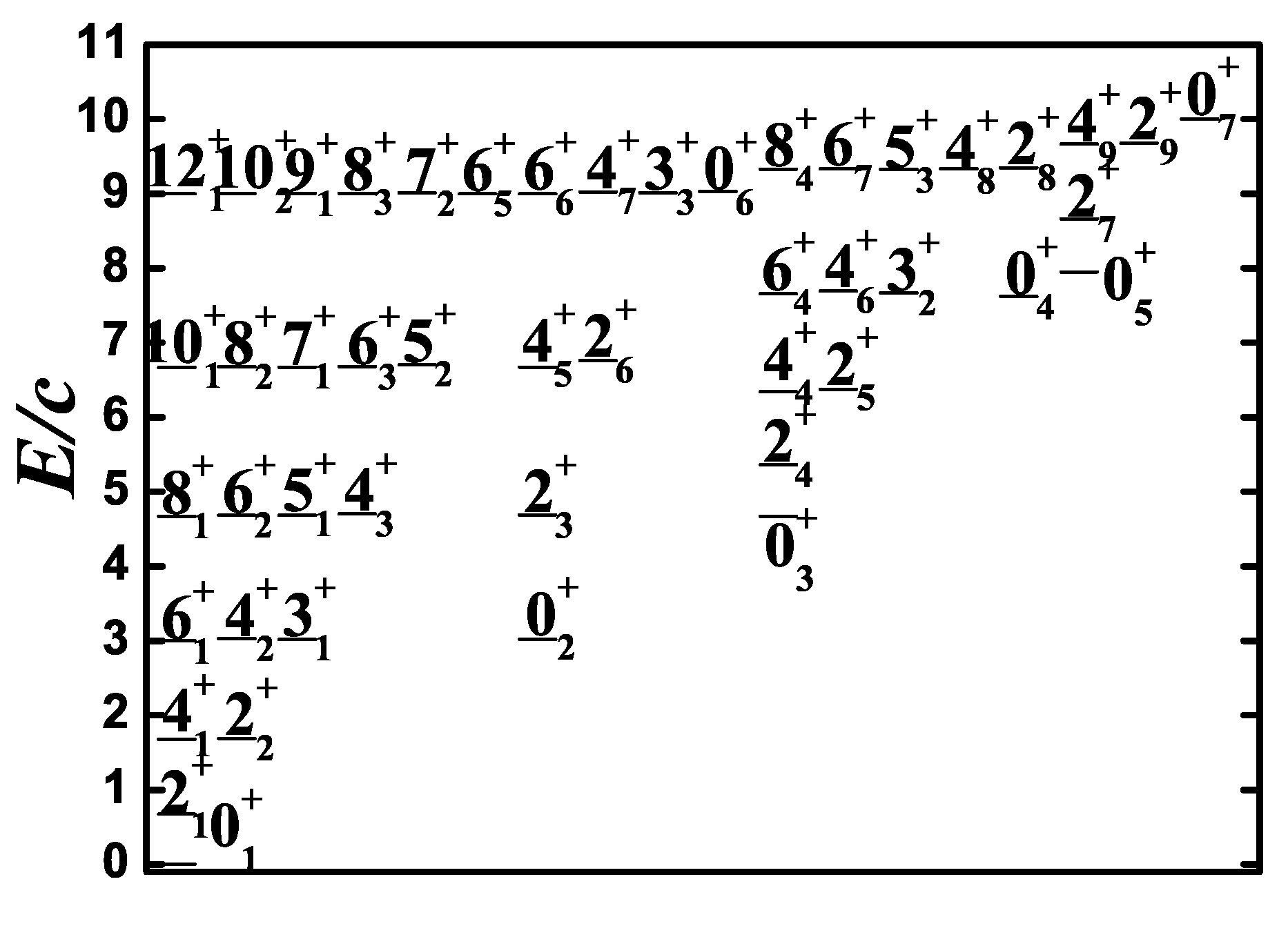
When in changes from 0 to 1, shape phase transition from the spherical shape to the -soft rotation can be described. However some conceptual conflicts will appear. In , O(6) -softness is in fact not a shape phase, it is a criticl point of the shape phase transition from the prolate shape to the oblate shape. The reason for this is the construction of is too simple. Because the whole transition has the O(5) symmetry, if the angular momentums are the same, the energy level evolutions have the level-crossing phenomena. This point was discussed in [47].
In previous studies, due to the simplicity of the adopted theories and insufficient experimental data, it was mistakenly concluded that both the U(5) and O(6) symmetry energy spectra exist, which is a rather intriguing coincidence.
2.2. Rigid Triaxility and the SU(3) Symmetry Mapping
Since the birth of quantum mechanics, the triaxial rotation has been a basic problem, which has the Hamiltonian as follows
where is the i-th component of angular momentum and is the corresponding moment of inertia. For , angular momentum is a conserved quantity.
For atomic nuclei, it is evident that the rigid triaxial shapes must be considered. If the nucleus is rigid triaxial, the moments of inertia of rotation in each direction are different, and the rotational effect should be discussed by . This was discussed by Davydov et al. based on the geometric model [55,56]. In quantum mechanics, the spherical body does not rotate, and a prolate or oblate body can rotate around an axis perpendicular to its symmetry axis, thus is not needed before.
In the previous understanding on the low-lying collective excitations of the nucleus, the rigid triaxial deformations are not important. For even-even nuclei, in the low-lying spectra, it seems difficult to see the shadow of rigid triaxial deformations. The main collective excitation modes of the nuclear quadrupole deformations are spherical phonon vibration excitation, prolate rotation excitation and -soft rotation mode, while the oblate rotation excitation is rare, and the rigid triaxial deformations are only discovered recently [57,58,59,60].
Thus, for a long time, served as a Hamiltonian that effectively characterizes both the realistic shapes of atomic nuclei and their shape phase transitions. These triaxial deformations are almost forgotten. , except for the introduction of the mirror symmetry of the prolate shape and the oblate shape, seems to be consistent with the realistic experimental data. It seemed that large-deformed nuclei can indeed be described by the prolate rotational spectra, and -soft nuclei can be characterized by the O(6) symmetry limit. Nuclei near the magic numbers can also be modeled by the spherical phonon excitation spectra. All these models appear reasonable, and seems particularly plausible.
This is very similar to the previous descriptions of the planetary orbits based on the geocentric theory of circular motion. It was not until Kepler deduced the elliptical orbit based on more accurate observations of Tycho that the heliocentric theory was confirmed.
Recently, I have come to realize that the rigid triaxialities play a decisive role in the study of the quadrupole shapes of nuclei based on more detailed experimental data, and the introduction of becomes more important. The breakthrough is that the spherical phonon excitation spectrum has not been proved by the experiments.
In 1981, Isacker and Chen realized that can not describe any rigid triaxial deformation [61]. To describe the rigid triaxial deformations, the third-order interactions must be introduced. They considered the 6-d interaction . This interaction has been used for a long time to describe the phenomena related to the rigid triaxiality. But there are some fundamental difficulties. (1) Clearly, this is a higher-order interaction related to the U(5) symmetry. This high-order interaction seems reasonable when the spherical phonon excitations exist, but it is not suitable now. (2) This higher-order interaction, while capable of inducing a rigid triaxial deformation with in the large-N limit, exhibits a peculiar energy spectrum for the finite N value that fails to align with the observed nuclear spectra. (3) This higher-order interaction cannot account for other triaxial deformation with values that is not .
Of course, there is another way to describe the rigid triaxiality, namely the SU(3) symmetry mapping of the rigid triaxial rotor [62,63,64,65].
Elliott was the first to introduce the SU(3) symmetry into the discussions of nuclear structures [66,67,68]. In the explanation of the magic numbers, the three-dimensional harmonic oscillator potential and the strong spin-orbit coupling are used [2,3]. The potential of three-dimensional simple harmonic oscillator has U(3) symmetry. When the strong spin-orbit coupling is added, the SU(3) symmetry of higher energy shells is broken, but the SU(3) symmetry of light nuclei is still preserved. Elliott observed this phenomenon, particularly when he discovered that certain light nuclei exhibit characteristic rotational spectra. He then introduced the SU(3) symmetry interaction to explain the properties of light nuclei, and for the first time, he linked the single-particle behavior with the collective excitation. This is an important breakthrough. In this work, the SU(3) symmetry and the rotation of the prolate shape are linked together for the first time.
However, for the medium and heavy nuclei, there are also significant rotational spectra [65]. This is interpreted as the emergence of the SU(3) symmetry at higher energy shells, leading to the discovery of pseudo-SU(3) symmetry [69,70]. Higher energy shells generally lack the SU(3) symmetry, but when divided into two parts, the lower part may exhibit the SU(3) symmetry, resulting in a rotational spectrum [71,72]. The upper part exhibits the O(M) symmetry (M is the number of the single particle orbitals in this part), which appears to be associated with the -softness.
Recently, Bonatsos et al. presented an updated perspective, revealing that, for higher energy shells, if removing the two highest-energy single-particle orbits, results in the lower shells exhibiting the SU(3) symmetry, termed proxy-SU(3) symmetry [73,74,75]. This changes the ideas induced by the pseudo-SU(3) symmetry, and the whole energy shell can have a good approximation of the SU(3) symmetry, even the holes dominated situation, can have the SU(3) symmetry.
In Elliott’s study, a straightforward correspondence exists between the angular momentum operators () and the quadrupole moment operators (), which can be mapped to the eight generators of the SU(3) symmetry. Therefore, the Hamiltonian they form possesses the SU(3) symmetry. In general nuclear structure researches, this correspondence is not considered. In previous studies, this correspondence was only used when discussing the prolate rotation.
If the atomic nucleus has triaxial deformation, its rotation must be described using the . In the SU(3) symmetry mapping, this corresponds to [62,63,64,65]
where a, b and c are the three transformer parameters. This transformation is very enlightening, which means that the rotation of the rigid triaxiality and the higher-order interactions have direct relationships. Thus if the rigid triaxiality is necessary in the description of the shapes of the nuclei, then the higher-order interactions are necessary in the SU(3) symmetry mapping. The SU(3) third- and fourth-order interactions appear to be important.
In Ref. [76], this was discussed in detail, not only the rotational effect but also the ground deformation. Thus the Hamiltonian that can describe the rigid triaxial deformation in the SU(3) symmetry mapping is as follows
where , are the SU(3) second- and third-order Casimir operators. Ref. [77] further extended the discussions on . However, in [76,77], the ground deformations are not discussed clearly. They use the combination of the and to derive any rigid triaxial deformation. Although was also mentioned, it received no attention.
At that time, the discussions of the rigid triaxial deformation and its rotation are important, especially this SU(3) symmetry mapping, but in fact such ideas are not really connected with realistic nuclei.
Recent pivotal experiments supporting the existence of the rigid triaxiality revealed that the 238U [78] and 154Sm nuclei [79], previously thought to have the prolate shape, actually possess small rigid triaxiality. These pivotal experiments not only confirm that the large-deformed nuclei are rigid triaxial, but also validate the correctness of the SU3-IBM [80,81]. Previous researches on the SU(3) symmetry mapping of the rigid triaxial rotation has become critically important. Since 2019, Otsuka et al. also argued that these large-deformed nuclei are in fact with small rigid triaxiality [82,83,84].
2.3. The SU3-IBM
Prior to Fortunato et al.’s discussions of the interaction [85], the SU(3) third-order Casimir operator had long been overlooked. In the first paper discussing the SU(3) higher-order interactions in the IBM [62], this item was found to merely alter the scale as a perturbation, thus appearing of little practical value.
This oversight has left us unaware of something extremely important. The reason is that in the study of nuclear structures, we have always assumed that higher-order interactions exist but can only play a perturbation role. However, from the rigid triaxial deformation and its rotation in , we can see that the higher-order interactions are actually important (from the prolate shape to any rigid triaxial deformation). The key issue here is that for a long time, the experimental energy spectra failed to demonstrate the utility of the rigid triaxial rotations. A major error here is our misinterpretation of the energy spectra near the previously assumed magic numbers, which we mistakenly assumed to be a spherical excitation spectrum [7]. The misunderstanding has led to a misinterpretation of the collective excitation of the entire atomic nuclei [19].
The existence of magic numbers implies that the interactions between nucleons in the nucleus correspond to a large mean field. So the remaining part of the correlation interactions seems to be determined by the two-body items. But there seems to be some new possibilities induced by the pairing interaction, which we have not understood in the IBM.
If there are more possibilities of two-body interaction, these interactions may bring about quantum cancellation, which may lead to the cancellation of the residual interaction between two-body interactions in the IBM. In this way, there may be strong three-body and four-body interactions in the nuclei near the magic numbers.
The small rigid triaxiality of 238U and 154Sm has decisive consequences, which is that these large-deformed nuclei have rigid triaxiality, so the description of these large-deformed nuclei in the IBM also needs the three-body and four-body interactions. This was never considered in previous IBM researches, and even in other nuclear structure models, which has posed fundamental challenges. This means that the three-body and four-body interactions are necessary for the collective excitation of the nucleus. This leads to a fundamental change in the view of collective excitation of atomic nuclei. At least in the IBM, third-order and fourth-order interactions must be considered.
Since 2019, our understanding of collective nuclear excitations has undergone a fundamental transformation. The previously overlooked rigid triaxial deformations and their rotations have now become central topics in nuclear structure, marking a Copernican revolution in the field. Especially in the IBM, has become unreasonable and higher-order interactions must be considered. This may not be obvious in other models.
In 2019, I became aware of the experimental works on spherical nuclei [8,9,10,11,12], which profoundly influenced my understanding of collective excitation in atomic nuclei (before the Otsuka et al.’ work [82] and the Garrett et al.’s work in 2019 [13]). I realized that if spherical nuclei do not exist, the previous understanding was flawed [19]. If only the two-body interactions are considered, the new results cannot be given. Only when the three-body and four-body interactions are introduced, new results can be obtained. (They do not generate a perturbation effect) Therefore, I proposed the SU3-IBM [15] (the first paper was published three years later, after the second paper on the B(E2) anomaly [86]), whose Hamiltonian is
where c, , , , , are fitting parameters. is and is . , are the SU(3) second- and third-order Casimir operators, respectively. During the fitting process, the interaction is also incorporated. The SU3-IBM is a new extension of the IBM. In the SU3-IBM, the SU(3) symmetry is the most important, and dominates all the quadrupole deformations [15,16]. Historically, SU(3) symmetry has played a very important role in the researches of nuclear structure [62,63,65,66,69,70,71,73,76,77]. Now, it becomes more important, or even fundamental.
In Fortunato et al.’ seminal work [85], the phase diagram of the simplest SU3-IBM was discussed (here ), see Figure 4. Compared with , the key is to replace the symmetry limit by describing the oblate shape with the SU(3) third-order Casimir operator . Thus they found a new evolutional path from the prolate shape to the oblate shape. Then an analytic discussion on the prolate to the oblate shape was given by Zhang et al. [87]. However, unfortunately, the discussion did not continue.
In Zhang et al.’s seminal work, two prominent results are found. One is the asymmetry between the prolate shape and the oblate shape, and another is the boson number odd-even effect at the side of the oblate shape. However, the latter one is not considered to exit in realistic nuclei. In this paper, when evolving from the prolate shape to the oblate shape, a first-order phase transition point at was conformed. It also pointed out this point is a multiple phase coexistence point with the SU(3) irreducible representation satisfying .
The two works [85,87] lay the theoretical foundation for the SU(3) three-order interaction, which is no longer negligible. However, their works lack further in-depth discussions. Otherwise, the SU3-IBM could have been proposed to describe the new characteristics of realist atomic nuclei at that time.
Since 2019, I realized that could describe a new spherical-like -soft structure [15], which could resolve the perplexing spherical nucleus puzzle discovered experimentally [8,9,10,11,12,13,14]. The result was revolutionary, changing our understanding of the collective nature of the nucleus. (This will be discussed in last two sections)
Subsequently the SU3-IBM was found to be able to explain the B(E2) anomaly [86,88,89,90,91,92,93,94,95,96,97,98,99] discovered in [100,101,102,103], to explain the prolate-oblate shape asymmetric evolution [51,85,87,104], to produce the features of the -soft nucleus 196Pt at a better level [105], and to produce the E(5)-like spectra in 82Kr [106]. Recently this model can successfully produce the boson number odd-even effect in 196−204Hg [28], which is a unique prediction of the SU3-IBM [87]. Recently, we have confirmed the 166Er and 154Sm with small rigid triaxiality in the SU3-IBM [80,81]. The shape phase transition from the new -soft phase to the prolate shape is also found [18]. These results prove that the SU3-IBM can give more accurate descriptions of the collective behaviors in nuclei than previous theories, and can provide a unified picture for understanding the collective excitations in nuclear structure.
Previously, the IBM was viewed as an approximate framework, making the current outcomes unpredictable. In the SU3-IBM, the SU(3) symmetry is upgraded to a fundamental one, which enables the theory to reveal a wealth of experimental details previously undetectable, representing a pivotal breakthrough in this new framework. This means that the SU(3) symmetry, a whole feature, is revealed in the low-lying excitations governed by pairing force, which is a key discovery not found in all previous nuclear structure theories. The IBM is not an algebraic correspondence of the geometric model, but a true effective theory of describing the low-lying excitations of atomic nucleus.
3. Experimental Discoveries of the Spherical Nucleus Puzzle
3.1. Cd Nuclei
In 2008, Garrett, Green and Wood published a seminal paper titiled “Breakdown of vibrational motion in the isotopes 110−116Cd” [8], which marked the experimental discovery of the spherical nucleus puzzle. In this paper, they concluded: “it is possible that the Cd isotopes may not represent vibrational systems and that the essential physics of their motion has been missing.”
As described earlier, researchers in the field of nuclear structure have been convinced since 1950 that the spherical phonon excitation spectrum must appear where collectivity begins. The harmonic vibration of the spherical shape has been regarded as one of the paradigms of the low energy collective quadrupole excitations of atomic nuclei, which is the beginning of the collectivity and has been proved by experimental data. Thus Ref. [8] is incredible when it first appeared. (Unfortunately, I did not follow up on the related researches until 2019.) In 2010, Garrett and Wood continued this analysis with a rotational point [9].
In 2012, Garrett et al. presented some critical evidences in another semical paper supporting this shift of opinions [10]. Near the magic numbers, when the number of valence nucleons is small, not only the collectivity but also the shape coexistence can appear [107]. Shape coexistence is universal in Cd nuclei. For the normal states, it has been discovered long ago that the B(E2) transition probabilities between these energy levels differ significantly from the ones in the spherical phonon spectra, while exhibiting behavior similar to that of the -soft nuclei. However, because of the shape coexistence, this inconsistency is explained as the strong coupling between the normal states and the intruder states, which leads to serious distortion of the transition behaviors. In [10], these misunderstandings were corrected, and the coupling strength between the normal states and the intruder states is actually weak. Thus the B(E2) values are not a distorted phenomenon. And these normal states represent the emergence of -soft behavior. They concluded: “The decay pattern of the nonintruder states is suggestive of a -soft rotor, or O(6) nucleus, rather than a vibrational, or U(5), pattern.”
Here, the experimental results have already denied the spherical phonon excitation spectrum, or at least for the Cd nuclei (whose energy spectra are very similar). But what it is remains unclear. Clearly, this is like the spherical energy spectrum, but the B(E2) values resemble that of a -soft nucleus. It appears to be absent in both the earlier IBM and other nuclear structure models.
The outdated understanding approach has persisted for 60 to 70 years, so such an unusual outcome naturally leaves people somewhat perplexed. Especially the spherical phonon vibration mode, which is the first mode studied when learning the geometric model, is hard to imagine that it does not exist.
These two papers [8,10] ushered in a new era in nuclear structure researches, as their findings were entirely contrary to previous ideas. But this point, at the beginning, was not well realized. In the history of scientific development, such anomalies always appear, and the subsequent research groups are indifferent.
In 2012, Batchelder et al. provided the decisive spectral signal in a seminal paper [11]. They found that in 120Cd, there is no the state near the nearly degenerate , , and (at the previous three-phonon level), see Figure 5(a). However, in this paper, they did not propose that this might be a new excitation mode.
The reason that the low-energy excitation modes of the Cd nuclei are misunderstood as the spherical phonon excitation modes and have been persisting for 60-70 years is the shape coexistence. It not only contributed to our misinterpretation of the distortion in B(E2) behaviors, but also resulted in a critical misrecognition. In 102Cd, see Figure 5(b), the first group intruder states (red) was recognized early, but the second group intruder states (blue) wasn’t recognized until 2019. For a long time, this blue state was mistakenly identified as the state in the three-phonon excitation of the normal states, leading to the misconception that the normal states here refer to the spherical phonon excitation spectra.
This is a fascinating coincidence, yet the misconception about the collective excitations in nuclei persists to this day.
When we consider the entire Cd isotopes, the overall results become more apparent, see Figure 6. The shape coexistence is obviously not the isolated behavior of a single nucleus, but appears on the evolution of the energy levels of the whole isotopes. As this is an intruder state behavior involving interactions with multiple nucleons, it exhibits a characteristic parabolic shape, as seen in the evolution of the first green states in Figure 6.
The two-phonon triple states , , (blue) (with previous phonon excitation language) are clear for the whole 108−120Cd. In the previous study, the five states , ,, (red) and the second green state have been mistaken as the three phonon quintuple states for a long time, although the second green state also shows a clear parabolic feature. But it was not until 120Cd that this became truly clear. The second green states are in fact the bandhead of the second intruder states [13,14].
3.2. Other Nuclei
In [12], Garrett et al. presents other nuclei showing the similar behaviors in the Cd nuclei, such the Te, Rd, Ru, Mo, Sr nuclei. Therefore, the spherical nucleus puzzle is a more common phenomenon. This reveals the collective behaviors of nuclei near magic numbers was generally misunderstood in the past.
4. Theoretical Discoveries
4.1. New Spherical-like -Soft Spectra
Theoretical discovery is another coincidence. In early 2019, I became aware of the challenge of the spherical nucleus puzzle. Unlike previous studies, I believed that a new collective excitation pattern has emerged here, which has never been theoretically discovered before. (This point was also not given by previous experiments) This may be related to my ongoing researches on the IBM’s higher-order interactions, and I have also developed the Fortran programs incorporating these interactions [47].
Therefore, a straightforward response was to employ the entire program to tackle the challenge of the spherical nucleus puzzle, reproducing the peculiar energy spectrum of the normal states in nuclei in Figure 6 (at that time the spectra in 120Cd). The finding was astonishing, confirming the existence of a new spherical-like -soft mode. When I found this result, I had not noticed Ref. [85,87]. After making this discovery, I reviewed their works and realized that the SU(3) three-order interaction playes a decisive role here.
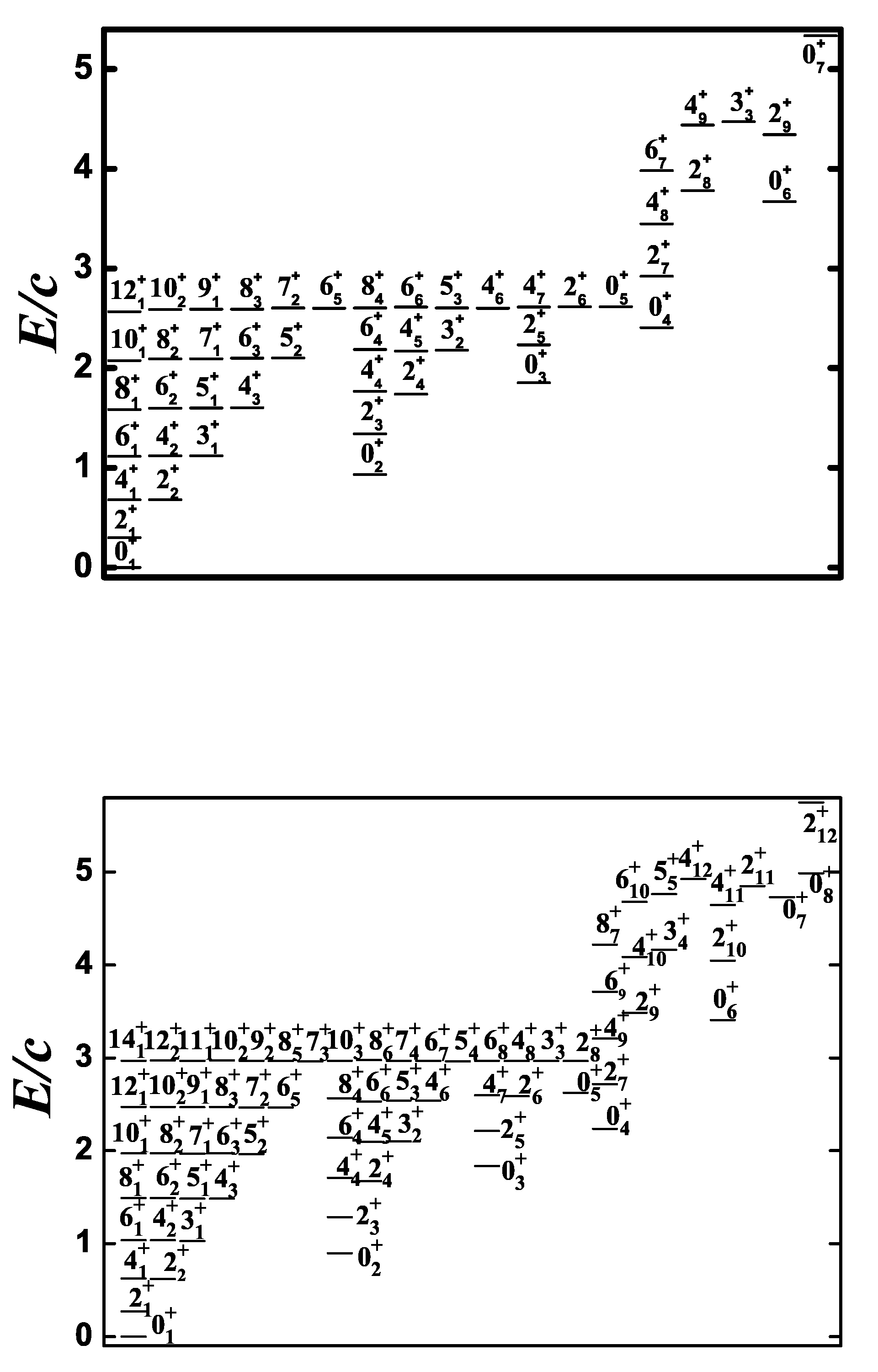
Figure 7 presents the new spherical-like -soft spectra. For , the parameters are , , . Therefore, the parameters of this energy spectrum are definite for any N. If , , , this is the SU(3) degenerate point, which is found in [87]. In Figure 7. the obvious degeneracy of energy levels can appear [15], such as , or , , . This is an unexpected outcome, as there exists no identical subgroup between the U(5) symmetry limit and the SU(3) degenerate point (SU(3) symmetry). Logically, degeneracy should not occur in this evolutional region. Thus the IBM still has underlying algebraic structures that remain unclear to us. The reason of this degeneracy has not been found yet. But now we know that this hidden symmetry is closely related to the actual collective excitations of the atomic nuclei.
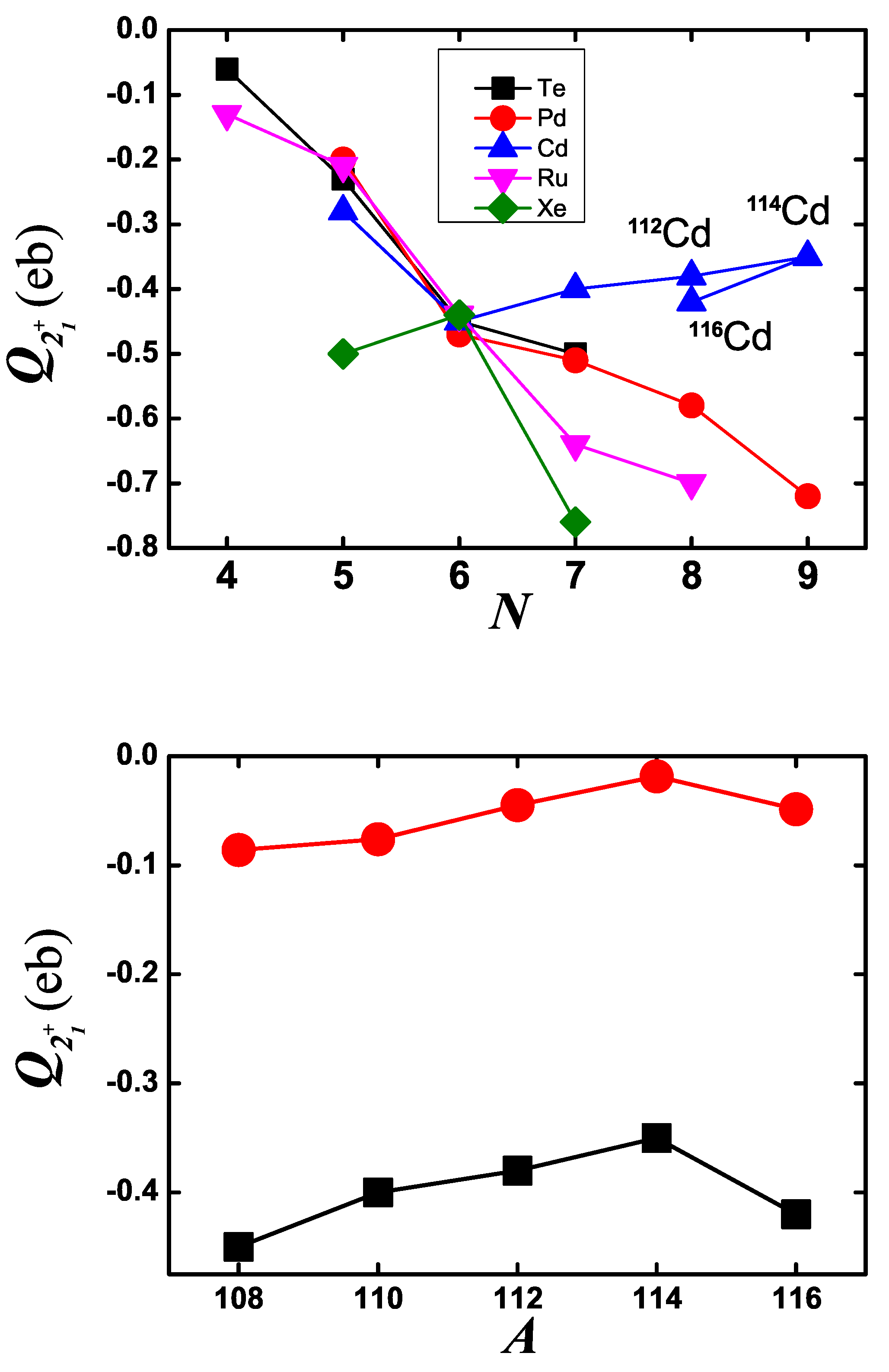
From Figure 7, it is clear that , and states are nearly degenerate, and especially there is really no the state near the , , and states. This is exactly what the experiments found. In [15,16], We applied this spectrum to fit the Cd data, and the fitting results were indeed excellent. Even some details are remarkably consistent, such as the anomalous evolution trend of the electric quadrupole moment in the first state.
As shown in Figure 8, the evolution trend of in Cd isotopes differs from that of its neighboring nuclei (Te, Pd, Ru, and Xe). When the number of bosons is between 6 and 9, this value decreases with increasing N. To the best of my knowledge, this feature has never been discussed in previous studies, as it has not been observed in earlier nuclear structure models. In our paper the results are given spontaneously. (the quantitative gap originates from the weak coupling between the normal states and the intruder states) This feature is also analyzed in detail in a recent paper [18], which explains the different evolutionary trends of Cd and Pd nuclei. A model that can spontaneously provide experimental details significantly enhance its credibility.
This unexpected discovery convinced me that the new spherical-like -soft spectrum provided by the SU3-IBM is indeed the genuine solution to the spherical nucleus puzzle. This leads me to seek a conclusion that is absolutely certain and can prove it.
4.2. 106Pd
In the study of Cd nuclei, we have only discussed the lowest energy levels, which is insufficient. From Figure 7, compared with the spectra in Figure 2 and 3, we can find that, this spectrum is really like the spherical phonon spectrum, but for the higher energy levels, they are very different. The excessive number of energy levels in the Cd nucleus, combined with the shape coexistence, makes it more challenging to investigate higher-energy level characteristics. So a new nucleus is needed, and the coupling between the normal state and the impinging state can be almost ignored. Thus, its normal states correspond to the new - soft spectra we need to determine.
Fortunately, I have discovered this reference nucleus, 106Pd.
Figure 9 shows the experimental and theoretical results of the low-lying levels of the normal states in 106Pd, up to the state and under 4000 keV. The degree of agreement between theory and experiment is striking. Clearly, the higher-energy group levels , , , , , and and , , , , , , , , and really exist and can be easily found. (The order of labeling in the experiment agrees with Ref. [108]) The theoretical five lowest states all have the experimental correspondences.
Figure 9.
The experimental and theoretical results of the low-lying levels of the normal states in 106Pd. This figure is from [16].
Figure 9.
The experimental and theoretical results of the low-lying levels of the normal states in 106Pd. This figure is from [16].
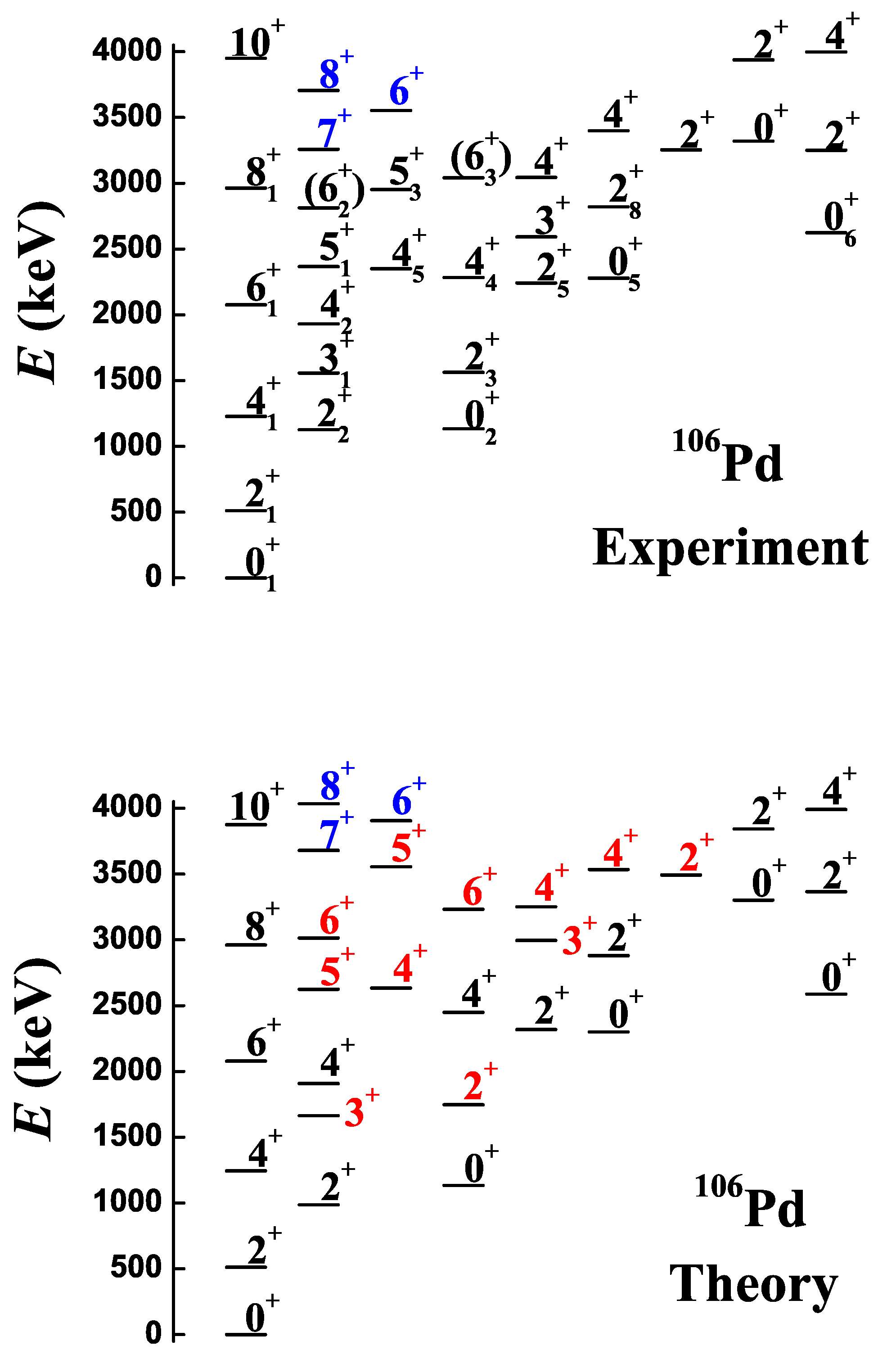
Table 1 shows the absolute values for transitions from the low-lying states in 106Pd. Qualitatively, the results of the theory and experiment fit at a good level, and there is no complete inconsistency. For the strong transitions, they almost fit very well. The value of (19(+7-3) W.u.) seems smaller than the theoretical result (84.6 W.u.), but in 108Pd, it’s 47(+5-11) W.u. and in 112−116Cd, they are 99(16), 127(16) and even (8) W.u. respectively. Overall, the new theory fits better than the IBM-2 (the protons and neutrons are distinguished) [111,112]. In the IBM-2 , the value of (12.3 W.u.) is much smaller than the experimental result (39(4) W.u.). In 108,110Pd, they are 35(+14-15) and 160(40) respectively. Clearly the values of , , and are all smaller. I look forward to more precise experiments with 106Pd.

Table 1.
Absolute values in W.u. for transitions from the low-lying states in 106Pd. The theory has effective charge (W.u.)1/2. aFrom Ref. [109], bFrom Ref. [110], cFrom Ref. [108], dFrom Ref. [111,112]. This table is from [17].
| Exp. 1a | Exp. 2b | Exp. 3c | Theo. | IBM-2d | |
|---|---|---|---|---|---|
| 44.3(15) | 42(4) | 44.3(15) | 44.3 | 40.0 | |
| 44(4) | 39(4) | 49.9 | 46.0 | ||
| 1.17(10) | 0.31 | 0.52 | |||
| 35(8) | 35(8) | 35.0 | 44.7 | ||
| 84.6 | 27.6 | ||||
| 76(11) | 71(7) | 76(11) | 65.4 | 64.5 | |
| 6.2 | 0.98 | ||||
| 0.50 | 0.92 | ||||
| 50.2 | 30.1 | ||||
| 7.21 | 9.38 | ||||
| 0.14(2) | 0.03 | 0.23 | |||
| 0.25 | 0.13 | ||||
| 5.57 | 2.80 | ||||
| 39(4) | 37.8 | 12.3 | |||
| 22.7 | 4.70 | ||||
| 2.87 | 0.001 | ||||
| 35(6) | 28.0 | 35.2 | |||
| 21(3) | 17.4 | 25.9 | |||
| 31.8 | 4.61 | ||||
| 88(9) | 80.2 | 75.7 | |||
| 0.00 | 0.00 | ||||
| 0.01 | 0.01 | ||||
| 0.04 | 7.63 | ||||
| 0.14 | 0.00 | ||||
| 16.9 | 4.67 | ||||
| 44.5 | 12.9 | ||||
| 0.57 | 0.39 | ||||
| 0.04 | 0.00 | ||||
| 60.5 | 23.2 | ||||
| 0.07 | 0.39 | ||||
| 5.61 | |||||
| 1.82 | |||||
| 3.32 | |||||
| 5.14 | |||||
| 0.001 | |||||
| 0.00 | |||||
| 0.06 | |||||
| 0.04 | |||||
| 12.5 | |||||
| 105(23) | 57.2 | ||||
| 11.2 | 15.5 |
Table 2 shows the quadrupole moments of the , , , , and states. Clearly the new theory also agrees with the experimental result very well, and better than the calculation results in [111,112].
Table 2.
The values of the quadrupole moments of some low-lying states in 106Pd in eb. aFrom Ref.[109], bFrom Ref.[110], cFrom Ref.[111,112]. This table is from [17].
| Exp.1a | Exp.2b | Theo. | IBM-2c | |
|---|---|---|---|---|
| -0.51(7) | -0.55(5) | -0.47 | -0.42 | |
| - | -0.97 | -0.60 | ||
| - | -1.43 | -0.70 | ||
| 0.31 | 0.28 | |||
| - | -0.13 | -0.03 | ||
| - | -0.61 | -0.23 | ||
| 0.175 | 0.232 |
From Tables 1 and 2, the deviation of the IBM-2 is about 1.36 times that of the new theory. The IBM-2 is insufficient to understand the systematic behaviors in the Cd nuclei [8,10], the B(E2) anomaly [100,101,102,103] and the prolate-oblate shape asymmetric evolutions [51]. So it is insufficient for understanding the collective behaviour of atomic nuclei. This fit directly confirms the existence of the new spherical-like -soft spectra and denies the possibility of the existence of the spherical nucleus in Cd-Pd nuclei region.
Table 3 shows the possible two-times relationships of the states in other candidates with the new spherical-like -soft spectra. The possible state, whose energy is nearly twice the one of the state, are shown. Its energy is also near the ones of and states. These will be discussed in future, and with the configuration mixing calculations [8,10].
Table 3.
Possible two-times relationships of the states in other candidates with spherical-like spectra. 106Pd is also listed. The unit is keV.
Table 3.
Possible two-times relationships of the states in other candidates with spherical-like spectra. 106Pd is also listed. The unit is keV.
| 108Cd | 110Cd | 112Cd | 114Cd | 108Pd | 106Pd | 102Ru | |
|---|---|---|---|---|---|---|---|
| 1913 | 1731 | 1433 | 1306 | 1053 | 1134 | 944 | |
| possible | (3800) | 3427 | 2834 | ||||
| possible | (3489) | 2883 | 2637 | (2141) | 2278 | 1968 | |
| 2565 | 2927 | 2666 | 2084 | 2366 | 2219 | ||
| 3683 | 3275 | 2881 | (2669) | 2548 | 2963 | 2706 |
Therefore, the confirmation of 106Pd’s energy spectrum is of paramount importance, as it validates that the new spherical-like -soft spectrum is indeed the definitive solution of the spherical nucleus puzzle. In the following studies, this new spectrum will be applied to other nuclei which were previously considered as spherical [12].
4.3. Shape Phase Transition from the New Spherical-like -Soft Phase to the Prolate Shape
In a recent paper [18], we further explored this new spherical-like -soft mode. In the IBM’s earlier model (), the O(6) gamma-softness is a critical point from the prolate to the oblate shape phase transition, which seems somewhat peculiar. In reality, typical -soft nuclei such as Xe, Ba, Os, and Pt nuclei do not exhibit this characteristic. More importantly, there is no mirror symmetry between the energy spectrum of the prolate shape and the oblate shape. In the SU3-IBM, this new -soft mode represents a real phase. The SU3-IBM predicts a novel shape phase transition from the new -soft phase to the prolate shape (a phenomenon not observed in previous nuclear structure studies), and we have identified key experimental data to support this prediction. 108Pd may be the critical nucleus. If the large-deformed nucleus has small rigid triaxiality, then this new -soft phase to the small rigid triaxial shape phase transition may be more realistic, which will be studied in the future.
5. Conclusion
The long-standing paradigm of spherical ground states and harmonic quadrupole vibrations has been experimentally and theoretically falsified. The low-lying spectra formerly labeled “spherical” are in reality the lowest excitations of a new spherical-like -soft phase that emerges naturally when the SU(3) higher-order interactions (three- and four-body interactions in the s-d boson space) are retained in the IBM. This has led to some fundamental changes, just as Heyde and Wood said: “a shift in perspective is needed: sphericity is a special case of deformation”.
Removing the spherical shape does not merely delete one row from the nuclear chart. It forces the entire community to adopt the SU(3) higher-order interactions as the default language for low-lying energy collective phenomena and to re-measure every nucleus against a -soft ruler rather than a spherical one, just as Heyde and Wood said: “the reference frame must be fundamentally one of a deformed many-body system”.
In this Review, I present a new view on the quadrupole deformations in nuclei. The spherical phonon vibrational excitations have been believed by the nuclear structure researchers because of the simple construction of the previous theories and the misunderstanding of the experimental data. Garrett et al.’s experimental works revealed a fact that starkly contradicted the traditional notions, proving the previous understanding to be incorrect. In the experiments, it is also revealed that the large-deformed nuclei are no longer the prolate shape as previously understood, but has small rigid triaxiality. This ultimately led to the failure of our previous understanding framework for the collective excitations in nuclei.
The rigid triaxial deformation, which was considered as unimportant before, has become the core of the new understanding. The SU3-IBM model I proposed has been well fitted to many anomalies, especially the new spherical-like -soft spectra which have been experimentally confirmed in 106Pd. These results cannot be regarded as accidental. So in the nucleus, the pairing interactions bring new effect that was not expected before, the low-lying phenomena of nuclei can be described by the interacting system of many bosons with definite number N. Arima and Iachello’s insights carry deeper significance.
Here, the three-body interactions play a dominant role. This does not exist in the previous understanding of nuclear structure. We do not know what the reason for such an effective description is, but what is certain now is that such a description is valid and correct. The IBM is an effective description of the low-lying collective excitations of nuclei, and it is more effective than previous understanding, and it has special consequences. In future studies, starting from the effective field theories [113,114] and the UV-free scheme [115], we aim to uncover the rationale behind this approach and gain a deeper understanding of the collective behaviors of nuclei.
Funding
This research received no external funding.
Data Availability Statement
No new data were generated or analyzed in this review.
Conflicts of Interest
The author declares no conflicts of interest.
Abbreviations
The following abbreviations are used in this manuscript:
| IBM | the interacting boson model |
| SU3-IBM | the interacting boson model with SU(3) higher-order interactions |
References
- Verney, D. History of the concept of nuclear shape. Eur. Phys. J. A 2025, 61, 82. [Google Scholar] [CrossRef]
- Mayer, M.G. On closed shells in nuclei. ii. Phys. Rev. 1949, 75, 1969–1970. [Google Scholar] [CrossRef]
- Haxel, O.; Jensen, J.H.D.; Suess, H.E. On the magic numbers in nuclear structure. Phys. Rev. 1949, 75, 1766–1766. [Google Scholar] [CrossRef]
- Bohr, A. Rotational motion in nuclei. Rev. Mod. Phys. 1976, 48, 365–374. [Google Scholar] [CrossRef]
- Mottelson, B. Elementary modes of excitation in the nucleus. Rev. Mod. Phys. 1976, 48, 375–384. [Google Scholar] [CrossRef]
- Rainwater, J. Background for the spheroidal nuclear model proposal. Rev. Mod. Phys. 1976, 48, 385–391. [Google Scholar] [CrossRef]
- Bohr, A.; Mottelson, B.R. Nuclear structure, Volume II: nuclear deformations; Addison-Wesley/W. A. Benjamin, Inc., United States, 1975. [Google Scholar]
- Garrett, P.E.; Green, K.L.; Wood, J.L. Breakdown of vibrational motion in the isotopes 110–116Cd. Phys. Rev. C 2008, 78, 044307. [Google Scholar] [CrossRef]
- Garrett, P.E; Wood, J.L. On the robustness of surface vibrational modes: case studies in the Cd region. J. Phys. G: Nucl. Part. Phys. 2010, 37, 064028. [Google Scholar] [CrossRef]
- Garrett, P.E.; Bangay, J.; Diaz Varela, A.; Ball, G.C.; Cross, D.S.; Demand, G.A.; Finlay, P.; Garnsworthy, A.B.; Green, K.L.; Hackman, G.; Hannant, C.D.; Jigmeddorj, B.; Jolie, J.; Kulp, W.D.; Leach, K.G.; Orce, J.N.; Phillips, A.A.; Radich, A.J.; Rand, E.T.; Schumaker, M.A.; Svensson, C.E.; Sumithrarachchi, C.; Triambak, S.; Warr, N.; Wong, J.; Wood, J.L.; Yates, S.W. Detailed spectroscopy of 110Cd: Evidence for weak mixing and the emergence of γ-soft behavior. Phys. Rev. C 2012, 86, 044304. [Google Scholar] [CrossRef]
- Batchelder, J.C.; Brewer, N.T.; Goans, R.E.; Grzywacz, R.; Griffith, B.O.; Jost, C.; Korgul, A.; Liu, S.H.; Paulauskas, S.V.; Spejewski, E.H.; Stracener, D. W. Low-lying collective states in 120Cd populated by β decay of 120Ag: breakdown of the anharmonic vibrator model at the three-phonon level. Phys. Rev. C. 2012, 86, 064311. [Google Scholar] [CrossRef]
- Garrett, P.E.; Wood, J.L.; Yates, S.W. Critical insights into nuclear collectivity from complementary nuclear spectroscopic methods. Phys. Scr. 2018, 93, 063001. [Google Scholar] [CrossRef]
- Garrett, P.E.; Rodríguez, T.R.; Diaz Varela, A.; Green, K.L.; Bangay, J.; Finlay, A.; Austin, R.A.E.; Ball, G.C.; Bandyopadhyay, D.S.; Bildstein, V.; Colosimo, S.; Cross, D.S.; Demand, G.A.; Finlay, P.; Garnsworthy, A.B.; Grinyer, G.F.; Hackman, G.; Jigmeddorj, B.; Jolie, J.; Kulp, W.D.; Leach, K.G.; Morton, A.C.; Orce, J.N.; Pearson, C.J.; Phillips, A.A.; Radich, A.J.; Rand, E.T.; Schumaker, M.A.; Svensson, C.E.; Sumithrarachchi, C.; Triambak, S.; Warr, N.; Wong, J.; Wood, J.L.; Yates, S.W. Multiple shape coexistence in 110,112Cd. Phys. Rev. Lett. 2019, 123, 142502. [Google Scholar] [CrossRef]
- Garrett, P.E.; Rodríguez, T.R.; Diaz Varela, A.; Green, K.L.; Bangay, J.; Finlay, A.; Austin, R.A.E.; Ball, G.C.; Bandyopadhyay, D.S.; Bildstein, V.; Colosimo, S.; Cross, D.S.; Demand, G.A.; Finlay, P.; Garnsworthy, A.B.; Grinyer, G.F.; Hackman, G.; Jigmeddorj, B.; Jolie, J.; Kulp, W.D.; Leach, K.G.; Morton, A.C.; Orce, J.N.; Pearson, C.J.; Phillips, A.A.; Radich, A.J.; Rand, E.T.; Schumaker, M.A.; Svensson, C.E.; Sumithrarachchi, C.; Triambak, S.; Warr, N.; Wong, J.; Wood, J.L.; Yates, S.W. Phys. Rev. C 2020, 101, 044302. [CrossRef]
- Wang, T. New γ-soft rotation in the interacting boson model with SU(3) higher-order interactions. Chin. Phys. C 2022, 46, 074101. [Google Scholar] [CrossRef]
- Wang, T.; Chen, X.; Zhang, Y. Spherical-like spectra for the description of the normal states of 108-120Cd in the SU3-IBM and the Q21+ anomaly. Chin. Phys. C 2025, 49, 014107. [Google Scholar] [CrossRef]
- Wang, T. Typical new spherical-like γ-soft spectra in 104,106,108Pd. Phys. Rev. C 2025, 112, 034301. [Google Scholar] [CrossRef]
- Zhao, D.H.; Wu, Y.X.; Gong, L.; Yin, Z.Y.; Kang, X.S.; Wang, T. Double shape quantum phase transitions in the SU3-IBM: new γ-soft phase and the shape phase transition from the new γ-soft phase to the prolate shape. arXiv: 2504.06571, accepted by Nucl. Sci. Tech.
- Cejnar, P.; Jolie, J.; Casten, R.F. Quantum phase transitions in the shapes of atomic nuclei. Rev. Mod. Phys. 2010, 82, 2155–2212. [Google Scholar] [CrossRef]
- Heyde, K.; Wood, J.L. Nuclear shapes: from earliest ideas to multiple shape coexisting structures. Phys. Scr. 2016, 91, 083008. [Google Scholar] [CrossRef]
- Bardeen, J.; Cooper, L.N.; Schrieffer, J.R. Theory of superconductivity. Phys. Rev. 1952, 108, 1175–1204. [Google Scholar] [CrossRef]
- Dean, D.J.; Hjorth-Jensen, M. Pairing in nuclear systems: from neutron stars to finite nuclei. Rev. Mod. Phys. 2003, 75, 607–656. [Google Scholar] [CrossRef]
- Strinati, G.C.; Pieri, P.; Röpke, G.; Schuck, P.; Urban, M. The BCS–BEC crossover: from ultra-cold Fermi gases to nuclear systems. Phys. Rep. 2018, 738, 1–76. [Google Scholar] [CrossRef]
- Hung, N.Q.; Dang, N.D; Moretto, L.G. Pairing in excited nuclei: a review. Rep. Prog. Phys. 2019, 82, 056301. [Google Scholar] [CrossRef] [PubMed]
- Chen, Q.J.; Wang, Z.Q.; Boyack, R.; Yang, S.L.; Levin, K. When superconductivity crosses over: from BCS to BEC. Rev. Mod. Phys. 2024, 96, 025002. [Google Scholar] [CrossRef]
- Arima, A.; Iachello, F. Collective nuclear states as representations of a SU(6) group. Phys. Rev. Lett. 1975, 35, 1069. [Google Scholar] [CrossRef]
- Iachello, F.; Arima, A. The Interacting Boson Model; Cambridge University Press: Cambridge, 1987. [Google Scholar]
- Wang, T.; Zhou, C.X.; Fortunato, L. The boson number hypothesis and the boson number odd-even effect in 196-204Hg. arXiv: 2412.14881v2.
- Demler, E.; Hanke, W.; Zhang, S.C. SO(5) theory of antiferromagnetism and superconductivity. Rev. Mod. Phys. 2004, 76, 909–974. [Google Scholar] [CrossRef]
- Lee, P.A.; Nagaosa, N.; Wen, X.G. Doping a Mott insulator: physics of high-temperature superconductivity. Rev. Mod. Phys. 2006, 78, 17–85. [Google Scholar] [CrossRef]
- Fradkin, E.; Kivelson, S.A.; Tranquada, J.M. Theory of intertwined orders in high temperature superconductors. Rev. Mod. Phys. 2015, 87, 457–482. [Google Scholar] [CrossRef]
- Fradkin, E. Intertwined orders and the physics of high temperature superconductors. Particles 2025, 8, 70. [Google Scholar] [CrossRef]
- Jolie, J.; Casten, R.F.; von Brentano, P.; Werner, V. Quantum phase transition for γ-soft nuclei. Phys. Rev. Lett. 2001, 87, 162501. [Google Scholar] [CrossRef]
- Warner, D. A triple point in nuclei. Nature 2002, 420, 614–615. [Google Scholar] [CrossRef]
- Casten, R.F. Shape phase transitions and critical-point phenomena in atomic nuclei. Nat. Phys. 2006, 2, 811–820. [Google Scholar] [CrossRef]
- Casten, R.F.; McCutchan, E.A. Quantum phase transitions and structural evolution in nuclei. J. Phys. G: Nucl. Part. Phys. 2007, 34, R285–R320. [Google Scholar] [CrossRef]
- Bonatsos, D.; McCutchan, E.A. Shape phase transitions in geometrical and algebraic nuclear collective models. Nucl. Phys. News 2009, 19, 13–17. [Google Scholar] [CrossRef]
- Casten, R.F. Quantum phase transitions and structural evolution in nuclei. Prog. Part. Nucl. Phys. 2009, 62, 183–209. [Google Scholar] [CrossRef]
- Cejnar, P.; Jolie, J. Quantum phase transitions in the interacting boson model. Prog. Part. Nucl. Phys. 2009, 62, 210–256. [Google Scholar] [CrossRef]
- Jolos, R.V.; Kolganova, E.A. Phase transitions in atomic nuclei. Phys.-Usp. 2021, 64, 325–343. [Google Scholar] [CrossRef]
- Fortunato, L. Quantum phase transitions in algebraic and collective models of nuclear structure. Prog. Part. Nucl. Phys. 2021, 121, 103891. [Google Scholar] [CrossRef]
- Cejnar, P.; Stránský, P.; Macek, M.; Kloc, M. Excited-state quantum phase transitions. J. Phys. A: Math. Theor. 2021, 54, 133001. [Google Scholar] [CrossRef]
- Bonatsos, D.; Martinou, A.; Peroulis, S.K.; Mertzimekis, T.J.; Minkov, N. Prolate-oblate shape transitions and O(6) symmetry in even–even nuclei: a theoretical overview. Phys. Scr. 2024, 99, 062003. [Google Scholar] [CrossRef]
- Cejnar, P.; Jolie, J. Quantum phase transitions studied within the interacting boson model. Phys. Rev. E 2000, 61, 6237–6247. [Google Scholar] [CrossRef]
- Cejnar, P.; Heinze, S.; Jolie, J. Ground-state shape phase transitions in nuclei: thermodynamic analogy and fnite-N effects. Phys. Rev. C 2003, 68, 034326. [Google Scholar] [CrossRef]
- Iachello, F.; Zamfir, N.V. Quantum phase transitions in mesoscopic systems. Phys. Rev. Lett. 2004, 92, 212501. [Google Scholar] [CrossRef]
- Pan, F.; Wang, T.; Huo, Y.S.; Draayer, J.P. Quantum phase transitions in the consistent-Q Hamiltonian of the interacting boson model. J. Phys. G: Nucl. Part. Phys. 2008, 35, 125105. [Google Scholar] [CrossRef]
- Iachello, F. Dynamic symmetries at the critical point. Phys. Rev. Lett. 2000, 85, 3580–3583. [Google Scholar] [CrossRef] [PubMed]
- Iachello, F. Analytic description of critical point nuclei in a spherical-axially deformed shape phase transition. Phys. Rev. Lett. 2001, 87, 052502. [Google Scholar] [CrossRef] [PubMed]
- Jolie, J.; Linnemann, A. Prolate-oblate phase transition in the Hf-Hg mass region. Phys. Rev. C 2003, 68, 031301(R). [Google Scholar] [CrossRef]
- Wang, T.; He, B.C.; Li, D.K.; Zhou, C.X. Prolate-oblate asymmetric shape phase transition in the interacting boson model with SU(3) higher-order interactions. Phys. Rev. C 2023, 78, 064322. [Google Scholar] [CrossRef]
- Wilets, L.; Jean, M. Surface oscillations in even-even nuclei. Phys. Rev. 1956, 102, 788–796. [Google Scholar] [CrossRef]
- Arima, A.; Iachello, F. New symmetry in the sd boson model of nuclei: the group O(6). Phys. Rev. Lett. 1978, 40, 385–387. [Google Scholar] [CrossRef]
- Cizewski, J.A.; Casten, R.F.; Smith, G.J.; Stelts, M.L.; Kane, W.R.; Börner, H.G.; Davidson, W.F. Evidence for a new symmetry in nuclei: the structure of 196Pt and the O(6) limit. Phys. Rev. Lett. 1978, 40, 167–170. [Google Scholar] [CrossRef]
- Davydov, A.S.; Filippov, G.F. Rotational states in even atomic nuclei. Nucl. Phys. 1958, 8, 237–249. [Google Scholar] [CrossRef]
- Davydov, A.S.; Rostovsky, V.S. Relative transition probabilities between rotational levels of non-axial nuclei. Nucl. Phys. 1959, 12, 58–68. [Google Scholar] [CrossRef]
- Toh, Y.; Chiara, C.J.; McCutchan, E.A.; Walters, W.B.; Janssens, R.V.F.; Carpenter, M.P.; Zhu, S.; Broda, R.; Fornal, B.; Kay, B.P.; Kondev, F.G.; Krolas, W.; Lauritsen, T.; Lister, C.J.; Pawłat, T.; Seweryniak, D.; Stefanescu, I.; Stone, N.J.; Wrzesinski, J.; Higashiyama, K.; Yoshinaga, N. Evidence for rigid triaxial deformation at low energy in 76Ge. Phys. Rev. C 2013, 87, 041304(R). [Google Scholar] [CrossRef]
- Forney, A.M.; Walters, W.B.; Chiara, C.J.; Janssens, R.V.F.; Ayangeakaa, A.D.; Sethi, J.; Harker, J.; Alcorta, M.; Carpenter, M.P.; Gürdal, G.; Hoffman, C.R.; Kay, B.P.; Kondev, F.G.; Lauritsen, T.; Lister, C.J.; McCutchan, E.A.; Rogers, A.M.; Seweryniak, D.; Stefanescu, I.; Zhu, S. Novel ΔJ=1 sequence in 78Ge: possible evidence for triaxiality. Phys. Rev. Lett. 2018, 120, 212501. [Google Scholar] [CrossRef]
- Ayangeakaa, A.D.; R. Janssens, V.F.; Zhu, S.; Little, D.; Henderson, J.; Wu, C.Y.; Hartley, D.J.; Albers, M.; Auranen, K.; Bucher, B.; Carpenter, M.P.; Chowdhury, P.; Cline, D.; Crawford, H.L.; Fallon, P.; Forney, A.M.; Gade, A.; Hayes, A.B.; Kondev, F.G.; Krishichayan; Lauritsen, T.; Li, J.; Macchiavelli, A.O.; Rhodes, D.; Seweryniak, D.; Stolze, S.M.; Walters, W.B.; Wu, J. Evidence for rigid triaxial deformation in 76Ge from a model-independent analysis. Phys. Rev. Lett. 2019, 123, 102501. [Google Scholar] [CrossRef]
- Bonatsos, D.; Martinou, A.; Peroulis, S.K.; Petrellis, D.; Vasileiou, P.; Mertzimekis, T.J.; Minkov, N. Triaxial shapes in even–even nuclei: a theoretical overview. Atoms 2025, 13, 47. [Google Scholar] [CrossRef]
- Van Isacker, P.; Chen, J.Q. Classical limit of the interacting boson Hamiltonian. Phys. Rev. C 1981, 24, 684–689. [Google Scholar] [CrossRef]
- Vanden Berghe, G.; De Meyer, H.E.; Van Isacker, P. Symmetry-conserving higher-order interaction terms in the interacting boson mode. Phys. Rev. C 1985, 32, 1049–1052. [Google Scholar] [CrossRef]
- Leschber, Y.; Draayer, J.P. Algebraic realization of rotational dynamics. Phys. Lett. B 1987, 190, 1–6. [Google Scholar] [CrossRef]
- Castaños, O.; Draayer, J. P.; Leschber, Y. Quantum rotor and its SU(3) realization. Com. Phys. Comm. 1988, 52, 71–84. [Google Scholar] [CrossRef]
- Kota, V.K.B. SU(3) Symmetry in Atomic Nuclei; Springer Nature: Singapore, 2020. [Google Scholar]
- Elliott, J.P. Collective motion in the nuclear shell model I. classification schemes for states of mixed configurations. Proc. Roy. Soc. (London) 1958, A245, 128–145. [Google Scholar] [CrossRef]
- Elliott, J.P. Collective motion in the nuclear shell model II. the introduction of intrinsic wavefunctions. Proc. Roy. Soc. (London) 1958, A245, 562–581. [Google Scholar]
- Harvey, M. The nuclear SU(3) model. Adv. Nucl. Phys. 1968, 1, 67–182. [Google Scholar]
- Hecht, K.T.; Adler, A. Generalized seniority for favored J=0 pairs in mixed configurations. Nucl. Phys. A 1969, 137, 129–143. [Google Scholar] [CrossRef]
- Arima, A.; Harvey, M.; Schimizu, K. Pseudo LS coupling and pseudo SU3 coupling schemes. Phys. Lett. 1969, B30, 517–522. [Google Scholar] [CrossRef]
- Draayer, J.P.; Weeks, K.J. Shell-model description of the low-energy structure of strongly deformed nuclei. Phys. Rev. Lett. 1983, 51, 1422–1425. [Google Scholar] [CrossRef]
- Draayer, J.P.; Weeks, K.J. Towards a shell model description of the low-energy structure of deformed nuclei I. even-even systems. Ann. Phys. (N.Y.) 1984, 156, 41–67. [Google Scholar] [CrossRef]
- Bonatsos, D.; Assimakis, I.E.; Minkov, N.; Martinou, A.; Cakirli, B.; Casten, R.F.; Blaum, K. Proxy-SU(3) symmetry in heavy deformed nuclei. Phys. Rev. C 2017, 95, 064325. [Google Scholar] [CrossRef]
- Bonatsos, D.; Assimakis, I.E.; Minkov, N.; Martinou, A.; Sarantopoulou, S.; Cakirli, R.B.; Casten, R.F.; Blaum, K. Analytic predictions for nuclear shapes, prolate dominance, and the prolate-oblate shape transition in the proxy-SU(3) model. Phys. Rev. C 2017, 95, 064326. [Google Scholar] [CrossRef]
- Bonatsos, D. Prolate over oblate dominance in deformed nuclei as a consequence of the SU(3) symmetry and the Pauli principle. Eur. Phys. J. 2017, A53, 148–149. [Google Scholar] [CrossRef]
- Smirnov, Y.F.; Smirnova, N.A.; Van Isacker, P. SU(3) realization of the rigid asymmetric rotor within the interacting boson model. Phys. Rev. C 2000, 61, 041302(R). [Google Scholar] [CrossRef]
- Zhang, Y.; Pan, F.; Dai, L.R.; Draayer, J.P. Triaxial rotor in the SU(3) limit of the interacting boson model. Phys. Rev. C 2014, 90, 044310. [Google Scholar] [CrossRef]
- Abdulhamid, M.I. ; et al. (STAR Collaboration), Imaging shapes of atomic nuclei in high-energy nuclear collisions. Nature 2024, 635, 67–72. [Google Scholar]
- Kleemann, J.; Pietralla, N.; Friman-Gayer, U.; Isaak, J.; Papst, O.; Prifti, K.; Werner, V.; Ayangeakaa, A.D.; Beck, T.; Colò, G.; Cortes, M.L.; Finch, S.W.; Fulghieri, M.; Gribble, D.; Ide, K.E.; James, X.K.H.; Janssens, R.V.F.; Johnson, S.R.; Koseoglou, P.; Krishichayan; Savran, D.; Tornow, W. Gamma decay of the 154Sm isovector giant dipole resonance: Smekal-Raman scattering as a novel probe of nuclear ground-state deformation. Phys. Rev. Lett. 2025, 134, 022503. [Google Scholar] [CrossRef] [PubMed]
- Zhou, C.X.; Shang, X.; Wang, T. Different triaxial shapes in the energy spectra of 154Sm. arXiv:2509.10008. submitted.
- Zhou, C.X.; Wang, T. Rigid triaxiality has the SU(3) symmetry: 166Er as an example, in preparation.
- Otsuka, T.; Tsunoda, Y.; Abe, T.; Shimizu, N.; Van Duppen, P. Underlying structure of collective bands and self-organization in quantum systems. Phys. Rev. Lett. 2019, 123, 222502. [Google Scholar] [CrossRef]
- Tsunoda, Y.; Otsuka, T. Triaxial rigidity of 166Er and its Bohr-model realization. Phys. Rev. C 2021, 103, L021303. [Google Scholar] [CrossRef]
- Otsuka, T.; Tsunoda, Y.; Shimizu, N.; Utsuno, Y.; Abe, T.; Ueno, H. Prevailing triaxial shapes in atomic nuclei and a quantum theory of rotation of composite object. Eur. Phys. J. A 2025, 61, 126. [Google Scholar] [CrossRef]
- Fortunato, L.; Alonso, C.E.; Arias, J.M.; Garcıa-Ramos, J.E.; Vitturi, A. Phase diagram for a cubic-Q interacting boson model Hamiltonian: signs of triaxiality. Phys. Rev. C 2011, 84, 014326. [Google Scholar] [CrossRef]
- Wang, T. A collective description of the unusually low ratio B4/2=B(E2;41+→21+)/B(E2;21+→01+). EPL 2020, 129, 52001. [Google Scholar] [CrossRef]
- Zhang, Y.; Pan, F.; Liu, Y.X.; Luo, Y.A.; Draayer, J.P. Analytically solvable prolate-oblate shape phase transitional description within the SU(3) limit of the interacting boson model. Phys. Rev. C 2012, 85, 064312. [Google Scholar] [CrossRef]
- Zhang, Y.; He, Y.W.; Karlsson, D.; Qi, C.; Pan, F.; Draayer, J.P. A theoretical interpretation of the anomalous reduced E2 transition probabilities along the yrast line of neutron-deficient nuclei. Phys. Lett. B 2022, 834, 137443. [Google Scholar] [CrossRef]
- Wang, T. B(E2) anomaly cannot be explained with O(6) higher-order interactions. Phys. Rev. C 2023, 107, 064303. [Google Scholar] [CrossRef]
- Zhang, Y.; Wang, S.N.; Pan, F.; Qi, C.; Draayer, J.P. Triaxial rotor modes in finite-N boson systems. Phys. Rev. C 2024, 110, 024303. [Google Scholar] [CrossRef]
- Pan, F.; Zhang, Y.; Wu, Y.X.; Dai, L.R.; Draayer, J.P. B(E2) anomaly along the yrast line in neutron-deficient A≈170 even-even nuclei induced by a triaxial rotor term. Phys. Rev. C 2024, 110, 054324. [Google Scholar] [CrossRef]
- Teng, W.; Zhang, Y.; Qi, C. A novel approach for the anomalous collectivity in neutron-deficient Os isotopes. Chin. Phys. C 2025, 49, 014102. [Google Scholar] [CrossRef]
- Zhang, Y.; Teng, W. B(E2) anomaly and triaxial deformation in the interacting boson model. Phys. Rev. C 2025, 111, 014324. [Google Scholar] [CrossRef]
- Teng, W.; Wang, S.N.; Zhang, Y.; Zhao, X.Z.; Deng, X.; Li, X.T. B(E2) anomaly and triaxial deformation within a two-fluid SU(3) symmetry. Chin. Phys. C 2025, 49, 084106. [Google Scholar] [CrossRef]
- Cheng, Y.X.; Zhao, D.H.; Shao, Y.Y.; Gong, L.; Wang, T.; Kang, X.S. SU(3) analysis for B(E2) anomaly. Chin. Phys. C 2025, 49, 104105. [Google Scholar] [CrossRef]
- Teng, W.; Zhang, Y.; Wang, S.N.; Pan, F.; Qi, C.; Draayer, J.P. Anomalous collective modes in atomic nuclei within the proton-neutron interacting boson model. Phys. Lett. B 2025, 865, 139487. [Google Scholar] [CrossRef]
- Teng, W.; Wang, S.N.; Zhao, X.Z.; Zhang, Y. The IBM description of the B(E2) anomaly: dynamical triaxiality and configuration mixing. Nucl. Phys. A 2025, 1063, 123214. [Google Scholar] [CrossRef]
- Zhang, C.G.; Jin, S.C.; Wang, T.; Wang, T. B(E2;21+→01+) anomaly in 166Os. Chin. Phys. C 2026, 50, 03410. [Google Scholar]
- Wang, T.; Cheng, Y.X.; Li, D.K.; Kang, X.S.; Jin, S.C.; Wang, T.; Zhang, Z.Q.; Zhang, C.G.; Zhang, Z.X. Level-anticrossing and new relationship in the B(E2) anomaly. arXiv:2503.22100v2.
- Grahn, T.; Stolze, S.; Joss, D.T.; Page, R.D.; Sayğı, B.; O’Donnell, D.; Akmali, M.; Andgren, K.; Bianco, L.; Cullen, D.M.; Dewald, A.; Greenlees, P.T.; Heyde, K.; Iwasaki, H.; Jakobsson, U.; Jones, P.; Judson, D.S.; Julin, R.; Juutinen, S.; Ketelhut, S.; Leino, M.; Lumley, N.; Mason, P.J.R.; Moller, O.; Nomura, K.; Nyman, M.; Petts, A.; Peura, P.; Pietralla, N.; Pissulla, Th.; Rahkila, P.; Sapple, P.J.; Saren, J.; Scholey, C.; Simpson, J.; Sorri, J.; Stevenson, P.D.; Uusitalo, J.; Watkins, H.V.; Wood, J.L. Excited states and reduced transition probabilities in 168Os. Phys. Rev. C 2016, 94, 044327. [Google Scholar] [CrossRef]
- Sayğı, B.; Joss, D.T.; Page, R.D.; Grahn, T.; Simpson, J.; O’Donnell, D.; Alharshan, G.; Auranen, K.; Bäck, T.; Boening, S.; Braunroth, T.; Carroll, R.J.; Cederwall, B.; Cullen, D.M.; Dewald, A.; Doncel, M.; Donosa, L.; Drummond, M.C.; Ertugral, F.; Ertürk, S.; Fransen, C.; Greenlees, P.T.; Hackstein, M.; Hauschild, K.; Herzan, A.; Jakobsson, U.; Jones, P.M.; Julin, R.; Juutinen, S.; Konki, J.; Kröll, T.; Labiche, M.; Lopez-Martens, A.; McPeake, C.G.; Moradi, F.; Möller, O.; Mustafa, M.; Nieminen, P.; Pakarinen, J.; Partanen, J.; Peura, P.; Procter, M.; Rahkila, P.; Rother, W.; Ruotsalainen, P.; Sandzelius, M.; Sarén, J.; Scholey, C.; Sorri, J.; Stolze, S.; Taylor, M.J.; Thornthwaite, A.; Uusitalo, J. Reduced transition probabilities along the yrast line in 166W. Phys. Rev. C 2017, 96, 021301(R). [Google Scholar] [CrossRef]
- Cederwall, B.; Doncel, M.; Aktas, Ö.; Ertoprak, A.; Liotta, R.; Qi, C.; Grahn, T.; Cullen, D.M; Hodge, D.; Giles, M.; Stolze, S.; Badran, H.; Braunroth, T.; Calverley, T.; Cox, D.M.; Fang, Y.D.; Greenlees, P.T.; Hilton, J.; Ideguchi, E.; Julin, R.; Juutinen, S.; Raju, M. Kumar; Li, H.; Liu, H.; Matta, S.; Modamio, V.; Pakarinen, J.; Papadakis, P.; Partanen, J.; Petrache, C.M.; Rahkila, P.; Ruotsalainen, P.; Sandzelius, M.; Sarén, J.; Scholey, C.; Sorri, J.; Subramaniam, P.; Taylor, M.J.; Uusitalo, J.; Valiente-Dobón, J.J. Lifetime measurements of excited states in 172Pt and the variation of quadrupole transition strength with angular momentum. Phys. Rev. Lett. 2018, 121, 022502. [Google Scholar] [CrossRef]
- Goasduff, A.; Ljungvall, J.; Rodríguez, T. R.; Bello Garrote, F. L.; Etile, A.; Georgiev, G.; Giacoppo, F.; Grente, L.; Klintefjord, M.; Kuşoğlu, A.; Matea, I.; Roccia, S.; Salsac, M.-D.; Sotty, C. B(E2) anomalies in the yrast band of 170Os. Phys. Rev. C 2019, 100, 034302. [Google Scholar] [CrossRef]
- Teng, W.; Wang, S.N.; Zhang, Y. Understanding Xe isotopes near A=130 through the prolate-oblate shape phase transition. Phys. Rev. C 2025, 112, 054317. [Google Scholar] [CrossRef]
- Wang, T.; He, B.C.; Zhou, C.X.; Li, D.K.; Fortunato, L. Emerging γ-soft-like spectrum in 196Pt in the SU3-IBM (I). Chin. Phys. C 2024, 48, 094102. [Google Scholar] [CrossRef]
- Zhou, C.X.; Wang, T. E(5)-like emerging γ softness in 82Kr. Phys. Rev. C 2023, 108, 024309. [Google Scholar] [CrossRef]
- Heyde, K; Wood, J.L. Shape coexistence in atomic nuclei. Rev. Mod. Phys. 2011, 83, 1467–1521. [Google Scholar] [CrossRef]
- Prados-Estévez, F.M.; Peters, E.E.; Chakraborty, A.; Mynk, M.G.; Bandyopadhyay, D.; Boukharouba, N.; Choudry, S.N.; Crider, B.P.; Garrett, P.E.; Hicks, S.F.; Kumar, A.; Lesher, S. R.; McKay, C. J.; McEllistrem, M. T.; Mukhopadhyay, S.; Orce, J. N.; Scheck, M.; Vanhoy, J. R.; Wood, J. L.; Yates, S. W. Collective quadrupole behavior in 106Pd. Phys. Rev. C 2017, 95, 034328. [Google Scholar] [CrossRef]
- ENSDF: https://www.nndc.bnl.gov/ensdf/.
- Svensson, L.E.; Fahlander, C.; Hasselgren, L.; Bäcklin, A.; Westerberg, L.; Cline, D.; Czosnyka, T.; Wu, C.Y.; Diamond, R.M.; Kluge, H. Multiphonon vibrational states in 106,108Pd. Nucl. Phys. A 1995, 584, 547–572. [Google Scholar] [CrossRef]
- Giannatiempo, A.; Nannini, A.; Sona, P. Interacting boson approximation-2 analysis of the Pd and Ru chains. I. Mixed symmetry states of Fmax-1 character in even palladium isotopes. Phys. Rev. C 1998, 58, 3316–3334. [Google Scholar] [CrossRef]
- Giannatiempo. Vibrational-γ bands in even 104-118Pd isotopes. Phys. Rev. C 2018, 98, 034305. [Google Scholar] [CrossRef]
- Hammer, H.W.; König, S.; van Kolck, U. Nuclear effective field theory: status and perspectives. Rev. Mod. Phys. 2020, 92, 025004. [Google Scholar] [CrossRef]
- Coello Pérez, E.A.; Papenbrock, T. Effective field theories for collective excitations of atomic nuclei. J. Phys. G: Nucl. Part. Phys. 2025, 52, 033001. [Google Scholar] [CrossRef]
- Jia, L.B. Tamed loops: a way to obtain finite loop results without UV divergences. Commun. Theor. Phys. 2026, 78, 015201. [Google Scholar] [CrossRef]
Figure 1.
Phase diagram of the IBM-1.
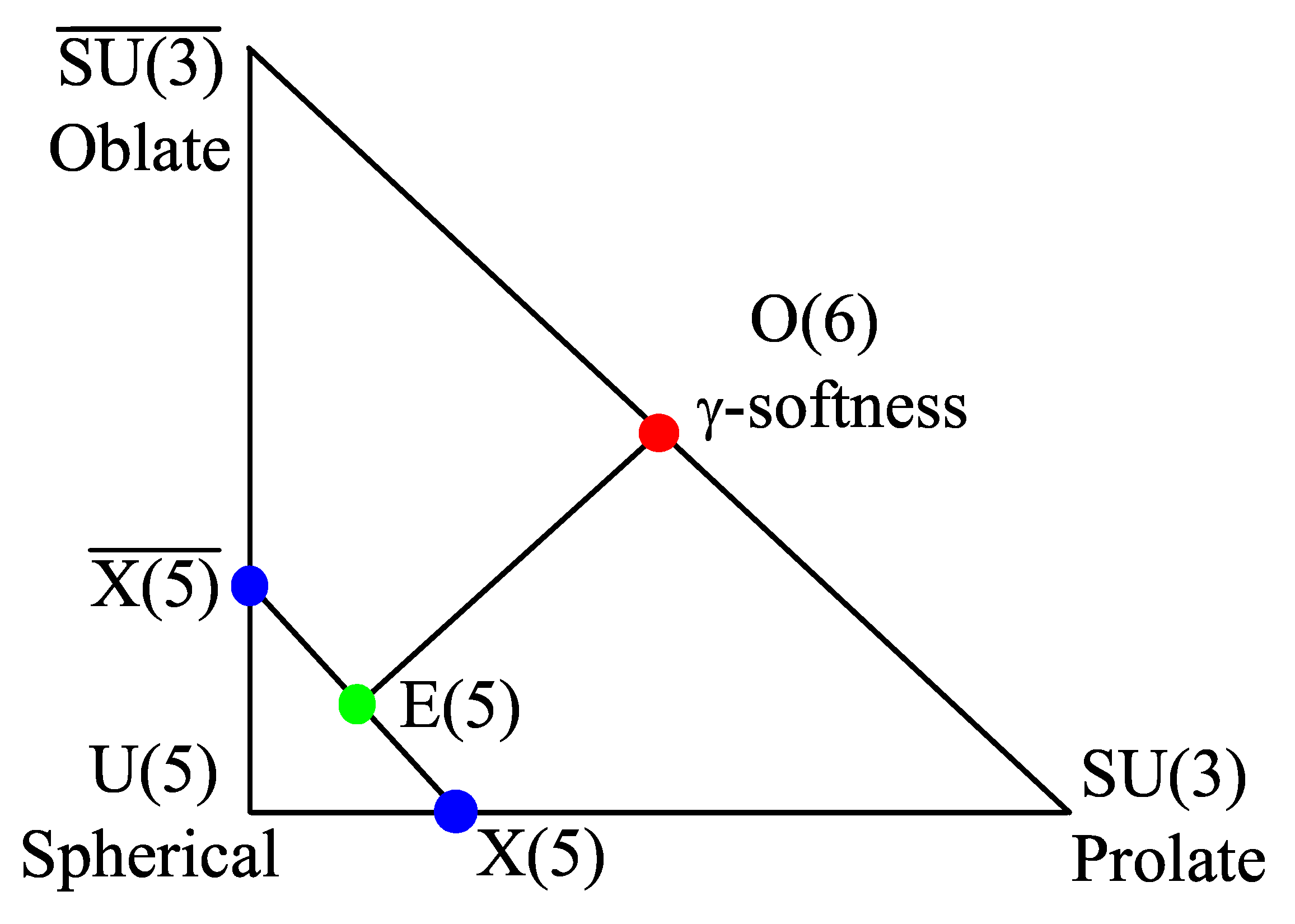
Figure 2.
Energy spectra of the U(5) symmetry limit in (the spherical shape).
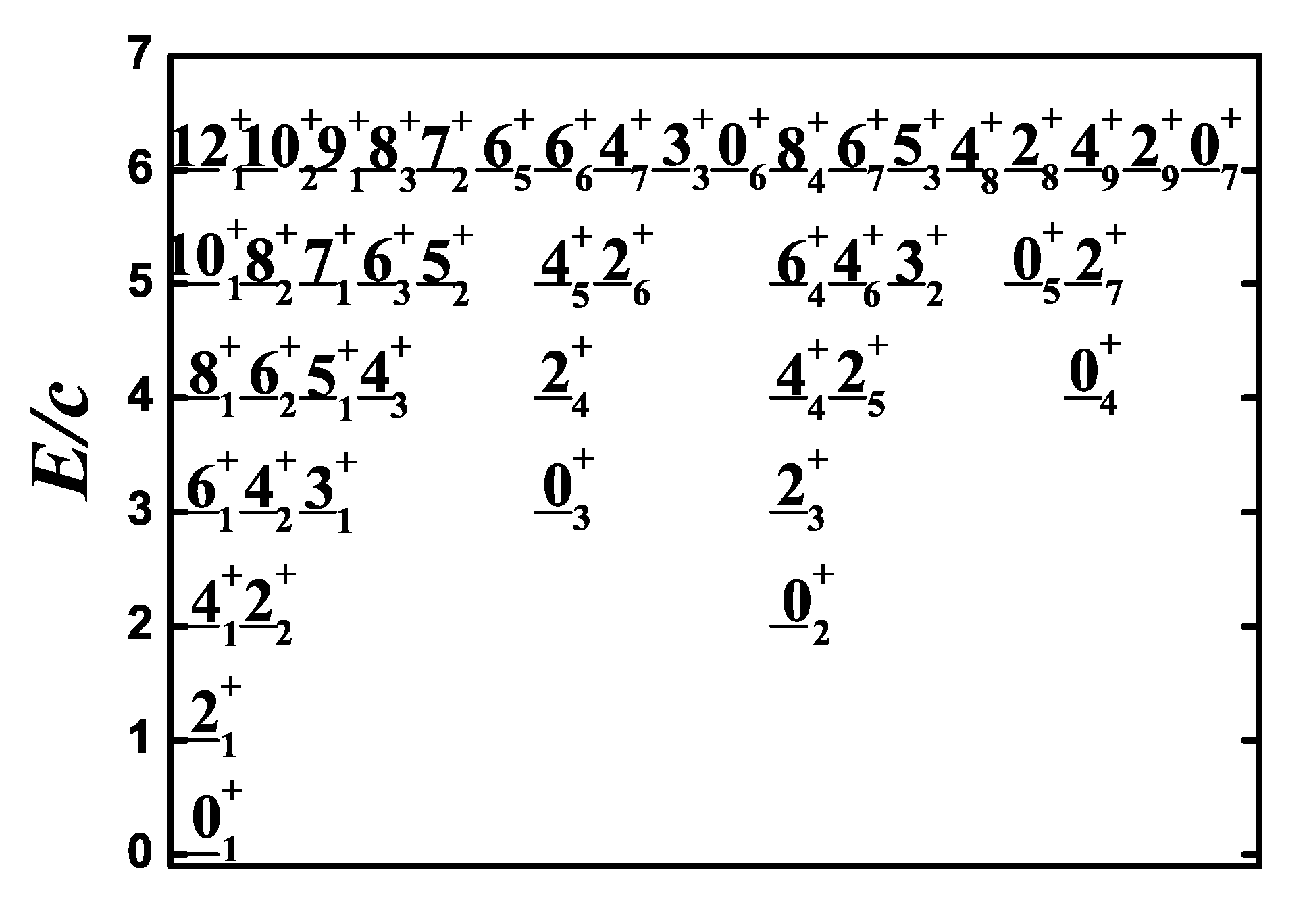
Figure 4.
Comparison of the phase diagram of the IBM and the simplest SU3-IBM. This figure is from [18].
Figure 4.
Comparison of the phase diagram of the IBM and the simplest SU3-IBM. This figure is from [18].
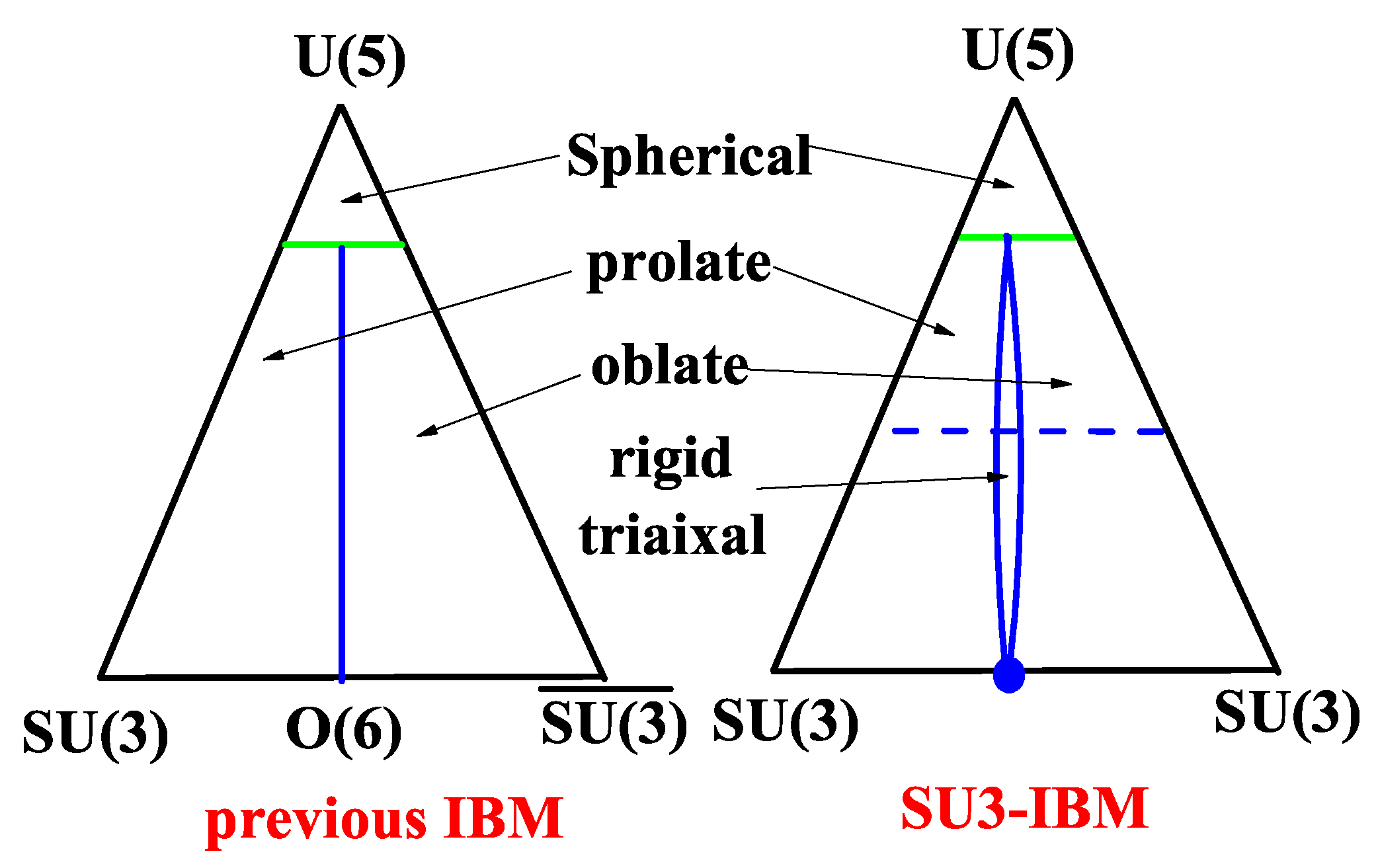
Figure 5.
Part low-lying spectra in 120Cd and 112Cd. This figure is from [16].
Figure 5.
Part low-lying spectra in 120Cd and 112Cd. This figure is from [16].
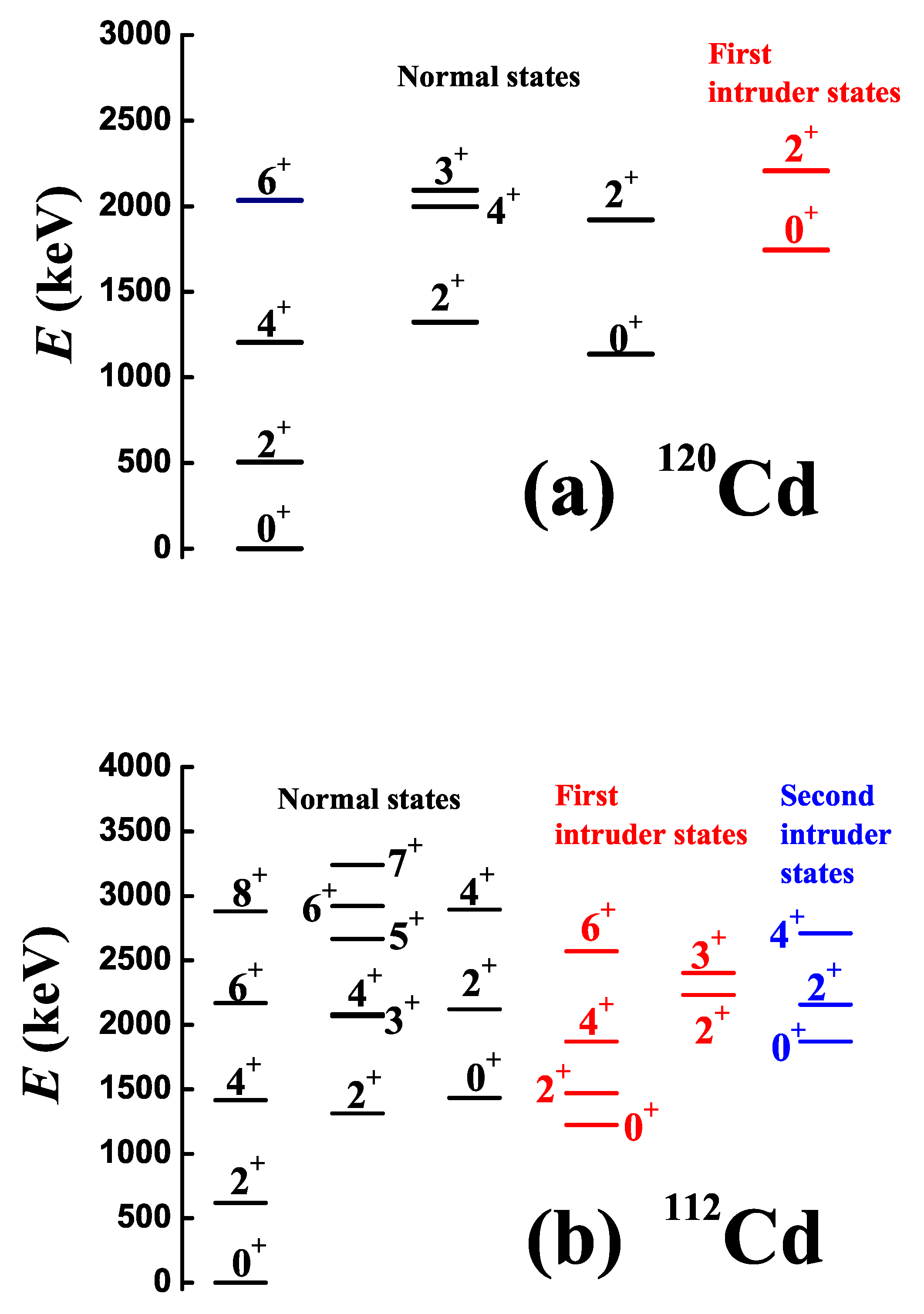
Figure 6.
Evolution of the part low-lying spectra of 108−120Cd. This figure is from [16].
Figure 6.
Evolution of the part low-lying spectra of 108−120Cd. This figure is from [16].
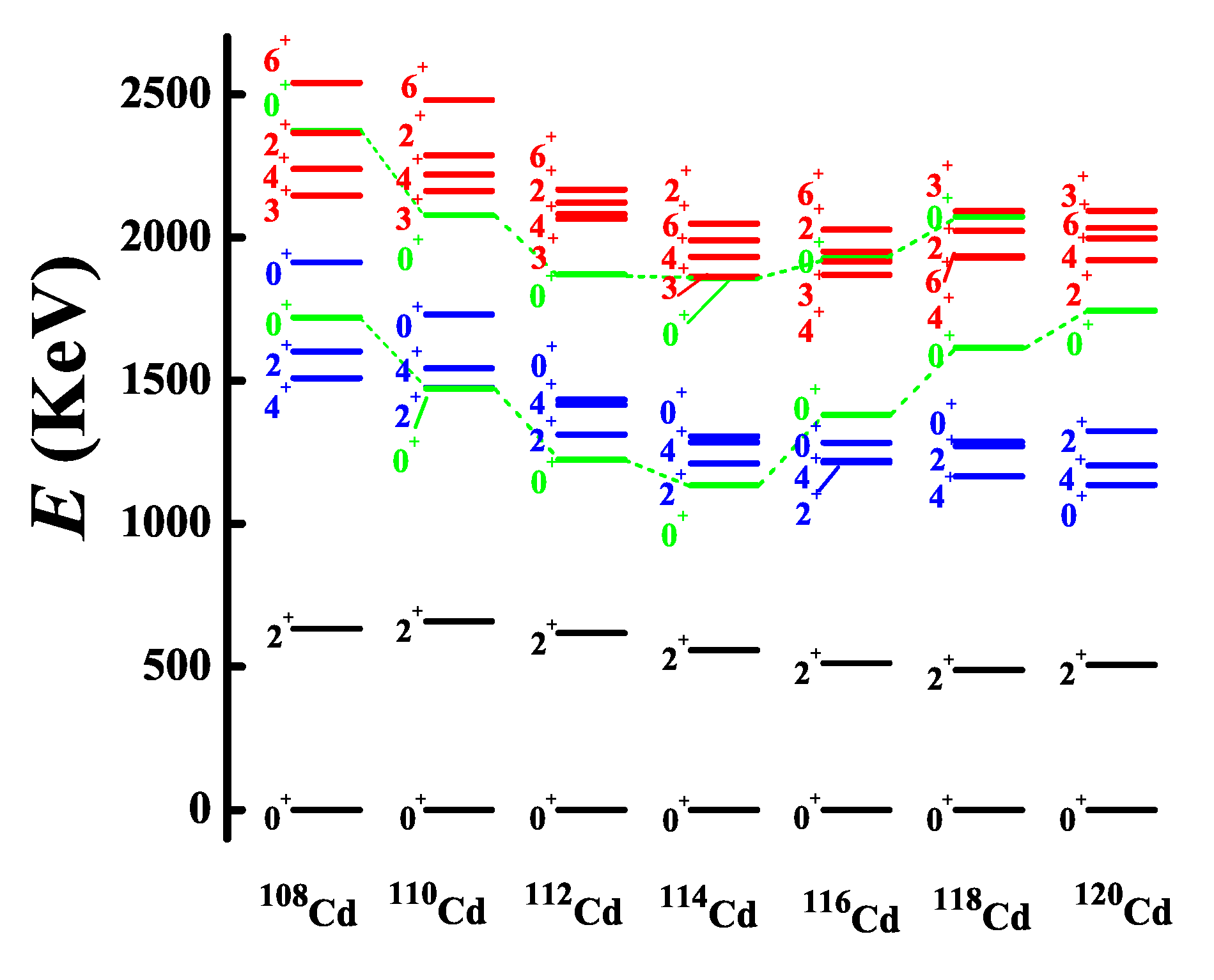
Figure 7.
Energy spectra of the new spherical-like -soft mode for (top) and (down). These figures are from [17,105].
Disclaimer/Publisher’s Note: The statements, opinions and data contained in all publications are solely those of the individual author(s) and contributor(s) and not of MDPI and/or the editor(s). MDPI and/or the editor(s) disclaim responsibility for any injury to people or property resulting from any ideas, methods, instructions or products referred to in the content. |
© 2026 by the authors. Licensee MDPI, Basel, Switzerland. This article is an open access article distributed under the terms and conditions of the Creative Commons Attribution (CC BY) license (http://creativecommons.org/licenses/by/4.0/).
Copyright: This open access article is published under a Creative Commons CC BY 4.0 license, which permit the free download, distribution, and reuse, provided that the author and preprint are cited in any reuse.


