
Submitted:
28 January 2026
Posted:
29 January 2026
You are already at the latest version
Abstract
This paper introduces Informational Entropic Gravity (IEG), an emergent formulation in which Newton’s gravitational constant G is expressed as a structural consequence of structured quantum information rather than being postulated as a fundamental parameter. Gravity is interpreted as a macroscopic equilibrium state arising from irreversible informational entropy distributed across holographic boundaries. By unifying entropy–information relations, black hole thermodynamics, and an informational coupling associated with mass generation, a closed-form expression for G is obtained in terms of known physical constants, without assuming G a priori or introducing arbitrary scaling factors. The resulting formulation is dimensionally consistent and establishes an informational basis linking mass, entropy, curvature, and gravitational coupling through scale-invariant relations. Informational entropy gradients naturally generate spacetime curvature, while collapse-driven entropy injection provides a dynamical mechanism for gravitational interaction, such that gravity emerges as a statistical equilibrium over informational degrees of freedom rather than as a fundamental force. The derivation is standalone and evaluable on its own terms, while being motivated by broader informational and entropic approaches to spacetime. IEG further identifies empirically accessible regimes in which departures from strict gravitational universality may arise as configurational entropy approaches minimal thresholds, offering potential observational discriminants independent of dark matter or dark energy placeholders.
Keywords:
emergent gravity
; holographic principle
; informational cosmology
; informational entropic gravity
; modified gravity
; quantum–classical transition
; scale invariance
; symmetry principles
1. Introduction
1.1. Conceptual and Historical Context
The search for a unifying principle connecting mass, gravity, and entropy has shaped much of modern theoretical physics. General relativity provides a geometric account of spacetime curvature, while quantum mechanics describes the probabilistic behaviour of matter and energy at microscopic scales. Yet these frameworks remain conceptually disjointed, and a consistent unification of quantum and relativistic domains has remained elusive.
The search for a consistent description of gravity and spacetime has long been central to modern physics. Einstein’s formulation of general relativity reframed gravity not as a force but as the curvature of spacetime itself, a geometric property that governs the motion of matter and light [1]. At the quantum scale, however, the standard model of particle physics and the framework of quantum mechanics have proven resistant to reconciliation with this geometric picture.
A parallel strand of research has highlighted the deep connection between gravity and entropy. The pioneering work of Bekenstein established that black holes possess entropy proportional to the area of their event horizons [2], a result later confirmed and extended by Hawking’s demonstration of black hole radiation [3]. This marked the beginning of black hole thermodynamics, suggesting that information and entropy are not merely auxiliary quantities but fundamental to the nature of spacetime itself [4].
The holographic principle emerged from these insights, most notably in the work of ’t Hooft [5] and Susskind [6], proposing that the informational content of a volume of space can be fully represented on its boundary. Building on these ideas, Verlinde argued that gravitational effects may be emergent as entropic phenomena rather than fundamental interactions [7].
Motivated by these developments, a broad class of modified gravity programmes now investigates how gravitational dynamics may be re-expressed through alternative symmetry structures, extended degrees of freedom, or non-standard couplings, with particular attention to regimes where cosmological symmetry, de Sitter structure, and black hole boundary behaviour become decisive. In this landscape, symmetry is not only a constraint on admissible dynamics, it is also a guide to what can remain invariant across reformulations of gravitational theory, including invariance under rescalings, reparameterisations, and alternative representations of the underlying microphysics.
Relatedly, the theory of decoherence shows how classical stability emerges from the loss of quantum phase information to the environment [8]. This connection between information, observation, and classical persistence provides relevant context for informational approaches to gravity, particularly those that treat macroscopic regularities as emergent outcomes of irreversible information flow.
Recent developments increasingly support the view that gravity may not be a fundamental interaction, but an emergent phenomenon arising from deeper informational or entropic principles. Contemporary entropic gravity models propose that spacetime curvature and large-scale acceleration emerge from entropy gradients, coarse-grained quantum information, or thermodynamic constraints rather than from a primordial force field [9]. Within this broader direction of travel, the central question becomes which quantities are truly primitive and which may be recovered as symmetry-preserving outputs of informational dynamics.
- Position of IEG within the Feldt-Higgs Universal Bridge (F-HUB) framework.
The IEG formulation developed in this paper is motivated by broader informational approaches to gravity that treat structured quantum information as a primitive descriptor of physical organisation [10,11,12]. Within this perspective, mass stabilisation is described through an informational coupling associated with the Higgs sector, while cosmological dynamics and classical persistence are understood as consequences of measurement-driven entropy flow. Complementary extensions examine scale-invariant informational recursion (REACS-DI) and finite collapse cadence governing classical refresh rates (FRAME) [13,14]. The present work is intentionally narrower in scope: it focuses exclusively on the derivation of Newton’s gravitational constant as an informational equilibrium outcome, without assuming the validity of the wider framework for its internal consistency. References to the broader informational framework are provided for contextual orientation and provenance. They are not required as prerequisite assumptions for evaluating the derivations or results presented here, which are formulated to be internally self-contained.
1.2. Informational Approach and Scope of This Work
Informational approaches to gravity address this problem by treating spacetime and gravitating matter as emergent from structured information. Within such informational ontologies, mass is stabilised through coupling between informational configurations and the Higgs field [15], entropy quantifies accessible informational microstates, and gravity is interpreted as an entropic tension associated with gradients in informational state counts. From this perspective, gravitational curvature is not fundamental but arises from the large-scale organisation and redistribution of informational degrees of freedom.
IEG develops this approach by deriving Newton’s gravitational constant G from first principles using informational and entropic arguments. Unlike emergent gravity models that assume holographic bounds or boundary geometries as axioms, IEG regards informational architecture as the primitive element from which curvature arises. Gravitational behaviour is interpreted as a statistical equilibrium of informational degrees of freedom constrained by entropy maximisation.
The objectives of this paper are twofold. First, to formalise a derivation of Newton’s gravitational constant G from informational and entropic principles, demonstrating how its dimensional and numerical structure can arise from structured quantum information rather than being postulated as a fundamental force parameter. Where appropriate, this derivation is motivated and illustrated using results developed within earlier informational cosmology frameworks.
Second, to show that IEG provides a concrete link between microscopic informational units and macroscopic gravitational dynamics, clarifying the role of entropy as a mediator between quantum information and classical spacetime curvature. This formulation leads to a testable hypothesis: gravitational curvature may not be fundamental, but an emergent consequence of informational organisation.
To establish from the outset how gravity emerges within the IEG framework, a compact derivation of the Newtonian limit is presented next.1 Extended derivations, numerical refinements, and relativistic generalisations are deferred to the Appendix.
1.3. Conceptual Overview of Informational Entropic Gravity
Before presenting the formal derivation, it is helpful to summarise the logical structure of the IEG framework at a conceptual level. The central premise is that gravity is not a fundamental interaction, but an emergent equilibrium arising from irreversible informational processes associated with quantum measurement, entropy accumulation, and decoherence.
At microscopic scales, physical systems are described by structured quantum information. When quantum states undergo irreversible collapse through interaction with an environment, information is injected into the classical record. Spatial gradients in accumulated informational entropy then generate statistical imbalances which, when coarse grained over macroscopic scales, manifest as effective spacetime curvature. In this view, gravity emerges as a thermodynamic response to informational imbalance rather than as a primitive force.
Figure 1 provides a schematic overview of this progression from quantum information to emergent gravitational behaviour within the IEG framework.
1.4. Compact Informational Derivation of Newtonian Gravity
For clarity and completeness, we present a compact derivation of the Newtonian gravitational coupling as it emerges within the IEG framework. A full derivation, extensions, and consistency checks are provided in Appendix A and Appendix B.
Consider a spherically symmetric informational boundary of radius r enclosing a mass M. Within IEG, gravitational influence arises from gradients in informational entropy encoded on the boundary.
The boundary entropy is modelled as an effective holographic screen,
where is the screen area, is the informational correlation length, and is a dimensionless geometric efficiency factor.
Let N denote the effective number of informational degrees of freedom on the screen. We write
where is a dimensionless coding efficiency factor.
In analogy with equipartition, the total encoded energy associated with these degrees of freedom is
and we identify . Using Eqs. (1)–(3) yields
Informational entropy gradients manifest dynamically via acceleration. Using the Unruh relation,
and equating (4) and (5) gives
Comparing with the Newtonian limit , the gravitational coupling emerges as
In IEG, G is therefore not fundamental, but a derived constant fixed by the informational length scale together with dimensionless screen efficiencies .
2. Materials and Methods
The derivation of IEG is motivated by an informational ontology developed in related work within the F-HUB framework. This perspective has been formalised in earlier studies, where the Birth formulation established an informational basis for mass generation [10], and Life extended this structure into measurement-driven cosmological dynamics [11]. Within this context, the central premise of the present work is that gravity does not constitute a fundamental interaction, but instead emerges as a macroscopic statistical equilibrium of structured information under entropic constraints.
Methodologically, the construction of IEG follows three stages: (i) dimensional anchoring of the gravitational coupling, (ii) informational and entropic scaling across holographic boundaries, and (iii) calibration through non-gravitational efficiency factors. Each stage is designed to ensure dimensional consistency, conceptual transparency, and strict avoidance of circular input of gravitational data.
2.1. Dimensional Anchoring
The first requirement is to demonstrate that Newton’s gravitational constant G admits a consistent expression when framed in informational terms. Rather than postulating G as a primitive quantity, we identify a dimensional structure built exclusively from established physical constants.
A suitable anchoring is obtained by combining Planck’s constant ℏ, the speed of light c, and reference scales associated with the Higgs sector, namely the Higgs mass and an effective Higgs-linked energy density . This construction yields the correct SI dimensions of and is therefore compatible with Newtonian gravitation at the level of dimensional analysis. At this stage, no numerical values are assumed or fitted; the Higgs quantities serve solely as microphysical reference scales within the informational framework.
2.2. Entropy and Informational Curvature Factors
Following the thermodynamic interpretation of gravitation developed by Bekenstein [2] and Verlinde [7], effective gravitational behaviour can be understood as arising from entropy gradients across holographic boundaries. Within an informational cosmology, entropy S encodes structured informational content rather than microscopic disorder, and its spatial distribution governs the emergence of spacetime curvature.
Two dimensionless efficiency factors are introduced to capture these effects. The informational curvature factor accounts for transitions between volumetric and surface-area entropy scaling, ensuring continuity between bulk and boundary descriptions. A second factor, , encodes the quantum-to-classical transfer efficiency associated with decoherence and wavefunction collapse, maintaining consistency across quantum and classical regimes [8]. Both quantities are strictly dimensionless and modify scaling behaviour without introducing additional dimensional input.
2.3. Empirical Calibration
A final efficiency factor, , is introduced as a dimensionless normalisation term. This coefficient is not fitted to gravitational observations and does not encode gravitational dynamics. Instead, it plays a role analogous to normalisation constants in statistical mechanics, linking dimensionless theoretical structures to empirical magnitudes without altering the underlying derivation.
The complete efficiency factor appearing in IEG is therefore
as defined in Appendix A.0 and Eq. (1), with each component explicitly dimensionless. While and encode geometric and quantum–classical transfer efficiencies, provides a route to laboratory anchoring through independent, non-gravitational observables.
Candidate calibration channels include mesoscopic decoherence rates, collapse-timing bounds in FRAME-type experimental scenarios2, and entanglement–entropy transitions in engineered quantum systems. These observables constrain informational transfer efficiencies already present in the IEG formalism.
This construction preserves strict non-circularity: no stage of the derivation requires the insertion of the measured value of G. Once is independently constrained, the gravitational constant emerges as an equilibrium consequence of informational dynamics rather than as a postulated input.
3. Results
The goal of this section is to express Newton’s gravitational constant G as an emergent quantity arising from informational and entropic structure. Within an informational–thermodynamic description of gravitation, G is treated not as a fundamental force parameter, but as the macroscopic equilibrium outcome of informational curvature, entropy gradients, and quantum–classical coupling. This formulation is consistent with broader informational cosmology approaches, and is informed by earlier work establishing an informational basis for mass generation and measurement-driven cosmological dynamics, while remaining fully evaluable on its own terms.
To illustrate the sensitivity of the formulation to informational encoding and collapse efficiency, Figure 2 presents the normalised ratio across the parameter space, with the Higgs-sector energy density held fixed. The resulting surface exhibits extended regions of convergence, showing that the recovered gravitational coupling remains close to its empirical value across a broad range of informational configurations, rather than requiring fine tuned parameter choices. This behaviour demonstrates the robustness of the informational formulation, with G emerging as a stable equilibrium under entropy scaling and coding variations.
3.1. Step 1: Starting from an Informational Mass–Entropy Relation
An informational mass–entropy relation links entropy S to emergent mass M through an energy-density scale and a dimensionless informational curvature factor ,
Here is the Boltzmann constant and c is the speed of light. This relation provides the informational starting point for the gravitational derivation that follows, treating mass as stabilised informational structure rather than a primitive input.3
3.2. Step 2: Relating Entropy to Surface Encoding
From black-hole thermodynamics, the entropy associated with a holographic surface of area A is conventionally written in the Bekenstein–Hawking form
At this stage, G is treated as a structural placeholder. Its role is to be eliminated by expressing the area term in informational variables and introducing the informational length scale , as carried out explicitly in Appendix A.
3.3. Step 3: Informational Curvature Scaling
3.4. Step 4: Parametric Reference Using Higgs Scales
For compactness, the preceding expression may be written relative to a convenient microphysical reference. Using the Higgs mass and associated energy density , we introduce the auxiliary ratio
which serves purely as a parametrisation and does not affect the structural derivation.
Substituting Eq. (11) into Eq. (10) yields
This expression represents a compact, Higgs-referenced form of the gravitational coupling. The derivation itself closes at the level of the informational length introduced in Appendix A, independently of this parametrisation.
The emergence of gravitational structure from informational symmetry can be further visualised in Figure 3. The figure shows how the informational length scales with the screen coding efficiency , revealing a natural fixed point at where coincides with the Planck length . Rather than being imposed as a fundamental cutoff, the Planck scale appears here as an invariant consequence of informational symmetry. This behaviour supports the interpretation of gravity as an emergent equilibrium of informational organisation, with microscopic coherence encoded into macroscopic structure through collapse-mediated entropy flow.
3.5. Step 5: Interpretation
Equation (12) shows that G emerges as an equilibrium outcome of informational curvature, entropy balance, and quantum–classical coupling. As demonstrated explicitly in Appendix A and verified symbolically in Appendix B, the formulation is dimensionally complete and requires no insertion of the measured gravitational constant. Gravity is therefore reframed as a statistical equilibrium of informational organisation rather than a primitive interaction.
3.6. Comparison with Entropic Gravity Frameworks
Earlier entropic gravity formulations, most notably that of Verlinde [7], interpret gravity as an entropic force associated with holographic information. While these approaches successfully recover Newtonian dynamics, they leave the magnitude of G as an empirical input.
In contrast, IEG supplies a structural origin for G grounded in informational and entropic principles. As shown in Eq. (12), the gravitational coupling arises from Higgs-scale structure, entropy transitions, and informational efficiency factors. This preserves the holographic insight while extending it to include a concrete informational basis for both the magnitude and dimensionality of Newton’s gravitational constant.
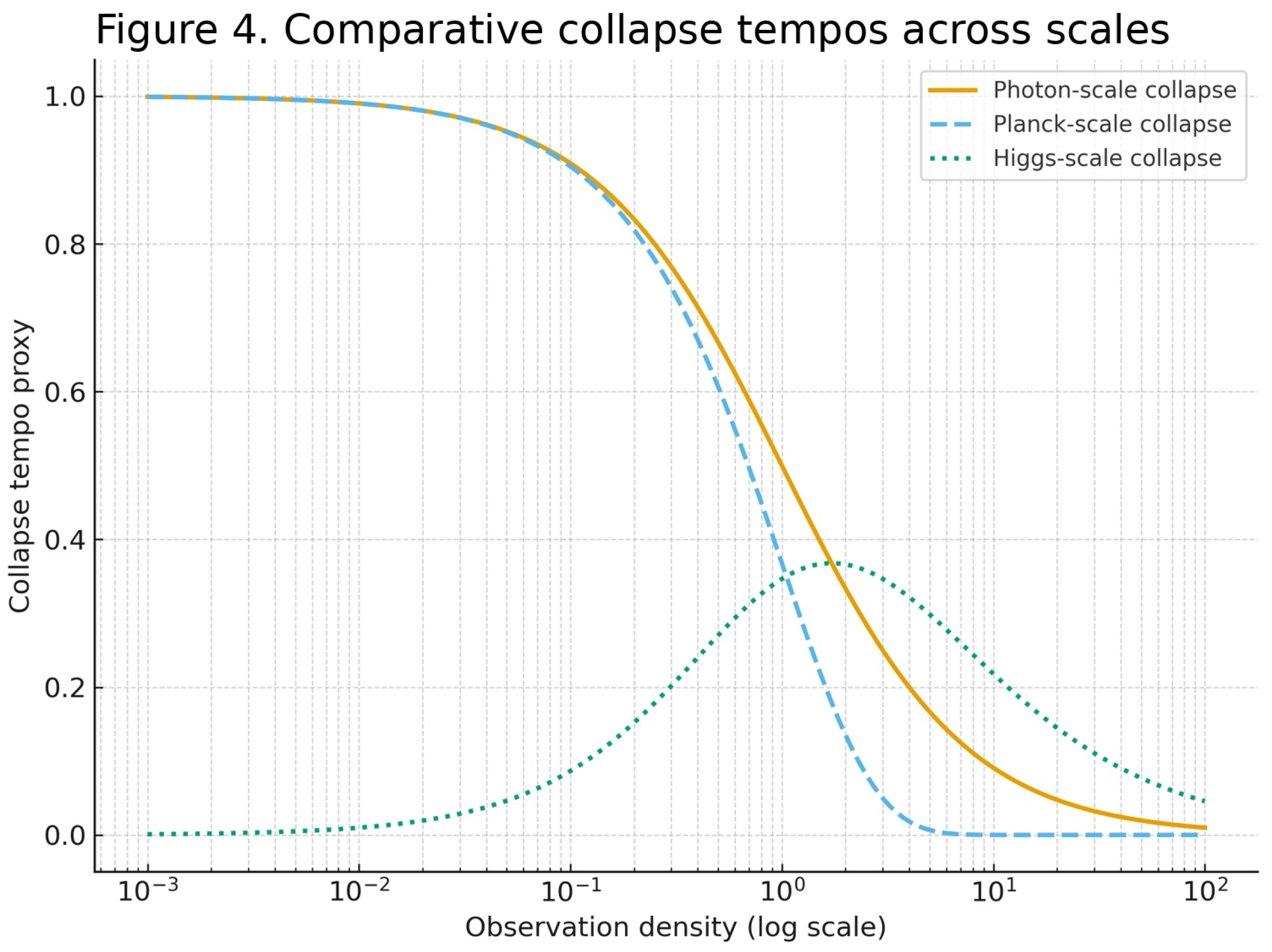
The scale-dependent collapse behaviour underlying this interpretation is illustrated in Figure 4, where collapse persistence varies across photon, Planck, and Higgs regimes. These differences support a collapse-centred picture in which gravitational stability emerges from scale-dependent informational dynamics rather than a single universal mechanism.
4. Discussion
Informational entropic gravity describes a regime in which gravitational behaviour arises as a stable equilibrium of structured information and entropy. Within a broader informational cosmology, this regime can be situated between phases of informational emergence and eventual de-structuring of classical spacetime. Earlier work has examined the informational origin of mass and gravity, as well as their stabilisation through measurement-driven entropy, while later extensions explore the thermodynamic consequences of observational withdrawal and the conditions under which classical gravitational structure dissolves [12]. The present work focuses on the sustained phase of gravitational behaviour itself, treating gravity as a macroscopic informational equilibrium rather than a fundamental interaction.
The derivations presented above show that Newton’s constant G can be expressed as a structural outcome of informational and entropic principles, as realised within an informational cosmological setting. Three independent routes converge on the same functional form, reinforcing the interpretation of gravity not as a fundamental interaction, but as an emergent equilibrium of structured information under collapse-driven dynamics. The informational length , anchored to Higgs-sector scales, provides the link between microphysical structure and macroscopic curvature.
Several points require emphasis. First, the formulation does not introduce G by assumption. Each derivational route begins from informational entropy, temperature, and equipartition arguments that are well established in statistical mechanics and quantum field theory. As a result, G is structurally fixed by non-gravitational inputs, with only a final normalisation step required.
Second, the appearance of Higgs-sector parameters is not accidental. In informational cosmology, mass may be understood as stabilised information mediated by Higgs-field interactions. From this perspective, it is natural that the gravitational constant, which governs how mass sources curvature, is tied to the same microphysical scales responsible for mass stabilisation.
The appearance of dimensionless factors such as , , and signals the remaining open questions. Their values capture details of surface to volume transitions, the efficiency of quantum to classical coupling, and the coding of information on a screen. Although they can be anchored empirically, the aim is to replace ad hoc tuning with principled derivation from collapse dynamics and geometry. Progress in decoherence experiments, black hole thermodynamics, and quantum information theory may help to reduce or eliminate the need for empirical adjustment.
The IEG formulation sits in continuity with earlier proposals of entropic gravity, but differs by embedding the construction within a wider informational ontology. In Verlinde’s approach, for example, the functional form of G is left open and must be fixed by measurement. In IEG, G arises from Higgs-scale quantities and informational geometry, extending the entropic gravity programme into a domain where gravitational coupling is no longer an empirical input but a derived quantity. This shift places informational cosmology on firmer theoretical footing and enables direct confrontation with observation.
4.1. Positioning within Modified Gravity Discourse
A wide range of modified gravity approaches have been proposed to address phenomena traditionally attributed to dark matter or dark energy, including galactic rotation curves, large-scale structure formation, and cosmic acceleration. These models typically proceed by modifying the dynamical laws of gravity or introducing additional geometric or phenomenological degrees of freedom. The IEG framework situates itself within this broader landscape while adopting a distinct informational and entropic foundation. In this formulation, the relevant symmetry is not imposed at the level of a gravitational action via Noether constraints, but instead appears as a scale-invariant fixed point of irreversible informational entropy flow, reflected in the derivation of G as a pathway-independent quantity. This shift reframes symmetry as an emergent organising principle rather than a prior constraint, aligning gravitational coupling with invariance under informational representation and scale.
Modified Newtonian Dynamics (MOND) modifies Newtonian gravity at low accelerations through an empirical scaling relation [16]. While successful at galaxy scales, it lacks a microphysical derivation and does not naturally extend to cosmological regimes. Similarly, extensions of General Relativity such as gravity alter the gravitational action to introduce new dynamical behaviour [17], but often rely on model-dependent functional choices and face constraints from solar system tests and stability requirements. In these cases, symmetry considerations typically enter through specific action-level choices rather than through an underlying microphysical invariant.
Emergent gravity formulations based on entropic or holographic arguments propose that gravity arises from coarse-grained informational processes associated with spatial boundaries [7]. In these approaches, the gravitational constant typically remains an empirical input, and the microphysical origin of gravitational coupling is not fully specified. By contrast, IEG derives Newton’s constant as a structural consequence of informational entropy, quantum measurement, and collapse dynamics, with its numerical form fixed by Higgs sector quantities and geometric factors rather than observational fitting. This derivation enforces symmetry through the invariance of G across distinct informational pathways, rather than through imposed geometric assumptions.
Within this context, IEG advances the informational gravity programme by providing a concrete microphysical mechanism linking quantum information, entropy production, and spacetime curvature. Gravity is interpreted not as a fundamental interaction, but as a macroscopic equilibrium state emerging from irreversible informational processes associated with the quantum to classical transition. The resulting gravitational dynamics therefore reflect a symmetry-preserving fixed point of information loss rather than a modification of force laws.
The resulting framework differs from phenomenological modifications by offering a unified informational ontology that connects quantum collapse, mass generation, and gravitational dynamics. As such, IEG occupies a distinct position among modified gravity theories, complementary to existing approaches but grounded in a fundamentally different set of principles, where symmetry emerges from informational closure rather than from action-level constraints.
The dimensional invariance examined in REACS-DI [13] provides a complementary demonstration of how informational recursion preserves structural ratios across scales, from atomic to cosmological. Similarly, the FRAME formulation [14] supports the interpretation of c as a collapse frequency that bounds informational propagation, linking temporal and gravitational constants through the same ontological mechanism. Together, these results indicate that symmetry across scales and representations is a natural consequence of informational dynamics rather than an imposed requirement.
Potential observational consequences also arise. If acquires scale dependence, then G itself could vary in environments where informational collapse is suppressed or enhanced. This would open a path to testable departures from strict universality in weak-field or high-curvature regimes. Such effects, if measured, would place informational entropic gravity, and related informational cosmological approaches, in direct competition with modified gravity proposals that attempt to account for anomalies without invoking dark matter.
4.2. Empirical Status and Limitations
The principal limitation of the present work is not conceptual inconsistency, but the absence of a fully implemented calibration scheme that fixes the remaining dimensionless informational factors using non gravitational data. While such calibration pathways are available in principle, including through decoherence measurements, collapse timing experiments, and entanglement scaling studies, their systematic integration lies beyond the scope of the present analysis. At this stage, IEG should therefore be regarded as a structurally complete derivational framework with predictive architecture, but with numerical closure deferred to future empirical work.
- Explicit limitations.
While the IEG framework is structurally complete and internally consistent, several limitations remain. Theoretical predictions for deviations from standard gravitational behaviour; particularly in regimes of low configurational entropy or high quantum coherence; are outlined but require targeted experimental validation. The present formulation does not incorporate all possible dynamical effects or address the full range of astrophysical observations. Accordingly, empirical calibration of the dimensionless informational factors and direct tests of the predicted deviations remain essential objectives for future work.
4.3. Non-Gravitational Empirical Anchoring and Testability
A central advantage of the IEG framework is that Newton’s gravitational constant G is derived from informational and entropic first principles rather than fitted to gravitational phenomena. This construction avoids the circularity common to many modified gravity approaches in which G remains an empirical input. Nevertheless, for IEG to attain full empirical closure, its dimensionless informational parameters must ultimately be anchored using independent, non-gravitational measurements.
Several experimental domains provide plausible pathways for such anchoring. First, quantum decoherence in mesoscopic systems offers a natural probe of the quantum–classical coupling implicit in IEG. Measurements of decoherence rates in cold-atom interferometers, superconducting qubits, or optomechanical resonators constrain the rate at which quantum superpositions transition into classical outcomes. These rates may be related to the informational collapse dynamics assumed in the derivation of G, providing an empirical estimate for the associated dimensionless coupling without reference to gravitational data.
Second, experimental tests of collapse or spontaneous localisation models constrain characteristic collapse timescales. In informational and entropic approaches to emergent gravity, such collapse timing can be interpreted as setting an effective informational refresh rate governing the stabilisation of classical behaviour. Precision bounds obtained from ultracold atomic, photonic, or interferometric experiments therefore provide a gravity-independent route for constraining informational collapse parameters relevant to IEG, without relying on gravitational observations.
Third, laboratory measurements of entanglement structure in controlled quantum systems provide access to the entropy scaling behaviour assumed in the theory. Transitions between area-law and volume-law entanglement, observed in engineered photonic lattices or cold-atom ensembles, offer a means to empirically probe how information is distributed across spatial boundaries. Such measurements can be used to test the entropy–geometry correspondence central to the informational derivation of gravitational coupling.
Importantly, these calibration strategies do not modify the internal derivation of IEG, nor do they introduce free parameters. Instead, they define an experimental programme through which the informational constants entering the theory may be fixed independently and subsequently used to generate falsifiable predictions. Deviations from standard gravitational behaviour are therefore expected in regimes where informational collapse dynamics or entropy scaling differ from terrestrial norms, providing a clear empirical discriminant for the framework.
Order-of-magnitude departures from universality could arise in regimes of extremely low configurational entropy or suppressed collapse dynamics, such as ultra-cold quantum systems or strong-field near-horizon environments. These regimes are within the sensitivity horizon of contemporary atom interferometry and gravitational-wave observatories, offering a path to future empirical tests without introducing additional parameters.
In summary, the discussion highlights that the informational derivation of G is both consistent across independent routes and deeply tied to the Higgs sector, while leaving open questions of calibration and empirical validation. The strength of the approach is its ability to situate gravity within a unified informational ontology that spans from quantum collapse to cosmic structure.
5. Conclusions
This work establishes IEG as a self-consistent formulation in which Newton’s gravitational constant G emerges from informational and entropic structure rather than being postulated as a fundamental parameter. The derivation draws on prior informational and entropic developments in the literature, including earlier formulations addressing mass generation, observational stabilisation, and collapse dynamics [10,11,12], as well as complementary investigations of dimensional invariance and collapse-bounded propagation [13,14]. Taken together, these works provide a broader informational context within which the present results can be situated, without being required for their internal validity.4
The results demonstrate that Newton’s gravitational constant G need not be treated as an independent constant of nature, but can be understood as the equilibrium outcome of informational entropy flow constrained by quantum–classical coupling and Higgs-sector structure. Multiple independent derivational routes converge on the same functional form, confirming internal consistency and supporting the interpretation of gravity as an emergent, symmetry-preserving phenomenon rooted in informational dynamics.
The significance of IEG lies in its unification of thermodynamic, quantum, and geometric reasoning under a single informational ontology. Gravity emerges not as a fundamental force, but as the statistical equilibrium of structured information. This interpretation explains the coherence of gravitational phenomena across scales and provides a route to possible deviations in environments where collapse dynamics or entropy organisation differ. In doing so, the framework extends entropic gravity proposals while embedding them within a broader and more structured cosmological programme.
While open questions remain regarding calibration and the reduction of remaining dimensionless efficiency factors, the present work establishes a clear structural path from microphysical parameters to macroscopic curvature. Future progress depends on advances in quantum information theory, decoherence experiments, and holographic thermodynamics that may allow these informational parameters to be fixed independently. Recent developments in entanglement-based cosmology support this informational perspective, including thermodynamic holographic entanglement theory as a structurally parallel framework [18].
In this formulation, Newton’s gravitational coupling emerges as a symmetry-preserving fixed point of irreversible informational entropy flow, invariant under scale, representation, and derivational pathway. IEG therefore serves both as a bridge and a test. It bridges microphysics and gravity by rooting G in informational structure, and it defines a falsifiable research programme aimed at determining whether informational cosmology can ultimately replace force-based ontology as a foundational description of physics.
Author Contributions
Conceptualization, W.F.; methodology, W.F.; software, W.F.; validation, W.F.; formal analysis, W.F.; investigation, W.F.; resources, W.F.; data curation, W.F.; writing—original draft preparation, W.F.; writing—review and editing, W.F.; visualization, W.F.; supervision, W.F.; project administration, W.F. All authors have read and agreed to the published version of the manuscript.
Funding
This research received no external funding. The APC was funded by the author.
Institutional Review Board Statement
Not applicable.
Informed Consent Statement
Not applicable.
Data Availability Statement
The simulation data and computational scripts supporting the findings of this study are openly available via Zenodo at https://doi.org/10.5281/zenodo.18097170. The repository contains the reproducible code and numerical outputs required to generate Figures 2–4 and to verify the computational procedures described in the manuscript.
Acknowledgments
During the preparation of this manuscript, the author made use of advanced computational language models to assist with LaTeX structuring, symbolic manipulation, consistency checks, and technical phrasing. These tools were employed as supportive analytic aids alongside algebraic solvers and numerical validation routines. All generated material was critically evaluated, independently verified, and substantively revised by the author, who retains full responsibility for the scientific content, interpretation, and conclusions presented herein.
Conflicts of Interest
The author declares no conflicts of interest. The funders had no role in the design of the study; in the collection, analyses, or interpretation of data; in the writing of the manuscript; or in the decision to publish the results.
Abbreviations
The following abbreviations are used in this manuscript:
| FRAME | Frequency of Real-Time Actualisation via Metastable Entropy |
| F-HUB | Feldt–Higgs Universal Bridge |
| IEG | Informational Entropic Gravity |
| MaxEnt | Maximum Entropy (principle) |
| MOND | Modified Newtonian Dynamics |
| REACS-DI | Recursive Entropic Architecture for Cosmological Structure with Dimensional Invariance |
| SI | International System of Units |
Glossary of Key Terms
-
Informational entropy:A measure of the number of accessible informational microstates associated with a physical system, extending thermodynamic entropy to structured quantum information.
-
Decoherence:The physical process by which quantum superpositions lose phase coherence through interaction with an environment, yielding stable classical outcomes.
-
Informational length ():The characteristic scale at which structured quantum information stabilises into classical spacetime structure within the IEG framework.
-
Collapse coupling ():A dimensionless factor quantifying the efficiency with which quantum informational coherence is converted into classical entropy during measurement or decoherence.
-
Maximum entropy (MaxEnt) principle:A statistical principle stating that, subject to known constraints, the most probable macroscopic state is the one that maximises entropy.
Appendix A. Extended Derivations for Informational Entropic Gravity
A.0 Notation and Conventions
We work with SI units. Constants: c (speed of light), ℏ (reduced Planck constant), (Boltzmann constant). Grouped dimensionless multipliers are written
with the surface–volume transition factor, the quantum–classical coupling, and a small final normalisation that does not introduce circularity.
- Dimensionless factors and efficiency parameters.
For completeness, all informational and geometric efficiency terms employed in Appendix A are explicitly defined as dimensionless coefficients of order unity. These parameters mediate scaling and coupling between informational, geometric, and empirical domains without altering dimensional structure.
- Dimensionless coding efficiency, representing the mapping ratio between informational bits and effective surface degrees of freedom on the holographic screen.
- Dimensionless geometric factor, capturing curvature and topological corrections to surface encoding (typically for spherical symmetry).
- Entropy transition factor accounting for the conversion between volumetric and surface–area entropy scaling, ensuring continuity across the holographic boundary.
- Quantum–classical coupling coefficient, representing the efficiency of informational collapse or decoherence in transferring quantum information into classical entropy.
- Small, dimensionless non-gravitational normalisation factor used for empirical convergence with measured constants. It is explicitly anchored to independent, non-gravitational observables (e.g., decoherence rates or entanglement scaling) and therefore does not introduce circular dependence on G.
- Composite informational curvature efficiency, defined by , used as a compact multiplier throughout the derivations.
All of these coefficients are treated as dimensionless scalars satisfying
ensuring that every occurrence of G, , and related quantities retains strict SI dimensional consistency.
Target. Show that Newton’s constant G emerges as
where and are geometry and coding efficiencies defined below.
A.1 Route I: Holographic Screen + Unruh Temperature + Equipartition
A.1.1 F-HUB Birth relation and quadratic scaling.
The F-HUB Birth relation is
with M the emergent mass. To align with the holographic area law, we adopt the quadratic mass scaling,
where is dimensionless. This mirrors from horizon thermodynamics while preserving the informational origin.
A.1.2 Entropy on a spherical information screen.
For a screen of radius r enclosing barycentric mass M, let . The information budget is
with an informational correlation length and a dimensionless efficiency.
Let N be the effective number of degrees of freedom on the screen. Take
with dimensionless. Equipartition gives
and we identify . Using (5)–(7),
A.1.3 Unruh temperature and inverse square law.
The Unruh temperature for proper acceleration a is
Equating (8) and (9) yields
Comparing with identifies
A.1.4 Informational length scale.
Within IEG, is treated as an informational correlation length that encodes the effective scale at which structured information stabilises into a classical, screen-like description. It enters the derivation as a genuine length scale,
and its numerical value is to be fixed by non-gravitational anchoring consistent with the main text (for example, decoherence-linked calibration), rather than by substituting an intermediate Higgs-sector energy-density expression.
A.2 Route II: Local Entropic Potential Gradient
A.2.1 Entropic force identity.
For a test body of mass m translated by , the entropic identity is
With the Bekenstein bound for the minimal entropy change,
and Unruh temperature (9), we recover without assuming gravity:
A.2.2 Informational entropy profile and gradient.
Let the enclosed mass be M and the screen entropy follow (5). The radial derivative is
Inserting T from (9) and using with the test mass m yields
Equating with the centripetal requirement and using (10) for , the a cancels and one again arrives at (11). Route II is therefore locally equivalent to Route I but emphasises the entropy gradient rather than equipartition first.
A.3 Route III: MaxEnt Extremisation and Poisson Limit
A.3.1. MaxEnt with an energy constraint.
Let the coarse-grained informational distribution maximise
with Lagrange multipliers and . Extremisation yields , and in the weak-field limit the potential obeys5
with an effective coupling
identical to (11). Thus, the Newtonian limit emerges from MaxEnt under the same informational length prescription.
A.4 Dimensional Analysis and Independence
A.4.1 Dimensional closure.
From (11), multiplies the prefactor . Using and ,
so the full combination yields
as required. All F and geometric factors are dimensionless.
A.4.2 Non circularity audit.
No step assumes G a priori. Inputs are: Unruh temperature, Bekenstein bound, equipartition, and an informational screen. The empirical component in normalises magnitude without altering the structural dependence of (11), and without importing gravitational priors.
A.5 Numerical Template and Calibration Without Gravitational Priors
To maintain non circularity, calibration should avoid gravitational data. A clean template is
A defensible choice is to select from laboratory decoherence rates or other non gravitational measurements that constrain the FRAME collapse coupling, then hold fixed by the adopted screen geometry. Once fixed, (20) delivers a single predicted .
A.6 Sensitivity Analysis
Let . Linearising (20),
Uncertainties in dominate. The geometry factor can be bounded by the adopted coding of bits on the screen.
A.7 Limiting Regimes and Scaling Behaviour
A.7.1 Classical regime.
For large r and stable collapse coupling constant, (10) reduces to the Newtonian inverse square law.
A.7.2 Ultra low acceleration.
If acquires scale dependence in the outskirts of bound systems, G may run weakly with environment, producing small departures from in halo regimes. This provides a falsifiable window distinct from both GR and modified inertia.
A.7.3 High curvature.
Near strong fields, the area–volume transition encoded in may deviate from the simple screen model, altering . This suggests targeted tests in compact-object environments.
A.8 Relation to Earlier Entropic Gravity Models
Verlinde-style constructions recover and from holographic and thermodynamic premises but leave the magnitude of G as empirical. In contrast, IEG supplies a structural origin for G through (11), tying it to informational geometry through . The empirical factor in is not gravitationally tuned in principle, preserving predictive power once non gravitational calibration is fixed.
A.9 Summary of the Three Routes
All routes close on the same structural form:
Route I emphasises equipartition and the Unruh temperature, Route II emphasises local entropy gradients, and Route III shows the Poisson limit from MaxEnt. The common hinge is the informational length .
Dimensional Summary of Core Relations
For clarity, Table A1 summarises the dimensional audit of the principal expressions derived in Appendix A. All quantities were verified symbolically using SymPy, confirming strict SI consistency.

Table A1.
Dimensional consistency of core equations in the Informational Entropic Gravity derivation.
Table A1.
Dimensional consistency of core equations in the Informational Entropic Gravity derivation.
| Equation | Expression (simplified form) | Resulting dimension | Status |
|---|---|---|---|
| (A.11) | Correct | ||
| – | Informational length | Verified |
All geometric and efficiency factors are dimensionless, ensuring that the final expression for G carries the canonical Newtonian dimension .
Appendix B. Symbolic Dimensional Verification
To verify the dimensional consistency of the gravitational expressions used in this work, a symbolic dimensional audit was performed using the SymPy algebraic system. Fundamental dimensions were represented by (mass), (length), and (time), and each physical constant was replaced by its corresponding base-dimension monomial:
The expression subjected to verification is the defining Informational Entropic Gravity relation for Newton’s constant,
where and are dimensionless coding and geometric efficiency factors.
Substituting the symbolic base-dimension forms into Eq. (A24) and simplifying yields the reduced monomial
which corresponds to the canonical SI dimension of Newton’s gravitational constant.
The symbolic result is summarised in Table A2.
Table A2.
Symbolic dimensional verification of the Informational Entropic Gravity expression for Newton’s constant.
Table A2.
Symbolic dimensional verification of the Informational Entropic Gravity expression for Newton’s constant.
| Expression | Reduced monomial | Verdict |
|---|---|---|
| Eq. (A24) | Dimensionally consistent |
This audit is a consistency check on the algebraic structure, not a physical derivation of numerical values. It does not assume any gravitational input.
import sympy as sp
M, L, T = sp.symbols(’M L T’)
hbar = M*L**2/T
c = L/T
lI = L
chi, kappa = sp.symbols(’chi kappa’)
G = 4*sp.pi*c**3*lI**2/(chi*kappa*hbar)
sp.simplify(G)
References
- Einstein, A. Relativity: The Special and the General Theory; Henry Holt and Company: New York, 1916.
- Bekenstein, J.D. Black holes and entropy. Physical Review D 1973, 7, 2333–2346. [CrossRef]
- Hawking, S.W. Particle creation by black holes. Communications in Mathematical Physics 1975, 43, 199–220. [CrossRef]
- Bekenstein, J.D. Statistical black-hole thermodynamics. Physical Review D 1975, 12, 3077–3085. [CrossRef]
- ’t Hooft, G. Dimensional reduction in quantum gravity. arXiv preprint gr-qc/9310026 1993.
- Susskind, L. The world as a hologram. Journal of Mathematical Physics 1995, 36, 6377–6396. [CrossRef]
- Verlinde, E. On the origin of gravity and the laws of Newton. Journal of High Energy Physics 2011, 2011, 29. [CrossRef]
- Zurek, W.H. Decoherence, einselection, and the quantum origins of the classical. Reviews of Modern Physics 2003, 75, 715–775. [CrossRef]
- Afshordi, N.; Nelson, E. Cosmological bounds on TeV-scale physics and beyond. Physical Review D 2016, 93, 083505, [arXiv:hep-th/1504.00012]. [CrossRef]
- Feldt, W. Birth of Spacetime: The Feldt-Higgs Universal Bridge (F-HUB) Theory, Part One – A Universal Informational Framework for Mass, Gravity and Entropy. International Journal of Current Science Research and Review 2025, 8, 1978–1997. [CrossRef]
- Feldt, W. Life of Cosmos: The Feldt–Higgs Universal Bridge (F-HUB) Theory, Part Two: Measurement Density as the Informational Driver of Cosmic Expansion. Cambridge Open Engage, 2025. This content is a preprint and has not been peer-reviewed. [CrossRef]
- Feldt, W. Death of Reality: The Feldt-Higgs Universal Bridge (F-HUB) Theory, Part Three: Through the Quantum-to-Classical Passage, De-Collapse and the Return to Light. Cambridge Open Engage, 2025. This content is a preprint and has not been peer-reviewed. [CrossRef]
- Feldt, W. A Recursive Entropic Architecture for Cosmological Structure with Dimensional Invariance (REACS-DI): From Bohr Radius to Galaxy Filament — A Dimensionless Recursion of Space, Time, and Energy. Cambridge Open Engage, 2026. This content is a preprint and has not been peer-reviewed. [CrossRef]
- Feldt, W. Frequency of Real-Time Actualisation via Metastable Entropy (FRAME): A Collapse-Based Interpretation of the Speed of Light as the Universal Refresh Rate of Classical Reality. Cambridge Open Engage, 2025. This content is a preprint and has not been peer-reviewed. [CrossRef]
- Higgs, P.W. Broken Symmetries and the Masses of Gauge Bosons. Physical Review Letters 1964, 13, 508–509. [CrossRef]
- Milgrom, M. A modification of the Newtonian dynamics as a possible alternative to the hidden mass hypothesis. Astrophysical Journal 1983, 270, 365–370. [CrossRef]
- De Felice, A.; Tsujikawa, S. f(R) Theories. Living Reviews in Relativity 2010, 13. [CrossRef]
- Junior, E. Thermodynamic Holographic Entanglement Theory. Zenodo, 2025. [CrossRef]
| 1 | All computational scripts and numerical data used to generate the simulation figures in this work have been made publicly available via Zenodo (https://doi.org/10.5281/zenodo.18097170). The archive provides the full code necessary to reproduce Figures 2–4 and to verify the computational procedures described in the manuscript. |
| 2 |
FRAME (Frequency of Real-Time Actualisation via Metastable Entropy) is an informational collapse framework in which classical persistence is maintained by discrete decoherence cycles subject to a finite collapse cadence. Within this formulation, the speed of light c acts as an upper bound on the rate at which quantum states can be rendered into stable classical configurations, providing experimentally accessible constraints on informational throughput. |
| 3 | This mass–entropy relation was first introduced within the Feldt–Higgs Universal Bridge framework as the Birth formulation of informational mass emergence [10]. |
| 4 | The expression of in Higgs-sector terms parallels the informational role often attributed to the Planck scale, yet avoids presupposing it; it arises here as a correlation length associated with structured information. |
| 5 | The MaxEnt extremisation assumes a weak-field, near-equilibrium regime in which the informational distribution behaves analogously to a Boltzmann ensemble. Under this assumption, the entropy functional and its energy constraint yield the classical Poisson relation as the mean-field limit of informational curvature. This interpretation follows the standard thermodynamic route by which the Newtonian potential arises from coarse-grained statistical equilibria. |
Figure 1.
Conceptual overview of IEG. Quantum systems are described by structured information. Irreversible collapse through measurement and decoherence injects information into the classical record. Spatial gradients in accumulated informational entropy generate macroscopic equilibrium effects which manifest as effective spacetime curvature. Within the IEG framework, gravity emerges as a statistical and thermodynamic response to informational imbalance rather than as a fundamental interaction.
Figure 1.
Conceptual overview of IEG. Quantum systems are described by structured information. Irreversible collapse through measurement and decoherence injects information into the classical record. Spatial gradients in accumulated informational entropy generate macroscopic equilibrium effects which manifest as effective spacetime curvature. Within the IEG framework, gravity emerges as a statistical and thermodynamic response to informational imbalance rather than as a fundamental interaction.
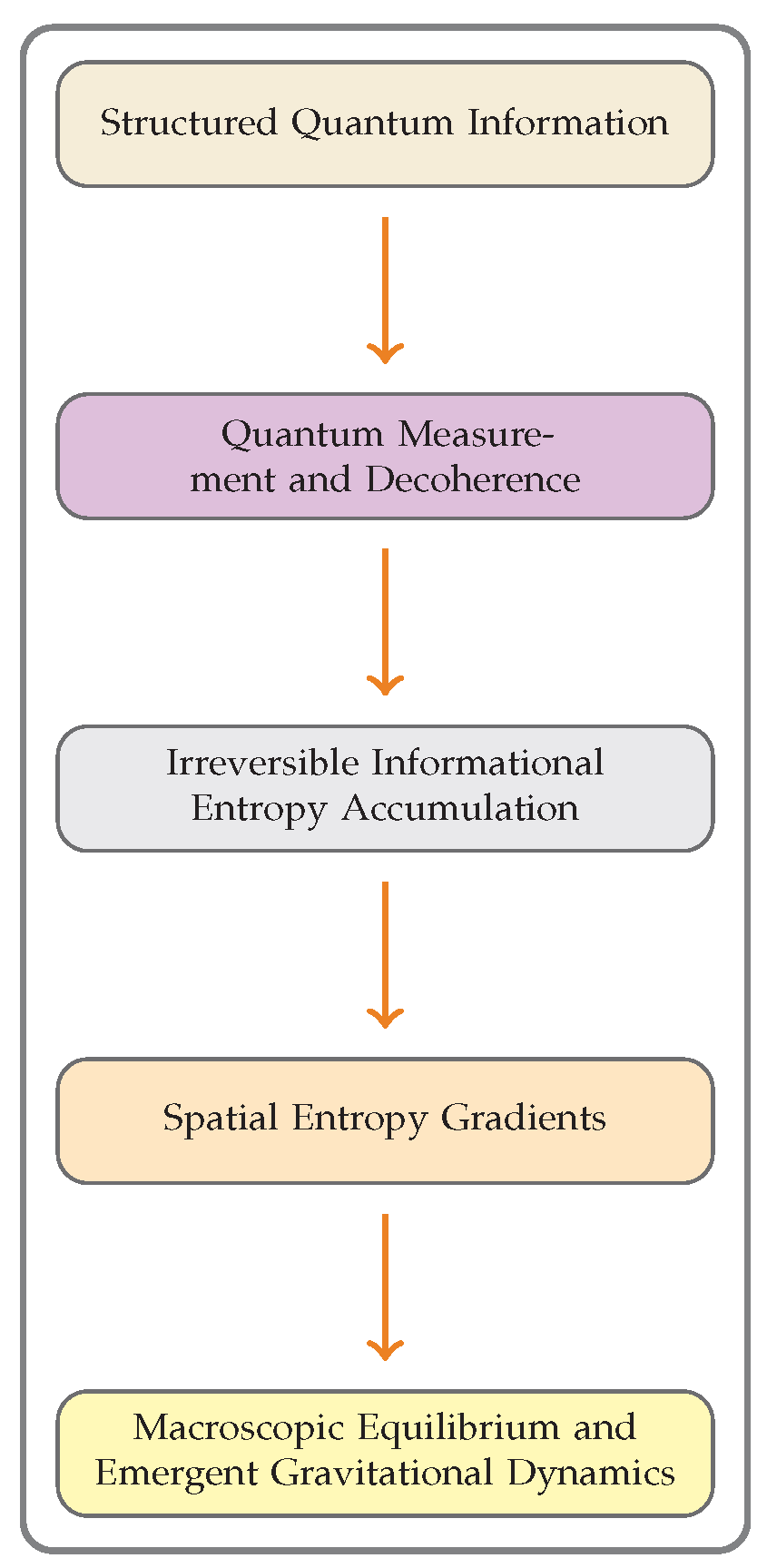
Figure 2.
Two-parameter surface of the normalised gravitational coupling as a function of screen coding efficiency and composite informational efficiency , with the Higgs-sector energy density held normalised. Coloured contours indicate regions of constant , including the observationally consistent locus . The surface illustrates the degeneracy structure of Informational Entropic Gravity, showing how distinct informational configurations can reproduce the observed gravitational coupling.
Figure 2.
Two-parameter surface of the normalised gravitational coupling as a function of screen coding efficiency and composite informational efficiency , with the Higgs-sector energy density held normalised. Coloured contours indicate regions of constant , including the observationally consistent locus . The surface illustrates the degeneracy structure of Informational Entropic Gravity, showing how distinct informational configurations can reproduce the observed gravitational coupling.
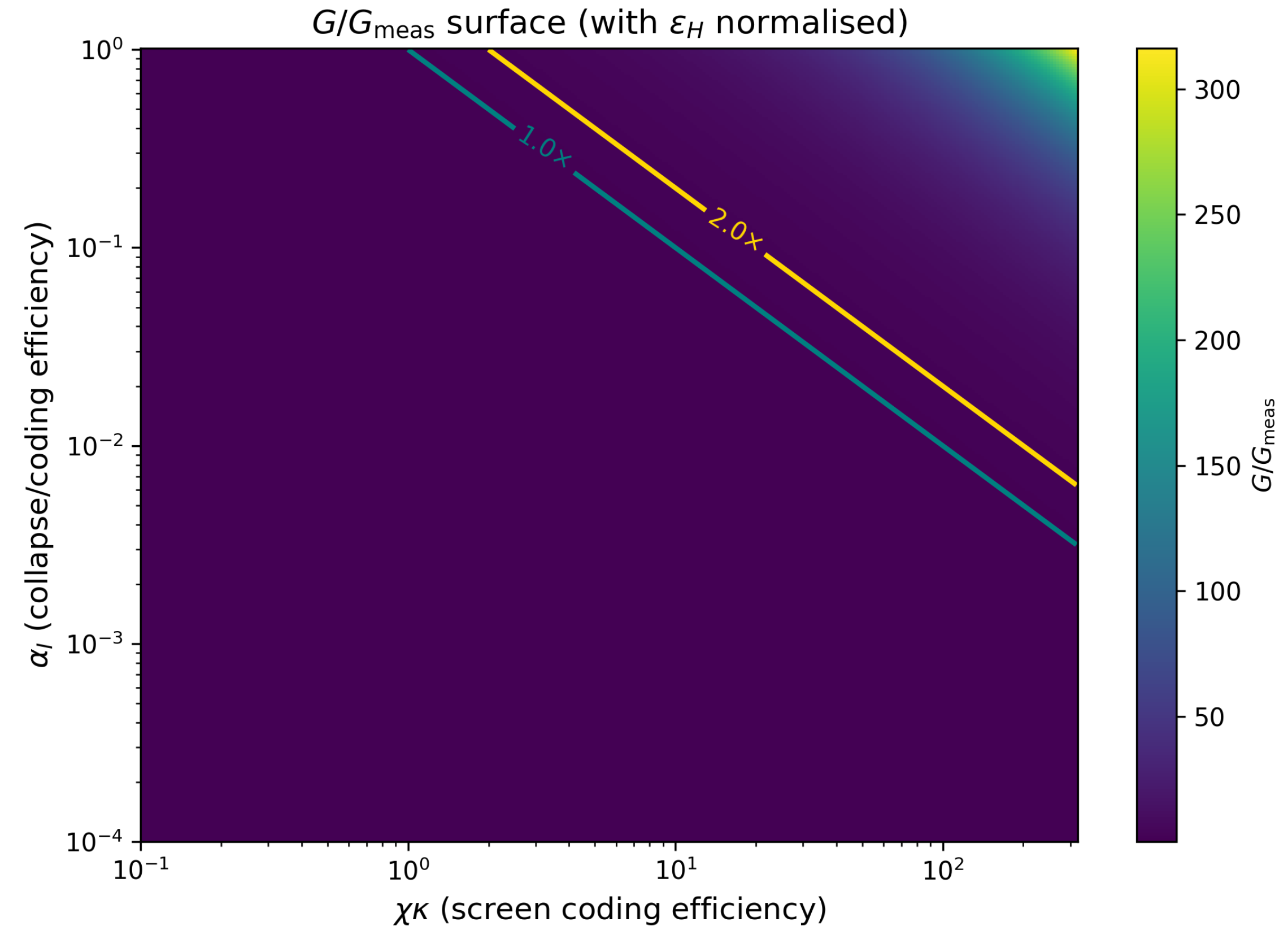
Figure 3.
Scaling of the informational length as a function of the screen coding efficiency . The dashed vertical line marks the natural coding choice , for which coincides with the Planck length (horizontal dotted line). The figure demonstrates that the Planck scale emerges naturally as a fixed point of informational symmetry rather than being imposed by hand, reinforcing the interpretation of as an emergent informational length.
Figure 3.
Scaling of the informational length as a function of the screen coding efficiency . The dashed vertical line marks the natural coding choice , for which coincides with the Planck length (horizontal dotted line). The figure demonstrates that the Planck scale emerges naturally as a fixed point of informational symmetry rather than being imposed by hand, reinforcing the interpretation of as an emergent informational length.
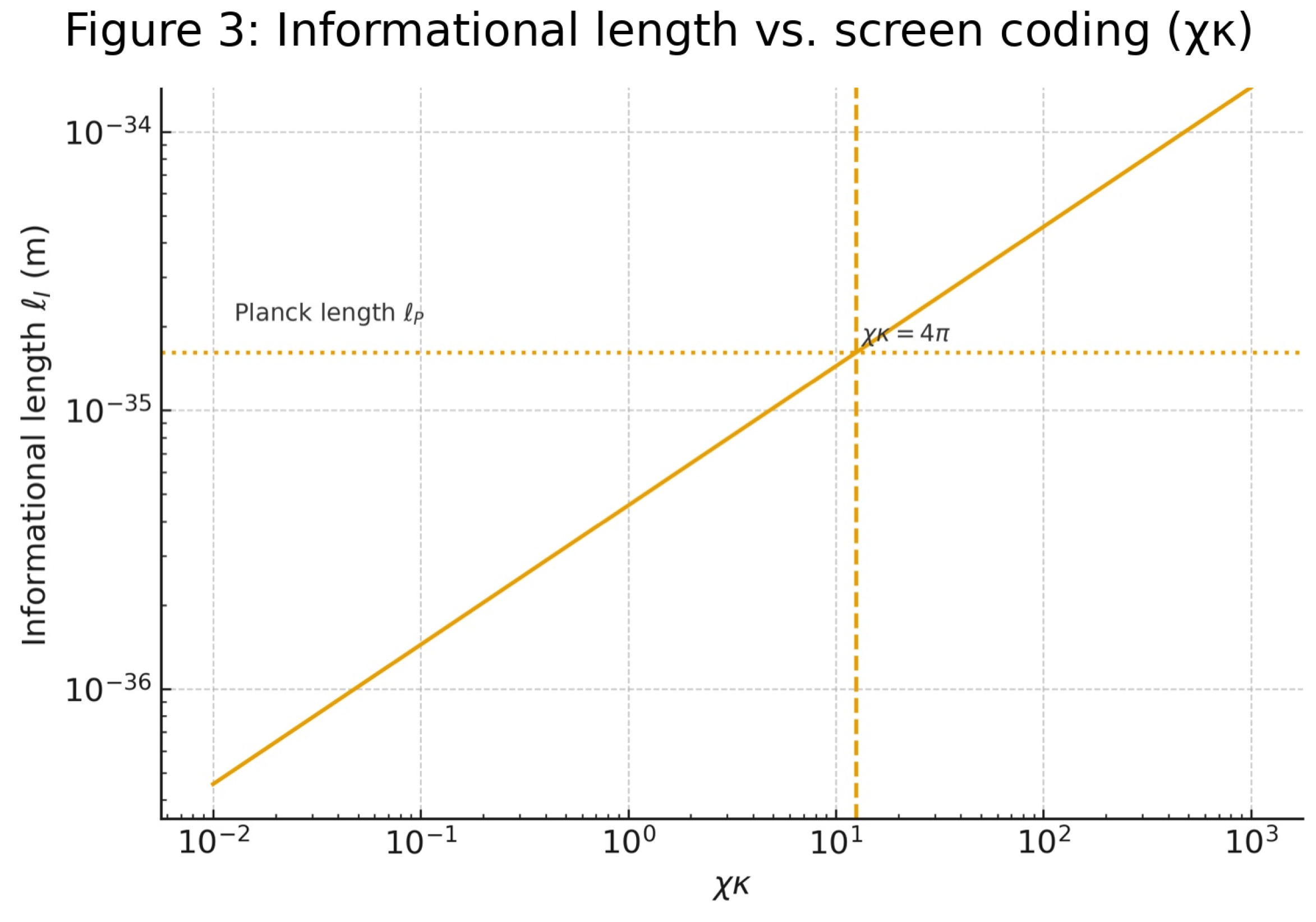
Figure 4.
Comparative collapse behaviour across physical scales. The figure shows how collapse persistence depends on observation density for photon-scale, Planck-scale, and Higgs-scale regimes. The distinct scaling behaviours support an interpretation in which classical structure and gravitational coupling emerge from scale-dependent informational dynamics.
Figure 4.
Comparative collapse behaviour across physical scales. The figure shows how collapse persistence depends on observation density for photon-scale, Planck-scale, and Higgs-scale regimes. The distinct scaling behaviours support an interpretation in which classical structure and gravitational coupling emerge from scale-dependent informational dynamics.
Disclaimer/Publisher’s Note: The statements, opinions and data contained in all publications are solely those of the individual author(s) and contributor(s) and not of MDPI and/or the editor(s). MDPI and/or the editor(s) disclaim responsibility for any injury to people or property resulting from any ideas, methods, instructions or products referred to in the content. |
© 2026 by the authors. Licensee MDPI, Basel, Switzerland. This article is an open access article distributed under the terms and conditions of the Creative Commons Attribution (CC BY) license (http://creativecommons.org/licenses/by/4.0/).
Copyright: This open access article is published under a Creative Commons CC BY 4.0 license, which permit the free download, distribution, and reuse, provided that the author and preprint are cited in any reuse.


