

Submitted:
28 January 2026
Posted:
28 January 2026
You are already at the latest version
Abstract
Bologna-style reforms have travelled well beyond the European Higher Education Area. Yet outside formal membership, it is often unclear whether these reforms lead to convergence or to local hybrids. This article examines how Bologna-style tools are localized in Kyrgyzstan through a comparative documentary case study of three management master’s programs: Kyrgyz Economic University (KEU), International University of Kyrgyzstan (IUK), and Kyrgyz State Technical University named after I. Razzakov (KSTU). Using Acharya’s (2004) norm localization framework and insights from policy borrowing research (Phillips & Ochs, 2003; Steiner‑Khamsi, 2004), the study traces how credits, curriculum structures, competence language, and quality mechanisms are reframed and adapted in different institutional settings. Evidence from program documents shows formal alignment around a two‑year, 120‑ECTS master’s structure, while the meaning of these tools varies by institutional logic: market‑sectoral (KEU), donor‑driven (IUK), and technocratic (KSTU). The findings suggest limited convergence and strong localization through selective adoption and institutional translation. The study contributes to policy borrowing literature by showing how Bologna-style tools can be reconstructed to fit post-Soviet governance logics while maintaining formal alignment with international standards.
Keywords:
Bologna process
; Kyrgyzstan
; norm localization
; policy borrowing
; higher education reform
; quality assurance
Introduction:
Kyrgyzstan has adopted many Bologna-style tools in higher education. This is visible in national regulation and in program documentation. Government Resolution No. 496 (2011) defines the credit system and sets clear workload rules, including the statement that one credit unit equals 30 academic hours (Government of the Kyrgyz Republic, 2011). In management master’s programmes, a two-year structure with a total workload of 120 ECTS is also common. At Kyrgyz Economic University (KEU), the Management OOP states a two-year duration and a workload of 120 credits (Kyrgyz Economic University named after M. Ryskulbekov, 2022, p. 4). At International University of Kyrgyzstan (IUK), the TALENT curriculum map frames the master’s cycle as 120 ECTS over two years (four semesters) (TALENT Consortium, 2019, p. 6). At Kyrgyz State Technical University named after I. Razzakov (KSTU), the master's programme description also states two years and 120 ECTS credits (KSTU, 2024).
These facts can look like convergence to the Bologna model. Yet formal alignment does not show how the tools are understood and used in practice—a common issue in post-Soviet reform settings, where imported standards often coexist with older governance routines and curriculum traditions. (DeYoung, 2011; Shadymanova & Amsler, 2018). In higher education research, this tension is often discussed through the convergence–divergence debate (Bennett, 1991; Georgiadis, 2008). However, this debate can miss the role of local actors in shaping what reforms become after they arrive.
To address this, the paper uses Acharya’s (2004) norm localization theory. Acharya argues that external norms are accepted through local reconstruction, not simple copying. Local actors reshape new ideas so they fit local institutions and interests. In this view, Bologna-style reforms are not only technical devices. They also become part of domestic governance. Policy borrowing research makes a similar point. Borrowed reforms can be selected and reframed to meet local needs, including legitimacy and external signalling (Phillips & Ochs, 2003; Steiner-Khamsi, 2004; Silova, 2005).
The Kyrgyz case shows clear signs of localization “friction.” Resolution No. 496 (2011) links credits to workload, but it also requires that contact hours make up at least 50 percent of the total workload (Government of the Kyrgyz Republic, 2011, Clause 4; Annex 1). This rule matters because it changes how credits function. It keeps classroom time central, even when credit language is adopted. Quality is also translated in different ways across institutions. At KSTU, external quality is linked to ISO 9001:2015 certification, where the scope explicitly includes higher professional education and scientific research activities (Quality Austria, 2022). This suggests a technocratic reading of “quality,” where education is framed through process management and standard routines.
A second feature is fragmentation. Some Bologna-style elements enter Kyrgyzstan through donor and project channels. Others are embedded in national standards and university OOP documents. The TALENT project provides a competence-based curriculum map for a full master’s cycle (TALENT Consortium, 2019). In KEU’s OOP, program profiles show a different kind of translation, with profile-based grids and strong core modules (Kyrgyz Economic University named after M. Ryskulbekov, 2022, pp. 7–10). This difference suggests that reforms can be strong in project-driven spaces but uneven across the system. Regional evidence also notes that project impacts often remain institutional and are difficult to mainstream nationally (European Commission/EACEA, 2022, p. 24).
Based on these observations, the paper asks three questions. First, what factors help explain Kyrgyzstan’s interest in Bologna-style reforms in a post-Soviet context. Second, how are Bologna tools localized through domestic governance logics and institutional incentives. Third, how do localization patterns differ across KEU, IUK, and KSTU when we compare management master’s programmes. The study combines a structured review of research and policy texts with a comparative documentary case study. The analysis suggests that convergence to the Bologna model is limited. Bologna tools are localized in ways that create formal alignment but also preserve institutional continuity and uneven implementation.
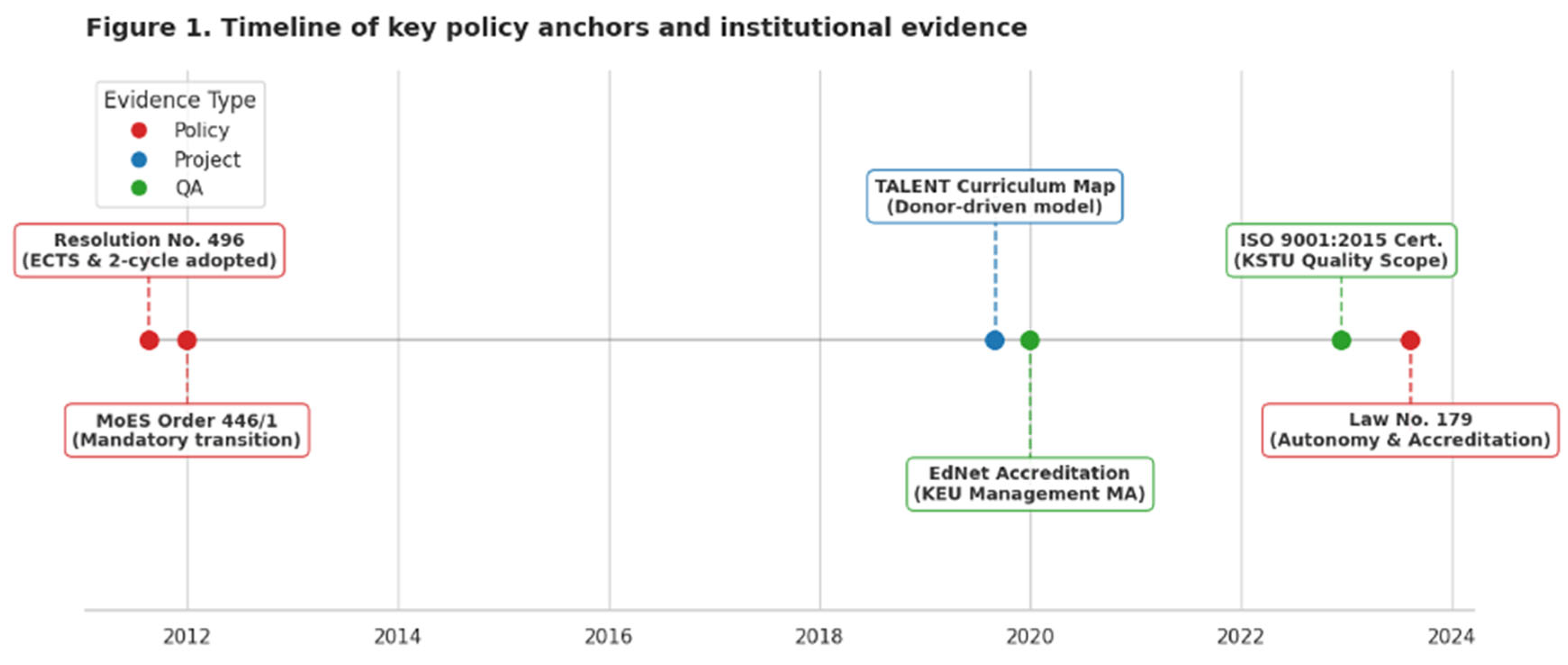
Figure 1.
Timeline of key policy anchors and institutional evidence in Kyrgyzstan's higher education reform.
Figure 1.
Timeline of key policy anchors and institutional evidence in Kyrgyzstan's higher education reform.
Theoretical Framework
2.1. Norms and Bologna-Style Reforms
This study treats Bologna-style reforms as a set of travelling norms and tools. In international relations, a norm is often defined as “a standard of appropriate behavior for actors with a given identity” (Finnemore & Sikkink, 1998, p. 891). In higher education, Bologna reforms carry such expectations. They promote a shared view of what a “modern” system should look like. This includes comparable degrees, portable credits, competence-based curriculum language, and external quality assurance routines.
In formal Bologna governance, many of these tools are voluntary. Still, they create standards that are widely seen as legitimate and useful. This is one reason they travel beyond Europe and beyond formal membership settings. In Kyrgyzstan, the adoption of a 120 ECTS, two-year master’s cycle and the use of credit-based regulation show that Bologna-style tools have entered domestic higher education reform.
2.2. Norm Localization
The main analytical lens in this paper is Acharya’s (2004) norm localization theory. Acharya argues against a simple view where external standards replace local practices. Instead, local actors reshape external norms so they fit local beliefs, institutions, and interests. This is the core idea of localization. Acharya links acceptance to “congruence building.” In simple terms, a foreign norm becomes acceptable when it can be made consistent with local rules and expectations (Acharya, 2004).
Localization is useful because it avoids a strict “success/failure” view of reform. It also goes beyond the convergence–divergence debate. A convergence lens can focus too much on formal similarity, such as the adoption of degree cycles and ECTS totals. A divergence lens can focus too much on difference and treat local outcomes as resistance. Localization focuses on translation. It asks how and why reforms are reconstructed after they arrive.
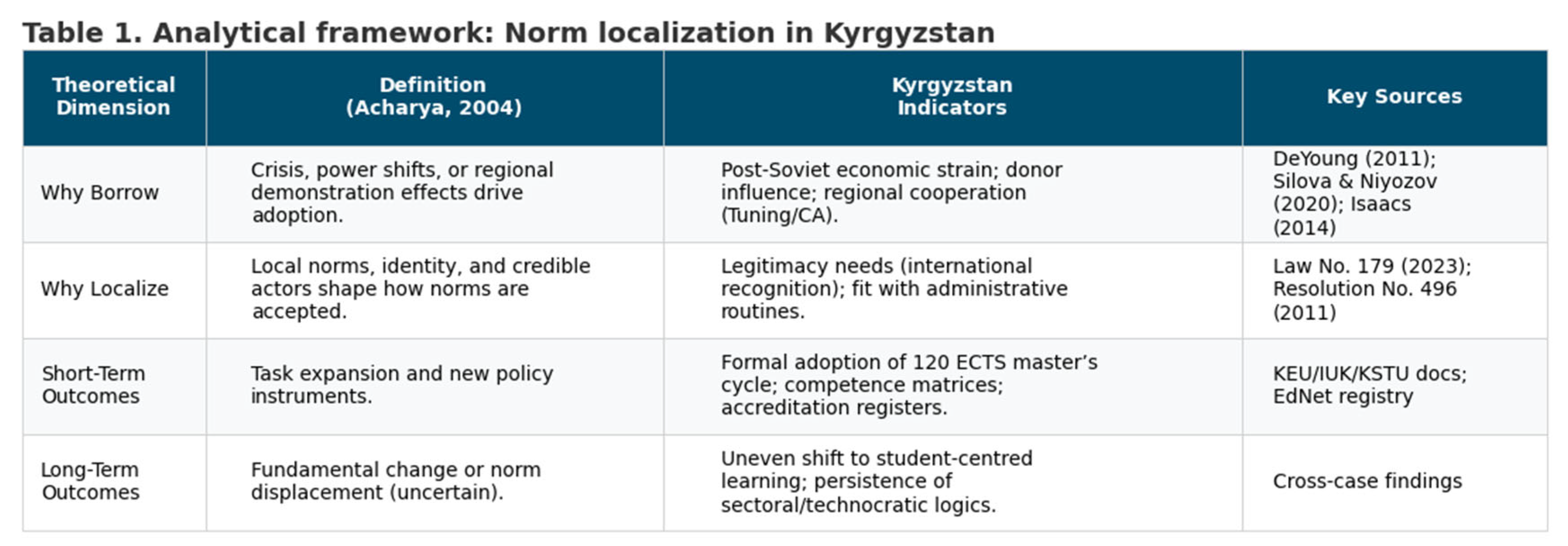
Acharya (2004) also identifies reasons for borrowing norms, reasons for localizing them, and possible outcomes. These categories can be used as an analytical framework for documentary evidence in higher education reform.

Table 1.
Analytical framework: Norm localization in Kyrgyzstan (adapted from Acharya, 2004).
 |
2.3. Policy Borrowing as Selection and Reframing
Norm localization is compatible with education policy borrowing research. Phillips and Ochs (2003) stress that borrowing is not simple copying. It involves selection, internalisation, and local decision-making. Steiner-Khamsi (2004) adds that borrowing often has a political economy dimension. Reforms can be used to signal modernisation, attract support, and strengthen legitimacy. These perspectives help explain why Bologna-style reforms can spread quickly in documents, while deeper changes can remain uneven.
In Kyrgyzstan, these ideas are relevant because many Bologna-style tools are visible as formal structures. At the same time, national rules can reshape their meaning. For example, Resolution No. 496 (2011) defines one credit unit as 30 academic hours and requires at least 50 percent contact hours (Government of the Kyrgyz Republic, 2011). This shows a local adjustment to a tool that is often presented as workload-based and student-centred.
2.4. How the Framework Is Used in This Study
This paper uses the localization framework in two connected ways.
First, it explains why Bologna-style reforms were borrowed. Here the focus is on post-Soviet drivers such as economic strain, expansion of higher education, and the influence of donors and regional cooperation (DeYoung, 2011; Silova & Niyozov, 2020; Isaacs, 2014). These drivers create demand for internationally legible tools.
Second, it explains how Bologna tools were localized in Kyrgyzstan. The analysis looks for evidence of:
reframing (how reforms are justified in laws, OOP documents, and project materials)
selective adoption (which tools become visible first, and which remain weak)
institutional translation (how tools are embedded in different university governance logics)
The three-university comparison (KEU, IUK, KSTU) is used to show variation under a shared national context. All three cases present the same formal master’s structure (two years; 120 ECTS), but they show different translations in curriculum architecture and quality mechanisms. This supports the idea that a single reform template can produce different local outcomes.
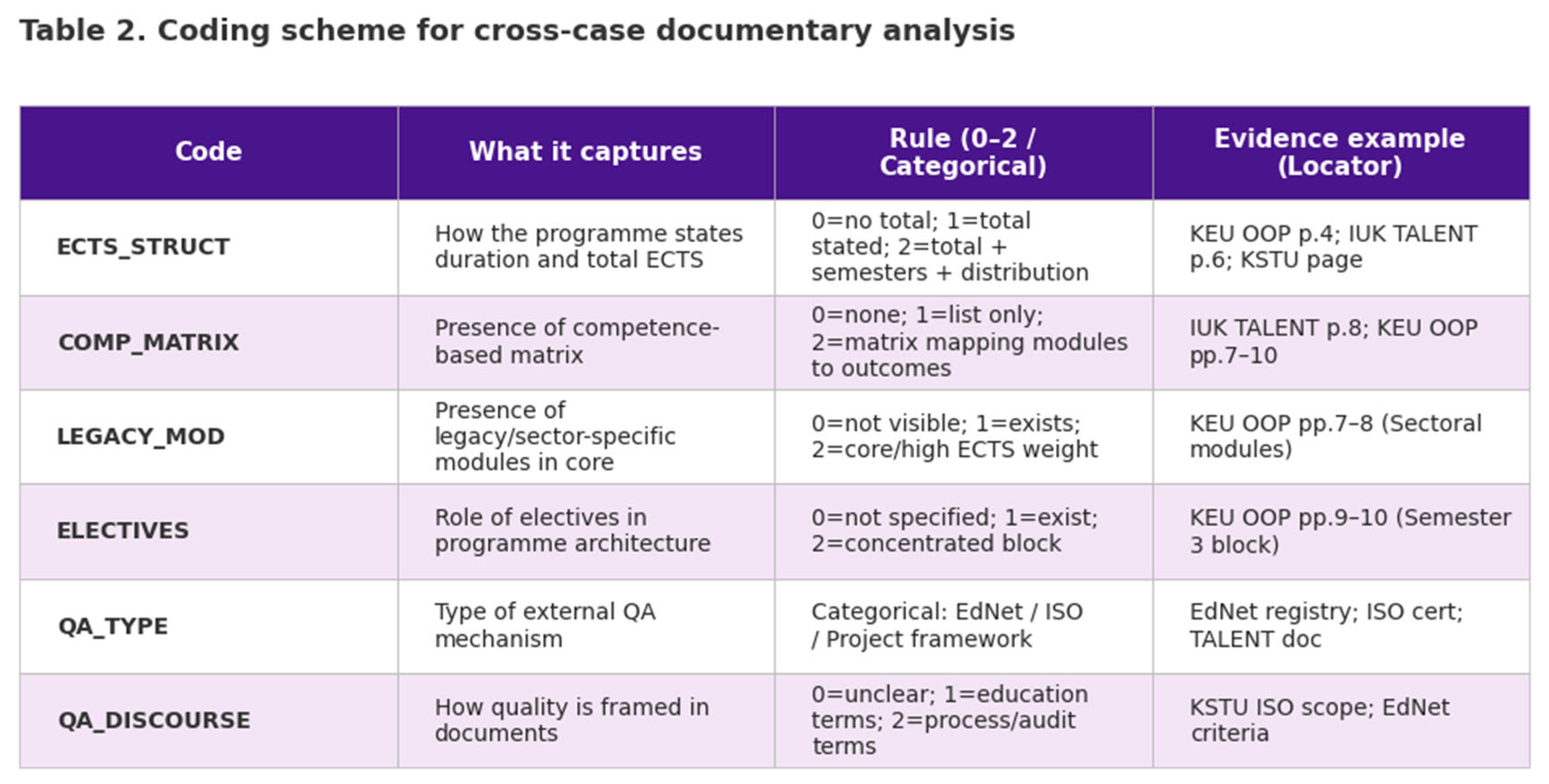
Table 2.
Coding scheme for cross-case documentary analysis.
 |
Research Method
3.1. Research Design
This study combines two approaches. First, it uses a structured review of research and policy texts to build the post-Soviet and Central Asian context for Bologna-style reforms. Second, it applies a comparative documentary case study to examine how Bologna-style tools are translated in three universities at the master’s level. This design follows the logic of the model article. It links a general explanation (why reforms travel) with a grounded explanation (how they are reshaped in specific institutions).
A documentary approach is appropriate for this topic because Bologna-style reforms travel through texts. They are often implemented as legal provisions, program templates, credit tables, competence matrices, and quality procedures. These forms produce traceable evidence. They allow the researcher to compare how similar tools are presented and organised across institutions. They also allow the researcher to identify points of “friction,” where a tool is adjusted to fit local routines.
The unit of analysis in the cross-case part is the management master’s programme (Direction 580200 Management and closely related management master’s cycles as formally described in program documentation). The study focuses on the master’s level because Bologna tools are clearly visible there in Kyrgyzstan. All three cases frame the master’s cycle as 120 ECTS over two years. This makes programs comparable and allows the analysis to focus on translation rather than on basic structural differences.
3.2. Case Selection
The study examines three Kyrgyz HEIs:
Kyrgyz Economic University (KEU)
International University of Kyrgyzstan (IUK)
Kyrgyz State Technical University named after I. Razzakov (KSTU)
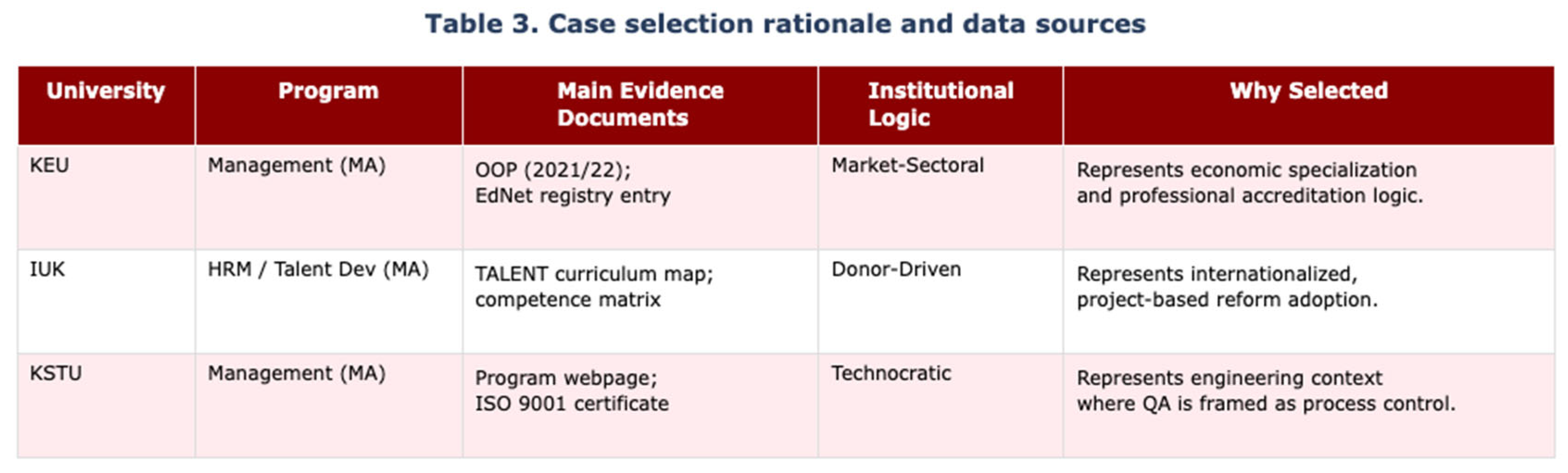
These cases were selected to capture institutional variation under a shared national framework. The cases represent three distinct “translations” of Bologna-style tools in Kyrgyzstan’s higher education governance.
KEU represents a market-sectoral translation. Its OOP documents show a standard 120 ECTS master’s structure, but also a profile-based program design and strong core modules that reflect local economic priorities and legacy content.
IUK represents a donor-driven translation. Program structure and competence framing are strongly shaped by project deliverables, especially Erasmus+ TALENT. These documents provide a modular design and competence mapping that are meant to be portable and comparable across partner universities.
KSTU represents a technocratic translation. Its management master’s program is embedded in an engineering-oriented institutional environment. External quality is also framed through ISO 9001:2015 certification, where the scope covers higher professional education and research activities. This provides a distinct quality governance logic.
Table 3.
Case selection rationale and data sources.
 |
3.3. Data Sources
The evidence base is organised in three layers.
3.3.1. National-Level Legal and Regulatory Texts
National texts are used to identify the formal rules that shape curriculum design, accreditation, and credit allocation. Two national anchors are central in this study:
Government Resolution No. 496 (2011). This resolution defines key credit rules, including the definition that one credit unit equals 30 academic hours and a rule that contact hours should constitute at least 50 percent of total workload (Government of the Kyrgyz Republic, 2011, Clause 4; Annex 1). These clauses provide a clear example of how a Bologna-style tool is operationalised domestically.
Law of the Kyrgyz Republic “On Education” (No. 179, 11 August 2023). This law provides the legal framing for higher education programs and accreditation arrangements. In this study, Article 18 and Article 30 are treated as key reference points because they define higher education program types and the role of independent accreditation agencies (Law of the Kyrgyz Republic, 2023, Art. 18; Art. 30).
These national texts are used as baseline constraints shared by all three cases.
3.3.2. Regional, Donor, and Project Documents
Regional and donor materials are used to trace how reform templates enter the system and how they are packaged. These sources include:
Regional cooperation literature on building a Central Asian higher education area, including competence-based tools and credit transfer logics (Isaacs, 2014).
System and policy reports describing higher education in Kyrgyzstan (European Commission/EACEA, n.d.).
Erasmus+ TALENT project deliverables. In this study, the TALENT curriculum map is a key artifact because it provides a clear structure: “Total workload of 120 ECTS distributed over 2 years (4 semesters) of the Master of Management cycle” (TALENT Consortium, 2019, p. 6, Table 1). The same document also provides competence mapping structures (TALENT Consortium, 2019, p. 8).
Project documents are treated as evidence of donor-driven diffusion and as a benchmark for program design features that are framed as “European standard.”
3.3.3. University-Level Program and Quality Documents
University-level evidence focuses on program architecture and quality mechanisms. For each case, the study uses the most direct and traceable documents available:
KEU: the Main Educational Program (OOP) for Management (Master’s level), 2021/2022 revision. The study uses the OOP statement of duration and workload (p. 4) and profile-based structural sections (pp. 7–10). It also uses course placement evidence within the program grid.
IUK: the TALENT curriculum map as a program-level design artifact used for the HRM master track and related management master cycles. Where available, additional module descriptions are used to identify competence mapping logic.
KSTU: the master’s program description page for Direction 580200 Management, which states duration and total ECTS. For external quality framing, the study uses ISO 9001:2015 certification evidence (Quality Austria, 2022).
External quality signals are also captured through accreditation registers. For KEU, an EdNet registry entry is used as evidence of independent program accreditation (EdNet, 2020).
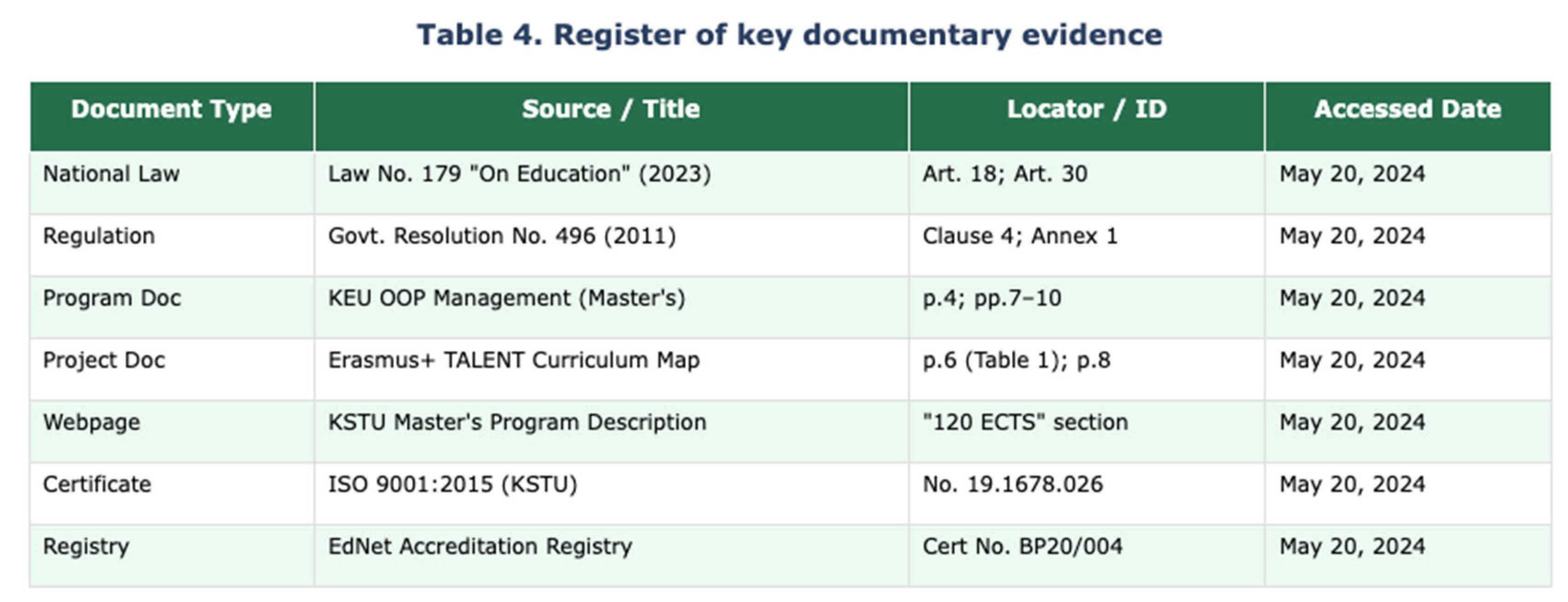
Table 4.
Register of key documentary evidence.
 |
3.4. Data Collection and Traceability
Documents were collected through targeted searches of official and institutional websites and project pages. For each source, the study records:
URL
date of access
file name (if PDF)
page number, table identifier, or clause number (for citations)
For web pages, the relevant text is archived as a screenshot or saved as PDF. This step is used to ensure that evidence remains stable even if web content changes. For PDFs, citations include page and table numbers when available.
3.5. Data Analysis
The analysis combines two coding layers.
First, it uses Acharya’s (2004) framework to organise interpretation. Evidence is coded for:
borrowing pressures (post-Soviet strain, donor influence, regional diffusion)
localization drivers (legitimacy needs, fit with local routines, credible channels)
outcomes (short-term tool expansion and long-term uncertainty)
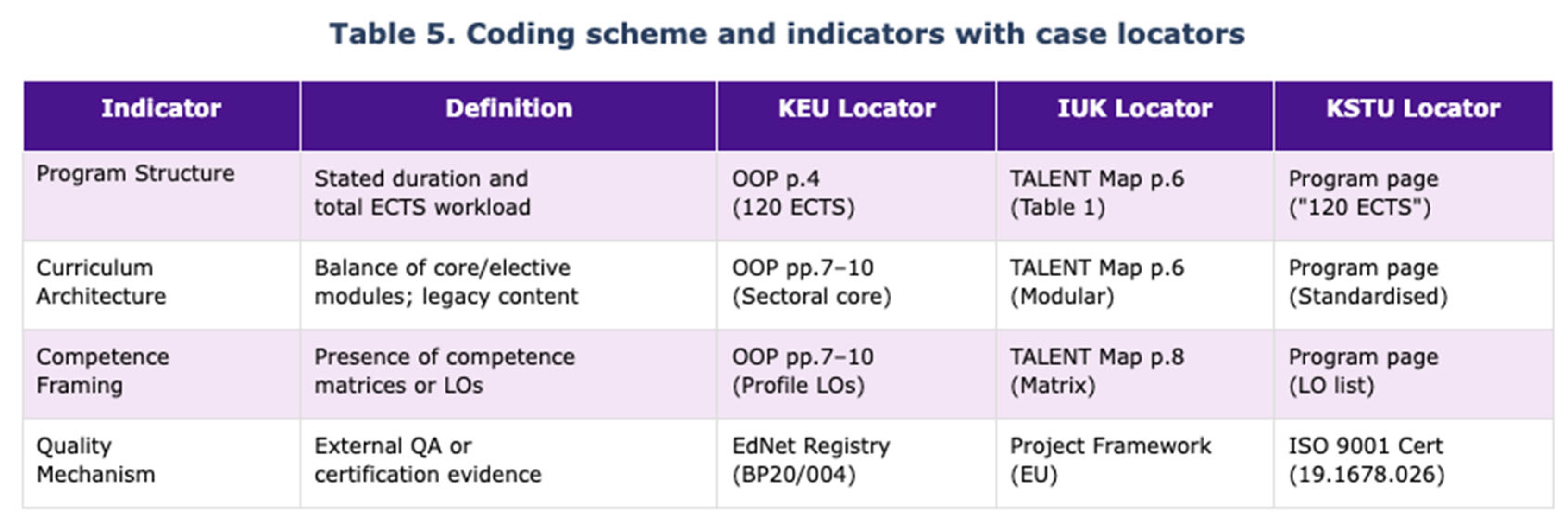
Second, it applies cross-case program coding. The three cases are compared using the same indicators:
Program structure: stated duration and total ECTS (2 years; 120 ECTS)
Curriculum architecture: core vs elective balance; presence of legacy or sectoral modules; profile differentiation
Competence and outcomes framing: presence of competence matrices; mapping logic; explicit learning outcomes language
Quality mechanism: professional accreditation register entries; project deliverable framing; ISO/QMS certification scope
This approach allows the study to separate “formal alignment” from “translation in use.” It also allows the analysis to link institutional differences to localization patterns without assuming that one model is fully adopted.
Table 5.
Coding scheme and indicators with case locators.
 |
Findings
4.1. Reasons for the Adoption of Bologna-Style Reforms in the Post-Soviet Context
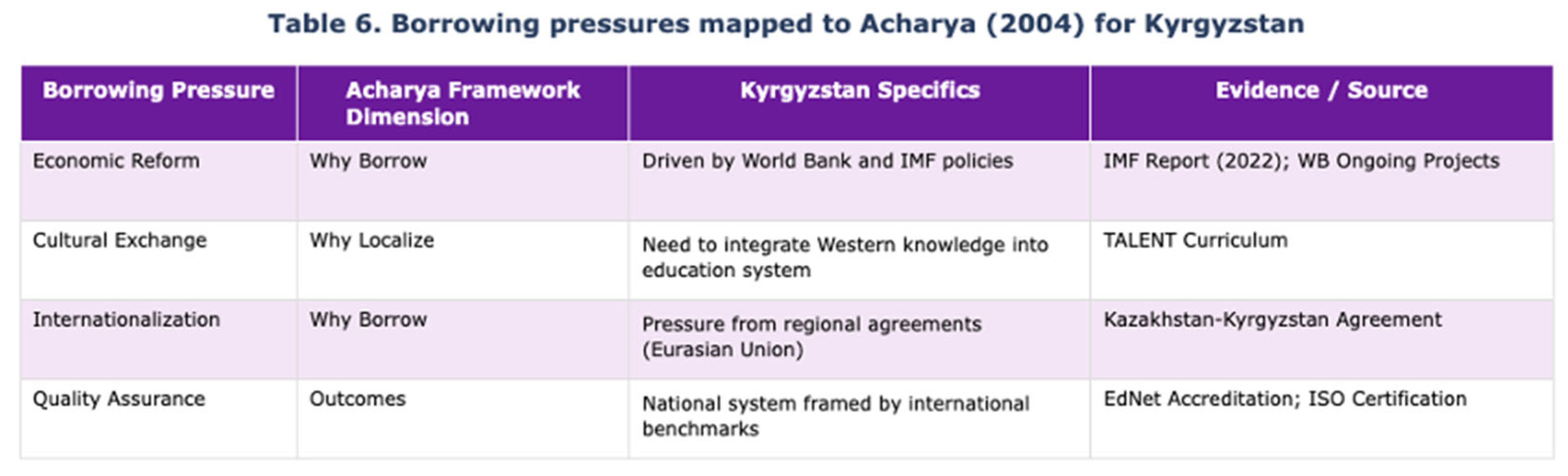
Acharya (2004) argues that countries borrow external norms under specific conditions: crisis, shifts in power, and regional demonstration effects. The post-Soviet context reflects all three. After 1991, higher education systems across the former Soviet space faced major disruption. State funding declined, institutions expanded, and universities had to operate in a new market environment. In many countries, this combination created pressure for reform and demand for internationally legible policy tools (Silova & Niyozov, 2020; DeYoung, 2011).
Economic and institutional strain is one key driver. In Kyrgyzstan, higher education expanded rapidly, while resources and institutional capacity remained uneven. DeYoung (2011) describes how higher education stayed highly valued socially, even as accountability mechanisms were weak and quality was contested. In such settings, adopting a recognised reform vocabulary can be attractive. Bologna-style tools offer ready-made categories that look modern and internationally comparable. They also offer administrative templates that can be quickly adopted in documents and reporting.
A second driver is the shift in global and domestic power relations. In the post-Soviet era, international organisations and donors became more active in education reform across Central Asia (Silova & Niyozov, 2020). Their projects often promoted a shared global language, such as learning outcomes, employability, transparency, and quality assurance. These terms can function as travelling policy scripts. They can be used by ministries and universities to present reforms as aligned with global standards. This is a known pattern in education policy borrowing, where reforms travel not only because they “work,” but because they are politically and institutionally useful (Phillips & Ochs, 2003; Steiner-Khamsi, 2004).
A third driver is a regional demonstration effect. Acharya (2004) notes that policy diffusion often happens through regional examples. In Central Asia, regional cooperation and European-supported initiatives promoted a shared reform vocabulary and tools, including competence-based curriculum design and credit transfer logics (Isaacs, 2014). Such initiatives reduce the entry costs of borrowing. They also create incentives for institutions to show compatibility with external partners, especially through program structures and documentation that can be easily presented.
Taken together, these drivers help explain why Kyrgyzstan became strongly interested in Bologna-style reforms. They do not mean that Kyrgyzstan converged to the Bologna model. Instead, they created conditions for selective borrowing. The external norm is attractive because it can support legitimacy and provide ready-made instruments. At the same time, domestic constraints shape what is adopted and how it is used.
Table 6.
Borrowing pressures mapped to Acharya (2004) for Kyrgyzstan.
 |
4.2. Localization of Bologna-Style Reforms in Kyrgyzstan
This section examines domestic conditions that shape Bologna-style reforms in Kyrgyzstan. Following Acharya (2004), the focus is on why borrowed tools are localized and what outcomes this produces. The analysis uses two national anchors (Resolution No. 496, 2011; Law No. 179, 2023) and connects them to institutional evidence from the three cases.
4.2.1. Legitimacy and the Prestige of International Alignment
In post-Soviet settings, international reform language can be used to signal modernisation. It can also strengthen legitimacy at home and abroad (Steiner-Khamsi, 2004; Silova, 2005). Kyrgyzstan’s legal framework provides a clear example of how reform is framed through governance scripts.
The Law of the Kyrgyz Republic “On Education” (No. 179, 11 August 2023) defines the main higher education program types. Article 18 states that higher education is implemented through bachelor, master, and specialist programmes (Law of the Kyrgyz Republic, 2023, Art. 18). Article 30 states that accreditation is conducted by independent accreditation agencies (Law of the Kyrgyz Republic, 2023, Art. 30). These provisions matter because they create a formal policy frame that makes Bologna-style structures and external evaluation appear as part of standard system governance.
In Acharya’s terms, a borrowed norm can support legitimacy when it strengthens existing institutions and practices. In Kyrgyzstan, Bologna-style tools can function as a recognised language of reform. At the same time, legal framing alone does not guarantee full adoption of the Bologna model. It mainly defines what can be shown in documents: programme categories, credit totals, and accreditation arrangements.
4.2.2. Domestic Norms and “Friction” in the Translation of ECTS
A key sign of localization is how a tool is defined and operationalised. ECTS is usually presented as a workload-based system that supports mobility and learning outcomes. In practice, its meaning can shift when it meets existing institutional routines.
Government Resolution No. 496 (2011) provides a direct example. Clause 4 and Annex 1 define the credit in academic hours: “"Трудoемкoсть oднoй зачетнoй единицы (кредита) сoставляет 30 академических часoв" ["The workload of one credit unit equals 30 academic hours"]” (Government of the Kyrgyz Republic, 2011, Clause 4; Annex 1). The same document sets a strong contact-hour requirement: “Объем аудитoрных занятий (кoнтактных часoв) дoлжен сoставлять не менее 50 прoцентoв oт oбщей трудoемкoсти” (Government of the Kyrgyz Republic, 2011, Clause 4; Annex 1). This combination is important. It suggests that credits are not only a workload measure. They are also tied to a minimum share of classroom teaching.
This rule creates a clear “friction point” in the translation of Bologna tools. Credits can be presented in ECTS terms, but the regulation keeps contact hours central. In institutional terms, this can favour a curriculum design logic that remains close to lecture-based teaching and administrative control of workload. It is consistent with Acharya’s argument that local norms can prevent wholesale borrowing and push reforms into adapted forms.
4.2.3. Credible Local Actors and Reform Channels
Acharya (2004) also stresses the role of local actors and channels in norm acceptance. In Kyrgyzstan, reform translation is shaped by ministries, university leadership, and external partners. In education borrowing research, donors and projects are often key carriers of templates and reform language (Steiner-Khamsi, 2004; Silova, 2005). In Central Asia, regional cooperation initiatives also support diffusion by providing shared tools and frameworks (Isaacs, 2014).
In Kyrgyzstan, donor-supported templates are visible in program-level documents, especially at the master’s level. The TALENT project deliverable is one example. It provides a structured curriculum map and a competence-based approach to master’s program design (TALENT Consortium, 2019). Such documents can support fast adoption of visible reform elements. They also provide a technical language that can be used by institutions to present programs as internationally aligned.
At the same time, donor channels can contribute to uneven implementation. Some institutions gain stronger access to templates and networks, while others translate reforms in more administrative or localised ways. This logic will be examined directly in the cross-case comparison.
4.2.4. Quality Assurance as a Key Policy Instrument
Bologna-style reforms often travel most effectively through QA instruments. QA relies on standards, reporting routines, and external evaluation. These tools fit well with systems where formal compliance is an established governance practice.
In Kyrgyzstan, Article 30 of the Education Law provides a legal base for external accreditation through independent agencies (Law of the Kyrgyz Republic, 2023, Art. 30). At the institutional level, external quality signals take different forms. KEU appears in the EdNet register through a program accreditation entry for “Management (Master’s level)” (EdNet, 2020). KSTU also shows a distinct quality logic through ISO 9001:2015 certification. The certificate scope explicitly includes higher professional education and scientific research activities, and it covers engineering, technology, and management (Quality Austria, 2022).
These patterns suggest that QA is not a single instrument in Kyrgyzstan. It is a field of tools that can be localised. Some tools are closer to professional accreditation logics. Others are framed through industrial process standards. Both are compatible with a governance environment where documents and verification procedures matter.
4.2.5. Short-Term and Long-Term Outcomes
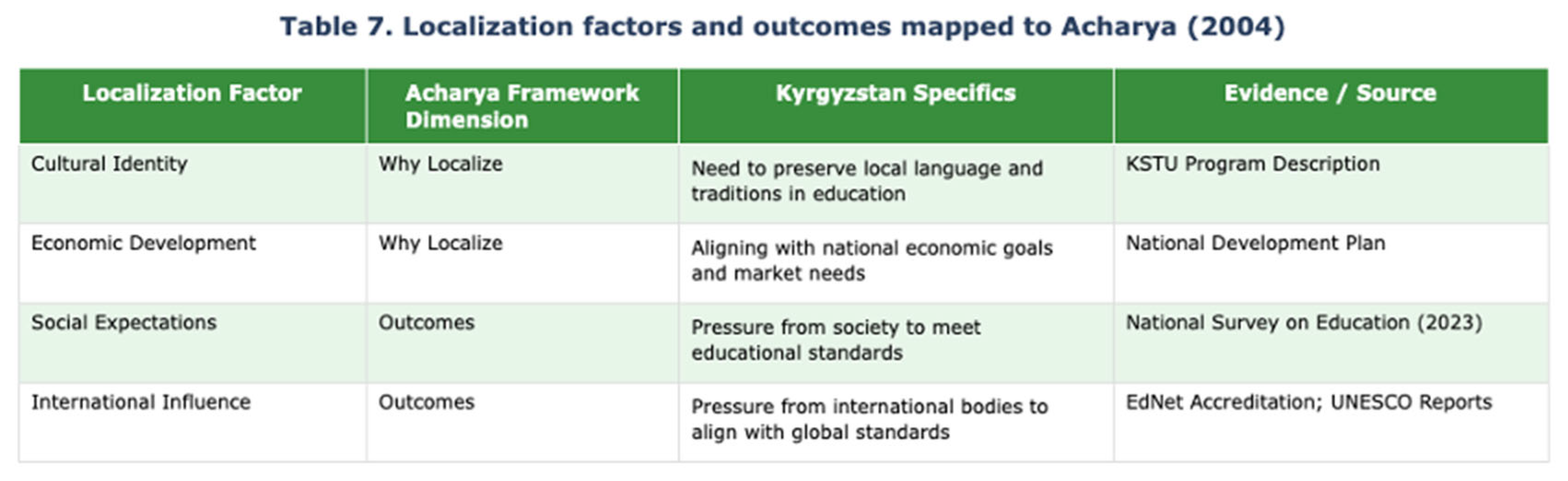
The evidence suggests that localization in Kyrgyzstan produces clearer short-term outcomes than long-term transformation. In the short term, Bologna-style reforms create visible institutional structures and documents:
a shared master’s cycle of 120 ECTS over two years (KEU OOP p. 4; TALENT p. 6; KSTU programme page)
competence matrices and module mapping in donor-linked templates (TALENT p. 8)
external quality signals through professional accreditation registers (EdNet entry) and ISO certification (Quality Austria certificate)
These outcomes allow universities to present programs in internationally legible formats. They also reshape governance routines through program documentation and external evaluation.
Long-term outcomes are less certain. A deeper shift toward competence-based learning and student-centred design requires stable curriculum work, assessment redesign, and institutional capacity. Post-Soviet research highlights persistent constraints such as limited resources, uneven institutional capacity, and inherited governance routines (DeYoung, 2011; Shadymanova & Amsler, 2018). These constraints can limit convergence even when formal alignment expands.
Table 7.
Localization factors and outcomes mapped to Acharya (2004).
 |
4.3. A Comparative Case Study of Management Master’s Programmes: KEU, IUK, and KSTU
This section compares how Bologna-style tools are translated in three Kyrgyz universities at the master’s level. All three cases operate under the same national legal framework. Yet they show different institutional logics in curriculum design and quality mechanisms. The aim is not to rank the universities. The aim is to show how localization varies across institutions.
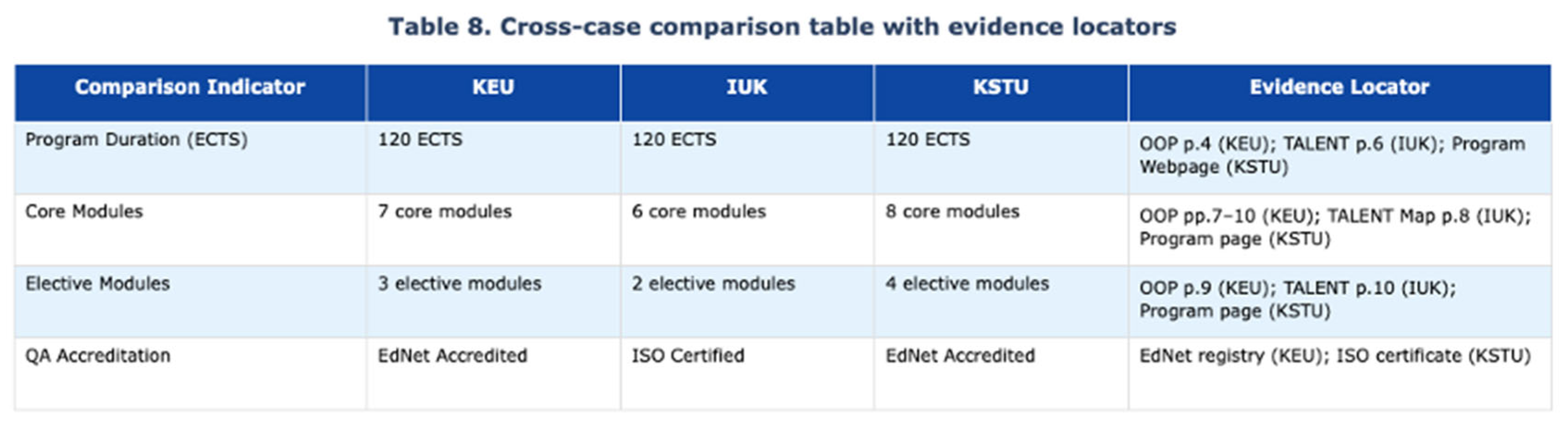
4.3.1. Shared Baseline: A Two-Year, 120 ECTS Master’s Structure
All three cases frame the master’s programme as a two-year cycle with a total workload of 120 ECTS credits. This shared structure provides a clear baseline for comparison.
At KEU, the OOP for “580200 Management (Master’s)” states: “Срoк oсвoения ООП — 2 гoда, трудoемкoсть — 120 зачетных единиц (кредитoв)” (Kyrgyz Economic University named after M. Ryskulbekov, 2022, p. 4, Table 1.1). At IUK, the TALENT curriculum map frames the master’s cycle as: “Total workload of 120 ECTS distributed over 2 years (4 semesters)” (TALENT Consortium, 2019, p. 6, Table 1). At KSTU, the programme page states: "Срoк oбучения … сoставляет 2 гoда … 120 кредитoв (ECTS)" (KSTU, 2024).
This shared format looks like formal convergence. Yet a common structure does not mean a common translation. The differences become clearer when we compare curriculum architecture, competence framing, and quality mechanisms.
4.3.2. KEU: Market-Sectoral Logic and Profile-Based Curriculum Design
KEU represents a market-sectoral translation of Bologna tools. On the surface, the programme follows a standard 120 ECTS structure. The OOP also organises the programme through profiles and detailed grids. This is a typical way to align with a credit-based system while keeping strong internal program control.
In the Crisis Management profile, KEU assigns a large share of the workload to core modules (Kyrgyz Economic University named after M. Ryskulbekov, 2022, pp. 7–8). In the Entrepreneurship profile, elective modules gain more weight in Semester 3 (Kyrgyz Economic University named after M. Ryskulbekov, 2022, pp. 9–10). This indicates that Bologna tools (credit totals and programme grids) are used to organise a curriculum that reflects local program priorities and market narratives, while also retaining continuity in core content.
KEU also shows an external QA signal through independent program accreditation. In the EdNet register, KEU appears with a program accreditation entry for “Management (Master’s level),” with validity 2020–2025 and certificate number BP20/004 (EdNet, 2020). This supports the view that Bologna-style QA is translated through professional accreditation mechanisms and external visibility. The existence of a register entry does not prove teaching change, but it shows that quality is governed partly through external evaluation and documentation.
4.3.3. IUK: Donor-Driven Logic and Competence-Based Templates
IUK reflects a donor-driven translation pathway. The TALENT project deliverable provides a structured curriculum map. It includes a full 120 ECTS design distributed over four semesters (TALENT Consortium, 2019, p. 6, Table 1). It also presents competence mapping (TALENT Consortium, 2019, p. 8). This is an example of how Bologna-style tools can enter directly through project templates.
In this translation, competence language is not only a general policy slogan. It is embedded in a curriculum design format. The document frames the master’s cycle as aligned with EHEA standards and uses structured mapping of modules to learning outcomes (TALENT Consortium, 2019, p. 8). This makes the program legible to external partners and supports portability.
At the same time, such project-based reforms can remain partly “island-like.” They can show strong formal design in a specific program or track, but they may have limited spillover into other programs not covered by donor channels. This is not a claim about success or failure. It is a structural observation about how reform templates enter and circulate.
4.3.4. KSTU: Technocratic Logic and ISO-Based Quality Management
KSTU shows a technocratic translation of Bologna-style reforms. The management master's programme is framed as two years and 120 ECTS credits, which confirms the shared baseline (KSTU, 2024). The distinctive feature of KSTU is how quality is governed and described.
KSTU holds ISO 9001:2015 certification. The certificate scope includes “Provision of higher professional education, additional professional education and scientific research activities in the fields of engineering, technology and management” (Quality Austria, 2022). The certificate is numbered 19.1678.026 and is valid from 2022-12-15 to 2025-12-14 (Quality Austria, 2022). This suggests a strong process and standardisation framing of quality. In this translation, quality is linked to routines such as audit and document control, which are typical in industrial management systems.
This provides a concrete example of “grafting” in Acharya’s terms. A Bologna-style emphasis on QA and external assurance is connected to a technocratic logic where education is treated as a process that can be standardised and verified. This logic can support formal alignment while also shaping what “quality” means in practice.
4.3.5. Cross-Case Summary
The comparison shows that a shared Bologna-style structure (120 ECTS, two-year master's cycle) coexists with quite different institutional translations. The three cases reflect three dominant logics: market-sectoral (KEU), donor-driven (IUK), and technocratic (KSTU). These logics shape how credits, modules, competence language, and quality mechanisms are interpreted and used.
The evidence supports the localization argument. Bologna-style tools travel to Kyrgyzstan and become visible as program structures and governance instruments. Yet they are reconstructed in different ways across institutions. This variation is consistent with Acharya’s view that external norms are accepted through local reconstruction rather than simple copying (Acharya, 2004).
Table 8.
Cross-case comparison of Bologna-style localization in management master's programmes.
 |
Discussion
This study set out to reconceptualize Bologna-style reforms in Kyrgyzstan through the lens of norm localization (Acharya, 2004). The findings support three main points about how external norms travel and how they are reshaped in a post-Soviet context.
First, the Kyrgyz case shows why the convergence–divergence debate is not enough. At the level of formal program structure, there is clear alignment. The master’s cycle is framed as two years and 120 ECTS across KEU, IUK, and KSTU. This looks like convergence. Yet the cross-case evidence shows that the same toolset does not lead to the same meaning. Credits, modules, and quality mechanisms are used in different ways. This is a central idea in Acharya (2004). External norms are accepted through reconstruction, not through copying.
Second, the evidence supports a political-economy reading of borrowing. Policy borrowing can serve legitimacy and signalling, not only technical improvement (Steiner-Khamsi, 2004). In Kyrgyzstan, Bologna-style reforms provide a recognised language of modernisation. They help universities present programs in an internationally legible format. They also help connect programs to external partners and projects. This is visible in the donor-linked IUK case, where a competence-based matrix and a modular curriculum design are framed through a project deliverable. It is also visible in KEU, where the program is organised in a standard ECTS format but keeps strong sectoral core content. KSTU shows another form. It translates quality into an ISO-based process model. In this case, “quality” is tied to procedures, audits, and standardisation routines. This suggests that Bologna-style QA expectations can be grafted onto an industrial logic.
A useful comparison is Kazakhstan. Kazakhstan joined the Bologna Process and has formal membership-based commitments. Yet studies still report selective adoption and translation. Anafinova (2024) argues that convergence to the Bologna model can remain limited even under membership. Lodhi and Ilyassova-Schoenfeld (2023) also show that policy transfer can be “successful” at the level of adoption while still producing unclear outcomes. In this sense, Kyrgyzstan’s experience is not unique. Membership status changes the governance setting, but it does not remove domestic constraints or local incentives. The Kyrgyz cases show how, even without membership, Bologna tools can become part of program documentation and governance scripts.
Third, the findings suggest that convergence to the Bologna model is likely to remain limited in Kyrgyzstan. The short-term outcomes are clear and visible. They include standardised master’s structures (120 ECTS over two years), modular curriculum grids, competence matrices in donor-linked templates, and external quality signals through accreditation registers or ISO certification. These outcomes matter. They shape how programs are documented, evaluated, and presented to external audiences. They also create administrative routines that can be expanded over time.
However, long-term outcomes remain uncertain. Deep change would require more than credit totals and formal templates. It would require stable capacity for curriculum design, consistent assessment alignment with learning outcomes, and sustained QA practices that support improvement rather than only reporting. A documentary study cannot fully measure classroom practice. Still, the variation across cases already suggests a risk of uneven internalisation. Formal structures can travel faster than teaching routines. This fits the broader post-Soviet literature on reform coexistence, where imported standards often live alongside inherited practices (Silova & Niyozov, 2020; Shadymanova & Amsler, 2018).
A final point concerns "selective portability." What travels most easily are the parts of Bologna that can be codified and displayed: program duration, ECTS totals, tables, and formal quality labels. What travels less easily are the parts that depend on daily academic work: redesign of assessment, student-centred learning routines, and research-based teaching cultures. This does not mean reforms are meaningless. It means the main outcomes may be administrative and organisational first, while pedagogical outcomes may be slower and more uneven.
Limitations. This study relies on documentary evidence and focuses on three universities in one field at the master’s level. The evidence is strong for formal structures and quality mechanisms, but less direct for teaching practice. Another limitation is that project-based evidence (such as TALENT) may highlight best-performing or best-documented elements. Future research could extend the analysis to additional disciplines and universities. It could also add interviews or observation to test how competence-based claims are enacted in teaching and assessment.
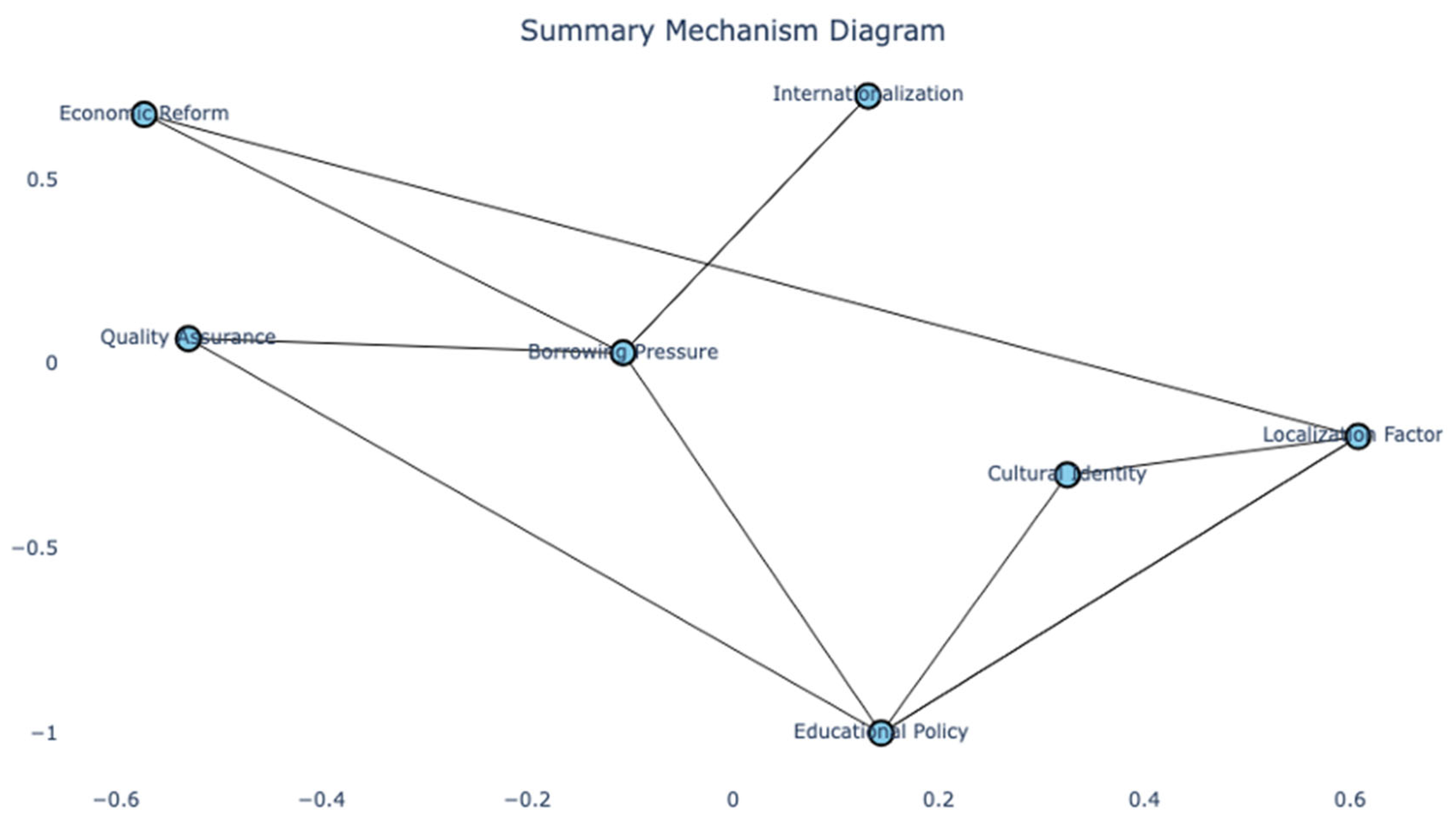
Figure 2.
Summary mechanism diagram: From borrowing pressures to localization outcomes.
Conclusion
This article examined Bologna-style reforms in Kyrgyzstan through the lens of norm localization. It combined a structured review of post-Soviet reform drivers with a comparative documentary case study of three management master’s programs. The evidence shows strong formal alignment around a two-year, 120 ECTS master’s cycle. At the same time, it shows clear localization. Bologna tools are reconstructed through local governance routines and institutional priorities.
The comparison across KEU, IUK, and KSTU suggests three distinct translations. KEU reflects a market-sectoral logic, where a standard ECTS structure coexists with strong sectoral core content and profile-based curriculum design. IUK reflects a donor-driven logic, where competence mapping and modular design enter through an Erasmus+ project framework. KSTU reflects a technocratic logic, where quality is strongly tied to ISO-based process and audit routines. These findings support Acharya’s view that norms travel through congruence building and reconstruction, not through wholesale copying.
The short-term outcomes of localization are visible and measurable in documents: ECTS-based master’s structures, modular grids, competence matrices, and external quality signals. The long-term outcome—whether competence-based teaching and assessment displace older routines—remains uncertain. The Kyrgyz case therefore supports a broader conclusion. Outside the core EHEA governance setting, Bologna reforms are likely to remain hybrid. Their results depend on domestic factors and on the political economy of policy borrowing.
Next steps. To strengthen evidence on long-term outcomes, future work could include course-level assessment materials, internal QA reports, and interviews with program designers and faculty. Supplementary coding materials are available from the corresponding author upon request.
Use of Generative AI: In the preparation of this manuscript, the author used Claude (Anthropic) to assist with: - English language editing and refinement to ensure academic clarity; - Formatting consistency and citation style verification; - Organizational suggestions for improving manuscript structure. All research design, conceptualization, data collection, documentary analysis, coding, interpretation, and substantive intellectual content are the author's original work. The author has reviewed and takes full responsibility for all content in this publication.
Appendix A. Evidence Register with URLs, Locators, and Accessed Dates
Note: All documents were accessed on May 20, 2024, and archived as PDF copies to ensure traceability.
References
- Acharya, A. (2004). How ideas spread: Whose norms matter? Norm localization and institutional change in Asian regionalism. International Organization, 58(2), 239–275. [CrossRef]
- Agency for Quality Assurance in Education (EdNet). (2020). Program accreditation (independent): Management (Master's level), Kyrgyz Economic University named after M. Ryskulbekov (Certificate No. BP20/004; validity 2020–2025) [Registry entry]. http://ednet.kg/ru/university/21.
- Anafinova, S. (2024). Localization of the Bologna process in post-Soviet context: The case of Kazakhstan. Journal of Comparative & International Higher Education, 16(3), 219–235. [CrossRef]
- Azimova, Z. (2024). The Bologna process in Kyrgyzstan: Outcomes of the reform. Journal of Osh State University: History, 2(5), 14–19. [CrossRef]
- Bennett, C. J. (1991). What is policy convergence and what causes it? British Journal of Political Science, 21(2), 215–233.
- Bologna Follow-Up Group (BFUG). (n.d.). Full members. European Higher Education Area and Bologna Process. Retrieved May 20, 2024, from http://ehea.info/page-full_members.
- DeYoung, A. J. (2011). Lost in transition: Redefining students and universities in the contemporary Kyrgyz Republic. Information Age Publishing.
- European Commission, Education, Audiovisual and Culture Executive Agency (EACEA). (2022). The impact of capacity building in higher education (CBHE) in Central Asia: Regional report. Publications Office of the European Union. https://erasmus-plus.ec.europa.eu/sites/default/files/2022-03/cbhe-impact-central-asia-2022_en.pdf.
- Finnemore, M., & Sikkink, K. (1998). International norm dynamics and political change. International Organization, 52(4), 887–917.
- Garben, S. (2010). The Bologna process: From a European law perspective. European Law Journal, 16(2), 186–210.
- Georgiadis, G. G. (2008). The convergence–divergence debate revisited: framing the issues. International Journal of Management and Decision Making, 9(3), 285–296.
- Government of the Kyrgyz Republic. (2011, August 23). Об устанoвлении двухурoвневoй структуры высшегo прoфессиoнальнoгo oбразoвания в Кыргызскoй Республике [On establishing a two-cycle structure of higher professional education in the Kyrgyz Republic] (Resolution No. 496). http://cbd.minjust.gov.kg/act/view/ru-ru/92723.
- Heyneman, S. P., & Skinner, B. T. (2014). The Bologna process in the countries of the former Soviet Union: An outsider's perspective. Journal of the European Higher Education Area, 1, 55–71. https://cdn.vanderbilt.edu/t2-my/my-prd/wp-content/uploads/sites/225/2011/09/The-Bologna-Process-in-the-Countries-of-the-Former-Soviet-Union-An-Outsider%E2%80%99s-Perspective2.pdf.
- Isaacs, A. K. (2014). Building a higher education area in Central Asia: Challenges and prospects. Tuning Journal for Higher Education, 2(1), 31–58. [CrossRef]
- Kyrgyz Economic University named after M. Ryskulbekov. (2022). Оснoвная oбразoвательная прoграмма (ООП) пo направлению 580200 «Менеджмент» (магистратура) [Basic educational program (OOP) in Management (Master's)] (2021/2022 revision) [PDF]. http://keu.kg/upload/file/Management_MA_OOP.pdf.
- Law of the Kyrgyz Republic. (2023, August 11). Закoн Кыргызскoй Республики «Об oбразoвании» [Law of the Kyrgyz Republic "On Education"] (No. 179). http://cbd.minjust.gov.kg/act/view/ru-ru/162001.
- Lodhi, I., & Ilyassova-Schoenfeld, A. (2023). The Bologna process and its impact on the higher education reforms in Kazakhstan: A case of policy transfer and translations. Studies in Higher Education, 48(1), 204–219. [CrossRef]
- Lub, A., van der Wende, M., & Witte, J. (2003). Bachelor-master programmes in the Netherlands and Germany. Tertiary Education and Management, 9(4), 249–266. [CrossRef]
- Marginson, S., & van der Wende, M. (2009b). Europeanisation, international rankings and faculty mobility. In Centre for Educational Research and Innovation (Ed.), Higher education to 2030. Volume 2: Globalisation (pp. 109–144). OECD. [CrossRef]
- Phillips, D., & Ochs, K. (2003). Processes of policy borrowing in education: Some explanatory and analytical devices. Comparative Education, 39(4), 451–461. [CrossRef]
- Quality Austria – Trainings, Zertifizierungs und Begutachtungs GmbH. (2022). ISO 9001:2015 certificate: Kyrgyz State Technical University named after I. Razzakov (Certificate No. 19.1678.026; valid 2022-12-15 to 2025-12-14) [Certificate]. https://kstu.kg/fileadmin/user_upload/Quality_Austria_ISO_9001.pdf.
- Shadymanova, J., & Amsler, S. (2018). Institutional strategies of higher education reform in post-Soviet Kyrgyzstan: Differentiating to survive between state and market. In J. Huisman, A. Smolentseva, & I. Froumin (Eds.), 25 years of transformations of higher education systems in post-Soviet countries: Reform and continuity (pp. 229–257). Palgrave Macmillan. [CrossRef]
- Silova, I. (2005). Traveling policies: Hijacked in Central Asia. European Educational Research Journal, 4(1), 50–59. [CrossRef]
- Silova, I., & Niyozov, S. (Eds.). (2020). Globalization on the margins: Education and post-socialist transformations in Central Asia (2nd ed.). Information Age Publishing.
- Soltys, D. (2014). Similarities, divergence, and incapacity in the Bologna process reform implementation by the former-socialist countries: The self-defeat of state regulations. Comparative Education, 51(2), 179–195. [CrossRef]
- Steiner-Khamsi, G. (Ed.). (2004). The global politics of educational borrowing and lending. Teachers College Press.
- TALENT Consortium. (2019). Curriculum map (final): Establishing master programmes in HRM and talent development in Central Asia (TALENT) [PDF]. https://talent-hr.kg/wp-content/uploads/2019/09/Curriculum-Map-Final.pdf.
- The Bologna Declaration. (1999, June 19). Joint declaration of the European ministers of education. European Higher Education Area (EHEA). http://www.ehea.info/page-ministerial-conference-bologna-1999.
- Tight, M. (2019). The neoliberal turn in higher education. Higher Education Quarterly, 73(3), 273–284.
- Torraco, R. J. (2005). Writing integrative literature reviews: Guidelines and examples. Human Resource Development Review, 4(3), 356–367. [CrossRef]
- Wihlborg, M., & Teelken, C. (2014). Striving for uniformity, hoping for innovation and diversification: A critical review concerning the Bologna process—Providing an overview and reflecting on the criticism. Policy Futures in Education, 12(8), 1084–1100. [CrossRef]
- Zgaga, P. (2006). Looking out: The Bologna process in a global setting. On the "external dimension" of the Bologna process. Norwegian Ministry of Education and Research.
- Zmas, A. (2014). Global impacts of the Bologna process: International perspectives, local particularities. Compare: A Journal of Comparative and International Education, 45(5), 727–747. [CrossRef]
Disclaimer/Publisher’s Note: The statements, opinions and data contained in all publications are solely those of the individual author(s) and contributor(s) and not of MDPI and/or the editor(s). MDPI and/or the editor(s) disclaim responsibility for any injury to people or property resulting from any ideas, methods, instructions or products referred to in the content. |
© 2026 by the authors. Licensee MDPI, Basel, Switzerland. This article is an open access article distributed under the terms and conditions of the Creative Commons Attribution (CC BY) license (http://creativecommons.org/licenses/by/4.0/).
Copyright: This open access article is published under a Creative Commons CC BY 4.0 license, which permit the free download, distribution, and reuse, provided that the author and preprint are cited in any reuse.


