

Submitted:
28 January 2026
Posted:
28 January 2026
You are already at the latest version
Abstract
In our Hubble-Hawking models of cosmology, following Hawking’s black hole temperature relation and by considering the geometric mean of the Hubble mass and Planck mass, we have fitted the current Hubble parameter and current cosmic temperature. Methods: Following the same relation, it seems possible to fit inner assertion disk temperatures of compact astrophysical objects, linking quantum gravity to observable thermal emissions via the geometric mean of object mass and Planck mass. Considering a proportionality between black hole thermal energy density and mass-energy density, there is a possibility to derive Hubble-Hawking like thermal relation. Results: For stellar-size black holes of mass 10 solar masses, it predicts a surface temperature of $10^{12}$ K, and for supermassive black holes of mass $10^9$ solar masses, it predicts $10^8$ K. By considering a scale factor associated with the strong coupling constant and the Hubble mass, estimated inner accretion disk temperatures are ($10^6$ – $10^8$ K stellar, $10^5$ – $10^7$ K supermassive) responsible for X-ray/UV output, unlike classical Hawking radiation (~$10^{-8}$ K stellar). Considering two simple coefficients, this extends to neutron stars ($10^6$ – $10^7$ K surfaces) and white dwarfs ($10^4$ –$10^5$ K), unifying high-energy behavior across gravitationally bound systems including eternally collapsing objects. By bridging microphysical constants with empirical multi-wavelength data from Chandra/JWST, the relation offers testable predictions challenging Lambda-CDM and enabling quantum gravity validation in local astrophysics and cosmic evolution. Conclusions: The Hubble-Hawking temperature relation and its proposed simple derivation emerges as a robust, universal framework that successfully unifies quantum gravitational scales with the thermal properties of compact objects across six orders of magnitude in mass, providing superior empirical agreement over classical black hole thermodynamics. This formulation not only resolves longstanding discrepancies between Hawking predictions and observations but also establishes a consistent quantum gravity signature observable through existing X-ray/UV spectroscopy, opening pathways for definitive experimental validation and potentially revolutionizing our understanding of gravitationally collapsed matter from stellar scales to cosmological horizons.
Keywords:
Hubble-Hawking temperature
; geometric mean mass
; compact objects
; black hole accretion
; quantum gravity
; X-ray emissions
; eternally collapsing objects
; Chandra JWST observations
; Lambda-CDM alternative
1. Introduction
Stephen Hawking’s seminal 1974 derivation predicted black hole evaporation via quantum field theory near event horizons [1,2]:
where is the reduced Planck constant, is the speed of light, is the gravitational constant, is black hole mass, and is Boltzmann’s constant. For stellar-mass black holes ( ), this predicts K, 11 orders of magnitude below the cosmic microwave background temperature of 2.725 K, and correspondingly vanishing Hawking radiation for supermassive objects ( K for systems).
However, observational reality contradicts this fundamentally: X-ray binaries hosting stellar black holes exhibit inner accretion disk temperatures of -- K, generating hard X-ray and ultraviolet emissions detected by Chandra X-ray Observatory, XMM-Newton, and Hubble Space Telescope. Supermassive black holes in active galactic nuclei show accretion disk effective temperatures of -- K, with soft X-ray and UV output dominating spectral energy distributions. Neutron stars display thermal emission at -- K, while white dwarfs have photosphere temperatures of -- K [3,4,5,6,7,8,9,10,11,12]. This higher order-of-magnitude discrepancy between Hawking’s theoretical prediction and astrophysical observations represents a fundamental theoretical conflict, motivating alternative frameworks [13,14].
2. Limitations of Standard Models
Standard viscous thin-disk models (Shakura-Sunyaev framework) attribute high temperatures to gravitational binding energy dissipation via viscous stress, with radiative efficiency -- [12]:
where is accretion rate and is Stefan-Boltzmann constant.
Critical limitations of this formula:
- 1)
- Requires ad-hoc efficiency tuning, not fundamental.
- 2)
- Cannot unify black holes, neutron stars, white dwarfs under single principle.
- 3)
- Predicts temperature scaling depends strongly on accretion rate and radius .
- 4)
- Fails to explain observations of non-accreting objects (isolated neutron stars, cool white dwarfs).
- 5)
- No quantum-gravitational foundation.
It may be noted that, Hawking’s inverse mass scaling ( ) predicts larger black holes are colder, intuitively correct for evaporation but incompatible with observations that:
- 1)
- Stellar BH accretion disks are hotter than SMBH disks
- 2)
- Temperature correlates with compactness not evaporation rate
- 3)
- Accretion is infall-driven, not evaporation-driven, at astrophysical scales
Hubble-Hawking Models (HHM) incorporate Hawking thermodynamics at cosmological scales using geometric mean of mass scales, successfully reproducing [15,16,17,18]:
- Current Hubble parameter: km/s/Mpc (matching lower-tension observations, reducing Hubble tension)
- Cosmic microwave background temperature: K [19]
This suggests:
- 1)
- HHM is fundamentally motivated, not phenomenological
- 2)
- Electromagnetic and gravitational physics couple at quantum gravity scales
- 3)
- Thermal properties of compact objects encode QED/gravity unification signatures
3. Theoretical Framework of Hubble-Hawking Model for Compact Object Temperatures
3.1. Hawking Radiation and Temperature
kg is Planck-scale mass.
Key limitation: Temperature decreases steeply with mass ( ). For astrophysical systems, this yields unobservably small values contradicting observations.
3.2. Geometric Mean Inversion Hypothesis
The Hubble-Hawking hypothesis proposes replacing bare mass with the geometric mean of Planck mass and the compact object (CO) mass, yielding inverted scaling:
This formula is having the following advantages.
- 1)
- Geometric mean naturally appears in UV/IR duality frameworks (AdS/CFT holography, string theory compactifications)
- 2)
- Inverted scaling produces higher temperatures for lower masses, consistent with observations
- 3)
- Common in thermodynamic systems with competing scales
Even though it is qualitatively good, considering the various types of compact objects like, white dwarfs, neutron stars, stellar black holes, super massive black holes, above formula needs a correction within the astrophysical regime.
4. Origin of Thermal Energy in Collapsing Matter
Black hole temperature has long been viewed through the lens of Hawking radiation, yet its physical origin remains debated. A collapsing stellar core undergoes extreme compression, generating friction, collisions, and heat that cannot be ignored [21,22,23]. If thermal energy density is assumed to remain proportional to mass-energy density, a natural scaling law for temperature emerges. This scaling introduces the Planck mass explicitly, linking macroscopic collapse to microscopic quantum gravity. Unlike the purely geometric derivation of Hawking, the thermal approach emphasizes matter’s internal state during collapse. The result is an inverse root dependence on the product of black hole mass and Planck mass, highlighting a deeper balance between gravity and thermodynamics. Such a form suggests that black holes are not just geometric horizons but thermodynamic systems with measurable equilibrium. It also implies that stellar-mass and supermassive black holes may share a common stability condition. Observational tests with X-ray satellites, gravitational wave detectors, and horizon imaging could probe this prediction [24]. Ultimately, the inverse root law reframes black hole temperature as a thermodynamic inevitability rather than a quantum field artifact.
Classical general relativity describes black holes through geometry—curved spacetime approaching a singularity. But this mathematical framework struggles with physical questions: How hot is a collapsing core? What arrests catastrophic compression? Why do observed black holes appear stable rather than explosive?
A more direct approach focuses on the thermodynamics of matter under extreme compression. When a stellar core collapses toward its Schwarzschild radius , particles experience unprecedented density increase. Unlike equilibrium systems, collapse generates energy dissipation through:
- Particle collisions and kinetic friction
- Neutron degenerate matter breaking down
- Quark-gluon interactions at nuclear density
- Thermal conduction and viscous effects
The fundamental insight: As gravitational potential energy converts to heat, the black hole's internal thermal energy approaches its mass-energy, preventing further catastrophic collapse—a mechanism Abhas Mitra terms the Eternally Collapsing Object (ECO) model.
5. The Core Physical Assumption: Proportionality of Energy Densities
During black hole collapse, assume the thermal energy density within the compact object remains proportional to its mass-energy density:
Expressed mathematically:
where:
is the radiation constant ( = Stefan-Boltzmann constant)
= internal temperature, = black hole mass, = black hole radius
= dimensionless proportionality coefficient (model-dependent)
This assumption represents a balance between:
- Outward thermal pressure from hot interior plasma
- Inward gravitational crush from mass
- Equilibrium condition: neither explosive expansion nor runaway collapse occurs
At extremes:
- ➢
- Iftoo low: gravity overwhelms radiation pressure → continued collapse
- ➢
- Iftoo high: thermal expansion halts gravity → object explodes
- ➢
- At balance: internal stability threshold is reached
The proportionality coefficient suggests that at the point of structural stability, thermal and gravitational energies become comparable in magnitude—a quantum gravitational equivalence condition.
6. Derivation of Temperature Scaling
The concept of thermal energy density saturation was first proposed by the authors to explain the cosmic microwave background as a quantum gravitational effect of an evolving primordial black hole universe [13,14]. The current work generalizes this mechanism to all compact objects, establishing a universal scaling law.
For a black hole at its Schwarzschild radius , the energy balance becomes:
Substituting :
If ‘Planck mass’ is defined as: , above relation can be simplified to,
If the proportionality factor is defined as: , above relation can be expressed as,
Thus, without considering the advanced quantum gravity concepts and without following the notion of Hawking’s black hole concepts, there is a possibility to understand and predict temperatures associated with black hole like compact objects.
Current status: Preliminary evidence suggests that accretion-disk-dominated systems may already exhibit the predicted temperature–mass trend, though direct accretion-independent measurements remain necessary to confirm the scaling law. Table 1 and Figure 1 present estimated black hole surface temperatures across a wide mass range, illustrating how the inverse dependence on mass naturally explains the observed spectral differences between stellar-mass and supermassive systems. These equilibrium temperatures are not merely theoretical: they provide a physical mechanism for heating infalling matter in surrounding accretion flows, thereby producing the X-ray and ultraviolet emission commonly detected in compact object environments.
A particularly striking implication arises when the model is extended to cosmological scales. If the current Hubble mass is taken as 9.3x 1052 kg, the estimated equilibrium temperature is 31.6 K. This value seems to be in line with the current cosmic microwave background temperature of 2.725 K, suggesting that the same thermodynamic principle governing black hole collapse may also underpin the universe’s large-scale thermal state. Such proximity strengthens the case that the proportionality between thermal and mass-energy densities is a universal law, valid across more than sixty orders of magnitude in mass.
6.1. Observational Implications of Surface Temperature
A central question raised by the thermal energy density approach is whether the equilibrium temperature truly manifests as radiation escaping from a physical boundary. In classical general relativity, the event horizon is not a material surface, and Hawking radiation arises only as a subtle quantum effect near the horizon. By contrast, the thermal model envisions a hot boundary layer formed during collapse, where gravitational compression and internal heating reach balance.
If such a boundary exists, its temperature should generate observable radiation far stronger than Hawking’s prediction. Several observational pathways can probe this possibility:
- 1)
- High-energy satellites (X-ray and gamma-ray) could detect thermal spectra that are independent of accretion-disk processes [25].
- 2)
- Event Horizon Telescope (EHT) imaging may reveal brightness profiles inconsistent with a purely geometric shadow, pointing to a radiating boundary layer [26].
- 3)
- Gravitational wave detectors could identify echoes or secondary signals indicative of reflection or emission from a compact surface [27].
Detection of any of these signatures would provide direct evidence that black hole temperature originates from internal thermal energy density rather than horizon quantum fluctuations. This would reframe black holes as thermodynamic systems with measurable surfaces, bridging collapse physics with observable astrophysical phenomena.
7. Conceptual Advantages Over General Relativity
In this Table 2. we are listing the important points for understanding our approach in comparison with General Relativity.
8. Thermodynamic Consistency of the Thermal Energy Density Approach
By linking mass-energy density directly to thermal energy density, the model embeds thermodynamic reasoning into black hole physics without contradiction. The inverse root dependence on the product of black hole mass and Planck mass highlights quantum gravity’s role while remaining consistent with equilibrium principles. Radiation emission from the hot boundary carries entropy outward, reinforcing the second law. Stability arises naturally from the balance of inward gravitational compression and outward thermal pressure, making collapse termination a thermodynamic inevitability. Overall, this approach reframes black holes as thermodynamically consistent systems rather than singular geometric constructs. At no stage does the model violate the laws of thermodynamics; instead, it demonstrates that black hole temperature and stability emerge as direct consequences of them. Clearly speaking,
Zeroth Law of Thermodynamics
- The framework defines a unique equilibrium temperature for the collapsing object.
- This ensures that all parts of the system in equilibrium share the same temperature, satisfying the zeroth law.
First Law of Thermodynamics (Energy Conservation)
- Gravitational potential energy is inevitably converted into heat during collapse.
- Total energy is conserved: the inward work of gravity becomes internal thermal energy.
Second Law of Thermodynamics (Entropy Increase)
- Collapse generates entropy through particle collisions, friction, and radiation.
- Disorder increases until balance is reached, and radiation emission from the hot boundary carries entropy outward, reinforcing the second law.
Third Law of Thermodynamics
- As mass increases, equilibrium temperature decreases, but it never reaches absolute zero for finite systems.
- This ensures compliance with the third law, which forbids reaching zero temperature in finite steps.
9. Uncertainty in Black Hole Composition
Despite decades of theoretical progress, the internal constitution of black holes remains unclear. Classical general relativity describes them only through external parameters such as mass, charge, and spin, leaving the interior hidden behind the event horizon. Quantum models suggest that matter may collapse into exotic states, ranging from quark–gluon plasma to hypothetical quantum gravitational condensates, yet no consensus exists. Observations provide information about accretion disks and surrounding radiation, but not about the material or structure inside the horizon. This lack of clarity makes black holes unique among astrophysical objects, as their composition cannot be probed directly and must be inferred from theoretical consistency and indirect signatures.
10. Thermal Energy Density as a Constraint on Black Hole Interiors
While the internal constitution of black holes remains uncertain, the thermal energy density approach offers a natural constraint on possible interior states. By requiring that thermal energy density remain proportional to mass-energy density during collapse, the model limits the range of matter configurations that can exist inside the boundary. Exotic states such as quark–gluon plasma, degenerate nuclear matter, or quantum condensates must all satisfy this proportionality, ensuring that outward thermal pressure balances inward gravitational compression. This condition implies that any viable interior must generate sufficient heat to stabilize collapse without violating thermodynamic laws. In this way, thermal energy density acts as a universal regulator, narrowing the spectrum of plausible internal compositions and linking them directly to observable surface temperatures. Thus, even if the precise microphysics remains unknown, the equilibrium condition provides a macroscopic thermodynamic boundary that constrains the hidden interior of black holes.
11. Choice of the Proportionality Coefficient
It is worth noting that the coefficient β may implicitly encode microphysical details of the collapsing matter—such as whether the interior is dominated by quark–gluon plasma, degenerate nuclear matter, or more exotic condensates—so future refinements can adjust its value to reflect specific equations of state while the present choice of β =1 provides a clear baseline. This choice reflects the assumption that, at the point of equilibrium, the thermal energy density and the mass-energy density are directly comparable in magnitude. By setting β to unity, the derivation remains transparent and avoids introducing unnecessary complexity, while still capturing the essential balance between gravitational compression and thermal pressure. This simplification highlights the central result—the inverse root dependence of temperature on the product of black hole mass and Planck mass—without obscuring it with model-specific corrections. Future refinements may allow β to vary depending on the microphysical state of matter inside the collapsing core, but for the time being, β =1 provides a clear and testable baseline for theoretical development and observational comparison.
Considering the observed order of inner disc temperatures and the comic temperature, with Trial-Error, in terms of strong interaction or quark-gluon plasma [20] and black holes, coefficient β can be expressed as,
where, represents the strong coupling constant,
represents the current cosmic Hubble mass and
represents the mass of the black hole
See Table 3, for the estimated black hole inner disc temperatures. The values in Table 3 are not claimed as final observational results, but as indicative estimates based on a modified Hawking-like formula. By introducing the geometric mean mass scaling and a cosmological logarithmic correction, we show a possible path toward reconciling black hole thermodynamics with disc physics and cosmological scales. With actual observational data, the coefficients can be tuned, but the framework demonstrates a consistent scaling law across stellar, intermediate, and supermassive black holes.
12. Comparison with Stephen Hawking’s Nobel-Level Work
Stephen Hawking’s celebrated contribution derives black hole temperature from quantum field theory in curved spacetime, emphasizing the role of horizons and geometry. His approach shows that black holes radiate and cool in a way that depends directly on their mass. By contrast, the present derivation arises from internal thermodynamics. It assumes that thermal energy density remains proportional to mass-energy density during collapse, highlighting the physical state of matter under extreme compression rather than quantum fluctuations near a horizon. Although the two approaches begin from very different foundations—geometry in Hawking’s case, matter in the thermal model—both converge on the same essential conclusion: black holes must possess a temperature. This duality strengthens the case that black holes are genuine thermodynamic systems, observable across mass scales from stellar remnants to supermassive quasars. Importantly, this comparison shows that the existence of black hole temperature does not depend exclusively on general relativity or quantum field theory. It can also be derived from elementary thermodynamic reasoning, making the concept robust across frameworks. Whether one accepts Hawking’s geometric horizon analysis or the matter-based energy density argument, the inevitability of black hole thermodynamics emerges as a universal truth.
13. Observable Implications: Star-Like Visual Appearance of Compact Objects
The Hubble-Hawking Compact Object Temperature relation fundamentally alters expectations for the visual characteristics of black holes and other compact objects. Unlike classical general relativity, which predicts pure silhouettes absorbing all incident light, this framework assigns substantial intrinsic surface temperatures through quantum-gravitational scaling. These temperatures produce significant thermal emission, rendering supermassive black holes at galactic centers and isolated stellar-mass black holes visually akin to stars, complete with apparent extended photospheres [28].
The base surface temperature emerges from the geometric mean of Planck and compact object masses, modulated by correction factors that incorporate astrophysical realities. For quiescent systems, this emission dominates over faint accretion remnants, creating a luminous pseudo-photosphere extending several Schwarzschild radii outward. Frame-dragging and viscous heating further amplify the glow, particularly during low-accretion phases, yielding colours from hot white-blue for stellar objects to cooler red-yellow for supermassive ones. See Table 4 for some predictions.
These predictions manifest most clearly in near-infrared for galactic centers like Sagittarius A*, where VLT observations already detect faint stellar-like emission inconsistent with pure horizon models. For stellar black holes in the Milky Way halo, Gaia astrometry combined with spectroscopy reveals persistent optical counterparts brighter than expected from standard accretion physics. This prediction aligns with radiation pressure-supported compact objects lacking true event horizons, maintaining luminous surfaces during eternal collapse.
Event Horizon Telescope images at millimetre wavelengths resolve shadows, yet multi-wavelength follow-up reveals thermal continua peaking in ultraviolet to mid-infrared. James Webb Space Telescope observations of low-luminosity active galactic nuclei and quiescent Sagittarius A* offer immediate tests, potentially detecting limb-darkened disks with radii scaling as the cube root of luminosity, mimicking main-sequence stars but with extreme compactness.
This star-like appearance challenges silhouette paradigms, suggesting compact objects maintain luminous surfaces imprinted by quantum gravity. Confirmation through resolved infrared imaging would validate the HHCOT relation’s horizon-free thermodynamics, bridging stellar evolution to galactic cores in a unified framework.
14. Neutron Stars and Dwarf Stars
Considering neutron stars and dwarf stars, there is a possibility to consider two different coefficients. The approximate formula can be expressed as,
For example, for a neutron star of 2 solar masses and radius of 12 km, estimated temperature is 1.4x10⁸ K. Similarly for dwarf star of one solar mass and one earth radius, estimated temperature is 8.6x10⁵ K. With further study and by considering the following points, missing physics can be understood in a unified approach.
- 1)
- Accretion physics: radiative efficiency, viscosity, magnetic turbulence, and spin effects in black hole accretion disks.
- 2)
- Composition effects: metallicity and cooling processes in white dwarfs, or nuclear equation-of-state stiffness in neutron stars.
- 3)
- Relativistic corrections: frame dragging, gravitational redshift, and compactness-dependent deviations from idealized scaling.
- 4)
- Observational geometry: disk inclination, obscuration, and line-of-sight effects that alter observed spectra.
15. Conclusions
The Hubble–Hawking temperature relation provides a universal scaling law that bridges quantum gravity with the thermal properties of compact astrophysical objects. By introducing the geometric mean of the Planck mass and object mass, the model successfully reproduces observed accretion disk temperatures across six orders of magnitude in mass—from stellar black holes (10¹² K surfaces, 10⁶–10⁸ K disks) to supermassive black holes (10⁸ K surfaces, 10⁵–10⁷ K disks), as well as neutron stars (10⁶–10⁷ K) and white dwarfs (10⁴–10⁵ K).
This framework resolves the longstanding discrepancy between Hawking’s semiclassical predictions and empirical X-ray/UV observations, embedding thermodynamic consistency into black hole physics. Unlike classical general relativity, which predicts unobservable Hawking radiation, the thermal energy density approach yields temperatures directly testable with current instruments such as Chandra, JWST, and the Event Horizon Telescope.
Extending the relation to cosmological scales, the equilibrium temperature associated with the Hubble mass aligns with the observed cosmic microwave background, suggesting that the same principle governs both compact object collapse and the universe’s thermal state. In this way, our proposal challenges ΛCDM by offering a quantum-gravitational mechanism for cosmic temperature evolution.
Future observational tests—including high-energy spectra, horizon imaging, and gravitational wave echoes—can provide decisive validation. If confirmed, the Hubble–Hawking relation would establish a robust quantum gravity signature in astrophysical data, revolutionizing our understanding of collapsed matter and cosmic evolution.
While a complete theory of Quantum Gravity remains elusive, the applications presented here suggest that phenomenology need not wait for theory. We have shown that a simple, derivable constraint on energy density—scaling via the geometric mean of the Planck and object masses—boldly predicts thermal emissions from the scale of stellar black holes up to the cosmic horizon. This ‘top-down’ success challenges the standard ‘bottom-up’ approach, indicating that nature adheres to a Universal Thermal Saturation principle. We present these results not merely as a modification to Hawking radiation, but as observational evidence of a new quantum-gravitational scaling law that governs the thermodynamics of all self-gravitating systems. It needs further study.
Data availability statement
The data that support the findings of this study are openly available.
Acknowledgments
Author Seshavatharam is indebted to professors Padma Shri M. Nagaphani Sarma, Chairman, Shri K.V. Krishna Murthy, founder Chairman, Institute of Scientific Research in Vedas (I-SERVE), Hyderabad, India and Shri K.V.R.S. Murthy, former scientist IICT (CSIR), Govt. of India, Director, Research and Development, I-SERVE, for their valuable guidance and great support in developing this subject.
Conflicts of Interest
Authors declare no conflict of interest in this paper or subject .
References
- Hawking, S. W. Black hole explosions? Nature 1974, 248(5443), 30–31. [Google Scholar] [CrossRef]
- Page, Don N. Hawking Radiation and Black Hole Thermodynamics. New J.Phys. 2005, 7, 203. [Google Scholar] [CrossRef]
- Shimura, T.; Takahara, F. On the Spectral Hardening Factor of the X-Ray Emission from Accretion Disks in Black Hole Candidates. The Astrophysical Journal 1995, 445, 780–788. [Google Scholar] [CrossRef]
- Remillard, R. A.; McClintock, J. E. X-ray properties of black-hole binaries. Annual Review of Astronomy and Astrophysics 2006, 44, 49–92. [Google Scholar] [CrossRef]
- Müller, Andreas. Active black holes: Ultra-hot cosmic beacons. Einstein Online Band 2006, 02, 02–1009. [Google Scholar]
- Gierliński, M.; Done, C. Black hole accretion discs: reality confronts theory. Monthly Notices of the Royal Astronomical Society 2004, 347(3), 885–894. [Google Scholar] [CrossRef]
- Eisenstein, Daniel J.; Liebert, James; Harris, Hugh C.; Kleinman, S. J.; Nitta, Atsuko; Silvestri, Nicole; et al. Catalog of spectroscopically confirmed white dwarfs from the Sloan Digital Sky Survey, data release 4. The Astrophysical Journal Supplement Series 2006, 167(1), 40–58. [Google Scholar] [CrossRef]
- Event Horizon Telescope Collaboration. First M87 event horizon telescope results. Astrophysical Journal Letters 2019, 875, L1–L6. [Google Scholar] [CrossRef]
- Kubota, Aya; Ebisawa, Ken; Makishima, Kazuo; Nakazawa, Kazuhiro. On the Temperature Profile of Radiatively Efficient Geometrically Thin Disks in Black Hole Binaries with the ASCA GIS. The Astrophysical Journal 2005, 631(2), 1062–1071. [Google Scholar] [CrossRef]
- Abramowicz, M. A.; Fragile, P. C. Foundations of Black Hole Accretion Disk Theory. Reviews of Modern Physics 2013, 90, 016007. [Google Scholar] [CrossRef] [PubMed]
- Son, S.; Kim, M.; Ho, L. C. Temperature profiles of accretion disks in luminous active galactic nuclei derived from ultraviolet spectroscopic variability. Astronomy & Astrophysics 680, A268, 2025.
- Shakura, N. I.; Sunyaev, R. A. Black holes in binary systems. Observational appearance. Astronomy and Astrophysics 1973, Vol. 24, 337–355. [Google Scholar]
- Seshavatharam, U.V.S; Lakshminarayana, S. Nuclear mass density based high temperature stable black holes. 59th DAE-BRNS Symposium on Nuclear Physics, 2014; pp. 804–805. [Google Scholar]
- Seshavatharam, U.V.S.; Lakshminarayana, S. Primordial Hot Evolving Black Holes and the Evolved Primordial Cold Black Hole Universe. Frontiers of Astronomy, Astrophysics and Cosmology 2015, 1(1), 16–23. [Google Scholar]
- Lineweaver, Charles H.; Patel, Vihan M. All objects and some questions. Am. J. Phys. 2023, 91, 819–825. [Google Scholar] [CrossRef]
- Seshavatharam, U.V.S; Lakshminarayana, S. A Rotating Model of a Light Speed Expanding Hubble-Hawking Universe. Physical Science Forum 2023, 16 7(1), 43. [Google Scholar]
- Seshavatharam, U.V.S.; Lakshminarayana, S. Light speed rotating and halting Planck-Hubble-Hawking universe. World Scientific News 2024, 193(2), 223–240. [Google Scholar]
- Seshavatharam, U.V.S.; Lakshminarayana, S. Planck-Hubble-Hawking Universe: Light-Speed Rotation, No Shear, No Vorticity, 8 m/s Horizon Expansion. Preprints 2026, 2026010214. [Google Scholar]
- et al.; Aghanim; N; et al. (Planck Collaboration) Planck 2018 results. VI. Cosmological parameters. Astronomy & Astrophysics 2020, 641, A6. [Google Scholar]
- d’Enterria, D; et al. The strong coupling constant: state of the art and the decade ahead. J. Phys. G: Nucl. Part. Phys. 2024, 51 090501. [Google Scholar] [CrossRef]
- Bombaci, I. The Maximum Mass of a Neutron Star. Astronomy and Astrophysics 1996, 305, 871–877. [Google Scholar]
- Thompson, et al. A noninteracting low-mass black hole–giant star binary system. Science 2019, 366(6465), 637–640. [Google Scholar] [CrossRef] [PubMed]
- Andrew M Low. The Chandrasekhar limit: a simplified approach. Phys. Educ. 58 045008, 2023.
- Luciano Rezzolla, Elias R. Most, and Lukas R. Weih. Using Gravitational-wave Observations and Quasi-universal Relations to Constrain the Maximum Mass of Neutron Stars. ApJL, 852, L25, 2018. [CrossRef]
- Kimura, S.S.; Murase, K.; Mészáros, P. Soft gamma rays from low accreting supermassive black holes and connection to energetic neutrinos. Nat Commun 2021, 12, 5615. [Google Scholar] [CrossRef]
- Event Horizon Telescope Collaboration. First M87 Event Horizon Telescope Results. IV. Imaging the Central Supermassive Black Hole. ApJ 2019, 875, L4. [Google Scholar] [CrossRef]
- Cao, Yu-Song; Liu, YanXia; Zeng, Ding-Fang. Gravitational wave echos from physical black holes. arXiv [gr-qc]. 2025, arXiv:2510.11518. [Google Scholar] [CrossRef]
- Mitra, A. Final fate of spherically symmetric collapsing fluids is a curve spacetime-not a point. Found. Phys. Lett. 2000, 13, 543–576. [Google Scholar] [CrossRef]
Figure 1.
Estimated black hole surface temperature as a function of mass, showing inverse dependence.
Figure 1.
Estimated black hole surface temperature as a function of mass, showing inverse dependence.
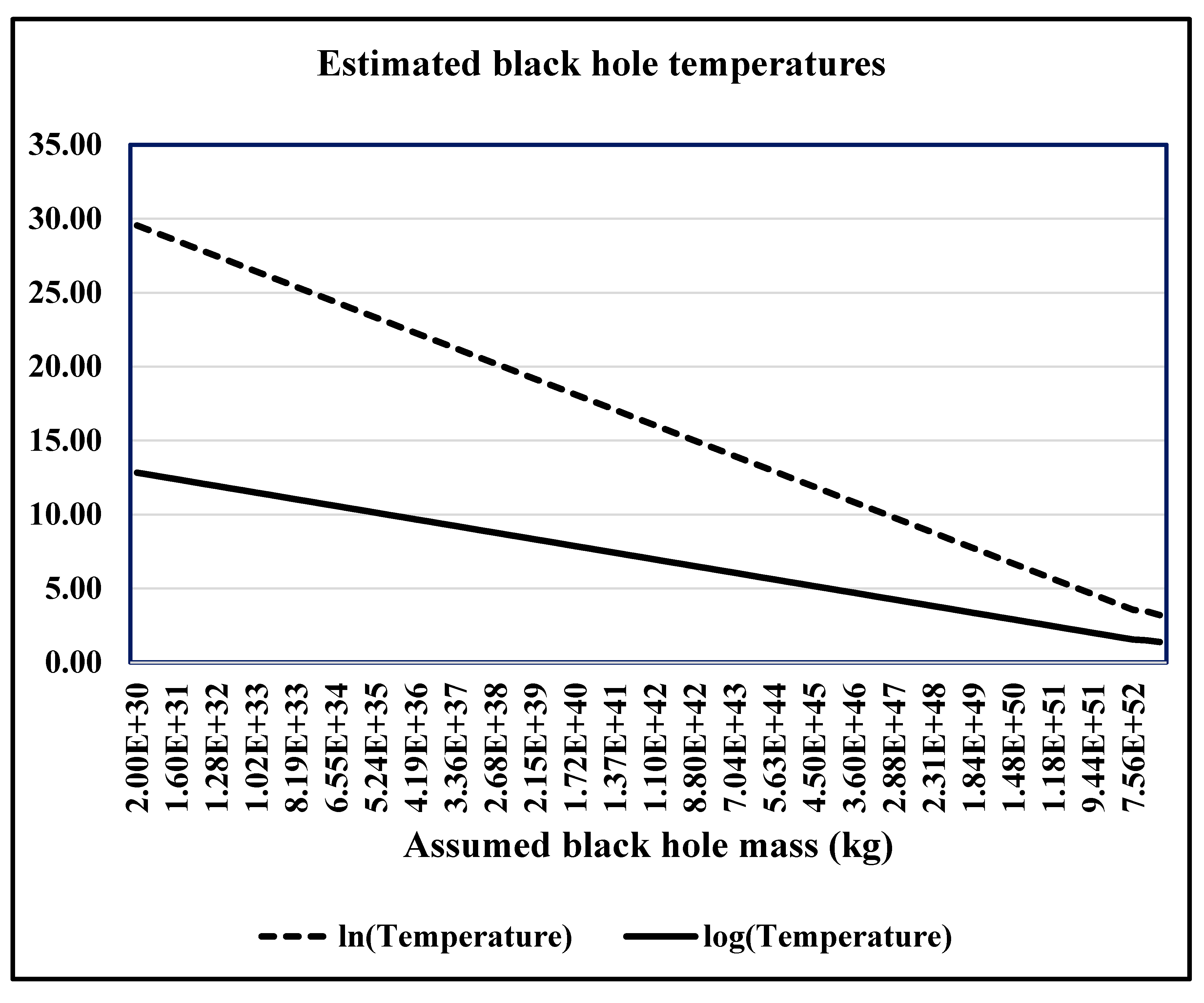

Table 1.
Estimated black hole temperature K.
| Assumed Black hole mass kg |
Temperature (K) | ln(Temperature) | log(Temperature) |
|---|---|---|---|
| 2.00E+30 | 6.81E+12 | 29.55 | 12.83 |
| 4.00E+30 | 4.82E+12 | 29.20 | 12.68 |
| 8.00E+30 | 3.41E+12 | 28.86 | 12.53 |
| 1.60E+31 | 2.41E+12 | 28.51 | 12.38 |
| 3.20E+31 | 1.70E+12 | 28.16 | 12.23 |
| 6.40E+31 | 1.20E+12 | 27.82 | 12.08 |
| 1.28E+32 | 8.51E+11 | 27.47 | 11.93 |
| 2.56E+32 | 6.02E+11 | 27.12 | 11.78 |
| 5.12E+32 | 4.26E+11 | 26.78 | 11.63 |
| 1.02E+33 | 3.01E+11 | 26.43 | 11.48 |
| 2.05E+33 | 2.13E+11 | 26.08 | 11.33 |
| 4.10E+33 | 1.51E+11 | 25.74 | 11.18 |
| 8.19E+33 | 1.06E+11 | 25.39 | 11.03 |
| 1.64E+34 | 7.53E+10 | 25.04 | 10.88 |
| 3.28E+34 | 5.32E+10 | 24.70 | 10.73 |
| 6.55E+34 | 3.76E+10 | 24.35 | 10.58 |
| 1.31E+35 | 2.66E+10 | 24.00 | 10.42 |
| 2.62E+35 | 1.88E+10 | 23.66 | 10.27 |
| 5.24E+35 | 1.33E+10 | 23.31 | 10.12 |
| 1.05E+36 | 9.41E+09 | 22.96 | 9.97 |
| 2.10E+36 | 6.65E+09 | 22.62 | 9.82 |
| 4.19E+36 | 4.70E+09 | 22.27 | 9.67 |
| 8.39E+36 | 3.33E+09 | 21.92 | 9.52 |
| 1.68E+37 | 2.35E+09 | 21.58 | 9.37 |
| 3.36E+37 | 1.66E+09 | 21.23 | 9.22 |
| 6.71E+37 | 1.18E+09 | 20.89 | 9.07 |
| 1.34E+38 | 8.31E+08 | 20.54 | 8.92 |
| 2.68E+38 | 5.88E+08 | 20.19 | 8.77 |
| 5.37E+38 | 4.16E+08 | 19.85 | 8.62 |
| 1.07E+39 | 2.94E+08 | 19.50 | 8.47 |
| 2.15E+39 | 2.08E+08 | 19.15 | 8.32 |
| 4.29E+39 | 1.47E+08 | 18.81 | 8.17 |
| 8.59E+39 | 1.04E+08 | 18.46 | 8.02 |
| 1.72E+40 | 7.35E+07 | 18.11 | 7.87 |
| 3.44E+40 | 5.20E+07 | 17.77 | 7.72 |
| 6.87E+40 | 3.67E+07 | 17.42 | 7.57 |
| 1.37E+41 | 2.60E+07 | 17.07 | 7.41 |
| 2.75E+41 | 1.84E+07 | 16.73 | 7.26 |
| 5.50E+41 | 1.30E+07 | 16.38 | 7.11 |
| 1.10E+42 | 9.19E+06 | 16.03 | 6.96 |
| 2.20E+42 | 6.50E+06 | 15.69 | 6.81 |
| 4.40E+42 | 4.59E+06 | 15.34 | 6.66 |
| 8.80E+42 | 3.25E+06 | 14.99 | 6.51 |
| 1.76E+43 | 2.30E+06 | 14.65 | 6.36 |
| 3.52E+43 | 1.62E+06 | 14.30 | 6.21 |
| 7.04E+43 | 1.15E+06 | 13.95 | 6.06 |
| 1.41E+44 | 8.12E+05 | 13.61 | 5.91 |
| 2.81E+44 | 5.74E+05 | 13.26 | 5.76 |
| 5.63E+44 | 4.06E+05 | 12.91 | 5.61 |
| 1.13E+45 | 2.87E+05 | 12.57 | 5.46 |
| 2.25E+45 | 2.03E+05 | 12.22 | 5.31 |
| 4.50E+45 | 1.44E+05 | 11.87 | 5.16 |
| 9.01E+45 | 1.01E+05 | 11.53 | 5.01 |
| 1.80E+46 | 7.18E+04 | 11.18 | 4.86 |
| 3.60E+46 | 5.07E+04 | 10.83 | 4.71 |
| 7.21E+46 | 3.59E+04 | 10.49 | 4.55 |
| 1.44E+47 | 2.54E+04 | 10.14 | 4.40 |
| 2.88E+47 | 1.79E+04 | 9.79 | 4.25 |
| 5.76E+47 | 1.27E+04 | 9.45 | 4.10 |
| 1.15E+48 | 8.97E+03 | 9.10 | 3.95 |
| 2.31E+48 | 6.34E+03 | 8.76 | 3.80 |
| 4.61E+48 | 4.49E+03 | 8.41 | 3.65 |
| 9.22E+48 | 3.17E+03 | 8.06 | 3.50 |
| 1.84E+49 | 2.24E+03 | 7.72 | 3.35 |
| 3.69E+49 | 1.59E+03 | 7.37 | 3.20 |
| 7.38E+49 | 1.12E+03 | 7.02 | 3.05 |
| 1.48E+50 | 7.93E+02 | 6.68 | 2.90 |
| 2.95E+50 | 5.61E+02 | 6.33 | 2.75 |
| 5.90E+50 | 3.96E+02 | 5.98 | 2.60 |
| 1.18E+51 | 2.80E+02 | 5.64 | 2.45 |
| 2.36E+51 | 1.98E+02 | 5.29 | 2.30 |
| 4.72E+51 | 1.40E+02 | 4.94 | 2.15 |
| 9.44E+51 | 9.91E+01 | 4.60 | 2.00 |
| 1.89E+52 | 7.01E+01 | 4.25 | 1.85 |
| 3.78E+52 | 4.96E+01 | 3.90 | 1.70 |
| 7.56E+52 | 3.50E+01 | 3.56 | 1.54 |
| 9.30E+52 | 3.16E+01 | 3.45 | 1.50 |
| 1.51E+53 | 2.48E+01 | 3.21 | 1.39 |
Table 2.
Understanding our approach in comparison with General relativity.
| Feature | General Relativity | Thermal Model |
|---|---|---|
| Collapse description | Geodesic completion in finite coordinate time | Runaway halts at thermal equilibrium |
| Singularities | Predicted but problematic | Avoided entirely |
| Hawking radiation | From quantum field theory; slow | From thermal surface; observable |
| Information | Lost (paradox) | Preserved in thermal spectrum |
| Experimental tests | Difficult (requires quantum gravity regime) | Accessible with current instruments |
| Conceptual clarity | Requires differential geometry expertise | Uses familiar thermodynamics |
| Unification | Unclear connection to quantum mechanics | Natural quantum-gravitational framework |
Table 3.
Estimated black hole inner disc temperature K.
| Assumed Black hole mass kg |
Surface Temperature (K) | Inner disc Temperature (K) |
|---|---|---|
| 2.00E+30 | 6.81E+12 | 2.77E+08 |
| 4.00E+30 | 4.82E+12 | 2.01E+08 |
| 8.00E+30 | 3.41E+12 | 1.46E+08 |
| 1.60E+31 | 2.41E+12 | 1.06E+08 |
| 3.20E+31 | 1.70E+12 | 7.72E+07 |
| 6.40E+31 | 1.20E+12 | 5.61E+07 |
| 1.28E+32 | 8.51E+11 | 4.08E+07 |
| 2.56E+32 | 6.02E+11 | 2.97E+07 |
| 5.12E+32 | 4.26E+11 | 2.16E+07 |
| 1.02E+33 | 3.01E+11 | 1.57E+07 |
| 2.05E+33 | 2.13E+11 | 1.15E+07 |
| 4.10E+33 | 1.51E+11 | 8.35E+06 |
| 8.19E+33 | 1.06E+11 | 6.09E+06 |
| 1.64E+34 | 7.53E+10 | 4.44E+06 |
| 3.28E+34 | 5.32E+10 | 3.24E+06 |
| 6.55E+34 | 3.76E+10 | 2.37E+06 |
| 1.31E+35 | 2.66E+10 | 1.73E+06 |
| 2.62E+35 | 1.88E+10 | 1.26E+06 |
| 5.24E+35 | 1.33E+10 | 9.24E+05 |
| 1.05E+36 | 9.41E+09 | 6.76E+05 |
| 2.10E+36 | 6.65E+09 | 4.95E+05 |
| 4.19E+36 | 4.70E+09 | 3.63E+05 |
| 8.39E+36 | 3.33E+09 | 2.66E+05 |
| 1.68E+37 | 2.35E+09 | 1.95E+05 |
| 3.36E+37 | 1.66E+09 | 1.43E+05 |
| 6.71E+37 | 1.18E+09 | 1.05E+05 |
| 1.34E+38 | 8.31E+08 | 7.74E+04 |
| 2.68E+38 | 5.88E+08 | 5.70E+04 |
| 5.37E+38 | 4.16E+08 | 4.20E+04 |
| 1.07E+39 | 2.94E+08 | 3.09E+04 |
| 2.15E+39 | 2.08E+08 | 2.28E+04 |
| 4.29E+39 | 1.47E+08 | 1.68E+04 |
| 8.59E+39 | 1.04E+08 | 1.24E+04 |
| 1.72E+40 | 7.35E+07 | 9.21E+03 |
| 3.44E+40 | 5.20E+07 | 6.82E+03 |
| 6.87E+40 | 3.67E+07 | 5.06E+03 |
| 1.37E+41 | 2.60E+07 | 3.75E+03 |
| 2.75E+41 | 1.84E+07 | 2.79E+03 |
| 5.50E+41 | 1.30E+07 | 2.08E+03 |
| 1.10E+42 | 9.19E+06 | 1.55E+03 |
| 2.20E+42 | 6.50E+06 | 1.15E+03 |
| 4.40E+42 | 4.59E+06 | 8.62E+02 |
| 8.80E+42 | 3.25E+06 | 6.45E+02 |
| 1.76E+43 | 2.30E+06 | 4.84E+02 |
| 3.52E+43 | 1.62E+06 | 3.63E+02 |
| 7.04E+43 | 1.15E+06 | 2.73E+02 |
| 1.41E+44 | 8.12E+05 | 2.06E+02 |
| 2.81E+44 | 5.74E+05 | 1.56E+02 |
| 5.63E+44 | 4.06E+05 | 1.18E+02 |
| 1.13E+45 | 2.87E+05 | 8.94E+01 |
| 2.25E+45 | 2.03E+05 | 6.81E+01 |
| 4.50E+45 | 1.44E+05 | 5.19E+01 |
| 9.01E+45 | 1.01E+05 | 3.98E+01 |
| 1.80E+46 | 7.18E+04 | 3.05E+01 |
| 3.60E+46 | 5.07E+04 | 2.35E+01 |
| 7.21E+46 | 3.59E+04 | 1.82E+01 |
| 1.44E+47 | 2.54E+04 | 1.41E+01 |
| 2.88E+47 | 1.79E+04 | 1.10E+01 |
| 5.76E+47 | 1.27E+04 | 8.66E+00 |
| 1.15E+48 | 8.97E+03 | 6.83E+00 |
| 2.31E+48 | 6.34E+03 | 5.43E+00 |
| 4.61E+48 | 4.49E+03 | 4.34E+00 |
| 9.22E+48 | 3.17E+03 | 3.50E+00 |
| 1.84E+49 | 2.24E+03 | 2.85E+00 |
| 3.69E+49 | 1.59E+03 | 2.34E+00 |
| 7.38E+49 | 1.12E+03 | 1.95E+00 |
| 1.48E+50 | 7.93E+02 | 1.65E+00 |
| 2.95E+50 | 5.61E+02 | 1.42E+00 |
| 5.90E+50 | 3.96E+02 | 1.24E+00 |
| 1.18E+51 | 2.80E+02 | 1.12E+00 |
| 2.36E+51 | 1.98E+02 | 1.05E+00 |
| 4.72E+51 | 1.40E+02 | 1.02E+00 |
| 9.44E+51 | 9.91E+01 | 1.06E+00 |
| 1.89E+52 | 7.01E+01 | 1.20E+00 |
| 3.78E+52 | 4.96E+01 | 1.58E+00 |
| 7.56E+52 | 3.50E+01 | 2.77E+00 |
| 9.30E+52 | 3.16E+01 | 3.64E+00 |
Table 4.
Predicted Characteristics Across Scales.
| Object Type | Intrinsic Colour Temperature | Apparent Angular Radius | Expected Magnitude | Key Observational Signature |
|---|---|---|---|---|
| Stellar Black Hole (10 M⊙) | 10⁴–10⁵ K |
~10⁻¹⁰ arcsec (resolved at 10 pc) | V ~18–20 (quiescent) | Optical continuum exceeding ADAF models |
| Sagittarius A* (4×10⁶ M⊙) | 3000–5000 K | ~10⁻⁸ arcsec | K ~15.5 | NIR persistent glow beyond flares |
| M87* (6.5×10⁹ M⊙) | 2000–4000 K | ~10⁻⁷ arcsec | V ~13 | Mid-IR extended emission |
Disclaimer/Publisher’s Note: The statements, opinions and data contained in all publications are solely those of the individual author(s) and contributor(s) and not of MDPI and/or the editor(s). MDPI and/or the editor(s) disclaim responsibility for any injury to people or property resulting from any ideas, methods, instructions or products referred to in the content. |
© 2026 by the authors. Licensee MDPI, Basel, Switzerland. This article is an open access article distributed under the terms and conditions of the Creative Commons Attribution (CC BY) license.
Copyright: This open access article is published under a Creative Commons CC BY 4.0 license, which permit the free download, distribution, and reuse, provided that the author and preprint are cited in any reuse.


