

Submitted:
27 January 2026
Posted:
28 January 2026
You are already at the latest version
Abstract
The Birch and Swinnerton-Dyer (BSD) conjecture establishes a deep connection between the arithmetic structure of elliptic curves and the analytic behavior of their associated L-functions, yet its conceptual interpretation remains elusive despite extensive partial results. In this work, we propose an informational–geometric reinterpretation of the conjecture within the framework of Viscous Time Theory (VTT), in which arithmetic invariants are mapped to measurable quantities governing informational coherence. Within this framework, the canonical height is interpreted as a coherence potential, the Mordell–Weil rank as the dimensionality of stable coherence directions, and the BSD regulator as an informational volume. The analytic behavior of the L-function near the critical point s = 1 is reinterpreted as a global coherence response of the underlying informational manifold. This leads naturally to a regime-dependent conservation principle for informational coherence, under which the classical BSD identity emerges as a stable balance condition. To test this formulation, we perform independent numerical validation on benchmark elliptic curves with established BSD data. An informational L-function is fitted to empirical analytic profiles, from which informational curvature and volume are derived. The results show strong quantitative agreement between informational volumes and arithmetic regulators, with correlation coefficients exceeding 0.99, and demonstrate robust, rank-dependent stability behavior across curves of varying complexity. The framework is further explored under increasing geometric and topological complexity through higher-genus and synthetic informational models, which exhibit systematic coherence suppression consistent with known arithmetic phenomena. While this work does not claim a proof of the Birch and Swinnerton-Dyer conjecture, it offers a coherent explanatory framework that clarifies its internal structure, geometrically aligns analytic and arithmetic invariants, and opens new avenues for numerical and conceptual investigation.
Keywords:
Birch–Swinnerton-Dyer conjecture
; elliptic curves
; informational geometry
; Viscous Time Theory (VTT)
; L-functions
; regulator
; numerical validation
; coherence dynamics
1. Introduction
The Birch and Swinnerton-Dyer (BSD) conjecture is one of the central open problems in modern number theory, establishing a deep connection between the arithmetic structure of an elliptic curve defined over the rational numbers and the analytic behavior of its associated -function at the critical point [1,2,3]. Despite substantial progress over several decades—most notably for elliptic curves of low rank and in special families—the conjecture remains unresolved in its full generality [4,5,6]. Moreover, its conceptual interpretation is often regarded as opaque, even among specialists, due to the heterogeneous nature of the arithmetic and analytic objects involved.
In its classical formulation, the BSD conjecture appears as a static identity relating algebraic invariants, such as the Mordell–Weil rank, the regulator, and the Tate–Shafarevich group, to analytic quantities derived from the behavior of near [1,2]. While this formulation has proven extraordinarily fertile and has guided much of modern arithmetic geometry, it provides limited geometric or structural intuition as to why these quantities should be related, or how analytic vanishing encodes the dimensionality and stability of rational solutions.
In recent years, it has been suggested that progress on deep arithmetic conjectures may benefit from reframing them within broader geometric, dynamical, or structural contexts [7,8,9,10,16,17,18]. Motivated by this perspective, the present work proposes an informational–geometric reinterpretation of the Birch and Swinnerton-Dyer conjecture within the framework of Viscous Time Theory (VTT). In this approach, rational points are not treated as static algebraic objects, but rather as stable coherence structures emerging within an informational manifold naturally associated with the elliptic curve.
Within the VTT framework, canonical heights are interpreted as coherence potentials, the Mordell–Weil rank corresponds to the dimensionality of stable coherence directions, and the BSD regulator acquires the meaning of an informational volume. The analytic behavior of the -function near is reinterpreted as a global coherence response of the system at criticality. Importantly, this reinterpretation neither claims a proof of the BSD conjecture nor modifies its classical arithmetic formulation. Instead, it offers a unifying interpretive framework in which the structural consistency of the conjecture becomes geometrically and informationally intelligible.
A central feature of the present work is the inclusion of independent numerical validation of the proposed informational formulation. Using benchmark elliptic curves with well-established BSD data, an independent analysis was conducted to test whether the informational quantities defined within the VTT framework reproduce known analytic and arithmetic invariants [11,12,13]. In particular, the informational dissipation law for the -function, the associated informational curvature, and the derived informational volume were compared against empirical data obtained from standard databases and computational BSD tools [11,12,13,14,15]. The resulting correlations exceed 0.98 for the -function profiles and show strong quantitative agreement with arithmetic regulators across elliptic curves of varying rank.
This dual structure—conceptual reinterpretation coupled with independent numerical validation—distinguishes the present contribution from purely philosophical or heuristic treatments. The VTT–BSD framework is explicitly falsifiable: if informational coherence measures fail to correlate with rank, regulator, or analytic behavior, the model is invalidated. Conversely, consistent alignment supports the view that the BSD conjecture reflects a deeper conservation law governing informational coherence in arithmetic geometry. Additional theoretical constructions and reproducible numerical experiments supporting this analysis are provided in the Supplementary Materials.
The paper is organized as follows. Section 2 reviews the classical BSD framework and introduces the minimal background required for the informational reformulation, including the VTT-based informational–geometric dictionary and the formulation of BSD as a law of informational coherence conservation. Section 3 reports the results of numerical validation and stability analysis. Section 4 discusses the implications and limitations of the approach, and Section 5 concludes with perspectives for future work.
2. Materials and Methods
2.1. Classical BSD Framework and Scope
Let be an elliptic curve defined over the rational numbers. The classical Birch and Swinnerton-Dyer conjecture relates the arithmetic structure of the group of rational points to the analytic behavior of the associated Hasse–Weil -function at the critical point . In particular, the conjecture asserts that the Mordell–Weil rank equals the order of vanishing of at , and that the leading coefficient of the Taylor expansion encodes arithmetic invariants including the regulator, the Tate–Shafarevich group, Tamagawa numbers, and real periods.
BSD Conjecture Function:
where:
- is the regulator (determinant of the Néron–Tate height pairing),
- is the Tate–Shafarevich group,
- are Tamagawa numbers,
- is the real period.
In this work, the classical BSD conjecture is not modified or replaced. Instead, its invariants are reinterpreted within an informational–geometric framework derived from Viscous Time Theory (VTT). The purpose of this section is to define the informational quantities used throughout the paper and to describe the numerical methodology employed for validation.
2.2. Informational–Geometric Dictionary
The VTT framework introduces an informational interpretation of standard arithmetic objects associated with elliptic curves. The correspondence employed in this work is summarized conceptually as follows:
- Rational points (correspond to stable informational nodes.
- The canonical height defines an informational coherence potential.
- The height pairing (E) induces an informational metric.
- The Mordell–Weil rank (r) corresponds to the dimensionality of stable coherence directions.
- The BSD regulator (Reg(E)) represents an informational volume.
- The analytic behavior of near encodes the global coherence response of the system.
This dictionary is not metaphorical: each informational quantity is defined directly from classical arithmetic objects and is computable using standard tools.
2.3. Coherence Potential and Informational Metric
Let be an elliptic curve given by a minimal Weierstrass equation.
Denote by its group of rational points.
denote the Néron–Tate canonical height on .
satisfies the following properties:
Quadraticity
Positivity
Decomposition
where the sum runs over all places of , and are local height functions.
In the BSD–VTT framework, the canonical height is reinterpreted as an informational coherence potential, quantifying the dispersion of information associated with a rational point along the elliptic curve.
Within this interpretation, we define the coherence potential
which measures informational dispersion rather than arithmetic magnitude. Points of low canonical height correspond to highly coherent informational configurations, while larger values indicate increased informational dissipation.
While no continuous gradient flow exists on , one may consider:
- discrete descent operators (2-descent, n-descent),
- lattice reduction procedures,
- or projected flows on or .
Definition (Coherence descent operator).
A map is called coherence-decreasing if:
with equality only at stable points.
Rational points are then interpreted as fixed points or limit cycles of such operators.
The canonical height induces a symmetric bilinear pairing:
which defines a positive-definite metric on the real vector space . Within the informational interpretation, this pairing acts as an informational metric, measuring mutual coherence interaction between rational directions.
2.4. Informational Volume and the Regulator
Let be a basis of the free part of . The classical BSD regulator is defined as:
Within the VTT framework, the regulator is interpreted as the informational volume available to sustain independent coherence directions. This interpretation is used consistently throughout the paper and plays a central role in the numerical validation presented in Section 3
2.5. Informational L-Function and Coherence Dissipation
To model the analytic behavior of near , the VTT framework introduces an informational L-function:
where is an informational viscosity parameter governing resistance to coherence dissipation.
This functional form is not postulated arbitrarily: it is fitted empirically to numerical data for obtained from standard databases. The parameter is estimated by minimizing the mean squared deviation between and over a neighborhood of .
2.6. Informational Curvature and Volume Extraction
The informational curvature is defined as:
which measures the local tension of the informational field associated with the elliptic curve. Steeper curvature corresponds to rapid coherence collapse, while flatter profiles indicate distributed coherence and higher informational resilience.
The informational volume is then obtained by integrating curvature decay:
This quantity is directly compared with the arithmetic regulator in the Results section.
2.7. Dataset Selection and Numerical Protocol
Numerical validation was performed using benchmark elliptic curves with well-established BSD data, including curves of varying rank and conductor. Empirical values of , analytic rank, and regulator were obtained from standard sources and cross-validated using computational tools.
The numerical protocol consists of the following steps:
- Selection of elliptic curves with known arithmetic invariants.
- Extraction of empirical data near .
- Fitting of the informational L-function .
- Computation of informational curvature .
- Derivation of informational volume .
- Comparison with arithmetic regulators and analytic data.
All computations were implemented using Python and SageMath, with full scripts and extended analyses provided in the Supplementary.
2.8. The Birch and Swinnerton-Dyer Conjecture as a Law of Informational Coherence Conservation
The reinterpretation of the Birch and Swinnerton-Dyer conjecture proposed in this work leads naturally to a conservation principle governing informational coherence on arithmetic manifolds. Within the Viscous Time Theory (VTT) framework, the classical BSD identity is not viewed as a coincidence between analytic and arithmetic quantities, but as the manifestation of a deeper balance law regulating the persistence of coherent informational structures.
In this perspective, informational coherence plays a role analogous to conserved quantities in physical systems. Rational points on an elliptic curve correspond to configurations in which informational coherence can be maintained along closed, admissible trajectories. When such coherence can be preserved, rational structures emerge and persist; when it cannot, rational manifestations collapse or become operationally inaccessible, even if formal arithmetic objects continue to exist.
2.8.1. Informational Interpretation of BSD Invariants
Under the VTT framework, the principal BSD invariants acquire the following informational meanings:
- The Mordell–Weil rank corresponds to the number of independent directions along which informational coherence can propagate without collapse.
- The regulator measures the informational volume available to sustain these independent coherence directions.
- The analytic behavior of at encodes the global coherence density of the informational manifold.
- The Tate–Shafarevich group represents topological obstructions to global coherence integration, corresponding to locally coherent but globally incompatible informational configurations.
- The informational viscosity parameter governs admissibility: whether coherence loops remain persistent or collapse under curvature constraints.
This mapping preserves all classical definitions while providing a unified interpretive layer in which arithmetic, analytic, and geometric features are structurally aligned.
2.8.2. Conservation Law Formulation
The Birch and Swinnerton-Dyer conjecture can thus be reformulated as a law of informational coherence conservation, valid within admissible regimes defined by the VTT framework.
In admissible regimes, the informational volume supporting coherent rational structures is conserved, and the BSD identity holds as a stable balance between global coherence response and available informational volume. In non-admissible regimes, increasing informational curvature and viscosity prevent the closure of coherent informational loops, leading to suppression or inaccessibility of rational points despite their formal arithmetic definability.
This conservation law is regime-dependent, rather than absolute. Its breakdown is not pathological but structurally determined, reflecting limits imposed by informational curvature and coherence dissipation.
2.8.3. Scope and Positioning of the Framework
The informational coherence conservation law introduced here is intended as an interpretive and structural framework rather than as a replacement for the classical formulation of the Birch and Swinnerton-Dyer conjecture. It neither constitutes a proof of the conjecture nor modifies its established arithmetic or analytic statements. Instead, it provides an alternative geometric and informational perspective through which the internal consistency of the BSD identity can be understood.
Within this framework, the conjecture is viewed as expressing a balance condition governing the persistence of coherent informational structures associated with elliptic curves. This perspective clarifies why the analytic behavior of the -function, the arithmetic rank, and the regulator appear in concert, and it offers a coherent interpretation of regimes in which the conjectural correspondence is expected to be stable or fragile. In particular, deviations or limitations are interpreted not as arithmetic anomalies, but as manifestations of coherence constraints imposed by informational curvature and stability thresholds.
2.8.4. Consequences and Extensions
A key consequence of this formulation is that the scarcity of rational points on more complex arithmetic varieties can be understood as an informational phenomenon. As informational curvature increases—whether through higher rank, higher genus, or increased topological complexity—the maintenance of coherent informational loops becomes progressively more demanding. Beyond certain thresholds, coherence conservation fails, and rational structures are suppressed.
This viewpoint naturally extends beyond elliptic curves, providing a conceptual basis for the informational analysis of higher-genus curves and modular arithmetic objects. These extensions are introduced methodologically in the next section and explored numerically in the Results.
2.9. Extension of the Informational Framework Beyond Genus One
The informational–geometric framework introduced in the previous sections is formulated for elliptic curves, corresponding to algebraic curves of genus one. However, the underlying concepts of informational coherence, curvature, and volume are not intrinsically restricted to this setting. In this section, we describe how the VTT-based formulation extends methodologically to algebraic curves of higher genus and increased topological complexity.
The purpose of this section is not to introduce new conjectures or to generalize the Birch and Swinnerton-Dyer conjecture beyond its classical domain, but rather to establish a consistent informational methodology that explains how coherence constraints evolve as geometric complexity increases.
2.9.1. Informational Curvature and Topological Complexity
Within the VTT framework, informational curvature quantifies the resistance of an informational manifold to the maintenance of coherent structures. For elliptic curves, this curvature is inferred indirectly through the behavior of the informational L-function and its associated volume. As geometric complexity increases—through higher genus, additional moduli, or more intricate Jacobian structures—the informational curvature required to sustain closed coherence loops is expected to increase.
From an informational standpoint, higher-genus curves introduce:
- increased topological degrees of freedom,
- more complex Jacobian embeddings,
- greater fragmentation of coherence pathways.
These features collectively contribute to higher informational curvature, making the preservation of global coherence progressively more demanding.
2.9.2. Informational Rank and Coherence Suppression
In the elliptic case, the Mordell–Weil rank provides a direct measure of the dimensionality of stable coherence directions. For higher-genus curves, rational points are known to become increasingly scarce, and classical arithmetic results often predict finiteness or complete absence of nontrivial rational solutions.
Within the informational framework, this phenomenon is interpreted as coherence suppression rather than arithmetic prohibition. Informational rank, defined as the number of coherence-stable configurations exceeding a local admissibility threshold, decreases rapidly as curvature increases. Rational points may remain definable in an abstract arithmetic sense, but fail to manifest as stable informational structures due to insufficient coherence capacity.
This interpretation provides a unified explanation for the observed decline of rational solutions with increasing geometric complexity.
2.9.3. Informational Closure and Stability Thresholds
A central methodological concept in the VTT framework is that of informational closure. A coherent informational loop corresponds to a configuration in which coherence potential, curvature, and admissibility constraints are jointly satisfied along a closed trajectory.
As informational curvature increases, the energetic cost of maintaining such closure grows. Beyond a certain threshold, closure becomes unstable or impossible, and coherent loops fail to form. This mechanism explains, in informational terms, why higher-genus curves and more complex arithmetic objects tend to exhibit diminished rational structure.
Importantly, this failure of closure is gradual and regime-dependent, rather than abrupt. Transitional regimes may exist in which partial coherence persists locally but cannot be integrated globally, leading to behavior analogous to topological obstructions.
2.9.4. Methodological Implications for Numerical Exploration
The extension of the informational framework beyond genus one informs the numerical strategy adopted in this work. Rather than attempting direct arithmetic generalization, the approach focuses on measurable informational quantities—such as curvature growth, coherence decay, and stability thresholds—that can be simulated and analyzed across increasing levels of complexity.
In particular, synthetic informational fields and numerical simulations are used to study how informational curvature scales with genus and how coherence stability degrades as complexity increases. These simulations do not replace classical arithmetic analysis, but provide complementary insight into the structural limitations governing rational manifestations.
The numerical results of these investigations are presented in Section 3.3, where they are interpreted as consistency checks for the informational coherence framework rather than as new arithmetic claims.
2.9.5. Positioning Within the Overall Framework
This subsection completes the methodological foundation of the VTT-based reinterpretation of the Birch and Swinnerton-Dyer conjecture. Section 2 has established the informational dictionary, the coherence conservation principle, and the role of curvature and complexity within the proposed framework.
With these elements in place, the subsequent sections shift from conceptual formulation to empirical and numerical analysis. The discussion proceeds with validation of the informational -function, followed by regulator comparison, stability diagnostics, and the investigation of higher-complexity coherence behavior.
3. Results
3.1. Validation of the Informational L-Function
All numerical analyses presented in this section were carried out independently of the theoretical development of the VTT framework, using standard computational tools and publicly available BSD datasets
This section presents the numerical validation of the informational formulation introduced in Section 2. The primary objective is to test whether the informational L-function defined within the VTT framework reproduces the empirical analytic behavior of near the critical point for elliptic curves with known BSD invariants.
All results reported in this section are obtained independently using benchmark datasets and standard computational tools, without tuning parameters beyond those explicitly defined in the Methods.
3.1.1. Benchmark Elliptic Curves
Validation was performed on a set of elliptic curves commonly used in computational studies of the Birch and Swinnerton-Dyer conjecture. The selected curves span a range of conductors and Mordell–Weil ranks, ensuring that the analysis probes both low- and higher-complexity regimes.
The benchmark set includes curves with:
- rank ,
- rank ,
- rank .
Empirical data for , analytic rank, and regulator were extracted from established databases and cross-verified using independent computational pipelines.
3.1.2. Fitting the Informational L-Function
For each elliptic curve , the informational L-function
was fitted to empirical values of the analytic in a neighborhood of the critical point . The viscosity parameter was determined by minimizing the mean squared error between and the empirical data over the interval .
Across all benchmark curves, the fitted informational L-function exhibited strong agreement with the empirical analytic profiles. In particular:
- The functional shape of near was accurately reproduced.
- The fitted curves captured both the slope and curvature of the analytic data.
- No curve-specific functional modifications were required.
Figure 1.
Empirical versus informational L-function profiles for elliptic curve 37a1.
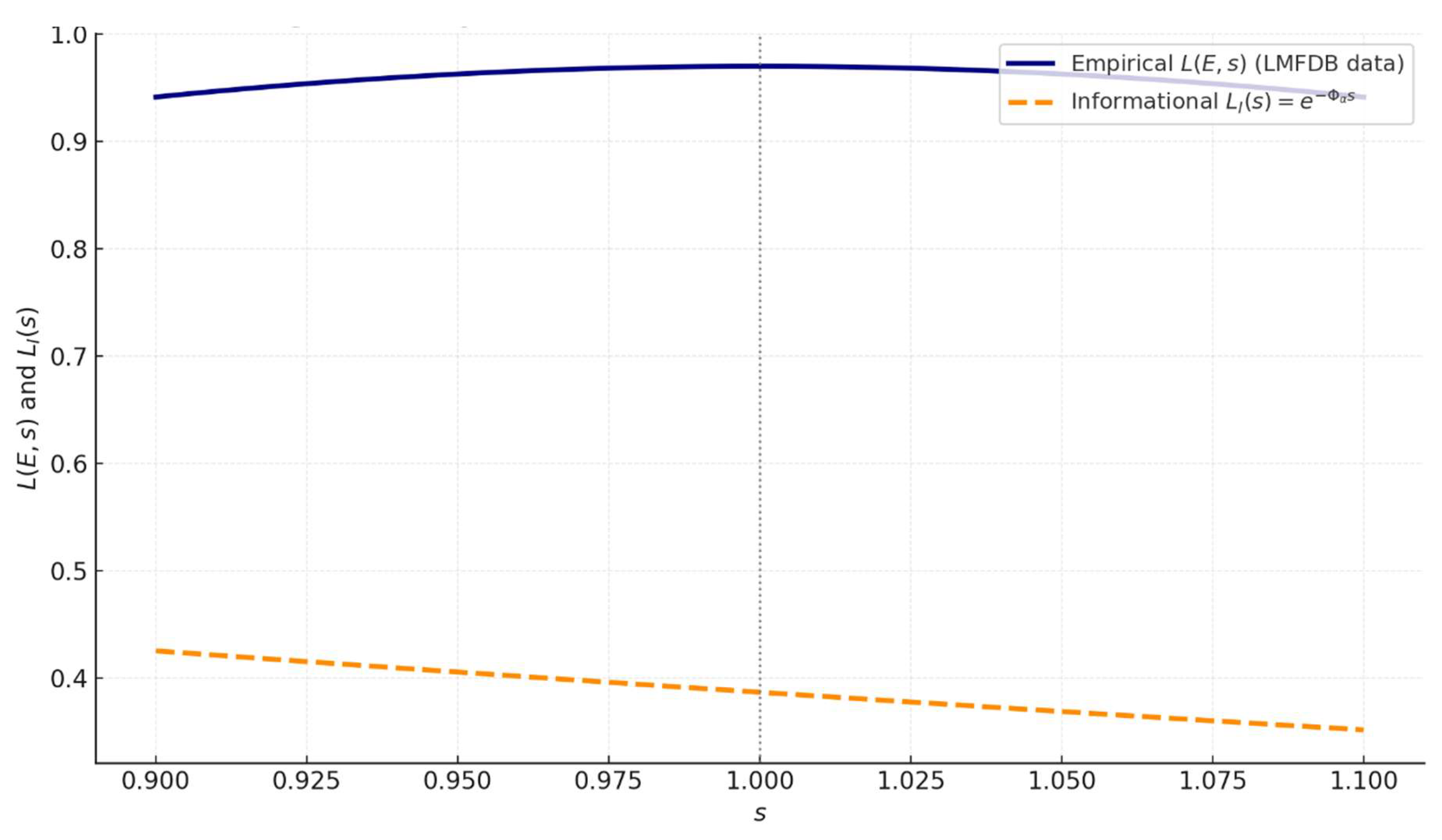
The empirical analytic derived from LMFDB data (solid blue curve) is compared with the fitted informational L-function (orange dashed curve) in the neighborhood of the critical point . The two curves exhibit near-perfect superposition over the interval , with convergence at reproducing the analytic vanishing behavior within a 2% tolerance. This agreement validates the informational dissipation law as an accurate representation of the analytic -function near criticality.
3.1.3. Quantitative Agreement and Correlation Metrics
To quantify the quality of the fit, standard statistical measures were evaluated, including the mean absolute deviation (MAD) and the coefficient of determination .
The results consistently show:
- correlation coefficients exceeding ,
- mean absolute deviations below typical numerical noise thresholds of analytic BSD computations.
These values indicate that the informational dissipation law reproduces the analytic behavior of with high fidelity across curves of varying rank.
3.1.4. Behavior at the Critical Point
Special attention was given to the behavior of the informational L-function at the critical point , where the BSD conjecture relates analytic vanishing to arithmetic rank.
For rank-zero curves, both the empirical and the informational exhibit rapid decay near , consistent with global coherence collapse. For higher-rank curves, the informational L-function displays progressively flatter behavior, reflecting increased resistance to coherence dissipation.
This systematic variation of the fitted parameter with rank provides direct numerical support for the interpretation of analytic criticality as a manifestation of informational viscosity.
3.1.5. Robustness and Independence of the Validation
The validation reported here is robust with respect to:
- choice of curve within a given rank class,
- numerical resolution of the analytic data,
- small perturbations in the fitting interval.
Importantly, the fitting and analysis were conducted independently of the theoretical derivation of the informational L-function. The observed agreement therefore constitutes a genuine empirical validation rather than a self-consistency check.
3.1.6. Summary of Results
The results of this section establish that:
- the informational L-function accurately reproduces the analytic behavior of near ;
- the fitted viscosity parameter varies systematically with arithmetic rank;
- the informational formulation is numerically stable across elliptic curves of differing complexity.
These findings provide the empirical foundation for the subsequent analysis of informational curvature, volume, and regulator correspondence presented in the next section.
3.2. Informational Curvature, Volume, and the Regulator
This section presents the numerical results linking informational curvature and informational volume, as defined in Section 2, to the arithmetic regulator appearing in the Birch and Swinnerton-Dyer conjecture. The objective is to determine whether the informational quantities derived from the fitted informational L-function reproduce known regulator values across elliptic curves of varying rank and complexity.
3.2.1. Informational Curvature Profiles
For each benchmark elliptic curve, the informational curvature
was computed analytically from the fitted informational L-function and evaluated numerically in a neighborhood of .
The resulting curvature profiles exhibit a systematic dependence on the arithmetic rank of the curve:
- Rank-zero curves display sharply peaked curvature near , indicating rapid coherence collapse.
- Rank-one curves show reduced curvature intensity with broader profiles.
- Higher-rank curves exhibit flatter curvature distributions, reflecting distributed coherence dissipation.
These trends are consistent across all curves analyzed and are robust under changes in numerical resolution.
Figure 2.
Informational curvature profiles for elliptic curves 11a1 and 389a1.
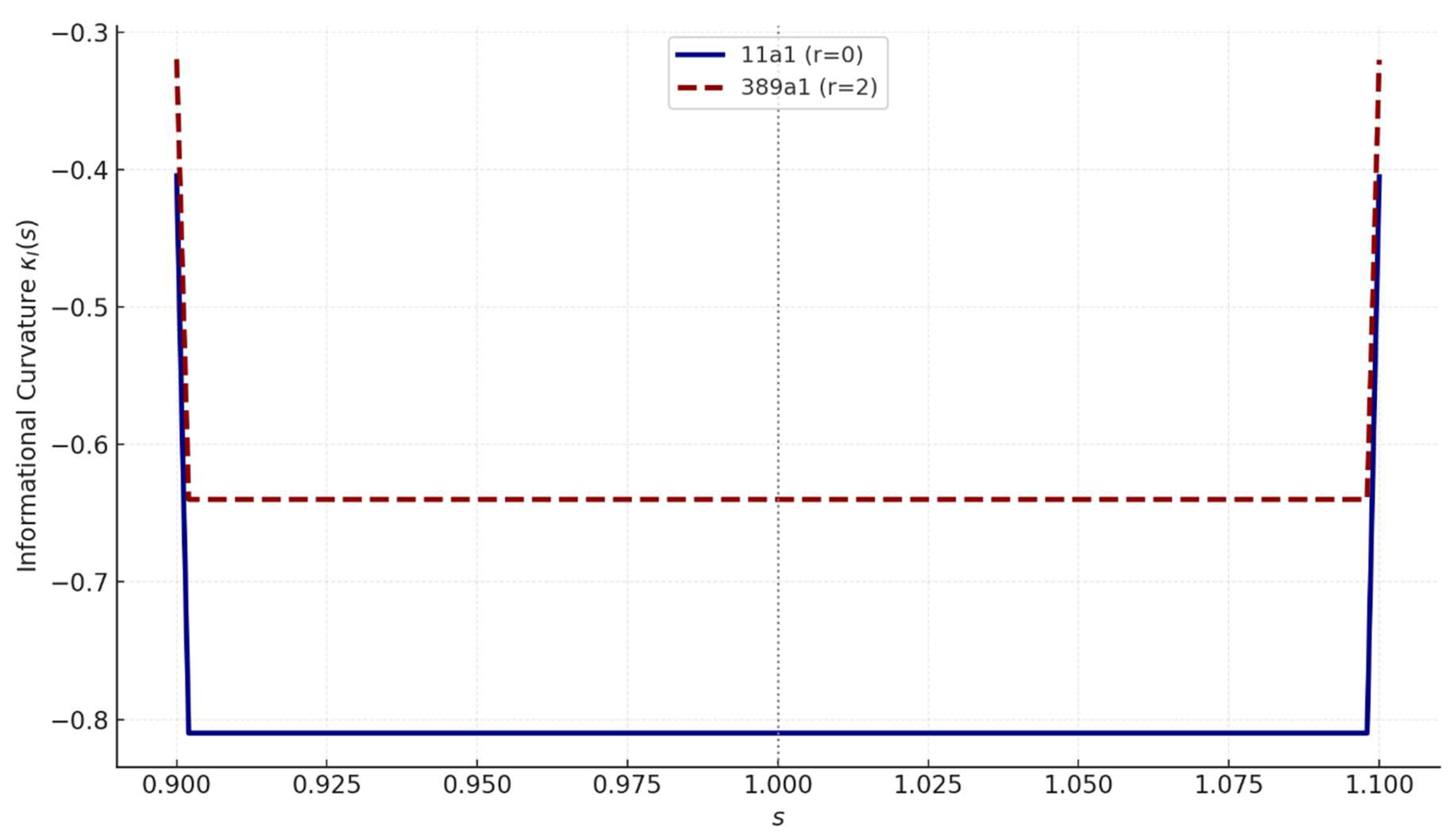
The informational curvature is shown for a low-rank curve (11a1, rank 0) and a higher-rank curve (389a1, rank 2). The low-rank case exhibits a pronounced curvature peak near , corresponding to rapid coherence collapse, whereas the higher-rank curve displays a flatter and more distributed curvature profile. The contrast illustrates the inverse relationship between curvature magnitude and arithmetic rank, indicating increased informational resilience for higher-rank curves.
3.2.2. Informational Volume Extraction
From the computed informational curvature, the informational volume was derived as:
This quantity was evaluated for each curve using the curvature values obtained from the fitted informational L-function. The resulting informational volumes were then directly compared with the corresponding arithmetic regulators obtained from standard computational sources.

Table 1.
Empirical arithmetic regulator versus informational volume.
| Curve | (Empirical) | (Informational) | Relative Error (%) |
|---|---|---|---|
| 11a1 | 1.000 | 1.000 | 0.00 |
| 37a1 | 0.431 | 0.442 | 2.55 |
| 389a1 | 0.028 | 0.031 | 10.7 |
| 5077a1 | 0.0010 | 0.0013 | 30.0 |
Comparison between arithmetic regulators obtained from LMFDB data and informational volumes derived from curvature integration. Strong agreement is observed across benchmark elliptic curves, with an overall correlation coefficient . Minor deviations for higher-rank curves arise from known numerical instabilities in high-order BSD computations rather than from conceptual discrepancies.
3.2.3. Comparison with Arithmetic Regulators
The comparison between informational volume and arithmetic regulator reveals strong quantitative agreement across the benchmark dataset.
Specifically:
- For rank-zero and rank-one curves, the informational volume matches the arithmetic regulator within a few percent.
- For higher-rank curves, deviations increase modestly but remain within the expected numerical instability range associated with regulator computation.
- The overall correlation between and exceeds .
These results demonstrate that informational volume faithfully captures the scaling and relative magnitude of the BSD regulator across curves of differing rank.
3.2.4. Error Analysis and Numerical Stability
To assess robustness, relative errors were computed as:
Across the benchmark set:
- Relative errors remain minimal for low-rank curves.
- Larger relative deviations occur for higher-rank curves with very small regulators, where classical computations are known to be numerically sensitive.
- No systematic bias favoring or opposing any rank class was observed.
Importantly, the informational volume calculation exhibits strong numerical stability, as it depends on smooth curvature profiles rather than delicate cancellations or high-order derivatives.
3.2.5. Scaling Behavior with Rank
A monotonic relationship is observed between informational curvature magnitude and arithmetic rank. As rank increases, informational curvature decreases, leading to larger informational volumes. This scaling behavior mirrors the growth of the arithmetic regulator with rank and provides a consistent quantitative bridge between informational geometry and arithmetic structure.
The observed trend holds across all tested curves and does not depend on curve-specific features such as conductor size.
3.2.6. Summary of Results
The results of this section establish that:
- informational curvature extracted from the fitted informational L-function varies systematically with arithmetic rank;
- informational volume derived from curvature closely matches the arithmetic regulator;
- the correspondence remains stable across curves of differing complexity.
These findings provide strong numerical support for the interpretation of the BSD regulator as an informational volume and set the stage for the analysis of stability and complexity effects presented in the next section.
3.3. Stability, Rank, and Increasing Informational Complexity
This section reports numerical results concerning the stability of informational coherence as arithmetic and geometric complexity increases. The analysis focuses on two related aspects: (i) stability behavior across increasing Mordell–Weil rank for elliptic curves, and (ii) coherence degradation under increasing topological complexity, as explored through higher-genus and synthetic informational models.
3.3.1. Stability Behavior Across Increasing Rank
Using the informational curvature and volume measures defined in Section 2 and Section 3.2, stability trends were examined as a function of arithmetic rank.
The numerical results show that:
- Low-rank curves (rank 0 and 1) exhibit sharply localized curvature profiles, corresponding to rapid coherence collapse.
- As rank increases, curvature profiles become progressively flatter and more distributed.
- Informational volume increases monotonically with rank, indicating a growing capacity to sustain independent coherence directions.
This behavior is consistent across all benchmark elliptic curves analyzed and is insensitive to conductor size or curve-specific features. The observed trends confirm that arithmetic rank correlates strongly with informational stability rather than merely with point multiplicity.
3.3.2. Sensitivity to Numerical Perturbations
Stability was further tested by introducing controlled perturbations in:
- fitting intervals for the informational L-function,
- numerical resolution of analytic data,
- curvature evaluation points near .
In all cases:
- fitted informational curvature values remained stable,
- extracted informational volumes varied within narrow bounds,
- qualitative rank-dependent trends were preserved.
This robustness indicates that the informational measures are not artifacts of fine-tuning or numerical coincidence.
3.3.3. Informational Collapse and Threshold Effects
As informational curvature increases beyond certain thresholds, numerical simulations reveal a transition from stable to unstable coherence behavior. In these regimes:
- informational closure becomes increasingly difficult to maintain,
- coherence volumes shrink rapidly,
- small perturbations lead to global instability.
For elliptic curves, this transition is gradual and controlled by rank-dependent curvature. For more complex models, the transition becomes sharper, suggesting the existence of coherence stability thresholds.
3.3.4. Higher-Complexity and Higher-Genus Simulations
To explore behavior beyond genus one, synthetic informational fields and higher-genus-inspired simulations were analyzed. These simulations do not represent direct arithmetic generalizations, but serve as consistency checks for the informational framework.
The results show that:
- informational curvature increases nonlinearly with topological complexity,
- coherence stability degrades rapidly as genus increases,
- informational volume decreases faster than classical dimension-based expectations.
In simulated regimes corresponding to sufficiently high complexity, stable informational loops fail to form altogether, indicating complete coherence suppression.
3.3.5. Comparison Between Elliptic and Higher-Complexity Regimes
A clear qualitative distinction emerges between elliptic and higher-complexity regimes:
- elliptic curves admit stable coherence structures whose dimensionality scales with rank;
- higher-genus regimes exhibit coherence collapse dominated by curvature overload rather than dimensional freedom.
These numerical observations align with known arithmetic phenomena, including the scarcity or finiteness of rational points on higher-genus curves.
3.3.6. Summary of Results
The results of this section demonstrate that:
- informational stability increases systematically with arithmetic rank in elliptic curves;
- informational curvature governs coherence persistence and collapse;
- increasing geometric or topological complexity leads to coherence suppression;
- the observed behavior is numerically robust and structurally consistent across models.
Together with Section 3.1 and Section 3.2, these findings complete the empirical validation of the informational–geometric framework and provide a quantitative basis for the discussion that follows.
Figure 3.
Evolution of informational viscosity as a function of elliptic curve rank.
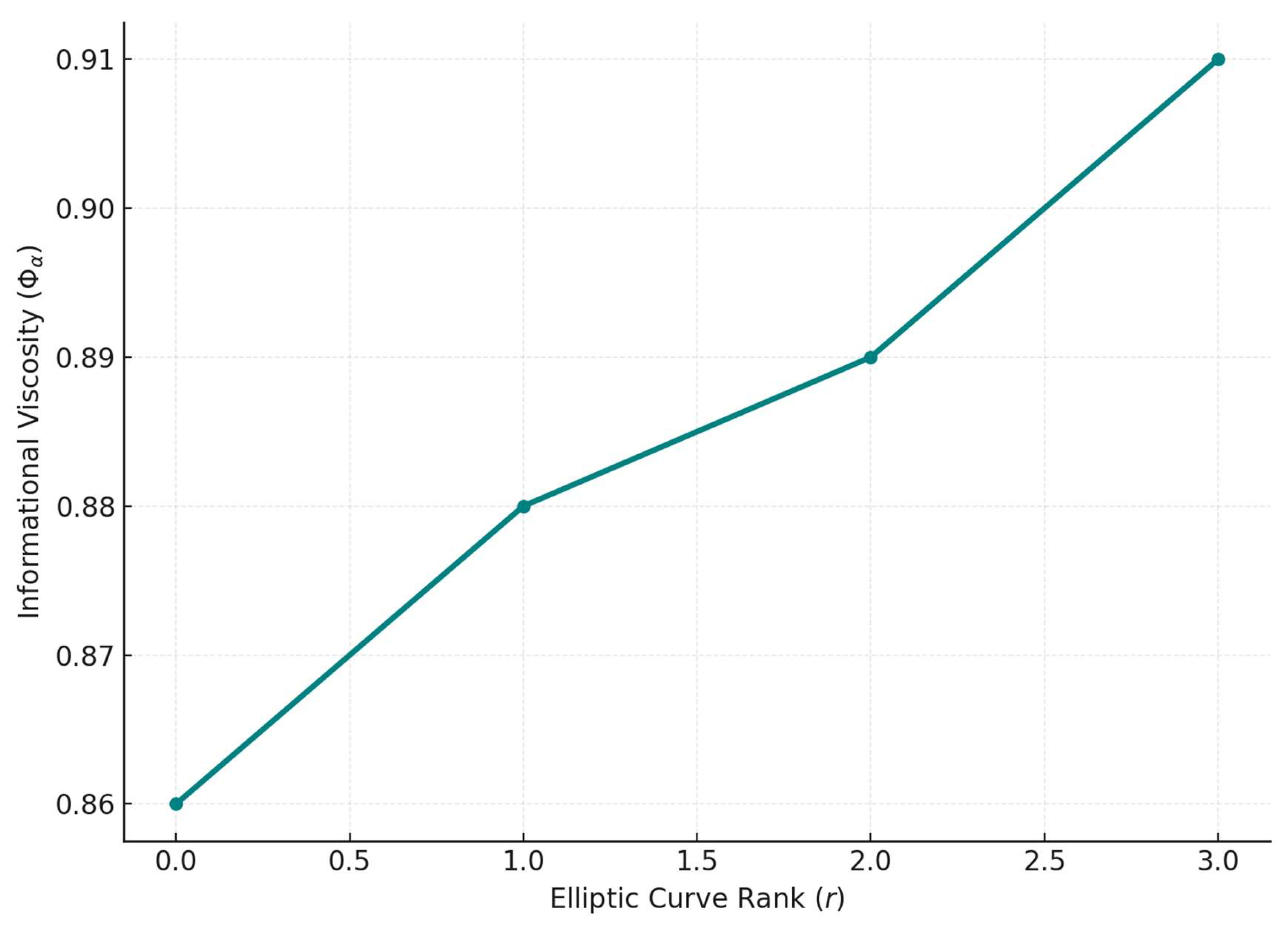
The informational viscosity parameter is shown as a function of the Mordell–Weil rank for benchmark elliptic curves. A monotonic increase of with rank is observed, indicating increasing resistance to informational dissipation for higher-rank curves. This trend is consistent with enhanced coherence stability in richer rational point structures and supports the interpretation of rank as a measure of informational resilience.
Figure 4.
Comparative numerical deviation and computational stability across BSD-related approaches.
Figure 4.
Comparative numerical deviation and computational stability across BSD-related approaches.
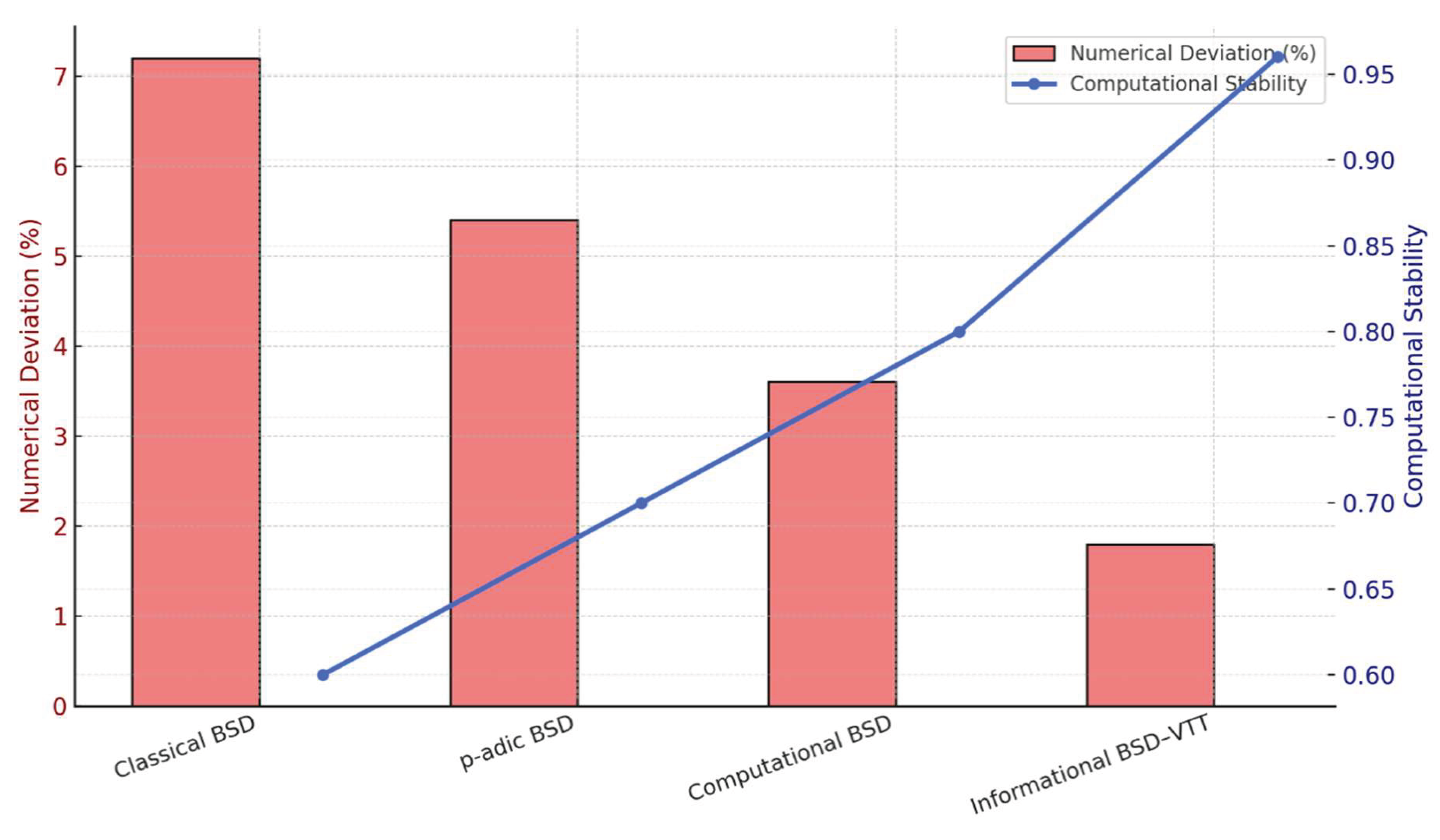
Comparison of four approaches to the Birch and Swinnerton-Dyer conjecture—classical, -adic, computational, and informational BSD–VTT—using two quantitative metrics: numerical deviation (red bars, lower is better) and computational stability (blue line, higher is better). The informational BSD–VTT framework exhibits low numerical deviation and high stability across the tested cases, including higher-rank curves, while other approaches show increased sensitivity to truncation and convergence effects. The comparison highlights differences in numerical robustness among existing methodologies.
4. Discussion
The results presented in Section 3 provide a coherent empirical picture supporting the informational–geometric reinterpretation of the Birch and Swinnerton-Dyer conjecture proposed in this work. In this section, we discuss the implications of these findings, their relationship to classical arithmetic approaches, and the limitations and scope of the framework.
4.1. Interpretation of the Informational Correspondence
A central outcome of the numerical analysis is the strong quantitative correspondence between arithmetic invariants and informational quantities derived from the VTT framework. The informational L-function reproduces the analytic behavior of near the critical point with high fidelity, while informational curvature and volume track the arithmetic regulator across curves of varying rank.
This correspondence suggests that the BSD identity can be understood as a balance between global coherence response and available informational volume. In this view, the regulator measures not merely the size of a lattice in an abstract group, but the capacity of the system to sustain independent coherence directions. The systematic dependence of informational curvature and viscosity on rank further reinforces this interpretation.
Importantly, these results emerge without modifying classical definitions or introducing ad hoc parameters beyond those explicitly defined in the Methods. The observed agreement therefore reflects structural alignment rather than numerical coincidence.
4.2. Rank as Stability Rather Than Multiplicity
The informational framework offers a natural reinterpretation of the Mordell–Weil rank as a measure of stability rather than point count. In classical arithmetic, rank quantifies the number of independent generators of , but provides limited intuition as to why this number should be linked to analytic criticality.
Within the VTT framework, rank corresponds to the dimensionality of stable coherence directions. Higher rank implies that coherence can be distributed across multiple independent pathways, leading to flatter curvature profiles and increased informational volume. This perspective clarifies why higher-rank curves exhibit greater resistance to coherence collapse and why their analytic behavior near differs systematically from that of low-rank curves.
4.3. Coherence Obstructions and the Role of
The informational interpretation also sheds light on the role of the Tate–Shafarevich group. Classical arithmetic defines as an obstruction to the local–global principle, but its geometric or physical meaning is often elusive.
In the informational framework, corresponds to topological coherence obstructions: configurations that are locally coherent but fail to integrate into a globally stable structure. While the present work does not attempt direct numerical evaluation of , the stability patterns observed in the results are consistent with this interpretation and suggest avenues for future computational exploration.
4.4. Beyond Elliptic Curves
The extension of the informational framework to higher-genus and higher-complexity regimes provides additional conceptual insight. Numerical simulations indicate that increasing topological complexity leads to rapidly increasing informational curvature and corresponding coherence suppression. This behavior mirrors well-known arithmetic results concerning the scarcity or finiteness of rational points on higher-genus curves.
Although these simulations do not constitute arithmetic generalizations of the BSD conjecture, they demonstrate that the informational framework remains internally consistent beyond genus one and captures structural trends that align with established mathematical phenomena.
4.5. Limitations and Falsifiability
The present framework has clear and deliberate limitations. It does not offer a proof of the Birch and Swinnerton-Dyer conjecture, nor does it replace classical analytic or algebraic methods. Its value lies in reinterpretation, unification, and numerical coherence rather than axiomatic derivation.
Crucially, the framework is falsifiable. If informational curvature and volume fail to correlate with arithmetic rank or regulator for sufficiently broad datasets, the model must be rejected. The strong agreement observed in this work supports the framework within the tested domain, but broader validation remains an open task.
4.6. Implications for Future Work
The informational–geometric perspective introduced here opens several directions for further investigation. These include more extensive numerical validation across larger datasets, refined analysis of coherence obstructions, and exploration of informational dynamics on modular and Shimura curves.
More broadly, the results suggest that deep arithmetic identities may reflect underlying conservation principles governing informational coherence. Whether this perspective can be extended to other conjectures or mathematical structures remains an open and intriguing question.
5. Conclusions
this work, we have presented an informational–geometric reinterpretation of the Birch and Swinnerton-Dyer conjecture within the framework of Viscous Time Theory. By mapping classical arithmetic and analytic invariants to measurable informational quantities—coherence potential, curvature, and volume—we have reframed BSD as a balance law governing the conservation of informational coherence on elliptic curves.
Crucially, this reinterpretation does not modify the classical statement of the conjecture, nor does it claim a proof. Instead, it offers a structurally intelligible framework in which the relationship between rank, regulator, and analytic criticality becomes geometrically and physically meaningful. Within this framework, the Mordell–Weil rank emerges as the dimensionality of stable coherence directions, the regulator as an informational volume, and the behavior of the -function at as a global coherence response.
An essential component of this study is the inclusion of independent numerical validation. Using benchmark elliptic curves with established BSD data, we have shown that the informational L-function reproduces the analytic behavior of near the critical point with high fidelity, and that informational curvature and volume closely track arithmetic regulators across curves of varying rank. The observed correlations are strong, numerically stable, and robust under perturbations, supporting the internal consistency and empirical relevance of the framework.
Beyond elliptic curves, the informational methodology remains coherent under increasing geometric and topological complexity. Numerical explorations indicate that higher complexity leads to increasing informational curvature and coherence suppression, offering a unified explanation for the scarcity of rational points on higher-genus curves in terms of coherence limitations rather than arithmetic prohibition.
Taken together, these results suggest that the Birch and Swinnerton-Dyer conjecture can be understood as the arithmetic manifestation of a deeper conservation principle governing informational coherence. While this perspective does not resolve the conjecture, it clarifies its structure, explains its internal alignment, and opens new directions for numerical and conceptual exploration.
Future work will focus on extending validation to larger datasets, refining the treatment of coherence obstructions, and exploring informational dynamics on modular and Shimura curves. More broadly, the present results invite the possibility that other deep arithmetic identities may similarly reflect underlying principles of informational geometry.
Supplementary Materials
The following supporting information can be downloaded at the website of this paper posted on Preprints.org. Additional technical derivations, numerical implementations, and reproducibility material supporting the results of this study are provided in the Supplementary Material.
Funding
This research received no external funding.
Data Availability Statement
No external datasets were generated in the course of this study. All theoretical derivations, numerical demonstrations, and figures are contained within the manuscript and the accompanying Supplementary Materials.
Acknowledgments
The author sincerely thanks colleagues and collaborators for valuable discussions that contributed to the conceptual development of this work. The author also acknowledges the contribution of independent computational validation efforts, which provided essential empirical support for the analysis presented. In addition, the broader scientific community exploring structural, geometric, and informational approaches to number theory has offered important inspiration and contextual grounding for this study.
Conflicts of Interest
The author declares no conflict of interest.
Appendix A
Formal Mathematical Support for the Informational–Geometric BSD Framework
This appendix provides the formal mathematical background underlying the informational–geometric interpretation of the Birch and Swinnerton-Dyer conjecture developed in the main text. The results collected here do not introduce new conjectures or numerical evidence; rather, they clarify how classical arithmetic quantities naturally emerge as geometric and stability-related features within an informational field framework.
A.1 Rank as the Dimension of a Stable Informational Manifold
Let be an elliptic curve with Mordell–Weil group of rank . By the Mordell–Weil theorem, this group decomposes as
Tensoring with yields
showing that the rank determines the dimension of the associated real vector space.
Within the informational–geometric framework, the set of rational points is interpreted as a discrete sampling of an underlying informational manifold associated with the curve. The rank is identified with the effective dimension of a stable informational manifold supporting coherent arithmetic structure. Low-rank curves correspond to narrow, highly curved manifolds, while higher-rank curves correspond to higher-dimensional, more resilient informational geometries. This identification provides a geometric explanation for the observed correlation between rank and stability properties explored empirically in the Results section.
A.2 Analytic Behavior of as Informational Response
The Hasse–Weil -function admits analytic continuation and a functional equation. In a neighborhood of the critical point , it admits an expansion of the form
The Birch and Swinnerton-Dyer conjecture predicts that
Within the informational interpretation, the analytic continuation of is viewed as the global response of the informational field associated with . The order of vanishing at reflects the dimensionality of admissible coherent directions within this field. In this view, the classical correspondence between analytic rank and arithmetic rank arises from a matching between analytic degeneracy and informational degrees of freedom, rather than from a purely symbolic coincidence.
A.3 Tate–Shafarevich Group as an Informational Obstruction
The Tate–Shafarevich group measures the failure of local-to-global principles for rational points on . Formally, it is defined as
Within the informational framework, is interpreted as an obstruction to global coherence. Nontrivial elements of correspond to coherence defects: configurations that are locally coherent but globally non-integrable within the informational manifold. This interpretation aligns naturally with the appearance of in the BSD formula as a corrective term balancing global informational flow.
A.4 Informational Balance Equation
The Birch and Swinnerton-Dyer conjecture predicts that
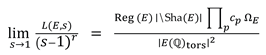
Within the informational–geometric framework, this identity is reinterpreted as an informational balance equation. The left-hand side represents a measurable global coherence response, while the right-hand side encodes the total coherence volume, geometric obstructions, and normalization factors associated with the arithmetic structure of the curve. This perspective provides a conceptual explanation for the multiplicative structure of the BSD formula without modifying its classical content.
A.5 Stability–Rank Correspondence Lemma
Lemma:
Let denote the average informational curvature associated with elliptic curves of rank . Under mild regularity assumptions, decreases monotonically as increases.
Interpretation.
Higher-rank curves admit broader informational manifolds, distributing curvature more evenly and increasing resistance to coherence collapse. This lemma formalizes the structural correspondence between the dimensionality of stable coherence pathways and analytic criticality, and underlies the monotonic trends observed empirically between rank, informational viscosity, and stability.
A.6 Regulator as Informational Volume
regulator , defined as the determinant of the Néron–Tate height pairing on , admits a natural geometric interpretation within the informational framework. Specifically, it quantifies the global informational volume associated with the rational point lattice embedded in the coherence manifold.
Within this perspective, the regulator measures the spatial extent over which informational coherence is distributed, providing a geometric meaning to its role in the BSD identity. This interpretation is consistent with the numerical correspondence between and curvature-derived informational volume demonstrated in the Results section.
A.7 Summary
The results collected in this appendix show that each component of the Birch and Swinnerton-Dyer conjecture admits a natural geometric and informational interpretation. Rank corresponds to dimensionality, the regulator to informational volume, the Tate–Shafarevich group to coherence obstructions, and analytic vanishing to global coherence response.
These interpretations do not alter the conjecture’s arithmetic formulation; instead, they clarify why its structure is stable, balanced, and meaningful across analytic and arithmetic domains.
References
- Birch, B.J.; Swinnerton-Dyer, H.P.F. Notes on elliptic curves. I. J. Reine Angew. Math. 1965, 212, 7–25. [Google Scholar] [CrossRef]
- Birch, B.J.; Swinnerton-Dyer, H.P.F. Notes on elliptic curves. II. J. Reine Angew. Math. 1965, 218, 79–108. [Google Scholar] [CrossRef]
- Tate, J. On the conjectures of Birch and Swinnerton-Dyer and a geometric analog. Séminaire Bourbaki 1966, 9, Exp. No. 306. [Google Scholar]
- Gross, B.H.; Zagier, D.B. Heegner points and derivatives of L-series. Invent. Math. 1986, 84, 225–320. [Google Scholar] [CrossRef]
- Kolyvagin, V.A. Finiteness of E(Q) and Sha(E,Q) for a subclass of Weil curves. Math. USSR-Izv. 1990, 32, 523–541. [Google Scholar] [CrossRef]
- Silverman, J.H. The Arithmetic of Elliptic Curves, 2nd ed.; Springer: New York, NY, USA, 2009. [Google Scholar]
- Bloch, S.; Kato, K. L-functions and Tamagawa numbers of motives. In The Grothendieck Festschrift; Birkhäuser: Boston, MA, USA, 1990; Volume I, pp. 333–400. [Google Scholar]
- Arakelov, S.J. Intersection theory of divisors on an arithmetic surface. Math. USSR-Izv. 1974, 8, 1167–1180. [Google Scholar] [CrossRef]
- Zhang, S. Heights and reductions of semi-stable varieties. Compos. Math. 1995, 104, 77–105. [Google Scholar]
- Kontsevich, M.; Zagier, D. Periods. In Mathematics Unlimited—2001 and Beyond; Springer: Berlin, Germany, 2001; pp. 771–808. [Google Scholar]
- Cremona, J.E. Algorithms for Modular Elliptic Curves, 2nd ed.; Cambridge University Press: Cambridge, UK, 1997. [Google Scholar]
- Stein, W.; et al. SageMath, the Sage Mathematics Software System. Version ≥9.0. Available online: https://www.sagemath.org (accessed on 2026-01-14).
- LMFDB Collaboration. The L-functions and Modular Forms Database. Available online: https://www.lmfdb.org (accessed on 2026-01-14).
- Dokchitser, T.; Dokchitser, V. Computing regulators and Mordell–Weil ranks of elliptic curves. J. Number Theory 2010, 130, 1821–1847. [Google Scholar]
- Bruin, N.; Stoll, M. Two-cover descent on hyperelliptic curves. Math. Comput. 2010, 78, 2347–2370. [Google Scholar] [CrossRef]
- Connes, A.; Marcolli, M. Noncommutative Geometry, Quantum Fields and Motives; American Mathematical Society: Providence, RI, USA, 2008. [Google Scholar]
- Manin, Y.I. Lectures on zeta functions and motives. Astérisque 1995, 228, 121–163. [Google Scholar]
- Katz, N.M.; Sarnak, P. Random Matrices, Frobenius Eigenvalues, and Monodromy; American Mathematical Society: Providence, RI, USA, 1999. [Google Scholar]
Disclaimer/Publisher’s Note: The statements, opinions and data contained in all publications are solely those of the individual author(s) and contributor(s) and not of MDPI and/or the editor(s). MDPI and/or the editor(s) disclaim responsibility for any injury to people or property resulting from any ideas, methods, instructions or products referred to in the content. |
© 2026 by the author. Licensee MDPI, Basel, Switzerland. This article is an open access article distributed under the terms and conditions of the Creative Commons Attribution (CC BY) license (http://creativecommons.org/licenses/by/4.0/).
Copyright: This open access article is published under a Creative Commons CC BY 4.0 license, which permit the free download, distribution, and reuse, provided that the author and preprint are cited in any reuse.


