
Submitted:
27 January 2026
Posted:
28 January 2026
You are already at the latest version
Abstract
In the context of digitalization, social media have become key tools for strengthening business competitiveness and sustainability. The objective of this work was to analyze the effect of social media use on the sustainable development of ecuadorian hotel MSMEs, considering the explanatory variables of digital positioning, brand image, and customer engagement. A quantitative approach was adopted, applying a survey to managers of 93 two- and three-star hotels. Based on the collected data, a multilayer perceptron (MLP) artificial neural network model was developed to capture nonlinear relationships among variables and to assess its predictive capacity regarding business sustainability, operationalized through ordinal categories. The model results show sat-isfactory predictive performance, with an overall accuracy of 90.1% in the training set and 84% in the test set. The normalized importance analysis revealed that variables as-sociated with customer engagement- particularly responsiveness via social media to tourists’ interests- exert the greatest influence on the sustainability of MSMEs, surpas-sing brand image and digital positioning. These findings confirm that active interaction and timely responses on social media are decisive factors in enhancing the sustainable development of these enterprises.
Keywords:
Ecuador
; MSMEs
; social media
; neural networks
; hotel organization
; tourism
1. Introduction
MSMEs constitute the backbone of the economy in most countries [1]; therefore, they play a significant role in achieving one of the Sustainable Development Goals (SDGs), specifically the goal aimed at poverty reduction [2]. MSMEs perform a valuable function in promoting sustainable development [3]; through social media, they find opportunities to structure themselves as spaces that encourage users to pursue a common goal according to their degree of affinity [4]. These platforms provide an ideal social environment for the exchange of experiences and for reducing sociocultural and territorial barriers [5].
Through social media, companies assume the responsibility of establishing contact with tourists and, consequently, achieving significant economic returns, as well as ensuring their sustainability and long-term projection [6]. Likewise, through these platforms, MSMEs have promoted actions that encourage the consumption of products of various nature [7].
With regard to the hotel sector, these organizations are recognized as a deeply rooted phenomenon in which the use of social media opens up clear possibilities for innovation within the hospitality industry [8]. In this context, MSMEs tend to focus inward and work on the commercialization of tourism services within high-cost and luxury destinations [9], relying on branding strategies, since without them they would lack opportunities to remain competitive [10].
Within a competitive environment, large hotels secure their development and growth by building a positive image, a task that is not easy for smaller establishments. Large hotels leverage their brands to compete through unique offerings, well-developed visual identities, and clear marketing communication strategies, this is not the case for MSMEs, which, in addition to other weaknesses, face the disadvantage of limited sustainability during periods of economic recession. Furthermore, environmental phenomena such as climate change may negatively affect smaller organizations, which are inherently the most vulnerable [11].
Although the literature has sufficiently documented the role of social media in business performance, digital marketing, and the competitiveness of tourism companies, empirical evidence remains limited with regard to analyzing the sustainable development of hotel MSMEs in Latin America contexts, particularly in Ecuador. Likewise, most published studies have relied on linear statistical approaches, which restrict the understanding of complex and nonlinear relationships among the variables of digital positioning, brand image, and customer engagement. In this regard, there is a research gap concerning the application of nonlinear models, such as artificial neural networks, which allow for a simultaneous and comparative analysis of the influence of these variables on the sustainability of Ecuadorian hotel MSMEs.
Accordingly, the general objective of this research was to examine the use of social media and its effects on the sustainable development of MSMEs in the ecuadorian hotel sector. The following research questions were formulated: How does the use of social media influence the sustainable development of ecuadorian MSMEs? What are users ‘responses to ecuadorian hotel organizations in relation to social media positioning? and, What types of social media activities influence the brand image of hotel organizations?
2. Materials and Methods
This research adopted a quantitative approach based on the administration of a survey using a questionnaire-type instrument designed in Google Forms, and applied online to the general managers of each of the 93 ecuadorian hotel MSMEs that comprised the study sample. The survey was conducted between august and november 2022.
The sample selection was carried out using information available on official websites of national government entities, specifically from the ecuadorian government´s tourism services platform (https://servicios.turismo.gob.ec/), where a registry of 533 one- and two-star hotels was identified. Consequently, a non-probabilistic sampling method was employed, which is considered appropriate when the study population is finite [12].
The structured date collection questionnaire consisted of 30 items measured using a five-point Likert scale, where 1 represents the lowest level of agreement and 5 the highest. The items were developed based on a review of specialized literature on digital marketing, social media, and sustainable tourism, and were conceptually grouped into three dimensions: digital positioning, brand image, and customer engagement.
Each dimension was represented by a set of items assessing practice and perceptions related to the use of social media within the hotel context. The questionnaire was administered to the general managers of the establishments, as they were considered key informants regarding organizational performance and the digital strategies of MSMEs. Prior to its application, the questionnaire was reviewed to ensure semantic clarity and conceptual coherence of the items.
The dependent variable of the study was the perceived business sustainability of hotel MSMEs, operationalized through a five-category ordinal scale derived from Likert-type items included in the questionnaire. This variable reflects the extent to which managers perceive that extent to which managers perceive that the use of social media contributes to the establishment´s continuity, competitiveness, and sustainable projection over time. For modeling purposes, the ordinal categories were treated as output classes, which justified the use of a multinomial classification approach through artificial neural networks.
The IBM® SPSS® Neural Networks model was employed, which uses nonlinear data modeling to uncover complex relationships and extract greater value from the data through the multilayer perceptron (MLP) procedure. The dataset was divided into two subsets: the first, comprising 70% of the data, was used for model training; the second, consisting of the remaining 30%, was used to conduct the corresponding model testing. It is important to note that the test set served to validate the obtained model, as it involved evaluating the neural network using previously unseen data.
2.1. Justification for the Use of the MLP Compared to Other Approaches
The selection of the MLP model was based on its capacity to capture nonlinear relationships among variables, a particularly relevant feature when analyzing digital interaction dynamics and tourist behavior. Although traditional techniques-such as logistic regression or generalized liner models-allow for the identification of direct associations, they rely on linearity assumptions that do not accurately reflect the complexity of processes inherent to digital positioning, brand image, and customer engagement. In contrast, the MLP enables the modeling of interactions among variables and the detection of patterns that cannot be identified through classical statistical methods, thereby justifying its suitability for the present analysis.
2.2. Variables and Their Conceptual Foundation
The variables included in the model were derived from the reviewed literature and were conceptually grouped into three dimensions: digital positioning, brand image, and customer engagement. Digital positioning refers to the extent to which to enhance visibility and strengthen its presence in digital environments.
Brand image encompasses users ‘perceptions of the hotel´s identity, reputation, and professionalism, whereas customer engagement describes the level of interaction, responsiveness, and attention provided to users through social media platforms, in this study, each item was included as a predictive variable under the theoretical assumption-supported by recent literature in digital marketing and tourism-that these factors influence the business sustainability of the hotel MSMEs analyzed.
2.3. Detailed Model Architecture
The model configuration followed a multilayer perceptron architecture composed of an input layer with 30 units corresponding to the questionnaire items, one hidden layer with five nodes, and an output layer with five ordinal response categories derived from the Likert scale. The hyperbolic tangent function was used as the activation function in the hidden layer, while the softmax function was applied in the output layer to enable multiclass classification.
The model was trained using the backpropagation algorithm with a cross-entropy error function, allowing for more stable classification of categorical data. During training, the model parameters were optimized through successive iterations until convergence was achieved.
2.4. Justification of Sample Size and Its Suitability for the Neural Model
The sample size of 93 observations was considered appropriate for this type of model, as the employed MLP does not include deep architectures or a large number of parameters, thereby reducing the risk of overfitting. For models of low to moderate complexity, it is feasible to obtain stable results with relatively small samples, provided that a reasonable ratio exists between input units and the number of cases, and that validation through test data is implemented, as was done in this study. The 70/30 split between training and testing data contributed to ensuring model robustness and prediction stability.
2.5. Methodological Rationale for Model Parameter Selection
The decision to exclude the bias unit from the model architecture was based on criteria of simplicity and numerical stability. In models with a limited number of observations, the inclusion of bias terms may introduce additional parameters that increase the risk of overfitting without yielding significant improvements in predictive performance. Moreover, given the ordinal nature of the output variable and the use of the softmax function, the network achieved stable classification results without requiring this component. Preliminary tests indicated that model performance did not vary substantially with the inclusion of the bias terms; therefore, it was omitted.
3. Results
The importance and application of neural networks in tourism-related contexts represent an innovative approach in the current landscape, particularly due to the rigorous analysis conducted on date of interest. In this regard, the present study examined data aimed at identifying the most influential predictive variables associated with the need for innovation through entrepreneurship and brand positioning in tourism-oriented hotels.
These patterns are consistent with the findings of recent studies [8], which indicate that sustainable competitiveness in tourism MSMEs is strongly dependent on leadership strategies, organizational performance, and responsible marketing initiatives that ensure digital presence and effective interaction with user.
The artificial neural network (ANN) architecture was defined as follows: the number of input units was 30; the model included one hidden layer with five units; the hyperbolic tangent function was used as the activation function in the hidden layer; the softmax function was applied in the output layer; and cross-entropy was employed as the error function. The entire procedure was conducted without including a bias unit. As a result, the model derived from the ANN training process and subsequently validated using the test data is presented in the analysis.
3.1. Validation of the Neural Network Model
Table 1 presents the average forecasting results corresponding to the training and testing sets, yielding an average correct classification rate of 90.1% and 84% respectively. These results support the validity and relevance of the ANN model. It should be noted that previous research has also demonstrated the appropriateness of classifying business groups using multivariate computational techniques [13].
As part the model´s effectiveness, Figure 1 presents the results of the dependent variable evaluated through the area under the curve (AUC), structured according to the identified model as follows: Agree (,649), very much agree (,670), somewhat agree (,670), strongly agree (,797), and strongly disagree (,788).
These results are also consistent with those reported by other authors [14], who highlight the ability of neural networks to model complex systems and to achieve lower error rates during both training and testing phases. Neural networks constitute a highly reliable techniques [15], and when appropriately trained, they enable accurate predictions to be made [16].
Furthermore, Figure 2 illustrates the lift associated with each class of the dependent variable, derived from the Likert scale categories. This figure allows for a straightforward interpretation of the model´s performance, considering the high correspondence between observed and predicted values, as reflected by the overlap of the curves.
Lift represents the effectiveness of the model in correctly identifying each class compared to random classification. Values above 1 indicate that the model outperforms random assignment, whereas values close to 1 reflect a reduction in discriminative capacity as more cases are included. The curves highlight the model’s initial efficiency in classifying categories with higher predicted probabilities, followed by a natural downward trend as the totality of observations is incorporated.
The relevance of attention to and interest in tourist regarding services promoted through social networks is observed to outweigh brand recognition as a strategy for promoting the services offered by hotel establishments.
The findings suggest that the positioning of these communication platforms positively and significantly influences engagement within hotel organizations. This result is similar to that reported in other studies [17], which indicate that social networks constitute a mechanism for generating trust and enhancing the attractiveness of hotel facilities, thereby positioning them favorably within virtual environments.
Figure 3 shows the level of importance of the variables considered in the proposed model, validated using test data. Accordingly, the variable EG4 (The hotel shows attentiveness to tourist ‘interest in services promoted on social networks) achieved a relative importance of 100%
Meanwhile, the variable IM4 (The hotel brand is recognized as a means to promote the service offered) reached 96.9%; PRS1 (The hotel uses social networks options) achieved 82.7% PRS4 (Social networks are considered a key strategy to promote the hotel in other social spaces) reached 65.5%; and EG1 (The hotel implements social media strategies to strengthen the brand) attained 59%.
Finally, IM3 (Brand image has been fundamental to making the company sustainable) reached 58.4%. This pattern is also similar to that found in other research, which demonstrates that social support generated within social networks significantly increases user engagement during the tourism experience [18].
4. Discussion
In contemporary times, the use of social networks in tourism organizations has become widespread and consolidated as marketing tools through which many MSMEs have managed to establish themselves as spaces for communication, interaction, and the offering of tourism products and services to the population [19].
The role occupied by social networks on the web is perceived as a transfer of physical space to virtual environments that are easily accessible to a vast number of individuals located in different geographical areas [20]. Therefore, within the tourism sector, they constitute highly complex relational networks that would be difficult to develop without the application of web-bases technologies.
The results obtained from the model designed based on data collection make it possible to reveal that the positioning of social networks exerts a positive influence on user engagement and, simultaneously, on user responses toward hotel establishments. This effect is particularly evident when the variable EG4 reached 100%, thereby addressing the first research question posed. These findings are consistent with previous studies that have identified the strategic use of social networks as a significant moderating factor between sustainable performance and organizational practices [21].
This finding translates into the trust conferred by social networks as effective channels to hotel customers, thereby strengthening the sustainability of these businesses as entities embedded within what some authors define as social media ecosystems [22]. This aligns with studies asserting that the various dimensions of social support present in social networks significantly influence user engagement and participation [23].
Likewise, the results reveal that a higher level of user involvement with a company´s social networks increase the creation of perceived value and, consequently, foster permanence and loyalty toward MSMEs [24].
This Dynamic is reinforced by research indicating that user-generated content plays a decisive role in shaping perceptions of credibility and in reducing skepticism toward MSMEs [25], Thereby influencing their engagement levels and digital reputation. Such behavior underscores the importance of developing dynamic organizational capabilities that enables MSMeS to innovate and adapt through the strategic use of online platforms [26].
The implications of this study invite reflection on the relevance of social media positioning, brand image, and user response as elements that contribute to the sustainable development of these enterprises within the ecuadorian context. In this regard, it appears advisable for one-and two-stars hotel establishments, classified as MSMEs, to adopt a more open approach toward the strategic use of social networks. Furthermore, it is encouraging these organizations to integrate into the digital environment, enabling them to enhance sustained growth over time and achieve recognition across diverse geographical spaces.
The results obtained align with contemporary trends in digital marketing for tourism, which recognize that sustained interaction on social networks has a direct influence on users ‘emotional and cognitive engagement [18,23]. Part of the reviewed literature [12,24] supports this relationship by indicating that active consumer participation in digital channels helps increase perceived value, recommendation intention, and the operational sustainability of small tourism enterprises. In this sense, the findings of this study confirm that digital positioning is not only a mechanism for visibility but also a determining factor in the formation of relational bonds that impact the sustainable performance of hotel MSMEs.
When the variable related to attention to tourists’ interest in service promoted through social networks (EG4) achieves a relative importance of 100%, it represents a notable contribution to engagement theory within tourism contexts. This result indicates that interaction is not unidirectional phenomenon but rather a dynamic construction in which the hotel establishment´s ability to respond, personalize, and recognize user needs becomes the primary determinant of the relational bond. This is consisted with contemporary literature, which suggests that engagements emerges when users perceive reciprocity, attention, and meaningful dialogue [10]. Thus, the value attained by EG4 supports this perspective, highlighting that within MSMEs, social media customer attention carries greater weight than brand image or prior reputation. It further suggests that engagement is generated less from institutional or corporate attributes and more from micro-level, immediate, and conversational interactions.
An additional interpretation of the results refers to the structural differences between hotel MSMES and large chains. While the latter tend to rely on consolidated brands and standardized communication strategies to support their positioning, the former exhibit a strong dependence on their ability to generate proximity, rapid responses, and personalized relationships through social networks. Previous research has clearly indicated that in contexts characterized by limited resources, direct interaction constitutes the main competitive advantage of small enterprises [8].
The results of the neural network model corroborate this premise, demonstrating that interaction and personalized attention represent the core of tourist engagement. Meanwhile, brand image, although significant, carries less weight compared to the hotel´s conversational and responsive capacity. This explains why variables associated with immediate user experience are more influential than institutional elements in the digital sustainability of MSMEs.
Finally, it is important to highlight the need for further research addressing technical aspects related to branding, as well as quantifying the impact of eco-labeling and ecological brand certification on tourist. Such effort would aim to enable microenterprises to offer their services to tourists as a unified and differentiated package.
5. Conclusions
Based on the analysis of the proposed model, it can be concluded that the positioning of social networks carried out by lodging companies has a strong impact on the level of engagement developed among users or tourists. This finding becomes evident when interaction emerged as the variable with the highest relative importance. Likewise, it can be inferred that brand image exerts a notable positive influence on hotel companies, thereby providing an answer to the second research question. However, this influence does not significantly affect the sustainable development of hotels.
In light of the aforementioned findings, it is clear that social networks, in alignment with the obtained model, generate a positive effect on sustainable development. This demonstrates that the companies analyzed find support for their business projection through promotional activities and strategies aimed at attracting users or strengthening engagement via social networks.
Regarding the PRS1 variable, it showed a positive influence of 83% within the model, corroborating that the main activities carried out by hotel establishments are closely linked to the use of social networks.
From another perspective, the fact that respondents acknowledged weaknesses in the management of user responses to achieve higher levels of sustainable development provides grounds to conclude that it is essential to implement actions aimed at enhancing online presence. Additionally, it is pertinent to note that considering user engagement does exert a positive effect on the use of social networks as a support mechanism for the sustainable development of the MSMEs analyzed within the ecuadorian context.
The results of this research demonstrate the interest of MSMEs in using social networks, primarily to promote the service offered, improve the quality of customer service, and position the hotel´s tourism brand as relevant and capable of delivering high-quality services.
Similarly, leveraging digital positioning-whether through achieving top ranking in social media searches, managing content strategically, or standing out on leisure and accommodation platforms-proves to be highly valuable. Overall, it should be noted that these insights were timely identified thanks to the learning capabilities provided by neural networks.
This study also identified certain limitations, the most significant being the difficulty in obtaining virtual questionnaire responses from a larger number of participants. This situation highlights that part of the sector remains at an early stage of digital adoption. Consequently, it is imperative that government entities, particularly the Ministry of Tourism and related organizations, strengthen training programs and the management of online resources in order to facilitate the integration of hotels into the digital environment.
Supplementary Materials
The following supporting information can be downloaded at the website of this paper posted on Preprints.org.
Author Contributions
Conceptualization, C.J.M.Q. and M.O.B.G.; methodology, C.J.M.Q.; software, C.J.M.Q.; validation, C.J.M.Q. and M.O.B.G.; formal analysis, C.J.M.Q.; research, C.J.M.Q.; resources, C.J.M.Q.; data curation, C.J.M.Q.; writing-original draft preparation, C.J.M.Q.; writing-revision and editing, C.J.M.Q. and M.O.B.G.; visualization, C.J.M.Q.; supervision, M.O.B.G.; project management, C.J.M.Q.; fundraising, M.O.B.G. All authors have read and accepted the published version of the manuscript.
Data Availability Statement
The data presented in this article are not publicly available due to the fact that the respondents requested confidentiality in the handling of the collected information and because the data form part of an ongoing research project. However, the data may be made available upon reasonable request by contacting the corresponding author at the following email address: carlosjulioquinonez388@alu.uhu.es.
Conflicts of Interest
The authors declare no conflicts of interest.
Abbreviations
The following abbreviations are used in this manuscript:
| MiPymes | Micro, Pequeñas y Medianas Empresas |
| ODS | Objetivos de Desarrollo Sostenible |
| MLP | Perceptrón Multicapa |
| IBM SPSS | Statistical Package for the Social Sciences |
| RNA | Red Neuronal Artificial |
| AUC | Área Bajo la Curva |
| ROC | Receiver Operating Characteristic |
| CSR | Corporate Social Responsibility |
| SMEs | Small and Medium Enterprises |
| MSMEs | Micro, Small and Medium Enterprises |
References
- Madden, K.; Scaife, W.; Crissman, K. How and why small to medium size enterprises (SMEs) engage with their communities: An Australian study. Int. J. Nonprofit Volunt. Sect. Mark. 2006, 11, 49–60. Available online: https://onlinelibrary.wiley.com/doi/abs/10.1002/nvsm.40. [CrossRef]
- Pathak, X.; Pathak-Shelat, M. Sentiment analysis of virtual brand communities for effective tribal marketing. J. Res. Interact. Mark. 2017, 11, 16–38. [Google Scholar] [CrossRef]
- Ruiz, D.F.; González, M.D.L.O.B. Turismo y desarrollo sostenible. El caso de Punta Umbría. Rev. Estud. Empres. 2008, 2, 4–23. Available online: https://revistaselectronicas.ujaen.es/index.php/REE/article/view/363.
- Schultz, D.E.; Peltier, J. Social media’s slippery slope: Challenges, opportunities and future research directions. J. Res. Interact. Mark. 2013, 7, 86–99. [Google Scholar] [CrossRef]
- Jussila, J.J.; Kärkkäinen, H.; Aramo-Immonen, H. Social media utilization in business-to-business relationships of technology industry firms. Comput. Hum. Behav. 2014, 30, 606–613. Available online: https://www.sciencedirect.com/science/article/abs/pii/S0747563213002860. [CrossRef]
- Rodríguez, Y.P.; Pérez, M.C. Redes de conocimiento. Cienc. Inf. 2009, 40, 3–20. Available online: http://www.redalyc.org/articulo.oa?id=181421573001.
- González Medina, R.; Sánchez Suárez, A. Patrimonio histórico versus patrimonio moderno: Problemática de conservación del Edificio de los Poderes de Campeche, México. Intervención 2015, 6, 61–72. Available online: https://www.scielo.org.mx/scielo.php?pid=S2007-249X2015000100008&script=sci_arttext. [CrossRef]
- Hermawati, A. Transglobal leadership approach to sustainable tourism competitiveness at tourism sector-engaged MSMEs. Int. J. Tour. Cities 2020, 6, 863–883. [Google Scholar] [CrossRef]
- Dina, R.; Sabou, G. Influence of social media in choice of touristic destination. Cactus Tour. J. 2012, 3, 24–30. Available online: https://acortar.link/PRdxg2.
- Borah, P.S.; Iqbal, S.; Akhtar, S. Linking social media usage and SME’s sustainable performance. Technol. Soc. 2022, 68, 101900. Available online: https://www.sciencedirect.com/science/article/abs/pii/S0160791X22000410. [CrossRef]
- Pompeia, M.L.F. Assessing the suitability of a single brand of MSMEs in the hospitality sector. Worldw. Hosp. Tour. Themes 2021, 13, 109–123. [Google Scholar] [CrossRef]
- Lee, C.T.; Pan, L.Y.; Hsieh, S.H. Artificial intelligent chatbots as brand promoters. Internet Res. 2022, 32, 1329–1356. [Google Scholar] [CrossRef]
- Fontalvo, I.M.S. Enfoques y modelos de educación intercultural. Praxis 2011, 7, 30–41. Available online: https://dialnet.unirioja.es/servlet/articulo?codigo=5907175.
- Villada, F.; López-Lezama, J.M.; Muñoz-Galeano, N. El papel de la educación financiera en la formación de profesionales de la ingeniería. Form. Univ. 2017, 10, 13–22. [Google Scholar] [CrossRef]
- Jiménez-Carrión, M.; Gutiérrez-Segura, F.; Celi-Pinzón, J. Modelado y predicción del Fenómeno El Niño en Piura, Perú mediante redes neuronales artificiales usando Matlab. Inf. Tecnol. 2018, 29, 303–316. Available online: https://www.scielo.cl/scielo.php?pid=S0718-07642018000400303&script=sci_arttext. [CrossRef]
- Álvarez Blanco, J.; Lau Fernández, R.; Pérez Lovelle, S.; Leyva Pérez, E.C. Predicción de resultados académicos mediante redes neuronales. Ingeniare 2016, 24, 715–727. Available online: https://www.scielo.cl/scielo.php?pid=S0718-33052016000400015&script=sci_arttext.
- Amezcua, M.P. Redes sociales y reputación organizacional para las PyMEs. Univ. Empresa 2012, 14, 131–149. Available online: https://www.redalyc.org/pdf/1872/187225561006.pdf.
- Chung, N.; Tyan, I.; Chung, H.C. Social support and commitment within social networking site in tourism experience. Sustainability 2017, 9, 2102. Available online: https://www.mdpi.com/2071-1050/9/11/2102. [CrossRef]
- Flores-Ruiz, D.; Bino-Raya, R.E.; Barroso-González, M.D.L.O. Responsabilidad social en el sector hotelero. J. Glob. Compet. Gov. 2016, 10, 116–135. Available online: https://dialnet.unirioja.es/servlet/articulo?codigo=6992501.
- Donath, J.; Boyd, D. Public displays of connection. BT Technol. J. 2004, 22, 71–82. Available online: https://link.springer.com/article/10.1023/b:bttj.0000047585.06264.cc. [CrossRef]
- Abbas, J.; Mahmood, S.; Ali, H.; et al. Effects of CSR practices and environmental factors on sustainable performance. Sustainability 2019, 11, 3434. Available online: https://www.mdpi.com/2071-1050/11/12/3434.
- Barnes, N.G.; Lescault, A.M. Social media adoption in higher education. In Ctr. Mark. Res.; Univ. Mass. Dartmouth: North Dartmouth, MA, USA, 2011; pp. 5–10. Available online: https://electrickite.com/wp-content/uploads/2015/09/higherEd.pdf.
- Lin, X.; Zhang, D.; Li, Y. Dimensions of social support on social networking sites. Comput. Hum. Behav. 2016, 58, 421–430. [Google Scholar] [CrossRef]
- Zhang, M.; Guo, L.; Hu, M.; Liu, W. Customer engagement and stickiness. Int. J. Inf. Manag. 2017, 37, 229–240. Available online: https://www.sciencedirect.com/science/article/abs/pii/S0268401216302195.
- Dunn, K.; Harness, D. User-generated versus company-generated CSR content. J. Mark. Manag. 2019, 35, 886–915. Available online: https://www.tandfonline.com/doi/abs/10.1080/0267257X.2019.1605401.
- Lawson, B.; Samson, D. Developing innovation capability in organisations. Int. J. Innov. Manag. 2001, 5, 377–400. Available online: https://www.worldscientific.com/doi/abs/10.1142/S1363919601000427. [CrossRef]
Figure 1.
ROC curve (Receiver Operating Characteristic). Source: Author´s own elaboration. Note: class1 (Agree), class 2 (Very much agree), class 3 (Somewhat agree), class 4 (Strongly agree), class 5 (Strongly disagree).
Figure 1.
ROC curve (Receiver Operating Characteristic). Source: Author´s own elaboration. Note: class1 (Agree), class 2 (Very much agree), class 3 (Somewhat agree), class 4 (Strongly agree), class 5 (Strongly disagree).
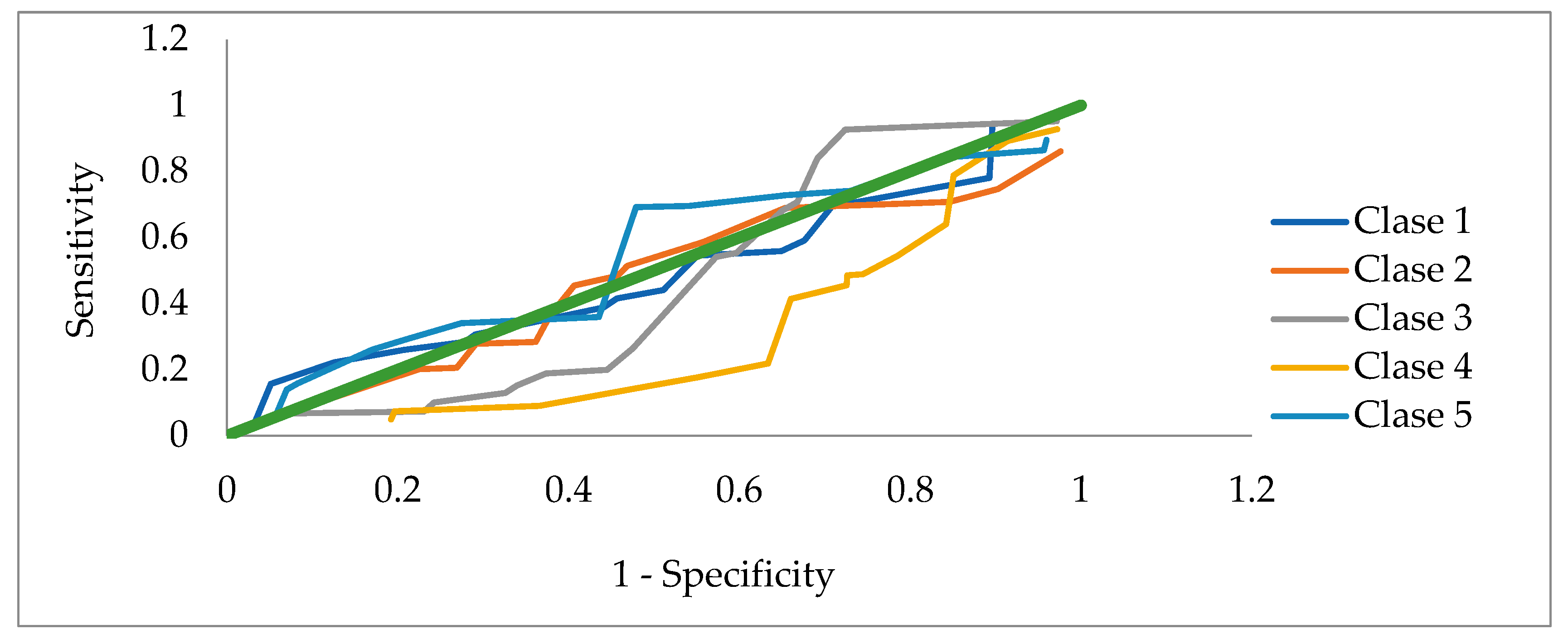
Figure 2.
Lift curve by Likert category. Source: Authors ‘own elaboration.
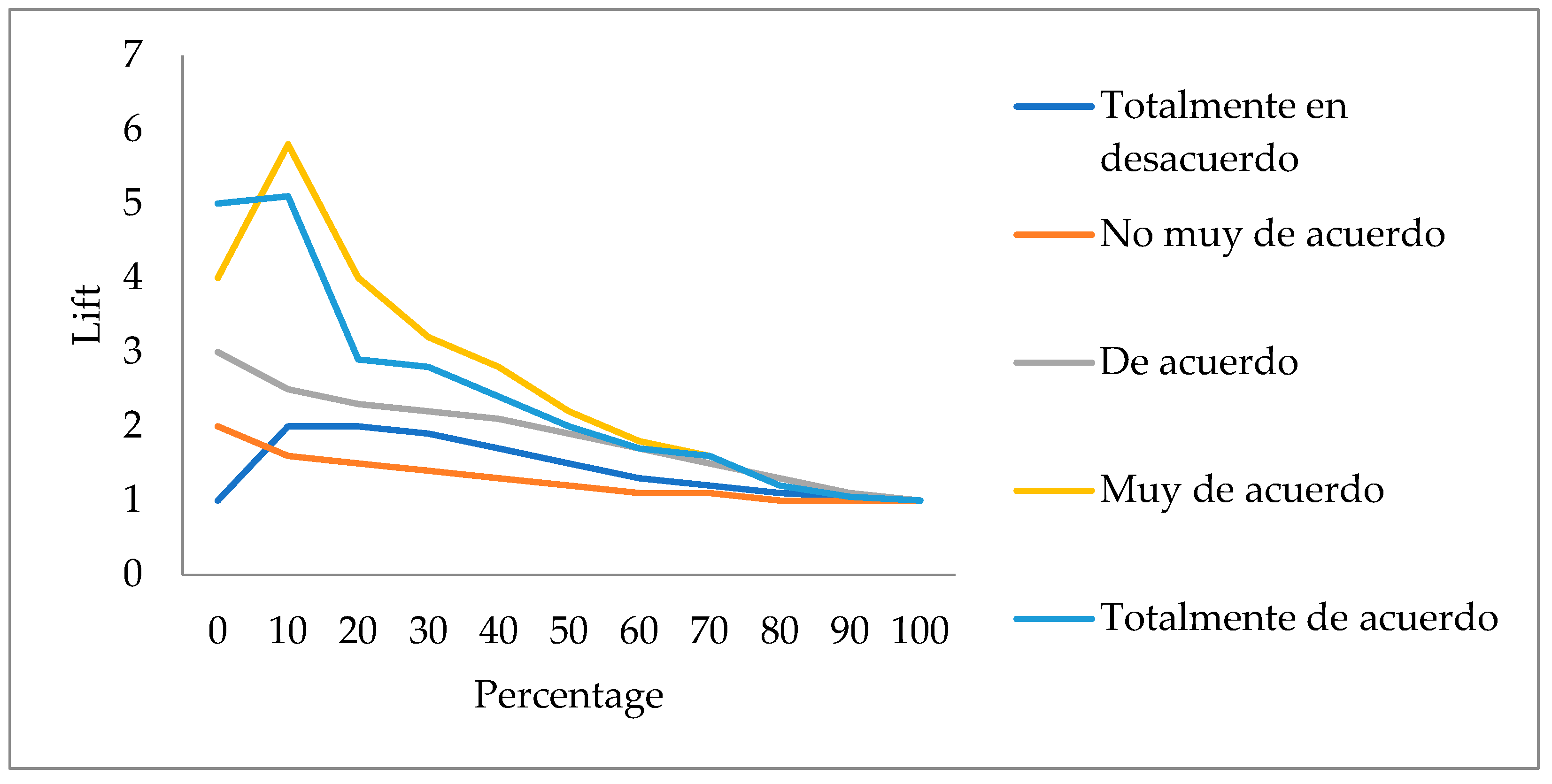
Figure 3.
Normalized importance achieved by each of the variables associated with the obtained neural network model. Source: Author´s own elaboration.
Figure 3.
Normalized importance achieved by each of the variables associated with the obtained neural network model. Source: Author´s own elaboration.
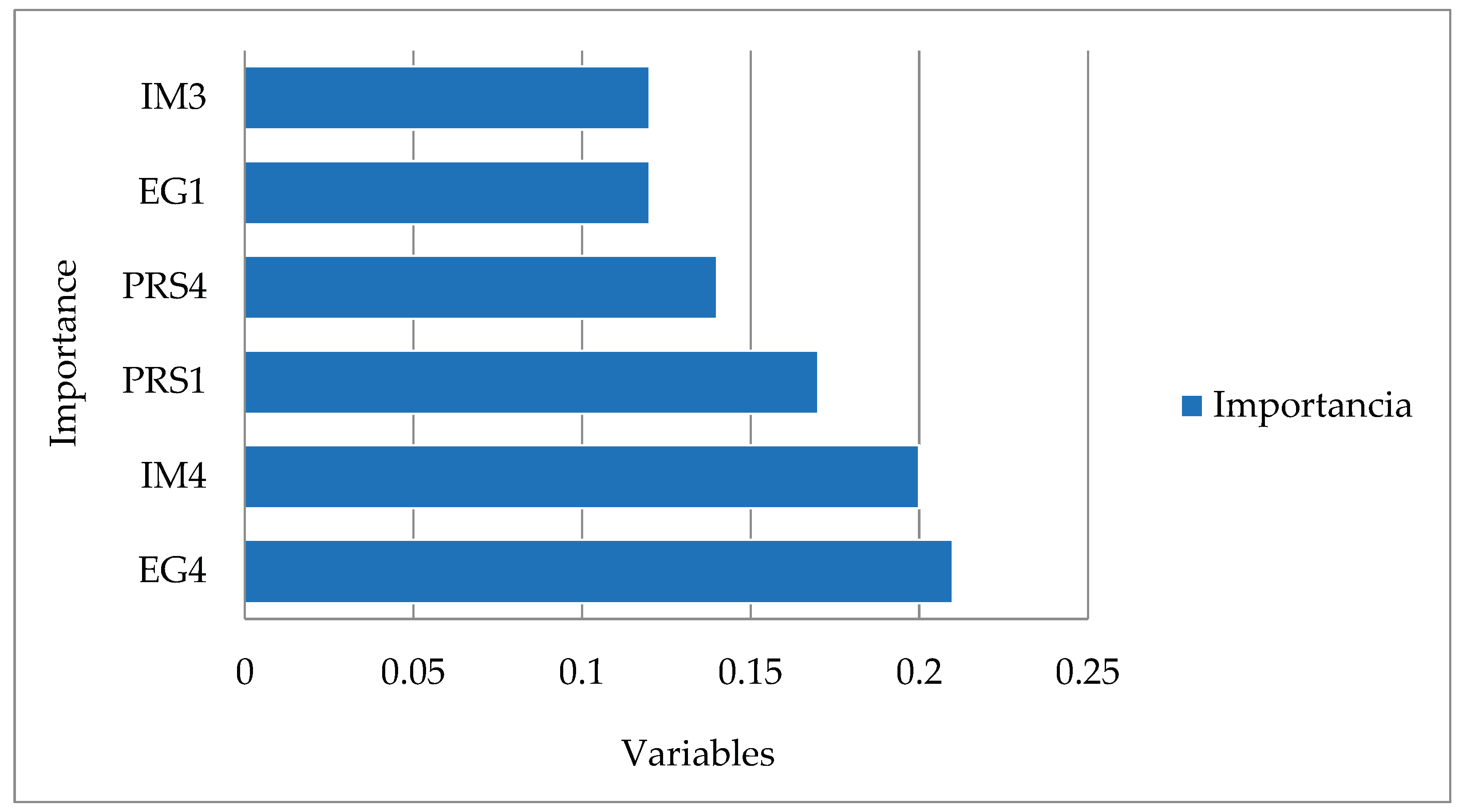

Table 1.
Classification Matrix.
| Sample | Observed | Forecast | |||
|---|---|---|---|---|---|
| 1,00 | 2,00 | 3,00 | 4,00 | ||
| Training | 1,00 | 0 | 4 | 0 | 0 |
| 2,00 | 0 | 32 | 0 | 0 | |
| 3,00 | 0 | 20 | 5 | 0 | |
| 4,00 | 0 | 5 | 1 | 0 | |
| 5,00 | 0 | 3 | 1 | 0 | |
| Overall percentage | 0% | 90,1% | 9,9% | 0% | |
| Test | 1,00 | 0 | 0 | 1 | 0 |
| 2,00 | 0 | 16 | 1 | 0 | |
| 3,00 | 0 | 4 | 2 | 0 | |
| 4,00 | 0 | 1 | 0 | 0 | |
| 5,00 | 0 | 0 | 0 | 0 | |
| Overall percentage | 0% | 84,0% | 16,0% | 0% | |
Source: Authors ‘own elaboration.
Disclaimer/Publisher’s Note: The statements, opinions and data contained in all publications are solely those of the individual author(s) and contributor(s) and not of MDPI and/or the editor(s). MDPI and/or the editor(s) disclaim responsibility for any injury to people or property resulting from any ideas, methods, instructions or products referred to in the content. |
© 2026 by the authors. Licensee MDPI, Basel, Switzerland. This article is an open access article distributed under the terms and conditions of the Creative Commons Attribution (CC BY) license.
Copyright: This open access article is published under a Creative Commons CC BY 4.0 license, which permit the free download, distribution, and reuse, provided that the author and preprint are cited in any reuse.


