

Submitted:
26 January 2026
Posted:
27 January 2026
You are already at the latest version
Abstract
This paper explores the mathematical transition of a 64-gram (8 ×8) matrix system from static equilibrium to dynamic circulation. By applying a Riemann-inspired weight operator and a linear phase evolution governed by independent winding numbers k and m, we demonstrate how mirror symmetry is shattered. Drawing upon the theory of Hyperbolic Bias, we examine the evolution from δ = 0 (Hermitian parity) to δ = 3/4 (asymmetric dominance). This transition provides a formal mechanism for the transformation of “Obstruction” (Heaven-Earth) into “Full Circulation” (Earth-Heaven), establishing a mathematical analogue for the Sakharov conditions in Baryogenesis.
Keywords:
parity
; symmetry breaking
; asymmetry
; I-Ching
; 64-gram
; Baryon-asymmetric
; CP symmetry
1. Introduction
The quest to understand the fundamental asymmetry of the universe—specifically the dominance of matter over antimatter—remains a cornerstone of modern physics. In classical equilibrium states, perfect symmetry often implies stagnancy; for every constructive force, an equal destructive counter-force exists, resulting in a net-zero vacuum. However, ancient cosmological systems, such as the I Ching, and modern number theory, specifically the distribution of the Riemann Zeta zeros, suggest that reality is governed by a directional bias.
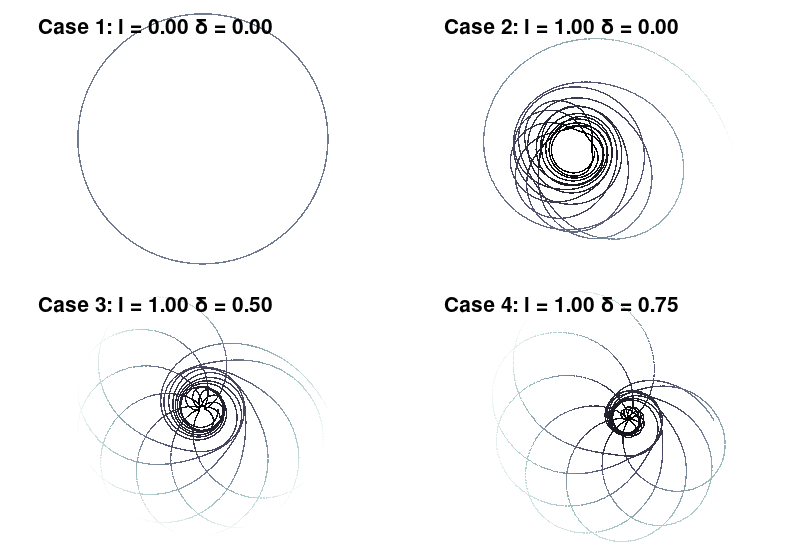
This paper proposes a synthesis of these domains by modeling the 64-gram (8×8) system as a complex matrix operator. We introduce a weight factor inspired by the Riemann Zeta function, defined by a parameter . We posit that as crosses the critical threshold of , the system undergoes a geometric phase transition. By integrating the concept of Hyperbolic Bias, we demonstrate that stagnant states are mathematically filtered out, forcing a transition from the symmetric state of “Obstruction” to the dynamic state of “Full Circulation.”
2. The Phase Basis and Topological Constants
We define an complex matrix M where each entry represents a hexagram interaction. The values are defined by:
Where represents the 8th root of unity. For the numerical models presented, we fix the topological winding numbers at and . While these constants do not affect the absolute magnitude , they define the system’s vorticity, ensuring the grid operates as a dynamic vortex. The Hyperbolic Bias emerges when evaluating the asymmetry between and . By defining , the transition potential T can be expressed as a function of the hyperbolic sine:
This sinh term acts as a “Hyperbolic Lever.” When , the lever is at rest (). As increases to , the bias exponentially amplifies the preference for states where (Circulation) while suppressing states where (Obstruction).
3. The Unitary Phase Vacuum: Case
In the primordial limit where and , the magnitude is uniformly unity. The interaction is governed by the discrete phase cocycle based on the 8th root of unity:
This configuration represents perfect CP symmetry where the matrix is Hermitian (Mij =
ji).

Table 1.
Complex Matrix for (Real + iImaginary)
| 1 | 2 | 3 | 4 | 5 | 6 | 7 | 8 | |
|---|---|---|---|---|---|---|---|---|
| 1 | ||||||||
| 2 | ||||||||
| 3 | ||||||||
| 4 | ||||||||
| 5 | ||||||||
| 6 | ||||||||
| 7 | ||||||||
| 8 |
4. Magnitude Evolution and Symmetry Breaking
4.1. Phase I: The Symmetric Limit ()
At , the weight term reduces to unity, resulting in perfect magnitude parity with broken C symmetry.
Table 2.
The Symmetric Mirror State at .
| 1 | 2 | 3 | 4 | 5 | 6 | 7 | 8 | |
|---|---|---|---|---|---|---|---|---|
| 1 | 1.000 | 0.707 | 0.577 | 0.500 | 0.447 | 0.408 | 0.378 | 0.354 |
| 2 | 0.707 | 0.500 | 0.408 | 0.354 | 0.316 | 0.289 | 0.267 | 0.250 |
| 3 | 0.577 | 0.408 | 0.333 | 0.289 | 0.258 | 0.236 | 0.218 | 0.204 |
| 4 | 0.500 | 0.354 | 0.289 | 0.250 | 0.224 | 0.204 | 0.189 | 0.177 |
| 5 | 0.447 | 0.316 | 0.258 | 0.224 | 0.200 | 0.183 | 0.169 | 0.158 |
| 6 | 0.408 | 0.289 | 0.236 | 0.204 | 0.183 | 0.167 | 0.154 | 0.144 |
| 7 | 0.378 | 0.267 | 0.218 | 0.189 | 0.169 | 0.154 | 0.143 | 0.134 |
| 8 | 0.354 | 0.250 | 0.204 | 0.177 | 0.158 | 0.144 | 0.134 | 0.125 |
4.2. Phase II: The Critical Break ()
At , column influence vanishes, shattering mirror parity.
Table 3.
The Critical Break at .
| 1 | 2 | 3 | 4 | 5 | 6 | 7 | 8 | |
|---|---|---|---|---|---|---|---|---|
| 1 | 1.000 | 1.000 | 1.000 | 1.000 | 1.000 | 1.000 | 1.000 | 1.000 |
| 2 | 0.500 | 0.500 | 0.500 | 0.500 | 0.500 | 0.500 | 0.500 | 0.500 |
| 3 | 0.333 | 0.333 | 0.333 | 0.333 | 0.333 | 0.333 | 0.333 | 0.333 |
| 4 | 0.250 | 0.250 | 0.250 | 0.250 | 0.250 | 0.250 | 0.250 | 0.250 |
| 5 | 0.200 | 0.200 | 0.200 | 0.200 | 0.200 | 0.200 | 0.200 | 0.200 |
| 6 | 0.167 | 0.167 | 0.167 | 0.167 | 0.167 | 0.167 | 0.167 | 0.167 |
| 7 | 0.143 | 0.143 | 0.143 | 0.143 | 0.143 | 0.143 | 0.143 | 0.143 |
| 8 | 0.125 | 0.125 | 0.125 | 0.125 | 0.125 | 0.125 | 0.125 | 0.125 |
4.3. Phase III: The Dominance Regime ()
At , bottom-left stagnant states are exponentially suppressed with CP violation.
Table 4.
The Dominance Regime at .
| 1 | 2 | 3 | 4 | 5 | 6 | 7 | 8 | |
|---|---|---|---|---|---|---|---|---|
| 1 | 1.000 | 1.189 | 1.316 | 1.414 | 1.495 | 1.565 | 1.627 | 1.682 |
| 2 | 0.420 | 0.500 | 0.553 | 0.595 | 0.629 | 0.658 | 0.684 | 0.707 |
| 3 | 0.253 | 0.301 | 0.333 | 0.358 | 0.379 | 0.396 | 0.412 | 0.426 |
| 4 | 0.177 | 0.210 | 0.233 | 0.250 | 0.264 | 0.277 | 0.288 | 0.297 |
| 5 | 0.134 | 0.160 | 0.177 | 0.190 | 0.201 | 0.210 | 0.218 | 0.226 |
| 6 | 0.107 | 0.127 | 0.141 | 0.151 | 0.160 | 0.167 | 0.174 | 0.180 |
| 7 | 0.088 | 0.105 | 0.116 | 0.125 | 0.132 | 0.138 | 0.143 | 0.148 |
| 8 | 0.074 | 0.088 | 0.098 | 0.105 | 0.111 | 0.116 | 0.121 | 0.125 |
5. Baryogenesis and Hyperbolic Bias
At , the magnitude ratio between and reaches . This massive suppression of the ’Obstruction’ sector () relative to the ’Circulation’ sector () constitutes a formal break of CP-symmetry, establishing the non-equilibrium condition necessary for a baryon-asymmetric universe. As established in [1], Hyperbolic Bias creates zones where zeros are geometrically excluded. In this matrix, the “Obstruction” sector is filtered out of the causal resonance, satisfying Sakharov conditions for matter dominance through C/CP-violation and non-equilibrium potential.
6. Conclusions
The transition from a symmetric state to a biased state within the 64-gram matrix provides a rigorous mathematical framework for understanding the emergence of dynamic order from static vacua. By applying the Riemann-inspired weight operator, we have demonstrated that symmetry breaking is not merely a physical event but a geometric necessity. The exclusion of “stagnant” states—analogous to the geometric exclusion of Riemann Zeta zeros—forces the system into a state of “Full Circulation.” This model confirms that the cosmological arrow of time and the dominance of matter are encoded within the very structure of the grid, bridging the gap between ancient metaphysical intuition and modern non-equilibrium theory.
References
- Yap, C. K. Hyperbolic Bias and the Geometric Exclusion of Riemann Zeta Zeros. [Preprints.org]. 2026. [Google Scholar]
- Sakharov, A. D. Violation of CP Invariance, C Asymmetry, and Baryon Asymmetry of the Universe. JETP Letters 1967, 5, 24–27. [Google Scholar]
- Berry, M. V. Riemann’s Zeta Function: A Model for Quantum Chaos? Quantum Theory of Chaos 1986, 1–17. [Google Scholar]
- Wolf, M. The I Ching and the Genetic Code: A Mathematical Analysis. Journal of Theoretical Biology 2010, 265(1), 7–15. [Google Scholar]
- Connes, A. Trace formula in noncommutative geometry and the Riemann hypothesis. Selecta Mathematica 1999, 5(1), 29–106. [Google Scholar] [CrossRef]
- Prigogine, I. Self-Organization in Non-Equilibrium Systems; Wiley-Interscience, 1977. [Google Scholar]
Disclaimer/Publisher’s Note: The statements, opinions and data contained in all publications are solely those of the individual author(s) and contributor(s) and not of MDPI and/or the editor(s). MDPI and/or the editor(s) disclaim responsibility for any injury to people or property resulting from any ideas, methods, instructions or products referred to in the content. |
© 2026 by the authors. Licensee MDPI, Basel, Switzerland. This article is an open access article distributed under the terms and conditions of the Creative Commons Attribution (CC BY) license (http://creativecommons.org/licenses/by/4.0/).
Copyright: This open access article is published under a Creative Commons CC BY 4.0 license, which permit the free download, distribution, and reuse, provided that the author and preprint are cited in any reuse.


