

Submitted:
26 January 2026
Posted:
27 January 2026
You are already at the latest version
Abstract
Digitalization has reshaped dental laboratory processes, introducing new tools and artefacts that support collaboration between clinicians, technicians, and engineers. However, these processes still involve collaboration challenges and frequent iterations that extend delivery times and complicate communication. This study aimed to analyze how digital processes unfold in a dental laboratory and to identify the causes of iterations during the design and manufacturing of custom abutments. Ten cases were selected for analysis, and their event logs were analyzed using process mining in Disco. The analysis reconstructed the process from case initiation to delivery, revealing a reference process consisting of scanning, CAD design, verification, manufacturing, and quality control. Iterations most frequently occurred during CAD and verification phase, often triggered by incomplete clinical information, differing interpretations, or design inconsistencies. Artefacts such as order forms, 3D models, and design outputs were found to mediate collaboration but also to introduce new dependencies and sources of rework. The findings show that variations in digital processes are closely tied to communication and artefact interpretation rather than technical errors. The study demonstrates how process mining can support exploratory analysis of observed process cases derived from dental event logs and provides a basis for earlier recognition of information gaps that contribute to repeated or newly introduced phases within design and manufacturing processes in digital dentistry.
Keywords:
digital dentistry
; process mining
; CAD
; CAM
; iteration
; dental laboratory
; custom abutment
1. Introduction
In many organizations, understanding how processes are executed in practice is essential for improving collaboration, communication, and decision making [1]. A process can be understood as an organized set of events, actions, and decisions that collectively lead to an outcome within an organization [2]. Such processes are often represented through process models that provide a reference description of how work is expected to proceed under standard conditions, including an intended ordering of steps [3]. However, observed execution frequently diverges from this reference description [1]. Steps may be repeated, delayed, or replaced, and additional phases may appear in response to new information or communication problems, influencing both the collaboration among actors and the process outcome. One common source of such divergence is iteration, understood here as a return to earlier steps in order to revise an outcome in response to feedback or newly available information [4]. In product development, iterations are a structural characteristic because interdependent steps often require revisiting previous phases to adjust earlier decisions [5,6]. While these iterations may improve verification, they also extend the process and cause delays that affect collaboration and time delivery. Each iteration requires additional communication and review, which lengthens the overall duration and increases the likelihood of bottlenecks (i.e., points in the process where accumulated work or information dependencies slow down subsequent execution) [7].
Understanding where and why iterations occur is therefore important to analyzing how information and actors interact during process execution. Traditional process analysis methods, such as interviews or model mapping, provide useful accounts of perceived work practices, but they rely on retrospective and interpretive reporting and may not capture how actions are carried out as work unfolds. For this reason, such accounts are often complemented with trace-based sources that record process execution as it occurs and can be used to verify and refine subjective descriptions. The increasing digitalization of organizational processes has made it possible to examine recorded traces known as event logs. Event logs contain sequences of recorded actions linked to individual process cases, providing an opportunity to compare real execution with the intended reference process. This possibility has ultimately led to the development of process mining.
Wil van der Aalst [8] described process mining as a set of techniques that use event logs to discover, analyze, and improve processes. Later research, including Mans et al. [9] and Rozinat [10], showed how process discovery (the reconstruction of a process model from recorded event logs) and conformance checking (the comparison between recorded process execution and a reference process model) make it possible to identify where actual behavior diverges from the reference process and how process models can be refined based on these insights. Studies also demonstrated that process mining can reconstruct observed process execution from recorded event logs, providing insight into how process phases are carried out and where iterations occur [11]. Beyond locating iterations, analysis of recurring execution patterns has shown that iterations can differ in their role within the process, including whether they reflect expected variation or indicate weaknesses in process control [12].
Although existing work demonstrates the ability of process mining to locate and classify iterations, it typically emphasizes structural aspects of process execution, offering less insight into the situational context surrounding the emergence of these patterns. Pentland et al. [1] addressed this limitation by emphasizing that contextual information, such as who performed an action, what resources were used, and under which circumstances, must be considered to understand the meaning of observed process behavior. This approach has shown that including context makes process analysis more informative and better suited to explain collaboration and decision making. Similar conclusions indicate that combining digital traces with qualitative observation helps to explain differences in clinicians’ performance related to the difficulty of individual clinical cases and the setup of the digital process [13]. Taken together, these insights suggest that process analysis requires both behavioral and contextual understanding to explain how observed processes evolve and how iterations arise. This need for combined structural and contextual analysis is particularly evident in healthcare-related domains, such as dentistry, where processes involve multiple actors and depend on digital tools. For a long time, dentistry was performed in an analogue procedure. Patient information was recorded on paper, communication between clinicians and dental laboratories occurred by phone or fax, impressions of teeth were poured in plaster, and models were manually waxed. In recent years, digital technologies have transformed many of these phases. Intraoral scanners capture digital impressions that generate detailed 3D models of the patient’s teeth. These models are processed in computer-aided design (CAD) tools for digital restoration design, which are then transferred to computer-aided manufacturing (CAM) tools for physical fabrication. These changes have created digital dental processes that enable clinicians, technicians, and engineers to collaborate through shared digital artefacts. However, they have introduced new interdependencies between actions, sometimes resulting in iteration when problems in the process occur. Mans et al. [14] were the first to apply process mining in this context, analyzing a crown-on-implant process across one dental practice and one laboratory. Their study demonstrated the potential of process mining to uncover how dental processes operate across organization boundaries. Since their research, digital dentistry has evolved considerably, with laboratories now collaborating with multiple clinicians, design engineers, and external scanning providers. Analyzing cases that vary in their clinical inputs, artefact quality, and collaboration patterns provides a more representative view of contemporary dental process execution and aligns with the argument that variation in recorded traces supports understanding of organizational processes [1]. Building on these arguments, the aim of this study is to analyze a digital dental laboratory process to identify where iterations occur during the design and manufacturing of custom abutments and which additional phases arise when execution departs from the reference process description. To address this aim, process mining is used to reconstruct observed sequences of actions across multiple cases and to locate recurring return paths to earlier phases. These structural findings are complemented by contextual inquiry with domain practitioners, which supports the interpretation and validation of identified iterations by linking them to the associated digital artefacts and process-related communication. By combining these sources, the study provides a contextual, multi-case account of iteration behavior in digital dental processes and demonstrates how process mining can support exploratory identification and explanation of repeated phases within collaborative design and manufacturing.
The paper is structured as follows. Section 2 reviews the state of research on digital processes and their analysis, focusing particularly on prosthodontics and the application of process mining. Section 3 describes the research methodology, structured around the sequential stages of case selection, event log information preparation, process mining analysis, and contextual inquiry used to support interpretation of identified iterations. Section 4 outlines the results of the analyzed cases, followed by Section 5, which discusses their implications in relation to previous studies. Finally, Section 6 concludes by summarizing the main contributions and suggesting directions for future research.
2. Background
To understand how digital processes are carried out in contemporary dental laboratories, it is necessary to position this study within the broader research on process execution and digital transformation. The following section therefore reviews literature that provides the conceptual foundation for analyzing digital dental processes. It first considers how organizational processes are represented and analyzed, why observed execution may diverge from a reference description, and how iteration can emerge in digitally mediated work. It then focuses on digital processes in prosthodontics by synthesizing research on scanning, design, manufacturing preparation, verification, and delivery to derive a reference process description used in the present analysis. Finally, review surveys approach studying processes, ranging from organizational and collaborative perspectives to information-based techniques, and introduce process mining as the method applied in this study to identify where and why iterations occur.
2.1. Understanding and Analysing Digital Processes
A business process can be described as a sequence of interrelated actions that transform inputs into outcomes that create value for an organization or its clients. Dumas et al. [2] defined a business process as a collection of events, actions, and decisions that collectively lead to an outcome that delivers value to customers. Within organizations, processes are usually represented through prescriptive process models that outline how work is expected to proceed under standard conditions. Such representations describe the reference process, which defines the intended order and structure of phases to achieve a desired result. However, as Pentland et al. [15] observed, the execution of processes in practice often diverges from this normative sequence. Iterations arise when collaboration between actors or the use of tools introduces variations, omissions, or iterations that were not foreseen in the model. Analyzing these differences is essential to understand how collaboration occurs in real conditions and what influences the sequence of actions. Digitalization has expanded the ability to observe and analyze how processes unfold in practice. As organization actions become increasingly mediated by digital tools, detailed traces of actions are automatically recorded, allowing researchers to study actual behavior rather than relying on abstract descriptions. Pentland et al. [1] described these traces as digital process information that reveal who performed an action, what was done, and in what sequence. Such information allows a deeper understanding of processed behavior and the circumstances under which iterations appear. This shift from model-based representations to information-informed analysis has brought new opportunities for identifying how processes evolve in real time and how decisions, communication, and tools shape their execution. One of the main characteristics of actual processes is that they rarely progress in a strictly linear order. Iteration, defined as the return to earlier phases to modify or refine an outcome, is a recurring element of processes that involve interdependent actions. Unger and Eppinger [5] demonstrated that such returns emerge when dependencies between information, tasks, and decisions require a previous phase to be revisited for adjustment. Similarly, Wynn et al. [6] explained that iteration is not an anomaly but a structural part of design and development processes, often necessary for aligning intermediate outputs with new knowledge or changing requirements. They differentiated between planned iterations, which are intentionally embedded to improve outcomes, and unplanned iterations, which result from incomplete information or communication problems. Although iteration enables refinement, it also extends the duration of the process and can create bottlenecks that affect collaboration among actors [7]. Recognizing the presence of iteration is therefore fundamental for understanding how digital processes operate and why their execution differs from the planned order of phases. Research in engineering design further highlights that digital processes are characterized by strong interdependencies among phases. McMahon [16] described how the increasing integration of digital tools in engineering processes has intensified the exchange of information across design phases. Eppinger et al. [4] illustrated through their model-based method that identifying dependencies between phases allows the prediction of potential feedback loops and repeated actions. These findings underscore that processes are dynamic systems, shaped by interactions between information, tools, and actors. Understanding such interactions requires attention to both the formal process structure and the contextual factors that influence how it unfolds in practice. Digitalization has made these dynamics more visible. When actions are mediated through tools, they generate detailed records that capture the sequence and timing of phases. Analyzing these digital traces allows researchers to identify where iteration occurs, what triggers it, and how it affects the subsequent progression of work. This perspective builds a foundation for examining domains where digital processes have become integral to everyday practice. Among these, prosthodontics provides a relevant example, as digital technologies have restructured how clinical and technical actors collaborate across design and production phases. The next section therefore focuses on digital processes in prosthodontics, outlining how scanning, design, and manufacturing have been integrated into a coherent digital process that forms the basis for the present analysis.
2.2. Digital Processes in Prosthodontics
The restorative process in prosthodontics typically follows a sequence of connected steps that begin with case initiation and order registration, followed by scanning, digital design, manufacturing, verification, and delivery to the clinic as seen in Figure 1.
Within this sequence, digital tools have progressively replaced conventional techniques. The integration of CAD and CAM into dentistry has been documented for more than two decades. Davidowitz and Kotick [17] traced the development of these technologies from their origins in the 1980s to their widespread use in clinics and laboratories, highlighting how they are now applied to a wide range of prosthetic procedures, including crowns, bridges, and implant abutments. Their review demonstrates that CAD/CAM are not only tools for replacing conventional use of teeth impressions, but also a technology that structures restorative processes by introducing digital artefacts at each phase, from scanning to final delivery. The organization of this process, however, differs across contexts. In some cases, dental laboratories function as separate entities receiving design requests from clinics, while in others design and production are integrated within a single organizational unit. A survey study done by Afzal et al. [18] showed that the prescription document, often referred to as a work authorization form, is central in structuring the communication between the clinic and the laboratory. The authors reported that incomplete or ambiguous forms were strongly associated with delays and misunderstandings, underlining how the initiation of a case is not only administrative but also decisive for subsequent phases of work. Such documents can be understood as boundary objects [19,20], artefacts that enable collaboration and shared understanding across professional or organizational boundaries. In this context, the work authorization form functions as a mediating artefact that translates clinical intent into technical instructions, aligning the actions of clinicians and technicians while also exposing points where interpretation or information gaps can lead to rework.
Within the digital restorative process, intraoral scanning represents the point where clinical information is first transformed into a digital record. From this phase onward, digital impressions form the basis for all subsequent design actions. Nagy et al. [21] showed that scanner performance varies across devices and regions of the arch, with reduced accuracy in posterior areas increasing the likelihood of iterations in later phases. Comparative studies of intraoral scanners have reported similar findings, noting that reliability tends to decrease as the scanned area expands, particularly in complete-arch acquisition (i.e., capturing the full dental arch in a single scan) [22,23]. Systematic reviews have confirmed that scanning is a critical phase in implant-supported prosthetics, as any inaccuracy introduced at this stage can extend through later design and manufacturing phases [24]. Other studies have shown that intraoral scanners can achieve levels of consistency comparable to conventional impressions [25] and can reproduce abutment positions with acceptable repeatability under controlled conditions [26]. Taken together, these findings indicate that intraoral scanning is not only the entry point of the digital process but also a phase that substantially influences the consistency and dependability of all subsequent actions.
Once scans are obtained, they must be registered and associated with case information. Obădan et al. [27] emphasized that entering information such as implant system, tooth position, and clinical requirements is essential for organizing and analyzing digital records. Their conclusion was that without systematic registration, case information becomes fragmented, making later verification and retrospective evaluation difficult. This observation reinforces the idea that digital dentistry does not only depend on the capture of artefacts but also on their organization within structured records.
Following information acquisition through intraoral scanning, the next phase involves translating the captured digital records into a digital design process. Within this context, the CAD phase has been described as central to the digital restorative process. It is at this point that the scanned geometry, clinical requirements, and material parameters are integrated into a coherent digital model of the restoration. Dawood et al. [28] identified CAD as the phase where clinical intentions are transformed into digital restorations, linking diagnostic information with design specifications. Gallo et al. [29] compared custom and prefabricated abutments and showed that variations in design parameters had measurable consequences for clinical adaptation and aesthetic outcomes. Taken together, these studies demonstrate that CAD serves not only to define the geometric form of the restoration but also to influence its functional and clinical performance.
The models generated using CAD are subsequently subject to validation. Ruhstorfer et al. [30] identified design approval as a critical phase where laboratory work must be reviewed against clinical requirements. Their review of multiple studies showed that corrections at this step were frequent, particularly when soft tissue conditions had not been fully represented in digital design. Such revisions often require returning to earlier phases of design to adjust parameters or regenerate geometries. Verification therefore represents a point of close interaction between clinicians and technicians, ensuring that digital designs correspond to clinical needs before manufacturing continues.
Following validation, the process advances to the manufacturing phase based on the approved CAD models. Dawood et al. [28] described how digital design files are transformed into physical components through milling or additive manufacturing, noting that this transition from digital to material form requires careful adjustment of material parameters and machine settings. More recently, Altwaijri et al. [31] examined the mechanical implications of design and manufacturing techniques, concluding that variations in fit and preload arise not only from fabrication tolerances but also from design decisions made in earlier phases of the process.
Quality control has been identified as a recurring phase rather than a final check. Mans et al. [14] found in their process mining study that verification points repeatedly appeared as bottlenecks, demonstrating that laboratory checks are structurally embedded within the process. This resonates with the emphasis in restorative dentistry reviews that long span or complex restorations require additional verification phases to ensure alignment and stability before delivery.
The culmination of the process is delivery to the clinic and clinical fitting. Nagy et al. [21] underscored that without proper integration of the fabricated components into the patient’s treatment plan, digital processes cannot achieve their intended outcomes. Their conclusion was that delivery and fitting are not merely final logistical phases but clinical acts that validate the entire sequence of design and production.
Finally, the closure of a case through archival has been emphasized as equally important. Obădan et al. [27] concluded that systematic storage of order forms, scan information, and CAD outputs is critical for traceability, quality assurance, and future research. Their study showed that archival ensures accessibility of digital artefacts and strengthens the ability to analyze processes over time.
2.3. Approaches to Process Analysis
The analysis of processes has long been central to understanding how work unfolds within and across organizations. Early approaches relied on interviews, observations, and manual mapping to construct process models. Depending on their analytical purpose, such models may be descriptive, documenting how work is carried out in practice, or prescriptive, specifying how work is intended to proceed as a proposed or intended process structure [32] . While these methods provided valuable insights into organizational routines, they were limited by their dependence on interpretive accounts and by their restricted ability to capture the detailed ordering and timing of actions as execution unfolds. As Eppinger et al. [4] demonstrated in their model-based method for organizing product development tasks, analyzing the dependencies among phases can reveal potential loops, rework, and collaboration challenges. However, without detailed records of how actions were performed, such analyses remained theoretical approximations rather than representations of real execution.
To improve the understanding of actual process behavior, researchers began integrating systematic approaches for documenting and examining how actions occur in practice. McMahon [16] described how process models in engineering design evolved from static flowcharts into dynamic representations that incorporate information exchange, feedback, and decision points. These models allowed the identification of where processes diverge from their intended course and where iteration arises due to information dependencies. Complementary work has further emphasized that tracing information flows can reveal how dependencies between actors and tools shape the progression of phases and where collaboration-related difficulties may arise [5] . As processes become increasingly mediated by digital tools, an additional analytical opportunity becomes available, namely the possibility to examine recorded traces of execution rather than relying only on retrospective descriptions [1]. Such records are commonly stored as event logs, which document what action occurred within a given case, who performed it, and when it was recorded. Analyzing event log information enables the reconstruction of observed action sequences and supports structured identification of divergence and repetition within process execution.. However, trace-based analysis requires contextual interpretation. Digital records describe what happened, but they do not in themselves explain how actions were shaped by work organization, role responsibilities, communication exchanges, or local constraints that influence execution [1]. To address this limitation, researchers have explored integrative approaches that combine trace-based analysis with contextual interpretation. For example, Furniss et al. [13] examined digital health record processes by combining trace evidence with cognitive analysis, linking variations in clinicians’ actions to task demands and professional routines. Their findings indicate that quantitative trace analysis alone may be insufficient to explain iterations and that contextual information is needed to interpret why execution varies across actors and organizational contexts.
In product development, Shafqat et al. [7] emphasized the importance of linking process iterations to learning and adaptation. Their study illustrated how unplanned iterations can reveal dependencies or risks that are not anticipated in a prescriptive process model or initial process description. By combining process mapping with risk and learning analysis, they indicated that examining iterations can inform changes that support collaboration and communication among actors. Similarly, Blakstad and Tingsborg [33] argued that iterative development methods provide insight into how feedback loops drive innovation and adaptation across project phases, further reinforcing the idea that process analysis must capture temporal and relational aspects rather than static sequences.
As a result of these developments, contemporary approaches to process analysis increasingly rely on combining model-based reasoning, contextual understanding, and digital evidence. This combination allows researchers to move from normative descriptions toward grounded representations of how processes behave in practice. Yet, this integration also creates methodological challenges. As van der Aalst [8] explained, requiring event logs into interpretable models requires robust techniques that can represent both control-flow and behavioral patterns. Process mining has emerged as a field that directly addresses this challenge by connecting event logs with process models to discover, monitor, and compare actual execution with the expected reference process. The following section therefore focuses on process mining as a methodological framework, outlining its principles, techniques, and relevance for analyzing digital dental processes.
2.4. Process Mining
Process mining connects recorded action information to process models to study how processes are executed in practice. Van der Aalst defines the field as a set of techniques that use event logs to discover, check, and enrich models of observed processes, thereby linking information science and process science [3,8]. In this context, an event log refers to a structured record of process cases in which each recorded event denotes the occurrence of an action within a specific case. Each event is linked to a case identifier and typically includes an ordering attribute, most often a timestamp. Many logs also include the actor or role associated with the action, together with additional case attributes that support interpretation of the recorded sequence. The level of detail captured by events depends on the tool and the purpose of recording. In some systems, events reflect fine-grained tool-supported actions, such as assigning a case, generating a design representation, or completing a verification step. In others, events represent higher-level phase changes, such as a case moving from design to verification or from manufacturing preparation to quality control. Event logs originate from a wide range of information systems. Besides process-aware systems such as workflow management, case handling, and enterprise resource planning (ERP), logs may also be generated by practice management tools in clinics and by order-tracking tools in dental laboratories, which register phase completion during restoration production[14,34]. Because dental cases often involve several independent organizations, relevant records may be split across systems; process mining provides a way to reconstruct end-to-end behavior across these boundaries [14]. Figure 2 illustrates the core idea. Systems that support day-to-day work record events, which can be assembled into event logs. From these logs, a process model can be discovered that reflects the ordering of actions observed in the recorded information. If a reference process description already exists, event log information can be used for conformance checking, that is, to assess where observed execution aligns with or departs from the expected ordering of phases. Finally, a model can be enriched using event log information, for example by adding frequencies or delays to indicate where cases accumulate or return to earlier phases [3,8,14].
Across these three purposes, different model representations can be used to relate event logs and process models, depending on the level of abstraction and the analytical question. Some representations emphasize control-flow structure by expressing how actions can follow one another and where alternative or parallel paths may occur. Within this group, the discovery literature commonly reports Petri nets, process trees, heuristic and causal nets, and directly-follows graphs as alternative ways of representing the ordering of actions observed in the same recorded information [8,34,35]. Other representations provide complementary viewpoints when execution is highly variable or loosely structured, including block-structured and declarative models. In addition, organizational and performance perspectives can be derived from the same event logs to examine which roles executed which actions and where delays occur during process execution [3,34].
Tools operationalize these techniques. In academic research contexts, ProM is the reference tool, offering hundreds of plug-ins for discovery, conformance, and enhancement on standard input formats such as XES [3]. Commercial platforms provide scalable discovery and visual analytics; examples include Disco, Celonis, and others, which typically render directly-follows graphs with frequency and delay annotations to support interactive filtering and comparison of variants [8]. In this study we use Disco to reconstruct the sequence of actions in digital dental laboratory cases and to highlight returns to earlier phases that indicate iteration, while drawing on the ProM literature to interpret model abstractions and conformance concepts.
Compared with business intelligence dashboards that focus on aggregate indicators, process mining looks inside the process and traces how actions, actors, and records are connected across time for each case [10,14]. This makes it suitable for examining where a process diverges from its intended order, which phases tend to repeat, and which conditions precede returns to earlier actions.
3. Methodology
The aim of this study is to analyze how the custom abutment process is carried out in practice within a dental laboratory and to identify where and why iterations occur during design and manufacturing. To address this aim, the study adopts an exploratory research design grounded in process-oriented analysis of digitally mediated execution. Process mining is applied as the primary analytical method to reconstruct and examine observed execution based on information recorded in event logs. This approach supports systematic analysis of action sequences across multiple cases and enables identification of repetition and variation in execution without presupposing strict compliance with a predefined process model [3,8]. Given the exploratory scope of the study, the methodological focus was placed on understanding how process execution unfolds in practice rather than on statistical generalization or predictive modelling.
Figure 3 provides an overview of the study methodology. The figure illustrates the progression from case selection and preparation of event log information, through process mining–based reconstruction of process execution and identification of iterative action patterns, to contextual inquiry conducted to support interpretation of the identified iterations. Each phase builds on the output of the previous one, forming a coherent analytical sequence. The methodological steps illustrated in Figure 3 also structure the organization of the methodology section.
3.1. Research Context and Case Selection
Custom abutments connect a dental implant to the final prosthetic restoration (Figure 4). They transmit mechanical load while shaping the transgingival profile that supports the surrounding tissue and provide the interface for restorations such as crowns or bridges [36]. Structurally, they comprise three functional segments: the implant connection segment, which ensures precise and stable attachment to the implant; the transgingival segment, which defines the emergence profile and maintains the biological seal with the soft tissue; and the prosthetic connection segment, which provides the interface for securing and aligning the final restoration. Custom abutments are designed to accommodate patient-specific anatomical and prosthetic requirements, ensuring both functional stability and aesthetic integration of the final restoration.
The custom abutment design process was selected because of three reasons. First, it involves multiple interdependent process phases that span design, verification and manufacturing, making it suitable for examining process execution and iteration. Second, the process relies heavily on digital artefacts, such as intraoral scans, CAD models and manufacturing files, which are systematically recorded and therefore observable through event log information. Third, custom abutments are routinely produced on a case-by-case basis, allowing each order to be treated as a distinct process case while maintaining a comparable overall process structure.
The study was conducted within the context of a dental laboratory that receives clinical orders from external clinics and processes them through design and manufacturing actions performed by specialized roles within the laboratory. Each order submitted by a clinician initiates a sequence of digitally mediated actions that includes information intake from the submitted order, design actions, manufacturing preparation, and quality verification. These actions are carried out by dental technicians and design engineers using shared digital tools and digital artefacts, while collaboration with clinicians occurs at defined process phases, particularly during order clarification and design verification. This context was selected because it represents a digitally integrated prosthodontic process in which multiple actors contribute to the execution of a single case through shared digital artefacts and representations. These include order documentation and stated requirements, intraoral scan files, design files and model representations, and manufacturing-related outputs that are generated and reviewed as the case progresses. The process relies on the transformation and review of these digital artefacts, through which design-relevant information is represented, revised, and validated. Communication is operationalized in this study as exchanges that occur during specific process phases when information is requested, clarified, or confirmed between clinicians and laboratory roles. This collaboration supports the resolution of emerging information requirements and communication problems that arise during process execution.
Ten cases of custom abutment design were selected for analysis. Consistent with case study research designs that prioritize in-depth examination over statistical generalization, this number falls within the range commonly used for exploratory case-based analysis [38]. Each case represented a completed digital process instance, spanning from order submission by the clinician to delivery of the manufactured abutment to the clinic. The cases were selected based on two criteria. First, each case provided complete digital records covering all relevant process phases, including order information, design artefacts, verification actions and manufacturing preparation. Second, several cases exhibited observable indications of iteration, such as repeated verification actions, rescanning, or the creation of alternative design versions. These characteristics made the selected cases suitable for examining how iterations emerge during process execution and how they relate to specific process phases and artefact transformations. All selected cases shared a common organizational and technical baseline. Each case was initiated by an external clinician through the submission of a digital order form specifying clinical and technical requirements. The dental laboratory processed all cases using the same set of digital tools for scanning, design, verification and manufacturing preparation. In every case, intraoral scanning was used to acquire digital impressions directly from the patient, followed by digital design carried out in a CAD tool used for modelling customized abutments. The consistent use of tools and procedures across cases ensured comparability while allowing variations in execution to be attributed to process-specific factors rather than differences in technological setup. Across all cases, the execution followed the same normative sequence of process phases, beginning with order submission and concluding with delivery to the clinic. This shared normative structure provided a common reference for comparing observed execution across cases and for identifying where and why iterations occurred relative to the expected progression of process phases.
For each case, multiple sources of information were examined, including case records and digital artefacts generated during process execution. Together, these sources provided insight into both the sequence of process phases and the contextual conditions under which iterations occurred. All information sources originated from routine laboratory process and were collected retrospectively after case completion. The order documentation constituted the formal entry point of each case and specified the clinical and technical requirements defined by the clinician, such as implant platform, tooth position and abutment type. These specifications framed the initial information requirements for the laboratory and represented the first structured exchange between the clinician and laboratory roles. Digital scans comprised intraoral impressions of the maxilla, mandible and gingiva and provided the geometric basis for subsequent design actions. These scans were produced using standard intraoral scanning procedures and stored as part of the case record. During the design phase, 3D HTML visualizations were used by the CAD tool to support design review. These visualizations allowed clinicians and design engineers to inspect the proposed abutment geometry, rotate and zoom the model, and add comments linked to specific regions of the design. In addition to the 3D visualizations, static images were exchanged during case-related discussions. These images included reference photographs and annotated screenshots used to communicate design adjustments, clarify aesthetic expectations or resolve ambiguities that could not be sufficiently addressed through the 3D representation alone. Written communication between clinicians and laboratory roles was examined to provide contextual information for interpreting process iterations. These exchanges were not treated as event records in the process mining analysis but were used to understand when additional information was requested, when design decisions were reconsidered and how collaboration between actors influenced the progression of process phases.
The laboratory provided a structured record of process execution referred to internally as a status timeline, which corresponds to an event log in process mining terminology. The event log originated from the laboratory’s case management tool and constituted the primary source for reconstructing observed execution. It contained records of actions performed within each case, together with the associated actor role and case identifier. Because actions may occur repeatedly within a single case, the ordering of recorded actions supports reconstruction of higher-level process phases and the identification of repeated sequences associated with iteration. To support interpretation beyond the action level, event log information was examined in relation to digital artefacts generated during execution. These artefacts included intraoral scan files, intermediate STL files used to transfer geometry between tools, evolving CAD models, and 3D HTML visualizations used during design verification. Considering event log information together with these artefacts enabled interpretation of repeated action sequences in terms of changes in information content, collaboration between actors, and communication-related adjustments.
3.2. Event Log Information Preprocessing
The event log information used in this study was derived from routine laboratory operations and reflected information generated during the execution of custom abutment processes. Each log instance corresponded to a single process case, representing one complete custom abutment order processed by the laboratory. The recorded information captured sequences of actions performed within a case, together with associated actor roles and case identifiers, and provided the basis for subsequent process reconstruction. Prior to analysis, the event log required preprocessing to ensure that actions could be compared consistently across cases. Although the original records already included action labels and ordering information, inconsistencies were observed that reflected differences in terminology, overlapping records generated by parallel tool interactions, and variations in the level of granularity at which actions were recorded. These inconsistencies are typical of event information generated in operational industrial contexts rather than for analytical purposes. Preprocessing therefore focused on harmonizing action labels, resolving duplicate or overlapping records, and aligning recorded actions to a consistent level of abstraction suitable for process mining analysis. This phase was necessary to ensure that repeated actions and sequences could be interpreted in a comparable manner across cases, and that identified iterations reflected differences in process execution rather than artefacts of recording practices.
Each individual event log was reviewed to ensure that the recorded actions reflected the actual ordering of process phases within a case. During this review, instances of duplicate or overlapping action records were identified, most frequently around transitions between closely related phases such as scanning, case creation, and design allocation. These overlaps were attributed to parallel tool interactions associated with the same ongoing work rather than to meaningful iterations in execution, such as returns to earlier phases for revision or re-verification. To avoid misinterpreting recording artefacts as process iterations, overlapping records referring to the same continuous work were consolidated into a single action representation. For example, in some cases the allocation of a case to design personnel appeared multiple times under slightly different labels due to concurrent updates generated by internal collaboration tools. These records were unified under a single action label to ensure consistent interpretation across cases. In addition, action labels were originally recorded in the laboratory’s native language. For the purposes of analysis and comparability, all labels were translated and standardized into English while preserving their original semantic meaning. This step ensured terminological consistency across the event log without altering the recorded ordering of execution.
After individual preprocessing, the ten case-level event logs were merged into a single consolidated event log for analysis. This consolidation retained the original case identifiers and associated attributes, but enabled process execution to be examined and compared across cases within one unified representation.
In this study, an action refers to a recorded unit of behavior captured in the event log, reflecting a tool-supported interaction that may occur multiple times within a process phase. Actions that represented different internal tool states of the same ongoing process phase were grouped under a single action label. For example, records initially labelled as CAM in preparation, CAM in pending, CAM in progress, and CAM in machine were consolidated under the action label CAM, because these labels primarily captured tool-level status changes within the manufacturing preparation phase rather than substantively different action types from a process analysis perspective. It is acknowledged that repeated occurrences of such sub-status records can reflect pauses, re-entries, or re-queuing within the tool. However, because these repetitions do not indicate a return to an earlier process phase and are not distinguishable in the log as separate execution cycles with different informational content, they were treated as internal variation within the same phase rather than as iterations at the process level.
This consolidation was applied selectively to action labels that denoted technical sub-statuses of the same process phase, while actions indicating distinct process behavior were retained as separate labels. The purpose of this grouping was to reduce representational fragmentation in the event log and to support analysis at a level of abstraction appropriate for examining collaboration and iteration across process phases, without eliminating links to contextual information provided by digital artefacts and communication records.
The resulting event log contained a harmonized set of action labels that corresponded to the main phases of the custom abutment process, including case initiation, scanning, case creation, design allocation, CAD modelling, design verification, CAM milling, quality control, and delivery. These labels were defined as analytical categories based on laboratory documentation and preliminary inspection of recorded actions. They served as a reference structure for comparing execution across cases rather than as a formal reference process specification.
For each recorded action, the event log included a case identifier, an action label, and an associated actor role. This structure supported reconstruction of within-case action sequences and enabled cross-case comparison of repeated patterns. Because all recorded actions were linked to case identifiers, the process mining analysis focused on case-level execution and did not model interactions between concurrent cases. Any potential cross-case effects mediated through shared resources or workload allocation therefore fall outside the scope of what can be inferred from the event log representation and are considered as a possible limitation of the analysis.
Prior to importing the consolidated event log into Disco, the attributes used for process reconstruction were specified. Case identifiers and action labels were used to derive observed action sequences, while actor roles were retained to support contextual interpretation without influencing the reconstructed structure. This preprocessing ensured that cases were examined at a comparable analytical granularity and supported consistent identification of recurring patterns and iterations across the analyzed cases. .
3.3. Process Mining
Process mining was applied to analyze how the custom abutment process was executed across multiple cases handled by the same dental laboratory. The analysis focused on comparing observed process execution across cases that shared a common reference process structure but differed in their execution conditions, such as incoming order characteristics, information completeness, and interaction patterns between clinicians and laboratory roles. This design allowed process mining to be used not for compliance checking, but for examining how variations in execution relate to the occurrence of iterations within the same organizational process. The inclusion of multiple cases enabled comparison of process execution under varying contextual conditions while holding the organizational context and digital tool landscape constant. Differences between cases therefore reflected variations in process execution rather than differences in institutional arrangements or technological infrastructure. Analyzing such variation across comparable cases is consistent with multiple-case research designs, which emphasize cross-case comparison as a means of identifying recurring process mechanisms rather than case-specific idiosyncrasies [38,39]. In the context of process mining, variation in recorded action sequences provides a basis for examining how iterations emerge in relation to information availability, collaboration demands, and actor interactions during process execution. Within this study, process mining was used to reconstruct observed sequences of actions for each case and to identify repeated patterns of execution across cases. By comparing these observed patterns, it was possible to distinguish process phases in which execution remained stable from those in which iterations frequently occurred. This analytical focus supports interpretation of how differences in execution conditions influence iteration behavior, without if all cases follow an identical trajectory through the process. For this analysis, the process mining tool Disco (Fluxicon) was used. Given the exploratory aim and the limited number of cases, process mining was employed as a descriptive and comparative technique, with Disco used to visualize dominant execution paths and iterative returns, rather than to derive statistically generalizable performance indicators. Disco supports the derivation and visual inspection of process models from event log information by representing frequently occurring action sequences as dominant paths and less frequent sequences as peripheral paths, which enabled identification of stable execution patterns and recurrent iterations across the analyzed cases [40]. In this study, Disco was used to visualize and analyze the combined event log comprising all ten cases. Based on the preprocessed event log information, the tool reconstructed a process model representing observed sequences of actions across cases. The resulting process map provided a structured overview of how actions were ordered and how frequently specific sequences occurred during process execution. In the process map, transitions between actions were represented as directed connections, with visual emphasis reflecting their relative frequency across cases. Iterations were identified where execution paths returned to previously observed actions before progressing further. These repeated patterns were interpreted in relation to the reference process description defined earlier in the methodology. Within the process mining analysis, iterations were operationalized as returns to previously observed actions within the same case. Identification of such returns was based on repeated sequences in the reconstructed process execution, rather than on assumptions about their causes or consequences. The analysis therefore focused on locating recurring action patterns and loops in the observed execution that indicated additional cycles within the process. These recurring patterns served as analytical markers for selecting process phases for further examination. Rather than interpreting their meaning at this stage, the identified iterations were used to structure the subsequent analysis, in which they were examined in relation to associated digital artefacts and communication records. This separation ensured that the process mining analysis remained descriptive and structural, while interpretation of why iterations occurred was deferred to the next stage of analysis. The iterations identified through process mining were subsequently examined in relation to associated digital artefacts and communication records to support their interpretation. For each case, relevant artefacts generated during process execution, including intraoral scans, CAD models, and three-dimensional (3D) visualizations, were reviewed to assess how information content changed across repeated actions. These artefacts were used to trace whether iterations coincided with design modifications, verification actions, or other adjustments reflected in successive versions of the same information object. Written communication exchanged between clinicians, dental technicians, and design engineers was also examined to contextualize the identified iterations. These exchanges were reviewed to determine whether repeated actions were associated with requests for clarification, additional information, confirmation of design decisions, or other collaboration-related interactions between actors. Rather than attributing iterations to a predefined set of causes, the analysis used these contextual materials to characterize the conditions under which repeated action sequences occurred. By combining the structural patterns identified through process mining with contextual evidence derived from artefacts and communication, the analysis related observed process behavior to the situational conditions in which it unfolded. This integrative approach provided the basis for a case-based interpretation of how iterations emerged across the analyzed cases, without presupposing their intent or normative role within the process.
3.4. Contextual Inquiry
Contextual inquiry was employed to support the interpretation and validation of iterations identified through process mining by grounding the structural analysis in actors situated accounts of work. Contextual inquiry is a qualitative research method originally developed within the contextual design and is characterized by in-situ observation and dialogue with actors as they engage with routine work artefacts and tasks [41]. Rather than eliciting abstract descriptions of work practices, the method focuses on understanding how work is performed in its natural context and how actors make sense of actions, decisions, and information as part of ongoing process execution [41]. In this study, contextual inquiry was used to clarify the meaning of iterative action patterns revealed by the process mining analysis and to ensure that these patterns reflected meaningful work practices rather than artefacts of logging or modelling. While process mining provided a structural account of where and how often iterations occur across cases, it did not explain the situational conditions under which these iterations emerged. Contextual inquiry therefore served as a complementary method for interpreting process mining results by providing practitioner perspectives on information requirements, communication exchanges, and collaboration between actors during process execution.
Three contextual inquiry sessions were conducted with domain actors directly involved in the custom abutment process. The participants included one design engineer and two dental technicians, representing the key laboratory roles responsible for design-related decisions and execution. They were selected because they routinely perform the relevant process phases, are familiar with end-to-end case progression from order intake and design allocation to design verification and manufacturing preparation and were involved in work practices reflected in the analyzed event log and associated artefacts. Within the laboratory, a single case is typically handled through collaboration between dental technicians and, when required by case complexity, a design engineer, while clinical input is provided by clinicians outside the laboratory during phases such as order clarification and design verification.
The number of sessions was set to ensure coverage of the key laboratory roles engaged in the process and to support interpretation of identified iterations through practitioner accounts. This choice is consistent with methodological guidance on contextual inquiry and closely related expert-focused qualitative approaches, which note that a small number of well-chosen knowledgeable participants can be sufficient to capture the essential structure of a narrowly scoped work practice [41]. Empirical work on thematic saturation further indicates that, when participant expertise is homogeneous and the focus is tightly defined, saturation can occur within a small number of interviews [42] .
Each contextual inquiry session focused on completed process cases that had been previously analyzed through process mining. For each session, participants were asked to walk through one full case from initiation to completion, describing their actions, decisions, and use of digital artefacts at each process phase. To support recall and to align discussion with the analyzed execution, the researcher used case-specific materials derived from the process mining analysis to indicate which phases contained repeated action sequences. These materials were used as prompts for discussion rather than as evaluative feedback, with the intention of eliciting participants’ explanations of what occurred and why, not of seeking confirmation of the process mining output. In addition to the full-case walkthrough, participants were presented with selected cases and specific phases in which iterations had been identified. During these walkthroughs, they explained why particular actions were repeated, what information was missing or required at the time, how communication with clinicians was initiated or adjusted, and how collaboration between roles influenced decisions to revisit earlier actions. The inquiry sessions were anchored in concrete digital artefacts, including intraoral scans, CAD models, and 3D visualizations, which enabled the researcher to link practitioners’ accounts to observable changes in information objects across iterations. This artefact-centered approach supported interpretation of how iterative action patterns observed in the event log related to design revisions, verification actions, and collaboration within the laboratory. Contextual inquiry therefore served both validation and interpretative functions within the methodological framework of the study. It supported assessment of whether iterations identified through process mining corresponded to meaningful aspects of execution and provided contextual explanations of how they emerged in relation to information handling, communication exchanges, and collaboration between actors. The sessions were documented through written field notes taken during the walkthroughs and were consolidated immediately after each session into a structured summary linked to the discussed cases and artefacts. The resulting insights were used to contextualize the process mining findings in the results analysis and to support an empirically grounded interpretation of iteration mechanisms in the custom abutment process.
4. Results
The results combine process mining and contextual inquiry to describe how the custom abutment process was executed across the analyzed cases and to explain where repeated action sequences occurred. Iterations were identified in the reconstructed action sequences as returns to previously observed actions within a case and were subsequently interpreted through the associated digital artefacts and communication exchanges. The analysis therefore focused on how artefacts were used and transformed through specific actions, including changes visible in successive scan files, CAD models, and 3D design representations, together with the collaboration and communication surrounding these changes. This approach distinguishes repeated actions linked to artefact revision and verification from repetition associated with collaboration demands, without reducing all repetition to a single notion of rework. The following sections present the results in three phases. First, the reconstructed process model is described to establish the reference structure of observed execution. Second, iterations identified through process mining are reported at the level of process phases and action sequences. Third, selected iterations are examined in more detail using contextual inquiry to explain how information requirements, communication problems, and collaboration between clinicians, dental technicians, and design engineers contributed to their emergence.
4.1. Process Discovery
The event log imported into Disco was used to reconstruct a process model representing the most frequently observed ordering of actions across the analyzed cases. Figure 5 presents this reference representation by combining the reconstructed process structure with representative digital artefacts generated during execution. Figure 5 provides a reference representation of observed execution by combining the reconstructed action structure with representative digital artefacts generated during key process phases. Figure 5a shows the reconstructed process model for a representative case that follows the dominant observed ordering from case initiation to delivery. Each node corresponds to an action category derived from the event log, and directed connections indicate the observed ordering between actions. The numerical values associated with the connections indicate how often a given transition occurred across the analyzed cases. In the illustrative case shown in Figure 5a, execution follows the dominant ordering without returns to earlier actions. Figures 5b–5d illustrate key digital artefacts associated with specific process phases. Figure 5b shows the intraoral scanning phase performed at the clinic, during which digital impressions of the dentition and implant region are acquired and stored as scan files that serve as the geometric basis for subsequent design-related actions. Figure 5c illustrates the CAD modeling phase, in which the custom abutment geometry is developed in a dental CAD tool (ExoCAD), resulting in a 3D design representation that may subsequently be reviewed and revised. Figure 5d presents a quality control report generated during CAM milling, documenting dimensional checks and verification outcomes prior to delivery.
Although Figure 5a depicts a case without observable iteration, the same dominant ordering of actions was identified across all ten cases as the most consistently observed pattern in the event log. This reference representation is descriptive rather than prescriptive: it summarizes the action ordering that appeared most frequently in the recorded execution and is not intended to represent an idealized sequence. A prescriptive process description, derived from laboratory procedures and documentation, is reported separately in the methodology and provides the basis for subsequent comparison with observed execution. Deviations from the dominant observed ordering occurred through additional action occurrences or alternative transition paths, which are examined in the following section as indicators of iteration within process execution.
The reconstructed process model comprises a sequence of process phases that structure the execution of a custom abutment case in the laboratory. The process begins with case initiation at the clinic, where a clinician submits an order through a digital form specifying treatment-related requirements. This order documentation provides the initial information basis for subsequent laboratory actions and establishes the case identifier used throughout execution. The next phase is scanning, which is conducted in the clinic using intraoral scanning. The resulting scan files provide the geometric representation of the dentition and implant region used in subsequent design-related actions. All analyzed cases in this study relied on intraoral scanning, which ensured that the same acquisition approach underpinned the observed execution across cases. Following scanning, the process proceeds to case creation, which constitutes an administrative phase in which the laboratory registers the incoming order in its internal collaboration tool and establishes the case record for managing case-related information and files. This phase does not represent design work itself, but it is required to enable subsequent allocation and traceability within the laboratory. In the design allocation phase, the responsible laboratory role assigns the case to the practitioner who will carry out the design-related work. Contextual inquiry indicated that this allocation decision is made by a senior dental technician based on an initial assessment of case characteristics and expected design effort. The allocation may assign the case either to a dental technician or to a design engineer, depending on the anticipated modelling requirements. The CAD phase covers the development of the abutment geometry in the CAD tool used by the laboratory. This phase results in one or more successive design representations that may later be subject to verification and modification. The subsequent design verification phase involves review of the proposed design in collaboration with the clinician. If verification results in requests for changes, execution returns to CAD phase, forming an iteration that is examined in the following section.
4.2. Conformance Checking
Conformance checking represents a stage of process mining that compares the observed process behavior recorded in event logs with the expected order of phases defined by the reference process model. It makes it possible to identify where the observed process follows the intended path and where it diverges, returning to earlier phases or introducing additional actions. Through this comparison, the analysis provides insight into how the process unfolded and where iterations or rework occurred.
The reconstructed model generated from the event logs is presented in Figure 6. It illustrates the aggregated structure of all ten analyzed cases, capturing both the reference process and the iterations that appeared in practice. Each box represents an identified action, and the numbers within the boxes indicate how many cases include that action. The arrows show the order of execution, with their thickness corresponding to the frequency of transitions between actions. The color intensity indicates how often an action appears across all cases, dark blue boxes represent the phases present in every case, while lighter nodes highlight occasional or exceptional actions.
Most iterations clustered around the scanning and CAD modelling phases, indicating that these phases were recurrent points of return within the analyzed execution. A return from design allocation to scanning via rescan was observed in two cases, but it was not handled in the same way in both instances. In one case, the event log also contained an explicit action for marking the scan as insufficient, whereas in the other case the need for rescanning was reflected only through the rescan-related transition and the subsequent replacement of scan artefacts. Iterations were also observed between CAD modelling and design verification, often accompanied by intermediate actions such as classifying the case as complex, requesting additional information, and updating design requirements. These connections indicate points where execution returned to earlier phases to revise the design before progressing toward manufacturing preparation.
Although these patterns appear structurally similar, their causes differ across cases. Case 1 followed the reference process without iterations, progressing linearly from initiation to delivery. In contrast, Cases 2 and 3 contained the same sequence of phases but reflected distinct conditions. In one case, the iteration resulted from incomplete scanning information, while in the other it was caused by feedback provided after verification.
Cases 5, 6, and 7 showed repeated actions within the CAD phase, corresponding to complex design cases where additional collaboration between technicians and engineers was required. These iterations occurred because complex geometries or multi-unit abutments demanded additional verification and adjustment. Case 4 demonstrated a different issue, where a misunderstanding of terminology between the laboratory and the clinician led to rework during design verification. In Case 8, the error resulted from a design in which abutments were not parallelized, requiring correction before manufacturing could proceed.
The conformance analysis reveals that all cases share the same core structure but differ in how individual phases were executed and interpreted. Iterations did not always signal errors; rather, they reflected points of negotiation, correction, or validation across actors and artefacts. However, several of these returns suggest possible communication issues that influenced collaboration between the laboratory and the clinicians. The process model therefore shows where rework occurred but not why. These findings indicate that further analysis of artefacts and communication exchanges is necessary to interpret the underlying causes of iterations. The following section explores these relationships in greater detail, focusing on how information, artefacts, and actions interacted within each phase of the process.
4.3. Contextual Explanation of Iteration Behavior
Contextual inquiry was used to interpret how iterations identified through process mining were handled in routine laboratory practice. The sessions examined the conditions under which repeated actions occurred, how digital artefacts were reviewed and revised in those situations, and how clinicians, dental technicians, and design engineers collaborated during the relevant process phases. Three sessions were conducted with domain practitioners who were directly involved in executing the analyzed cases. The participants included a senior dental technician, a design engineer, and a dental technician, all of whom routinely work with custom abutment cases and were familiar with the complete digital process from order intake to delivery. Their roles provided complementary perspectives on design allocation, modelling decisions, verification interactions, and communication with clinicians. All participants were actively involved in the analyzed process cases and possessed detailed knowledge of the tools, artefacts, and information flows examined in the study.
During the contextual inquiry, cases that exhibited iterations in the process mining analysis were reviewed in detail. Each session was conducted as an individual walkthrough with one participant, and it followed a complete case execution while revisiting key process phases where returns to earlier actions had been observed. Event log sequences were used to structure the discussion, and phase-specific digital artefacts were examined to support explanation and validation, including intraoral scans, successive CAD model versions, 3D design visualizations, and images exchanged during verification and clarification. In several reviewed cases, participants indicated that iterations could be traced to ambiguities or gaps in the information available at earlier process phases. For example, when rescanning occurred, participants explained that the initial scan did not adequately capture the implant region or soft tissue contours required for design, despite appearing acceptable at an initial check. These shortcomings only became apparent during CAD phase, when geometric constraints or alignment issues emerged. The decision to return to the scanning phase was therefore not the result of error detection at the point of scanning, but of information requirements that only surfaced during subsequent actions. Iterations between CAD and design verification phases were frequently associated with differences in interpretation of clinical intent. The inquiry sessions showed that design verification requests often stemmed from implicit expectations held by clinicians that were not explicitly documented in the original order. These expectations became visible only when clinicians reviewed the 3D design representations. Participants explained that design revisions in these cases reflected negotiation and clarification rather than correction of incorrect designs. Successive CAD model versions served as artefacts through which these interpretations were aligned. In cases involving complex geometries or multi-unit restorations, repeated CAD actions were explained by the need for internal collaboration within the laboratory. Contextual inquiry indicated that such iterations often involved informal consultation between dental technicians and design engineers, particularly when standard modelling approaches were insufficient. These interactions were not explicitly captured in the event log but were reflected in successive changes to the CAD models and intermediate design representations. The artefacts thus acted as coordination objects that supported collaborative problem-solving across roles. Communication records examined during the sessions further clarified that not all iterations were preceded by explicit clarification requests. In several cases, additional design actions were initiated proactively by laboratory personnel based on anticipated verification feedback or prior experience with similar cases. These anticipatory adjustments resulted in repeated actions that appeared as iterations in the process model but were understood by participants as preventive measures to avoid later rejection during verification. Across the analyzed cases, the contextual inquiry demonstrated that iterations emerged through a combination of evolving information requirements, interpretation of digital artefacts, and collaborative decision-making between actors. The findings show that while process mining made it possible to locate where iterations occurred within the process structure, the contextual inquiry was necessary to explain how and why these repeated action sequences arose in practice. By linking event log patterns to artefact transformations and practitioner accounts, the analysis provided a grounded explanation of iteration behavior without reducing it to a single notion of rework or error.
5. Discussion
The aim of this study was to examine how the custom abutment process is executed in a digital dental laboratory and to identify where and why iterations occur during design and manufacturing. In addition to reporting case-specific findings, the study illustrates an analytical approach that combines event log information, process mining, and artefact-based interpretation to examine iteration behavior in comparable digitally mediated laboratory processes. Based on event log information and process mining, the analysis reconstructed the observed ordering of phases and identified repeated sequences of actions, which were interpreted in relation to actor roles and digital artefacts involved in execution. The results indicate that the reference process description provides a stable point of comparison, while observed execution includes recurring returns to earlier phases, most often during design and verification. Across the analyzed cases, iterations appeared as regular features of process execution shaped by interdependence between actions and the information embodied in digital artefacts. The following discussion interprets these patterns in relation to how digital dental laboratory processes are carried out in practice and what the identified iterations indicate about collaboration across roles and phases.
5.1. Iterations Across Process Phases of Dental Abutement Design in a Dental Laboratory
Previous studies have described iteration as an integral part of product development processes, serving both as a means of refinement and as a response to uncertainty [5,6]. The results of this study support these findings within the context of digital dental laboratories, where iterations were not exceptions but recurring characteristics of process execution. The observed returns to previous phases, particularly within the CAD and verification stages, illustrate how interdependent actions require repeated validation and adjustment before a design can progress to manufacturing. This behavior reflects the structural interdependence described by Unger and Eppinger [43], in which feedback loops are necessary for integrating new information into the evolving artefact. However, while prior research often approached iteration as an intentional element of design, the current study revealed that many returns occurred as unplanned reactions to information gaps or collaboration difficulties. This aligns with Shafqat et al. [7], who are distinguished between planned and unplanned design iterations, emphasizing that unplanned ones usually arise when communication or information transfer between actors is disrupted. In cases 2, 3 and 8, returns to the CAD phase followed incomplete or inconsistent input from clinicians, suggesting that the reliability of artefacts exchanged between actors directly affects the stability of process progression. These findings therefore expand on Shafqat et al.’s [7] conclusions by demonstrating how unplanned iterations manifest in digitally mediated laboratory processes, where inter-organizational communication and artefact exchange are central. Compared to the process described by Mans et al. [14], who analyzed a single clinic–laboratory interaction, the inclusion of multiple clinicians in this study revealed that iteration patterns persist even when digital tools are standardized within one laboratory. This suggests that iterations observed relative to the reference process are not merely the result of local inefficiencies but are inherent to the collaborative character of digital dental design. Even when shared digital tools and representations are used, variations in artefact quality, interpretation, and timing lead to repeated revisions across process phases. This observation is consistent with the argument that process execution cannot be fully understood without considering the contextual conditions that shape actions [1]. In the analyzed cases, iterations did not indicate a breakdown of the process; rather, they reflected situated adjustments by actors in response to evolving conditions, such as incomplete or ambiguous inputs and the need for clinical clarification. An additional insight emerging from the analysis concerns the relationship between the process phase in which an iteration occurs and the form that the iteration takes. In earlier phases, such as scanning and case initiation, iterations were rare and usually resulted from missing or unclear information. In contrast, during design and verification, returns were frequent and more substantial, reflecting the increasing interpretative load on the actors involved. These findings partially confirm the conclusions of Wynn et al. [6], who observed that iteration tends to accumulate in process phases where decision-making is most dependent on the integration of distributed information. In the dental context, this is where laboratory technicians translate clinical intent into manufacturable form, often reconciling multiple artefacts such as digital impressions, design files, and clinical notes.
5.2. The Role of Artefacts in Shaping Iteration and Collaboration Between Actors and Actions
The results show that key artefacts guide the translation of clinical intent into manufacturable abutments and, at the same time, channel where iterations arise. This accords with the view of boundary objects, namely documents or representations that different communities can use for coordinated action while retaining their own interpretations [19,20]. In our cases, the work authorization form functioned as the first shared artefact of the process. Its content framed the initial scope and parameters of design, which matches survey evidence that incomplete prescriptions are associated with delays and misunderstandings between clinics and laboratories [18]. When mandatory fields were missing or ambiguous, actors returned to earlier phases to clarify intent, producing the first observable iterations of the process. Digital impressions and registration files formed the second set of boundary artefacts. Prior studies indicate that scanner performance varies across devices and arch segments, and that errors at this phase propagate to later actions in implant-supported prosthetics [21,22,23,24]. The present study is consistent with this pattern. Where scan coverage or labelling did not meet the needs of design, the CAD phase paused, and a new scan or an additional description was requested. These returns were not simply corrections. They were part of an interpretive process through which actors aligned geometric evidence with case requirements recorded on the form. Within design, CAD models and associated 3D previews were the central artefacts. Earlier literature describes CAD as the locus where clinical objectives are translated into digital restorations, with design choices affecting adaptation and esthetic outcome [28,29]. Our findings refine this view by showing that the choice to produce a 3D HTML preview occurred with cases that required richer explanation of design intent, especially under complex geometry or when multiple implants were involved. In these cases, the preview acted as a conversational artefact between actors, making specific features inspectable and thus enabling targeted requests for change. This mirrors evidence from computer supported cooperative work and design research that shared visual artefacts can structure collaboration and reduce interpretive gaps [19,44]. Verification checkpoints relied on CAD outputs, screenshots, and short notes. Systematic reviews point out that approval often triggers corrections when soft tissue conditions or space constraints have not been fully represented in the digital design [30]. The present results are consistent with this observation. Returns from verification to CAD recurred when abutment emergence or insertion paths were questioned. In one case, non-parallel abutments prompted a return to adjust angulation before manufacturing. These patterns align with the distinction between planned and unplanned iterations in design processes, where planned returns are built into approval phases while unplanned ones arise from gaps in shared understanding or information quality [7]. Manufacturing artefacts, including CAM files and material settings, introduced their own constraints. Prior work shows that fitness and preload are influenced not only by fabrication tolerances but also by upstream design choices [31]. Our cases showed pauses or returns at the hand-off from design to production when toolpath limits or stock selection revealed mismatches with the intended geometry. These returns were shorter than design revisions but still visible as additional phases in the process model. Methodologically, these insights depend on combining event-log–based reconstruction with contextual inquiry. Interviews alone can elicit plausible explanations, but they do not reliably reveal where iterative returns cluster across cases, how repeatedly specific action sequences recur, or how variation in artefact states aligns with those returns. Event log information provides a comparable cross-case trace of execution, while contextual inquiry supplies the situated meaning needed to interpret why the same structural pattern manifests differently across cases.
Taken together, the pattern that emerges is that iterations cluster around points where artefacts must bridge professional perspectives. Importantly, the combined approach did not merely confirm that iterations occur; it made their distribution and recurrence visible at the level of action sequences and artefact states. Several iteration loops that appeared structurally similar in the process model were shown through artefact inspection and practitioner walkthroughs, to stem from different informational deficiencies (e.g., scan insufficiency versus ambiguity in the work authorization form versus verification-driven design refinement). This distinction is difficult to establish through unstructured interviews because participants tend to describe iteration in design as a single phenomenon rather than as multiple mechanisms anchored in different boundary artefacts. The prescription form links clinical intent and laboratory planning. Scans link intraoral conditions and geometric modelling. CAD models and 3D previews link digital geometry and shared evaluation. CAM files link digital intent and physical realization. At each of these boundaries, the artefact both enables progress and exposes differences in interpretation, which is consistent with Pentland et al. [1], who argue that process traces gain meaning only when contextualized by who acted, with what, and under which conditions. The observed returns therefore reflect not only error correction but also the collaboration work required to make artefacts actionable across actors and actions. The contextual inquiry sessions also served as a plausibility check on model completeness: practitioners verified that the dominant phases and the main iterative return paths in the reconstructed model corresponded to routine execution, and they identified which activities were absent from the event log because they were performed outside the case management tool (e.g., ad hoc clarifications or informal checks). This triangulation supported interpretation of the conformance view as a trace of tool-recorded execution rather than as an exhaustive representation of all work. Given these findings, a focused study of communication problems around these boundary artefacts is warranted. The next stage of research will examine how actors formulate requests, how they reference artefacts when proposing changes, and which moments in the process benefit most from structured templates or shared visual support. This direction follows Furniss et al. [13], who combined digital traces with qualitative observation to explain variation in clinician behavior, and it aims to deepen the understanding of how specific artefacts shape iteration in digital dental processes.
5.3. Limitations and Future Work
This study was exploratory in nature, aiming to reconstruct and interpret digital processes within a dental laboratory through a limited number of representative cases. The inclusion of ten orders provided sufficient variation to reveal how artefacts, actors, and actions interact across phases and where iterations emerge. However, the small number of cases means that the analysis did not reach information saturation, and the observed patterns cannot yet be generalized to other laboratories or product types. Future studies should therefore expand the information set to include a broader range of orders, materials, and clinical contexts. A larger sample would allow for comparative analysis between laboratories with different organizational structures and degrees of digital integration, providing a stronger basis for establishing recurrent iteration patterns and their causes. Another limitation concerns the available information. The event logs used in this study originated from a single organization information base and reflected only the digitally recorded phases of the process. Certain interactions, such as informal clarifications or design discussions, were not automatically captured, which restricted the interpretation of some events. As Pentland et al. [1] argued, digital traces alone cannot fully explain the meaning of actions without their contextual background. Integrating process mining with additional information sources, such as event logs from communication tools or observational notes, would improve the completeness and interpretability of future analyses.
The use of Disco tool enabled the discovery and visualization of process structures, but it also introduced analytical constraints. The aggregation of events into simplified maps may conceal rare but meaningful iterations, and the interpretation of paths on the selection of actions included in the analysis, as well as domain expertise. Future work could employ complementary tools such as ProM or Celonis to validate results across different algorithms and to explore organizational or performance perspectives in greater depth. Combining these approaches would help verify whether similar iteration patterns appear across multiple analytical processes. A further methodological limitation is the focus on a single product type (custom abutments) which constrains the generalizability of findings to other dental restorations. However, this focus provided a controlled view of interdependent digital phases that can serve as a foundation for comparative research on crowns, bridges, or multi-unit frameworks. Future investigations could also benefit from incorporating parametric modelling tools such as ShapeDiver, which enable controlled modification of design parameters and direct visualization of changes in real time. Integrating such tools within the analysis would make it possible to simulate design decisions and assess their influence on process variation and iteration, offering new insights into the dynamics between design intent, artefacts, and production.
6. Conclusion
This study examined how digitally mediated processes are executed in a dental laboratory, with a focus on identifying where and why iterations occur during the design and manufacturing preparation of custom abutments. Using event log information analyzed through process mining in Disco, the study reconstructed observed process execution from case initiation to delivery and identified recurring returns to earlier phases. Iterations clustered at points where clinical requirements and technical design work had to be aligned, particularly during information intake and registration, CAD-based modelling, and design verification. These returns reflected the need to refine inputs, resolve ambiguities, or revise design representations, indicating that cross-role collaboration is a key influence on process execution. The findings further show that iterations are not attributable only to technical issues but also arise from incomplete information and differences in interpretation between actors. Digital artefacts such as order documentation, CAD models, and verification representations played a dual role in enabling collaboration while also creating opportunities for misunderstanding when their information content was insufficiently specified.
By linking recurring action sequences in event logs to changes in artefacts and practitioner explanations, the study provides a trace-based account of how and where iterations emerge in the observed laboratory process. Despite the limited number of cases, it contributes (i) an empirically grounded reference representation of observed process execution, (ii) a structured identification of iterative return patterns across cases, and (iii) contextual evidence showing how information gaps and artefact-mediated interpretation contribute to repeated phases. Future research should expand the case base and further integrate process mining with qualitative inquiry to examine how collaboration practices and communication exchanges can be strengthened to prevent avoidable iterations and support more predictable execution in digital dental laboratory work.
Author Contributions
Conceptualization, I.H., P.K., T.M. and S.Š.; methodology, I.H., P.K., T.M. and S.Š.; tool, I.H.; validation, P.K., T.M. and S.Š.; formal analysis, I.H.; investigation, I.H.; resources, S.Š., P.K.; information curation, I.H.; writing—original draft preparation, I.H.; writing—review and editing, I.H., P.K., T.M. and S.Š.; visualization, I.H.; supervision, S.Š.; project administration, S.Š.; funding acquisition, S.Š. All authors have read and agreed to the published version of the manuscript.
Funding
This research was funded by the project NPOO.C3.2.R3-I1.04.0121: Generative Design for Mass Personalization of Dental Implantoprosthetic Abutments (GENKON).
Institutional Review Board Statement
Not applicable.
Informed Consent Statement
Not applicable.
Information Availability Statement: The raw information supporting the conclusions of this article will be made available by the authors on request.
Acknowledgments
The authors would like to thank Neo Dens Ltd. (Zagreb, Croatia) for providing access to process data and digital artefacts that made this study possible. The authors also gratefully acknowledge the participants who were involved in the contextual inquiry sessions and generously shared their time, expertise, and insights into routine laboratory practice.
Conflicts of Interest
The authors declare no conflicts of interest.
Abbreviations
The following abbreviations are used in this manuscript:
| CAD | Computer-aided design |
| CAM | Computer-aided manufacturing |
| PDM | Product data management |
| ERP | Enterprise resource planning |
References
- Pentland, B.T.; Recker, J.; Germany, U. of C.; Wolf, J.; USA, U. of R.; Wyner, G.; USA, B.C. Bringing Context Inside Process Research with Digital Trace Data. JAIS 2020, 21, 1214–1236. [Google Scholar] [CrossRef]
- Dumas, M.; Rosa, M.L.; Mendling, J.; Reijers, H.A. Fundamentals of Business Process Management; 2018. [Google Scholar] [CrossRef]
- Aalst, W.M.P. van der Process Discovery from Event Data: Relating Models and Logs through Abstractions. Wiley Interdiscip. Rev.: Data Min. Knowl. Discov. 2018, 8. [Google Scholar] [CrossRef]
- Eppinger, S.D.; Whitney, D.E.; Smith, R.P.; Gebala, D.A. A Model-Based Method for Organizing Tasks in Product Development. Research in Engineering Design 1994, 6, 1–13. [Google Scholar] [CrossRef]
- Unger, D.W.; Eppinger, S.D. Comparing Product Development Processes and Managing Risk. IJPD 2009, 8, 382. [Google Scholar] [CrossRef]
- Wynn, D.C.; Eckert, C.M. Perspectives on Iteration in Design and Development. Res. Eng. Des. 2017, 28, 153–184. [Google Scholar] [CrossRef]
- Shafqat, A.; Oehmen, J.; Welo, T. Planning Unplanned Design Iterations Using Risk Management and Learning Strategies. J. Eng. Des. 2022, 33, 120–143. [Google Scholar] [CrossRef]
- Aalst, W.M.P. van der Process Mining: Discovery, Conformance and Enhancement of Business Processes. J. Biomed. Inform. 2012, 45, 1018–1019. [Google Scholar] [CrossRef]
- Mans, R.S.; Aalst, W.M.P.V.D.; Vanwersch, R.J.B. Process Mining in Healthcare: Evaluating and Exploiting Operational Healthcare Processes; Springer International Publishing: Cham, 2015; ISBN 978-3-319-16070-2 978-3-319-16071-9. [Google Scholar]
- Rozinat, A. Process Mining : Conformance and Extension; 2010. [Google Scholar]
- Silva, L.F.N. da Process Mining: Application to a Case Study; 2014. [Google Scholar]
- Swinnen, J.; Depaire, B.; Jans, M.J.; Vanhoof, K. Business Process Management Workshops, BPM 2011 International Workshops, Clermont-Ferrand, France, August 29, 2011, Revised Selected Papers, Part I. Lect. Notes Bus. Inf. Process. 2012, 87–98. [Google Scholar] [CrossRef]
- Furniss, S.K.; Burton, M.M.; Grando, A.; Larson, D.W.; Kaufman, D.R. Integrating Process Mining and Cognitive Analysis to Study EHR Workflow. accessed on. (accessed on 7 October 2025).
- Mans, R.; Reijers, H.; Genuchten, M.V.; Wismeijer, D. Mining Processes in Dentistry. In Proceedings of the Proceedings of the 2nd ACM SIGHIT International Health Informatics Symposium, January 28 2012; ACM: Miami Florida USA; pp. 379–388. [Google Scholar]
- Pentland, B.; Feldman, M.S. Organizational Routines as a Unit of Analysis; 2005. [Google Scholar] [CrossRef]
- McMahon, C. Design Informatics: Supporting Engineering Design Processes with Information Technology. Journal of the Indian Institute of Science 2016, 95, 365–378. [Google Scholar]
- Davidowitz, G.; Kotick, P.G. The Use of CAD/CAM in Dentistry. Dental Clinics of North America 2011, 55, 559–570. [Google Scholar] [CrossRef] [PubMed]
- Afzal, H.; Ahmed, N.; Lal, A.; Al-Aali, K.A.; Alrabiah, M.; Alhamdan, M.M.; Albahaqi, A.; Sharaf, A.; Vohra, F.; Abduljabbar, T. Assessment of Communication Quality through Work Authorization between Dentists and Dental Technicians in Fixed and Removable Prosthodontics. Applied Sciences 2022, 12, 6263. [Google Scholar] [CrossRef]
- Pratt, W.; Reddy, M.C.; McDonald, D.W.; Tarczy-Hornoch, P.; Gennari, J.H. Incorporating Ideas from Computer-Supported Cooperative Work. Journal of Biomedical Informatics 2004, 37, 128–137. [Google Scholar] [CrossRef]
- Star, S.L.; Griesemer, J.R. Institutional Ecology, “Translations” and Boundary Objects: Amateurs and Professionals in Berkeley’s Museum of Vertebrate Zoology; 1989. [Google Scholar]
- Nagy, P.; Szurok, L. Full Digital Implant Workflow Utilizing the One-Abutment One-Time Concept. Journal of Dentistry 2022, 121, 104030. [Google Scholar] [CrossRef]
- Park, G.-H.; Son, K.; Lee, K.-B. Feasibility of Using an Intraoral Scanner for a Complete-Arch Digital Scan. The Journal of Prosthetic Dentistry 2019, 121, 803–810. [Google Scholar] [CrossRef]
- Kim, R.J.-Y.; Park, J.-M.; Shim, J.-S. Accuracy of 9 Intraoral Scanners for Complete-Arch Image Acquisition: A Qualitative and Quantitative Evaluation. The Journal of Prosthetic Dentistry 2018, 120, 895–903.e1. [Google Scholar] [CrossRef]
- Wulfman, C.; Naveau, A.; Rignon-Bret, C. Digital Scanning for Complete-Arch Implant-Supported Restorations: A Systematic Review. The Journal of Prosthetic Dentistry 2020, 124, 161–167. [Google Scholar] [CrossRef]
- Ender, A.; Attin, T.; Mehl, A. In Vivo Precision of Conventional and Digital Methods of Obtaining Complete-Arch Dental Impressions. The Journal of Prosthetic Dentistry 2016, 115, 313–320. [Google Scholar] [CrossRef] [PubMed]
- Fukazawa, S.; Odaira, C.; Kondo, H. Investigation of Accuracy and Reproducibility of Abutment Position by Intraoral Scanners. Journal of Prosthodontic Research 2017, 61, 450–459. [Google Scholar] [CrossRef] [PubMed]
- Obădan, M.E.; Mitruț, I.; Ionescu, M.; Obădan, F.; Târtea, D.A.; Popescu, M.A.; Popescu, S.M.; Smarandache, A.M.; Manolea, H.O. Clinical Efficacy Analysis of the Personalization of Prosthetic Abutments in Implant Supported Restorations in Comparison to Available Standard Titanium Abutments. JPM 2023, 13, 1402. [Google Scholar] [CrossRef]
- Dawood, A.; Marti, B.M.; Sauret-Jackson, V.; Darwood, A. 3D Printing in Dentistry. Br Dent J 2015, 219, 521–529. [Google Scholar] [CrossRef]
- Gallo, S.; Pascadopoli, M.; Pellegrini, M.; Pulicari, F.; Manfredini, M.; Zampetti, P.; Spadari, F.; Maiorana, C.; Scribante, A. CAD/CAM Abutments versus Stock Abutments: An Update Review. 2022. [Google Scholar] [CrossRef]
- Ruhstorfer, M.; Güth, J.-F.; Stimmelmayr, M.; Waltenberger, L.; Schubert, O.; Graf, T. Systematic Review of Peri-Implant Conditions and Aesthetic Outcomes of Customized versus Conventional Healing Abutments. Int J Implant Dent 2024, 10, 61. [Google Scholar] [CrossRef]
- Altwaijri, S.; Alotaibi, H.; Alnassar, T.M.; Aldegheishem, A. Influence of Digital Manufacturing and Abutment Design on Full-Arch Implant Prostheses—An In Vitro Study. Materials 2025, 18, 3543. [Google Scholar] [CrossRef] [PubMed]
- Blessing, L.T.M.; Chakrabarti, A. DRM, a Design Research Methodology; 2009. [Google Scholar]
- Blakstad, K.J.; Tingsborg, O. The Iterative Development Method Its Aspects and Effect on Innovation within New Product Development; 2023. [Google Scholar]
- Hofstede, A.T.; Dumas, M.; Aalst, W. van der Process-Aware Information Systems: Bridging People and Software through Process Technology; Wiley-Interscience: Hoboken, N.J, 2005. [Google Scholar]
- van derWerf, J.M.E.M.; van Dongen, B.F.; Hurkens, C.A.J.; Serebrenik, A. Process Discovery Using Integer Linear Programming. Fundam. Informaticae 2009, 94, 387–412. [Google Scholar] [CrossRef]
- Kosec, P.; Gulin, F.; Škec, S. Towards Mass Personalization in Dentistry: Analysis of Dental CAD Tools. In Proceedings of the Computer Aided Design ’24 Proceedings, Eger, Hungary, 2024. [Google Scholar]
- Kosec, P.; Huić, I.; Gulin, F.; Škec, S. Towards Systematic Approach of Mass Customization in Dental Prosthetics. In Proceedings of the Proceedings of the MCP 2024 Conference; Novi Sad. Serbia, Anisic, Z., Forza, C., Eds.; 25 September 2024. [Google Scholar]
- Yin, R.K. Applications of Case Study Research, 2. ed., [Nachdr.].; Sage: Thousand Oaks, Calif., 2008; ISBN 978-0-7619-2550-7 978-0-7619-2551-4. [Google Scholar]
- Eisenhardt, K.M. Building Theories from Case Study Research on JSTOR; 1989. [Google Scholar]
- Günther, C.W.; Aalst, W.M.P. van der Fuzzy Mining - Adaptive Process Simplification Based on Multiperspective Metrics; 2007. [Google Scholar] [CrossRef]
- Karen, H.; Hugh, B. Interactive Technologies Contextual Design Design for Life; Morgan Kaufmann Publishers Inc: 340 Pine Street, Sixth Floor San Francisco CA United States, 2016; ISBN 978-0-12-800894-2. [Google Scholar]
- Crandall, B.; Klein, G.A.; Hoffman, R.R. Working Minds: A Practitioner’s Guide to Cognitive Task Analysis; The MIT Press: Cambridge, MA, 2006; ISBN 9780262270922. [Google Scholar]
- Unger, D.; Eppinger, S. Improving Product Development Process Design: A Method for Managing Information Flows, Risks, and Iterations. Journal of Engineering Design 2011, 22, 689–699. [Google Scholar] [CrossRef]
- Maier, A.M.; Eckert, C.M.; Clarkson, P.J. Factors Influencing Communication in Collaborative Design. Journal of Engineering Design 2021, 32, 671–702. [Google Scholar] [CrossRef]
Figure 1.
Digital restorative process in prosthodontics.
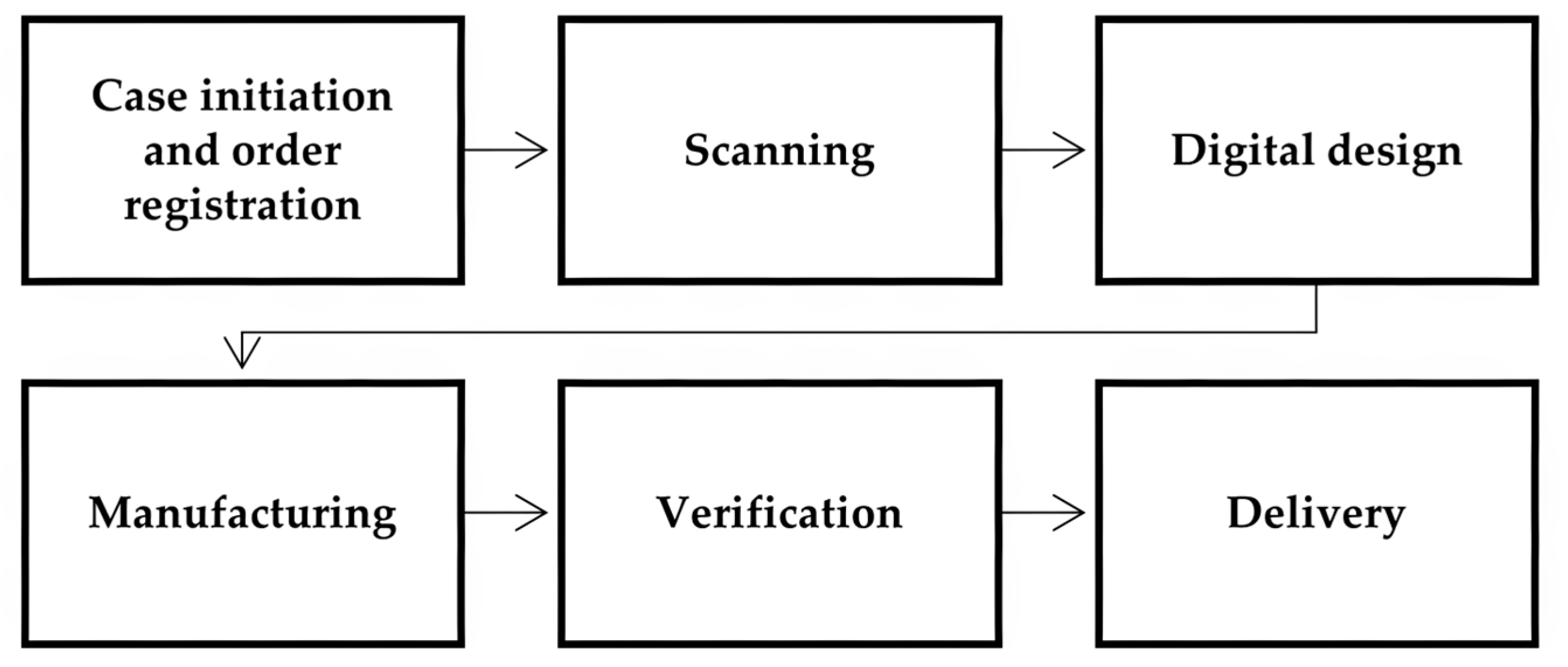
Figure 2.
Relationship between systems, event logs, and process models, and the three main types of process mining: discovery, conformance, and extension [14].
Figure 2.
Relationship between systems, event logs, and process models, and the three main types of process mining: discovery, conformance, and extension [14].
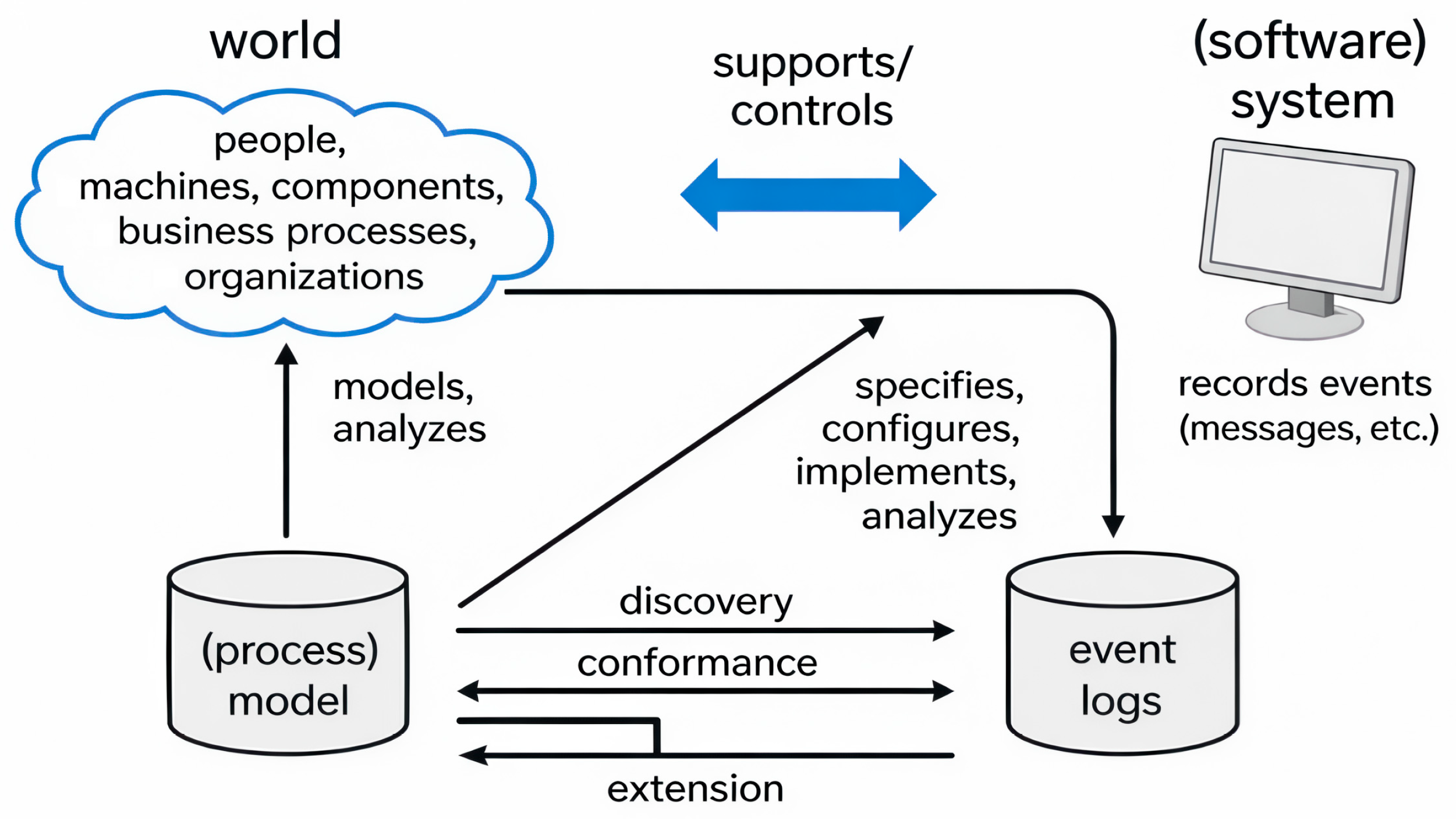
Figure 3.
Overview of the methodological phase of the study.
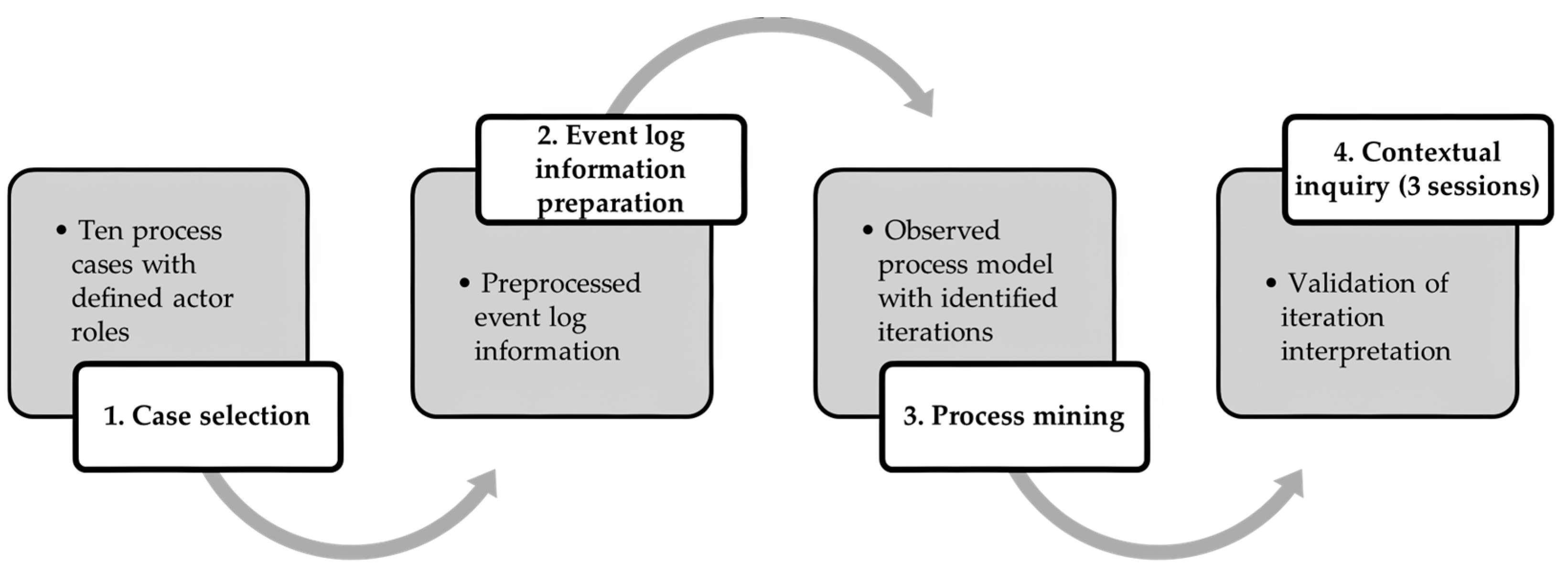
Figure 4.
Implant abutment assembly [37].
Figure 4.
Implant abutment assembly [37].
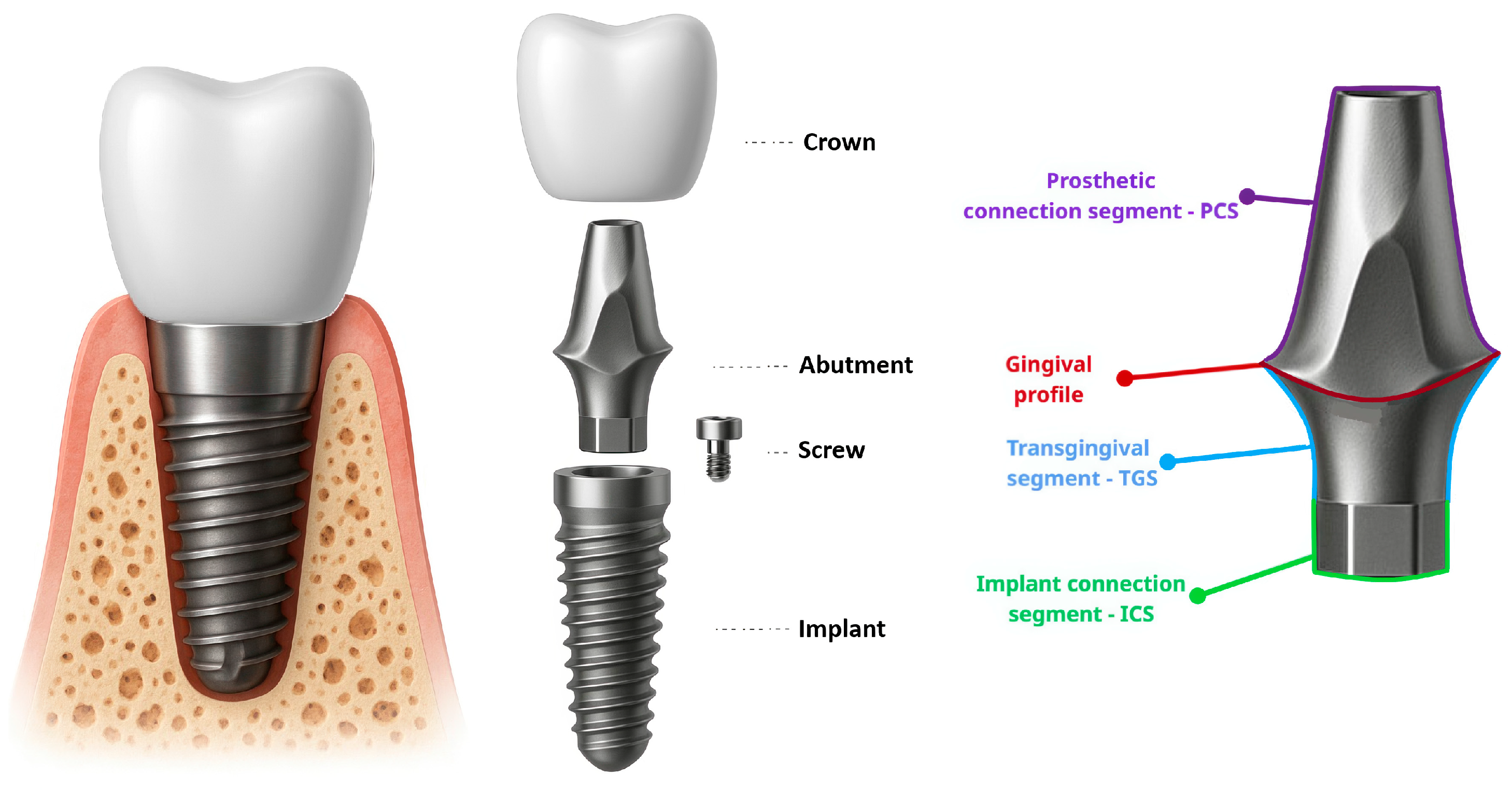
Figure 5.
Reference process model of custom abutment design and representative digital process: (a) Process model reconstructed from event logs; (b) Intraoral scanning procedure performed with an intraoral scanner; (c) CAD modeling phase in ExoCAD tool; (d) Quality control report generated in WM ExaCT Analysis using ExaCT eXact M computer tomography workstation.
Figure 5.
Reference process model of custom abutment design and representative digital process: (a) Process model reconstructed from event logs; (b) Intraoral scanning procedure performed with an intraoral scanner; (c) CAD modeling phase in ExoCAD tool; (d) Quality control report generated in WM ExaCT Analysis using ExaCT eXact M computer tomography workstation.
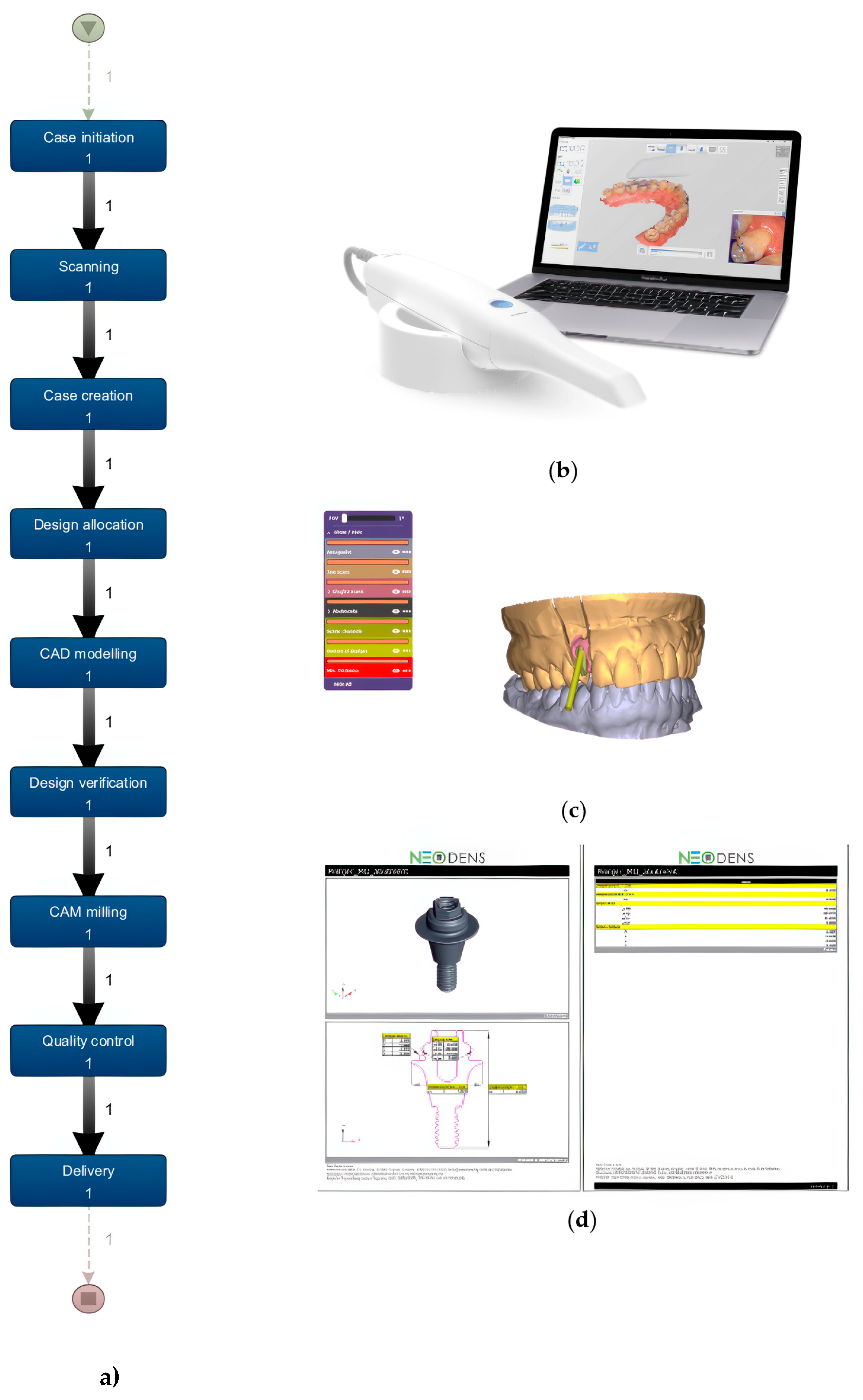
Figure 6.
Conformance model of all analyzed cases showing frequency and rework connections in the digital dental process (generated with tool for process mining Disco).
Figure 6.
Conformance model of all analyzed cases showing frequency and rework connections in the digital dental process (generated with tool for process mining Disco).
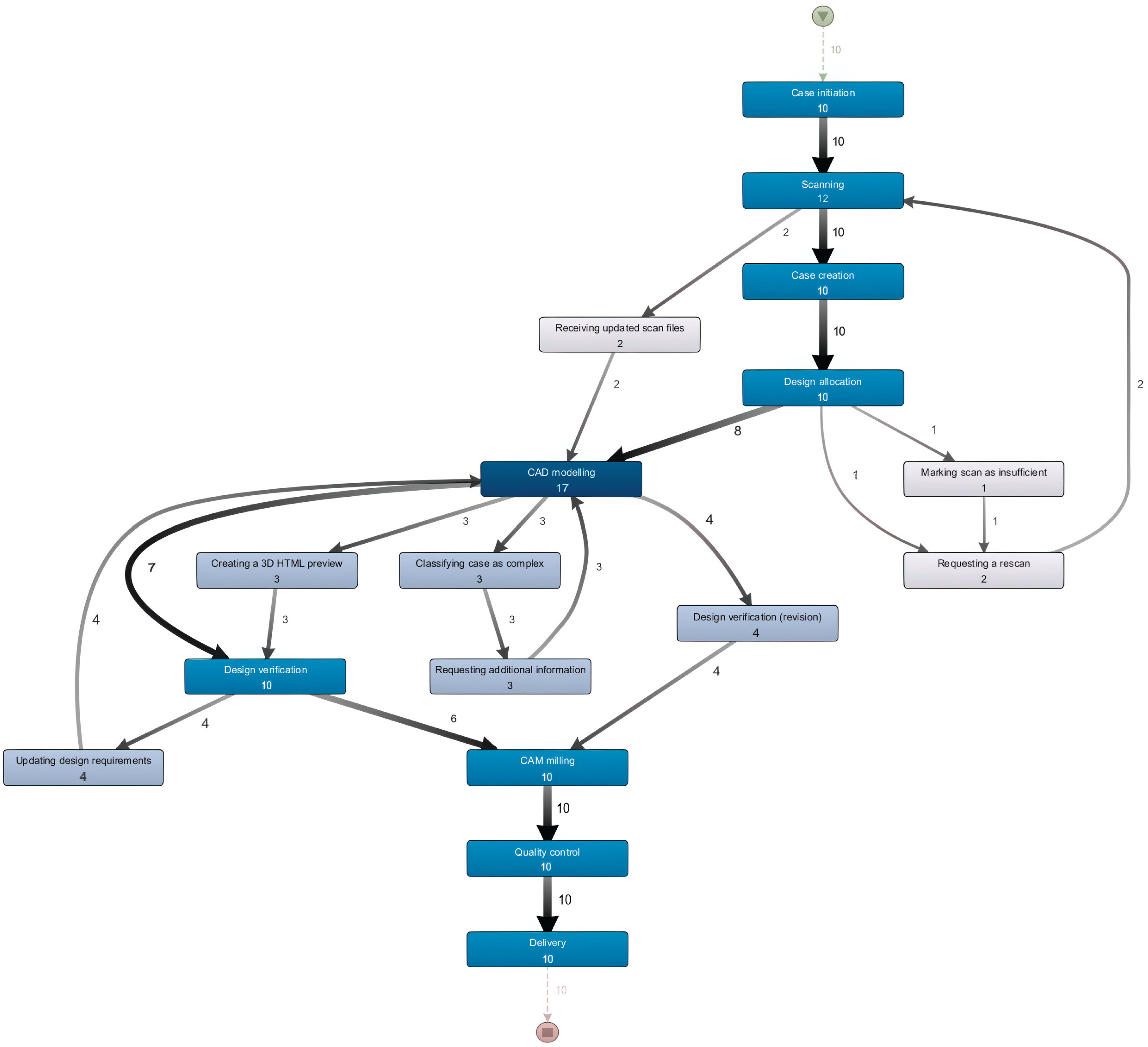
Disclaimer/Publisher’s Note: The statements, opinions and data contained in all publications are solely those of the individual author(s) and contributor(s) and not of MDPI and/or the editor(s). MDPI and/or the editor(s) disclaim responsibility for any injury to people or property resulting from any ideas, methods, instructions or products referred to in the content. |
© 2026 by the authors. Licensee MDPI, Basel, Switzerland. This article is an open access article distributed under the terms and conditions of the Creative Commons Attribution (CC BY) license (http://creativecommons.org/licenses/by/4.0/).
Copyright: This open access article is published under a Creative Commons CC BY 4.0 license, which permit the free download, distribution, and reuse, provided that the author and preprint are cited in any reuse.


