

Submitted:
23 January 2026
Posted:
26 January 2026
You are already at the latest version
Abstract
This study examines the δ-complements of graphs—a specific type of graph complement whose adjacency depends on the adjacency of the vertices with identical degrees in the original graph. More specifically, we study this type of complement regarding the domination number. We provide sharp Nordhaus-Gaddum-type bounds on the domination number of a graph and its δ-complement. We also provide sharp bounds on the domination numbers of the δ-complements of joined graphs and Cartesian product graphs.
Keywords:
domination number
; complement graph
; Nordhaus-Gaddum type bound
; join
; Cartesian product
1. Introduction
A dominating set D of a simple undirected graph is a subset of V such that each vertex not in D is adjacent to a vertex in D. The smallest cardinality among the dominating sets of G is called the domination number of G, denoted by . A dominating set with the smallest cardinality is called a minimum dominating set. Applications of dominating sets and domination numbers exist in various fields. For instance, in ad-hoc wireless networks, devices form a dominating set that ensures message delivery (Nguyen and Huynh (2006); Wu and Li (2001); Yu et al. (2013)); in social networks, we identify influential users based on their connections (Daliri Khomami et al. (2018); Wang et al. (2011)); and in facility location, we can select optimal locations to cover a region (Corcoran and Gagarin (2021); Sabarish et al. (2017)).
Many properties of the domination number have been investigated; for example, Nordhaus-Gaddum type bounds on the domination number in terms of the number of vertices were given individually by Borowiecki Borowiecki (1976) and Jaeger Jaeger and Payan (1972). Desormeaux et. al. Desormeaux et al. (2018) provided a Nordhaus-Gaddum type relation of the domination number in terms of minimum degrees of graphs. They also proved several results on the domination number in various parameters.
In 2022, Pai et. al. Tangjai et al. (2024) introduced a variant of graph complements in which the complement takes place only among the vertices of the same degree. They called it the -complement graph of G. Later in 2023, Vichitkunakorn et. al. Vichitkunakorn et al. (2023) gave a Nordhaus-Gaddum type relation on the chromatic number of a graph and its -complement. The Nordhaus-Gaddum type bounds are given in various parameters, including the number of vertices, degrees, and clique number.
In this work, we further study the -complement by investigating the domination numbers of the -complements of graphs. In particular, we provide Nordhaus-Gaddum type bounds, bounds on the join of graphs, and bounds on Cartesian products of graphs. Examples showing that most of our bounds are sharp are also given.
Outline of the paper. Section 2 contains necessary notations, definitions, and some theorems about the domination number of a graph and its complement. Section 3, Section 4 and Section 5 contain our results. Specifically, a Nordhaus-Gaddum type bound on the domination number is provided in Section 3, some upper bounds and exact values on the domination number of the -complement of the join of two graphs are provided in Section 4, some upper bounds and exact values of the -complement of the Cartesian product of two graphs are provided in Section 5. We also provide examples relevant to each case.
2. Background
In this section, we provide necessary notations and definitions of a graph, its complement and -complement, a dominating set, and the domination number. We also present some results on bounds and Nordhaus-Gaddum type bounds on the domination number of the complement of a graph.
Let (or ) be a simple undirected graph where V is the vertex set and E is the edge set. The subgraph of G induced by a subset S of V is denoted by . For each vertex , the neighborhood of u in G is denoted by , and the degree of u in G is denoted by . Given two graphs G and H, the join of G and H, denoted by , is a graph with and . The disjoint union of G and H, denoted by , is a graph with and . The Cartesian product of G and H, denoted by , is a graph with and where and , or and } In this paper, we denote a path and a cycle of order n by and , respectively. The complement of G is denoted by .
Many results on the bounds of the domination numbers of a graph and its complement have been discovered. The findings listed below serve as inspiration for our work.
Theorem 1
Theorem 2
Theorem 3
Theorem 4
Theorem 5
With a new variant of graph complements introduced by Pai et. al. Pai et al. (2022), we explore bounds on the domination numbers of this particular complement. A formal definition of the -complement of a graph is given below.
Definition 1
(Pai et al. (2022)). The δ-complement of a graph G, denoted by , is a graph obtained from G by using the same vertex set and the following edge conditions: if
- 1.
- in G and , or
- 2.
- in G and .
Some properties of the -complement of a graph were studied in Pai et al. (2022), Tangjai et al. (2024) and Vichitkunakorn et al. (2023). For instance, the following theorem will be used to prove one of our results in Section 5.
Theorem 6
3. Results on a Nordhaus-Gaddum Type Bound on the Domination Number
This section contains our results on a Nordhaus-Gaddum type bound on the domination number. Throughout the rest of the paper, we denote the number of vertices in G and denote the number of distinct degrees of vertices in G. We also denote the set of vertices of degree d in G by . Let be the partition of the vertex set of G as follows:
Let be the number of singletons in , i.e., for and for . The ordering of the order of and the number of singletons will be used later in Section 5.
We observe that if and only if there exists a vertex v such that .
Lemma 1.
There are infinitely many graphs G that .
Proof.
For , let . Since u is adjacent to all other vertices in G, we have . In addition, u is the only vertex of degree in G, so u is also adjacent to all other vertices in . Hence . See Figure 1 for an example. □
Lemma 2.
There are infinitely many graphs G that where n is an order of G and m is the number of distinct degrees of G
Proof.
For an even number , let where . We have . Notice that G has r vertices of degree 0 and r vertices of degree . So . It is easy to see that . □
Theorem 7.
Let G be a graph of order n having m distinct degrees. We have and . Furthermore, the bounds are sharp for infinitely many n.
Proof.
Let , and for . Since , we have for , by Theorem 5. The union of a dominating set of gives a dominating set of G. Similarly, the union of a dominating set of gives a dominating set of . Thus . Since , it follows that . Hence, we have . By Lemma 1 and Lemma 2, we complete the proof. □
Theorem 8.
If G is not a complete graph and , then .
Proof.
Consider . Since , there is a vertex v which is adjacent to all other vertices in G.
- Case 1
- v is the only vertex of degree in G. Then v also has degree in . Hence .
- Case 2
- v is not the only vertex of degree in G. Pick . In , we have v dominates and u dominates . So dominates V in . Hence .
From these two cases, we have . □
The converse of Theorem 8 is not necessarily true, as in the following example.
Example 1.
If , then . Hence, and .
4. Join of Graphs
This section contains our results on upper bounds and exact values on the domination number of the -complement of the join of two graphs. Here is an overview of this section. Given two graph G and H, if they satisfy Condition (1) in Theorem 9, then . If not, Theorem 10 provides the exact domination number of when both G and H are regular graphs. If one of the graphs is nonregular, a sharp upper bound is given in Theorem 11. Finally, Corrolary 1 provides an upper bound when the two are nonregular. We summarize these results in Table 1 at the end of this section.
Theorem 9.
Let G and H be graphs. If
then .
Proof.
Since, in , each vertex in covers all vertices in and vice-versa, it follows that . □
Example 2.
Let and . We see that
Graphs G and H satisfy the condition in Theorem 9. Hence, . In fact, as vertex dominates .
When G and H are regular, is also regular, which implies that . Thus, . This yields the result in Theorem 10. Despite the simplicity of its proof, we have not found this result in any literature, to our knowledge. Hence, we present it here. (Same for the case of the Cartesian product where when G and H are regular and the results are present in Lemma 5, 6, 7 and Corollary 2.)
Theorem 10.
Let G be an a-regular and H be a b-regular. If , then .
Proof.
Since all vertices in have the same degree, it follows that . This completes the proof. □
In the following example, we construct two graphs G and H that exhibit the sharp upper bound given in Theorem 11.
Example 3.
For , let G be a graph such that where and in which U and W induce complete graphs and , respectively, and is adjacent to and for each . See Figure 2 for an example when . With this construction, we have , a disjoint union of n paths of order 3. Also . Let H be an -regular graph with vertices. We have .
In , the degree of is , the degree of is , and the degree of is . Then
We see that is a dominating set of of size .
Let S be a dominating set of . We will show that . Suppose that . To cover , at least one of must be in S. Since , exactly one of is in S. If , then S does not cover . If , we assume that and . Then is not covered by S. Hence, S cannot be a dominating set, which is a contradiction.
Thus .
Theorem 11.
For any graph G and H, if G is nonregular, then . Furthermore, the bound is sharp for infinitely many graphs.
Proof.
Let and , and let and be the partitions of the vertex sets of G and H respectively. A vertex in and a vertex in have the same degree in if and only if . Without loss of generality, we order so that for all for some .
We note that and . In addition, in graph , the vertices in are adjacent to the vertices in for any .
Let D be a dominating set of . Since G is nonregular, is nonempty for all . If for some , then is a dominating set of where . This is because D dominates and v dominates . Otherwise, D is a dominating set of .
The bound is sharp by Example 3. □
Corollary 1.
Let G and H be nonregular graphs. Then
5. Cartesian Product of Graphs
This section contains our results on upper bounds on the -complement of the Cartesian product of two graphs, in particular, when one of them is a regular graph or a cycle. Sharp bounds are obtained when both of the graphs are regular or one of them is a cycle. Recall that, for a graph G, the vertex partition of by the degrees is , and the number of singletons in is .
There are a number of results of bounds on the domination number of the Cartesian product of graphs Gravier and Khelladi (1995); Hartnell (2004); Vizing (1963). We include one of the bounds below as Lemma 3, which, combining with Theorem 6, produces a rough bound on the -complement of the Cartesian product of any two graphs shown in Lemma 4.
Using Theorem 6, we get the following bound for .
Lemma 4.
Let G and H be graphs. Then,
Proof.
From Theorem 6, we have and . We have . The last inequality follows from Lemma 3. □
We note that the bound in Lemma 4 is sharp. Some examples include and or when one of the graphs is .
When one of the graphs in the product is regular, the bounds can be improved as shown in Theorem 12. We first give the following lemmas which will be used in Theorem 12.
Lemma 5.
For and , then .
Proof.
Two vertices and are adjacent in if and only if . Let and where . Then dominates . Hence, the set is a dominating set. Since every vertex of is of degree , there is no dominating set of size 1. Hence, . □
Lemma 6.
For and , we have
Proof.
Consider . Then, . Hence, and when .
Consider . We write . Let . Then, is a minimum dominating set of , see Figure 3 for an example.
Consider . Let . For , we write . We have that is a minimum dominating set of , see Figure 3. For , we let . Then is a minimum dominating set of . □
Lemma 7.
For and , we have .
Proof.
Two vertices and are adjacent in if and only if and . Let and be such that and . Suppose . Consider . If , then . So, is adjacent to . If , then is adjacent to or . Hence, D is a dominating set.
Suppose there is a dominating set of size 2. If , then where is not adjacent to any vertices in S. If , then where is not adjacent to any vertices in S. If and , then is not adjacent to any vertices in S. This is a contradiction. So, the domination number is 3. □
Theorem 12.
Let G and H be graphs, each with at least two vertices. If H is a regular graph, then
Furthermore, the bounds are sharp for infinitely many graphs.
Proof.
Let . For a vertex partition , we order it so that . Since H is regular, we see that is a vertex partition of the vertices of based on its degree.
Let be a minimum dominating set of . For any , we have that dominates in . Thus, we need at most vertices to cover . Next, we consider each . Let .
Case 1. . Let be such that v dominates and . We have dominates in . Let where .
- If , then is not adjacent to in .
- If , then is not adjacent to in .
We have dominates in for . Thus, we need at most vertices to cover . Hence, in this case, .
To show that this bound is sharp, for and , we let and H be a null graph . We see that and . Note that
Since contains no edge between two vertices of different degrees, it follows that . By Lemma 5, we have for . We note . Thus, .
Case 2. . Let be such that and dominates . We have dominates in . Consider where .
- If , then is not adjacent to in .
- If , then is not adjacent to in .
It follows that dominates in for . Thus, we need at most vertices to cover . Hence, in this case, .
To show that this bound is sharp, for and , we let and . We see that and . Note that
Since contains no edge between two vertices of different degrees, it follows that . By Lemma 6, we have for . Thus, .
Case 3. . For each , pick any two vertices and any two vertices . Let .
- If and , then is not adjacent to in .
- If and , then is not adjacent to in .
- If and , then is not adjacent to in .
Hence, dominates in for . Thus, we need at most vertices to cover . Hence, in this case, .
To show that this bound is sharp, for and , we let and . We see that and . Note that
Since contains no edge between two vertices of different degrees, it follows that . By Lemma 7, we have for . We note . Thus, . □
Consequently, we obtain sharp upper bounds when both graphs in the product are regular.
Corollary 2.
Let G and H be regular graphs, each with at least two vertices. Then
Furthermore, the bounds are sharp for infinitely many graphs.
Proof.
Note that and . The result follows directly from Theorem 12.
Next, we show that the bounds are sharp. For , . Lemma 6 implies that . In addition, . Lemma 6 implies that . Hence, both bounds are sharp. □
Finally, the following theorem is another special case of Theorem 12 where one of the graphs in the product is a cycle. In this case, sharp bounds can also be obtained.
Theorem 13.
Let G be a graph. Then
Furthermore, the bounds are sharp for infinitely many graphs.
Proof.
Let . If , then and . From Lemma 6, we get and for .
For , Theorem 12 implies the result. To show that the bounds are sharp, we let . Note that
So, contains no edge between two vertices of different degrees, hence
In the case that , by Lemma 6, for . Hence, . In the case that , by Lemma 6, for . Hence, . □

Table 2.
The summary of bounds on the Cartesian product of two graphs. Note that, other than the first case, G and H are required to contain at least two vertices.
Table 2.
The summary of bounds on the Cartesian product of two graphs. Note that, other than the first case, G and H are required to contain at least two vertices.
| Condition | G | H | Upper bound of | Reference |
| - | any graph | any graph | Lemma 4 | |
| regular | regular | 2 | Corollary 2 | |
| regular | regular | 3 | Corollary 2 | |
| any graph | regular | Theorem 12 | ||
| any graph | regular | Theorem 12 | ||
| any graph | regular | Theorem 12 |
6. Discussion and Conclusion
In this research, we investigate the domination numbers of the -complements of graphs. We provide Nordhaus-Gaddum type bounds on the domination number between a graph and its -complement, bounds on the domination number of the -complement of joined graphs and Cartesian products of graphs. The bounds are in terms of the number of distinct degrees, the domination number of the -complement of each graph in the product, or the number of degrees with one vertex, and the given bounds are sharp.
Many interesting aspects of the domination numbers of the -complements of graphs are yet to be explored, for example, bounds when both graphs in the product are non-regular, bounds on other types of graph products, and bounds on other types of domination numbers of the -complement graphs.
Funding
This research project was financially supported by Thailand Science Research and Innovation (TSRI).
Data Availability Statement
This study did not generate or analyze any datasets.
Conflicts of Interest
The authors declare no conflicts of interest.
References
- Borowiecki, M. 1976. On the external stability number of a graph and its complement. Prace Naukowe Inst. Mat. Politechniki Wroclawskiej 12: 39–43. [Google Scholar]
- Corcoran, P., and A. Gagarin. 2021. Heuristics for k-domination models of facility location problems in street networks. Computers & Operations Research 133: 105368. Available online: https://www.sciencedirect.com/science/article/pii/S030505482100143X. [CrossRef]
- Daliri Khomami, M. M., A. Rezvanian, N. Bagherpour, and M. R. Meybodi. 2018. Minimum positive influence dominating set and its application in influence maximization: a learning automata approach. Applied Intelligence 48: 570–593. [Google Scholar] [CrossRef]
- Desormeaux, W. J., T. W. Haynes, and M. A. Henning. 2018. DOMINATION PARAMETERS OF A GRAPH AND ITS COMPLEMENT. Discussiones Mathematicae Graph Theory 38: 203–215. [Google Scholar] [CrossRef]
- Gravier, S., and A. Khelladi. 1995. On the domination number of cross products of graphs. Discrete Mathematics 145: 273–277. [Google Scholar] [CrossRef]
- Hartnell, B. L. 2004. On dominating the Cartesian product of a graph and K2. Discussiones Mathematicae 24: 389–402. [Google Scholar] [CrossRef]
- Jaeger, F., and C. Payan. 1972. Relations du type Nordhaus–Gaddum pour le nombre d’absorption d’un graphe simple. C. R. Acad. Sci. Paris Sér. A 274: 728–730. [Google Scholar]
- Nguyen, T., and D. Huynh. 2006. Connected D-Hop Dominating Sets in Mobile Ad Hoc Networks. 2006 4th international symposium on modeling and optimization in mobile, ad hoc and wireless networks; pp. 1–8. [Google Scholar] [CrossRef]
- Pai, A., H. A. Rao, S. D’Souza, P. G. Bhat, and S. Upadhyay. 2022. δ-Complement of a Graph. Mathematics. 10. Available online: https://www.mdpi.com/2227-7390/10/8/1203. [CrossRef]
- Sabarish, B. A., B. Kailassh, K. Baktha, and Y. Janaki. 2017. Recommendations of location for facilities using domination set theory. In 2017 international conference on communication and signal processing (iccsp). pp. 1540–1544. [Google Scholar] [CrossRef]
- Tangjai, W., W. Pho-on, and P. Vichitkunakorn. 2024. On the δ-chromatic numbers of the Cartesian products of graphs. Open Mathematics 22: 20240087. [Google Scholar] [CrossRef]
- Vichitkunakorn, P., R. Maungchang, and W. Tangjai. 2023. On Nordhaus-Gaddum type relations of δ-complement graphs. Heliyon 9, 6: e16630. [Google Scholar] [CrossRef] [PubMed]
- Vizing, V. G. 1963. The Cartesian product of graphs. Vyčisl. Sistemy 9: 30–43. [Google Scholar]
- Wang, F., H. Du, E. Camacho, K. Xu, W. Lee, Y. Shi, and S. Shan. 2011. On positive influence dominating sets in social networks. Theoretical Computer Science 412, 3: 265–269. Available online: https://www.sciencedirect.com/science/article/pii/S0304397509007221. [CrossRef]
- Wu, J., and H. Li. 2001. A dominating-set-based routing scheme in ad hoc wireless networks. Telecommunication Systems 18: 13–36. [Google Scholar] [CrossRef]
- Yu, J., N. Wang, G. Wang, and D. Yu. 2013. Connected dominating sets in wireless ad hoc and sensor networks – A comprehensive survey. Computer Communications 36, 2: 121–134. Available online: https://www.sciencedirect.com/science/article/pii/S014036641200374X. [CrossRef]
Figure 1.
An example of and its -complement , when , in the proof of Lemma 1. Their minimum dominating sets contain only one common vertex, which is indicated in red color.
Figure 1.
An example of and its -complement , when , in the proof of Lemma 1. Their minimum dominating sets contain only one common vertex, which is indicated in red color.
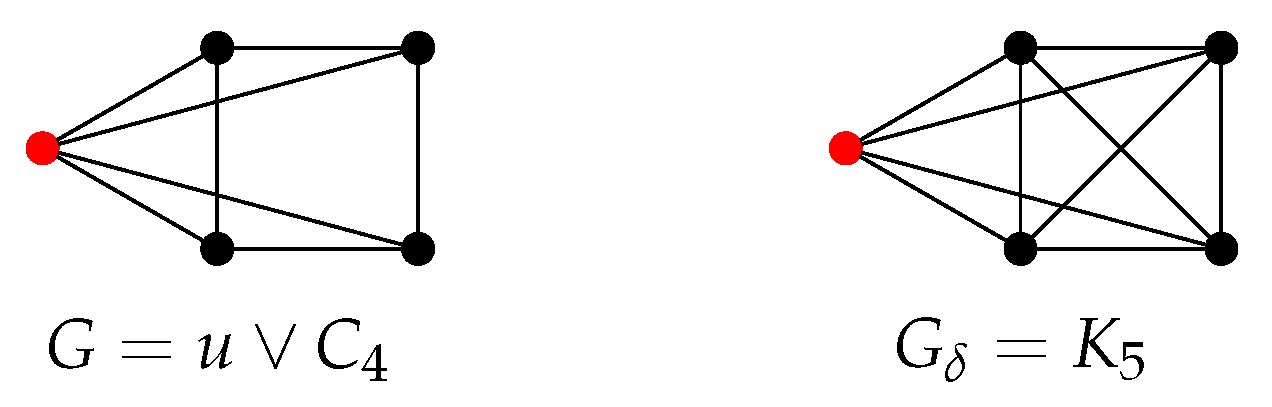
Figure 2.
An example where as discussed in Example 3.
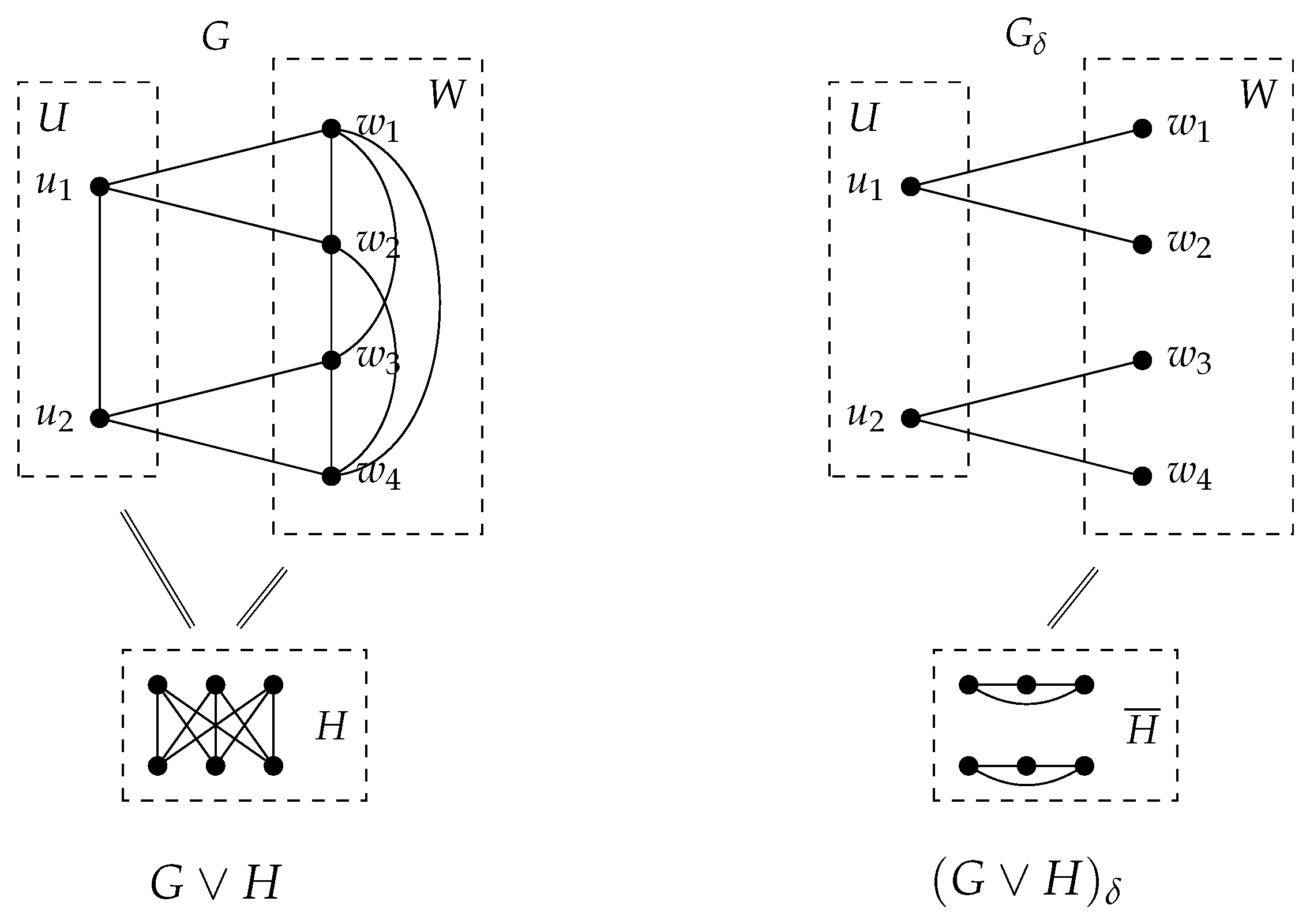
Figure 3.
(Top figures) and . (Bottom figures) The -complement of and with vertices of their minimum dominating sets indicated in red color.
Figure 3.
(Top figures) and . (Bottom figures) The -complement of and with vertices of their minimum dominating sets indicated in red color.
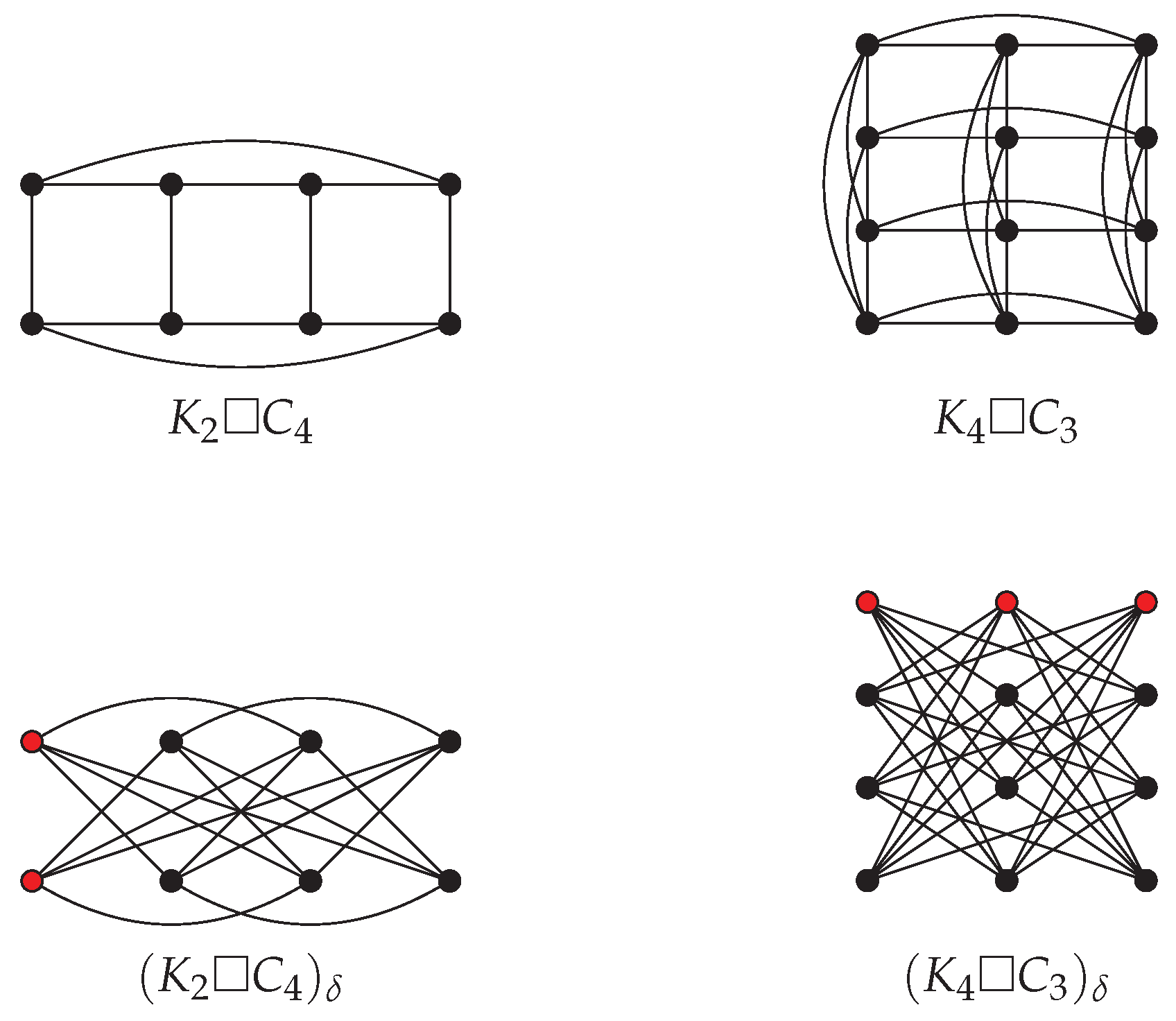
Table 1.
The summary of bounds on the join of two graphs. To use the table, first check whether G and H satisfy Condition (1), then proceed with the types of the two graphs.
Table 1.
The summary of bounds on the join of two graphs. To use the table, first check whether G and H satisfy Condition (1), then proceed with the types of the two graphs.
| Condition (1) | G | H | Upper bound of | Reference |
| in Theorem 9 | ||||
| true | any graph | any graph | 2 | Theorem 9 |
| false | regular | regular | Theorem 10 | |
| false | regular | nonregular | Theorem 11 | |
| false | nonregular | regular | Theorem 11 | |
| false | nonregular | nonregular | Corollary 1 |
Disclaimer/Publisher’s Note: The statements, opinions and data contained in all publications are solely those of the individual author(s) and contributor(s) and not of MDPI and/or the editor(s). MDPI and/or the editor(s) disclaim responsibility for any injury to people or property resulting from any ideas, methods, instructions or products referred to in the content. |
© 2026 by the authors. Licensee MDPI, Basel, Switzerland. This article is an open access article distributed under the terms and conditions of the Creative Commons Attribution (CC BY) license (http://creativecommons.org/licenses/by/4.0/).
Copyright: This open access article is published under a Creative Commons CC BY 4.0 license, which permit the free download, distribution, and reuse, provided that the author and preprint are cited in any reuse.


