

Submitted:
09 January 2026
Posted:
23 January 2026
You are already at the latest version
Abstract
Psychologists and economists have employed mean national IQ as a human capital variable to characterize a nation’s potential for economic growth. While previous studies consistently show a high positive correlation between a nation’s average IQ and its wealth, there is disagreement regarding the reason behind this relationship. Some believe high IQs facilitate economic growth while others believe wealth explains why IQs vary across nations. To address this uncertainty, this study analyzes retrospective observations across time within a wealth-equated sample of underdeveloped nations. The correlation between the level of economic growth experienced by the nations sampled and their average IQ across five decades was r = .74 (R2 = .548). Statistical tests demonstrate that high IQ nations displayed significantly more growth and that nations experiencing more growth had higher IQs. These results support the use of average national IQ as a human capital variable and demonstrate its causative role in economic growth.
Keywords:
cognitive ability
; gross national income
; high vs. low-income countries
1. Introduction
Long before the advent of scientific research investigating human cognition, intelligence was thought to be an important factor in many human endeavors. Following up on this intuition, the construct of intelligence assumed a central role in the earliest studies of psychology and was initially defined in terms of sensory keenness (Galton, 1869, 1883). The scientific interest in intelligence has continued uninterrupted into the modern era with psychological research developing sophisticated assessments yielding some of the most valid, reliable, and useful measures employed in the social sciences (Deary, 2012).
Although the interval-level IQ scores generated by assessments of cognitive ability do not permit an estimate of the magnitude of the variance in intelligence (i.e., only a ratio scale with a true zero-point permits an estimate of absolute magnitude), there are large inter-individual differences in IQ scores and these differences predict important aspects of our social lives (Gottfredson, 1997; Ruiz, 2009). The differences associated with the variance in intelligence are remarkably wide ranging and include how an individual makes basic life decisions, school success, vocational choices, income and money management, social choices, and the use of computers and other digital technologies. This has led to considerable scientific interest in how IQs vary across individuals and populations and how and why that variance relates to academic achievement, occupational attainment, wealth, and other social outcomes (Gottfredson, 2003).
While the influence of an individual’s IQ on their social status has been a central focus in psychology, the impact of average group intelligence has also been studied by social scientists. Econometric studies have been particularly influential in documenting the relationship between a group’s average cognitive ability and its efficiency. These studies have employed mean national IQ as a human capital variable and analyzed its relationship with national prosperity (Jones & Schneider, 2006). That research shows that countries vary considerably in their average cognitive ability and that this average correlates not only with a country’s financial wealth, but also with its level of cooperation, political efficiency, and educational attainment (Hanushek & Woessmann, 2015; Lynn & Vanhanen, 2012; Rindermann, 2018; Rindermann et al., 2015).
A study by Rindermann and Becker (2018) used a broad measure of national cognitive ability (CA) that reflected both intelligence (i.e., IQ scores) and educational achievement (i.e., Programme for International Student Assessment (PISA) and Trends in International Mathematics and Science Study (TIMSS)) and found a correlation of r = .82 between a nation’s mean CA and its per capita gross domestic product (GDP). In a widely publicized study of the practical significance of average group intelligence, economists Hanushek and Kimko (2000) showed that compared to an individual’s IQ, the average IQ of the country in which the individual resides is a more powerful predictor of a person’s monetary earnings.
To explain why national IQ displays this strong positive association with an individual’s economic well-being, theorists have suggested that it derives from a tendency for high IQ populations to behave more cooperatively, work more productively, save more monetarily, and vote more informatively (Jones, 2016). These proposed explanations, however, have been challenged by theories evoking a reverse causation mechanism. As applied to the correlation between average national intelligence and individual earnings, reverse causality and the closely associated simultaneity bias have been used to support a hypothesis that it is national prosperity that generates higher IQs through wealth-mediated effects on healthcare, nutrition, and education.
In making the case for reverse causation, social scientists point out that ‘correlation need not imply causation’ and that other mechanisms might explain the high correlation between IQ and wealth (Ervik, 2003). In fact, Nechyba (2004) suggests that the causation behind the correlation “is likely to run exactly the opposite” of theories suggesting that average IQ sets the level of attainable wealth. In support of reverse causation explanations, social theorists point to research showing economic development leads to environmental changes that are known to increase IQs. Evidence of these environmental effects have been reported in statistical analyses of natural experiments showing mental test score differences can be partially attributed to iodized salt (Tafesse, 2022; Zimmermann et al., 2006), disease control (Lucas, 2010; Venkataramani, 2012), environmental toxins (McFarland et al., 2022), and Flynn effects associated with improved education, parental supervision and management, and modernization (Pietschnig & Voracek, 2015; Rodgers & O’Keefe, 2023).
So, while hundreds of studies have firmly established the existence of a robust correlation between average national IQ and economic productivity, there continues to be uncertainty regarding the nature of that relationship (Jones & Schneider, 2006). Explaining the causative mechanism behind the positive correlation between national wealth and national IQ is important for theory development and scholarship in fields as diverse as anthropology, economics, and world history. In addition, a better understanding of the relationship has considerable practical value for designing social interventions that promote economic development, governmental reforms, constructive immigration law, and other social initiatives.
Because previous research examining the correlation between affluence and intelligence has relied primarily on data reflecting a longstanding relationship between the two variables, model uncertainty, even in studies employing the most advanced statistical methods (Jones & Schneider, 2006), prevents a definitive answer to the question of whether wealth is primarily responsible for facilitating intelligence or vice versa. To address the uncertainty arising in interpreting the correlations within in-vivo data reflecting the long-standing relationship between intelligence and wealth, this study analyzes retrospective observations within a wealth-equated sample of nations across fifty years.
The research was designed to equate national wealth by selecting nations that were initially similar in per capita gross national income (GNI). By tracking economic changes in nations that initially displayed a low level of GNI, differences in IQ could not be attributed to differences in affluence. It allowed a more controlled study of how the mean national IQ impacts the economy. This is a study of the world’s countries that had underdeveloped economies in 1974. While their economies were very similar at the beginning of the study, they differed in their average IQ. The data from the countries permitted an inference regarding the direction of causation to provide insight into the nature of the relationship between national IQ and economic growth. The specific question addressed by this research is whether knowing the average IQ of a developing nation would allow social researchers to predict the amount of economic growth achieved over five decades. If the change in national income is predicted by average national IQ within this wealth equated group of nations, it would support the hypothesis that IQ is a causative factor (i.e., an independent variable) in creating national wealth. Alternately, if changes in wealth are not predicted by national IQ, this would support the view that average national intelligence might be more appropriately modeled as a dependent variable governed by the long-term economic health of a nation.
Wicherts et al. (2010) point out the problematic aspects of employing current IQs to make inferences across expansive time intervals (i.e., 60,000+ years) like those associated with evolutionary theories. However, regardless of whether population genetics or environmental factors primarily influence current geographic IQ, the rank order of average national IQ has remained stable across time spans of 2-3 generations (i.e., 50 years). While the ubiquitous Flynn effect has produced IQ gains across most nations over the last 50 years (i.e., approximately 2.4 points and 1.8 points per decade during 1948-1985 and 1986-2020 respectively) (Wongupparaj et al., 2023), the rank order of national IQs has remained remarkably stable across the economically dynamic five-decade time span examined here. The minor variations in these rank orders would not significantly influence the correlational analyses used in this study (Pietschnig & Voracek, 2015).
2. Methods
2.1. The Economic Data
The economic data utilized in this longitudinal retrospective research design conveys the economic history of 86 nations across five decades from 1974 to 2023 as documented by the World Bank repository (World Bank, 2023). The data extracted from the World Bank reflects a comprehensive sample of nations exhibiting per capita incomes of less than 2000 USD (i.e. GNI < $2000) in 1974. It follows their development across the economically dynamic five-decade period from 1974 to 2023. This was a period in world history during which nations generally experienced large economic gains.
2.2. The IQ Estimates
For each of the 86 countries, the average IQ was obtained from the Lynn and Becker (2019a) data published online at https://viewoniq.org/ (Lynn & Becker, 2019b). Table 1 shows the mean, standard deviation (SD), and minimum and maximum average IQs for the 86 nations included in this study and for the two subgroups of nations created by dividing the total sample into two equal sized groups using the median IQ of the 86 nations.
2.3. Analytic Strategy
A correlational analysis is used to estimate the coefficients of correlation between mean national IQ and economic growth in ten-year increments over five decades (1974-2023). An R-square was calculated to convey the proportion of variance in economic growth explained by average national IQ. Simple t-tests are performed using two perspectives on the data. First, the economic growth of the 43 nations ranked in the top half on average national IQ is compared with the growth for the 43 nations ranked in the lower half on average national intelligence. Secondly, a t-test of the mean IQ of nations displaying the most economic growth (n = 43) is compared with the mean IQ of nations experiencing less economic growth (n = 43). For both t-tests, the groups (i.e., High and Low) are constructed using a mid-point calculated from the median value to derive two groups of equal size.
3. Results
Figure 1 displays the correlations between the nation’s economic growth and the average national IQ in approximately ten-year increments across 10 to 49 years for all nations with a per capita GNI of less than 2000 USD in 1974. After 10 years (i.e., in 1984) the correlation between economic growth and the mean national IQ was r = .43. After 20 years (i.e., in 1994) the correlation was r = .68, at 30 years (i.e., in 2004) the correlation equaled r = .67, at 40 years (i.e., in 2014) the correlations were r = .72, and after 49 years (i.e., in 2023) r = .74. The overall proportion of variance in growth explained by average national IQ was R2 = .548.
Table 2 shows the GNI for the combined sample and for the high and low IQ nations. While all nations in the study initially displayed low per capita GNI (average = 594 USD), the average GNI for the high IQ group was modestly higher by 312 USD. However, by 2023 that difference expanded to over 8000 USD. While both groups increased GNI, the rate of growth for the high IQ group was much stronger. Figure 2 graphically displays this change in GNI for the two subgroups across the 49 years.
Table 3 displays the results of the t-test of differences in national economic growth for the High and Low IQ groups. The t value was t = 6.30 and was significant at p < .0001.
Table 4 displays the t-test of mean IQs for the 43 nations with higher economic growth compared with the 43 nations experiencing less growth. The nations with more gains had an average IQ of more than 12 points higher (i.e., effect size = .83), yielding a t-value of 8.38 and a p < .0001.
4. Discussion
This study addresses the question of whether knowing the average IQ of a low-income nation was effective in predicting its future economic success. The statistical results reported here suggest that it did strongly predict economic growth. Because the sampling of nations equated for initial wealth, wealth-mediated environmental effects cannot explain these results. This study allows a clearer inference regarding the direction of causation. Specifically, the hypothesis that higher IQs foster more economic growth is supported. This finding is also in line with previous investigations suggesting a trend of stronger economic growth significantly correlated with higher IQ scores over decades (i.e., r = .36 for high-income countries vs. r = .60 for middle-income countries) (Wongupparaj et al., 2023).
While there is evidence that average national IQ can be impacted by wealth-mediated environmental factors, geographic population intelligence appears to play a significant causative role in fostering economic progress (Plomin & Deary, 2015). This study helps quantify the degree to which geographic population IQs promote economic success. While it is possible that the construct(s) assessed by intelligence tests are not strictly invariant across time and populations, the closely related constructs that are actually assessed by IQ testing and the closely associated CA measures across different populations and across the 2-3 generations examined here did predict economic growth in the nations that initially displayed low per capita incomes (Wicherts et al., 2004).
This study has limitations regarding the causal interpretation of findings using a correlational design. In addition, the social and geopolitical characteristics of countries may systematically differ in their capacity to drive change, influencing whether a developing country transitions into a developed nations over time and further complicate the interpretation of the results (Wongupparaj et al., 2015). Finally, the dataset from Lynn and Becker (2019) may contain estimation biases for the IQ scores of some countries, as values for missing nations were inferred from those of geographically neighboring countries rather than obtained directly.
Author Contributions
Conceptualization, CDK, DN, and PW; methodology, CDK, DN, and PW; Software, CDK and DN; validation, CDK, DN, and PW; formal analysis, CDK; investigation, CDK, DN, and PW; resources, CDK; data curation, CDK, DN, and PW; writing – original draft preparation, CDK; writing – review and editing, CDK, DN, and PW; visualization, CDK; supervision, CDK; project administration, CDK. All authors have read and agreed to the published version of the manuscript.
Funding
This research received no funding.
Institutional Review Board Statement
Not applicable.
Informed Consent Statement
Not applicable.
Data Availability Statement
The raw data supporting the conclusions of this article will be made available by the authors upon reasonable request.
Conflicts of Interest
The authors declare no conflicts of interest.
References
- Deary, I.J. 125 years of intelligence in the American Journal of Psychology. The American journal of psychology 2012, 125, 145–154. [Google Scholar] [CrossRef]
- Galton, F. Hereditary genius. An inquiry into its laws and consequences; Macmillan, 1869; Available online: http://www.forgottenbooks.org.
- Galton, F. Inquiry into human faculty and its development; Macmillan, 1883; Available online: http://www.forgottenbooks.org.
- Gottfredson, L.S. Why g matters: The complexity of everyday life. Intelligence 1997, 24, 79–132. [Google Scholar] [CrossRef]
- Gottfredson, L.S. The scientific study of general intelligence: tribute to Arthur R. Jensen; Pergamon, 2003. [Google Scholar]
- Hanushek, E.A.; Kimko, D.D. Schooling, labor-force quality, and the growth of nations. American economic review 2000, 90, 1184–1208. [Google Scholar] [CrossRef]
- Hanushek, E.A.; Woessmann, L. The knowledge capital of nations: Education and the economics of growth; MA; MIT press, 2015. [Google Scholar]
- Jones, G. Hive mind: How your nation’s IQ matters so much more than your own; Stanford University Press, 2016. [Google Scholar]
- Jones, G.; Schneider, W.J. Intelligence, human capital, and economic growth: A Bayesian averaging of classical estimates (BACE) approach. Journal of economic growth 2006, 11, 71–93. [Google Scholar] [CrossRef]
- Lucas, A.M. Malaria eradication and educational attainment: evidence from Paraguay and Sri Lanka. American Economic Journal: Applied Economics 2010, 2, 46–71. [Google Scholar] [CrossRef]
- Lynn, R.; Becker, D. The intelligence of nations; Ulster Institute for Social Research London, UK, 2019a. [Google Scholar]
- Lynn, R.; Becker, D. The NIQ-Dataset version 1.2.2. 2019b. Available online: https://viewoniq.org/.
- Lynn, R.; Vanhanen, T. National IQs: A review of their educational, cognitive, economic, political, demographic, sociological, epidemiological, geographic and climatic correlates. Intelligence 2012, 40, 226–234. [Google Scholar] [CrossRef]
- McFarland, M.J.; Hauer, M.E.; Reuben, A. Half of US population exposed to adverse lead levels in early childhood. Proceedings of the National Academy of Sciences 2022, 119, e2118631119. [Google Scholar] [CrossRef]
- Nechyba, T.J. IQ and the Wealth of Nations. Journal of Economic Literature 2004, 42, 220–221. [Google Scholar]
- Pietschnig, J.; Voracek, M. One century of global IQ gains: A formal meta-analysis of the Flynn effect (1909–2013). Perspectives on Psychological Science 2015, 10, 282–306. [Google Scholar] [CrossRef]
- Plomin, R.; Deary, I.J. Genetics and intelligence differences: five special findings. Molecular psychiatry 2015, 20, 98–108. [Google Scholar] [CrossRef]
- Rindermann, H. Cognitive capitalism: Human capital and the wellbeing of nations; Cambridge University Press, 2018. [Google Scholar]
- Rindermann, H.; Becker, D. FLynn-effect and economic growth: Do national increases in intelligence lead to increases in GDP? Intelligence 2018, 69, 87–93. [Google Scholar] [CrossRef]
- Rindermann, H.; Kodila-Tedika, O.; Christainsen, G. Cognitive capital, good governance, and the wealth of nations. Intelligence 2015, 51, 98–108. [Google Scholar] [CrossRef]
- Rodgers, J.L.; O’Keefe, P. A synthetic theory to integrate and explain the causes of the Flynn effect: the parental executive model. Intelligence 2023, 98, 101740. [Google Scholar] [CrossRef]
- Ruiz, P.E. Measuring fluid intelligence on a ratio scale: Evidence from nonverbal classification problems and information entropy. Behavior research methods 2009, 41, 439–445. [Google Scholar] [CrossRef] [PubMed]
- Tafesse, W. The effect of Universal Salt Iodization on cognitive test scores in rural India. World Development 2022, 152, 105796. [Google Scholar] [CrossRef]
- Venkataramani, A.S. Early life exposure to malaria and cognition in adulthood: evidence from Mexico. Journal of health economics 2012, 31, 767–780. [Google Scholar] [CrossRef]
- Wicherts, J.M.; Borsboom, D.; Dolan, C.V. Why national IQs do not support evolutionary theories of intelligence. Personality and individual differences 2010, 48, 91–96. [Google Scholar] [CrossRef]
- Wicherts, J.M.; Dolan, C.V.; Hessen, D.J.; Oosterveld, P.; Van Baal, G.C.M.; Boomsma, D.I.; Span, M.M. Are intelligence tests measurement invariant over time? Investigating the nature of the Flynn effect. Intelligence 2004, 32, 509–537. [Google Scholar] [CrossRef]
- Wongupparaj, P.; Wongupparaj, R.; Morris, R.G.; Kumari, V. Seventy years, 1000 samples, and 300,000 SPM scores: A new meta-analysis of Flynn effect patterns. Intelligence 2023, 98, 101750. [Google Scholar] [CrossRef]
- Wongupparaj, P.; Wongupparaj, R.; Morris, R.G.; Kumari, V. Seventy years, 1000 samples, and 300,000 SPM scores: A new meta-analysis of Flynn effect patterns. Intelligence 2023, 98, 101750. [Google Scholar] [CrossRef]
- World Bank. World development indicators. 2023, 10/07/2025. Available online: https://databank.worldbank.org/indicator/NY.GNP.PCAP.CD/1ff4a498/Popular-Indicators.
- Zimmermann, M.B.; Connolly, K.; Bozo, M.; Bridson, J.; Rohner, F.; Grimci, L. Iodine supplementation improves cognition in iodine-deficient schoolchildren in Albania: a randomized, controlled, double-blind study1 2 3. The American journal of clinical nutrition 2006, 83, 108–114. [Google Scholar] [CrossRef]
Figure 1.
The correlation coefficients between mean national IQs and change in GNI across 49 years.
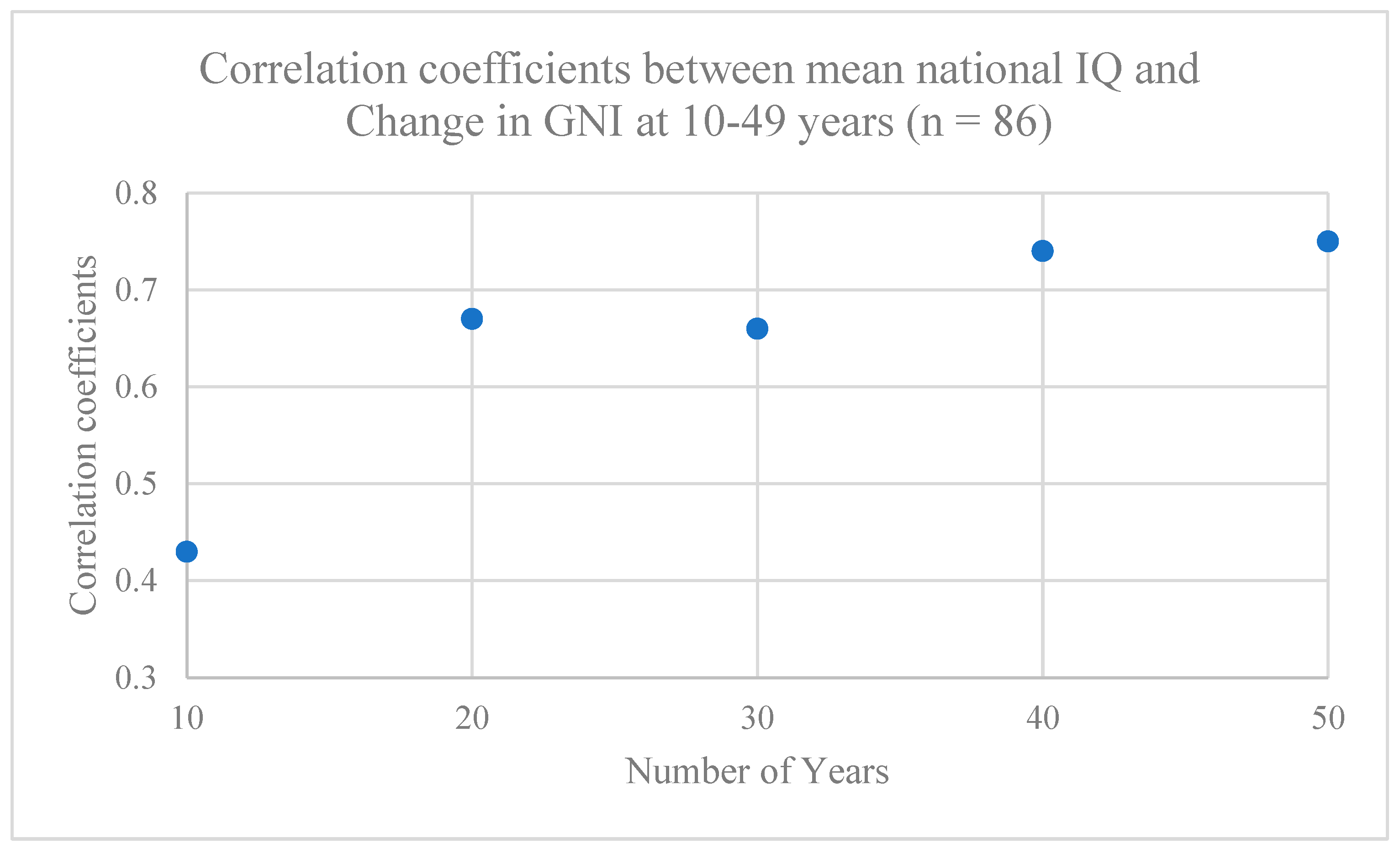
Figure 2.
Gains in national wealth for High and Low IQ nations.
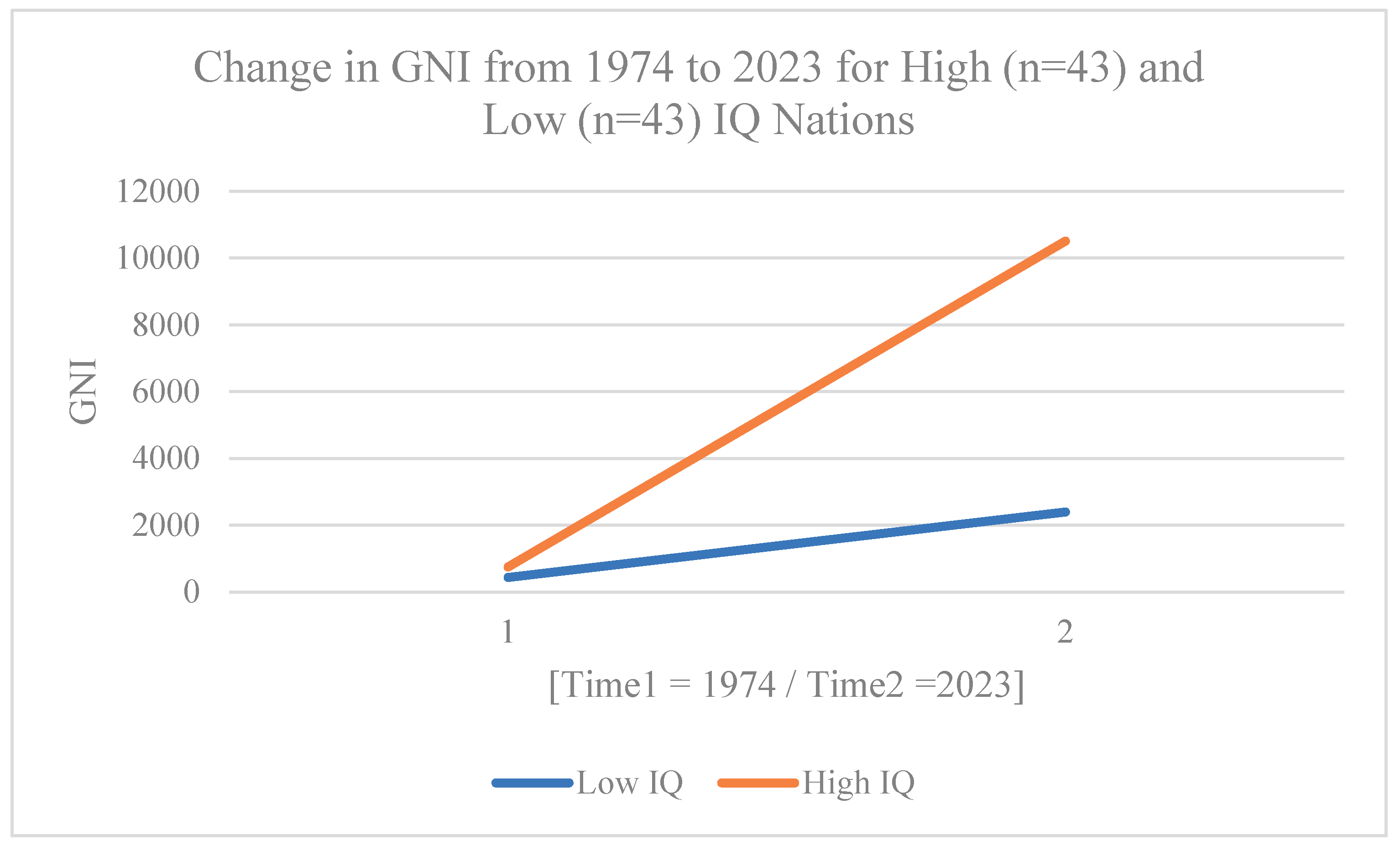

Table 1.
IQ statistics of all nations in the sample and for the High and Low IQ group of nations.
| Variable | n | Mean IQ | SD | Min. | Max. |
|---|---|---|---|---|---|
| Combined Group | 86 | 77.88 | 9.29 | 62 | 106 |
| High IQ Group | 43 | 85.35 | 6.21 | 79 | 106 |
| Low IQ Group | 43 | 70.42 | 4.68 | 62 | 78 |
Table 2.
Means and Standard Deviations (SDs) of the high and low IQ groups in 1974 and 2023.
| Group | n | 1974 Mean GNI | SD | 2023 Mean GNI | SD |
|---|---|---|---|---|---|
| Combined | 86 | 594 | 428.60 | 6,451 | 7,182.20 |
| High IQ | 43 | 749 | 401.80 | 10,521 | 8,082.50 |
| Low IQ | 43 | 437 | 399.90 | 2,391 | 2,307.50 |
Table 3.
t-test of Mean Change in GNI From 1974 to 2023 for Low and High IQ Groups.
| IQ Group | n | Mean Change | t | p |
|---|---|---|---|---|
| Low | 43 | 1954.2 | 6.30 | <.0001 |
| High | 43 | 9760.9 |
Table 4.
t-test of Average IQ for High and Low GNI Change Groups From 1974 to 2023.
| GNI Change | n | Mean IQ | t | p |
|---|---|---|---|---|
| Low Group | 43 | 71.65 | 8.38 | <.0001 |
| High Group | 43 | 84.12 |
Disclaimer/Publisher’s Note: The statements, opinions and data contained in all publications are solely those of the individual author(s) and contributor(s) and not of MDPI and/or the editor(s). MDPI and/or the editor(s) disclaim responsibility for any injury to people or property resulting from any ideas, methods, instructions or products referred to in the content. |
© 2026 by the authors. Licensee MDPI, Basel, Switzerland. This article is an open access article distributed under the terms and conditions of the Creative Commons Attribution (CC BY) license (http://creativecommons.org/licenses/by/4.0/).
Copyright: This open access article is published under a Creative Commons CC BY 4.0 license, which permit the free download, distribution, and reuse, provided that the author and preprint are cited in any reuse.


