

Submitted:
22 January 2026
Posted:
22 January 2026
You are already at the latest version
Abstract
Extreme solar eruptions convert stored magnetic energy at the solar surface and in the 2 solar atmosphere into fast electromagnetic transients, particle acceleration, and coronal 3 mass ejections (CMEs) capable of coupling into planetary magnetospheres. Using the 4 1859 Carrington Event as a historically documented benchmark, this article traces the 5 energy pathway from magnetic breakdown and reconnection in a high-conductivity plasma 6 environment, through CME propagation in interplanetary space, to interaction with Earth’s 7 magnetic field and the generation of large-scale geomagnetically induced electric fields. 8 These fields drive quasi-DC currents in long conductors, including power-transmission 9 lines and communication wiring, where voltage stress, insulation failure, arcing, and 10 fire hazards can arise. The analysis integrates established space-weather and power- 11 engineering literature with an electromagnetic compatibility (EMC) framework to clarify 12 how conductor geometry, grounding topology, and network scale govern vulnerability, and 13 why modern protections mitigate but do not eliminate risk. Within Photony Theory, solar 14 eruptions are interpreted as magnetic-chain breakdown events in a conductive plasma, 15 while terrestrial damage is framed as electric-chain (voltage) breakdown favored in low- 16 conductivity materials, providing a unified physical interpretation of the magnetic origins 17 and electrical failure mechanisms underlying both historical and modern Carrington-class 18 events.
Keywords:
solar flares
; coronal mass ejections
; Carrington Event
; space weather
; geomagnetically induced currents
; electromagnetic compatibility
; power grid resilience
; voltage breakdown
; electrical fires
; Photony Theory
1. Introduction
Solar eruptive phenomena represent one of the most direct pathways by which astrophysical energy release can couple into technological systems on Earth. Solar flares and coronal mass ejections (CMEs) originate from the rapid conversion of magnetic energy stored in the solar photosphere and corona into electromagnetic radiation, energetic particles, and large-scale plasma outflows. While the solar drivers of such events have been studied extensively within heliophysics, their downstream impacts on terrestrial infrastructure remain an active and increasingly urgent area of research, particularly as modern society relies on expansive, interconnected electrical and communication networks that are intrinsically susceptible to low-frequency electromagnetic disturbances.
The historical benchmark for extreme space-weather impact is the Carrington Event of September 1859, during which intense auroral activity was observed at low latitudes and telegraph systems across Europe and North America experienced uncontrolled currents, sparking, equipment damage, and documented fires. Subsequent analyses have established that these effects were not caused by direct particle bombardment, but by large-scale, time-varying geomagnetic fields that induced substantial electric fields at Earth’s surface, driving currents through long conductive paths. This mechanism, now formalized as geomagnetically induced currents (GICs), has since been implicated in transformer damage, grid instability, and communication outages during more recent but less extreme geomagnetic storms.
Significant advances have been made since the nineteenth century in both space-weather monitoring and electromagnetic compatibility (EMC) engineering. Modern power grids incorporate protective relays, improved grounding practices, transformer design refinements, and selective mitigation strategies intended to limit the impact of quasi-direct currents. Communication systems employ shielding, filtering, and topology optimization to reduce susceptibility to external electromagnetic fields. Nevertheless, these measures are fundamentally mitigative rather than eliminative. The underlying coupling mechanism—conversion of large-scale magnetic disturbances into electric fields along extended conductors—remains unavoidable when system dimensions approach or exceed the characteristic spatial scales of geomagnetic variation. Consequently, Carrington-class events continue to represent a credible hazard, with contemporary systems potentially exposed to different, but not necessarily lesser, modes of failure, including voltage breakdown; insulation puncture or arcing, and fire ignition.
From a physical perspective, a persistent challenge in this domain is the conceptual separation often imposed between magnetic energy release at the Sun and electric-field-driven damage on Earth. Solar flares and CMEs are typically framed as magnetic reconnection phenomena occurring in a highly conductive plasma, whereas terrestrial impacts are analyzed almost exclusively using circuit-level or continuum electromagnetic models. This division obscures the continuity of the energy pathway and complicates attempts to form a unified interpretation of causality extending from solar magnetic structures to electrical breakdown in engineered systems.
In this work, the energy chain is traced explicitly from magnetic breakdown and reconnection at the solar surface and atmosphere, through CME propagation and magnetospheric interaction, to ground-level electric-field induction and voltage stress in wired infrastructure. The analysis integrates established heliophysical and power-engineering literature with an electromagnetic compatibility framework to clarify why certain conductor geometries, grounding schemes, and network scales are inherently vulnerable. In parallel, Photony Theory is introduced as a complementary interpretive framework in which solar eruptions are understood as magnetic-chain breakdown events in high-conductivity environments, while terrestrial failures are understood as electric-chain (voltage) breakdown favored in low-conductivity materials. This dual description provides a coherent physical bridge between magnetic origins and electric consequences, offering insight into both the fires observed during the Carrington Event and the conditions under which similar failures could occur in modern wired systems.
Finally, the reader is advised that several interpretive elements used throughout this work draw upon the Photony framework developed by Martin (2025, 2026). Although all physical conclusions presented here remain grounded in standard electromagnetic theory and observational space-weather science, the Photony references provide the underlying conceptual definitions and terminology, particularly regarding magnetic-chain and electric-chain behavior, that support the unified narrative developed in this paper. Readers seeking a deeper understanding of these interpretive constructs are therefore encouraged to consult the cited Martin work alongside the present analysis.
1.1. Relationship of Photony Theory to Maxwellian Electrodynamics
Photony Theory is not proposed as a replacement for Maxwell’s equations, nor does it modify their mathematical form within the regimes considered in this work. Instead, it functions as a physical reinterpretation and microstructural extension of classical electromagnetic theory, providing an explicit energy-bearing ontology for magnetic and electric fields while remaining fully consistent with Maxwellian electrodynamics at observable scales.
In the context of this study, Maxwell’s equations are assumed to remain valid descriptions of electromagnetic field behavior in both solar and terrestrial environments. Photony Theory does not alter the field equations, boundary conditions, or constitutive relations employed in conventional magnetohydrodynamics (MHD). Rather, it supplies a physical interpretation of magnetic and electric fields as structured energy-carrying chains, offering a mechanistic picture of energy storage, transport, and release that is implicit but not specified in classical formulations.
Accordingly, the predictions of Photony Theory for the phenomena discussed here; solar magnetic breakdown, coronal mass ejection formation, geomagnetic coupling, geomagnetically induced currents, and voltage breakdown in terrestrial systems are intentionally identical to those obtained using conventional MHD and electromagnetic induction theory. In this work, no deviation from established observational outcomes is asserted. The distinction lies in interpretation rather than prediction: Photony Theory provides a unified physical narrative linking magnetic energy release in high-conductivity plasma to electric breakdown in low-conductivity engineered systems, without introducing new free parameters or altering measurable quantities.
This interpretive role is particularly relevant for clarifying the asymmetry between magnetic-dominated energy release at the Sun and electric-dominated failure mechanisms on Earth. In highly conductive plasma environments, Maxwellian electrodynamics predicts suppressed electric-field buildup and magnetic-energy-dominated release, while in terrestrial materials the same governing equations permit large electric potentials, arcing, and ignition. Photony Theory reframes this well-known behavior in terms of magnetic-chain versus electric-chain breakdown, without changing the underlying physics or its predictions.
Thus, within the scope of the present paper, Photony Theory should be understood as a complementary physical interpretation layered atop standard electromagnetic and MHD theory, not as a competing mathematical framework. All empirical conclusions and hazard assessments presented here remain grounded in established electrodynamics and space-weather science.
2. Energy-Transfer Pathways from Solar Magnetic Breakdown to Terrestrial Fires
The sequence illustrated in Figure 1 traces the physical pathway by which the magnetic energy released at the Sun can ultimately manifest itself as voltage breakdown and fire ignition in terrestrial wired systems. Each stage represents a distinct physical regime governed by different conductivity, spatial scale, and characteristic timescale.
Magnetic energy accumulation occurs over timescales of hours to days within stressed solar magnetic structures rooted in the photosphere and extending into the corona. When local magnetic stress exceeds stability limits, rapid magnetic breakdown and reconnection occur, releasing energy on timescales of seconds to minutes in the form of electromagnetic radiation, accelerated particles, and bulk plasma motion (Carrington, 1859; Tsurutani et al., 2003). Within Photony Theory, this stage corresponds to magnetic-chain breakdown in a highly conductive plasma environment.
Note: Magnetic fields generated on Earth do not directly initiate fires; however, time-varying geomagnetic fields can induce large-scale electric fields and currents in conductors, leading to voltage breakdown, arcing, resistive heating, and ignition in susceptible materials.
2.1. Magnetic-Chain Breakdown in a Highly Conductive Solar Plasma
Within Photony Theory, the initial stage of extreme solar eruptive events corresponds to magnetic-chain breakdown occurring within a highly conductive plasma environment. In this framework, magnetic fields are interpreted as physically real, energy-bearing chains composed of electromagnetically bound photonic constituents, rather than as purely abstract field lines. These magnetic chains store energy through curvature, tension, and compressive crowding within solar magnetic structures rooted in the photosphere and extending into the corona (Martin, 2025; Martin, 2026).
In the solar atmosphere, plasma conductivity is sufficiently high that magnetic structures remain effectively frozen into the plasma over macroscopic timescales. Convective motion, differential rotation, and flux emergence progressively distort magnetic configurations, increasing chain density and curvature without immediate dissipation. Energy accumulation therefore proceeds quasi-statically over hours to days, consistent with both classical magnetohydrodynamic descriptions and the Photony interpretation of increasing magnetic-chain compression within confined topologies (Priest & Forbes, 2000; Martin, 2025).
Magnetic-chain breakdown is initiated when local stress exceeds the structural stability limit of the chain network that secures the solar flux tube or rope fibrils’ contained plasma in place. Rather than gradual resistive diffusion, the transition is abrupt, producing rapid magnetic field line (chain) breaks and reconfigurations and large-scale energy release as literally chain reactions. This behavior is consistent with the impulsive nature of solar flares, including white-light emission and sudden radiative output on timescales of seconds to minutes, as first documented during the 1859 event by Carrington and Hodgson (Carrington, 1859; Hodgson, 1860).
Within Photony Theory, this transition is interpreted as a mechanical failure of the magnetic-chain lattice, analogous to fracture or buckling in a stressed material, occurring in a medium where electrical conductivity suppresses large-scale charge separation.
A defining feature of this regime is the dominance of magnetic energy release over electric-field-driven breakdown and energy from the plasma-containingfibrils. In a highly conductive plasma, any incipient charge separation is rapidly neutralized, preventing the buildup of strong localized electric potentials. As a result, the breakdown manifests primarily as magnetic energy conversion into electromagnetic radiation, bulk plasma acceleration, and the initiation of coronal mass ejections, rather than as dielectric failure or electrical arcing. This distinction is central to the Photony framework, as it explains why extreme solar eruptions release enormous energy without producing electrical breakdown phenomena analogous to those observed in terrestrial systems (Martin, 2026).
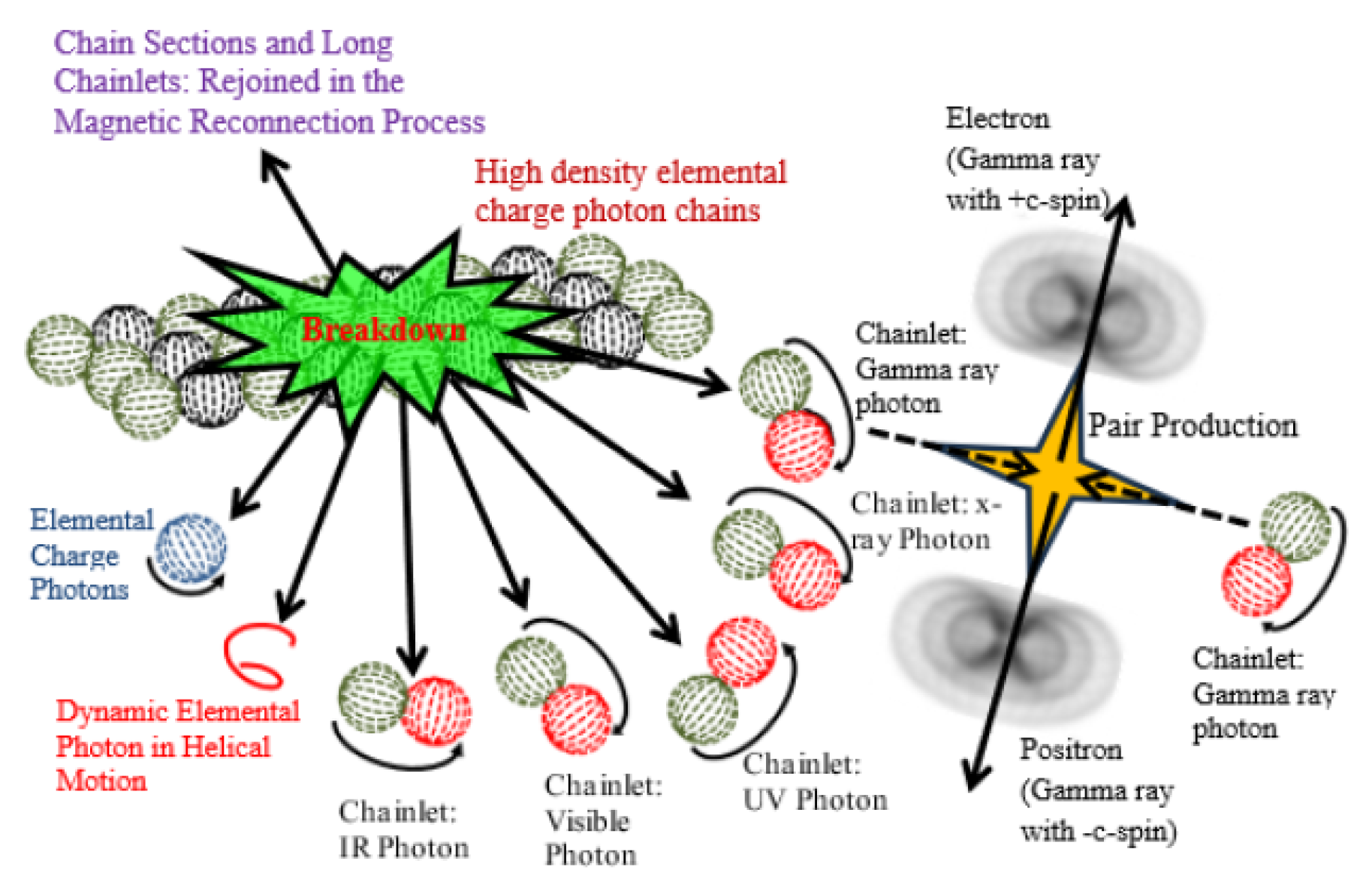
Magnetic Breakdown (see Figure 2) occurs when one or more chain loops catastrophically lose integrity due to excessive:
- curvature tension,
- compression from converging flux,
- dynamic overfeeding of elemental charge photons, or
- rapid depletion of solar flux tube internal free electrons that supply the chains.
When a chain fails, it releases its stored dynamic energy as radio/microwaves and classical photons. The dominant frequencies are in the microwave and infrared regimes, matching observed flare spectra.
Microscopically:
which determines the photon emission spectrum during breakdown.
Magnetic Breakdown is therefore not a topological event, but an energetic collapse of chain structure.
2.2. Quantitative Correspondence Between the Photony Framework and Observational Measures
The Photony framework employed in this study is intended to provide a physically intuitive mapping onto established electromagnetic and magnetohydrodynamic (MHD) quantities, rather than to introduce independent predictive variables. Accordingly, all quantitative connections discussed below are defined through correspondence relations to standard observables, ensuring consistency with existing measurements and models.
Magnetic-chain density and magnetic field strength.
Within Photony Theory, magnetic energy storage is described in terms of magnetic-chain density and compression. Quantitatively, this construct corresponds directly to magnetic field strength as expressed in conventional electrodynamics. Regions of high magnetic-chain density map to regions of high magnetic energy density,
where B is the magnetic field magnitude and is the permeability of free space. No additional degrees of freedom are introduced: magnetic-chain density is a reinterpretation of the same energy content already quantified by . Observationally inferred magnetic field strengths in active regions therefore serve as direct proxies for chain density within the Photony interpretation.
Breakdown threshold and reconnection onset.
Magnetic-chain breakdown is defined as the point at which accumulated magnetic stress exceeds the stability of the local magnetic configuration. Quantitatively, this threshold corresponds to the onset conditions for rapid magnetic reconnection in standard MHD, typically characterized by strong current-sheet formation, enhanced magnetic shear, and the development of small spatial scales where ideal constraints fail. Observational markers of this transition include abrupt increases in reconnection rate, impulsive flare onset, and rapid topological restructuring of coronal magnetic fields. Photony Theory does not prescribe a separate numerical threshold; instead, it identifies reconnection onset as the macroscopic manifestation of chain instability already captured in conventional models.
Energy release rates and flare/CME energetics.
Energy release during magnetic-chain breakdown corresponds quantitatively to the rate at which magnetic energy is converted into kinetic, thermal, and radiative forms during flares and coronal mass ejections. In standard terms, this rate is constrained by the available magnetic free energy and the reconnection rate inferred from observations, yielding total released energies of order – J for major flares and CMEs. Photony Theory does not alter these values; rather, it interprets them as the macroscopic consequence of rapid chain reconfiguration in a highly conductive plasma. Observed flare radiative outputs, CME kinetic energies, and associated timing therefore remain the quantitative benchmarks for energy release within both frameworks.
Taken together, these correspondences demonstrate that Photony Theory maintains quantitative equivalence with established electromagnetic and MHD descriptions for the phenomena addressed in this work. Its contribution lies in providing a unified physical interpretation linking magnetic energy storage, instability, and release across plasma and terrestrial regimes, without modifying the numerical predictions or observational constraints derived from conventional theory.
2.3. Conditions Governing CME and Flare Association
Observations over multiple solar cycles demonstrate that magnetic breakdown and reconnection do not produce a single, universal outcome. Instead, the manifestation of an eruptive event as a coronal mass ejection (CME), a flare, or a coupled CME–flare system depends on the magnetic topology, energy partitioning, and degree of magnetic confinement present at the time of breakdown (Priest & Forbes, 2000; Chen, 2011).
Statistical studies indicate that the largest eruptive events frequently involve both a flare and a CME, reflecting a scenario in which magnetic breakdown simultaneously releases energy radiatively and ejects magnetically structured plasma into interplanetary space (Yashiro et al., 2005; Schrijver, 2009). In such cases, stressed magnetic arcades or flux ropes undergo rapid reconfiguration, with part of the stored magnetic energy converted into particle acceleration and electromagnetic radiation (the flare), while another part drives the mechanical expansion and escape of plasma (the CME).
However, a substantial fraction of CMEs are observed to occur with weak or absent flare signatures. These "stealth CMEs" or "flareless CMEs" are typically associated with gradual magnetic restructuring in the corona, weakly sheared magnetic fields, or large-scale flux-rope destabilization occurring high in the corona, where plasma density and radiative efficiency are low (Robbrecht et al., 2009; Ma et al., 2010). In such events, magnetic breakdown leads primarily to the loss of magnetic confinement and outward expansion, with minimal energy deposited into localized particle acceleration or chromospheric heating.
Conversely, many flares, particularly compact or confined flares, occur without accompanying CMEs. These events are associated with strong overlying magnetic fields that prevent large-scale plasma escape, even though magnetic breakdown and reconnection proceed efficiently at smaller spatial scales (Wang & Zhang, 2007; Thalmann et al., 2015). Energy release in these cases remains magnetically and thermally confined, producing intense radiation and particle acceleration without significant mass ejection.
From a physical perspective, these observational classes can be distinguished by the balance between magnetic-chain stress, confinement, and available escape pathways. When magnetic breakdown occurs in configurations with weak overlying field strength or open magnetic topology, chain reconfiguration favors bulk expansion and CME formation. When breakdown occurs beneath strong overlying fields, energy release remains localized and flare-dominated. Intermediate cases naturally produce coupled CME–flare events.
Within Photony Theory, these distinctions correspond to different modes of magnetic-chain failure. CME-dominated events reflect large-scale chain detachment and reorganization, in which magnetic-chain integrity is lost over extended volumes, permitting outward transport of magnetically bound plasma. Flare-dominated events correspond to localized chain fragmentation and rapid re-indexing, producing intense electromagnetic emission without macroscopic chain escape. Thus, the presence or absence of a CME following magnetic breakdown is governed not by whether the breakdown occurs, but by how and where the magnetic-chain network fails within the solar atmosphere (Martin, 2025; Martin, 2026).
The magnetic-dominant nature of this initial release establishes the boundary conditions for subsequent energy transport. The resulting coronal mass ejection carries plasma and embedded magnetic structure outward with relatively little dissipation, preserving the energy liberated during magnetic-chain breakdown. Only after this energy enters environments of lower effective conductivity, such as the Earth’s magnetosphere, lithosphere, and engineered wiring, does the same energy pathway favor electric-field amplification, voltage breakdown, and fire ignition. Magnetic-chain breakdown at the Sun therefore constitutes the first and causally necessary step in the magnetic-to-electric energy conversion sequence traced throughout this work.
Coronal mass ejections produced during such events propagate through interplanetary space embedded within the solar wind. Typical CME transit times range from approximately one to four days; however, reconstructions of the Carrington Event indicate an unusually rapid transit of roughly 17–18 hours, implying exceptionally high CME velocity and magnetic intensity (Cliver & Dietrich, 2013). During this interval, magnetic energy is transported largely without dissipation.
Upon arrival at Earth, CME magnetic fields interact with the terrestrial magnetosphere. Strong southward components facilitate efficient magnetic coupling, driving large magnetospheric and ionospheric current systems. This coupling unfolds over minutes to hours and produces rapid temporal variations in the Earth’s magnetic field, constituting the geomagnetic storm phase (Boteler et al., 1998; Pulkkinen, 2007).
Time-varying geomagnetic fields induce large-scale electric fields on the Earth’s surface through electromagnetic induction. These geoelectric fields persist for durations ranging from tens of minutes to several hours, depending on the evolution of the storm and the ionospheric conductivity. When integrated along long conductors, such fields generate geomagnetically induced currents (GICs) that flow quasi-directly through transmission lines, communication cables, and grounded infrastructure (Pirjola, 2002).
The final stage occurs within engineered systems. GICs produce voltage offsets, resistive heating, and sustained arcing at impedance discontinuities, grounding points, and exposed contacts. Unlike high-frequency surges, these currents persist long enough to raise temperatures to ignition thresholds, leading to insulation failure, material degradation, and fire initiation. Within the Photony framework, this regime represents electric-chain (voltage) breakdown in comparatively low-conductivity terrestrial materials, completing the magnetic-to-electric energy conversion sequence observed during the Carrington Event and posing ongoing risk to modern infrastructure (Boteler, 2006; Kappenman, 2010).
2.4. Pedagogical Role of the Magnetic-Chain Versus Electric-Chain Distinction
The distinction between magnetic-chain and electric-chain behavior within the Photony framework is introduced primarily for pedagogical clarity rather than to assert new physical predictions. Its purpose is to provide an intuitive conceptual bridge between well-established electromagnetic behavior in highly conductive plasma environments and voltage-driven failure mechanisms in low-conductivity terrestrial systems.
In standard electromagnetic theory, the same Maxwell equations govern both solar and terrestrial phenomena, yet students and practitioners often struggle to reconcile why extreme solar events manifest as magnetic reconfiguration and plasma motion, whereas their terrestrial consequences appear as voltage breakdown, arcing, and fire. The magnetic-chain versus electric-chain terminology highlights this asymmetry by emphasizing how environmental conductivity determines which field component dominates observable behavior. In highly conductive plasma, charge separation is rapidly neutralized, suppressing large electric fields and favoring magnetic-energy storage and release. In contrast, in terrestrial materials and engineered systems with finite conductivity and discrete insulation, electric fields can accumulate to breakdown thresholds, producing localized failure.
This distinction aligns directly with standard electromagnetic reasoning, but makes the transition between regimes explicit. Magnetic-chain behavior corresponds to familiar MHD concepts such as frozen-in fields, magnetic tension, and reconnection-driven energy release. Electric-chain behavior corresponds to voltage buildup, dielectric stress, arcing, and thermal ignition governed by conventional circuit and EMC principles. By naming these regimes distinctly, the framework helps readers track how the same energy pathway changes character as it moves from plasma-dominated to material-dominated environments.
Pedagogically, this framework assists in linking space-weather physics to practical engineering consequences. It clarifies why geomagnetic storms do not cause electrical arcing in the solar atmosphere, yet can produce fires in terrestrial infrastructure, without invoking separate or ad hoc physical mechanisms. The magnetic-chain versus electric-chain distinction therefore functions as a teaching tool that integrates heliophysics, electromagnetism, and EMC into a single coherent narrative while remaining fully consistent with established theory and observations.
3. Research Methods and Data
This study employs a synthesis-based research methodology that integrates historical observations, contemporary space-weather datasets, and established analytical frameworks from heliophysics, geomagnetism, power engineering, and electromagnetic compatibility (EMC). Rather than introducing new experimental measurements, the objective is to trace the physical energy pathway from solar magnetic energy release to terrestrial electric-field induction and voltage breakdown in wired systems. The emphasis is placed on historically extreme events and current solar-cycle conditions as empirical anchors for evaluating infrastructure vulnerability.
3.1. Historical Data: The Carrington Event
The geomagnetic storm of September 1859, widely known as the Carrington Event, serves as the primary historical reference for extreme space-weather impact. Contemporary records include solar observations by Carrington and Hodgson, widespread low-latitude auroral reports, magnetometer traces, and extensive documentation of telegraph-system malfunctions, including uncontrolled currents, arcing, operator shocks, and fires (Carrington, 1859; Hodgson, 1860; Boteler, 2006). These telegraph records provide early evidence that large-scale geomagnetic disturbances can induce substantial electric fields along long conductors, even in the absence of modern electrical infrastructure.
Although instrumental coverage in 1859 was limited, modern reconstructions of the Carrington Event have employed proxy methods based on surviving magnetogram data, inferred solar wind parameters, and auroral extent (Cliver & Dietrich, 2013; Tsurutani et al., 2003). These studies indicate geomagnetic field variations significantly exceeding those observed during major twentieth- and twenty-first-century storms. In the present work, telegraph failures during the Carrington Event are treated as early manifestations of voltage breakdown and arcing driven by geomagnetically induced currents, providing a baseline against which modern electrical and communication systems can be assessed.
3.2. Documented Fire-Related Effects During the Carrington Event
Direct nineteenth-century records from the Carrington Event do not contain systematic fire incident statistics in the modern engineering sense. Nevertheless, multiple independent contemporaneous accounts provide convergent qualitative evidence of ignition, sustained arcing, and fire hazards associated with telegraph infrastructure during the storm. These reports originate from telegraph operators, observatory personnel, newspaper articles, and later technical syntheses of historical documentation (Carrington, 1859; Hodgson, 1860; Boteler, 2006).
Primary accounts consistently describe telegraph systems that exhibit electrical behavior driven externally during the geomagnetic disturbance. Operators reported strong currents flowing through circuits even after chemical batteries were disconnected, demonstrating that the energy source was geomagnetically induced rather than internally supplied. These currents produced persistent arcing at the equipment interfaces and sustained heating of the conductive and insulating components within the telegraph stations.
Several documented effects recur across independent reports and geographic regions, including:
- sustained sparking and arcing at telegraph keys and relay contacts;
- overheating of relay coils, contact points, and associated wiring;
- ignition or smoldering of nearby combustible materials, including paper tape, wooden desks, and insulation;
- operational conditions that require emergency disconnect or abandonment of telegraph equipment due to fire risk.
Newspaper reports and telegraph company correspondence describe stations where fires either ignited or were narrowly prevented through rapid intervention, particularly in North America and Europe (Cliver & Dietrich, 2013). Although some secondary sources loosely refer to "fires along telegraph lines," a closer examination indicates that ignition events were concentrated at telegraph offices, relay stations, and line terminations, where induced voltages and currents were most strongly concentrated.
Later technical analyses reinterpret these observations using modern electromagnetic theory and geomagnetic storm modeling. Boteler et al. (1998) and Boteler (2006) showed that geomagnetically induced currents during extreme storms can reach several amperes in long conductors, producing voltage differences sufficient to sustain arcing across open contacts and cause prolonged resistive heating. Such quasi-direct currents differ fundamentally from transient lightning-induced surges, as their persistence allows temperatures to rise to ignition thresholds rather than dissipating rapidly.
The spatial distribution of reported fires is consistent with the contemporary understanding of electromagnetic coupling. Long telegraph lines, often extending hundreds to thousands of kilometers, acted as effective collectors of low-frequency geomagnetic disturbances, while grounding points and impedance discontinuities at stations concentrated electric potential differences (Pirjola, 2002). This mechanism explains why unsupported overhead wire rarely ignited spontaneously, while station-based equipment and terminations exhibited the highest fire risk.
Although no quantitative fire counts or temperature measurements survive from 1859, the consistency of independent reports, their geographic simultaneity, and their agreement with established electromagnetic principles provide strong qualitative evidence that the Carrington Event produced voltage breakdown, sustained arcing, and fire ignition in telegraph infrastructure. These observations form a critical empirical foundation for assessing analogous fire risks in modern power and communication systems exposed to extreme geomagnetic disturbances.
3.3. Contemporary Space-Weather Data and the Current Solar Cycle
To contextualize historical extremes within modern operating conditions, data from the current solar cycle are incorporated, including observations of solar flares, coronal mass ejections (CMEs), and geomagnetic storm indices. Contemporary datasets include satellite-based solar imaging and in situ solar-wind measurements, as well as ground-based magnetometer networks that quantify geomagnetic disturbances through indices such as Dst and Kp (Pulkkinen, 2007; Schrijver et al., 2014).
Recent geomagnetic storms, while generally less intense than reconstructed Carrington-class events, have demonstrated that significant geomagnetically induced currents can still arise under present-day solar-cycle conditions. Documented impacts include transformer saturation and heating, relay failure, communication disruptions, and increased stress on grounded infrastructure (Kappenman, 2010; North American Electric Reliability Corporation, 2012). These observations confirm that the fundamental coupling mechanisms identified in nineteenth-century events remain active and relevant, despite advances in system design and protection.
3.4. Documented Observational Data from the Carrington Event (1859)
The geomagnetic storm of September 1859, widely known as the Carrington Event, represents the most extreme space-weather event documented in the instrumental era and serves as the primary historical reference for solar–terrestrial coupling. Multiple independent data sources from this period provide consistent evidence of large-scale magnetic and electric disturbances affecting both the near-Earth environment and terrestrial technological systems.
Solar observations.
On September 1, 1859, a sudden and intense white-light solar flare was independently observed by Richard C. Carrington and Richard Hodgson. Carrington reported a rapid localized brightening within a sunspot group, with an onset and decay occurring on the timescale of minutes, indicating an abrupt release of stored magnetic energy rather than gradual solar variability (Carrington, 1859; Hodgson, 1860). Approximately 17–18 hours later, severe geomagnetic disturbances were observed on Earth, implying an unusually rapid solar–terrestrial transit consistent with an extreme coronal mass ejection.
Auroral observations.
Auroral emissions associated with the Carrington Event were reported at exceptionally low geomagnetic latitudes, including the Caribbean, Hawaii, Central America, and southern Europe. Contemporary accounts describe auroral brightness sufficient to illuminate landscapes and permit reading at night, indicating intense ionospheric excitation and strong magnetospheric current systems (Cliver & Dietrich, 2013). The geographic extent and intensity of these auroras imply a global-scale disturbance of Earth’s magnetic field far exceeding typical geomagnetic storms.
Magnetometer data.
Magnetometers operating at observatories such as Kew Observatory recorded abrupt, large-amplitude deflections during the event, with some instruments driven off scale and unable to record peak variations. Surviving magnetograms show rapid changes in the horizontal component of the geomagnetic field, consistent with the passage of strong ionospheric and magnetospheric current systems (Tsurutani et al., 2003). These magnetic-field variations correspond to the induction of large-scale electric fields at Earth’s surface.
Telegraph-system effects.
Telegraph networks across North America and Europe experienced widespread operational failures during the storm. Reported effects included
- Uncontrolled currents flowing even when power supplies were disconnected;
- Sparking and arcing at telegraph keys and relay contacts;
- Electric shocks to operators;
- Documented fires at telegraph stations and along transmission lines (Boteler, 2006).
In several cases, telegraph systems continued to operate solely on geomagnetically induced current, demonstrating that the induced voltages were comparable to or exceeded normal operating voltages. Line lengths spanning hundreds to thousands of kilometers acted as effective collectors for low-frequency geomagnetic disturbances, maximizing induced electric potential differences.
Physical implications.
Together, these observations demonstrate that the Carrington Event generated large-scale quasi-static electric fields on the Earth surface capable of driving substantial currents through long conductors, substantially separated from their associated return paths (ground).
The data provide early empirical evidence that extreme geomagnetic disturbances can bypass conventional electrical isolation and directly produce voltage breakdown, arcing, and fire ignition, even in relatively simple wired systems lacking modern power electronics or high-voltage infrastructure.
3.5. Analytical Framework and EMC Perspective
The analytical framework adopted in this study traces energy conversion across domains rather than treating solar, magnetospheric, and terrestrial processes as isolated phenomena. Magnetic energy release at the Sun is examined as the initiating source, CME propagation as the transport mechanism, magnetosphere–ionosphere coupling as the magnetic-to-electric field conversion stage, and interaction with long conductors as the final pathway leading to voltage stress and breakdown at ground level (Boteler et al., 1998; Pirjola, 2002).
An EMC perspective is used to evaluate how conductor length, orientation, grounding topology, and network interconnectivity govern susceptibility to induced electric fields. Protective measures such as series capacitance, grounding optimization, shielding, and network segmentation are treated as mitigating layers rather than absolute safeguards (Paul, 2006). Within this framework, Photony Theory is employed as an interpretive model that distinguishes magnetic-chain breakdown in high-conductivity plasma environments from electric-chain (voltage) breakdown in low-conductivity terrestrial materials, providing a unified physical interpretation of both historical Carrington-era fires and potential failure modes in modern wired systems.
3.6. Electromagnetic Compatibility Perspective: Loop Area, Coupling, and Mode Conversion
From an electromagnetic compatibility (EMC) perspective, susceptibility of wired systems to geomagnetically induced electric fields is governed primarily by loop area, conductor geometry, and grounding topology. In its simplest form, the induced voltage in a conductor is proportional to the time variation of the magnetic flux threading the effective loop area formed by the current path and its return. For early telegraph systems, this loop area was exceptionally large, as signal conductors often extended hundreds to thousands of kilometers with return current flowing through the Earth itself. The effective loop area could therefore be approximated by the product of line length and the average separation between the overhead wire and its ground return, maximizing magnetic flux linkage during geomagnetic disturbances (Boteler et al., 1998; Pirjola, 2002).
This large loop-area configuration made telegraph systems highly susceptible to low-frequency and quasi-static geomagnetic field variations. Induced voltages accumulated over long distances and concentrated at relay stations and terminations, where impedance discontinuities promoted arcing, heating, and ignition. In EMC terms, these systems functioned as extremely large single-turn induction loops, optimized (unintentionally)for coupling to slowly varying magnetic fields.
Modern transmission and communication systems have evolved explicitly to reduce the effective loop area and thereby suppress magnetic-field coupling. Power transmission lines employ closely spaced phase conductors, bundled configurations, and engineered grounding schemes that reduce the net loop area compared to early single-wire systems. Communication and signal lines have undergone an even more pronounced evolution, with widespread adoption of twisted pair conductors, coaxial cables, and shielded twisted pairs, all of which enforce close proximity between signal and return paths. By minimizing the enclosed loop area, these geometries substantially reduce susceptibility to externally imposed magnetic flux (Paul, 2006).
In addition to geometric control, modern systems incorporate voltage-limiting and protective elements, including surge arresters, grounding resistors, and series capacitors, to constrain voltage buildup and limit current flow during abnormal conditions. However, while these measures reduce susceptibility, they do not eliminate coupling entirely, particularly for long conductors exposed to spatially coherent geomagnetic fields acting on continental scales (Kappenman, 2010).
A further distinction of central importance in EMC analysis is that between differential-mode and common-mode signals. Differential-mode currents flow between paired conductors carrying equal and opposite currents, such that external magnetic-field coupling is minimized when conductor spacing is small. Common-mode currents, by contrast, flow simultaneously on multiple conductors with respect to a shared reference, such as ground. Geomagnetically induced currents predominantly excite common-mode behavior, as the driving electric field is imposed over large spatial scales and couples similarly to all conductors in a network (Pirjola, 2002).
Even systems designed for differential signaling are, therefore, vulnerable when common-mode excitation is converted into differential-mode voltages through asymmetry, impedance imbalance, or grounding nonuniformity. This process, known as mode conversion, can occur at connectors, transformers, bonding points, and terminations, where small geometric or electrical mismatches transform externally induced common-mode currents into localized differential stresses (Paul, 2006). Once converted, these differential voltages can exceed insulation ratings, drive unintended current paths, and initiate arcing or thermal damage.
In the context of extreme geomagnetic storms, this distinction is critical. While modern wiring practices dramatically reduce loop area and suppress differential-mode pickup, they remain exposed to common-mode excitation imposed by large-scale geoelectric fields. Mode conversion at system interfaces then provides a pathway by which magnetically induced energy can manifest itself as localized voltage breakdown and fire risk, even in systems designed according to contemporary EMC best practices. This mechanism explains why improved design mitigates, but does not eliminate, the vulnerability of modern infrastructure to Carrington-class events.
4. Conclusions
This work has traced a continuous physical energy pathway linking magnetic energy release at the Sun to voltage breakdown and fire risk in terrestrial wired systems. Beginning with magnetic breakdown and reconnection in the highly conductive solar photosphere and corona, energy is released explosively and transported outward through coronal mass ejections, preserved within embedded magnetic structure during interplanetary transit, and ultimately coupled into Earth’s magnetosphere. Time-varying geomagnetic fields generated during this interaction induce large-scale electric fields at Earth’s surface, driving geomagnetically induced currents in long conductors and creating conditions favorable for voltage breakdown, arcing, and ignition.
Historical evidence from the 1859 Carrington Event demonstrates that such mechanisms are not speculative. Contemporary records document uncontrolled currents, sustained arcing, and fires at telegraph stations connected to long lines, establishing an early empirical link between geomagnetic storms and electrically driven ignition. Although modern power and communication systems differ substantially from nineteenth-century telegraph infrastructure, the underlying coupling physics remains unchanged. Large spatial scales, long conductor lengths, and grounding asymmetries continue to permit common-mode excitation by geomagnetic disturbances, with mode conversion enabling localized differential stresses even in systems designed according to modern electromagnetic compatibility principles.
Advances in EMC engineering, particularly the reduction of loop area through closely coupled conductors, shielding, grounding optimization, and voltage-limiting devices, have significantly reduced susceptibility to geomagnetic disturbances. However, these measures act as mitigation rather than absolute protection. For extreme storms approaching Carrington-class intensity, induced electric fields may still exceed design assumptions, particularly in extended transmission networks and interconnected infrastructures.
Within Photony Theory, the sequence examined here acquires a unified physical interpretation. Solar eruptions correspond to magnetic-chain breakdown in a high-conductivity plasma environment, where electric-field buildup is suppressed and energy release remains dominantly magnetic, predominately in the incipient phase of a solar event. In contrast, terrestrial damage occurs in low-conductivity materials and engineered systems, where the same energy sourcing pathway favors electric-chain (voltage) breakdown, arcing, and thermal ignition. This magnetic–electric asymmetry provides a coherent conceptual bridge between solar eruptive physics and ground-level electrical failure, clarifying why fires can result from geomagnetic storms without requiring direct particle impact or high-frequency electromagnetic surges.
Taken together, the analysis indicates that extreme space-weather events remain a credible fire hazard for modern wired systems, despite substantial improvements in monitoring, protection, and EMC design. Understanding the full magnetic-to-electric energy conversion pathway is therefore essential not only for space-weather forecasting but also for infrastructure resilience, fire risk assessment, and the design of future mitigation strategies.
Funding
This research received no external funding.
Acknowledgments
During the preparation of this manuscript/study, the author used [ChaGPT, version 5.2 for the purposes of [directed searches and initial (later significantly revised, edited and corrected) material]. The figures were not created using AI. Grammarly was used solely for grammatical and spelling issues. The author has reviewed and edited the output and take full responsibility for the content of this publication.
Conflicts of Interest
The author declares no conflicts of interest.There are no funders in the design or production of the study.
References
- Boteler, D. H.; Pirjola, R. J.; Nevanlinna, H. The effects of geomagnetic disturbances on electrical systems at the Earth’s surface. Advances in Space Research 1998, 22(1), 17–27. [Google Scholar] [CrossRef]
- Boteler, D. H. The superstorms of August/September 1859 and their effects on the telegraph system. Advances in Space Research 2006, 38(2), 159–172. [Google Scholar] [CrossRef]
- Carrington, R. C. Description of a singular appearance seen in the Sun on September 1, 1859. Monthly Notices of the Royal Astronomical Society 1859, 20, 13–15. [Google Scholar] [CrossRef]
- Cliver, E. W.; Dietrich, W. F. The 1859 space weather event revisited: Limits of extreme activity. Journal of Space Weather and Space Climate 2013, 3, A31. [Google Scholar] [CrossRef]
- Hodgson, R. On a curious appearance seen in the Sun. Monthly Notices of the Royal Astronomical Society 1860, 20, 15–16. [Google Scholar] [CrossRef]
- Kappenman, J. G. Geomagnetic storms and their impacts on the U.S. power grid. In Metatech Corporation Report; Oak Ridge National Laboratory, 2010. [Google Scholar]
- Ma, S.; Attrill, G. D. R.; Golub, L.; Lin, J. Statistical study of coronal mass ejections with and without flares. The Astrophysical Journal 2010, 722(1), 289–301. [Google Scholar] [CrossRef]
- Martin, F. L. Photony Compendium, Volume IV: Energy Science Interpreted through the Lens of Photony, First Edition ed; 2025; ISBN 978-0-9980347-3-7. [Google Scholar]
- Martin, F. The Photony Mathematical Framework and the Foundations of Photony Theory. 2026. Available online: https://acrobat.adobe.com/id/urn:aaid:sc:us:685e58d9-f989-4d61-a409-63fe9fedd9f8. [CrossRef]
- North American Electric Reliability Corporation. 2012 Special Reliability Assessment: Effects of geomagnetic disturbances on the bulk power system; NERC: Atlanta, GA, 2012. [Google Scholar]
- Paul, C. R. Introduction to Electromagnetic Compatibility, 2nd ed.; Wiley-Interscience: Hoboken, NJ, 2006. [Google Scholar]
- Pirjola, R. Review on the calculation of surface electric and magnetic fields and geomagnetically induced currents in ground-based technological systems. Surveys in Geophysics 2002, 23, 71–90. [Google Scholar] [CrossRef]
- Priest, E. R.; Forbes, T. G. Magnetic Reconnection: MHD Theory and Applications; Cambridge University Press: Cambridge, UK, 2000. [Google Scholar]
- Pulkkinen, T. I. Space weather: Terrestrial perspective. Living Reviews in Solar Physics 2007, 4, 1. [Google Scholar] [CrossRef]
- Robbrecht, E.; Patsourakos, S.; Vourlidas, A. No trace left behind: STEREO observation of a stealth coronal mass ejection. The Astrophysical Journal 2009, 701(1), 283–291. [Google Scholar] [CrossRef]
- Schrijver, C. J.; Dobbins, R.; Murtagh, W.; Petrinec, S. M. Assessing the impact of space weather on the electric power grid based on insurance claims for industrial electrical equipment. Space Weather 2014, 12, 487–498. [Google Scholar] [CrossRef]
- Tsurutani, B. T.; Gonzalez, W. D.; Lakhina, G. S.; Alex, S. The extreme magnetic storm of 1–2 September 1859. Journal of Geophysical Research: Space Physics 2003, 108(A7), 1268. [Google Scholar] [CrossRef]
Figure 1.
Energy-transfer pathway from solar magnetic breakdown and reconnection to terrestrial voltage breakdown and fire ignition.
Figure 1.
Energy-transfer pathway from solar magnetic breakdown and reconnection to terrestrial voltage breakdown and fire ignition.
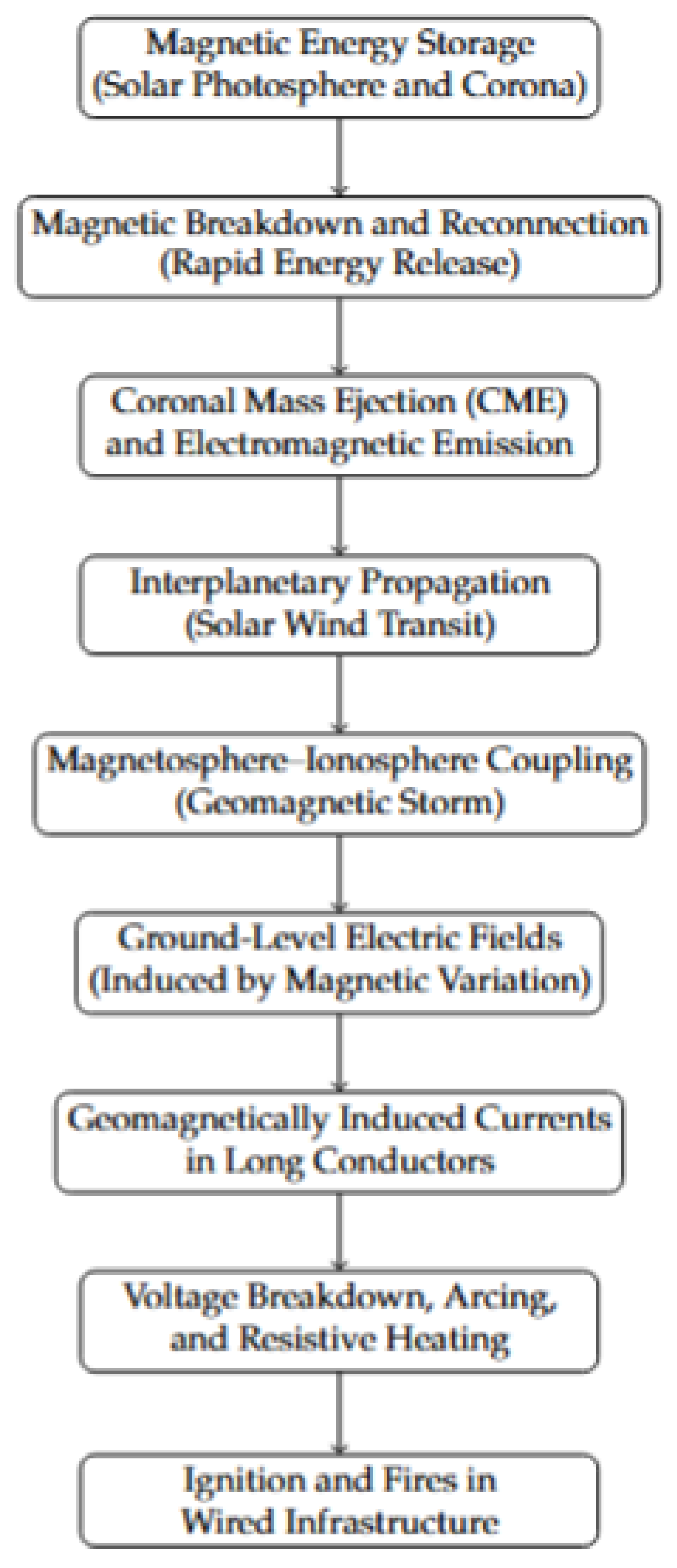
Figure 2.
Magnetic Breakdown- the Incipient Phase of a Magnetic Reconnection Event.
Disclaimer/Publisher’s Note: The statements, opinions and data contained in all publications are solely those of the individual author(s) and contributor(s) and not of MDPI and/or the editor(s). MDPI and/or the editor(s) disclaim responsibility for any injury to people or property resulting from any ideas, methods, instructions or products referred to in the content. |
© 2026 by the authors. Licensee MDPI, Basel, Switzerland. This article is an open access article distributed under the terms and conditions of the Creative Commons Attribution (CC BY) license (http://creativecommons.org/licenses/by/4.0/).
Copyright: This open access article is published under a Creative Commons CC BY 4.0 license, which permit the free download, distribution, and reuse, provided that the author and preprint are cited in any reuse.


